Episode 934: Some plans we could spoil

Last Experience

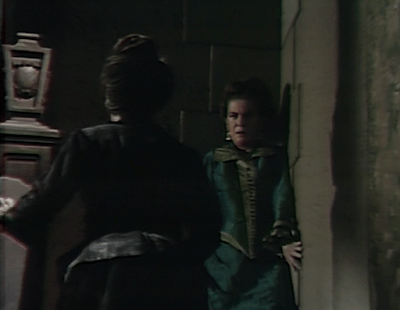
We open with a reprise of the end of yesterday’s episode. Quentin Collins and Amanda Harris are reenacting the myth of Orpheus and Eurydice. As in the ancient Greek story, they will live together if they can escape all the perils on the road from the realm of the dead to that of the living. Unlike that story, they are allowed to look at each other along the way, but they are not allowed to touch.

The teaser ends where Wednesday’s episode ended, with Amanda falling through a gap in a footbridge and Quentin crying out in anguish. After the opening title, we are surprised to find ourselves at the same scene. Amanda is not yet lost. Quentin pulls her up from the ravine she fell into. But that involves touch, so the ceiling of the cavern collapses and buries her. Suddenly, Quentin finds himself lying on the ground, in the upper world, with no sign of any way back to the place from which he just came.

Amanda’s demise marks Donna McKechnie’s final appearance on Dark Shadows. Miss McKechnie left to be in the original cast of Stephen Sondheim’s Company, paving the way for her enormous success on Broadway in the 1970s. Much later, Miss McKechnie would reprise the role of Amanda in a couple of Big Finish Productions’ Dark Shadows audio dramas, and nowadays she appears at the Dark Shadows conventions.

Any account of Donna McKechnie’s last day at 433 West 53rd Street would be incomplete without this story from Hamrick and Jamison’s book Barnabas and Company:

In rehearsal, we went through the scene with a few Styrofoam boulders and a little peat moss, no big deal. Nobody told me there was going to be ten times as much dropped during the taping. So, when it was time to tape the scene, I was looking up, and I just got buried. I got peat moss in my eyes and in my mouth and ears and nose… and I was covered in rocks. The way things worked at the studio, at the end of that scene, the lights went out, and the camera and crew and actors all moved on to the next scene, in another part of the studio. So there I was, laying under all those Styrofoam rocks and peat moss, and nobody helped me get out. I had to dig myself out, and that was my last experience on Dark Shadows.

Craig Hamrick and R. J. Jamison, BARNABAS AND COMPANY: THE CAST OF THE TV CLASSIC DARK SHADOWS (2nd edition, 2012) page 245.

They’ve been doing a bit of videotape editing recently, as several awkward cuts have made clear. One might think that the whole Underworld sequence, pre- and post-title, was edited in from tape left over from yesterday’s shoot. But Miss McKechnie’s story proves that is not so. The episodes were done in sequence, so if the last bit of tape they shot yesterday had been the crushing of Amanda there wouldn’t have been any next scene to run off to and Miss McKechnie would have had plenty of help digging herself out from under.

Some Sort of Monster was After Him

Meanwhile, the sheriff is at the home of occult expert Timothy Eliot Stokes. Stokes and his friend, mad scientist Julia Hoffman, have called him in because a monster wrecked Stokes’ bedroom, in the process killing a man named Paul Stoddard.

No law enforcement officer on Dark Shadows has yet solved a case, and Sheriff Davenport seems likely to prove the most useless member of the fraternity yet. At no point does he interrogate Stokes and Julia, or even show much interest in what they were doing while Paul was being killed. He refuses to believe Julia when she says that he should be looking for a monster, even though Collinsport has been overrun with monsters for years now and he has acknowledged that the wreckage at Stokes’ is like nothing he has ever seen. Julia tells him that the monster lives in the room at the top of the stairs in the antique shop operated by Megan and Philip Todd. In response, he flatly states that “They wouldn’t have anything to do with his death.” He finally agrees to get a search warrant for the Todds’ place, but when he presents it to Philip he says that he will execute it “unless of course, you don’t want me to?”

The meatiest part of the episode is a long scene between Megan and Philip. She is exultant that the monster has killed Paul and certain that it will go on to do other, even more wonderful things. He’s scared to death of what the monster will do to them if it is not defeated and of the retribution that will come to them if it is. She sneers at him as a coward. He admits that he is a coward, but insists that they run away and count themselves fortunate if they can escape with their lives.

In her first role on Dark Shadows, as Eve, The Fiancée of Frankenstein, Marie Wallace was called upon to show an unbending, unvarying contempt for Adam, the patchwork man she was supposed to marry. Since that was the only feeling Eve had ever shown for Adam, it wasn’t very interesting. But Megan loved Philip when we first met them. The other day, when she told the monster that she had loved Philip for a long time, we could believe her. So her scorn today does carry some force, and no one knows better how to play scorn and play it to the hilt than does Miss Wallace.

The part of Philip has not been a particularly congenial one for Christopher Bernau up to this point, but he too excels in the scene. He has lots of lines you would expect a man to find it hard to say, calling himself a coward and so on, but he speaks them smoothly and fluently. He shows his hesitancy and anguish not in his delivery of the lines, but in his facial expressions and movements while Megan is speaking. You can see him deciding to put aside all male ego and say something that might get through to Megan, no matter how humiliating it is for him to say it. With lines proclaiming his cowardice, Bernau creates the image of a remarkably brave Philip.
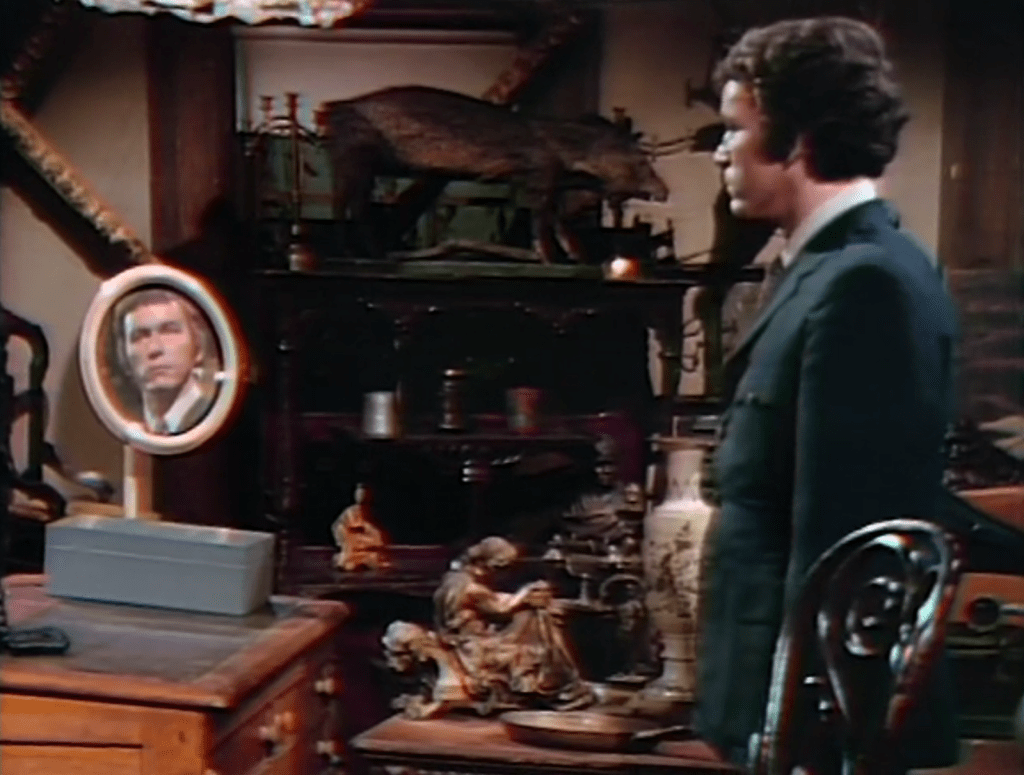
Philip divided. Screenshot by Dark Shadows Before I Die.

That in turn makes it possible for the episode to end on a suspenseful note. The closing cliffhanger has Sheriff Davenport turning the doorknob to the monster’s room, while Philip is frenziedly trying to come up with a way to talk him out of entering it. When we watched that, my wife, Mrs Acilius, said to the screen “If you don’t tell him what’s in there, it’s murder,” in a tone that suggested she thought Philip actually might tell the sheriff the truth. That such an idea could even form is a testament to Bernau’s outstanding performance in this episode.
Episode 789: We are going to create a thing

In #762, the Rev’d Mr Gregory Trask walked in on lawyer Evan Hanley and handsome rake Quentin Collins as they were performing a Satanic rite. Trask’s response was to blackmail Evan. Trask wanted his wife Minerva out of the way so that he could marry rich spinster Judith Collins, Quentin’s sister. Threatened with exposure, Evan cast a spell on an unfortunate young man named Tim Shaw. He brainwashed Tim into reenacting the plot of The Manchurian Candidate, with Trask in the Angela Lansbury role and Evan as the People’s Republic of China. As Evan and Trask planned, Tim killed Minerva. Shortly after, Trask married Judith.

On their wedding day, Judith saw Minerva’s ghost in the corner of the drawing room in the great house of Collinwood. In yesterday’s episode, Minerva’s ghost took possession of Judith, and the closing cliffhanger showed the possessed Judith about to stab Evan with a letter opener to avenge Minerva’s death. As we open today, Judith’s brother Edward enters and prevents the stabbing, and Judith is released from possession. She can remember nothing that happened while she was under Minerva’s power, and Edward is convinced that she has gone mad.

Edward takes Judith to her room, and Trask enters. Evan tells him that Minerva’s ghost has been in touch with Judith. The ghost knows what they did, and if the contact continues Judith will know as well. Trask demands that Evan do something to prevent that, and Evan says that he can cast a spell that may turn the haunting to their advantage and neutralize Judith permanently.

The plan turns out to be the creation of a “black ghost.” The only Black actor to have had a speaking part on Dark Shadows was Beverley Hope Atkinson, who played an unnamed nurse in one scene in #563, almost a year ago. Humbert Allen Astredo, who plays Evan, was also in that scene, playing suave warlock Nicholas Blair. Atkinson was terrific, and it would be great to see her again, but it turns out that the “black ghost” is not actually black. Nor is it a ghost. This misnamed entity is a simulacrum of Minerva, a kind of supernatural hologram that Evan will fabricate and that will appear when Judith is around. This will lead Judith to believe that she is insane, thereby causing her actually to become insane and to cease to be an obstacle to Trask’s enjoyment of her wealth.

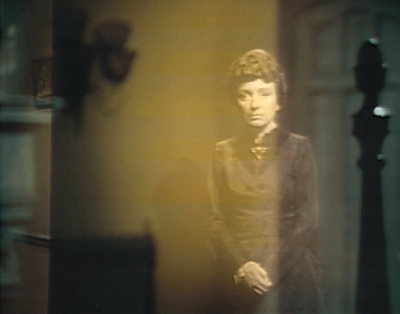
The simulacrum first shows up in a transparent form in Judith’s bedroom. Judith screams. In the drawing room, Trask and Edward hear her scream and break off a conversation in which Edward has been urging Trask to agree to annul his marriage to the obviously disturbed Judith. Judith comes downstairs. She is reluctant to explain why she screamed, and tells Edward and Trask that nothing is wrong. She and Trask go to the drawing room and talk privately. He has to prod her a bit before she will admit she saw Minerva. He tells her it was just her imagination. She considers this; after all, she was in bed when she saw the image, so it may have been a dream. But then the simulacrum appears in the drawing room, near the spot where she saw Minerva’s ghost on her wedding day. Judith sees Minerva sitting quietly and sewing. Trask pretends he does not see anything; after a bit, Judith pretends she can’t see the image either. Trask leaves Judith alone with the simulacrum. Judith goes upstairs, and the simulacrum follows her. When they reach the top of the staircase, Judith cries out in fear and tells the simulacrum to stay away from her.

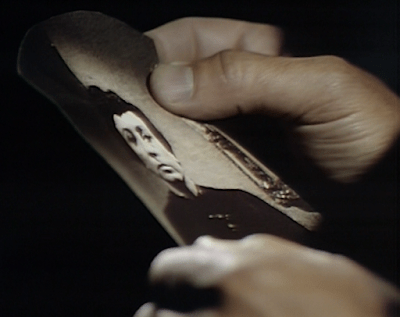
Though it is disappointing to be reminded that Beverley Hope Atkinson isn’t coming back, it is always good to see Clarice Blackburn. In her interviews with the authors of the book Barnabas and Company, Nancy Barrett said that Blackburn was the best performer in the entire cast of Dark Shadows. She doesn’t have a lot to do today- she delivers the opening voiceover, we see a snapshot of her, and as the simulacrum she stands motionless in a corner, sews placidly, then is seen from behind as she follows Judith up the stairs. But if there ever was a case to prove the old cliche that no part is small when a big enough actor plays it, Blackburn makes each of these little turns into a moment viewers will remember.

As Judith, Joan Bennett also deserves a great deal of credit for getting the gaslighting plot off to a good start. For example, there is an embarrassingly ill-written scene when Judith is in her room, pacing back and forth while some vibes play on the soundtrack. A knock comes at the door, and the music stops. Judith opens the door, and no one is there. The music resumes, and she starts pacing again. There is another knock. Again the music stops, again Judith opens the door, and again no one is there. The music resumes, and she’s back to pacing. The knock comes a third time. A third time the music stops, and a third time Judith turns to the door. This time she asks who’s there. It’s Trask. She lets him in, and he denies having knocked before. Knocking on doors and running away is a pretty crude tactic even on a show with an audience consisting largely of kids aged twelve and under, and the apparent complicity of the music in Trask’s plot is the kind of thing they ridiculed in Looney Tunes cartoons. But Bennett’s soulful performance holds our attention throughout.

This is the second time Dark Shadows has shown us an adventurer trying to gaslight his new wife so that she will go away and give him unfettered access to her fortune. The first time was in March 1968, when the show was set in 1796. Naval officer/ sleazy operator Nathan Forbes had married fluttery heiress Millicent Collins. Nathan discovered that Millicent had transferred all her assets to her little brother Daniel. Nathan then set about driving Millicent out of her mind so that he could take her place as Daniel’s legal guardian. That plot also featured some weak writing, but Joel Crothers and Nancy Barrett were so irresistible as Nathan and Millicent that it hardly mattered. Perhaps the writers wanted to revisit the gaslighting theme to show that this time they could consistently write scripts worthy of their outstanding cast.

Episode 733: From pocket to pocket

A lot of business about a magical urn that belongs to undead blonde fire witch Laura Collins. This is Laura’s second tour on Dark Shadows; she didn’t have an urn the first time around, but the plot is much busier these days and she needs a MacGuffin for her enemies to chase after if she’s going to stay afloat.

There are also a couple of moments when characters deride spinster Judith Collins as “plain Judith,” envious of the “pretty wives your brothers brought home.” This is ridiculous. Judith isn’t even Hollywood ugly; she’s played by Joan Bennett, one of the great beauties of the screen in her youth and still, in her late 50s, a remarkably attractive woman.

But all in all, the episode is quite good. The highlight is a confrontation between governess Rachel Drummond and a villain who makes her first appearance today, Minerva Trask. Minerva is the wife of the loathsome Rev’d Gregory Trask, and with him she runs a boarding school called Worthington Hall. Rachel grew up at Worthington Hall, and like all other children there she was subjected to continual abuse at the hands of the Trasks. We haven’t seen Gregory for several days; as played by Jerry Lacy, he is so overwhelmingly evil a presence that the makers of the show wisely decided to use him sparingly. It looks like Rachel will soon be forced to go back to Worthington Hall as a teacher.

Minerva is played by Clarice Blackburn, whom many consider to be the single best actor in the whole series. For example, Nancy Barrett gave her that title in her interviews with the authors of the book Barnabas and Company. Blackburn is absolutely believable as the sanctimonious Minerva, so much so that I found her scenes as difficult to watch as are those featuring Mr Lacy as Gregory. Kathryn Leigh Scott plays the terror and misery Minerva inspires in Rachel quite effectively, but to be honest I felt those emotions very intensely myself just watching the episode on TV. I suspect that when you have a scene partner like Blackburn, all you need is to learn your lines and remember your training and you’ll connect with the audience.

Rachel and Minerva. Screenshot by Dark Shadows Before I Die.

Rachel tells her troubles to broad ethnic stereotype Magda Rákóczi, who volunteers to help her escape the Trasks. Magda’s plan requires Rachel to do three extraordinary things. She must give her garnet-encrusted broach, the only keepsake her late mother gave her, to Magda to sell to raise money for a coach ride to Boston. She must spend the night in a secret room hidden in an old mausoleum. And once in Boston, she will have to find employment without having recourse to any credentials or references that would make it possible for her to find a situation agreeable to a neurotic intellectual such as herself. We could never believe Rachel would do any of these things if she were facing a less gruesome threat than return to Worthington Hall.

Longtime viewers may wonder just how far Rachel’s fears will drive her. In #9, broadcast and set in the year 1966, flighty heiress Carolyn Collins Stoddard told well-meaning governess Victoria Winters that over the years, two governesses had leapt to their deaths from the precipice atop Widow’s Hill, and that legend had it that a third governess would someday follow their lead. In other episodes, before and after, that story was rephrased as “two women” rather than “two governesses.”

So far, we have only seen one woman take the plunge, and she wasn’t a governess. She was the gracious Josette, also played by Miss Scott. Josette jumped in 1796 because she saw that she was about to be made into a vampire. Now, the dramatic date is 1897. The prospect of turning into a member of the teaching faculty of Worthington Hall is scarcely less horrifying than is the prospect of becoming a vampire, so perhaps it will turn out that Rachel was one of those whom Carolyn had in mind after all.