Permanent houseguest Julia Hoffman asked housekeeper Mrs Johnson to add more draperies to those already on the window of her room. In #361, she had asked Mrs Johnson to remove all the draperies. Evidently Julia fixates on window treatments when she isn’t feeling well.
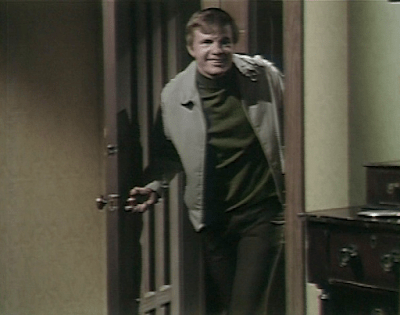
Julia’s trouble today is that she has been bitten by vampire Tom Jennings. She is trying to keep this fact from everyone, including her friend Barnabas Collins and Barnabas’ servant Willie Loomis. Since Barnabas was himself a vampire for 172 years and Willie was for many months his victim, they are particularly well-positioned to recognize the signs of vampirism, and both do know that Tom is now an undead bloodsucker. At Barnabas’ direction, Willie sneaks into Julia’s room; the gleeful look on his face as he lets himself into a lady’s bedroom suggests that the personality he had before Barnabas bit him, when he was a dangerously unstable ruffian who threatened to rape all the young women and beat up their boyfriends, is not entirely gone.
Willie was himself staying at the great house of Collinwood, perhaps in this very room, when Barnabas first bit him. After he sees Julia, he goes back to Barnabas’ house and tells him about the contrast between her condition when he found her unconscious early this morning and her current state. She was dazed and weakened then, and now seems much stronger, but is strangely hostile. This so closely matches the description of Willie’s own condition in his early days as a blood thrall that there is no need for him to mention Tom to explain why there is such an urgent note of concern in his voice.
Barnabas goes to the great house and intercepts Julia returning from a session with Tom. After some verbal preliminaries, he pulls the scarf off her neck and exposes the vampire’s bite marks. Julia’s secret is out.
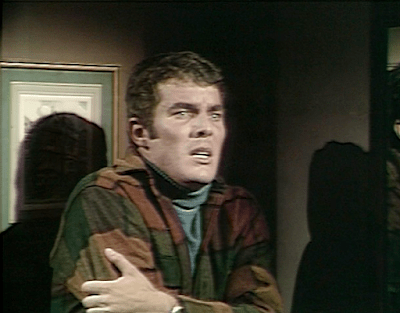
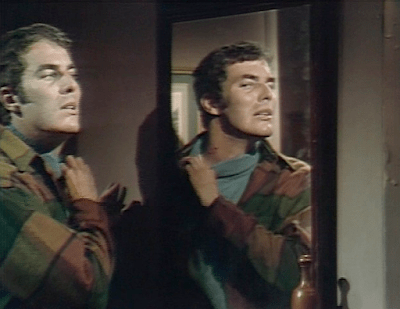
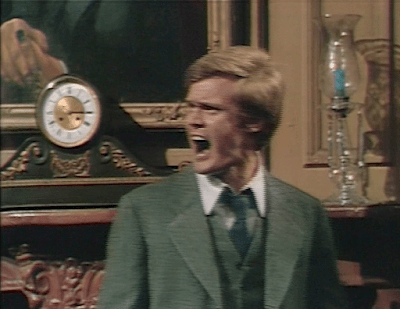
Tom has a substantial amount of dialogue today, the first we have heard him speak since he joined the ranks of the undead. Don Briscoe doesn’t seem to have found the character yet. There is a familiar note in the voice, but one I couldn’t place until much later in the series. Eventually, Briscoe will appear in a different role and not only imitate the voice of a famous actor of the past but wear a costume modeled on one that actor wore in his most celebrated parts. I won’t give away who it is, but once you’ve seen those episodes you will recognize that person’s voice every time Briscoe speaks.
One mad scientist built a Frankenstein’s monster, and another brought it to life. The builder, Eric Lang, had forced a man to dig up freshly buried corpses he used as materials. That man, an unpleasant fellow named Peter who prefers to be called Jeff, left Lang’s employ after he awoke on a surgical table and found Lang trying to cut his head off. Shortly after that, Lang died, and his colleague Julia Hoffman completed the experiment.
Lang and Julia’s creation is known as Adam. Adam is under the mistaken impression that Julia’s friend, recovering vampire Barnabas Collins, was his maker. He is now threatening to kill all the Collinses unless Barnabas and Julia provide him with a mate. They are complying. They have collected Lang’s journals, and are keeping a cadaver and some equipment in Barnabas’ basement.
Well-meaning governess Vicki is engaged to marry Peter/ Jeff. Barnabas is fond of Vicki, and Adam’s original threat was to kill her. He kidnapped her and held her prisoner for a couple of days; it was when he released her that he extended his threat to the whole family. When he was holding her, Adam gave Vicki’s engagement ring to Barnabas as proof of his seriousness. Now Barnabas has told Vicki that her ring turned up outside his house, and she drops by to pick it up.
Barnabas is alarmed that Vicki came to the house after dark. He knows not only that Adam is still at large, but also that a vampire named Tom Jennings is on the prowl. Vicki doesn’t remember her time as Adam’s prisoner and knows nothing about Tom, but she has heard enough about strange goings-on that she appreciates Barnabas’ concern. She assures Barnabas that she didn’t walk through the woods, and she isn’t alone. Peter/ Jeff is just outside, waiting in her car. Barnabas tells her he’s sorry Peter/ Jeff didn’t come in with her. As he says this, he looks at the door, giving the impression that he is sincere. Earlier, Peter/ Jeff had told Vicki that he was jealous of Barnabas; this scene makes it clear that he has nothing to worry about on that score. Regular viewers know that Julia has a crush on Barnabas; his behavior towards Vicki, whom he sometimes claims to love and want to marry, leaves her looking blissful.
Vicki notices that Julia is carrying one of Lang’s journals; Barnabas tells her that he and Julia are thinking of writing a book about Lang. Vicki knows only that Lang was a doctor who was a friend of theirs, so she accepts this explanation easily. When she goes, Barnabas insists on accompanying her to the car.
Barnabas returns, and tells Julia that he and his servant Willie Loomis will go out and try to find Tom before he bites someone. He speaks tenderly to her; she smiles.
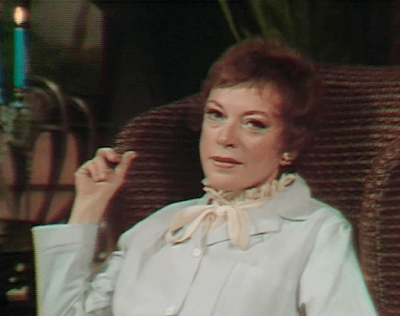
Julia, content with the state of her relationship with Barnabas. Screenshot by Dark Shadows Before I Die.
Julia goes to the basement to close down the experiment for the night. She is still in a blissful mood as she listens to the radio playing the Jackie Gleason Orchestra’s truly appalling version of George Gershwin’s “Love is Here to Stay.” Since they have a stolen corpse in the basement and incriminating documents scattered throughout the house, the front door is of course unlocked. Peter/ Jeff lets himself in and is shocked to find Lang’s journal on the desk in the front parlor.
Julia comes upstairs and finds Peter/ Jeff. He explains that he wanted to see Barnabas and asks why they have Lang’s journal. Julia repeats the story Barnabas told Vicki. Peter/ Jeff laughs at the idea that Barnabas and Julia would write a book about Lang’s attempt to build a man from stolen body parts; Julia says it won’t be about that part of his life. Peter/ Jeff is still laughing when he leaves the house.
It’s odd Julia sticks with Barnabas’ story. A few days ago, Peter/ Jeff confronted Barnabas and Julia with his suspicion that Adam is Lang’s creation. Had she said they were disturbed by his suggestion and were checking Lang’s records to make sure there was no way he could be right, he wouldn’t be in a position to contradict her. He certainly wouldn’t be bothered that they lied to Vicki to cover up what they know about Lang’s experiment, since he is at one with them in his desperation to keep her from ever finding out what he did. Later, we see her writing a note to Barnabas explaining that Peter/ Jeff had not believed “my- really, your- story.” Perhaps she is embarrassed that she did not live up to her usual standards as Dark Shadows’ most fluent and most plausible liar.
Julia heads back to the basement, and we see a figure peering in the window. It is Tom. Coming on the heels of her failure to deceive Peter/ Jeff, this leaves us with no doubt that Julia’s happy night will soon give way to misery.
While Julia is writing her note for Barnabas, Tom appears in the basement. Julia sees him, realizes who he is, and screams as he bares his fangs and approaches the camera.
This ending comes as an anticlimax. The sight of Tom at the window was enough to let us know what Julia was in for; there was no real need to continue the episode beyond it. Moreover, the scene is poorly executed. When Tom walks toward the camera, he twice stops himself awkwardly because he’s running out of set. He also stops in the middle of opening his mouth, apparently realizing he has started that move too soon. Julia’s scream doesn’t help, either. Grayson Hall was a brilliant actress, the heart of the show, but she was terrible at screaming. This is actually one of her better attempts, but coupled with Don Briscoe’s stumbling it still brings a bad laugh.
Julia Hoffman, MD, is in the hospital looking for information about Tom Jennings. Tom was never her patient, but she knows that he was bitten by a vampire and will become a vampire himself if he dies.
Julia meets Tom’s cousin Joe Haskell. Joe tells her that Tom is already dead. Seeing how distraught Joe is, Julia says she will call his doctor. When he says he doesn’t need medical attention, because “I’m upset, that’s all,” Julia responds “There’s medication for that, too, you know.” Joe tells Julia Tom will be buried before the day is out.
Meanwhile, recovering vampire Barnabas Collins is in his basement, examining a new arrival. Barnabas and Julia are being forced to create a Frankenstein’s monster, and Barnabas’ servant Willie Loomis brought a cadaver home last night for material. Willie comes downstairs and declares that the project is too dangerous and too horrible for him to participate any further. Willie refers to himself in the third person, telling Barnabas that “Willie Loomis” has something to tell him. In this, he reverts to a habit he had in his first week on the show, when he was played by James Hall. He stopped doing this shortly after John Karlen took over the role, long before he gave up trying to imitate Mr Hall’s Mississippi accent. Maybe he will go back to that next. Barnabas tells Willie that he will do as he is told, and that Julia will give him a sedative next time he comes back with a corpse. Willie storms out, and Julia comes in with the news about Tom.
Barnabas says they must drive a stake through Tom’s heart before he rises to prey on the living. He calls Willie in. At that, my wife, Mrs Acilius, laughed. “He’s going to make Willie do it!” But this time, Barnabas has decreed that all three of them will go to the cemetery.
They are clustered near a tree, looking for all the world like the Three Stooges, when they spot Joe standing at the grave. They haven’t caught on that Joe is himself the victim of a vampire. That’s a bit odd. You’d think they would be among the very first to spot the signs of such a condition, and in the opening scene Joe was even sitting directly under a “Give Blood” poster. But they are oblivious.
Barnabas and Willie dig up the coffin. Barnabas is ready with the mallet and the stake when Willie opens the lid. He is shocked to find that it is empty.
Dangerously unstable ruffian Willie accidentally freed vampire Barnabas from his coffin in #210, and became his sorely bedraggled blood thrall. Barnabas has since been cured of his vampirism, more or less, and when first we saw Willie after that it seemed he might be about to revert to his old ways. But he has settled back into a life under Barnabas’ thumb. Today, he is digging up a grave, planning to steal a body for Barnabas and mad scientist Julia to use in creating a Frankenstein’s monster.
Willie is interrupted in this gruesome task when hardworking young fisherman Joe, walking through the graveyard, spots him and announces that he will be taking him to the sheriff. Joe is pale and has trouble concentrating; at one point he asks Willie about a voice only he can hear. Willie is in such a panic that he doesn’t notice the signs that Joe is ill. When Joe walks off, Willie is still pleading with him not to go to the police.
As it happens, Joe is not on his way to the sheriff’s office. He has been bitten by Angelique, formerly the wicked witch who made Barnabas a vampire, now a vampire herself. He is answering her summons. Were Willie not so terrified of the sheriff, perhaps he would have recognized a fellow sufferer of his old affliction.
Joe has been on Dark Shadows from the beginning, long before Willie and Barnabas joined the cast. For his first 112 weeks, he was the show’s most straightforward specimen of Healthy Man. His only foible was his tendency to lose track of his plans when he had the chance to help a neighbor. Now Angelique has transformed him into an addict desperate for a fix.
Joe and Willie represented opposite extremes of personality before they were bitten, and actors Joel Crothers and John Karlen were similarly remote from each other in their approaches to their work. Karlen used techniques like those popularized by Marlon Brando and James Dean to throw himself into a depiction of Willie’s emotions that could be compelling no matter how stale the dialogue he was given. Crothers could overcome weak lines as well, but he did it with a manner as precise and deliberate as Karlen’s was volatile and intense. For example, today he says “There are places I should be, other places,” which may not look like much in print, but his delivery shows a deep poetry in it.
Joe goes to Angelique in the house by the sea where she is staying. He wrestles with his compulsion to submit to her bite; she assures him that he will soon forget everything else in his life, including his love for his fiancée Maggie. Regular viewers will hear an unexpected echo in this; Maggie is played by Kathryn Leigh Scott, who in the part of Dark Shadows set in the 1790s played gracious lady Josette. It was her frustration that Barnabas loved Josette and not her that led Angelique to cast the spells that caused disaster in those days, culminating in her transformation of Barnabas into a vampire.
Joe awakens after the bite and tells Angelique about his encounter with Willie. Angelique’s master Nicholas appears. He instructs Joe to tell him what happened in the graveyard, and dismisses Angelique. We see Joe’s old gallantry one last time as he tells Angelique she doesn’t have to take orders from Nicholas. She tells him she does, and leaves him alone with Nicholas.
Nicholas tells Joe that he controls Angelique, and therefore controls him. Joe tells him he did not stop to tell the sheriff about Willie. It is Nicholas who wants a Frankenstein’s monster and has set up the scheme that is forcing Barnabas and Julia to try to make one, and so he is relieved to hear that. Nicholas gives Joe an order we do not hear.
Meanwhile, Willie is back at Barnabas’ house, still in a state of panic. Barnabas asks what is wrong, and he tells him that Joe found him digging up a grave and said he would go to the police. Willie wants to leave town at once, but Barnabas refuses.
Barnabas is figuring out how he can dump responsibility for the whole mess on Willie when a knock comes at the door. Thinking it is the sheriff, he sends Willie upstairs, telling him that if he talked to them he would only make it worse. It turns out to be Joe, come to tell Barnabas what he saw and explain that he decided that, since Willie saved his life a while ago, he won’t go to the police after all. Barnabas is very quiet and very courtly, sounding for all the world like Boris Karloff. After Joe leaves, Willie enters, jubilant to be off the hook. Barnabas is troubled by Joe’s obvious ill-health.
Back in the house by the sea, Nicholas tells Angelique that he has received some alarming news from the hospital. The victim of her first bite, easygoing electrician Tom, is coming out of his coma. If Tom tells what he knows, Nicholas and Angelique will be exposed. Angelique has only been a vampire for a short time, and is unsure of her powers. But Nicholas has demonstrated sufficient ability that it is difficult to see Tom as much of a threat to him. The episode thus ends without any particular suspense.
Hardworking young fisherman Joe has always been at his most appealing when he is going out of his way to help a new friend. My favorite example is #58, when strange and troubled boy David asks him for help deciphering a set of tide tables. He drops everything and is completely absorbed in the task.
Friday, we saw Joe’s impulse to help turned against him. Vampire Angelique claimed to be a prisoner of the suave and mysterious Nicholas. He wanted to take her straight to the sheriff’s office, but agreed to let her rest her head on his shoulder first. With that, she bit him, and he was enslaved.
Today, old world gentleman Barnabas pays a call on Joe. Barnabas was a vampire himself for 172 years, and he knows that a vampire is operating in the area. He is deeply disquieted by what he sees of Joe, but does not attempt to diagnose his condition.
Barnabas came to the 1960s when dangerously unstable ruffian Willie opened his coffin in #210. Willie hoped to steal jewels, but was instead bitten and enslaved, becoming a sorely bedraggled blood thrall. Now that Barnabas’ curse has gone into remission, he controls Willie without supernatural means. He wants Willie to dig up corpses so that he and his friend, mad scientist Julia, can build a Frankenstein’s monster. On Friday, Willie tried to refuse, and Barnabas extorted his agreement by describing a scenario in which Maggie, the girl on whom Willie has a crush, might be killed if Barnabas and Julia do not complete their grotesque plan. Willie protests again today that he cannot “rob a grave.” Well he might protest- all of the trouble going on now started the last time he tried it.
The sun goes down, and we return to Nicholas’ house. Angelique rises. She hasn’t been a vampire long, and doesn’t know how to summon Joe until Nicholas tells her. From November 1967 to March 1968, Dark Shadows was a costume drama set in the 1790s, and Angelique was a wicked witch. Her spells, including the one that made Barnabas a vampire, so often misfired that it seemed she was new to witchcraft. Viewers who remember that phase of the show and see her today will be quite sure that Barnabas was the first vampire she ever made, and that she is on altogether unfamiliar ground.
While Joe is responding to Angelique’s summons, he crosses paths with Willie in the cemetery. The episode ends with Joe announcing he will take Willie to the sheriff. In itself, that doesn’t produce much suspense. We know that he has no choice but to go directly to Angelique. But since Nicholas is ultimately behind both Angelique’s vampirism and Barnabas and Julia’s attempt to stitch a person together, it does suggest that his skill at manipulating events might ultimately prove to be as faulty as is Angelique’s. Perhaps the next time Nicholas’ pawns bump into each other, there will be consequences that he cannot control.
Barnabas Collins may not be a vampire these days, but he’s still at his best when he gets to be an absolute bastard. He has such an opportunity today. His bedraggled servant Willie Loomis has been refusing to steal corpses from their graves so that Barnabas and mad scientist Julia Hoffman can build a mate for Frankenstein’s monster Adam. At first Barnabas threatens to have Julia recommit him to the psychiatric institution she runs; Willie says he would rather spend the rest of his life as a mental patient than dig up dead bodies, and Julia tells him she won’t send him back to the institution in any case.
When Barnabas learns of this, he gets a sinister gleam in his eye and tells Willie that if Adam finds out Willie is refusing to help in the project, he might kill Maggie Evans, The Nicest Girl in Town, on whom Willie has a crush. As Barnabas presses this idea on Willie, he seems more and more pleased with himself, and Willie becomes more and more distraught. When Willie finally caves in and agrees to do what he wants, Barnabas looks as happy as we have ever seen him.
Maggie is engaged to marry hardworking young fisherman Joe Haskell. Joe has received a note asking him to call at the home of the suave and mysterious Nicholas Blair shortly after sundown. When he does, a woman named Angelique meets him and tells him Nicholas will be back soon. She tells Joe that Nicholas is holding her prisoner. As Barnabas shows to his best advantage when he is a cold villain, so Joe shows to his when he suddenly finds himself with a chance to help a new friend. He is great right up to the moment when Angelique embraces him and reveals the vampire fangs with which she will bite him.
Suave warlock Nicholas Blair is lounging in his living room, blissfully contemplating the imminent success of all his evil plans. An unexpected visitor arrives. He is Adam, a Frankenstein’s monster whom Nicholas has been teaching to adopt a cruel and amoral code of extreme egoism. Adam is under the mistaken impression that recovering vampire Barnabas Collins created him, and he wants Barnabas to create a mate for him. Much to Nicholas’ approval, Adam abducted well-meaning governess Vicki Winters and told Barnabas he would kill her unless he gave in to his demands. Nicholas has Vicki stashed in a room in his attic.
Adam is bringing news Nicholas does not welcome. Adam’s former mentor, Professor Timothy Eliot Stokes, visited him in his hiding place. Barnabas had told Stokes of Adam’s threats against Vicki. Stokes tried to talk Adam into letting Vicki go. His last appeal was to ask the big guy to imagine how he would feel if someone were holding his favorite person, heiress Carolyn Collins Stoddard, and threatening to kill her if his demands weren’t met. That got through to him. He has come to tell Nicholas that they must release Vicki.
Nicholas asks Adam why he finds Stokes’ arguments convincing. Adam finally says that by making the comparison between Vicki and Carolyn, Stokes made him feel bad. Nicholas seizes on this, and says that those bad feelings are not evidence of any truth about the situation, but are just something Stokes imposed on him by trickery. Nicholas’ dismissal of conscience as a product of other people’s influence rather than an intuitive source of knowledge sounds rather like one of the crass immoralists Socrates shoots down in Plato’s dialogues, or like a simplified version of the criticisms of conventional morality with which thinkers like Marx, Nietzsche, and Freud scandalized the late nineteenth century.
Adam goes back to Barnabas’ house and repeats his demand. Barnabas and his friend, mad scientist Julia Hoffman, waver. Barnabas finally agrees to try to build a woman for Adam, but only after he sets Vicki free. The big guy thinks about it for a moment, then agrees. He tells Barnabas that if he backs out of his part of the bargain, he will not only find Vicki again and kill her, but that he will murder everyone who bears the name of Collins. Since that includes Carolyn, it would seem that Nicholas’ teachings have had a very profound influence on him indeed.
Christine Scoleri of Dark Shadows Before I Die dramatized Stokes’ and Nicholas’ competing attempts to influence Adam with this image:
Act One consists of recovering vampire Barnabas and mad scientist Julia standing around Barnabas’ front parlor recapping various ongoing storylines.
Danny Horn devotes his post about this episode to a detailed analysis of this scene. He shows that Jonathan Frid’s performance and Grayson Hall’s are open to many objections. They fall short in such technical categories as “knowing their lines” and “standing on their marks” and “having the slightest idea what is going on.” But they are fascinating to watch nonetheless. Danny declares that “[t]he point of these scenes is to see how long two adults can stand around in a room saying preposterous things to each other.” Frid and Hall operate at such a high level of tension that the prospect of either of them breaking character generates enough suspense to keep us on the edge of our seats.
Patrick McCray wrote two separate posts about this episode. In the one that went live 13 September 2017, he too focuses on the performances in Act One. He writes:
Poor Jonathan Frid. He must have had a rough night. I am usually oblivious to his infamous (and completely understandable) line trouble, but in this one, it is so palpable that I totally understand why he retired from TV after DARK SHADOWS left the air. In his early dialogue with Grayson Hall, you can see sheer terror in the eyes of both performers as Barnabas haltingly recalls a trip to the hospital. This is followed by the “Frid Surge,” where Barnabas becomes far more committed and energetic when he turns to face the teleprompter. Of course, this gives him that great sense of vulnerability that was the secret to Barnabas’ success.
This is the only post on the Collinsport Historical Society tagged “Frid Surge”; that’s too bad, I’d like to see that phenomenon tracked throughout the series. I should also mention that Patrick goes on in this post to express his “confidence that Frid could have acted the doors off the collected ensemble had the poor guy just been given another frickin day to study his sides.”
Barnabas and Julia’s recap scene ends when an unexpected visitor barges in. He is an unpleasant man named Peter, who prefers to be called Jeff. Peter/ Jeff is fiancé to well-meaning governess Vicki, whom Barnabas and Julia know to have been abducted by Frankenstein’s monster Adam. Adam came to Barnabas’ house yesterday and threatened to kill Vicki unless Barnabas and Julia created a mate for him.
Peter/ Jeff was assistant to Eric Lang, the mad scientist who created Adam, and he knows that Barnabas and Julia were connected to the experiment. He does not know for sure that Adam is Lang’s creation, that Barnabas and Julia brought Adam to life after Lang’s death, or that Adam has abducted Vicki. He does, however, have grounds to suspect that each of these things might be true. In this scene, he announces his suspicions to Barnabas and Julia. They huddle in one corner of the room while he shouts his lines in his singularly irritating voice. They deny all three of his points. One of the commenters on Danny’s post, “Straker,” summed up their reaction admirably:
Frid and Hall were too professional to show it but I sensed they were both annoyed when Roger Davis marched in and started yelling. It’s kind of like how you feel when you’re at a party and the host’s five year old son throws a tantrum. Sort of an embarrassed tolerance.
Comment left by “Straker” at 6:21 am Pacific time 31 July 2020 on “Episode 557: A Race of Monsters,” by Danny Horn, Dark Shadows Every Day, 1 January 2015
Roger Davis as Peter/ Jeff, in one of the most subtle moments of his performance. Screenshot by Dark Shadows Before I Die.
After Peter/ Jeff’s scene, it is Barnabas’ turn to be an unwelcome guest. He calls on occult expert Timothy Eliot Stokes. Barnabas and Julia suspect that Stokes may be the evil mastermind who has turned the previously gentle Adam toward evil plans. When Stokes hears Barnabas knocking on his door, he looks up and rasps to himself “Go away… No one is home…” This is one of my favorite lines in the whole series. Stokes was quite cheerful when he first involved himself in the strange goings-on, but as he has found himself drawn deeper and deeper into the unholy world of Collinsport he has come to regret his decisions.
Stokes is quite impatient with Barnabas’ demands that he tell him what he knows and his refusal to reciprocate with information about himself. It is only because Vicki is in danger that Stokes tells Barnabas anything at all.
Stokes already knows how Adam came into being, and Barnabas tells him about Adam’s conversation with him. This brings up a question about the scene with Peter/ Jeff. Why couldn’t Barnabas and Julia have trusted Peter/ Jeff with as much information as Barnabas here gives Stokes? Peter/ Jeff can no more go to the police than Stokes can, he will not tell Vicki anything about Lang’s experiment, and Barnabas and Julia have no reason to suspect him of being behind Adam’s turn to evil. These questions don’t come to mind during the scene with Peter/ Jeff, partly because he is so disagreeable a presence that we want him off screen as soon as possible, and partly because it has long been Barnabas’ habit to tell his enemies everything he knows while he zealously guards his secrets from potential helpers.
Patrick McCray’s second post about this episode, published 30 July 2018, includes an analysis of Thayer David’s portrayal of Stokes:
Professor Eliot Stokes gains fascinating dimension in 557. Normally, jovial and helpful, we see his protectiveness of Adam reveal an irascible and sternly just man within. Anton LaVey extolled “responsibility to the responsible,” and there are few other places where Barnabas gets both barrels of that. Stokes is perhaps the most inherently good man in Collinsport since his fellow freemason, Bill Malloy, took his last diving lesson. (Ironically, at the hands of Thayer David’s first character.) Stokes’ prime reason for siding with Adam and not Barnabas? The former vampire and Julia have withheld vital information for months. Yes, they have necessary trust issues, but this is Stokes we’re talking about. Adam may be a wildly unpredictable man-beast, capable of leveling Collinsport to sand before breakfast, but he’s also (until later in the episode) a prime graduate of Rousseau’s Finishing School for Noble Savages. He’s nursed greedily on the milk of morality that spurts abundantly from the ripe and straining teat of of Eliot Stokes’ moral tutelage. It takes a Nicholas Blair — so often Stokes’ foil — to teach him the less savory lessons in humanity. Stokes knows that there’s only so much danger in which Adam can find himself… Victoria Winters is another matter.
Barnabas passes the baton to Stokes, who becomes the third character in the episode to pay an unwelcome visit. He goes to Adam. He asks the big guy who has taught him to be cruel and amoral, and gets nothing but lies in return. He tries to persuade him that he must not hurt an innocent person, and Adam angrily declares that it is “fair” for him to make Barnabas watch him kill Vicki if Barnabas will not make a mate for him.
In Patrick McCray’s 2017 post, he praises Robert Rodan’s performance as Adam:
Robert Rodan issues a highly cerebral, emotionally packed performance. Rodan never receives the credit he deserves. Much of Adam’s stint on the show finds him equipped with an eloquent, even sesquipedalian command of the language. His inner conflict is as existential as it gets… Where do you turn? Rodan balances this absurd chimera of conflicts with effortless aplomb that makes Cirque du Soleil look as clumsy as a Matt Helm fight scene.
Robert Rodan is an unsung hero of an actor, delivering his existential angst with passion and truth. It’s a shame that his identification with an eventually unpopular character was probably a factor in Rodan not being recycled by Dan Curtis, despite being the dark-haired, blue-eyed “type” that typified the ruggedly handsome, DS norm (such as Selby, Lacy, Crothers, George, Ryan, Prentice, Storm, Bain, etc.)
While I always found the sight of Conrad Bain a guarantee of a fine performance, I can’t say it ever occurred to me to class him as “ruggedly handsome” in the way that one might class the other men Patrick lists. There’s no accounting for taste, I suppose.
Recovering vampire Barnabas Collins is in the woods on the estate of Collinwood, searching for well-meaning governess Vicki Winters. He hears dogs howling, as they used to howl when he was in the grip of bloodlust. He goes to pieces at the memory.
Barnabas’ fellow searcher, Vicki’s fiancé Peter Bradford, sees him standing petrified. Barnabas asks him if he can hear the dogs. Peter says he can, and is puzzled that Barnabas was afraid he was hallucinating their sounds. Peter asks Barnabas if he is all right. Barnabas insists that he is just worried about Vicki, and resumes searching.
Shortly after, Barnabas finds himself in the foyer of the great house on the estate, slumped in a chair under his own portrait. He makes a sad contrast with the haughty figure in the painting. His friend Julia Hoffman enters, and he gives her a pleading look that emphasizes the contrast between his present weakness and the arrogant power he wielded when he posed for the portrait, more than 170 years before.
Barnabas tells Julia that he does not know how he got into the house. The last he remembers, he was in the woods and heard the dogs howling. She suggests that their noise may not mean anything, but he is sure there is some unearthly horror afoot.
Barnabas tells Julia something else he is sure of. Earlier this evening, Frankenstein’s monster Adam came to his house. Adam mistakenly believes that Barnabas created him, and demanded that he build a woman to be his mate. When Barnabas told him that would be impossible, Adam vowed to make him sorry, then left. Shortly after, Vicki came by for a brief visit. Barnabas is certain that Adam abducted Vicki to use as a hostage, and that the only ransom he will accept is the artificially created woman he has no way of supplying.
Barnabas goes to the telephone and announces he is going to tell the police what he knows about Adam. Julia objects that Adam can tell the police enough about the two of them to expose them both to prosecution. Barnabas says that he is willing to take that risk for Vicki’s sake, and begins dialing. Julia says she is not, and places her finger on the telephone receiver to end the call.
Julia has never been able to entirely conceal her dislike for Vicki, rolling her eyes when Vicki talks to her and making sarcastic remarks when Barnabas praises her, so regular viewers can hardly be surprised that Julia does not volunteer to go to prison for her sake. Still, Julia has often enough shown a troubled conscience about the many crimes she has committed during her association with Barnabas that her utter coolness represents a new step in the character’s development. The other day she wanted to shoot wicked witch Angelique, but Angelique was not really human and was enormously dangerous. Even so, Julia was deeply upset when she made up her mind to kill her, and she backed down when she came face to face with Angelique. But Vicki is resolutely, unfailingly, rather tediously good, Good with a capital G. That Julia is so blandly willing to consign her to death at Adam’s hands suggests that her sense of right and wrong will no longer serve as a brake on any sinister plans that might advance whatever goals she and Barnabas are pursuing.
Barnabas looks at Julia, shocked. Perhaps her coldness shocks him. Perhaps what shocks him is that he is so dependent on her that he does not resume dialing.
Meanwhile, another drama has played out not so far away. Electrician Tom Jennings was inspecting the wiring in a house that suave warlock Nicholas Blair is renting from the ancient and esteemed Collins family. Tom told Nicholas that he wanted to inspect the cellar to make sure the foundation was in good repair. Nicholas replied that this would not be necessary, but Tom insisted. He opened the cellar door, and found a coffin. Nicholas told him that the coffin was there when he moved in. Tom asked if he’d called the police, and Nicholas replied there was no need, since the coffin was empty.
On his way home, Tom told himself that the Collinses wouldn’t leave a coffin in the basement of one of their houses. That shows what he knows- for the first 55 weeks of the show, matriarch Elizabeth Collins Stoddard thought that her husband was buried in a box in the basement of the great house, and when he was a vampire Barnabas kept his coffin in the basement of his house. It wouldn’t be a Collins house if it didn’t have a coffin in the basement, and a dungeon too.
Tom sees someone and asks who it is. The part of the other person is played by the camera, so we do not know. The camera zooms in, and Tom collapses.
Later, Peter finds Tom propped against a tree. He touches Tom, and Tom falls over, apparently dead. He has two bloody wounds on his neck. Peter goes back to the great house. He tells Barnabas and Julia that he must use the telephone. They hear him describe Tom’s wounds to the police. Afterward, Barnabas and Julia realize that there is another vampire operating in the area.
Tom’s appearance is the debut of Don Briscoe, who would be a big part of Dark Shadows for almost two years. On his Dark Shadows Every Day, Danny Horn told an amazing story about Briscoe:
Many years ago, when I was in high school, my mother walked into the room while I was watching Dark Shadows.
She looked at the guy on the screen, and said, “Is his name Don?”
I said, yeah, that’s Don Briscoe, and she said, “I thought so. I knew him, when I was in grad school. He asked me out once.”
Seriously, true story. She said that they were both getting a master’s in English — he was at Columbia University, and she was at Barnard, which is right across the street. He asked her out on a date, and he was very handsome, and very nice, but he wasn’t Jewish, so she said no.
At the time, I had no way to verify this, and I never really knew what to think about it. I mean, she knew the guy’s first name, but maybe she confused him with some other brown-haired guy named Don.
But now I have this excellent book called Barnabas & Company, which has extensive bios on everybody in the cast. It turns out that he really did get a master’s degree in English at Columbia University, and that means that Don Briscoe is kind of my dad.
Granted, hundreds of actors had parts on Dark Shadows over the five years of its run, a great many people have blogged about the show, and I’m sure Danny’s mother was a very attractive young woman who had offers from lots of fellows. But Briscoe was one of the more important members of the cast, and Danny is as good as any of the bloggers. So it really is a noteworthy coincidence that they are connected to each other in that particular way.
In #83, strange and troubled boy David Collins repaid his governess, the well-meaning Vicki, for her determined attempts to befriend him by locking her in a room where he hoped she would die. The room was located deep in the long-deserted west wing of the great house of Collinwood, and Vicki found that she could neither open the door nor reach the window.
Vicki had two visitors during her time trapped in this dusty chamber. In #85, the ghost of local man Bill Malloy appeared and sang to her; this was the first sustained and direct interaction between a living person and a supernatural being on Dark Shadows, and it left Vicki terrified and confused. In #87, David’s abusive father, high-born ne’er-do-well Roger Collins, knocked on the door and pretended to be a ghost, scaring Vicki further. When Roger then opened the door and rescued Vicki, she threw her arms around him, sobbing and saying that he was right and David really was a monster. In those days, Vicki’s attempt to win David over was the only storyline on the show that worked; when it seems that she will join all the other grownups in giving up on the little guy, the audience’s hearts break.
The Second Captivity
In #108, Vicki had come to the conclusion that Roger killed Bill. Unsure where to go, she stopped in the cottage on the estate where handyman Matthew Morgan made his home. Talking to him, she prompted him to make an indiscreet remark that revealed that he, not Roger, pushed Bill off the cliff from which he fell to his death.
Matthew would not let her leave the cottage. He acknowledged that she had done nothing wrong, but said that he would have to kill her now that she knew his secret. She tried to dissuade him, but it was only a chance visit from matriarch Elizabeth Collins Stoddard that prevented the murder. Matthew ran away, and Vicki was free.
The Third Captivity
In #116, Vicki went to look for David in the long-deserted Old House on the estate. She did not find him, but instead found Matthew, a wanted fugitive with a grudge against her. Until #126, Matthew kept her bound and gagged in the secret room behind the bookcase in the front parlor.
Others came and went. David, no longer homicidal, is convinced Matthew is innocent of Bill’s death and unaware he is holding Vicki, and he sneaks Matthew food he has stolen from the kitchen in the great house. Vicki’s friends Burke and Joe search the Old House, and she can only listen while Matthew hides with her in the secret room.
Matthew was fetching an ax with which to kill Vicki when the ghost of the gracious Josette Collins appeared to her and told her not to be afraid. When he came back, Josette led the ghosts of Bill Malloy and of the legendary Widows of Widows’ Hill as they surrounded Matthew and scared him to death.
The Fourth Captivity
From #365 to #461, Dark Shadows was a costume drama set in the late eighteenth century. Vicki had come unstuck in time, and found herself at Collinwood as it was in those days. Her total failure to adapt to her new environment led to her arrest, trial, and condemnation as a witch. From #401 on, she was in gaol, with a couple of brief and disastrous excursions.
Vicki had several visitors during her time in gaol, most of them people who had at some point wished her well but whom she alienated by her compulsive sharing of information she had learned when she was in the 1960s. By the time she had been sentenced to hang, she had only two friends left. One was her gaoler/ defense attorney/ boyfriend/ co-conspirator/ fellow prisoner, an unpleasant man named Peter Bradford. The other was Barnabas Collins, a vampire. Neither was able to do her much good, so in #460 and #461, Vicki mounted the gallows, was hooded, a noose placed around her neck, and the lever pulled to open the trap door under her feet. She then found herself restored to her own time, mere moments after her departure, but wearing the clothes she wore in the 1790s and bearing the marks of the wounds she sustained then, including the rope burns on her neck.
The Fifth Captivity
Shortly after Vicki returned to 1968, Barnabas’ vampirism went into remission. Peter also turned up, suffering from total amnesia and calling himself Jeff Clark, but still disagreeable to look at or listen to. Vicki and Peter/ Jeff became engaged the other day. Yesterday, Vicki left Peter/ Jeff to wait for her in the great house while she went to the Old House, which is now Barnabas’ home. She wanted to give him the news.
What freed Barnabas of the vampire curse was the creation of Frankenstein’s monster Adam. Now, Adam wants a mate, and is under the mistaken impression that Barnabas can create one for him. He has decided to extort Barnabas’ cooperation by taking Vicki as his hostage.
Adam is wanted by the police for abductions and assaults he committed before he learned to talk. Heiress Carolyn Collins Stoddard, who is acting as mistress of Collinwood while Liz is in the hospital, took pity on Adam and has been hiding him in a dusty room in the west wing. It is not the room Vicki was trapped in back in 1966; there is a window within reach. But when she comes to and finds herself there, she tells Adam she knows where she is. He responds “No!” She says that it’s the west wing, and she has been there before Most of the audience joined the show long after Vicki’s first captivity, so it will be as much news to them as it is to Adam that Vicki is on familiar ground.
Adam agrees that Vicki has done nothing to harm him, but tells her that he may nonetheless have to kill her. In this, he reminds us of what Matthew said to Vicki when he held her prisoner in his cottage.
Peter/ Jeff is still waiting for Vicki in the foyer of the great house when Carolyn finds him. He tells her Vicki went to Barnabas’ house more than two hours before, promising to return in an hour. Carolyn smiles and, with a mischievous twinkle in her eye, tells Peter/ Jeff that Barnabas and Vicki are “such good friends” it’s no wonder the two of them would lose track of time when they were alone together. This bothers Peter/ Jeff almost as much as it was obviously intended to do, and he goes to the Old House.
Peter/ Jeff arrives and demands Barnabas take him to Vicki. Barnabas is taken aback by Peter/ Jeff’s tone, and for good reason. When actor Roger Davis shouted his lines, which he did most of the time, he projected his voice not from the muscles of the pelvic floor, as singers are often taught to do, but from the sphincters in his buttocks, with the result that he sounded like he was trying to defecate. Barnabas has some nice rugs on his floor, so an angry Peter/ Jeff is an alarming visitor.
While Peter/ Jeff yells at him, Barnabas remembers that Adam had been in the house just moments before Vicki came, and that he had threatened to make Barnabas “very sorry” for not doing what he wanted. It was odd that Barnabas didn’t offer to walk Vicki home after that, a fact which has apparently dawned on him. He rounds on Peter/ Jeff and says that they are both to blame if anything happened to Vicki, since neither of them should have let her walk through the woods alone. Peter/ Jeff agrees with that, and his yelling moderates a bit. They get some flashlights and go out to search for her.
As they are searching, Peter/ Jeff proves that he is a true member of the Dark Shadows cast when he shines a flashlight directly into the camera. Barnabas tells him they should split up. This may or may not be a logical step towards finding Vicki, but it definitely will reduce Barnabas’ exposure to Peter/ Jeff, so it is no wonder he is eager to do it.
Barnabas goes to the great house and talks to Carolyn. He tells her that Vicki is missing, that he and Peter/ Jeff have searched the woods thoroughly, and that he suspects Adam has abducted her. He insists that she tell him where Adam is, and she denies knowing. He tells her he does not believe her, and says that if Adam harms Vicki, she “will be held responsible.” Jonathan Frid and Nancy Barrett were always interesting to watch together, and this is the first time they have played a scene where their characters were adversaries facing each other down. The dialogue is nothing special and the situation is all too familiar, but their performances make for a few fresh and exciting minutes.
Carolyn goes to Adam’s room. As Barnabas had been reading when Peter/ Jeff called on him, so Adam, who shares a mystical connection with Barnabas, has a book in his hand when Carolyn stops by. As David sneaked food from the kitchen to Matthew at the Old House, so Carolyn has been sneaking food from the kitchen to Adam in the west wing.
Adam is very slow to let Carolyn into the room. She notes that he has always invited her in before, and does not go away when he claims to have been asleep. He lets her in. As Burke and Joe had searched the Old House when Matthew was hiding Vicki in the secret room there, so Carolyn looks around the room while we know Vicki is somewhere inside it. Adam denies having been out of the room, and tells her Barnabas was lying when he said he had gone to his house. Adam has not lied to Carolyn before, so she accepts what he says. After she leaves, Adam opens the door to his own secret room, a closet in which Vicki is bound and gagged as Matthew had once bound and gagged her.
This is the twelfth episode directed by John Walter Sullivan, but the first credited to him as “Sean Dhu Sullivan.” The name “Jack Sullivan” appeared on the previous installments.







 Dark Shadows Commentary