Episode 764: A primitive tribe

Odds and ends today:

The Kindest, Warmest, Bravest, Most Wonderful Human Being I’ve Ever Known in My Life

The show is doing an homage to The Manchurian Candidate this week, with schoolteacher Tim Shaw brainwashed into becoming an assassin when he sees the Queen of Spades. We open with the plan going awry. Lawyer/ warlock Evan Hanley did the brainwashing with the intention that Tim would kill someone else, but when he shows Tim the card, Tim tries to kill him. As Evan, Humbert Allen Astredo shows us a man suddenly becoming frightened and just as suddenly making up his mind to be brave. In other episodes, Astredo has already shown us Evan responding to fear in other ways. He really was a remarkably good actor, and it is a pleasure to see how much variety he can find in his parts.

Later, we see Judith Collins, the mistress of Collinwood, playing solitaire. Tim comes to the house. We know that each episode ends with a cliffhanger, and so this leads us to expect that we will end today with Tim’s hands around Judith’s throat. But that is a misdirection. In fact, Judith turns the Queen of Spades away from Tim at the last second, and he leaves the room without attacking her.

Slight Enough to Vanish, But Too Dense to Live

Tim’s brainwashing is a B-story on the show right now, and it would throw off the rhythm of the week to end two consecutive episodes with cliffhangers from it. The A-story is about the rakish Quentin Collins, who has been cursed to become a werewolf. There is a full moon tonight, and the sheriff’s department is roaming the grounds of the great estate of Collinwood with guns looking for the wolf who walks like a man. Joining in the search is Quentin’s distant cousin, Barnabas Collins, who is, unknown to all but a very few people, a vampire. Barnabas has traveled back in time to the year 1897, and among the things he is hoping to do is to learn how the werewolf curse that has afflicted his friend Chris Jennings in the 1960s first began.

Barnabas learned in 1969 that in 1897 Quentin and a woman named Beth Chavez paid a man named Ezra Braithwaite to make a silver pendant in the form of a pentagram and that a baby boy was buried in that year wearing that pendant. Tonight, Ezra telephones Barnabas at the great house of Collinwood and tells him that Beth just came in, ordered such a pendant, and told him to send the bill to Quentin.

Barnabas knows that the pentagram was an amulet meant to ward off werewolves. Beth is Quentin’s girlfriend, a fact that is no secret to anyone, not even Barnabas. So you might assume Barnabas would have figured out that Quentin is the werewolf. But apparently he has not. He materializes inside Beth’s room and demands she tells him who the werewolf is. When she refuses, he bites her. That bite is the cliffhanger.
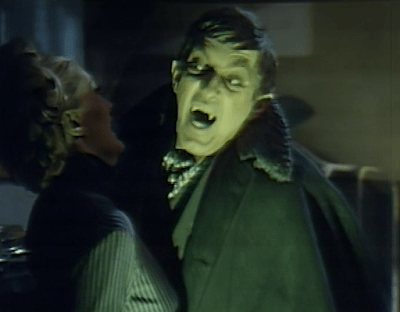
Dear cousin Barnabas. Screenshot by Dark Shadows Before I Die.

Barnabas occasionally makes remarks about how he wants to keep the original timeline intact so that the people he knew in the 1960s will still be there when he gets back. But he’s been feasting on the people he meets in 1897 with abandon. Beth is the fourth resident of Collinwood he has bitten, and he has killed at least two young women in the village. Moreover, his approach to every problem he encounters or imagines is to confront the most powerful person associated with it and antagonize them immediately. It’s hard to see how he expects anything to remain unchanged after he inserts this rampage into the history of the late Victorian age.

But You Wouldn’t Know Anything About That

Judith tells Barnabas today that Beth came to Collinwood as a lady’s maid two years ago. Beth claims to have a cousin in town to Judith today while lying to cover up her trip to Braithwaite’s, and when Barnabas asks Judith if Beth is from Collinsport she mentions this cousin as her reason for believing that she is. Judith clearly knows very little about Beth, and cares less.

The lady who brought Beth as her maid was Quentin’s then-wife, Jenny, who was secretly a member of the Romani people. In #701 it was hinted that Beth was concealing a Romani origin of her own. Casting the tall, blonde, blue-eyed, pale Terrayne Crawford as Beth would seem to indicate that they were not committed to following up this hint, but in today’s scenes with Judith they do go out of their way to emphasize that Beth’s background is a mystery.

The Woman Who Never Left

Beth has been helping the family hide the fact that Jenny went mad and bore twins after Quentin left her. Quentin murdered Jenny in #748, eliminating the need for a servant to cover up her existence, and the twins, about whom Quentin does not know, are firmly ensconced in the care of a woman in the village named Mrs Fillmore. In #750, Judith fired Beth, but it didn’t take. Beth never left the house, and after a while the family started giving her orders again. Today Beth tells Judith that Mrs Fillmore reports that the boy twin is feverish, and asks to be kept on staff until he gets well. Judith agrees.

Judith tells Beth that she has decided to tell Quentin about the twins. She hopes that is what will prompt her brother to cast aside his selfish ways and become a mature adult. Beth is horrified and begs her not to do so. Judith, puzzled, says that Beth has always urged her to tell Quentin. She asks why she has changed her mind, and she makes up something obviously false about Quentin being unable to cope with the news that his son has a fever.

Yesterday, Beth learned that Quentin’s curse is hereditary. Returning viewers might wonder if she is afraid that Quentin will also learn that, and that if he does he might kill his children to prevent them passing it on. He does keep saying that he would rather be dead than have the curse, so he might talk himself into regarding such a murder as an act of mercy.

Featuring Edward Marshall as Ezra Braithwaite

Edward Marshall plays Ezra, a part played in #684 and #685 as an 87 year old man living in the year 1969 by Abe Vigoda (who was 48 at the time, but he and the makeup department both knew their business well enough that he was entirely convincing.) Mr Marshall appeared in #669 as unsightly ex-convict Harry Johnson, a part originally created by the not-always-stellar Craig Slocum. Mr Marshall gave Harry the same attitude and many of the same mannerisms Slocum had given him, but was so much more fun to watch that I wanted to see a lot more of him.

Parts of Harry’s costume and most of his surly demeanor are recycled in the 1897 segment in the character of dimwitted groundskeeper Dirk Wilkins, played by the repulsive Roger Davis. Whenever Dirk is on screen, I imagine Mr Marshall in Mr Davis’ place. I recommend that bit of mental recasting, it goes a long way towards making Dirk bearable. Unfortunately this is Mr Marshall’s final appearance on Dark Shadows.

Episode 727: The lost lamb

Well-meaning time-traveler/ bloodsucking abomination from the depths of Hell Barnabas Collins has found himself in the year 1897, where he must take action to prevent his distant cousin Quentin from becoming a malevolent ghost who will ruin everything for everyone on the estate of Collinwood in 1969. He has no idea what that action will be, so has decided to intrude as aggressively as he can in as much of the family’s business as he can until something turns up.

At the moment, Barnabas is strenuously trying to keep Judith Collins, the mistress of Collinwood, from sending her twelve year old nephew Jamison to a boarding school called Worthington Hall. Worthington Hall is run by the Rev’d Gregory Trask, a descendant of one of Barnabas’ old nemeses. Yesterday, Trask had an unsettling encounter with Jamison during which the camera dwelt heavily on Jamison’s nervous habit of fiddling with his belt, prompting us to wonder why Trask gives Jamison the feeling that he ought to make very sure he remains fully clothed.

Today, Trask’s daughter Charity shows up. Nancy Barrett, who previously played the sometimes-capricious, always likable heiress Carolyn and the fragile, highly comic heiress Millicent, makes Charity just as imposing a heavy as her father.

Jamison’s governess, neurotic intellectual Rachel Drummond, tells Barnabas that she was a student at Worthington Hall for many years, and that the place was gruesome. The Trasks kept the children separated from one another, locked them in cupboards for weeks on end when they incurred their displeasure, and generally exploited and abused them. She herself was forced to stay at the school as a teacher when Trask lied to her and claimed that she owed him money, and she escaped with the aid of a fellow sufferer.

Trask confronts Rachel in the drawing room. She tries to stand up for herself, but he breaks her resistance down expertly. Trask’s one moment of weakness comes when he starts talking about Rachel’s lovely hair, and he suddenly turns away. The mask has slipped, and the audience has seen that Trask’s interest in Rachel is sexual. But Rachel is too intimidated to recognize what has happened, and when he resumes his righteous tone she crumbles. When she next sees Barnabas, she rushes away in tears.

Rachel is terrified by Trask. Screenshot by Dark Shadows Before I Die.

Rachel had another traumatic experience over the last few days. Quentin died, turned into a zombie, and abducted her. No one has given her the news yet, but Quentin came back to life yesterday. She is horrified when he comes into the drawing room and sees Quentin. At first he takes on a lumbering gait, and she screams. Then he laughs and starts walking normally. He explains what happened, as best he can, and they have a strangely pleasant conversation. Again, this is a testament to the high quality of the acting. It is hard to imagine that anyone less charming than David Selby could make us believe a woman would be so comfortable with Quentin after what Rachel has been through.

Barnabas takes on the form of a bat and bites Charity in her bedroom. Presumably he does this so that he can use her as an agent against her father. This raises the question of why he didn’t just bite Trask and put an end to the whole thing. Of course, the real-world explanation is that the writers wanted to keep the story going, but usually they take care to maneuver Barnabas into a situation where he is compelled to bite one person rather than another. So it’s rather sloppy to end the episode this way.

Still, this is a very good installment. Too good for some viewers; my wife, Mrs Acilius, refuses to watch the Gregory Trask episodes, because Jerry Lacy plays him so effectively that it ruins her day to spend half an hour in the presence of such an overpowering evil. Kathryn Leigh Scott brings Rachel’s self-doubts and final defeat vividly to life as well. By the time I got to the end of their scene, I was shouting at the screen “Bring back the zombies and werewolves and witches!” So I cheered when Barnabas bit Charity.

Episode 468: As free as you are

Vampire Barnabas Collins, desperate to save his own life after he aged extremely rapidly as the result of an attempt mad scientist Julia Hoffman had made to turn him into a real boy, bit his distant cousin Carolyn Collins Stoddard and enslaved her in #351. In #462, Barnabas was afraid that well-meaning governess Vicki Winters had learned his secret, so he bit her as well. As it happens, Vicki had not figured out that Barnabas was a vampire, so the bite was unnecessary. That was lucky for Barnabas. After he bit her, Vicki was noticeably less interested in Barnabas and less deferential to him than she had been at any point in the year or so she had known him.

Now, Barnabas has happened upon another mad scientist, Eric Lang. Lang has apparently succeeded where Julia had failed. Barnabas can go around in the daytime and do other things humans do. What’s more, Lang takes a look at Vicki’s neck and sees that the marks of Barnabas’ bite have vanished. Vicki remembers having the bites. Even after Lang has told her that they vanished because the reason for them no longer exists, she has an enigmatic look on her face when she stares into the mirror and studies the spot where they used to be. It was never clear what she made of Barnabas’ biting her and sucking her blood- maybe she just thought he favored an aggressive make out technique. She looks deeply puzzled now, but what exactly she is trying to understand is a mystery. She looks away from the mirror, then looks down, defeated in her attempt to find sense in her memories. Finally, she turns her back on the mirror and goes resolutely about her business.

For her part, Julia is in the great house of Collinwood with Carolyn. Julia is surprised that Carolyn is talking to her in a friendly manner, as she did before she and Barnabas “became so close.” Carolyn removes her scarf, glances in the mirror, and is delighted to see that the marks on her neck are gone. Carolyn asks what that means. Julia says that it means that she is free, as free as Barnabas, and that it must continue to be so.

Carolyn discovers her emancipation. Screenshot by Dark Shadows Before I Die.

Unlike Vicki, Carolyn had a full briefing from Barnabas about his condition and its requirements, and she was deeply involved in his criminal enterprises for some weeks. Her joyous reaction to the disappearance of the marks leaves no doubt that she remembers something about this experience. There is nothing in any script after this to tell us what, but we will often notice actress Nancy Barrett giving a line reading or showing an unquiet reaction that suggests she remembers everything. I suppose you could say she was padding her part with these little signs, but the directors obviously didn’t object and it will be quite a while before the writers give her dialogue which forces her to stop doing it.

There’s also a lot of business in this episode with Vicki and an unpleasant man named Peter. Lately, Peter has been pretending to be someone else, even though the audience and Vicki know perfectly well who he is. Today the show suggests that this irritating little storyline is the consequence of Peter having amnesia. The episode ends with him, Vicki, and Julia opening the secret panel that reveals the hidden chamber in the Collins family mausoleum where Barnabas was trapped from the 1790s until 1967. That proves that Vicki traveled back in time to the 1790s and that Peter knew her in that era. Since the audience already knows both of those facts and none of the characters directly involved in the action has any reason to doubt either of them, it’s an anticlimactic conclusion.

When Vicki and Julia are entering the mausoleum, Vicki shines a flashlight directly into the camera. In at least eleven of the episodes made when the show was in black and white, characters entering darkened spaces did this with flashlights, often creating elaborate halo effects. Sometimes this appeared to be a blooper, several times it was obviously intentional. We’ve only seen it once or twice, briefly, since the show went to color in the summer of 1967. It’s nice to see it again.

Episode 464: Justice to history

High-born ne’er-do-well Roger Collins was Dark Shadows‘ first villain. Through the first 40 weeks of the show, dashing action hero Burke Devlin was determined to prove that Roger, not he, had been driving when his car hit and killed a pedestrian ten years before, and Roger would stop at nothing to keep Burke from succeeding. The Revenge of Burke Devlin storyline was never particularly exciting. By the time Burke formally gave up on his quest for vindication in #201, it had been running on fumes for some time. Roger hasn’t been central to a plot since then. The show has capitalized on actor Louis Edmonds’ unrivaled gift for sarcasm by having him deliver the occasional zinger, and otherwise has used him as a symbol of the inability of the Collins family to use its wealth and connections to solve any of its problems.

For nineteen weeks ending this past Monday, Dark Shadows was a costume drama set in the late eighteenth century and Edmonds played haughty overlord Joshua Collins. That performance was a triumph, and the entire segment turned out to be The Tragedy of Joshua Collins. So returning viewers will have an appetite to see more of what Edmonds can do, and will be excited when we come back from the opening title sequence to a scene focusing on Roger.

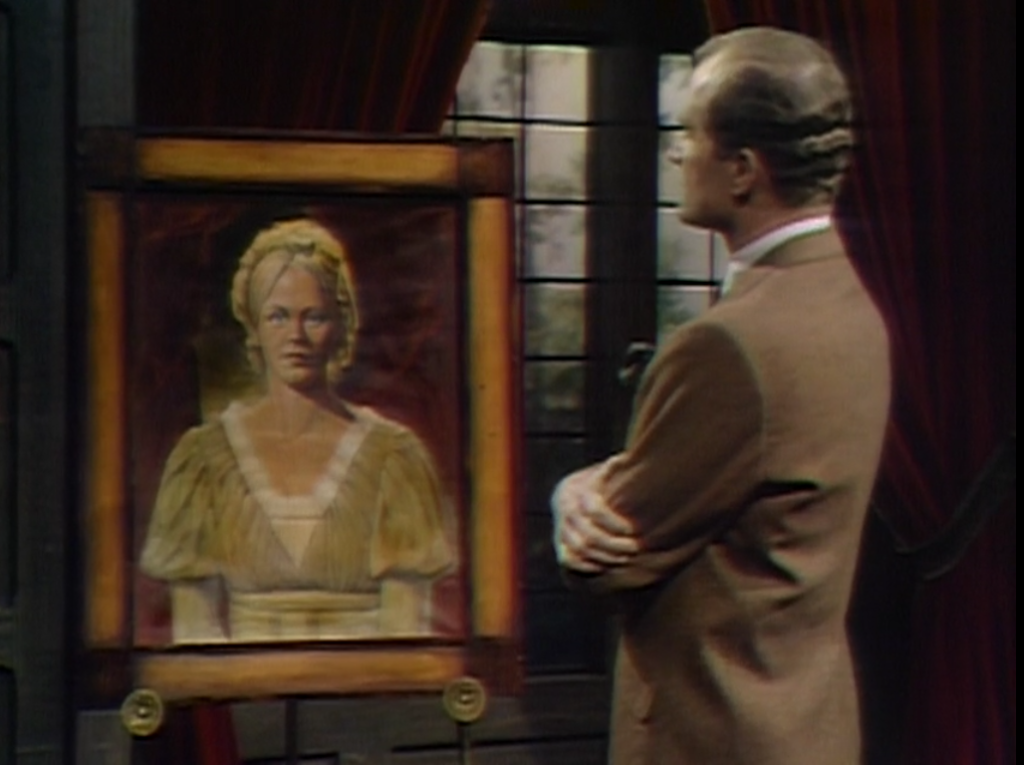
Roger spends this scene staring at a portrait and reciting poetry to it while various people enter the room and try to get his attention. That may not sound like a promise of thrills, but it is on this show. For example, Roger’s son, strange and troubled boy David, had a lively if somewhat one-sided conversation with the portrait of Josette Collins that hangs in the Old House on the estate in #102, and that conversation presaged danger for David and an important role for Josette’s ghost. The show’s first supernatural menace was Roger’s estranged wife, undead fire witch Laura Murdoch Collins, and several characters had important relationships with portraits of Laura during the four months she was in the cast. And dangerously unstable ruffian Willie Loomis once spent a week staring at the portrait of the late Barnabas Collins that hangs in the foyer of Collinwood. As a result, Willie wound up opening Barnabas’ coffin, finding that he was a vampire, and turning Dark Shadows into an entirely different kind of show.

Roger talks to the portrait of Angelique.

The portrait that has captured Roger’s attention is of Angelique, the wicked witch who turned Barnabas into a vampire in the first place. Well-meaning governess Vicki found this portrait in an antique store and brought it home yesterday. It was Vicki who took us to the 1790s when she became unstuck in time. While there, she met Angelique and the living Barnabas. Shortly after her return to the 1960s, Vicki found that her memory of her time in the past had become spotty. She can’t explain why she wanted the painting, but it does make sense to her that Barnabas reacts to it with violent dislike.

We first saw the portrait in #449, when it was clear that Vicki would be returning to the 1960s soon but unclear whether Angelique would follow her. Showing us that they had commissioned a portrait of Lara Parker was their way of telling us she would be back. Having Roger become obsessed with the portrait is their way of telling us that he will be the instrument of her arrival, as Willie was the instrument of Barnabas’.

We learn that Roger’s obsession will blur the distinction between him and Joshua when long-term houseguest Julia Hoffman approaches him and he speaks to her in Joshua’s voice, addressing her as the Countess DuPrés, who was a houseguest at Collinwood in Joshua’s time. Julia and the countess are both played by Grayson Hall. Vicki mistook the countess for Julia when she first met her in 1795, and since her return to 1968 has kept mistaking Julia for the countess. Now that Roger has made the same mistake, Julia must be trying to figure out what’s going on.

A man comes to the front door. Vicki answers it and sees a familiar face. It belongs to Professor Timothy Eliot Stokes. She hasn’t met him before, but she met his ancestor, much put-upon servant Ben Stokes, in the 1790s.

Like Ben and crazed handyman Matthew Morgan from 1966, Professor Stokes is played by Thayer David. Matthew and Ben were both major characters, so we can assume that Stokes will be as well. Matthew was a bad guy, Ben a good guy. When Ben was on the show, the contrast between him and Matthew was drawn very heavily to make the point that Matthew’s crimes are what Ben’s virtues would have led him to do had his personality been warped by the environment in which Matthew grew up. That environment was the consequence of the curse that Angelique placed on the Collinses in the 1790s. Burke expressed this idea in #64 when he said of Matthew that “Collinwood breeds murderers,” but he was understating the effect. Matthew grew up, not on the estate, but in the nearby village of Collinsport, and the curse leaves its mark on everyone who comes from there. Since Stokes is an out-of-towner, he is likely to be unaffected by the consequences of the curse, and so we do not know what we will find under his worldly and self-possessed exterior.

Stokes is researching his ancestor Ben, and wanted to buy the portrait because he thought it might depict a woman Ben knew. Stokes says that Ben wrote a memoir. Barnabas is in the room; in the 1790s, Ben was his closest friend, and knew all about his vampirism. So he is alarmed by the idea of a volume of memoirs by Ben. He can take some comfort when Stokes tells him that most of the manuscript was lost in a fire a few years ago.

The idea of a servant writing memoirs that might expose Barnabas’ secret first came up in #326. At that point, Willie was out of his control, and Barnabas told Julia, who is a mad scientist and his confederate, that he was afraid Willie might start “writing his memoirs!” That phrasing was meant to raise a laugh, since Willie is conspicuously not burdened with literary ambitions. But it planted a seed that flowers for the first time here, and that will flower again later.

Stokes offers Vicki $200 for the painting. Barnabas is eager to get the thing out of the house and urges her to take Stokes’ money, but before she can Roger bids $500. Stokes can’t afford that, and so it stays at Collinwood.

Stokes’ interest in family history establishes a contrast between him and Roger. Stokes, like Roger, appears to be a confirmed bachelor. But while Roger’s lack of interest in the responsibilities of marriage is of a piece with his indifference to all family ties, so that he was eager to divorce Laura and palm David off on her even after it had become clear to other characters that she was a danger to the boy, Stokes is an avid genealogist. He has renounced the prospect of marriage because he has other ways to be of service, not simply because he wants to wallow in his own crapulence as Roger does.

Suddenly Vicki remembers that the woman in the portrait is named Angelique, that Angelique was a witch, and that her spells caused all the misfortune that began at Collinwood in 1795. We hear all of this while Barnabas is in closeup, squirming gloriously. Stokes leaves with Barnabas and tells him he knew that the woman’s name was Angelique, but that it’s news to him that she was a witch. He is impressed by Vicki’s knowledge, and says that he can sense that she is attuned to paranormal phenomena. He wants to get to know her better.

Vicki suddenly remembers who Angelique was. Screenshot by Dark Shadows Before I Die.

Most characters we have met spend a long time slowing the story down by scoffing at the idea of the supernatural. That Stokes is a self-identified student of the occult and immediately receptive to Vicki’s identification of Angelique as a wicked witch tells us that he will serve to speed up the pace of events.

This again makes a stark contrast with Roger. When Vicki managed to get Roger away from the painting for a moment in Act One, he told her that he refused to believe that she traveled to the past and returned to the present. When she lists some of the abundant evidence he and everyone else saw that can be explained no other way, he says he attributes all of that to mass hallucination.

In his Dark Shadows Every Day post about this episode, Danny Horn at one point refers to Stokes as a character whose function is “to backfill Dr. Woodard’s spot in the cast,” referring to a stolid medico whom Barnabas and Julia murdered several months back. But in this contrast, we see that the character whose place Stokes is actually taking is Roger. When the show started, the Collinses of Collinwood were the central frame of reference for the action. But Roger and his sister, matriarch Liz, are for various reasons locked out of the supernatural storylines. Since those are the only storylines they have, the show needs to build another family to anchor the action, and that family is going to be defined, not by marriage and genealogy, but by a shared commitment to getting as deep as possible into the weirdest shit going.

Stokes tells Barnabas that there was a series of unsolved murders in Collinsport in the 1790s, and wonders if it might be possible to prove that Angelique was responsible for them. Barnabas suggests that it is too late to do justice in such an old case, to which Stokes replies that it is never too late to do justice to history. Not only does this reply deepen the contrast between Stokes and the amoral Roger, it has, by happenstance, a deep resonance for many who might see the episode today. It originally aired on 4 April 1968, just a few hours before the Rev’d Dr Martin Luther King, Jr, was assassinated. Millions are still unsatisfied with the official answers about who killed Dr King and why; they might cheer the idea that there is a species of justice that is still possible even after 56 years or more have gone by.

Barnabas bit Vicki the other day in an attempt to control her and keep her from revealing any information about him she may have acquired during her sojourn in the past. Disquieted by his conversation with Stokes, Barnabas stares out his window and summons Vicki to his house. In her bedroom, an enchanted music box Barnabas gave her as part of an earlier brainwashing attempt opens itself and begins to play. She rises from bed and goes to him listening to the music box all the way.

At Barnabas’ house, Vicki gives him the music box. He tells her that the next time he calls her, they will go away together forever. He bites her neck.

Barnabas has Vicki over for a bite. Screenshot by Dark Shadows Before I Die.

We cut to Vicki’s bedroom. The music box is back in its place and she is back in bed, asleep. Julia comes in to check on her. Vicki says she’d had a bad dream, and Julia finds the bite marks on her neck.

In the weeks leading up to Vicki’s visit to the past, Julia had alienated Barnabas by opposing his efforts to seduce Vicki. Now she marches over to Barnabas’ house and renews her opposition. She accuses him of having been in Vicki’s bedroom. He answers that he brought her to his house. This might seem to be a trivial distinction, but perhaps not to viewers who have been with the show from the beginning. Today’s focus on Roger might remind us of #4, when Roger tried to let himself into Vicki’s room while she was sleeping, obviously in search of some kind of sexual thrill that would not be preceded by her consent. Barnabas can’t deny that he is the moral equivalent of a rapist, but he isn’t going to miss an opportunity to differentiate himself from Roger.

Barnabas doesn’t seem very interested in anything Julia is saying. Even when she gives him an ultimatum, threatening to expose him if he doesn’t back off by tomorrow night, he reacts with a mild irritation. Regular viewers, remembering the displays of jeering contempt and seething rage which are typically the options from which Barnabas chooses his response to this sort of thing, will be startled by his relative blandness. Julia should be unnerved by it.

Episode 462: Whole image

In November 1967, Dark Shadows was very rapidly running out of stories to tell. Rather than introduce new characters and new complications to solve this problem, they kept killing off existing characters and foreclosing possible developments, making it impossible not to notice that they were speeding directly towards a blank wall. In #365, they did something no one could have seen coming. Rather than crashing into the wall, they passed right through it and relaunched the show as a costume drama set in the 1790s. The result was a triumph, nineteen weeks of high drama, low farce, lurid horror, pointed satire, and authentic tragedy. Now they are back in contemporary dress, and we are waiting to see what comes next.

Before the costume drama insert, mad scientist Julia was trying to keep well-meaning governess Vicki from falling into the clutches of vampire Barnabas. Julia’s efforts pitted her against many opponents. Vicki regarded Barnabas as a friend, actress Alexandra Moltke Isles was eager to get into the main storyline, the fans wanted to connect the show’s original point of view character with its breakout star, and the writers needed a fresh story to tell. But by repeatedly hypnotizing Vicki and making her subconsciously aware of Barnabas’ horrible secret, Julia was able to hold the line until Vicki disappeared into the 1790s and took the audience, the writers, and Mrs Isles with her.

At the top of today’s episode, Julia is hypnotizing Vicki again. Vicki is in bed, and Julia is extracting memories of her visit to the late eighteenth century, using a post-hypnotic suggestion to sequester those memories from her conscious mind.

Julia hypnotizes Vicki. Screenshot by Dark Shadows Before I Die.

Vicki has a dream in which the ghost of Jeremiah Collins, who befriended her in 1795, warns her about Barnabas. The ghost’s voice is provided by Addison Powell, whom Danny Horn named on his great blog Dark Shadows Every Day as “THE WORST ACTOR EVER TO APPEAR ON DARK SHADOWS.” I can think of two or three who might finish ahead of Powell in the contest for this title, but his voice performance today is indeed amazingly bad. He delivers his lines on a single shrill note throughout, and has a lot of trouble managing his breath. I suppose his attempts to get through long speeches without inhaling make sense for someone who just emerged from his grave, but the consequent lack of emphasis on any particular words or phrases and the intermittent gasps each time he runs out of oxygen do keep him from establishing the sense of mystery and terror that the scene calls for.

We then cut to the terrace outside the house, where we see Barnabas approaching the door. Julia meets him, with a new haircut.

Julia’s hair. Screenshot by Dark Shadows Before I Die.

This is Grayson Hall’s actual hair; the wig she was wearing in the first scenes had been part of Julia’s costume from her first appearance, in #265. The last time an actress was freed from a wig to perform under her own hair was when Maggie Evans’ tight little blonde hairpiece gave way to Kathryn Leigh Scott’s reddish brown tresses in #20. With that, the wised-up waitress who was everybody’s pal and nobody’s friend became The Nicest Girl in Town. Longtime viewers who remember Maggie’s transformation will recognize what is happening today, when the same device marks a reset of a character. Julia, who yesterday was precisely as hostile to Barnabas and as helpless before him as she was when we left off in November, is today both willing to cooperate with him and very much in control of the situation. He even goes down on one knee to beg her to help him find out what Vicki learned during her sojourn in the eighteenth century. She promises nothing.

Kneeling Barnabas. Screenshot by Dark Shadows Before I Die.

After another visit to Vicki in her room, Julia assures Barnabas that she can use her mastery of hypnosis to cordon off any memories Vicki may have that might pose a threat to him. Unconvinced, Barnabas decides to take matters into his own hands.

Julia tells Barnabas she can control Vicki. Screenshot by Dark Shadows Before I Die.

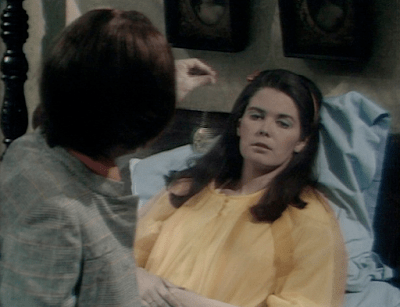
Barnabas appears in Vicki’s room. She awakens and is surprised to find him at her bedside. She recoils from him as she had been doing in November, when Julia had made her unconsciously aware of his true nature, but, again as she had done in those days, she overcomes her aversion and turns to him. He tells her to come to him. She hesitates, but does. He tells her he can give her peace and make it seem that everything that is distressing her is far away. She embraces him and asks him to do so. It looks very much like a seduction. Considering that Vicki kept embracing Barnabas and pushing her neck towards his teeth before Julia started hypnotizing her, it is an overdue one. Barnabas opens his mouth. He displays the same inner struggle he has shown on previous occasions when he had the chance to bite Vicki, but is still bending his head towards her neck when we fade out for the closing credits.

Barnabas about to bite Vicki. Screenshot by Dark Shadows Before I Die.