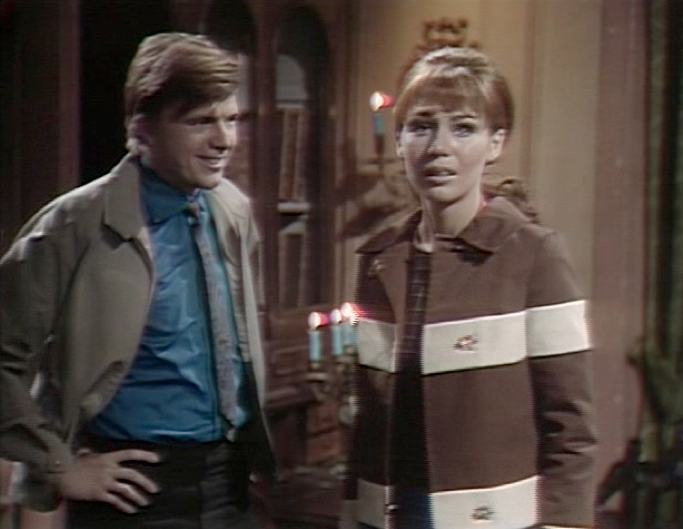
Episode 499: Fair warning

From #133, artist Sam Evans was compelled to paint a series of pictures that explained the evil intentions of undead blonde witch Laura Murdoch Collins, estranged wife of sarcastic dandy Roger Collins. In #146, Laura put a stop to Sam’s work by starting a fire that burned his hands so badly it seemed for a time he might never be able to paint again.

Sam shares his home, the “Evans cottage,” with his daughter Maggie, who is The Nicest Girl in Town and a waitress at the diner in the Collinsport Inn. Between her earnings there and the paintings Sam sells, the Evanses make a living, but it isn’t such a grand living that he can turn down any commissions, even very eccentric ones. Moreover, his work space entirely dominates the interior of the cottage. In the early days of the show, Sam’s old friend Burke Devlin often stopped by, and the conversation always turned to reminiscences of Burke’s youthful days of honest poverty. Nowadays the most frequent visitor is Maggie’s fiancé, hardworking fisherman Joe Haskell. Sam is delighted with the prospect of this upwardly mobile laborer as a son-in-law. When a representative of the moneyed world visits Sam or Maggie at home, as New York art dealer Portia Fitzsimmons did in #193 and old world gentleman Barnabas Collins did in #222, the contrast between their manner and the humble surroundings is meant to jolt us. The Evans cottage is therefore our window on the working class of Collinsport. When the troubles of the ancient and esteemed Collins family have an effect there, Dark Shadows is telling us that the whole town is dependent on the businesses they own and suffers as a result of their problems.

Yesterday, Barnabas came back to the cottage and brought Sam a very odd commission indeed. He presented a painting of a lovely young woman in eighteenth century garb and offered Sam $500* to paint over the image so that before morning the woman would look to be “about 200 years old.” Sam wasn’t in a position to refuse that much money, even though Barnabas wouldn’t explain why he wanted him to do such a thing.

If Sam knew what the audience knows, he would likely have turned the job down even if Barnabas had offered $500,000,000. The woman in the portrait is Angelique, and like Laura she is an undead blonde witch. In the 1790s, Angelique cursed Barnabas and made him a vampire. In #466, Barnabas’ vampirism went into remission. Shortly thereafter, the portrait made its way to the great house of Collinwood, where Roger became obsessed with it. In #473, Roger returned from an unexplained absence with a new wife. She is Angelique, wearing a black wig and calling herself Cassandra. From #366-#461, Dark Shadows had been a costume drama set in the 1790s; during this segment, we saw that Angelique was a far more dynamic and brutal menace than Laura ever was. Sam would hardly want to involve himself in a battle with this wiggéd witch.

For his part, Barnabas first appeared on camera in #210 and #211. But his portrait was first seen hanging in the foyer at Collinwood in #205, having been prefigured in #195. Dangerously unstable ruffian Willie Loomis became obsessed with the portrait of Barnabas. Willie could hear a heartbeat pounding from the portrait in #208 and #209, and followed its sound to the crypt where Barnabas was trapped in his coffin. As Roger’s obsession with Angelique’s portrait would bring her back to the world of the living, so Willie’s obsession with Barnabas’ portrait led to his return.

In the opening teaser, we see Sam working on the painting. He tells it that he can’t understand why Barnabas would want to disfigure such a pretty face, then resumes his task. The camera zooms in on the painting, as it had zoomed in on Barnabas’ portrait in #208 and #209, and the soundtrack plays the same heartbeat. Sam doesn’t react- he can’t hear it. It is addressed to the audience, especially to those members of the audience who remember the show as it was 13 months ago.

Angelique/ Cassandra is in the gazebo on the grounds of Collinwood. She is wearing a hooded cloak to conceal the aging she has already experienced as a result of Sam’s work. Her cat’s paw Tony Peterson, a local attorney, shows up, responding to her psychic summons. She entrances him with a flame and he tells her that the artist who has been in touch with the Collinses most frequently of late is Sam Evans. From this she concludes that Sam is aging her portrait at Barnabas’ bidding. Before Angelique/ Cassandra and Tony can go their separate ways, heiress Carolyn Collins Stoddard comes upon them.

Tony and Carolyn met in #357. In that episode, he was an instance of Jerry Lacy’s Humphrey Bogart imitation. A hard-boiled materialist, Tony had grown up in Collinsport as a working-class boy. He resented the Collinses and attributed all of their unusual characteristics to their wealth and social prominence. At that time, Barnabas was still a vampire and Carolyn was under his power. As a blood thrall, she knew that there was more to life than could be explained by Tony’s reductive logic, but she wasn’t free to offer any explanations. When Tony saw Barnabas biting Carolyn in #463, he interpreted their embrace as a sign of a sexual relationship.

Now their roles are reversed. It is unclear what Carolyn remembers from her time under Barnabas’ control; Nancy Barrett often plays the character as if she remembers everything, but the dialogue doesn’t give her much support for that, and in this scene she is as this-worldly as Tony was in the Autumn of 1967. She interprets Tony and Angelique/ Cassandra’s meeting at the gazebo as proof positive of an adulterous liaison, and declares she will report it to Roger. When Tony tells her that Angelique/ Cassandra has some mysterious power, Carolyn is dismissive, declaring that the Collinses are the ones who have all the power in this town. Tony tries to explain that the power Angelique/ Cassandra has is of an entirely different order from the power their ownership of capital gives the Collinses, and Carolyn responds with unconcealed contempt.

Angelique/ Cassandra knocks on the door of the Evans cottage. Sam opens the door. She ignores his objections and enters. While he keeps ordering her to get out of his house, she stands next to the portrait as he has aged it and points out her resemblance to it. He is astounded, but keeps telling her to leave. She says that she has no grievance against him and that no harm will come to him if he hands the painting over to her. He refuses. She heads out.

Angelique/ Cassandra and her portrait. Screenshot by Dark Shadows Before I Die.

Angelique/ Cassandra has barely closed the door behind her when Sam has trouble seeing. After a moment, he realizes he has been struck blind. She comes back in, takes the painting, tells him she warned him, and leaves.

Sam realizes he is blind. Screenshot by Dark Shadows Before I Die.

Closing Miscellany

Over the years, several members of the cast said on the record that Sam’s blindness was actor David Ford’s idea. He thought that if he could wear dark glasses it wouldn’t bother the audience that he read all his lines off the teleprompter.

In 2022, a commenter on Danny Horn’s post about this episode on his blog Dark Shadows Every Day identified the portraits of Angelique as the work of ABC Art Department specialist Joseph Guilfoyle:

You asked if anyone knew who painted these portraits. I can verify that the portraits of Angelique were painted by Joseph Guilfoyle. He was an artist in the Art Department at ABC. He was my Godfather and his daughter remembers this very well as it made her a bit of a celebrity at the time. Portraits were not commissioned out but instead were created in the Art Department as it was filled with many talented artists.

“Erin Allan,” posted at 5:55 PM Pacific Time 26 February 2022 on “Episode 499: A Senior Moment,” Dark Shadows Every Day, Danny Horn, 10 October 2014

Also worthy of note are the two facial makeups representing Angelique’s aging. It’s no wonder they didn’t have the personnel to make David Ford’s fake mustache look convincing when they were lavishing all the work on turning Lara Parker into two quite distinct old crones.

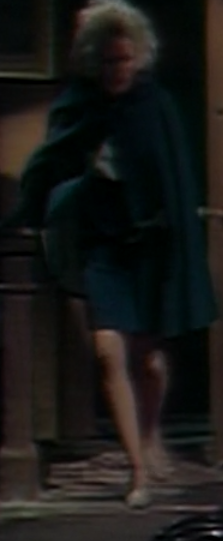
The costumers were involved in a famous production error in the final scene. Angelique/ Cassandra’s hooded cloak cuts off above her knees. There is no old age makeup on her legs, which are featured from every angle, making a ludicrous contrast with her face and wig.
*In 2024’s money, that’s $4544.17.
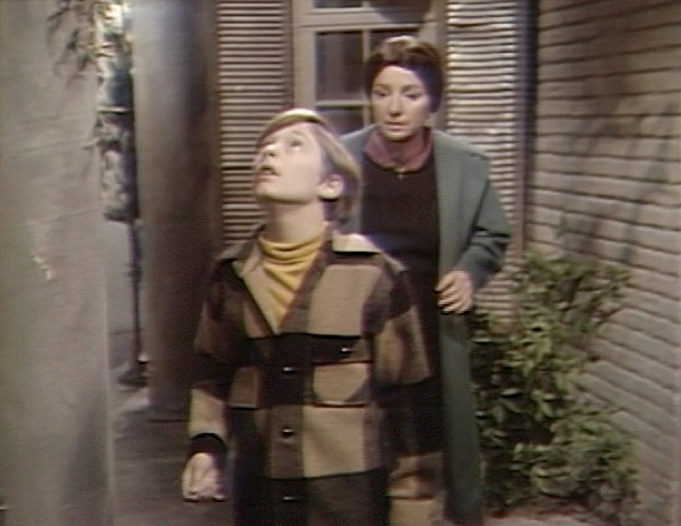
Episode 497: Acting like ourselves

Mrs Johnson, housekeeper in the principal mansion on the great estate of Collinwood, isn’t herself. She had a nightmare a week ago, and ever since has been plagued with a compulsion to tell its details to strange and troubled boy David Collins. She knows that if she does, David will have the same nightmare, the same compulsion to tell it to some third person, and that if he does that person will suffer the same complex. She doesn’t know that the nightmare is part of a curse sent by wicked witch Angelique, or that at the climax of the curse old world gentleman Barnabas Collins is supposed to revert to the vampirism that afflicted him from the 1790s until last month. But she does know that it is part of something horrible, and she has tried desperately to keep it from continuing.

Mrs Johnson spent a couple of days with her sister in Boston to stay far from David, but she kept having the nightmare there. She has given up, and has come back to Collinwood. She does not go straight home to the great house, but stops first at the Old House in the estate. Barnabas lives there, but it is Barnabas’ friend Julia Hoffman she sees. Julia had passed the dream to her. Julia urges Mrs Johnson not to tell David about it. She replies that she knows she should not tell him, but that she has no more choice in the matter than Julia had in telling her.

This scene will raise a question in the minds of regular viewers. Julia is a medical doctor doubly qualified in hematology and psychiatry; she also has developed a method of hypnosis so powerful that she can virtually rewrite a subject’s memory, confining even very intense recollections to the depths of the unconscious mind, sometimes after an acquaintance of only a few minutes. Why doesn’t she try to hypnotize Mrs Johnson into forgetting the dream? All she actually does is slap her and repeat her command to avoid David.

David turns up. His father has sent him to ask Julia to come to the great house at her convenience. Julia tries to manage the situation by sending Mrs Johnson home first and keeping David in the house for a while. After Mrs Johnson leaves, Barnabas’ servant Willie enters and tells Julia there is an emergency in the basement. David agrees to wait for her to come back, but once she is gone he shouts that he will be playing outside.

We follow David out the front door, and find that Mrs Johnson is there waiting for him. She comes up on him from behind and says she has something to tell him. This scene will startle regular viewers. For nineteen weeks, from #365 to #461, Dark Shadows was a costume drama set in the 1790s. In that period, Clarice Blackburn played repressed spinster Abigail Collins and David Henesy played Daniel Collins, heir to the Collins fortune. We first saw Daniel in #431, when his Aunt Abigail intercepted him on this very spot and scolded him for playing at the Old House. Abigail was enforcing rules and believed she was acting in Daniel’s best interests; now the same actors invert the scene, showing us Mrs Johnson doing something she knows to be wrong and harmful to David.

Mrs Johnson sneaks up on David. Screenshot by Dark Shadows Before I Die.

Maggie Evans, The Nicest Girl in Town, isn’t herself. Some emerald earrings mysteriously appeared in her purse the other day, and when she tried them on she got a faraway look on her face, began speaking in a voice different from her own, and a tinkling music played on the soundtrack. Today her boyfriend Joe tells her that he took the earrings and showed them to a jeweler and to the police. The jeweler valued them at $15,000* and the police said that they didn’t match the description of any jewelry that had been reported missing. Maggie was not only irked that Joe had taken the earrings without her permission, as anyone might be, but when he tries to get her to agree that such expensive things don’t just materialize out of thin air her usual level-headedness and cheerful disposition vanish and she becomes childishly defensive. Maggie does not know that Barnabas’ servant Willie placed the earrings in her purse as an attempt to reestablish the connection the two of them had when she was Barnabas’ prisoner in the Old House. As a result of Julia’s hypnosis, she does not even remember what Barnabas did to her. But after she runs Joe off, she is compelled to go to the Old House.

Again, regular viewers will recognize an echo of an earlier episode, in this case one that aired a year ago. When Maggie was Barnabas’ victim in May 1967, she snapped at Joe and drove him out of her house as she does today. Then too, she headed for Barnabas once Joe was gone.

Maggie doesn’t find Barnabas at the Old House. Instead, she sees Willie. Barnabas had framed Willie for his crimes against Maggie, and Willie was confined to the mental hospital Julia runs. Barnabas and Julia have brought him back to the Old House to help with their latest nefarious scheme. Willie had been Barnabas’ blood thrall; it is not clear to the audience just what effect it had on Willie when Barnabas’ vampirism went into remission. When we first see him today, he is playing with an unloaded rifle and grinning maniacally, reminding us of the dangerously unstable ruffian he was before Barnabas first bit him.

Maggie knocks on the door and asks Willie if she can come in. He falls over himself inviting her. He becomes the friend he tried to be to her during her imprisonment. She says she knows that he wasn’t the one who hurt her, and he is overjoyed. She seems blissful. He asks her out on a date; she says that Joe wouldn’t like it. Before Barnabas, Willie propositioned all the young women and threatened all their boyfriends, and at first this approach, like his gleeful handling of the rifle, suggests that dangerously unstable ruffian is back. He assures Maggie that he only wants friendship, but after she leaves he picks the rifle up again and says that Joe will be out of the way soon.

Maggie finds herself strangely at home. Screenshot by Dark Shadows Before I Die.

For her part, Maggie’s behavior does not represent a reversion to her time as Barnabas’ prisoner. Rather, the earrings seem to have done what Barnabas tried to do when he bit her, imprisoned her, and subjected her to a series of role-playing exercises. Her personality is showing signs of giving way to that of Barnabas’ lost love, gracious lady Josette. In #260, Barnabas told Maggie “You are Josette!”; in #370, we saw that he was right, inasmuch as Kathryn Leigh Scott played both characters, as Zita Johanns had played both Helen Grosvenor and Princess Ankh-Esen-Amun in the 1932 film The Mummy, from which Barnabas’ Josettification project was borrowed. The tinkling melody that plays on the soundtrack when Maggie wears the earrings is that of Josette’s music box; this could be a sign that her memory of what Barnabas did to her is coming back, since he forced her to listen to the music box for hours on end. But the voice she speaks in at those times is the voice Miss Scott used as Josette, and her blissfulness reminds us of Josette’s first scenes with her beloved Barnabas, not of Maggie’s captivity in the ghoul’s dungeon.

Back at Collinwood, Mrs Johnson watches David sleep. She tells him she is sorry for what she has done and for what he will suffer. Clarice Blackburn was always good, but she outdoes herself with this speech. It is a beautiful performance.

David has the nightmare. The first several dream sequences in the Dream Curse storyline ended with the dreamer opening a door, seeing something scary, and screaming. David’s goes a step further. There is a gigantic spider web behind the last door he opens. He not only sees it, but is tangled in it when he starts screaming. He awakes, still screaming, and Mrs Johnson holds him.

*Equivalent to $135,796.52 in 2024’s money, according to the CPI Inflation Calculator.

Episode 199: About as welcome as poison ivy

Yesterday’s episode ended with a powerful scene in which Maggie Evans, The Nicest Girl in Town, learned the terrible secret her father, drunken artist Sam Evans, has been keeping for the last ten years. Today begins with a reprise of that scene.

Sam has admitted that one night he saw a car barreling down the highway, swerving wildly from lane to lane. It hit and killed a man, then sped off. Sam could see the driver, high-born ne’er-do-well Roger Collins. Dashing action hero Burke Devlin was passed out in the back seat, and Roger’s future wife, blonde fire witch Laura Murdoch, was also in the car. The night after the collision, Roger showed up at the Evans cottage and offered Sam $15,000 for some paintings.*

Sam tells Maggie that he knew this was a bribe to secure his silence. He explains that at that time, Maggie’s mother was very sick with the illness that would ultimately take her life, and that he had no way of earning enough money to meet even the family’s basic expenses. With the money from Roger, he was able to give Maggie’s mother everything he had always wanted her to have. The more Sam explains that he traded his conscience for money, the more Maggie looks down at herself and sees her waitress’ uniform. Apparently she can’t help thinking about where the household income has been coming from in the years since Sam’s big sale, and assessing Sam’s current contribution to their balance of expenses.

Maggie talks slowly, choosing her words with care and her themes with tact. She acknowledges that it would have been hard to refuse Roger’s money under the circumstances, and Sam exclaims that it would have been impossible. Maggie turns away with a look of distress, as if she suspects that another sort of person might have found it entirely possible to say no to Roger. She leaves that topic alone, and focuses on how shocked she is that Sam kept quiet when Burke was tried, convicted, and sentenced to five years in prison on the premise that he had been the driver.

Sam asks Maggie what he can do or say to regain her respect. She suggests he go to Burke and confess to him. Sam asks if she wants him to go to jail; she says no, of course she doesn’t want that. He swears he will quit drinking; wearily, she tells him she hopes he sticks with it this time. Eventually she stops responding to what he says, and just answers his pleas by announcing that she has a date to get ready for.

This exchange is divided into two scenes. The second begins with some repetition of points from the first, but that actually works to strengthen the drama- it shows us that Sam is desperate to find some way of making things right with Maggie that doesn’t involve volunteering for a prison sentence.** When Maggie has left for her date, we see Sam stew around for a moment. Finally, he picks up the telephone and calls Burke. By that time, we can see that he really has exhausted every possible alternative.

In between the two Sam/ Maggie scenes, we see Burke having dinner with well-meaning governess Vicki at Collinsport’s only night spot, The Blue Whale. Vicki is telling Burke everything she knows about the current doings at the great house of Collinwood. She is worried about reclusive matriarch Liz, who hasn’t been herself lately, and uncomfortable around Liz’ houseguest, seagoing con man Jason McGuire. Burke has never heard of Jason. As the Collins family’s sworn enemy, Burke of course listens attentively to all the intelligence Vicki has gathered. One does wonder what the Collinses think of their governess blabbing so much to Burke, who casually mentions in response to one of Vicki’s expressions of concern for Liz that he is trying to drive her out of business.

Jason shows up in the tavern and approaches Vicki. She introduces him to Burke. While they are exchanging pleasantries, a young man enters and smiles. He calls to Jason, who hastens away from Burke and Vicki to talk alone with him.

The young man leers at Vicki. Burke gets up and says he wants to confront the young man, but Vicki insists he sit back down. The young man continues leering at Vicki, and Jason pleads with him to stop. The man’s tone and bearing are threatening, and his habit of referring to himself in the third person while talking about the things to which “Willie” is entitled emphasizes the note of menace. When another customer brushes against him, Willie jumps up. Three men, Jason, Bob the bartender, and a background player*** restrain him from punching the guy. Burke and Vicki comment on Jason’s choice of friends.

Willie forlornly watches a man leave, taking with him his chance to beat him up

Actor James Hall does a fine job of showing Willie as a dangerously unstable man. His staring at Vicki unsettles everyone, a fact which seems to please him. As soon as he stops talking, the airy manner he adopts when he declares that his current lodgings are “not Willie’s style” or that “Willie is not a patient man,” disappears and his face settles into a look of depression. The brush that sets him off into his spasm of violence is so light and so brief as to be noticeable only in a prison laundry. When Jason, Bob, and the man from the background hold him and he realizes he has missed his chance to beat someone up, his rage at once gives way to a hollow look of yearning and sorrow, as if he is in mourning for the violence that might have been. He would be right at home on a cross-country killing spree, but it’s hard to see what use Jason would have for him. Jason is a con man and blackmailer, two forms of criminality that require the ability to gain some measure of trust from a victim, and no one would trust Hall’s Willie for even a fraction of a second.

If it turns out that Jason has more than one piece of compromising information on Liz, Willie might make sense. Let’s say that, when she and her long-absent husband lived together, they found themselves implicated in a number of Jason’s crimes, and some of those involved hyper-violent hoodlums. Then when Liz sees Willie, she might find herself falling back into an old trap and try to figure out a new way to free herself from it. But if all Jason knows about Liz is what he has threatened to reveal in his three conversations with her so far, Willie would seem to be an unsolvable puzzle.

Burke shows up at the Evans cottage and tells Sam that he received his message. Since Sam had told the clerk at Burke’s hotel that he was calling in connection with an emergency, Burke keeps pressing him to explain what he wanted to say. Sam keeps stalling. Despite his promise to Maggie a few minutes ago to quit drinking, his stalling involves a couple of shots of booze. Finally Sam screws up his courage and tells Burke everything. Burke declares “I knew it!”

*According to the Bureau of Labor Statistics online CPI calculator, $15,000 in the summer of 1956 would have the same purchasing power as $165,905.41 in March of 2023.

**I am curious as to what Sam’s legal position would actually have been. He tells Maggie that neither he nor Roger said anything about the accident when he gave him the money; Sam simply assumed he was taking a bribe. Since Roger did receive the paintings, and famed art dealer Portia Fitzsimmons has told Sam that the paintings would now be worth a great deal of money, only Sam’s confession of his corrupt motive would suggest that he did anything ten years ago that it might be possible to prosecute him for. Besides, he never committed perjury or lied to law enforcement- he never said anything at all. It would seem the most they could have got him on at the time would have been failure to report an accident, and surely the statute of limitations on that misdemeanor would have expired after ten years.

His more recent behavior would seem to present a more serious problem. Ever since Burke came back to town in episode 1, Sam and Roger have been talking to each other about the accident and its aftermath, meeting in public places and confirming over and over that the money was a bribe. Moreover, Sam has spent the last few days blackmailing Roger, threatening to go to Burke unless Roger produces the paintings in time for him to have Portia Fitzsimmons show them in her gallery. Roger has not been able to find the paintings. So going to Burke, or even to the police, could be interpreted as an act in furtherance of Sam’s blackmail scheme, and therefore as itself felonious. It is no wonder that when Sam went to the telephone, my wife, Mrs Acilius, was shouting at the screen “Call a lawyer!”

***Who according to the Dark Shadows wiki worked under the name “Frank Reich.” Since “Frankreich” is the German name for France, I assumed that “Frank Reich” was an obvious pseudonym. But it turns out there are a number of people in the world whose actual given name is “Frank Reich,” some of them well-known, so who can say.