Centenarian Charles Delaware Tate, once a famous painter, is trapped in his parlor with a man who is threatening to kill him. The man is Chris Jennings. Chris tells Tate that there will be a full moon tonight, and he identifies himself as a werewolf. In 1897, Tate painted a portrait of Chris’ great-grandfather, Quentin Collins. That portrait had magical powers that immunized Quentin against both lycanthropy and aging, and Chris is demanding Tate do the same for him. Tate keeps telling Chris that he no longer has the ability to create such things, but Chris won’t listen. Tate does a sketch. He says that his work is finished and tells Chris to take it and leave. Before Chris can comply, he turns into the wolf and attacks Tate.
Chris had been in a secure room at a mental hospital controlled by his friend, mad scientist Julia Hoffman. He deliberately checked himself out and forced his way into Tate’s house because he wanted to use his condition as a weapon to coerce Tate. Julia is the audience’s chief point of view character these days, and she feels sorry for Chris. We also like two characters who care about Chris and don’t know that he is a werewolf. Heiress Carolyn Collins Stoddard is attracted to Chris and seems to have some lingering hopes that a romance might blossom between them, and Chris’ little sister Amy loves him and believes in him. Even one of Chris’ surviving victims, prematurely gray Sabrina Stuart, told Carolyn in #889 that while Chris is dangerous, “he is good.”
Despite everything these ladies are doing to help us like Chris, there can be no doubt that his attack on Tate is murder with premeditation and extraordinary cruelty. Roger Davis can usually be counted on to make us sympathize with anyone who is murdering one of his characters, but he plays Tate today with sensitivity and pathos, leaving us no way to avoid seeing a helpless old man locked up with a vicious killer. Chris’ future on Dark Shadows is limited for a number of reasons, chiefly his passivity in the face of his curse and his dependence on Julia and others to initiate action on his behalf. His abuse of Tate suggests that for whatever time he may have left on the show, Chris will be an unsympathetic villain.
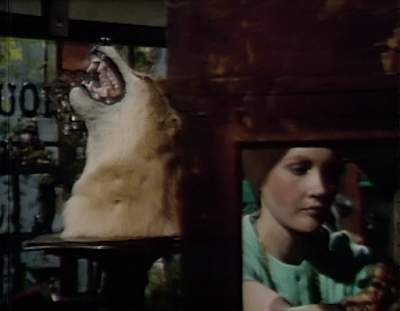
Meanwhile, Carolyn is spending the day working as an assistant in an antique shop owned by her friends Megan and Philip Todd. Our first view of the shop today features Carolyn reflected in a mirror, but the main part of it is the taxidermied head of a baying wolf, emphasizing the danger Chris poses to everyone in and around the village of Collinsport.
A pair of hands cover Carolyn’s eyes. When they are pulled away, she expects to find that they belong to Philip’s eight year old nephew Alexander, but instead discovers that a thirteen year old boy she has never before seen has introduced himself to her by creeping up behind her and grabbing her face. The boy tells her that his name is Michael, that he is another of Megan and Philip’s relatives, and that Alexander has gone away. He tries to give Carolyn a pendant, but she recognizes it as one Megan wears and says that Michael can’t very well make a gift of something that doesn’t belong to him. He becomes very stiff and screams “How dare you not believe me!?” He doesn’t get any more pleasant as the scene goes on.
Philip comes in and tries to establish some kind of control; Carolyn takes the opportunity to excuse herself. As Michael and Philip talk, it becomes clear that they are part of a secret group with sinister plans. Returning viewers know that Michael and Alexander are not really human children, but are two manifestations of the same supernatural force. As Alexander, this force was a joyless, hateful little tyrant; Michael is no more appealing.
Dark Shadows originally ran on the ABC television network five days a week, from Monday through Friday. The episodes were numbered in a sequence reflecting the order of their original broadcast. When for whatever reason the show did not air on a given day, they would skip a number to keep the episodes airing on Fridays associated with production numbers divisible by 5. That made it easy to figure out how many weeks the show had been on, which in turn made it easy to keep track of where the show was in the thirteen week cycle that governed its long-term planning and the network’s decision to renew it.
In the last months of 1969, the show was being taped several weeks in advance of airdates, in a couple of instances more than five weeks ahead of time. This was atypical, and it led to a problem with the numbering. They knew that no episodes would air on Thanksgiving Day, Christmas Day, or New Year’s Day, but did not foresee that the network would preempt #891 for live news coverage of the return of the Apollo 12 astronauts to Earth on 24 November 1969. Since they had already shot that episode and many following it with the original production numbers on the opening slate, it wasn’t until this one that they had the chance to get the numbers back in synch. That is why it is listed with the three numbers 919, 920, and 921. The only other time they had to skip two numbers was in November 1966, when coverage of football games on and after Thanksgiving Day blotted out #109 and #110. Since that disruption to the schedule was planned, the slate for the next episode was just marked #111. This is therefore the only episode regularly referred to with a triple number.
Episodes 1 through 274 of Dark Shadows opened with voiceovers by Alexandra Moltke Isles, usually in character as well-meaning governess Victoria Winters. What followed was therefore in some sense a story told by Vicki, implying that she would eventually learn everything that happened in it. Indeed, this was the case for the first 39 weeks of the show. Vicki represented our point of view, and nothing remained secret from her for long.
That changed after vampire Barnabas Collins joined the cast in #211. Originally it seemed that Barnabas would be merely the second in a series of supernatural Big Bads, and that like his predecessor, undead blonde fire witch Laura Murdoch Collins, he would meet with defeat after Vicki caught on to his true nature and rallied the other characters against him. But Barnabas drew a whole new audience to the show. After a few weeks, he had raised Dark Shadows from its place at the bottom of the daytime ratings; by the summer, the show was a sort of hit. It was out of the question to destroy him. They had to find a way to keep him on the show indefinitely. Since the core of Vicki’s character was her trustworthiness, she could not possibly know about a vampire and fail to destroy him. So she ceased doing the narrations, ceased functioning as the audience’s representative, and after a while ceased to have any reason to be on the show at all. Vicki was written out late in 1968, and is now almost entirely forgotten.
Mrs Isles’ final episode as Vicki was #627. In our last glimpse of her, she was talking with Julia Hoffman, a permanent houseguest in the mansion of Collinwood. That shot represented the hand-off from one audience point of view character to another.
Julia first joined the show in the summer of 1967 as a psychiatrist treating one of Barnabas’ victims, then came to Collinwood to join forces with Barnabas as she left psychiatry to pursue her true calling as a mad scientist. Julia soon knew everything about the horrors Barnabas and the other monsters who joined the cast perpetrated. As deceptive as Vicki was truthful, as incriminated as she was pure, Julia was perfectly at home in the all-villain cast that is the hallmark of the show’s strongest periods.
Julia was absent from the show for most of 1969, when Dark Shadows was a costume drama set in 1897. She traveled back in time to that year and took part in the action for much of September, but for the other seven months we were in suspense as to when she would find out what had happened and what she would do with the news. When her friend Barnabas returned to 1969 from his long stay in 1897, she expected him to bring her up to date. We knew that he had come under the influence of a mysterious group and was likely to be distant towards her, but were still shocked when he refused to tell her anything at all.
Today, Julia’s function as the character who knows what the audience knows is dramatized when matriarch Elzabeth Collins Stoddard and her brother Roger are in the drawing room at Collinwood having a conversation about Roger’s son David. Julia is on the stairs in the foyer, heading to her room, when she sneaks back down and places her ear to the door. In no way does this conversation concern Julia; she eavesdrops only to reassure us that she will know what is happening.
Julia’s friendship with Barnabas has been her starting point in most of the stories so far. She is so well established on the show that she doesn’t really need him, but she does need someone to talk to about her investigations and discoveries. A flunky who will follow her orders will suffice to serve that purpose for now, and so she has taken troubled drifter Chris Jennings on in that capacity.
When Vicki was leading the fight against Laura, she needed a flunky. So they gave her a boyfriend named Frank Garner. Every character has to have some connection to the ancient and esteemed Collins family; Frank and his father were the lawyers representing the family in its business dealings. Long before they were introduced, the show had moved on from the business stories of its first months. By that time, all we hear about the Collinses’ money is that they have an inexhaustible supply of it, and it occasionally attracts unwelcome attention. Conard Fowkes was a capable actor and did what he could with the part, but there was so little to it that he wound up doing a very convincing imitation of a person you might meet in a law office in Bangor, Maine in 1966, with no more entertainment value than you might expect such a person to offer.
Chris gives the writers far more to work with than Frank ever did. He is related to the Collinses through his great-grandfather Quentin Collins, and like Quentin is a werewolf. Chris and heiress Carolyn Collins Stoddard dated before his lycanthropy took hold, and they still have not resolved their feelings for each other. His little sister Amy lives at Collinwood, and is often involved in the stories. He hopes that Julia will be able to cure him of his curse.
Julia’s plan for accomplishing this goal centers on a man named Charles Delaware Tate. When Julia was in 1897, she befriended Quentin and learned that Tate had painted a portrait of him. On nights of the full moon the portrait becomes that of a wolf while Quentin remains human. In fact, Quentin himself came back to Collinsport a few days ago, still alive and to all appearances 28 years old. He has amnesia and refuses to believe any of the preposterous facts Julia tells him about himself, but is quite obviously Quentin. Julia has found two almost identical paintings done in recent years, one signed “C. D. Tate” and the other “Harrison Monroe.” Julia has tracked Monroe down in the hope that he really is Tate and that he will be able to paint a portrait that will do for Chris what was done for Quentin.
Yesterday, Julia had told Chris she wanted to go to Monroe’s place to see if he was Tate. Later, we simply cut to her in front of the door. She rang the doorbell, and a voice from a loudspeaker mounted above the door-frame told her to go away. She said she had a message from “Delaware Tate,” and the door drifted open. She entered the door as the episode ended.
Today’s opening reprise recreates the scene at the door, with a different voice coming through the loudspeaker and Grayson Hall remembering to put the “Charles” in front of “Delaware Tate.” When we come back from the main title sequence, she is wandering around inside a darkened house while a voice from another loudspeaker gives her directions.
Julia makes her way into a room where a young man sits at a desk. The room is as dark as the rest of the house, but she can see him clearly. She recognizes him as Tate, his appearance unchanged from what we saw in 1897. It is not entirely clear how she knows who he is- she and Tate did not meet during her sojourn in the past- but viewers who are faithful enough to know this also know that she represents our point of view. Since we saw far more of this unappealing character than we wanted, we are untroubled that Julia knows him.
The mysterious group that has coopted Barnabas is generating a story based on H. P. Lovecraft’s novella The Dunwich Horror. Fans of Lovecraft who are happy about this will recognize the shadowy figure in a corner of a room who speaks through an electronic amplifier as an homage to his The Whisperer in Darkness, throughout which the protagonist consults with a man who meets that description. Julia and we get a much closer look at Tate today than Professor Albert Wilmarth gets of Henry Wentworth Akeley until the conclusion of the story, at which point Akeley’s true appearance represents a twist ending.
Tate looks down throughout their conversation and keeps shouting at Julia that she should go away. His mouth moves in time with the words booming from the loudspeaker. He responds to everything she says with an announcement that it is of no interest to him. When she mentions that she has “transcended time” and compares that feat with Tate’s apparent success at finding “a way to suspend time,” he is as gruffly indifferent as if she had said she had washed her car and he has changed the oil in his. She tells him what he did for Quentin; he shouts that the story is “only a legend.” Finally, Tate looks up, he laughs, the lights flicker, a noise sounds, and he looks back down. Julia takes this as her cue to leave.
Accompanied as it is by the sound and lighting effects that precipitate Julia’s exit, I take it that the laugh is supposed to be maniacal or unearthly or something. Roger Davis had extensive training as an actor and has had a huge career on screen, so one supposes he could deliver such an effect had he chosen to do so. Instead, what he actually does is stick out his upper lip and emit a throaty guffaw, sounding very much like the Disney character Goofy.
“Hyuck-hyuck!”
I was left wondering why Julia left this meeting while still holding the strongest card in her hand. Quentin is not the only person who has come to town recently whom Tate knew in 1897. A woman calling herself Olivia Corey is actually Amanda Harris, who popped into existence one day in 1895 when Tate was painting a portrait of his ideal woman. Like Quentin, Amanda appears to be the same age she was when she was in Collinsport in 1897. Tate was obsessed with her then, but she and Quentin fell in love with each other. She still loves Quentin, and has now met him and set about trying to restore his memory. Julia knows all about Amanda, and has even come into possession of one of the portraits Tate painted of her. Had she said that she knew where he could find Amanda Harris, Julia could have expected a strong reaction from Tate. I suppose we can expect to see Julia team up with Amanda and then pay another visit to Tate.
The Whisperer in Darkness is not the only work of fiction Julia’s meeting with Tate recalls. It will also remind longtime viewers of #153 and #154, when Vicki and Frank went to a building in the old cemetery north of town and met the cemetery’s caretaker. Much of #153 was taken up with what writers call “shoe leather,” material showing how characters get from one scene to another. There was a whole act about Vicki and Frank setting out on a date for dinner in a restaurant, riding in his car, and her developing a vague sense they should go somewhere else instead. They quarrel about her vague sense, then he capitulates and takes a series of turns she dictates. It gradually dawns on her that the ghost of Josette Collins is feeding the directions into her mind. They find themselves in the cemetery, and Vicki relays further directions from Josette until they find themselves at the door. They knock, wait around, and are about to leave. Then, the door drifts open. They stand there staring inside. That’s the end of the episode.
Vicki and Frank were still at the front door in the reprise that opened #154. They were met there by the caretaker of the cemetery, who asked them if they were ghosts. The conversation got weirder from there, but he did let them into the building. Frank faded into the background during that scene, but his unfailingly rational, serviceably masculine presence did rule out any possibility that Vicki would be in any serious danger during the scene. Had Vicki been alone with the caretaker, there would have been some suspense as to what would happen between them. The setting is eerie enough that he might turn out to be a ghost himself, or some other kind of being who will be a threat to her. As it is, he is labeled a harmless old crank from the first moment we see him.
Yesterday’s episode dispensed with all of #153’s shoe leather. We’ve heard Julia wants to visit Monroe, we cut to her pressing a doorbell, and we assume that she drove to Monroe’s house. The door drifted open at the end of yesterday’s episode just as it did at the end of that one, but Julia actually went inside. She goes alone, so that she will not have anyone to help her fight any enemy she may find there or to corroborate her version of whatever events she may witness.
In those ways, these two episodes are an improvement over what we saw in #153 and #154. There is another way, however, in which they are a deep step down. The doddering old caretaker, played by Daniel F. Keyes, was hilarious, a refugee from EC Comics who got laughs every minute he was on screen. Tate, like other Roger Davis characters, elicits impatience at best and revulsion all too often. Julia, and we, deserve better than to have to see him again.
In December 1968, children David Collins and Amy Jennings explored the long-deserted west wing of their home, the great house on the estate of Collinwood. They stirred up the ghost of Quentin Collins, who turned out to be David’s great-great uncle and Amy’s great-grandfather. For the next several weeks, Quentin steadily gained power and wrought ever graver havoc, until by the end of February the great house had become uninhabitable and David was hovering between life and death. At that point, David and Amy’s distant cousin Barnabas Collins did some mumbo-jumbo to try to contact Quentin’s ghost, only to come unstuck in time and find himself in the year 1897, when Quentin was a living being.
For the next eight months, Dark Shadows was primarily a costume drama set in 1897. Occasional glimpses of 1969 showed us that the haunting was continuing. In #839, we saw David lying dead before his father Roger, finally having succumbed to the effects of the haunting. But while Roger was lamenting him, David came back to life. The events in the part of the episode set in 1897 had changed the future, so that the ghost of Quentin found peace and Collinwood returned to its usual condition. But that took effect as of the anniversary of the change. Everyone’s memories of the ten months of Quentin’s haunting and of the eight months of Barnabas’ absence in the past are intact.
Not only is Quentin no longer a ghost, he isn’t even dead. In the altered version of 1897 that we saw, an artist named Charles Delaware Tate painted a portrait of Quentin that had the same magical effects on him that Dorian Gray’s portrait had in Oscar Wilde’s novel. Quentin looks, moves, and sounds exactly like he did when he was 28 years old. He has recently returned to Collinsport, and has amnesia. He was found carrying identity papers in the name of Grant Douglas. He’s open to the possibility that that may not be his right name, but when he finds Dr Julia Hoffman, MD trying to convince him he is the 99 year old Quentin, he is incredulous.
At Collinwood
We open today in Quentin’s old room in the west wing. Julia has persuaded Quentin to sit there and listen to his record player. In the unaltered timeline, he was obsessed with a sickly little waltz, listening to it over and over in 1897 and inflicting it on Collinwood when he was a ghost. Julia plays the record, and it doesn’t mean a thing to him. She becomes frustrated and accuses him of lying when he says that he doesn’t remember that he is Quentin.
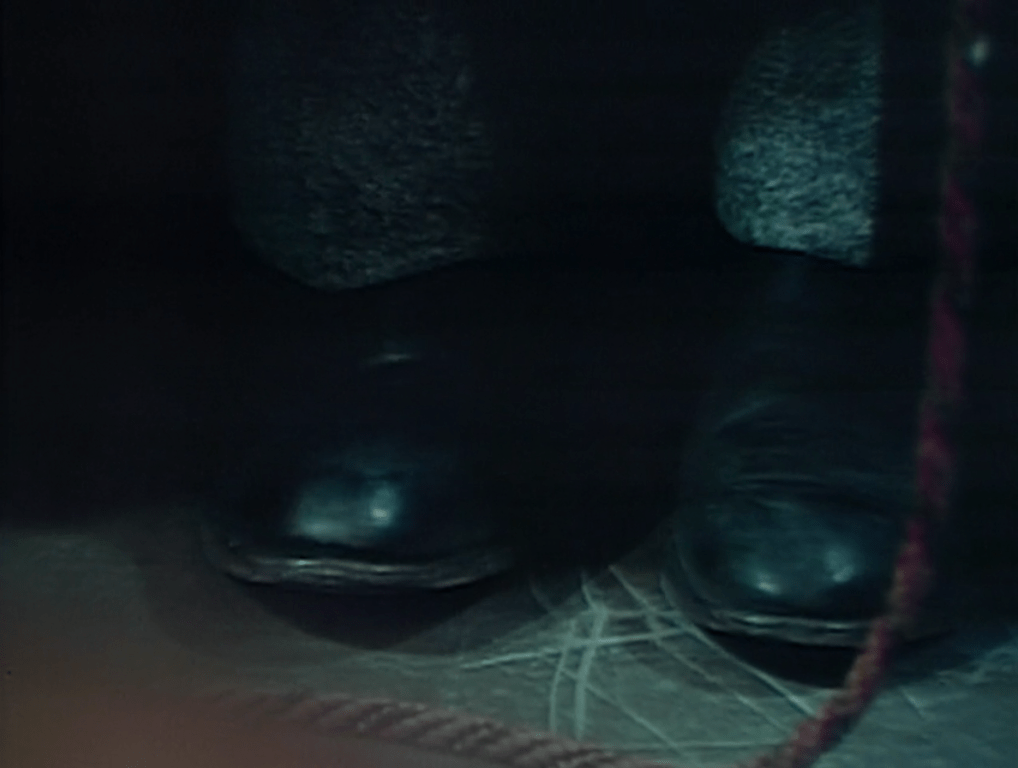
The music does ring a bell for someone else in the house. The sound of it reaches David and wakes him. Alarmed, he makes his way to Quentin’s room. By the time he gets there, Quentin is hiding behind a curtain. Julia tells David she went in to look for a painting, and that she thoughtlessly started the record player. He accuses her of hiding Quentin. While she is denying it, he sees Quentin’s shoes sticking out from under the curtain.
Quentin’s shoes, as seen by David.
In 1963, philosopher Edmund Gettier published a little paper about the traditional definition of knowledge as “justified true belief.” He gave several examples of justified true beliefs that most people would not regard as knowledge. His examples were kind of far-fetched, but it is easy to come up with more plausible instances. For example, I first read Gettier’s paper when I was in college, and at the same time I was reading Anthony Trollope’s novel The Eustace Diamonds. The main point of that novel is that everyone believes that Lizzie Greystock has stolen some diamonds from her late husband’s estate. She has in fact done so, and they have good reason for believing that she did so, but those reasons are so mixed up with misunderstandings of Lizzie’s motives and other circumstances that we wouldn’t say any of them really knows anything about her. My epistemology professor was excited when I told her about the novel, since the example she gave to our class to show that Gettier’s contrivances were not the only cases illustrating his point was something overly elaborate about believing that you have recognized someone whom you have partially seen while he is hiding most of himself behind a curtain.
David’s claim that Julia is hiding Quentin is another Gettier case. He believes it, the sight of Quentin’s shoes in Quentin’s room provides compelling justification for believing it, and it is true. Yet the Quentin whom Julia is hiding does not have any of the characteristics that give David’s belief the significance that he draws from it. His presence is not a sign that the haunting has resumed and that David is back in mortal danger. He is not a ghost at all and is not a threat to David or anyone else in the house. So while David has a justified true belief that Julia is hiding Quentin, that belief is so deeply entangled with a severe misunderstanding of the situation that we wouldn’t count it as knowledge.
Once David is gone, Quentin emerges and demands answers from Julia. She tells him something about Quentin’s ghost; he already finds her insistence that he is 99 years old to be so preposterous that the additional detail that he used to be dead prompts a merry laugh. By the time he is at the front door ready to leave, he is stern and telling Julia that he expects a “full explanation” tomorrow. Lotsa luck on that- ghosts, time travel, magical portraits, and a universe where the present is a stew made up of the consequences of several mutually incompatible pasts? And those are just the elements you can’t avoid in the executive summary of the situation. A “full explanation” involves werewolves, vampires, a humanoid Phoenix bent on incinerating her children, demons conjured from the depths of Hell, a sorcerer who still misses his pet unicorn, and about a thousand other fantastical topics.
David eavesdrops on Quentin and Julia’s parting conversation. When he was a ghost, we never heard Quentin speak- he communicated telepathically with David and Amy, and they could apparently hear his voice on a particular telephone, but he never stood around and talked with anyone like this. So the mere fact of the conversation undermines David’s belief that the man he is looking at is Quentin’s ghost. When David hears Julia call Quentin “Mr Douglas,” he can see that whoever this person may be, he is not exactly Quentin, not as he knew him. He does recognize the name “Mr Douglas” as that of a man his cousin Carolyn Stoddard met at the antique shop in the village where she works and whom she visited in the hospital when he first had amnesia, so his attitude towards him changes.
In the Antique Store
Unknown to Julia or Carolyn, David has been assimilated to a cult that serves unseen supernatural beings known as the Leviathans. Carolyn’s mother, Elizabeth Collins Stoddard, has also been absorbed into the cult, as has Barnabas. Megan and Philip Todd, the owners of the antique store, are members too, and they are fostering a mysterious creature who currently appears to be an eight year old boy and answers to the name Alexander. Liz takes David and Amy to the antique store, where they interrupt an uncomfortable conversation between Alexander and Julia.
Liz suggests to Julia that they should leave Amy and David in the store to play with Alexander. Julia doesn’t think this is such a hot idea, but Liz insists.
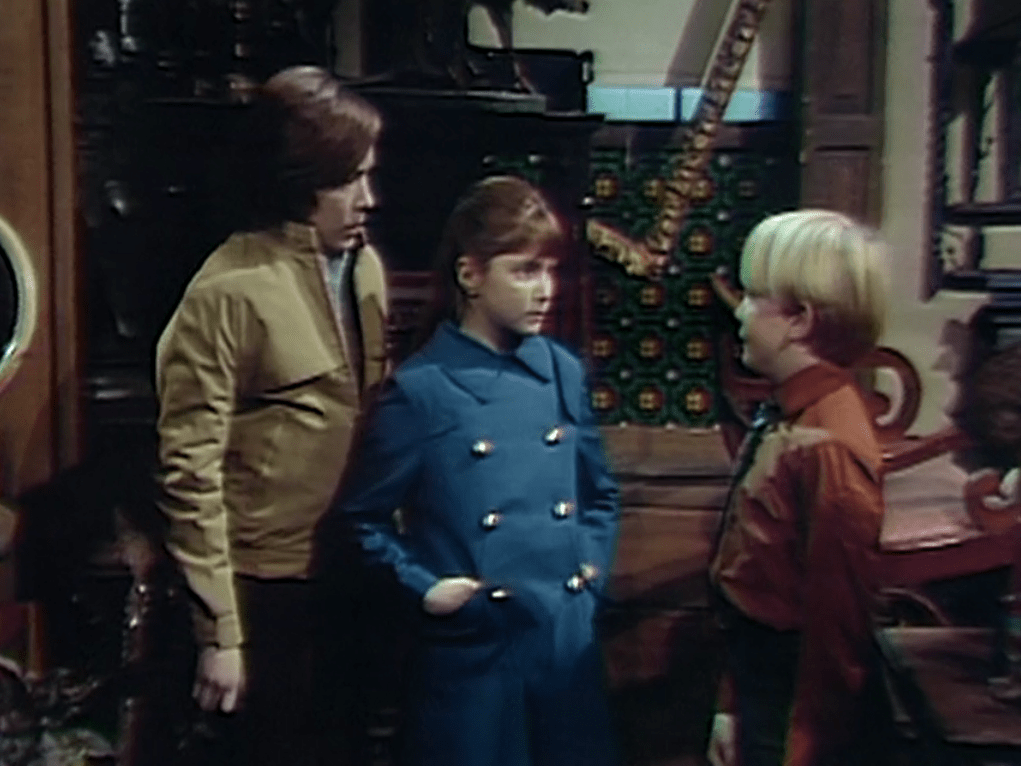
We then have the first scene on Dark Shadows populated by three child actors. It was a breakthrough when the ten year old David played with the ghost of nine year old Sarah Collins in the spring and summer of 1967; their scenes, the first interaction between children on Dark Shadows, advanced it towards becoming a kids’ show. David had up to that point been the only child on the show. He was first a homicidal monster who threatened the adults, then a figure threatened by his mother Laura and in need of rescue. When we saw him with Sarah, the two of them built a relationship that was of importance in itself and that had consequences which grew to dominate the story, leading directly to the show’s first time travel segment in November 1967. In David and Sarah, the fans running home from elementary school to watch the show could see characters their own age driving the action.
The current phase has been very heavy in adult interest. This first three-scene among children might be expected to take us back to territory Sarah and David did so much to open, but it does nothing of the kind. The three children do not really interact with each other at all. David is under the control of the Leviathans, Alexander is a manifestation of their power, and Amy is at a loss to figure out what’s going on. The forces motivating the action are not on screen, any more than they would be if the boys’ parts were played by marionettes.
David, Amy, and Alexander
Amy finds that Alexander has a photograph of Carolyn as she was when she was eight. She realizes that he stole it from a photo album at Collinwood. She declares that she will take it back to the house. Alexander forbids her to do so, and David takes his side. Amy is puzzled by David’s attitude. David threatens to sic Quentin on her. That shakes her up, but she says that Quentin is gone. David says he isn’t, and he and Alexander force her to play hide and seek. Once she is out of the room, David tells Alexander to keep her away for a couple of minutes. He telephones “Grant Douglas” and asks him to come to the shop to pick up a book he left there.
Amy comes back just in time to see and recognize Quentin. She runs upstairs and goes into the room which belongs to Alexander. She hears a heavy breathing there and sees something that terrifies her. Returning viewers know that what she saw was some inhuman thing that is of the Leviathans.
For his part, David is quite calm with “Grant.” Though we saw at the beginning that his connection to the Leviathans has not removed his fear of Quentin, he has reached the conclusion that he doesn’t need to be afraid of “Grant Douglas.” Maybe he thinks that someone using the names of two such prominentCanadians can’t be all bad. He gives Quentin the book and assures him Amy will be all right.
Quentin accepts David’s assurance, but we cannot. Amy is absent from the cast for long periods, and is usually unmentioned during those intervals. The same was true of Nora Collins, the character Denise Nickerson played in the 1897 segment. The show seems to be deliberately telling us not to get used to having this fine young actress in the cast. And the Leviathans haven’t done anything truly horrible yet- they are due to murder a character we really like. So it is quite possible we will tune in tomorrow and find that Amy is dead. Again, the contrast with the David and Sarah story is telling. David Henesy was a core member of the cast from the first week of the show, and the ghost of Sarah was a key part of the show for months. Dark Shadows was as much their show as it was that of any of the adults on screen. Keeping both Amy and Denise Nickerson at the margins, they make it clear that the kids are going to be taking a back seat.
David Henesy and Denise Nickerson were both highly capable performers, but eight year old David Jay just stands on his mark and shouts his lines. That need not have been a problem. Alexander has only been in human form for a week or two, so we don’t expect subtlety from him, and to the extent that he sounds like a real child he is supposed to be a vicious little bully trying to figure out what he can get away with. Such children often do put on acts and sound awkward, so Mr Jay’s professional ineptitude dovetails with the requirements of his part. That’s similar to the way Sharon Smyth’s limitations fit with the part of Sarah. We were supposed to be unsure whether Sarah knew that she was a ghost, whether she knew what year it was, and what if anything she remembered from one appearance to the next. Since Miss Smyth* was, as she says now, “clueless” about the craft of acting, she did a great job keeping us guessing. Later we saw Sarah as a living being, and Miss Smyth’s performance was less satisfactory. We know that Alexander is likely to transform into a shape that is not compatible with David Jay soon, so his shortcomings aren’t a particular concern. But again, the fact that Alexander comes with an expiration date keeps us from regarding him as one of the main characters.
The Store Room
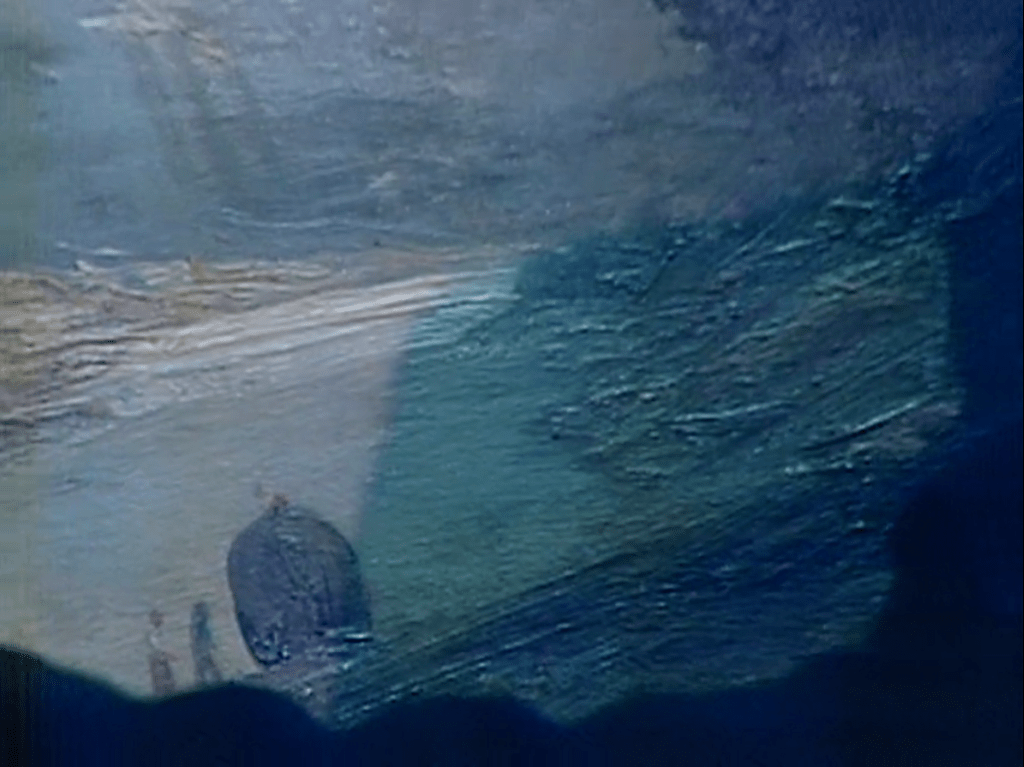
While the kids were alone in the antique shop, Liz took Julia to a store room in the west wing of Collinwood to show her some photographs she had been asking about. While there, they come upon a painting. Liz says that she bought it about a year before at a charity auction, and that when her brother Roger saw how lousy it was he said he hoped that it was a worthy cause. She took it directly to the store room. It is signed “Harrison Monroe” and dated 1968. We will learn tomorrow that it depicts a place called Indian Hill. Julia recognizes the painting as extremely similar to an equally undistinguished landscape she bought a few weeks ago.
Detail from “A View of Indian Hill,” Harrison Monroe, 1968.
That painting was the work of Charles Delaware Tate, executed about 20 years previously. That Tate had been alive and working as recently as that gave Julia the hope that he might still be around and able to help a friend of hers who has problems. Yesterday, an expert called on to remove the landscape and reveal the portrait underneath it said that Tate died in 1959. But this painting is apparently the product of the same hand. Julia hopes that “Harrison Monroe” is a pseudonym of Tate’s.
It has been clear to the audience ever since Julia found the first painting that Tate would be back. That can’t be welcome news to many people. Like all characters played by Roger Davis, Tate is a loathsome man who shouts his lines and assaults his scene partners. So this pseudonym, as strongly redolent of oldVirginia as “Grant Douglas” is of twentieth century Canada, will bring a sinking feeling to much of the audience. Our reprieve that began when we left Tate in the nineteenth century five weeks ago cannot last much longer.
*Her name is Mrs Lentz nowadays, but that’s an odd title to give a nine year old. So I refer to her as Miss Smyth.
Strange and troubled boy David Collins has stolen an old book from an antique shop. He didn’t want the book, but had damaged it slightly and was terrified that he would be punished if this was discovered and his father had to pay for the rare volume.
David’s friend and fellow resident of the great house of Collinwood, Amy Jennings, catches him with the book in the drawing room. He tells her he is going to burn it in order to conceal his crime. She points out that this will make a bad situation much worse. As a creature of Soap Opera Land, David can have no higher calling than to make bad situations worse, so this does not deter him.
While Amy offers to take the book to the nearest grownup and to claim that she was the one who stole it, David opens it to a page depicting a group of intertwined snakes, a symbol the show refers to simply as “the Naga.” He is transfixed by the symbol. His whole manner changes. His posture becomes more rigid, his voice grave and authoritative. He tells Amy he no longer wants to burn the book. Instead, he will read it. Since the book is written in a script neither of them has seen before, Amy tells David he cannot read it, but he assures her he can. She asks him to read it to her, and he says that it is forbidden for her to hear any of it. She says that she doesn’t like the game David is playing and would rather turn to another; he says it is no game. She leaves him alone with the book.
The book was not in fact part of the antique shop’s merchandise, though it was on a display table there. The owners of the shop, Megan and Philip Todd, have been inducted into a mysterious cult led by David’s distant cousin, old world gentleman Barnabas Collins, and the book is one of that cult’s most sacred objects. The Todds flew into a panic when they realized the book was missing, and Barnabas told Philip that he faced a severe penalty for losing it. Those reactions make it hard to understand why Philip and Megan left the book on the table in the first place.
Longtime viewers know that many of the major plot-lines on Dark Shadows start with David. So we may suspect that the supernatural forces behind the cult, unknown to Barnabas or the Todds, caused the book to be left on the table and led David to take it so that he could become part of the story. Indeed, once he is alone with the book David intones a statement from it: “And then those who have been hidden so long shall rise and show themselves, and the others will know their time is ended and the time of the people of the Leviathan will begin.” Later, he goes to the mysterious cairn in the woods that is the center of the Leviathan cult’s ceremonial activity, and announces that he is one of them now. The stones at the bottom of the cairn part, revealing a small opening. David crawls into it. The words are solemn, the music melodramatic, the action of the boy stuffing himself into the little hole preposterous. It is the perfect Dark Shadows sequence.
David Henesy was nine years old when the show started, and was thirteen by this time. It would seem no one told the carpenters he had grown in the interval. That gap is such a tight fit for him that he has to wiggle his rear end at the camera for quite a while as he tries to wedge himself into it. Screenshot by Dark Shadows Before I Die.
We Actresses are Vain
As David is leaving to go to the cairn, he has to refuse a request from permanent houseguest Julia Hoffman. Julia wants him to go to the Old House on the estate and give a note to Barnabas. She keeps telling him that it is urgent, but he tells her he is already on his way to do something urgent.
Julia does not know about the Leviathan cult, much less about Barnabas’ connection with it. All she knows is that Barnabas has been her best friend for a year and a half, and when last they had a chance to spend time together they were concerned with the rakish Quentin Collins, whose whereabouts they do not know. Now it is 4:45 PM, and Julia is expecting a Mr Corey to come to the house at 5:00 and look at a painting she bought from the Todds a little while ago. She thinks this Mr Corey might be Quentin, and is keen for Barnabas to meet him.
When David cannot help her, Julia decides to take the note to the Old House herself. The show is usually fairly vague and inconsistent about the geography of Collinwood, but several times they have said that it takes about fifteen minutes to walk between the great house and the Old House. They stick with this today. Julia leaves at 4:45, and returns as the clock is striking 5:15. Barnabas was not at home, so she just turned right around.
Julia hears voices in the drawing room. They are heiress Carolyn Collins Stoddard and another woman. Julia gathers that Mr Corey is actually Ms Olivia Corey. When she enters the room, she sees that Olivia is a dead ringer for Amanda Harris, a woman who lived in 1897. Julia became aware of Amanda in September, when she and Barnabas were traveling in time and met each other in that year. Julia did not meet Amanda, but evidently must have seen at least one of the many portraits of her that magical artist/ dreary goon Charles Delaware Tate painted. She mentions these portraits to Olivia, who claims that Amanda was her grandmother. Amanda was in love with Quentin, and Julia takes an excited breath when she asks Olivia who her grandfather was. Olivia gives his name as Langley. Quentin may well have used an alias, so that doesn’t rule out the possibility that Olivia may be his granddaughter, though Dark Shadows fans looking back in these later days will think of another member of the Collins family when they hear that name.
Olivia is a famous New York actress. Julia tells her that she has seen her on stage and has seen her photograph in the newspapers, but that she never noticed her resemblance to Amanda. Olivia asks where Julia heard about Amanda; she says that she must have read about her somewhere in connection with one of the portraits. She also tells Olivia that she isn’t likely to want the painting, since it is not a portrait. Olivia says that she wants any painting of Tate’s she can get. Julia tells her there is no portrait of Quentin Collins in the house; Olivia pauses for a fraction of a second, then blandly asks if she is supposed to know who that is.
Some of Tate’s paintings had supernatural effects. When Tate painted pictures of his ideal woman, Amanda came into being as their embodiment, like Galatea emerging from Pygmalion’s statue. And when he painted Quentin’s portrait, Quentin was freed of the effects of the werewolf curse. Like a Halloween version of The Picture of Dorian Gray, the portrait turned into a wolf on the nights of the full moon, while Quentin remained human.
As long as the portraits of Amanda and Quentin are intact, they themselves will remain alive and well and youthful. So Julia’s hope that Quentin might still be traveling the world and using false names 72 years after the period when she and Barnabas knew him is not ill-founded, and her surmise that Olivia might be, not Amanda’s granddaughter, but Amanda herself, is also plausible.
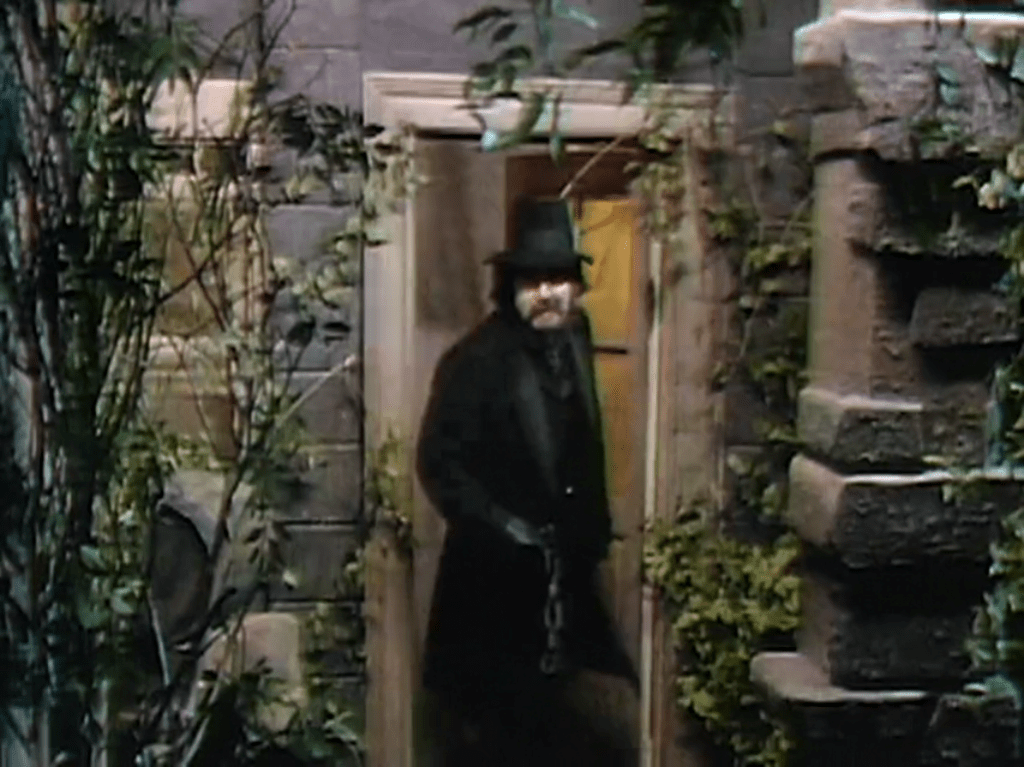
Yesterday, we spent a lot of time watching an unidentifiable man wandering around the estate of Collinwood. We only saw him from the back; he was wearing a dark coat and hat, and had silver-gray hair. Evidently we were supposed to expect his face would mean something to us when it was finally revealed.
At the end of yesterday’s episode, permanent houseguest Julia Hoffman caught the prowler coming out of the Old House on the grounds of the estate, home of her friend, missing person Barnabas Collins. She did not recognize the man, and he refused to identify himself. We see him in today’s opening reprise. His face would not be familiar to her, but it is instantly recognizable to longtime viewers. It is that of actor Dennis Patrick, who from March to July 1967 played seagoing con man Jason McGuire. Jason blackmailed reclusive matriarch Elizabeth Collins Stoddard to the point of marriage. When Liz finally stood up to Jason, his scheme collapsed. On his way out of town, Jason went to the Old House hoping to steal jewels from Barnabas. That attempt also failed, and Barnabas strangled Jason.
We spend most of the episode wondering how Jason managed to rise from the dead. Near the end, Liz’ daughter Carolyn runs into the prowler. She gets a good look at him and talks to him for a few minutes, but does not recognize him. Carolyn would certainly recognize Jason, whom she was ready to shoot if Liz had gone through with the wedding. So Patrick must be playing another character. He does not give Carolyn his name, but his strong emotional reaction when she gives hers tells us that he has some kind of connection to her. We are again supposed to leave the episode wondering who he might be.
Unfortunately, word of that did not get to the people who make up the closing credits. Patrick is billed today as “Paul Stoddard.” Paul is Carolyn’s long-missing father, Liz’ ex-husband, and a close friend and partner in crime of the late Jason McGuire. This is not the first time on Dark Shadows the closing credits have identified a character whose identity was supposed to keep us guessing. For example, at the end of #124 we are supposed to be in suspense as to which of a few people a mysterious woman is, but the closing credits identify her as “Laura Collins,” a name which blows the secret completely for attentive longtime viewers. A mysterious little girl turns up in #255 and for a few episodes we are supposed to be in the dark as to who she is. But at her first appearance the character was billed as “Sarah Collins.”
It’s interesting to cast Patrick as Paul. Jason’s scheme was based on Liz’ belief that she had killed Paul, when in fact Paul and Jason had worked together to fake his death and swindle her of some money. Since Paul and Jason committed the two halves of the same crime, they merge together in the disastrous effects they have had on Liz’ life. So they may as well look and sound exactly alike.
Waiting for Barnabas
Barnabas vanished from his basement some time ago while he was involved with some supernatural doings. Julia has been hanging around the house for over a month, waiting for him to rematerialize. She explains to Carolyn that because he disappeared from the basement, it is the only place where he can reappear. They go into the house and Julia almost immediately suggests they leave. She is sure he isn’t there, because she locked the basement door. Evidently Julia has spent all this time waiting to hear Barnabas banging on that door demanding to be let out.
Carolyn points out that Barnabas might be unconscious, and if he is he would not be banging on the door even if he has come back. Julia exclaims “I hadn’t even thought of that! He- he could be down there now!” At this, my wife, Mrs Acilius, laughed and said “He could have been down there for a month!” By profession, Julia is a mad scientist. She knows how to cure vampirism, bring Frankenstein’s monsters to life, rewrite people’s memories at will, and travel back in time, but she has her blind spots.
Be that as it may, Julia checks the basement and finds Barnabas is not there.
The Antique Shop
Carolyn takes Julia to an antique shop that has just opened in the village of Colllinsport. Carolyn called the shop “divine” yesterday, and is still thrilled about it today. I suppose it reminds her of home- like all the unoccupied spaces in the great house of Collinwood, it is crammed with a lot of miscellaneous junk.
Carolyn may have a soft spot for the place, but she hasn’t lost all capacity for judgment. The proprietors, a young couple named Philip and Megan Todd, have just unpacked a painting they bought that morning. Philip says that when it came up for auction he couldn’t resist it. Carolyn widens her eyes, tilts her head back, and says in an incredulous voice, “Hmm, your taste must be quite different from mine, Philip. I could have resisted that.”
The painting Philip couldn’t resist.
Philip mentions that the artist’s name is Charles Delaware Tate. At that, Julia perks up. She asks Philip if he is certain that it is an authentic Tate; he assures her that he is. He astonishes her by saying that it was painted only about twenty years ago. Julia says that Tate would have been in his 80s then. Seeing that the painting is about as good as anything Tate ever did, she says that he was still at the height of his powers despite his advanced age. She wonders if, having been in such good shape so recently, he could still be alive. Philip doesn’t know about that.
Julia asks for the price. When Philip says he will part with the painting for $300, Julia takes out her checkbook. Carolyn looks on, amazed to see her shell out so much money so quickly for a mediocre picture. When it is time to go, Julia asks her if she is ready. Still agape, Carolyn replies “Yes.. for practically anything!”
For eight months, from #701 at the beginning of March to #884 last week, Dark Shadows was a costume drama set in the year 1897. In the second half of that segment, Tate was one of the minor villains. He had made a bargain with evil sorcerer Count Petofi. Petofi made him a nationally famous painter whose works were very much in demand. Many of his paintings also had magical powers. The magical powers were the result of Petofi’s spell, but it was never made entirely clear whether Tate’s fame was the result of a talent Petofi gave him to paint well or if Petofi’s intervention was more direct and he simply bewitched people into admiring Tate’s paintings and wanting to buy them. Indeed, if we had to classify the works of Tate that we saw, the most secure categorization would be “Nothing Special.” They certainly do not stand comparison to the best of the portraits that the ABC Network’s Art Department prepared for the Collinwood sets. Carolyn’s reaction today clearly suggests that once Petofi’s influence receded, the paintings lost their charm.
Julia’s interest in Tate is not aesthetic. Julia traveled back in time for a couple of weeks in September. She knows that Tate’s portrait of Quentin Collins prevented Quentin from turning into a werewolf. The prospect that Tate might still be alive leads her to hope that her friend Chris Jennings, a great-grandson of Quentin’s, might also be cured of lycanthropy.
The audience is unlikely to find much ground for optimism in the thought of more Tate. As is usual for characters played by Roger Davis, Tate is hard to watch. He delivers most of his lines in a shout, and he amplifies his voice by clenching his rectal sphincter muscles. The result is what Pauline Kael used to call an “anal screech.” He also has what we might tactfully call a poor sense of personal space; indeed, two of the tags that most often appear together on posts on this blog are “Roger Davis” and “Abusive Behavior on Camera.” So I would just as soon Julia give up her search for Tate.
The Todds
Megan and Philip exult over Julia’s purchase. They are in the middle of talking about how it is a good sign for their new business, when Megan is suddenly seized with a fit of foreboding. She wants to close the shop early; Philip protests that they still have time to make a few more sales. Megan then says she has a premonition that if they stay in Collinsport something terrible will happen to them. She says she wants to sell the shop and move away. Philip tries to soothe her. He puts his head against hers and kisses her. She just looks straight on, her eyes full of dread.
Philip working his way to Megan’s neck while it dawns on her that they are now characters on Dark Shadows.
Megan is the third role Marie Wallace played on Dark Shadows. Her first two were Eve, the Fiancée of Frankenstein, and Crazy Jenny Collins, Quentin’s estranged and deranged wife. Miss Wallace had a lot of fun with those parts, but neither of them gave her much opportunity to interact meaningfully with her scene partners. Eve was unyieldingly nasty to everyone, whatever they might say or do, and Jenny was just one long mad scene. As Megan, she gets to listen to Philip and react to what he says. That ends when she ignores his kissing her neck, but while it lasts it’s good to see.
Philip is played by Christopher Bernau. Some fans say that Bernau and Miss Wallace lacked “chemistry,” but their last shot today shows how misguided that criticism is. The key to chemistry is for one character to initiate a kiss and the other to kiss back. Megan is supposed to be too preoccupied with her premonition to notice anything in her environment, even her beloved husband kissing her. If she had responded to him at all, the whole point of the scene would have been lost.
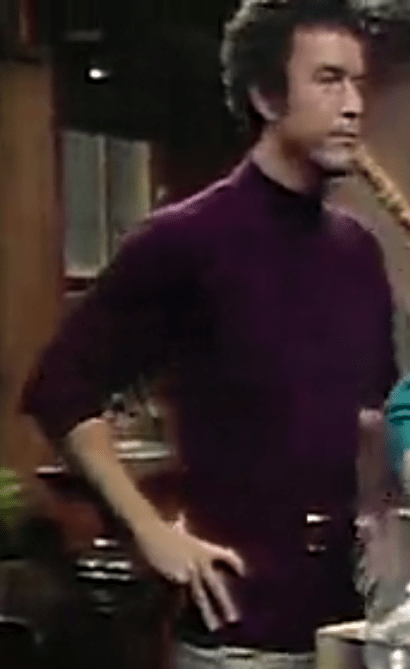
It is true that Bernau does not perfectly embody a romantic lead in Philip’s scenes with Megan. As a happy couple, Philip and Megan constantly make little jokes with each other. The jokes in the script aren’t very good, and Bernau tries to put some life into them by imitating Jack Benny. In the 1920s and 1930s, Benny’s persona struck people as a spoiled rich kid, and in later years he was so famous that it just meant Jack Benny. But by the 1960s, any man other than Jack Benny would send a very different message if he were to speak with that drawl and walk with that mincing gait. When the man in question is an antique dealer wearing a belted sweater that looks suspiciously like a dress, it does not seem especially likely that he will passionately in love with his wife.
I think Philip borrowed this from Maggie Evans…
Several times in his career Bernau proved he could be effective in love scenes with women, most famously as ladies’ man Alan Spaulding on The Guiding Light. I mentioned that role in a comment on Danny Horn’s post about this episode on his great Dark Shadows Every Day:
I was a kid when Bernau joined GUIDING LIGHT. My mother watched that show, and I had several times attempted to watch it with her, but it always defeated me after 5 or 10 minutes. It just seemed like a window into the deepest level of Hell, the frozen cavern where absolutely nothing happens. But Bernau caught my imagination. I could watch entire episodes if he was in them.
Years later, when I watched DARK SHADOWS on the Sci-Fi Channel, I realized what made Bernau so compelling on GUIDING LIGHT. He was doing a Jonathan Frid imitation. Within moments of first seeing Barnabas, I exclaimed “Alan Spaulding!” It was only years later that I learned Bernau had been on DARK SHADOWS.
Comment left 10 December 2020 by Acilius, on Danny Horn, “Episode 888: Little Shop,” 26 June 2016, Dark Shadows Every Day.
I’m very fond of John Gielgud’s story that from the time he first saw Claude Rains give a performance, his acting style consisted of imitating Claude Rains. Gielgud went on to say that this represented a great improvement over his previous style, which consisted of imitating Noël Coward. I doubt Bernau’s style ever depended entirely on either Jack Benny or Jonathan Frid, but he certainly learned a great deal by watching each of them.
In the parts of Dark Shadows set in 1966 and 1967, the home of artist Sam Evans and his daughter Maggie, The Nicest Girl in Town, was a frequent set. Sam and Maggie were important characters in several storylines, and in their cottage they represented the working class of the village of Collinsport, as against the rich people in the big house on the hill.
Now, the show is a costume drama set in 1897. In that year, the Evans Cottage is already an artist’s studio. It is occupied by Charles Delaware Tate, who became a nationally renowned painter by making a deal with evil sorcerer Count Petofi. Today, Petofi is staying in the cottage, and Tate is functioning as his goon.
Petofi is deep in a trance, trying to cast a spell that will cause him and handsome young rake Quentin Collins to switch bodies. Once he has accomplished this switch, he will cast another spell to take himself, in Quentin’s body, to the year 1969, leaving Quentin behind in 1897 to face the vengeance of Petofi’s mortal enemies.
Cockney showgirl/ mentalist Pansy Faye has caught on to what Petofi is attempting to do, and has sneaked into the cottage to stop him. He snaps out of his trance and declares he will punish her. She grabs his glasses and runs to the door; Tate enters and grabs her. At Petofi’s behest, Tate ties Pansy up. Petofi then sends Tate to the great house of Collinwood to fetch Quentin. He is to say that Petofi will kill Pansy unless Quentin comes within the hour.
At the great house, Tate finds that Quentin has fled and cannot be reached. Quentin’s friend and distant cousin, time traveler/ recovering vampire Barnabas Collins, insists on going back to the cottage with him. When he arrives, it occurs to Petofi that Barnabas’ body is just as well suited to his purposes as is Quentin’s. He lists some of the characters who are waiting for Barnabas in 1969, and predicts they will receive him “with open arms” when he arrives in Barnabas’ form. Regular viewers are perhaps chilled, and certainly intrigued, by the idea that the show might go forward with Petofi impersonating Barnabas in a contemporary setting while a Barnabas who looks like Petofi tries to make his way back from the past, though there are so few surviving characters and unresolved story points left in 1897 that it is hard to imagine many more episodes even partially set in this period. Petofi uses his magic powers to knock Barnabas unconscious, and goes into a trance to effect the body swap.
The door swings open, and someone called Garth Blackwood enters. The other day, Petofi had Tate draw a picture of Blackwood, a picture endued with magical powers. It brought Blackwood back to life. Some years ago, Blackwood was a jailer murdered by an escaping convict named Aristide. Petofi found Aristide and took him on as a servant. Aristide has recently proven to be unreliable, and Petofi has decided he wants to be rid of him once and for all. He was amused by the idea of resurrecting Blackwood to perform the task. Blackwood has killed Aristide, but Petofi found on Monday that there is more to him than his own magical powers created. He cannot lay Blackwood to rest. Now, Blackwood has resolved to kill Petofi and Tate.
Tate flees at the sight of Blackwood. Pansy, free, asks if he is the police. He identifies himself as the master of Dartmoor Prison. Pansy, being English, is impressed. She points to Petofi and tells Blackwood that he must act against him. Blackwood puts handcuffs on Petofi, then slaps him until he comes out of his trance.
Petofi pleads with Blackwood to drop all charges against him, since he was the one who gave him the chance to kill Aristide. Barnabas comes to and asks what is going on. When Blackwood asks if he testifies for Petofi or against him, Barnabas gladly pronounces “Guilty!” He starts to say that Petofi must be killed immediately, and Blackwood cautions him against giving opinions. The witnesses are to offer only facts. So he asserts that Petofi and Aristide traveled the world together for years and committed every possible crime. At that, Blackwood bids him and Pansy leave. Once he is alone with Petofi, Blackwood picks up a metal can, douses the place with fluid, and lights a fire.
Back at the great house of Collinwood, Barnabas and Pansy talk about what just happened. Barnabas says he is confident Blackwood will kill Petofi, but he thinks he and Pansy may have to fight Blackwood later. Pansy has a vision of Blackwood and Petofi struggling with each other amid the flames in the Evans Cottage. She also sees the portrait of Quentin burning there. Since this portrait has a magical charge that keeps Quentin from turning into a werewolf, that’s bad news.
Petofi has been so powerful that it has long seemed likely that his destruction could come only as the result of his own action. When his right hand, the locus of most of his powers, was reattached to his wrist in #815, the show was giving hints it might wrap 1897 up soon. We kept hearing that the Hand had developed a mind of its own in the century it had been separated from Petofi; we could easily imagine it deciding to strangle him, and indeed in #841 it nearly did. But 1897 was such a big hit that they kept restarting it, and for some time now the Hand has done more or less what Petofi wanted it to do.
It would have been fitting had Pansy killed Petofi, since she is, in her present form, one of his creatures. The original Pansy Faye was killed in #771. In #819, Petofi erased the personality of minister’s daughter Charity Trask and gave Charity’s body to Pansy. Pansy’s light-heartedness and apparent harmlessness would have added to her suitability as the instrument of Petofi’s demise. The whole idea of the supernatural is that what appears to be weak is in fact irresistibly strong, so it would be fitting to have a tiny woman who is a character from very broad comedy conquer the great wizard.
Blackwood has only been on Dark Shadows since #878, was never previously mentioned, and is the shallowest character possible. But those weaknesses, too, give him a logical place as Petofi’s executioner. Petofi was never more smug in his self-assurance than he was when he used Tate to bring Blackwood into being in order to murder Aristide. Petofi has so easily defeated efforts by characters who had long records of dominating the action of the show, such as Barnabas and wicked witch Angelique, that we can understand why it would not occur to him that a day player could present him with any serious difficulty. That self-assurance leads him to carelessness, as he creates in Blackwood a being whose strength comes not only from him, but from the fires of Hell from which he came. Indeed, Petofi’s only thought when he brought Blackwood back from the dead was of the suffering he would inflict on Aristide, and his only feeling was delight in contemplating that suffering. Coming as the price of his overconfidence and his gleeful cruelty, it puts a moral at the end of the story when Petofi falls at Blackwood’s hands.
This episode marks the final appearance of the characters Petofi and Blackwood. It is also the final on-screen appearance of Pansy, though her voice will be heard once more, in an episode next week.
The dramatic date is November 1897. We open in an abandoned mill on the old North Road in Collinsport, Maine. The late Garth Blackwood, once the keeper of Britain’s Dartmoor Prison, is about to avenge his own murder. Blackwood was raised from the dead by sorcerer Count Petofi and Petofi’s stooge, artist Charles Delaware Tate. Petofi wants to be rid of his unreliable servant Aristide, and decided that Blackwood, whom Aristide killed while escaping from Dartmoor and has feared ever since, will be the one to slay him.
Blackwood is ready to strangle Aristide, who takes a moment to tell him that if he does so he will be endangering his own existence. He explains that there are others who conjured him up to perform the very task he is about to undertake, and that once he has completed it they will not need him anymore. Blackwood says that this is no problem. Once he has killed Aristide, he will kill them too. He pulls a chain tight around Aristide’s neck.
Tate is outside while this is happening. The set represents the exterior of the mill. The set is alternately in deep shadow and illuminated by lightning flashes. We haven’t seen it before, it is rather nice.
Tate hides while Blackwood leaves, then goes into the old mill and confirms that Aristide is dead. Aristide was a nasty and inept fellow, but Michael Stroka found so many ways to make him fun to watch that he will be missed.
Back in his studio, Tate tells Petofi what he saw. He also reminds Petofi that Blackwood has killed two other people, and that he will in all likelihood go on killing everyone he meets. Petofi doesn’t care about any of that. All that interests him is his plan to forcibly swap bodies with handsome young Quentin Collins and, as Quentin, to travel to the year 1969.
Blackwood storms in, declares that Petofi and Tate are his prisoners, and says that they are under sentence of death. Petofi tries to cast a spell to make Blackwood go away; he finds that there is more to Blackwood than his magic can control. He can only hold him at bay, and that only for a moment. Tate shoots Blackwood. The bullet wounds cause him to fall and briefly lose consciousness, but he is soon back on his feet. He leaves, and vows that he will return to finish what he started.
At the great house of Collinwood, Quentin is going through his belongings. Cockney showgirl/ mentalist Pansy Faye enters. Quentin explains that he will be leaving on the early morning train to get away from Petofi. Pansy is sad to see him go, but she well knows how dangerous Petofi is. Quentin further explains that he has been looking through all his old stuff to see if any of it is worth keeping. He doesn’t think any of it is, but she thinks a photograph of him at the age of ten is adorable, and is glad when he makes a gift of it to her. They share a really lovely moment, as she says that she still wishes they could have become lovers and he plays along. She says that if he’d married her, she’d even have given up her career for him. He says gravely that he never would have asked her to do that. Quentin never asked Pansy for any of what she wanted to give him, and her reaction to this line shows that it has reminded her of that fact. But she still cares about him, and it is still a sweet little exchange. They smile their unforgettable movie-star smiles at each other when they part.
Later, Pansy has a dream in which Quentin falls asleep and Petofi seizes his body the instant his guard is down. She awakes, and realizes she must rush downstairs to prevent this dream coming true.
Throughout October 1897, which at 4 PM on participating stations of the ABC television network coincided with October 1969, 150 year old sorcerer Count Petofi occupied the body of handsome young Quentin Collins and banished Quentin to his own aging form. Last week Quentin broke that spell, and now the two of them are themselves again.
News of the restoration has not reached everyone, however. On Friday and Monday, Quentin’s lover, maidservant Beth, saw him at the top of Widows’ Hill. Thinking he was Petofi, she flung herself to her death on the rocks below rather than submit to whatever evil magic he had in store for her. Yesterday, Petofi’s unreliable servant Aristide went to Quentin, thinking he was his master, and begged for a task by which he could earn his way back into his good graces. Quentin sent him to murder Petofi, which he is trying to do when we open today.
The attempt takes place in the studio of artist Charles Delaware Tate, an unpleasant man who is tied to Petofi. Tate finds Aristide plunging a knife into Petofi’s chest. He stops the attack and gets through to Aristide that the swap is over and he is stabbing Petofi himself. Desperate to undo his latest offense, Aristide hastens back to the great house of Collinwood, intending to kill Quentin.
Petofi comes to and tells Tate that he intends to repossess Quentin’s body and use it to escape his enemies. When Tate tells him what Aristide has gone to do, he sends him to stop him. He does so, showing up in the drawing room at Collinwood in the nick of time and, at gunpoint, forcing Aristide to lay down the sword with which he was about to run Quentin through.
Back in the studio, Petofi instructs Tate to draw a magical sketch. The sketch depicts a man called Garth Blackwood, a cruel jailer whom Aristide killed when he escaped from prison in England. Petofi remembers meeting Aristide for the first time the night he escaped Blackwood’s prison. In #854 Petofi had said he met Aristide in an alley near the Thames in London, but this time we flash back to a meeting on the moors in the county of Devon. Petofi recalls that Aristide pledged his fealty to him in return for freedom from Blackwood’s ghost.
Once Tate has drawn his sketch, Blackwood will come back to life, determined to take his vengeance on Aristide. Aristide returns to the studio to resume begging for mercy, and Petofi takes great pleasure in showing him the sketch and telling him what is in store for him.
In #425, broadcast in February 1968 and set in February 1796, the gracious Josette was near the cliff on the top of Widow’s Hill when she saw her lost love, Barnabas Collins. Wicked witch Angelique had turned Barnabas into a vampire, and Barnabas planned to kill Josette and raise her from the dead with the same curse. Angelique sent a vision to Josette of what her existence would be like after she rose from the grave to prey on the living. While Barnabas watched helplessly, Josette flung herself to her death onto the rocks far below the cliff.
Barnabas spent the next centuries telling himself that Josette’s suicide was the result of a misunderstanding. In #233, broadcast and set in May 1967, he was masquerading as his own descendant, a cousin from England come to visit the Collinses of Collinsport, Maine. He told heiress Carolyn Collins Stoddard and well-meaning governess Vicki Winters that Josette jumped from the cliff because she did not realize that her lover had come with only good intentions for her. By that time, it seemed he might actually have convinced himself it was true.
Today, it is 1897, and rakish libertine Quentin Collins and his sometime lover, maidservant Beth Chavez, reenact Josette’s suicide. They, however, follow the script which had previously applied only in Barnabas’ head. For several weeks, sorcerer Count Petofi has been occupying Quentin’s body, having confined Quentin to his own aging form. Beth was for a time in thrall to Petofi, and is terrified of him. Petofi was still Quentin-shaped yesterday when he chased Beth onto the top of Widows’ Hill. He collapsed in the woods, and a moment later the spell was broken and the body was Quentin’s again. Quentin, restored to his own person, wanders up to the summit and is surprised to see Beth there.
Quentin tries to tell Beth that he is himself, but she is not disposed to listen. Thinking that he has come to do something worse than simply kill her, she leaps from the cliff.
Terry Crawford says that when they first did this scene, they wanted her to emphasize the drama of Beth’s suicide by really flinging herself down hard. Since the floor was only a couple of feet below the set, the springy mattress that she flung herself on bounced her back into the frame, and they had to retake the shot. I wish we had that out-take, it must have been hilarious.
Quentin returns to the great house of Collinwood, in shock. He doesn’t notify the police or anyone else of Beth’s death- apparently the seascape just isn’t complete without a dead maidservant or two strewn carelessly about.
Barnabas, who has traveled back in time from 1969 to 1897 and who is currently free of the effects of the vampire curse, enters. He has befriended Quentin, and is at war with Petofi. He knew about the body swap, and had urged Quentin to make the effort that reversed it. He does not know how that effort turned out. He is happy to hear that Quentin is himself again, unhappy to learn of Beth’s demise, and insistent that Quentin must go far away before Petofi can get at him again.
We cut to a studio occupied by artist Charles Delaware Tate, a stooge of Petofi’s. We can see that Tate stole the magical portrait that keeps Quentin from turning into a werewolf. He covers the portrait with white paint. A visitor enters. It is Petofi’s servant Aristide. Aristide’s face is covered with dirt. Petofi has turned against Aristide, who has been in hiding. Tate agrees to help Aristide get a bath and clean clothes, but will not intercede with Petofi on his behalf.
Aristide does not know that the body swap is over. He goes to Collinwood, finds Quentin, and assumes that he is Petofi. When he offers to do whatever is necessary to restore himself to his master’s good graces, Quentin tells Aristide to find the man who appears to be Petofi and kill him. Aristide, a sadistic fiend, is delighted to receive this sort of command. He goes back to Tate’s, finds the real Petofi there, and stabs him in the chest.
Aristide getting ready to stab Petofi. Still not using his favorite knife, “The Dancing Girl” (alias “The Dancing Lady.”) Screenshot by Dark Shadows Before I Die.
In October 1897, sorcerer Count Petofi has hijacked the body of Quentin Collins and banished Quentin to his own aging form. I call the villainous Petofi played by David Selby Q-Petofi, and the forlorn Quentin played by Thayer David P-Quentin.
P-QuentinQ-Petofi
Today, wicked witch Angelique explains to P-Quentin how she and mad scientist Julia Hoffman cured time-traveler Barnabas Collins of vampirism, created a Doppelgänger of Barnabas, and used that Doppelgänger to persuade Quentin’s family in the great house of Collinwood that Barnabas never really was a vampire. Later, artist Charles Delaware Tate mistakes P-Quentin for Petofi, and tries to kill him. Q-Petofi then enters and takes control of Tate, using him for a project of his own.
Petofi stripped Angelique of her powers in #865, and deprived Tate of his ability to paint in #851. Angelique has been such an important part of the show for so long that regular viewers are confident she will be back eventually, but the 1897 segment seems to be lurching towards its close, and after her last exit there was no urgent reason in the story for her to come back. It’s good to see that she is still part of this arc.
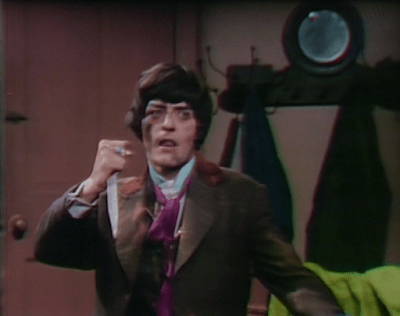
Tate’s continued presence is rather less good news. Like all characters played by Roger Davis, he has an obnoxious personality and a grating voice, with a disturbing habit of invading his scene partners’ personal space. Today, he keeps grabbing at Q-Petofi’s coat while Q-Petofi bats him away; this is so irritating that it is unclear whether the line “You’ve got trouble with your hands” was scripted for Q-Petofi or ad libbed by David Selby.
For the last couple of weeks, we have had grounds for hope that Tate would just go away. When he sold the portrait of the lovely and mysterious Amanda Harris in #864, he lost his last connection to an ongoing plot point. We saw in that same scene that he had a lot of paintings he could sell for high prices if he took them back to New York or another major city. We also know that he has no friends or potential sources of income in the small town of Collinsport. So evidently he is just sticking around to punish the audience for watching the show.










 Dark Shadows Commentary