Episode 67: I was fresh out of arsenic

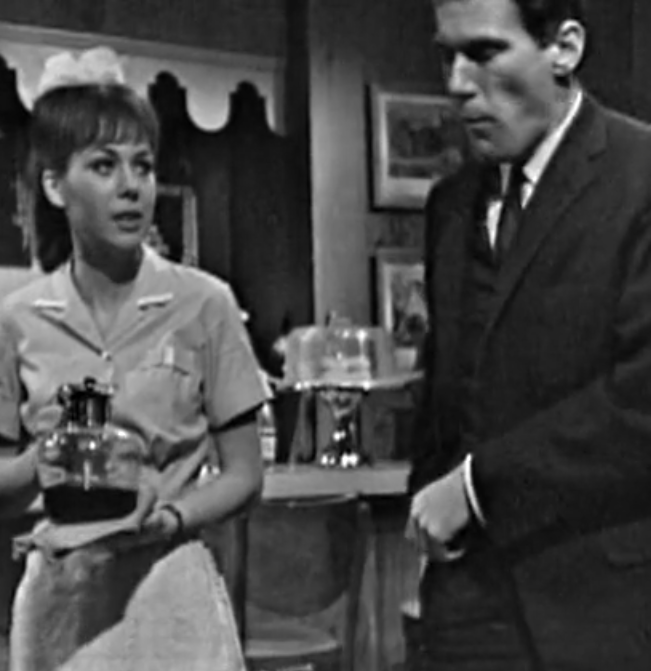
This one belongs to Maggie Evans, the nicest girl in town. We open with her doing some work in the restaurant she runs. She isn’t feeling so nice today- dashing action hero Burke Devlin has accused her father, drunken artist Sam Evans, of various crimes, including the murder of beloved local man Bill Malloy. When flighty heiress Carolyn comes into the restaurant, Maggie tells her that it might be a good idea to flavor Burke’s coffee with rat poison.

Burke does show up. When he complains about the coffee, Maggie picks up on the idea she had floated to Carolyn and apologizes for not adding arsenic.

Maggie apologizing to Burke for failing to give him arsenic
No arsenic today, sorry

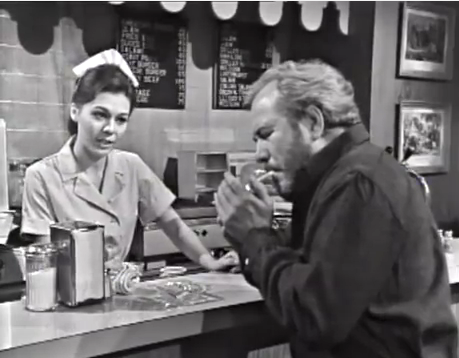
Not that she’s going to let her father off without a piece of her mind. When he comes in and tells her some lies, she discards her usual adult-child-of-an-alcoholic manner of exaggerated patience and calmly asks him if he minds that she doesn’t believe him. He mumbles that there’s no reason why she should.

The sheriff comes into the restaurant to ask Maggie if she can confirm her father’s whereabouts at the time of Bill’s death. She gives him a sarcastic answer. When he asks what she is prepared to swear to on the witness stand, she makes it clear that she will swear to whatever she damn well pleases. Sam then tells the sheriff that Maggie doesn’t actually know where he was that night. At that, she declares that Sam has no idea what she does or doesn’t know. If she wants to perjure herself, it will take more than Sam and the sheriff to stop her.

In the sheriff’s office, we meet Mrs Sarah Johnson, housekeeper to the late Bill Malloy. Mrs Johnson is furious with the Collinses, the family in the big dark house on the hill who own half the town. She more or less blames them for Bill’s death. She very much blames them for his life, which he spent doing nothing but working for their interests. Mrs Johnson is even more indignant than Maggie, but the only person she interacts with is the sheriff. So we have a contrast between a character who gives us several distinct shades of outrage, one for each person she puts in their place, and another who spends her time bringing one specific shade of anger into perfect focus.

In between there’s a scene with Sam and the sheriff, and at the end one between Carolyn and Burke. These offset the studies in indignation from Maggie and Mrs Johnson, both giving the audience a bit of a breather and giving their fiery turns time to sink in.

Miscellaneous:

There’s a moment when the sheriff goes to the water cooler and finds the paper cup dispenser empty. He apologizes that he can’t offer Mrs Johnson a drink. All the websites list this as a production fault, but I’m not sure- it goes on for a while, longer than I imagine it would if he were actually drawing two drinks of water and giving her one, and the timing doesn’t seem off afterward. I don’t know if it was in the script- I suppose they might have noticed they were out of cups and improvised the scene before or during dress rehearsal. At any rate, I don’t think actor Dana Elcar was actually surprised by the absence of cups during the taping.

This episode was recorded on the Sunday before it aired. The Dark Shadows wiki quotes Kathryn Leigh Scott (Maggie) explaining that this was because one of her fellow cast members had shown up drunk on the day they were originally supposed to record it. Mitchell Ryan and David Ford both have important parts in it, and they were both alcoholics. After he stopped drinking, Ryan admitted that he showed up on the set of Dark Shadows drunk on more than one occasion. Ford never stopped drinking, and booze was apparently part of the reason he died in 1983 at the age of 57. Also, while Ryan and Ford are the two actors in this period of the show who usually have the most trouble with their lines, they are both nearly letter-perfect today, as if they had been in trouble and knew they had to be good boys or else. So it could have been either of them.

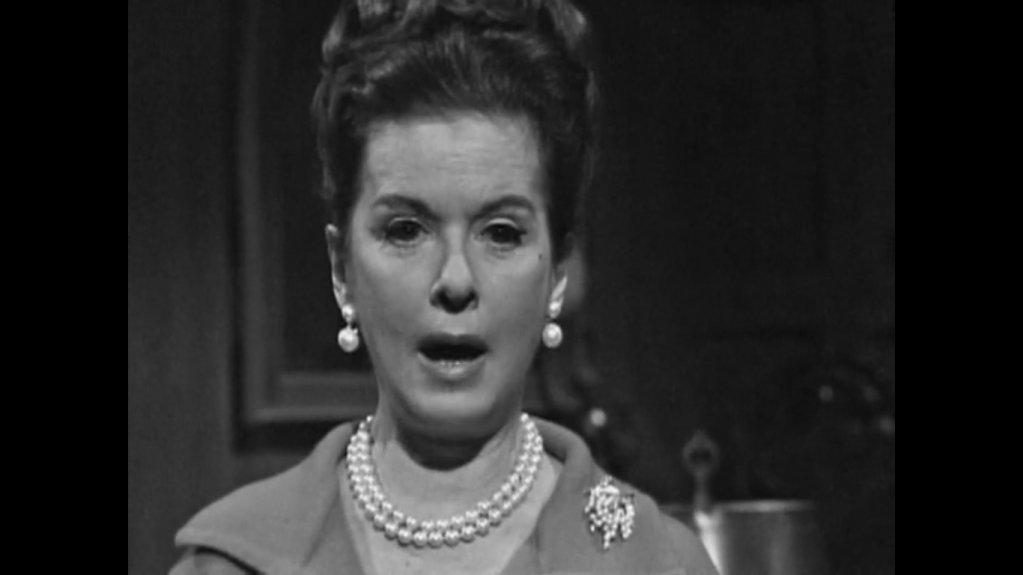
Clarice Blackburn joins the cast as Mrs Johnson today. As Mrs Johnson, Blackburn will be crucial at certain moments in the years ahead, and she will also be cast as other important characters in the later run of the show. When Mrs Johnson was cast, Blackburn was told to model her on Judith Anderson’s performance as Mrs Danvers, the frightening housekeeper in Hitchcock’s Rebecca. That instruction didn’t last very long, and when four years later they actually got round to including an homage to Rebecca, Blackburn didn’t play the Mrs Danvers part.

On his blog Dark Shadows from the Beginning, Marc Masse develops a theory that set designer Sy Tomashoff was influential in casting Dark Shadows. He focuses on a guest spot Clarice Blackburn had on an earlier series where Tomasheff did the sets, a primetime show called East Side, West Side:

The version of Mrs. Johnson we see today in episode 67 is based on an even earlier role as Gert Keller in the critically acclaimed but greatly overlooked groundbreaking series East Side, West Side, in a 1964 episode called The Givers. Perhaps the biggest surprise to those not familiar with the series would be its leading actor, featuring George C. Scott as a… social worker.

It should be noted that both of these earlier productions had Dark Shadows scenic designer Sy Tomashoff as the “art director”; in the East Side, West Side episode The Givers, the cast list even featured Bert Convy, the original early choice for casting as Barnabas Collins on Dark Shadows. Tomashoff held the same production role in For the People. Both of these series are notable for a good many cast member crossovers with Dark Shadows, often several in a single given episode; and because Sy Tomashoff worked so closely with executive producer Dan Curtis on Dark Shadows, it is likely that he played a significant part in a number of the key casting decisions in the early days of Dark Shadows.

Especially curious as noted in the introduction to today’s post is how Mrs. Johnson comes across as the grieving widow, indicating that she may have been more than just a housekeeper to Bill Malloy even if Malloy himself was never aware of this. If you see her as Gert Keller in the East Side, West Side episode, she seems to be reprising this earlier role…

An even more striking parallel between the portrayals of Gert Keller and Sarah Johnson are the similarities in character dialogue between the speech patterns and emotional tone… [I]n each instance, vocal delivery of dialogue as provided by the actress shows a similar shift between the emotional extremes of tearful despair and bitter resentment at the injustice of each character’s passing, first over Arthur Keller in East Side, West Side with an almost identical pattern and tone evident today on Dark Shadows over Bill Malloy.

In East Side, West Side, Art Keller is a business man struggling with elusive opportunities due to a past bankruptcy situation. Despite the best efforts of Neil Brock [George C. Scott] and his resources and contacts, Keller winds up ending his life soon after Brock drops by with the news that despite the availability of a possible deal for work in connection with a local congressional office, he had to intervene on Keller’s behalf because of the shady nature of the congressman’s methods of operation.

Two years later on Dark Shadows, Gert Keller is transplanted from East Side, West Side to make her debut as Bill Malloy’s bereaved housekeeper, Sarah Johnson.

It’s plausible, but not conclusive- after all, both East Side, West Side and Dark Shadows were cast with New York actors at a time when there was already more national television production, and therefore more proven acting talent, in Los Angeles. Many of the relatively well-established actors who were in New York in the 1960s were there because they were busy with specific projects and weren’t in a position to commit the time for a recurring role on a five-day-a-week TV show. So if you’re casting Dark Shadows and you’re looking for someone you can trust to give you a performance with a particular quality, of course you’re going to look at a lot of people who were on East Side, West Side, whether Sy Tomashoff recommended them or not.

Episode 55: We are the only ones here, unless you include the ghosts of your past

Sheriff Patterson is at the mansion on the estate of Collinwood, talking with reclusive matriarch Liz and Liz’ ne’er-do-well brother Roger about the mysterious death of plant manager Bill Malloy. Liz listens as Roger answers the sheriff’s questions, seeming every bit the trusting sister. The minute the sheriff leaves, she turns to Roger and asks in an icy voice “How much of what you told him was the truth?” She confronts Roger with the differences between what he told the sheriff and what he’d told her. Roger is upset, and finally tells Liz she has to trust him. Liz looks sadly off into the distance and says that yes, she does have to do that.

Liz saying she has to believe Roger
“Yes, I do have to do that.”

I’m always interested to watch actors play characters who are themselves acting. When she’s concealing her doubts about Roger from the sheriff, Joan Bennett has her first chance to show us what sort of actress she thinks Liz would be. She’s a skillful one- she does have some subtle reactions to Roger’s evolving story when the sheriff isn’t looking at her, but her abrupt, contemptuous turn to Roger is the removal of a convincing enough mask that it shocks the audience. And her statement that she does have to believe Roger, coming after she has made it clear that she knows he has been lying to her and is likely to go on lying, is a performer’s resolution to go on playing a part, however unpromising that part may be.

Intercut with the scenes at Collinwood are scenes in the restaurant at the Collinsport Inn. Waitress Maggie Evans is serving one customer, her father Sam Evans. Sam wants Maggie to return a sealed envelope he gave her some time ago. He won’t tell her what’s in the envelope, why he wants it back, or why he gave it to her in the first place. She won’t give it back to him without answers to at least some of those questions.

Maggie and Sam at the restaurant
Screenshot by Dark Shadows Before I Die

Francis Swann is the writer credited with today’s script, but the contrast between the scenes at Collinwood and those in the restaurant form a diptych of the sort Art Wallace specialized in. Sister Liz demands information which brother Roger won’t give; Roger is a fountain of lies and evasions, and finally tells Liz that her idea of family loyalty requires her to behave as if he were telling her the truth. Daughter Maggie demands information which father Sam won’t give; Sam mutters little lies, stonewalls, and begs her to forget about the whole thing.

The two family pairs are both unhappy, but in different ways. The Evanses aren’t having any fun, but you can imagine them reopening communication and re-establishing trust, if only Sam can get off the hook in this crisis. Liz and Roger don’t seem ever to have trusted each other, but they are so much fun to watch that you can see how they might choose to go on fighting these battles indefinitely.

No one has told Maggie or Sam or anyone else that Bill Malloy is dead. When Maggie wonders if Bill might be able to help Sam with whatever troubles he’s refusing to tell her about, Sam replies that yes, Bill might be the only one who can help him. Dashing action hero Burke Devlin telephones the restaurant to order delivery of a meal; he asks if Maggie has seen Bill. Maggie tells Sam that everyone has been asking about Bill.

The sheriff comes in to the restaurant. Roger had told him that he was with Sam and Burke the night Bill disappeared, and the sheriff mentioned then that he’d be talking to both of them. The sheriff reacts strongly when he sees Sam, and tries to strike up a friendly conversation with him. Before the sheriff can elicit much of a response, he gets a telephone call. He rushes out of the restaurant as soon as he’s hung up. On his way out, he casually mentions to the Evanses that it was the Coast Guard calling to say they’d found Bill Malloy’s corpse. They are shocked at the news.

The sheriff doesn’t seem to be watching Sam’s reaction to the news about Bill’s death. That’s odd- while viewers know that Roger is the show’s principal villain at this point, Sam seems to be an equally likely suspect in the case of Bill Malloy. Casually mentioning such a terrible piece of news would seem to be a tactic that a policeman might use to gauge a suspect’s emotional state. Unless it is a tactic of some kind, it would be a spectacularly unprofessional way of announcing to the people of a small town that a highly respected local man was dead. Up to that point the sheriff hadn’t been presented as a blundering fool, so I wonder what they were saying by having him do that.

Miscellaneous:

Marc Masse’s blog posts about the first 54 episodes of Dark Shadows include promotions for Kathryn Leigh Scott’s novel Dark Passages. His post for episode 55 is the first that doesn’t include one of those, and is also the first in which he refers to Miss Scott as “the actress who plays Maggie Evans.” As in “scenes like this emphasize the great and natural chemistry for the father-daughter relationship being portrayed as embodied by David Ford and the actress who plays Maggie Evans.” I wonder if Miss Scott was alienated by “The Dan and Lela Show,” the dialogues between executive producer Dan Curtis and director Lela Swift that he claims to have heard in the background of the episodes. Many Dark Shadows fans were indignant about these, and I’m sure they let Miss Scott know about their objections. Perhaps she pulled her ads from Masse’s blog, and he couldn’t bring himself to mention her name afterward.

While I’m reporting on blog posts, I should mention that the “Collinsport Historical Society” post for this episode is hilarious. Here’s a quote:

Sam Evans is starting to regret writing his Get Into Jail Card that confesses his role in Devlin’s railroading. He tries to get Maggie to return it to him, but she’s not stupid. Maggie is probably a better avatar for the show’s audience than Victoria, and if there’s anything we like more than a mystery, it’s learning the solution to said mystery. While there’s genuine concern for her father’s latest alcohol, caffeine and tobacco binge, she suspects she’s in possession of the final few pages in the mystery novel the whole town is talking about. And she’s running out of reasons not to take a peek and see how things end.

Sam is doing his usual “I’m not looking suspicious by trying not to look suspicious, am I?” thing at the restaurant when Patterson arrives. There’s something of a performer in Sam, who brings his sketchiest A-game when he sees the sheriff, and gets twitchier than Peter Lorre with a pocket full of letters of transit. Luckily for him, the sheriff has other things on his mind. The Coast Guard has found Bill Malloy. Dead.

I’m beginning to lose track of how often we’ve been given the news that Malloy is dead.

Episode 54: A proper charge

At the end of yesterday’s episode, dour caretaker Matthew admitted to reclusive matriarch Liz that he had found a drowned man on the beach, that the man was missing plant manager Bill Malloy, and that he had pushed the body out to sea and watched it float away. Liz then called the sheriff.

As today’s episode opens, Liz’ ne-er-do-well brother Roger doesn’t know about Matthew’s confession. We see him in his office, countermanding orders Bill Malloy had given and acting like he has Malloy’s job. On his blog Dark Shadows from the Beginning, Marc Masse interprets this as an indication of guilty knowledge on Roger’s part:

Roger has evidently just implemented a new system that has effectively replaced Bill Malloy’s previous methods for operations at the plant. This indicates that Roger knows for certain that Malloy will not be returning as plant manager, which enshrouds him with an additional layer of suspicion given how as of the close of episode 53 only two people knew for certain that Bill Malloy was in fact dead: Matthew Morgan and Elizabeth Stoddard, and as of today’s episode the sheriff. Roger will be informed of Malloy’s demise later on that day when his sister calls him away from the office to have him return to Collinwood, and Roger will feign surprise upon hearing the news, but it’s evident from his phone conversation above that he was somehow already aware of Malloy’s fate.

That’s a possible interpretation, and I certainly thought of it the first time I saw the episode. On the other hand, Malloy has been missing for more than a day, and was last seen drinking in a bar. So even if he were to walk in the door in prime physical condition at this very moment, he would be in a poor position to defend himself in workplace politics. Roger could easily claim that he was simply moving to fill a vacuum. The show is keeping Roger viable as a suspect, but is not committing itself to the idea that he is the guilty party.

Whatever Roger knows about the situation, dashing action hero Burke knows less. But Burke seems to think of himself as very knowledgeable. He storms into Roger’s office and confronts him with the fact that Malloy was trying to prove that Roger, not Burke, was responsible for the killing that sent Burke to prison years before. Burke makes many accusations against Roger, some of which the audience knows to be true, but none of which he is yet in a position to prove.

The scenes in Roger’s office are intercut with scenes in the drawing room in the mansion at Collinwood. There, the sheriff is talking with Liz and Matthew about Matthew’s confession. Matthew asks the sheriff if he will be arrested now. To which the sheriff replies, “I can’t think of a proper charge.” He jokes about “burial without a license,” then goes on to warn Matthew that he has laid himself open to suspicion.

This is a moment when you can tell you’re watching a show made in 1966. Seven years later, coverage of investigations into the Watergate affair would give the American public an intensive eighteen-month tutorial in criminal law concerning obstruction of justice and related offenses. Ever since that time, residents of the USA have known that you are risking jail any time you make things difficult for the police. Prior to that, however, this was not well-known even among lawyers who practiced in areas other than criminal law.

Watergate itself illustrated this. Several of the major figures in that matter were lawyers, and many of them, including Richard Nixon himself, genuinely did not know that it was an offense for a person who had not been involved in a crime to cover that crime up. You can hear Nixon on the White House tapes telling his legal aide John Dean that because Dean didn’t know about the Watergate burglary in advance, the things Dean had done to hinder the investigation of the burglary can’t possibly put him in danger of prosecution. In his memoirs, Dean admits his own ignorance of the relevant law, confessing that he first read the federal statutes on obstruction of justice not when he was in law school, not when he was studying for the bar, not when he was a staffer for a commission tasked with rewriting the federal criminal code, but in his office at the White House, after he’d been running the Watergate cover-up for nine months. He reports in that same book that several other White House staffers who were lawyers shared his ignorance. Many of them would go on to confirm this aspect of his account.

In light of the legal education that Watergate provided the people of the USA, the sheriff sounds like an idiot. That same education ruined other old shows. Perry Mason, for example- ridiculous as it is that every episode ends with the guilty party jumping up in court and shouting “I did it!,” if you’re into the story you feel enough poetic justice in those endings that they don’t really bother you. But Mason himself can hardly make it through five minutes without committing every crime with which Haldeman, Ehrlichman, Mitchell, and Dean would be charged and a few more besides. Perry Mason broadcast its final episode in May of 1966, so that show, not the Watergate news, was the law school the original audience had attended.

Miscellaneous:

The episode opens with footage of Louis Edmonds walking around outdoors on a waterfront. They play some nice sound effects of sea-birds over it.

The sheriff we see in this episode is Sheriff Patterson, the first of that name. He is played by Dana Elcar, a fine actor who would be ubiquitous on American television and cinema screens in the 1980s. If we’re heading into a major story arc dominated by a mystery story, it’s a relief to know that the policeman role will be in such trustworthy hands. The part will be re-cast many times in the years to come, and never again as well. Then again, none of the subsequent Sheriffs Patterson will be as important as is this first.

Since there is a good deal of overlap between fans of Star Trek and fans of Dark Shadows, I might mention that this was the episode that aired on the day Star Trek premiered.

There was a great deal of Anglophilia involved in the making of Dark Shadows: the mid-Atlantic accents, the plots lifted from English literature, etc. So it may not be a coincidence that a dark-haired, small-chinned matriarch named Elizabeth presides over the family at the center of it. Indeed, Joan Bennett looked enough like the northern European royals that when they wanted to cast an actress who resembled her closely enough to set the audience wondering how their characters were related, they settled on the daughter of a Danish count. So I might also mention that I am writing this on the day Britain’s Elizabeth II died.

There are two big flubs. At one point when they’re about to cut from the drawing room back to the office, we hear a loud noise and some garbled voices in the background. My wife, Mrs Acilius, wondered if this was Josette Collins trying to make herself heard.

At the very end of the episode, as announcer Bob Lloyd is intoning “Dark Shadows is a Dan Curtis production,” a figure walks in front of the camera. You can just see the top of his head. The Dark Shadows wiki refers to the figure as “a crew member.” Marc Masse says it’s probably Mitch Ryan. John and Christine Scoleri speculate on their blog Dark Shadows Before I Die that it might be Dan Curtis himself. To me it looks like more the hairdo Thayer David is wearing as Matthew Morgan than like either Ryan’s hairdo as Burke or Dan Curtis’ hair- there seems to be some grey in it, and it looks to be more matted than either wavy or curly.