The opening voiceover complains about “a frightening and violent man.” We then see a fellow with a crazed look on his face trying to break into a coffin. Assuming that he is the frightening and violent man, a first time viewer might not be especially upset when a hand darts from the coffin and chokes him, even though something like that can’t be altogether a good sign.
At a mansion identified as the great house of Collinwood, an aristocratic lady is demanding that a man in a captain’s hat account for the whereabouts of someone called Willie. The man answers to the name of Jason and calls the lady Liz. Liz has had all she can take of Willie, whoever he might be, and is not at all happy that Willie’s things are still in her house. Jason does a lot of fast talking, but cannot satisfy Liz either that Willie is really leaving or that he himself does not know where Willie is.
Jason talks with the housekeeper, a woman named Mrs Johnson. He asks her a series of questions about what she knows about Willie and she asks why he wants to know. Even though Mrs Johnson was in the room when Liz was insisting that Jason find Willie and get rid of him, for some unaccountable reason he will not tell her that he is looking for Willie.
Despite Jason’s inexplicable reticence, Mrs Johnson does tell him that Willie was preoccupied with the portrait of an eighteenth century figure named Barnabas Collins, that he was also interested in a legend that another eighteenth century personage, someone named Naomi Collins, was buried with a fortune in jewels, that Naomi Collins is buried in a tomb in a cemetery five miles north of town, and that the night before she saw Willie hanging around the toolshed. Returning viewers will recall that in yesterday’s episode, well-meaning governess Vicki had also told Jason that she had seen Willie in the vicinity of the toolshed, carrying a bag. There doesn’t seem to be a television set in the house, so everyone spends the evenings looking out the windows at the toolshed.
We see a cemetery. It soon becomes clear that it is the same cemetery we saw in the opening teaser. The gate of the tomb in which the frightening and violent man did his sinister work is swinging in the breeze. An old man in a three piece suit and celluloid collar comes upon it. He shows alarm and mutters that he can feel evil in the air.
Jason arrives at the cemetery and meets the old man. Jason says that he is looking for a friend of his, a young man. The old man identifies himself as the caretaker of the cemetery and laments the fact that a young man meeting the description Jason gives was there last night and broke the lock on the gate to the tomb. A first-time viewer’s suspicion that Willie and the frightening and violent man from the teaser are one and the same finds confirmation.
The caretaker can’t believe that Jason is unable to sense the palpable evil that emanates from the tomb. Jason overcomes the caretaker’s attempts to keep him out and makes his way into the tomb. The caretaker keeps warning Jason of the perceptible evil and Jason keeps failing to perceive it. Jason does find a cigarette on the edge of a casket in the tomb, and in closeup gives a look that can only be his recognition of a trace of Willie’s presence.
Jason finds Willie’s cigarette
Jason returns to the great house. Liz is exasperated that he still can’t tell her where Willie is, and Mrs Johnson is irritated he doesn’t put his hat and coat where they belong. After Jason and Liz have left her alone in the foyer, Mrs Johnson takes Jason’s things to the coat closet.
We see Mrs Johnson fussing with the hat and coat from inside the coat closet, an unusual perspective that has in the past been used during shots when characters have stumbled onto important evidence about whatever mystery they were puzzling over at the moment. The shot goes on long enough to lead us to wonder if Mrs Johnson is about to find something important. My wife, Mrs Acilius, mentions that each time she has seen this shot she expected Mrs Johnson to find Willie’s cigarette in Jason’s pocket and to recognize it.
Mrs Johnson fussing with Jason’s coat
That expectation is thwarted when there comes a knock at the door. Mrs Johnson answers and greets the visitor.
The next shot is from the perspective of the visitor. We see a look of astonishment on Mrs Johnson’s face as a man in a fedora and an overcoat asks to be announced to “the mistress of this house, Mrs Elizabeth Collins Stoddard.” He identifies himself as Mrs Stoddard’s cousin from England. Mrs Johnson invites the man in. He hastens across the threshold.
We cut back to the interior, and see the man and Mrs Johnson facing each other. As she bustles up the stairs, the camera tracks around to show him standing next to the portrait of Barnabas Collins, a portrait he resembles strongly. He says, “Oh, madam! If you would, you may tell her that it is Barnabas Collins.”
For regular viewers, it is refreshing to see Jason on the defensive. Ten times in the first eight episodes where they appeared together, he and Liz had a conversation in which he made a demand of her, she resisted, he threatened to expose her terrible secret, and she capitulated. Today is the second episode in which they have interacted without reenacting this drab ritual. Liz is driving the action, Jason is thinking fast, and they are each in their element. For a first time viewer wondering about the hand that came out of the coffin, it’s a lot of filler, but for those of us who have been suffering through the tedium of the blackmail plot it is a fun change of pace.
Regular viewers will also be glad to see the return of the caretaker. He appeared four times* in the storyline of Laura Murdoch Collins, the humanoid Phoenix, and managed to be simultaneously eerie and funny. His catchphrases “Died by fire!” and “The dead must rest!” are all it takes to make Mrs Acilius laugh out loud. His return in #209 moved Patrick McCray to label him a refugee from the EC comics universe, and in my post about that episode I pointed to a shot that looks so much like a panel from an EC comic book that I wonder if the similarity might have been intentional.
While first time viewers may be confused or impatient with the caretaker’s oft-repeated attempts to alert Jason to the nimbus of evil that hangs in the air around him, regular viewers know that the caretaker is the one who understands the show he is on. Jason thinks that he’s on a noir crime drama, and indeed there had been a period when Dark Shadows just about met that description.
But for months now, all the action has been pointing towards the supernatural back-world behind the visible setting. Jason’s own storyline was introduced the very day Laura’s ended, and it is a means for wrapping up all the non-supernatural narrative elements still lying around. Jason’s insensibility to the evil in the tomb is not only a sign that he is himself too corrupt to tell the difference between a wholesome space and a cursed one, but also that he doesn’t fit into the genre where Dark Shadows will be from now on. The audience in 1967 wouldn’t have known that actor Dennis Patrick always insisted on fixing a date for his departure when he joined the cast of a daytime soap, but this scene should give them a strong indication that Jason McGuire is not to be with us indefinitely.
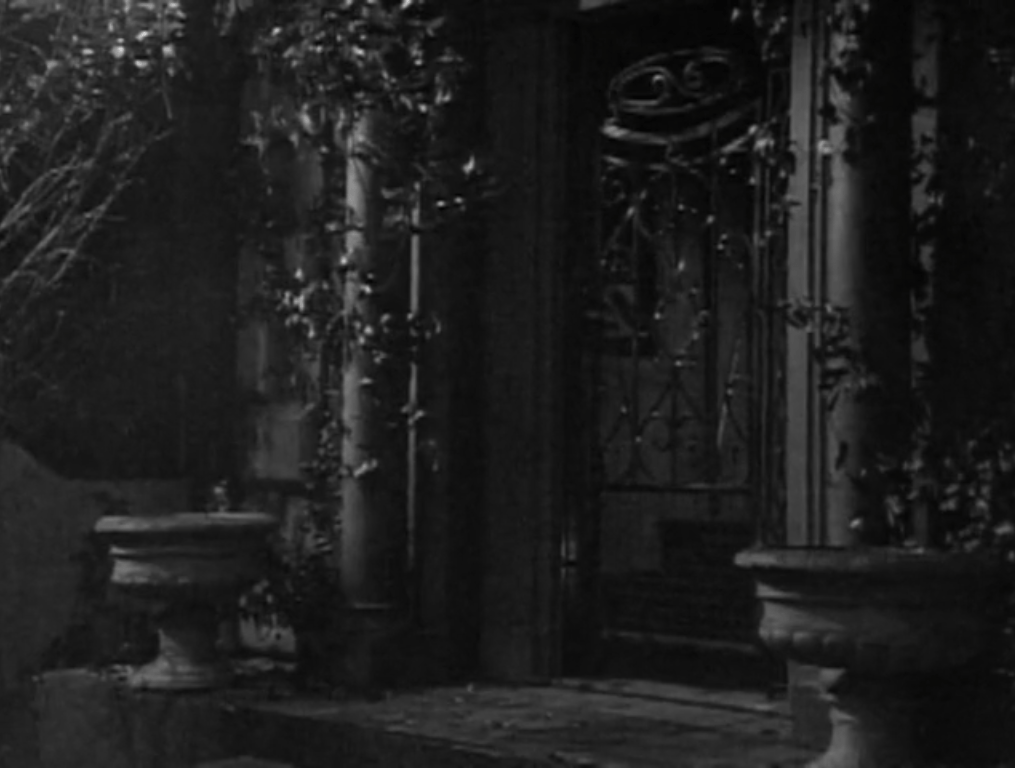
Patrick McCray’s commentary on this episode includes an analysis of director John Sedwick’s visual strategy in the last two shots, those in which Jonathan Frid first appears as Barnabas Collins. McCray confines himself to the first thing photography students are usually taught, the “Rule of Thirds.” But that’s all it takes to get us to look closely at the imagery and to see how Sedwick tells his story with pictures:
Two clear and subtly clever images with a bridge. His introduction comes from his own perspective, rather than Mrs. Johnson’s. It’s an exterior shot of the entrance, looking in.
The grid helps us divide the image. People in the west read from left to right, and tend to circle in our gaze back to the left. Sedwick uses this model of composition in all three shots. In image 1, we see someone — him? — through the eyes of Mrs. Johnson as the camera hangs over his shoulder, minimizing her (1.1). Why is she so transfixed? We follow her gaze up to the towering figure (1.2). Following the slope of his collar, we come back to Mrs. Johnson… specifically, her throat (1.3). After that, we circle back up to her gaze, even more worried. For what reason?
Then he enters with purpose, and we next see him again from the back, divesting himself of his cane and hat, getting a glimpse of his strangely antique cloak. His voice is rich with a uniquely tentative sense of authority. We still don’t see his face, just bits of his profile. These moments tease us, and yet they put us in the position of a confidant of the vampire’s. The composition mirrors what we saw outside. Within, Mrs. Johnson (2.1) is minimized, and the turn in the figure shows him looming, ready to pounce. Again, we begin with her, following her gaze from left to right. The mystery of what bedevils her, bedevils us, as well. The man towers (2.2) in the right, blocking the exit. Instead of following a sloping collar, we follow its larger, expanding offspring in the cape, which takes us circling to the left again where we stop on the poor, miniscule shield of his hat and then, like a wolf pulling her away, his feral looking cane (2.3).
Situated so close to the predator, with his gaze elsewhere, we have a strange safety. We don’t see him from the eyes of his prey. Instead, we are a quietly unacknowledged friend. Finally, as Mrs. Johnson goes to summon Elizabeth, the figure turns to face the portrait, rotating upstage to let us see him from profile to profile. As she exits, and we are alone with him, the chiseled face comes into focus from the side. It is alien. It is familiar. We think we know why, but then we see why. They are only face to face for a moment before the camera takes us away from him and uncomfortably close to the painting from 1795, cold and haughty and haggard and sad. He then steps even uncomfortably closer to it and spins to give his inevitable name. We see the two men in mutual relief.
The painting of Barnabas is a prisoner in a four-sided frame on the wall, disapproving and distant as the first thing our eyes rest on (3.1). Is the painting gazing at the man? No. The more we look, the more the painting is gazing at us, as if we’ve been caught looking. It’s natural to avert our eyes from this, and by comparison, section 3.2 is practically benevolent. His impossible doppelganger is standing before it in three dimensions on our 2D screen. Liberated, he smiles, and there is something optimistic about it. He’s gazing upward to the landing, yes, but it’s also to the future. Gazing left, he’s anticipating the next image rather than look for one that has passed. Subtly, our eyes wander down to 3.3, his medal, a subtle reminder that, despite his strange warmth, he’s a soldier as well, and a force to be reckoned with.
Dangerously unstable ruffian Willie Loomis stares at the portrait of Barnabas Collins hanging in the foyer of the great house of Collinwood. The portrait’s eyes glow and the sound of a heartbeat fills the space. Willie’s fellow unwelcome house-guest, seagoing con man Jason McGuire, comes into the room. Willie is surprised Jason can’t hear the heartbeat.
After consulting the Collins family histories, Willie goes to an old cemetery where legend has it a woman was interred with many fine jewels. The Caretaker of the cemetery stops Willie before he can break into her tomb. Willie hears the heartbeat coming from the tomb, but, again to his amazement, the Caretaker cannot hear it.
Yesterday, strange and troubled boy David Collins had told Willie that in some previous century, a pirate fell in love with Abigail Collins, gave her jewels, and that Abigail took those jewels to her grave. Today, Willie repeats this story to wildly indiscreet housekeeper Mrs Johnson, only he identifies the woman as Naomi Collins. Fandom likes to seize on this kind of thing, presenting it either as an error or as a sign of retcons in progress, but I suspect that it is just a clumsy way of suggesting that the characters are hazy on the details of the legend.
The legend itself is very much the sort of thing that inspired Dark Shadows in its first months. ABC executive Leonard Goldberg explained that he greenlighted production of the show when he saw that Gothic romance novels were prominently featured everywhere books were sold. The idea of a grand lady in a manor house somehow meeting and having a secret romance with a pirate is a perfect Gothic romance plot, as for example in Daphne du Maurier’s Frenchman’s Creek. Willie’s fascination with the tale might reflect an accurate assessment of the situation if Dark Shadows were still a Gothic romance, but the show left that genre behind as the Laura Collins storyline developed from #126 to #193. If Willie had been watching the show, he would know that the story David told him is not the one that is going to shape his future as a character on it.
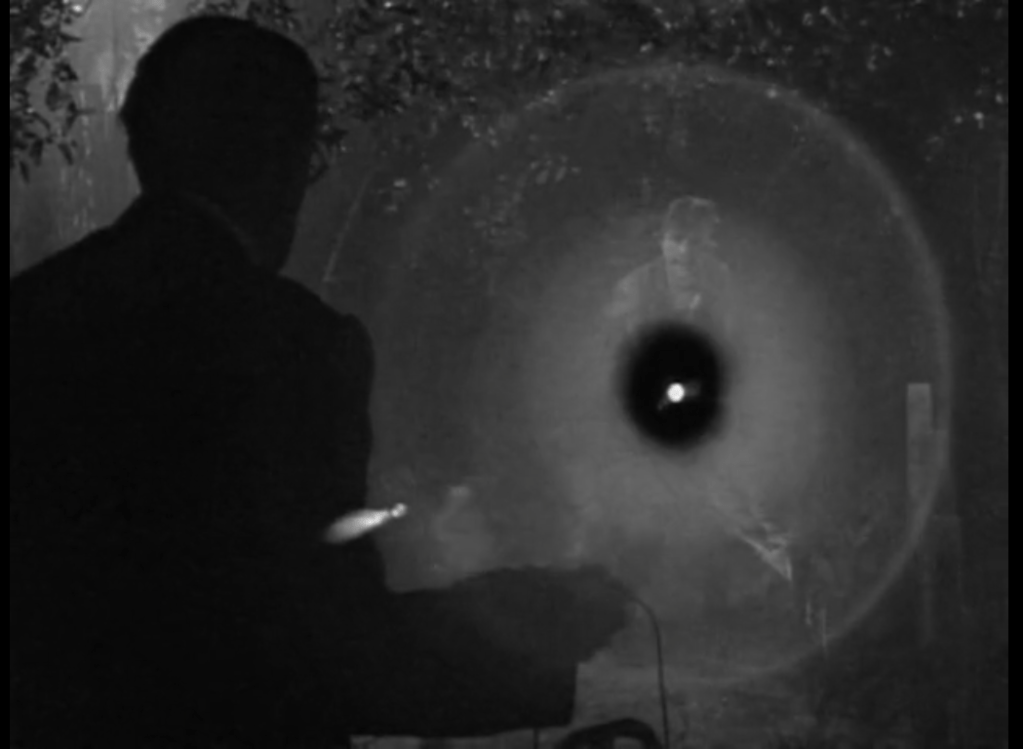
When Willie is wandering around the old cemetery, he twice shines a flashlight directly into the camera and creates a halo effect. The first time might have been an accident on the actor’s part, but the second time the halo frames the Caretaker in a way that is obviously intentional. Patrick McCray’s entry on this episode in his Dark Shadows Daybook describes the Caretaker as “a refugee from the EC universe.” Indeed, Willie’s crouching posture and angry facial expression, the halo filling so much of the screen, the tombstones in the background, and the Caretaker’s silhouetted figure carrying a lantern add up to a composition so much like a panel from an EC comic book that it may well be a conscious homage:
Beware the Vault of Horror!
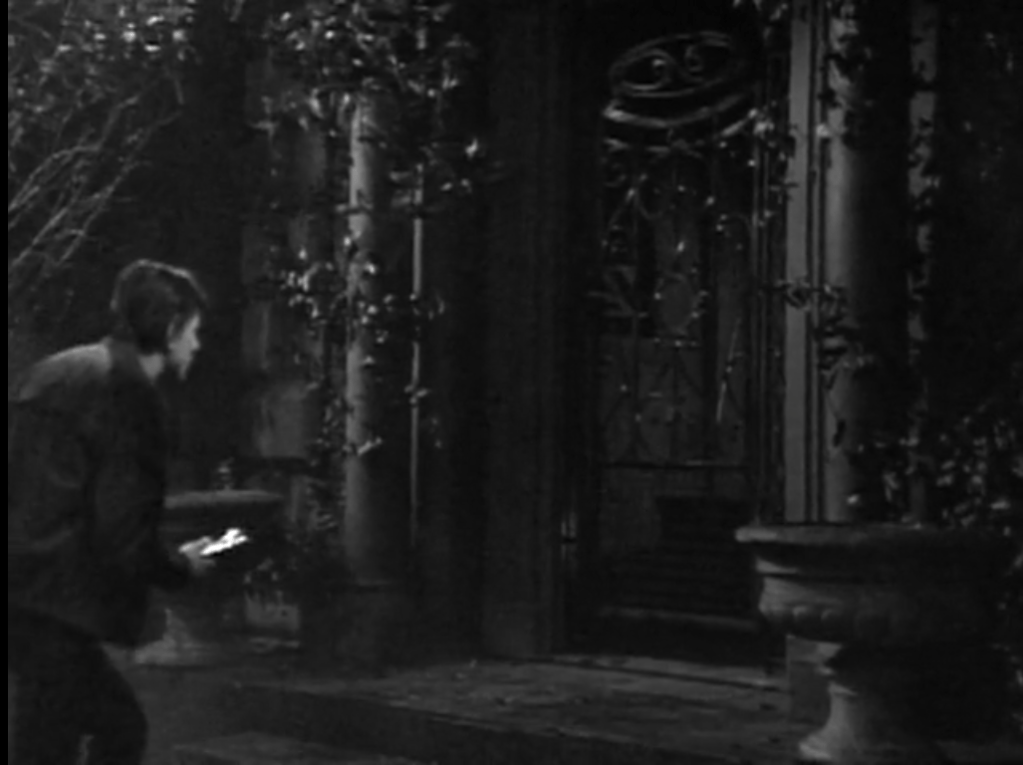
This is our first look at the Tomb of the Collinses.
Introducing the Tomb of the CollinsesWillie sneaks up to the Tomb
It’s also the first time we are told the name of the cemetery five miles north of Collinsport in which the Tomb is situated. Mrs Johnson calls it “Eagle’s Hill Cemetery,” though later it will be called “Eagle Hill.” Mrs Johnson also mentions the Collinsport cemetery two miles south of town, and the Collins’ family’s private cemetery located in some other place. They won’t stick with any of this geography for long, though it all fits very neatly with everything we heard about burial grounds in the Collinsport area during the Laura story.
Dangerously unstable ruffian Willie Loomis is staying at the great house of Collinwood, much to everyone’s dismay. Yesterday’s episode ended with a scene in which he appeared to be trying to rape well-meaning governess Vicki in the study. She resisted him pretty vigorously, especially after he trapped her in front of some furniture. When reclusive matriarch Liz interrupted the confrontation and demanded Willie leave the house, Vicki ultimately let Willie off the hook, saying that he didn’t really do anything.
Today, Vicki sees flighty heiress Carolyn in the kitchen and warns her about Willie’s violent ways. After Willie has insulted everyone in the house, Vicki and dashing action hero Burke Devlin run into him while on a date at Collinsport’s night spot, The Blue Whale. Willie enrages Burke, and the two men are about to fight. Vicki urges Burke not to fight, leading him to pause. She shouts at Willie, demanding that he go away. He does. This leads me to wonder if the reason Vicki didn’t back Liz up is that she wants to fight her own battles.
Willie returns to Collinwood. He finds Carolyn alone in the drawing room. He blocks her exit from the room. He grabs at her hair, and tells her that she is, unknown to herself, attracted to him. When she says she wants to leave the room, he orders her to stay until he dismisses her. He closes the doors and approaches her, responding to her protests by saying that he can’t hear her. If they had cut away at this moment, it would have been a fully realized rape scene. There is nothing left to show by putting the actual assault on screen.
But they don’t end it there. Carolyn reaches into the desk drawer and pulls a loaded gun on Willie. Willie does stand there and keeps talking for a moment, but eventually he takes “If you don’t leave me alone I’ll blow your head off” for an answer. He backs out of the room and goes upstairs. Evidently Carolyn doesn’t need rescuing either.
The closing credits run over an image including the spot on the wall to the left of the main doors to Collinwood. That spot has alternately been decorated with a mirror and a metallic device resembling a miniature suit of armor. Lately it has been the mirror; when Jason first entered the house, that mirror reflected a portrait. Now, the spot is decorated with a portrait. It is one we haven’t seen before.
We also see something that hasn’t happened since episode #1. The production slate tells us that this episode went to a Take 3. Considering what they left in for broadcast, it always boggles the mind what might have led them to stop tape.
Hardworking young fisherman Joe Haskell is having a drink at the bar in Collinsport’s tavern, The Blue Whale. Dashing action hero Burke Devlin enters and annoys Joe by sitting next to him. Burke and Joe had some conflicts earlier in the series, and Joe had formed a decided dislike of Burke in those days. The conflicts are no longer generating any action, so Burke has been trying to befriend Joe. Joe isn’t having it.
Burke tells Joe that he hears he has been having some adventures. Joe says that he doesn’t know what Burke is talking about, and isn’t sure he cares. Burke says that he has heard that Joe and parapsychologist Dr Guthrie went to the old graveyard north of town, opened a couple of graves, and found them empty. This is true, and since the only people who knew about it were either sworn to secrecy or strangers to Burke Joe is mystified as to how he found out.
Burke tells him that well-meaning governess Vicki told him. “Vicki wouldn’t tell you that,” says Joe. Burke explains that she had to tell him, because she needed his help. Strange and troubled boy David Collins adores Burke, and Vicki is the leader of a group who are afraid that David’s mother, blonde fire witch Laura Murdoch Collins, is going to burn David alive.
Burke dated Laura years ago, and was still hung up on her when she came back to town. He’d been urging David to get closer to his mother and to go live with her. He several times made it clear that he hoped to marry Laura and become David’s stepfather. Vicki laid out the evidence that she, Dr Guthrie, and the rest of her group have assembled in support of their view about Laura’s unearthly nature and horrifying plans. Since he heard Vicki out, Burke has joined her side.
Joe is taking all this in when we hear a tinkling sound and a muffled voice. The bartender comes to him and says “Mr Haskell, there’s a call for you.” I believe this is only the third time we’ve heard the bartender speak, after #3 and #156.
We see Joe take the call. He is shocked by what he hears. He returns to his spot and tells Burke that Dr Guthrie is dead. His car ran off the road and burst into flames.
Joe mentions Vicki and David, and Burke is alarmed at the thought that Vicki and David might have been with Guthrie. Joe calms him, explaining that Guthrie was on his way to meet Vicki and David. They, along with drunken artist Sam Evans, are waiting for Guthrie at the long-abandoned Old House on the grounds of the estate of Collinwood. They planned to hold a séance there to contact the ghost of Josette Collins, in hopes that Josette, who has been giving them hints and clues all along, will be able to tell them how to defeat Laura. Burke insists on going to the Old House with Joe.
Joe and Burke exchange all this information in normal conversational tones punctuated with shouts. We don’t see any other customers, but the bartender is right there, and while they are on the way out we even see him react to their mention of the séance.
Bob the bartender, wishing those two would keep their gobs shut
I’m sure they are relying on the bartender’s professional discretion. Still, they are catching on that Laura is extremely dangerous, participating in séances can wreck the reputation of people in the businesses Joe and Burke are in, and Joe and Guthrie’s grave-opening expedition was quite obviously something that could get them sent to jail. You’d think they would want to spare him the responsibility for so much sensitive information. It’s just inconsiderate to dump all that on a guy in return for the tips you give him for two beers.
At the Old House, Vicki, David, and Sam spend more than one scene waiting for Guthrie to show up. There is quite a bit of filler in this episode; when Sam says “I hate waiting like this!,” we can sympathize. Even after Joe and Burke show up with the news of Guthrie’s death, there is yet another scene of filler, in which Sam rants about Laura as the cause of Guthrie’s death and can’t decide whether he is willing to join Vicki and David in going through with the séance.
Of course they do go through with it. A ghost begins speaking through David, but it is not the spirit of Josette. It is David Radcliffe.
David Collins had not heard of David Radcliffe, but Vicki and others know that in 1867, Laura Murdoch Radcliffe burned herself alive with her young son David. A contemporary newspaper account reported that David Radcliffe happily joined his mother in the flames, refusing to be rescued. Vicki and her group believe that the current Laura Murdoch Collins is a reincarnation of that other Laura Murdoch, and that, as a humanoid Phoenix, she achieves a cyclical immortality by burning herself alive and rising from the ashes. They fear that Laura Murdoch Collins will take David Collins into the flames with her, and that he, like his namesake, will choose to burn to death.
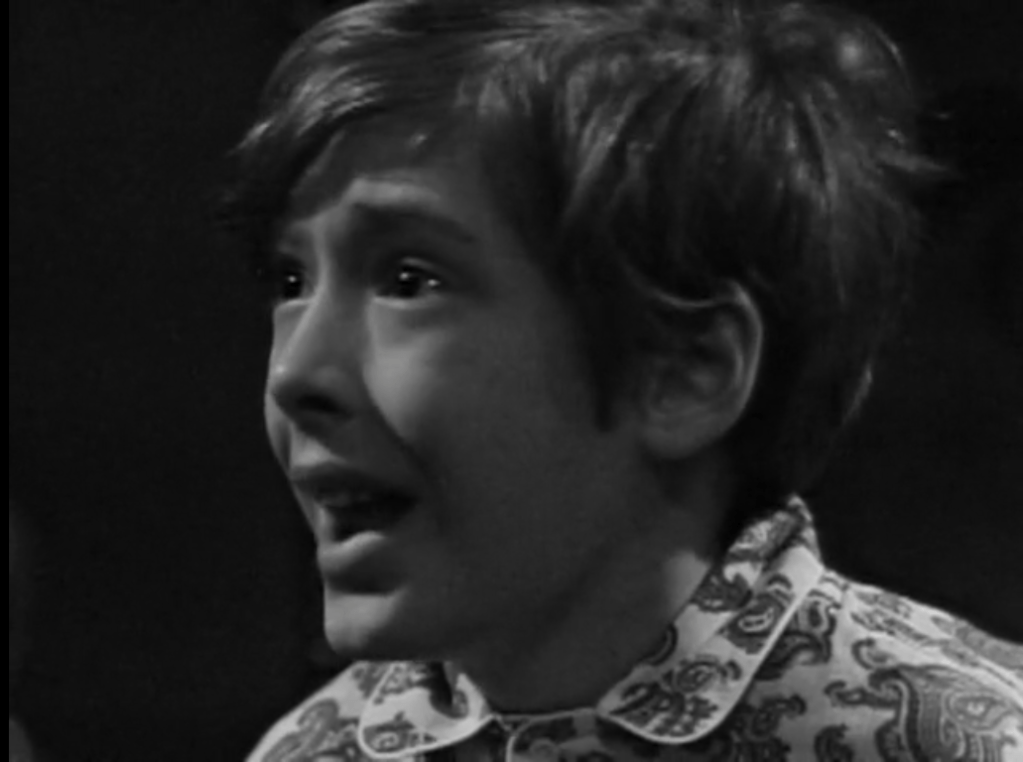
They do not know whether David Radcliffe shared his mother’s immortality, or whether David Collins will rise again if he burns with his mother. The show has repeatedly identified ghosts as unquiet spirits of the dead, so David Radcliffe’s appearance as a ghost speaking through David Collins would by itself militate against the idea that Laura’s resurrections are shared by her sons. In his speech, David Radcliffe describes himself being held by his mother while the fire rages and wanting to be with her forever, but ends with an tortured cry as he asks where she has gone. In agony, David screams and collapses.
This scene is a remarkable tour de force for David Henesy, and completes the audience’s understanding of what Laura is and what danger she represents. Her son is a means to the end of her own immortality, not a partner in that immortality. That Laura Murdoch Collins gave her son the same name her previous incarnation gave to the son she killed for her own sake shows that it was her plan all along to make him a human sacrifice to her inhuman survival. If Vicki can rescue David from the fate Laura has in store for him, she will not only prolong his life, but give him an altogether new life and give him herself as the mother of that life.
So, there are two sources of suspense. First, what further obstacles will Vicki encounter on the way to rescuing David, and what will be lost as she makes her way through them? There might be further deaths- Guthrie might have been the most readily disposable character on the show at the end of last week, but there are several others without whom Dark Shadows could go on just fine. There could also be lots of changes in relationships among characters, or in the personalities of characters we like as they are.
That brings us to the second source of suspense. It is a question that has been on the minds of regular viewers since the Phoenix story began approaching its climax. What will the show be about once Laura is gone? The only consistently interesting relationship on Dark Shadows so far has been that between Vicki and David, and once Vicki has established herself as David’s de facto mother that is going to be defined pretty securely. There might be periodic threats to their friendship, but once Vicki has managed to replace David’s mother there won’t be much doubt that she can overcome any lesser disruptions.
Art Wallace’s original story bible for the series, Shadows on the Wall, called for Laura Robin Collins to die under mysterious circumstances and for Vicki to be put on trial for her murder. That does not sound promising. We’ve spent months of episodes, most of them dismally slow-paced, figuring out information about Laura. Most of the characters now know as much about her as we do. An entire narrative arc spent rehashing what they’ve already rehashed beyond endurance would be impossible for even the most devoted fans to watch.
Vicki is to some extent based on Jane Eyre, a governess who ends by marrying her charge’s father, Mr Rochester. David’s father is named Roger, which is as close as they could get to “Rochester” without making people miss Eddie Anderson. They brought up the idea of Vicki and Roger going on dates in #72, #78, and #96, but in each case Roger was merely trying to keep Vicki from making trouble for him, very possibly by killing her.
Further, the show has been hinting very heavily from the first day that Roger is Vicki’s uncle, the biological daughter of his sister Liz. Wallace McBride mentions the single most compelling piece of evidence:
In Dark Shadows, your reflection always tells the truth.
Duality was a series theme from the very first episode, which implemented a shocking amount of symbolism in its photography. As a daily series, it was never designed to withstand the scrutiny of re-runs, let alone the far-flung fantasy concept of “home video.” The series was as disposable as a newspaper, something to be enjoyed for a few minutes and then forgotten. The writers and directors of Dark Shadows did not get that memo, though, and set about creating afternoon entertainment that was more psychologically complex than it had any right to be.
The first episode established this dynamic immediately. Victoria Winters is riding on a train through the night, her reflection in the glass beside her. We discover that she’s a “foundling,” anonymously abandoned to the state as an infant. She’s traveling to Collinsport, Maine, to take a job — and to learn the truth about her own mysterious past.
In other words, she’s looking for the real Victoria Winters — represented throughout this episode by her own reflection. We see Victoria reflected back in the window of the train carriage, the mirror in the restaurant of the Collinsport Inn, and in a mirror (in a flashback!) at her bedroom at the foundling home.
Most telling is the reveal in the episode’s final scene. When she arrives at her destination, the doors of Collinwood open to show Elizabeth Collins-Stoddard standing in the entrance, looking very much like Victoria’s reflection. (For me, this is all the evidence I’ve ever needed that Liz was Victoria’s mother.)
Among soap opera characters, attempted murder is frequently a prelude to romance, and an engagement between two people who are, unknown to themselves, closely related can build suspense as we wonder whether a third person who does know the truth will tell before it is too late.
But as Roger’s character develops it becomes ever clearer that he is not interested in marrying anyone. He is a narcissist, a coward, and devoid of family feeling. Worst of all, he’s spent all of his money. If she marries him, Vicki will either join him as his sister Liz’ charity case or get a blue-collar job and support him in a style to which he has no conceivable intention of becoming accustomed. That might work on another show, but it doesn’t sound at all right for Dark Shadows.
There are some odds and ends lying around from previous storylines, but those didn’t take off the first time we saw them and aren’t likely to be any more exciting now. Why is Liz a recluse? They haven’t shown us anyplace she’d be interested in going. Will Burke be avenged on Roger? Not if it requires writing Roger off the show- he’s hilarious. Will Joe marry Maggie Evans, The Nicest Girl in Town and daughter of Sam? Why not, they’re happy together and no one is against it. Will a serious romance blossom between Vicki and instantly forgettable young lawyer Frank? That’s such an urgent question that no one has noticed Frank isn’t on the show anymore. There just isn’t an episode’s worth of story in any of those questions. You may as well ask whether any more of Burke’s custom-made fountain pens will show up in town, or what happened to the dartboard Roger used to have in his office, back when he had an office.
Once it finishes with Laura, Dark Shadows is going to need a reboot. Both Laura’s storyline and the one that immediately preceded her, that of crazed groundskeeper Matthew Morgan, led us into the supernatural back-world of the show’s universe. That’s clearly where Dark Shadows 2.0 will be heading, and probably in a way too dynamic for the wispy presences of Josette and the Widows to survive. There may also be an attempt to mine some of the leftover pieces from Shadows on the Wall, but it’s hard to see how anything in there will get you very far.
Strange and troubled boy David Collins is sleeping peacefully in his bed. His cousin, flighty heiress Carolyn, comes into his room to check on him. She tucks him in, waking him. He asks what she is doing in his room. When she says that she was making sure he was asleep, he points out that she woke him up. When she keeps showing concern for him, he reminds her that she has called him “a spoiled monster” and a “menace to the civilized world” among other endearments, and that if he showed up in her room there would be no end of hollering.
Carolyn goes on talking to David in a gentle voice about how important he is to her, and says that maybe she’s the one who is a spoiled monster and a menace to the civilized world. After Carolyn maintains an affectionate attitude towards him for a few unbroken minutes, David asks her if she is OK. She assures him that she is. As David Collins, David Henesy’s bewildered response to Carolyn’s friendliness brings the house down.
While we are still laughing, David presses Carolyn to explain why she is being nice to him. A look of fear comes over him, and he asks if something terrible has happened. Carolyn assures him that nothing has, but he just looks more and more alarmed. By the time she leaves him, his expression is little short of heartbreaking.
David alarmed
The next morning, well-meaning governess Vicki is sitting with David in the drawing room, going over his homework. He has written an essay about what it might be like to have an older sister. He wonders if such a sister would love him. Vicki says that she might, and that it is a waste when you don’t love the people who love you. When Vicki asks David where he got the idea of writing about an imaginary older sister who loves him, he doesn’t give a direct answer. He does start talking about Carolyn, making it clear that he is thinking of her.
Vicki leaves David alone in the drawing room for a short while. He looks into the fireplace and sees his own face wearing a placid expression and immersed in the flames. He flees the room in terror, bumping into visiting parapsychologist Dr Guthrie. Vicki comes running, and David holds onto her for dear life.
ReflectionsSafe with Vicki
David’s vision reminds me of a post of Wallace McBride’s on The Collinsport Historical Society from April of 2020. His point is summarized in his title, “In Dark Shadows, Your Reflection Always Tells the Truth.” David lives in 1967, so he doesn’t have access to that article. But he already knows the truth it tells- his terrified reaction shows that he knows it means there is an imminent danger that he will die by fire.
We see hardworking young fisherman Joe poring over old newspapers in the Collinsport Public Library. He finds something that alarms him, and rushes to a public telephone to call Vicki. He tells her he is coming to the house to show something important to her and Guthrie.
Joe on the phone
When Vicki tells Joe and Guthrie that David had a vision of himself in flames, she connects it with a recurring nightmare that had plagued him several weeks ago. David’s mother, blonde fire witch Laura Murdoch Collins, had come back into his life after an absence of several years, and he kept dreaming that she was beckoning him to join her in flames. While he was suffering from this nightmare, drunken artist Sam Evans, miles away in town, inexplicably painted a couple of canvases depicting exactly the image that kept appearing in David’s dreams.
Joe and Guthrie become very animated when Vicki tells them what David saw and how he reacted. Joe declares that what David has seen is a vision of the past. Joe has already shown Guthrie what he found in the library, a newspaper article from one hundred years before. The article is about someone named Laura Murdoch Radcliffe. That Laura Murdoch died in 1867 in a fire along with her young son. His name was David.
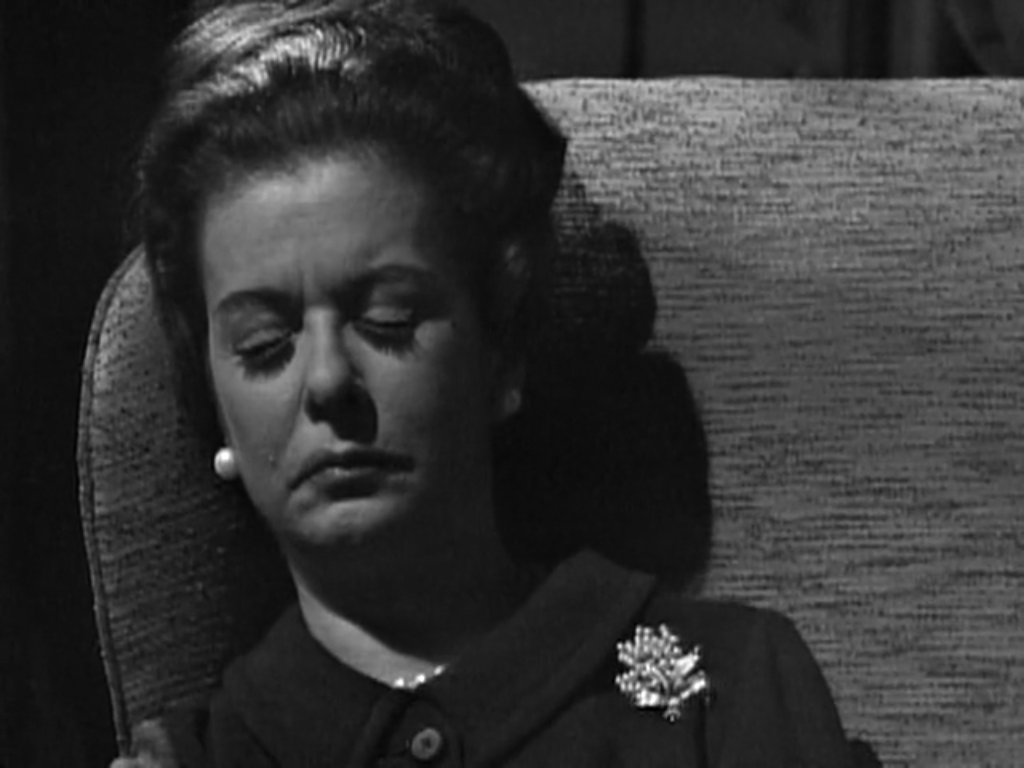
In episode 10, reclusive matriarch Liz had napped in a chair in the drawing room of the great house of Collinwood. Her sleep was troubled by unpleasant dreams; we saw her shifting in the chair and heard her muttering about ghosts. Strange and troubled boy David awakened her when he came in, having just sabotaged his father’s car in an attempt to murder him.
Liz’ troubled sleep in episode 10
Today, we open with well-meaning governess Vicki sleeping in the same chair, showing the same signs of discomfort, and muttering in her sleep words she had heard Liz say in a mad scene at the end of yesterday’s episode: “fire… stone… bird…”
Vicki’s troubled sleep in episode 157
Vicki awakens, not to find David returning from a homicidal errand, but to be overwhelmed by the presence of the ghost of Josette Collins. She smells Josette’s jasmine perfume, and the picture is out of focus. She walks around the room talking to Josette, whom we can neither see nor hear. She agrees to some instruction from Josette only she can hear.
Vicki’s boyfriend, instantly forgettable young lawyer Frank, shows up. He is complaining that Vicki called him at 5 AM, asked him to come over at once, and still won’t explain why.
Liz’ brother, high-born ne’er-do-well Roger Collins, appears at the top of the stairs and demands to know what Frank is doing in the house. Vicki claims that she wants Frank to take her for a drive in the country to help her clear her head. This makes sense to Roger. Liz is in a very bad way, for no reason the doctors can determine, and it has been a rough night in the house. Roger tells Vicki that he thinks it would be a good idea if she and Frank did take a drive. He is going to need a lot of help today, and the more relaxed Vicki is, the better able she will be to provide it.
The audience knows what Vicki has come to suspect, that Roger’s estranged wife Laura is a blonde fire witch who is responsible for Liz’ condition. Laura is staying in the cottage on the estate and she and Roger have begun the process of divorce. Laura and Liz clashed about guardianship of David, and Laura responded by casting a spell on Liz. With something like this in mind, Vicki wants Frank to take her back to a cemetery where they found some clues about Laura last week.
It is interesting to see Vicki with Frank in this episode. She is usually very demure, rarely looking anyone directly in the eye and consistently using a soft, delicate voice. She is that way today when Roger is around. But she looks straight at Frank and tells him in a crisp, candid tone just what they are going to do and why they are going to do it. That’s one of the reasons I keep wishing someone other than Conard Fowkes had played Frank. Fowkes is so dull that he simply could not survive on a show like Dark Shadows, but Frank is a character who gives us a chance to see a seldom-glimpsed side of Vicki.
Frank and Vicki visit the Caretaker of the cemetery outside town. In the archives of his building, Vicki smells jasmine and feels Josette’s presence. The Caretaker catches a distant whiff of jasmine too, but only Vicki’s nose can lead her to where Josette wants her to go. Josette pushes a book off a shelf and opens it to a page about a Laura Murdoch Radcliffe, who died by fire in Collinsport in 1867. Since they already know of another Laura Murdoch who died by fire there in 1767 and of someone who is medically indistinguishable from Laura Murdoch Collins who died by fire in Arizona earlier this year (1967,) Vicki finds great significance in the interval of 100 years. She tells Frank that the Laura Murdochs who died in Collinsport in 1767 and 1867 and the woman who died in Arizona this year are parts of the same corporate entity that is represented by the woman staying in the cottage.
Patrick McCray and Wallace McBride of “The Collinsport Historical Society” gave up writing daily episode commentaries around the time Ron Sproat joined the writing staff of Dark Shadows, but McCray does have a post about this episode. As usual, his remarks are thought-provoking:
We are about fifty episodes away from the introduction of Barnabas Collins, and you can feel the show straining with the need for it. We are at least watching a supernatural show, now. Going back to something less exotic will take the charm of a Dennis Patrick to pull off. He and Laura have something new that they are bringing/will bring to the show. One of the problems with the first six months of the show is how sad it is. The villains are wracked with guilt, somewhat grating in their personalities, and driven by necessity. Laura changes that. Her contribution to the show is less supernatural than philosophical. She likes who she is. She likes what she’s doing. She is demented enough to see that burning David alive is just dandy. Contrast this with Roger. He just wanted to be left alone, like a quietly queeny, ineffectual Hulk.
I’m not at all sure Laura “likes what she’s doing.” Most of the time, what she’s doing is sitting motionless by the fire. She is stirred from that position only when someone calls for her, and then only with difficulty.
The only times happiness registers on Diana Millay’s face are when Laura is talking to David and telling him about the blissful life that awaits in the fantastic realm she comes from, not about the path she must take to approach that realm. At other times, her dominant mood is weariness and her manner is so distant as to be inscrutable. With characters other than David, she is energetic and immediate only when she flies into a rage.
We don’t even know how many of her there are. Vicki tells Frank at the end of today’s episode that Laura seems to be made up of four components, but the audience also knows of ghostly apparitions that seem to travel with those corporeal Lauras and to be at least partly independent of them. Maybe somewhere in that complex there is a spirit that delights in the idea of taking David into a pyre, but we don’t see that delight.
McCray goes on:
Burke? He just wanted to even the odds. I get that. But his victory would mean shutting down Collinwood, and that gives any viewer mixed feelings. As much as I like Burke, his storyline misfired because you’re left with nobody to root for. If Burke wins, the show has to end, and that’s not going to happen. For Burke to lose, justice must elude him once more, and a character we like goes away. I suppose that the show originally was so Vicki-centric that we weren’t supposed to care for either Team Burke or Team Collins compared with Team Winters. With the arrival of Laura, all of this changes. (I say this because Matthew was a loon and couldn’t take pride in his wrongdoing.) Like Burke and Roger or not, everyone is pitted against/used by the first in a series of Gloucesters employed by the series to delight viewers.
Ibid
McCray is exactly right that Burke’s original storyline could never be resolved. The character had an even bigger problem that prevented the writers from coming up with a new storyline for him. That problem is his type. As a dashing action hero, sooner or later he’s going to have to rescue someone. Yet he never gets to save anyone from anything.
The first three rescues on the show are all rescues of Vicki. David locks her up and leaves her to die in the abandoned part of the great house of Collinwood. Burke doesn’t have access to that part of the house, so she ends up being rescued by Roger, of all people. That adds some complexity to Vicki’s attitude to Roger, keeps her from catching on to some plot points she isn’t supposed to understand yet, and most importantly enlarges the obstacles keeping her from befriending David, thereby enriching the one narrative arc that works every time we see it.
Next, gruff groundskeeper Matthew tries to break Vicki’s neck in the cottage. Liz saves her that time. It would have to be her, since she is the only person Matthew listens to. That’s the in-universe reason. Also, Joan Bennett is the biggest star on the show, the origin of the relationship between Liz and Vicki is supposed to be the biggest secret in the show, and the mostly-female audience of a daytime soap might be interested in a scene where a female character saves the day. So it is more satisfying all around to have Liz rescue Vicki from Matthew than it would have been to have Burke barge in.
When Matthew is holding Vicki prisoner in the Old House on the estate and is about to swing an ax at her head, Burke is in the area looking for her. But it is the ghosts of Josette and the Widows, accompanied by the ghost of beloved local man Bill Malloy, who rescue Vicki then. Burke and Roger show up after the fact and walk her home. The show has spent so much time building up the ghosts and the supernatural back-world behind the continuity in which the characters operate that it would be a cheat if they did not come forward at this point and bring a story to its climax. Again, Burke is left on the outside looking in.
Now David needs rescuing, but since the show’s most reliably interesting storyline has been the budding friendship between David and Vicki, she is the only one who can be his rescuer. Burke is got out of the way by having Laura entrance him with the memory of their old love. Since the threat to David is supernatural, this is also an opportunity to bring the ghosts back into play.
When the vampire story begins, Burke will become entirely superfluous. A dashing action hero can’t allow a bloodsucking fiend to run amok. But stop the vampire, and you stop the first ratings generator the show has ever had. So that will finish Burke once and for all.
Further:
I may be so-so on the Phoenix as a big bad on the show, partly because she was such an out-there villain, grounded in an unclear mythology. Nonetheless, she ushered in a sentient, supernatural threat and a new school of evil that finally gave viewers a moral compass to lead them through Collinsport.
Ibid.
It may be pedantic to point this out, but it is the nature of supernatural mythologies to be unclear. Once you pass the point where the laws of nature that we can examine out in the open apply, it’s up to the audience to guess at what the alternative structure of cause and effect might be. The storytellers can guide our guesses. Vicki’s discovery that the three Laura Murdochs died by fire in 1767, 1867, and 1967 leads her to tell us that the hundredth anniversary of the previous fire has the power to cause the next one. The power of anniversaries will indeed become a major part of Dark Shadows’ cosmology, coming up in several future storylines, and is the inspiration for my posting these blog entries at 4:00 pm Eastern time on the 56th anniversary of each episode’s original broadcast.
When you get to vampires and witches and Frankensteins and werewolves and other relatively familiar monsters, you can draw on horror movies produced by Universal Studios in the 1930s and endlessly shown on television since the 1950s, and beyond those on the plays, novels, and folklore from which those movies derived some of their imagery. That reduces the amount of explaining the protagonist has to do. We all know what blood and bats and wooden stakes and crosses and mirrors and daylight signify in connection with vampires, for example. That creates an impression that there are clear and logical rules, but when you hang out with the vampire for a thousand episodes you start to realize just how little sense any of those rules really make.
Laura is interesting precisely because she starts without any of that unearned sense of clarity. The show has to build her up to the point where she makes enough sense that we are in suspense, but not to go beyond that point and explain so much that we can’t avoid realizing how disconnected she is from the world we live in. I’d say they strike that balance quite well.
Moreover, because we have so little information about Laura, she is the perfect adversary for the supernatural beings we have met so far on the show. The ghosts of Josette and the Widows are definitely around, but they are deep in the background, seldom seen, even more seldom heard, and when they do intervene in the visible world their actions are brief and the consequences of them ambiguous. These vague, distant presences are credible as a counterforce to a figure as undefined as Laura, but have to evaporate when a menace appears that calls for a dynamic response sustained over a long period. Since the show has spent so much time hinting around about Josette and the Widows, it would be a shame if they hadn’t come up with a supernatural adversary for them to engage.
Back to McCray:
This episode is rich in atmosphere and menace, but anything involving the mysterious Caretaker will do that. It serves up Collins history as a net that strangles generation after generation… and the place where the answers to today’s mysteries will be found. The show has always been about the past… Paul Stoddard, the car accident, Vicki’s parentage… but (Widows notwithstanding) never beyond the lifetimes of the protagonists. By having our heroes deal with ancient dangers that still long to cause harm, DARK SHADOWS truly begins.
Ibid.
I demur from lines like “Dark Shadows truly begins” at some point other than episode 1. The whole wild ride of improvisation and reinvention is what I find irresistible. Each period of the show has some connections to the one immediately before it, but as time goes on there is absolutely no telling where they will go. Watching this part, the so-called “Phoenix” story, you can just about see how it follows from the moody, atmospheric showcase that Art Wallace and Francis Swann’s scripts provided for fine acting, ambitious visual compositions, and evocations of Gothic romance in the first 20 weeks of the series. And you can just about see how the period of the show that comes after it is resolved follows from the Phoenix. But when you look at the stories they will be doing in 1968 and later, all you can do is ask how they could possibly have found their way from here to there. Going along for that chaotic, meandering journey is the fun of it, and you deny yourself a little bit of that fun every time you ignore or downgrade an episode.
I also have reservations about the remark that “This episode… serves up Collins history as a net that strangles generation after generation.” The 1767 incarnation of Laura Murdoch married into the Stockbridge family, and the Caretaker told us they were great and powerful. The 1867 version of her married into the Radcliffes, and the Caretaker is shocked to find that her parents are not listed in his records- the Radcliffes were so high and mighty that none of them would ever have married someone whose parents were not known. So the history that strangles generation after generation is not the history of a single family, but something about the part of central Maine where Collinsport is. “Laura Murdoch” is a curse that falls on each prominent family in the region in its turn.
Well-meaning governess Vicki, fresh from imprisonment at the hands of strange and troubled boy David Collins, gets a few days off work to visit Bangor, Maine. Flighty heiress Carolyn had agreed to drive her to the bus station in the town of Collinsport. Carolyn doesn’t have a job, go to school, or seem to have anything else to do, so why she and Vicki don’t just take a road trip together is unclear.
They wait for the bus at the local restaurant. From there, Carolyn telephones dashing action hero Burke Devlin, her family’s arch-nemesis and the object of her own obsessive crush, and invites him to join the two of them at their table.
Carolyn tells Burke that Vicki has recently seen the ghost of beloved local man Bill Malloy. Vicki tries not to give Burke any additional information. When Burke learns of Vicki’s plans, he volunteers to take her to Bangor in his car. She declines, but he won’t take no for an answer. I don’t drive, and I admire the way this scene shows how hard it can be for a non-driver to decline a ride.
When Burke leaves to get Vicki’s bags, Carolyn blows up at her. Carolyn tells Vicki that she must have known she came to town hoping to see Burke and spend the evening with him. Vicki did not know any such thing. After all, Burke has openly declared his intention of forcing Carolyn’s entire family into bankruptcy and disgrace, and she has expressed remorse for her infatuation with him. When Carolyn makes it clear she is still chasing Burke, Vicki doesn’t know what to say.
The Collinsport Historical Society says that Carolyn spends this week alienating the audience, and her passive-aggressive behavior towards Vicki is indeed exasperating. Watching the scene in the restaurant, it makes perfect sense that Vicki would decide that escaping Carolyn is worth the risk of getting in trouble with her employers by spending an hour with Burke.
Back home at the great house of Collinwood, Carolyn hears her mother, reclusive matriarch Liz, playing the piano. She makes a lot of noise when she comes in, ensuring that her mother will call her into the drawing room. Once there, Carolyn puts on a great show of being upset. She gives partial, teasing answers to each of her mother’s questions, drawing her in as best she can. She finally declares that Vicki is not to be trusted. She reveals that Vicki is in a car with Burke, probably telling him everything she knows about the Collinses and Collinwood. We then cut to Vicki and Burke in the car, where she is telling him everything she knows about her recent sighting of Bill Malloy’s ghost in the house.
Again, the scene in the restaurant explains Vicki’s behavior. Carolyn had told Burke so much about it that it would be hard for Vicki or anyone else to see much point in trying to keep the rest of the story from him. When Burke wants her to say that the ghost accused someone in the house of murder, she insists that it only said it was someone in Collinsport, not Collinwood.
Carolyn has always been tempestuous, and Vicki has always been quick to forgive her. Perhaps now that the relationship between Vicki and David is about to enter a quieter, more complicated phase, the makers of the show wanted to ensure that there would be a continual source of conflict within the house. That might explain why they have chosen to feature Carolyn’s nastier side so heavily this week.
Yesterday, dashing action hero Burke Devlin announced to the ancient and esteemed Collins family that he intends to drive them out of business and take all their holdings. He then muddied the waters by offering to pay them an inflated price for their dilapidated old house. Still, everyone came away with the impression that Burke had openly declared himself to be the deadly enemy of the Collinses.
Problem child David Collins wasn’t in that episode, and he refuses to believe the characters who were when they tell him that his idol Burke has said that he is out to strip the Collinses of their assets. The only person David likes, aside from Burke, is his aunt, reclusive matriarch Liz. He struggles when forced to choose sides between them. His misery and frustration grow palpably throughout the episode.
At least David can still do something he likes. His cousin, flighty heiress Carolyn, tries to get him to return a photograph of Burke that he stole. While she is in his room, he taunts Carolyn with the idea that Burke isn’t really attracted to her, but that he prefers well-meaning governess Vicki. This infuriates Carolyn, much to David’s satisfaction.
The photo itself is a bit of a mystery. It shows Burke striking oil:
The show has repeatedly told us that Burke grew up poor, that he was still poor when he went to prison, and that he was penniless, despised, and alone in the world when he got out of prison just five years ago. Yet now, he owns a corporate raiding firm, and is a millionaire many times over. They’ve dwelt on this time frame so much that even a soap opera audience is likely to start wondering how he got so rich so quickly. The photo may be an attempt to answer that question. Everyone knows that if you strike oil, you can become a millionaire overnight. Of course, you would have to own the mineral rights to the land the oil is on to profit from such a discovery, and would also need to secure drilling equipment and to hire a crew to operate it if you’re going to make the strike in the first place. How an indigent person fresh out of the state penitentiary is supposed to have paid for those things is not really easier to explain than how he could start a private equity concern.
Both yesterday’s episode and today’s include references to Liz’ estranged husband, Carolyn’s father Paul Stoddard. Yesterday’s included a reference to another character we have yet to see, Laura Collins. Laura is David’s mother, the estranged wife of high-born ne’er-do-well Roger Collins, and the onetime fiancee of Burke. These two had been mentioned only a handful of times in the first months of the show, and neither was given a name until well into it. That they are coming up more often now might lead us to wonder if we will be meeting one or both of them sooner or later.










 Dark Shadows Commentary