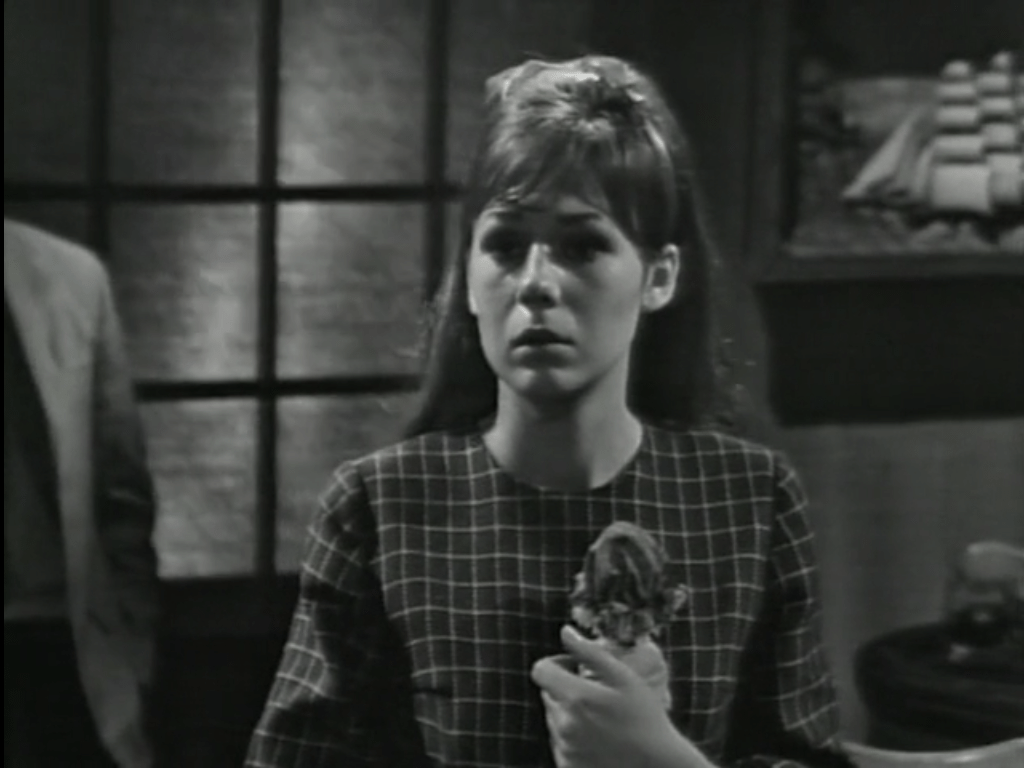
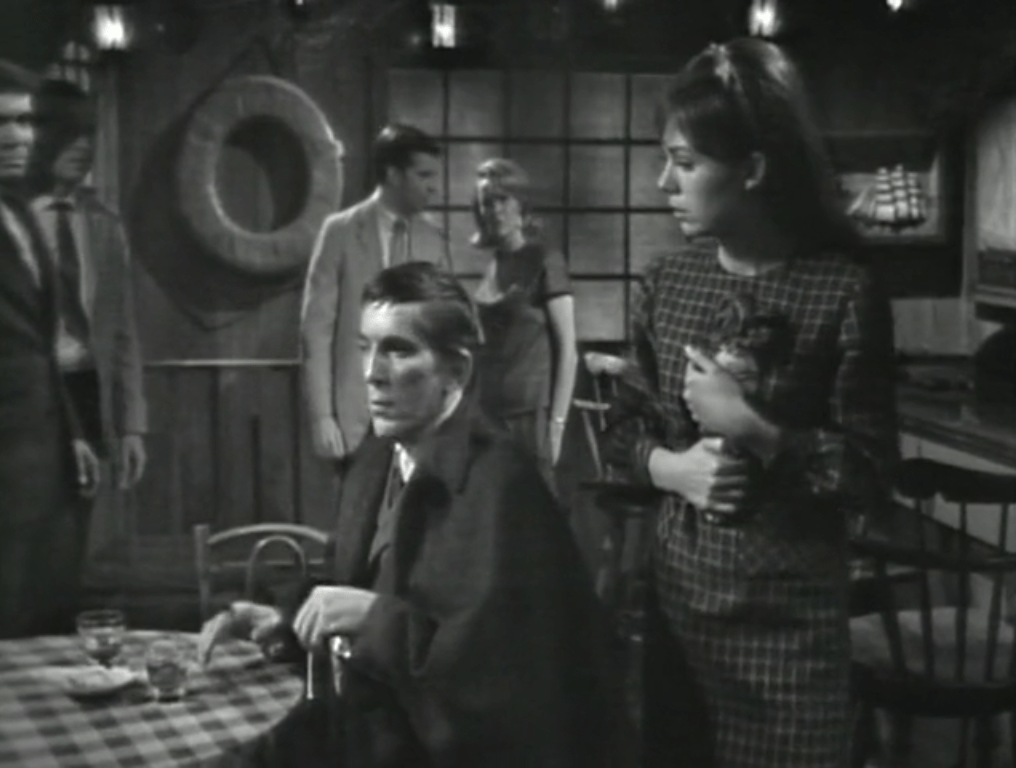
In a clearing in the woods, strange and troubled boy David Collins runs into his friend, the ghost of his distant cousin Sarah Collins. Sarah wants him to spend time with her, but he explains that he has to go and have dinner. Sarah persuades him to come with her to Eagle Hill cemetery, where she will show him a secret.
The secret turns out to be the hidden chamber inside the Tomb of the Collinses. David objects when Sarah tells him they will be opening the coffin there. His curiosity finally overcomes his scruples. He is shocked by what is inside, Sarah is pleased.
The whole interaction between Sarah and David is charming beyond words. At first she is lonely, and her simple rendition of this one emotion is sad enough to explain why David cannot stick with his resolution to get home in time for dinner. Once they are in the cemetery, she is brisk and commanding, insisting David open the door to the tomb, instructing him to release the secret panel inside, assuring him that it will be all right for him to stand on the sarcophagus of Naomi Collins* to reach the lever that controls the panel, directing him to open the coffin, and smiling when he does so.
Sarah shows such raw emotion in the scene in the woods and such verve in the cemetery sequence that I wonder if this may be the episode taped on the day of one of the more infamous moments in Dark Shadows history. Nine year old Sharon Smyth and eleven year old David Henesy would play on the set while the crew was preparing for taping. Mrs Sharon Smyth Lentz now tells the story that one day, they were playing hide-and-seek and she decided it would be a good idea to hide inside a coffin. She heard David Henesy approach the coffin, and just as she expected him to open it and find her inside, he jumped on top and sat there. She could hear the director calling out “We’re ready for Sharon! Where is Sharon?” but couldn’t open the lid of the coffin or make herself heard from within. Behind the scenes between Sarah and David C. may be a bit of unfinished business between Sharon and David H.**
There’s also some stuff in the Old House on the great estate of Collinwood. Vampire Barnabas Collins is feeling sick, and thinks it may be due to the efforts mad scientist Julia Hoffman is making to cure him of vampirism. He tells his sorely bedraggled blood thrall Willie to kill Julia if he suspects Julia is doing anything to harm him.
Barnabas also tells Willie that he is deeply worried about Sarah’s presence. He has no idea why she has come back or what she wants. Indeed, no one seems to know what Sarah is up to. David keeps complaining to her today of her mysteriousness, and everyone else who has mentioned her is full of unanswered questions. The audience hasn’t seen anything that would explain what she intends to do; it isn’t even clear that she has a plan. Whether she does or not, the writers are definitely making her story up as they go along. Which, oddly enough, turns out to be enormously compelling. The very wackiness of their improvisations gives us a feeling that Sarah really is a visitor from another plane of existence, one that does not follow any of the rules we expect to see in our daylight world.
Julia then comes in, and Barnabas tells her that he will kill her if the treatments do not work. She is irritated, and asks why he must continually pester her with death threats. Julia’s refusal to be frightened by Barnabas is so funny that the comedy must be intentional on the part of the actors and directors, if not of the writers.
*Her mother, as David doesn’t quite know. In the first year of the show, David had been on friendly terms with a number of the ghosts; as recently as #288, he wondered aloud if Sarah were a ghost. But now he seems to have forgotten all about the supernatural back-world of the action. In his post about this episode, Danny Horn writes that stripping David of his ghost-awareness just as Dark Shadows is going all-in on paranormal stories amounts to “grinding up his character for the sake of plot mechanics.” Considering that they are in the process of grinding several other characters up in the same way for the same short-sighted reason, it’s a worrying development.
Fake Shemp Burke Devlin is starting to suspect that there is something odd about old world gentleman Barnabas Collins. He suspects that Barnabas is not from England as he claims to be. More darkly, he is considering the possibility that Barnabas might be the one who abducted Maggie Evans, The Nicest Girl in Town, and held her prisoner. As it happens, the audience knows that he is correct in both of these suspicions. We also know more- that Barnabas is a vampire.
Burke has hired investigators to probe into Barnabas’ past. Barnabas told him he lived near London with a cousin named Niall Bradford. Burke’s investigators have found that the last time a man of that name lived in London was 130 years previously. Dark Shadows has been going back and forth for months on whether Barnabas lived in the 1830s or in the eighteenth century. Yesterday they seemed to commit themselves to the earlier date, but now we’re back with the 1830s.
Burke asks Maggie’s doctor, addled quack Dave Woodard, to show him all of her medical records. Woodard protests that medical records are confidential. He then tells Burke everything he knows about Maggie’s case.
Burke calls on Maggie. She is back home, apparently well, but suffering from amnesia covering the entire period of her captivity. Unknown to any of the characters we see today, Maggie’s psychiatrist Julia Hoffman is a mad scientist in league with Barnabas, and she has wiped Maggie’s memory clean of any information that might threaten to expose him. Burke talks with Maggie and her boyfriend, hardworking young fisherman Joe, repeating everything Woodard told him a few minutes before.
Maggie and Joe tell Burke that she has had a few visitors since she came home. Maggie blithely mentions that Barnabas was one of those visitors. Burke is startled to hear this, and Maggie repeats that Barnabas dropped in to pay his respects.
During the fourteen weeks when Dark Shadows was driven by undead fire witch Laura Murdoch Collins, Burke saw extensive evidence of supernatural doings. But he lately he has decided that he lives in the kind of world where the show took place in its first few months, where there might be hints of ghosts in the background, but all the action came from flesh and blood humans subject to the usual laws of nature. Since it doesn’t occur to him that a person might have powers like Julia’s, Maggie’s calmness when talking about a visit from Barnabas seems to prove that Barnabas is innocent.
Burke learns that Barnabas has been to see Maggie.
Maggie does say that there is just one memory she has that seems to be connected with her time in captivity. It is a bit of music- “a light, playful tune. A soft, tinkling sound.” She freely admits that it seems unlikely that this would have any connection with such an experience, and speculates that it may have been something she remembered from childhood.
In the great house of Collinwood, well-meaning governess Vicki is listening to the enchanted music box Barnabas gave her. Burke and Vicki are now engaged to be married. He comes to see her, and remarks on the music box. She accuses him of being jealous of Barnabas, and he keeps coming back to the music box. When she opens it for him, he remarks that it makes “a light, playful tune… a soft, tinkling sound.”
The episode ends with Burke listening to the music box and staring off into space. Barnabas gave the music box first to Maggie, then to Vicki, in each case hoping that she would listen to it until its magical quality caused her to believe that she was his lost love Josette. Seeing the look on Burke’s face as he listened, my wife, Mrs Acilius, said “Maybe Burke will start to think that he’s Josette.” Who knows, maybe he and Barnabas could be very happy together.
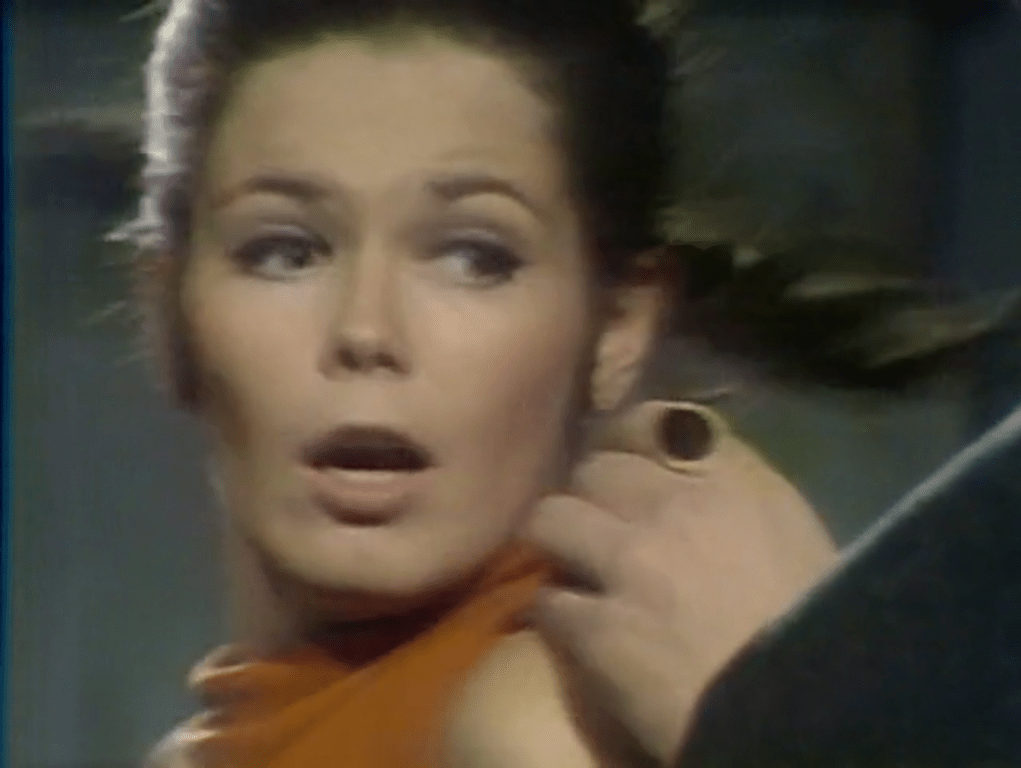
Vampire Barnabas Collins creeps up on well-meaning governess Vicki from behind. He touches her neck, and she is startled.
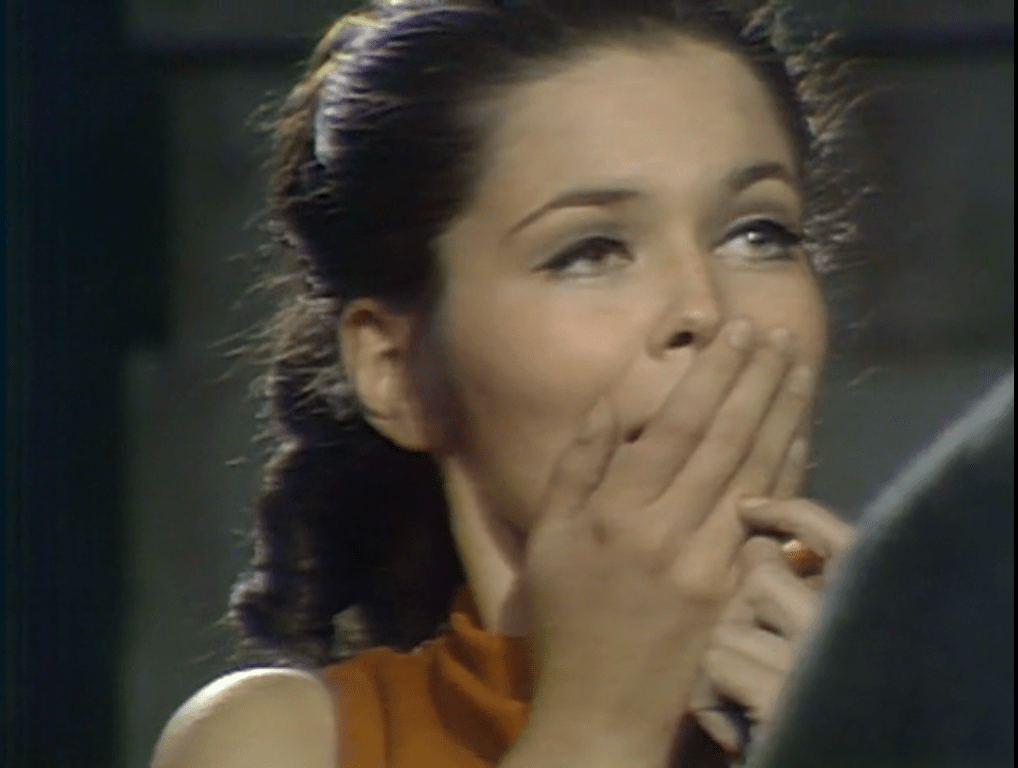
Stifling a giggle
This scene plays twice. First, before the opening title sequence, then again immediately after. The first time around, Vicki stifles a giggle when she sees Barnabas. The second, she seems frightened.
Frightened
Barnabas does not bite Vicki. He apologizes for startling her. She says that no apology is needed, and she stands very close to him. They talk about the Moon and the night and about what incredible romantics they both are.
Incredible romantics
In #285 and #286, Vicki contrived to get Barnabas to invite her to spend the night in his house. In #293, she invited Barnabas to tag along on a date she was having with her depressing boyfriend Burke, and while Burke stood there she had eyes only for Barnabas. In this conversation, Vicki reluctantly turns down an invitation from Barnabas so she can go on some more dismal dates with Burke.
Mad scientist Julia Hoffman interrupts Barnabas and Vicki. After Vicki excuses herself to get ready for her date, Julia demands that Barnabas leave her alone. Barnabas says that he means her no harm. This is all too believable- twice before today, we have seen Barnabas enter a room where Vicki was sleeping and leave without biting her. It’s starting to seem unlikely that she will ever have a place in the vampire story. Since the vampire story is the only plot going on Dark Shadows, that leads us to wonder why she is still on the show.
This scene takes place on a new set, a courtyard with a terrace and a fountain. It looks very much like a set in the 1965 film The Sound of Music, the one where the Countess who is supposed to marry Captain von Trapp has the conversations that remove her from the love triangle and leave the path open for von Trapp to marry Maria. That movie was such a big hit that it seems likely that they had it in mind when they designed this set for scenes concerned with the love triangle involving Vicki, Burke, and Barnabas.
Julia’s intervention leads some to believe that there is another love triangle budding in which she will vie for Barnabas’ affections, but I don’t see any trace of that in Julia’s stern manner today. She simply seems to be concerned that Barnabas stop preying on people while she performs the experiments that are supposed to cure him of vampirism.
In later years, Grayson Hall would claim that she decided on her own initiative to play Julia as if she were in love with Barnabas. She said that by the time the writers and directors caught on to what she was doing, they had received so much enthusiastic fan mail that they had to let her go on doing it. In response to this story, Danny Horn makes some uncharacteristic remarks in his post about this episode on Dark Shadows Every Day:
It’s a great story, especially because it appeals to the audience’s secret belief that the actors really are the characters that they play. We love to believe that, especially for daytime soap opera characters, who we spend time with every day.
But really, everybody who watches television believes that the characters are real. That’s why we love to hear about unscripted moments that were invented during rehearsal. As intelligent adults, we understand that writers and directors and producers create the characters, and then the actors show up and say the words. But there’s a little child inside of us, who wants to be told that Julia Hoffman is real, and she lives inside Grayson Hall.
Danny Horn, “A Human Life,” Dark Shadows Every Day, 2 Jaunary 2014.
As the blog went on, Danny put more and more emphasis on the chaotic process by which Dark Shadows was created. I suspect this passage was something he wrote in haste. Even at this early stage, he had made it clear that he knew that it was not true that “writers and directors and producers create the characters, and then the actors show up and say the words.” By the time he finished in 2021, his main theme had long been that the real subject of Dark Shadows was “a team of under-resourced lunatics desperately struggling every day to make the most surprising possible show.” That team most definitely included actors padding their parts in ways they could do only because the show was done live to tape, with edits never done if not absolutely necessary, and often not done even when they were.
Julia visits Vicki’s room and helps her choose an outfit for her date with Burke. Julia urges Vicki to avoid Barnabas, because he has a crush on her and it would hurt him to encourage him in it. Vicki says that she has never seen any sign of such a crush. Nor have we- he has talked with his sorely bedraggled blood thrall Willie about a plan to take Vicki as his next victim. Aside from giving her an enchanted music box that is supposed to brainwash her, he has been remarkably leisurely about the whole thing. If anything, she is the one who has been pursuing him.
Vicki and Burke are out by the fountain. He remarks that she has been very quiet, and she refers to having a lot on her mind. This raises our hopes that she is thinking about what Julia told her and is going to ditch Burke and go to Barnabas. They start talking about their wretched childhoods. Previously, we had heard that Burke’s mother died when he was young and that his alcoholic father supported the family by making lobster pots; now Burke tells us that when he was nine his father left the family. It’s hard to see much point in this retcon; most likely the writers had just forgotten about the earlier story.
Vicki mentions that there was one nurse at the Hammond Foundling Home whom she liked. In the early days of the Dark Shadows, she would often reminisce about her ridiculously bleak experiences growing up in this fictional orphanage. Usually she would get a faraway look in her eyes and smile, then tell some story that started with an appalling horror and got worse and worse as it went. This time, she again stares off into the distance and smiles, so that viewers who have been watching from the beginning brace themselves to hear that the nurse turned out to be the worst abuser of all, or that she was murdered in front of Vicki while the other children laughed, or that she ran the kitchen the winter they ran out of food and had to resort to cannibalism. But no, Vicki is just sharing a pleasant little memory. The show is a lot less hard-edged now that it’s about a vampire.
Not that they’ve stopped presenting horrible images altogether. No, they show us Burke kissing Vicki.
When Burke was played by Mitch Ryan, he was a great kisser, a talent he displayed with Vicki among others. But Anthony George does not appear to have seen anyone kiss before he attempts it. As he points his lips at Alexandra Moltke Isles, she stiffens her neck, a move that may have suggested excitement if her partner were doing something recognizable as a sign of affection, but that in this context looks like she’s suffering from whiplash. After his first failed effort, he rests his head on her shoulder and looks miserable.
Attempted kissAfter the failure
We pull back from Burke’s fumbling and see Barnabas at the gate to the courtyard, looking forlorn. I’m sure the writer and director wanted us to take this image as a sign that Barnabas is feeling sorry for himself, but the scene he’s been watching with us is so dreary that we would all have the same look on our faces.
Barnabas has seen the sorry spectacle
Some attribute George’s phenomenally bad kissing to his sexuality. I don’t buy it. Joel Crothers was also gay, and we’ve seen Joe Haskell give convincingly sultry kisses to two actresses. Louis Edmonds was gay too, and when Dark Shadows finally gives him an on-screen kiss two years from now he will do just as well. And the actresses unanimously testified that Jonathan Frid was the best kisser in the cast. Furthermore, the other conspicuously inept kisser on the show was the emphatically heterosexual Roger Davis (whom we have yet to see.) So George’s failures in this department are his alone, and do not reflect on any demographic group of which he was a member.
In the house, Vicki and Burke continue their vain struggle to kiss. Julia walks in and apologizes for intruding. She does not leave, nor does she take her eyes off Vicki and Burke. That makes sense- after all, she is still an MD, and it would appear that whatever is wrong with Burke might require some kind of medical intervention.
Vicki excuses herself to go to bed, and Burke asks Julia to join him in the drawing room. There, he denounces Vicki for her “vivid imagination,” a terrible quality that must be stamped out. He tells Julia that Vicki has experienced two hallucinations recently. We know that these were not hallucinations at all, but actual visitations from the ghost of Sarah Collins. Burke doesn’t know that. However, he does know of another sighting which led him to angrily accuse Vicki of being insane, when she saw Maggie Evans, The Nicest Girl in Town, walking in a cemetery. At the time, everyone thought Maggie was dead, but now that it has been revealed she is alive, he removes the incident from his bill of particulars against Vicki.
Burke is furious with Vicki for having an imagination and wanting to be part of the story
Burke and Vicki, like most of the other characters, believe Julia’s cover story that she is an historian researching the Collinses for a book about the old families of New England. He asserts that helping Julia with her project is having a bad effect on Vicki, because she must “live in the present.” Julia asks if this means that she must live with him. Burke agrees that it does.
To Burke’s surprise, Julia agrees that Vicki should stop helping her and stay away from anything suggestive of past centuries. The two of them talk about how Vicki must be watched and controlled lest her imagination “run wild.” Julia is a mad scientist in league with a vampire, so this sort of talk is to be expected from her, but Burke is supposed to be on Vicki’s side. His frank intention to crush her imagination, expressed alternately with undisguised rage and airy paternalism, is as repulsive as anything we have seen from Barnabas.
Upstairs, Vicki is asleep. Barnabas opens the door and walks into the room. Again he thinks about biting her, again he doesn’t. He opens the enchanted music box, looks at her a bit longer, and leaves the way he came. If Barnabas doesn’t get off the dime soon, Vicki may marry Burke and become useless forever.
The only story on Dark Shadows at this point is the one about vampire Barnabas Collins. They’re trying to get a second one off the ground, about an old vacant house that has caught the fancy of well-meaning governess Vicki. Vicki’s depressing boyfriend Burke has interpreted her interest in the place as a marriage proposal. He wants to buy the house and live in it with her.
Today, we find out that the house is the property of the ancient and esteemed Collins family. That isn’t a big surprise, since Barnabas clearly knew something about it from his time as a human. It does suggest a partial answer to a question Vicki had when she, Burke, and Barnabas visited the house on Thursday. Barnabas found a handkerchief there bearing the initials “F. McA. C.” and gave it to Vicki. She expressed a determination to find out what those initials stood for. Now she should be able to look at the family’s records and search for a Mrs Collins whose maiden name had the initials “F. McA.”
Burke asks matriarch Liz if she is willing to sell the house to him, and she is perfectly agreeable. Liz’ daughter Carolyn joins them for a tour of the house. There is some startlingly sloppy writing in this scene. Carolyn remarks that the house has a special warmth and speculates that it is the result of so much light reflected into its windows from the sea nearby. A couple of minutes later, Liz complains that the house is terribly cold, and Carolyn says that’s because it is so close to the sea.
Both Liz’ glad willingness to sell the house to Burke and her trip to it signal that storylines from the first year of the show are now behind us once and for all. Burke was introduced in episode 1 as a dashing action hero returning to his home town to wreak vengeance on his old persecutors, the Collins family. The “Revenge of Burke Devlin” arc consisted so largely of talk about people, places, and events we never saw that it didn’t amount to much, and by the time Burke formally renounced his revenge in #201 it had long since fizzled. That left some chance it would flare back up, so in #223 Liz vowed she would never sell Burke any property at any price, but now the door is firmly closed on that old theme.
When Dark Shadows started, Liz was a recluse who hadn’t left home in eighteen years. Since they never showed us anyplace Liz might want to go, that story was an even more total dud than was The Revenge of Burke Devlin. Even after the reason for Liz’ seclusion was exposed as fraudulent in #273, she still made a show of reluctance when her brother Roger suggested she go to town in #277. Now she doesn’t hesitate to hop in a car and go to the house by the sea. In fact, she is the one who urges Carolyn to get out of the house. So that sends another non-starter to the narrative junk yard.
In this episode, the characters refer to “the house by the sea” as “Seaview.” That was an inside joke. The Newport, Rhode Island mansion used in the exterior establishing shots of the great house of Collinwood was known as Seaview Terrace. In 1974, Martin and Millicent Carey bought the house, and it came to be known as the Carey Mansion.
Meanwhile, Vicki is visiting Maggie Evans, The Nicest Girl in Town. Maggie has amnesia, a condition induced by her doctor, mad scientist Julia Hoffman. Julia is in league with Barnabas, and has damaged Maggie’s memory to keep her from recalling that Barnabas abducted her and tried to replace her personality with that of his lost love Josette. Vicki is trying to help Maggie regain her memory.
There is another instance of distressingly sloppy writing in this scene. Vicki tells Maggie that she thought she saw her in Eagle Hill cemetery during the period she cannot recall. She tells Maggie that Burke tried to convince her that she can’t have seen her. In response, Maggie asks if Burke saw her, and Vicki again says Burke tried to convince her she hadn’t seen her.
Vicki tells Maggie that she and Burke had gone to the cemetery to lay flowers at Josette’s grave. Maggie reacts strongly to Josette’s name, and Vicki starts telling her about Josette. When she mentions that Barnabas has restored Josette’s room, a light comes on in Maggie’s eyes and she grows very animated. She is about to say something when a knock comes at the door. It is Julia.
There is a strange blooper in the conversation between Vicki and Julia at the door. Julia asks “Would it be all right if I came in and waited?” Vicki responds “Not at all.” My wife, Mrs Acilius, is usually very forgiving of bloopers, but she laughed out loud at this one.
It could be that Julia’s line was “Would you mind if I came in and waited?” Alexandra Moltke Isles was famously accurate with her line delivery, even when her scene partners bobbled, and it could be that she just went ahead and said what Vicki was supposed to say even though it didn’t make sense. In view of Carolyn’s self-contradictory lines about the temperature of the house and Vicki’s repetitious lines about Burke’s attempt to gaslight her, both of which were obviously scripted, it could also be that the actors are working from Ron Sproat’s unrevised first draft.
While Julia looks at some of Maggie’s father’s paintings, Vicki sits back on the couch with Maggie. Julia hears Maggie exclaim “Barnabas!” and get very agitated. It seems she is about to tell Vicki all about what happened when she was missing.
Maggie, remembering
Julia swoops in, asking if they like antiques. Vicki looks bewildered at the interruption, but answers with a polite yes.
Julia interrupts
Julia presses her jeweled medallion on her. Vicki passes it to Maggie, and Julia asks for a cup of tea. Maggie volunteers to make the tea, but Vicki insists on doing it. In #143, the living room and kitchen in the Evans cottage were two parts of an undivided space, but now we hear Vicki close a door when she goes to make tea. Not only is that confusing to viewers who remember the earlier episodes, but since Vicki goes in the direction of the front door it seems for a moment that she is leaving the cottage altogether.
While Vicki is out of the room, Julia hypnotizes Maggie. She commands her to forget everything that happened while she was missing. When Vicki returns, Maggie has indeed forgotten everything.
The only story going on Dark Shadows is about the doings of vampire Barnabas Collins. So the only characters we will see in action are those connected to Barnabas. That puts the audience in the odd position of hoping that characters we like will become his victims or his accomplices.
Maggie Evans, The Nicest Girl in Town, has been an audience favorite since she was introduced in episode 1. Months ago, Barnabas bit Maggie and held her prisoner for a long time. After the ghost of Barnabas’ nine year old sister Sarah helped her escape him, Maggie had amnesia and became a patient at a mental hospital run by mad scientist Julia Hoffman, who is now in league with Barnabas. Sarah helped Maggie escape from the hospital and return to the town of Collinsport. Her amnesia lifted, but Julia erased Maggie’s memory before she could expose Barnabas.
The audience is tempted to accept Julia’s crime against Maggie as a convenient resolution of its own conflicting desires. On the one hand, we like Maggie and don’t want Julia to lock her up or Barnabas to kill her. On the other, Barnabas’ destruction would leave Dark Shadows without any stories to tell. That would lead to the show’s cancellation, taking Maggie and all the others with it. With Maggie’s memory mutilated, the show can stay on the air and Maggie can stay on it.
Our conflicting desires and divided loyalties create suspense. In his post about this episode on his blog Dark Shadows Every Day, Danny Horn analyzes a scene in which Sarah visits Maggie in her room today, and shows how it keeps us from simply accepting what Julia has done:
Maggie keeps making closing statements like, “Well, the important thing is that wherever I was, I’m back, and everything is going to be just like it was.” There’s an opportunity here to just wrap everything up in a bow and go do something else, the way they did with the blackmail storyline a month ago.
But then there’s Sarah, the weird little ghost girl who helped Maggie escape from the vampire’s dungeon, and then brought her home from the sanitarium…
It’s not clear whether Sarah actually has a plan to expose Barnabas as the vampire… But for today, at least, she seems to be dropping in purely for a social call.
She stands at the open French windows and watches Maggie read. Maggie looks up, and notices that she has a visitor.
Maggie: So, I see. Well, would you like to come in?
Sarah: Thank you.
And she strolls in, with a big smile…
Maggie is acting like a good-humored, friendly adult who’s meeting a strange child for the first time…
The penny drops. Maggie bends down, and looks Sarah in the eyes.
Maggie: Little girl… Sarah… Do you know anything about what happened to me?
Sarah: Will you tell me the truth?
Maggie: What truth?
Sarah: Do you remember me?
Maggie: The honest truth? No, I don’t.
Sarah pulls away.
She says, “You’ve forgotten me. Just like everybody else. You’ve forgotten me.”
Now, she’s not a great actress, and I’m not saying that she is. She’s nine years old and she has a strong Philadelphia accent,* and sometimes it sounds like she’s learned her lines phonetically. But right now, she’s a nine year old kid whose best friend suddenly doesn’t recognize her.
And it’s legitimately heartbreaking. Sarah is really important. She visited Maggie, and showed her how to escape, and told her father where to find her. Then she listened and concentrated for weeks, until she figured out where the sanitarium was, and then she helped Maggie escape from there, too. Sarah’s been faithful, and clever, and she truly believes that Maggie is her very best friend.
So Maggie’s memory loss isn’t just a magic reset button that wraps up this story thread. Sarah feels hurt, and with good reason. It really feels like a betrayal.
Sarah says she wants her doll back, and then she walks out, muttering, “Only my doll remembers me. Only my doll.”
…The important thing that happens in this episode is that Sarah is a lonely little girl who’s made one friend in the last hundred and fifty years, and Barnabas and Julia took her friend away.
That was a very bad mistake. Sarah is pissed. There will be consequences.
The reference to “the blackmail storyline a month ago” shows what is at stake for Maggie. When that story ended, Barnabas killed the character who drove it, seagoing con man Jason McGuire. Jason will be mentioned a couple of times in the next weeks, and then forgotten forever. If the show decides to “wrap everything up in a bow and go do something else,” there won’t be any way to fit Maggie into the only story they have. In the opening scene, Maggie’s father Sam and fiancé Joe are talking about leaving town. And rightly so- if Maggie no longer has unsettled business with Barnabas, either she and Joe will get married and move away, or they will simply fade into the background. Either way, they will be forgotten.
When Sarah goes away and takes her doll, we wonder if she will no longer protect Maggie. If so, we might see Maggie’s death very soon. Yesterday’s episode ended with Barnabas saying in a soliloquy that he didn’t believe Julia’s mumbo-jumbo would work, and that he would kill Maggie the following night. That night is tonight, and Barnabas is knocking on the door of the Evans cottage.
Sam and Maggie are happy to see Barnabas. Sam asks Barnabas to sit with Maggie while he goes to deliver a painting he has completed. Barnabas and Maggie chat about the gap in her memory. Barnabas says that he wishes people wouldn’t be so persistent with questions about it, a very credible statement. When Maggie says she thinks there is a chance her memory will come back bit by bit, he reacts with a look that tells us he has decided to come back later and go through with his plans.
Barnabas comes into Maggie’s room while she is sleeping. He picks up a pillow, intending to smother her. Why he doesn’t just drink her blood, I don’t know, maybe he’s on a diet or something. Suddenly Sarah’s voice rings out singing her signature song, “London Bridge.” Barnabas calls to Sarah and asks what she wants. She just keeps singing. He backs away from Maggie, then leaves. Sarah may be disappointed in Maggie and unwilling to let her keep the doll, but she is still watching over her.
In an entry in the “Dark Shadows Daybook,” Patrick McCray goes into depth about Sarah’s part today. I won’t quote any of it, because it is full of spoilers stretching right up to the final episode, but it is well worth reading if you have already seen the whole series.
*I don’t see any reason to object to Sharon Smyth’s accent. I’m sure a dialect expert could tell you all about the difference between the accents of eighteenth century Mainers and those of Baby Boomers from Philadelphia, but no one else could. Besides, the show gave up on having its actors sound like they were from Maine during its first month on the air.
Maggie Evans, The Nicest Girl in Town, has come back to Collinsport. This is a surprise to everyone. Months ago, Maggie had escaped from an unknown captor who drained her blood and deranged her mind. Maggie’s family doctor, addled quack Dave Woodard, had persuaded her father and her fiancé to join him in telling everyone that she was dead and to lock her up in a mental hospital a hundred miles north of town. Evidently, Woodard thought that if the captor believed he had got away with his crimes, he would turn into a solid citizen and a good neighbor.
The mental hospital where Woodard sent Maggie was administered by Dr Julia Hoffman, an MD whose specialties in psychiatry and hematology made her seem like the perfect person to oversee Maggie’s care. Unfortunately for Maggie, Julia is also a mad scientist. She has for years dreamed of finding a vampire on whom she can try an experimental treatment that will turn him back into a human. Julia quickly recognized Maggie’s condition as a symptom of vampire attacks, and eventually identified Barnabas Collins as the vampire who held Maggie prisoner. She has now met Barnabas and promised to keep Maggie in a state of amnesia so long as he cooperates with her experiments.
Yesterday, the ghost of Barnabas’ nine year old sister Sarah liberated Maggie from Julia’s hospital and transported her back to Collinsport. This had such a great effect on everyone that the show is now in color.
Barnabas goes to the great house of Collinwood and tells Julia that Maggie has come back. He declares that he will have to kill her. Julia forbids him to kill Maggie, on the grounds that doing so would ruin years of her work. Talented a liar as Julia is, she comes up with this so quickly and in such a tense situation that it is hard to believe it is not her true reason for wanting to leave Maggie alive.
Barnabas clarifies the matter further when he says that he will kill Julia first. He follows Julia around the drawing room, apparently thinking of strangling her then and there. She keeps talking, and he can’t resist responding. The telephone rings, and she answers. It is Woodard, calling her to come to his office and take over treatment of Maggie. Julia triumphantly assures Barnabas that once she has done her work, Maggie will never remember what he did to her.
In Woodard’s office, Maggie’s memory is rushing back. She tells her friend Vicki that when she was being held prisoner she spent time in a special room where she smelled a sweet, powerful fragrance and heard a special kind of music. She had told Julia about those sense impressions in a session in #282, and when in #289 Vicki told Julia about a special room in Barnabas’ house where there was a jar of jasmine perfume and an antique music box, Julia had reconstructed Barnabas’ entire plan. When she hinted to Vicki that Barnabas was trying to recreate the late Josette Collins, Vicki had become defensive and stormed off, indicating that Julia is casting an unflattering light on something Vicki has been looking at through a romantic lens.
The camera is tight on Vicki’s face when Maggie mentions the room, the fragrance, and the music. Vicki’s face darkens in response to each point, a little bit more each time. She seizes on the key word of each statement, rephrasing it as a question- “Special room?… Special scent?… Special music?” So far on Dark Shadows, every plot has come to its climax as a result of Vicki figuring out what’s going on. So each of these reactions generates its own little jolt of suspense.
Special room?Special scent?Special music?
By the time Julia gets there, Maggie is saying that she remembers everything. Julia hustles Woodard out of the room, and is alone with Maggie when Maggie says that Barnabas Collins was her captor. She describes him as a creature from the world of the dead. She allows that this description is difficult to believe, but Julia assures her that she believes everything she tells her. Julia then tells her that they must stabilize her memory so that she will not regress to the miserable state she was in when first they met. She takes out a jeweled medallion and hypnotizes Maggie.
Woodard waits outside his office while Julia works on Maggie. Finally, Julia opens the door and asks if he would like to see the change in her. Woodard eagerly goes into his office.
He asks Maggie how she is. As she answers, she sounds just like she did before she fell into Barnabas’ clutches. She has regained her Adult Child of an Alcoholic habits of advertising her happiness by starting every utterance with a laugh in her voice and putting exaggerated stress on almost every syllable with a rising pitch. She tells him that “Apparently, there was something wrong with my memory, but I’m fine now.” He asks what happened to her when she was gone, and she has no idea what he means. She remembers falling asleep in her own bed, and then she found herself here with Dr Hoffman. If he could just tell her what happened in between, she’s sure she will be just fine.
Woodard is shocked, but Julia flashes a look of glee. She does remember to put on her worried face after Woodard looks at her, but the smile never really leaves her eyes.
That Julia was able to achieve so precise and extensive a mutilation of Maggie’s memory in so short a time would suggest that she spent the whole period Maggie was under her care laying the groundwork for it. That would in turn tend to confirm that her only interest in Maggie is as a tool to gain access to Barnabas as a subject for her experiment.
Closing Miscellany
As the opening title sequence begins, an ABC staff announcer says he brings “Good news! This program, Dark Shadows, is now being presented in color.”
Opinions may vary as to how good this news was. In the 1960s and 1970s, most television sets in the USA did not receive in color. So even programming that was made in color had to be composed first to look good in black and white. It took a big budget and a relaxed production schedule to make a show that would also benefit from color, and Dark Shadows never had either of those things. When a sense of atmosphere is especially important, as it usually is early in a storyline, it is best to watch the show with the color turned off.
Still, directors Lela Swift and John Sedwick were ambitious visual artists, and before long there will be some moments when they find ways to turn the muddy, cruddy TV colors of the era to their advantage. The camera operators will learn their craft even more quickly. Today, only a few closeups really meet broadcast standards, while every other shot is badly out of focus. There aren’t many other episodes like that, at least not until the woeful Henry Kaplan becomes one of the directors in December 1968.
This is not only the first color episode, but also the first one where the words “Dark Shadows” swoop and swirl around on the screen during the opening titles. I’m sure that was a very impressive effect in 1967.
When we saw Julia hypnotize Maggie in their sessions in the hospital, she shone a penlight in her eyes. This is the first time she uses the medallion. That is an example of the use of color- the medallion wouldn’t have been anything special in black and white.
Maggie Evans, The Nicest Girl in Town, is a patient in a mental hospital run by a mad scientist who is in league with the vampire who kept her prisoner. So there are bars on the windows of her room, and a lock on the outside of the door. The vampire, Barnabas Collins, scrambled her memories before she escaped from him, and the mad scientist, Julia Hoffman, intends to keep her in her amnesiac state.
We see Maggie at the barred window, begging for someone to help her go home. At that, her friend, the ghost of nine year old Sarah Collins, materializes in the room. Maggie hugs Sarah, and Sarah apologizes for taking so long to find her. Sarah assures Maggie that she can help her get home, but tells her she will have to do what she says.
Sarah apologizes for taking so long to come
At Sarah’s direction, Maggie stands in the corner behind the door and calls the nurse while Sarah sits on the bed. The nurse opens the door and sees Sarah, but not Maggie. Maggie slips out and closes the door behind her, locking Sarah and the nurse in the room. The nurse tries the door, looks back, and sees that Sarah is nowhere to be found. The camera stays with her for a long moment as she looks around in bewilderment. As Nurse Jackson, Alice Drummond does a great job with this stage business.
Meanwhile, back in Collinsport, there is a misdemeanor in progress. Well-meaning governess Vicki, her depressing boyfriend Burke, and Barnabas are sneaking into an old vacant house that has captured Vicki’s fancy. Barnabas astounds Burke with his ability to see in the dark as he describes the “No Trespassing” sign, and refers to the same ability as he volunteers to explore the upper storey of the house while Burke and Vicki stand around on the ground floor.
Burke has taken Vicki’s interest in the house as a marriage proposal, and keeps talking about how they should furnish it when they live there together. The only thing he says that gets much of a reaction from her is a disparaging remark about Barnabas, which elicits flash of anger. Yesterday’s episode included a couple of clues that Vicki’s infatuation with “the house by the sea” might lead her, not to Burke and irrelevance, but to Barnabas and the center of the action. Her forceful response to Burke’s Barnabas-bashing renews those hopes.
Burke has spoken ill of Barnabas
Barnabas comes back from the upstairs with a handkerchief bearing the initials “F. McA. C.” He makes a present of it to Vicki. When she objects to this act of theft, he assures her that whoever it belonged to would want her to have it. That too picks up on hints from yesterday, when Barnabas indicated by his typical slips of the tongue that he had a connection to the house that he didn’t want the other characters to know about. We haven’t yet heard of anyone living or dead with the initials “F. McA. C.,” so presumably we are supposed to start waiting to hear a fresh story about Barnabas’ earlier existence.
Somewhere to the north, Maggie and Sarah are sitting in the woods. In recent days, we have heard several times that the mental hospital is a hundred miles from Maggie’s home in Collinsport, so if they are going to walk the whole way and take breaks it will be a while before they get back.
Maggie asks Sarah how she got into her room. “Do you really want to know?” Maggie says she does. “The same way I got out.” How did she get out? “The same way I got in!” At that, Maggie laughs. Sarah first met Maggie when she was Barnabas’ prisoner, and she remarks that this is the first time she has heard her laugh. She tells her she ought to do it all the time.
Apparently, an early draft of the script called for a truck driver to pick Maggie up and take her back to town. But that couldn’t be. How will Sarah get Maggie to Collinsport from the hospital? The same way she got to the hospital from Collinsport, of course.
In Collinsport, Vicki, Burke, and Barnabas are sitting at a table in the Blue Whale tavern. While Barnabas gets the drinks, Vicki tells Burke that he and Barnabas are extraordinarily unalike. Burke says he takes that as a compliment, a remark to which Vicki reacts with displeasure.
Burke has repeated his offense
We can sympathize- sure, Barnabas is a vampire, and that is sub-optimal in a potential husband. But it doesn’t make him the opposite of Burke, who has been draining the life out of Vicki lately with his demands that she steer clear of anything that might be interesting to the audience and become as dull as he is. The real difference between Burke and Barnabas is that Barnabas drives one exciting plot point after another, while Burke makes nothing happen.
Barnabas comes back to the table, and the conversation returns to the “house by the sea.” Burke is about to propose marriage to Vicki. Suddenly, the jukebox stops playing and everyone falls silent. It is as if something has entered the room that everyone can feel but no one can see. The door opens, and in walks Maggie.
Vicki is the first to see her. She calls her name. Barnabas reacts with alarm. Maggie walks slowly towards their table. She approaches Barnabas, who tries to remain very still. She takes a long look at him, walking around to get the best angle. She touches her head, calls out “No!,” and faints. And that is what you call a “cliffhanger ending.”
Mad scientist Julia Hoffman is hanging around her new base of operations, the Old House on the great estate of Collinwood. She is getting ready to perform an experiment which, if successful, will convert vampire Barnabas Collins into a real boy. She learned of Barnabas’ existence when treating his former victim Maggie Evans, The Nicest Girl in Town. Julia answers a knock on the front door, and sees her old acquaintance, addled quack Dave Woodard.
Woodard has no idea what Julia is up to. So far as he knows, she is still on board with his own idiotic scheme, in which he, along with Maggie’s father Sam and her fiancé Joe, has told everyone in town that Maggie is dead in hopes that her captor would forget about imprisoning girls and draining their blood. In fact, Julia has told Barnabas that Maggie is alive and has lured him into cooperating with her project by promising to keep Maggie in a state of amnesia so that she will not represent a threat to him.
In yesterday’s episode, Sam and Joe called on Woodard and complained that Julia is staying at Collinwood while Maggie is a hundred miles away. They demanded that Woodard take her out of Julia’s care. Woodard tells Julia today that her conduct is growing “more and more unethical.”
Last week, Julia was able to forestall Woodard’s threat to take her off the case by playing dumb. This time, she has to take him partly into her confidence, telling him that Maggie encountered the supernatural and that her case represents an opportunity to find a crossing point on the boundary between life and death. She dangles the possibility of great fame before him, saying that the doctors who make the breakthrough she sees coming will go down in history. When he presses for details, she says that there is great danger in what she already knows, and that she must not tell him more.
Woodard has been on the show for months, and has been stuck in just two modes the whole time. When he’s with a patient, he makes a show of brisk dissatisfaction, as if trying to convince them that they oughtn’t to take their disease so seriously that they give up. This mode was as far as Richard Woods, the first actor to play Woodard, got in his two appearances (in #219 and #229.) When he is talking with someone else, Woodard struggles to find the words to express his bafflement at the terrible case he is treating. These two modes didn’t make Woodard a source of suspense. They were just filler between his announcements of what the script called for him to do next.
When Julia asks Woodard if, when he was in school, he dreamed of making a major contribution to the science of medicine, he gets a thoughtful look and says “Well, of course.” This is the first moment we have seen Woodard outside his two modes. When Julia tempts him with the idea that he will go down in history as the co-discoverer of the most fundamental truth imaginable, he displays an emotion that might lead to him to any of a number of exciting, story-productive actions. The first scene in the first episode credited to writer Gordon Russell manages the astounding feat of turning Dr Woodard into an interesting character.
We cut to the woods on the estate. We see the ghost of Barnabas’ nine year old sister Sarah sitting on a rock crying. All of Sarah’s previous scenes started with some other character on camera, then proceeded to Sarah making a mysterious entrance. That’s what we would expect of a ghost, after all. This time, Sarah is all by herself at rise. The first time we saw a ghost was in #70, when the ghost of Josette Collins emerged from her portrait and danced around the columns of the Old House. That was a solo appearance as well, but people had been in the Old House talking about Josette immediately before, so she was manifesting herself in response to attention from the living. Here, we see a ghost on her own, processing her emotions, hoping someone will come and hang out with her.
Strange and troubled boy David Collins shows up and asks Sarah why she is crying. She says she can’t find Maggie. David breaks the news to her that Maggie is dead. Sarah laughs, and assures David that she is still alive. When David insists that Maggie is dead, Sarah tells him that he may know “about leaves and everything,” but she knows “who’s dead, and who isn’t.”
Less than a week ago, in #288, David saw a portrait of Sarah and wondered aloud if the girl he has met is her ghost. In the first 39 weeks of the show, he was on intimate terms with Josette and some of the other ghosts. When he first met Barnabas in #212, he asked him if he were a ghost, and was disappointed to hear that he was not. So returning viewers expect David to ask Sarah the same question. Indeed, David has always interacted with ghosts as if they were people with whom he could pass the time of day, share thoughts and feelings, and get to know better from one encounter to the next. Seeing Sarah crying by herself should validate this attitude. But instead, David has developed Soap Opera Goldfish Syndrome, forgetting information which everything we have seen has led us to expect he will remember.
David insists Sarah come home with him to the great house of Collinwood and have dinner with the family. She tries to decline politely, but he will not take “I’ve been dead for centuries” for an answer. He gets Sarah into the foyer, then goes to the drawing room to announce her presence. He finds Julia there, with well-meaning governess Vicki and Vicki’s depressing boyfriend, fake Shemp Burke Devlin. By the time David gets the adults into the foyer, Sarah has disappeared.
Vicki is suffering from an even more frustrating version of Soap Opera Goldfish Syndrome. She had had extensive dealings with the ghosts of Collinwood on many occasions between #85 and #191, and that had been the basis of her bond with David. Vicki’s interactions with the supernatural reached a climax when she led the opposition to David’s mother, undead fire witch Laura Murdoch Collins, from #126 to #191. Since then, Josette has spoken through Vicki at a séance and she has seen Sarah.
But lately, Vicki has started to deny that there are ghosts. This is in response to Burke’s demands. Burke lost his connection to the story months ago, and he’s been trying to gaslight Vicki into dismissing all of her spectral encounters as signs of mental illness so that she will join him on the show’s discard pile of useless characters. In Friday’s episode, Vicki had apparently decided to give in to Burke and make herself believe that there were no supernatural beings at work around Collinwood. As a result, her scenes in that episode were unbearably dreary.
Before David brought Sarah home, Vicki had been dreary again. She’s excited about some old house she saw, and wants Burke to go look at it with her. As David’s governess, Vicki’s compensation consists largely of room and board, so as long as she has her job her interest in any particular piece of real estate isn’t going to lead to story development. If she quits the job and marries Burke, she will be giving up on ever being part of the action again. So her rambling about “the house by the sea” is suspenseful only to fans of Vicki who are afraid she will vanish into the background of the show.
When David starts telling the adults about Sarah, Vicki launches into the same garbage Burke has been giving her, talking down to him about imaginary friends and insinuating that anyone who believes in ghosts is soft in the head. Burke, who had previously been David’s great friend, joins in this abusive behavior. After David indignantly stalks away, Julia gets very uptight and lectures Vicki and Burke about the need to stifle David’s imagination and discourage him from telling them things they don’t already know. This scene is effective, but the effect is claustrophobic- by the end of Julia’s little speech, we feel like the mad scientist is holding us prisoner.
Vicki and Burke decide to leave to look at the house, and Vicki finds Sarah’s cap on the floor. That’s such a great moment that not only do we leave the episode no longer disappointed in David’s goldfish memory, we can even forgive Vicki’s.
The closing credits run over an image of the foyer with Sarah’s cap on the table. My wife, Mrs Acilius, thought it would have been hilarious if Sarah had marched in and taken the cap while the credits were rolling. I’d have liked to see that too, especially if, after putting it back on, Sarah had turned to the camera and put her finger to her lips, telling the audience to keep quiet about what we had seen.
It’s chiasmus week on Dark Shadows. Chiasmus is when the last thing that happens in a story resembles the first thing that happened. Usually that causes the audience to look back on that first thing in a new light. Sometimes chiasmus gets very detailed, and the first several things are mirrored by the last several things.
On Wednesday, we began with well-meaning governess Vicki asleep in vampire Barnabas Collins’ house on the estate of Collinwood. Barnabas crept into her bedroom and stood over her, but did not bite. Then it was morning, and Barnabas’ sorely bedraggled blood thrall Willie delayed Vicki as she was leaving the house. Vicki took our point of view with her to the great house on the estate, where we started to see events through the eyes of visiting mad scientist Julia Hoffman. That episode ended with Julia going to Barnabas’ house. Willie delayed Julia entering the house, and Barnabas and Julia met. Their scene was tense, but Barnabas did not use any of his powers against Julia. That chiasmus marked the transition from Vicki to Julia as the audience’s main character to identify with.
On Thursday, we began with Barnabas spying on Vicki through her window, then entering her bedroom and standing over her while she slept. He again left the room without harming her. We ended with Julia spying on Barnabas through his window, then entering his house, opening his coffin, and looking at him. The parallel is completed when we see today that she left the coffin room without harming Barnabas. That chiasmus showed that Julia is capable of turning the tables on Barnabas.
Today’s episode begins with a reprise of yesterday’s cliffhanger, showing Julia gasping when she opens the coffin. So returning viewers suspect that it is likely to end with Barnabas in Julia’s room, and the suspense comes as we try to figure out how he will get there and how she will escape his malign power.
We see Julia in the drawing room of the great house talking to her friend, addled quack Dave Woodard. Dr Woodard says that her failure to report to him on the progress she has made with their common patient, Maggie Evans, The Nicest Girl in Town, coupled with her presence at Collinwood, a hundred miles from the hospital where Maggie is, has forced him to remove Maggie from her care. Julia lies to him, claiming that she has no progress to report and that the whole thing is impossibly boring. This somehow convinces Dr Woodard to leave Julia on the case.
Julia is at Collinwood pretending to be an historian studying the old families of New England, and Vicki has volunteered to help her in her research. Now Vicki is terribly afraid that if she gets involved in what Julia is doing, she will become involved in things that are too interesting for her to handle, and she wants to withdraw before she forever loses contact with tedium and drabness.
Barnabas tells Vicki that she has nothing to fear from “the past,” which at this point on Dark Shadows means the plot. While he is reassuring her, the set catches fire. We hear fire extinguishers and other noises in the background, but Jonathan Frid and Alexandra Moltke Isles don’t break character for an instant. The scene is a dreary one, marking as it does the doom of Vicki as a major part of the show, and the lines are poorly written, but they are absolutely committed to their work.
Barnabas does not believe Julia’s cover story, and is quite sure she represents a threat to him. He meets with her in the drawing room to reiterate his refusal to cooperate with her project. When Julia says that she is particularly interested in his “namesake”- actually himself- Barnabas airily asserts that he was by all accounts a dull fellow. Julia may have been able to sell that line to Dr Woodard on this same set a few minutes ago, but Barnabas doesn’t make any impression on Julia with it. The two of them continue to argue as they pass from the drawing room through the foyer. The dialogue isn’t really any better than what Barnabas and Vicki had in the previous scene, but because Frid and Grayson Hall have a lively relationship to depict- two people who each of whom knows more about the other than they are willing to say, and each of whom knows that the other knows much of what they are holding back- they make their whole sparring match seem to glisten with wit and style.
Barnabas agrees to meet Julia at his house the next evening. After he leaves, Julia tells his portrait that she can’t wait that long for their next encounter, and she knows he can’t, either.
We cut to Julia in her bedroom. Vicki pays a visit, during which we hear another depressing conversation about Vicki’s newfound fear of narrative relevance. Julia assures her that “There is nothing for you to fear.” After Vicki leaves, Julia looks at her clock and sees it is a quarter to one in the morning. We dissolve to the foyer, where the hall clock reads 2:00. Barnabas appears in Julia’s bedroom and approaches the bed, where he prepares to uncover Julia. We then hear Julia greeting Barnabas by name. She emerges from the shadows on the other end of the room, and tells Barnabas she has been waiting for him a long, long time.
Vampire Barnabas Collins spends most of his time on screen doing a job of acting. He is playing the role of a present-day gentleman from the long-forgotten English branch of the ancient and esteemed Collins family of Collinsport, Maine. His performance has been convincing enough that the Collinses have entrusted him with the long-abandoned Old House on the great estate of Collinwood. He and his sorely bedraggled blood thrall Willie reside there and have restored it to the condition it was in when Barnabas was alive.
Today, another actor comes to Collinwood. She is mad scientist Julia Hoffman. By profession, Julia is a medical doctor with specialties in psychiatry and hematology. She is treating Maggie Evans, The Nicest Girl in Town, who is in a state of complete mental collapse after months as Barnabas’ victim. After Maggie escaped from Barnabas, her family doctor, addled quack Dave Woodard, decided to tell everyone in town that she was dead and send her to Julia’s mental hospital so long as her captor was unknown and at large. So when Julia figures out that the person responsible for Maggie’s woes is an undead monster who dwells at Collinwood, she has to conceal her identity from everyone there and in Collinsport.
In the drawing room of the great house at Collinwood, Julia tells well-meaning governess Vicki and Vicki’s charge, strange and troubled boy David Collins, that she is an historian writing a book about the Collinses. David immediately exposes a fatal flaw in Woodard’s cockamamie plan when he mentions a girl named Sarah whom he has seen near the Old House. Julia knows that Maggie saw Sarah when she was imprisoned and that Sarah visited Maggie’s father Sam and told him where to find her. If that information had been made public, Vicki and David would have been able to connect Sarah with the Old House, and the police would have suspected Barnabas weeks ago. Returning viewers know that Sarah is the ghost of Barnabas’ sister, a fact onto which Julia cottoned yesterday and of which she finds corroboration today.
Vicki tells Julia how elusive Sarah is
We also know that Barnabas wants Vicki to become his next victim, and that she is already under his influence to a substantial degree. When she and Julia are talking in the drawing room, Vicki waxes enthusiastic about how Barnabas has recreated a past world and committed himself to living in it, and says that this is a fine thing for him. “But not for you?” asks Julia. Vicki looks down, and with a troubled expression says that she supposes not.
When Julia asked “But not for you,” she drew a reaction from my wife, Mrs Acilius. Mrs Acilius said that while Julia may not seem like any kind of therapist in the sessions we’ve seen her have with Maggie, her delivery of that question sounds exactly like every therapist she’s ever had. With Maggie, the mad scientist is very much on the surface of Julia’s manner, but when she is playing the role of Miss Hoffman the historian she can draw on her profession to make herself appealing.
Vicki takes Julia to the Old House and shows her the restored bedroom of Josette Collins. Vicki says that she could stay in that room forever, which is as a matter of fact precisely what Barnabas has in mind for her. Julia feels a chill as the sun sets. Perhaps this is the result of Barnabas coming back to life and rising from his coffin in the basement of the house, or perhaps it is Sarah or another friendly ghost* trying to warn her to get out before the vampire finds her. Whatever its cause, Vicki doesn’t feel it. Again, we don’t know whether this is because Barnabas already has a strong enough hold on Vicki that she is insensitive to warnings about him, or if it is a message specifically for Julia.
Julia wants to leave the room, but Vicki insists on lighting a candle so that they can see it as Josette did. The candle burns long enough for Julia to make the appropriate comments, and then something we cannot see blows it out while Julia feels another chill. The cold still doesn’t reach Vicki.
Julia returns to Woodard’s home office,** where she has stashed Maggie. Maggie has the doll Sarah gave her when she visited her in Barnabas’ dungeon. Julia takes the doll from Maggie, much to Maggie’s displeasure. She holds the doll and says she wants her to listen for the doll’s name. Maggie furrows her brow and asks “Doll talk?” Maggie has been speaking in complete sentences lately, but apparently Julia’s latest antics have been too much for her and she has lost some ground.
Julia orders Maggie to listen and says the names of some of the people at Collinwood. Maggie doesn’t react until she gets to “Barnabas Collins,” at which point Maggie freaks out. Julia holds her and repeats “It is the wrong name” until Maggie stops crying and starts singing “London Bridge.” She then looks away and says “The wrong name for the doll… but the right name for… something else.”
*Sarah’s little cousin, Caspar Collins?
**An exact replica of his office in the hospital as we saw it in #242. Man knows how he likes to have things set up.














 Dark Shadows Commentary
