In the great house on the estate of Collinwood, reclusive matriarch Liz and instantly forgettable young lawyer Frank worry about where well-meaning governess Vicki has got to. Since Vicki is a witness in the investigation of the death of beloved local man Bill Malloy, and she has been the target of at least two attempted assassinations in the last 24 hours, the sheriff and his men are searching the grounds of Collinwood looking for her.
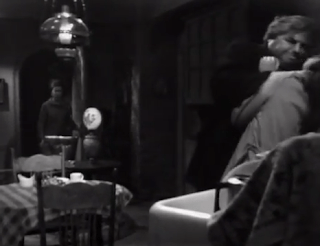
As it happens, gruff caretaker Matthew is holding Vicki prisoner in his cottage on the estate. Matthew had blurted out a confession that he killed Bill, and has now decided he must kill Vicki to keep her quiet. Vicki tries to persuade Matthew that he will be better off with her alive, but he will not change his mind. As he is putting his hands around her neck with the stated intention of breaking it, the door opens. Liz enters. Startled, Matthew unhands Vicki. She tells Liz that Matthew killed Bill and is about to kill her.
Art Wallace’s original story bible for Dark Shadows, which circulates under the title Shadows on the Wall, had called for Liz’ brother, high-born ne’er-do-well Roger, to be exposed as a murderer and a deadly threat to Vicki. Roger would fall to his death in the course of his final attempt on Vicki’s life. That was still possible a week ago.
Now that we’ve heard Matthew’s confessions, we know that Roger isn’t going anywhere. Not only does that keep one of the show’s most engaging actors, Louis Edmonds, in the cast; it also opens a long list of story possibilities. Perhaps Roger and Vicki will reenact the climax of Jane Eyre, and the dark-haired governess will marry her charge’s father. Perhaps the horrendous relationship between Roger and his son, strange and troubled boy David, will improve in some way, or perhaps David will make another attempt to kill his father. Certainly we can expect more scenes between Roger and Liz, as the show plays out the first of its signature relationships between Bossy Big Sister and Bratty Little Brother.
Further, Liz tells Frank and the sheriff that there are three residences on the estate- the great house, the Old House, and the caretaker’s cottage. One of Matthew’s previous attacks on Vicki took place at the Old House, and we’ve twice seen a ghost there who is clearly marked as someone who will be coming back again. Vicki is trapped in the caretaker’s cottage now, and the great house is the main setting for the series. By listing the three locations in this way, Liz is telling the audience to expect to see more of each of these sets, not just in this storyline but in the stories to come.
The makers of Dark Shadows set out to give every episode airing on a Friday a number divisible by 5. Since no episode aired on Thanksgiving Day or the day after, that meant that episode 108, originally broadcast Wednesday, 23 November 1966, was followed by episode 111, originally broadcast Monday, 28 November 1966. There never was an episode 109 or 110. I’ve decided to take advantage of such breaks in the flow of the series to post general notes.
When we finished our first watch-through of Dark Shadows on 2 April 2021,* I looked back over the show and divided it into these 14 periods:
Episodes 1-45 “Meet Vicki”
Episodes 46-126 “Meet Matthew”
Episodes 127-192 “Meet Laura”
Episodes 193-209 “Meet Jason”
Episodes 210-260 “Meet Barnabas”
Episodes 261-365 “Meet Julia”
Episodes 366-466 “Meet Angelique”
Episodes 467-626 “Monster Mash”
Episodes 627-700 “Meet Amy” (subdivided into “Chris the Werewolf,” 627-638, and “The Haunting of Collinwood,” 639-700)
Episodes 701-885 “1897″ (subdivided into “Meet Quentin,” 701-748, and “Meet Petofi,” 749-885)
Episodes 886-969 “Leviathans”
Episodes 970-1060, “Meet Another Angelique”
Episodes 1061-1198, “Meet Gerard” (subdivided into “1995,″ 1061-1070, “The Re-Haunting of Collinwood,” 1071-1109, and “1840,″ 1110-1198)
Episodes 1199-1245, “Dying Days”
I’ve decided that it makes more sense to divide the first 42 weeks into two periods defined by writing staff rather than four periods defined by characters. So I now think of the first 21 weeks as the Art Wallace/ Francis Swann era, and of the second 21 weeks as the Ron Sproat/ Malcolm Marmorstein era. Wallace and Swann wrote finely etched character studies that gave their fine cast a chance to show their stuff. Sproat and Marmorstein didn’t really understand what actors could do, and needed much busier and more outlandish plots to keep the show going.
As for the stories, I’ve noticed a 14 week cycle. For the first 14 weeks of the series, characters occasionally use the word “ghost” as a metaphor for unresolved conflicts that have ongoing consequences. Often as not, they go on to say that around the great estate of Collinwood, ghosts are more than a metaphor- literal ghosts haunt that place. We see a few events for which no non-ghostly explanation is immediately forthcoming. Some of them would have to be either legitimately supernatural occurrences or deliberate hoaxes in the tradition of Scooby-Doo. In episode 70, at the end of week 14, we get our first sighting of an unmistakable, non-metaphorical ghost.
The second 14 week cycle ends with episode 140. That comes early in the saga of the “Phoenix.” The one storyline in the first 42 weeks that works every time we see it is well-meaning governess Vicki’s attempt to befriend her charge, strange and troubled boy David. In episode 140, David is terrified of his mother and goes to her only after Vicki has persuaded him to do so. It is a powerful scene, showing that David has come to trust Vicki totally. That marks the end of the Vicki-befriends-David story, and sets up the rest of the Phoenix saga as an exploration of what that trust means and what will become of it.
The third 14 week bloc ends with #210. That one is mostly about petty thief Willie Loomis trying to find some jewels that he believes are buried somewhere around the estate. It ends with Willie opening a coffin, from which a hand shoots out and grabs him by the throat. That moment turns out to be quite an important break from one phase to another.
So, my revised periodization of the first 42 weeks is:
Episodes 1-106, the Wallace/ Swann era. Subdivided into 1-35, Prologue; 36-106, The Mystery of Bill Malloy. In its turn, The Mystery of Bill Malloy is further divided into Bill Investigates, Bill Disappears, and Who Killed Bill?
Episodes 107-210, the Sproat/ Marmorstein era. Subdivided into 107-126, Matthew Imprisons Vicki; 127-192, the Phoenix; 193-210, Jason.
*The fiftieth anniversary of the first broadcast of the final episode.
At the end of yesterday’s episode, we saw gruff caretaker Matthew push a heavy stone urn from the top of the Old House on the great estate of Collinwood. It landed at the feet of well-meaning governess Vicki standing far below. Vicki didn’t see Matthew and doesn’t realize he is her enemy, so she runs to his cottage to look for help.
Matthew won’t let Vicki use his telephone to call the sheriff, won’t let her leave his house, and won’t stop telling her that all her troubles are in her imagination and that everyone else’s troubles are her fault. She did barge into his house and she knows that he is a rough customer, so none of this leads Vicki to any conclusions.
In the manor house, reclusive matriarch Liz is worried that it is taking Vicki so long to get back from the Old House. When she tells strange and troubled boy David that Vicki had gone there looking for him, David suggests that one of the ghosts who haunt that house may have got her. This does nothing to lighten Liz’ mood, and she sends him off to have dinner. Later, instantly forgettable young lawyer Frank shows up and says that he and Vicki had a dinner date. Liz decides that the two of them should go to the Old House to look for Vicki. Before they go, she telephones Matthew’s cottage.
In the cottage, Vicki listens to Matthew’s side of the conversation. When she hears him tell Liz “I haven’t seen her,” Vicki can’t think of anyone but herself to whom he might be referring. She asks Matthew a series of questions about the conversation. Matthew claims he was talking about flighty heiress Carolyn, a claim which Vicki knows cannot be true. When Matthew sees that Vicki knows he is lying, he becomes agitated. She claims to believe his denials and tries to leave. He grabs her and pulls her back into the house. She screams.*
Back in the manor house, Liz and Frank have returned from their search of the Old House. They saw the stone urn shattered on the ground, a sight that deepens their alarm. Liz calls the sheriff. He comes and says he and his men will search the grounds for Vicki.
In the cottage, Vicki keeps telling Matthew she isn’t frightened, and he keeps pointing out that she screamed and is trembling. Only when Matthew betrays special knowledge of an earlier attempt on her life does it dawn on Vicki that he is her would-be assassin. When Matthew blurts out a confession to the killing of beloved local man Bill Malloy, Vicki looks desperately for a means of escape. Matthew forces her to sit down and tells her he will have to kill her.
*That scream was authentic enough to impress a very tough critic. Our beagle woke up from a nap and looked around with alarm when he heard it. It took some time to assure him that Alexandra Moltke Isles is fine.
Well-meaning governess Vicki has uncovered evidence which has led the sheriff to resume his investigation of the death of beloved local man Bill Malloy. The three suspects in the sheriff’s initial examination of the case were high-born ne’er-do-well Roger Collins, drunken artist Sam Evans, and dashing action hero Burke Devlin. Yesterday the sheriff questioned Roger, and today he questions Sam.
Since it became known Vicki might be a witness in the case, someone has tried to enter her bedroom, and someone has tried to run her down on the road. Roger is the only one of the three suspects who could have tried to get into Vicki’s room, and he has an alibi for the time when the car swerved towards Vicki. Vicki’s potential boyfriend, instantly forgettable young lawyer Frank Garner, suggests that Roger and Sam might both be working to silence her, whether in tandem or separately. Vicki considers Sam a friend, and finds it hard to believe he might want to hurt her.
Vicki’s charge, strange and troubled boy David Collins, is not to be found in the great house on the estate of Collinwood. She goes to look for him at his favorite hangout, the long-abandoned Old House on the same property. As she approaches the front door of the Old House, we see gruff caretaker Matthew Morgan on the roof high above. Matthew is pushing a large, heavy ornamental urn. The urn falls, and lands at Vicki’s feet.
Matthew has been presented as a volatile, dangerous man, and a potential threat to Vicki. He admitted to hiding Bill Malloy’s corpse, and becomes agitated anytime the topic of his death is raised. At the end of a half hour devoted to asking who, if not Roger, Sam, or Burke, might be behind the attacks on Vicki, the shot of Matthew pushing the urn towards her leaves little doubt that he is in fact the villain we’ve been looking for.
At the end of Friday’s episode, dashing action hero Burke Devlin and the sheriff caught high-born ne’er-do-well Roger Collins digging up a fountain pen from under a rock. It appears to be the fountain pen Roger had stolen from well-meaning governess Vicki. Some think that Roger stole the pen and hid it because it is evidence implicating him in the death of beloved local man Bill Malloy. Today, Roger is in the sheriff’s office.
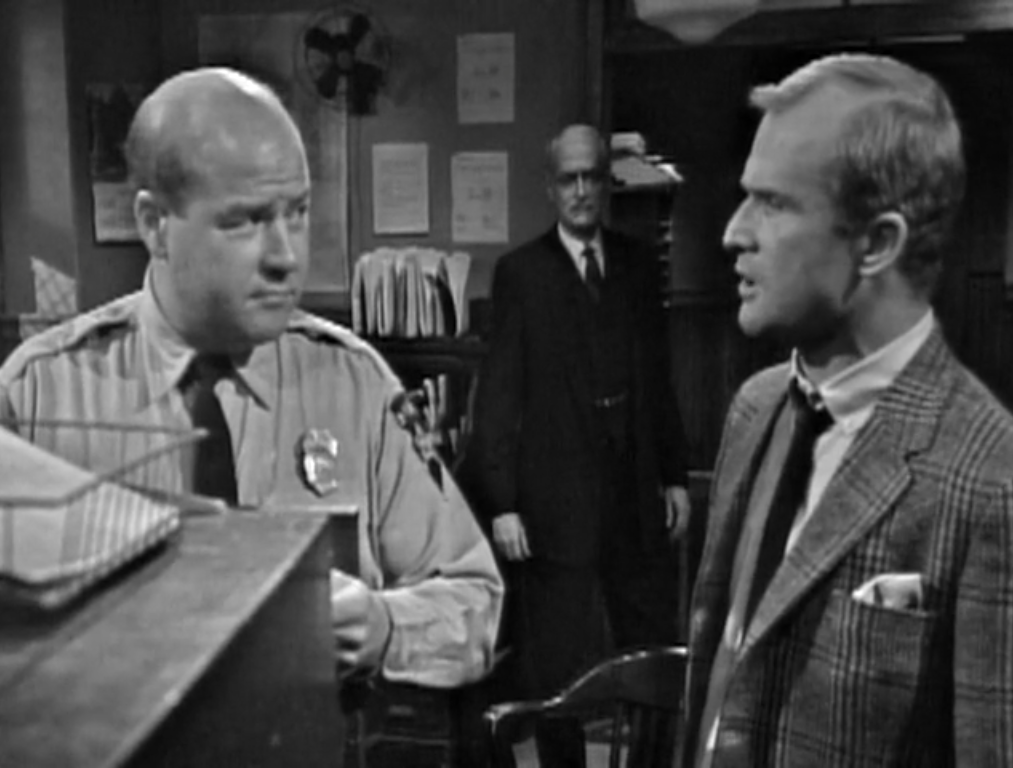
Accompanied by Richard Garner, the Collins family’s lawyer, Roger talks and talks, admitting that he saw Bill that night, badly injured and face-down in the water. He jumped to the conclusion that Bill was dead, and left the scene without notifying anyone. He also admits that he concealed evidence that he believed the police would find relevant to the investigation. As if that weren’t enough, he admits that he lied to the police time and again, most recently the night before, and is caught in yet another lie when he gives a nonsensical explanation of his plan to meet Bill that night.
Roger begins his confess-a-thon
Garner makes only one feeble attempt to interrupt Roger’s torrent of self-incriminating remarks. When the sheriff questions Vicki, Garner takes the opportunity to ask her some questions of his own, questions which produce even more information that is adverse to his client’s interests. On their site Dark Shadows Before I Die, John and Christine Scoleri feature commentary on Garner’s performance from a lawyer friend of theirs. Setting aside the utter hopelessness of Garner’s work from a real-world perspective, this friend analyzes his conduct by contrast with the standards set by other TV lawyers:
This brief addendum will review the competence of Garner using a “TV Lawyer Competency Rating” (TVLCR) scale. This WAG scale is based on my estimation of how a general audience might rate a TV Lawyer’s performance. I have supplemented these TVLCR scores with some comments reflecting real-world practices.
Even by those standards, Garner doesn’t come out very well:
Garner strikes me as the go-to civil attorney for the Collins family who got dragged into this murder case just because they are familiar with him. Based on Garner’s poor competency rating as a TV Lawyer, Roger Collins should fire him and instead reach out to Raymond Burr or Andy Griffith.
Soap operas typically generate suspense by sharing information with the audience that some, but not all, of the characters have. We wonder when the secrets will be revealed, and how those to whom they are revealed will react when they finally get the news.
By the end of today’s episode, all of the characters will know almost everything the audience knows. Even what the characters don’t know, they’ve heard of. For example, Roger and drunken artist Sam Evans have not confessed the guilty secrets they share to any of the other characters, but everyone seems to have figured out more or less what they’ve been up to. Not everyone believes in ghosts, but it’s all over town that Vicki and her charge, strange and troubled boy David Collins, have seen ghosts in and around the great house of Collinwood, and even the most skeptical are not in a hurry to hang around the place after dark.
This is the next-to-last episode credited to writer Francis Swann. Swann will fill in for the new writers a week from Wednesday, but today is really the end of the Art Wallace-Francis Swann era of the show. From tomorrow, the new team of Ron Sproat and Malcolm Marmorstein will be holding the reins. By bringing all the characters up to at least our level of knowledge about the ongoing storylines, Swann is clearing the decks for Sproat and Marmorstein to set up their own crises and dilemmas.
Swann’s great strength is his ability to give actors room to show what they can do. Today’s episode is a case in point. Just when Garner’s disastrous intervention in the sheriff’s questioning of Vicki has led us to wonder if he’s all there, he has a moment when he opens his eyes wide and looks out the window. As Hugh Franklin plays it, that’s enough to make us wonder what’s on Garner’s mind, and to think he might be about to do or say something interesting.
Of course stage veteran Louis Edmonds thunders delightfully as the wildly indiscreet Roger, and of course TV stalwart Dana Elcar does an expert job of presenting the sheriff as a skilled professional firmly in control of the situation. There might be a crying need for a defense attorney to intervene when a suspect is blabbing as freely to the police as Roger is to the sheriff, but there is no need for a third actor to get in the way of Edmonds’ and Elcar’s interplay. Standing in the background between those two, Franklin occasionally gives a slight facial expression that underlines some point or other, but never upstages them.
In the first half of the episode, Alexandra Moltke Isles’ Vicki has to give some long speeches full of recapping, and in those she takes the character through several distinct shades of discomfort. She begins with diffident nervousness, builds up to frightened indignation, and ends with pure sadness.
Later, flighty heiress Carolyn comes into the sheriff’s office and pleads with Vicki to say that her beloved Uncle Roger couldn’t be a criminal. In front of the sheriff and Garner, all Vicki will say is that the two of them should leave. As Carolyn, Nancy Barrett makes the most of the melodramatic turn, but Mrs Isles takes possession of the scene with her few words spoken in a quiet, husky voice we haven’t heard before. Those brief remarks cap the progression we saw her making in her speeches earlier, and define the mood she is still in during a conversation between Vicki and Carolyn in Collinwood later. Vicki’s feeling for the pity of it all holds the episode together, and leads us back into the texture of the life of the family at the center of the story.
Dashing action hero Burke Devlin visits the sheriff in his office. He brings the sheriff up to date on the recent threats well-meaning governess Vicki has faced. He also tells the sheriff that Vicki had found a pen belonging to Burke on a beach, and that he thinks that high-born ne’er-do-well Roger Collins dropped the pen there while murdering beloved local man Bill Malloy. Burke also thinks that Roger is the one who has been menacing Vicki. He asks the sheriff if he will play along with a scheme that might put some “concrete evidence” behind his beliefs.
In the great house of Collinwood, Roger faces a series of very sharply pointed questions about Vicki’s problems from his sister, reclusive matriarch Liz. He denies everything, including things Liz can prove to be true. He tries to say that Vicki is untrustworthy because she claims to have seen a ghost dripping wet seaweed on the floor in the west wing of the house. Liz reminds Roger that they investigated that claim, and found the wet seaweed just where Vicki said it would be.
The sheriff and Burke show up at the house. In the mood established by their conversation, Liz and Roger are left feeling trapped and small, as this shot none-too-subtly shows:
The sheriff asks to see Vicki. Liz explains that she gave her a sedative and sent her to bed. He then questions Roger and Liz about the stories Burke has told. Liz downplays Vicki’s experiences; Roger makes another attempt to sell the idea that Vicki is nuts because she claims to have seen a ghost. When Burke brings up the topic of the pen, Liz is at a loss- it is the first she has heard of it. Roger tries to brazen it out. When Burke produces a pen identical to the one Vicki found, he flails and finally denies that the pens are at all alike. The sheriff asks Liz to send both Vicki and flighty heiress Carolyn to his office first thing in the morning to examine the pen.
Liz tells Roger that she is confident Carolyn and Vicki will tell the sheriff the truth. When he tells her he needs time to think, she replies that he doesn’t need any time to think of more lies. He declares that there is something he must attend to immediately, and rushes out of the house. Liz watches her little brother leave the house, frustrated in her attempts first to correct his behavior, then to shield him from its consequences.
Roger goes to the peak of Widow’s Hill. He had stolen the pen Vicki found and buried it under a rock there. He digs it up. As he looks at it, Burke and the sheriff appear and thank him for saving them a lot of trouble.
Art Wallace’s original story bible for Dark Shadows had called for Roger to have his final scene on this spot. Vicki was to have found evidence that would send Roger to prison, he was to attempt to kill her by throwing her off the peak of Widow’s Hill. She would avoid that fate when Roger instead went over the cliff himself. As it has worked out, Louis Edmonds is too appealing an actor to lose. So Roger stays on the show as a suspect in an investigation, perhaps as a defendant in a trial. It won’t be the last time Dark Shadows extends an attractive villain’s stay on the show by playing out different events on the set where his story was originally meant to end.
In the great house of Collinwood, well-meaning governess Vicki is terrified of high-born ne’er-do-well Roger Collins. She had found evidence that led her to suspect Roger of murdering beloved local man Bill Malloy. Roger learned of her suspicions and told her a story that has left her unsure what to think.
In yesterday’s episode, someone unlocked the door to Vicki’s room and started to enter while she was in bed. She screamed, and the door slammed shut. Seconds later, Roger came. He denied having unlocked the door or seen anyone else in the hallway.
Today, Vicki is discussing that event with reclusive matriarch Liz. Vicki won’t explicitly say anything against Liz’ brother Roger, and Liz will not draw any conclusions about him in front of her. When Liz says she can’t imagine who might be in the house that Vicki could have reason to fear, gruff caretaker Matthew enters. This is not the least subtle clue the show has given us that we should consider Matthew a potential threat to Vicki.
Vicki tries to call her friend Maggie Evans. She talks to Maggie’s father, drunken artist Sam. Sam asks her to meet him at the local tavern to discuss a painting he did long ago of a woman to whom Vicki thinks she might be related.
After Vicki has left, Roger comes home. Liz is unhappy that he did not return her call when she telephoned him at his office in the business she owns. He is unrepentant. When she questions him about Vicki, he tells her that he thinks Vicki should leave Collinwood. He says that she is not safe there because she knows too much about the death of Bill Malloy. This does not leave Liz with a particularly sunny view of her bratty little brother.
At the tavern, Sam admits to Vicki that he doesn’t have anything to tell her about the painting. He wants to pump her for information about her suspicions. Vicki says she has something to say to Maggie about that subject, but only to her- she doesn’t want to go through it any more often than necessary. She refuses to tell Sam anything. When Sam gets overheated, she gets up to leave the table. He touches her sleeve. She gives him a look that goes from startled to commanding to wondering to pitying to just sad in the space of fifth of a second. He shrinks into his seat, and she sits back down. He offers her a ride home, she says she would rather walk. After she goes, he gulps a drink, then follows her out.
On the road, a car tries to run Vicki down. They’ve introduced a new set dressing for this scene. I like the signpost:
Between Brock Harbor and Collinsport
Vicki must have lost her keys when the car was coming at her, because she pounds on the front door of Collinwood until Liz lets her in. Vicki describes the incident, saying that the car deliberately swerved to hit her. In answer to Liz’ questions, Vicki says she couldn’t see anything but the headlights, and declines to call the sheriff. “I can’t talk to the sheriff. I can’t talk to anyone.” Liz mentions that Roger has left the house, and says it’s too bad he didn’t find her. Vicki replies “Maybe he did.” Liz responds to that by fetching a sedative and insisting Vicki take it.*
While Liz is out of the room, Vicki telephones dashing action hero Burke Devlin and tells him of the incident with the car. We hear only her side of the conversation, but we can presume Burke will do something about it.
*The first of countless sedatives that will be consumed in the drawing room of Collinwood in the years ahead. If the show had lasted another decade, the Ramones might have written a replacement for Robert Cobert’s piece for theremin as its theme song .
Another action-packed episode from writer Francis Swann. His new colleague Ron Sproat seems to have given him a jolt of energy.
High-born ne’er-do-well Roger Collins has been Dark Shadows‘ foremost villain so far. This week’s theme is that well-meaning governess Vicki suspects Roger of murdering beloved local man Bill Malloy. She is terrified of what Roger might do to her, and Roger is terrified she might go to the sheriff. Vicki and Roger scramble to keep up with each other, and draw the other characters into their frantic activity.
Today we divide our time between the great house of Collinwood, where Roger and Vicki live and play their high-stakes game of cat and mouse, and the Blue Whale, a tavern in the village of Collinsport where we see the consequences of their actions ripple out into the broader community. In yesterday’s episode, Vicki and Roger had a talk in which he told her that he did see Bill the night he died, but that he was already dead when he found him. That accounted for the evidence Vicki found, but only increased the tension between them.
We begin and end today in Vicki’s bedroom. In the opening teaser, Roger knocks on her door and lets himself in when she doesn’t answer him. In the closing scene, Vicki’s door is unlocked and opens while she is in bed. This prompts her to scream. When she does, the door quickly closes. Roger comes in seconds later, and implausibly denies that he opened it until after she screamed.
In between, we see Vicki in the tavern, telling Roger’s arch-nemesis, dashing action hero Burke Devlin, what Roger told her yesterday. Burke is incredulous that Vicki seems willing to believe that Roger might be telling the truth this time. She responds “I know you think I’m an idiot, but I can’t help it!” Maybe Bill wasn’t pushed to his death- maybe he was just clumsy and fell without anyone’s intervention. Burke does not contradict Vicki when she tells him he thinks she is an idiot. He urges her to leave town, since Roger might kill her at any time. She insists on staying at Collinwood.
Vicki and Burke leave the tavern. Drunken artist Sam Evans and his daughter Maggie Evans, The Nicest Girl in Town, enter. Maggie tells Sam that she talked to Vicki yesterday. Vicki told her almost everything, holding back Roger’s name but making it clear she can’t be thinking of anyone else. Maggie sees that the idea of the investigation into Bill’s death being reopened and connected with the incident that sent Burke to prison ten years ago disturbs Sam intensely. When Sam answers one of her questions with a lie, she asks “Haven’t you thought of a better one than that?” He mumbles a response, but won’t tell his daughter what he has to be afraid of.
Maggie calls Collinwood. Roger answers, and Maggie asks to speak to Vicki. Returning viewers will remember that when Burke called Vicki in yesterday’s episode, Roger was in the room. Vicki concealed the fact that she was talking to Burke by pretending she was talking to Maggie. Maggie’s call tips Roger off to Vicki’s lie. He tells her that Vicki isn’t home. She tells him that the Evanses are at the Blue Whale, that they haven’t been home all evening, and that they haven’t seen Vicki.
Vicki comes home. She tells Roger she was visiting Maggie at her house. Roger plays along and encourages Vicki to elaborate on this story. At the tavern, Burke had told Vicki she was a bad liar. She proves him right, giving Roger one falsifiable detail after another about her time at the Evans cottage.
After the affair of the door, Roger sees Vicki’s frank disbelief that he will not admit that he unlocked and opened it. Facing her unspoken accusation that he is brazenly lying to her, he casually mentions Maggie’s call. He suggests Vicki call her tomorrow, so that the two of them can get their story straight. He saunters away, having deflated her righteous indignation about his apparent lies.
As Vicki, Alexandra Moltke Isles was one of the cast members who delivered her lines with the fewest stumbles. She has a doozy today, though. When she returns from her conference with Burke, Roger sees her climbing the stairs and calls out to her: “Vicki!” She replies: “Rodgie!” A man you address as “Rodgie” is not someone of whom you are deathly afraid. They have done such a good job building up an atmosphere of tension between Vicki and Roger that this slip is one of the most breathtaking bloopers in the entire series. It’s still a Genuinely Good Episode, but that moment does make you wish for a videotape editor.
A deluxe episode today- multiple location inserts, three sets, six credited actors, several extras, music we haven’t heard before, and a special effect. By Dark Shadows standards, that’s a spectacular.
At the end of yesterday’s episode, high-born ne’er-do-well Roger Collins had sneaked up on well-meaning governess Vicki from behind, seized her, covered her mouth with his hands, and ordered her to be silent. Since Vicki is convinced Roger is a murderer and is afraid he will murder her to protect his secrets, that was quite a cliffhanger.
As we open today, Roger makes Vicki promise she won’t scream if he lets her go. He explains that when he decided to forcibly silence her, Maggie, keeper of the Collinsport restaurant and The Nicest Girl in Town, might still have been within earshot of a scream. So he “had to do that.” Otherwise, Maggie, to whom he contemptuously refers as “that little countergirl,” might have intruded on their private conversation. Now, they are all alone in the house.
Vicki does not find Roger’s explanation of his assault on her any more satisfactory than we might expect. She moves about the room keeping her eyes on him, her weight on her toes, and a clear line between her and the exit. Roger asks if she thinks he killed beloved local man Bill Malloy. She answers “I don’t think anything.” He asks her to listen to the whole story. She hears him out, but doesn’t let her guard down for a second.
Roger admits that he did see Bill the night he died. That involves admitting that he tricked Vicki into thinking he left home later than he in fact did, and thereby into giving him a false alibi in a statement to the sheriff. Roger ignores Vicki’s shocked reaction to this, and goes on to explain that Bill was already dead when he saw him. They had arranged to meet atop Lookout Point, but when Roger arrived he saw a body face-down on the beach below. He hurried down, and saw that it was Bill. Vicki asks if he looked like he’d been dead long. Not long, Roger says; he must have fallen off the cliff, been knocked unconscious, and drowned in the two or three feet of water on the beach just moments before.
Roger says he left Bill without calling for help or reporting the accident because he was afraid people would think he murdered him. “After all, I had motive, as they say.” Roger’s motive would be that Bill was trying to prove that he, not dashing action hero Burke Devlin, was responsible for a fatal hit-and-run accident ten years before. “Even you don’t believe me, do you?” he asks Vicki. Vicki says she doesn’t know what to believe, and edges closer to the door.
Returning viewers know that Roger is Dark Shadows’ most clearly defined villain, and have seen him frantically trying to conceal or destroy evidence relating to Bill’s death. Any story the makers of the show want us to consider accepting will have to give him some share of guilt. In this story, he is admitting to leaving the scene of a fatal accident. That is the very crime Bill was trying to prove that he, not Burke, committed ten years before. Since Roger is not a doctor, he is not competent to make a determination as to whether an unresponsive person is dead. For all he knows, Bill might have been saved had he gone for help. If we’ve been paying attention to the “Revenge of Burke Devlin” story, we should be wondering whether the account Roger has given Vicki will itself be enough to send him to prison. If so, we will wonder what Roger has up his sleeve to keep her quiet.
At the long-abandoned Old House, Roger’s son, strange and troubled boy David Collins, is talking to the portrait of his ancestor Josette. He asks Josette why she won’t “come down like you usually do” and talk to him. We don’t hear an answer, but David says “Well, I suppose you know what’s best.”
David tells the portrait that his governess Vicki knows that his father murdered Bill Malloy. He asks Josette if Bill’s ghost is with her and the other ghosts. Apparently she doesn’t answer him. He says that if his father finds out what Vicki knows, he will murder her, and then probably go on to murder him as well. David hears sounds outside the Old House. He puts out his candle and hides behind a chair.
Gruff caretaker Matthew enters. He announces to the dark room that he saw a light through the window, so there’s no point hiding. David comes out from behind the chair. He tells Matthew that he is visiting his friends- the ghost of Josette, of another woman similar to her, and of a younger woman, one about Vicki’s age. Matthew dismisses the topic of ghosts. David tells him that Vicki knows who killed Bill Malloy. As he has done each time Bill’s death has been mentioned, Matthew becomes agitated.
This time, Matthew’s agitation takes the form of a solicitous curiosity. David declares that his father is the murderer. “Did Miss Winters say that?” Matthew asks. No, David allows, but that’s what she meant. He asks Matthew to help him protect Vicki from Roger. Matthew mutters that he wouldn’t want any harm to come to Vicki.
Matthew’s agitation redirects our attention to the opening voiceover. Each episode starts with a brief monologue. For the first 55 weeks, all of these are delivered by Alexandra Moltke Isles in character as Vicki. Usually, they are not very informative. They are more about setting a vaguely anxious mood than about giving us specific facts about what’s going on in the story. Usually, whatever factual claims they do make are true. The only clear exception we’ve seen to that pattern so far came in #15, when Vicki says in the opening voiceover that she has made friends with David, a claim utterly belied by all the events that follow. Today, Vicki says in the opening that Roger is “the one person I have reason to fear.” That may also be false. Early on, reclusive matriarch Liz warned her that Matthew is a “strange and violent man,” and his unease about the death of Bill suggests that she might do well to keep an eye on him.
After David and Matthew have left the house, we see a replay of a bit of video from episode 70. The portrait of Josette glows, and her transparent figure walks down invisible stairs from the mantelpiece to the floor, then turns and looks back at the portrait. When David asked Josette to “come down like you usually do,” evidently he was referring to this manifestation.
Josette’s apparition has a different resonance for viewers today than it would have had for most viewers in 1966. The devices on which we see the show now have bigger screens and far clearer pictures than almost anyone would have had in those days. So it is easy for us to recognize a fact of which almost no members of the original audience would have been aware- the ghost of Josette is played by Kathryn Leigh Scott, the same actress who plays the Maggie whom Roger disdained as “that little countergirl.” Social class is a major concern of the show in the first 42 weeks, and the contrast between high-status and low-status characters is especially vivid today. That a character whose station is so lowly Roger cannot even bring himself to mention her name is played by the same person who plays a personage so lofty that she has a mansion to herself more than a century after her death gives a special punch to that contrast.
Meanwhile, flighty heiress Carolyn is on a date with Burke in the local tavern, The Blue Whale. Carolyn and Burke are well-dressed, as are the several extras at the other tables. They have china plates in front of them, and there is a more upscale type of background music playing than we usually hear at The Blue Whale. The show is at pains to establish that the tavern is a place for a nice date, rather than the waterfront dive it often appears to be. If that isn’t enough to set up an expectation that Burke and Carolyn’s date will be an important one, he says he plans to take her to another, even nicer, place later on for dancing and drinks.
Carolyn tells Burke she thinks that Vicki and Roger are becoming a couple. He is surprised. As she is explaining what has led her to this theory, she mentions that she told Roger something which Burke knows will reveal that Vicki suspects him of killing Bill. Burke excuses himself, saying that he is supposed to telephone his lawyer. He calls Vicki, and tells her he’s sending a taxi to take her away from Roger. She agrees to meet it.
Back at the table, Burke abruptly terminates the date. He explains to Carolyn that he has an urgent business meeting in ten minutes. She takes the news with uncharacteristically good humor.
Vicki slips out the back door of the house. The episode closes with a new location insert, a shot of her outdoors in the dark.
This may sound like a lot of talk, much of it recapping, but when you watch it the whole thing feels like it’s packed with high-stakes action. The actors are all in good form today, and, as usual, Francis Swann’s script gives them the opportunity to show what they can do. It is strong from beginning to end, well worth the extra expenditures they devoted to it.
Well-meaning governess Vicki has found what she believes to be evidence that beloved local man Bill Malloy was murdered by high-born ne’er-do-well Roger Collins. She fears that if Roger knows what she has found, he might kill her next. Since Vicki and Roger live in the same house, she has to be careful.
At the end of yesterday’s episode, Vicki had gone to town. In today’s opening scenes, Roger talks with his niece, flighty heiress Carolyn. Carolyn doesn’t know what’s on Vicki’s mind, and has blithely told Roger the vital information. When Roger finds out Carolyn doesn’t know where Vicki is, he asks his son, strange and troubled boy David. David strings his hated father along for a bit with unsatisfactory answers, all the while inviting him to contemplate a drawing of a man being hanged for the murder of Bill Malloy.
After Roger leaves the house, David opens the doors to the drawing room. He lets Vicki out. This is not only the first time in this episode we know that she was in the house. It is also the first time in any episode we see Vicki and David acting in concert as friends. Vicki’s attempt to befriend David has been the one story on the show that has worked every time we’ve seen it. Now that they are working together, that story has kicked onto a higher gear.
A knock comes at the front door. It’s Maggie, The Nicest Girl in Town. Maggie is bringing Vicki’s purse. Vicki is astounded- she hadn’t even missed it, much less realized she left it at the restaurant Maggie operates. Maggie insists that Vicki tell her what is bothering her. After a show of reluctance, Vicki tells her that she has found evidence that Bill Malloy was murdered, that she knows who the murderer is, and that if the murderer knows that she knows of his guilt he will be a threat to her. She therefore dare not share her knowledge with Maggie, lest she expose her to the same danger.
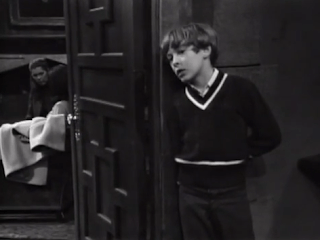
Maggie reacts sharply to this. Her father was suspected of killing Bill until the coroner ruled the death an accident, and her reflex when that ruling is challenged is to defend him. She tells Vicki that “I don’t understand you. You pussyfoot around pretending to be so friendly with everyone, and all you succeed in doing is stirring up trouble. As a matter of fact, all the trouble in Collinsport started the day you arrived.” These are startling words for The Nicest Girl in Town to address to our point of view character. But we don’t see her say them, or Vicki react to them. Instead, the camera is on David, eavesdropping at the door. That the show directs our attention to David even when Vicki and Maggie are having such a dramatic moment leaves no doubt that he is at the center of the most important events going on right now.
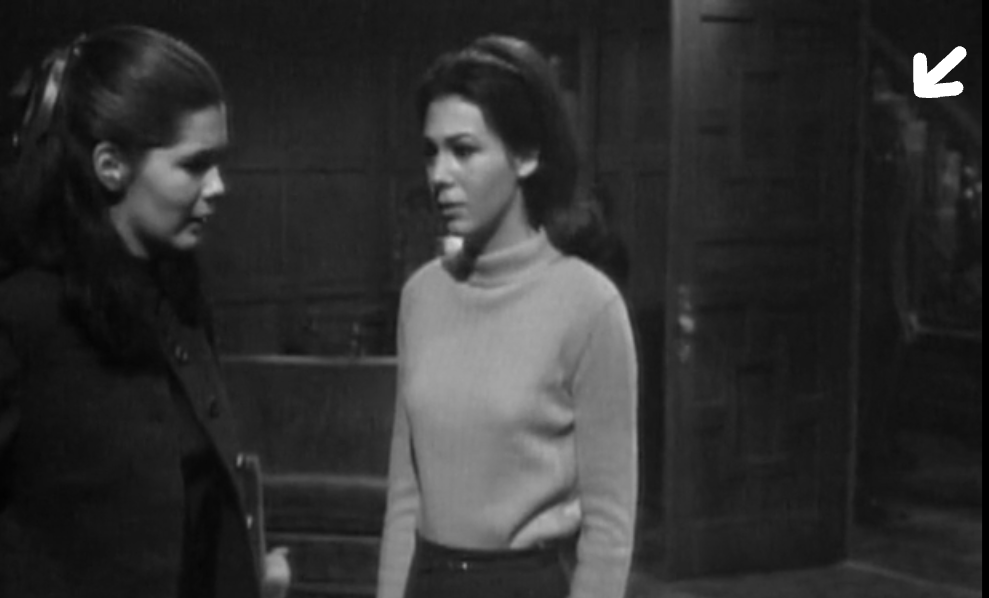
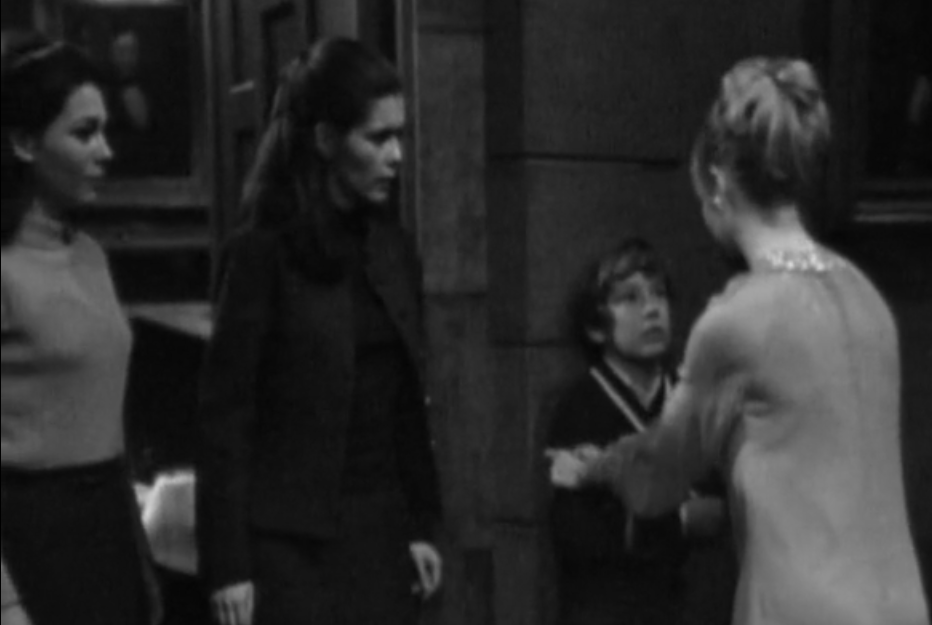
While we hear Vicki trying to defend herself, Carolyn catches David spying on them. Vicki and Maggie come out to watch her rough him up.* David runs off, and Carolyn leaves for a date.
Afterward, Maggie presses Vicki for more information. She offers to take her home to spend the night with her and her father, Sam- “unless he’s the one you’re talking about.” Vicki tells her not to be silly. Maggie relaxes. Having ruled Sam out, Vicki makes a remark that also rules out dashing action hero Burke Devlin. Since Sam, Burke, and Roger were the three suspects everyone in town was talking about before the coroner’s ruling, that shouldn’t leave Maggie much difficulty guessing who Vicki thinks killed Bill or why she is uncomfortable in the house.
Francis Swann wrote this one, and he often plays up the similarities between Roger and David. While Vicki, having at first told Maggie she couldn’t possibly tell her anything, is telling her everything, Roger enters from the same door David had used a moment before, and stands at the same spot where David had listened to them.
Like son, like father
When Vicki shows Maggie out and declines her repeated offers to stay with her or to take her home, Roger hides in the shadows of the foyer, as we have seen David do many times. He waits by the door until Vicki comes back in.**
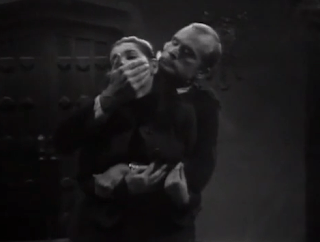
Once Vicki is alone, Roger creeps up on her. He grabs her from behind, covers her mouth, and orders her to keep quiet. Roll credits!
After a few episodes written by Ron Sproat, it is refreshing to get back to one by Swann. Sproat has been good so far at keeping the actors busy, but he doesn’t really understand their craft. Working from a script by Swann, each member of the cast can trace a line of development through the episode that gives the story structure and its events significance. Sproat’s first episodes have had some exciting moments, but the characters in them are just pieces being moved around a board. The excitement, when it comes, is that of watching a well-played chess match. Today, we have people to care about, not just the game the writer has devised for himself to play.
*This sequence is the first time we see all three young women in the same shot. With David Henesy, it also features four cast members all of whom are, as of November 2022, still alive.
Carolyn grabs David
**This is the first we see the wall extending from the door toward the front of the set. It is decorated with a metallic device. The theme of the house would lead us to expect a portrait of an ancestor on a spot like that…






 Dark Shadows Commentary