Well-meaning governess Vicki is being held prisoner by homicidal fugitive Matthew, a fact unknown to any of the characters in today’s episode. As in all episodes from the first 55 weeks of Dark Shadows, Vicki delivers the opening voiceover; she seems annoyed when she says that “the inhabitants of Collinwood have only begun to suspect I’m missing!”
Reclusive matriarch Liz is in fact very worried about where Vicki has got to. Housekeeper Mrs Johnson holds fast to the theory that she and flighty heiress Carolyn drove off together to visit Vicki’s boyfriend in Bangor, Maine, but cannot convince Liz of this. Mrs Johnson concedes that Carolyn had been very concerned about her appearance before she went out, and that she would not have been likely to make such a point of looking her best if she were just driving Vicki to Bangor.
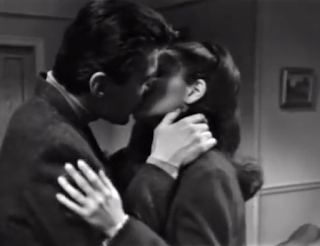
Carolyn wanted to look especially good for the same reason she didn’t tell her mother where she was going. She is on a date with her family’s arch-nemesis, dashing action hero Burke Devlin. By the time we catch up to them, they’ve gone back to Burke’s hotel room, where they are drinking, exchanging sweet nothings, and doing some serious kissing.
Burke and Carolyn kissing
Just Thursday, Burke was kissing Vicki, and now he’s moved on. This shouldn’t reflect too badly on him- after all, he’s one of only two eligible bachelors in all of Collinsport.
The other eligible bachelor is Carolyn’s ex, hardworking young fisherman Joe Haskell. Joe interrupts Burke and Carolyn’s kiss with a knock on the door. They gather that Joe is there on behalf of Liz and jump to the conclusion that he is trying to enforce Liz’ prohibition against her daughter dating the family’s foe. This leads to a fistfight between Joe and Burke, in which Joe fulfills the vow he made in #24 to punch Burke in the mouth. When Burke learns that Vicki is missing, he forgets all about his date with Carolyn and goes to Collinwood to form a search party.
Within one minute, Carolyn goes from the high of seeing the entire available male population of the town fighting over her attentions to the low of being dismissed as both of them start literally chasing after Vicki. Nancy Barrett usually throws herself into all of her parts with the utmost gusto, but she plays this bit of emotional whiplash very quietly. It’s an effective choice- the situation is so blatant that an underplayed reaction comes off as shock.
At the great house of Collinwood, Joe hangs his coat up. It’s the first time we see someone doing this from inside the imaginary closet in the foyer. While doing it, he sees Vicki’s suitcase, proof that she did not go to Bangor:
The telltale suitcase
It’s a relief to have an episode in the middle of a captivity story that doesn’t lock the audience up with the captive. There are a couple of awkward bits. Vicki’s huge suitcase is in the coat closet, but there is no door separating that closet from the entryway, so it is simply inexplicable that no one notices it until the end of the episode. And, entertaining as Joe and Burke’s fight is, regular viewers will find it repetitious- Joe and Carolyn broke up weeks ago, long after they had bored us all silly with their pointless, joyless relationship. We know that Joe and Burke have nothing to fight about. And the conversations between Liz and Mrs Johnson go on too long and involve at least two statements of every point.
But those are relatively minor objections. This one moves along at a fair pace, has more action than usual, and the actors manage to paper over even the weakest of the weak points.
Well-meaning governess Vicki visits dashing action hero Burke in his hotel room. Burke wants to express his sympathies over Vicki’s recent ordeal as prisoner of the homicidal Matthew. Vicki wants to tell Burke that, because he is the sworn enemy of her employers, the ancient and esteemed Collins family, she can never see him again. He abruptly kisses her, then apologizes. She tells him to forget about it, then leaves.
The actors do what they can with what they’ve been given. Alexandra Moltke Isles and Mitch Ryan were two of the ablest stage kissers on Dark Shadows, and their smooch looks great. But the whole theme of their conversation is a wistful sadness as the two of them wonder what might have been were it not for the conflict. In that context, the kiss is a gesture of mourning. Later, reclusive matriarch Liz will notice that Vicki is unsettled and will ask if it is because of something Burke did. Evidently we’re supposed to think Vicki is coming undone because she shared a great moment of passion with Burke, but the scene that was in the script included no such thing.
The real highlight of the episode comes later, when strange and troubled boy David Collins raids the pantry in the kitchen at Collinwood to get food to take to the fugitive Matthew. It’s our first look at any part of the kitchen since #53. It’s good to know they still have the kitchen in mind. The characters have always exchanged a lot of story-productive information during their conversations in that relaxed, intimate environment, so I hope they build that set again soon.
The writers didn’t always put a lot of effort into Dark Shadows’ opening voiceovers, but today’s is exceptionally dire:
My name is Victoria Winters.
Collinwood is still living up to its name as a ghost-ridden house where deaths have gone unsolved. Except that in this case, the murderer is known. Only his whereabouts are unknown. But much like a wounded animal at bay, he has taken refuge in the one place where he thinks he will be safe. The Old House has already been searched thoroughly, so Matthew Morgan feels this is one place the police will not look again.
“Collinwood is still living up to its name”- it is still in the woods and is still occupied by people called Collins? No, “its name as a ghost-ridden house.” So, it is living up to its reputation, not to its name.
Then we get three short sentences beginning with “Except,” “But,” and “Only.” If the narrator has to issue three retractions in fifteen words, it’s difficult to be optimistic about what will happen when people start exchanging dialogue.
“But much like a wounded animal at bay, he has taken refuge in the one place where he thinks he will be safe.” How does that make him more like a wounded animal at bay than like any other creature who is aware of only “one place where he thinks he will be safe”?
“The Old House has already been searched thoroughly”- that sounds OK, until about 30 seconds into the episode, when Matthew lets himself into a secret chamber of the Old House that only he knows about. When you say a house has been searched “thoroughly,” I for one assume you mean that the searchers figured out how many rooms were in it.
This is the final script credited to Francis Swann. That sloppy, confused narration doesn’t sound like his writing. Maybe he was in such a rush to be done with Dark Shadows that he didn’t bother to take a second look at the opening voiceover once he’d pounded it out of his typewriter.
Or maybe he didn’t write it at all. Malcolm Marmorstein’s name will appear in the credits soon, and Marmorstein was eminently capable of writing something that lousy. The actors have an unusually hard time with their lines today, as if the teleplay got to them later than usual. Swann hasn’t written an episode since #106, and that one felt very much like his farewell. So it could be that Marmorstein was supposed to write this one, got stuck, and Swann came in to bail him out.
Further supporting that theory is a change of texture between the first half of the episode and the second half. After the prologue showing the fugitive Matthew hiding in the Old House, we go to the room in the Collinsport Inn occupied by dashing action hero Burke Devlin. Mrs Johnson, housekeeper at Collinwood and spy for Burke, visits him there. She recaps the last couple of episodes for him. The scene is listless and disjointed, in part because of the actors going up- at one point Clarice Blackburn actually prompts Mitch Ryan with Burke’s next line- but also because they have so little to work with when they do remember what they’re supposed to say.
After Mrs Johnson leaves Burke’s room, strange and troubled boy David Collins drops in on him. Mitch Ryan and David Henesy were always fun to watch together, and they manage to get a good deal of interest out of an opening exchange in which David tries to get Burke to admit that Mrs Johnson is his agent inside the Collins home. They then go into Burke’s kitchen, where they talk about their respective grudges against David’s father, high-born ne’er do-well Roger Collins. That’s an emotionally charged topic, and the kitchen is an intimate space. But the conversation is dull. The actors don’t look at each other very much- even when they aren’t reading off the teleprompter, they keep casting their eyes to the floor, as if they’re having trouble staying awake. You can’t blame them if they are sleepy- there’s nothing new in their lines.
The second half of the episode takes us back to Collinwood, and all of a sudden it comes to life. In the foyer, an authoritative-sounding Mrs Johnson scolds David for not hanging his coat up properly. He then puts her on the spot with his ideas about her and Burke. Once he has her good and nervous, he tells her he’s going to the Old House to talk to the ghosts. Mrs Johnson takes the supernatural very seriously, and responds to that idea with some words spoken in a deeply hushed tone. She finally dismisses him with a brusque command to be back for dinner. After the door closes behind him, she looks about for a moment, pensive. Taking Mrs Johnson through these moods, Clarice Blackburn traces a clear line of emotional development that gives the scene a healthy dose of dramatic interest.
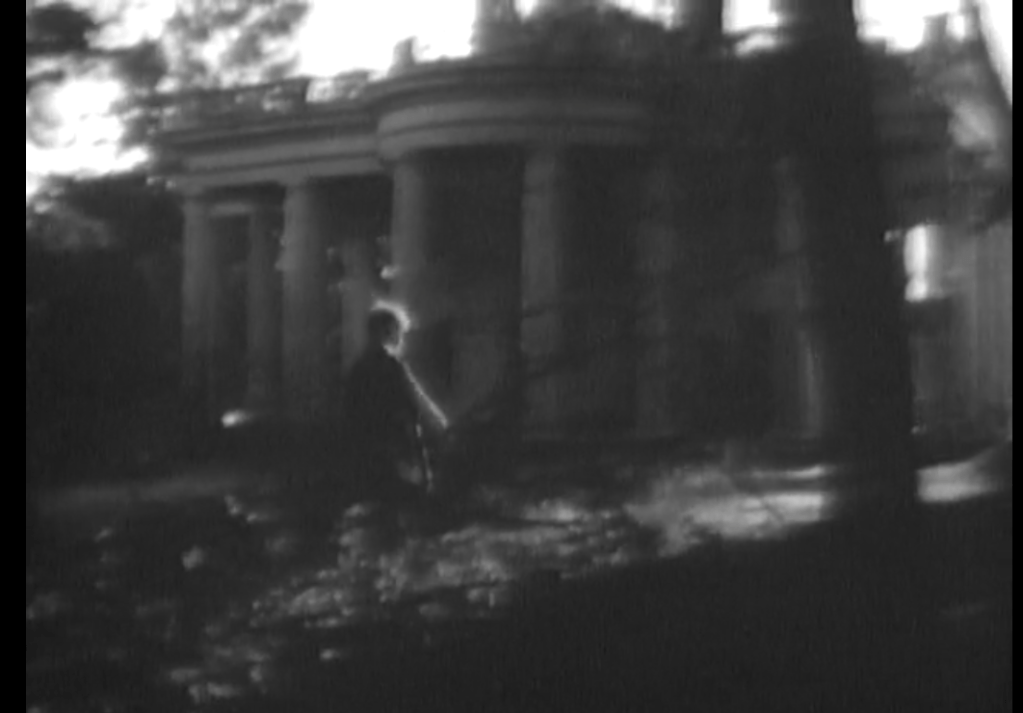
We are then treated to a previously unseen location insert in which David is skipping along the path to the Old House. It’s a lovely little scene, dreamlike and eerie:
David skipping on his way to the Old House
David stands before the portrait of Josette Collins and asks for information about Matthew. The portrait isn’t talking, but Matthew himself appears. David tells Matthew that he doesn’t believe he is a murderer, and that the two of them can investigate and prove his innocence. When David tells Matthew he has no choice but to trust him, Matthew asks “Ain’t I?” Returning viewers remember that in the previous two episodes, well-meaning governess Vicki and reclusive matriarch Liz both asked Matthew to trust them. In response, he tried to kill Vicki, and only his fanatical devotion to Liz kept him from doing the same to her. David’s blithe self-assurance stops Matthew this time, and he agrees to stay in the Old House and let David take care of him.
This episode is the first time we see the secret chamber off the parlor of the Old House. Much will happen there. Another first comes when Matthew is deciding whether to trust David or to kill him. He goes to the window of the parlor. We cut to the outside, and see him in the window thinking murderous thoughts. Many, many times next year and the year after we will see another character, one not yet introduced, in that window, vowing to kill someone or other.
The Old House isn’t the only place where today brings firsts. Up to this point the proper way for people to dispose of their coats when entering the great house of Collinwood has been to fold them and place them on a polished table in the foyer. But this time, David responds to Mrs Johnson’s reproof by taking his coat to a space next to the door where he mimes placing it on a hanger. In later years, we will actually see a set dressing there that can pass for a closet, but for now we just have to imagine one exists.
Hardworking young fisherman Joe is spending the evening with Maggie, The Nicest Girl in Town. It’s their first date. Maggie impresses him with her knowledge of ships, and he sings a verse of “What Do You Do With a Drunken Sailor?” It may not sound like much, but the actors, Kathryn Leigh Scott and Joel Crothers, sell it so well that we’ll be rooting for Joe and Maggie for years to come. The final moment of the scene comes after Joe leaves. Maggie looks directly into the camera and says to the audience, “Goodnight, pal.”
Goodnight, pal
In the great house of Collinwood, high-born ne’er-do-well Roger Collins greets his niece, flighty heiress Carolyn, on her return home. Carolyn is upset because Joe has broken off their relationship and is having a date with Maggie. The story of Joe and Carolyn was a bore, largely because the two of them never had a scene with any fraction of the sweetness we see between Joe and Maggie today. There was nothing at stake in their quarrels, because they had nothing to lose if they simply gave up on each other.
Roger tells Carolyn that well-meaning governess Vicki hasn’t been seen for hours, and that he promised Carolyn’s mother, reclusive matriarch Liz, that he would sit up waiting for Vicki’s return. Carolyn is worried as well, and asks Roger why he isn’t actively searching for her. He says she’s probably fine. When Carolyn says that people don’t just disappear, he reminds her of family friend Bill Malloy, who disappeared not so long ago, but then turned up. Considering that Bill turned up in the form of a corpse washed ashore by the tide, it is perhaps unsurprising that Carolyn does not find Roger’s analogy particularly comforting.
After Roger persuades Carolyn to toddle off to bed, he makes sure he’s alone (well, alone except for the stagehand in the lower left-hand corner of the screen.)
Once assured that no one mentioned in the script can see him, Roger returns to the drawing room and opens a secret passage we’ve never seen before. After he disappears into it, Carolyn comes to the drawing room and is baffled at his absence.
The suggestion that Carolyn doesn’t know about the secret passage is characteristic of the show. From the beginning, Vicki has represented our point of view. She started off knowing nothing about the other characters, and everything had to be explained to her while she was on camera. If Vicki knows just what we know, Carolyn, who grew up in the house where most of the action is set, can be presumed to know a great deal we do not. When they reveal a secret to us, they can amplify its importance by showing that Carolyn isn’t in on it. They’ve done this several times, mostly in situations having to do with the murky origins of Roger’s feud with dashing action hero Burke Devlin. Carolyn’s ignorance of the secret passage is particularly effective- it’s right there in the most important room of the only house she’s ever lived in. If she doesn’t know about it, it must be a very well-kept secret indeed.
We go with Roger into the secret passage. He shines his flashlight directly into the camera, creating a halo of light around it. This would not seem to be a desirable visual effect, yet we will see it many, many times in the years to come. This is the second appearance of the effect. The first time came when Roger’s son, strange and troubled boy David, was leading Vicki into the abandoned Old House in episode 70. Now we see it when Roger himself is entering another abandoned space, one where he might meet Vicki.
Halo
It’s hard to believe that the repeated use of this effect was altogether unintentional.
All the more so because of what follows Roger’s entry into the passageway. His journey through it actually does seem to wind through a very large space. In the opening narration, Vicki had said that the house is made up of 80 rooms, retconning the total of 40 given in the second episode. Roger’s trek up one flight of stairs, down another, up a spiral staircase, around corners, past windows, etc etc, seems like it must take him past enough space for at least that many. Perhaps the sequence would be a bit more attractive with less time spent focused on Roger’s feet, but all in all it is as effective a creation of space as Dark Shadows would ever do. If there had been Daytime Emmy Awards in 1966, Lela Swift would have had every right to expect to win Best Director for conjuring up this illusion of vast, winding corridors without editing or going outside the tiny studio space available to her.
Roger does indeed discover Vicki’s whereabouts. He hears her calling for David from behind a locked door, promising David not to tell anyone he imprisoned her there if he will let her out now. Roger does not simply let Vicki out. Instead, he makes some loud noises, then puts on a ghostly, wavering voice and calls out to Vicki that she is in great danger as long as she stays in Collinwood. He seems to be having trouble keeping a straight face when he makes these spooky sounds. Vicki isn’t laughing, and returning viewers aren’t either- in Friday’s episode, she and we saw the ghost of Bill Malloy in the room, and heard that ghost warn her that she would be killed if she stayed in the house much longer.
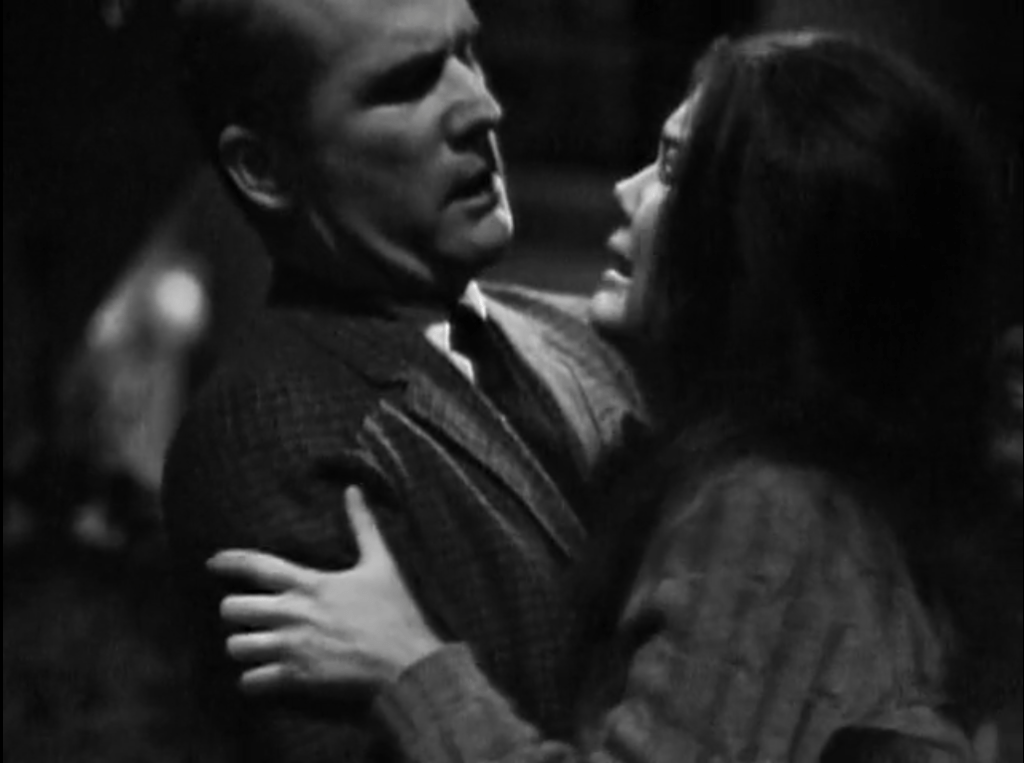
Once he’s had his fun, Roger opens the door. After another flashlight halo, Vicki recognizes him. Alexandra Moltke Isles gives us one of the finest moments of acting in the entire series, when Vicki throws her arms around Roger, her bodily movement as smooth as any ballet dancer’s but her voice jagged, and says that “David is a monster, you were right!” Up to this point, Roger has been brutally hostile to his son, Vicki heroically friendly to him. Her determination to befriend David has become so central to her character that hearing her make this declaration makes it seem that she is permanently broken.
Broken Vicki
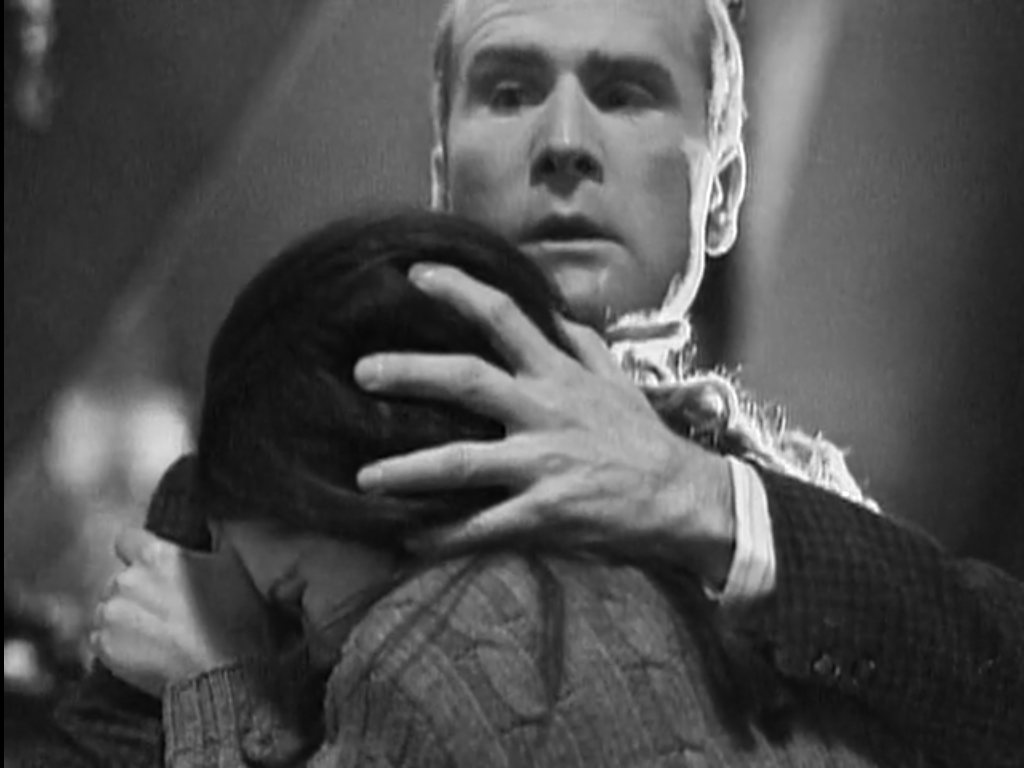
Vicki struggles to hold back her sobbing long enough to tell Roger that she saw the ghost of Bill Malloy. That’s an episode-ending sting- Roger wants everyone to forget about Bill’s death, and if his ghost starts popping up he is unlikely to get that wish.
Stunned Roger
Mrs Isles was a “head actor,” one who found the character’s innermost psychological motivation and worked outward from that. That heavily interiorized style would be one of the things that left her in the dust, along with similar performers like Joel Crothers and Don Briscoe, in the period when Dark Shadows was a hyper-fast paced, wildly zany show about vampires and werewolves and time-travel and God knows what. But in the period when Art Wallace and Francis Swann were writing finely etched character studies, she consistently excelled. In this little turn, she shows that when it was logical for her character to go big, she could go as big as any of the stars of the show in those later days.
Strange and troubled boy David Collins has managed to lock his well-meaning governess, Vicki, in a room in the long-abandoned west wing of the great house of Collinwood. David’s father, high-born ne’er-do-well Roger and his aunt, reclusive matriarch Liz, have noticed that Vicki is missing and are beginning to make inquiries.
It is inexplicable that Vicki fell into David’s trap, and her efforts to escape are embarrassingly inept. Today, Liz also behaves inexplicably. In David’s room, she finds the key to the closed part of the house where David is keeping Vicki, and she confronts David with it. When he denies that he locked Vicki up, she says she believes him and drops the subject. I’m afraid this has to be classified as an instance of what Roger Ebert called “idiot plot,” a story that goes on only because the characters are dumber than the audience. It’s especially frustrating to see characters like Liz and Vicki, who up to now have used their intelligence to make plot points happen, suddenly do things that can be explained only by saying that the script told them to do it.
Roger doesn’t appear to be fooled, but neither is he in any hurry to rescue Vicki. He sees her as a threat to his evil plans, and wants her out of the way. We see him alone in the drawing room, smiling broadly and drinking a toast to “Miss Victoria Winters… wherever you are.” He’s so deliriously happy with Vicki’s absence that he’s standing around not wearing any pants.*
Southern exposure
Meanwhile, Liz’ daughter, flighty heiress Carolyn, is sharing a cozy moment with the family’s arch-nemesis, dashing action hero Burke Devlin. In Friday’s episode, the two of them crossed paths at the tavern, and today they are sitting cozily on the couch in Burke’s hotel room. Burke gives Carolyn alcoholic drinks she isn’t of legal age to have, charms her with stories of his time in Brazil, and kisses her goodbye. He seems to be drunk, but as soon as she leaves the room he looks into the camera and in a sober voice vows that his vengeance will destroy her along with the rest of the Collins family.
There is one moment when Carolyn is still in the room when Burke slips out of his drunk act and forgets his charm. Carolyn asks if he’s ever been in love. He springs up from the couch, his face contorted with rage, looks away from her, and spits out the word “Once!” Startled, Carolyn asks if it’s always so painful. Then he remembers himself and resumes the role of the marginally amorous drunk.
Dark Shadows is very literal in its cutting in these early months. They often use scene connectors in the dialogue, moments when the last word of a scene they cut away from is one of the first words of the scene they cut to. And a question at the end of a scene will often be answered by the visual to which the scene jumps- so if someone asks “Who tampered with the brakes on Roger’s car?,” we will cut to a shot of David. At the end of this little exchange about the single, painful, time Burke fell in love, we cut to… Roger.** It’s 1966, and it’s American television, so it is unlikely that the show will actually tell us that Burke and Roger were lovers. On the other hand, it’s 1966, and the actors, writers, and directors are from the New York theater, so it is all but certain that they wanted some segment of the audience to wonder about that.
There’s also a bit of trivia. The drawing room scene among David, Liz, and Roger marks the first time David refers to Vicki as “Vicki.” Up to now he has always called her “Miss Winters.”
*In fact, this is the scene that actor Louis Edmonds famously played without the lower part of his costume.
The final episode written by Art Wallace is the first to feature actors singing. It’s also the first to feature a talking ghost.
The song is “What Do You Do With A Drunken Sailor?” It is sung first in the tavern, where drunken artist Sam Evans and dashing action hero Burke Devlin are reminiscing about their late friend, beloved local man Bill Malloy. Bill worked on the fishing boats for many years, and sang that old shanty all the time. Sam and Burke croon a few of its more family-friendly lines.
We hear the song again, sung by the ghost of Bill Malloy. Well-meaning governess Vicki is, for reasons far too tedious to repeat, imprisoned in a disused room. Bill’s ghost manifests itself in the doorway, takes a step into the room, and begins singing. Draped in the wet seaweed that covered his body after it washed up on shore, he warns Vicki that she will be killed if she does not escape. He turns back towards the door and vanishes into thin air. Vicki tells herself that the apparition was a dream, but finds wet seaweed on the floor where Bill had stood.
As the representative of the business operations that support the ancient and esteemed Collins family in their old dark house on the hill, Bill Malloy had been central to the rational, daylight logic side of the show. He came to the house to keep reclusive matriarch Liz updated on the operations of the cannery and the fishing fleet, and he discussed financial affairs with her. There had been a couple of indications that he once had a crush on Liz, suggesting the possibility that they might fall in love, complicating their business relationship and giving rise to a rather tame soap opera romance. For the last couple of months a mystery story about his death and the investigation into it has kept us mindful of evidence and witnesses and the sheriff and other symbols of explainable, shared reality. When Art Wallace, who wrote the series bible and was credited with the first 40 episodes, moves Bill Malloy into the supernatural back-world of Josette and the Widows, he forecloses any possibility that Dark Shadows will be a conventional soap opera with plots about slightly inconvenient love affairs and struggles over the ownership of a sardine packing concern. We’re going to be seeing “ghosties and ghoulies and long-leggedy beasties and things that go bump in the night,” to repeat a quote Sam delivers today.
It’s also worth pointing out the type of ghost Bill is. He is mostly spirit, but there is a corporeal side to him as well. He enters the room at the closed door. Since he is insubstantial enough that wooden barriers won’t stop him, he isn’t a revenant or a zombie or any other kind of reanimated corpse. On the other hand, he is substantial enough that he moves from one location- somewhere on the other side of the door, apparently- to another. So he isn’t a pure phantom. Unlike a true revenant, he vanishes into thin air, but unlike a pure phantom he leaves behind clumps of the wet seaweed with which he was festooned. We will see more ghosts in the years ahead, and most of them will be a mixture of the spectral and the bodily.
Art Wallace’s name is on every episode of Dark Shadows under “Story Created and Written by,” but he had nothing to do with it after this episode. He will be missed. He wasn’t perfect- this week has been pretty grim, with the unwelcome story of Vicki’s confinement, and with Wednesday’s episode and Thursday’s having been utter stinkers- but he was usually quite good. He and Francis Swann both had a firm understanding of what actors can do and how writers can enable them to do it. After Swann leaves the show late next month, they won’t have another writer of whom that can be said until Joe Caldwell comes aboard next summer.
In the great house of Collinwood, strange and troubled boy David Collins tricks his well-meaning governess, Vicki, into a room where he locks her up. Hardworking young fisherman Joe comes to the house to tell his sometime girlfriend, flighty heiress Carolyn, that he can’t spend the evening with her because he has a date with someone else.
I suppose this is one of writer Art Wallace’s diptych episodes, in which the contrast between a pair of intercut scenes tells us more about the characters than we would gather watching either scene straight through. Most such episodes are powerful and engrossing. Unfortunately, both of today’s topics are deadly dull. The pointlessness of the one multiplies the tedium of the other.
Joe and Carolyn’s relationship has never been interesting for one second. Their scenes are divided between Carolyn’s flagrant displays of contempt for Joe, quarrels that begin when Joe objects to those displays, and the occasional conversation about how the two of them don’t have a future. Today’s conversation between them is a break-up scene. An actual breakup would be welcome, but they’ve raised our hopes that way before. Since the only emotion Carolyn and Joe have managed to arouse in the audience is impatience, we don’t have any of the mixed feelings that could make the scene poignant or exciting.
The contrast at the hinge of the diptych is between, on the one hand, David taunting the suddenly brainless Vicki with the prospect that she will be in her prison for the rest of her life and, on the other, Carolyn dismissing the suddenly self-assertive Joe with the prospect that they will never see each other again. Joe’s uncharacteristic strength is more appealing, and better grounded in what we’ve seen so far, than is the uncharacteristic stupidity that led Vicki into David’s trap. But even if the breakup is the real thing this time, it’s hard to feel much relief when we know that we’re going to be locked up and miserable with Vicki.
There is some trivia in this one that will appeal to confirmed fans of Dark Shadows. It’s the first time we go inside the west wing; we get a look at a corridor and at the room where Vicki will be confined. Vicki and David talk about the long, twisting way they have taken, suggesting that it is a very large place. Much larger than reclusive matriarch Liz suggested in episode 2, when she told Vicki that the whole house, including the closed-off portions, has a total of 40 rooms.
Also, Vicki mentions that the west wing has been closed for 50 years. David picks up on “50 years” in a story he tells to frighten Vicki, ensuring that it will stick in the audience’s mind. Yet Liz, who is supposed to be in her 40s, has a conversation with her daughter Carolyn in which she remembers a time when far “fewer rooms were closed off.” That suggests that there is not only a locked-up west wing, but perhaps an east wing as well. That won’t be confirmed for four years, but it is implicit here.
Reminiscing about the way the house used to be, Liz says “There’s nothing in those rooms now but ghosts and memories.” In fact, the rooms in the west wing, like the abandoned Old House and the basement, are stuffed to bursting, not only with antique furniture, books, trunks, vases, paintings, rugs, and other things that could be sold at a high enough price to finance a considerable amount of work on the house, but also with old newspapers, tattered clothing, helpless governesses, and other unsaleable items that should not be kept in storage. For his part, David tells us that the west wing is full of mice, and we see so many cobwebs that the air quality in the occupied parts of the house must be severely affected by its dust. The Collinses really ought to empty their disused spaces and hire a couple to keep them clean.
No abandoned corridor would be complete without a full-sized metal candelabra in front of a porcelain vase resting on a dedicated stand
Apparently executive producer Dan Curtis insisted as a point of visual style that abandoned buildings be shown crammed with stuff. Today, that means that Vicki’s failure to pick up any of the blunt objects surrounding her and start beating the door down makes her look like an even bigger idiot than she already does for falling into the trap in the first place. The window is too high for her to reach, but with so much furniture and so many other objects in the room it would be no trick for her to stack something up she could climb on. After all, animal behaviorists give intelligence tests in which they get baboons to pile one thing on top of another so that they can reach a piece of fruit dangling from the ceiling. Too bad Vicki doesn’t have a baboon with her to give her some guidance.
In the great house of Collinwood, well-meaning governess Vicki makes unsuccessful attempts to reason with strange, troubled boy David and with David’s father, high-born ne’er-do-well Roger. At the restaurant in the Collinsport Inn, it dawns on hardworking young fisherman Joe that Maggie, The Nicest Girl in Town, would like to date him.
A fancy fountain pen Vicki found on the beach has gone missing from David’s room. After the two of them have spent a few relaxed moments looking for it, David declares it isn’t in the room. He suggests a ghost might have taken it. Rejecting this possibility out of hand and seeing no other explanation, Vicki concludes that David must be hiding the pen from her. She calmly asks him to return it; he indignantly denies having taken it. Exasperated with him, she raises her voice.
We cut to an outdoor setting, where we see Roger burying the pen. The audience saw him steal the pen at the end of yesterday’s episode. Roger is afraid the pen will be a piece of physical evidence implicating him in a homicide, so he is desperate to get everyone to forget that it exists. Why he doesn’t throw it in the ocean, or in a trash can, is never explained.
Roger returns to the house and hears Vicki and David yelling at each other about the pen. He goes upstairs to make inquiries. He takes David’s side, leaving both David and Vicki staring at him in astonishment. Roger then talks privately to Vicki, and urges her to forget about the whole thing. She reluctantly agrees never to speak of the pen again, to anyone. Roger visits David in his room, extracting the same promise from him. David tells Roger that he will get even with Vicki for her false accusation against him. Roger, eager as ever to get Vicki out of the house, has no objection to that idea. David glares out the window, looking directly into the camera and muttering to the audience that he will settle his score with Vicki.
The B-plot is much friendlier. Joe and Maggie are nice, attractive young people who have known each other for a long time, have fun together, and share many interests. Maggie is single, and Joe is at the end of a dull and mismatched relationship with flighty heiress Carolyn. There is no reason why they shouldn’t become a couple.
In fact, that is their biggest problem. As soap opera characters, they can have a romance if and only if there is some obstacle between them they will have to overcome in a dramatic fashion. Maggie and Joe are so obviously well-matched that generating such an obstacle will require the writing staff either to dig deep into the characters’ psychology and to expound that psychology in a superlatively well-crafted plot, or, if that is beyond them, to do something dumb like have them get bitten by vampires.
Joe stops by Collinwood to see if he can talk to Carolyn. Vicki tells him that Carolyn isn’t around, but asks him to stay for a while anyway. Vicki is nervous. She explains that “You don’t know what it’s like to be alone in this house with David.” Joe asks Vicki if she thinks he is an idiot for trying to resuscitate his relationship with Carolyn. When she can’t say he isn’t, he announces that he’s resigning from the idiot’s union and leaving for a dinner date. We know that he’s going to Maggie’s house, but he doesn’t tell Vicki that.
Joe may be resigning from the idiot’s union, but it looks like Vicki is ready to fill his place. David looks at her with undisguised hostility and tells her that he has indeed hidden her pen. When she asks where it is, he points to the closed-off part of the house. Vicki tells him no one can get in there; he shows her a key, and says that no one but he can. She is clearly on edge throughout the whole scene. After some protest, she follows this person she has just said she fears into a locked area to which he has said only he has the key. All that’s missing is a gigantic sign made of electric lights spelling out the words THIS IS A TRAP.
Future writing teams will gradually transform Vicki from the intelligent, appealing young woman we have come to know into a fool who will get them from one story point to another by doing or saying something stupid. We’ve seen Dumb Vicki in one or two fleeting moments already, but those moments haven’t really damaged the character yet. She is just on screen so much of the time, and is so consistently the innocent party in whatever conflict is going on, that when the writers paint themselves into a corner she is the only person available to take some insufficiently motivated action that will solve their problems for them.
This time, though, the episode is credited to not to any of those future writing teams, but to Vicki’s creator, Art Wallace. And her inexplicable action is going to stick us with her in a frustrating situation for days to come. As Vicki, Alexandra Moltke Isles follows David into the place of confinement with slow steps and her neck bent, as if she has resigned herself to being sacrificed. That’s an intriguing acting choice, but there is nothing at all in the writing to suggest that her spirit has been broken in that way. My theory is that Wallace, who will be leaving the show in a few days, is losing interest in the work, and Mrs Isles is trying to salvage what she can from a weak script.
Vicki to the slaughter
Monday’s episode was so washed-out I thought it was a kinescope, and I said in my post that it was the first one of the series. Apparently it wasn’t- that episode is taken from a surviving videotape, just one that is in bad shape. This one really is the first episode to come down to us on kinescope. It really doesn’t look any worse than do prints like Monday’s.
PS- This is the only episode from the first 42 weeks that Danny Horn discussed on his tremendous blog Dark Shadows Every Day. He includes an analysis of it in the middle of a long riff about #1219, the “missing episode.” His remarks are hostile, unfair, misleading, and absolutely brilliant. I recommend it to everyone.
We spend today, not so much with the ancient and esteemed Collins family, but with two of the three members of their household staff. Gruff caretaker Matthew Morgan goes into town so that he can scowl at the family’s nemesis, dashing action hero Burke Devlin. Mrs Sarah Johnson goes to the great house of Collinwood to interview for the position of housekeeper.
During the interview, Mrs Johnson tells reclusive matriarch Liz that “I’m not a gossip.” This will become a frequent refrain of hers in the years to come, and will usually serve as a preface to remarks in which she will blab the entire contents of her mind to anyone who will listen. This time, “I’m not a gossip” is followed immediately by her assertion that in all her years as housekeeper to beloved local man Bill Malloy, she never repeated a word she heard spoken in his house to anyone. It seems to be news to Liz that Bill had ever spoken any words he would want to have kept in confidence. It’s certainly news to the audience. All we’ve heard up to this point was that Bill’s whole life was absorbed in his work. Mrs Johnson set me wondering what we might yet learn about Bill.
Matthew drives Mrs Johnson back to town. He sits down with her as she prepares to have lunch at the restaurant in the Collinsport Inn. Matthew tries to persuade her she would be better off moving in with her daughter than taking a job at Collinwood. He tells her that Collinwood is in fact haunted, and that if she isn’t afraid of its ghosts she ought to be. She is unconvinced.
Matthew gets a great deal of emphasis in this episode. There are two location inserts featuring him- when he walks through downtown Collinsport to the Collinsport Inn, and when the taxi carrying Mrs Johnson pulls up to the outside of the house and we see him trimming bushes. Exterior footage is never commonplace in Dark Shadows, and when we see a character moving around outdoors it’s a sign of something important.
Matthew in townMatthew sees the taxi
Unknown to Matthew or Liz, Mrs Johnson is in fact convinced that Liz’ brother, high-born ne’er-do-well Roger, is responsible for Bill’s death and that Liz is protecting him. She wants to become housekeeper at Collinwood so she can spy on the Collinses for Burke.
After Matthew leaves the restaurant, Mrs Johnson reports to Burke on her interview with Liz. He is dissatisfied with her work as a secret agent. He berates her, as we had seen him berate his henchmen in earlier episodes. They had submitted to his rantings meekly. Mrs Johnson snaps at him, and gets an apology. Evidently we are supposed to expect that she will be a strong character in her own right, not a mere cat’s paw for Burke.
This is the first of many episodes that survives only on kinescope. This has some happy effects. For example, the footage of Matthew walking in downtown Collinsport is preceded by a shot of him going out the front door of the great house. The kinescope’s poorer resolution makes this set look like very much like an outdoor shot itself.
CORRECTION: It turns out this isn’t a kinescope, just a particularly crummy videotape. There’s a kinescope coming up later this week, though.
Well-meaning governess Vicki sits placidly in her bedroom at the great house of Collinwood, sewing and looking out the window. Flighty heiress Carolyn comes in and loudly berates Vicki for spending the day away from her charge, problem child David. Carolyn saw Vicki coming home as a passenger in a car driven by the family’s arch-nemesis, dashing action hero Burke Devlin, and jumped to the conclusion that Vicki was both on a date with Burke and on Burke’s side in his conflict with her family. Vicki is at first bewildered by Carolyn’s rage, and then confronts her with her own record of infatuation with Burke.
This scene shows how well cast Nancy Barrett and Alexandra Moltke Isles were as Carolyn and Vicki respectively. Miss Barrett throws herself completely into whatever her character is supposed to be doing at any given moment, a perfect style for the role of someone who is stormy and unpredictable. Mrs Isles takes a very deliberate approach to her part, working her way from the center of Vicki’s thoughts out to whatever lines she has to deliver. That suits the role of someone who is often baffled by the strange goings-on around her and who gradually gathers the strength to stand up for herself.
Carolyn is on her way to the front door when her mother, reclusive matriarch Liz, asks her where she’s going. Still upset after her confrontation with Vicki, Carolyn snaps at Liz and gives sarcastic answers. Eventually she tells her that Vicki didn’t give David his lessons for the day, that she spent the day with Burke, and that she brought Burke home with her. Alarmed by this report, Liz heads upstairs towards Vicki’s room. Carolyn remembers her latest project, persuading her mother to take Mrs Sarah Johnson onto the domestic staff as a housekeeper. Liz cuts her off, saying that she has no time to think of hiring a housekeeper- all she can think about is firing a governess.
After Liz leaves the foyer to fire Vicki because Carolyn has led her to suspect she might be a spy for Burke, Carolyn picks up the telephone. She tries to call Burke. Evidently the infatuation Vicki had brought up to her is still driving Carolyn to inexplicable actions.
Mrs Johnson is in the restaurant at the Collinsport Inn. In fact, we first see her on the pay-phone there, talking to Burke about her plan to join the staff at Collinwood so she can work as a spy for him. Patrick McCray makes a nice remark about this on his Dark Shadows Daybook:
[P]lanting a spy for Burke Devlin is just the touch of espionage intrigue that Collinwood needs. Finally, someone can actually be the spy that Vicki is suddenly accused of working as. (In the same episode no less, with the irony and subtlety of an anvil landing in your lap.) That kind of duality — especially among the backstairs staff — is a concession to the dramatic thinking that DARK SHADOWS kinda lost over the years. The show gained plot, but it lost those opportunities for characters to reflect one another. As it reached a supernatural frenzy, this earlier, authorial delicacy was a necessary casualty. However, it’s vital to know that a sculpted duality like Mrs. Johnson and Vicki is an instinct buried in the program’s DNA.
I think he paints with a bit of a broad brush when he says that “this earlier authorial delicacy was a necessary casualty.” The frenzied pace of the later years didn’t stop Joe Caldwell or Violet Welles from crafting dramatic miniatures Art Wallace and Francis Swann would have been proud of. While Sam Hall and Gordon Russell were no miniaturists and did often value slam-bang story development over every other consideration, they did take time to show characters in each other’s reflections. Indeed, the whole “1970 Parallel Time” arc is months and months of nothing but “opportunities for characters to reflect one another,” and the actors could often make those reflections interesting (at least the first two or three times you saw them.) Of course, there are also large numbers of episodes written by Ron Sproat and Malcolm Marmorstein, but you can’t blame their shortcomings on excessively rapid pacing.
Mrs Johnson is a difficult customer for Maggie Evans, who runs the restaurant. She sends a sandwich back because she disapproves of the mayonnaise, and the look on Maggie’s face shows us that the cost of that sandwich is coming out of her paycheck. Mrs Johnson insists her meal be served in courses, demands that Maggie sit at her table, and gives her a tip of 10 cents (I checked- 10 cents in October 1966 would have the same purchasing power as 90 cents in October 2022. You could take that to your local hardware store, buy several nails, and still have enough left to operate a gumball machine.) She declares that the death of her late employer, beloved local man Bill Malloy, was no accident, and that according to the Bible someone will have to pay for it. When Carolyn comes into the restaurant, Maggie leaps at the opportunity to leave Mrs Johnson and wait on her.
Clarice Blackburn must have had tremendous fun playing Mrs Johnson in these sequences. The character is exaggerated almost to the level of what would become Dark Shadows’ “Go back to your grave!” house style of acting, so that there is no need to worry about overacting. Besides, so many performers wait tables that one of the standard responses young people in Los Angeles get when they tell people they are actors is “Great! What restaurant?” So it must always be gratifying to play a character who will show the world what a bad restaurant customer looks like.
As Maggie, Kathryn Leigh Scott also has a juicy role today. We usually see her in one of two settings. Either she is in the restaurant, where she is required to be nice to everyone, or she is at home with her father, drunken artist Sam. As the adult child of an alcoholic, she has a thousand habits designed to keep the mood light. When she is dealing with Mrs Johnson, Miss Scott shows us what Maggie looks like when her Nicest Girl In Town persona is stretched to the max.
When she greets Carolyn, Maggie goes right into the chirpiest version of that persona. It’s a version that brings home the continuity between Maggie’s relationship to her father and her relationship to her customers. She speaks the first few syllables of each of her lines through a laugh. Many Dark Shadows fans complain about that as a habit of Kathryn Leigh Scott’s, but it’s a habit of Maggie’s. And if you start watching the series from episode 1, seeing all the scenes in the Evans cottage between Maggie and Sam, you’ll recognize it as something many adult children of alcoholics do. At the risk of giving away a spoiler, I’ll say that Sam will eventually cut back on his drinking, and some time after that will be written out of the show altogether. But Maggie’s character is formed in these weeks, when Sam is drunk all the time. Some of Miss Scott’s other characters on the show have similar habits, but those are the characters who are presented as Maggie Evans by other means, so they would have to be recognizable as her.
Carolyn tries to explain to Maggie, sotto voce, why Mrs Johnson is so upset, and Maggie drops her Nicest Girl In Town voice completely for a second- “I know who she is,” she rasps. Carolyn has been friendly to Maggie, and is equally friendly when she goes to sit with Mrs Johnson and tries to talk her into taking the job as housekeeper at Collinwood, assuming that her mother will offer it to her. After Mrs Johnson leaves, Maggie tells Carolyn that she has never been able to stand her- “She’s always given me the willies. I don’t know why,” she says, looking thoughtfully off into the middle distance.
Carolyn’s friendliness to the working class Maggie and Mrs Johnson is a welcome relief from her terribly snobbish sneer at Vicki as “Little Orphan Annie” who should “go back to your precious foundling home.” And it’s an opportunity for Nancy Barrett to take her performance from one emotional extreme to another within a single episode.
Back in the mansion, Liz confronts Vicki about not giving David his lessons. Vicki replies that Liz’ brother, high-born ne’er-do-well Roger, had said that he would tell Liz that he had taken Vicki on a tour of the cannery and had given David the day off. When Vicki hears Liz on the telephone confirming this with Roger, she blows up at Liz. She objects to being checked up on, she objects to being accused of lying, and, turning to look at the last spot where she had seen Carolyn, she objects to being accused of stealing people’s boyfriends. After she is done with her objections, she walks over to Liz. With their backs to the camera, the women quietly apologize to each other. Vicki explains that her protests mark the only way she can go on living in the house. Liz for the first time calls Vicki by her first name. Hearing this conversation when they are looking away from us is remarkably effective at creating a sense that they are sharing an intimate moment- more is happening between the two of them than even the audience can know.
Mrs Isles and Joan Bennett, as Liz, both play a wide array of emotions in their two scenes together, and do so brilliantly. It’s particularly interesting to compare Liz’ startled reaction to Carolyn’s snapping at her in the foyer when she asks her where she’s going to with her startled reaction to Vicki raising her voice at her in the drawing room when she’s been on the phone with Roger. They are two quite distinct startles. We see Liz from behind when Carolyn startles her. From that angle, we see the muscles in the back of her neck tense, signifying anger. That startle gives way to a parental sternness. The startle Vicki provokes is shown in profile. Liz pulls back a little, suggesting guilt. It leads to a rapid retreat.











 Dark Shadows Commentary