Maggie Evans, The Nicest Girl in Town, is giving up hope. Vampire Barnabas Collins locked her up in the jail cell in the basement of his house some time ago, and everyone she knows is coming to believe that she is dead.
The other day, a little girl in eighteenth century clothing appeared outside Maggie’s cell. The girl did not respond when Maggie tried to get her attention, nor did Barnabas’ sorely bedraggled blood thrall, Willie, see her when she walked past him. Only on her second or third visit to Maggie did the girl interact with her, and then only to warn her not to tell her big brother that she had seen her. Maggie suspects that the girl was a hallucination of hers.
We know that the girl is real, because we saw her interacting with someone else. Outside Barnabas’ house, the girl talked with strange and troubled boy David Collins and played catch with him. If we’ve been watching the show from the beginning, we also know that there are many ghosts in and around Barnabas’ house, and that they have a special rapport with David. Further, this girl gives her name as Sarah and says that everyone she knows went away a long time ago. We’ve been told that Barnabas had a sister named Sarah who died in childhood, so we know that Sarah is the ghost of that sister.
Today, the girl appears to Maggie again. This time she shows up in the cell itself. At first, she tosses her ball in the air, sings “London Bridge,” and ignores Maggie’s repeated questions. Eighteenth century kids didn’t have mobile phones, apparently they had to resort to a ball and “London Bridge” when they wanted to tune out the grownups. Sarah finally comes around when Maggie puts her hand on her shoulder.
Sarah explains that she came because Maggie was crying. She asks what Maggie is sad about, which Maggie doesn’t try to explain.
Sarah won’t answer many of Maggie’s questions. Sarah says that she has been looking for her parents, and she is puzzled as to where they and everyone else have gone. She says she does have one friend. If that is a reference to David, it would show that Sarah can learn information during one apparition and retain it during subsequent apparitions. It is unclear whether she knows that she is a ghost, and her understanding of Maggie’s situation is remarkably slight.
Maggie and Sarah play catch and sing “London Bridge” together. Sarah vanishes a moment before Barnabas arrives. Maggie reacts to him with terror, but when it becomes clear that he isn’t planning to kill her right away her excitement at Sarah’s visit comes bursting out. She tells him that she has a secret friend who visits her in her cell and plays with her. When he asks what she’s talking about, she tells him it’s a secret. She babbles in a gleeful, childlike way.
Barnabas reacts to this with discomfort. He keeps his eyes on Maggie and edges away from her, speaking to her in a pitying tone. Bleak as Maggie’s situation is, this is a laugh-out-loud moment- she’s become too weird for Barnabas.
Maggie weirds Barnabas out
Upstairs, Barnabas tells Willie that Maggie isn’t working out. In a moment of wild hope, Willie asks if that means he’ll let her go. Barnabas sourly replies that of course it does not mean that- they will have to kill her. His plan is to kill her in such a way that no trace of her will ever be found, “because there will be no trace.”
Willie takes a meal to Maggie and demands she stop pretending to be crazy. It isn’t helping her, he says. She denies that she is doing any such thing, and babbles cheerfully that “I do whatever anyone tells me to do.” Willie leans in, putting his face close to hers, and screams and shouts that she has to be her usual self if she is to have any chance of survival.
After Willie leaves, Maggie starts crying again and telling herself that there is no little girl. But then she looks at the floor and finds a doll Sarah left behind. Maggie smiles, knowing that her secret friend does exist.
Maggie’s mad scenes are fascinating. Even though she believes that Sarah is real and we know she is right, seeing Sarah has the same effect on Maggie a psychotic break might have. It takes her out of the reality that she shares with Barnabas and Willie, and gives her an affect that is neither continuous with her usual personality nor intelligible to them.
The three adult actors are all on the top of their form today, just superb. Nowadays, when Sharon Smyth Lentz describes her performance as Sarah, she says that “The first word that comes to mind is ‘clueless.’” But that works out surprisingly well. We know so little about what, if anything, is going on in Sarah’s mind that the keynotes of the performance would have to be “lost,” “confused,” and “vague,” and she had those three things down pat. Things sometimes get rocky when Sarah has a long stretch of dialogue or when multiple actors are moving at the same time, but neither of those is a problem today.
Joe Caldwell started making uncredited contributions to the writing of Dark Shadows early in 1967, and I am tempted to attribute every good thing in a script by Malcolm Marmorstein to him. But Caldwell’s name is showing up in the credits now, and this episode is excellent. So maybe Marmorstein could rise to an occasion every now and then.
My wife, Mrs Acilius, points out that this is the first episode set entirely in the Old House.
We reprise the final scene of Friday’s episode, in which vampire Barnabas Collins catches his prisoner Maggie Evans trying to stab him. He flashes his fangs at her.
Doctor Teeth and the Electric Mayhem
The first time around, this had been the climax of a number of powerfully realized scenes, so it still carried a punch despite the silliness of the fangs. From a standing start, though, the result is a bad laugh.
In the 45 seconds following the first commercial, ABC staff announcer Bill Rice* summarizes the action of the previous week’s episodes.** This recap comes so close to exhausting every event we saw in those 110 minutes of scripted drama that regular viewers will have another unintended laugh.
The recap was inserted because many ABC stations preempted Dark Shadows to cover a United Nations debate about the Vietnam War. The show was about as resolutely disengaged from contemporary politics as it was possible to be, but conjoining US policy in Vietnam with a character like Barnabas, who combines a vast capacity for killing with a desperate need to be loved, does bring certain thoughts to mind.
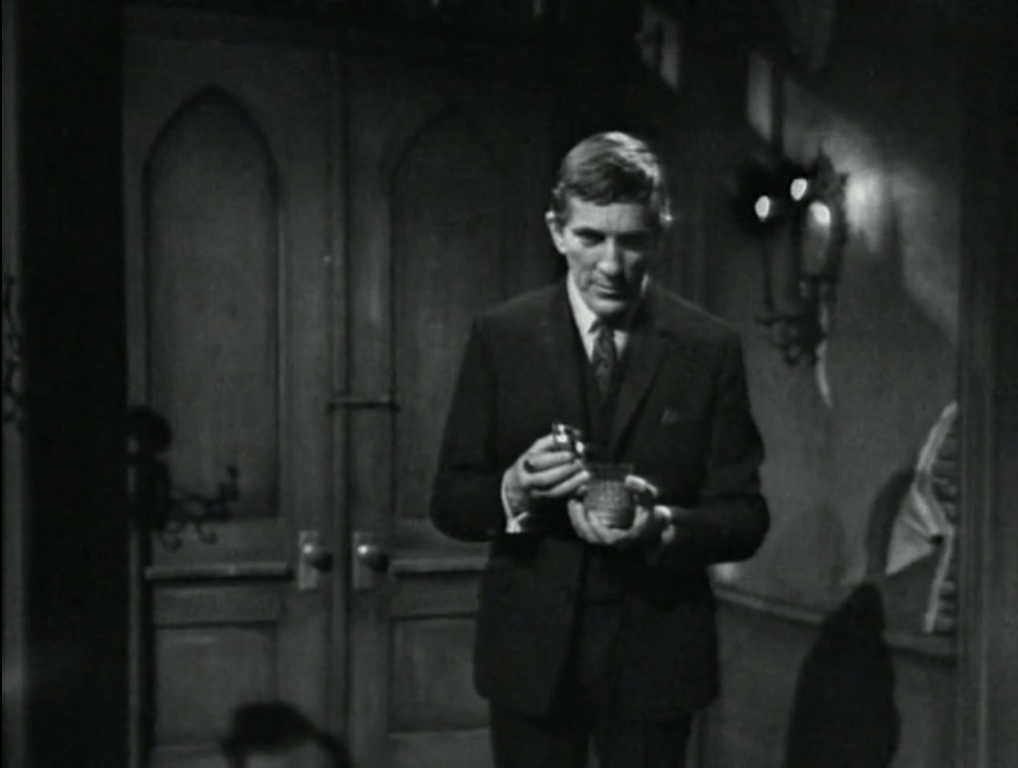
Barnabas and Maggie have a conversation about his inclination to kill her. Barnabas’ sorely bedraggled blood-thrall Willie Loomis joins in, saying that Barnabas will have to kill him first. This would not seem to present Barnabas with any difficulty at all. Willie wouldn’t be missed- everyone else on the show remembers Willie from the days before he met Barnabas, when he was dangerously unstable ruffian Willie Loomis, and has been urging Barnabas to get rid of him. Nor would it be especially difficult for Barnabas to replace Willie- he just has to bite someone else, and that other person will become his new slave. But Barnabas stands around arguing with Willie and Maggie. When someone knocks on the front door, he scolds Willie for failing to keep it locked, such a humdrum complaint under the circumstances as to bring another bad laugh. Barnabas leaves Willie and Maggie in the basement while he answers the door. Before he goes, he sticks out his lower lip, a facial expression known as “pouting.”
Barnabas pouts
The visitor is well-meaning governess Vicki, who tells Barnabas that the sheriff has ordered that no woman go out alone at night. Some think it strange to send a woman out alone at night to carry this message to a man who is indoors, but considering what we’ve seen of the sheriff, doing the exact opposite of what he commands would seem always to be the wisest course.
Vicki notices an antique music box on a table in Barnabas’ front parlor. Vicki admires its tune and makes a few not-very-coherent remarks about “the past” while it is playing. Barnabas has been using this music box as a tool to hypnotize Maggie into believing that she is his long-lost love Josette. After Vicki leaves, he opens it again, then looks at the door through which she left. He turns his head and smiles, looking very much like someone who has just had an exciting new idea.
Lightbulb moment
Meanwhile, Maggie and Willie talk to each other in the basement. The two of them had one of the most electrifying scenes of the entire series down there Friday. The last traces of that energy have been piddled away by the time Barnabas comes back downstairs and resumes his conversation with them.
Willie urges Barnabas to look at Maggie and see how beautiful she is. Barnabas says “No” and looks away. Coming at a moment of high dramatic tension, this might have been powerful. When we sit down as an audience, we enter into a sort of agreement that if the show includes something worth seeing, we will look at it. So when we see a character refusing to look at a sight as well worth contemplating as was the young Kathryn Leigh Scott,*** we might be shocked. But there has been too much idle chatter, and the memory of Barnabas’ pout is so fresh, that all we can think of is a petulant child saying “I don’t wanna look at her!”
Barnabas announces that he will not kill Maggie right away. He tells her that he will make her suffer torments worse than anyone has ever known so that death will finally come as a blessed relief, then locks her up in the prison cell in the basement of the house. What, your house doesn’t have a prison cell in its basement? It’s a standard feature of homes in Collinsport, as we will come to see in future episodes.
Barnabas goes to the great house of Collinwood and talks to Vicki. He brings a handkerchief that, legend has it, was a gift from the queen of France to Josette. They babble about “the past” and Barnabas invites her to drop in at his house “some day.” He says “day,” even though he’s busy being dead every day until sunset. And doesn’t specify when- any old time, if she hears screams coming from the basement she’ll probably just ignore them.
Evidently Barnabas is thinking of Vicki as a backup Josette in case Maggie doesn’t come around. This marks a retreat from #240 and #241, when strange and troubled boy David Collins, who has seen Josette’s ghost many times, saw Maggie in the gown Barnabas gave her and said that she must have been Josette because she looked “exactly the same” as he had seen her before. That suggested, not only that Barnabas chose Maggie because of her looks, but also that he might be right in thinking that she is Josette’s reincarnation. This storyline is modeled on the 1932 Universal film The Mummy, in which Imhotep’s idea that Helen Grosvenor is the reincarnation of his lost love Princess Ankh-esen-amun is substantiated when Zita Johann plays both roles. If Vicki and Maggie are interchangeable, then all of that goes by the boards.
*Presumably no relation to the main character of Gene Roddenberry’s 1963-4 CBS TV series The Lieutenant, one episode of which was written by Art Wallace.
For those who have missed the last few episodes of Dark Shadows: Elizabeth Collins [Stoddard,] at Jason McGuire’s insistence, has taken Vicki, Carolyn, and Roger into the basement room and convinces them that it holds no mystery. They don’t realize that beneath the flagstones on the floor is concealed the room’s secret—the body of Elizabeth’s husband, Paul. Elizabeth, now realizing that the secret can never be told, announces to the family that she and Jason will be married. Maggie Evans escaped from Barnabas and attempted to get to her father, but was recaptured and told by Barnabas that unless she assumes the identity of Josette Collins, she will die. Realizing that she can never escape, Maggie attempts to destroy Barnabas.
The title card shown during the recap
***Or for that matter as is the not-so-young Miss Scott of today, she’s one of the best looking octogenarians around.
Maggie Evans, the Nicest Girl in Town, has been the prisoner of vampire Barnabas Collins for some time. At rise, she is in front of her mirror, struggling to remember who she is. Her name and her father’s come back to her, but then the music box Barnabas gave her starts playing, and she begins to believe that she is Barnabas’ long-lost love Josette. This scene takes about a minute more than is necessary.
She renews the struggle later, and this time overcomes the hypnotic power of the music box. She decides to pretend that she believes that she is Josette in order to trick Barnabas and Barnabas’ sorely bedraggled blood thrall Willie into giving her enough freedom to escape. She fools them, only to hear Barnabas tell Willie that her compliance means that the time has come for the final part of his plan.
Maggie hears carpentry work, and sneaks down to the basement. She finds Barnabas watching Willie build a coffin. It sits next to the coffin in which Barnabas spends his days. It becomes clear that once Maggie is fully Josettified, she will be a vampire as well. Unfortunately, Jonathan Frid has a great deal of trouble with his lines in this scene. I don’t usually mind Frid’s bobbles, but his line troubles here take us out of what needs to be a terrifying moment.
In the morning, Maggie goes back to the basement. Willie finds her there. He is not convinced that she believes she is Josette. He presses her, and she finally breaks down and gives up the act.
Maggie shows Willie the diamond necklace Barnabas gave her as a present for their wedding, and tells him it will be his if they destroy Barnabas and escape. Willie’s fascination with jewels was what led him to undertake the grave-robbing expedition that freed Barnabas in the first place, and the necklace does distract him for a little while. But then he hears Barnabas’ heartbeat. He heard that sound before, in #208, #209, #210, and #217, but in those episodes no one else could hear it. Maggie can, since Barnabas has been drinking her blood too, but she can still resist the vampire’s spell. She is holding a large awl, ready to drive it into Barnabas’ heart, but Willie cannot overcome his urge to protect his master. He disarms Maggie.
We see Maggie in her room and hear Barnabas’ voice on the soundtrack going over what she heard him say in the basement. This is the first time an interior monologue has played quotes from another character. They aren’t the lines Jonathan Frid actually delivered, but cleaned-up, intelligible lines, presumably the ones that were in the script.
As sunset nears, Willie takes Maggie back to the basement. He leaves, telling her that she and Barnabas must be alone when he completes “the ceremony.” She finds the awl, picks it up, and opens the coffin. Before she can drive it into Barnabas’ heart, he awakens and shows his fangs. She screams and presses herself against the brick wall behind her.
Back to the wall
This is the second episode credited to writer Joe Caldwell, and is certainly the best teleplay Dark Shadows has seen since Francis Swann left the show in November of 1966. Like Swann and Art Wallace, Caldwell understood what actors could do and knew how to give them a platform to show their stuff.
Aside from Frid’s one bad scene, the actors excel. In 1967, Kathryn Leigh Scott was already a highly trained actress. Maggie Evans, on the other hand, has never acted before. When Maggie is pretending to believe she is Josette, Miss Scott shows her giving a crude imitation of Barnabas’ high-flown style, mixed with some prancing movements you might see from a little girl playing the princess in a school play. Barnabas is so desperate to believe that his lunatic scheme is working that he falls for it completely. When he and Maggie are in the front parlor together, he responds to her amateur performance as a sign that she is matching his pomposity, which of course thrills him.
When Willie and Maggie are in the basement, John Karlen plays his earthy skepticism with a simplicity that makes Maggie’s pretending look ridiculous. When Maggie gives up her act and whispers a plea for Willie to help her, Miss Scott matches the force of Karlen’s performance and the resulting encounter is as powerful as anything the show ever achieves.
The episode is good enough that we barely noticed some major lapses in story logic. If Maggie can sneak down to the basement to eavesdrop on Barnabas and Willie, why can’t she slip out the front door? She knows how to get from Barnabas’ house to the great house of Collinwood, where she has friends and there is a telephone to call the sheriff.
And when did she learn that you can destroy vampires by driving stakes through their hearts? She’s lived in Collinsport all her life, and no one in that town has ever heard of vampires. Granted, the show would move a lot faster and could have more layers of irony if the characters had read Dracula and seen movies from Universal and Hammer, but this is the first hint that any of them has.
My wife, Mrs Acilius, was very interested in the fact that Maggie calls herself “Maggie, or Margaret” in this one. First time we hear the name Margaret! I’m not sure why that impressed her so much, but she’s very bright, so I’m sure it’s important. All I can think of is that “Maggie” waits tables in the diner, cleans up after her Pop has had one drink too many, and is everybody’s pal, while “Margaret” is a saint’s name, and a queen’s name. So Margaret might have a bigger destiny than we’ve seen.
Artist Sam Evans can think of nothing but his daughter Maggie, The Nicest Girl in Town. Maggie disappeared from the hospital weeks ago, and the police haven’t found a clue as to how she got out or where she is. Sam’s friend, dashing action hero Burke Devlin, drops by Sam’s house and offers to take him to dinner. Sam isn’t hungry. Burke urges Sam to work on a painting; he says he can’t concentrate.
Burke brings up the idea of Sam painting a portrait of him. Burke did commission Sam to paint him in #22, and for weeks and weeks afterward Sam vacillated about doing so. That was part of the since-abandoned “Revenge of Burke Devlin” storyline. In the notes about this episode on the Dark Shadows wiki, we read that “the episode’s writer seems unaware of the portrait-painting history between Sam and Burke, the fact that it was a sore subject, and even of the general animosity between the two.” I don’t think that is necessarily so. Burke gave up on his revenge in #201, and everyone was thoroughly bored by the topic well before then. So I suspect this conversation is telling us that Burke and Sam have turned the page on all that.
Before Maggie disappeared, Sam had been painting a portrait of mysterious eccentric Barnabas Collins. Barnabas insisted on working only at night and on doing all the painting at his place, the Old House on the estate of Collinwood, which does not have electricity. Since Maggie vanished, Sam has offered to take the canvas home and work on it there, but Barnabas would not let it leave his house. Tonight, Sam decides to go to Barnabas’ and do some painting by candlelight.
Sam knocks on Barnabas’ door. Barnabas’ servant, Willie Loomis, answers. Before he met Barnabas, Willie was a dangerously unstable ruffian. Willie menaced Sam and Maggie in the local tavern so severely that Burke had to beat him to a pulp, and Sam came away from the experience hating Willie. But in his time working on the portrait, Sam has come to believe that Willie is a changed man.
Willie explains that Barnabas is away, that he doesn’t know when he will be back, and that he isn’t supposed to let anyone in the house in his absence. Sam protests that he is no stranger, and that he is sure Barnabas will want the portrait finished. Willie finally suggests that he take the canvas home and work on it there. That’s what Sam has wanted to do all along, so he is delighted to hear it. He carries the painting to his station wagon while Willie carries the easel. The two are in a jolly mood as they leave the house, seeming very much like good friends.
Sam leaves his pipe on a table in the front parlor of Barnabas’ house. In the first months of the show he went back and forth between smoking this pipe with its white bowl carved into a likeness of George Washington and puffing on cigarettes. We haven’t seen the pipe in a long while, but today we get a number of closeups of it. The first comes before Sam leaves home to go visit Barnabas, and the second when he and Willie are on their way to the station wagon.
The pipe in the Evans cottageThe pipe at Barnabas’ house
As soon as Sam and Willie are outside, a figure draped in white comes down the stairs into the parlor. It is Maggie. It turns out Barnabas is the one who is holding Maggie. He has taken his cue from the 1932 film The Mummy, in which Boris Karloff is an undead creature who tries to convince a woman that she is the reincarnation of his lost love so that he can kill her and bring her back to life as that other person. Barnabas, it turns out, is a vampire. He wants to erase Maggie’s personality, replace it with that of his long-lost Josette, and then turn her into a vampire.
Maggie is sufficiently under Barnabas’ sway that doesn’t know who she is, but she is not fully convinced that she is Josette. When she picks up her father’s pipe she seems to remember something. She doesn’t sniff it, but a pipe is a highly aromatic object, and scents are powerful drivers of memory.
Maggie reaches for the pipeSomething comes back to Maggie’s mind
Maggie wanders back upstairs, keeping the pipe with her. Sam and Willie come in, and Sam is mystified that his pipe has vanished. When Willie says he must have left it outside, Sam starts to argue. Seeing that the pipe isn’t in the room and believing there is no one else in the house, Sam laughingly calls himself absent minded and asks Willie to keep an eye out for it.
Maggie wanders back downstairs after her father has gone. She and Willie argue about whether she ought to leave her room and who she is. She doesn’t let on that she knows anything about the pipe. She goes upstairs again, and Willie goes to the basement.
This is the first time we have seen the basement, and we get a long look at it. There is a metal door with a barred window, big cobwebs, a stone staircase, big candelabra, and a coffin. The coffin lid opens, and we see Barnabas inside. This is the first time we’ve seen him there.
Barnabas asks Willie why he has come. When Willie tells him he has news, Barnabas beckons him closer. When Willie obeys, he grabs him by the throat. When Willie has delivered his report, he flings him to the floor, apparently on general principles. He stands over Willie’s crumpled form and gives a lecture about the importance of keeping visitors out of the house during the day. Notably, he does not object to sending the canvas home with Sam.
Maggie wanders downstairs a third time. We see her face and hear her recorded voice on the soundtrack. This is the third instance of interior monologue on Dark Shadows, after we heard Willie thinking at the portrait of Barnabas in #205 and #208. As Willie did not know who Barnabas was or why he was drawn towards him when we heard his thoughts, so today Maggie does not know who she is or what Barnabas is doing to her. She looks at the pipe in her hand, concludes that there is someone she must take it to, and walks out the front door.
In the Evans cottage, Sam is working on the portrait of Barnabas when Burke comes in with a sandwich to share. They chat about the painting. Sam explains that he can’t get the eyes right- they keep looking cold and forbidding, while he and Burke agree that Barnabas doesn’t seem that way at all.
We cut back to the Old House, where Barnabas is sitting in his armchair, giving Willie some orders. He may not seem cold and forbidding to Sam, but he couldn’t be more blatantly malevolent than he is with Willie. When they discover that Maggie is gone, Barnabas and Willie run out the front door.
This is the first episode in which Barnabas is just a total bastard the entire time. When he is with people who don’t know that he is a vampire, he plays the role of the Collins family’s mild-mannered cousin from England; Barnabas is so committed to that performance that we wonder to what extent he is a monster pretending to be a nice guy, and to what extent he is a nice guy forced to function as a monster. When we’ve seen him alone with Maggie, he has obviously been a crazy person, but a twisted sweetness comes peeping out as he talks about his longing for Josette. Even in his previous scenes alone with Willie, scenes that have more than once ended with him beating Willie unmercifully, Barnabas has allowed Willie to go on talking about his feelings much longer than he would have to if he were entirely sincere when he tells Willie that his inner life is of no consequence. But there isn’t the least flicker of warmth in either of Barnabas’ scenes today.
In the Evans cottage, Sam is puzzling over the portrait while Burke is in the kitchen. Maggie comes drifting into view in the window behind Sam. The Evans cottage has been a prominent feature of the show from its early days, and the foliage visible through the window has changed often enough from episode to episode that regular viewers know there is an actual space behind it, but this is the first time we have seen a person there. In her white dress, with her dazed expression and her wafting movements, Maggie looks like a ghost. Sam sees her and is startled. He calls her name. She disappears. Sam and Burke run out of the house to look for her.
Maggie entersMaggie comes into viewMaggie sees SamSam sees MaggieSam moves in for a look
There are some significant flaws in the episode. The opening scene between Sam and Burke goes on too long, the repeated closeups on the pipe are embarrassingly heavy-handed, and Maggie’s three trips downstairs are one too many. There are also some badly framed shots, surprisingly so for director Lela Swift. For example, I cropped the fifth image above to zoom in on Sam and Maggie. Here is what actually appears in the show, cluttered with distracting junk on all sides and devoting more screen space to David Ford’s butt than anyone wanted to see:
Moon over Collinsport
Still, there is a lot of good stuff in the episode, and the ending is very effective. It is far from a gem by any reasonable standard, but it may be the best script Malcolm Marmorstein ever wrote.
Maggie Evans, The Nicest Girl in Town, suffered from an ailment her doctor, Dave Woodard M. D., could not identify. She then vanished from her hospital room in a manner law enforcement, led by Sheriff George Patterson, could not explain. The opening voiceover says that Maggie’s troubles “mystify the finest minds.” This is the first and last time either Woodard or Patterson is classed with “the finest minds” even among the low-functioning characters who abound in the period when Dark Shadows is being written by Ron Sproat and Malcolm Marmorstein. Well-meaning governess Vicki is still the single smartest character on the show, and she turns into an absolute moron every two or three days.
In the opening teaser, dashing action hero Burke Devlin asks Dr Woodard if his studies of Maggie’s blood samples will help find her. He says that they won’t, but that if he can diagnose her he might be able to help her after she is found. Burke asks if he is about to make a diagnosis. He says that he might be making progress towards that goal. At that point, there is a dramatic musical sting, and we cut to the credits. That’s the hook, a statement that further study is needed.
Dr Woodard tells Burke that he has contacted “Hoffman, one of the best men in the field,” and that he hopes Hoffman will be able to get things moving. Under Burke’s questioning, he admits that he is pessimistic that Hoffman will see anything he has missed. This is the first mention of the name “Hoffman” on Dark Shadows. I believe it is only the second mention* of any surname that is not derived from Irish (as are such names as Collins, Devlin, Malloy, and McGuire,) English (as are names such as Woodard, Patterson, Loomis, Johnson, Stockbridge, and Garner,) Welsh (as are names such as Evans and Morgan,) Scottish (as are the names Adair and Murdoch,) or French (as are the names La Freniere, Bilodeau, and du Près.)** It is certainly the first name we have heard that suggests there might be Jewish people in the universe of Dark Shadows.
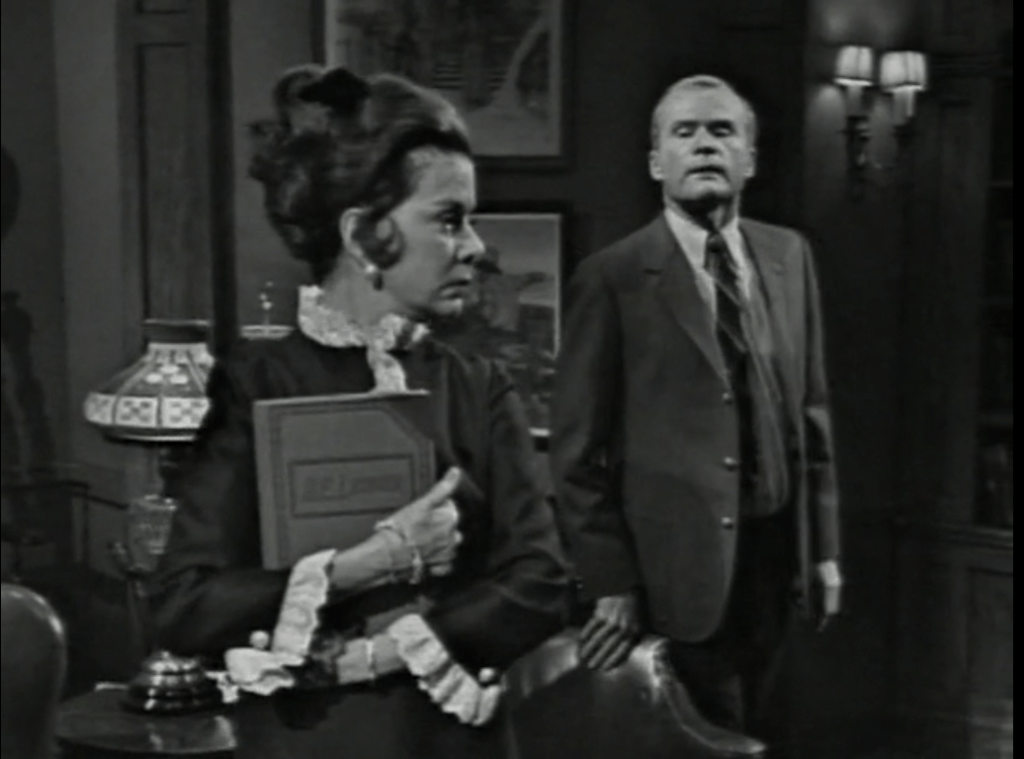
We then cut to the study in great house of Collinwood, where high-born ne’er-do-well Roger Collins has to confront his sister, reclusive matriarch Liz. The auditors have told Roger that the books are out of balance at the family business. Roger knows that the reason for this is that Liz is giving money to buy the silence of seagoing con man Jason McGuire. He reminds Liz that he himself was afraid of blackmail for the first 40 weeks of the show, so he knows from personal experience that it is no way to live. Liz refuses Roger’s plea that she tell him her secret. As he probes and she resists, they move around the room at times like fencers, at times like dancers performing a paso doble. Their movements are easily the most interesting element of the episode, a credit to director John Sedwick.
Roger’s first approach to the shielded LizLiz parries Roger’s thrustRoger’s second approach
Roger admits that he hasn’t been much help to Liz over the years, but begs her to let him help her now. Liz won’t tell him anything, but she is touched to see her bratty brother sincerely trying to step up.
Liz goes to the drawing room. The camera is behind her as she approaches the room. Jason is standing at the fireplace under the large portrait, the spot furthest from the camera. Not only does he look as small as possible, but at the moment we first see him he is turned away from us, his head tilted far back as he takes a drink. Jason’s smallness and obscurity, coming so soon after Roger’s speech about the dreariness of blackmail, feels like an acknowledgment that Jason doesn’t have much to offer the audience.***
Coming upon Jason
Liz tells Jason she can’t give him any more money without blowing the secret they share. He amazes her by accepting this information calmly, but she is sure he is not done tormenting her.
Liz returns to the study, where Roger is still sitting. She tells him that she has talked to the auditor and straightened out the books. That sounds like something that would take quite a while, even if you are sitting across from each other, and Liz and the auditor had to do it over the telephone. So how long has Roger been sitting there?
Then we rejoin Burke and Woodard in the doctor’s office, which someone has ransacked. The perpetrator wrenched the metal bars out of the window and stole Maggie’s blood samples. Dr Woodard says that the only way the bars could have been twisted was by someone with the “supernatural strength of madness.” I’m not an expert in mental health, but that does not sound like a conventional psychiatric opinion to me.
*After Lieutenant Costa of the Arizona State Police, whom we saw when Dark Shadows took us to Phoenix in #174.
**It is pretty weird that a show set in Maine has so few French-surnamed characters. We’ve only heard of one working-class Mainer with a French name, Amos Bilodeau. La Freniere was given in #45 as the maiden name of Josette, a grand lady who came from France to marry into the Collins family in a previous century; eventually, Josette’s birth name will be retconned to du Près.
***My wife, Mrs Acilius, was the one who really noticed the visual strategy both in Liz and Roger’s first scene in the study and in Liz’ entry into the drawing room.
Vampire Barnabas Collins has taken up residence in the long-abandoned Old House on the grounds of the great estate of Collinwood and restored two rooms, leaving the rest of the mansion a shambling ruin. That image captures the current state of Dark Shadows. This episode, like many others we’ve seen recently, contains some scenes that are all right by themselves, but that do not contribute to any structure. The result is continual frustration and disappointment.
From its introduction in #70 until Barnabas claimed it in #212, the Old House was the stronghold of the ghost of Josette Collins and the playground of Josette’s darling, strange and troubled boy David Collins. We’ve seen Josette appear several times, and characters including David, well-meaning governess Vicki, and artist Sam Evans have interacted with her. Now, Barnabas not only seems to have silenced Josette’s ghost, but is holding Sam’s daughter Maggie and trying to turn her into a resurrected Josette by following the procedures Boris Karloff’s character Imhotep demonstrated in the 1932 film The Mummy. Regular viewers are growing impatient to see Josette emerge from her portrait and lead the battle against Barnabas, as she led the successful battles against crazed handyman Matthew Morgan in #122-#126 and against blonde fire witch Laura Murdoch Collins in #126-#191.
Today, David reflects our impatience. We see him at the Old House, knocking on the door, then peeping through the window. He sees a veiled figure in Josette’s white dress walking down the stairs. He returns to the door, which opens for him. No one is in sight.
We have assumed that the woman in white was Maggie wearing the dress Barnabas gave her, but the fact that she was out of sight by the time the door opened suggests that it might have been Josette’s ghost after all. David calls to Josette. When she does not answer, he goes upstairs to look for her.
David finds Josette’s restored bedroom, where her portrait now hangs. He talks to the portrait, not in the easy conversational tone he had used with it in #102, but in awkward shouts. He pleads and protests that he can’t sense her presence. When he came to the house in #223 and saw that the portrait was not in its old place above the mantle in the front parlor, he had wandered around whining that the portrait is lost and Josette is lost with it. Now that he has found the portrait, his perplexity deepens- she is still nowhere near.
Barnabas enters, and demands to know what David is doing deep in his house. After a moment, he sits and talks with the boy. He tries to present the idea of ghosts as absurd on its face, but David has seen too much to find that convincing. When Barnabas tells him that the door probably opened because of the warping of the wood, we know that it must have been the work of a paranormal being- a villain cannot say something so plausible unless it is false. Even if the figure David saw was Maggie, there is definitely some spectral presence in the house that Barnabas does not know about and cannot control.
Barnabas and David have a man-to-man talk, or should I say ghoul-to-boy.
Barnabas finally tells David to take a long, deep look at the portrait, and asks him if he still feels that Josette is there. David says that he does not have that feeling. Barnabas triumphantly declares that Josette is really gone.
Now, at last, we expect everything will start to come together. David will talk to Vicki, they will compare notes about their encounters with Josette, and will try to figure out how and why she has changed. There will be images building on the ambiguity about who David really saw through the window and who really opened the door for him. David’s father, high-born ne’er-do-well Roger, will try to revert to his usual denials that anything peculiar is going on, but will grudgingly admit that the events of the last several months have proven that Josette’s ghost is real, and will not be able to resist wondering what is going on with it now. That in turn will lead to a new understanding between Roger and Vicki, allowing Roger’s relationships with both her and David to become more dynamic. Barnabas will realize that, even if he can keep Josette from manifesting herself again, she has already revealed enough to the characters about the supernatural back-world behind the settings in which they operate that she has created a dangerous situation for him, and he will have to scramble to keep them from discovering that he is a vampire.
The script brings us right up to the brink of every one of those events, only to whisk us away and instead show us something dull and pointless. David does tell Vicki that he saw Josette’s ghost, that Josette is in some way he cannot explain different than she was when he saw her before, and that he could not feel Josette’s presence in her portrait. But Vicki does not draw on her many experiences with Josette and join David in trying to unriddle these mysteries. Instead, she behaves as she did in the first twelve weeks of the show, and treats David as if he is having a neurotic episode.
David tells Vicki that Josette’s face, as he saw it through Barnabas’ window, was “exactly the same” as it was when he saw her ghost before. We don’t see the face at all today, and when we’ve seen Josette before, the only look we had at her face were brief glimpses in #149, #165, and #184. In each of those episodes, she was played by stand-in Rosemary McNamara. Today, the performer wearing the dress is Dorrie Kavanaugh. Casting Miss McNamara and letting a bit of her face peep out for a fraction of a second would seem to be way of building on the ambiguity, especially since she resembles Kathryn Leigh Scott strongly enough that she could easily be taken for Maggie.
Though Miss Scott played Josette’s ghost in #70 and #126, this is the first we’ve heard that Maggie resembles Josette. Perhaps Barnabas chose Maggie, not only because she is an attractive young woman who works late and often has to walk home alone after dark, but because she really does look like Josette. If so, the parallel with The Mummy is stronger- Helen Grosvenor looked just like the Princess Ankh-esen-amun, and the movie hints that Imhotep may have been right to believe that she was her reincarnation.
Vicki doesn’t react at all to David’s observation. She simply grows more exasperated with him for his persistence in believing in ghosts and intruding on Barnabas’ privacy, and warns him that “your father and I” will have to become stricter with him if his behavior does not improve.
Meanwhile, Barnabas and Roger are talking in the drawing room. Roger speculates that David has gone back to his preoccupation with ghosts because everyone is so worried about the missing Maggie, then remarks that it is strange that the boy’s behavior should have created a connection between Maggie and the portrait of Josette. This line doesn’t make any sense in the script as written, but if we could believe that Roger remembers what he recently knew to be true about Josette’s ghost, its powers, and its connection to Maggie’s father, it would be a sign that he is on his way to making a crucial discovery. In that situation, Barnabas’ mounting dread as he listens to Roger would carry considerable dramatic force, as opposed to the meaningless throwaway it in fact is.
Barnabas absorbing what Roger has said
Vicki’s amnesia is especially depressing, because the only story that consistently worked in the first 39 weeks of the show was the relationship between Vicki and David. At first David hated Vicki and wanted to kill her. After he found out she’d seen a ghost, David proclaimed his love for Vicki, but that was a love that might quickly transform itself into a violent hostility. Gradually, a true friendship grew between them. The Laura arc was the climax of that story, ending with David turning away from the biological mother who wanted to kill him and embracing Vicki as a more acceptable mother figure.
Once David had adopted Vicki as his new mother, their story was complete. Alexandra Moltke Isles and David Henesy made so much of Vicki and David’s scenes together, often in spite of very bad writing, that we are eager to see a sequel to that story that will give us more victories over the stuff that dribbled out of the typewriters of Ron Sproat and Malcolm Marmorstein. One possible sequel would have been an arc in which Vicki and David have to work together to defeat the vampire. If Vicki has forgotten everything that’s happened on the show since October of 1966, when she saw the ghost of Bill Malloy in #85, she won’t be able to do that, or much of anything else for that matter. The show has been primarily a supernatural thriller for months now, and if Vicki is excluded from the supernatural stories her future on it is very limited indeed.
A possible non-supernatural storyline might have been a romance between Vicki and Roger. After all, if Vicki is acting as David’s mother and she lives in the same house as his father, it only makes sense that the two of them should become a couple. And indeed, there are moments today when that seems to have happened. She hesitates for a fraction of a second while delivering the line about “your father and I,” which does sound so much like something an impatient mother would say. She then goes on to have a quarrel with Roger about how to discipline David and what emotions it is proper to display in front of him, sounding like they’ve been married for years. After a lot of raised voices, they apologize to each other and leave together.
We’ve seen Vicki and Roger in date-like situations a few times, for example in #78 and #96, and each time it has immediately become clear that the two of them are wrong for each other. Besides, Roger has been turning into the actor who plays him, the obviously gay Louis Edmonds. So a relationship between Vicki and Roger would be doomed from the start.
Still, it would reactivate some dead storylines. The series started with Vicki on a quest to learn who her parents were, a theme that went nowhere. They’ve been hinting very heavily that Roger’s sister, reclusive matriarch Liz, is Vicki’s mother, so that an engagement between Vicki and Roger would put Liz in a position where she could hardly keep that secret any longer. Moreover, Vicki has gone on some dates with dashing action hero Burke Devlin, who is not directly connected to any ongoing storylines. Burke hates Roger and is attracted to Vicki, so a love triangle involving the three of them might bring him back into the show. But that fizzles out just as the other potentially interesting situations do, leaving us without much to look forward to.
Dark Shadows has been a supernatural thriller ever since the ghosts of Josette and the Widows scared Matthew Morgan to death in December 1966. But today’s episode is the first one that is structured like a horror movie.
Horror movies tend to focus on the visible damage done to the bodies of the female victims of the monster. The current victim is Maggie Evans, The Nicest Girl in Town, and the monster is vampire Barnabas Collins. We open with Maggie’s father, artist Sam Evans, looking helplessly around the house. Sam doesn’t know it, but Maggie was compelled to leave by the power that Barnabas has gained over her by drinking her blood.
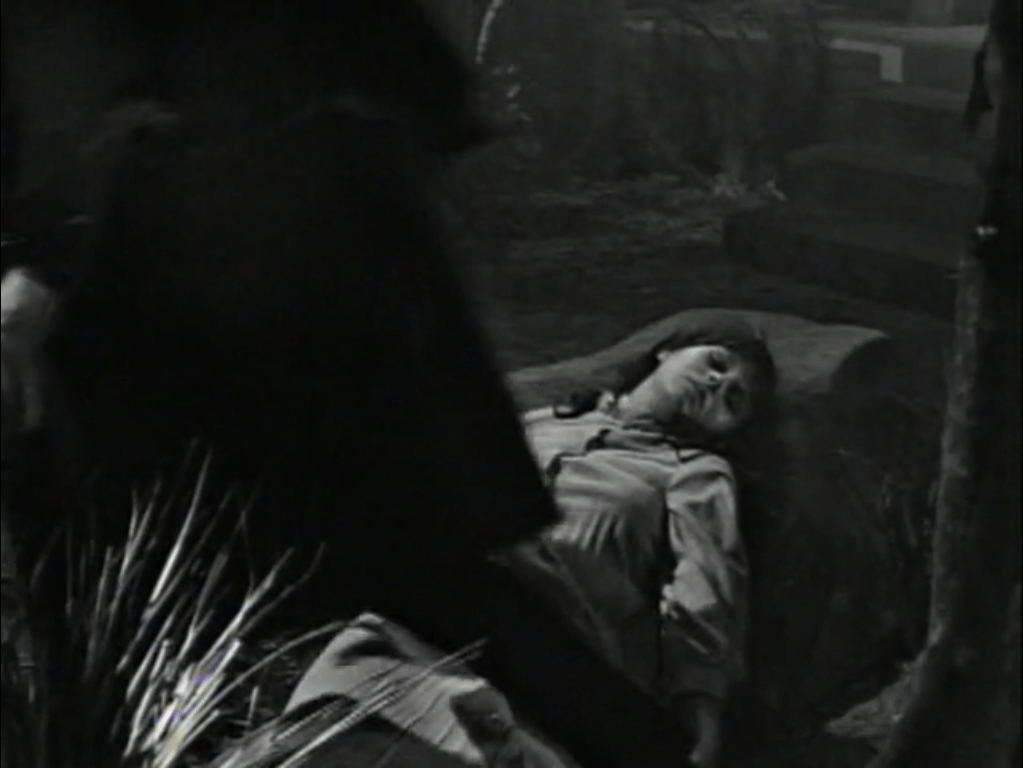
What Sam does know is that Maggie was in extremely poor health. He cannot understand how she could have gone anywhere under her own power. We then see Maggie looking awful and wandering around the graveyard. Later, a closeup of a professional headshot of actress Kathryn Leigh Scott will dissolve into an image of Maggie among the tombstones, contrasting her usual fresh-faced beauty with her present ghastly haggardness.
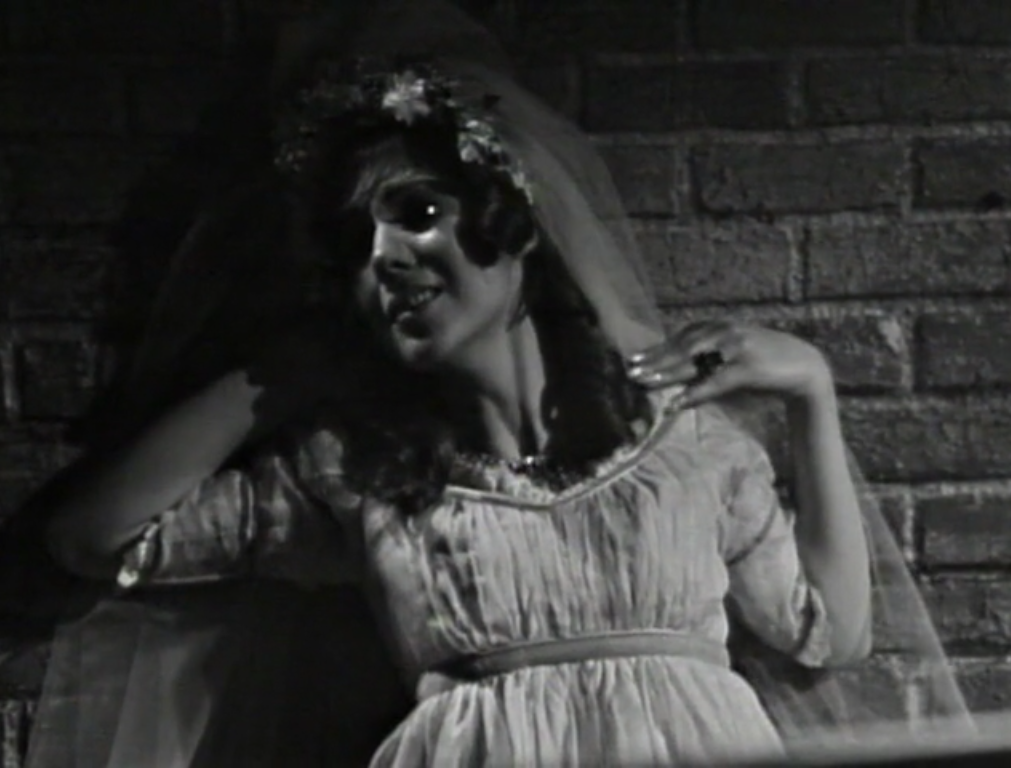
Maggie’s professional headshotThe dissolveBride of the monster
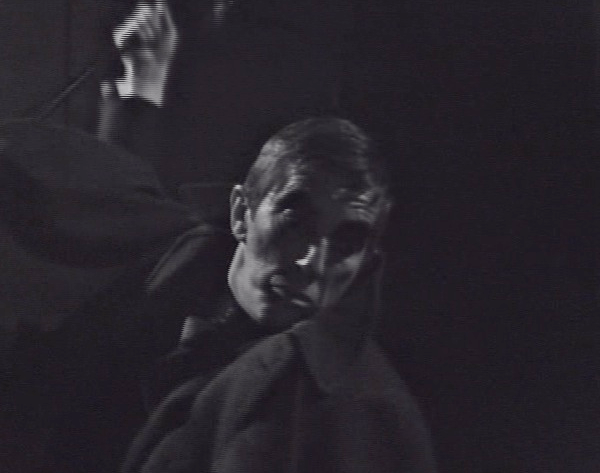
The monster who has reduced her to this sorry state, vampire Barnabas Collins, emerges from the fog. Barnabas has been on the show for four full weeks now, but this is the first time we see his face not in the pleasant disguise of a wealthy gentleman visiting from across the sea. He is wearing a more extreme version of the makeup Maggie has on, and his fangs feature prominently. This is the introduction of the monster, a key element on any horror film, and it suggests that Barnabas is now what Maggie will become.
When Barnabas hears Maggie’s friends approaching before he can complete his evil plan, he drops her on the ground and steps over her, again treating her body as a thing.
Barnabas steps over Maggie
After she is carried home, Maggie moans about her pain but can say nothing about what has happened to her, who is responsible for it, or what she is thinking. Again, we can connect only with her physical being, not her social relations or her inner life or the events that have involved her. At the end, the handkerchief tied around her neck is removed without her permission or objection, as if she were inanimate. The camera zooms in on open wounds on her neck, isolating that area and leaving us with the image of the wounds as things available to us to examine apart from Maggie’s personality or the rest of her body.
The Source of the Evil
The episode is an adaptation of elements from Bram Stoker’s Dracula. Early in that novel, the vampire’s victim Lucy rose from her sickbed and wandered off to a graveyard. As Lucy is found by her friend Mina, so Maggie will be found by her friend, well-meaning governess Vicki. As Mina would spend the second half of the novel as the only female member of a group of stalwart and dynamic men doing battle with the evil Count, so Vicki is working with an otherwise all-male search party led by dashing action hero Burke Devlin. As Mina’s colleagues exclude her from their activities and thereby come close to total failure, so the men leave Vicki behind in the Evans cottage to wait by the phone, only to find that she is the one who will have the most to offer when she joins them in the field.
After Lucy dies and her undead form is destroyed, Mina becomes Dracula’s victim. Mina ends up as the precursor of the “Final Girl” in the mad slasher movie, playing a key part in Dracula’s final defeat, though unlike those movies Dracula ends with a successful team effort.
Since Vicki has been our point of view character from the beginning, was an effective protagonist in the “Phoenix” storyline, and is as relentlessly wholesome as the Final Girl typically is, we might expect that she will be Barnabas’ last victim. That expectation in turn suggests that Maggie, like Lucy, will die, rise as a vampire, and be destroyed by those who love her most. Maggie is one of every viewer’s favorite characters, so the prospect that she might turn into a monster and then leave the show altogether brings keen suspense.
Barnabas Beats His Willie
Vicki does have two important conversations with sorely bedraggled blood thrall Willie Loomis while she is in the Evans cottage. The first occurs when Willie comes to the door to bring a message that his master Barnabas will not be available at the usual time to sit for the portrait Maggie’s father is painting of him. Vicki tells Willie that Sam is out searching for Maggie, and Willie becomes very upset to learn that Maggie is missing.
The second conversation comes a few minutes later, when Willie, not disguising his voice in any way, telephones the Evans cottage and tells Vicki that Maggie is in the cemetery and that she is in extreme danger. Somehow Vicki doesn’t recognize his voice. I suppose there were lots of people it might have been- maybe it was Detective Mary Beth Lacey’s husband Harvey from Cagney and Lacey, or Stefan from Daughters of Darkness, or Jock Porter from Love is a Many Splendored Thing, or Geoffrey Fitton from the original Broadway cast of All in Good Time, or any of dozens of policemen and criminals who were in single episodes of cop shows in the 1970s and 1980s.
Willie’s call to Vicki made me wonder about the extent of Barnabas’ powers. When we first saw Barnabas with Willie, his power over him was so extreme that it cost Willie a great effort even to ask Barnabas an unwelcome question, and a look was enough to drive Willie to scurry off and perform the most hateful of tasks. An act of defiance like this was out of the question. Perhaps Barnabas can only keep one blood thrall under total control at a time, and by adding Maggie to his diet he has weakened his hold over Willie.
Willie intrudes on Barnabas’ encounter with Maggie in the cemetery to warn him that Maggie’s friends are on their way. Barnabas instantly suspects that Willie told them where to look for her. When Vicki’s party arrives in the cemetery, Barnabas and Willie run away and hide in the back room of the Collins family tomb where Barnabas was trapped for about 170 years until Willie accidentally released him. This is a departure from Dracula– the Count would have attacked whoever interrupted him, no matter how many of them there were, and fled only if they were armed with crucifixes or consecrated communion wafers or other objects he couldn’t tolerate. But, as my wife Mrs Acilius pointed out, Barnabas has gone a long time without using his vampire powers, so he’s probably rusty.
Barnabas and Willie listen as Burke looks around the outer room of the mausoleum. Once they are sure he is gone, Barnabas confronts Willie with his suspicions. Willie’s lies do not satisfy him, and he lifts his heavy cane and starts beating Willie with it. All we see of this beating is Jonathan Frid’s face and the cane in his hand, but those images, coupled with sound of John Karlen’s cries, imply a violence that shocks us.
Burke picks Maggie up off the ground, grunting audibly as he does so. He carries her into her house, again with a lot of grunting. If I had been Kathryn Leigh Scott’s agent, the production staff would have received a very hot letter about that grunting. The good-looking young women on a soap opera aren’t supposed to weigh anything at all, certainly not enough to cause a dashing action hero to grunt like that even if he carried her all the way from the cemetery.*
In his post about this episode, Danny Horn has some lines about the ineffectiveness of the Collinsport police that I can’t resist quoting:
Sam tells the Scooby gang that he’s alerted the police — the sheriff and his deputies are out looking for Maggie. But, as everyone knows, the police department in Collinsport is 100% useless, so by now the deputies have probably arrested each other, and the sheriff’s all tangled up in a clothesline somewhere…
Vicki tries to call the sheriff, but there’s no answer; apparently every single person associated with the police department is out searching for Maggie, or falling down wells, or buying magic beans, or whatever the hell it is that Collinsport police officers do in a crisis.
When I first read about “the sheriff all tangled up in a clothesline somewhere” a few years ago, I laughed for about five minutes and knew I would be reading Danny’s blog to the end. I’m glad I did, it’s so much fun it inspired me to start this one.
*Mrs Acilius and I remembered a story Miss Scott tells nowadays. Early in the production of the show, Joan Bennett saw her eating a cheese Danish and said “The figure you have now can be your career for the rest of your life.” She put the cheese Danish down immediately, and hasn’t eaten another since. Our response to the story has been to eat cheese Danish on Miss Scott’s behalf at regular intervals.
Dark Shadows is recycling a story element from December 1966 and January 1967. Back then, blonde fire witch Laura Murdoch Collins kept staring out the window into the night and establishing a psychic connection with her son, strange and troubled boy David Collins. Each time she did so, David would have a terrible nightmare in which she was beckoning him to his death in flames. Since burning him to death was in fact her plan, we were left wondering if the nightmares were Laura’s attempt to get him used to the idea; if they were signs of his own willpower as he resisted her influence; if they were messages from the benevolent ghost of Josette Collins trying to warn her descendant of the danger his mother presented to him; or were the result of some other force that travels with Laura, but that is not under her control or necessarily known to her.
The other day, vampire Barnabas Collins stared out his window into the night and established a psychic connection with Maggie Evans, The Nicest Girl in Town. Maggie reacted to that contact with confusion and dismay. In yesterday’s episode, she had a nightmare in which she saw a coffin open from the inside and herself laid out in it. It isn’t much of a stretch to assume that Barnabas’ plans for Maggie will require her to spend her days in a coffin. That leaves us with just the same options we had in accounting for David’s nightmares.
Maggie and Barnabas cross paths today in Collinsport’s night spot, The Blue Whale tavern. When Maggie leaves, Barnabas wishes her “Sweet Dreams.” She is shocked at this conventional night-time farewell. We see her at home getting ready for bed; Barnabas is still in The Blue Whale, chatting amiably with dashing action hero Burke Devlin. Barnabas gets a peculiar look on his face, excuses himself, and hurries out. Then we cut to the Evans cottage, where we see him entering her room to bite her. These are things we might have expected to see if the nightmare was something Barnabas sent to get Maggie used to the idea of becoming a vampire.
Barnabas sits at a table in the tavern with Maggie’s father Sam. They talk about how strong and independent she is. We have known her since the first episode, and know that she is indeed someone who can stand up for herself. Reminding us of that, this conversation leaves open the idea that the source of the nightmare is Maggie’s own struggle against Barnabas.
Sam himself figured prominently in the Laura story as a medium for Josette’s influence. He is an artist, and when David’s nightmares did not suffice to make Laura’s plans clear to the characters, Josette took possession of Sam and used him to literally paint a picture for them. That possession occurred in Sam and Maggie’s cottage. Moreover, Maggie had been delighted with Barnabas before the nightmare, but seeing him now she is extremely uncomfortable. That reaction, Sam’s presence in the episode, and the scene in the Evans cottage would all seem to support the idea that the nightmare was a warning from Josette.
When Barnabas and Burke are alone at the table, Burke is admiring the silver wolf’s head sculpted on the handle of Barnabas’ cane. He says that it looks ferocious and asks if the cane was made to be a weapon. Barnabas replies that he sees the wolf’s head as a peaceful symbol, an animal originally wild and hostile that has been tamed to be a companion, “almost a servant,” to humans. Canines are not so tame when Barnabas is busy, however. We hear a variety of dog noises, ranging from the howl of a sad hound to the violent snarling of a pack of large hunting dogs. This does not appear to serve his interests. Since it happens around people like Maggie who are mystically connected to him when he is far away, it is difficult to see it as a natural phenomenon. And since Josette’s previous interventions have not involved dogs, she is not an obvious suspect. So perhaps when Barnabas rose from his grave, he brought with him a ghostly companion who is not his servant, but is working at cross-purposes with him.
Barnabas realizes that he wants to have a bite before sunrise
Joe and Maggie are interesting today. Maggie wakes up from her nightmare and calls Joe. We see Joe, getting our first look at his apartment. We don’t see much of the place, just a single panel behind him decorated in true Collinsport fashion with a painting on one side and the shadow of some studio equipment on the other.
Joe at home
It isn’t just the decor that tells us Joe is a true Collinsporter. Maggie waits anxiously for him to answer when the phone rings several times. When we see him, we know what took him so long- he had to put his robe on over his pajamas. Sure, he lives alone, but he isn’t a savage.
When Joe and Maggie enter the tavern, she remarks that they could have saved money- she has liquor at home. Joe tells her she needed to get out of the house. Again, he is following the norms of Collinsport. A young woman alone at home telephones her boyfriend in the middle of the night and asks him to come over right away. A fellow from another town might not have realized that the best thing to do was to take her to a public place where they would be likely to meet her father.
Maggie and Joe have been talking about getting married for a while now. She kept saying she couldn’t marry, because she was worried about her father. During the “Revenge of Burke Devlin” arc, which ran from the first episode until Burke decided to peace out in #201, Sam was an alcoholic given to binge drinking. When they gave up on that storyline, they dropped the theme of Sam’s alcoholism as well. Today he goes to a bar with someone who is determined to buy him all the liquor he will accept. He stops after a couple of drinks and goes home, where he is crisp and sober. Apparently he just isn’t an alcoholic any more. I’m no expert, but I have a feeling it doesn’t really work that way. Be that as it may, it leaves Joe and Maggie with no reason not to get married.
Joe and Maggie not only run into Sam at The Blue Whale, but also Barnabas. If Art Wallace and Francis Swann were still writing the show, or if Violet Welles had come on board, I might wonder if this were a subtle hint that sexual repression creates monsters. Joe Caldwell has been making uncredited contributions to the writing for months, and he was perfectly capable of slipping in a point like that. But this one is credited to Ron Sproat, and Sproat is shameless about putting characters where they need to be to make the next plot point happen on whatever flimsy pretext he can find, regardless of any other consideration. So while it is always possible that the cast or the director or someone else associated with the production was trying to make a clever point, I don’t think Sproat was in on it.
Closing Miscellany:
The makers of Dark Shadows wanted episodes aired on Fridays to have numbers that ended in 5 or 0. A strike several weeks ago caused them to miss a day of broadcasting, and the numbers have been off ever since. They gave this one two numbers, 525 and 526, to get back on track.
Barnabas addresses Burke as “Devlin” and hardworking young fisherman Joe Haskell as “Haskell.” We’ve heard him call Sam “Mr Evans,” so evidently he’s following some rule of his own about who gets a courtesy title and who doesn’t. His exquisite manners are such a big part of what comes up when the other characters talk about him that the writers might well have thought they were making some kind of point with this, but heaven knows what it was. Making it even harder to decipher, he calls Maggie “Miss Evans” at the beginning of the episode, but “Maggie” at the end.
We begin with a chat between strange and troubled boy David Collins and his (vastly) older cousin, vampire Barnabas Collins. David has questions about the portrait of his ancestor Josette that long hung in the house Barnabas is now occupying. Barnabas assures him that he will hang it prominently once the house has been refurbished.
Yesterday, David was wandering from set to set moaning that he couldn’t feel the presence of Josette’s ghost. This was a clumsy way of addressing a question that is at the top of the minds of regular viewers. Josette’s ghost has been decisive in all the storylines on Dark Shadows for the six months prior to Barnabas’ arrival, and the house Barnabas has taken over is her stronghold. Though she can at moments erupt into the foreground with awesome power, as when she and the other ghosts scared crazed handyman Matthew Morgan to death in #126, she is usually a vague, wispy presence. It is unclear how or if she can survive contact with a menace as dynamic as a vampire.
Josette communicates with David through her portrait, and when she was recruiting a team to thwart the plans David’s mother, blonde fire witch Laura Murdoch Collins, had to burn him alive, she took possession of artist Sam Evans and made him paint pictures warning what Laura was up to. Now Barnabas has hired Sam and is sitting for a portrait that he will hang where Josette’s was long displayed. In #212, Barnabas looked at Josette’s portrait and said that the power it represented was ended, and David’s reactions yesterday suggested he was right.
Portraits are not Josette’s only means of communication. During the Laura storyline, David had a recurring nightmare that may have been in part the product of Josette’s intervention. Someone else has a nightmare today, and it is clearly a warning about Barnabas.
While Barnabas is sitting for Sam, he makes a series of remarks about Sam’s daughter Maggie, The Nicest Girl in Town. To those who know that he is a vampire, everything about Barnabas is creepy, but he lays such heavy emphasis on lines like “I believe her future is already assured” that it is hard to believe Sam isn’t alarmed. We dissolve from that sequence to Maggie in her bedroom* trying to get some sleep. That in turn dissolves to a dream sequence** in which Maggie sees herself in a coffin and screams. She then wakes up, still screaming.
Josette was able to use Sam as a medium, and to do so while he was in the front room of the same house where Maggie is sleeping. So those who remember the Laura storyline will see the nightmare as the opening gambit in Josette’s effort to oppose Barnabas, and will be anticipating her next move.
Between these two segments, we spend some time with seagoing con man Jason McGuire and his former associate, Barnabas’ sorely bedraggled blood thrall Willie Loomis. Reclusive matriarch Liz informs Jason that Willie has been living with and working for Barnabas. Jason had believed that Willie left town permanently several days earlier, and has no idea he is in any way connected with Barnabas. Liz wants to be rid of Willie. Jason likes to boast that he can control Willie, something we have never seen him succeed in doing, and assures her that he will be able to handle the situation.
Jason goes to the Old House and confronts Willie. He makes a number of sarcastic remarks questioning Willie’s masculinity, demands to know what kind of scam he is running on Barnabas, and grabs him by the lapels when Willie can tell him only that he is trying to lead a different sort of life. Jason is holding Willie and snarling at him when Barnabas shows up. Jason unhands Willie and is surprised at how meekly Willie complies with Barnabas’ command that he run an errand.
Barnabas catches Jason with his hands on his Willie
Barnabas tells Jason that he has spoken with Liz and that she has agreed to let him keep Willie. Jason tries to tell Barnabas about Willie’s past and boasts once more of his ability to control Willie. Barnabas cuts him off with “I can deal with him far more effectively than anyone.” That leaves Jason speechless.
In his post about this episode on Dark Shadows Every Day, Danny Horn tells us that the scene between Jason and Willie brought a memo from ABC’s Standards and Practices office. A censor named Bernardine McKenna was concerned that Jason’s lines might suggest a sexual relationship between Willie and Barnabas.***
McKenna’s memo raises some questions about Jason’s whole relationship with Willie. When Jason was first introduced, we occasionally saw him on the telephone talking to someone who was evidently important to his plans. Eventually he started calling this person “Willie.” After Willie appeared in person, we kept waiting to see what Jason wanted him to do. Jason’s only project is to blackmail Liz, and he doesn’t need any help with that. Not only did we never see Jason give Willie anything to do, but Willie continually caused him troubles that made life so unpleasant for Liz that she considered calling the police, a move that would would have brought Jason’s whole plan crashing down around his ears. So Jason’s decisions to bring Willie along and to keep him around were not motivated by any immediate need for his assistance.
A couple of times, Willie threatened to expose Jason’s own terrible secrets. But by the time Willie was recovering from Barnabas’ initial attacks on him, those threats didn’t seem to have much substance, and yet Jason insisted on keeping Willie around Collinwood and nursing him back to health. Jason’s scenes with Willie in his sickroom show enough traces of tenderness and genuine concern that there must be some depth to their relationship.
The original plan had been to name the character, not “Willie,” but “Chris.” I wonder if that would have given Bernadine McKenna more to worry about. If we’d listened to Jason on the telephone with a mysterious “Chris” who was in some kind of partnership with him, we might assume that “Chris” was his girlfriend. When Chris turned out to be Christopher, we would set that thought aside. But we might not have forgotten it entirely. When we were wondering what the connection is between the men, one of the possibilities we couldn’t quite exclude might have been that they had been lovers.
*This is the first time we see Maggie’s bedroom. The living room of the Evans cottage has been a frequent set from the earliest days of the show, but this addition of a second room augments its importance and confirms that Maggie will be a major character in the current storyline.
**We’ve heard characters talk about their dreams before, but this is the first time a dream is shown to us.
We begin in the drawing room of the great house of Collinwood, where reclusive matriarch Liz and seagoing con man Jason are shouting at each other. Jason showed up and started blackmailing Liz when the last interesting storyline ended four weeks ago, and she is so fed up with the whole thing she doesn’t even bother to close the door when they’re yelling about her terrible secret. Liz’ daughter, flighty heiress Carolyn, comes in and overhears a chunk of the quarrel. She demands to know what it’s all about. Liz tries to fob her off with an obvious lie. Carolyn stalks off, frustrated that her mother won’t tell her what is happening.
Carolyn tries to figure out what’s going on with her mother and Jason
Carolyn goes to the local tavern, The Blue Whale. There, she meets two other characters who don’t have any particular reason to be on the show right now. One of them is dashing action hero Burke Devlin, whose quest to avenge himself on Carolyn’s family drove much of the action in the early months of the show, gradually fizzled out, and came to an abrupt conclusion in #201.
With Burke is hardworking young fisherman Joe. When Dark Shadows started, Joe and Carolyn were dating, and there were a bunch of scenes about how their relationship wasn’t working. Since they were already terminally bored with each other the first time we saw them, this was never much of a story. Now Joe is seeing Maggie, The Nicest Girl in Town. Joe and Maggie are relaxed and happy together, and they want to get married. During the Revenge of Burke Devlin story, there was the prospect that Maggie’s father’s connection with Burke’s plans would get in their way. Now that’s all over, and nobody’s stopping them from getting on with their lives.
Burke, Joe, and Carolyn hang around the tavern for most of the episode and apologize to each other for what they did and said back in the days when they were principals in ongoing narrative threads. Meanwhile, the jukebox keeps going, playing a wider assortment of music than we’ve ever heard from it. In addition to several pieces by Robert Cobert, including an orchestral bit I don’t think we’ve heard before, we hear Les and Larry Elgart’s versions of a tune by Gerry and the Pacemakers and of “Brazil.” This latter is something of a signature of Burke’s. He has often talked about his business interests in South America, and “Brazil” usually plays when a scene at The Blue Whale focuses on him. In his conversation with Carolyn, he behaves as if he is at home and she is his guest, even escorting her to the door when she leaves. As he shows her out, “Brazil” swells on the soundtrack.
Carolyn returns to Collinwood. The drawing room doors are closed now, but Liz and Jason are so loud that she can tell they are still having the same quarrel they were having when she left. Carolyn goes into the room and tells her what she couldn’t help overhearing. Liz tells another transparent lie, then leaves.
Liz is still visible on the stairs when Carolyn asks Jason what they were really talking about. When she presses him for answers, Jason tells Carolyn that if she doesn’t stop asking questions, her mother could get into serious trouble. We’ve seen Jason threaten Liz many, many times, but this is the first time he has shown his nasty side to another member of the family.














 Dark Shadows Commentary