Episode 851: Common cause

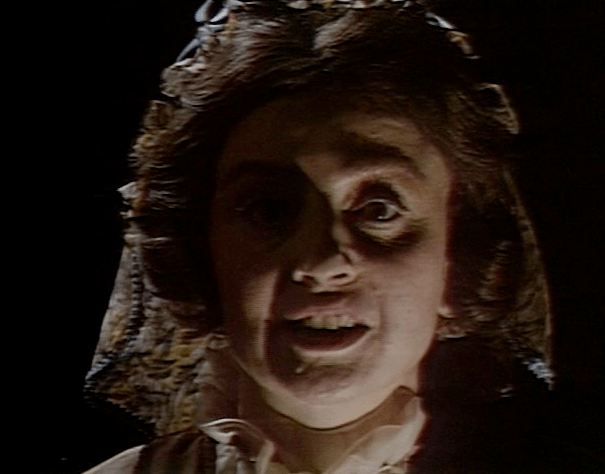
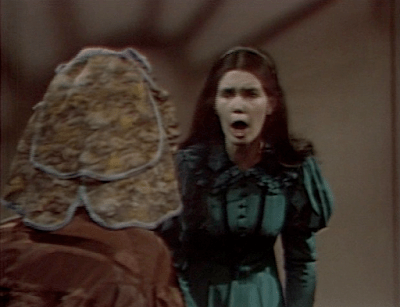
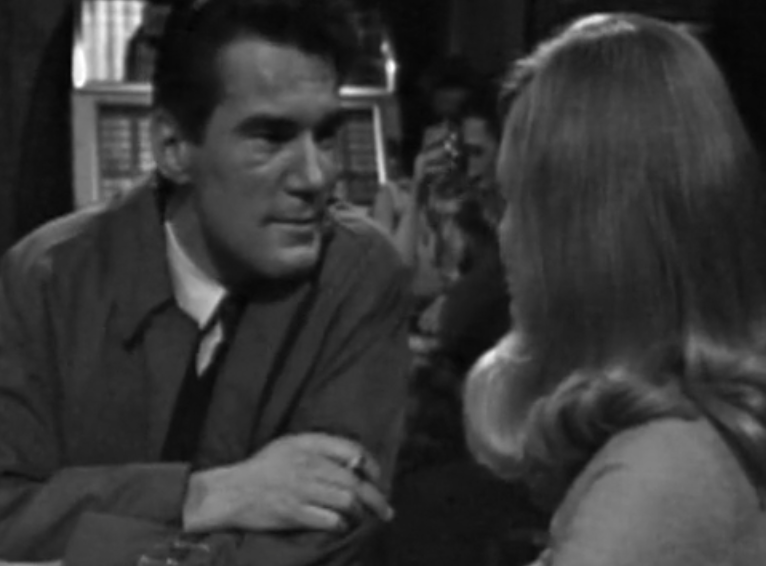
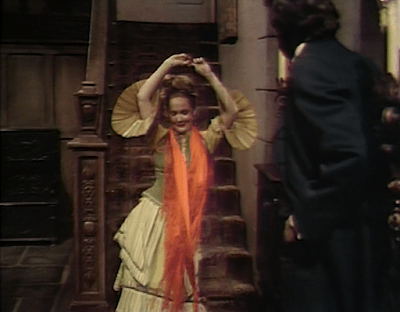
Rakish libertine Quentin Collins races to the train station to meet his fiancée, the lovely and mysterious Amanda Harris. He thinks he sees her, but it is actually another young woman wearing a remarkably similar outfit. She tells him the train to New York City left a few minutes ago; Quentin knows Amanda was on it, and that she thinks his absence means that their relationship is over. The young woman was quite miffed when Quentin first approached her, but by the time he offers his second apology her look has gone from indignant to concerned to yearning. The guy’s got game, you have to grant him that.

It’s been less than a minute since he made a bad first impression on her, and she’s ready to run off with him. Screenshot by Dark Shadows Before I Die.

Quentin was detained by a fistfight with a repulsive little man called Charles Delaware Tate. Tate is an artist whose works sometimes have magical powers. His portrait of Quentin, for example, keeps Quentin from turning into a werewolf and ensures him against physical harm. Since Tate is obsessed with Amanda, he stole the portrait from Quentin when he learned Amanda was planning to leave with him. Quentin dared not leave without it, and went to Tate’s studio to demand its return. He very satisfyingly beat Tate senseless, but he did not find the portrait, and now he fears he has lost Amanda forever.

We cut to Tate’s studio. Tate is lying on the floor where he fell when Quentin finished hitting him. Unfortunately, he gets up. Sorcerer Count Petofi, who granted Tate the power to make magical artworks some years ago, enters. He tells Tate that it was stupid to steal Quentin’s portrait. Tate pretends not to know what Petofi is talking about, irritating him and us. Petofi says that he will have to be punished. After he forces Tate to draw a sketch of a pretty woman, he squeezes his wrists, helps himself to Quentin’s portrait, and says what sounds very much like a final goodbye. He exits, and Tate sits down with his pad and pencil. He discovers that he is no longer able to draw, not even a straight line.

These days, Dark Shadows is a costume drama set in 1897. Most of the time between 1966 and 1968, it took place in a contemporary setting. In those days, the set now used as Tate’s studio was the Evans cottage, home to artist Sam Evans, a drunken sad sack, and his daughter Maggie, The Nicest Girl in Town. In December of 1966 and January of 1967, the ghost of the gracious Josette compelled Sam to paint alarming images of Laura Murdoch Collins.

It turned out Josette was doing this because she knew the characters were not all that bright and she had to literally paint them a picture to explain that Laura was an undead fire witch bent on incinerating her young son David. Laura tried to thwart Josette’s plan by harming Sam. In #146, Laura caused a fire at the Evans cottage that burned Sam’s hands, temporarily depriving him of the ability to paint. Petofi’s disabling of Tate on the same set will bring this incident back to longtime viewers. Especially so, since Josette is in the air at this point in the show. In #844, a character named Kitty joined the cast. She keeps having mental flashbacks to things only Josette would remember, and Josette’s music box appeared on Kitty’s table at a time when Josette’s ghost seemed to be the likeliest agency to have put it there. Perhaps she will insert herself into Tate’s story for some reason.

When we were watching the scene between Tate and Petofi, my wife, Mrs Acilius, said that she very much wished someone else were playing Tate. Violet Welles’ script gives whoever is playing Tate a lot of opportunity to show what he can do in that scene. Roger Davis is a highly trained actor who has a long list of stage and screen credits, but he is almost always very unpleasant to watch on Dark Shadows, and he wastes the potentially fascinating dialogue Welles gave him. When Mr Davis is particularly trying, I usually try to make the scenes bearable by imagining what Frederic Forrest, who was a featured background player in #137, would have done in his place. But the echo of the story about Sam makes me wonder what David Ford would have done as Tate. Ford was in his forties, smallish and pudgy, so a David Ford Tate could not believably have had a fistfight with a character played by the very tall and fit 28 year old David Selby. But he might have been a subtle enough villain that such an exchange would not have been called for. Moreover, the incestuous undertone of Tate’s desire for Amanda, who is the product of one of his magical paintings and therefore a kind of daughter to him, would have been all the more disturbing had Tate been played by the man we knew as Maggie’s father in the 1960s and, when the show was set in the 1790s, as Josette’s.

Back home at the great house of Collinwood, Quentin receives a visit from Tim Shaw, Amanda’s ex and a would-be sleazy operator. He demands Tim tell him what he knows about Amanda’s life in New York before they came to Collinwood. Tim declares he will tell him nothing, to which Quentin responds by choking him and flinging him to the floor. Tim then burbles out everything he knows, which turns out to be nothing of the slightest use. Quentin picks Tim up and throws him out the front door in the most humiliating possible way. We cheer this on almost as joyously as we cheered Quentin’s beating of Tate Friday, but for the opposite reason. Mr Davis is a genuinely disagreeable person who ruins episode after episode, and it was him we were angry with. We chanted at the screen, not “Quen-tin! Quen-tin! Quen-tin!,” but “Da-vid! Da-vid! Da-vid!” hoping Mr Selby would pay him back for all his on-screen assaults on the women and children in the cast. But Don Briscoe was as nice a guy as Tim has become despicable, and he and Mr Selby enjoyed working together. You can see Briscoe’s joy in performance in the way he holds on to a little yellow piece of paper representing a note from Amanda all through the beating Quentin administers. Even the shot of Quentin shoving Tim out with his buttocks prominent is the product of Briscoe’s enthusiastic use of his body to demonstrate Tim’s total defeat.
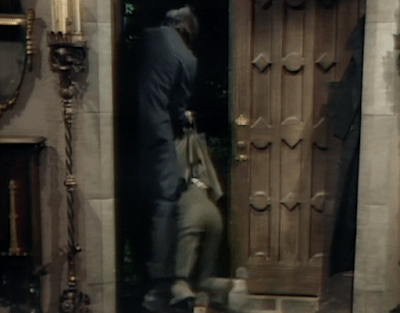
Quentin throws Tim’s sorry ass out the door. Screenshot by Dark Shadows Before I Die.

Quentin’s other fiancée, wicked witch Angelique, comes downstairs to ask what the ruckus was about. Quentin makes up a transparent lie about having a financial interest in some firm in Boston, and says that he and Tim were quarreling about the details of it. Angelique lets him go on with this for a while and to say that he is leaving for Boston, then insists that they set a date for their wedding. He begs off, claiming not to know how long he will be away.

Petofi enters, and tells Angelique about Quentin’s plan to go to New York and look for Amanda. He also tells her that they now have a common cause, and proposes an alliance. Each of them is so powerful, and so evil, that this is a sobering prospect.

When Quentin returns to the foyer, it is his turn to be alone with Petofi. Quentin knows that Petofi gave Tate both the power to create the portrait that freed him of his curse and the commission to do so, and that he is therefore beholden to Petofi for his continued humanity. Part of his motivation for fleeing to New York with Amanda was his hope that he could escape the slavery Petofi has imposed on him as the price of that benefice. When Petofi tells Quentin he has come to see him before he goes, Quentin is momentarily stunned, and then makes a brave little noise to the effect that Petofi can’t stop him. Petofi assures him that he does not want to stop him. It doesn’t matter in the least to him where Quentin is- he can control him from anywhere.

Petofi calls on Tim at his room in the inn. He deepens Tim’s misery by pretending he doesn’t believe what Tim told him about Tate’s magical powers. As he leaves, he takes a brooch that belonged to Amanda.

Quentin is at the train station. Angelique appears there, and tells him not to go. He says that he doesn’t care if she kills him. It will be consolation enough to have died walking away from her. She says that she will not harm him in any way. This causes him to open his eyes wide in terror as it dawns on him what she means. She produces Amanda’s brooch and a doll. She positions the pin of the brooch over the doll’s chest and says that no matter where Amanda is, she will die a horrible death when the pin impales the doll.

Closing Miscellany

The actress who plays the young woman Quentin meets at the train station is billed in the credits as “Amy Yaekerson,” the only person known to Google ever to be called “Yaekerson” and known only for this appearance. But in a comment on Danny Horn’s post about the episode at his great Dark Shadows Every Day, a commenter known as “miles” pointed out that there are lots of people named “Yakerson.” He went on to identify an Amy Yakerson born in New York City on 1 April 1946, and to find a 1966 notice of a play featuring an actress of that name and probably of that age in the New York Daily News. I followed that up with some Googling of my own; the only Amy Yakerson I can find who is online today was born in Connecticut in 1954, so I don’t know where Amy Yakerson, star of stage and screen, is now.

We saw some of Sam’s paintings in Tate’s studio Friday and today, twenty-some years before Sam was born. Tate hides the portrait of Quentin behind one of Sam’s seascapes, and Sam’s portrait of Maggie’s mother is on the floor next to him when we see him lying there in the aftermath of the fight. John and Christine Scoleri have the details in their post about Friday’s episode at Dark Shadows Before I Die.
Episode 804: He is a gem, isn’t he

The evil Count Petofi, a 150 year old sorcerer, has taken possession of twelve year old Jamison Collins and is wreaking havoc in the great house of Collinwood. Due to Petofi’s spells, Jamison’s father Edward thinks he is a valet recently separated from the service of the Earl of Hampshire. Edward’s brother Quentin tries to explain to him what is actually going on, but Edward merely concludes that he is Quentin’s valet now. When Quentin follows the Collinses’ long-established protocol for dealing with mentally ill family members and locks Edward in the tower room, Edward bangs on the door and protests that he won’t be able to do his job if he is locked up. “And I will do it!” he vows.

Charity Trask, disastrously uptight step-daughter of Quentin and Edward’s sister Judith, falls under Petofi’s influence and is possessed by the spirit of Cockney showgirl Pansy Faye. Pansy was on the show briefly in June. The childlike Carl Collins, brother to Judith, Edward, and Quentin, was engaged to marry Pansy before she was killed by vampire Dirk Wilkins. Pansy and Charity never met; when Carl asked Charity if she had seen Pansy, the scene was staged to make it seem absurd that the two women could exist in the same universe. Now, they exist in the same body.

Ta Ra Boom De Ayyyy… Screenshot by Dark Shadows Before I Die.

If Petofi has caused startling changes in Jamison, Edward, and Charity, the change in Quentin is perhaps the most jarring of all. He has been a ghost, a homicidal maniac, a Satanist, a zombie, and a werewolf, but always and everywhere a source of total chaos, who destroys all recognized order and is perfectly at home in the midst of sheer madness. Today, Quentin keeps making earnest attempts to restore everyone to their right minds and reestablish the proper and respectable relations within the household.

First time viewers will immediately catch on that the preteen David Henesy is not the actor who would usually play a 150 year old Hungarian nobleman, and when Nancy Barrett suddenly takes on an East London accent and enters wearing a garish costume and doing a dance with lot of hip shaking and pelvic thrusts, they will know that Charity is turning into someone else. The dialogue in the scenes involving Edward explains what is happening to him. They may not know that Quentin is not supposed to be the defender of the status quo. That information is supplied in two scenes. Charity/ Pansy receives a psychic message from the world beyond telling her that Quentin was involved in the murder of Carl, and she announces this information. Also, Quentin calls for help, and the helper who materializes is his distant cousin, Barnabas Collins the vampire.

At the end of the episode, Barnabas lays hold of Jamison/ Petofi and drags him into the secret passage leading from the drawing room to the west wing. It is usually bad news when a vampire abducts a child and shoves him into a dark space, but David Henesy brings such joy to the role of Jamison/ Petofi that we can hardly doubt that what comes next will be equally fun to watch.

Meanwhile, a painter named Charles Delaware Tate has presented himself. Tate’s first appearance will cause a sinking sensation in longtime viewers; he is played by Roger Davis, a terrible actor who delivers much of his dialogue by shouting while clenching the sphincter muscles in his buttocks, and who routinely assaults the women and children in the cast while on camera. We may have hoped we had seen the last of Mr Davis when his most recent character, Dirk, was destroyed shortly after murdering Pansy. But evidently Pansy’s return in the form of another actress has come at the price of Mr Davis’ return in the guise of another character.

For much of 1968, Mr Davis played a man known variously as Peter Bradford and Jeff Clark. His approach to characterization consisted of shouting “My name is Jeff Clark!” When this technique was played out, he took to shouting “My name is Peter Bradford!” He doesn’t shout today, mercifully. But he does say the name “Charles Delaware Tate” quite a few times.

Today’s story about Tate is potentially interesting. Jamison/ Petofi finds him when he answers the front door. Tate asks to see Jamison Collins; Jamison/ Petofi confirms that despite his appearance, he is indeed the person Tate has come to see. Tate accepts this with a blandness that suggests that he knows he is dealing with a magical personage.

Jamison/ Petofi gives Tate a photograph of Quentin and says that he wants a portrait of him. When Quentin comes to the drawing room and finds Tate sketching, he asks who he is. Again, Quentin adopts a stern tone which suits someone defending the sanctity of private property against an unknown intruder. Tate introduces himself and shows him a handwritten letter which Quentin instantly accepts as the product of his grandmother Edith. He tells Tate that Edith has been dead for some time and that he is not interested in a portrait of himself. Tate says that he has already accepted the commission and the money that Edith sent with it, and so he will rent lodgings in the village of Collinsport and finish the job regardless. Quentin does what viewers have hoped everyone who shared a scene with one of Mr Davis’ characters would do, and throws him out.

The forged letter is a fascinating touch for returning viewers. Petofi made himself welcome as a guest at Collinwood by showing Edward forged papers creating the impression that he shared Edward’s friendship with the Earl of Hampshire. That he has also created papers that Quentin immediately accepts as coming from Edith, who died long before Petofi had any reason to come to Collinwood, suggests that his powers of forgery are very extensive indeed.

Tate not only seems to know that Petofi has magical powers; he also shows an acquaintance with Petofi’s henchman Aristide.* When Tate mentions Aristide, he calls him “Aristeedy,” a sort of pet name with a diminutive suffix. This is probably just a blooper on the part of Mr Davis, but since Petofi is continually telling Aristide how lovely he is and how he is more attractive when he doesn’t speak, it does remind us of the gay subtext that runs through their scenes together. We might suspect that Petofi and Aristide’s sexuality is in one way or another one of the reasons they are connected to Tate.

The script opens all of these questions about Tate. Had he been played by an actor who was capable of depicting depth and highlighting ambiguity, it could have been a lot of fun to speculate about just what their answers might be. In #137, future movie star Frederic Forrest was a featured extra on the dance floor at The Blue Whale tavern; it’s easy to suppose he would have taken a speaking part. So when the show puts Mr Davis in front of us, I like to make the time a little more tolerable by imagining what Forrest might have brought to the role of Tate.

*His name is spelled “Aristede” in the closing credits, but it was “Aristide” in the original scripts.

Episode 427: I object

The opening voiceover melds into a sequence in which we cut back and forth between repressed spinster Abigail Collins and the fanatical Rev’d Mr Trask standing in front of black backgrounds, looking directly into the camera, and declaring that the trial of bewildered time-traveler Vicki for witchcraft must begin at once.

Soap Opera Land famously does not observe the legal codes that prevail elsewhere. If that is going to bother you, you probably aren’t in the right frame of mind to enjoy the show at all. But there is an art to depicting a fictional trial. You can deviate as much as you like from the rules that prevail in the real world, but there have to be some kind of rules the audience can understand. We can either see those rules applied with the result that a disorderly world is reduced to order, or see them flouted so that our heroes’ hopes of justice are cruelly dashed. If we aren’t aware of any rules, there is no point in setting the play in a courtroom.

That’s the first problem with Vicki’s trial. Now and then her lawyer/ gaoler/ boyfriend/ etc Peter will object to some question or move that a statement be stricken, and once or twice the judges will agree with him. But they are just as likely to respond to identical protests by ordering him to stop interrupting. The witnesses respond to questions with extended free association sessions. Vicki herself interrupts testimony repeatedly, usually to make self-incriminating remarks, and no one tries to stop her. Trask is for some reason simultaneously the prosecutor and one of the witnesses. Opposing counsel periodically engage in shouting matches with each other while the judges watch. The whole thing is so chaotic that it may as well be taking place in a bar-room or at the county fair or on the waterfront after dark.

The second problem with the trial is that it requires Peter to raise his voice repeatedly. Actor Roger Davis can deliver dialogue more or less competently when he is speaking in a normal conversational tone, but his loud voice always tends toward an ugly snarl. This is a major limitation for any performer on a show as shouty as Dark Shadows, but the opposition of Peter to Trask puts Davis head to head with Jerry Lacy, who is a virtuoso of shouting. Next to Lacy’s, Davis’ shouting is not recognizable as a performance.

When I’m watching a scene on Dark Shadows that suffers because of an actor’s shortcomings, I sometimes try to make it bearable by imagining what it would have been like had someone else who may have been available for the part been cast instead. Harvey Keitel was an extra on the show in #33; no doubt he would have accepted a speaking part if offered. Roger Davis plays Peter as a deeply angry man, and Mr Keitel is one of the very best at making audiences empathize with such characters. So it’s interesting to try to picture him as Peter.

On the other hand, there’s nothing in the scripts that requires Peter to constantly seethe with barely contained rage. That was Mr Davis’ contribution. Had the show gone with a more amiable Peter, they might have been able to cast Frederic Forrest in the part. In #137, Forrest was a background player. While Forrest played his share of angry men over the years, he also excelled as goofily cheerful characters, most famously as Chef in Apocalypse Now. I would have liked to see Peter played that way. I think he would have had some real chemistry with Alexandra Moltke Isles’ Vicki, and that we would have had protective feelings for him as he went up against the formidable Trask.

There is a third problem with the trial that neither Harvey Keitel nor the late Frederic Forrest could have done any more with than could Mrs Isles. That is that Vicki and Peter are written as phenomenally stupid. Vicki hasn’t done a single intelligent thing since arriving in the late eighteenth century in November,* but she has become, if anything, even dumber since 1795 gave way to 1796. Peter’s behavior has also been deeply foolish, and today he hits rock bottom when he blurts out to the court that he abused his position as gaoler to help Vicki sneak out, to commit a burglary at the great house of Collinwood, and to steal evidence against her so that it could not be presented to the court. Even under Soap Opera Law, that’s three felonies.

Some claim that the phrase “Dumb Vicki” is ableist. I disagree. “Dumb” really does not mean “mute” anymore, so that using it isn’t ableist against people who do not have the power of speech. And the intelligence characters like Peter and this version of Vicki lack is not the intelligence that IQ tests are supposed to measure. One of the most interesting characters in the part of Dark Shadows set in the eighteenth century is fluttery heiress Millicent Collins, who would probably fall far short of a triple digit score on a Stanford-Binet scale, but whose behavior makes sense to us because we tell what she wants out of life and how she thinks her actions will help her get it. That’s really all we mean when we talk about a “smart character.” A well-crafted story about someone with profound developmental disabilities can depict that person as a smart character, in that sense, as easily as can one about a great sage or a brilliant scientist. Vicki and Peter are not smart characters, no matter how what kind of school we might suppose would best suit them as students, because there is nothing for us to learn by observing their behavior and no suspense as to what their several actions will add up to. They just do one damn thing after another.

Clarice Blackburn and Jerry Lacy do some fine acting today, as does Grayson Hall in a brief turn as the Countess DuPrés. The pre-title bit with Blackburn and Lacy in front of the black backgrounds is so specific to theater in the 1960s that I can’t help but smile at it, but I’m glad it’s there. It isn’t as though you could ever really forget that the show is 56 years old, and I like to see that they preserved something that would have been so typical of the off-Broadway productions that would have been such a big part of the working lives of the cast and other creatives in those days.

*In her testimony today, Abigail gives the dramatic date of Vicki’s arrival in the past as 12 October 1795. The episodes in which the events she describes happened were broadcast on 17 November and 20 November 1967. In the last few weeks, the show has explicitly told us that the day and month of the dramatic setting in 1796 is the same as the broadcast date in 1968, so it’s confusing.

Episode 180: She’s out there somewhere

Yesterday, we saw four men visiting a crypt. They are parapsychologist Dr Guthrie, hardworking young fisherman Joe, instantly forgettable young lawyer Frank, and the unnamed Caretaker of the old cemetery. They witnessed an uncanny event when the ghost of Josette Collins opened the coffin of Laura Murdoch Stockbridge, who died (by fire!) in 1767.

The ghostly intervention was disturbing enough in itself, but when the four men saw that the coffin was absolutely empty they had to change their ideas. Before Josette took action, the Caretaker had vowed that he would die rather than let a grave be disturbed. After they have seen the empty interior of the coffin, Guthrie asks him about another grave he wants to dig up and the Caretaker gives him directions. Frank had shouted at Joe and Guthrie that they would go to jail if they didn’t immediately stop disturbing the crypt, but now he agrees to go to the other grave and help dig. Joe had joined Guthrie only with utmost reluctance and had wanted to stop when the Caretaker first showed up, but now he is the one who points out a toolshed from which he volunteers to grab some shovels.

The second grave is that of Laura Murdoch Radcliffe. In 1867, just one hundred years after the fire that killed Laura Murdoch Stockbridge, Laura Murdoch Radcliffe died the same way. What’s more, a woman initially identified as Laura Murdoch Collins died (by fire!) in Phoenix, Arizona earlier in 1967 and her body inexplicably disappeared from the morgue some weeks after her death. Evidently Guthrie’s hypothesis is that graves will both be empty, because the body of each Laura Murdoch disappeared after death. He also surmises an otherworldly connection between these three dead and vanished Laura Murdochs and the apparently alive Laura Murdoch Collins who has been hanging around the great estate of Collinwood for a couple of months.

Back in the crypt, the Caretaker is delivering a soliloquy. He thinks Guthrie, Joe, and Frank are wasting their time trying to learn secrets from the dead. He has information he could share if they would stay and listen to him. He remembers that there was something strange about the death of Laura Murdoch Radcliffe, and that a book about the Radcliffes is on the shelves in the crypt. He looks through the book and finds the information. “The child!” he exclaims.

Laura Murdoch Collins materializes in a dark corner and strikes up a conversation with the Caretaker. As her talk grows more and more mystifying, the Caretaker looks confused, as if he has never before been the least weird person in any room.

Laura’s appearance gave us (Mrs Acilius and I) two grounds for fear. Our first fear was that Laura might kill the Caretaker. We could easily imagine Guthrie, Joe, and Frank coming back to the crypt to find it in flames, the records kept there in ashes, and the Caretaker dead (by fire!) We like the Caretaker, and want to see him in future episodes.

Our second fear was that Laura would go to the grave of Laura Murdoch Radcliffe and interrupt the exhumation. What we dreaded about that prospect was that it would slow the story down. Yesterday’s show moved at a nice clip, and while today does not match it, at least some things are happening to advance the plot. In the last several weeks, the pace has alternated between glacial and dead stop. So the idea of yet another delay is well worth a shudder.

Laura Murdoch Collins examines the coffin of Laura Murdoch Stockbridge

There is a moment when it seems that Laura will go to stop the men. The Caretaker tells her that they have gone to the grave of Laura Murdoch Radcliffe, and starts to give her directions. She tells him not to bother explaining where it is. Laura doesn’t speak the line “I’ve been there before,” but Diana Millay’s eyes communicate the thought to the audience. Having already seen her inspecting the inside of Laura Murdoch Stockbridge’s empty coffin, we know that she is on a tour of her old neighborhood.

Laura Murdoch Collins doesn’t need directions to the grave of Laura Murdoch Radcliffe

For whatever reason, Laura does not interfere with Guthrie, Joe, and Frank. They dig up the coffin of Laura Murdoch Radcliffe. They open it and look inside. Guthrie asks “What do you see?” Frank replies “What you thought we’d see.” There it is, a bullfrog in a top hat singing “Hello, My Baby.” Oh no wait, I changed the channel there for a second. On Dark Shadows, the answer is “Nothing. Absolutely nothing. An empty box. It’s almost like it’s always been empty.” No wonder we’re still watching the show after all these years, where else can you find thrills like that.

Hello, my ragtime gal

The Caretaker is talking to Laura and looks down for a second. When he looks up, he is baffled. We cut back to the spot where she had been standing, and it is vacant.

Guthrie, Joe, and Frank return to the crypt. They apologize for having been away for so long. The Caretaker tells them they have only been gone for a minute or two. They are puzzled. They find the book about the Radcliffes, and discover that a portion of a newspaper clipping containing an account of Laura Murdoch Radcliffe’s death has been erased, as by an intense light generated by a fire. This leaves us wondering why Laura erased only that section of the clipping, calling attention to it, when she could just as easily have set fire to the book and destroyed the whole thing.

It’s a relief that the Caretaker survives to dodder another day, and a relief that Guthrie, Joe, and Frank complete their business in the cemetery and free us to move on to the next story point. As Guthrie, John Lasell was visibly bored yesterday; today his part is smaller, but he is back on his game, and the others are good too.

Daniel F. Keyes has some particularly good moments as the Caretaker. Yesterday he struck the heroic note when he told Guthrie and Joe that they would have to kill him before they could open the graves, and he made that a powerful moment. Today, he shows us both how lonely the Caretaker is, and why he cannot escape that loneliness. The feeling is painfully raw in his soliloquy about the information he could give if only the others would listen, and his exaggeratedly careful movements and other mimicries of a fragile old age give that rendition of helpless, desperate loneliness an extra punch. His interaction with Laura is even more interesting- while he lives too much in the world of ghosts and taboos to be at home with the living, he is too much a part of the this-world institution of the cemetery and of its rational, bureaucratic routines to know what to do when he encounters an otherworldly being face to face. He is entirely alone, caught in the interstices between the natural and the supernatural, unable to communicate with the denizens of either realm.

Today is the last time we will see actor Conard Fowkes and his character, Frank. I call him “instantly forgettable young lawyer Frank” because, while Fowkes consistently does an excellent job of embodying whatever Frank supposed to be at any given moment, he never gives the feeling that there is anything else under the surface. I keep wishing Frederic Forrest, who danced at the Blue Whale in #137, had been cast as Frank. Forrest could have created a convincing character while also giving a sense of a goofy, engaging personality inside whatever Frank is in any given scene, so that you not only appreciate each turn but also wonder what is coming next. Each time you see Fowkes, you can recognize that he presented exactly what he was supposed to present, but he never drops a hint that anything different might be coming. Still less does he leave you wanting more.

Today, Frank is supposed to be chastened by the sight of what Josette did and willing to join Guthrie and Joe in their exhumation. He is the very image of “Chastened.” Yesterday, he was indignant about Guthrie and Joe’s lawless behavior. A still of him from that episode would have been a fine illustration for a dictionary definition of “Indignant.” In #169, he was haggard and concerned about the mysterious illness gripping reclusive matriarch Liz. Again, he was a faultless model for “Haggard and Concerned.” When we first saw him in the offices of his firm in #92, he was so much the fellow you would expect to meet in a law office in Bangor, Maine in 1966 that you felt like you were reading a writ of replevin.

In a way, Fowkes was an excellent actor. Unfortunately, it wasn’t the way in which a regular member of the cast of a scripted television series ought to excel. The proper medium for him would be something more static, such as filmstrips or View Master reels, in which we could stop and look at him as he demonstrated various moods and personality types. I suppose he might also have been an outstanding mime. Fowkes was always pleasant, and in her scenes with him Alexandra Moltke Isles has a chance to show aspects of the personality of well-meaning governess Vicki that we never see in any other setting. So I’ll miss him, but I’d have missed Forrest a whole lot more.

Episode 137: The one with Frederic Forrest

Drunken artist Sam Evans is slamming down the booze at Collinsport’s tavern, The Blue Whale. The sheriff asks him if he’s seen high-born ne’er-do-well Roger Collins. After the sheriff leaves, Sam goes to the pay phone and calls Roger at home, leaving us wondering why the sheriff didn’t think to do that. Sam asks Roger to come and meet him.

Before Roger can get to the tavern, dashing action hero Burke Devlin invites himself to sit at Sam’s table. Sam and Roger have a tense conversation about Roger’s recently returned wife, the mysterious and long-absent Laura. Roger comes, and he and Burke have another tense conversation about Laura and her plans. Later, Roger and Sam leave, and Roger’s niece, flighty heiress Carolyn, joins Burke at the table. They have a scattered and confused conversation about what Laura is up to.

The most important thing about all of these scenes at The Blue Whale is that one of the background players is future movie star Frederic Forrest, making his first screen appearance. He is in quite a few shots. The camera work is ambitious in this one, and Forrest’s face is one of the elements director Lela Swift and the camera operators work hardest to capitalize on. Indeed, after the episode opens with establishing shots of the exteriors of the mansion and the tavern, Forrest’s face is the first thing we see:

The first shot with actors.

As Sam makes his way to the telephone, he has to cut in on the dancing couple. As he does so, Forrest’s face is again emphasized:

Sam finds that the dancing couple is blocking his access to the pay phone
Sam makes his way through the dancing couple

When Roger comes into the tavern, the couple is at first startled to see the biggest snob in town in such a place. When Roger seems uncomfortable, they play it cool. Their body language seen from behind conveys the startle, but it is on Forrest’s face that we see the pretended nonchalance:

Is that Collins of Collinsport!?
We’re being casual.

We catch another glimpse of the couple. Burke has been staring off into space thinking about Roger and Laura while Carolyn struggles to get his attention. He takes a break from that and tries to be charming to Carolyn. As he does so, we see the couple in the background, showing what two people look like when they are actually interested in each other. Forrest keeps moving and changing expressions, while the woman holds a smile. It really is his face that sells the moment:

Frederic Forrest talking to his date

That so much emphasis was placed on a background player who later proved himself to be a remarkably capable screen actor makes it hard not to wonder what might have been. Well-meaning governess Vicki is in the early stages of a relationship with instantly forgettable young lawyer Frank. Conard Fowkes, the actor who played Frank, seems to have been a nice guy and all, but perhaps if Forrest had taken the part the character’s full name wouldn’t have started with “instantly forgettable.”

I think of the goofy sincerity Forrest brought to the part of Chef in Apocalypse Now, and I see the perfect companion to Vicki as she wanders into a world of ever-more bizarre supernatural beings. Vicki always seems very innocent at the beginning of a scene, but quite often in these early months she makes tart little remarks that remind us that she is supposed to have grown up as a street kid in NYC. Forrest would have been ideal to both emphasize Vicki’s sweetness and to set her up to show her incisive side. Maybe it’s just as well that didn’t happen- I suspect that if Forrest had played Frank, the Vicki/ Frank romance might have been popular enough that the show might never have got round to the wild experiments that eventually made it such a hit that it is still available today.

Forrest’s skill at playing quiet men who can explode into fury when provoked would have turned many characters we haven’t met yet into fan favorites. Elsewhere, I’ve mentioned Forrest as the actor who should have played Charles Delaware Tate; I suspect that if I keep this blog up through episode 1245, Forrest’s name will come up in connection with several more.

Also, this is the episode where we first learn that authorities in Phoenix, Arizona have identified a charred corpse as the remains of Laura Collins. Since we have by this time begun to suspect that Laura might be a ghost, or an inhuman impostor, or two separate beings, one of them a ghost and the other an inhuman impostor, this news seems less ridiculous to us than it does to the characters.

For the first months of the show, the set representing the foyer of Collinwood ended a few inches from the front door. When they expanded that, they at first decorated the wall with a metal device resembling a coat of arms. Today, we see a mirror there. Throughout the rest of the interior, portraits of Collins ancestors adorn spaces of comparable prominence. The metal thing looked cheap and silly compared to the portraits. The mirror looks better, serves an obvious practical purpose for the characters, and figures in several of the complicated shots Lela Swift and her crew pull off today. But still, there really ought to be a portrait there.

Indeed, this episode explicitly tells us that portraits are terribly important. Sam takes Roger to his home and shows him a portrait of Laura surrounded by flames that some mysterious force has possessed him to paint. Sam hates the painting, and Roger is appalled by it. So it would seem unlikely to be hung next to the front door of Collinwood, but we might suspect that a portrait will eventually land there that will be associated with some kind of weird power.

Episode 92: It’s hard to believe there was ever any gaiety at Collinwood

The only episode of the series to take place entirely outside of the town of Collinsport and the great house of Collinwood, this one is set in Bangor, Maine.

Well-meaning governess Vicki has gone to that town in search of information about herself. When she asks her employer, reclusive matriarch Liz, even the most basic questions about why she decided to hire her and how she knew she existed, Liz becomes evasive, then flatly and transparently lies to her. Vicki has found an old document in the house that may shed light not only on the matters Liz has already refused to discuss, but even on her questions about her birth family. Sure that Liz won’t give her any information about the document, she decides to take it to Liz’ lawyers, the firm of Garner and Garner.

Vicki meets Garner and Garner. Screenshot by Dark Shadows Before I Die

Lawyers on soap operas don’t always follow the rules that bind their counterparts in our universe, but at least in this episode Garner and Garner are not going to tell Vicki anything their client does not want her to know. Indeed, the Garners are realistic enough to present a problem. One of them is Frank Garner, a young lawyer who is going to date Vicki for a few months. As played by Conard Fowkes, Frank is very much the sort of fellow you would expect to meet in a law office in Bangor, Maine. In this phase Dark Shadows still has some room for low-key stories and naturalistic acting, but no TV series this side of C-SPAN would be able to accommodate a character like Frank.

It’s a shame Frank isn’t more suited to Dark Shadows. The show urgently needs more young men in the cast. At this point, the only male actors between the ages of 11 and 40 they have who have appeared more than once are Joel Crothers as hardworking young fisherman Joe Haskell, Mitch Ryan as dashing action hero Burke Devlin, and Dana Elcar as Sheriff Patterson. Sheriff Patterson is supposed to be older than the 39 year old Elcar, and is coded as an authority figure who is unavailable for dating. So Joe and Burke have to provide the male points on all of the love triangles.

I think Frank could have been saved had he been played by a different actor. However dull the dialogue the writers might give him, he is on screen enough that a sufficiently charismatic performer could have grabbed our attention. And maybe stimulated the imagination of the writers, so that he would have had interesting things to say and do. Harvey Keitel had danced in the background at The Blue Whale in episode 33, and so must have been available for a speaking part on the show. Keitel’s quiet, brooding intensity always convinces an audience that a character who is saying very little is thinking deeply and feeling strongly and planning mighty things. Keitel would have been quite powerful as Frank.

Fowkes brought a light tone to his performance, and that is welcome. Dark Shadows always struggled to maintain a bit of sparkle against the background of a setting so gloomy that in this episode Vicki finds it “hard to believe there was ever any real gaiety at Collinwood.” If that line is meant to raise our hopes that a Vicki-Frank relationship will create a bright new mood, it sets us up for instant disappointment. Frank is cheerful and pleasant enough, but he doesn’t project enough personality to change the feeling even of the shots he is in, let alone of the entire series.

Keitel has never been known for lightness. If you wanted that, you could have turned to another Blue Whale dancer- Frederic Forrest, whom we will see in episode 137. Thinking of the goofy charm that Forrest’s character maintained throughout a movie as heavy as Apocalypse Now it’s easy to imagine a breeze of fresh air running through Dark Shadows. Not only would Forrest himself have been fun to watch as Frank, but he might well have brought out some of the most under-utilized aspects of Vicki’s character. A handful of times in these early months, Vicki is allowed to make jokes, usually in her scenes with strange and troubled boy David. David will not be amused, but the audience can see that Alexandra Moltke Isles is capable of being extremely funny. A relationship between a character played by Forrest and one played by Mrs Isles might have given the writers abundant opportunities to showcase that side of her. A pairing with the earnest, cheerful, but entirely humorless Frank represents a death sentence for Funny Vicki.