Episode 446: You have given me nothing I can understand

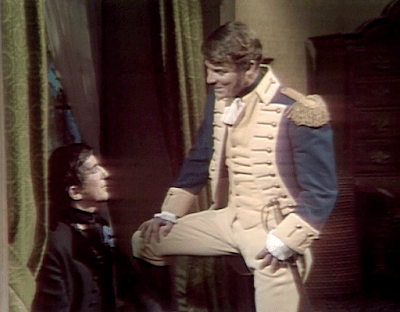
Haughty tyrant Joshua Collins goes to the basement of the Old House on his estate and finds his son Barnabas rising from a coffin. Barnabas explains to his father that he has become a vampire.

Joshua and Barnabas in the coffin room. Screenshot by Dark Shadows Before I Die.

This scene prompts considerable discussion in fandom about gay subtext. In his post about the episode on Dark Shadows Every Day, Danny Horn points out that actors Jonathan Frid and Louis Edmonds were both gay, and speculates that this fact might have had some influence on the way they play Barnabas’ coming out to his father. “I’m not suggesting that this situation is intended to be a metaphor for a gay child talking to his father about his terrible, shameful secret life… But the ‘keep the secret, don’t tell my mother’ part — there’s some resonance, isn’t there? At least, it’s a hook into the story that helps us to get closer, and really feel some of the horror of this moment. A father hands a gun to his son, and says, Kill yourself, so that your mother never finds out.”

Even this tentative raising of the question, with its “I’m not suggesting” and “some resonance” and “at least,” is too much for Patrick McCray. In his Dark Shadows Daybook post about #446, he concedes that “homosexuality is the obvious choice” for an interpretive lens through which to read the scene, but goes on to flatly assert that “this isn’t a veiled metaphor for something like homosexuality.” For him, as for Danny, Barnabas figures in the scene as a murderer first and last, and Joshua as a man finding himself irrevocably severed from the world of rationally explainable phenomena.

For my part, I think that we have to remember that intentionality is always a more complicated thing in a work of art than it is when lawyers are interpreting a contract or cryptographers are cracking a cipher. Certainly the scene is not simply a coming-out scene played in code. Barnabas’ murders do not map onto any metaphor for sexual encounters. While the vampire’s bite is often a metaphor for the sexual act, Barnabas presents his acknowledgement in this scene that he has murdered three women in terms of the secrets he calculated he could keep by killing them and maintains a cold, matter-of-fact tone while doing so. When in the course of the scene Barnabas exasperates Joshua by attempting to murder him, there is nothing erotic between the men. No doubt the scene is at one level meant to be what Danny Horn and Patrick McCray say it is, the point when Joshua realizes he is part of a supernatural horror story and the audience realizes that Barnabas is a cold-blooded killer. As such, it is one of the key moments that defines the 1795 flashback as The Tragedy of Joshua Collins.

But there are other levels of intentionality here as well. One has to do with the word “vampire.” When Barnabas is trying to tell his story to Joshua, his first approach is to give him the facts and leave it to him to apply the correct label. But the facts are so alien to Joshua that they only deepen his confusion. Seeing his father’s bewildered reaction, Barnabas’ frustration mounts until he finally shouts “I am a vampire!”

We have heard this word only once before on Dark Shadows, when wicked witch Angelique mentioned it in #410, but it figured in the show as a metaphor for outness long before it was spoken. In #315, Barnabas’ associate, mad scientist Julia Hoffman, urges him not to murder strange and troubled boy David Collins. She catches herself, breaking off after saying that David deserves better than “to die at the hands of a-” Barnabas grins and teases her, asking “At the hands of a what, doctor?” He dares her to say the word and taunts her for her faux pas in coming so close to using it. Julia and Barnabas have a tacit understanding that they will discuss his vampirism only in euphemisms and circumlocutions. To say the word would be to push beyond the limits of Barnabas’ outness to Julia.

When he tries to avoid calling himself a vampire, Barnabas is trying to establish a relationship in which his father will know enough that he is no longer inclined to ask questions, but not enough to achieve any real understanding of his feelings. When he realizes that he cannot keep from using the embarrassing, ridiculous, utterly necessary word, Barnabas is forced to come out to Joshua in a way he had desperately wanted to avoid.

Moreover, Jonathan Frid’s performance as Barnabas departs starkly from anything else he does on Dark Shadows. After he calls himself a vampire, Frid’s whole body relaxes. His neck, shoulders, and hips are looser than we have ever seen them; even his knees bend a little. His voice shifts a bit away from the old-fashioned mid-Atlantic accent he typically uses as Barnabas, a bit toward twentieth century Hamilton, Ontario. At that point, he is not playing a murderer or a creature from the supernatural or an eighteenth century aristocrat- he is playing himself, enacting a scene from his own life.

Barnabas’ coming out to his father is not today’s only story about information management. Joshua rules his corner of the world by parceling out just that information he thinks people ought to have. We have seen this habit lead to disaster after disaster. In his scene with Barnabas, we see another such instance. Joshua has come to the basement because naval officer/ sleazy operator Nathan Forbes told him that he had seen Barnabas at the Old House, and that Barnabas had attacked Joshua’s second cousin Millicent. After Barnabas admits to his various murders, Joshua brings up the attack on Millicent. Barnabas denies that he had any involvement in that attack, sparking an angry response from Joshua. When Barnabas later asks Joshua why he came to the basement, he swears that Barnabas will never know why.

Had Joshua told Barnabas that Nathan sent him to the basement, the two of them might have figured out that Nathan faked the attack on Millicent as part of his scheme to trick her into agreeing to marry him and to blackmail Joshua into consenting to the marriage. That in turn might have helped Joshua find a way to prevent Nathan from carrying out his evil schemes. But his parsimony with information leaves Joshua believing Nathan’s story about the attack, and therefore puts him and the rest of the Collinses entirely at Nathan’s mercy. When we see the effect that the radical honesty of coming out as a vampire had on Barnabas, we can’t help but wonder how many misfortunes the Collinses might have avoided if they had not lived according to Joshua’s code of truthlessness.

A voice comes from the upstairs. Naomi Collins, wife to Joshua and mother to Barnabas, has entered the house. Joshua leaves his gun with Barnabas and tells him to do the honorable thing, then hastens up to meet her.

Naomi tells Joshua that she he came to the Old House because Nathan told her he had gone there. She insists that Joshua explain what is going on; he pleads with her not to ask. She tells him to think of her; a quiver in his voice, he says “I am thinking of you now.” Naomi is as mystified and as frustrated by Joshua’s refusal to explain himself as Joshua had been with Barnabas’ story, but even as she plays these reactions Joan Bennett also shows us Naomi softening towards her husband. She catches a glimpse of the lover hidden beneath the lord of the manor, peeking out from below the massive superstructure of his pride.

Back in the great house, Nathan is sprawled on the sofa, his boots resting on a polished table, guzzling the Collinses’ fine liqueurs. When Joshua and Naomi return, Nathan offers Joshua a snifter of brandy and invites him to drink it with him in the drawing room. Joshua reacts indignantly, protesting that he is not accustomed to a guest offering him the hospitality of his own house.

This exchange is familiar to longtime viewers. From March to June of 1967, when Dark Shadows was set in contemporary times, the great house was dominated by seagoing con man Jason McGuire, who was blackmailing reclusive matriarch Liz. Several times, most notably in #200 and #264, Jason poured himself a drink and invited Liz’ brother, high-born ne’er-do-well Roger Collins, to join him. Roger would protest that he was not accustomed to being offered a drink of his own brandy in his own house, often drawing the rejoinder that it was Liz’ brandy and Liz’ house, and that he was as much her guest as Jason was.

Roger and Joshua are both played by Louis Edmonds. Roger represents the final stage of decay from the height Joshua represents. He has squandered his entire inheritance, committed acts of cowardice that cost the lives of two men, and let a more or less innocent man go to prison in his place. In #4 he tried to sneak into well-meaning governess Vicki’s room while she slept, and when Liz caught him he told her he didn’t want to be lectured on his “morals,” leaving no doubt that he was looking for some kind of cheap sexual thrill at Vicki’s expense. He openly scorns his responsibilities as a father, cares nothing for the family’s traditions, and the one time we see him working in his office at the headquarters of the family’s business all he does is answer the telephone and tell the caller to contact someone else instead. He drinks constantly, is always the first to give up on a difficult task, makes sarcastic remarks to everyone, and backs down whenever he faces the prospect of a fair fight. In #273, he even admitted to Liz that, had he known what Jason knew about her, he probably would have blackmailed her too.

Joshua’s relentlessly dishonest approach to life may be rooted in fear, and it is never difficult to see that its end result would be to produce a man as craven as Roger. But Joshua himself is as strong as Roger is weak. It is impossible to imagine Roger shaking off an attempt on his life as Joshua shakes off Barnabas’ attempt to strangle him today. While Roger is prepared to sacrifice any member of his family for his own convenience, Joshua will go to any lengths to protect Naomi from the truth of Barnabas’ horrible secret. Nor does Joshua take the easy way out even when he is knuckling under to Nathan. In their scene today, Nathan makes it clear that he is willing to accompany Joshua back to the Old House. Had Roger known what Joshua knows about that basement, he would never have missed an opportunity to send Jason there and let Barnabas do his dirty work for him. But Joshua cuts Nathan off the moment he raises the subject.

Joshua does go back to the coffin room, and he finds Barnabas standing around. He is disappointed that his son has not killed himself. Barnabas tries to explain that he cannot die by a gunshot, but Joshua dismisses his words. He takes the gun himself and, with a display of anguish, shoots Barnabas in the heart. Only thus, he believes, can he keep the unbearable truth from coming to light.
Episode 394: Not a simple woman

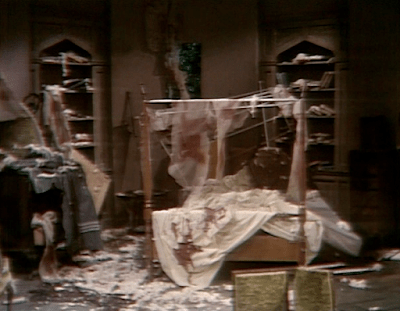
The ghost of Jeremiah Collins has gone to the newly built great house of Collinwood and made a terrible mess in the bedroom that was to be occupied by a house-guest of the Collins family, the Countess DuPrés. Among those who discover the mess is Angelique, who was the countess’ maid before she became the fiancée of Jeremiah’s nephew, Barnabas. Not everyone in the house knows of the change in Angelique’s station, so it is unclear whether she ought to stick with her former role and clean the room herself or start functioning as a member of the family by calling for a servant to do it. Since Angelique is also the wicked witch who raised Jeremiah from the grave, putting her in this awkward position would seem to be a passive-aggressive way for him to get back at her.

Messy room. Screenshot by Dark Shadows Before I Die.

Repressed spinster Abigail Collins, sister of the master of the house, comes into the room. She insults Angelique’s former master, the countess’ brother André, prompting him to leave the room in a huff. Angelique begins to follow André, but Abigail orders her to to stay.

Angelique has taken no care to cover her tracks, and it is obvious to all that something very unusual has been happening around the estate of Collinwood since she arrived. Most of those who have witnessed the strange goings-on are rational, modern people who are reluctant to believe in the supernatural, and the rest have settled on the idea that eccentric governess Victoria Winters is the witch. But Abigail has learned of Angelique’s engagement to Barnabas, has realized that every bizarre occurrence has contributed to making it possible, and has concluded that Angelique is in league with Vicki and the devil.

Up to this point, Abigail has been a figure who did ridiculous things but whom we came to respect as we saw that a person of her time and place might well have interpreted the information available to her as she does. In this scene, she isn’t ridiculous at all. She is mistaken about Vicki, who is a well-meaning innocent. But she has figured Angelique out long before anyone else has even begun to suspect her. Abigail emerges as a character who is smart enough to turn the story in fresh and surprising directions.

Abigail interrogates Angelique. Screenshot by Dark Shadows Before I Die.

Once Abigail has left the room, Angelique summons Jeremiah and tells him she has something for him to do before she will let him return to his grave. Jeremiah has already gone beyond the instructions she gave him, not only in befouling the countess’ room but also in repeatedly showing himself to Naomi Collins, the lady of the house. But I suppose Angelique has such a limited staff she can’t afford to let someone go for overenthusiasm.

We see Barnabas in his new room in the great house. His friend Nathan comes and asks him about the report that he is going to marry Angelique. Barnabas confirms that it is true, and assures Nathan that Angelique is not pregnant.

Nathan is puzzled that Barnabas wants to marry Angelique. Screenshot by Dark Shadows Before I Die.

As written, the scene is a bit of a throwaway, but the actors flirt with each other pretty blatantly throughout the scene. As the screenshot above shows, it begins with Nathan thrusting his crotch into Barnabas’ face while Barnabas smiles appreciatively, and it continues along that line. Considering that Nathan is puzzled that Barnabas wants to marry a woman, even a beautiful one, and that viewers know that Barnabas intends it to be a sham marriage, the flirty tone makes it hard not to recognize a comment on a familiar closet situation. Jonathan Frid and Joel Crothers were both gay, but they had many scenes together and never seemed to be flirting at any other time, so perhaps this comment was intentional on their part and that of director John Sedwick.

After Nathan leaves, Jeremiah appears in Barnabas’ room. He denounces Barnabas for killing him in a duel over the gracious Josette and vows to haunt Barnabas and Josette forever if they marry.

This does not at all reflect the attitude Jeremiah had in life. Jeremiah and Josette married under the influence of a spell Angelique cast on them, and they deeply regretted the pain their elopement brought Barnabas. In his last conversation with Josette before the duel, Jeremiah made it clear that he was going to let Barnabas kill him and that it was all right with him if Josette and Barnabas went on to marry. Jeremiah’s rantings to Barnabas today are Angelique’s words, not his own. This leads us to wonder if she is simply manipulating him as a puppet, or if some fragment of her personality took up residence in Jeremiah when she raised him from the dead. We’ve seen several times that supernatural beings on Dark Shadows are complex phenomena made of parts that work independently and often at cross-purposes with each other, so perhaps when Angelique casts a spell she is dividing herself into parts that will thwart each other’s goals.

Regular viewers know that the segment of the show set in 1795 will show us Barnabas becoming a vampire. We assume that Angelique will be responsible for this transformation. Since the Barnabas we knew in 1967 showed many of the personality traits that Angelique has shown in 1795, seeing her at least use Jeremiah’s reanimated corpse as a mouthpiece for her words and perhaps turn it into a part of herself makes us speculate if the vampiric Barnabas we thought we knew was really Angelique all along.

After Jeremiah leaves Barnabas’ room, Angelique comes in. She tells Barnabas that Abigail is making trouble for them, he tells her about Jeremiah’s apparition, and they decide to marry at once. This three-part sequence in Barnabas’ room- his scenes with Nathan, with Jeremiah, and then with Angelique- mirrors a sequence in Josette’s room in yesterday’s episode, in which she is visited by Jeremiah, then by the countess, then by Angelique. That sequence ended with Angelique telling Josette that she and Barnabas were to be married and thus represented a step towards the wedding. The echo of its structure at the end of today’s installment gives us a sense that the wedding is approaching with irresistible momentum.

Episode 390/ 391: Accept me as I am

Wicked witch Angelique cast a spell bringing a painful and apparently terminal illness to little Sarah Collins, beloved baby sister of young gentleman Barnabas. Angelique was enraged that Barnabas would not love her and wanted him to watch Sarah in agony, so that the love he felt for his sister would torture him. Barnabas happened by Angelique’s room in the servants’ quarters of the manor house of Collinwood while Sarah was languishing, and it occurred to Angelique that she had some leverage to use against him. She told him she might know of a cure for Sarah, and extorted his promise to marry her if she effected it. He agreed, Sarah recovered, and today Angelique comes to collect.

At first, Barnabas is bewildered by Angelique’s belief that they are going to marry. She brings up his promise. He is flabbergasted to find that she took it seriously. He does not know that she is a witch, and only now seems to suspect that she is a crazy person. She asks if he won’t have her because she is a servant. He gallantly denies that class makes any difference. He says that the real problem is in his feelings for Josette, his former fiancée, who eloped with his uncle Jeremiah. He says that he knows there can never again be anything between him and Josette, but neither will he ever cease to love her. Barnabas asks if Angelique would be willing to marry him, knowing that Josette will always have the first place in his heart; she asks what that matters, as long as she gets to be his wife. She repeatedly releases him from the promise he made while Sarah was ill, but he agrees to marry her anyway.

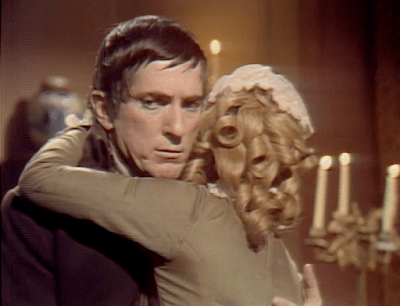
The lovers embrace. Screenshot by Dark Shadows Before I Die.

Yesterday’s episode and today’s include writer Ron Sproat’s first significant scenes featuring Angelique and Barnabas. In the scenes Sam Hall and Gordon Russell gave them, it seems that, while Barnabas has definitely made up his mind that Josette is the one for him, he also has the hots for Angelique. So he squirms and looks unhappy when Angelique throws herself at him, but he does kiss her and he does not hesitate to accept her invitation to visit her alone in her room in the servants’ quarters. So we can imagine that when Barnabas first met Angelique on the island of Martinique, believing as he did at that time that Josette could never love him, he was just doing what came naturally to him when he availed himself of her favors.

But in Sproat’s scenes, Barnabas isn’t attracted to Angelique at all. Yesterday he saw her while he was frantically worried about Sarah’s illness, so any sign of attraction would have had to be subtle. But today, they have a long, deeply emotional conversation in the course of which they decide to get married, and throughout he looks and sounds like he’s talking to his grandmother. That invites us to imagine their affair on Martinique in quite a different light. Perhaps he settled for Angelique then in the same way he is settling for her now- he despaired of ever getting the relationship he really wanted, and decided to give the path of least resistance a try.

It may not be irrelevant that Sproat was gay. For that matter, so was actor Jonathan Frid, a fact that wasn’t publicly acknowledged by his representatives until he’d been dead for ten years, but that can’t have been all that hard for sophisticated viewers to figure out in 1967.

Before Dark Shadows took us back in time to 1795, we knew Barnabas as a vampire trying to convince people he was a living man. In his efforts to pass, we often saw him alienated from his own feelings, isolated from others, and unable to express himself through any conventional form of masculinity. It wasn’t hard to find gay subtext in him then. But I think that in this scene we see the most specific and recognizable closet situation he has been in so far. When he expresses disbelief that Angelique will “accept me as I am,” even knowing “the way I feel,” the character collapses into the actor for a moment, and Josette merges into some guy to whom Frid would never feel comfortable introducing us. When he takes Angelique at her word and agrees to a sham marriage, he sees her as someone who has a place for the man he is. From what we have seen of her single-minded pursuit of Barnabas’ devotion, we know that she expects to turn him into someone else, and that they will both be terribly disappointed.

Episode 277: Redesigned to live without it

Part One. The Unlamented Man

Vampire Barnabas Collins and his sorely bedraggled blood thrall Willie Loomis talk about the man Barnabas killed the other day, seagoing con man Jason McGuire. Willie has been in town, and assures Barnabas that no one misses Jason. They say a few words about Barnabas’ plan to take control of well-meaning governess Vicki, erase her personality, and replace it with that of his long-lost love Josette. Barnabas then decides to invite the residents of the great house of Collinwood to a costume party.

In the drawing room of the great house, matriarch Liz and her brother Roger talk about the family business. Liz hasn’t willingly left home for 18 years, for reasons that were never very interesting and that the show has now promised to stop bothering us with. So Roger urges her to stop working from home and start coming to the office. She reflexively says that she can’t, but then agrees that she will. It’s an interesting moment of psychological realism- even if Liz’ original motive for cooping herself up had nothing to do with agoraphobia, such a long immurement would breed tenacious habits.

Liz and Roger wonder about Jason. He had been living at Collinwood while blackmailing Liz, and now has disappeared. They are glad to see the last of him, but are puzzled that he didn’t take any of his belongings. Even his razor is still in his room.

That will also strike regular viewers as odd. Willie had been staying at Collinwood when Barnabas claimed him, and they were able to get Willie’s things out of the house without anyone noticing them come or go. You’d think they’d have done the same with Jason’s things, just to prevent any suspicion forming.

Part Two. Gone the Sun

Barnabas comes by the great house. Vicki greets him at the door. He invites her to come outside and look at the scenery. He chats about the loveliness of the sea and the Moon, then starts hating on the Sun. “I find the daylight harsh and cruel, whereas the night is kind and soft… When one considers that the Moon takes on its beauty by reflecting the rays of the Sun, it seems inconceivable that the sun could be so ugly… One cannot even look upon it without being blinded; it burns the skin, it scorches the Earth.” The episode was taped in New York City on 5 July 1967, a fairly hot day, so the part about how the Sun “scorches the Earth” was at least topical.

In reply to this, Vicki says of the Sun that “our whole universe revolves around it. We can’t exist without it… man was designed to live with it.” Vicki may overstate the scientific case with her reference to “the whole universe,” but she is putting the matter into a powerful mythological context. In trying to alienate Vicki from the Sun, Barnabas is trying to lure her into his private world away from the common light in which communities of people live. His world is cut off from the cycle of growth, fertility, aging, and death which the Sun traditionally represents.

Further, the Sun is in many cultures a symbol of the masculine, and its relationship to the Earth represents the union of male and female. Barnabas’ plans for Vicki will short-circuit her sex life and replace it with something that is essentially solitary. Perhaps this aspect of the vampire myth explains why so many pubescent girls in the late 1960s embraced Barnabas. Though within his narrative universe he is a blood-sucking creature of Hell, in terms of the situation such girls are actually uneasy about he is a Non-Threatening Boy who will not push her into something she isn’t ready for.

That may also be part of the reason why LGBTQIAAPP+ people have had such a complicated reaction to the image of the vampire over the years. On the one hand, the vampire promises an escape from compulsory heterosexuality. On the other, that escape leaves in place a whole cosmic order centered on opposite sex relationships. It leads to an absolute dead end of isolation, sterility, and parasitism. A figure like Barnabas shows that a real liberation for sexual minority groups can come only in the course of revolutionary change on the grandest scale, not as a result of individual adventures.

Part Three. A Family Party

Barnabas invites Liz, Roger, and Vicki to his party. Liz initially declines. While Barnabas and Vicki wait in the study, presumably going into greater depth about how ugly the Sun is, Roger exhorts her to give up her reclusive ways. She agrees.

Barnabas explains that he has clothing that belonged to their ancestors in the late eighteenth century, and that he will make it available to his guests. He will dress as his “ancestor” (actually himself,) Barnabas Collins. Roger and Liz will dress as Barnabas’ parents, Joshua and Naomi Collins. He turns to Vicki and says “You will be Josette Collins.” The credits roll.

Vicki reacts to Barnabas’ casting her as Josette

Vicki was excited when Barnabas first invited her to the party, but looks pensive when Barnabas tells her that she will be Josette. My wife, Mrs Acilius, pointed out that for Vicki, Josette is still an active presence. Josette’s ghost appeared and spoke to her in #126, and interacted with her and her friends many times during the arc centering on Roger’s ex-wife, undead fire witch Laura Murdoch Collins. Further, Barnabas’ house had been Josette’s stronghold in the months between her first appearance in #70 and Barnabas’ arrival there in #212. As far as Vicki is concerned, Barnabas is asking her to dress in the clothing of the mistress of the house and to impersonate her while she watches. That would make anyone feel silly.

Episode 262: Hand the world over to madmen and murderers

On Thursday, reclusive matriarch Liz admitted to well-meaning governess Vicki that she is being blackmailed. Eighteen years ago, Liz killed her husband, Paul Stoddard. Seagoing con man Jason McGuire then buried Stoddard in the basement. Now, Jason is threatening to expose this secret unless Liz marries him.

Today, Liz asks Vicki to be the legal witness at her wedding to Jason. Vicki demurs, saying that she might be compelled to speak up when the officiant asks if there is anyone who present who knows why these two people should not be joined in matrimony. The conversation then shades off into Vicki urging Liz to share her secret with her daughter, flighty heiress Carolyn. Liz won’t look directly at Vicki when Carolyn’s name is mentioned.

Word is spreading that Maggie Evans, The Nicest Girl in Town, is dead. Vicki had just received that news when Liz brought up the wedding. Alexandra Moltke Isles does a fine job of expressing Vicki’s emotional tumult as she reels from one kind of shock to another. When Vicki breaks the news of Maggie’s death to Carolyn and then quarrels with Carolyn about her plan to marry motorcycle enthusiast Buzz, Mrs Isles reprises this transition from fresh bereavement to festering conflict, again quite effectively.

Carolyn goes out with Buzz, and Vicki goes for a walk on the beach with her boyfriend, Burke Devlin. Each episode begins with a voiceover which Mrs Isles delivers in character as Vicki. Typically, these consist of remarks about the sea and the weather which have some vaguely metaphorical connection to what’s happening on the show. While Vicki sits with Burke and stares out at the water, she launches into one of these monologues. In response, my wife, Mrs Acilius, started laughing so hard we had to pause the streaming. When Burke joins in with the observation that it is getting dark and “may get darker”- sometimes that happens as the evening goes on, seems to be some kind of pattern there- we both burst out laughing and had to pause it again. Before we restarted it that second time, Mrs Acilius asked “What does it say about us that we are sitting here watching this? That we choose to watch it when we’ve seen it before?” I’m not sure I want to know the answer to that one.

Vicki and Fake Shemp. Screenshot by Dark Shadows Before I Die

Vicki gets home shortly before Carolyn. Carolyn tells Vicki and Liz that after she saw Maggie’s boyfriend Joe walking down the street looking sad, she just wanted to go home and mourn. After Carolyn leaves them alone together, Vicki again urges Liz to tell her the truth. Vicki judges that Carolyn would listen to her sympathetically in the mood she is in now. Liz says she might tell Carolyn tomorrow, Vicki says that Carolyn might not be in the same frame of mind tomorrow, Liz says she can’t do it now.

In fact, Maggie is alive- her doctor decided to promote the story that she is dead as a lamebrained scheme to keep the person who tried to kill her from trying again. The blackmail plot, on the other hand, has barely shown a sign of life since it first arrived on the show ten weeks ago.

Jason is supposed to sweep away the last non-paranormal story elements left over from the period before Dark Shadows became a supernatural thriller/ horror story in December 1966. So far he has managed to disclose to the audience, but not to the other characters, why Liz hasn’t left home since the night Stoddard was last seen. That wasn’t an especially interesting question, as they have never shown us anyplace she would want to go, and it’s the only thing he has cleared up.

Another unanswered question is the one that led Vicki to come to Collinwood in the first place. She grew up in a foundling home, with no idea of who her parents were. The show has been hinting heavily that Liz is Vicki’s mother. Indeed, when Jason was brought on the show, the plan was that the grand finale of his storyline would confirm this. If that is still the plan, then the relationships among Vicki, Liz, and Carolyn are due for a drastic upheaval. That prospect lends a certain interest to the scenes among these characters today.

Closing Miscellany

This episode originally aired on 27 June 1967, the first anniversary of the broadcast of #1.

From #1 until #248, dashing action hero Burke Devlin was played by Mitchell Ryan. Ryan showed up at the set too drunk to work when they were supposed to tape #254 and was fired off the show. Today announcer Bob Lloyd tells us that “The part of Burke Devlin will be played by Anthony George.” There was never very much on Dark Shadows for a dashing action hero to do, and now that the most popular character on it is a vampire there isn’t going to be. It was only Ryan’s star quality that kept the character on the show so long.

Anthony George had appeared in feature films in the 1950s, had guest-starred in several prime-time shows, had been a regular cast member on the hit series The Untouchables, and had played one of the leads on a series called Checkmate. When the original audience saw him, many of them would have recognized him as a famous actor and would have expected the character to go on to do something important. Evidently they haven’t given up on Burke yet. But they had better come up with a story for him- George may have had a terrific resume, but he doesn’t have any fraction of Ryan’s charisma.

Unfortunately, they have given up on Buzz. He is on screen only briefly today, and we don’t see him again. Worst of all, while his first three episodes left us with the impression that he could not fail to be hilarious, he manages not to be even a little bit funny in this final appearance. He is just nasty and inconsiderate, demanding that Carolyn forget about whatever it is that’s bothering her and come to the loud party he’s planned.

Getting Buzz off the show the day Anthony George comes on as Burke does solve one problem. As of this episode, the three young women on Dark Shadows all have boyfriends. Maggie has Joe, played by Joel Crothers; Vicki has Burke, played by Anthony George; and Carolyn has Buzz, played by Michael Hadge. Those three actors were all gay. That wasn’t widely known at the time (except perhaps in the case of Mr Hadge, who really does not seem to be making an effort to keep the closet door shut while playing Buzz,) but now that everyone knows all about it, it does seem to be a sign that the show was spending a lot of energy on things that aren’t going anywhere.

Episode 224: Alone in the growing darkness

We begin with a chat between strange and troubled boy David Collins and his (vastly) older cousin, vampire Barnabas Collins. David has questions about the portrait of his ancestor Josette that long hung in the house Barnabas is now occupying. Barnabas assures him that he will hang it prominently once the house has been refurbished.

Yesterday, David was wandering from set to set moaning that he couldn’t feel the presence of Josette’s ghost. This was a clumsy way of addressing a question that is at the top of the minds of regular viewers. Josette’s ghost has been decisive in all the storylines on Dark Shadows for the six months prior to Barnabas’ arrival, and the house Barnabas has taken over is her stronghold. Though she can at moments erupt into the foreground with awesome power, as when she and the other ghosts scared crazed handyman Matthew Morgan to death in #126, she is usually a vague, wispy presence. It is unclear how or if she can survive contact with a menace as dynamic as a vampire.

Josette communicates with David through her portrait, and when she was recruiting a team to thwart the plans David’s mother, blonde fire witch Laura Murdoch Collins, had to burn him alive, she took possession of artist Sam Evans and made him paint pictures warning what Laura was up to. Now Barnabas has hired Sam and is sitting for a portrait that he will hang where Josette’s was long displayed. In #212, Barnabas looked at Josette’s portrait and said that the power it represented was ended, and David’s reactions yesterday suggested he was right.

Portraits are not Josette’s only means of communication. During the Laura storyline, David had a recurring nightmare that may have been in part the product of Josette’s intervention. Someone else has a nightmare today, and it is clearly a warning about Barnabas.

While Barnabas is sitting for Sam, he makes a series of remarks about Sam’s daughter Maggie, The Nicest Girl in Town. To those who know that he is a vampire, everything about Barnabas is creepy, but he lays such heavy emphasis on lines like “I believe her future is already assured” that it is hard to believe Sam isn’t alarmed. We dissolve from that sequence to Maggie in her bedroom* trying to get some sleep. That in turn dissolves to a dream sequence** in which Maggie sees herself in a coffin and screams. She then wakes up, still screaming.

Josette was able to use Sam as a medium, and to do so while he was in the front room of the same house where Maggie is sleeping. So those who remember the Laura storyline will see the nightmare as the opening gambit in Josette’s effort to oppose Barnabas, and will be anticipating her next move.

Between these two segments, we spend some time with seagoing con man Jason McGuire and his former associate, Barnabas’ sorely bedraggled blood thrall Willie Loomis. Reclusive matriarch Liz informs Jason that Willie has been living with and working for Barnabas. Jason had believed that Willie left town permanently several days earlier, and has no idea he is in any way connected with Barnabas. Liz wants to be rid of Willie. Jason likes to boast that he can control Willie, something we have never seen him succeed in doing, and assures her that he will be able to handle the situation.

Jason goes to the Old House and confronts Willie. He makes a number of sarcastic remarks questioning Willie’s masculinity, demands to know what kind of scam he is running on Barnabas, and grabs him by the lapels when Willie can tell him only that he is trying to lead a different sort of life. Jason is holding Willie and snarling at him when Barnabas shows up. Jason unhands Willie and is surprised at how meekly Willie complies with Barnabas’ command that he run an errand.

Barnabas catches Jason with his hands on his Willie

Barnabas tells Jason that he has spoken with Liz and that she has agreed to let him keep Willie. Jason tries to tell Barnabas about Willie’s past and boasts once more of his ability to control Willie. Barnabas cuts him off with “I can deal with him far more effectively than anyone.” That leaves Jason speechless.

In his post about this episode on Dark Shadows Every Day, Danny Horn tells us that the scene between Jason and Willie brought a memo from ABC’s Standards and Practices office. A censor named Bernardine McKenna was concerned that Jason’s lines might suggest a sexual relationship between Willie and Barnabas.***

McKenna’s memo raises some questions about Jason’s whole relationship with Willie. When Jason was first introduced, we occasionally saw him on the telephone talking to someone who was evidently important to his plans. Eventually he started calling this person “Willie.” After Willie appeared in person, we kept waiting to see what Jason wanted him to do. Jason’s only project is to blackmail Liz, and he doesn’t need any help with that. Not only did we never see Jason give Willie anything to do, but Willie continually caused him troubles that made life so unpleasant for Liz that she considered calling the police, a move that would would have brought Jason’s whole plan crashing down around his ears. So Jason’s decisions to bring Willie along and to keep him around were not motivated by any immediate need for his assistance.

A couple of times, Willie threatened to expose Jason’s own terrible secrets. But by the time Willie was recovering from Barnabas’ initial attacks on him, those threats didn’t seem to have much substance, and yet Jason insisted on keeping Willie around Collinwood and nursing him back to health. Jason’s scenes with Willie in his sickroom show enough traces of tenderness and genuine concern that there must be some depth to their relationship.

The original plan had been to name the character, not “Willie,” but “Chris.” I wonder if that would have given Bernadine McKenna more to worry about. If we’d listened to Jason on the telephone with a mysterious “Chris” who was in some kind of partnership with him, we might assume that “Chris” was his girlfriend. When Chris turned out to be Christopher, we would set that thought aside. But we might not have forgotten it entirely. When we were wondering what the connection is between the men, one of the possibilities we couldn’t quite exclude might have been that they had been lovers.

*This is the first time we see Maggie’s bedroom. The living room of the Evans cottage has been a frequent set from the earliest days of the show, but this addition of a second room augments its importance and confirms that Maggie will be a major character in the current storyline.

**We’ve heard characters talk about their dreams before, but this is the first time a dream is shown to us.

***Danny read McKenna’s memo in Jim Pierson’s 1988 book The Introduction of Barnabas.

Episode 220: He belongs to the house

Dark Shadows began with no happy couples. When the show started, reclusive matriarch Liz was legally married to a man named Paul Stoddard, whom neither she nor anyone else had seen in eighteen years. Liz’ brother, high-born ne’er do-well Roger Collins, was married to Laura Murdoch. Roger hadn’t seen Laura in years, and was quite happy with the idea he would never see her again. When she did show up, everyone learned that she was a murderous fire witch from beyond the grave, not at all the sort of person you can settle down with. Liz’ daughter, flighty heiress Carolyn, was dating hardworking young fisherman Joe, and the two of them were sick to death of each other. Everyone else was single.

Now, we’ve learned that the reason Liz hasn’t left the house since 1948 is that she’s afraid someone will dig up the basement and find Stoddard’s corpse. Laura is dead, more or less, and Roger has taken up life as a Confirmed Bachelor. Joe and Carolyn have gone their separate ways, and he is in a relationship with Maggie Evans, The Nicest Girl in Town. There are no obstacles to their happiness, so no reason for them to be on screen in a soap opera, and we’ve barely seen them. Except for Joe and Maggie, everyone is single.

When the narrative found seagoing con man Jason McGuire the day after Laura finally disappeared, we would occasionally glimpse him talking urgently on the telephone to someone whose name turned out to be “Willie.” The original plan had been that Jason would call this person “Chris,” leading the audience to suspect that he was trying to reassure a woman named Christine or Christabel or whatever of her part in his plans.

Willie would eventually show up. His chaotic behavior outraged most people and jeopardized Jason’s evil plans. No one had enough information to figure out the nature of Jason’s connection to Willie, certainly not the audience, but it was clear that they had known each other for years and were rarely apart for long in that time. Jason insisted that Liz keep Willie around the great house of Collinwood even when Willie was a grave inconvenience to him.

Now, their association is at an end. Unknown to Jason, a third party has disrupted their relationship. Willie has wakened a vampire and become his blood-thrall.

Today, Willie is getting out of bed, and he and Jason have a quarrel. Jason complains that he has asked Willie every question he can ask, and hasn’t got a single answer. He laments that they are “splitting up,” but he can’t see any alternative. Willie, dreading what the night holds, doesn’t protest.

If they had stuck with the name “Chris,” the audience might have reacted differently to these scenes. When we first saw that Chris was Christopher, we would have set aside the idea that Jason might be bringing a lover to town. But as the weeks pass and it never becomes any clearer what Jason wants from Willie, that thought might have come back to our minds as one of the possibilities we can’t quite exclude. Seeing how comfortable Jason is in and around Willie’s bed and hearing his lines about “splitting up” with him, we might wonder if the show is trying to tell us something.

Jason takes Willie downstairs to tell Liz that he is now leaving her house not to return. Willie wants to tell Liz something, but she doesn’t want to hear anything he has to say. He pleads that it is important, but she refuses to listen. He goes away sadly, and the audience assumes that he just lost the last moment of freedom when he could have spoken out against the vampire.

The vampire himself then comes to pay a call on Liz. He is her recently arrived cousin Barnabas Collins, ostensibly from England. He presents himself to Liz as a courtly, rather diffident gentleman. He has asked to live in the long-abandoned Old House on the grounds of the estate. She has thought it over, and is delighted to give him the keys.

Barnabas enters the Old House, leaving the door open behind him. He looks around. He turns to the door and says “What are you waiting for? Come in.” A defeated Willie enters.

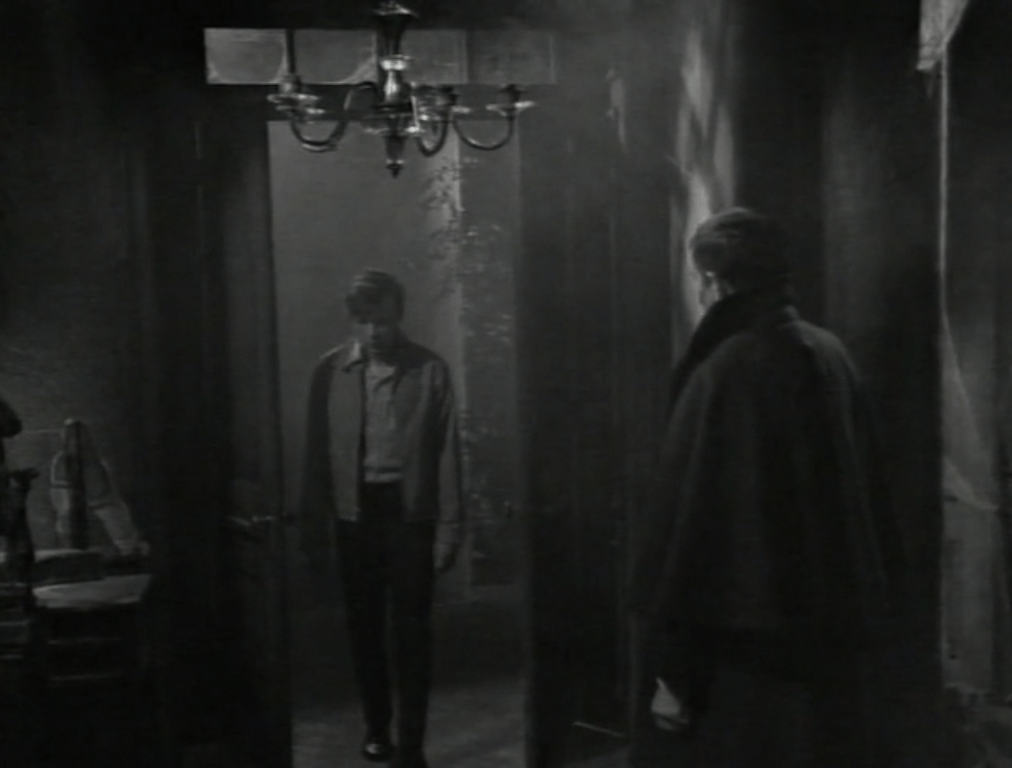
Barnabas summons Willie into the Old House

Barnabas tells Willie that this will be their new home, and that he will have much work to do in the days to come. Willie says that is all right. He tells Willie that he knows what he has to do tonight. Willie reacts with horror and protests that he can’t do it. Barnabas tells him there is no longer any connection between what he wants and what he will do, and orders him to go forth.

We saw Barnabas’ hand clutch Willie’s throat at the end of #210 (reprised at the beginning of #211.) We’ve seen Barnabas communicate with Willie several times through his portrait in the foyer at Collinwood. This is the first scene the two actors have together, and is also the first time we see Barnabas without his “cousin from England” shtick. After he made some remarks to well-meaning governess Vicki at the great house that sounded harmless to her and sinister to the audience (for example, “You cannot put a price on what I intend to do” in the Old House,) the sight of him without his mask carries a punch.

Episode 119: We criss-crossed paths a dozen times

Nothing today but recapping.

The actors do what they can to hold it together, and there are a couple of memorable lines. Reclusive matriarch Liz calls her daughter, flighty heiress Carolyn, a “young girl” during yet another conversation pleading with her to stop dating the family’s arch-nemesis, dashing action hero Burke Devlin. Carolyn asks when her mother will admit that she is a woman. “When it is a fact,” Liz replies. Carolyn declares that “It won’t be a woman who bestows that title on me, but a man- Burke Devlin!” Everyone in Collinsport seems to be living according to a rule of chastity, so Carolyn’s open declaration that she plans to have sex with Burke is rather startling.

Liz’ brother, high-born ne’er-do-well Roger, comes home. Liz tells Roger that well-meaning governess Vicki is missing and may be in danger. Roger refuses to take an interest in the matter. When Liz is shocked by his indifference, he says that she sometimes expects too much of him. Considering that Burke and hardworking young fisherman Joe are searching the grounds of the estate for Vicki, and that the sheriff’s department has been involved in the search as well, Roger’s disregard for Vicki is not merely cavalier, but childish in the extreme.

When Roger finds out that Carolyn had been on a date with Burke, he tries to take the authoritative tone that her mother had taken with her earlier. Neither Carolyn nor Liz is impressed with the attempt this boy-man is making to impersonate a paterfamilias. Liz and Roger are the prototype for Dark Shadows‘ most characteristic relationship, that between a bossy big sister and her bratty little brother. She tries to correct his behavior, and when he disappoints her she shields him from accountability. In this scene, she sees yet again how useless he really is.

Burke and Joe come to the house to report that their search for well-meaning governess Vicki has been fruitless. Roger makes one sarcastic remark after another to Burke. Louis Edmonds is so skilled at delivering acerbic dialogue that these lines are fun to listen to, even though they don’t advance the plot or add to our understanding of the characters in any way.

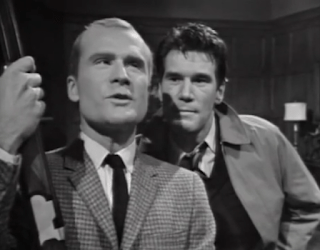
Burke and Roger having words. Screenshot by Dark Shadows Before I Die

It’s a shame the scene isn’t better written. During the nineteen weeks when Art Wallace and Francis Swann were in charge of writing the show, they hinted that there may have been some kind of sexual relationship between Burke and Roger. This time, Burke has borrowed Roger’s shotgun, and Roger very conspicuously handles the gun after Burke returns it to him. He unloads it, and for no reason that we can see reloads it. As directed by Lela Swift, the actors are uncomfortably close to each other, and can’t keep themselves from getting closer as they exchange their wildly bitter remarks. In the hands of Wallace or Swann, or for that matter of almost any moderately competent writer, that scene would have made sense as a Freudian interlude. But today belongs to Malcolm Marmorstein, and the evidence of repressed sexuality doesn’t add up to much.

Carolyn tries to break the tension in the drawing room by playing “Chopsticks” on the piano. All she gets for her trouble is an irritated look from her mother.

Joe and Carolyn were dating when the series started. All we saw of their relationship was one breakup scene after another. They have a nice loud one today. If there had ever been anything between them, it would be a dramatic moment.

Earlier in the episode, Burke had told Joe he didn’t think he would ever really put his attachment to Carolyn behind him. We’ve seen Joe have a couple of happy dates with Maggie Evans, The Nicest Girl in Town, and are hoping the two of them will have a storyline together. The prospect that Burke may be right and we may be sentenced to sit through yet more bickering between Joe and Carolyn is too dreary for words.

Episode 86: No way to go but down

Strange and troubled boy David Collins has managed to lock his well-meaning governess, Vicki, in a room in the long-abandoned west wing of the great house of Collinwood. David’s father, high-born ne’er-do-well Roger and his aunt, reclusive matriarch Liz, have noticed that Vicki is missing and are beginning to make inquiries.

It is inexplicable that Vicki fell into David’s trap, and her efforts to escape are embarrassingly inept. Today, Liz also behaves inexplicably. In David’s room, she finds the key to the closed part of the house where David is keeping Vicki, and she confronts David with it. When he denies that he locked Vicki up, she says she believes him and drops the subject. I’m afraid this has to be classified as an instance of what Roger Ebert called “idiot plot,” a story that goes on only because the characters are dumber than the audience. It’s especially frustrating to see characters like Liz and Vicki, who up to now have used their intelligence to make plot points happen, suddenly do things that can be explained only by saying that the script told them to do it.

Roger doesn’t appear to be fooled, but neither is he in any hurry to rescue Vicki. He sees her as a threat to his evil plans, and wants her out of the way. We see him alone in the drawing room, smiling broadly and drinking a toast to “Miss Victoria Winters… wherever you are.” He’s so deliriously happy with Vicki’s absence that he’s standing around not wearing any pants.*

Southern exposure

Meanwhile, Liz’ daughter, flighty heiress Carolyn, is sharing a cozy moment with the family’s arch-nemesis, dashing action hero Burke Devlin. In Friday’s episode, the two of them crossed paths at the tavern, and today they are sitting cozily on the couch in Burke’s hotel room. Burke gives Carolyn alcoholic drinks she isn’t of legal age to have, charms her with stories of his time in Brazil, and kisses her goodbye. He seems to be drunk, but as soon as she leaves the room he looks into the camera and in a sober voice vows that his vengeance will destroy her along with the rest of the Collins family.

There is one moment when Carolyn is still in the room when Burke slips out of his drunk act and forgets his charm. Carolyn asks if he’s ever been in love. He springs up from the couch, his face contorted with rage, looks away from her, and spits out the word “Once!” Startled, Carolyn asks if it’s always so painful. Then he remembers himself and resumes the role of the marginally amorous drunk.

Dark Shadows is very literal in its cutting in these early months. They often use scene connectors in the dialogue, moments when the last word of a scene they cut away from is one of the first words of the scene they cut to. And a question at the end of a scene will often be answered by the visual to which the scene jumps- so if someone asks “Who tampered with the brakes on Roger’s car?,” we will cut to a shot of David. At the end of this little exchange about the single, painful, time Burke fell in love, we cut to… Roger.** It’s 1966, and it’s American television, so it is unlikely that the show will actually tell us that Burke and Roger were lovers. On the other hand, it’s 1966, and the actors, writers, and directors are from the New York theater, so it is all but certain that they wanted some segment of the audience to wonder about that.

There’s also a bit of trivia. The drawing room scene among David, Liz, and Roger marks the first time David refers to Vicki as “Vicki.” Up to now he has always called her “Miss Winters.”

*In fact, this is the scene that actor Louis Edmonds famously played without the lower part of his costume.

**In his pantsless scene, no less.

Episode 18: Strange sounds and lonely echoes

Only three characters in this one- Roger, Vicki, and David. In the previous episode, Roger learned that his crash was no accident, that someone tampered with his brakes. Now he wants Vicki to tell him what she can that will help him prove that Burke Devlin was the one responsible. Which is a great deal- she saw him in the garage, with a wrench, next to Roger’s car. She had gone into the garage after hearing what she thought was a car door slam. She admits that the slam could have been the hood over the engine compartment, and since the car door next to Devlin was open, this seems likely. Since the reason Roger was on the road was that Devlin had invited him to town to discuss “business,” and the two of them do not seem to have any business together at all, the case against Devlin seems quite strong.

David will place rather a substantial difficulty in the way of Roger’s hope of sending Devlin back to prison. As the audience knows, it was he, not Devlin, who removed the valve from the braking system on his father’s car. We even see him handling the valve in this episode. In episode 17, he nearly confessed to his Aunt Elizabeth, and this time he makes an incriminating statement to Vicki. Both women had assumed he was merely expressing guilt for his hostility to his father, and tried to reassure him that his feelings and thoughts didn’t mean that he was to blame for what happened on the road. David even tries to talk to his father in this one, and Roger icily dismisses him. But we’ve seen enough mystery stories, including inverted mysteries where the audience knows who done it before the detective does, to be sure that Roger will learn the truth when he least expects it.

Roger not only has reason to suspect that Burke is responsible for his crash; he also has deep, complex, ungovernable feelings where Burke is concerned. Some of those feelings have to do with the testimony he gave at the trial ten years before which sent Burke to prison. Some go back before that, and have to do with the friendship that existed between them before that trial. All of them are deeply secret.

This show was being made in 1966, when Freudianism reigned supreme in much of American intellectual life, and the most respected of respectable novels was Proust’s À la recherche du temps perdu. All of the cast and much of the production staff comes from Broadway, where at that time Tennessee Williams was the undisputed king of serious playwrights. And the part of Roger was played by Louis Edmonds, who came out of the closet as a gay man as soon as it was possible to do so, and who was never in the closet as far as his friends and colleagues were concerned. So it seems likely that the secrets Roger is so desperate to conceal include some kind of homoerotic connection with Burke. This episode lampshades some standard soap opera craziness in order to call our attention to the irrational nature of Roger’s attitude towards Burke, and I think a mid-1960s audience would be likely to suspect that a repressed sexuality is driving that irrationality.

Here’s how I put it in a comment on John and Christine Scoleri’s Dark Shadows Before I Die:

When Vicki tells Roger what she saw Devlin doing in the garage, Roger asks her to come with him to confront Devlin at the hotel. That’s a typical soap opera character idea. What isn’t so typical is Vicki’s response, that it would be better to go to the police. She sticks with that rational idea until Roger tells her of his urgent need to see Devlin’s face. That picks up on Roger’s frantic behavior in Week One and sets him up for the whole saga of Where Burke Devlin’s Pen Is, in which we see that Roger’s attitude towards Burke is rooted in some deep and complicated emotions.