Until November 1967, Dark Shadows was set in contemporary times. So when #283 was shown in July 1967, we could assume that its dramatic date more or less matched its broadcast date.
In that one, psychiatrist Julia Hoffman (Grayson Hall) brought her patient Maggie Evans (Kathryn Leigh Scott) to the old cemetery north of the village of Collinsport, Maine. When Maggie reacted to one or another of the sights of the cemetery with a particularly strong emotion, Julia pressed closer to it. This technique led the two women to a mausoleum. Once inside the mausoleum, Maggie had the strongest reaction of all. Julia was trying to break through Maggie’s amnesia. She did not yet know that vampire Barnabas Collins had held Maggie prisoner, and that there was a secret room hidden in the mausoleum where he once tortured her.
Now, the dramatic date is 1897. Broad ethnic stereotype Magda Rákóczi (Grayson Hall) brings neurotic intellectual Rachel Drummond (Kathryn Leigh Scott) to the old cemetery north of the village of Collinsport, Maine. Rachel’s position as governess in the great house on the estate of Collinwood has been eliminated, and she is terrified that she will have to return to Worthington Hall, a hideously abusive school where she was forced to spend a miserable childhood as a pupil and an equally miserable first part of adulthood as a teacher. The headmaster of Worthington Hall, the evil Gregory Trask, is demanding Rachel return to his school-cum-cult, extorting her with threats of false criminal charges against her and her one friend from the school, fellow student-turned-teacher Tim Shaw. Magda takes Rachel to the same mausoleum we saw in #283, because she knows about the secret room and has decided it is the perfect place for Rachel to hide from Trask.
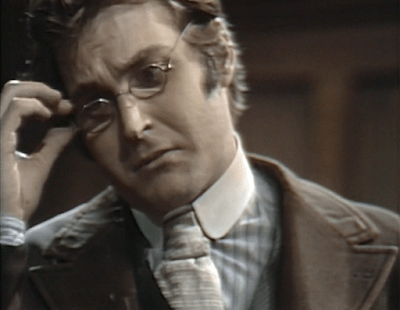
Meanwhile, Tim is on the job at the school, shaking his head at Rachel’s former charge, twelve year old Jamison Collins. Tim is played by Don Briscoe, who when the show was set in 1968 and 1969 played cursed brothers Tom and Chris Jennings. The Jenningses were supposed to be bad-boy sex symbols, and Briscoe often seemed stiff and uncomfortable when he had to take his shirt off or be aggressive. But as a beaten man who takes refuge from his guilt in pomposity, he’s just terrific. They found the perfect part for him.
On Dark Shadows Before I Die, Christine Scoleri says that she finds Tim Shaw the fretful schoolteacher to be “Totally hot!” Evidently Don Briscoe didn’t have to play a troubled bad boy to be a sex symbol for some people.
Jamison hasn’t done his schoolwork, and Tim is keeping him after class. Trask enters, and asks why Jamison is in detention. Tim claims that Jamison is not being punished, but that the two of them are just talking. Trask is displeased with that hint of friendliness, and before long he finds a reason to lock Jamison in a storage closet. Jamison objects to this confinement, prompting Trask to gleefully declare that “there are worse punishments! Much worse!” When Jamison lets himself out of the closet, he finds Trask waiting for him, grinning. Trask says that they will spend the day together tomorrow, and that in the course of their time together he will ordain Jamison’s further punishment.
Trask sends Tim to Collinwood to fetch Rachel. He makes a show of resistance before going. At first he has trouble finding her; he goes back to the school and reports to Trask that he has failed. Trask refuses to accept this, and sends him back. Tim meets Magda and persuades her that he is Rachel’s friend. She leads him to the secret room, and leaves him alone with Rachel. When Rachel and Tim leave the room, Trask is waiting for them.
Well-meaning time-traveler/ bloodsucking abomination from the depths of Hell Barnabas Collins has found himself in the year 1897, where he must take action to prevent his distant cousin Quentin from becoming a malevolent ghost who will ruin everything for everyone on the estate of Collinwood in 1969. He has no idea what that action will be, so has decided to intrude as aggressively as he can in as much of the family’s business as he can until something turns up.
At the moment, Barnabas is strenuously trying to keep Judith Collins, the mistress of Collinwood, from sending her twelve year old nephew Jamison to a boarding school called Worthington Hall. Worthington Hall is run by the Rev’d Gregory Trask, a descendant of one of Barnabas’ old nemeses. Yesterday, Trask had an unsettling encounter with Jamison during which the camera dwelt heavily on Jamison’s nervous habit of fiddling with his belt, prompting us to wonder why Trask gives Jamison the feeling that he ought to make very sure he remains fully clothed.
Today, Trask’s daughter Charity shows up. Nancy Barrett, who previously played the sometimes-capricious, always likable heiress Carolyn and the fragile, highly comic heiress Millicent, makes Charity just as imposing a heavy as her father.
Jamison’s governess, neurotic intellectual Rachel Drummond, tells Barnabas that she was a student at Worthington Hall for many years, and that the place was gruesome. The Trasks kept the children separated from one another, locked them in cupboards for weeks on end when they incurred their displeasure, and generally exploited and abused them. She herself was forced to stay at the school as a teacher when Trask lied to her and claimed that she owed him money, and she escaped with the aid of a fellow sufferer.
Trask confronts Rachel in the drawing room. She tries to stand up for herself, but he breaks her resistance down expertly. Trask’s one moment of weakness comes when he starts talking about Rachel’s lovely hair, and he suddenly turns away. The mask has slipped, and the audience has seen that Trask’s interest in Rachel is sexual. But Rachel is too intimidated to recognize what has happened, and when he resumes his righteous tone she crumbles. When she next sees Barnabas, she rushes away in tears.
Rachel had another traumatic experience over the last few days. Quentin died, turned into a zombie, and abducted her. No one has given her the news yet, but Quentin came back to life yesterday. She is horrified when he comes into the drawing room and sees Quentin. At first he takes on a lumbering gait, and she screams. Then he laughs and starts walking normally. He explains what happened, as best he can, and they have a strangely pleasant conversation. Again, this is a testament to the high quality of the acting. It is hard to imagine that anyone less charming than David Selby could make us believe a woman would be so comfortable with Quentin after what Rachel has been through.
Barnabas takes on the form of a bat and bites Charity in her bedroom. Presumably he does this so that he can use her as an agent against her father. This raises the question of why he didn’t just bite Trask and put an end to the whole thing. Of course, the real-world explanation is that the writers wanted to keep the story going, but usually they take care to maneuver Barnabas into a situation where he is compelled to bite one person rather than another. So it’s rather sloppy to end the episode this way.
Still, this is a very good installment. Too good for some viewers; my wife, Mrs Acilius, refuses to watch the Gregory Trask episodes, because Jerry Lacy plays him so effectively that it ruins her day to spend half an hour in the presence of such an overpowering evil. Kathryn Leigh Scott brings Rachel’s self-doubts and final defeat vividly to life as well. By the time I got to the end of their scene, I was shouting at the screen “Bring back the zombies and werewolves and witches!” So I cheered when Barnabas bit Charity.
When Dark Shadows began in June 1966, strange and troubled boy David Collins (David Henesy) was frantically afraid that he would be sent away from the great house of Collinwood. In #10, David overheard his father Roger (Louis Edmonds) telling his aunt Elizabeth Collins Stoddard (Joan Bennett) that they ought to do just that. As the owner of the house and holder of all the family’s wealth, it is up to Liz to make the decision. Hearing his father press to send him away, David responded by sabotaging the brakes on Roger’s car, nearly killing him.
Roger told Liz that David belonged in an “institution,” but David was just as terrified when it was suggested that he might go to an ordinary school. It was not entirely clear why he had this attitude. David and Roger had only lived in the vast gloomy house for a few weeks when the show started. Roger openly hated David, as did Liz’ daughter Carolyn. Liz loved him, but as a recluse and an aging grande dame had little in common with a young boy. Moreover, David hated his governess, the well-meaning Vicki, as much as he could hate any school. His mother, who did not live in the house and whose name was in those days was never to be mentioned there, was the only person for whom David expressed fondness; when in #15 David watched Roger drive off in the car whose brakes he had sabotaged, we saw him standing by himself, saying “He’s going to die, mother. He’s going to die!” So it is difficult to see why David was so intensely committed to staying at Collinwood.
Today, we see a suggestion that David may have been influenced by an ancestral memory of bad times at a boarding school. It is 1897, and David’s grandfather Jamison Collins (David Henesy) is twelve. Jamison’s father Edward (Louis Edmonds) has asked the Rev’d Mr Gregory Trask to come to Collinwood to urge his sister, Judith Collins (Joan Bennett,) to send Jamison and his nine-year old sister Nora to be students at Worthington Hall, a boarding school Trask runs. As the house’s owner and holder of all the family’s wealth, it is up to Judith to make the decision.
Trask wins Judith’s confidence by performing a ceremony after which Jamison and her brother, Jamison’s uncle Quentin, are restored to themselves after a spell that had made Quentin a zombie and put his spirit in possession of Jamison. Recently arrived, thoroughly mysterious distant cousin Barnabas Collins sputters with rage at the very sight of Trask, and exasperates Judith with his insistence that Trask is evil. Judith does not trust Barnabas, and Barnabas’ inability to either explain or contain his hostility only confirms her favorable judgment of Trask.
Once Quentin and Jamison are themselves again, Trask sends Barnabas and Quentin out of the drawing room. Quentin raises his eyebrows in response to Trask’s order and asks his sister “Are you sure you’re still in charge of this house, Judith?” She does not respond.
Judith makes a remark about Quentin’s influence on Jamison, saying that “He’s been like this ever since [Quentin] came home.” Since Jamison was just freed from possession a few minutes before, it is unclear what she could mean, and Jamison objects “That’s not true!” Trask unctuously replies “Now, your aunt does not tell lies, Jamison.” Returning viewers know that Judith lies constantly. Nor is Trask unaware that Judith is less than perfectly truthful. When he first arrived in Friday’s episode, Judith and Barnabas tried to conceal the situation with Quentin and Jamison from him, and she told a series of lies in pursuit of that objective.
When Jamison continues his attempts to tell the truth, Trask silences him with “Now, there is only one who is constantly right, Jamison, and He is not on this earth, but above. Now, I want you to go out into the hall and consider all the wonderful things your aunt has done for you recently. I am sure you will have much to think about.” Jerry Lacy brings such an inflexible authority to Trask’s personality that we cannot imagine a rebuttal to this sanctimonious little speech. We share Jamison’s helplessness and frustration.
Alone with Trask, Judith agrees to let him take Jamison and Nora to Worthington Hall. Jamison barges back in and declares that he will not go. Trask assures him that he will not take him unless he is willing to go. He then obtains Judith’s permission to talk with Jamison alone in his room.
While Jamison is taking Trask upstairs, we cut to the study. Quentin and Barnabas are alone there. Quentin asks Barnabas if Trask really was his “savior.” Barnabas replies “Apparently.” Quentin asks Barnabas what he thinks really happened; he sidesteps the question. Quentin keeps probing for Barnabas’ interpretation of his recent experience; Barnabas alludes to Quentin’s adventures in Satanism, saying “You dabble in odd things, perhaps one of your interests resulted in this.” Quentin observes that this is “Delicately put,” and goes on to remark on “what an interesting life” he has had.
Barnabas then takes his turn as the questioner. He asks Quentin about his wife, a tall, beautiful, homicidally crazed woman named Jenny who is being held prisoner somewhere in the house. Quentin grows tense, and does not give direct answers. He explodes at Barnabas, saying that he has no interest in making a friend of him. Barnabas observes that he has in fact made an effort to turn him into an enemy; Quentin interjects “Your fault!” Barnabas says they could be useful to each other; Quentin exclaims “Wrong!” When he thinks of Barnabas, Quentin says, only one question comes to mind- “What does he want from me?”
Jonathan Frid said that his favorite scene in Dark Shadows was one he had with Anthony George in #301. Barnabas tells local man Burke Devlin that their relationship to each other is like that of “two superb swordsmen with highly sharpened blades. You thrust, and I parry. I thrust, you parry.” That scene has never impressed me. The Barnabas/ Burke conflict did not have enough grounding in the story to come to life, and having the characters tell the audience that they were like “superb swordsmen” does not make it so. But this showdown really does pay off. Barnabas and Quentin are the show’s two great breakout stars, and we are in the middle of a long run of episodes where everything works. This scene brings out all the values they might have hoped that Burke and Barnabas’ confrontation would put on screen when they planned it.
We return to Jamison’s room, the same bedroom David Collins occupied in the 1960s. Trask is still being friendly. When Jamison says that he would miss his pony if he had to go away to Worthington Hall, Trask says “You must bring him with you!” When Jamison refuses to tell Trask his pony’s name, the friendliness vanishes. Trask darkens, tells him “You’re going to have to learn to answer questions, boy,” and insists they pray together. When Jamison resists, Trask tells him that he must change his ways lest he go on being a disappointment to his father. Jamison protests that his father loves him, and Trask asks incredulously “Does he?” He asks Jamison if he wants his soul to be saved. Jamison can’t very well say anything but yes to that, and so Trask says “Then I think I can help you.” Jamison is trapped.
After a scene in the drawing room where Quentin demands Judith tell him where Jenny is locked up, we return to Jamison’s room. The scene begins with a closeup of the rope belt of Jamison’s robe. Jamison is retying it. He keeps fiddling with it, perhaps a nervous habit, but it is the first thing we see and they hold the shot for a long time. We cannot but wonder whether the belt was untied at some point while Jamison and Trask were alone off camera.
Jamison fiddles with his belt.
Trask orders Jamison to tell Judith that he wants to go to Worthington Hall; Jamison says he will not. The dialogue does not explain how Jamison’s robe came undone, and neither he nor Trask seems concerned with the matter. Their blasé attitude turns an uncomfortable image into a lingering mystery.
In the drawing room, Trask announces to Judith that Jamison has something to say. Jamison says that Trask threatened him and tried to make him lie. Trask says that Judith will have to find another school for him, and she declares that she will not. Jamison will go to Worthington Hall.
Trask exits. Jamison finds Quentin and asks him to help him escape the grim fate in store for him. Quentin promises to do so, and by the end of the episode Jamison will be safely hidden somewhere in the house. Meanwhile, Barnabas throws a fit before Judith, saying that he cannot understand why “You would believe that maniac before you believe Jamison.” Judith scolds him and tells him to treat Trask with respect.
Trask returns. Barnabas asks him if his family is from Salem, Massachusetts. Trask affirms that it is so. Barnabas claims to have seen ink drawings of a Rev’d Trask who was at Collinwood in the 1790s; Trask says that he was his ancestor. He says that the earlier Rev’d Trask disappeared shortly after leaving Collinwood, and that his disappearance was never explained.
Longtime viewers know that Barnabas is a vampire who lived in the 1790s, and that the original Trask is one of those he blames for the many misfortunes that befell the family in those days, including his own transformation into a bloodsucking abomination. We remember the first Trask as a case study of a type much on people’s minds in the 1960s, Eric Hoffer’s “True Believer.” That Trask was so deeply and unshakably convinced of his own understanding of the situation around him that when he set out on a witch hunt, the real witch was easily able to manipulate him into doing her work for her. Barnabas murdered the original Trask in #442 by bricking him up in an alcove, one of the most famous moments in all of Dark Shadows. He seems pleased to hear that people are still wondering what became of the late witchfinder.
Gregory Trask seems to be a different sort. He can change his tune in a way that his forebear never could, putting on a friendly mask when it serves his interests to do so. While the original Trask was single-mindedly trying to live up to his own twisted idea of virtue, the second sometimes responds to bad news with a delighted grin, suggesting that he sees an opportunity to profit from it. The first Trask’s fanaticism sometimes led him to hypocrisy, when he thought that his ends were so good that they justified dishonest means, but this Trask seems to be a hypocrite who has kidded himself into acting like a fanatic. Mr Lacy’s performance makes him a formidable presence; the writers have made him a powerful adversary.
In April 1967, Barnabas Collins showed up at the great house of Collinwood, home of Elizabeth Collins Stoddard and her family. Liz (Joan Bennett) was isolated, embattled, and under the control of a blackmailer. When a courtly gentleman claiming to be a distant cousin from England showed up, apparently wanting nothing from her but her friendship, she quickly accepted him, even giving him the Old House on the estate to live in. As Barnabas’ eccentricities became ever more difficult to ignore and bizarre and terrible events piled up around him, Liz steadfastly refused to entertain the idea that Barnabas might be anything less than perfectly trustworthy. Since Barnabas was in fact a vampire escaped from his grave to prey upon the living, this refusal tended to push Liz further and further to the fringes of the story.
Now Barnabas has traveled back in time to the year 1897. Joan Bennett again plays the mistress of Collinwood. Like Liz, spinster Judith Collins has agreed to let Barnabas stay in the Old House and do some work on it, presumably at his own expense. Unlike her, Judith is not desperate for friendship, and she is not at all sure Barnabas is someone she should trust.
Today, Joan Bennett is in closeup while a recorded monologue in her voice tells us what Judith thinks of Barnabas:
What is happening to all of us? Until Barnabas arrived, everything seemed the same. But what has Barnabas to do with it? Something, something, I’m sure. He knows too much, he’s involved himself so quickly, as if he were the center of it.
Had Liz ever thought in those terms for one second, Barnabas would have been exposed and destroyed and Dark Shadows would have gone back to telling stories about the Collins family cannery. But 1897 is a more dynamic setting, in which no one has much time to wonder where Barnabas goes during the daylight hours or why he keeps his cellar door locked.
Today’s great crisis concerns Judith’s brother Quentin and her twelve year old nephew Jamison. Quentin died the other day, which you might expect to mark an ending of sorts. But as it happens, his body is roaming about as a zombie and his spirit has taken possession of Jamison. Yesterday Judith permitted Barnabas to do some mumbo-jumbo that lured Quentin back to his coffin, and, with the help of Judith’s surviving brother Carl, Barnabas buried Quentin and filled the grave with cement. But before the episode was over, Quentin had made his way out of the ground and abducted governess Rachel Drummond. For his part, Jamison is still possessed.
Today, Barnabas announces to Judith that she must let him take Jamison to Quentin’s grave, where he will perform another ceremony. Judith is appalled, as one might expect her to be, but yields to him. By the time Barnabas and Jamison come back to the great house, Judith is entertaining a visitor. He is the Rev’d Mr Gregory Trask.
When longtime viewers see Jerry Lacy wearing a cassock, they will expect to hear Trask’s name and title. Mr Lacy played another Rev’d Trask from December 1967 to March 1968, when Dark Shadows was set in the 1790s, the period when Barnabas first became a vampire. That Trask was a fanatical witchfinder whose zeal was matched only by his ineptitude. Wicked witch Angelique was able to manipulate Trask for her own purposes, and he earned Barnabas’ most cordial hatred.
When Barnabas sees Gregory Trask, he blurts out his surname. Puzzled, Trask asks if they have met. Barnabas does not answer, but immediately begins to display his hostility towards the newcomer. Barnabas is a poor tactician who has a habit of volunteering to his enemies exactly what he thinks of them. His interactions with the first Trask were a case in point, and we see him falling into the same pattern with this second.
Trask has come to Collinwood at the invitation of Judith’s brother Edward, father of Jamison and of nine year old Nora. Just four weeks ago Edward brought Rachel to the great house to be Nora and Jamison’s governess; last we saw, in #715, Edward was optimistic Rachel would work out well in her position. But now he has called Trask to come and take the children away to a school he operates, eliminating the need for a governess.
With Quentin lumbering around the house and Jamison spouting off about his possession, Judith and Barnabas cannot keep Trask from figuring out what is going on. He sits Quentin in a chair, intimidates Jamison into kneeling, sends Barnabas and Judith out of the drawing room, and starts praying for help. When Barnabas tries to enter, Trask tells him he can do nothing but help the devil, and slams the doors in his face. Judith and Barnabas are left standing in the foyer, wondering what will happen.



 Dark Shadows Commentary