
Episode 619: Advantages of being the master

Well-meaning governess Vicki has found a grievously injured Barnabas Collins in the woods. Barnabas insists Vicki not take him to a doctor or anyone else, but hide him somewhere no one will find him. She thinks of a secret door to the long-abandoned west wing of the great house of Collinwood, and uses that to take him to a hiding place there.

For the first year of Dark Shadows, the west wing was strongly associated with Vicki. In #14, she alone saw the locked door separating the bedrooms from the west wing open and close, apparently by itself. That was the first unequivocal evidence of supernatural activity on the show. In #84, Vicki’s charge, strange and troubled boy David, led her into the west wing, the first time we had seen its interior. He then trapped her in a room there, hoping she would die. She would languish in that room until David’s father, high-born ne’er-do-well Roger Collins, rescued her in #87. When Vicki was engaged to Roger’s nemesis Burke Devlin in #338, matriarch Liz offered to restore the west wing and let Vicki and Burke live there. After Burke died in a plane crash in #345, Vicki vowed to go on with the project of restoring the west wing. In #347, permanent houseguest Julia Hoffman, MD, exploited Vicki’s interest in the west wing to get her to stare into a crystal supposedly taken from a chandelier there until she is in a state of deep hypnosis.

More recently, Frankenstein’s monster Adam stayed in the west wing for many weeks as the guest of heiress Carolyn. Vicki’s connection with the wing was renewed when Adam abducted her and hid her there for a few days starting in #553. Today, Vicki hides Barnabas in Adam’s old room, re-establishing the west wing as her space. Thus we loop back to a theme that goes back to the third week of the show.

Later in the episode, Barnabas wakes up and is distressed to find that it is almost sunset. He pleads with Vicki to bring him a cross as quickly as possible. The audience knows, but Vicki does not, that Barnabas is the victim of vampire Angelique. Vicki’s ignorance of this point reminds us that she has been excluded from the show’s A-plots ever since #211, when Barnabas was introduced, himself in those days a vampire. Her calm departure to go fetch a cross reminds us that she knows this part of the house well. Every room in it is stuffed with bric-a-brac, undoubtedly she will have seen something nearby that is in the shape of a cross.

Meanwhile, Julia is in a hospital room, visiting local man Joe Haskell. Julia has become Barnabas’ inseparable friend, and Joe is Angelique’s other victim. She does not know that Angelique is the vampire, though she had surmised as much in #608. She questions Joe. At first he denies everything, but after she discloses that she was for a time the victim of yet another vampire he tells her that she must know why he can’t tell her who has been sucking his blood. She asks if the suave Nicholas Blair is hiding the vampire. Joe closes his eyes and scoffs at the idea. This reaction does nothing to curtail Julia’s suspicions of Nicholas.

Julia goes to Nicholas’ house. He genially escorts her into his living room. There, he takes a seat while she stalks about the room and tells him what she knows about him. Barnabas has a self-defeating habit of showing his cards to his adversaries, and longtime viewers may at first be afraid Julia has picked it up from him. Since Nicholas is a warlock who not only controls Angelique but has a wide range of magical powers that he uses to promote Satan’s interests on Earth, he is not an opponent with whom one can afford to make mistakes. Angelique herself was once a witch who, in #378, was able to turn a man into a cat at a moment’s notice. Nicholas’ command of the black arts goes far beyond Angelique’s. He was able to strip Angelique of her powers, raise her from the dead at least twice, and turn her into a vampire. Julia is simply a mad scientist, and she does not have any equipment with her. There’s no telling what Nicholas might do to Julia if their interview displeases him.

On his great blog Dark Shadows Every Day, Danny Horn lists three reasons why we know Julia will survive this confrontation without being turned into a toadstool:

Really, the thing that everybody wants to know is: why can’t the Stormtroopers shoot straight in Star Wars? It turns out there are three simple answers. #1. Stormtroopers shooting laser bolts are more interesting to look at than Stormtroopers who stand around complaining. #2. Shooting Luke Skywalker in the head halfway through the first movie is going to leave a rather obvious gap in the trilogy. #3. ‘Strong Guy Kills Weak Guy’ is not headline news.

Danny Horn, Dark Shadows Every Day, “Episode 619: The Gunslinger,” posted 4 April 2015

This is all very true- of course Nicholas and Julia will not leave each other alone indefinitely, of course the show cannot spare her, of course she will overcome her disadvantages and come away from their showdown with the upper hand. But it misses the point. Suspense comes when we know what must happen, but cannot see any way it might happen. What makes the scene work is the moment when Julia tells Nicholas that Barnabas is missing. That is news to him, and as Danny says elsewhere in his post, it is “the first sign of a crack that’s going to bring his entire operation crashing down,” as his shocked reaction suggests it might be.
Julia realizes she has won her showdown with Nicholas. Screenshot by Dark Shadows Before I Die.

The scene is one of the best in the series, though it is marred by a miscalculated ending. In the early part, we see Julia making an effort to keep her cool while Nicholas sits watching her smugly. She succeeds in keeping her brave face on until she senses that she has Nicholas off guard, at which point she moves in for the kill and tells him about Barnabas. She is then firmly in command. He composes himself and dismisses her.

That’s when it goes wrong. When Julia is heading out the door, Nicholas recovers his smugness and tells her that he must admit that he admires her for coming to see him. She looks alarmed and asks why. He replies, in a half-whisper, “You know.” She hastens out. I can see that this ending may have seemed like a good idea. We clearly saw in the beginning how hard it was for Julia to keep her fear in check and how easy it was for Nicholas to bask in the superiority his powers give him over a mere mortal. Though Julia has emerged as the winner in this engagement, she still has grounds for immense fear, and he for boundless self-confidence. But it is so broadly drawn as to be confusing. Has Nicholas already found a way to turn Julia’s success against her? Has she realized too late that she has made a mistake we aren’t aware of?

We learn shortly after that neither of these things has happened. Angelique comes upstairs. She sees Nicholas being very still. She makes several attempts to engage him in conversation. He finally approaches her and strikes her across the face. He then orders her to undo what she has done to Barnabas before it ruins his plans.

This is the second time Nicholas has slapped a woman in the face. The first time was in #610, when he struck Frankenstein’s monster Eve. Humbert Allen Astredo and Marie Wallace executed that business well, as he and Lara Parker execute it well today. For that matter, Grayson Hall and Lara Parker had done a good job when Julia slapped Angelique in the face in #535. Watching them, you can admire trained professionals practicing a specialized aspect of their craft. But since Nicholas has such vast powers, he is persuasive as a villain only when we are left guessing about just what he is up to. When we see him is reduced to hitting a woman, he shrinks from avatar of Satan to cheap pimp.

After Julia leaves Nicholas’ house, she lingers in the woods outside, watching his front door. She sees Nicholas leave the house, then sees Angelique and realizes that she is the vampire.

Julia is the most intelligent character on the show, and while we watch her in the woods her face suggests that she is thinking clever thoughts. Unfortunately, we hear her interior monologue in a recorded voiceover, and her lines are remarkably obtuse. On the heels of her overdone fear on the way out of Nicholas’ house, it does as much to undercut Julia’s image as a smart person who can win a duel with the Devil as Nicholas’ physical abuse of Angelique undercuts his image as a demonic sorcerer.
Episode 610: You are the angel of death

A woman named Eve sees a man standing on the terrace of the great house of Collinwood. She addresses the man as “Peter Bradford.” Regular viewers know that this is indeed his name, but we also know that he prefers to be called “Jeff Clark.” Peter/ Jeff has died and came back to life since he was first known as “Peter Bradford,” so I suppose you could say that’s a case of deadnaming. But while most transfolk tend to be patient when people inadvertently deadname them, Peter/ Jeff is a huge jerk about correcting people who use his former name. Yesterday twelve year old David Collins called him “Peter Bradford,” and he grabbed the boy and shook him until it looked like he had given him a concussion.

Eve is also a returnee from the world of the dead. Doubly so; her body is a Frankenstein creation made of parts salvaged from corpses, while her memories and personality are those of eighteenth century homicidal maniac Danielle Roget. Peter lived in that same era, and when Eve/ Danielle recognizes him we learn that they knew each other then. Peter/ Jeff doesn’t assault her as he did David; she’s his own size. He doesn’t recognize her, which she attributes to the fact that she looks different than she did when they knew each other. He keeps whining that his name is “Jeff Clark,” but she isn’t having it.

Meanwhile, Peter/ Jeff’s fiancée, well-meaning governess Vicki, is in the drawing room, having a conversation with matriarch Liz. There is a blooper in the middle of this conversation. Liz is supposed to say something like “Then you’ve resolved all your difficulties,” but Joan Bennett stumbles over the words. Alexandra Moltke Isles improvises a response that makes sense of it. That response is smooth enough, but she delivers the rest of her lines very quickly and with unusually little eye contact with her scene partner. Perhaps that is because she was afraid the improvised line was going to put the scene over time, or maybe she realized she had called attention to Bennett’s flub and was nervous because she had embarrassed a big star.

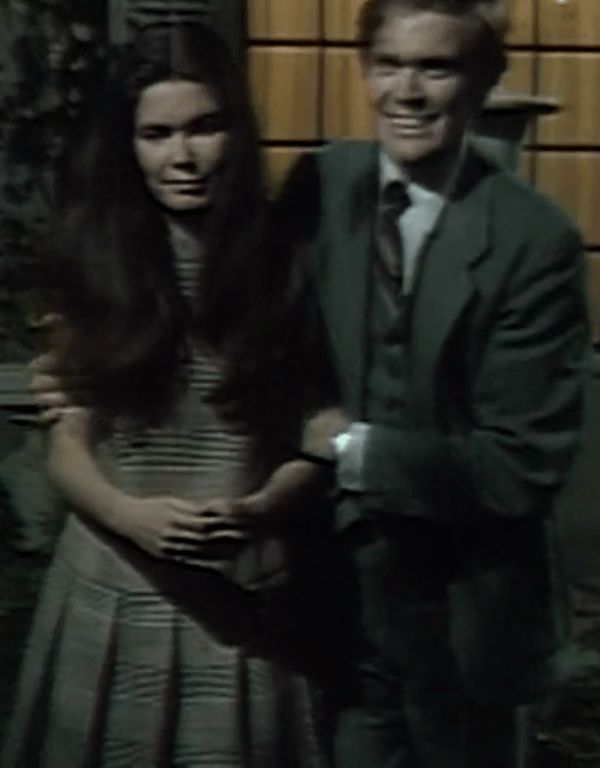
Or maybe Mrs Isles was nervous because her next scene was going to be with Peter/ Jeff, and she knew it would involve Roger Davis putting his hands on her. As they exit, Peter/ Jeff clutches Vicki by wrapping his arms around her in a remarkably awkward fashion, and she visibly squirms. This is most likely Mrs Isles’ discomfort arising from Mr Davis’ habit of physically assaulting his scene partners. A charitable viewer just might be able to believe that it is Vicki’s discomfort because Peter/ Jeff just spent the whole scene telling her transparent lies. He doesn’t want to tell her about his encounter with Eve/ Danielle, and makes up totally unconvincing excuses for his distracted state. Perhaps Mrs Isles channeled her unhappiness at being yoked with Mr Davis into her expression of Vicki’s dissatisfaction with the loathsome little man she is engaged to marry.

Peter/ Jeff steers Vicki offscreen.

Once Vicki and Peter/ Jeff are gone, Eve/ Danielle emerges from the bushes whence she had been spying on them. Liz comes out to the terrace and sees Eve/ Danielle. She asks who she is. When she does not answer, Liz tells her that she knows- she is the angel of death. Eve/ Danielle is startled by this, and hurries away.

The next scene takes place in the house of suave warlock Nicholas Blair. Nicholas has been keeping Eve/ Danielle there since she came to life. She has returned from Collinwood. Nicholas is upset with her for going out without his permission. She taunts him, and he slaps her. He threatens to kill her, and she says that while she does not know what his plans are, it is clear to her that she figures too prominently in them for him to do that.

Coming so shortly after we saw an actress give strong signs of unease at contact with Roger Davis, Nicholas’ slap to Eve/ Danielle’s face is a lesson in how professional actors handle scenes involving physical violence. Eve/ Danielle is relaxed before the slap and in shock after it. Her reaction gives the scene its energy. If Marie Wallace had reason to believe Humbert Allen Astredo would actually hit her, she may well have been as tense before the slap as Mrs Isles was before Roger Davis slithered his arms around her, and the scene would have dribbled out as lifelessly as does Peter/ Jeff’s scene with Vicki.

Once Nicholas concedes that Eve/ Danielle is important to his plans, she relaxes again and decides she may as well tell him about her encounter with Peter/ Jeff. Nicholas is intrigued, and disturbed. He tells Eve/ Danielle that “If it is true that they are one and the same, then there are forces at work here that I don’t know about.” Eve/ Danielle’s memory of her previous existence is very incomplete, and she wants Nicholas to help her to learn more about herself. Once he has heard about Peter/ Jeff, he is eager to oblige. He hypnotizes her.

At this point, my wife, Mrs Acilius, expressed frustration. “He’s going to hypnotize her and afterward she won’t remember anything! It’s only interesting if she remembers.” Eve/ Danielle does have a flashback to 1795, but at the end she seems to come out of the trance on her own. She turns to Nicholas, calls him by name, and says that she remembers Peter Bradford and she loves him. Since Nicholas doesn’t give her a post-hypnotic suggestion and snap his fingers, it seems likely she will remember her past with Peter.

When Danielle was introduced, I assumed that the name “Roget” was a case of deadline-induced selection. She is based on Madame DuFarge from A Tale of Two Cities, so she had to be French. But the writer didn’t have a list of French surnames at his fingertips, so he looked at his desk, saw a copy of Roget’s Thesaurus, and went with that. Perhaps that was what happened, but today Eve/ Danielle lives up to her namesake and goes into the synonym business. She calls Peter/ Jeff by his original name. She is on the receiving end of synonymy from Liz, since “the angel of death” is as good a name for her as any. And one of the memory gaps Eve/ Danielle wants Nicholas to help her fill is her previous name.

Marie Wallace plays Danielle in the flashback, even though she had mentioned in the first act that she looked different in those days. This occasions much discussion on the fansites. Here is the debate on the Dark Shadows Wiki:

During the fiashback scene, Danielle Roget should have been played by Erica Fitz instead of Marie Wallace. Fitz had previously portrayed Danielle Roget in episode 594, so it would have made sense and for character continuity to continue using the same actress. [Addendum: There are strong reasons to argue otherwise as well. One could argue that this is a memory that Nicholas is conjuring in Eve, so it’s from Eve’s perspective, and she would naturally see herself in her current guise, not even knowing what Danielle Roget looked like. This is also a reasonable place for dramatic license to prevail. The scene is very short, and it wouldn’t have been especially practical to have an additional actress. It’s also possible that viewers may have been confused if another actress was in the scene–Erica Fitz was on the show for only two episodes, so viewers at the time might not even have seen or not fully remembered what she looked like. Aside from that, it’s also possible Erica Fitz was not available.]

Discussion under “Bloopers and Continuity Errors” in “610” on The Dark Shadows Wiki.

In a comment on his own post about the episode on Dark Shadows Every Day, Danny Horn puts it more succinctly:

Yeah, I think the in-universe explanation is that the flashback pictured at the top of this post is Eve’s hypnosis-assisted memory of the event, so she’s picturing herself as she is now.

The real-world explanation is that Marie Wallace is playing Eve/Danielle now, and exactly nobody wants Erica Fitz to come back and appear in the flashback.

Comment left 23 March 2015 by Danny Horn on “Episode 610: Inexplicable You,” Dark Shadows Before I Die, 21 March 2015.

For my part, I’m sure Erica Fitz Mears is a very nice lady, and we should all give her money to help with her health problems. But no, she was not a good actress and I do not regret that she did not get more work on screen. Since Mrs Mears was only in two episodes, today’s flashback might have been an opportunity to give some other actress a chance to show what she could do as Danielle. But Miss Wallace does a very good job, and rounding the episode with two confrontations between the same pair of performers does a great deal to strengthen its structure. It would probably have been a mistake to cast anyone else in the flashback.

The flashback scene does come as bad news to longtime viewers, for reasons that have nothing to do with the casting of Danielle. When in November 1967 the show needed to develop a backstory for vampire Barnabas Collins, it took us back to 1795 and introduced Angelique, a maniacal ex-girlfriend who was determined to disrupt Barnabas’ new romance. That was a triumph that turned Barnabas from a stunt that boosted their ratings sufficiently to ward off cancellation into one of the major pop-culture phenomena of the 1960s, and Angelique herself became one of the show’s most important characters. That they are trying the same tactic with Peter/ Jeff, right down to a dramatic date of 1795, leads us to fear that they see him as a permanent part of the cast, and that they want to tie Eve/ Danielle as closely to him as Angelique is tied to Barnabas.

Episode 540: Intervening factor

Suave warlock Nicholas Blair tells his subordinate, the wicked witch known variously as Angelique and Cassandra, that she has an hour to figure out why her recent attempt to turn Barnabas Collins back into a vampire failed. When she tells him that won’t be enough time, he suggests she spend the hour preparing for her final destruction. At the last minute, her stepson David tells Angelique/ Cassandra about an audiotape message that happens to give her exactly the information she needs.

Nicholas threatens Angelique. Screenshot by Dark Shadows Before I Die.

Angelique/ Cassandra has been an extremely unsympathetic villain, so it is daring to have an episode mostly from her point of view which is suspenseful if and only if we want her to stay around. My wife, Mrs Acilius, says that might have been a reasonable bet when a character as dynamic as Angelique/ Cassandra is played by a performer as appealing as Lara Parker, but it doesn’t pay off today, for two reasons. First, the episode doesn’t have much of a plot. Second, returning viewers will be angry with Angelique/ Cassandra right now. She just subjected us to a three month ordeal called “The Dream Curse,” in which we saw the same dull sequence play out a dozen times, heard it described almost twice as many times, and then found out that there was no point to any of it. We know perfectly well that Angelique/ Cassandra is too interesting to stay off the show for long, so that the “final destruction” Nicholas is threatening will probably last for three weeks at most. But we really do want to see her punished for wasting our time.

This is the first episode in which John Karlen reads the opening narration, and only the third episode in which any male performer reads it. Most cast members have read these narrations more or less in the characters they will play in that day’s episode; Karlen takes his place alongside Kathryn Leigh Scott as one of two who strive to invest the role of Narrator with its own personality.

This was the last of the five episodes credited to director John Weaver. It isn’t hard to find reasons why they wouldn’t have contracted him to do more. There are a number of moments when the action jolts to a standstill for no apparent reason, Humbert Allen Astredo as Nicholas never seems to know what direction he should be facing, and when Angelique/ Cassandra orders the bedraggled Willie Loomis to “Look into my eyes!” we get a shot of him looking past her.

Episode 525: Tree in the forest

Beginning in #365, well-meaning governess Vicki Winters spent nineteen weeks in the 1790s. Ever since Vicki brought Dark Shadows back to a contemporary setting in March 1968, the show has been dealing with the consequences of her journey.

Today, we open with a dream sequence. The boyfriend who followed Vicki from the 1790s, a man named Peter, came to the twentieth century with total amnesia and a belligerent personality that kept him from listening when Vicki tried to explain who he was. His dream is about people and events from 1796, and it finally breaks down his insistence that he is someone else. That insistence was never at all interesting- it wasn’t as if his name were Watt Iduno Hu, in which case he and Vicki could at least have done a version of Abbott and Costello’s “Who’s on First?” But now that it is over, there are no obstacles at all between Peter and Vicki, and no reason for either of them to be on the show.

Meanwhile, suave warlock Nicholas Blair has carried a portrait of wicked witch Angelique from the bedroom where he is staying in the great house on the estate of Collinwood down to the drawing room. He makes a tremendous display of effort as he concentrates on the portrait, talks to it in an urgent voice, and makes many movements with his hands, all in an attempt to make contact with Angelique’s spirit so that he can reconstitute her body. Vicki walks in on him as he is doing this, and he breaks off, embarrassed. He finds out that Vicki owns the portrait, and she refuses him permission to borrow it.

Nicholas caught in the act.

Later, Nicholas finds out about Vicki’s visit to the 1790s. He is intrigued that in those days the same witchfinder who has disincorporated Angelique mistook Vicki for a witch and tried to perform an exorcism on her. He decides that the spot on which this rite took place must be the same as that where Angelique’s ashes are now deposited. So he casts a spell on Vicki, causing her to lead him to the place.

Other fansites feature complaints that Nicholas could just have cast a spell on Vicki during their first scene together. In his post about the episode on Dark Shadows Every Day, Danny Horn writes of their first scene that “Nicholas actually has the power to mesmerize Vicki and get her to do whatever he wants, so technically he could just put the whammy on her right now, and tell her to clear the room.” And on Dark Shadows Before I Die, Christine Scoleri wonders “If Blair could make Vicki ‘listen and obey’ so easily, then why didn’t he just make her give him the portrait instead of getting all pissy when she refused to loan it to him?”

That didn’t bother me. When Vicki walked in on Nicholas in the drawing room, he was straining himself to make contact with the spirit of Angelique. He again puts himself deeply into his mumbo-jumbo when he casts his spell on Vicki. So it seemed perfectly reasonable to me that he couldn’t just drop what he was doing with the portrait and go directly into another spell.

The obvious sexual symbolism of the scene in the drawing room reinforces that point. On the Dark Shadows Daybook, Patrick McCray describes the display Nicholas makes while interacting with the painting depicting his putative sister as suggestive of incestuous feelings;* and the awkwardness Humbert Allen Astredo and Alexandra Moltke Isles bring out when Vicki walks in on Nicholas getting all worked up as he stares at a woman’s picture and puts all his energy into imagining her physical presence will likely seem familiar to anyone who has ever had a room-mate. Since Nicholas’ mind is so intensely engaged with the idea of Angelique, it isn’t hard to imagine that he would need time to redirect his attention to Vicki.

*His actual words were “uncomfortably Kentuckian,” but Mrs Acilius was born in Kentucky and is tired of incest jokes about her onetime neighbors. [UPDATE: Patrick points out his own Kentuckian heritage, and protests that his little joke was an irony fondly intended.]

Episode 522: Brother devil

A stranger comes to the great house on the estate of Collinwood and introduces himself as Nicholas Blair, brother of Cassandra Blair Collins. Cassandra’s husband Roger Collins is shocked; Cassandra had never mentioned that she had a brother. Moreover, she has been missing for the last 24 hours, and Roger is convinced something terrible has happened to her. Roger’s distant cousin Barnabas Collins and Dr Julia Hoffman are also shocked, but for a different reason. They know that Cassandra is actually Angelique, a wicked witch who, in the 1790s, turned Barnabas into a vampire. She recently returned to the world of the living when Barnabas’ vampirism went into remission, and she tried to implement a plan to bring it back in full force. When Angelique/ Cassandra went missing, they hoped it meant that she had been defeated. Nicholas’ arrival replaces their hopes with the fear of new battles.

Nicholas at first assumed that Barnabas was Angelique/ Cassandra’s husband, and told him “I should have recognized you anywhere!” This is a sure sign of trouble- Barnabas, who was in fact briefly married to Angelique in 1796, has not been out of the state of Maine since 1795, and has never been photographed. Nicholas says that he has recently been on Martinique, where Barnabas first met Angelique in the eighteenth century, and that he is a “citizen of the world” with no fixed address. He assures Roger that it is Cassandra’s way to disappear abruptly, and that she is sure to return.

Roger, Julia, Barnabas, and Nicholas in the drawing room.

Roger takes Nicholas to the bedroom he and Angelique/ Cassandra share. He shows Nicholas a portrait of Angelique which returning viewers know to have a mysterious connection with Angelique/ Cassandra’s physical being. Roger leaves the room, and Nicholas talks to the portrait. He asks Angelique if she can hear him, and a musical cue associated with her plays on the soundtrack. The cue cuts out, and Nicholas follows up with another question. Dark Shadows stood out from the daytime soaps of the period in having an orchestral score instead of an organ accompanying the action. The meta-theatrical touch of a character who can hear that score is a major departure. It is something people at the time would have seen in animated shorts from Warner Brothers, but likely not anywhere else. Since the biggest and fastest-growing share of Dark Shadows’ audience at this point was children under the age of 13, there was a risk that adult viewers might take that association with cartoons as a sign that it was time for them to find something else to do with their mid-afternoons.

Back in his own house on the same estate, Barnabas finds his servant Willie Loomis holding a rifle. Willie says that he is afraid that man named Adam will come to the house. Barnabas dismisses that fear and orders Willie to put the rifle away. Willie objects. Barnabas repeats the command and leaves. Willie grumbles, but does as he was told. We see a face peering in at the window.

The face belongs to hardworking young fisherman Joe Haskell. Returning viewers know that Barnabas held Joe’s fiancée Maggie prisoner from May to June of 1967 and was extremely cruel to her. When the case was being investigated, Barnabas framed Willie for those crimes. Willie was sent to a mental hospital, and Barnabas had Willie released and brought him back to work for him some weeks ago. Joe thinks that Willie is the perpetrator, and has no patience with him. He knocks on the door and demands Willie let him in.

Joe insists that Willie tell him what he knows about Adam. Willie tries to evade his questions. When Willie says that Adam dislikes him, Joe responds”that means he knows you.” Joe twists Willie’s arm while repeating his questions. Once Joe releases him, Willie runs off and comes back with the rifle. He points it at Joe and orders him out of the house. Joe complies, but says that he will be back, and that he will be having words with Barnabas.

Later, Willie is in the basement. Some bricks are missing from a wall, exposing a skeleton hanging from the ceiling. Viewers who have been with Dark Shadows all along will recognize the basement of Barnabas’ house as a redress of the set that represented the basement of the main house in the first year of the show. The spot with the missing bricks was where a door stood that was always locked in those days. For the first 54 weeks of Dark Shadows, matriarch Liz thought that her husband’s corpse was buried behind that door. That belief turned out to be mistaken, but now we see that there are indeed human remains in the most similar possible spot. We might wonder what else Liz might have been less wrong about than at first sight appeared.

We watch Willie preparing to fill in the missing bricks, leaving the skeleton in place. After all, judging by Liz’ old way of thinking, that’s what ought to be in a space like that. We hear Willie’s interior monologue. He is making himself laugh with a pun on his own name when a stagehand wanders into the shot.

Uh, hello?

That moment of unintentional humor gives way to a scene rich in intentional comedy. Willie goes upstairs and finds that Nicholas has let himself into the house. Nicholas entrances him and extracts information from him. Willie tells him about a meeting with a ghost- “the one downstairs,” he specifies. Nicholas directs Willie to sit down, to remain in a blissed-out state until he leaves, and then to forget all about their encounter.

Nicholas goes to the basement, looks at the skeleton, and calls it “Reverend Trask!” Willie hadn’t given him this name; evidently he recognizes Trask the same way he recognized Barnabas.

The gang’s all here.