Three locations on the great estate of Collinwood have featured prominently in two or more storylines on Dark Shadows: the great house, the long-abandoned Old House, and the cottage. The great house is the only permanent set, and is the site of most of the action. The cottage has been vacant since blonde fire witch Laura left the show in March, and came to be so strongly associated with her that it will likely remain vacant until the audience doesn’t expect her to come back. As the abode of ghosts and ghouls, the Old House is likely to become central to the show as it takes its turn to the paranormal. And indeed, in his first full episode, the mysterious Barnabas Collins had gone to the Old House and announced to its invisible occupants that he was claiming it as his own.
The physical condition of the Old House evokes an extinct storyline. When the series began, the Collinses were running out of money, and their vengeful foe Burke Devlin had vowed to use his own great wealth to ruin them completely. Now Burke has lost interest in vengeance, and the business stories have vanished altogether. If we aren’t going to be hearing about the Collinses’ precarious financial position, we won’t be able to explain why they have let a huge mansion on their property go completely to ruin. Even if the locals are too afraid of the place to do any work there, a family rich enough to have a secure grip on the assets we hear about would be rich enough to hire an out-of-town crew to fix the place up, or tear it down, or at least clear it out and seal it off. So the Old House is going to have to be transformed to get the last of the narrative clutter left over from the first 39 weeks out of the way.
Today, Barnabas asks reclusive matriarch Liz and her brother, high-born ne-er-do-well Roger, if they will let him live in the Old House and use his own funds to rehabilitate it. Liz is stunned by the idea and doesn’t know what to say. When Barnabas offers to pay whatever rent they might wish to charge, Roger exclaims that they wouldn’t dream of charging him anything at all. At that, they cut to a startled reaction shot from Liz. Regular viewers will find this reaction hilarious. Liz owns the place; Roger owns nothing and is staying there as her guest. Liz is quite surprised at Roger’s generosity with her property.
Liz reacts to Roger’s generosity with her property
Jonathan Frid is excellent in this scene. Barnabas is at once faultlessly well-mannered and entirely relaxed, gentle with Liz’ unease and warm to Roger’s enthusiasm. Everything they can see suggests to Liz and Roger that Barnabas would be a valuable addition to any household.
We, of course, know that Barnabas is an undead creature released from a coffin to prey upon the living. Watching the scene with that knowledge, we are in suspense as to Barnabas’ intentions. It seems clear that he wants Liz and Roger to like him now and to voluntarily give him what he wants. We do not know if he will go on wanting that for any length of time, nor do we know how he will respond if they oppose him in any substantial way. Because Barnabas stays entirely in character as the human he is pretending to be, we have no clue as to how far the act he is putting on diverges from his true motives. For all we know, Liz and Roger’s oh-so-courtly, oh-so-amiable cousin may be planning their deaths at this very moment.
Before he leaves the house, Barnabas has a conversation with seagoing con man Jason McGuire. Jason is blackmailing Liz, and has forced her to accept him as her house-guest. He is a throwback to an earlier period of the show, an in-betweener brought on the day after Laura left to clear away the last non-paranormal plot elements and to help introduce Barnabas.
Jason is clueless that the show changed its genre from the noirish crime drama it more or less was in the fall of 1966 to the supernatural thriller/ horror story it has been since. That cluelessness was illustrated in the opening of the episode, when he has followed his friend and sometime henchman, the sorely bedraggled Willie Loomis, to the Tomb of the Collinses. He has figured out that Willie tried to rob the graves in the tomb, but cannot imagine what he actually found there. Today, Jason looks around the interior of the tomb, baffled that Willie seems to have disappeared, and wanders off helplessly. Barnabas then appears and watches him go, the future of the show seeing off an emissary from its past.
Jason wants to know more about the legends that Barnabas’ relatives were buried with their jewels, the legends that gave Willie the idea of robbing their graves and thereby led to Barnabas’ release from his coffin. Barnabas tells Jason those legends are false, and rehearses his whole “cousin from England” bit. Not much happens. Still, the conversation is fun to watch, because the actors are both on top of their game and the characters represent different directions Dark Shadows might have taken at different points in its development.
Seagoing con man Jason McGuire finds his old henchman, the sorely bedraggled Willie Loomis, in a bar and drags him back to the great house of Collinwood. He orders Willie to apologize to reclusive matriarch Liz and her daughter Carolyn for, among other things, trying to rape Carolyn. The ladies distrust Willie at first, and Carolyn has occasion to remind Willie that she had to fend him off by pointing a loaded pistol at him and promising to blow his brains out. After a few minutes, though, Carolyn realizes that Willie is strangely changed and seriously ill.
Carolyn leaves, and Liz and Jason have a scene together in the drawing room while Willie and the portrait of Barnabas Collins have a scene in the foyer. Willie and the portrait have some fresh material to explore; Willie tries to evade the portrait’s gaze. When he cannot, he screams and faints. A closeup of the portrait emphasizes its grim look of command. It was Willie’s obsession with the portrait that drew him to his doom, and now a sinister force calls to him through it.
The scene in the drawing room is anything but fresh. Jason makes a demand of Liz, in this case that she let Willie stay in the house; Liz resists the demand; Jason threatens to expose her terrible secret; Liz capitulates. This is the eleventh time we have seen this particular ritual, and it is no more interesting than were the previous ten.
Writing from the perspective of someone who started watching Dark Shadows with #210, Danny Horn praises the acting of Joan Bennett and Dennis Patrick and declares this the first good scene on the show. Bennett and Patrick were outstanding performers to be sure, but those of us who have seen this same scene so many times before will be less enthusiastic. Besides, there have been some other good scenes in the last few days, even if most of them involved actors triumphing over weak scripts. And in the first months of the series, there were whole episodes that were good, one of them as recently as eight weeks ago.
It is by no means clear why Jason wants Willie in the house. Jason’s whole plan seems to be to blackmail Liz and squeeze her for whatever he can get, and Willie plays no part in that. On the contrary, the danger he represents to Carolyn and to well-meaning governess Vicki very nearly prompts Liz to call the police and put an end to the whole situation.
In #204 and #205, Willie threatened to expose Jason’s guilty secrets if he didn’t deliver a large sum of money right away, suggesting that Jason is keeping his own blackmailer close at hand. But yesterday, Willie said he didn’t want any money, and today he says that he wants to go far away and never see Collinwood again. So it would seem Jason is off whatever hook Willie may have been keeping him on.
Liz breaks it to Carolyn that Willie is going to be back in the house while he recovers from his illness. Carolyn at once agrees that this is as it should be. She is deeply concerned about Willie’s sorry state and believes that his apology is sincere. She asks Liz if she also believes this. Joan Bennett plays her response for a laugh- Liz is so surprised that Carolyn is actually convinced by Willie that she momentarily forgets to pretend to be convinced herself.
Viewers who saw all of Willie’s depredations will appreciate Carolyn’s response. If someone as thoroughly loathsome as he was can inspire this much sympathy after falling under the malign influence he has released, how much more poignant will it be when the same influence starts to work on a character we actually like?
The episode ends with a scene between Willie and Jason. Willie is in bed, moaning that he wants to get away from Collinwood, while Jason bullies him to stay and tries to find out what’s wrong with him. When Willie snarls at him to stay away from the bite on his wrist, all those scenes with Liz become retroactively easier to tolerate. Willie was hard to watch when he was trying to rape the female characters, but now that he has been brought low by the fell powers of darkness he’s likable enough. Jason’s insistence on probing into Willie’s doings suggests he too will get his comeuppance sooner or later.
The contrast between Carolyn’s final speech to Liz, with its reference to Willie’s apparently “spiritual” disorder and her remark that she isn’t sure she wants to know what is going on with him, and Jason’s final interrogation of Willie, with its assumptions that Willie has committed a specific crime and sustained a specific injury in the course of it, shows the difference between Carolyn and Jason as characters. Carolyn has been on Dark Shadows from the beginning and knows that the ghosts have been getting more and more intrusive. She remembers that her Aunt Laura visited recently and turned out to be a murderous fire witch from beyond the grave, and that by the end of Laura’s time no one could be sure if anything that has happened in Collinsport has been entirely of this earth. She knows that she is part of a supernatural thriller/ horror story, and has an eye out for the uncanny.
Jason showed up only a few weeks ago, immediately after Laura vanished. He is an in-betweener, meant to sweep away some leftover story elements, get the vampire onto the show, and fill time before the deadline for departure the actor gave the producers when he took the part. But as far as Jason knows, he is the leading character in a show about blackmail plots, whodunits, and missing fountain pens. He is a throwback to a phase of the show that ended in November of 1966, and he is speeding towards his doom.
In the drawing room of the great house of Collinwood, seagoing con man Jason McGuire has his third conversation with reclusive matriarch Liz. It is identical in form and content to their first two conversations. He makes a demand, she resists, he threatens to expose her one and only secret, and she gives in.
Liz’ brother, high-born ne’er-do-well Roger, is also being blackmailed. His blackmailer is drunken artist Sam Evans. Unlike Jason, Sam is someone we know and have reason to like. And unlike Jason and Liz, Sam and Roger do not repeat the same conversation every time we see them.
Moreover, Jason is acting against the interests of the audience, while Sam is trying to achieve something we might like. Jason is working to isolate Liz and to drain her funds. Those goals reduce the range of stories the show can tell, limiting a major character’s interactions with the rest of the cast and cutting back on the power of the family at the center of the series from making things happen in town. Sam wants to get hold of some old paintings of his, which will give him a chance at making a big splash in New York. If Sam succeeds, future episodes will be set at least partly in the midtown Manhattan art world. That would be a radical departure from the show we’ve been watching, but a radical departure of some kind is inevitable if Dark Shadows is to keep going at all. Dark Shadows 1.0 finished its liveliest stories when blonde fire witch Laura Murdoch Collins vanished two weeks ago, and if Dark Shadows 2.0 is going to hold our attention it is going to have to come up with something very fresh.
Ten years ago, Roger paid Sam $15,000 and received from him ten paintings. These paintings have suddenly become fashionable, and a prominent art dealer has come to Sam asking about them. The real reason Roger gave Sam the money was nothing to do with the paintings, but to bribe him. The paintings changed hands only to cover the bribe.
Sam had seen a fatal hit and run accident, and knew that Roger, not dashing action hero Burke Devlin, was the driver. Burke went to prison for the crime, and has been trying ever since to prove that Roger was responsible. Now Sam threatens to go to Burke unless Roger produces the paintings. Roger has been searching Collinwood for the paintings, but he cannot find them.
The highlights of the episode are two scenes between Sam and his daughter Maggie. In the first, we see Sam drinking and talking to himself while Maggie is in the room getting ready to go to work. Maggie knows that her father has a great opportunity and that the man who has the paintings is keeping him from realizing it. She doesn’t know who that man is. She keeps asking questions, and he keeps getting upset. He shouts “Are you going to work or aren’t you!?” Then he apologizes and tells her he didn’t mean to raise his voice. She says bitterly that she should be used to it by now. He tells her that what he’s doing, he’s doing for her, that if he succeeds she will get everything she has coming to her. She isn’t impressed, and doesn’t have much to say.
As Maggie, Kathryn Leigh Scott does a fine job of showing an Adult Child of an Alcoholic trying to distinguish between the challenges the outside world is presenting to her father and those he has brought on himself. She’s looking for a way to simultaneously be Sam’s ally against the man who is keeping the paintings from him and to stand firm as an opponent of his drinking. Above all, she is trying not to let her pity for him harden into contempt. As Sam, David Ford is alternately so self-absorbed he apparently forgets Maggie is in the room, so angry he doesn’t care what he says to her, and so hopelessly dependent on her that he all but transforms into a baby. When he is looking up at Maggie and telling her all he hopes to do for her, Sam looks for all the world like a toddler trying to keep his mommy from being angry with him. It’s a heartbreaking finish.
Their second scene is even more powerful. Maggie comes home from work to find a groggy Sam slumped in a low chair. Once he has come back to life, Sam tells her that the man was in the house while she was at work, and that he can’t find the paintings. He lets slip that the man lives in Collinwood. Maggie realizes that it must be Roger. Sam tries to deny it, but since Roger is the only man who lives there he is stuck. He can hardly claim that well-meaning governess Vicki, a 20 year old woman, was a man ten years ago, or that she paid $15,000 for ten paintings to put on display in her cubicle at the Hammond Foundling Home. He briefly claims that “Collinwood” was a slip of the tongue, but can’t keep that lie up.
Sam finally admits that Roger is the man. Maggie asks why Roger bought the paintings. Sam asks if she really wants to hear him say it. When she says she does, he starts to speak, but falls abruptly silent in the middle of a sentence. While he looks down in shame, she blurts out that he took the money as a bribe to keep silent about Roger’s crime and to consign Burke to prison. She has suspected this for some time, but is devastated to say the words and see her father’s face.
Of all the questions the two blackmail plots might prompt the show to answer, how Maggie and Sam’s relationship will change as the result of the disclosure of his secrets is the most interesting. So it should be no surprise these two scenes are among the strongest we’ve seen in months.
Closing miscellany:
At one point in the episode, we see Jason talking on the telephone to someone named “Willie.” This marks the first time we hear this name on Dark Shadows.
During a conversation with Roger, Jason sits at the piano and pokes at a few keys. This is the first time since flighty heiress Carolyn tried her hand at “Chopsticks” in #119 that a member of the cast makes use of the instrument.
Roger and Liz have a scene in the basement of Collinwood. Roger’s fear of blackmail leads him to hope that he might find Sam’s paintings in a locked room there, while Liz’ fear of blackmail leads her to forbid that anyone ever go into that room. When Roger asks Liz what is in there, she refers to her long-absent husband, Paul Stoddard: “They are… ah… old things of Paul’s. Yes, that’s it! I put his things in there.” This is so obviously a lie she is making up on the spot that we laughed out loud. Joan Bennett must have meant to elicit this reaction.
Strange and troubled boy David Collins is sleeping peacefully in his bed. His cousin, flighty heiress Carolyn, comes into his room to check on him. She tucks him in, waking him. He asks what she is doing in his room. When she says that she was making sure he was asleep, he points out that she woke him up. When she keeps showing concern for him, he reminds her that she has called him “a spoiled monster” and a “menace to the civilized world” among other endearments, and that if he showed up in her room there would be no end of hollering.
Carolyn goes on talking to David in a gentle voice about how important he is to her, and says that maybe she’s the one who is a spoiled monster and a menace to the civilized world. After Carolyn maintains an affectionate attitude towards him for a few unbroken minutes, David asks her if she is OK. She assures him that she is. As David Collins, David Henesy’s bewildered response to Carolyn’s friendliness brings the house down.
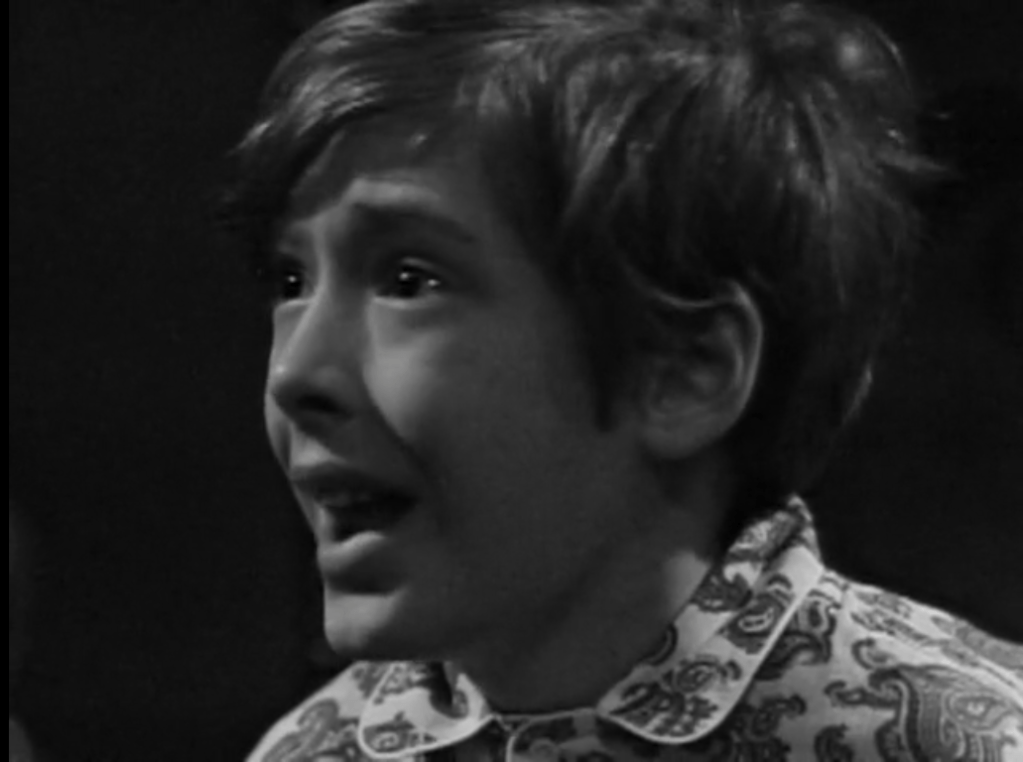
While we are still laughing, David presses Carolyn to explain why she is being nice to him. A look of fear comes over him, and he asks if something terrible has happened. Carolyn assures him that nothing has, but he just looks more and more alarmed. By the time she leaves him, his expression is little short of heartbreaking.
David alarmed
The next morning, well-meaning governess Vicki is sitting with David in the drawing room, going over his homework. He has written an essay about what it might be like to have an older sister. He wonders if such a sister would love him. Vicki says that she might, and that it is a waste when you don’t love the people who love you. When Vicki asks David where he got the idea of writing about an imaginary older sister who loves him, he doesn’t give a direct answer. He does start talking about Carolyn, making it clear that he is thinking of her.
Vicki leaves David alone in the drawing room for a short while. He looks into the fireplace and sees his own face wearing a placid expression and immersed in the flames. He flees the room in terror, bumping into visiting parapsychologist Dr Guthrie. Vicki comes running, and David holds onto her for dear life.
ReflectionsSafe with Vicki
David’s vision reminds me of a post of Wallace McBride’s on The Collinsport Historical Society from April of 2020. His point is summarized in his title, “In Dark Shadows, Your Reflection Always Tells the Truth.” David lives in 1967, so he doesn’t have access to that article. But he already knows the truth it tells- his terrified reaction shows that he knows it means there is an imminent danger that he will die by fire.
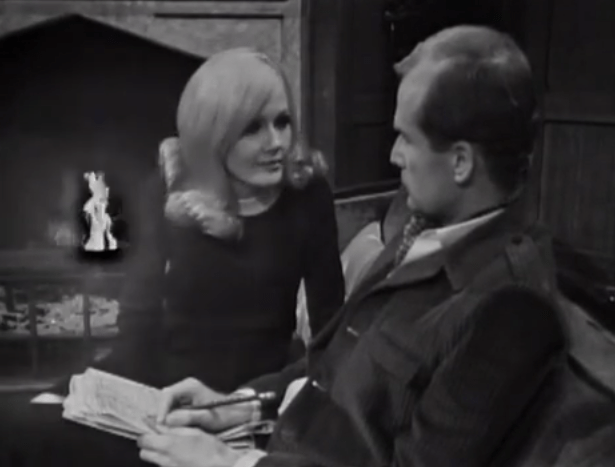
We see hardworking young fisherman Joe poring over old newspapers in the Collinsport Public Library. He finds something that alarms him, and rushes to a public telephone to call Vicki. He tells her he is coming to the house to show something important to her and Guthrie.
Joe on the phone
When Vicki tells Joe and Guthrie that David had a vision of himself in flames, she connects it with a recurring nightmare that had plagued him several weeks ago. David’s mother, blonde fire witch Laura Murdoch Collins, had come back into his life after an absence of several years, and he kept dreaming that she was beckoning him to join her in flames. While he was suffering from this nightmare, drunken artist Sam Evans, miles away in town, inexplicably painted a couple of canvases depicting exactly the image that kept appearing in David’s dreams.
Joe and Guthrie become very animated when Vicki tells them what David saw and how he reacted. Joe declares that what David has seen is a vision of the past. Joe has already shown Guthrie what he found in the library, a newspaper article from one hundred years before. The article is about someone named Laura Murdoch Radcliffe. That Laura Murdoch died in 1867 in a fire along with her young son. His name was David.
There isn’t really any structure to this episode, certainly no suspense. It’s a collection of scenes in various moods, each exploring some familiar themes, all taking place in the great house of Collinwood.
Reclusive matriarch Liz wakes her nephew, strange and troubled boy David. She is glad to find that David is cheerful, but disturbed to hear that his mother, the mysterious and long-absent Laura, visited him in his room last night. Liz says that Laura couldn’t have been in the house last night. David proves that she was there by showing Liz the handkerchief she gave him.
Liz is puzzled how Laura got in and out of the house without being seen. Friday, she learned that there had been strong evidence of supernatural activity in the house yesterday. As she questions David about the details of Laura’s visit, it looks like she might be trying to rule out a supernatural explanation of Laura’s visit. That’s a bit of a dead end- Liz is committed to covering up anything that will make the family look weird, so if she is thinking along those lines she certainly won’t be talking about it with anyone. But she had a confrontation yesterday with Laura, in the course of which each implied that she had sufficient willpower to defeat the other. So Liz’ unsettled reaction might explain why Laura left the handkerchief. She wants Liz to know that she is not dealing with any ordinary antagonist.
We then see Liz and her brother, high-born ne’er-do-well Roger Collins, having breakfast in the kitchen. Roger is delighted by the prospect that his wife Laura will divorce him and go away with their son David. He promises Liz he will think fondly of David when David is a distant memory. Liz is exasperated with Roger’s narcissism. She reminds him that he lives as a guest in her house, and that it was for David’s sake she took him in. He studiously ignores the implication that if David goes away, he will have to find a place to live and pay his own bills.
Liz’ daughter, flighty heiress Carolyn, comes into the kitchen as Roger is leaving. She informs Liz that Laura has been seeing the family’s arch-nemesis, dashing action hero Burke Devlin. Before Laura came back, Burke had been leading Carolyn on, and she has been bitterly disappointed that no romance will be blossoming between them. She leads Liz to the idea that after Roger and Laura are divorced, Laura will deliver David to Burke. “The last of the Collins! The only hope our name will continue!” exclaims Liz. Fearing Burke’s intentions, she vows to keep Laura away from David.
While she may not have forgotten what she heard Friday about the indications of supernatural doings, Liz has not grasped the message the ghosts are trying to send. While Burke may want David to forget Roger, think of him as his father, and change his name from Collins to Devlin, the ghosts have been telling anyone they can reach that he won’t get the chance. If David goes to Laura, she will change far more about him than his last name. Perhaps she will kill him, perhaps she will turn him into some kind of otherworldly creature, but whatever her plans are, Burke should be the least of Liz’ worries.
Roger was among those who saw and heard the signs of the ghosts on Thursday. On Friday, he flatly declared to well-meaning governess Vicki that he refused to think about them any more. While Carolyn is in the kitchen giving Liz the news about Burke and Laura, Roger goes to David’s room to try to talk him into spending more time with his mother.
When he hears Roger at the door, David is sitting on his bed, playing with toy soldiers on a chessboard. He hastily shoves the soldiers and the edge of the board under his pillow and picks up a textbook.
Everything Roger says seems to bewilder David. When Roger tells David that he has done something to please him, David replies “I have?” David continues to answer all of Roger’s statements in that wise until Roger protests that David is using “two-word questions” only to annoy him. He talks about how important it is for a boy to spend time with his mother, that he ought to ask Liz if he can go on a long trip with his mother, etc. At the end of their talk, Roger tells David “You can be a very intelligent little fella when you want to be.” David continues to give him a mystified look.
Since David has already had several scenes where he angrily told Roger that he knew Roger was trying to send him away with his mother because he wants to get rid of him, regular viewers are likely to take this scene as an indication that David is changing his approach to Roger. He’s tried confronting his father with the ugly truth, screaming at him, and threatening him. Last summer, when Laura was still an unseen, half-remembered figure David would call to while standing at the window, he tried murdering him. None of those tactics got him anywhere, so now he is just deflecting him with a show of incomprehension.
There is another possible explanation for David’s change. The most shocking of David’s recent behavior came when the ghost of Josette Collins was making her most intense efforts to get through to him about the danger his mother represented. That process manifested itself in nightmares and a frightening painting that threw David’s mind into an uproar. Now, Laura has appeared to him in the night, blocking the nightmares, and Roger has burned the painting. Josette is temporarily silenced. David is not afraid of his mother, and may not be enraged with his father.
Those who have been watching closely all along will find another interesting note in Roger’s attempt to manipulate David. In #68, Roger had been eager to get rid of well-meaning governess Vicki. In those days, David saw Vicki as an enemy. Roger sits with David in the drawing room and talks very calmly about the fact that David hates him. He asks if he doesn’t hate Vicki even more. David doesn’t deny it, and expresses extreme hostility. This was only a few weeks after Roger found out that David had tried to kill him, so it is rather chilling when he tells David that he will leave it entirely up to him to solve the problem of Vicki.
In that scene of horrifying child abuse, David was helpless as his father deliberately set about warping his mind so that he would attempt a murder. By contrast, this scene is a comedy in which David Henesy and Louis Edmonds get real laughs, and David Collins is certainly no worse off at the end than he was a the beginning.
David is playing with his toy soldiers again when he hears someone else at the door. Again, he stuffs the soldiers under his pillow. It is his cousin Carolyn. He tells her that with so many visitors to his room, he is having trouble studying. Carolyn takes the soldiers from under the pillow and says she can see how hard he’s been studying. He asks “Secret?” She replies “Secret!”
As far as I can recall, this is the first time we’ve seen Carolyn in David’s room. The “Secret?” “Secret!” exchange is certainly the first time we’ve seen them so friendly. It’s a relief- Carolyn’s over-the-top denunciations of David as a “little monster” were getting monotonous, and each of these characters needs more people to talk to.
After she and David have talked about Laura for a while, Carolyn goes back downstairs to talk to her Uncle Roger. Roger is lounging on the couch doing the crossword puzzle. He is quite annoyed that Carolyn is interrupting him in this most important task of his day. This is a bit of mirroring- as David is more concerned with his toy soldiers than with his studies, so Roger is more concerned with his puzzle than with any of the responsibilities you might suppose would attach themselves to a grown man who is nominally employed as an executive at his sister’s business.
Carolyn brings up Burke and Laura. Roger says that she needn’t worry about that- until their divorce is final, Laura won’t dare do anything to alienate the Collinses. Carolyn asks what will happen after the divorce, when David is living with Laura and Laura is available to Burke. It seems to dawn on Roger that it might be bad for the Collinses if the family’s only male heir is the stepson of their deadliest enemy, and so he says he’ll do something about it. Carolyn so adores her uncle and so resents Laura and Burke’s relationship that not even his crossword puzzle can keep her from blinding herself to his complete ineffectiveness. She is gleeful at the thought that Burke and Laura will now get their comeuppance at his hands.
Like Roger, Carolyn was among those who saw and heard the signs of Josette’s presence Thursday. She knows all about David’s nightmare and about the painting in which she warned that Laura would set fire to herself and David. Yet she has inherited the family’s tradition of denial. She will not see what is in front of her, and cannot shift her focus from her thwarted desire for Burke to the grave danger impending over David.
At the end of yesterday’s episode, Maggie Evans, The Nicest Girl in Town, and her boyfriend, hardworking young fisherman Joe Haskell, had gone out to look for Maggie’s father, drunken artist Sam Evans. Maggie and Joe wound up carrying Sam home from the tavern.
Joe left the Evans cottage, Maggie went to the kitchen to brew up some coffee, and Sam lit a cigarette and passed out. The cigarette fell on some newspapers and started a fire.
While the fire began, the face of blonde fire witch Laura Collins was superimposed on the image of Sam. Some mysterious force has compelled Sam to paint pictures of Laura naked and in flames. Laura objects to these portraits. She came to the Evans cottage the afternoon before the fire and told Sam she would find a way to stop him painting any more of them. Her face appearing over the fire, along with spooky music and everything else the show has told us about Laura, demonstrates that she is casting a spell on Sam with the intention of making good her threat.
Today, Sam regains consciousness and sees the fire. He tries to put it out with his hands, burning them badly. Maggie comes running and beats the flames out with a rug.
The current storyline hinges on the idea that Laura’s supernatural powers make her a deadly threat to her son, strange and troubled boy David Collins, and perhaps to others as well. The outcome of this spell creates suspense as the audience wonders if Laura is mighty enough to keep the narrative arc going. After all, causing Sam to pass out and mess himself does not take much. There’s no suggestion that any magical abilities reside in Bob the bartender, yet he manages to do that just about every night, and he collects a paycheck for it to boot. For all we know, Laura’s spell might have been a total failure- it might be a sheer coincidence that she was trying to make him pass out and drop a lit cigarette when that’s what he was going to do anyway.
Maggie scolds Sam for his drinking. To Maggie’s exasperation, he raves that Laura started the fire. As he goes on and on about an unnamed power that has been controlling his behavior, Maggie responds “I think they call it alcohol.” Yesterday, Maggie was talking to Joe about laying aside her role enabling her father’s alcoholism and leaving the town of Collinsport altogether. Regular viewers will remember that conversation today, when she tells Sam that she is approaching the limit of what she will take from him. Sam loves Maggie more than anything, and he desperately tries to convince her that he is telling the truth. She sees his desperation, and we see her struggle to make herself say that nothing can convince her of a story like the one he is telling her.
As the voice of correction, Maggie is perfectly reasonable, perfectly justified, and perfectly mistaken. Sam is indeed the plaything of uncanny powers. A couple of weeks ago, they gave us scene after scene full of sound and fury, repeating the point that some spiritual force was making Sam paint Laura’s picture. We see today how little of that was necessary- Laura’s likeness and the theremin music are plenty to show us that the fire is in line with a spell she is casting. But Maggie, while she has often said that she wants to avoid the estate of Collinwood because she believes the stories that ghosts and ghouls haunt it, refuses to entertain the idea that there is anything unearthly at the root of Sam’s troubles. She says that she has to have evidence she can look at out in the open, and that she isn’t going to listen to Sam’s talk about unseen and unknowable powers. Although we know that Sam is right and Maggie is wrong about the particulars of this incident, to the extent that Maggie is speaking to her father as an adult child of an alcoholic she is the voice of the audience.
Meanwhile, Laura is sitting by the hearth in the drawing room at the great house of Collinwood. She is casting her spell on Sam. Reclusive matriarch Liz enters and tries to get Laura’s attention. When Laura finally looks up, her face is contorted in an unattractive expression. Liz remarks on it, and Laura asks if she looked ugly. Liz says yes, then for a fraction of a second looks embarrassed when she realizes that she told another woman that she was ugly. She quickly makes some meaningless remarks in a courteous voice. It is a small moment, but Joan Bennett extracts the jewel of comedy from it quite deftly.
Laura has come to Collinwood to re-establish a relationship with David. After years away, she wants to take David and leave. David’s father, high-born ne’er-do-well Roger, is all for this plan, but Liz is determined to thwart it. As the only male of his generation in the family, David represents the sole hope that the name of Collins will continue. As the custodian of the family’s past and future, Liz wants to be the chief maternal presence in David’s life. Besides, she never leaves the estate, so she needs all the company she can get.
Liz tells Laura that, while she had agreed that Laura could take David if their relationship were to make the right sort of progress, she is not at all satisfied that such is happening. Her objections don’t make much sense, and if the audience hadn’t been informed that Laura is an uncanny being whose plans will likely lead to David’s death we would probably be appalled at how unfair she is.
Roger shows up and takes Laura’s side. While the two of them stand firm against Liz’ wispy arguments, a knock comes at the front door. It is Maggie. Laura is shocked to see her- apparently she had expected her spell to do enough damage to the Evans cottage that Maggie would be unable to go visiting tonight. Laura’s reaction is dramatic enough, and the music behind it is overstated enough, that we may think Laura expected to kill Maggie. Again, the indications of Laura’s failure lead us to wonder if she is enough of a witch to deliver the supernatural thriller we have been led to expect.
Maggie wants to tell Laura about Sam’s accident, and to lament that Sam’s obsession with Laura has led him to the idea that she somehow caused it. Roger is indignant that Sam would say such things about his estranged wife, and storms off to the Evans cottage to give Sam a piece of his mind. Liz, on the other hand, is intrigued by Sam’s ideas and wants Maggie to give as many details as possible about Laura’s visit to the cottage earlier that day.
When we were watching the episode, Mrs Acilius wondered if Liz’ interest in Maggie’s story was a sign that she had noticed something eerie about Laura during their previous acquaintance. My interpretation was that Liz is so desperate to find information she can use to present Laura as an unfit mother that she is ready to listen when the town drunk claims she cast a spell on him. As reasonable, justified, and wrong as Maggie was in her scolding of Sam, so unreasonable, unjustified, and right is Liz in her conversation with Laura.
When Maggie says that Laura had threatened to stop Sam painting pictures of her naked and in flames, Liz asks what threat she made. Laura answers that all she said was that she would find a way to stop him. With a look of suspicion on her face, Liz asks what she was planning to do when she said that. “Just what I did do,” Laura answers. After a pause, she specifies, “Turn the matter over to Roger.”
In the Evans cottage, Roger reads the Riot Act to Sam. Louis Edmonds was a master of sarcastic dialogue, and Roger’s lines in this scene give him many chances to shine. Indeed, he and David Ford have a blast playing Roger and Sam’s mutual hatred. When Roger ridicules his claim to be subject to mystic powers, Sam replies in a taunting voice that Roger is in as much trouble as he is. The two men jeer contemptuously at each other, and it is a wonder to behold.
Mrs Acilius was particularly impressed by the contrast between the opening scene with Maggie scolding Sam and the closing scene with Roger railing at him. Sam’s two interlocutors make the same basic point, but the differences between them as individuals and between their respective relationships to Sam tell us entirely different things. Sam hates Roger almost as much as he loves Maggie, and their hostility is as explosive as Sam’s scene with Maggie is poignant. Maggie’s lovable, down-to-earth persona makes her the polar opposite of Roger with his haughty manner, sharp tongue, and utterly debased moral stature. In her scene, Maggie was to an extent the voice of the audience; insofar as Roger is continuing the lesson Maggie began teaching Sam, he is taking over in that capacity. It is quite a different thing for us to relate to The Nicest Girl in Town as our voice than it is for us to see a virtueless snob like Roger in that capacity, and so Roger’s first moments berating Sam in the Evans cottage whip us around fast.
Sam confirms that he has been driven to paint another picture of Laura, and Roger announces that he will destroy it. Sam doesn’t object. When Roger goes over to the painting, he sees that most of it has already been burned away. Sam is shocked to see this- the fire was on the other side of the room, and nothing in the several feet between a burned spot on the carpet and the painting has been touched by the flames. With this, the suspense is resolved- we know that Laura’s fire magic did achieve a result that Sam’s drinking could not. So the show will have a story to tell after all.
The script is credited to Malcolm Marmorstein, who was by far the worst writer on Dark Shadows. It is difficult for me to believe that someone who delivered so many low points wrote a script this good all by himself. Joe Caldwell was making uncredited contributions to the writing by this time, and he was so much better than Marmorstein that I am inclined to suspect that he wrote this one.
I suppose Marmorstein might just have been having a good day. There don’t seem to be any surviving documents identifying those contributors to the writing whose names didn’t appear in the on-screen credits for any given episode, so we can only guess which ones Caldwell worked on in his first several months on the show. But the structure, dialogue, and pacing of this one feel a lot more like the ones with his name on them than they do like the general run of Marmorstein’s work.
Each of the 1225 episodes of Dark Shadows features one name under the credit “Written by.”* A total of nine names rotate in that spot. While we know that some episodes included writing from uncredited contributors, the only such contributors we can identify come from among that tiny group of eight men and one woman. For example, Malcolm Marmorstein, credited with today’s script, wasn’t officially named among the writers until #115, but he may well have written additional dialogue as far back as #46. Joe Caldwell’s name doesn’t appear on-screen until #245, but he will actually be writing some of the scripts attributed to Ron Sproat starting this month, maybe this week.
Opinions will of course vary as to which of the nine identifiable writers was better and which was worse. Few, however, will find a place for Marmorstein on a list of Dark Shadows’ eight best writers. Although he had extensive experience in the theater, Marmorstein had none of the sense of what actors can do that Art Wallace and Francis Swann brought to the first nineteen weeks of the show. Nor did he know how to structure a drama, write crisp dialogue, or invent fresh story points. Directors Lela Swift and John Sedwick collaborate with a uniformly strong cast to put Marmorstein’s scripts on such a strong footing that at moments they seem like they are about to be good. Those brief flashes of hope are invariably, cruelly, disappointed.
There are indeed some bright spots in today’s episode. Reclusive matriarch Liz is in the drawing room of the great house of Collinwood. Well-meaning governess Vicki and homicidal fugitive Matthew are both missing, and Liz is worried that Vicki may have fallen into Matthew’s hands. Wildly indiscreet housekeeper Mrs Johnson shares her conviction that Matthew has killed Vicki, and won’t stop talking about this belief even after Liz expressly orders her to do so. Clarice Blackburn plays Mrs Johnson as a woman with no self-awareness whatsoever, and no screen actor has ever had a more effective way of showing horror at displays of social maladroitness than did Joan Bennett. In their hands, this scene is laugh-out-loud funny.
A knock at the door rescues Liz from Mrs Johnson’s untrammeled morbidness. The sheriff has come to report to Liz on the state of the searches for Vicki and Matthew. Mrs Johnson answers the door and won’t let the sheriff see Liz until she’s given him a piece of her mind about the incompetence of his department. There aren’t any memorable lines in this exchange, but the contrast between Blackburn’s highly animated movements and Dana Elcar’s cheerful placidity is so obviously suitable for comedy that it feels funny.
Back in the drawing room, the episode starts to fall apart. Liz and the sheriff talk about the searches for Vicki and Matthew. The dialogue is full of repetition and wasted words. Liz asks if the sheriff has an idea where Matthew might be, to which he replies, “He could be anywhere, and everywhere.” Might he hurt Vicki? “He might, but on the other hand he might not.” After all, “he’s very unpredictable.” Then, “you know how unpredictable he is.” Yep, unpredictable, let’s repeat that word five or six more times, that’ll keep us busy until the commercial break.
They could have cut some of that smoke-blowing and replaced it with lines about what the sheriff has done. My wife, Mrs Acilius, wishes the sheriff had mentioned telephoning Vicki’s former residence, the Hammond Foundling Home, and asking people there about where Vicki might have gone and whom she might have tried to contact. That might not have led to any action, but at least it would invite us to imagine that something might be going on somewhere.
The scene between Liz and the sheriff does have an effective ending. She asks him if he holds out much hope for Vicki. He replies, “Frankly, no.” She turns to leave the room. We break for commercial on that downbeat, which lets the bleakness of the situation sink in.
Strange and troubled boy David Collins comes home. David is the one person who knows that Matthew is hiding in the long-abandoned Old House on the grounds of the estate. He has been delivering supplies to him. Even David does not know that Matthew is holding Vicki prisoner in a hidden chamber. David sees that the sheriff is in the house, and asks Mrs Johnson if the sheriff has any news about Vicki or Matthew. Mrs Johnson seizes this opportunity to resume denouncing the sheriff’s incompetence, saying that the only clue he can recognize one that tells him it is time to eat and make himself even fatter than he already is.
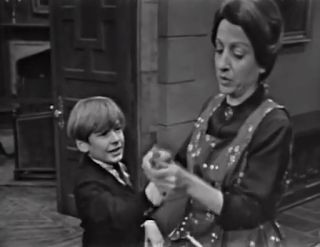
David is about to move on when Mrs Johnson questions him about the pack of cigarettes he stole from her earlier. She sets some punchlines up for David in this exchange. She mentions that she lit a cigarette while serving David his breakfast, to which David replies by asking if she is supposed to smoke while working. She says she knows that she set her pack of cigarettes on the table when she and David were alone in the kitchen, and that she hasn’t seen it since. He suggests it walked away by itself. She tells him he’s the only one who could have taken them; he says that if he wanted cigarettes, he wouldn’t steal them, he’d buy them. None of these lines is much on the page, but as delivered by Blackburn and David Henesy, they are genuinely funny.
David goes into the drawing room and talks with the sheriff. Picking up on Mrs Johnson’s remark about the sheriff’s vigilant observation of meal-times, David asks him what it means when the whistle blows at the cannery. “Lunch,” says the sheriff. Again, not a world-class piece of comic material, but Henesy and Elcar make it land.
David then asks the sheriff for the details of his search for Matthew. The sheriff happily answers all of David’s questions in detail, as if he were giving a briefing to the state police. He tells David that anyone who might be hiding Matthew will go to jail.
This scene shows the limits of what a good actor can do with bad material. David is going to return to the Old House at the end of the episode. He will be prompted to go back there because he has learned information from the sheriff that Matthew will want to know. While there, he will set up suspense by revealing to Matthew that the sheriff has triggered his intense phobia of jail. That locks the sheriff into playing his scene with David as a babbling oaf.
In Elcar’s first episodes as the sheriff, he had made indiscreet remarks to David, but as we saw him observing the reactions those remarks elicited from David and others he seemed to be using them as ploys to advance his investigations. For example, in #59, he had given David some information that excites him and unnerves his father, high-born ne’er-do-well Roger Collins.
We can see how he might use similar tactics in this situation. After all, Vicki is David’s governess, and David has spent more time with her than has anyone else. Matthew had been the caretaker in the house where David lives, and David knows him quite well also. In this conversation, when the sheriff refers to Matthew as unlikable, David becomes very excited and exclaims “I like him! Er, I did like him, I mean.” If the sheriff knows his business he might well pay very close attention to everything David says, and keep encouraging David to say more. He will certainly notice David’s terrified reaction to the idea that someone helping Matthew will go to jail, and test his reaction to further comments on related themes. But if he takes any note at all of David’s attitude, the current storyline will end within minutes. So in this scene, Marmorstein leaves Elcar no way to play the sheriff as an intelligent character.
After the sheriff leaves, David and Liz have a scene in the drawing room that builds up to a tremendously frustrating moment. David keeps asking his aunt one question after another about Matthew and Vicki, Vicki and Matthew, does Matthew have Vicki, is Vicki in danger from Matthew, then without taking a breath “Do you know any secrets about the Old House?” Liz responds “I wish that someday you’d ask an important question.”
Granted, we know that Matthew is holding Vicki prisoner in the Old House and Liz does not, but it is hard to imagine anyone failing to see the connection between these two thoughts. Joan Bennett and David Henesy had a fine rapport that made the scenes between Liz and David Collins a delight, and you can see them trying to save this exchange. David is in a panic at the beginning of the scene and gets steadily more worked up as it goes along. We see Liz observing his agitated emotional state, paying such close attention to his facial expressions, tone of voice, and frantic bodily movements that she misses key elements of his words. It’s a valiant attempt on their part to make the scene work.
David wants to go to the Old House to see Matthew. In the foyer, Mrs Johnson again confronts him about the cigarettes. He yells at her to “Get off my back!” and runs out. This might have been an attempt to show that David feels his world closing in on him, but it doesn’t succeed. We’ve already seen those two characters say everything they had to say about that topic on that set. Repeating it just feels like filler.
*There are reference works that draw on the original paperwork produced by the makers of the show; even these list one writer per episode. That’s how the Dark Shadows wiki manages to list a writer for every episode, including those that don’t show writing credits on-screen.
Last Friday, the sheriff called the home of drunken artist Sam Evans. He warned Sam that dashing action hero Burke Devlin might be coming to his house, and urged him to call back if he did. Burke did go to Sam’s house, but Sam didn’t call the sheriff. After a brief confrontation with Burke, Sam ran away and left Burke alone with his daughter Maggie and their house-guest, well-meaning governess Vicki.
Yesterday, the sheriff called reclusive matriarch Liz at her home, the great house of Collinwood. He warned Liz that Burke might be coming to her house, and urged her to call back if he did so. Burke showed up at the house at the end of the episode.
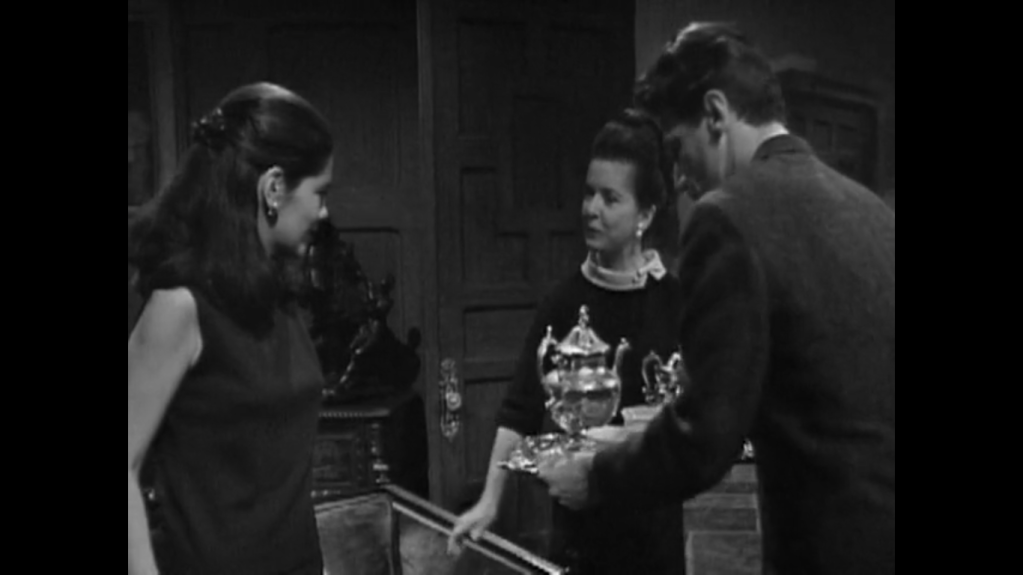
Liz doesn’t call the sheriff either. After Burke refuses her commands to get out of her house, she decides to confuse him with a display of hospitality. It turns out to be quite an effective tactic. When Vicki walks in and asks Burke what he’s doing at Collinwood, he replies in bewilderment “I think I’m having tea.”
Burke takes the tea tray from Liz
Burke had gone to Collinwood looking for Liz’ brother, ne’er-do-well Roger. Roger is with Sam at the tavern in town. Yesterday we heard some new music at the tavern, a funky tune that sounds like it was cut from a Booker T and the MGs album. It played then as grizzled caretaker Matthew sat by himself waiting for Burke to come in so he could threaten him. It was so obviously not something Matthew would listen to that it served to emphasize his isolation. It plays again today as Roger and Sam reach the end of a strange conversation, with Roger first refusing Sam’s offer to leave town for money, then Sam refusing Roger’s offer to give him money to leave town. As Roger and Sam, Louis Edmonds and David Ford have so much fun with this exchange that it feels like an Abbott and Costello routine. The music is different enough from what we’ve heard on the show so far that it highlights Roger and Sam’s silliness.
I should also mention that in the opening voiceover, Vicki says the phrase “Dark Shadows.” This is the second time we’ve heard a character say the title of the series. The first was in episode 46, when Roger had said that a drawing by his son, problem child David, had captured “Collinwood, with all its dark shadows.”
Three people expressed surprise in episode 40 that Roger Collins wasn’t at his office. He still isn’t there today, and three more people are surprised. He finally decides to go in when Liz presents him with the alternative of looking for Carolyn.
Bill Malloy isn’t at work either, hasn’t been all day. He and Roger have been taking turns inviting themselves into Sam Evans’ house. Sam is also not working, and in fact takes time out of his busy schedule of downing one glass of whiskey after another to destroy the only thing we’ve seen him make as part of a paying job, a sketch of Burke. Maggie pieces the sketch back together- she’s also at home when she’s supposed to be working.
Telephones are unusually dynamic in this episode. Typically we see only one end of a phone call on Dark Shadows. This time, we cut back and forth between both ends of three telephone conversations this time. In the teaser Roger is browbeating Sam; Sam sets the phone down and walks off. While he gets another drink, the receiver is in the foreground and we hear Roger’s voice at the same volume as we did when Sam was listening. Sam comes back, returns the receiver to its cradle, and goes to sit down while it rings.
The bit when we see the phone and hear Roger’s voice, though Sam isn’t looking at the phone and can’t hear it, establishes the telephone as a character with its own relationship to the audience, independent of anyone who may or may not be paying attention to it. It’s a neat moment:
Liz calls the office and talks to Joe. Joe tells her Bill hasn’t been in all day. The stress in his voice, the papers piled on his desk, and the tight grip he has on the telephone receiver all make it credible that he’s the only person in town who showed up for work today:
Liz mainly wants to talk to Joe about Carolyn. Joe tells her he hasn’t talked to Carolyn in some time, and that he has no idea what if anything she is thinking about their relationship. While he breaks this news to Liz, we see him continue working, then cut back to the look of distress on Liz’ face.
Maggie calls Collinwood. Vicki answers and is excited to talk to Maggie. I guess the show is telling us they’re friends now. Maggie asks to talk to Roger. Vicki says Roger is probably in the office at this time of day, Maggie somehow knows he isn’t, Vicki remarks that he isn’t in the habit of confiding in her. Roger overhears this and asks “Is there any reason why I should confide in you?” When Vicki holds the receiver out to him and says Maggie Evans is on the line, he takes it and hangs up without so much as putting the receiver to his ear. Vicki and Roger then have one of their little quarrels.
That’s the only thing Vicki does in the episode. Her character is heading into a danger zone. Through the first eight weeks, she was on all the time. She was our representative, the outsider who knew nothing about the other characters or the town they live in, and to whom everything had to be explained. Now she knows as much about the rest of the characters as they know about each other, and we know as much as we want to learn by hearing explanations.
The major characters all have their secrets, but the only two who know each other’s secret are Roger and Sam. Vicki isn’t any likelier than anyone else to uncover that one. She has no secrets of her own, and her original story-line- her quest to discover her origins- is dead in the water. What’s more, Vicki is no good at lying. Soap operas are mostly conversation, and the big events on them are lies and the exposure of lies. The only time Vicki has tried to lie to anyone- in episode 13, when she told Matthew that Liz knew she was in his cottage- she was immediately found out, with disastrous consequences. If she’s going to stay relevant to the show, something is going to have to change, and fast. It’s fun to watch Alexandra Moltke Isles bicker with Louis Edmonds, but the characters they play need something meatier to bicker about.
This is the first episode credited to writer Francis Swann, indeed the first episode credited to anyone other than Art Wallace. Swann’s teleplay finds humor in the idea that so many people have taken the day off. Each time another character remarks on a case of absenteeism it gets that much closer to raising a chuckle. And Roger’s line that looking for Carolyn would require him to “neglect my vital tasks at the office… Dear me, no” is genuinely funny, especially as Louis Edmonds delivers it. The telephone scenes are also an innovation, and promise a new source of visual activity. Those favorable omens are offset by Vicki’s scene and its suggestion that her character is about to be allowed to wither on the vine.
A couple of the blogs I read when I prepare my comments made remarks about this episode with which I disagree. John Scoleri of Dark Shadows Before I Die says this of the quarrel between Sam and Maggie:
I know Sam gets frustrated with Maggie, but I’m beginning to wonder about their relationship. If he’s that close to hitting Maggie when he gets drunk, there’s no way I’m believing he hasn’t done that before.
It doesn’t look to me like Sam has hit Maggie. She’s inches from his face when he is at his angriest, yet she doesn’t flinch, doesn’t slump down, doesn’t show any sign of withdrawal or fear or anger or panic or sullenness or bewilderment or any other possible response to physical abuse.
There hasn’t been much happening on DARK SHADOWS in the last few weeks, but that doesn’t mean the show hasn’t been moving forward. There’s been a growing sense of doom throughout the show, and it’s obvious that someone is going to die. In this episode Sam rips up his portrait sketch of Burke Devlin, he and Roger lob threats at each other, Liz begins to draw Joe’s attention to his girlfriend’s romantic intentions on the family rival, and Victoria has been pushed around by just about everyone in the cast. In theory, any one of them is eligible for a ride in the bone wagon, but the show has been implying that Devlin is headed for a fall. It’s interesting that the show decides to go in another direction: I don’t know when Bill Malloy checks in at Eagle Hill Cemetery, but it’s probably sooner rather than later.
While it is true that “in theory, any one of them is eligible for a ride in the bone wagon,” I do think there’s a clear front-runner to be the first Dark Shadows character to be killed. It’s Sam who is obsessed with the fear of death, Sam whom Roger has threatened, Sam who left a mysterious sealed envelope to be opened in the event “something happens.” And, from an out-of-universe perspective, it’s Sam who has a daughter played by an appealing actress who needs a story-line. Maggie seeking revenge for the killing of her father would be just the plot to elevate Kathryn Leigh Scott from the bottom of the second string to the starting lineup where she so obviously belongs.
No other character has anyone so well-positioned to play avenger if they’re killed. The only keen attachment Bill Malloy has shown is his devotion to Liz, and in her scene with Matthew in episode 38 Liz demonstrated that she sees devotion from people outside the family as a tool to use when time comes to protect the good name of those inside it. So if she suspects Roger killed Bill, she won’t become Bill’s avenger- if she could order Matthew to throw away his own good name to cover up the truth about David, we can hardly expect her to expose Roger to redress Bill’s grievance against him. Indeed, when Bill is murdered, they will introduce an entirely new character to seek revenge for him.
Vicki is an orphan, who tells us in today’s opening narration that before she arrived at Collinwood she had never known a home. No one is likely to avenge her, and besides, she still does the opening narration for every episode- she’s supposed to be important, even if the writers can’t quite figure out what to do with her. Burke is supposed to be rich and powerful. Presumably he has friends, but we haven’t seen any of them. Joe is Mr Nice Guy and he’s mentioned a friend or two, but again, we haven’t seen them. The series story bible calls for Roger to die when Burke finally gets his revenge, but every time Louis Edmonds’ performance is the most interesting thing in an episode it becomes so much the less likely that they will ever get around to playing that scene. So the smart money, at this point, would be on Sam to be the victim in the first Dark Shadows murder. So much so, indeed, that it might not be surprising enough if it does happen- they may think they have to kill someone else to keep the audience engaged.
We see David looking for a place to hide a small metal valve. He settles on Vicki’s underwear drawer. She catches him going through it; he runs off, and she finds nothing missing. She would apparently rather not think about what he was doing in that particular drawer. Later, he will claim that he was trying to slip a present into the drawer- a seashell, at first; then, a magazine.
Alone in the upstairs hallway, Vicki sees the locked door to the closed-off part of the house open and close, apparently by itself. At first, she thinks it’s David playing a prank on her, but he comes out of his room so soon after that there doesn’t seem to be any way he could have done it. The show has been using the idea of ghosts in episode after episode to suggest that something big is about to happen; now, for the first time, we see an event that is either a supernatural manifestation or an elaborate, Scooby Doo-esque hoax perpetrated by some unknown person for some unknown reason. So what she’s doing now- looking for David, trying to figure out what he’s been up to- is directly connected to something that is disturbing the supernatural back-world of Collinwood. It may be a while before the back-world erupts into the foreground, and even longer before it crowds out everything else and becomes the whole show. But that little valve represents the first irretrievable step on the path that will lead to what Dark Shadows became.
This is also the first episode in which Vicki gets to make someone laugh. Carolyn says that she and Joe will probably go to a movie, because “What else is there to do in this town?” To which Vicki replies “You could get into a fight in a bar.” It’s also the last episode in which Vicki is allowed to make a joke. Humorlessness one of the things that will eventually squeeze the life out of the character. Alexandra Moltke Isles delivers her one good joke well enough that it clearly could have been otherwise. Those of us who wish Vicki had stayed at the center of the show all the way through can’t help but feel sad that it wasn’t to be.







 Dark Shadows Commentary