Episode 349: A man who would have been long dead by now

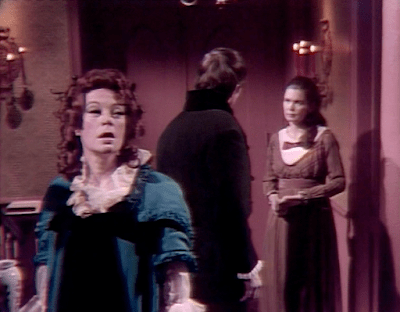
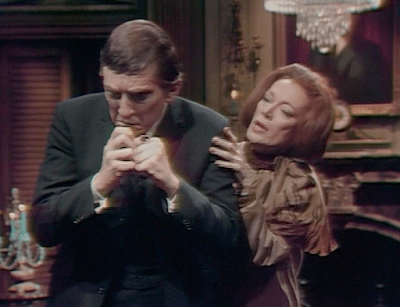
Mad scientist Julia Hoffman has been trying to cure Barnabas Collins of vampirism. We open today with Julia fleeing from Barnabas in terror. You’d think he’d be used to this reaction, but she’s been pretty cozy with him for a long time, so he knows she isn’t doing it for the usual reason. He demands to know why, and she tells him it’s to do with his appearance. He can’t use a mirror, so he touches his face. He realizes that, as an unforeseen side effect of Julia’s treatments, he is starting to look his age. Considering that he’s about 200 years old, the typical look would be a pile of dust, so he is quite upset about the situation.

Barnabas accuses Julia of intentionally botching the experiment because he refused to let “our relationship become all you wanted.” For the last couple of weeks, Julia has been responding to the realization that she is going to be connected to Barnabas for the rest of her life by trying to fall in love with him. He has observed this attempt, and answers it by pouring scorn on her. The other day, we saw her struggling to hold back tears at the end of an episode. She keeps her cool this time, and dismisses this particular accusation quickly.

One of the aspects of Barnabas’ sudden aging that bothers him the most is that he will have to cancel a date to watch the sun rise with well-meaning governess Vicki. Julia can hardly keep from laughing out loud when she says that “Foregoing an appointment with Vicki must be a bitter pill.” Barnabas responds “Spare me your sarcasm!” Even before she decided she would have to cultivate a romantic interest in Barnabas, Julia often showed signs of impatience when conversing with Vicki. She often rolled her eyes as soon as Vicki wasn’t looking, and sometimes plastered on a smile and spoke to her very slowly. But this is our first direct confirmation that Julia thinks Vicki is an idiot.

The Vicki/ Julia relationship is the first time on Dark Shadows that one major character is oblivious of the fact that another holds her in disdain. That adds a fresh wrinkle to their scenes together, as we wonder if Vicki will catch on to Julia’s real attitude towards her.

Barnabas orders Julia to run up to the great house of Collinwood and tell Vicki that he won’t be able to watch the sunrise with her. Julia opens the front door to comply, and sees Vicki standing there. She has overheard the last part of their conversation. Barnabas sits in a high-backed armchair with his back to her and claims that he has an illness he is afraid she will catch if she comes too close to him. He also claims that he will be leaving town on a long business trip later in the morning. When Vicki points out that these two things don’t fit together, he makes a lot of statements that don’t add up to much more than throat-clearing.

Barnabas hiding in his chair. Screenshot by Dark Shadows Before I Die.

It’s also odd that Vicki, who like the other residents of the great house of Collinwood does not know that Julia is a doctor, doesn’t seem to notice that she’s wearing a lab coat, much less to wonder what she’s doing in Barnabas’ house in the pre-dawn hours. The whole scene is so ridiculous that the comedy must be intentional, on the part of the director and the actors if not of writer Ron Sproat.

After Vicki goes, Barnabas says he will have to save himself by reverting to his bloodsucking ways. Julia is shocked by the thought that the horrors will resume, and laments that she will be “partially responsible” for them.

Julia’s shock doesn’t last long. She urges Barnabas to choose Vicki as his first victim. She is absolutely gleeful about this idea.

Barnabas’ doctor suggests a new addition to his diet. Screenshot by Dark Shadows Before I Die.

Barnabas is miserable- he has already passed up several prime opportunities to bite Vicki, including an occasion when she invited herself over to spend the night in his house and one on the terrace of the great house when she virtually pressed her neck into his mouth. There have been times when we have expected Vicki to draw an arrow on her neck and write next to it the words “MR VAMPIRE, BITE HERE!” But Barnabas doesn’t want to let go of the fantasy that Vicki’s personality will somehow disappear and be spontaneously replaced with that of his lost love Josette. His attachment to this fantasy suggests that Barnabas is as bored with the actually existing Vicki as is Julia.

Back in the great house, Vicki tells heiress Carolyn that Barnabas was in a strange mood. Carolyn says that Vicki has become quite fond of Barnabas, and Vicki says that she is more than fond of him. She has come to rely on him. Since Vicki’s depressing fiancé, Burke, is missing and presumed dead, there is no reason why this shouldn’t mean that Vicki will fall in love with Barnabas. No reason, that is, except Barnabas’ obvious lack of interest in her.

Later, we see Carolyn and her old friend, hardworking young fisherman Joe, sitting at the Blue Whale tavern. Yesterday, Carolyn had a visit from the ghost of ten year old Sarah Collins. As a result, she believes that her young cousin, strange and troubled boy David, was probably telling the truth when he claimed to have seen various weird things.

Carolyn tries to enlist Joe in an effort to investigate David’s stories, but he won’t have it. He admits that Sarah exists. He has to- lots of people have seen her and she has made several observable things happen. Besides, Joe himself encountered the ghost of Josette in #179, so he can’t very well deny that there are such things as ghosts. But like other characters who have admitted that one or another supernatural being exists, he snaps right back to a frame of reference that doesn’t allow for the supernatural, or even for the unusual. Joe asks Carolyn if she really believes that there is “something sinister about Barnabas,” as David’s visions would imply. She admits that she doesn’t.

While Vicki sleeps, Barnabas materializes in her room. He stands there watching her, as he has done before. This time, his wizened appearance shows that it is a matter of urgency that he feed on someone. But he still can’t bring himself to bite her. Even when his existence is hanging in the balance, he just isn’t into Vicki.

Barnabas tries to work up desire for Vicki. Screenshot by Dark Shadows Before I Die.

After Barnabas loiters for a while trying to talk himself into doing what he so plainly has no desire to do, Carolyn comes to Vicki’s door. She apologizes for waking Vicki, and explains that she thought she heard someone in the room. Vicki isn’t upset at the interruption, but grateful for Carolyn’s concern. The two are startled when they see the silhouette of a giant bat outside Vicki’s window.

Episode 328: My entire career

In the Old House on the great estate of Collinwood, vampire Barnabas Collins frets that his sorely bedraggled blood thrall, Willie Loomis, is failing to die. A couple of weeks ago, the police shot Willie and jumped to the conclusion that he was responsible for the abduction of Maggie Evans, The Nicest Girl in Town, among many other crimes that Barnabas actually committed. He’s been in a coma ever since, and if he dies, Barnabas will be off the hook.

Barnabas tells his co-conspirator, mad scientist Julia Hoffman, that he will go to the hospital and murder Willie. Her assurances that Willie will soon die of natural causes don’t stop Barnabas, but her news that the sheriff is on his way to the house does. Barnabas then orders her to go to the hospital and carry out the murder, but she refuses.

Meanwhile, Sheriff George Patterson, addled quack Dr Dave Woodard, and Maggie’s father Sam are hanging around Willie’s hospital room recapping the story so far. The sheriff wonders where Willie could have kept Maggie during the weeks she was held prisoner. Willie lives in Barnabas’ house and does not appear to have access to any other building. You might think this would be grounds for suspecting Barnabas of involvement, but no such thought crosses the minds of any of the three luminaries keeping Willie company. They just take it for granted that no crime could have taken place in Barnabas’ house.

George, Dave, and Sam, or their intellectual equivalents.

Back in the Old House, Barnabas has had an inspiration. He took a ring from Maggie in #253, and today he hides it in a candlestick in Willie’s bedroom. When the sheriff and Sam come to search that room (but no other part of the house,) Barnabas watches until they’ve given up, then knocks the candlestick over and exclaims in a ridiculously fake voice “Look! A ring!” Sam recognizes it as Maggie’s, and he and the sheriff are convinced it is conclusive evidence of Willie’s guilt.

For her part, Julia has made her way to Willie’s hospital room. She is there with Woodard when Willie shows signs of regaining consciousness. Woodard rushes out to tell the deputy to get the sheriff, and leaves Julia alone with Willie. She looks at Willie’s IV and remembers Barnabas urging her to kill him.

The sheriff and Sam are leaving Barnabas’ house with the ring when the deputy comes to the front door. He announces that Willie is coming to and is likely to start talking at any moment. We end with a closeup of a horrified Barnabas.

Closing Miscellany

In his post about this episode on The Collinsport Historical Society, Patrick McCray gives a fine analysis of the intentional comedy that runs throughout it. In his post on Dark Shadows Every Day, Danny Horn presents an equally fine analysis of the maybe not quite so intentional comedy of the thick-headed Dave, George, and Sam.

During the opening titles, announcer Bob Lloyd tells us that the part of Sheriff Patterson will be played by Vince O’Brien. This week’s episodes were shot out of broadcast sequence, so we will see Dana Elcar as Patterson one more time. O’Brien was on the show four times in January and February of 1967 as the second actor to play Lieutenant Dan Riley of the Maine State Police, an officer attached to an investigation concerning undead fire witch Laura Murdoch Collins. Patterson isn’t much of a character, and even an actor as distinguished as Elcar had trouble making him interesting. If we remember O’Brien from his time as Dan Riley Number Two, we know that he was a competent professional, but we won’t have much hope that he will outdo Dana Elcar.

O’Brien does show beyond all doubt that he belongs on Dark Shadows, though. While the closing credits are rolling, he strolls onto the set behind technical director J. J. Lupatkin’s name.

Screenshot and annotation by Danny Horn at Dark Shadows Every Day.

Episode 316: He just showed up one night

Strange and troubled boy David Collins got himself trapped in the secret chamber of the old Collins mausoleum in #310, and everyone has been searching for him ever since. Most of them want to get him home safe, but his distant cousin, Barnabas, has a different agenda. He suspects that David has learned that he is a vampire, and is determined to be the first to find him so that he can kill him.

Friday, David got out of the secret chamber and walked outside, straight into Barnabas’ hands. Today, we open with a reprise of that scene. After Barnabas greets his young cousin with a richly sinister “Hel-lo, David!,” he questions him sharply. He expresses dissatisfaction with David’s answers, then tells him that because no one is at home in the great house of Collinwood, he will be taking David to his own house. David grows more and more uncomfortable. Just as he is coming to be really frightened, the voice of local man Burke Devlin calls his name.

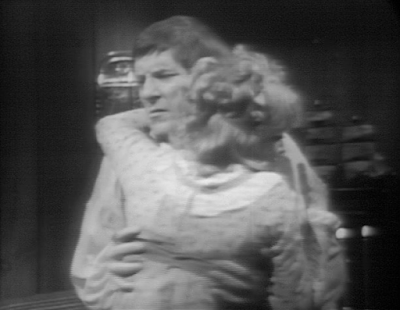
When Burke reaches them, David throws his arms around him and Barnabas squirms guiltily. Burke dislikes Barnabas, and gives him a suspicious look while he and David explain what has happened. When Burke says that there are people at home in the great house, David flashes a look of alarm at Barnabas. Barnabas says that no one had answered when he knocked on the door earlier, so he assumed everyone had joined the search. The two men take David home.

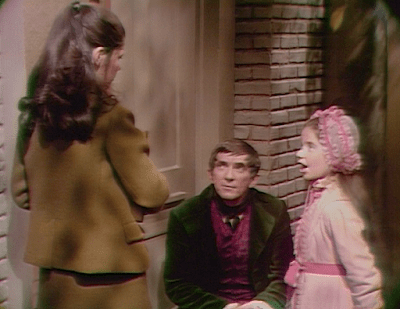
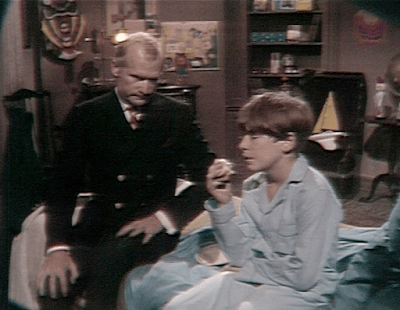
There, David eats a sandwich in his room while his father Roger asks him where he has been. This conversation is just magnificent. Roger is trying to be stern, but is such a flagrantly neglectful father that David knows full well that he can’t be bothered to punish him. So while Roger puts a series of pointed questions to him, David ignores him and muses aloud about Barnabas. “Barnabas is mysterious, isn’t he, Father?…You know, we don’t know anything about him. He just showed up one night.” Roger keeps urging David to forget about Barnabas and start answering his questions, but gets nowhere. Louis Edmonds and David Henesy were both talented comic actors, and they worked well together, so it’s no surprise this scene is laugh-out-loud funny.

Screenshot by Dark Shadows Before I Die.

Along with the comedy comes the thrill of a potential change in the show. In his post about this episode, Danny Horn writes: “It’s a great moment. It’s like the ‘logical explanation’ spell was suddenly broken, and David just realized how bizarre his life is.” The structure of Dark Shadows’ storylines has been that someone has a terrible secret, they are deep in denial about the extent to which the secret is deforming their lives, and when they finally let go of their secrets they are free. So matriarch Liz had a terrible secret that kept her from leaving her house for over eighteen years, she revealed the secret in #270, and now she’s happy to go anywhere. She’s on an extended visit to Boston at the moment. Roger had a secret connected with an incident for which Burke went to prison years ago and he spent all his time making a fool of himself as he struggled to keep it hidden; he admitted the truth in #201, and since then he has been a carefree fellow who can make anyone laugh. So the Collins family curse that Barnabas embodies is made up chiefly of denial, and it can be defeated by facing facts. If David has seen through all the lies and is willing to reckon with the truth, he has the power to bring everything to a conclusion. So when he says that Barnabas “just showed up one night,” we catch a glimpse of what it would be like if the entire series came to its ultimate climax.

We end with David still in his room, telling well-meaning governess Vicki that he feels someone evil is watching him. We cut to Barnabas in his own house, staring out the window at the great house in the distance, thinking his sinister thoughts. David’s feeling should be familiar to him- when his mother, undead fire witch Laura Murdoch Collins, was staying in the cottage in the estate, she often stared out her window and caused David to have nightmares.

Laura was a threat to David because the basic conditions of her existence drove to kill her son. Barnabas’ threat to him is a result of circumstances that were always likely to arise, but that might not have, and that might yet be changed. So when Laura was on the show, the suspense was how she would be destroyed before she could kill David. Now with Barnabas, there is a question whether he will try to kill David at all. So the suspense is more complicated, and there are more options for pacing. The plot doesn’t have to be either glacial or rapid, as it did with Laura, but can move at any of a variety of speeds depending on which of the many possible directions they decide to take the story.

Episode 312: Find the boy

Well-meaning governess Vicki and vampire Barnabas are on the terrace of the great house of Collinwood. Vicki’s charge, strange and troubled boy David, is missing, and she is upset. Vicki is weeping on Barnabas’ shoulder.

Heiress Carolyn and hardworking young fisherman Joe show up in the nick of time to prevent Barnabas biting Vicki and giving her a role in the main storyline. They report on their fruitless search for David. When they mention that David had been looking for mysterious girl Sarah, Barnabas becomes alarmed.

In recent episodes, many characters have been trying to find Sarah, in hopes that she will be able to tell them who abducted Maggie Evans, The Nicest Girl in Town. In two conversations about Sarah, Vicki has kept quiet about the fact that she saw a girl matching her description in Barnabas’ house. She is sure her friend Barnabas is innocent of any wrongdoing, and does not want anyone to suspect him in connection with what happened to Maggie. But her concern for David drives that thought out of her mind, and she tells Joe and Carolyn what she saw.

Meanwhile, Barnabas goes home and tells his sorely bedraggled blood thrall Willie that they must find David. Barnabas knows that Sarah is the ghost of his little sister, and he is afraid she may have told David that he is a vampire. When Willie asks what Barnabas will do if he finds David, Barnabas makes it clear that he plans to kill him.

David is about ten years old, and he is the last bearer of the Collins name. Dark Shadows fans sometimes ask what would happen if any of Barnabas’ plans had ever succeeded. I think his fell design for David answers that question- he would annihilate the Collins family and turn their estate into a hellscape cut off from the world of the living. In July of 1970, the show will give us an extended vision of what would happen were another supernatural menace to achieve that result. We will also get a glimpse of an alternate version of Barnabas driving towards the same objective when House of Dark Shadows hits theaters in October of 1970.

That was a possible outcome for a feature film, but a continuing series could hardly go down that road. And lately, Barnabas has seemed too harmless to bring it about. Even first-time viewers have already seen him fail to bite someone who was actively pressing her neck towards his fangs. So it doesn’t really seem that David is in all that much danger. Indeed, Barnabas is well on his way to becoming a comic villain. We see the action through his eyes as he scrambles to keep his lies in place, and see him devise one cockamamie scheme after another, all of which fall apart. He is something like Wile E. Coyote operating in extreme slow motion.

Before Barnabas and Willie can leave in search of David, there comes a knock at the front door. It is Joe and the sheriff asking to go through the place looking for David and Sarah. The episode becomes pure comedy from that point on. On his Dark Shadows Daybook, Patrick McCray analyzes it as situation comedy; on Dark Shadows Every Day, Danny Horn analyzes it as farce.

The sheriff asks to search Barnabas’ house. Screenshot by Dark Shadows Before I Die.

While Joe searches upstairs and the sheriff searches the main floor, Willie keeps jabbering about how awful it would be if they went into the basement, where they might discover Barnabas’ coffin. Barnabas keeps shushing him. Both Barnabas and Willie panic a little more visibly each time the rooster crows, reminding them that Barnabas is running out of time to get back into his coffin.

When Joe and the sheriff do ask Barnabas to unlock the basement door so they can search there, Barnabas is cornered into claiming that he lost the key. They are openly incredulous, and he squirms as he elaborates on his assertion. He gives even lamer excuses when Joe offers to break the door down and then repair it. Finally, Carolyn lets Barnabas off the hook when she comes running with word that a boy meeting David’s description has been seen on the beach. Joe and the sheriff rush out, just in time for Barnabas to find shelter from the sunrise.

Episode 305: I’m trying to be your friend

In a clearing in the woods, strange and troubled boy David Collins runs into his friend, the ghost of his distant cousin Sarah Collins. Sarah wants him to spend time with her, but he explains that he has to go and have dinner. Sarah persuades him to come with her to Eagle Hill cemetery, where she will show him a secret.

The secret turns out to be the hidden chamber inside the Tomb of the Collinses. David objects when Sarah tells him they will be opening the coffin there. His curiosity finally overcomes his scruples. He is shocked by what is inside, Sarah is pleased.

Screenshot by Dark Shadows Before I Die.

The whole interaction between Sarah and David is charming beyond words. At first she is lonely, and her simple rendition of this one emotion is sad enough to explain why David cannot stick with his resolution to get home in time for dinner. Once they are in the cemetery, she is brisk and commanding, insisting David open the door to the tomb, instructing him to release the secret panel inside, assuring him that it will be all right for him to stand on the sarcophagus of Naomi Collins* to reach the lever that controls the panel, directing him to open the coffin, and smiling when he does so.

Sarah shows such raw emotion in the scene in the woods and such verve in the cemetery sequence that I wonder if this may be the episode taped on the day of one of the more infamous moments in Dark Shadows history. Nine year old Sharon Smyth and eleven year old David Henesy would play on the set while the crew was preparing for taping. Mrs Sharon Smyth Lentz now tells the story that one day, they were playing hide-and-seek and she decided it would be a good idea to hide inside a coffin. She heard David Henesy approach the coffin, and just as she expected him to open it and find her inside, he jumped on top and sat there. She could hear the director calling out “We’re ready for Sharon! Where is Sharon?” but couldn’t open the lid of the coffin or make herself heard from within. Behind the scenes between Sarah and David C. may be a bit of unfinished business between Sharon and David H.**

There’s also some stuff in the Old House on the great estate of Collinwood. Vampire Barnabas Collins is feeling sick, and thinks it may be due to the efforts mad scientist Julia Hoffman is making to cure him of vampirism. He tells his sorely bedraggled blood thrall Willie to kill Julia if he suspects Julia is doing anything to harm him.

Barnabas also tells Willie that he is deeply worried about Sarah’s presence. He has no idea why she has come back or what she wants. Indeed, no one seems to know what Sarah is up to. David keeps complaining to her today of her mysteriousness, and everyone else who has mentioned her is full of unanswered questions. The audience hasn’t seen anything that would explain what she intends to do; it isn’t even clear that she has a plan. Whether she does or not, the writers are definitely making her story up as they go along. Which, oddly enough, turns out to be enormously compelling. The very wackiness of their improvisations gives us a feeling that Sarah really is a visitor from another plane of existence, one that does not follow any of the rules we expect to see in our daylight world.

Julia then comes in, and Barnabas tells her that he will kill her if the treatments do not work. She is irritated, and asks why he must continually pester her with death threats. Julia’s refusal to be frightened by Barnabas is so funny that the comedy must be intentional on the part of the actors and directors, if not of the writers.

*Her mother, as David doesn’t quite know. In the first year of the show, David had been on friendly terms with a number of the ghosts; as recently as #288, he wondered aloud if Sarah were a ghost. But now he seems to have forgotten all about the supernatural back-world of the action. In his post about this episode, Danny Horn writes that stripping David of his ghost-awareness just as Dark Shadows is going all-in on paranormal stories amounts to “grinding up his character for the sake of plot mechanics.” Considering that they are in the process of grinding several other characters up in the same way for the same short-sighted reason, it’s a worrying development.

**Mrs Lentz tells that story during this 2020 cast reunion.

Episode 278: If you become Josette

The first major villain on Dark Shadows was high-born ne’er-do-well Roger Collins, played by Louis Edmonds. Edmonds was a master of the sarcastic remark, so that Roger was often funny. But no matter how often he made the audience laugh, Roger was never a comic villain. That requires a character we can empathize with as we watch them scheme and plot, scramble and improvise, in pursuit of goals that could not be achieved without ruining all the fun. We laugh when we recognize our own foibles in an outlandish character, and laugh again when we realize that our ability to feel with others encompasses even those whose feelings have led them to do dastardly deeds.

Roger’s personality was too cold, his motives too contemptible for us to empathize with him. Where a comic villain thinks fast and puts himself in ridiculous situations, Roger stuck with his fixed ideas, using the same tactics time and again to bully his unwilling co-conspirator Sam to stick with their plan. Even when he bumbled about with a damning piece of evidence, a fountain pen left at a crime scene, he was never the coyote caught in his own over-elaborate trap, but a criminal in a police procedural. He was a melodramatic villain who was only incidentally funny.

The first supernatural menace on the show was Roger’s ex-wife, undead fire witch Laura Murdoch Collins, played by Diana Millay. Millay was hilarious, every bit as funny as Louis Edmonds. It was a shame the two of them didn’t play a married couple in a long-running comedy. They could have raised sarcasm to heights previously unknown to humankind. But while Millay gets laughs every time the script gives her the least chance, Laura was even less of a comic villain than Roger.

It is clear that Laura is a malign presence from beyond the grave and that, if she is not stopped, she will burn her young son David to death. But everything else about her is an impenetrable mystery. She is not part of a familiar mythology, and even the most basic questions about her remain unanswered. We cannot empathize with her motives, since we cannot begin to guess what her motives are or even be sure if she has motives.

The first comic villain on Dark Shadows was seagoing con man Jason McGuire, played by Dennis Patrick. Jason had his first comic turns only after he had been on the show for weeks, during which time we had been subjected to many iterations of a dreary ritual in which he made a demand of reclusive matriarch Liz, Liz resisted, he threatened to expose her terrible secret, and she capitulated. When his henchman Willie slips out of Jason’s control and he starts scrambling to contain the damage Willie is doing to his plan, Patrick finally gets a chance to play Jason as a comic villain, and the result is very engaging. But those scenes are scattered too thinly through Jason’s long-running, relentlessly monotonous storyline to make him a success as a comic villain.

Now, the show has struck gold. Vampire Barnabas Collins is becoming a pop culture phenomenon and bringing the show the first good ratings it has ever had. They have to keep Barnabas on the show indefinitely, and he has to be the most important character. That presents a practical difficulty. Vampires usually figure in folklore and fiction as unstoppable killing machines. Daytime soap operas explore the shifting relationships among large casts of characters. It’s going to be hard to maintain that cast if Barnabas sets about murdering everyone. To square the circle, they try to redefine Barnabas as a comic villain.

Barnabas is giving a costume party for his distant cousins, the living members of the Collins family. He has invited well-meaning governess Vicki to attend and to wear the dress of the legendary Josette Collins. In the first 39 weeks of Dark Shadows, Vicki had developed a close friendship with Josette’s ghost, so she is excited about this. For his part, Barnabas has borrowed an evil scheme from the 1932 film The Mummy. He will erase Vicki’s personality and replace it with Josette’s, then kill her so that she will rise as a vampiric Josette. So he is glad she likes the dress.

Barnabas asks Vicki to come to his house and help him pick out the antique clothes that the family will wear at the party. She enthusiastically agrees, saying that she loves to go through trunks full of old clothes. The clothes are in a trunk in Josette’s old room, which Barnabas has restored.

In the room, we see the ghost of Barnabas’ 9 year old sister Sarah sitting on the trunk. She vanishes a second before Barnabas and Vicki enter. Both of them have a strong feeling that someone just left the room. Barnabas tries to dismiss the sensation as nervousness, but Vicki has had too much experience with ghosts to be put off so easily.

Vicki has been our point of view character for most of the series. At first, that was because she was a newcomer to the great estate of Collinwood and the nearby town of Collinsport, and so we would learn everything we needed to know as we listened to people explain things to her. Later, it was because she was the key protagonist in the stories, so that the action got going once she knew what was going on. So when Barnabas equals Vicki’s sensitivity to Sarah’s presence, he is presented to us as another possible point of view character.

Barnabas keeps talking about the Collinses’ eighteenth century ancestors in terms that make it obvious that he knew them, so that he more than once has to clean up after himself with remarks like “I would imagine.” He does alarm Vicki when he blurts out something about what will happen to her should she “become Josette.” He hastens to say that he means that Vicki will become her for the duration of the party.

“Become Josette?”

Vicki goes back to the great house and talks with Liz about the party. Liz smiles happily, the first time we’ve seen this expression on her face in the whole run of the series.

Happy Liz

Vicki goes on about Barnabas’ connection to the past, saying that he gives the impression of someone who really is misplaced in time. She has the feeling that he needs to recreate a bygone era, and that he is doomed to be unhappy because of the impossibility of traveling backward in time. Vicki does not know what Barnabas’ plans for her are, but she understands his motives perfectly and empathizes with him deeply. That Vicki, Barnabas’ intended victim, can feel this way suggests that we can, too.

Back in Barnabas’ house, Sarah reappears in Josette’s room and sees her blue dress. She is excited to find it. She looks at her reflection in the mirror and smiles. Her good cheer is emphasized when her musical cue, an excerpt from “London Bridge,” is for the first time played in a major key.

Sarah’s reflection looks like it has never seen a ghost before

The minor key was appropriate during Sarah’s previous appearances. The first several times we saw her, Sarah was associated with Barnabas’ imprisonment of Maggie Evans, The Nicest Girl in Town. Maggie was the victim of Barnabas’ first mad attempt at Josettery, and Sarah intervened just in time to keep Barnabas from killing her. The other day, Barnabas killed Jason, and we saw Sarah when Barnabas was forcing Willie to help him hide his old friend’s corpse. Barnabas isn’t killing anyone today, so Sarah can be a bit more cheerful.

Sarah helps to establish Barnabas as a comic villain. As the ghostly sister who returned to the upper world when Barnabas was loosed to prey upon the living, Sarah and he are part of the same eruption from Dark Shadows‘ supernatural back-world into its main continuity. Perhaps she personifies his conscience, certainly she gives him an occasion to make schmaltzy speeches about his days as a human. More important than either of these, when we see that Barnabas’ 9 year old sister is his most powerful adversary, we begin to wonder just how seriously we should take him.

Closing Miscellany

Yesterday and today, Alexandra Moltke Isles delivered the recorded voiceover monologue at the beginning of the episode. The first 270 times she did this, it was in character as Vicki. Now, they’ve given up the idea that Vicki or any other one character will eventually find out about everything that we see on screen, so the openings are delivered by whatever actress is available as a nameless external narrator.

In those first 270 outings, Mrs Isles sounded like Vicki. She adopted Vicki’s distinctive way of speaking, carefully articulating one word at a time and often ending sentences with surprising little inflections- a curl of uncertainty here, a touch of breathy optimism there, a falling note of despair in another place. The voiceovers were usually remarks about the weather or the sea that were supposed to involve some vague metaphor for events in the story, so that it is open to question whether it was really worth Mrs Isles’ time to put so much effort into creating a character with them. But I guess a pro is a pro, and it was a matter of course that she would do her best no matter how little she had to work with.

In these last two, she has used a relatively flat voice, with none of Vicki’s particular vocal traits. The pacing has been structured, not around sentences, but around an attempt to convey an overall sense of urgency. They sound very much like The Narrator. I wonder what Mrs Isles would have made of The Narrator if the voiceover passages had extended beyond the opening moments and run through the episodes.

There is a famous production error under the closing credits, when a stagehand shows up in the window, realizes he’s on camera, and makes himself all the more conspicuous when he tries to escape from his predicament.

From PostImages

Episode 258: Secret friend

Maggie Evans, The Nicest Girl in Town, is giving up hope. Vampire Barnabas Collins locked her up in the jail cell in the basement of his house some time ago, and everyone she knows is coming to believe that she is dead.

The other day, a little girl in eighteenth century clothing appeared outside Maggie’s cell. The girl did not respond when Maggie tried to get her attention, nor did Barnabas’ sorely bedraggled blood thrall, Willie, see her when she walked past him. Only on her second or third visit to Maggie did the girl interact with her, and then only to warn her not to tell her big brother that she had seen her. Maggie suspects that the girl was a hallucination of hers.

We know that the girl is real, because we saw her interacting with someone else. Outside Barnabas’ house, the girl talked with strange and troubled boy David Collins and played catch with him. If we’ve been watching the show from the beginning, we also know that there are many ghosts in and around Barnabas’ house, and that they have a special rapport with David. Further, this girl gives her name as Sarah and says that everyone she knows went away a long time ago. We’ve been told that Barnabas had a sister named Sarah who died in childhood, so we know that Sarah is the ghost of that sister.

Today, the girl appears to Maggie again. This time she shows up in the cell itself. At first, she tosses her ball in the air, sings “London Bridge,” and ignores Maggie’s repeated questions. Eighteenth century kids didn’t have mobile phones, apparently they had to resort to a ball and “London Bridge” when they wanted to tune out the grownups. Sarah finally comes around when Maggie puts her hand on her shoulder.

Sarah explains that she came because Maggie was crying. She asks what Maggie is sad about, which Maggie doesn’t try to explain.

Sarah won’t answer many of Maggie’s questions. Sarah says that she has been looking for her parents, and she is puzzled as to where they and everyone else have gone. She says she does have one friend. If that is a reference to David, it would show that Sarah can learn information during one apparition and retain it during subsequent apparitions. It is unclear whether she knows that she is a ghost, and her understanding of Maggie’s situation is remarkably slight.

Maggie and Sarah play catch and sing “London Bridge” together. Sarah vanishes a moment before Barnabas arrives. Maggie reacts to him with terror, but when it becomes clear that he isn’t planning to kill her right away her excitement at Sarah’s visit comes bursting out. She tells him that she has a secret friend who visits her in her cell and plays with her. When he asks what she’s talking about, she tells him it’s a secret. She babbles in a gleeful, childlike way.

Barnabas reacts to this with discomfort. He keeps his eyes on Maggie and edges away from her, speaking to her in a pitying tone. Bleak as Maggie’s situation is, this is a laugh-out-loud moment- she’s become too weird for Barnabas.

Maggie weirds Barnabas out

Upstairs, Barnabas tells Willie that Maggie isn’t working out. In a moment of wild hope, Willie asks if that means he’ll let her go. Barnabas sourly replies that of course it does not mean that- they will have to kill her. His plan is to kill her in such a way that no trace of her will ever be found, “because there will be no trace.”

Willie takes a meal to Maggie and demands she stop pretending to be crazy. It isn’t helping her, he says. She denies that she is doing any such thing, and babbles cheerfully that “I do whatever anyone tells me to do.” Willie leans in, putting his face close to hers, and screams and shouts that she has to be her usual self if she is to have any chance of survival.

After Willie leaves, Maggie starts crying again and telling herself that there is no little girl. But then she looks at the floor and finds a doll Sarah left behind. Maggie smiles, knowing that her secret friend does exist.

Maggie’s mad scenes are fascinating. Even though she believes that Sarah is real and we know she is right, seeing Sarah has the same effect on Maggie a psychotic break might have. It takes her out of the reality that she shares with Barnabas and Willie, and gives her an affect that is neither continuous with her usual personality nor intelligible to them.

The three adult actors are all on the top of their form today, just superb. Nowadays, when Sharon Smyth Lentz describes her performance as Sarah, she says that “The first word that comes to mind is ‘clueless.’” But that works out surprisingly well. We know so little about what, if anything, is going on in Sarah’s mind that the keynotes of the performance would have to be “lost,” “confused,” and “vague,” and she had those three things down pat. Things sometimes get rocky when Sarah has a long stretch of dialogue or when multiple actors are moving at the same time, but neither of those is a problem today.

Joe Caldwell started making uncredited contributions to the writing of Dark Shadows early in 1967, and I am tempted to attribute every good thing in a script by Malcolm Marmorstein to him. But Caldwell’s name is showing up in the credits now, and this episode is excellent. So maybe Marmorstein could rise to an occasion every now and then.

My wife, Mrs Acilius, points out that this is the first episode set entirely in the Old House.

Episode 257: If you feel it, sit it

For almost 13 weeks, seagoing con man Jason McGuire (Dennis Patrick) has been blackmailing reclusive matriarch Liz (Joan Bennett.) Time and again, Liz has capitulated to Jason’s demands lest he reveal that she murdered her husband Paul Stoddard 18 years ago and he buried Stoddard in the basement. When Liz gave in to Jason’s demand that she marry him, her daughter Carolyn (Nancy Barrett) vowed to prevent the marriage.

Today, it looks like Carolyn may have found a way to fulfill that vow. She has announced her engagement to motorcycle enthusiast Buzz (Michael Hadge,) whom Liz cannot stand. Liz considers going to the police to keep from gaining Buzz as a son-in-law.

We spend the first half of the episode in the great house of Collinwood. Buzz has come to see Carolyn. The opening sets up a charge of comic energy that raises our hopes for another installment as funny as Buzz’ first star turn in #254. Buzz knocks on the front door, Liz opens it, and greets him with a disgusted “Oh.” She closes the door in his face, then goes inside to tell Carolyn that he is there. Carolyn goes out to meet Buzz, who is smoking a large cigar.* They kiss, and Carolyn lets Buzz in. He takes a seat on the staircase.

Buzz on the stairs

Instead of building on the comic potential Buzz brings with him, we then grind to a halt with a Buzzless scene in the drawing room. Carolyn recites teen-rebel cliches at Liz, punctuating her dreary lines with a few random pokes at the piano. Nancy Barrett’s all-in style of acting often exposes values that another performer might have left buried in the script, but when the writing is as tired as this not even she can dig up anything interesting.

Carolyn chose Buzz to mock her mother’s relationship with Jason. She defies Liz to find a reason for regarding Buzz as an unsuitable partner for her that would not cut at least as strongly against Jason. Buzz mirrors Jason in another way so far as the audience is concerned. Dennis Patrick was a gifted comic actor, and Jason is appealing when he gets to be a comedy villain. But most of the time he is stuck repeating the same deadly dull threat to Liz time and again.

Buzz is a villain only in Liz’ imagination, but he is funny all the time. His incongruity with everything else on Dark Shadows automatically produces a laugh whenever he is on screen. Michael Hadge’s near-total incompetence as an actor limits Buzz’ future on the show sharply, but within those limits he’s irresistible.

Jason comes down the stairs and finds Buzz blocking his way. They have a little confrontation which Jason wins by threatening to break Buzz’ shin. Not even Dennis Patrick can make that funny.

We are subjected to a second Buzzless scene in the drawing room. Liz tells Jason that she has yielded to his demands because she was afraid the truth would ruin Carolyn’s life. If Carolyn’s life is going to be ruined anyway, there is no point- she will just go to the sheriff and have done with it. Joan Bennett does have a couple of moments in this scene when she seems like she is about to get some comedy going, but the somber Dark Shadows musical cues ring out and darken the mood before Patrick has a chance to respond.

Jason goes to Carolyn’s room to try to talk her out of marrying Buzz. Since Carolyn’s whole motivation is her hatred for Jason, we may wonder what influence he has that will enable him to do this. It quickly becomes clear that he has none. This is followed by another scene between Liz and Jason in the drawing room. Liz tells Jason that it was obvious to her all along that his talk with Carolyn would produce no results. That is to say, we have a scene the point of which is to explicitly acknowledge that the preceding scene was a waste of time.

The second half is set in the Blue Whale tavern. Buzz and Carolyn are there on a date, and Jason comes to try to bribe Buzz into leaving her. The musical score behind this part comes from the jukebox. That music is much more suitable for comedy than is the heavily melodramatic stuff we hear when the action is taking place at Collinwood.

When we get to the tavern, Carolyn and Buzz are dancing. As a true Collinsporter, Carolyn’s style of dance consists of thrashing about as if she’d had a brain injury. Buzz, by contrast, moves quite gracefully. He must be from out of town.

Carolyn does the Collinsport Convulsion, while Buzz executes a fine Beer Stein Shuffle

Carolyn is in the ladies’ room when Jason shows up. He asks to join Buzz at their table. Buzz replies with that rallying cry of the 60s counterculture, “If you feel it… sit it!” I can only wish that had been the title of a spinoff of Dark Shadows featuring Buzz, it would have been great.

Buzz’ back is to the camera while he delivers his immortal line

Buzz tells Jason that Carolyn is from a family that “makes a lot of noise,” while he is from a family that “makes a lot of money.” Then he laughs. Buzz was credited as “Buzz Hackett” in his first appearance in #252, and is credited that way again today; in #254, he was credited simply as “Buzz.” We never hear him called “Hackett.” In #223, we’d heard about an unscrupulous local businessman called Hackett, but Buzz made a laughing reference to his lifelong poverty in #252, so I don’t think we can suppose he really is from a family that makes a lot of money. In view of Buzz’ laugh, the likeliest explanation is that this is a joke of some kind. A confusing joke, poorly told, but considering that it is a line written by Malcolm Marmorstein and delivered by Michael Hadge, that is to be expected.

Jason tells Buzz that Carolyn is using him to get back at her mother. Buzz blandly replies that Carolyn has told him all about that, and he’s having a great time with her whatever her intentions. This is reminiscent of the relationship between Carolyn and dashing action hero Burke Devlin in the early months of the show. Carolyn continued seeing Burke even after he tacitly admitted that he was using her to pursue revenge on her family. After Burke renounced his revenge, they met at this same table and had a soulful conversation about what they had been to each other (#213.)

Jason offers to buy Buzz a new motorcycle if he will stop seeing Carolyn. Buzz flatly refuses the offer, declaring “I like the bike I got, and the chick I got!” Carolyn returns to the table, and Buzz tells her about Jason’s attempt to bribe him. They laugh at Jason and leave the tavern. He staggers into a corner, looking bitter.

Laughing at Jason

This also harks back to an incident involving Burke in the early days of the show. In #3, Burke met hardworking young fisherman Joe in the tavern. Joe was at that point dating Carolyn. Burke offered to buy a fishing boat for Joe if he would spy on her family. Joe refused, and reported the contact to Liz. While Buzz is Joe’s opposite in many ways, regular viewers will see that the two men are equally honest.

*It appears to be a robusto, though it could be a corona gorda.

Buzz and his stogie

Episode 254: As much fun as a bag of spiders

Reclusive matriarch Liz and well-meaning governess Vicki are in the drawing room of the great house of Collinwood. Liz is depressed because her daughter Carolyn is dating motorcycle enthusiast Buzz. She asks Vicki if she has any idea how to break Carolyn and Buzz up, then answers her own question. Liz knows that Carolyn is protesting her engagement to seagoing con man Jason McGuire, and that only by breaking it off with Jason can she change things with Carolyn.

When Liz claims that she is marrying Jason because she wants to, Vicki says it’s none of her business. Vicki has seen abundant evidence that Jason is blackmailing Liz, and won’t pretend she hasn’t. She manages to be quite respectful to her employer without backing down an inch. Despite herself, Liz is impressed with Vicki’s firmness and diplomacy.

Alexandra Moltke Isles was cast as Vicki because she and Joan Bennett looked so much alike, and this is one of the scenes that uses their resemblance to show Vicki as a reflection of Liz. As Vicki is finding tactful ways to express her suspicions, she says things that we have heard Liz say and that we know she is thinking. Each time she does so, Joan Bennett does a quarter turn one direction from the shoulders and a quarter turn the other direction from the neck, as if she were being twisted open. When Liz tells Vicki to stop, she calls her “Victoria,” a name we haven’t heard her use since 1966, and when Vicki asks permission to leave the room she responds, in a near-whisper, with the usual “Vicki.” This alternation also suggests twisting, and to regular viewers who remember that Liz has a secret connected with the fact that “Her name is Victoria” it is another twisting open.

Meanwhile, Jason is entering the Blue Whale tavern with his former henchman, Willie Loomis. Jason wants to confront Willie with the fact that he saw him in town earlier in the day selling a piece of jewelry. Willie says that he was selling it on behalf of his employer, wealthy eccentric Barnabas Collins. Jason knows of Willie’s obsessive fascination with jewels and his tendency to steal them, and does not believe that Barnabas would entrust him with such a task. What Jason does not know is that Barnabas is a vampire and Willie is his sorely bedraggled blood-thrall. As such, Barnabas has a power over Willie that makes it rational to entrust the most remarkable tasks to him.

Carolyn and Buzz enter. They almost leave when Carolyn sees Jason and Willie. Jason and Willie rise and meet them at the door. Jason assures Carolyn that they were just going. Before they do, he taunts Carolyn with his engagement to Liz.

On Tuesday, Carolyn and Buzz started dancing together in the drawing room. Buzz made a few very graceful moves, saw Carolyn going into the Collinsport Convulsion, and sat down to observe. Today, Buzz sees two background players twitching awkwardly while the jukebox plays and declines Carolyn’s invitation to join her on the dance floor. He wants to stop drinking, saying that he is looking for something that will make him feel like he’s never lived before, while “drinking only makes you feel drunk.” It sounds a little bit like he’s going to offer Carolyn a drug stronger than alcohol, but by the end of the scene he just wants to get back on his bike. Liz’ fears to the contrary, Buzz seems pretty darned wholesome.

While Carolyn and Buzz are on their way out of the tavern, hardworking young fisherman Joe comes in. Carolyn asks Buzz to wait outside while she talks with Joe. Buzz reluctantly agrees to spend a few minutes alone with his bike.

Carolyn and Joe were dating when the show started, and there was a whole storyline about how they were tired of each other and couldn’t get themselves sufficiently organized to break up. Their scenes together reminded us that the 1960s were the decade in which Michelangelo Antonioni used the cinema to explore the nature and significance of boredom.

But they are far from boring today. After he and Carolyn finally called it quits, Joe started seeing Maggie Evans, The Nicest Girl in Town. Maggie is now missing and feared dead. Carolyn sits next to Joe at the bar and expresses her sympathies. When I say that Nancy Barrett’s acting style was to throw herself unreservedly into whatever the script gave her character to do that day, it may sound like I’m saying she was undisciplined or that she lacked subtlety. That is not at all what I mean, and in this scene she does one of the most delicate drunk acts I’ve ever seen. Carolyn sits a fraction of an inch too close to Joe, tilts her head back a fraction of a degree too far, opens her eyes the tiniest bit too wide, and speaks ever so slightly too slowly. No one of those signs would even be noticeable by itself, but together they make it very clear why Buzz was anxious that he and Carolyn should leave their drinks unfinished.

Back in the drawing room, Jason is badgering Liz into setting the date for their wedding. Carolyn and Buzz come back, and Jason tells them he and Liz will be married two weeks from tonight. Carolyn says that she and Buzz ought to get married the same night. Buzz is delighted when she first says this, and is still smiling when she insists she is being serious.

Buzz delighted with Carolyn’s proposal.
Screenshot by Dark Shadows Before I Die

My wife, Mrs Acilius, urged me to call this one “A piece of that action,” something Jason says to Willie. Trekkie that she is, that seemed irresistible to her. But Joe’s line that Buzz seems to be “about as much fun as a bag of spiders” is the funniest of the many witty lines in today’s script, and when you remember that Dark Shadows has, since December of 1966, been basically a horror story, you have to think that in its terms a bag of spiders might be a lot of fun. So that had to be the title.

Episode 253: Ring cycle

Vampire Barnabas Collins is keeping Maggie Evans, The Nicest Girl in Town, in a prison cell in his basement. He won’t let her out until she discards her personality and adopts that of his long-lost love Josette. That would seem to rule Maggie out as a source of plot development for quite some time.

Writer Joe Caldwell knew that he was not the first dramatist to have to tell a story in which one of the main female characters is cooped up. In ancient Athens, women of citizen rank were supposed to be immured in the house, hidden away from all men outside their immediate families. While the reality was a great deal more complicated, audiences at the city’s dramatic festivals liked to see plays set in a world that approximated that ideal. So tragedians like Euripides, and after him the Greek and Roman playwrights of the New Comedy, devised a whole repertoire of ways that ladies could send messages to their boyfriends without leaving home.

One of the most prominent of these methods was the dispatch of an identifiable token by a household servant. Since many people, both men and women, wore rings with unique decorations, rings were very often used for this purpose. In plays where the heroine has been captured by pirates and is being held prisoner by someone to whom the pirates made a gift of her, as in Plautus’ Miles Gloriosus (sometimes translated into English as The Swaggering Soldier,) the heroine and her accomplices will use the villain’s greed or that of his servant to trick them into taking a valuable ring and showing it to someone who will be able to help her. Plautus would have been relatively familiar to audiences in 1967, and very much front-of-mind for the Broadway-oriented people involved in making Dark Shadows, because of the success of the 1962 show A Funny Thing Happened on the Way to the Forum and its 1966 film version, both of which end with a recognition prompted by the sight of an unusual ring.

Maggie doesn’t seem to be up on her New Comedy. In the first part of the episode, she asks Barnabas to take her ring to her father to let him know she is still alive. Barnabas is insulted that she would think he was dumb enough to do that.

There is some good dialogue in this scene, and Kathryn Leigh Scott and Jonathan Frid are always fun to watch together, but we have to share Barnabas’ reaction. Until today, Maggie had been one of the few characters on the show who had never done or said anything inexplicably stupid, and asking Barnabas to give her father the ring breaks that streak. Barnabas’ complaint lampshades the problem, which does help a bit- it gives us time to think that maybe Maggie is trying to distract Barnabas from another plan she is cooking up, or maybe the script is telling us that she is so desperate she doesn’t know what she’s doing.

Later, Barnabas’ sorely-bedraggled blood thrall Willie Loomis comes to check in on Maggie. Willie is so obsessed with jewels that when Maggie offered him a diamond necklace on Friday, he turned his back on Barnabas’ coffin while she stood there preparing to stab him through the heart. Maggie persuades Willie to take her ring as a token of her gratitude for keeping Barnabas from killing her on Monday. That marks a good recovery from the earlier dumbness, and gets us off to a fresh start.

Strange and troubled boy David Collins sneaks into Barnabas’ house through an unlocked window. He often visited the house in the months before Barnabas was introduced to Dark Shadows, when the ghost of Josette was the principal supernatural presence on the show and the house was her stronghold. David can’t feel her presence there now, and calls for her forlornly as he wanders through the front parlor.

Willie catches David and demands to know why he is in the house. David tries to defend his indefensible behavior, and when that fails he goes on the attack. He says that he knows what Barnabas and Willie are doing. Willie tenses and asks what it is they are doing. David says they are hurting Josette. Willie listens until he is sure that David is talking only about the ghost, not about Maggie. Then he picks David up and throws him out the front door. There is so much hilarious stuff in this part that not even the bit in the middle when Willie briefly thinks he may have to murder David dampens the mood.

Willie picks David up…
…and throws him down.

In the course of bodily ejecting David from the house, Willie drops the ring. David finds it on the ground while he is getting back onto his feet. He calls to Willie and tries to return the ring, but Willie has already locked the door and will give no response but shouts of “Go away!” David takes a good long look at the ring and goes home to the great house of Collinwood.

Well-meaning governess Vicki greets him there, scolding him for having gone so far from the house. She notices the ring in his hand. This moment comes straight out of ancient comedy- David’s clothes have pockets, after all, but this scene is written for an actor wearing a pallium and a terracotta mask. David won’t tell Vicki where he found the ring, and she examines it. She has seen that there is an inscription in it and is just about able to read it when a knock comes at the door.

It is Barnabas. He tells David that he wants to apologize for Willie’s forcible ejection of him from his house. Vicki turns to David and asks if that’s where he was. The boy has little choice but to admit it, and suggests that the ghost of Josette invited him. Vicki asks if he found the ring at Barnabas’ house. Barnabas, startled by the mention of a ring, asks to see it. He claims that it is a family heirloom which he gave Willie to sell. He takes it, and in a genial voice suggests David steer clear of Willie.

Back home, Barnabas returns to Maggie’s cell. She pretends to be coming around to believing that she is Josette. Barnabas shows her the ring and shatters her hopes. He leaves. Rather than end the episode with a shot of her staring helpless through the barred door, we follow Maggie into the cell and see her slam shut the lid of Josette’s music box. We see her thwarted, but no less able to take action than she was when we began.

Caldwell deserves credit for a fine script, aside from the awkwardness in Maggie’s early scene with Barnabas. Director John Sedwick keeps it looking clean and crisp, and the final shot of Maggie in her cell is a triumph of timing. Best of all, the actors all liked each other and were having fun working together today, and that gives an irresistible energy to the finished product. The result is the fourteenth episode, and the first since #182 early in March, that I would label “Genuinely Good.”