
Wedding Day
On Dark Shadows, weddings are usually stopped when one of the couple makes a decision in the middle of the ceremony that leads to the exhumation of an empty coffin. In #270, the first wedding followed that pattern, when instead of saying her vows matriarch Elizabeth Collins Stoddard announced that she and her intended, seagoing con man Jason McGuire, had killed her first husband, Paul Stoddard. That led the sheriff to dig up the spot in the basement of the great house of Collinwood where Liz said Jason had buried Paul, only to discover an empty box. It turned out Paul wasn’t dead at all.
The next wedding we saw was in #397, set in the year 1796. Scion Barnabas Collins and wicked witch Angelique Bouchard managed to get through the ceremony, but before the night was out Angelique had been abducted by the late Jeremiah Collins, whom she had raised from the dead as a zombie. Jeremiah dug up his own grave, opened his empty coffin, and put Angelique in it.
In #625, well-meaning governess Vicki was supposed to marry an unpleasant man known variously as Peter and Jeff. Peter/ Jeff left the ceremony to dig up another grave, and find another empty coffin.
For sixteen weeks, Dark Shadows was dominated by an effort to take some themes from the tales of H. P. Lovecraft and build them into a story. We kept hearing about the Leviathan People, a race of Elder Gods who were trying to retake the Earth and destroy humankind. The Leviathan material never coalesced into a story, and they gave up on it last week.
The last event in the Leviathan segment was an attempted wedding between Liz’ daughter Carolyn and someone who appears to be a very tall young man, but is in fact a shape-shifting creature from beyond space and time. When he first assumed the form of the tall young man, the creature asked people to call him Jabe. That didn’t come off, so he answers to “Jeb” instead. The Leviathan plan has always called for Jabe to join himself with Carolyn in an unholy ceremony that would cause her to become the same sort of creature he is, and last Friday they stood by an altar in the woods while Nicholas Blair, the high priest of a cult devoted to the service of the Leviathans’ project, called on Jabe to take his place behind the altar. There, Jabe deviated from the rubrics of the ceremony. He smashed a small wooden box and called for Barnabas to rescue Carolyn. The wooden box was empty, but it was not exactly a coffin- it was the matrix from which Jabe first emerged, four months ago, when he was nothing more than a whistling.
After their traditional Collinwood non-wedding in #625, Vicki and Peter/ Jeff had a second ceremony in #637. They completed it, but shortly afterward the supernatural powers that allowed Peter/ Jeff to exist in the 1960s lost their grip and he vanished into a rift in time and space. Today Jabe and Carolyn also complete a second ceremony, but it seems their marriage is approaching a similar crisis. When Jabe smashed the box, Nicholas told him that his humanoid appearance was all that was left of him, and that it was only a projection from a true form that was destroyed with the box. He could not continue to exist as Jabe for very long. As Peter/ Jeff prolonged his time in the 1960s by force of will, Jabe has prolonged his own existence beyond what Nicholas had thought possible, but returning viewers will still expect him to vanish at any moment.
Moreover, Jabe has made many powerful enemies. One of them is Angelique. She has taken a cue from George MacDonald’s 1858 novel Phantastes and plagued him with a shadow that he does not cast but that follows him about. The shadow menaces Jabe a couple of times today, and each time it prompts him to shriek to Carolyn that they must flee. Since he won’t explain to her what is going on, we can only wonder if he will meet his demise before she concludes that he is an abject lunatic and files for an annulment.
Meanwhile, Barnabas and his friend, mad scientist Julia Hoffman, are on a vampire hunt. Barnabas is a vampire himself; Angelique turned him into one when their marriage didn’t work out, Julia and another mad scientist cured him of the effects of that curse in 1968, and then Jabe placed another vampire curse on him more recently. Barnabas has bitten a woman named Megan Todd and accidentally turned her into a vampire. One of Megan’s victims, a man named Sky Rumson, tips Barnabas and Julia off that her coffin is hidden somewhere in the long-disused east wing of the great house. Barnabas conducts a search there while Julia goes with Liz to inspect the carriage house on the estate, where Jabe has been staying.
In the first months of the show, they went back and forth on whether the great house had a vacant west wing or a vacant east wing. They eventually settled on a west wing, and the west wing was an important locale at various points. Once in a while actors would slip and refer to an east wing. It was not until #648 that the show made it unequivocally clear that the house had both east and west wings, and not until #760 that we had a look inside the east wing. This is the first reference to it since then.
Barnabas is walking through a dark, dusty corridor, thinking that no one had been down it in “years.” Double doors open, and Barnabas sees a fully furnished, brightly lit room. He tries to enter, and suddenly turns into a mime struggling to escape from an invisible cage. He sees a framed photograph on a table in the room. The photograph appears to show his distant cousin Quentin sitting next to Liz’ nephew, strange and troubled boy David. It is signed “Your loving husband, Quentin.” Barnabas knows that Quentin and David have not been photographed together, and Quentin’s only marriage ended when he murdered his wife long before David was born, so neither the photograph nor the writing on it make any sense to him.
Barnabas sees Liz enter the room from a doorway on the other side. She is wearing a completely different outfit than she had on when Barnabas saw her shortly before. She does not see Barnabas or hear him, even though he is standing only a few feet away and calling out to her. She opens a closet and examines some clothes.
Julia enters, wearing a French maid outfit. She demands to know what Liz is doing. Since Barnabas knows Liz as the owner of Collinwood and Julia as a houseguest there, albeit one of unlimited tenure and an overpowering nature, her tone is as inexplicable as her attire. She orders Liz to leave the clothes alone. They argue about a person to whom they refer only as “she.” Liz says that “she” is dead, Julia insists that “she” will return. Liz wants to prepare the room for someone else’s use, Julia declares that only “she” will ever possess it.
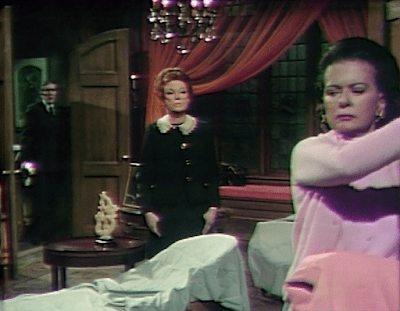
The doors close. Barnabas cries out to Liz and Julia. He opens the doors again, only to find that the room is entirely bare. It has no furniture, no carpeting, no lights, no decoration of any kind. It is as dark and as dusty as the rest of the east wing, and appears to have been unvisited for as long.
Barnabas returns to the main part of the house. He sees Liz and Julia returning through the front door, dressed as they had been before they left for the carriage house and talking to each other in the same relaxed, friendly manner. Flummoxed, he asks Julia if they went anywhere other than the carriage house. She says they did not. He tells her he did not find Megan’s coffin, and tries to explain what he did in fact see.
The Man Who Wasn’t There
It would seem that whatever phenomenon Barnabas is seeing when he looks into this room is going to mark the beginning of the next phase of Dark Shadows. When Jabe smashed the box, he ended the Lovecraft segment. But the show had not set up any story to follow it. For the last few days, we’ve passed the time watching him and some other characters left over from it flounder about helplessly. Peter/ Jeff’s ghost showed up and claimed to have a grudge against Jabe that dated from the 1790s. Since Jabe did not exist in those days, I suspect the tale Peter/ Jeff tells is a remnant of some story they planned long ago but never developed, with Jabe hastily put in the place of some character they projected but did not introduce.
I’m not sure what the untold story and never-introduced character were, but there may be a clue in this episode. Sky Rumson was at one point under the power of the Leviathans. Barnabas tells Sky that Jabe has smashed the box and everyone is now free of their power, which fits with what we have seen and with what Nicholas told his henchman Bruno. Sky is indeed disconnected from the Leviathans- he now figures only as Megan’s victim. But for no reason that has to do with today’s events, he denies that and says “My deal was with Mr Strak.”
In #899 and #900, there was a flashback to the year 1949. We saw that Paul Stoddard unwittingly sold his daughter Carolyn to the Leviathans that year, and that their agent was a Mr Strak. Strak was played by John Harkins, who had played a monster in several episodes not long before. The whole point of Strak as a character seemed to be that he was someone Paul could never find again, so that he was entirely helpless in the face of the deal he had struck. The casting of Hankins reinforced that for viewers who recognized him, since he was pretty obviously there to use up the last two episodes on his contract. It would seem to defeat the purpose to bring his name up again, yet Sky’s reference to Strak marks the second time we have heard his name recently. Doomed Leviathan cultist Nelle Gunston told Barnabas in #951 that Strak had recruited Bruno.
Nicholas’ association with the Leviathans is also hard to explain. He was on the show in 1968 as Angelique’s boss. At that time the show was taking a peculiar sort of Christian turn, and it was very clear that Nicholas was in the employ of Satan. Indeed, just last week he invoked Satan at the ceremony to join Carolyn and Jabe. But the Leviathans are rooted in Lovecraft’s resolutely non-Christian cosmology, and when Jabe himself performed an incantation to raise some dead men to serve him as zombies he called upon multiple “gods of the underworld,” not Satan. Moreover, we know that Nicholas was at Collinwood in 1968, and Nicholas tells Jabe that he has been confined to the underworld since then. It is therefore nonsensical when Sky treats Nicholas as his long-established supervisor in the Leviathan cult.
I suspect that Nicholas’ role, the references to Strak, and Peter/ Jeff’s complaint against Jabe are all traces of a single never-introduced character. They may have intended, in the early stages of planning the Leviathan segment, to bring in a second Leviathan, one who had been lurking on the Earth for a long time and had great powers, though he could not fill Jabe’s intended place as harbinger of the new age. This projected character would have been the main villain of the second half of the Leviathan segment, which would have involved another trip in time back to the late eighteenth century. When the ratings sagged, they often scrapped a lot of what they had written and everything they had planned to get to something fresh. Since the Leviathan segment was a flop, it certainly would not be surprising if they had chucked that new villain, along with the second half of the Leviathan segment and its time-travel story, plugging in Nicholas, the references to Strak, and Peter/Jeff’s complaint to Jabe to cover what they tore out.
Closing Miscellany
The clergyman who marries Jabe and Carolyn is called “the Reverend Brand.” The clergyman who married Barnabas and Angelique in 1796 was called “the Reverend Bland.” Those names are similar enough that I have to suppose there was some point to it. Perhaps an inside joke between writers Gordon Russell and Sam Hall.
The show has been ambiguous about the Collinses’ precise religious affiliation. In the 1790s, we saw that repressed spinster Abigail Collins was a very extreme sort of Congregationalist, but the other members of the family pointedly referred to “Cousin Abigail’s religion” as one of the things that set her apart from the rest of the family. As the name suggests, Congregationalists vary quite a bit from place to place, so the other Collinses’ differences with Abigail do not mean that they were not of that tradition in the 1790s. As upper crust New Englanders of an early vintage, they would likely have been Congregationalists at some point, though by the 1790s, they may well have been Unitarians or Presbyterians. By the 1960s they could have been just about any kind of Protestant without occasioning comment. Today, Liz mentions that the Reverend Brand has a “vestry meeting” to attend. Only Anglicans call the lay leadership of their parishes a “vestry,” and the only Anglican denomination the Collinses could plausibly have belonged to in 1970 was The Episcopal Church.
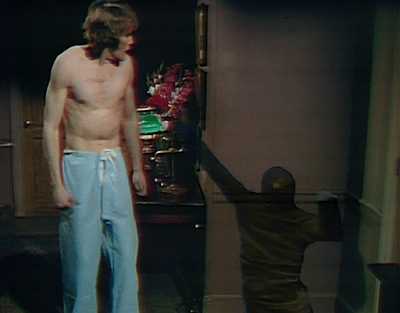
We see Jabe and Carolyn asleep in bed together on their wedding night. This is the first time we see a couple sharing a bed on Dark Shadows. What’s more, while most sleepers we have seen have been fully clothed under their bedsheets, even wearing shoes, Jabe is wearing only pajama bottoms, and those are tugged down noticeably below his waist when he first gets out of bed. You can say goodbye to the uptight Sixties, it’s the Seventies now, baby.

During the joining ceremony between Jabe and Carolyn, Bruno was in the carriage house. There was a magical room there where Jabe changed between his human form and his rugose, paleogean one. When Jabe smashed the box, Bruno saw that room suddenly engulfed in flames. Later, he and Nicholas examined the room, and could not find any sign there had ever been a fire there. Nicholas explained that the fire was a supernatural manifestation, and that what it consumed was not any of the material aspects of the room, but its character as Jabe’s changing station. But Liz tells Julia she is going to the carriage house to inspect fire damage, and when they come back they say that they have seen such damage.
Danny Horn’s post about this episode on his great blog Dark Shadows Every Day is a particular delight. It’s so full of spoilers about the story that begins today that I can’t say much about it. I’ll tell you it is written from the perspective of a person who would be familiar with the versions of Liz and Julia that Barnabas encounters in the east wing, but not with him. Danny is writing from an imaginary world in which actor David Selby went into politics and was elected president of the United States in 2016.




 Dark Shadows Commentary