Episode 302: As dead as Jeremiah Collins

When new writers start working on Dark Shadows, they do some inventorying of ongoing and disused storylines. When Ron Sproat came aboard in November of 1966, he contrived a lot of scenes that served to mark storylines as “To be developed” or “To be discarded.” Now Gordon Russell has begun to be credited with scripts. He addresses continuity questions with brief lines of dialogue.

For example, for the last forty weeks the show has been equivocating about when it was that Barnabas Collins lived as a human being. Sometimes they say that he died and became a vampire in the 1830s. That fits with the original idea that Jeremiah Collins built the great house of Collinwood for his bride Josette in that decade, because Barnabas is supposed to have loved Josette and hated Jeremiah. At other times, they have pushed Barnabas, Josette, and Jeremiah back into the eighteenth century.

Now Barnabas has risen from the grave. Mad scientist Julia Hoffman has developed a series of injections to cure him of vampirism and turn him into a real boy. When Julia finds that Barnabas has heard the ghostly voice of his sister, nine year old Sarah, she declares that “The injection can wait!” and wants to talk all about Sarah. When Barnabas tries to avoid the subject, saying that Sarah has been dead for nearly 200 years, Julia replies “So have you.” That would seem to nail down that continuity question.

Julia speculates that Barnabas has subconsciously willed Sarah to return to the living, because she symbolizes the kindly side of his nature. There have been a bunch of possible explanations for why Sarah emerged shortly after Barnabas did; evidently this is the one we will be going with, at least for a while.

Barnabas has been looking through an album of family portraits, Sarah’s among them. He tells Julia that he is particularly intrigued by another portrait in the same volume, that of Jeremiah. He says that Burke Devlin, depressing boyfriend of well-meaning governess Vicki, bears a striking resemblance to Jeremiah. This point was first made in #280, when Burke came to a costume party at Barnabas’ in Jeremiah’s clothing and Barnabas was shocked by the resemblance. Barnabas says that he will be a happy man when Burke is as dead as Jeremiah. This tells us, not only that Barnabas is serious about his hostility to Burke, but also that we can expect some connection between Jeremiah and Burke to be developed.

Julia chases Barnabas around his living room until he hangs his head and mutters a promise not to hurt anyone, not even Burke, as long as there is a chance the injections will work. This helps both to explain why Barnabas has been so harmless lately and to reinforce the Bossy Big Sister/ Bratty Little Brother dynamic that is forming between him and Julia.

Julia goes to the great house. Matriarch Liz is under the impression that Julia is an historian writing a book about the old families of New England, and letting her stay in the mansion on the understanding that she is doing research into the Collinses. Liz asks about Julia’s previous books. Julia evades the question, saying that only scholars have ever heard of them. Liz mentions that she was a recluse for eighteen years, during which time she read so widely that she became aware of many scholarly books. Julia seizes on Liz’ reference to her time as a recluse, and asks a series of questions about it. Observing Julia’s facility at deflecting questions she doesn’t want to answer, Liz says that “If you are as nimble with the written word as you are with the spoken, you must be a very interesting writer.” This conversation not only marks Liz’ period of seclusion as an extinct topic, but also shows that Julia’s cover story is not going to be solid enough to cover her operations indefinitely. Moreover, it gives Joan Bennett a chance to show what Liz sounds like when she is smart.

Vicki meets Burke in the courtyard of the great house. She asks him why he’s late. He says he had a meeting with his lawyer, James Blair (a character we last saw in #95 and last heard mentioned in #133.) The reference to Blair tells regular viewers that Burke’s business interests may have something to do with an upcoming storyline.

Vicki asks what the meeting was about. Burke says it was to do with a message from London, then declares he didn’t come to talk about business. At the end of yesterday’s episode, Burke placed a call to London to initiate an investigation of Barnabas, so we know that he has already received some information about him. We also know that he is keeping the investigation secret from Vicki.

Burke brings up the marriage proposal he made to Vicki when last they saw each other. She says that she doesn’t know enough about him to be comfortable making a decision. In particular, she doesn’t know how he made his money or who his business associates are. In response to that, he launches into a speech dismissing those concerns as matters of “the past,” saying that he wants her to think only about “the future.” Considering that Burke won’t even tell Vicki what business he was conducting twenty minutes ago, “the past” that is off limits to her stretches right up to the present. This tells even first time viewers that Burke is a secretive and untrustworthy man likely to drag a wife into some shady enterprises.

It rings even louder warning bells for regular viewers. At this point in Dark Shadows, “the past” is how the characters refer to the vampire arc, which is the only ongoing storyline. Several times, Burke has angrily demanded Vicki renounce interest in “the past,” by which he means her attempts to stay relevant to the plot. As he has made those demands, he has accused her of being crazy when she told him that she saw and heard phenomena that we also saw and heard, in some cases phenomena that Burke himself is in a position to know are real. On Thursday, Burke enlisted Julia’s support in his effort to gaslight Vicki; in that conversation, Julia asked Burke if, when he said Vicki must “live in the present,” he meant that she must live with him, and he confirmed that he did. So Burke’s evasiveness in this scene shows that he is likely to be an abusive husband who will devote himself to controlling Vicki and stifling her contributions to the story.

The show is making something of an effort to launch a storyline in which Vicki and Burke will get married and move into a long-vacant “house by the sea” that has some kind of association with Barnabas and therefore with the supernatural. So the parade of red flags that Burke sends marching in front of his proposal may tell us to expect a story in which Vicki, the long-suffering wife confined to a haunted house, loses contact with the world of the living.

Perhaps that is where we will see Burke’s connection to Jeremiah. Maybe Burke will be possessed by the spirit of Jeremiah, and under that possession his abuse of Vicki will intensify. It is also possible that Burke will be revealed as a descendant of Jeremiah. On Friday, the story of Burke’s childhood was retconned, introducing the idea that his father left the family when Burke was nine. Perhaps it will turn out that he did this after he found out that Burke was the product of an extramarital dalliance with a Collins. That in turn might revive another paternity question concerning a nine year old boy. For months, the show hinted that Burke, not Liz’ brother Roger, was the father of strange and troubled boy David Collins. If Burke is a Collins bar sinister, then David can be his natural son and still retain his symbolic importance as the last in the male line of the family.

Whatever the nature of Burke’s connection to Jeremiah, Vicki’s eventual flight from him might lead her into the vampire story. Since Barnabas thinks he wants Vicki to be his next victim, he has been solicitous towards her, and she regards him warmly. My wife, Mrs Acilius, points out a sort of visual pun implicit in the prospect of Vicki choosing Barnabas over Burke. As played by Anthony George, Burke is an astonishingly poor kisser. As a vampire, Barnabas gives what might be called “the kiss of death.” A woman might prefer a single kiss of death to a lifetime of the impossibly awkward kisses of George.

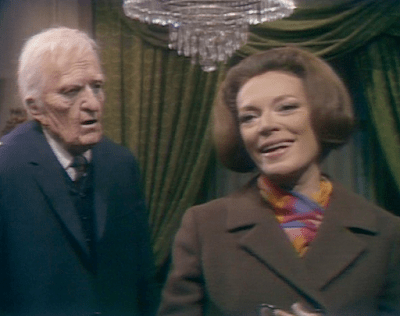
Vicki caves in and agrees to marry Burke, even though he won’t answer any of her questions. They go into the drawing room and announce this ominous news to Liz, Barnabas, and Julia. Barnabas responds by looking off into space and exclaiming “Jeremiah!” Again, whatever relationship develops between Burke and Jeremiah, we know that Barnabas is committed to resisting its influence on Vicki.

“Jeremiah!” Screenshot by Dark Shadows Before I Die.

Barnabas cannot conceal his dismay. He and Julia leave, explaining that they had planned to spend the evening together in town. Liz remarks that Barnabas was happy when he came, and sad when he left. Still, the idea that he and Julia might be going on a date is enough to keep Burke smiling.

In the courtyard, Barnabas tells Julia that he will give her his full cooperation as she tries to cure him of vampirism. He explains he wants to become human again so that he can prevent Vicki from marrying Burke.

This is rather alarming for the viewers. Dark Shadows became a hit when a vampire joined the cast. If the Burke/ Vicki/ Barnabas story is going to be just another daytime soap love triangle among humans, you may as well watch The Guiding Light. The foreboding dun dun DUNN! that ends each episode has rarely seemed more apt than it does coming on the heels of this grim prospect.

Episode 300: Burke Devlin must die

Sorely bedraggled blood thrall Willie Loomis tries to tell his master, vampire Barnabas Collins, that his plans for well-meaning governess Vicki Winters are unlikely to come to fruition. Barnabas wants Vicki to volunteer to become his vampire bride, a goal he has done remarkably little to advance. Even when Vicki invited herself to spend the night in his house, he couldn’t be bothered to bite her. Now she’s getting serious about her depressing boyfriend, Burke Devlin, and Willie thinks Barnabas has missed his chance.

Barnabas responds to Willie’s opinion as we might expect- he grabs him by the throat and threatens to kill him. He sends him away with orders to follow Vicki and Burke on their date and to report on every detail of their conversations.

Mad scientist Julia Hoffman is trying to cure Barnabas of his vampirism, and she brings him substantially the same message, along with a command to leave Vicki alone. Barnabas has enough hope that Julia’s experiments will succeed that he can’t treat her as he does Willie. So he evades her questions, pouts at her orders, and sulks when he finds himself having to go along with her.

Barnabas agrees to do as Julia says. Screenshot by Dark Shadows Before I Die.

The scene looks very much like the interactions we saw in the early months of the show between matriarch Liz and her brother, high-born ne’er-do-well Roger. Those were sometimes echoed in the interactions Vicki had with her charge, Roger’s son strange and troubled boy David. The bossy big sister/ bratty little brother pattern is on its way to becoming the signature relationship of Dark Shadows.

Meanwhile, Willie has been following his orders. He saw Burke and Vicki make several laughably awkward attempts to kiss each other, then heard Burke propose marriage to Vicki. Vicki asked for time to think it over.

When Willie reports this to Barnabas, he says he is sure she will say yes. Barnabas says that there will be no marriage, and proclaims “Burke Devlin must die!”

Episode 299: When darkness falls

Vampire Barnabas Collins creeps up on well-meaning governess Vicki from behind. He touches her neck, and she is startled.

Stifling a giggle

This scene plays twice. First, before the opening title sequence, then again immediately after. The first time around, Vicki stifles a giggle when she sees Barnabas. The second, she seems frightened.

Frightened

Barnabas does not bite Vicki. He apologizes for startling her. She says that no apology is needed, and she stands very close to him. They talk about the Moon and the night and about what incredible romantics they both are.

Incredible romantics

In #285 and #286, Vicki contrived to get Barnabas to invite her to spend the night in his house. In #293, she invited Barnabas to tag along on a date she was having with her depressing boyfriend Burke, and while Burke stood there she had eyes only for Barnabas. In this conversation, Vicki reluctantly turns down an invitation from Barnabas so she can go on some more dismal dates with Burke.

Mad scientist Julia Hoffman interrupts Barnabas and Vicki. After Vicki excuses herself to get ready for her date, Julia demands that Barnabas leave her alone. Barnabas says that he means her no harm. This is all too believable- twice before today, we have seen Barnabas enter a room where Vicki was sleeping and leave without biting her. It’s starting to seem unlikely that she will ever have a place in the vampire story. Since the vampire story is the only plot going on Dark Shadows, that leads us to wonder why she is still on the show.

This scene takes place on a new set, a courtyard with a terrace and a fountain. It looks very much like a set in the 1965 film The Sound of Music, the one where the Countess who is supposed to marry Captain von Trapp has the conversations that remove her from the love triangle and leave the path open for von Trapp to marry Maria. That movie was such a big hit that it seems likely that they had it in mind when they designed this set for scenes concerned with the love triangle involving Vicki, Burke, and Barnabas.

Julia’s intervention leads some to believe that there is another love triangle budding in which she will vie for Barnabas’ affections, but I don’t see any trace of that in Julia’s stern manner today. She simply seems to be concerned that Barnabas stop preying on people while she performs the experiments that are supposed to cure him of vampirism.

In later years, Grayson Hall would claim that she decided on her own initiative to play Julia as if she were in love with Barnabas. She said that by the time the writers and directors caught on to what she was doing, they had received so much enthusiastic fan mail that they had to let her go on doing it. In response to this story, Danny Horn makes some uncharacteristic remarks in his post about this episode on Dark Shadows Every Day:

It’s a great story, especially because it appeals to the audience’s secret belief that the actors really are the characters that they play. We love to believe that, especially for daytime soap opera characters, who we spend time with every day.

But really, everybody who watches television believes that the characters are real. That’s why we love to hear about unscripted moments that were invented during rehearsal. As intelligent adults, we understand that writers and directors and producers create the characters, and then the actors show up and say the words. But there’s a little child inside of us, who wants to be told that Julia Hoffman is real, and she lives inside Grayson Hall.

Danny Horn, “A Human Life,” Dark Shadows Every Day, 2 Jaunary 2014.

As the blog went on, Danny put more and more emphasis on the chaotic process by which Dark Shadows was created. I suspect this passage was something he wrote in haste. Even at this early stage, he had made it clear that he knew that it was not true that “writers and directors and producers create the characters, and then the actors show up and say the words.” By the time he finished in 2021, his main theme had long been that the real subject of Dark Shadows was “a team of under-resourced lunatics desperately struggling every day to make the most surprising possible show.” That team most definitely included actors padding their parts in ways they could do only because the show was done live to tape, with edits never done if not absolutely necessary, and often not done even when they were.

Julia visits Vicki’s room and helps her choose an outfit for her date with Burke. Julia urges Vicki to avoid Barnabas, because he has a crush on her and it would hurt him to encourage him in it. Vicki says that she has never seen any sign of such a crush. Nor have we- he has talked with his sorely bedraggled blood thrall Willie about a plan to take Vicki as his next victim. Aside from giving her an enchanted music box that is supposed to brainwash her, he has been remarkably leisurely about the whole thing. If anything, she is the one who has been pursuing him.

Vicki and Burke are out by the fountain. He remarks that she has been very quiet, and she refers to having a lot on her mind. This raises our hopes that she is thinking about what Julia told her and is going to ditch Burke and go to Barnabas. They start talking about their wretched childhoods. Previously, we had heard that Burke’s mother died when he was young and that his alcoholic father supported the family by making lobster pots; now Burke tells us that when he was nine his father left the family. It’s hard to see much point in this retcon; most likely the writers had just forgotten about the earlier story.

Vicki mentions that there was one nurse at the Hammond Foundling Home whom she liked. In the early days of the Dark Shadows, she would often reminisce about her ridiculously bleak experiences growing up in this fictional orphanage. Usually she would get a faraway look in her eyes and smile, then tell some story that started with an appalling horror and got worse and worse as it went. This time, she again stares off into the distance and smiles, so that viewers who have been watching from the beginning brace themselves to hear that the nurse turned out to be the worst abuser of all, or that she was murdered in front of Vicki while the other children laughed, or that she ran the kitchen the winter they ran out of food and had to resort to cannibalism. But no, Vicki is just sharing a pleasant little memory. The show is a lot less hard-edged now that it’s about a vampire.

Not that they’ve stopped presenting horrible images altogether. No, they show us Burke kissing Vicki.

When Burke was played by Mitch Ryan, he was a great kisser, a talent he displayed with Vicki among others. But Anthony George does not appear to have seen anyone kiss before he attempts it. As he points his lips at Alexandra Moltke Isles, she stiffens her neck, a move that may have suggested excitement if her partner were doing something recognizable as a sign of affection, but that in this context looks like she’s suffering from whiplash. After his first failed effort, he rests his head on her shoulder and looks miserable.

Attempted kiss
After the failure

We pull back from Burke’s fumbling and see Barnabas at the gate to the courtyard, looking forlorn. I’m sure the writer and director wanted us to take this image as a sign that Barnabas is feeling sorry for himself, but the scene he’s been watching with us is so dreary that we would all have the same look on our faces.

Barnabas has seen the sorry spectacle

Some attribute George’s phenomenally bad kissing to his sexuality. I don’t buy it. Joel Crothers was also gay, and we’ve seen Joe Haskell give convincingly sultry kisses to two actresses. Louis Edmonds was gay too, and when Dark Shadows finally gives him an on-screen kiss two years from now he will do just as well. And the actresses unanimously testified that Jonathan Frid was the best kisser in the cast. Furthermore, the other conspicuously inept kisser on the show was the emphatically heterosexual Roger Davis (whom we have yet to see.) So George’s failures in this department are his alone, and do not reflect on any demographic group of which he was a member.

In the house, Vicki and Burke continue their vain struggle to kiss. Julia walks in and apologizes for intruding. She does not leave, nor does she take her eyes off Vicki and Burke. That makes sense- after all, she is still an MD, and it would appear that whatever is wrong with Burke might require some kind of medical intervention.

Vicki excuses herself to go to bed, and Burke asks Julia to join him in the drawing room. There, he denounces Vicki for her “vivid imagination,” a terrible quality that must be stamped out. He tells Julia that Vicki has experienced two hallucinations recently. We know that these were not hallucinations at all, but actual visitations from the ghost of Sarah Collins. Burke doesn’t know that. However, he does know of another sighting which led him to angrily accuse Vicki of being insane, when she saw Maggie Evans, The Nicest Girl in Town, walking in a cemetery. At the time, everyone thought Maggie was dead, but now that it has been revealed she is alive, he removes the incident from his bill of particulars against Vicki.

Burke is furious with Vicki for having an imagination and wanting to be part of the story

Burke and Vicki, like most of the other characters, believe Julia’s cover story that she is an historian researching the Collinses for a book about the old families of New England. He asserts that helping Julia with her project is having a bad effect on Vicki, because she must “live in the present.” Julia asks if this means that she must live with him. Burke agrees that it does.

To Burke’s surprise, Julia agrees that Vicki should stop helping her and stay away from anything suggestive of past centuries. The two of them talk about how Vicki must be watched and controlled lest her imagination “run wild.” Julia is a mad scientist in league with a vampire, so this sort of talk is to be expected from her, but Burke is supposed to be on Vicki’s side. His frank intention to crush her imagination, expressed alternately with undisguised rage and airy paternalism, is as repulsive as anything we have seen from Barnabas.

Upstairs, Vicki is asleep. Barnabas opens the door and walks into the room. Again he thinks about biting her, again he doesn’t. He opens the enchanted music box, looks at her a bit longer, and leaves the way he came. If Barnabas doesn’t get off the dime soon, Vicki may marry Burke and become useless forever.

Episode 296: Safe tonight

Maggie Evans, The Nicest Girl in Town, has come back to Collinsport. This is bad news for vampire Barnabas Collins, who kept Maggie prisoner and fears she will expose him. Barnabas’ new accomplice, mad scientist Julia Hoffman, has erased Maggie’s memory and assures him she is no longer a threat to him.

Barnabas is unconvinced that Maggie’s amnesia will last. As he grows more agitated, Julia grows calmer. This contrast reaches its climax when Julia blithely lights a cigarette from Barnabas’ candelabra and he reacts with stunned bewilderment.

Julia lights up. Screen capture by The Collinsport Historical Society.

Julia tells Barnabas he has no choice but to trust her and leave Maggie be. He says that it would seem so. It doesn’t seem so to the audience- we know all Barnabas has to do is bite Julia to bring her under his power.

Julia shows herself out, a spring in her step. Once Barnabas is alone, he hears a rooster announce the dawn. He mutters that Maggie is safe for the moment, but that he will kill her tonight.

By now, there are three groups of characters on Dark Shadows: those who know Barnabas is a vampire; those who do not know this, but do know that supernatural doings are afoot; and those who think the show is still the Gothic romance/ noir thriller it was in its first weeks. Those in category one can move the story along very quickly, those in category two can nudge it forward a bit, and those in category three are blocking figures who slow things down.

When she was Barnabas’ victim, Maggie was in category one. Now she’s fallen back into category three. She has even resumed her vocal habits of showing herself to be happy by starting every statement with a laugh in her voice and of exaggerating the stress on whatever words have a rising intonation. She had those classic Adult Child of an Alcoholic mannerisms in the early days of Dark Shadows, when her father’s drinking problem was a story element. Months ago they revised him as a social drinker, so it’s like she’s been spliced in from tapes of old episodes. The question of Maggie’s memory therefore generates suspense, not only because we don’t want Barnabas to kill her, but also because we don’t want her to end up in a narrative dead end and fade from the foreground of the show.

Episode 295: A special kind of music

Maggie Evans, The Nicest Girl in Town, has come back to Collinsport. This is a surprise to everyone. Months ago, Maggie had escaped from an unknown captor who drained her blood and deranged her mind. Maggie’s family doctor, addled quack Dave Woodard, had persuaded her father and her fiancé to join him in telling everyone that she was dead and to lock her up in a mental hospital a hundred miles north of town. Evidently, Woodard thought that if the captor believed he had got away with his crimes, he would turn into a solid citizen and a good neighbor.

The mental hospital where Woodard sent Maggie was administered by Dr Julia Hoffman, an MD whose specialties in psychiatry and hematology made her seem like the perfect person to oversee Maggie’s care. Unfortunately for Maggie, Julia is also a mad scientist. She has for years dreamed of finding a vampire on whom she can try an experimental treatment that will turn him back into a human. Julia quickly recognized Maggie’s condition as a symptom of vampire attacks, and eventually identified Barnabas Collins as the vampire who held Maggie prisoner. She has now met Barnabas and promised to keep Maggie in a state of amnesia so long as he cooperates with her experiments.

Yesterday, the ghost of Barnabas’ nine year old sister Sarah liberated Maggie from Julia’s hospital and transported her back to Collinsport. This had such a great effect on everyone that the show is now in color.

Barnabas goes to the great house of Collinwood and tells Julia that Maggie has come back. He declares that he will have to kill her. Julia forbids him to kill Maggie, on the grounds that doing so would ruin years of her work. Talented a liar as Julia is, she comes up with this so quickly and in such a tense situation that it is hard to believe it is not her true reason for wanting to leave Maggie alive.

Barnabas clarifies the matter further when he says that he will kill Julia first. He follows Julia around the drawing room, apparently thinking of strangling her then and there. She keeps talking, and he can’t resist responding. The telephone rings, and she answers. It is Woodard, calling her to come to his office and take over treatment of Maggie. Julia triumphantly assures Barnabas that once she has done her work, Maggie will never remember what he did to her.

In Woodard’s office, Maggie’s memory is rushing back. She tells her friend Vicki that when she was being held prisoner she spent time in a special room where she smelled a sweet, powerful fragrance and heard a special kind of music. She had told Julia about those sense impressions in a session in #282, and when in #289 Vicki told Julia about a special room in Barnabas’ house where there was a jar of jasmine perfume and an antique music box, Julia had reconstructed Barnabas’ entire plan. When she hinted to Vicki that Barnabas was trying to recreate the late Josette Collins, Vicki had become defensive and stormed off, indicating that Julia is casting an unflattering light on something Vicki has been looking at through a romantic lens.

The camera is tight on Vicki’s face when Maggie mentions the room, the fragrance, and the music. Vicki’s face darkens in response to each point, a little bit more each time. She seizes on the key word of each statement, rephrasing it as a question- “Special room?… Special scent?… Special music?” So far on Dark Shadows, every plot has come to its climax as a result of Vicki figuring out what’s going on. So each of these reactions generates its own little jolt of suspense.

Special room?
Special scent?
Special music?

By the time Julia gets there, Maggie is saying that she remembers everything. Julia hustles Woodard out of the room, and is alone with Maggie when Maggie says that Barnabas Collins was her captor. She describes him as a creature from the world of the dead. She allows that this description is difficult to believe, but Julia assures her that she believes everything she tells her. Julia then tells her that they must stabilize her memory so that she will not regress to the miserable state she was in when first they met. She takes out a jeweled medallion and hypnotizes Maggie.

Woodard waits outside his office while Julia works on Maggie. Finally, Julia opens the door and asks if he would like to see the change in her. Woodard eagerly goes into his office.

He asks Maggie how she is. As she answers, she sounds just like she did before she fell into Barnabas’ clutches. She has regained her Adult Child of an Alcoholic habits of advertising her happiness by starting every utterance with a laugh in her voice and putting exaggerated stress on almost every syllable with a rising pitch. She tells him that “Apparently, there was something wrong with my memory, but I’m fine now.” He asks what happened to her when she was gone, and she has no idea what he means. She remembers falling asleep in her own bed, and then she found herself here with Dr Hoffman. If he could just tell her what happened in between, she’s sure she will be just fine.

Woodard is shocked, but Julia flashes a look of glee. She does remember to put on her worried face after Woodard looks at her, but the smile never really leaves her eyes.

Julia suppressing a cackle. Screeenshot by Dark Shadows Before I Die.
Julia concerned. Screenshot by Dark Shadows Before I Die.

That Julia was able to achieve so precise and extensive a mutilation of Maggie’s memory in so short a time would suggest that she spent the whole period Maggie was under her care laying the groundwork for it. That would in turn tend to confirm that her only interest in Maggie is as a tool to gain access to Barnabas as a subject for her experiment.

Closing Miscellany

As the opening title sequence begins, an ABC staff announcer says he brings “Good news! This program, Dark Shadows, is now being presented in color.”

Opinions may vary as to how good this news was. In the 1960s and 1970s, most television sets in the USA did not receive in color. So even programming that was made in color had to be composed first to look good in black and white. It took a big budget and a relaxed production schedule to make a show that would also benefit from color, and Dark Shadows never had either of those things. When a sense of atmosphere is especially important, as it usually is early in a storyline, it is best to watch the show with the color turned off.

Still, directors Lela Swift and John Sedwick were ambitious visual artists, and before long there will be some moments when they find ways to turn the muddy, cruddy TV colors of the era to their advantage. The camera operators will learn their craft even more quickly. Today, only a few closeups really meet broadcast standards, while every other shot is badly out of focus. There aren’t many other episodes like that, at least not until the woeful Henry Kaplan becomes one of the directors in December 1968.

This is not only the first color episode, but also the first one where the words “Dark Shadows” swoop and swirl around on the screen during the opening titles. I’m sure that was a very impressive effect in 1967.

When we saw Julia hypnotize Maggie in their sessions in the hospital, she shone a penlight in her eyes. This is the first time she uses the medallion. That is an example of the use of color- the medallion wouldn’t have been anything special in black and white.

Julia’s medallion. Screenshot by Dark Shadows Before I Die.

Episode 291: Doctor Hoffman has fooled us all

Up to this point, Dark Shadows has been scrupulous about avoiding references to Christianity. Of course, that was necessary- you can more or less casually drop in an image from ancient Greek mythology, for example, because not many people put a lot of energy into wondering whether they ought to be worshiping Zeus. But Christianity is very much a live option nowadays, with the result that even a subtle allusion to it tends to take over the audience’s reaction to whatever story you’re telling and turn their reception of it into a theological debate.

It can be particularly hard to steer clear of Christian ideas when you draw elements from stories that were first told in cultures where Christianity was so heavily dominant that people simply took its major concepts for granted and used them without thinking. To take an obvious example, vampires are an inversion of Jesus. Where Jesus is the ultimate example of self-sacrifice, the vampire is a metaphor for selfishness. Where Jesus’ resurrection represents his final victory over death, the vampire’s resurrection leaves him under the power of death every dawn. Where Jesus invites us to drink his blood and eat his flesh and thereby join him in eternal life, the vampire drinks our blood and annihilates our flesh in order to subject us to his indefinitely prolonged dying. Where Jesus commands his followers to spread truth wherever they go, the vampire’s existence depends on lies and secrecy. It’s no wonder that Bram Stoker’s Dracula is all about people using crucifixes and communion wafers to contain and destroy the sinister Count.

The scene that closed Friday’s episode and that is reprised in today’s opening is, I think, the first to include a recognizable allusion to the Christian story. In the Gospels, the first human being to learn that Jesus has been resurrected is Mary Magdalene. She learns this when Jesus interrupts her attempt to mourn his death and calls her by name, and that act of naming creates a new kind of relationship between them and a new place for her in the history of the cosmos. In Dark Shadows, the first person to find out that Barnabas Collins is a vampire otherwise than by becoming his victim is Dr Julia Hoffman. Barnabas learns that Julia has caught on to him when she interrupts his attempt to kill her and calls him by name, and that act of naming creates a new kind of relationship between them and a new place for her in the narrative arc of Dark Shadows.

Furthermore, Jesus had, before his death and resurrection, freed Mary of seven demons who possessed her. The memory of that past liberation was the original basis of her devotion to him. In this scene, Julia, as the anti-Mary Magdalene, promises that she will free Barnabas of the force that has made him a vampire. Hope for that future liberation is what stops Barnabas from murdering Julia, and will become the basis of their initial collaboration. Julia’s promise is not based in any claim of divine power, but in a lot of pseudo-scientific gibberish derived from the 1945 film The House of Dracula, in which a mad scientist tries to cure Dracula of vampirism by an experimental treatment that involves the participation of several other characters from Universal Studios’ existing intellectual property. The echo of the Mary Magdalene story also evokes the “meddling in God’s realm” theme of that and the other monster movies Universal made in the 1930s and 1940s.

Julia is not the first scientist on Dark Shadows to offer to help an undead menace to rejoin the world of the living. That was Dr Peter Guthrie, parapsychologist, who in #184 told blonde fire witch Laura Murdoch Collins that if she would stop trying to incinerate her son, strange and troubled boy David Collins, he would help her. Laura laughed at Guthrie’s offer, and when he said that his research into conditions like hers “has been my life,” she remarked that she found his choice of words strangely apt.

As a humanoid Phoenix, periodically burning herself and her sons to death and then reappearing in a living form, Laura was not part of any mythology as familiar and well-articulated as are the vampire stories from Bram Stoker, Universal Studios, or Hammer Films. The only really well-known thing about Phoenixes, beyond their rebirth from ashes, is their elusiveness. That the Fire Bird can be seen alive or not at all is a recurring theme of medieval and early modern literature based on Celtic and Germanic folklore, and a reason why the Phoenix is so often associated with the mysterious realms that figure in the legends of the Holy Grail. It is essential to Laura that we cannot understand what she is thinking, or even be sure if she has an inner mental life at all. Not only can Laura not give up her plan to burn David alive and retain a sense of menace. If we so much as catch her thinking about Guthrie’s offer, she will cease to be any kind of monster. So it is no surprise that she responds to Guthrie by killing him the moment opportunity presents itself.

Vampires, by contrast, combine decades of prominence in popular culture with a deep resonance for those who identify with their individual compulsions and social isolation. That gives storytellers a whole warehouse of resources to use when shaping a vampire into an image in which the audience can recognize themselves. So when Julia tells Barnabas that she has spent her whole life looking for someone like him to use as an experimental subject, he doesn’t have to make a snappy remark like that Laura made to Guthrie. He takes it in, and spends the rest of the episode weighing whether to cooperate with Julia or kill her.

Barnabas takes Julia back to his house. While she is in the basement picking out a room to use as a laboratory, Barnabas tells his sorely bedraggled blood thrall Willie that he has decided to kill her after all. Willie protests, and Barnabas goes back and forth on the question. When Julia comes back upstairs, Barnabas sends Willie away.

As Barnabas moves in to kill Julia, she tells him that her survival guarantees his. She explains that this is because his former victim, Maggie Evans, The Nicest Girl in Town, is not dead as everyone has been told, but alive and well-hidden. Maggie is suffering from amnesia covering her time with Barnabas. Julia is Maggie’s psychiatrist, and if Barnabas cooperates with her experiment she will see to it that Maggie does not recover her memory.

Julia betrays Maggie. Screenshot by Dark Shadows Before I Die.

From our first glimpse of Julia in #265, she has been a mysterious, forbidding figure, harsh with Maggie and indifferent to the usual norms of medical ethics. But she is, after all, a doctor, and so we’ve been willing to give her the benefit of the doubt. Now that we’ve heard her tell the vampire that she will abet his crimes by using her professional skills to ensure that Maggie’s psychological injury will not heal, we realize that she is not a maverick, but a mad scientist.

Again, the echo of the story of Mary Magdalene in the opening adds to the shock of Julia’s willingness to betray Maggie at the end. Mary was Jesus’ most faithful disciple, accompanying him to the cross when the men he had called were all busy denying him and looking for places to hide. It is also traditional among Eastern Orthodox, Oriental Orthodox, and Roman Catholics to name her in prayers for healing, because of old stories that she had healed people of blindness, mobility impairments, and leprosy, among other conditions. So Mary Magdalene is the most trustworthy of healers, and it is startlingly appropriate that Julia, as her exact opposite, is the least.

Episode 290: The work itself

It’s chiasmus week on Dark Shadows. Chiasmus is when the last thing that happens in a story resembles the first thing that happened. Usually that causes the audience to look back on that first thing in a new light. Sometimes chiasmus gets very detailed, and the first several things are mirrored by the last several things.

On Wednesday, we began with well-meaning governess Vicki asleep in vampire Barnabas Collins’ house on the estate of Collinwood. Barnabas crept into her bedroom and stood over her, but did not bite. Then it was morning, and Barnabas’ sorely bedraggled blood thrall Willie delayed Vicki as she was leaving the house. Vicki took our point of view with her to the great house on the estate, where we started to see events through the eyes of visiting mad scientist Julia Hoffman. That episode ended with Julia going to Barnabas’ house. Willie delayed Julia entering the house, and Barnabas and Julia met. Their scene was tense, but Barnabas did not use any of his powers against Julia. That chiasmus marked the transition from Vicki to Julia as the audience’s main character to identify with.

On Thursday, we began with Barnabas spying on Vicki through her window, then entering her bedroom and standing over her while she slept. He again left the room without harming her. We ended with Julia spying on Barnabas through his window, then entering his house, opening his coffin, and looking at him. The parallel is completed when we see today that she left the coffin room without harming Barnabas. That chiasmus showed that Julia is capable of turning the tables on Barnabas.

Today’s episode begins with a reprise of yesterday’s cliffhanger, showing Julia gasping when she opens the coffin. So returning viewers suspect that it is likely to end with Barnabas in Julia’s room, and the suspense comes as we try to figure out how he will get there and how she will escape his malign power.

We see Julia in the drawing room of the great house talking to her friend, addled quack Dave Woodard. Dr Woodard says that her failure to report to him on the progress she has made with their common patient, Maggie Evans, The Nicest Girl in Town, coupled with her presence at Collinwood, a hundred miles from the hospital where Maggie is, has forced him to remove Maggie from her care. Julia lies to him, claiming that she has no progress to report and that the whole thing is impossibly boring. This somehow convinces Dr Woodard to leave Julia on the case.

Julia is at Collinwood pretending to be an historian studying the old families of New England, and Vicki has volunteered to help her in her research. Now Vicki is terribly afraid that if she gets involved in what Julia is doing, she will become involved in things that are too interesting for her to handle, and she wants to withdraw before she forever loses contact with tedium and drabness.

Barnabas tells Vicki that she has nothing to fear from “the past,” which at this point on Dark Shadows means the plot. While he is reassuring her, the set catches fire. We hear fire extinguishers and other noises in the background, but Jonathan Frid and Alexandra Moltke Isles don’t break character for an instant. The scene is a dreary one, marking as it does the doom of Vicki as a major part of the show, and the lines are poorly written, but they are absolutely committed to their work.

Barnabas does not believe Julia’s cover story, and is quite sure she represents a threat to him. He meets with her in the drawing room to reiterate his refusal to cooperate with her project. When Julia says that she is particularly interested in his “namesake”- actually himself- Barnabas airily asserts that he was by all accounts a dull fellow. Julia may have been able to sell that line to Dr Woodard on this same set a few minutes ago, but Barnabas doesn’t make any impression on Julia with it. The two of them continue to argue as they pass from the drawing room through the foyer. The dialogue isn’t really any better than what Barnabas and Vicki had in the previous scene, but because Frid and Grayson Hall have a lively relationship to depict- two people who each of whom knows more about the other than they are willing to say, and each of whom knows that the other knows much of what they are holding back- they make their whole sparring match seem to glisten with wit and style.

Barnabas agrees to meet Julia at his house the next evening. After he leaves, Julia tells his portrait that she can’t wait that long for their next encounter, and she knows he can’t, either.

We cut to Julia in her bedroom. Vicki pays a visit, during which we hear another depressing conversation about Vicki’s newfound fear of narrative relevance. Julia assures her that “There is nothing for you to fear.” After Vicki leaves, Julia looks at her clock and sees it is a quarter to one in the morning. We dissolve to the foyer, where the hall clock reads 2:00. Barnabas appears in Julia’s bedroom and approaches the bed, where he prepares to uncover Julia. We then hear Julia greeting Barnabas by name. She emerges from the shadows on the other end of the room, and tells Barnabas she has been waiting for him a long, long time.

Julia greets her long-awaited visitor. Screenshot by Dark Shadows Before I Die.

Episode 289: Hold back the dawn

A storm is keeping everyone awake at the great house of Collinwood. Well-meaning governess Vicki is having a particularly hard time falling asleep, since she has the feeling someone is staring at her. When heiress Carolyn comes into Vicki’s room, Vicki points out the window and asks Carolyn if she sees a figure standing behind a tree. Carolyn doesn’t know what Vicki is talking about. We cut to the yard, but we see a figure crouching in the bushes, not standing by a tree.

Peeping Drac. Screenshot by Dark Shadows Before I Die.

The crouching figure is vampire Barnabas Collins, and he looks ridiculous. Barnabas has been meaning to bite Vicki for weeks now, and keeps getting sidetracked. Earlier this week she even invited herself to spend the night in his house, and come morning she still had all her blood.

After Carolyn leaves the room, Vicki goes to bed. Barnabas finally materializes and approaches her bedside, but again can’t bring himself to go through with the bite. Instead, he opens the music box he gave her and disappears. The music awakens her.

Carolyn comes back in and tells Vicki the power is out. Vicki says she doesn’t understand how the music box could have been opened while she slept, and says she had a feeling that something dangerous had been in her room. Barnabas’ pusillanimity makes him dangerous indeed to Vicki- if she doesn’t get a place in the vampire story soon, Vicki will be at risk of becoming irrelevant to the show.

Vicki and Carolyn go downstairs and find Julia Hoffman awake and reading some old books. Julia is a mad scientist who has learned that Barnabas is a vampire and has come to study him, but she has told the family that she is an historian working on a book about the old families of New England.

Julia questions Vicki about Barnabas. She had learned about Barnabas in her capacity as a doctor treating his previous victim, Maggie Evans, and Vicki’s answers explain what Maggie meant when she remembered that she heard “a tinkling melody” and smelled a “sweet fragrance” during her captivity. As Julia continues to probe, Vicki becomes upset and hastens back to her room. Vicki has been Julia’s main advocate in Collinwood, as she was the main advocate for Dark Shadows‘ first character derived from Professor Van Helsing, Dr Peter Guthrie, who helped in the fight against undead fire witch Laura Murdoch Collins last spring. Julia’s unbothered reaction to her angry departure suggests that she isn’t planning to take Vicki into her confidence and doesn’t think she needs her help.

Julia and Carolyn chat for a moment, then go back to bed when the power comes back on. John Scoleri has a fine summary of this part of the episode: “So in Collinwood they drink coffee when they can’t sleep, get up when the power is off, and go back to bed once it comes back on. Maybe they’re all vampires…”

At home in the Old House on the estate, Barnabas is staring out the window feeling sorry for himself. Julia sneaks up near the window. She listens to him talk to his sorely bedraggled blood thrall Willie.

Barnabas tells Willie to go to Portland, Maine to buy some necessities and to come back as soon as possible so that he can keep Julia away from the house. He says he is worried about who Julia really is and what she wants. He tells Willie that the sun is about to rise, so he might as well leave right away while Barnabas goes to the basement.

Once the front parlor is clear, Julia opens the window, a process we see from the inside. Just three weeks ago, we saw seagoing con man Jason McGuire enter through the same window. Jason would fight Willie, go to the basement, find Barnabas in his coffin, and be killed.

Julia has made sure Willie is gone, but she does go to the basement. Like Jason, she finds Barnabas’ coffin, opens it, and sees him inside. We see her reaction. For the first time, there is a trace of fear on her face.

Julia sees it. Screenshot by Dark Shadows Before I Die.

Julia is now the first person to learn that Barnabas is a vampire otherwise than by becoming his victim. As the episode began with Barnabas spying on Vicki through her window, then entering her room while she was unconscious and looking at her, so it ends with Julia spying on Barnabas through his window, then entering his inner sanctum while he is unconscious and looking at him. This chiasmus suggests that Julia is capable of turning the tables on Barnabas. It remains to be seen whether the parallel will be complete, and she will choose to leave him be as Barnabas left Vicki be, or she will try to do something against him.

Episode 288: Feminine vanity

At the great house of Collinwood, well-meaning governess Vicki is in a stupor, staring out a window and dreaming of a time when she will again be central to the plot.

Ever since #191 when she rescued her charge, strange and troubled boy David Collins, from his mother, undead fire witch Laura, Vicki has been hanging on to narrative relevance by her fingernails. Now Dark Shadows is built around vampire Barnabas Collins, and Vicki longs to play a major role in his storyline. He plans to make her his next victim, but is moving so slowly towards that objective that we’ve started to wonder if he ever will strike.

David comes into the room and calls Vicki’s name several times. When she finally comes to, she admits that she has been zoning out a lot lately, and says that it is a habit she needs to break. David says that it frightens him when she gets that way. She doesn’t look like herself when those spells come over her. He gets the feeling that she’s turning into someone else. Vicki can’t deny that David is onto something, and only when he insists on sticking with the subject after she has clearly become uncomfortable does Vicki become defensive and retreat behind claims that David is letting his imagination run away with him.

Mad scientist Julia Hoffman has insinuated herself into the house, concealing her true identity and pretending to be an historian writing a book about the old families of New England. David shows her an album of family portraits. He identifies one portrait as his namesake, David Collins. In #153, it was established that he was the first member of the family to bear the name “David,” and that his mother Laura insisted on giving her son this name would ultimately become evidence that her evil plans for him were in place long before he was born. So David’s remark about a previous “David Collins” will strike longtime viewers as a significant retcon.*

Though David has looked through the book many times, he finds a portrait in it that he has never seen before. It depicts Sarah Collins, who lived from 1786 to 1796. Sarah’s ghost has been busy in the area in recent weeks, and the clear implication is that she inserted the page. That in turn would suggest that Sarah might have more powers than we have seen her use so far.

Julia and David find a photograph of Sarah Collins, d. 1796.
Screenshot by Dark Shadows Before I Die

David has seen Sarah and played with her on more than one occasion, and he recognizes the portrait. He wonders aloud if the girl he has met is Sarah’s ghost. Julia laughs off the suggestion. Vicki returns. She also recognizes the picture of Sarah. The police circulated a drawing of her when Maggie Evans, The Nicest Girl in Town, was missing. Since Julia is actually a doctor who found out that supernatural doings were afoot at Collinwood when she was treating Maggie, she has heard several facts about Sarah, and by the end of her talks with David and Vicki she knows enough to be sure David is right about her.

We cut to the Blue Whale tavern, where Vicki is on a date with her depressing boyfriend, fake Shemp Burke Devlin. Burke sullenly complains about Vicki’s wish to help Julia with her project, complaining about Vicki’s “interest in the past.” “Interest in the past” is at this point synonymous with “a function in the story,” and Burke lost the last trace of that months ago. It’s as if Burke and Vicki know that they are fictional characters, and he resents her for holding on to a place in the action while he has settled in once and for all on the discard pile.

Vicki mentions that the night before, she had been awakened by the sound of a small girl singing. She says that after she got up and lit a candle, she could still hear the singing, but could not see the girl. Burke is too busy grumbling and making nasty remarks about Vicki’s mental health to ask her why she lit a candle rather than flipping the light switch. Vicki has to press on with more details and then volunteer that she wasn’t sleeping in her own room. She was sleeping in the Old House at Collinwood, home to Barnabas Collins.

Burke is upset by this news. Unfortunately Vicki doesn’t let him believe she went to bed with Barnabas. She tells him she was in a guest room, and that Barnabas was “a perfect gentleman.” Burke demands Vicki never go to the Old House again, and she refuses to make any such promise.

Julia takes the book of portraits to the Old House and insists that Barnabas look through it. While he grudgingly complies, Julia opens her compact. She finds that Barnabas does not cast a reflection in its mirror. This confirms her suspicion that Barnabas is a vampire. In #241 and #278, we had seen his reflection, but perhaps those were slip-ups and they were planning all along to use the idea that vampires do not cast a reflection.

Barnabas catches Julia studying her mirror and angrily asks what she is doing. She smiles and chirps that even historians have their share of feminine vanity. He glowers at her. The camera holds on his menacing look for quite some time, leading us to think that Julia has signed her own death warrant. But she doesn’t seem to think she is in any great danger. She is still smiling when she leaves.

Back in the great house, Vicki wanders up to the portrait of Barnabas that hangs by the front door. Apparently she is planning to stare at it as she resumes her dream of having something to do on the show. It worked for dangerously unstable ruffian Willie Loomis- after a couple of long sessions staring at the portrait, Barnabas summoned him and next thing he knew he was securely established as his sorely bedraggled blood thrall, a core member of the cast. So Vicki is trying to take a proven path to success.

Before Vicki can get any high-quality staring done, Julia enters. Vicki asks her how it went with Barnabas, and Julia exults that she may have learned everything she needed to know.

*My wife, Mrs Acilius, noticed this and had a lot to say about it. I will refer to her insights in later entries, as they would contain spoilers at this point in the run of the show.

Episode 287: Entering the past

In the first year of Dark Shadows, every major storyline came to its climax after well-meaning governess Vicki found out what was going on. Now, the only ongoing storyline is centered on vampire Barnabas Collins. If Vicki finds out Barnabas is a vampire, she will lead an effort to destroy him, as she led an effort against Dark Shadows’ previous undead menace, blonde fire witch Laura Murdoch Collins. Barnabas is a hit, bringing far and away the biggest ratings Dark Shadows has had. So we are in suspense as we wonder how Vicki will find out about Barnabas, and in another kind of suspense as we wonder how they will manage to keep him on the show after she does.

As we open today, we see an intriguing possibility. Vicki is staying over at Barnabas’ house, sleeping in the bedroom of his lost love Josette. Barnabas is standing over her, about to bite. If he does, perhaps he will turn her into a vampire. Then we might find out what kind of vampire Vicki could be. Perhaps she would be like Lucy in Bram Stoker’s Dracula, who became the “Bloofer Lady” and preyed on the small children of the East End of London. Since Vicki’s whole thing has been her role as protector of strange and troubled boy David Collins, it would be a heartbreaking reversal to see her become a threat to David. And perhaps she might emerge as a rival to Barnabas. He is a lackadaisical vampire, who was on the show for 13 weeks before he got round to killing anyone and even then it wasn’t a premeditated murder. Maybe Vampire Vicki will be the killing machine who shows Barnabas how it’s done.

But Barnabas wimps out. He keeps looking at Josette’s portrait, and slinks out of the room without biting Vicki. If they go on like this much longer, we will stop wondering how and when Vicki will be incorporated into the vampire story and start wondering why she is still on the show.

Vicki is bustling out the front door of Barnabas’ house when his sorely bedraggled blood thrall, Willie, offers to make breakfast for her. He keeps asking her if she sensed anything wrong while she was sleeping, and holds onto the topic until she remembers the dangerously unstable ruffian he was before Barnabas got hold of him. She sternly asks if he slipped into the room while she was sleeping, and he denies it.

Back at the great house, mad scientist Julia Hoffman, pretending to be an historian studying the early history of the ancient and esteemed Collins family, is trying to convince matriarch Liz to cooperate with her project. Liz is too worried about Vicki to pay Julia much attention. Vicki had left for Barnabas’ house after everyone in the great house was asleep, planning to be back before they awoke, but because she felt such profound peace in Josette’s room she overslept. Vicki comes in and explains the situation. Liz seems like she is about to weep for joy, and talks about how wonderful it is that Vicki was with Barnabas. Julia has figured out the truth about Barnabas, and reacts to Liz and Vicki’s swoony attitude towards him with alarm. This is one of the first times someone other than Vicki has served as the audience’s representative while Vicki is on screen.

Julia does not share Liz’ conviction that Barnabas is the best host a girl could hope for
Julia takes a look at Vicki’s complexion and her neck

Vicki backs Julia’s efforts to win Liz over. When Julia says that she is sure she will uncover important information if Liz and “Mr Collins” help her, Liz replies that her brother Roger is even less interested in the past than she is.

Julia explains that she was referring to Barnabas, but the mention of Roger reinforces the concern Barnabas’ failure to bite Vicki raised. When Dark Shadows started, Roger was its principal villain. That all ended, and he hasn’t had a storyline in months. Louis Edmonds was such a talented actor and such a funny person that the whole cast is loose and zestful in episodes that do include Roger, but in terms of the plot he is surplus equipment. Now that Barnabas is driving the story, “interested in the past” is synonymous with “relevant to the plot,” so that when Liz says that neither she nor Roger is interested in the past, she is saying neither of them is likely to make anything happen.

The biggest draw for the first episode of Dark Shadows was that onetime major movie star Joan Bennett was in the cast, but none of Liz’ storylines really clicked, and now all she does is spend a scene or two objecting to plot developments that we all know she won’t be able to prevent. If those two characters could end up on the junk-heap, there is no reason why the same might not happen to Vicki.

Indeed, Julia’s project suggests that Vicki may be heading for the fringes of the story. The last time a researcher was at Collinwood under false pretenses was during the Laura story. As the leader of the good guys, Vicki had advised parapsychologist Dr Peter Guthrie to keep his specialty a secret from Roger and others to reduce the danger that Laura would catch on to what they were doing. Now, Vicki is one of the people from whom the secret is being kept.

After Liz caves in and tells Vicki that, as a favor to her, she will allow Julia to proceed, Julia goes to Barnabas’ house. This gives us a bit of chiasmus. As the episode began with a scene involving Vicki and Barnabas followed by a scene in which Willie delays Vicki’s departure from the house, so it will end with a scene in which Willie delays Julia’s entry into the house followed by a scene between Barnabas and Julia. That structural device is another hint that Julia will be occupying a space where we had expected to find Vicki.

Julia keeps interrupting Willie’s demands that she leave the house with questions that he can’t resist answering. She is impressed that the restoration of the house is so consistently faithful to the period, and asks if Barnabas referred to pictures when they were doing the work. Willie answers with a flat no. She asks how he managed to create something so convincing that it looks like the work was supervised by someone who saw the house when it was originally in that condition in a previous century, and Willie says that he did have pictures. She asks him why he lied to her, and he is tongue-tied. She asks if Barnabas is such a difficult man to work for that he feels he has no choice but to lie, and Willie panics all the more.

Willie is still trying to get out of the trap when Barnabas appears. As usual when he has to talk to a visitor whom Willie has failed to scare off, Barnabas apologizes for Willie’s unfriendliness. He is his usual gracious “cousin from England” self at first, but very bluntly refuses to cooperate with Julia’s efforts. She prods him, and he becomes rather crude. Her amused response to his arrogant remarks leaves him uneasy, knowing that she has made him look foolish and limited the options available to him in future encounters.