Episode 904: To have fun, like everybody else

Matriarch Elizabeth Collins Stoddard (Joan Bennett) was usually a blocking figure in the first 73 weeks of Dark Shadows, and when the pace of the stories picked up sufficiently that they didn’t need to slam on the brakes so often she drifted far to the margins. When she does show up, she is usually a talk-to for characters who might actually do something. The few times she has been the center of attention have been when she was so crushingly depressed she was a suicide risk. At one point she went beyond that, succumbing to a boredom so extreme that she lapsed into a catatonic state and was mistaken for dead.

Today, Liz is being atypically dynamic. She is trying to figure out what her nephew, strange and troubled boy David Collins, has been up to. Her investigations have shown her that David stole an old book from an antique shop and bought some clothes at a department store. These aren’t exactly the most thrilling discoveries of the age, especially when it appears that David has already returned the book to its rightful owners, but it represents a big step up from her usual activity level.

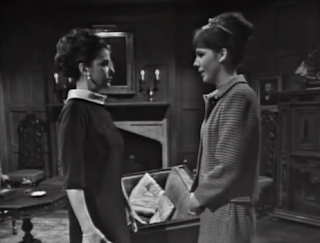
Liz walks in on David in his room, and finds him reading from a book. He denies that it is the book from the antique shop, but she doesn’t believe him. Later, Liz is poring over the book in her drawing room when her distant cousin Barnabas comes in. She tells him she doesn’t recognize the language or the script in which it is written, but that she has found certain blocks of text that are repeated throughout, in the manner of ritual language. She thinks it must be a religious book of some kind. Barnabas recognizes this as a remarkably intelligent observation. He offers to take the book to the antique shop himself. Liz happily accepts his offer, and goes upstairs to bed.

Liz has a dream. In the dream, David is wearing a fat suit. He takes her to a funhouse. At first the mirrors merely add to her chronic depression, but she brightens when she sees Barnabas in one of the mirrors. And when David recites a bit of doggerel- “Fat and Skinny had a race, all around the steeplechase./ Fat fell down and broke his face./ Skinny said, I won the race!” she laughs heartily. She wakes up. In her bed, she is staring into space, all jollity gone.

David’s fat suit. Screenshot by Dark Shadows Before I Die.

Most of the dream is shot in a kaleidoscopic style, splitting the screen into many copies of the same image. Regular viewers know that Dark Shadows puts kaleidoscopic patterns on the screen when it is showing people submitting to one or another form of mind control. For example, when mad scientist Julia Hoffman hypnotizes people, we often see pictures that seem to come from inside a kaleidoscope. Liz herself asks David at the beginning of the dream if the mirrors will show her “all the people I could have been”; he says that no, “They’ll show you all the people you really are.” Since the dream is full of odd looking dolls and puppets, that suggests all the people she really is are controlled by someone other than herself. The cut from her laughing face at the end of the dream sequence to her blank expression when she wakes up would also suggest a discontinuity between the Liz who had the dream and the Liz who will rise from bed.

Over the last few weeks, the show has been developing a story about a cult devoted to mysterious supernatural beings known as the Leviathan people. The cult is secretly absorbing one person after another, enabling the Leviathans to act through them. Barnabas and David have taken turns leading the cult, and the owners of the antique shop are members of it. If Liz is no longer herself, we must conclude that she has now been coopted into the cult as well.

Liz’ daughter Carolyn works at the antique shop. Early in the episode, she met a man whom we could see only from the chest down. He was wearing a belted overcoat. In #902, we had the same view of a man wearing the same overcoat as he wandered into Liz’ house, straightened a portrait of Barnabas, hid from Carolyn, and wandered out again. Evidently this is the same man. Later, Barnabas went to the shop, and Carolyn told him she was smitten by the man and that he would be coming back when the shop closed, after 10 pm.

The man does come back as promised, but doesn’t quite make it into the shop. He is between the streetlight and the door, in a space which we must interpret as representing a sidewalk, when Barnabas runs him down with his car. Carolyn comes out of the shop and Barnabas claims that the man just darted out of nowhere, giving him no chance to stop. It is unclear when Barnabas learned to drive. When he was first on the show in April 1967, he was a vampire who had been sealed in a coffin since the 1790s. He was cured of the effects of vampirism in March 1968, and in #687 we heard about him driving. Perhaps his training in the rules of the road was irregular. Still, you would think he would have a better excuse for driving into a pedestrian than failing to expect him to be on the sidewalk.

The camera zooms in on the injured man’s face. We don’t see enough of it to be sure who it is. The closing credits tell us that “Unknown Man” is played by David Selby. It must be a goof that we don’t see much of Mr Selby’s face. Over the year he has been playing the rakish Quentin Collins, Mr Selby has become a huge breakout star, rivaling the fame Jonathan Frid has gained as Barnabas. Surely they wouldn’t put him on unless they wanted us to recognize him.

Quentin first came on the show as a ghost at the end of 1968, and found his greatest success from March to November 1969, when the show was set in the year 1897. Since the show returned to a contemporary setting, we have been sure that Quentin will be back, but we haven’t had any reason to expect him to return at any particular time. In #887, the first episode set in November 1969, we saw the back of a man prowling about the estate of Collinwood; we might have suspected he was Quentin. But he turned out to be Liz’ ex-husband Paul Stoddard, who had never before been a real character on the show and who has been unmentioned for more than two years. So when we are kept from seeing the face of another prowler, he could be anyone at all. Perhaps Frank Garner is training to be a ninja, or Ezra Hearne is having a personal crisis.

The closing credits run over this image from Liz’ dream. The dolls move while the credits are scrolling over them, the effect is hilarious. I didn’t think the dream sequence was particularly effective, but I wish every episode ended with these two figures doing their little act.
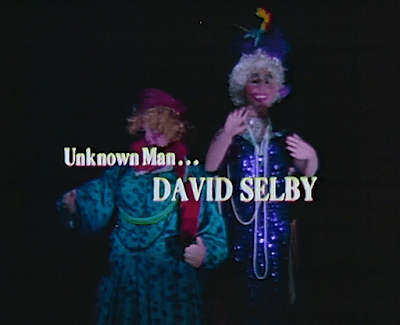
The real stars of today’s show. Screenshot by Dark Shadows Before I Die.

Episode 503: Man made monster

Adam the Frankenstein’s monster has abducted heiress Carolyn and taken her to an abandoned structure. Carolyn says the structure looks like a root cellar. She doesn’t have a television, or she would have recognized it at once. It’s the old Flintstone place.

Screenshot by Dark Shadows Before I Die.

Adam was created in an experimental procedure mad scientist Julia Hoffman completed, an experiment that Julia’s late colleague Eric Lang designed to free old world gentleman Barnabas Collins from vampirism. The experiment was a success, but Barnabas and Julia are the world’s worst parents. They have kept Adam chained to the wall of the prison cell in the basement of Barnabas’ house for the first three and a half weeks of his life. As far as Adam is concerned, it is normal for people to confine one another in underground spaces.

The cell was in the basement of the house when Barnabas and his little sister Sarah were growing up there in the eighteenth century; in #260, we found that Sarah had found a secret passage leading out of the cell, suggesting she must have spent a lot of time there in her nine years of life. Perhaps the cycle of abuse that Adam is perpetuating goes back a very long way.

Barnabas is out searching for Adam and Carolyn. Julia is in his house, along with his servant Willie. Julia finds that Willie has had a nightmare and is compelled to tell Carolyn about it. The nightmare is part of The Dream Curse. One person after another has the same dream, which the audience sees dramatized every time. Then that person wrestles with a compulsion to tell the nightmare to someone else. We usually see that, too. Finally, the person does tell the dream, giving a speech to repeat the material to us yet again. This time-waster will go on indefinitely, and is supposed to end with Barnabas reverting to vampirism.

Julia knows all about this. She had the dream herself, and has interacted with others who have had it since. Today, she tries to hypnotize Willie into forgetting the dream.

It is very strange Julia hasn’t tried this before. She has a phenomenal ability to use hypnosis to erase memories, so regular viewers would expect her to turn to that right away. When she starts giving Willie the instructions, kaleidoscopic colors pulse on the screen, suggesting that she will have yet another great triumph. Willie does have a vision of Carolyn in the Flintstone house, so Julia must have unlocked his capacity for extrasensory perception. But he still remembers the dream, and is still driven to tell it to Carolyn.

The sheriff comes by. He tells Julia and Willie about evidence that Adam has a connection with the house. They deny everything. Willie is a panicky mess. He is still upset because of the dream, and the barking of the police tracking hounds outside triggers his memories of the nights when Barnabas’ bloodlust prompted dogs to howl. Julia is able to parry all of the sheriff’s questions and observations, but she is too shaken to produce her usual stream of perfectly plausible lies.

Adam comes to the house. He is hungry, and it is the only place he has ever seen food. The sheriff sees him, threatens to shoot him unless he stops, and opens fire immediately. Adam isn’t killed; in fact, he is so healthy that it takes twenty (20) men to subdue him and take him to gaol.

The sheriff sticks around and tells Julia and Willie that Adam gave them a look of recognition. Julia dismisses that, and the sheriff protests “I’m not a stupid man!” Regular viewers know that he is in fact an utterly stupid man, and that Julia is extraordinarily intelligent. Typically, she wouldn’t need more than five seconds to distract him from whatever was on his mind and get him chasing after an imaginary squirrel. But she is so run down from the ongoing crises that she is reduced to challenging him to “Prove it!”

Episode 63: The world around it

Each episode of Dark Shadows begins with a voiceover. In this phase of the show, the voiceovers are all narrated by Alexandra Moltke Isles in character as Victoria Winters, well-meaning governess, and are brief passages of almost purely decorative prose, meant only to set a mood and to vanish from the audience’s memory as soon as the action starts. Art Wallace and Francis Swann, the writers credited for the first 97 episodes, were old pros who had been turning out scripts for decades, and were good at staying out of their own way. That’s why I haven’t yet said anything about any of the opening voiceovers- when Wallace or Swann set out to write something forgettable, they succeeded. By the time I started writing, I had no recollection of them whatever.

Today’s opening voiceover is unusually substantive, so much so that it threatens to leave a trace in the audience’s mind:

My name is Victoria Winters. Once again it is quiet in Collinwood. There is no sound but the ticking of the great clock in the entrance hall. And the lonely footsteps of a woman who hasn’t left its grounds in eighteen years. A woman whose life is limited to musty corridors and the endless beat of a grandfather clock. A beat that seems to ignore the vitality of the world around it.

Vicki names herself, names the estate where she lives, talks about how quiet it is, mentions the clock, tells the audience that the lady of the house is a recluse who hasn’t left home in eighteen years, complains about the air quality in the house, brings the clock up again, and assures us that interesting things are happening everywhere except here. It leaves us wondering why Vicki is so hung up on the clock, why she doesn’t run the vacuum cleaner herself, and why, if the entire world surrounding Collinwood is chock full of vitality, they don’t turn the camera in some other direction.

That’s the sort of thing we’re going to get from Wallace and Swann’s immediate successors, Ron Sproat and Malcolm Marmorstein. In writing their opening voiceovers, Sproat and Marmorstein fell between two stools. They didn’t write brief, deliberately forgettable passages as Wallace and Swann had done; nor did they integrate the opening voiceovers into the action of the show, as would happen in later years when the story is moving very fast and the episodes start with detailed recaps of events so far. Instead, Sproat and Marmorstein saw the voiceovers as vehicles for long passages of flowery, over-developed imagery. Those are certainly no more effective at setting a mood than were Wallace and Swann’s brief remarks, but they do both try the patience of the audience and linger as distractions. That’s one of the things that prejudices viewers against the character of Vicki- since so many episodes from the Sproat/ Marmorstein era start with Vicki rambling on about the weather or making vague remarks about “one small boy” or whatever, the first impression she leaves on viewers who start watching with episodes from that period is that of a prattling fool.

While Wallace and Swann are the only writers whose names have appeared in the credits thus far, it is very possible that others not credited contributed additional bits. I may be wrong, but my nose catches a whiff of Marmorstein in these six strange, distracting sentences. The description of the clock while we’re looking at it, the specified number of years since reclusive matriarch Liz has left the estate, the evocation of the “musty corridors,” the yearning glance at the eventful world outside, are all typical of Marmorstein’s attempts to turn the voiceovers into freestanding dramatic monologues, but without identifiable characters or plot development.

Today’s episode doesn’t shed much light on Vicki’s relationship to the clock or on the standards of cleanliness in the great house of Collinwood. Instead, it’s a kaleidoscope episode, in which each change of scene varies the combination of characters who interact on each set. The action plays out on two sets this time, the foyer/ drawing room representing the downstairs of the great house, and the Blue Whale tavern, representing the low and bustling life of the village. Because the sets typify the “musty corridors” inside the house and the “vitality of the world around it,” the episode is also a diptych of sorts- not Art Wallace’s usual diptych contrasting two pairs of people, but a diptych contrasting two places and the attitudes those places inspire in the people who spend time in them.

The five pieces tumbling about in today’s kaleidoscope are reclusive matriarch Liz, tightly-wound handyman Matthew, flighty heiress Carolyn, hardworking young fisherman Joe, and Maggie, the nicest girl in town. The regular bartender at the Blue Whale gets a fair bit of screen time as well. In the first 63 episodes, he’s answered to names including “Joe,” Andy,” “Mike,” and “Punchy.” Today, Joe the fisherman calls the bartender “Punchy,” a name he called him most recently in episode 56, the same episode where drunken artist Sam calls him “Mike.” Maybe we’re supposed to think that the young men know the bartender as “Punchy,” the older men as “Mike.” Eventually the show settles on the name “Bob” for him, perhaps because the performer’s name was Bob O’Connell. In one episode (#319,) Sam calls him “Ba-ba-roony,” giving rise to the idea that his name is Bob Rooney.

Liz appears only at Collinwood, of course; Joe and the bartender appear only in the bar. The others migrate back and forth between the two sets. We first see Carolyn with Joe in the bar, talking about what a flop their date has been and how pointless their whole relationship is. Maggie interrupts this thrilling conversation, looking for her father, Sam the drunken artist. After puzzling Carolyn and Joe with a number of cryptic remarks, Maggie gives up looking for her father and goes to Collinwood to look for high-born ne’er-do-well Roger. Roger isn’t home, so she winds up talking to Liz. This is the 63rd episode, and it’s the first time we’ve seen these two major characters together.

Screenshot by Dark Shadows Before I Die

We first see Matthew in Collinwood, telling Liz how much he wants to help her. He then goes to the bar, where Carolyn and Joe see him. Matthew is looking for dashing action hero Burke Devlin, whom he hates. He implies to Carolyn and Joe that Burke is to blame for the death of beloved local man Bill Malloy. Joe doesn’t like Burke any more than Matthew does. The instant he hears Matthew’s idea, he is all in on it. Carolyn resists the suggestion.

Carolyn goes home to Collinwood. Maggie has explained to Liz that Burke has been saying terrible things about her father, that she can’t find her father to ask him about Burke’s allegations, and that Roger might know something about them. Liz urges Maggie to believe in her father, and to regard Burke as a dangerous, unscrupulous man capable of many dark deeds. Hearing the last part of this, Carolyn asks her mother if she believes that Burke is capable of murder. Yes, Liz says, she does believe that he is capable of that.

Episode 58: A day for remembering, and forgetting

Art Wallace, credited as the author of this episode’s script, specialized in finely-etched character studies. Often as not, he favored a diptych structure, in which the episode intercuts between two groups of characters. In the contrast between their relationships, we learn more about them in a shorter time than we could if one group was on screen the whole time.

He doesn’t use that structure today. It’s more of a kaleidoscope, in which the characters tumble about, moving from set to set, recombining in different groups. The five reflecting surfaces in this particular kaleidoscope are drunken artist Sam; hardworking young fisherman Joe; the sheriff; flighty heiress Carolyn; and problem child David. Their reactions to the mysterious death of plant manager Bill Malloy have set them spinning.

Carolyn, Sam, and the sheriff play it very hot. Bill was like a father to Carolyn. She wants to keen over him, and is raging with frustration that she can’t find anyone to wail with. Bill was trying to prove that Sam had committed a crime. He can barely restrain himself from panicking in his fear that he will be accused of killing Bill. The sheriff is investigating the case. He wants answers from Sam, and comes down on him very hard when he doesn’t get them.

Joe is more subdued. He is clearly saddened by the death of a man he worked for and admired, but is quiet and attentive to others. When Sam insistently tries to get him to figure out what the police will be able to reconstruct from the place where Bill’s body washed up on shore, Joe very patiently explains about tide tables and the like. When the sheriff comes upon Sam and Joe and suggests Joe go away, he complies in good humor.

David is absolutely cool. He is trying to figure out where Bill’s body first went into the water in hopes that he will be able to prove that his father, whom he hates, murdered Bill. When Carolyn demands that he adopt an attitude consistent with hers, he flatly refuses. She persists, he delivers one incisive comeback after another.

Carolyn bemoans their fate, living in the walls of the mansion at Collinwood. David says he likes it, that it’s fun to live in a house with real ghosts. “Sure, it’s scary sometimes,” he allows, but the ghosts are his friends. Maybe Mr Malloy will be one of them. Carolyn is exasperated by this reply, but can’t bring herself to deny that the house is haunted.

Joe shows up at the big dark house on the hill to see Carolyn. David picks up where Sam left off, and questions Joe about how to read a tide table. Unlike Sam, David has a set of tide tables with him, and the two of them sit down and start doing calculations. Carolyn reacts to this with abhorrence. Joe leaves with Carolyn, but not before encouraging David to stick with his calculations. He tells the boy to ask his father for help, a suggestion to which David reacts sharply.

Screenshot by Dark Shadows Before I Die

After Joe and Carolyn have left the house, a knock comes at the door. David exclaims joyously, “Joe, I knew you’d come back!” When he opens the door, though, it isn’t Joe- it’s the sheriff. David resumes his perfect serenity and asks, “Have you come to see my father?” When he says yes, David goes to fetch him, a blissful smile on his face.