Episode 795: My little puppeteer

A MacGuffin day today, as everyone is busy trying to get hold of the magical Hand of Count Petofi. Broad ethnic stereotype Magda Rákóczi stole the Hand, which incidentally is a literal severed hand, from Romani chieftain/ organized crime boss King Johnny Romana. She hoped to use it to cure handsome rake Quentin Collins of the werewolf curse she placed on him, but found that she was unable to master its powers. Several people have stolen it from each other since then; at the beginning of the episode it is in the possession of wicked witch Angelique, who is also unable to figure out how to use it to solve Quentin’s problem.

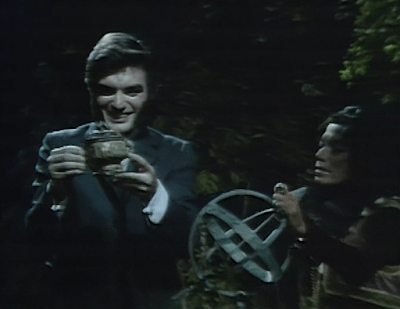
Today, a man named Aristide is holding Quentin prisoner. He straps Quentin to a table under a descending pendulum with what we are supposed to imagine is a razor sharp blade. He goes to Angelique and tells her that Quentin will die in minutes unless she gives him the hand. Since Angelique can’t see Quentin and Aristide doesn’t even describe the predicament, it isn’t clear why Aristide went to all this trouble, but it does create a memorable image and a nice homage to the works of Edgar Allan Poe. It would also warm the hearts of viewers mourning the end of the Batman TV series.

Holy Toledo! Screenshot by Dark Shadows Before I Die.

Meanwhile, a small and pretty young woman named Julianka has told Quentin’s distant cousin Barnabas Collins that she can cure Quentin if she has the Hand. He gets it from Angelique and takes it back to his house, where Julianka is waiting. She pulls a knife on him and declares that she is an emissary of King Johnny. She will not cure Quentin, and will stab Barnabas if he does not surrender the Hand. Barnabas calmly offers her money and the Hand if she will cure Quentin before she goes, but she refuses. He gives her the Hand. After she goes, we hear his thoughts as he is feeling sorry for her.

In the woods, Julianka hears a squeaking bat. She reacts with horror as the bat turns into Barnabas in front of her. She asks what he is; he tells her that he believes she knows what he is. He does not bite her, but she does become docile. It seems that Barnabas is using the “Look into my eyes!” vampiric power that he only recently acquired. It also seems that, while Julianka was lying when she originally claimed she had come to Collinwood to cure Quentin, she was telling the truth when she said that she was able to do so.

The Hand recently disfigured Quentin’s face, as it had a few days before disfigured the face of Quentin’s onetime friend Evan Hanley. Evan’s good looks returned after a while, and we have not been told why. Today Quentin’s do as well, and when he asks Aristide for an explanation the best he can do is to suggest it may just be luck. They spent quite a bit of time showing Evan’s efforts to cure himself, and even more time showing Quentin feeling sorry for himself, so this is not at all a satisfactory payoff.

In an original cast panel at a Dark Shadows convention in the 80s or 90s, David Selby reminisced about today’s scene between Quentin and Aristede. He said that when the cameras started rolling, he knew what actions he and Michael Stroka were supposed to perform, that he was supposed to end up tied to the table, and that it was supposed to take a certain number of minutes and seconds. He also knew that there was some dialogue they were to speak in the midst of all that, but he couldn’t remember any of it. The teleprompter was out of view. He looked at Stroka, hoping to see something in his face to jog his memory, and what he actually saw was the same blankness he was himself experiencing. So the two of them improvised their way through it. When they were done, they looked at the clock and saw that they had filled exactly the allotted time. But not a word of what they said was in the script. The resulting scene includes some awkward lines, but it has a great energy to it, just the sort of thing that gets you hooked on live theater.

Episode 792: No place. And every place.

Quentin Collins has devoted himself to the pursuit of evil, and as a result he has two intractable problems. When Quentin murdered his wife Jenny, her sister, broad ethnic stereotype Magda Rákóczi, turned him into a werewolf. Magda later found out that Jenny had borne twins to Quentin, and since the curse is hereditary she tried to lift it. She placed the magical “Hand of Count Petofi” on Quentin before his transformation. That didn’t stop him becoming a wolfman, but it did cause his face to be severely disfigured when he returned to human form.

Now Quentin has made his way to the house of Evan Hanley, his onetime friend and partner in Satanism. Evan had recently been disfigured in the same way Quentin is disfigured, also as a result of contact with the hand, and Quentin knows that Evan stole the hand from Magda to use in an attempt to de-uglify himself. When Quentin sees that Evan is handsome again, Evan denies that he used the hand to restore his looks. He claims not to know what happened. That is as frustrating for the audience as it is for Quentin. We were sure Evan would start looking like himself again, and they went to enough trouble to show that he was not able to correct his appearance by himself that we were expecting the cure to involve a significant plot point. When Evan presents us with “It just happened” as his explanation of how he got his old face back, we are quite sympathetic to Quentin’s decision to grab a blunt instrument and knock him out.

Quentin finds the hand in a box in Evan’s desk, and a strange man immediately enters. He demands Quentin give him the hand at once. Quentin is willing to surrender the hand once he has used it to become his desperately handsome self again, but the man will not wait. He pulls a knife to underline his point. The knife is a flat piece of wood cut in a shape with some pronounced curves and no sharp edges, and the man holds it loosely at the end of an arm that is directly over the box Quentin could easily raise to disarm him. So the audience has to help a bit to make the confrontation credible. Still, the acting is very good, and the dialogue, in which the man combines lethal threats with apparently sincere expressions of sympathy for Quentin’s plight and jokes at his expense, is complex and lively enough that we are glad to make the effort. Besides, the man goes to the trouble of telling Quentin that the knife is named “The Dancing Girl” and that it was made long ago by a Persian swordsmith, so he’s giving our imaginations something to work with. I, for one, didn’t have any trouble keeping a straight face when Quentin lost the fight and the man left with the box containing the hand.

Kids, if you are going to rob someone at knife-point, do not imitate what Aristide is doing here. Screenshot by Dark Shadows Before I Die.

Quentin goes to Magda at the Old House on the estate of Collinwood and reports what happened. She is frightened, since she herself stole the hand from a Romani chieftain/ organized crime boss named King Johnny Romana. When he says that a strange man came to take the hand, she assumes that he is an emissary of King Johnny’s, and that his next stop will be to kill her. When Quentin says that the man was young, Magda is puzzled- the recognized norms dictate that King Johnny send “an elder of the tribe” to complete such a task. She sets aside her plan to flee, and agrees to help Quentin in his attempt to summon wicked witch Angelique.

Quentin and Evan conjured Angelique up in #711. In previous segments of the show, when it was set in the 1790s and in the 1960s, Angelique established herself as one of its principal sources of action. But she hasn’t had much to do in 1897. She had a showdown with fellow undead blonde fire witch Laura Murdoch Collins back in May, and has barely been seen since. Quentin and Magda speak for the audience when they wonder where she is and what she has been doing. They speculate that she might have gone home to the depths of Hell, and light some black candles to accompany an incantation meant to call her thence.

Angelique does appear, but not at the Old House. Evan finds her in his parlor when he comes to. One of the possible explanations for the restoration of Evan’s good looks was that he made some kind of bargain with Angelique; this is excluded, not only when he is surprised to see her, but when she asks questions that make it clear she knows nothing about the hand or anything that has happened since Magda brought it back with her. Angelique orders Evan to give her a complete briefing, and we cut back to the Old House.

Quentin is still in front of the black candles, fervently reciting his mumbo-jumbo, and Magda is telling him they have failed. After a moment, Angelique enters. Quentin jubilantly declares that he has succeeded in summoning her, and Angelique says that she is not aware of that. She tells him she was with Evan, and asks about the hand. Quentin tells her it was taken from him, and asks for her assistance. She says she is willing to help him, for a price, and that as a token of her good faith she will retrieve the hand. But first she insists he tells her everything he knows. We cut to the waterfront.

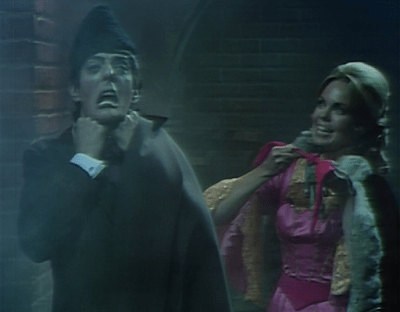
There, the man who took the hand from Quentin is standing alone in the fog. Angelique enters and flirts with him. He gives his name as Aristide. She says she is a puppeteer, and that if he lends her his handkerchief she will perform a trick. She wraps his handkerchief around the neck of a doll depicting a Continental soldier, a familiar prop from 1967 that became prominent during the 1790s segment, and squeezes it. Aristide begins choking, and Angelique orders him to give her the hand before he dies.

The Collinsport Strangler strikes again? Screenshot by Dark Shadows Before I Die.

The closing credits bill Michael Stroka as playing “Aristede,” an unusual spelling. The following item, posted in the comments under Danny Horn’s post about this episode at Dark Shadows Every Day, confirms my resolution to stick to the conventional spelling:

Factoid… I have the original script for episode 808, and Aristede is spelled throughout as Aristide.

Comment left 3 September 2017 by “Isaac from Studio 16 on W 53rd” on Danny Horn, “Episode 792: Dances with Wolves,” Posted at Dark Shadows Every Day, 19 December 2015.

In the same comment thread, Carol Zerucha goes on at length about Stroka’s ethnicity. He was Slovak, as she is, and she had a big crush on him when she was a kid watching the show. The characters in today’s episode assume that Aristide is Roma, but Ms Zerucha points out that we have no reason to assume they are right, and that he, too, might be Slovak.

Also in that thread, FotB “Straker” says that Aristide looks like William F. Buckley, Jr. I agree. I wish they had at some point cast him as a character who leaned way back in his chair and used polysyllabic words.

Episode 736: Quentin and Magda find Laura’s urn

In this episode, libertine Quentin Collins teams up with broad ethnic stereotype Magda Rákóczi to find an Egyptian urn belonging to Quentin’s enemy, undead blonde fire witch Laura Murdoch Collins. Quentin has learned that the urn contains a magic fire, and that if the fire goes out Laura will die.

Quentin and Magda find the urn hidden under an armillary sphere near the gazebo on the grounds of the estate of Collinwood. Quentin takes the lid off the sphere, and the flame jumps out. He then takes some sand from a decorative pot near the gazebo and starts heaping it on the flame. If the flame keeps burning when the lid is on the urn, you’d think only magic could put it out. Then again, it is Collinwood- maybe they have magic sand around. The flame does fade from view, and we cut to a scene of Laura losing her strength.

Quentin and Magda find the urn under the armillary sphere. Screenshot by Dark Shadows Before I Die.

In a movie that runs two hours or less, the characters can be frantically absorbed in a search for any old thing. Alfred Hitchcock famously made that point when he called the objects of these searches “MacGuffins.”

But when a show that fills a thirty minute time slot five days a week and a storyline can stretch on for months, a MacGuffin has to represent something important about a character or a relationship between characters. So when, in the early days of the show, strange and troubled boy David Collins tried to kill his father Roger by sabotaging his car, it was fitting that the resulting plot spent a lot of time on the bleeder valve David removed from the car’s braking system. David is interested in mechanical work, and in his hostility to his son Roger refuses to share that interest or do anything to support it.

It was less successful when Roger was suspected of murder and the piece of evidence he spent several weeks obsessing over was a filigreed fountain pen belonging to his friend-turned-nemesis Burke Devlin. There was some obvious sexual symbolism in the question of where Burke’s pen is, and that symbolism did focus our attention on the question of what exactly Burke and Roger’s relationship was like before they turned against each other. Had writers Art Wallace and Francis Swann stayed with the show, they might have used that question to make the pen a powerfully evocative image. But Ron Sproat and Malcolm Marmorstein took over the writing duties as the fountain pen story was getting started. Sproat was gay himself, and perhaps for that reason made a point of avoiding any suggestion of homoeroticism in his work. Marmorstein was just clueless. In their hands, the pen was just a pen, and the 21 episodes devoted to the search for it were not among the great artistic achievements in the history of television.

The urn does remind us that Laura is supposed to have a mystical connection to Egypt, which is more meaning than Sproat dared or Marmorstein could attach to Burke’s pen. But her relationship to that country is not central to anything we see, as David’s relationship to his father was central to what we saw in the early days. So as metonymy for Laura and Egypt it is marginally more exciting than the pen was as a metonymy for Roger and Burke, but significantly less exciting than was the bleeder valve as a metonymy for David and Roger.

At the beginning of the episode, we have one of the most preposterously bad special effects we’ve seen so far, which is saying a lot. Teacher Tim Shaw is rescuing Laura’s daughter Nora from a burning school building. The school as seen in the green screen is hilariously unconvincing.

Screenshot by Dark Shadows Before I Die.

Episode 357: Hit the blood

Mad scientist Julia Hoffman must hide her notebook from vampire Barnabas Collins and Barnabas’ blood thrall, his distant cousin Carolyn. The notebook documents Barnabas’ vampirism, and he does not want it to fall into the hands of the authorities. Once he gets hold of it, he plans to kill Julia.

The last time Dark Shadows devoted as much story time to attempts to hide and find an object as they have to this notebook was when high-born ne’er-do-well Roger Collins was frantically trying to hide local man Burke Devlin’s filigreed fountain pen, a story that dragged on from August to November of 1966. Few remember that storyline fondly, but at least the pen was a unique piece of evidence that might connect Roger to a homicide. The notebook is less satisfactory as a focus of attention, since there is nothing unique about it- Julia could easily have written a hundred documents detailing Barnabas’ secret and stashed them all over the world, and for all Barnabas knows she may have done. There are several strong episodes during this period, but the inadequacy of the notebook as a MacGuffin, combined with the fact that Julia could at any moment hop in her car and drive someplace where Barnabas wouldn’t be able to hurt her, prevents any momentum carrying over from day to day.

There are two important things about this installment. It is the first episode written chiefly by Sam Hall,* who will become far and away the most important member of Dark Shadows‘ writing staff. Hall would write hundreds of episodes, right up to the final one, would write the two theatrical features based on the show that were produced in the early 1970s, and would stick with producer Dan Curtis for years afterward, even contributing a script to the ill-fated 1991 primetime reboot of Dark Shadows. The husband of Grayson Hall, who played Julia, he would develop the show into something as different from its November 1967 incarnation as that version is from the show that premiered in June 1966.

On his blog Dark Shadows Every Day, Danny Horn argued that Hall’s contribution was to see Dark Shadows as, first and foremost, a “mashup” of various stories. The example he gives in his post about this episode are the scenes in the office of Tony Peterson, a local attorney whom Julia has hired to keep the notebook locked up in his safe. Tony is played by Jerry Lacy, who in the 1960s and 1970s was chiefly known for his Humphrey Bogart imitation. He would do that imitation on Broadway in 1969 in Woody Allen’s Play It Again, Sam and again in the 1972 film version of that play; here he is doing it in a 1980 commercial for the Long Beach California Press-Telegram.

In the scenes Danny focuses on, Mr Lacy imitates Bogart as Sam Spade or Philip Marlowe meeting a succession of mysterious women in his office. Grayson Hall plays Julia as a frightened and barely coherent client and Nancy Barrett plays Carolyn as the blonde you’d be a fool to trust, even if she does have a pair of gams that won’t quit. They’re all having a great time with their pastiche of The Maltese Falcon, The Big Sleep, and other staples of the Late Late Show.

Carolyn fingers the notebook. Screenshot by Dark Shadows Before I Die.

I do have to demur from Danny’s claim that Hall pioneered Dark Shadows as a mashup. It was that from #1, when Jane Eyre met the Count of Monte Cristo and they both found Art Wallace trying to remake a script he’d already sold to television twice. Nor is he the first to mash up disparate genres. The story of Burke’s fountain pen led into a police procedural that merged with a ghost story; Burke’s typically soapy conflict with Roger dissolved into the story of Roger’s ex-wife, undead fire witch Laura Murdoch Collins, a story which was Dark Shadows’ first and most detailed adaptation of Dracula. The difference in Hall’s approach to mashups is that always before, one of the genres was Gothic melodrama. Today, a vampire story is meeting a film noir, and there are some elements of conventional daytime soap opera in the margins. Hall is letting go of Dan Curtis’ original idea of chasing viewers who read Gothic romances.

We get a clue as to what that might mean for the existing characters when Tony asks Julia if she is afraid of Roger Collins. Julia laughs loud and long at the idea that Roger is any kind of danger. For the first 25 weeks, Roger was indeed a deadly menace, but ever since Laura came through he has been reduced to occasional comic relief. Viewers who find a reminder of Burke’s fountain pen in the business with the notebook will see that even the villainous early Roger is a minor threat compared to the supernatural force Barnabas represents. So we are not to assume that any character or theme surviving from the show’s original conception is safe.

*The credits on screen say Gordon Russell wrote it, but evidently the paperwork from the show demonstrates that Hall did. Also, some of last week’s episodes sounded and felt as much like Hall’s work as this one does, but none of the experts tries to credit him with those, so I’ll defer to the consensus and say that while his influence may have been visible some days ago, this one marks his debut on Dark Shadows as the principal author of a teleplay.

Episode 144: Saying things I don’t expect you to say

Alfred Hitchcock famously used the name MacGuffin to refer to some object that the characters in a story are all trying to get hold of. His point was that if the action is interesting enough, the audience won’t care what the characters’ ostensible motivation is- the MacGuffin can be anything at all.

It’s one thing to show a bunch of people all in constant movement, fighting, scheming, and racing about, for an hour or two. If that’s what you’re showing, sure, it doesn’t matter what they are chasing. But on a daytime soap opera where a story may play out day after day for weeks, where much of the time will be taken up with people sitting around having conversations where they recap plot points over coffee, and where at most half the characters are involved in any given storyline at a time, a meaningless MacGuffin soon becomes a bottomless pit into which all dramatic interest falls, never to be seen again.

Dark Shadows proved that point during the twenty or so episodes devoted partly or entirely to looking for Burke Devlin’s fountain pen. Today is the third episode in which well-meaning governess Vicki is aware of a locket sometimes worn by the mysterious and long-absent Laura Collins, and the locket is already beginning to match Burke’s pen as a source of soul-killing tedium.

A week ago, in #139, Laura showed the locket to Vicki and went on at length about how important it was to her. Yesterday, in #143, a policeman brought a locket indistinguishable from the one Laura had shown Vicki and said that it was found in the what was left after a fire destroyed Laura’s apartment in Phoenix, Arizona. When Vicki says that Laura had shown her the identical locket, reclusive matriarch Liz says that she can’t have seen the one in front of them. That seems obvious, since it has just arrived from Phoenix. Strangely, Liz goes on to deny that there could be a duplicate of the locket.

Vicki, Liz, and the policeman go to Laura’s cottage. Laura identifies her belongings, including the locket. The policeman asks about a woman whose charred body was found in what was left of Laura’s apartment. Laura tells him she and the landlord had the only keys. After he tells her that the doors and windows of the apartment were locked from the inside, so that the dead woman must have had a key, Laura makes up a transparent lie about a cleaning woman who may have had a key.

Liz and the policeman leave; Vicki stays behind, and asks Laura about the locket. As she had done with Liz, Vicki opens by claiming that she had seen Laura wear that particular locket. Laura very reasonably points out that she just got it back from the fire. Laura then does as Liz had done and denies that there is a duplicate of the locket. It would seem to be the easiest thing in the world for Laura to say that she had a duplicate made. After all, she could lie to the policeman to put his questions off- why not lie to Vicki to shut her down? Laura’s insistence that she did not show Vicki the locket is just frustrating.

Vicki goes back to the great house of Collinwood and crosses paths with the policeman as he is leaving. She asks him a number of questions about his investigation. He had been present when Vicki and Liz were talking about the locket, and had seen Vicki stay behind to talk with Laura. It would be natural for him to ask her if Laura cleared up her concerns. That he doesn’t think to raise the subject is a missed opportunity to give us a reason to care about the locket.

Vicki, Liz and instantly forgettable young lawyer Frank play a scene in the drawing room of the great house. Frank asks Vicki how she is. “Confused!” she answers. “You have a habit of saying things I don’t expect you to say,” Frank replies. Frank has no such habit. He says just what you would expect him to say, in just the way you would expect him to say it. That might make him a reassuring person to handle your legal affairs, but it does not deliver much entertainment value.

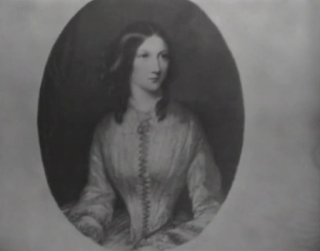
They all leave the room, and we see the Collins family album open by itself. It opens to a portrait of Josette Collins, wearing the locket. After Vicki and Liz return to the room, Vicki sees the portrait and wonders if it is a sign. She has encountered the ghost of Josette, and feels it is her protector.

This portrait of Josette looks quite different from the other images of Josette we have seen. At this point, the show is still placing Josette’s life in the 1830s. The portrait of her above the mantle in the Old House at Collinwood is just about possible for that period, although it would more likely have been painted twenty or thirty years later. Next year, they will readjust the family history and put Josette in the 1790s. This picture could have been done anytime between then and the 1860s:

Josette, is that you? Screenshot by Dark Shadows Before I Die

Confused, Vicki goes for a walk on the beach to clear her mind. As if to acknowledge that the story of Burke’s fountain pen was a drag and to promise they will do better with their MacGuffins this time, they reuse the footage from #75 of Vicki walking on the beach, up to the moment when she discovered the pen there. They intercut that video insert with footage of Laura staring, evidently suggesting that Laura is watching Vicki. For the first time, we have clear evidence on screen that Laura and Josette are on a collision course.

Episode 95: My pen is among the missing

Well-meaning governess Vicki is in a hotel restaurant in Bangor, Maine. She is waiting for dashing action hero Burke to drive her the 50 miles to her home in the great house of Collinwood.

Vicki is sitting at a table with Burke’s lawyer, Mr Blair. Blair takes out a pen to mark up some contracts. Vicki tells him that his pen is identical to one she found on the beach at “a place called Lookout Point.” She had earlier told another lawyer, her new friend Frank, that beloved local man Bill Malloy was killed at Lookout Point. Blair doesn’t know that part of it.

Blair tells Vicki that she must be mistaken- there are only six such pens in the world. He has one, Burke has one, and the other four are in South America. Blair tells her that if she found one, it must be Burke’s. He goes on to say that the pen is very expensive, and that if it is Burke’s he would certainly want it back.

Blair hands Vicki the pen. She examines it. A look of alarm crosses her face. She hurriedly assures Blair that, looking at it close up, she can see that it is nothing like the pen she found.

Burke returns to the table. Blair gives him the contracts to sign. He asks Blair to lend him something to write with, saying “My pen is among the missing.” Focused on the contracts, the men do not notice as Vicki’s look of discomfort intensifies.

Burke asks Vicki if she’s ready to go. She excuses herself to make a telephone call. Unable to reach Frank, she calls Collinwood. High-born ne’er-do-well Roger answers. Vicki asks Roger to come to Bangor to get her. Appalled by the notion, Roger asks why he would ask him to inconvenience himself so seriously. She says she thinks she might be in danger. She explains her theory that the pen she found made its way to Lookout Point when Burke dropped it there while murdering Bill Malloy. Roger tells Vicki to wait for him, and rushes out of the house.

Vicki calls Roger to come to her rescue. Screenshot by Dark Shadows Before I Die

Over a period of several episodes, the sheriff questioned Roger, Burke, and drunken artist Sam Evans about Bill’s death. Roger is firmly outlined as the villain, so we suspect him. There were also a number of moments when the show gave us definite reasons to think Sam might be the culprit. At no point did they dwell on the idea that Burke may be responsible, but it would be an interesting twist.

Bill had told Burke he would find evidence to clear his name in connection with a manslaughter charge that sent him to prison years before, and it has never been clear just what Bill could do to deliver on that promise. Perhaps we will learn that Burke discovered that Bill couldn’t deliver on it, and, succumbing to the violent temper he has displayed many times, he reacted by shoving Bill off Lookout Point to his death in the waters below. For all we know, Vicki’s suspicions might be the first step towards exposing Burke as the killer of Bill Malloy.

It’s true that Roger had Burke’s pen and believes that the pen Vicki found will suggest that he was at Lookout Point. But it could easily be that Burke, who after all gave the pen away very blithely when he was having lunch with flighty heiress Carolyn in the same restaurant where he and Vicki are today, in fact owns another one, that Vicki found that other one, and that Roger lost the pen Burke gave Carolyn somewhere else. Roger’s frantic attempts to hide the pen would incline us to believe that he was at Lookout Point with Bill, but it is precisely that belief that would make the revelation that it was Burke who dropped the pen a twist ending.

The pen itself, as the only piece of physical evidence in a whodunit that has been going for ten weeks and shows no signs of ending, gets a great deal of attention. Dark Shadows fans often lament this, and rightly so. At times, the pen falls into Alfred Hitchcock’s famous category of a “MacGuffin,” the thing that everyone in the story is urgently trying to get hold of. In a 90 minute action movie, just about anything can be a MacGuffin- a cache of diamonds, a secret document, the Maltese Falcon, etc. But when the story goes on for months and it involves a mystery we’re supposed to be trying to solve, the thing people are trying to get their hands on can’t be just anything.

Of course, if we’re watching an inverted mystery where we see the case from the villain’s point of view, there will be excitement any time s/he suddenly realizes s/he left a piece of evidence unconcealed. Some of Roger’s scenes with the pen play this way, but since we didn’t see what happened to Bill Malloy and haven’t been told anything definite, they don’t quite close the loop.

There are two things a piece of evidence has to be if it is to work in the place the story gives to Burke’s pen. First, it has to be a clue that will solve the mystery. Roger’s behavior concerning the pen certainly reinforces our suspicions of him, but it is easy to think of many other ways it could have been left where it was. Even if we leave aside the possibility that it is a duplicate Burke dropped, we have to remember it was several days after Bill’s death that Vicki found the pen. Who knows what sort of creature might have been attracted to its shiny surface, carried it from wherever it was originally left, and deposited on the beach long after Bill was already dead.

Second, and more importantly, the object has to connect one substantive story element to another. The crucial piece of evidence in Dark Shadows’ first mystery story met this requirement. Strange and troubled boy David had tried to kill his father, Roger, by tampering with the brakes on his car. David had trouble getting rid of the bleeder valve, and was eventually caught with it in his possession. We’ve seen David reading a magazine about mechanics and playing with mechanical toys, and have seen Roger refusing to take an interest in machinery. So a piece of hardware in David’s possession reminds us of the estrangement between father and son. Moreover, while Roger is not interested in the workings of his car, he is avidly concerned with it as a marker of his status. Burke envies him that status, and hangs around the car. When Burke comes to be involved in the story of Roger’s crash, the prominence of a piece of the car brings that envy to mind. That the same object represents Roger’s conflicts with David and with Burke associates those conflicts with each other in our minds, and sets us up to expect them to merge, as indeed they do.

Burke’s pen has no such associations. It’s something he shares with Mr Blair, who is barely a character on the show, and with four other men whom we have never seen and whose names we’ve never heard. Neither Burke nor anyone else we’ve seen is a calligrapher, or a writer, or any other person who would come to mind when we hear about pens. So the story doesn’t establish a specific symbolic charge for a pen considered as a pen.

Of course, the show was made in 1966, so there is an inevitable symbolism associated with any cylindrical object. Zach Weinersmith explained this the other day in a Saturday Morning Breakfast Cereal comic:

https://www.smbc-comics.com/comic/dongworld

I think the writers intentionally put their fair share of Freudianism into the scripts, and I can’t imagine Louis Edmonds didn’t expect some in the audience to watch his portrayal of Roger’s panicked obsession with where Burke’s pen is and think in those terms. Indeed, while Weinersmith talks about the period 1890-1970 and singles out the 1930s as a peak, it was in the 1960s, the age of Tennessee Williams, Edward Albee, and Peter Shaffer, that Freudianism peaked in its influence on the New York theater world where the people involved in making Dark Shadows were most at home. So this episode would be a case in point for Weinersmith’s hypothesis.