
Episode 842: Some kind of an unnatural creature

Mad scientist Julia Hoffman has traveled back in time to the year 1897 to help her friend, vampire Barnabas Collins. Julia has fallen into the clutches of sorcerer Count Petofi and is bound and gagged in Petofi’s lair. A loaded revolver is tied to the doorknob, rigged to fire a round through her heart when the door opens.

Barnabas has learned where Julia is, but not about the death-trap in which she is ensconced. He storms into the building, turns the doorknob, and thereby discharges the gun. He sees Julia slumped over in her chair, and shouts at Petofi’s henchman that he will kill him. He then goes to Julia and finds that she is alive. There is a bullet-hole through the back of her chair, but she herself is unharmed.

Julia declares that there is only one explanation for this phenomenon that makes sense. Considering the kinds of stories that play out on Dark Shadows, we would think that an explanation that makes sense would be the one we could discard immediately, but Julia plows ahead. When she traveled back in time, only her “astral body” made the trip. Her physical body is still in 1969. For his part, Barnabas had a body in 1897, trapped in a sealed coffin. That body is hosting his personality, which is why he is subject to physical injury. But Julia is in no danger. When she later says that she can disregard Petofi’s threats, Barnabas says that if he finds out the truth, Petofi will just find another way to immobilize her, so she has to lie low.

Petofi is so powerful that Barnabas does not believe that he and Julia can fight him by themselves. So he tells Julia to summon wicked witch Angelique. Barnabas and Angelique have been enemies for centuries, but he thinks they have a common cause now. Angelique is determined to marry his cousin Quentin, whom he has befriended and Petofi has enslaved. So Barnabas expects she will agree to help fight Petofi.

Angelique does come in response to Julia’s message. She remembers Julia from time she herself spent in the 1960s, and is shocked to find her in 1897. Julia refuses to explain how she made her way back in time. She says that if Angelique can come to 1897 from 1968, she oughtn’t to be surprised she has come there from 1969. Angelique responds that Julia is not like herself and Barnabas. “I’m human,” says Julia. Since she is separated from her proper body, she isn’t fully human, not at the moment, but she still takes evident satisfaction in applying the label to herself. This marks a contrast with Angelique, who was offended earlier in the episode when Petofi laughed and taunted her for being “so human.” Julia and Angelique then snipe at each other about their respective relationships to Barnabas.

Julia says that it is essential Barnabas should “complete his mission” and solve the problems they were facing in 1969. Angelique responds that he will never be able to do that, because he has changed history too much in the time he has spent in 1897. This remark is intriguing for regular viewers. Barnabas’ six months of bungling around, picking fights, and committing murders must have had major consequences for what came after. That gives the show two ways forward. When Barnabas and Julia go back to a contemporary setting, they might meet an entirely different cast of characters and have to find a place for themselves in an alternate universe. Or they might do what they did when the show’s first time-travel story ended in March 1968, and dramatize the force of the Collins family’s propensity for denial. The head of the family in the 1790s decided to compel everyone in and around the village of Collinsport to pretend that none of the events we had seen had ever taken place, and when the costume drama segment ended we found that he had made that pretense stick ever since.

After Julia points out that it is to her advantage to emancipate Quentin from his bondage to Petofi, Angelique agrees to help. She still will not answer Julia’s questions. After she leaves the room, Julia looks in the mirror, sees an image of Angelique, and says that now she understands what she is going to do and believes it will work. That puts her one up on the audience.
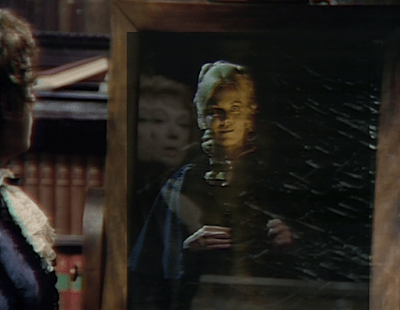
Julia looks for an image of herself, and finds Angelique. Screenshot by Dark Shadows Before I Die.

The scene pairs Julia and Angelique as two women whose lives have been shaped by their pursuit of Barnabas. Their bickering makes this similarity explicit. When Julia looks in the mirror and sees Angelique, they put very heavy emphasis on the similarity. In a brilliant, but now inaccessible, post on the great Collinsport Historical Society,* Wallace McBride wrote that “On Dark Shadows, your reflection always tells the truth.” He demonstrated that on the show, reflections are very strongly coded as true, so much so that they must be making a serious statement when they give us an image like this one. They are committing to the idea that Julia is, in some important way, the same as Angelique.

There are also a couple of scenes featuring the repulsive Roger Davis as artist Charles Delaware Tate. Mr Davis is especially hard to take in a scene with Donna McKechnie as the mysterious Amanda Harris. Miss McKechnie had already done outstanding work on Broadway as a singer and dancer by this time, but she felt herself to be a beginner as an actress, and she could not conceal her discomfort when Mr Davis shouted his lines. The 4:3 aspect ratio of old-time American television meant that the performers spent much of their time only a few inches from each other, and when Mr Davis yells in Miss McKechnie’s ear, she winces. He clutches at her arm, and she recoils; before she can relax from that invasion of her space, he slams down on a table, making a loud noise and causing her to jump.

Mr Davis’ incessant shouting will bring back memories for viewers who have been with the show from the beginning. The scene takes place on a set which is known in the parts of Dark Shadows set in the 1960s as the Evans Cottage. The Evans Cottage was home to drunken sad-sack Sam Evans and his daughter Maggie, The Nicest Girl in Town. Sam, like Tate, was an artist, and the artworks scattered around the set in the 1897 segment remind us of the cottage’s iconography.

The first seven times we saw Sam, between #5 and #22, he was played by an actor called Mark Allen. Like Mr Davis, Allen had considerable training as an actor and a long resume of stage and screen appearances. Also like him, he is just terrible. Mr Davis did have extensive skills and could on occasion give nuanced performances, though he rarely chose to do so. He much preferred spending his time roughing up the women and children in the cast.

But Allen never once did a good job of acting. In each of his episodes, he either shouted every line with the same ear-splitting bellow, or whined every line in the same putrid snivel. Allen didn’t assault his scene partners on camera, as Mr Davis routinely did, though Kathryn Leigh Scott, who played Maggie, has made it clear that she did not feel safe in scenes where they embraced. Moreover, in some corners of fandom there are persistent rumors about abusive behavior off-camera that led to Allen’s dismissal. People claim to have heard remarks cast members and others associated with the show let drop at Dark Shadows conventions over the years, and from those remarks they come to some alarming conclusions about what Allen did behind the scenes. Who knows if those conclusions are correct, or if the people who report the remarks even heard them clearly, but Allen was so unpleasant as a screen presence that it is tempting to believe the worst about him.

The point of Tate’s scene with Amanda is that she does not want to believe that she is an artificial being who came to life when he painted a portrait that looked like her. Tate’s success as an artist is the result of magic powers Petofi gave him; he just recently learned that he can make things pop into existence by drawing or painting them. To convince Amanda that he has this power, Tate sketches an imaginary man. She screams, and we see her looking at the man who has come into being.

This seems like a bad choice on Tate’s part. Why not draw an inanimate object instead? If he’d drawn a hat or a gold bar or a gemstone, he could just have given it to Amanda with his compliments. But now he has a 25 year old man whom he is obligated to help make his way in the world. If an inanimate object wasn’t a striking enough image to send the episode out with a dash of spectacle, then Tate could have created a farm animal, such as a donkey or a goat. If Amanda didn’t want such an animal, Tate could just shoo it outside and be confident someone would claim it- Collinsport is supposed to be a tiny town in the middle of a rural area, after all. But for all the irresponsible behavior we’ve come to accept from characters on Dark Shadows, we are not going to be able simply to forget about this human being. They are going to have to do something to account for him.

*A site which has now been taken over by a “crypto-based casino” outfit! You’d be safer at Collinwood.

Episode 22: I only run from enemies

This episode doesn’t intercut scenes as Art Wallace likes to do. Instead, we have four distinct scenes in succession, to only one of which do we cut back. First, Maggie and Burke at the Evans cottage; second, Sam and Roger at the restaurant; third, Sam, Maggie, and Burke at the Evans cottage; fourth, Carolyn and Roger at Collinwood; then, a reprise of Sam, Maggie, and Burke at the Evans cottage.

The first two scenes don’t give new information. Burke and Maggie do some recapping for the audience, then Roger and Sam reenact the exchanges they had in week one about the danger Burke represents to them both.

When Sam joins Maggie and Burke at the cottage, he jumps to the conclusion that Maggie has told Burke the secrets of the Evans family. Looking at the lines, I guess this was supposed to show that the tough facade he maintained in the face of Roger’s menacing crumbles when he finds Burke in his house, but since Mark Allen’s portrayal of Sam consists entirely of bellowing his lines it doesn’t really come off.

Burke offers Sam $1000 to paint a portrait of him that will fit on the walls of Collinwood, of a size and style that will fit with those of the Collins ancestors. In episode 11, Burke had asked Roger if Liz would want to sell the house or the business; Roger reflexively responded “You know she wouldn’t!” Asked what the “business deal” was he wanted to discuss with Roger at the Blue Whale the night of Roger’s crash, he claims that he wanted to talk further about buying the cannery. Now we have indications that his plan, whatever it is, will leave him in control of the house.

Roger and Carolyn discuss Burke. Carolyn says that she doubts Burke’s guilt, Roger loses his temper and says that he doesn’t care whether Burke is guilty or not. He then apologizes, explaining that he didn’t mean to say such a thing.

Usually the other actors manage to do a good job despite Mark Allen, but Mitch Ryan has a lot of trouble in this episode with the level of his voice. Even before Allen enters, he’s alternately too loud and too soft in the two-scene between Burke and Maggie, and from the time Allen enters his voice is never at a well-modulated level. I can only surmise that Allen bellowed his way through rehearsal as badly as he does through the finished episode, and that Ryan was trying to figure out how he was going to fight his way through the problem.

Episode 20: A mockery to the future

In episode 18, Roger (Louis Edmonds) had demanded Vicki (Alexandra Moltke Isles) come with him to Burke’s hotel room, where they will tell Burke (Mitch Ryan) about all the evidence they have connecting him to Roger’s car wreck. Vicki repeatedly protests in that episode that it would be better to take this information to the police. In this one, they arrive at the hotel, and again Vicki objects that they really should be going to the police. Roger, however, is a man obsessed. He asks Vicki to wait in the restaurant while he goes to Burke’s room, telling her that it may not be necessary for her to join him.

Sam (Mark Allen) comes to the restaurant looking for his daughter Maggie. Finding that Maggie isn’t at work, he invites himself to Vicki’s table. Their previous encounter had been a strange and frightening one on the top of Widow’s Hill; Vicki is no more comfortable with Sam now than she had been then. He bellows at her, she reacts with quietly frosty disdain. These attitudes may have less to do with the script or the direction than with Mark Allen’s limitations as an actor; he bellows all of his lines in this episode, and quiet frostiness is as effective a technique as any other for holding onto the audience while sharing a scene with an incompetent loudmouth.

There’s no incompetence in the scenes in Burke’s room. Louis Edmonds and Mitch Ryan were first-rate stage actors, and their confrontation is a terrific fireworks display. When Roger brings Vicki up to tell Burke what she saw him do in the garage, she again plays the scene quietly, an effective counterpoint to the artillery blasts the men have been letting loose.

In the Evans cottage, Sam finds that Maggie (Kathryn Leigh Scott) has been home all this time. When Allen bellows at her, Scott bellows back at him, a far less effective tactic than the quiet intensity Mrs Isles had used earlier. The scene has some potential- the situation is that an alcoholic finds that his adult daughter has been checking up on him, he resents it, and they have a fight about all of the ways in which she has been forced to take on the parental role in their relationship. But as a shouting match, it might as well be about anything, or about nothing.

Returning home after their confrontation with Devlin, Roger and Vicki say goodnight in the foyer. Time and again in these early episodes, people have urged Vicki to leave Collinsport while she still can. Even in this episode, Burke had told her that. But as they part ways for the night, Vicki to her bedroom and Roger to the brandy bottle, Roger tells her that as a witness, “you can’t leave now.”

That line is effective enough, but if the scene between Sam and Maggie had worked it would have been very powerful. The Evanses, father and daughter, are a case of two people who are trapped, trapped in Collinsport, trapped with each other, trapped with his alcoholism and her sense of obligation to keep him alive. As written, the scene could have brought all that out, and induced a claustrophobic sense in the audience that would have made Roger’s line feel like a death sentence. As ruined by Mark Allen, it just leaves us with the sense that we’re watching a show that needs some recasting.

Episode 12: You can still hear the widows

Roger and Vicki encounter each other on the peak of Widow’s Hill. Roger remarks it is the highest point in the area. At the end of their conversation, Vicki will call to Carolyn, inviting her to join them “down here.” This may seem to be a blooper, but since we hear “down” used to mean “up” in a later episode, I speculate that it’s a peculiarity of Collinsport English.

Little happens to advance the plot in this episode, but between Roger’s announcement that he and Vicki are standing on the highest point in the area and Vicki’s invitation to come “down here,” we hear a lot about the ghostly legends of the place. After the scene in episode 11 where the ghosts are troubling Elizabeth while David is doing something mysterious involving motor grease and little pieces of metal, it seems that the show is using the ghosts as a sign that something big is happening. Certainly the “Widow’s Wail” is a striking sound effect, and Louis Edmonds does a good job of selling the idea that Roger really does believe in all the legends about the house that his social position might require him and Elizabeth to ridicule publicly.

It’s a bit jarring that Carolyn drifts into the scene asking what Vicki and Roger are doing- “planning a suicide pact?” She had just told Vicki about the legend that a third governess would die by jumping off the cliff, and the series story bible still calls for Roger to throw himself to his death from it. So you might think it would be in questionable taste to bring that particular topic up just now.

There’s also a scene in the Evans cottage where Maggie (Kathryn Leigh Scott) tries to get Sam (Mark Allen) to tell her what’s been bothering him. In episode 11, Conrad Bain had triumphed over a weak script and Mark Allen’s relentless whine to turn what might have been a lot of tedious recapping into a compulsively watchable scene. At the beginning of this scene, Kathryn Leigh Scott is mustering such powerful emotions that it looks like she might be about to accomplish the same feat, but Allen has switched from whining all his lines to bellowing them. So the scene is a dead loss.

Episode 11: “‘Straight from the bean to you!’ I wonder who writes that junk.”

One of the great challenges of writing a serial is fitting enough recap of previous story points into each installment that new viewers can catch up without putting so much in that you bore the regulars. A time will come when Dark Shadows gives up recapping altogether, but in these early weeks they are scrupulous about soapcraft.

In episode 11, much of the recapping takes place in a scene between innkeeper Mr Wells (Conrad Bain) and drunken artist Sam Evans (Mark Allen.) The story justification for Mr Wells telling Sam everything the audience might need to know about Burke Devlin and the Collinses is that Sam’s daughter Maggie, who runs the restaurant in the inn, is about to return to work, and Mr Wells doesn’t want her to see her father drunk. He knows that as long as Sam thinks he might have something new to tell him about Burke, he will sit there and drink coffee.

The scene between Mr Wells and Sam is an example of something that becomes ever more important to Dark Shadows as it goes on: good acting trumping not-so-good writing. And good acting trumping bad acting- while Mark Allen is the worst actor on the show, Conrad Bain is phenomenally good. He single-handedly takes what must have looked in the script to be a terribly dull scene and makes it completely absorbing. I can imagine a show entirely composed of him looking into the camera and telling stories, and that show would be great. No wonder he went on to have such a big career in television!

Episode 7: Nowhere- Everywhere- Perhaps I was here.

Vicki and Burke run into each other at the Collinsport Inn where Maggie serves them coffee, Roger lets himself into the Evans cottage where he makes demands of Sam, Maggie tells Roger that Burke and Vicki are sharing a table and he runs away.

In these interactions, we see Burke using his considerable charm to try to get information out of Vicki, Roger using his social position to try to bully Evans the father while Evans the daughter exposes his cowardice, Sam wallowing in self-pity, Maggie letting information out indiscriminately, and Vicki taking it all in, cautiously.

Marc Masse’s post about this episode on his Dark Shadows from the Beginning has some interesting stuff. Both Mitch Ryan as Burke and Mark Allen as Sam are required to talk with their mouths full; both of them have mishaps, which he records with gifs showing matter falling out of their mouths. He also has these intriguing paragraphs about the character of Sam Evans:

One thing about the Evans cottage you notice in this episode is that when Sam walks in the door you can see houses across the street, a setting that would suggest a quiet, cozy cul-de-sac near the waterfront. Sam has neighbors, but none ever come calling. One gets the impression that Sam is troubled about something and just wants to be left alone, but time and again unwanted trespassers will just keep barging in, like this nervous, frightened man who lives in a mansion on the hill who busts in to order him around and warn him to keep certain information secret that might be damaging to the both of them. There will at one point be a cannery plant manager who just walks in without knocking while he and Roger are arguing about Burke Devlin, the plant manager telling Sam that if he wants privacy he should keep his door locked. But even that wouldn’t work, because as time goes on the trespassers will only become more aggressive: a fire goddess who, by staring into a blazing fireplace miles away, can make Sam fall asleep on the sofa with a lit cigarette to ignite a nearby newspaper so that he burns his hands badly enough that he can no longer paint; a newly risen vampire who sneaks in through the French windows to make a blood bank of his daughter; a Frankenstein monster who lets himself in for food and shelter and who knows where the cutlery is kept; a werewolf that doesn’t even bother with locked doors and just crashes in through the nearby window. The Evans cottage is a hub of activity for invasive beings with criminal intent.

But now, in the relatively sane and quiet summer of sixty-six, all Sam Evans has to do for a little peace of mind is assure his unwanted patrician visitor that he will not do or say nothing to jeopardize the agreement the two apparently made that ties them together like conspirators – because that’s what they represent to the viewer, two people who keep information away from others, information the viewer at this point is also not fully privy to.

But the one salvation for Sam Evans is that, unlike Roger Collins, he does seem to have some remnant of a conscience about whatever unsavory information ties these two unlikely co-conspirators together, and therefore a soul that may be worth saving.

Marc Masse has more use for Mark Allen’s acting than I do- I would say that he tends to be monotonous, his voice either a constant whine or a series of bellows. So I find it difficult to think of Sam Evans #1 as a soul worth saving. But this is a most insightful passage.