Episode 637: Too late for anything to happen

Well-meaning governess Vicki ran out of story in #191, and has been at the fringes of the show ever since. Since March, Vicki has been stuck in a relationship with an unpleasant man named Peter who preferred to be called Jeff.

As long as Alexandra Moltke Isles played Vicki, longtime viewers could hold onto some sliver of hope that she would eventually reconnect with an interesting plotline. Mrs Isles’ last episode was #627, and the part was taken over by Betsy Durkin, who stresses random words in her lines (such as, “Jeff, you’ve got to stop thinking about the past!,”) keeps looking at her scene partners with her face still for a few seconds too long after delivering her lines, and moves about awkwardly, as if she were afraid of tripping over her costume. For his part, Peter/ Jeff is played by Roger Davis, a highly trained actor who doesn’t do any of those things, but who routinely assaults actresses on camera and who clenches his rectal sphincters whenever he raises his voice, causing him to sound like he is struggling with constipation. Miss Durkin and Mr Davis are a difficult pair to watch, and since there is no reason in the story for either fake Vicki or Peter/ Jeff to be on the show their scenes are an unwelcome intrusion.

Today, fake Vicki and Peter/ Jeff get married. The morning after their wedding, he fades into nothingness while she watches, which considering his personality is the best case scenario for her.

We spend the middle of the episode with recovering vampire Barnabas and mad scientist Julia, who unlike fake Vicki and Peter/ Jeff are actually characters on Dark Shadows. Barnabas and Julia enter the great house of Collinwood. They have been at pains to keep the residents of the great house from finding out about any of the supernatural doings, yet when they walk in the front door they blab about everything in nice loud voices.

Matriarch Liz comes in and tells Barnabas and Julia that Vicki has married Peter/ Jeff. Once Liz leaves, Barnabas, stunned and dejected, moans “Julia, why did she do it? Why did Vicki marry him?” Barnabas has often claimed to be in love with Vicki, but in fact takes remarkably little interest in her, so it is no surprise that less than a minute goes by before he shrugs the whole thing off with “I’ll accept it and pray that she’ll be happy with it.”

Julia reacts to Barnabas’ reaction to the news of Vicki’s wedding. Screenshot by Dark Shadows Before I Die.

Barnabas and Julia go off to drive a stake through the heart of witch-turned-vampire Angelique. It’s a rule on Dark Shadows that a wedding scene leads to the exposure of an empty coffin, so it will be no surprise to longtime viewers that when Barnabas and Julia open Angelique’s coffin they find she isn’t in today. Barnabas fears that she has changed in some way that will make her even more dangerous when she eventually returns.

Angelique and Peter/ Jeff were the last loose ends left over from the big collection of storylines introduced in the spring of 1968; her absence and his vanishing wrap up the Monster Mash period that constituted Dark Shadows 4.0. The only indication we have had so far as to what version 5.0 will turn out to be was a scene in #632 between werewolf Tom Jennings and his sister Amy. It remains to be seen how the Jenningses will connect with the Collinses and what other characters will join them.

Episode 490: We’re both alive

Dark Shadows is in one of its most “High Concept” phases today. Mad scientist Julia is trying to transfer the “life force” of recovering vampire Barnabas into a Frankenstein’s monster named Adam. She is having difficulty concentrating because she is in the grip of an elaborate spell cast by wicked witch Angelique, a “Dream Curse” in which each victim has the same nightmare, is compelled to describe it to someone they saw in the nightmare, and that person is then the next to have the nightmare.

The episode is so completely dominated by these plot elements that the writers couldn’t find time to give the characters motivations. Julia is supposed to tell the nightmare to housekeeper Mrs Johnson. Julia is busy in the house by the sea where the lab is, and there is no reason for Mrs Johnson to go there. So they just have Mrs Johnson show up without a reason. She talked with Angelique on Friday and is in a trancelike state when she enters today, inviting us to imagine Angelique cast a spell that caused her to go to Julia.

Well-meaning governess Vicki also turns up at the house by the sea. She wants to talk to Barnabas about a note he left saying that he would be going away and a man named Adam would be coming. What Vicki lacks isn’t so much a reason to be on this set as it is a reason to be on the show. For thirteen months now, whatever Barnabas is doing has been the A plot of Dark Shadows. Barnabas has systematically refused to let Vicki into his life in any substantive way. In this scene, he confirms that Vicki will not be allowed into the action when he assures her that “loving me would have been the worst mistake of your life.”

For a little while, Vicki was in a B plot about her romance with a man named Peter who insists on being called Jeff. There is no longer any obstacle to Vicki and Peter/ Jeff being together or any connection between Peter/ Jeff and any other story. Besides, Peter/ Jeff is a repellent screen presence, and if Vicki wants to spend time with him we’d frankly prefer she do it when the cameras are off. She and Barnabas do some recapping, and then she goes back to the shelf where the writers are evidently determined to keep her.

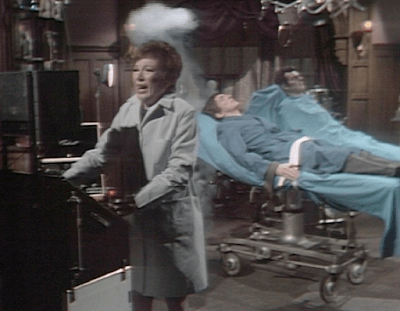
Julia conducts the procedure. There are lots of closeups of gadgets meant to suggest sophisticated medical devices. So many of these are operating in the lab that we wonder why they didn’t hook Adam up to machines that were supposed to make his heart beat and his lungs pump during the many many days he spent lying on the table in this unrefrigerated room. After all, the principle governing the inclusion of machines on this set is clearly “the more, the merrier.”

As the procedure goes on, Barnabas smiles and says with absolute delight “I’m getting weaker. I feel life slipping away from me.” Dark Shadows is already deep into its Monster Mash period, and this kind of misplaced glee is usually the keynote of dramas that are loaded with vampires and witches and Frankensteins and whatnot. But this line is the first time they’ve really sounded that note, and it will be two and a half years before the show outdoes this instance of it.

The equipment goes haywire. Screenshot by Dark Shadows Before I Die.

Some of the equipment crackles and fizzes, and there are explosions. Julia cannot continue, and leaves the room thinking the procedure has failed. Barnabas stays behind to make a speech to the lifeless body, only to see the eyes open. He realizes it is not lifeless at all. The plan was that his original body would die and he would wake up as Adam; he is puzzled that they are both alive.

Dark Shadows and the legends of the Holy Grail

In 281 of the posts that follow, I link to comments I made on Danny Horn’s blog, “Dark Shadows Every Day.”

I added most of these comments in the months between the shutdown of live theater in March of 2020 and the completion of the blog in April of 2021. But I have added some comments since. Yesterday, I read Julius Evola’s The Mysteries of the Grail (translated by Guido Stucco; Rochester, Vermont, 1997.) Evola is not someone I agree with about things, to put it mildly, but that book describes dozens of moments from legends about the Quest for the Holy Grail that may have been in the minds of people making Dark Shadows.

In this long comment on Danny’s post about episode 559, I collect various moments in the medieval romances concerning the quest for the Holy Grail that may have inspired story points on Dark Shadows. The whole thing starts as a response to Danny’s exasperated remark about the apparently uncharacteristic infatuation of evil wizard Nicholas Blair for nice girl Maggie Evans, an infatuation that will lead to Nicholas’ downfall. I do not claim that the show does a good job of fitting this relationship into the story, but I do use it as a jumping-off point for a long catalog of similarities:

“Also, Nicholas is in love with Maggie.

“Sorry to spring it on you like that, but it’s that kind of storyline. Nicholas Blair is some kind of evil wizard man, and so far we haven’t had any indication that he’s looking for a girlfriend. In fact, he’s been mocking Angelique relentlessly for having human emotions. And yet, here we are.”

I think there’s a possible explanation for this. By the end of the 1960s, the legends of King Arthur, the Knights of the Round Table, and the Holy Grail had been in vogue for decades. New York theater people like those involved in Dark Shadows would of course have been keenly mindful of Lerner and Loewe’s CAMELOT, which was a hit on Broadway from 1960 to 1963 and which appeared as a feature film in 1967. As part of that fashion, bookstores generally would carry paperback translations of Thomas Malory’s 1453 LE MORTE D’ARTHUR and of selections from the romances about the Holy Grail written in the years 1175-1225 on which the legends of Arthur and his group were based.

Nicholas is a representative of the Devil. In Malory (especially Book 14, verses 9 and 10,) we see a theme that recurs in several of the Grail romances, that Lucifer fell from Heaven because he had conceived a passion for a mortal woman.

In fact, many of the themes of the Grail romances show up in DARK SHADOWS. The title of the novel on which the musical CAMELOT was based is THE ONCE AND FUTURE KING, harking back to a legend that King Arthur only appears to be dead- he is in suspended animation, confined to a coffin in a hidden tomb, awaiting a hero who will revive him and restore his dynasty. There are many many such figures in the Grail romances and in similar legends in Norse and Celtic myth. Obviously vampires like Dracula, Barnabas Collins, and Mamuwalde* represents a dark inversion of this legend, as do figures like The Mummy of the Universal and Hammer horror movies.

One of the more interesting of the Hidden Kings in the Grail romances is Amfortas. As the tale is told in Heinrich of Turlin’s THE CROWN, Amfortas was a king who was wounded, paralyzed and confined to a hidden coffin because of a wound he received from a sorceress he disappointed in love, the mighty Orgeluse. Sir Gawain found Amfortas and restored to him both his strength and his ability to die. Barnabas’ transformation into a vampire at the hands of Angelique recalls the wounding of Amfortas; his reemergence as a mortal man under the ministrations of Dr Lang recalls Amfortas’ restoration by Gawain.

After he is restored, Amfortas yields his kingdom to Sir Percival, marking the end of the original dynasty of the Grail. Barnabas’ attempt to replace himself with Adam, whether Adam has the face he actually has or Peter/Jeff’s face, an attempt which will eventually lead Adam to ask him “How can you hate yourself so much?,” brings this self-effacement to mind.

After his abdication, Amfortas’ wound reappears and seems to make him a leper. Again, Barnabas’ eventual return to vampirism, accompanied as it is by all the Grail-inflected imagery of the Leviathans, may have echoes of this story.

The dynasty of the Grail appears in several of the romances in connection with the figure of Joseph of Arimathea. This Joseph of Arimathea is very different from the man of the same name who appears in the New Testament. There he is a Jewish elder, a member of the Council, and a secret disciple of Jesus. In the Grail legends, Joseph is a pagan knight, who was never Jewish and is never quite Christian. He comes to be associated with Simon Peter and with Jesus’ other fisherman followers, and is known as The Rich Fisherman or the Fisher King. His dynasty rules over the Grail itself and all of its heads are known by these same titles. Again, that the Collinses are supposed to have derived their wealth from the Atlantic fisheries of Maine is not only historically plausible, since the first prosperity of upper New England came from the cod industry, but also mythically resonant, as it would make them a line of Rich Fishermen.

There is more. For a series of writings that appeared in northwestern Europe around the turn of the twelfth century, the Grail romances are startlingly cool to the whole idea of Christianity. There are no good guy priests, and the Christian imagery overlaid on the stories is so inconsistent with the traditions of the church that it must be deliberately opposed to it. Indeed, Sir Percival explicitly renounces the whole idea of serving God on his way to attain the highest honors. For its part, the church repaid the compliment by declaring that there was no such thing as the Holy Grail and denouncing the whole cycle of the romances. That the only identifiable representatives of organized Christianity in the show are the Reverends Trask, and that it is in general, as Danny says, “one of your more Satan-friendly TV shows,” is at least consistent with a connection to the Arthurian stories.

Also, when the various knights are initiated into the mysteries of the Grail, their first response is usually an overwhelming sense of nostalgia. Again, this connects us to DARK SHADOWS, where most of the characters seem to be torn between a desire to return to the past and a desire to reinvent it.

*Also known as “Blacula.”

I considered adding one more point. Throughout the Grail romances, there are moments when knights and kings fail in their missions because they fail to ask a crucial question- usually, “Where is the Grail?” Time and again watching Dark Shadows, we find ourselves frustrated with the characters for their failure to communicate with each other. This could be a sign that the writers, producers, and others were not reading the Grail romances while they were creating the show.

They may not have had to read them, or works derived from them, at all to achieve the similarities noted above. As I said, the stories were prominent enough in the English-speaking world in the twentieth century, and certainly in the New York theater world in the 1960s, that a group of creative people could be influenced by them at second-hand or third-hand. It’s a shame, though- if they’d read Wolfram of Eschenbach calling Sir Percival a tool of the Devil for his failure to ask the right question, they may have seen a way to convert the characters’ taciturnities into productive story points.

Dividing Dark Shadows into Periods

In the posts that follow, I link to comments I made on Danny Horn’s blog Dark Shadows Every Day. Unlike most daytime serials, Dark Shadows tended to restart itself from time to time, dividing the show into major periods. I’ve tagged most of these posts with the periods of the show to which they refer. 

There are several ways of periodizing the show. The scheme I use is this: 

Episodes 1-45 “Meet Vicki” 

Episodes 46-126 “Meet Matthew”

Episodes 127-192 “Meet Laura”

Episodes 193-209 “Meet Jason”

Episodes 210-260 “Meet Barnabas”

Episodes 261-365 “Meet Julia”

Episodes 366-466 “Meet Angelique”

Episodes 467-626 “Monster Mash”

Episodes 627-700 “Meet Amy” (subdivided into “Chris the Werewolf,” 627-638, and “The Haunting of Collinwood,” 639-700)

Episodes 701-885 “1897″ (subdivided into “Meet Quentin,” 701-748, and “Meet Petofi,” 749-885)

Episodes 886-969 “Leviathans”

Episodes 970-1060, “Meet Another Angelique” 

Episodes 1061-1198, “Meet Gerard” (subdivided into “1995,″ 1061-1070, “The Re-Haunting of Collinwood,” 1071-1109, and “1840,″ 1110-1198)

Episodes 1199-1245, “Dying Days” 

Episode 470: Mad Men

In which I say that by imagining Howard da Silva in Addison Powell’s place and Harvey Keitel in Roger Davis’, I was able to sit through the whole Dr Lang/ Jeff scene without throwing up. 

Episode 470: Mad Men