Yesterday, the ghost of Jeremiah Collins started to bury wicked witch Angelique alive. Today, we see that he barely got her dress dirty. She’s lying on a mound next to the empty grave when we find her.
This is the one where Angelique marries Barnabas. It ought to be packed with incident. There is a lot of activity, but like the live burial, it doesn’t amount to much. It’s a real disappointment.
One particular weak spot in the episode is the officiant at the wedding, the aptly named Reverend Bland. Actor Paul Kirk Giles does what he can, but as soon as the Rev’d Mr B realizes that something unwholesome is going on he declares that he is getting out of the place. Apparently his conception of the duties of a pastor consists of avoiding people who might need help confronting the spiritual forces of darkness. It doesn’t matter- Bland’s squeamishness disappears after Barnabas orders him to stay and perform the wedding.
After the wedding, Angelique returns to her bedroom. There is a gift that hadn’t been there before. Opening it, she finds a music box. The music box was a big deal in 1967, when Barnabas was a vampire and he thought that a woman who listened to it would turn into his lost love, the gracious Josette. This is the first time we have seen the music box during the segment of Dark Shadows set in 1795. In 1967, Barnabas told various stories about the origin of the music box, but the one thing that remained consistent was that it was meant for Josette.
Barnabas and Josette were engaged when the 1795 segment began, but that ended when Josette and Jeremiah conceived a mad passion for each other and eloped. Unknown to Barnabas, that was the result of a spell Angelique cast in hopes of getting Barnabas for herself. Barnabas responded to the elopement by killing Jeremiah in a duel. He has told Angelique that he still loves Josette and always will, but that he knows there can never again be anything between them. Moments after he had told her that, Angelique agreed to marry him. Evidently it was to be a sham marriage.
Jeremiah’s ghost has been railing at Angelique for raising him from his grave, and apparently he wants to be avenged by making the sham marriage even shammier. When Barnabas comes into the room, he sees the music box, explodes in rage, and storms out.
In life, Jeremiah never knew that Angelique was behind his and Josette’s passion. He has evidently learned that and other of her secrets, and is using them against her. Perhaps Angelique put more of herself into him than she intended.
On The Collinsport Historical Society, Patrick McCray says that this is an important episode because Barnabas and Angelique’s wedding is the basis for some developments much later in the series. That’s true, but by the time he’s talking about the show isn’t very good any more. So I consign it to the ranks of the “Stinkers.”
Fake Shemp Burke Devlin is starting to suspect that there is something odd about old world gentleman Barnabas Collins. He suspects that Barnabas is not from England as he claims to be. More darkly, he is considering the possibility that Barnabas might be the one who abducted Maggie Evans, The Nicest Girl in Town, and held her prisoner. As it happens, the audience knows that he is correct in both of these suspicions. We also know more- that Barnabas is a vampire.
Burke has hired investigators to probe into Barnabas’ past. Barnabas told him he lived near London with a cousin named Niall Bradford. Burke’s investigators have found that the last time a man of that name lived in London was 130 years previously. Dark Shadows has been going back and forth for months on whether Barnabas lived in the 1830s or in the eighteenth century. Yesterday they seemed to commit themselves to the earlier date, but now we’re back with the 1830s.
Burke asks Maggie’s doctor, addled quack Dave Woodard, to show him all of her medical records. Woodard protests that medical records are confidential. He then tells Burke everything he knows about Maggie’s case.
Burke calls on Maggie. She is back home, apparently well, but suffering from amnesia covering the entire period of her captivity. Unknown to any of the characters we see today, Maggie’s psychiatrist Julia Hoffman is a mad scientist in league with Barnabas, and she has wiped Maggie’s memory clean of any information that might threaten to expose him. Burke talks with Maggie and her boyfriend, hardworking young fisherman Joe, repeating everything Woodard told him a few minutes before.
Maggie and Joe tell Burke that she has had a few visitors since she came home. Maggie blithely mentions that Barnabas was one of those visitors. Burke is startled to hear this, and Maggie repeats that Barnabas dropped in to pay his respects.
During the fourteen weeks when Dark Shadows was driven by undead fire witch Laura Murdoch Collins, Burke saw extensive evidence of supernatural doings. But he lately he has decided that he lives in the kind of world where the show took place in its first few months, where there might be hints of ghosts in the background, but all the action came from flesh and blood humans subject to the usual laws of nature. Since it doesn’t occur to him that a person might have powers like Julia’s, Maggie’s calmness when talking about a visit from Barnabas seems to prove that Barnabas is innocent.
Burke learns that Barnabas has been to see Maggie.
Maggie does say that there is just one memory she has that seems to be connected with her time in captivity. It is a bit of music- “a light, playful tune. A soft, tinkling sound.” She freely admits that it seems unlikely that this would have any connection with such an experience, and speculates that it may have been something she remembered from childhood.
In the great house of Collinwood, well-meaning governess Vicki is listening to the enchanted music box Barnabas gave her. Burke and Vicki are now engaged to be married. He comes to see her, and remarks on the music box. She accuses him of being jealous of Barnabas, and he keeps coming back to the music box. When she opens it for him, he remarks that it makes “a light, playful tune… a soft, tinkling sound.”
The episode ends with Burke listening to the music box and staring off into space. Barnabas gave the music box first to Maggie, then to Vicki, in each case hoping that she would listen to it until its magical quality caused her to believe that she was his lost love Josette. Seeing the look on Burke’s face as he listened, my wife, Mrs Acilius, said “Maybe Burke will start to think that he’s Josette.” Who knows, maybe he and Barnabas could be very happy together.
We cut back and forth between an opulent estate called Collinwood and a mental hospital called Windcliff.
At Collinwood, we spend our time with well-meaning governess Vicki. From the beginning of Dark Shadows, Vicki has been the audience’s main point of view character. The audience is now made up chiefly of people who want to see how they are going to fit vampire Barnabas Collins into an ongoing series, and Barnabas’ principal concern is getting hold of a woman, erasing her personality, and replacing it with that of his lost love Josette. So of course Vicki is fascinated with Barnabas and fantasizes about being Josette.
Matriarch Liz has functioned as a blocking figure. Her goal has been to keep her secrets. Her actions in pursuit of that goal have slowed story development in a largely futile attempt to create suspense. She’s fresh out of secrets, but is still trying to put the brakes on. She keeps complaining that Vicki’s interest in Josette is unwholesome.
Liz has a point. Barnabas has settled on Vicki as the next subject of his experiment. To that end, he has given Vicki Josette’s music box. When he was trying his lunatic plan on Maggie Evans, The Nicest Girl in Town, he had given Maggie the music box. Evidently the music box has some kind of magical power over the women to whom Barnabas gives it. When she opens it, Vicki sits for hours staring vacantly into space listening to its simple tune.
The previous night, Vicki had worn Josette’s dress at a costume party Barnabas hosted in his house on the estate. The party ended in a séance in which Josette spoke through Vicki. Liz mentions this possession as a sign that Vicki is becoming too involved with Josette. Vicki doesn’t see anything out of the ordinary. She blandly exclaims “It’s happened before!” Indeed, the show’s first séance, in #170 and #171, climaxed with Vicki channeling a message from Josette. Liz points out that this doesn’t make it better.
Vicki goes to Barnabas’ house to return the dress. She and Barnabas’ sorely bedraggled blood thrall Willie take it to Josette’s restored bedroom upstairs. There, she blissfully tells Willie she wishes she could wear Josette’s clothes all the time. Remembering what Barnabas did to Maggie and knowing his plans for Vicki, Willie winces. He hates the things Barnabas does, but is too far under his power to actively oppose him. Vicki goes on about how close she is coming to feel to Josette, and Willie winces harder. She tells him that she has been listening to the music box for hours at a time, and he shouts “You shouldn’t do that!” When she asks why not, he takes a second to come up with something that he can say. He tells her she might damage the mechanism. Still blissful, she says, “Oh, I’ll be careful.”
Willie tells Vicki that tomorrow is Josette’s birthday. Vicki is delighted with this information. She resolves to go to the cemetery and lay flowers on Josette’s grave. When she tells Liz of this plan, Liz objects to it. Because of Liz’ function as a blocking figure, her opposition implies that it will advance the plot. To appease Liz, Vicki agrees not to go alone, but to take Liz’ fellow narrative speed-bump Burke Devlin.
At Windcliff, Maggie is in session with her therapist, Dr Julia Hoffman. As a result of her time as Barnabas’ prisoner, Maggie has amnesia and can speak only with difficulty. In his effort to Josettify Maggie, Barnabas combined his own supernatural powers with sensory stimuli like the music box that were supposed to elicit the responses he had in mind. Now Julia is trying to recreate those stimuli in her effort to recover Maggie’s memories and restore her personality.
At one point, Maggie tells Julia about a sweet scent that regular viewers know to be that of Josette’s jasmine perfume. As she does so, music starts playing on the soundtrack that we have heard when Josette’s ghost has appeared. When this happened, my wife, Mrs Acilius, said “Josette is there.” Later in the episode, when Vicki is in Josette’s room with Willie, Vicki takes a whiff of the perfume. The music strikes up then too. Josette’s ghost hasn’t manifested since March- maybe the ghost’s musical cue is now the perfume’s.
Their use of sensory stimuli is not the only way in which Julia is a reverse-image reflection of Barnabas. Barnabas is a vampire, so we expect to hate him and oppose his plans. But he is also the character who makes the show fun to watch, so we find ourselves wanting to see more of him. Further, he evolves into a comic villain, with whom we identify as we see him scramble to keep his madcap schemes from backfiring. And the longer we see him, the more of actor Jonathan Frid’s personality comes through, and Frid seems to have been adorable.
Julia is a doctor trying to help a patient we know and care about, so we expect to like her and cheer her on. Yet she always seems more than a little sinister. She takes a stern, occasionally impatient tone with Maggie today, which we might think is part of her therapeutic technique. But in her previous appearance, in #265, she took the same tone with Maggie’s father, boyfriend, and family doctor, none of whom is her patient. More than once in that episode, she made remarks suggesting that she suspected that Maggie’s condition was the result of an encounter with an undead monster, then refused to explain what she meant. We wonder why she would withhold such information. At the end of today’s installment, she insists that Maggie return to a place where something terrible happened to her. When Maggie begs her not to make her go back there, we see a closeup of Julia’s face with a look of satisfaction that led Mrs Acilius to say “Julia can do ‘evil face’ as well as Barnabas can.”*
Julia’s E-face
Julia’s grim satisfaction mirrors ours. Ever since Liz gave her great show of reluctance at Vicki’s plan to lay flowers at Josette’s grave, we’ve been wondering what kind of progress a stop at the cemetery could possibly represent for the story. Julia has unwittingly answered that question for us. The place she is going to take Maggie is, of course, that very cemetery.
*Mrs Acilius had a lot to say about Julia as Barnabas in reverse, this whole section is derived from her insights.
Vampire Barnabas Collins is giving a costume party in his home at the Old House on the great estate of Collinwood. His distant relatives, the living members of the Collins family, are dressed as their ancestors from Barnabas’ own time as a living being. The whole thing was impossibly dull until the mischievous and witty Roger Collins suggested they have a séance. Now well-meaning governess Vicki is in a trance, channeling the spirit of Josette Collins.
The last time Josette took possession of Vicki at a séance was in #170 and #171. At that time, Josette delivered her message in French. Since Vicki could not speak French (but Alexandra Moltke speaks it fluently,) that was evidence enough to convince even the most skeptical that something was going on. Today Josette speaks English. The characters are all sure that she is the one speaking, but it doesn’t have the same effect on the audience as did that earlier irruption of a language we had not expected to hear.
I do wonder if the decision not to use French came at the last moment. Even though Vicki/ Josette’s voice is loud and clear, the others make a show of struggling to understand what she is saying and seize on a word here and there (“Something about ‘run!'”,) as people do when they are listening to someone speak a language they don’t quite understand. Perhaps writer Joe Caldwell wasn’t quite up to writing in French, and the Writer’s Guild wouldn’t let Alexandra Moltke Isles or any other Francophones on set make a translation. Or maybe they thought that the switch to French wouldn’t be as effective the second time as it was the first.
Josette is telling the story of her death. A man was chasing her, and fleeing him she threw herself off the peak of Widow’s Hill to the rocks below. Barnabas interrupts and breaks Vicki’s trance.
When the others scold him for stopping Josette before she could reveal the name of the man who ran her off the cliff, Barnabas says that the name could not have been of any importance, since whoever it was who drove Josette to kill herself must have been dead for “almost 200 years.” The others do not suspect that he was that man. They do not know that he is a reanimated corpse; they think he’s just English.
When Dark Shadows started, the stories of the tragic death of Josette and of the building of the great house of Collinwood were set in the 1830s. In the weeks before Barnabas’ introduction in April of 1967, they implied that Josette’s dates were much earlier, sometime in the 18th century. Last week, they plumped for the 1830s again. But Barnabas’ line about “almost 200 years ago” puts us back to the 1700s.
After the séance ends, we have evidence that this bit of background continuity might start to matter. Vicki looks at the landing on top of the staircase and sees the ghost of Barnabas’ 9 year old sister Sarah watching the party.
It seems that when Barnabas was freed to prey upon the living, he unknowingly brought Sarah with him. Sarah has been popping in and out quite a bit the last few weeks, and she has already made some important plot points happen. We’re starting to wonder just how many more beings will emerge from the supernatural back-world into the main action of the show. The opening voiceover today tells us that “the mists that have protected the present from the past are lifting,” so perhaps they will have to nail these dates down sooner rather than later.
The whole party had accepted instantly that Vicki was channeling the spirit of Josette and none of them ever comes to doubt it. But when she says that she saw a little girl at the head of the stairs, they get all incredulous. By the end of the episode, Vicki will have encountered so much disbelief on this point that she herself will decide that she must have been hallucinating.
Back in the great house, Roger is still overjoyed that the séance turned out to be so exciting. His sister Liz and Liz’ daughter Carolyn consider this to be in terrible taste. But Roger won’t give an inch. He has some great lines, exiting with “I think that all of the unhappiness of all of my ancestors is my rightful heritage, and you shouldn’t try to keep it from me. Good night, ladies.” Both Patrick McCray, in his Dark Shadows Daybook post about this episode, and Danny Horn, in his Dark Shadows Every Day post, make insightful remarks as they analyze the fun Louis Edmonds has playing Roger.
Carolyn approaches Vicki to speak privately. She tells her that she isn’t bothered that fake Shemp Burke Devlin is dating Vicki. Vicki’s response to this is “What?” Carolyn reminds Vicki that she used to be interested in Burke and was initially jealous of Burke’s interest in her. But she assures her she doesn’t feel that way any longer. Vicki smiles, nods, and looks away. Carolyn then says “He’s really very nice!” Vicki answers “Who?” “Burke!” says Carolyn. Again, Vicki smiles, nods, and looks away.
This is probably supposed to tell us that Vicki is coming under some kind of spell associated with Barnabas, but in fact it is likely to suggest something quite different to the audience. Burke was originally a dashing action hero played by Mitch Ryan. Dark Shadows never really came up with very much for a dashing action hero to do, but Ryan’s skills as an actor and his charismatic personality always made it seem that he was about to do something interesting. Several weeks ago, Ryan was fired off the show after he came to the set too drunk to work.
Since then, the part of Burke has been played by Anthony George. George was a well-trained actor with an impressive resume, and by all accounts was a nice guy. But he cannot dig anything interesting out of the character of Burke as he stands at this point in the series. The only scene in which George has shown any energy so far was in #267, when Burke had lost a dime in a pay phone. The rest of the time, he has blended so completely into the scenery that it is no wonder Vicki can’t remember him from one line to the next.
Back in the Old House, Barnabas talks to Josette’s portrait. In the months from #70 to #192, it was established that Josette can hear you if you do this. Several times she manifested herself either as a light glowing from the surface of the portrait or as a figure emerging from it. In #102, we saw strange and troubled boy David Collins having a conversation with the portrait- we could hear only his side of it, but it was clear that Josette was answering him.
The first time we saw Barnabas in the Old House, in #212, he spoke to the portrait. At that point, Josette was not yet his lost love. It seemed that she was his grandmother, and that she had sided against him in some terrible fight with his father Joshua. He ordered Josette and Joshua to leave the house to him. The next time David tried to talk to the portrait, in #240, it seemed that they had complied- David could no longer sense Josette’s presence in it.
Barnabas had spoken briefly to the portrait the other day, but today he makes his first substantial address to it since banishing Josette and Joshua in #212. Again he entreats her to go, but for a very different reason. Now he says that she is lost to him forever, and must allow him to live in the present. Since he has been scheming to capture a woman, erase her personality, replace it with Josette’s, and then kill her so that she will rise from the grave as a vampiric Josette, this sounds like he has decided to make a big change in his relations to the other characters.
It turns out that he hasn’t, but the writers have decided to change their relationship to their source material. Barnabas’ original plan was identical to that which Imhotep, the title character in the 1932 film The Mummy, had pursued in his attempt to replicate his relationship with his long-dead love Princess Ankh-esen-amun. Imhotep met Helen Grosvenor, whom he regarded as the reincarnation of Ankh-esen-amun because they were both played by Zita Johanns, and subjected her to the same treatment Barnabas first inflicted on Maggie Evans, The Nicest Girl in Town, and now plans to try on Vicki.
Maggie is played by Kathryn Leigh Scott. The audience in 1967 would not have known that Miss Scott also played the ghost of Josette in some of her most important appearances. However, they would have noticed when David saw Maggie dressed as Josette in #240 he assumed it was the ghost, because her face was “exactly the same” as it had been when she manifested herself to him previously. So we have the same reason to believe that Maggie is the reincarnation of Josette that Imhotep had to believe that Helen was the reincarnation of the princess, and we therefore assume that Barnabas, like Imhotep, was trying to take possession of both the ghost and the living woman.
But after Barnabas tells Josette to go away, he declares that if he is to have her, she must be someone from the present. This sequence of words is nonsensical in itself, but harks back to a theory he had laid out to his sorely bedraggled blood thrall Willie in #274: “Take the right individual, place her under the proper conditions and circumstances, apply the required pressure, and a new personality is created.” Jonathan Frid would always sound and move like Boris Karloff, but now his project of Josettery is inspired less by Imhotep than by the various “mad doctors” Karloff played in the 1940s. Of course, in the 1960s real-life mad scientists such as Stanley Milgram and John Money were performing experiments on human subjects for which Barnabas’ statement might have served as a motto. So Barnabas is coming to be less a merger of Dracula and Imhotep than of Dracula and Dr Frankenstein.
One of the devices by which Barnabas tries to place women “under the proper conditions and circumstances” for Josettification is a music box which he bought for the original Josette and may or may not have given her.* He gives this to Vicki. To his satisfaction, she is reduced to a complete stupor when she hears it play. She is in that state when the episode ends.
* In #236, he says he never had the chance to give it to her. In subsequent episodes, he implies the opposite.
We reprise the final scene of Friday’s episode, in which vampire Barnabas Collins catches his prisoner Maggie Evans trying to stab him. He flashes his fangs at her.
Doctor Teeth and the Electric Mayhem
The first time around, this had been the climax of a number of powerfully realized scenes, so it still carried a punch despite the silliness of the fangs. From a standing start, though, the result is a bad laugh.
In the 45 seconds following the first commercial, ABC staff announcer Bill Rice* summarizes the action of the previous week’s episodes.** This recap comes so close to exhausting every event we saw in those 110 minutes of scripted drama that regular viewers will have another unintended laugh.
The recap was inserted because many ABC stations preempted Dark Shadows to cover a United Nations debate about the Vietnam War. The show was about as resolutely disengaged from contemporary politics as it was possible to be, but conjoining US policy in Vietnam with a character like Barnabas, who combines a vast capacity for killing with a desperate need to be loved, does bring certain thoughts to mind.
Barnabas and Maggie have a conversation about his inclination to kill her. Barnabas’ sorely bedraggled blood-thrall Willie Loomis joins in, saying that Barnabas will have to kill him first. This would not seem to present Barnabas with any difficulty at all. Willie wouldn’t be missed- everyone else on the show remembers Willie from the days before he met Barnabas, when he was dangerously unstable ruffian Willie Loomis, and has been urging Barnabas to get rid of him. Nor would it be especially difficult for Barnabas to replace Willie- he just has to bite someone else, and that other person will become his new slave. But Barnabas stands around arguing with Willie and Maggie. When someone knocks on the front door, he scolds Willie for failing to keep it locked, such a humdrum complaint under the circumstances as to bring another bad laugh. Barnabas leaves Willie and Maggie in the basement while he answers the door. Before he goes, he sticks out his lower lip, a facial expression known as “pouting.”
Barnabas pouts
The visitor is well-meaning governess Vicki, who tells Barnabas that the sheriff has ordered that no woman go out alone at night. Some think it strange to send a woman out alone at night to carry this message to a man who is indoors, but considering what we’ve seen of the sheriff, doing the exact opposite of what he commands would seem always to be the wisest course.
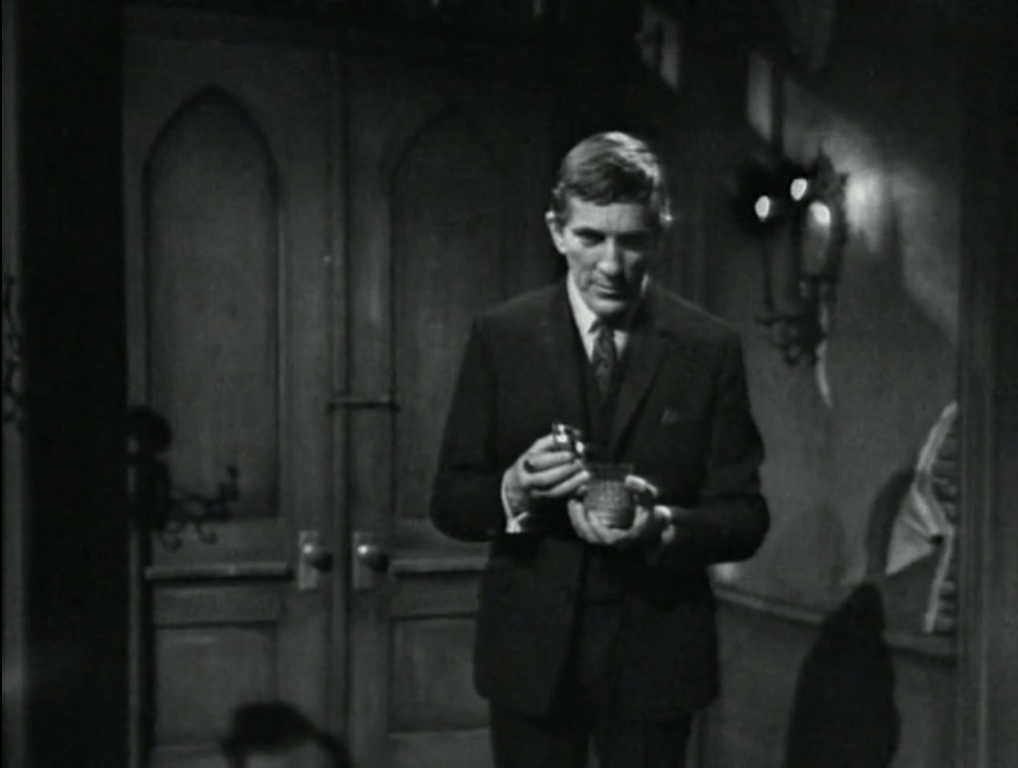
Vicki notices an antique music box on a table in Barnabas’ front parlor. Vicki admires its tune and makes a few not-very-coherent remarks about “the past” while it is playing. Barnabas has been using this music box as a tool to hypnotize Maggie into believing that she is his long-lost love Josette. After Vicki leaves, he opens it again, then looks at the door through which she left. He turns his head and smiles, looking very much like someone who has just had an exciting new idea.
Lightbulb moment
Meanwhile, Maggie and Willie talk to each other in the basement. The two of them had one of the most electrifying scenes of the entire series down there Friday. The last traces of that energy have been piddled away by the time Barnabas comes back downstairs and resumes his conversation with them.
Willie urges Barnabas to look at Maggie and see how beautiful she is. Barnabas says “No” and looks away. Coming at a moment of high dramatic tension, this might have been powerful. When we sit down as an audience, we enter into a sort of agreement that if the show includes something worth seeing, we will look at it. So when we see a character refusing to look at a sight as well worth contemplating as was the young Kathryn Leigh Scott,*** we might be shocked. But there has been too much idle chatter, and the memory of Barnabas’ pout is so fresh, that all we can think of is a petulant child saying “I don’t wanna look at her!”
Barnabas announces that he will not kill Maggie right away. He tells her that he will make her suffer torments worse than anyone has ever known so that death will finally come as a blessed relief, then locks her up in the prison cell in the basement of the house. What, your house doesn’t have a prison cell in its basement? It’s a standard feature of homes in Collinsport, as we will come to see in future episodes.
Barnabas goes to the great house of Collinwood and talks to Vicki. He brings a handkerchief that, legend has it, was a gift from the queen of France to Josette. They babble about “the past” and Barnabas invites her to drop in at his house “some day.” He says “day,” even though he’s busy being dead every day until sunset. And doesn’t specify when- any old time, if she hears screams coming from the basement she’ll probably just ignore them.
Evidently Barnabas is thinking of Vicki as a backup Josette in case Maggie doesn’t come around. This marks a retreat from #240 and #241, when strange and troubled boy David Collins, who has seen Josette’s ghost many times, saw Maggie in the gown Barnabas gave her and said that she must have been Josette because she looked “exactly the same” as he had seen her before. That suggested, not only that Barnabas chose Maggie because of her looks, but also that he might be right in thinking that she is Josette’s reincarnation. This storyline is modeled on the 1932 Universal film The Mummy, in which Imhotep’s idea that Helen Grosvenor is the reincarnation of his lost love Princess Ankh-esen-amun is substantiated when Zita Johann plays both roles. If Vicki and Maggie are interchangeable, then all of that goes by the boards.
*Presumably no relation to the main character of Gene Roddenberry’s 1963-4 CBS TV series The Lieutenant, one episode of which was written by Art Wallace.
For those who have missed the last few episodes of Dark Shadows: Elizabeth Collins [Stoddard,] at Jason McGuire’s insistence, has taken Vicki, Carolyn, and Roger into the basement room and convinces them that it holds no mystery. They don’t realize that beneath the flagstones on the floor is concealed the room’s secret—the body of Elizabeth’s husband, Paul. Elizabeth, now realizing that the secret can never be told, announces to the family that she and Jason will be married. Maggie Evans escaped from Barnabas and attempted to get to her father, but was recaptured and told by Barnabas that unless she assumes the identity of Josette Collins, she will die. Realizing that she can never escape, Maggie attempts to destroy Barnabas.
The title card shown during the recap
***Or for that matter as is the not-so-young Miss Scott of today, she’s one of the best looking octogenarians around.
Maggie Evans, the Nicest Girl in Town, has been the prisoner of vampire Barnabas Collins for some time. At rise, she is in front of her mirror, struggling to remember who she is. Her name and her father’s come back to her, but then the music box Barnabas gave her starts playing, and she begins to believe that she is Barnabas’ long-lost love Josette. This scene takes about a minute more than is necessary.
She renews the struggle later, and this time overcomes the hypnotic power of the music box. She decides to pretend that she believes that she is Josette in order to trick Barnabas and Barnabas’ sorely bedraggled blood thrall Willie into giving her enough freedom to escape. She fools them, only to hear Barnabas tell Willie that her compliance means that the time has come for the final part of his plan.
Maggie hears carpentry work, and sneaks down to the basement. She finds Barnabas watching Willie build a coffin. It sits next to the coffin in which Barnabas spends his days. It becomes clear that once Maggie is fully Josettified, she will be a vampire as well. Unfortunately, Jonathan Frid has a great deal of trouble with his lines in this scene. I don’t usually mind Frid’s bobbles, but his line troubles here take us out of what needs to be a terrifying moment.
In the morning, Maggie goes back to the basement. Willie finds her there. He is not convinced that she believes she is Josette. He presses her, and she finally breaks down and gives up the act.
Maggie shows Willie the diamond necklace Barnabas gave her as a present for their wedding, and tells him it will be his if they destroy Barnabas and escape. Willie’s fascination with jewels was what led him to undertake the grave-robbing expedition that freed Barnabas in the first place, and the necklace does distract him for a little while. But then he hears Barnabas’ heartbeat. He heard that sound before, in #208, #209, #210, and #217, but in those episodes no one else could hear it. Maggie can, since Barnabas has been drinking her blood too, but she can still resist the vampire’s spell. She is holding a large awl, ready to drive it into Barnabas’ heart, but Willie cannot overcome his urge to protect his master. He disarms Maggie.
We see Maggie in her room and hear Barnabas’ voice on the soundtrack going over what she heard him say in the basement. This is the first time an interior monologue has played quotes from another character. They aren’t the lines Jonathan Frid actually delivered, but cleaned-up, intelligible lines, presumably the ones that were in the script.
As sunset nears, Willie takes Maggie back to the basement. He leaves, telling her that she and Barnabas must be alone when he completes “the ceremony.” She finds the awl, picks it up, and opens the coffin. Before she can drive it into Barnabas’ heart, he awakens and shows his fangs. She screams and presses herself against the brick wall behind her.
Back to the wall
This is the second episode credited to writer Joe Caldwell, and is certainly the best teleplay Dark Shadows has seen since Francis Swann left the show in November of 1966. Like Swann and Art Wallace, Caldwell understood what actors could do and knew how to give them a platform to show their stuff.
Aside from Frid’s one bad scene, the actors excel. In 1967, Kathryn Leigh Scott was already a highly trained actress. Maggie Evans, on the other hand, has never acted before. When Maggie is pretending to believe she is Josette, Miss Scott shows her giving a crude imitation of Barnabas’ high-flown style, mixed with some prancing movements you might see from a little girl playing the princess in a school play. Barnabas is so desperate to believe that his lunatic scheme is working that he falls for it completely. When he and Maggie are in the front parlor together, he responds to her amateur performance as a sign that she is matching his pomposity, which of course thrills him.
When Willie and Maggie are in the basement, John Karlen plays his earthy skepticism with a simplicity that makes Maggie’s pretending look ridiculous. When Maggie gives up her act and whispers a plea for Willie to help her, Miss Scott matches the force of Karlen’s performance and the resulting encounter is as powerful as anything the show ever achieves.
The episode is good enough that we barely noticed some major lapses in story logic. If Maggie can sneak down to the basement to eavesdrop on Barnabas and Willie, why can’t she slip out the front door? She knows how to get from Barnabas’ house to the great house of Collinwood, where she has friends and there is a telephone to call the sheriff.
And when did she learn that you can destroy vampires by driving stakes through their hearts? She’s lived in Collinsport all her life, and no one in that town has ever heard of vampires. Granted, the show would move a lot faster and could have more layers of irony if the characters had read Dracula and seen movies from Universal and Hammer, but this is the first hint that any of them has.
My wife, Mrs Acilius, was very interested in the fact that Maggie calls herself “Maggie, or Margaret” in this one. First time we hear the name Margaret! I’m not sure why that impressed her so much, but she’s very bright, so I’m sure it’s important. All I can think of is that “Maggie” waits tables in the diner, cleans up after her Pop has had one drink too many, and is everybody’s pal, while “Margaret” is a saint’s name, and a queen’s name. So Margaret might have a bigger destiny than we’ve seen.
At the end of yesterday’s installment, artist Sam Evans looked out the window of his house and saw his daughter, missing local girl Maggie. Today, the sheriff shows up and reports that he and his men couldn’t find anything to substantiate Sam’s report. The sheriff then tries to convince Sam that he didn’t really see Maggie at all. When last we see Sam, he is telling himself that it was only his imagination.
Maggie had escaped from the custody of vampire Barnabas Collins and Barnabas’ sorely bedraggled blood thrall, Willie Loomis. Today, Barnabas meets Maggie in the graveyard, chokes her, and takes her into the tomb where he spent a century or two. He declares that he will punish her for trying to leave him.
As Barnabas talks, Maggie seems inclined to go along with his plan to annihilate her personality and replace it with that of his long-dead love, Josette. He wonders aloud if the punishment he was planning is necessary after all. But then she remembers that she is holding her father’s pipe, and she calls out “Pop!” Barnabas then takes her to the hidden room in the back of the tomb and shuts her up in his old coffin.
Director Lela Swift was uncharacteristically sloppy with the framing yesterday, but today she makes up for it with one of the most remembered shots of the entire series. When Barnabas shuts Maggie up in the coffin, we see him from her point of view. Claustrophobic viewers beware!
Barnabas closing the lid
The next morning, Willie releases Maggie from the coffin, takes her back to Barnabas’ house, and urges her to convince herself that she is Josette. For a while, she tries it. We start to wonder if Willie will have as much success with Maggie as the sheriff had with her father. But then she looks in the mirror and shouts “I’m Maggie Evans!”
That may not sound like much story for 22 minutes, but it never feels slow. Swift and the actors are all in fine form today.
On the other hand, there are a couple of script problems. The sheriff is written as such a fool that we can’t help but be distracted, and the scene between Maggie and Barnabas in the outer section of the tomb goes on too long. But even at its lowest points the actors just about save it. Dana Elcar always makes it seem that Sheriff Patterson knows more than he’s letting on, so it isn’t until he starts trying to talk Sam into believing he didn’t really see Maggie that we get the sinking feeling that he is absolutely useless. And Jonathan Frid and Kathryn Leigh Scott are electric as Barnabas and Maggie, so much so that we could forgive the scene between them even if it had been twice as repetitious as it fact is. With two consecutive episodes including as much good stuff as was in yesterday’s and today’s, it’s starting to seem like they are due to land one in the ranks of the Genuinely Good Episodes any day now.
Maggie Evans, The Nicest Girl in Town, has vanished from her hospital bed. We start with a long succession of characters talking about this fact with Maggie’s father Sam. Had David Ford played Sam as effectively as he did in his first weeks on the show, one such exchange might have made for a good scene. But Ford is overacting today, and the first part of the episode drags on and on.
We cut to the Old House on the great estate of Collinwood, where Maggie’s boyfriend Joe and dashing action hero Burke Devlin have gone. Vampire Barnabas Collins resides in the Old House along with his sorely bedraggled blood thrall, Willie Loomis. Joe and Burke have no clue there is anything odd about Barnabas, but they don’t like Willie and suspect he may know what happened to Maggie.
Barnabas lets Joe and Burke in the house and explains that he sent Willie to run some errands for him out of town. When they tell him about the evidence that has led them to think Willie might be connected with Maggie’s disappearance, he persuades them that there is nothing to their suspicions. Once they are gone, he calls out “It’s all right, they’ve gone. You’re safe here- safe here with me.” Maggie walks into the room.
Barnabas talking to Burke
This scene is very good. Barnabas is made up to look much more like The Vampire than he has been in previous encounters with characters he was trying to fool into thinking he was a harmless eccentric recently arrived from overseas. He is polite enough to Joe and Burke that they can chalk his appearance up to the lateness of the hour, but as the audience watches him extract information from them point by point, until he knows exactly what they do and don’t know, we can see him calculating when and how he will have to kill them. It is as good a scene as Jonathan Frid has had since he debuted as Barnabas.
Frid’s performance in this scene benefits from his flawless line delivery. Not so, unfortunately, the scene that follows. His bobbles are not especially bad by Dark Shadows standards, but his task is far more fragile than any he has taken on before. We’ve seen him pretending to be the Collins family’s mild-mannered cousin from England; in those moments, Barnabas himself is taking on a challenging acting job, and Frid’s difficulties sometimes dovetail with troubles we might expect Barnabas to have in his performance. We’ve seen him abusing Willie; in those moments, we might expect him to sputter a bit, and Frid can hide some of his memory lapses in that mannerism. But now, he is telling Maggie what his plans are for her. As he does so, we realize he is a crazy man spilling out his deepest and sickest obsession. That context leaves nowhere to conceal even the slightest flub. As a sign of triumphant psychosis, the lines have to flow without interruption. Every time Frid stumbles for a fraction of a second, he breaks character.
Nor can Kathryn Leigh Scott bail him out. As Maggie, her part is to wander around in a stupor and occasionally repeat the last word or two of whatever is said to her. She makes that a lot more interesting to watch than you might expect, but there’s only so far it can take you.
Barnabas’ plan takes us outside the themes we are familiar with from vampire fiction. He wants to brainwash Maggie into thinking that she is Josette Collins, who has now been retconned into the woman Barnabas loved in his human days. His goal is that Maggie Evans will cease to exist, and that in her body Josette will live again.
Dracula never wanted to do anything like that, though after Dark Shadows has a hit with this storyline it will become part of vampire lore. Prince Mamuwalde, the menace in the 1972 film Blacula, kidnapped the heroine and tried to turn her into his long-dead love. Another undead fictional man from Africa had tried the same thing in 1932, when Imhotep, played by Boris Karloff, had spent the bulk of The Mummytrying to turn the heroine into a revived form of his adored Princess Ankh-esen-amun. Frid’s face and coloring were somewhat similar to those of Bela Lugosi, a fact often remarked in connection with his casting as a vampire. But his voice and movements are strongly reminiscent of Boris Karloff, and as a mashup of Dracula and Imhotep he is a synthesis of these two actors.
Barnabas gives Maggie a music box that he had intended to give Josette. He says that he bought it for Josette in his travels in “the Orient,” intending to give it to her “on a very special day,” and “this is that day.” This leaves us wondering why the day never came when he could give it to Josette. Did he become a vampire before he returned from his travels? Did he come back from his travels to find that she was no longer available to him? Or was it supposed to be a present at their wedding, a wedding that never occurred?
Barnabas also produces Josette’s wedding dress and tells Maggie that she, as the new Josette, will wear it. When Imhotep produces Ankh-esen-amun’s clothing and jewelry, we remember that royal personages in ancient Egypt were buried with their possessions and assume that he has retrieved them from her tomb. The show did lead us to wonder if the Collinses once had a similar practice. Willie released Barnabas because he had heard a story that some of the Collinses were buried with expensive jewelry and so was trying to rob a grave. The story of the buried jewels was framed as an echo of the Gothic romances that inspired the first weeks of Dark Shadows, but has now become an anticipation of the show’s journey into Universal Pictures’ back catalogue of horror movies.
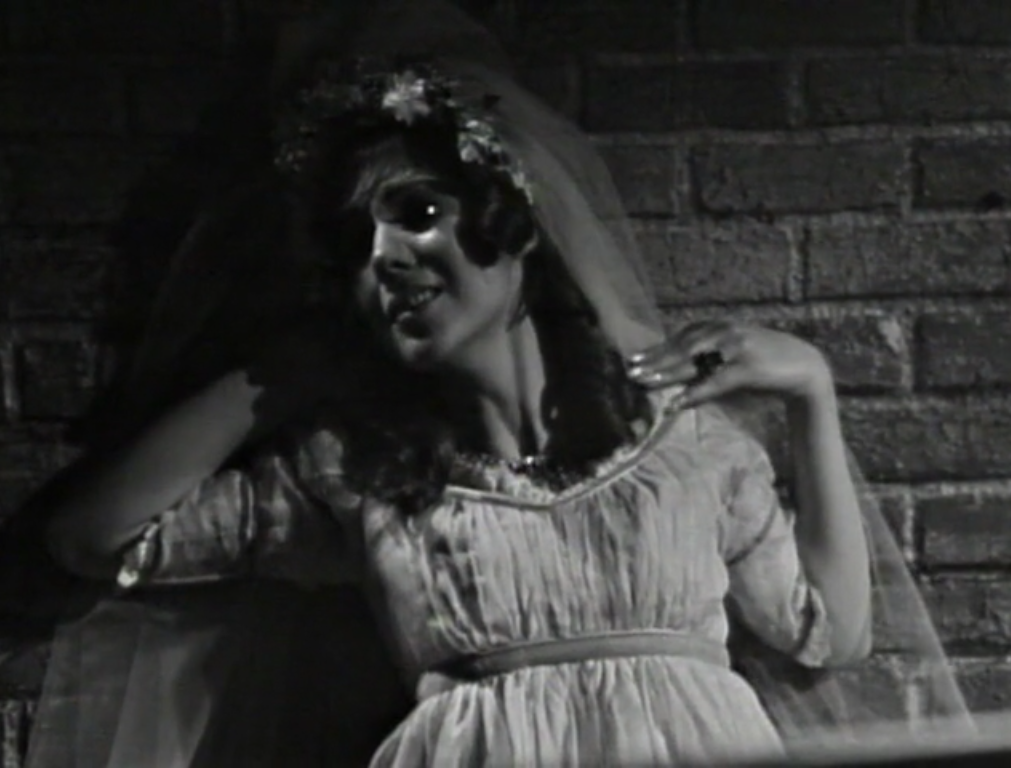
If Barnabas does manage to somehow erase Maggie and bring Josette back to life in her body, it won’t be the first time Miss Scott has played Josette. In #70, Miss Scott was the ghost who emerged from Josette’s portrait and danced outside the Old House. Miss Scott put Josette’s veil on again in #126 when she led the ghosts who scared maniacal handyman Matthew Morgan to death before he could murder well-meaning governess Vicki. In that one, she delivered a few lines as Josette. Miss Scott’s name did not appear in the credits as Josette in either of those episodes, and the only time we caught a glimpse of Josette’s face was in #149, when she was played by stand-in Rosemary McNamara. But if by any odd chance a viewer does know that Miss Scott has played Josette before, the final dissolve from a closeup of Miss Scott to one of Josette’s portrait suggests a definite possibility that Barnabas’ plan, nonsensical though it seems, will somehow succeed.
Danny Horn’s post about this episode on his Dark Shadows Every Dayis particularly good. He compares its visual strategy to that of the one surviving contemporary segment of General Hospital, and praises the ambitious approach director Lela Swift took to composing images. I should also mention Patrick McCray’s Dark Shadows Daybook post, in which he analyzes the way the story alienates us from our rooting interest in Maggie’s safety by promising a more exciting story if Barnabas has his way with her for an extended period.
We open in the hotel suite occupied by dashing action hero Burke Devlin. Burke is getting a briefing from a paid agent of his whom he placed in the home of his enemies, the ancient and esteemed Collins family. This agent is wildly indiscreet housekeeper Mrs Johnson.
Mrs Johnson has come to report on a conversation between high-born ne’er-do-well Roger Collins and Roger’s estranged wife, the mysterious and long-absent Laura. Mrs Johnson overheard Laura telling Roger that she is keeping Burke pacified by pretending that she will testify on his behalf in a retrial of a long-ago criminal case. When Mrs Johnson relays this to Burke, he flies into a rage. He demands to know who is paying her to defame Laura. Mrs Johnson stands up to his abuse, and he apologizes.
Mitch Ryan and Clarice Blackburn were outstanding actors, and it’s always fun to see them play a scene together. But this doesn’t really make much sense. Whatever Laura’s plans, it is hardly likely that she would advance them by telling Roger that she is going to side with Burke. Since this is a conversation Burke is having with a secret agent in his employ, the audience would expect him to understand deception.
Meanwhile, Laura is in the cottage where she is staying on the grounds of the great estate of Collinwood. She has a visitor- her son, strange and troubled boy David. The head of the Collins family, reclusive matriarch Liz, has forbidden Laura to see David and ordered her to leave the estate. Laura repeatedly urges David to keep his visit to her a secret. She gives him a music box, reminding him to hide it from everyone in the great house.
Moments after David gets home, Liz catches him with the music box. She recognizes it as Laura’s and scolds him for visiting her. She tries to explain why he can’t see his mother. David takes this badly, shouting at her that he doesn’t love her. When she objects that this is a terrible thing to say, he tells her he hates her.
Liz sets out for Laura’s cottage. Laura is there, but she is not alone. Burke has come to ask about the conversation Mrs Johnson overheard. Several days ago, Burke had asked her about her relations with Roger, naming well-meaning governess Vicki as his source. Today, Laura asks if Vicki has been talking again. Thoughtlessly, Burke won’t answer, further convincing Laura that Vicki is her enemy.
Laura starts crying. Burke’s anger evaporates. He embraces her and kisses her. At that moment, Liz enters.
Burke, whom we first saw today in his role as spymaster, tells Liz he’s glad that happened because he likes to have everything out in the open. Liz, who has sealed up most of her house and hasn’t left the estate in eighteen years because she is trying to cover up some hideous secret, says that she also likes that. Burke leaves.
Liz demands Laura leave the estate no later than tomorrow morning, and vows that she will never have custody of David. Laura says that no power on earth can keep her from her son, and tells Liz she will learn to her cost what she is capable of.
Back in the house, Laura’s face is superimposed over the screen as Liz grows faint. Liz starts climbing the stairs. She calls for help, naming Roger and well-meaning governess Vicki. We see her start to fall. Then we see her sprawled at the bottom of the stairs.
The process shot makes it clear that Laura is using witchcraft to control Liz. Burke’s behavior is also uncharacteristic, but it is an open question whether it is the result of Laura casting a magic spell on him, of his own emotions leading him to make a fool of himself, or of sloppy work on the part of the writers.





 Dark Shadows Commentary