Episode 278: If you become Josette

The first major villain on Dark Shadows was high-born ne’er-do-well Roger Collins, played by Louis Edmonds. Edmonds was a master of the sarcastic remark, so that Roger was often funny. But no matter how often he made the audience laugh, Roger was never a comic villain. That requires a character we can empathize with as we watch them scheme and plot, scramble and improvise, in pursuit of goals that could not be achieved without ruining all the fun. We laugh when we recognize our own foibles in an outlandish character, and laugh again when we realize that our ability to feel with others encompasses even those whose feelings have led them to do dastardly deeds.

Roger’s personality was too cold, his motives too contemptible for us to empathize with him. Where a comic villain thinks fast and puts himself in ridiculous situations, Roger stuck with his fixed ideas, using the same tactics time and again to bully his unwilling co-conspirator Sam to stick with their plan. Even when he bumbled about with a damning piece of evidence, a fountain pen left at a crime scene, he was never the coyote caught in his own over-elaborate trap, but a criminal in a police procedural. He was a melodramatic villain who was only incidentally funny.

The first supernatural menace on the show was Roger’s ex-wife, undead fire witch Laura Murdoch Collins, played by Diana Millay. Millay was hilarious, every bit as funny as Louis Edmonds. It was a shame the two of them didn’t play a married couple in a long-running comedy. They could have raised sarcasm to heights previously unknown to humankind. But while Millay gets laughs every time the script gives her the least chance, Laura was even less of a comic villain than Roger.

It is clear that Laura is a malign presence from beyond the grave and that, if she is not stopped, she will burn her young son David to death. But everything else about her is an impenetrable mystery. She is not part of a familiar mythology, and even the most basic questions about her remain unanswered. We cannot empathize with her motives, since we cannot begin to guess what her motives are or even be sure if she has motives.

The first comic villain on Dark Shadows was seagoing con man Jason McGuire, played by Dennis Patrick. Jason had his first comic turns only after he had been on the show for weeks, during which time we had been subjected to many iterations of a dreary ritual in which he made a demand of reclusive matriarch Liz, Liz resisted, he threatened to expose her terrible secret, and she capitulated. When his henchman Willie slips out of Jason’s control and he starts scrambling to contain the damage Willie is doing to his plan, Patrick finally gets a chance to play Jason as a comic villain, and the result is very engaging. But those scenes are scattered too thinly through Jason’s long-running, relentlessly monotonous storyline to make him a success as a comic villain.

Now, the show has struck gold. Vampire Barnabas Collins is becoming a pop culture phenomenon and bringing the show the first good ratings it has ever had. They have to keep Barnabas on the show indefinitely, and he has to be the most important character. That presents a practical difficulty. Vampires usually figure in folklore and fiction as unstoppable killing machines. Daytime soap operas explore the shifting relationships among large casts of characters. It’s going to be hard to maintain that cast if Barnabas sets about murdering everyone. To square the circle, they try to redefine Barnabas as a comic villain.

Barnabas is giving a costume party for his distant cousins, the living members of the Collins family. He has invited well-meaning governess Vicki to attend and to wear the dress of the legendary Josette Collins. In the first 39 weeks of Dark Shadows, Vicki had developed a close friendship with Josette’s ghost, so she is excited about this. For his part, Barnabas has borrowed an evil scheme from the 1932 film The Mummy. He will erase Vicki’s personality and replace it with Josette’s, then kill her so that she will rise as a vampiric Josette. So he is glad she likes the dress.

Barnabas asks Vicki to come to his house and help him pick out the antique clothes that the family will wear at the party. She enthusiastically agrees, saying that she loves to go through trunks full of old clothes. The clothes are in a trunk in Josette’s old room, which Barnabas has restored.

In the room, we see the ghost of Barnabas’ 9 year old sister Sarah sitting on the trunk. She vanishes a second before Barnabas and Vicki enter. Both of them have a strong feeling that someone just left the room. Barnabas tries to dismiss the sensation as nervousness, but Vicki has had too much experience with ghosts to be put off so easily.

Vicki has been our point of view character for most of the series. At first, that was because she was a newcomer to the great estate of Collinwood and the nearby town of Collinsport, and so we would learn everything we needed to know as we listened to people explain things to her. Later, it was because she was the key protagonist in the stories, so that the action got going once she knew what was going on. So when Barnabas equals Vicki’s sensitivity to Sarah’s presence, he is presented to us as another possible point of view character.

Barnabas keeps talking about the Collinses’ eighteenth century ancestors in terms that make it obvious that he knew them, so that he more than once has to clean up after himself with remarks like “I would imagine.” He does alarm Vicki when he blurts out something about what will happen to her should she “become Josette.” He hastens to say that he means that Vicki will become her for the duration of the party.

“Become Josette?”

Vicki goes back to the great house and talks with Liz about the party. Liz smiles happily, the first time we’ve seen this expression on her face in the whole run of the series.

Happy Liz

Vicki goes on about Barnabas’ connection to the past, saying that he gives the impression of someone who really is misplaced in time. She has the feeling that he needs to recreate a bygone era, and that he is doomed to be unhappy because of the impossibility of traveling backward in time. Vicki does not know what Barnabas’ plans for her are, but she understands his motives perfectly and empathizes with him deeply. That Vicki, Barnabas’ intended victim, can feel this way suggests that we can, too.

Back in Barnabas’ house, Sarah reappears in Josette’s room and sees her blue dress. She is excited to find it. She looks at her reflection in the mirror and smiles. Her good cheer is emphasized when her musical cue, an excerpt from “London Bridge,” is for the first time played in a major key.

Sarah’s reflection looks like it has never seen a ghost before

The minor key was appropriate during Sarah’s previous appearances. The first several times we saw her, Sarah was associated with Barnabas’ imprisonment of Maggie Evans, The Nicest Girl in Town. Maggie was the victim of Barnabas’ first mad attempt at Josettery, and Sarah intervened just in time to keep Barnabas from killing her. The other day, Barnabas killed Jason, and we saw Sarah when Barnabas was forcing Willie to help him hide his old friend’s corpse. Barnabas isn’t killing anyone today, so Sarah can be a bit more cheerful.

Sarah helps to establish Barnabas as a comic villain. As the ghostly sister who returned to the upper world when Barnabas was loosed to prey upon the living, Sarah and he are part of the same eruption from Dark Shadows‘ supernatural back-world into its main continuity. Perhaps she personifies his conscience, certainly she gives him an occasion to make schmaltzy speeches about his days as a human. More important than either of these, when we see that Barnabas’ 9 year old sister is his most powerful adversary, we begin to wonder just how seriously we should take him.

Closing Miscellany

Yesterday and today, Alexandra Moltke Isles delivered the recorded voiceover monologue at the beginning of the episode. The first 270 times she did this, it was in character as Vicki. Now, they’ve given up the idea that Vicki or any other one character will eventually find out about everything that we see on screen, so the openings are delivered by whatever actress is available as a nameless external narrator.

In those first 270 outings, Mrs Isles sounded like Vicki. She adopted Vicki’s distinctive way of speaking, carefully articulating one word at a time and often ending sentences with surprising little inflections- a curl of uncertainty here, a touch of breathy optimism there, a falling note of despair in another place. The voiceovers were usually remarks about the weather or the sea that were supposed to involve some vague metaphor for events in the story, so that it is open to question whether it was really worth Mrs Isles’ time to put so much effort into creating a character with them. But I guess a pro is a pro, and it was a matter of course that she would do her best no matter how little she had to work with.

In these last two, she has used a relatively flat voice, with none of Vicki’s particular vocal traits. The pacing has been structured, not around sentences, but around an attempt to convey an overall sense of urgency. They sound very much like The Narrator. I wonder what Mrs Isles would have made of The Narrator if the voiceover passages had extended beyond the opening moments and run through the episodes.

There is a famous production error under the closing credits, when a stagehand shows up in the window, realizes he’s on camera, and makes himself all the more conspicuous when he tries to escape from his predicament.

From PostImages

Episode 257: If you feel it, sit it

For almost 13 weeks, seagoing con man Jason McGuire (Dennis Patrick) has been blackmailing reclusive matriarch Liz (Joan Bennett.) Time and again, Liz has capitulated to Jason’s demands lest he reveal that she murdered her husband Paul Stoddard 18 years ago and he buried Stoddard in the basement. When Liz gave in to Jason’s demand that she marry him, her daughter Carolyn (Nancy Barrett) vowed to prevent the marriage.

Today, it looks like Carolyn may have found a way to fulfill that vow. She has announced her engagement to motorcycle enthusiast Buzz (Michael Hadge,) whom Liz cannot stand. Liz considers going to the police to keep from gaining Buzz as a son-in-law.

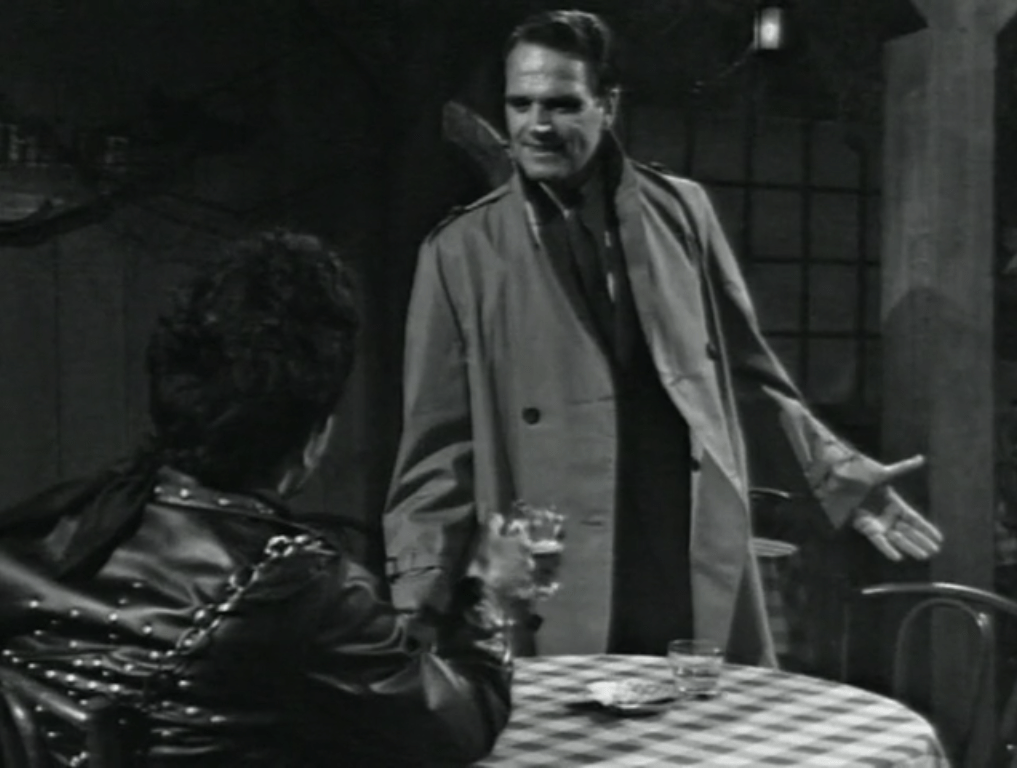
We spend the first half of the episode in the great house of Collinwood. Buzz has come to see Carolyn. The opening sets up a charge of comic energy that raises our hopes for another installment as funny as Buzz’ first star turn in #254. Buzz knocks on the front door, Liz opens it, and greets him with a disgusted “Oh.” She closes the door in his face, then goes inside to tell Carolyn that he is there. Carolyn goes out to meet Buzz, who is smoking a large cigar.* They kiss, and Carolyn lets Buzz in. He takes a seat on the staircase.

Buzz on the stairs

Instead of building on the comic potential Buzz brings with him, we then grind to a halt with a Buzzless scene in the drawing room. Carolyn recites teen-rebel cliches at Liz, punctuating her dreary lines with a few random pokes at the piano. Nancy Barrett’s all-in style of acting often exposes values that another performer might have left buried in the script, but when the writing is as tired as this not even she can dig up anything interesting.

Carolyn chose Buzz to mock her mother’s relationship with Jason. She defies Liz to find a reason for regarding Buzz as an unsuitable partner for her that would not cut at least as strongly against Jason. Buzz mirrors Jason in another way so far as the audience is concerned. Dennis Patrick was a gifted comic actor, and Jason is appealing when he gets to be a comedy villain. But most of the time he is stuck repeating the same deadly dull threat to Liz time and again.

Buzz is a villain only in Liz’ imagination, but he is funny all the time. His incongruity with everything else on Dark Shadows automatically produces a laugh whenever he is on screen. Michael Hadge’s near-total incompetence as an actor limits Buzz’ future on the show sharply, but within those limits he’s irresistible.

Jason comes down the stairs and finds Buzz blocking his way. They have a little confrontation which Jason wins by threatening to break Buzz’ shin. Not even Dennis Patrick can make that funny.

We are subjected to a second Buzzless scene in the drawing room. Liz tells Jason that she has yielded to his demands because she was afraid the truth would ruin Carolyn’s life. If Carolyn’s life is going to be ruined anyway, there is no point- she will just go to the sheriff and have done with it. Joan Bennett does have a couple of moments in this scene when she seems like she is about to get some comedy going, but the somber Dark Shadows musical cues ring out and darken the mood before Patrick has a chance to respond.

Jason goes to Carolyn’s room to try to talk her out of marrying Buzz. Since Carolyn’s whole motivation is her hatred for Jason, we may wonder what influence he has that will enable him to do this. It quickly becomes clear that he has none. This is followed by another scene between Liz and Jason in the drawing room. Liz tells Jason that it was obvious to her all along that his talk with Carolyn would produce no results. That is to say, we have a scene the point of which is to explicitly acknowledge that the preceding scene was a waste of time.

The second half is set in the Blue Whale tavern. Buzz and Carolyn are there on a date, and Jason comes to try to bribe Buzz into leaving her. The musical score behind this part comes from the jukebox. That music is much more suitable for comedy than is the heavily melodramatic stuff we hear when the action is taking place at Collinwood.

When we get to the tavern, Carolyn and Buzz are dancing. As a true Collinsporter, Carolyn’s style of dance consists of thrashing about as if she’d had a brain injury. Buzz, by contrast, moves quite gracefully. He must be from out of town.

Carolyn does the Collinsport Convulsion, while Buzz executes a fine Beer Stein Shuffle

Carolyn is in the ladies’ room when Jason shows up. He asks to join Buzz at their table. Buzz replies with that rallying cry of the 60s counterculture, “If you feel it… sit it!” I can only wish that had been the title of a spinoff of Dark Shadows featuring Buzz, it would have been great.

Buzz’ back is to the camera while he delivers his immortal line

Buzz tells Jason that Carolyn is from a family that “makes a lot of noise,” while he is from a family that “makes a lot of money.” Then he laughs. Buzz was credited as “Buzz Hackett” in his first appearance in #252, and is credited that way again today; in #254, he was credited simply as “Buzz.” We never hear him called “Hackett.” In #223, we’d heard about an unscrupulous local businessman called Hackett, but Buzz made a laughing reference to his lifelong poverty in #252, so I don’t think we can suppose he really is from a family that makes a lot of money. In view of Buzz’ laugh, the likeliest explanation is that this is a joke of some kind. A confusing joke, poorly told, but considering that it is a line written by Malcolm Marmorstein and delivered by Michael Hadge, that is to be expected.

Jason tells Buzz that Carolyn is using him to get back at her mother. Buzz blandly replies that Carolyn has told him all about that, and he’s having a great time with her whatever her intentions. This is reminiscent of the relationship between Carolyn and dashing action hero Burke Devlin in the early months of the show. Carolyn continued seeing Burke even after he tacitly admitted that he was using her to pursue revenge on her family. After Burke renounced his revenge, they met at this same table and had a soulful conversation about what they had been to each other (#213.)

Jason offers to buy Buzz a new motorcycle if he will stop seeing Carolyn. Buzz flatly refuses the offer, declaring “I like the bike I got, and the chick I got!” Carolyn returns to the table, and Buzz tells her about Jason’s attempt to bribe him. They laugh at Jason and leave the tavern. He staggers into a corner, looking bitter.

Laughing at Jason

This also harks back to an incident involving Burke in the early days of the show. In #3, Burke met hardworking young fisherman Joe in the tavern. Joe was at that point dating Carolyn. Burke offered to buy a fishing boat for Joe if he would spy on her family. Joe refused, and reported the contact to Liz. While Buzz is Joe’s opposite in many ways, regular viewers will see that the two men are equally honest.

*It appears to be a robusto, though it could be a corona gorda.

Buzz and his stogie

Episode 229: A very sick girl

The opening voiceover tells us that “Evil reaches deeply into man’s soul, turning his heart to stone, transforming him into a vile monstrosity, and it is horrible to observe this process in an innocent and not be able to recognize it or prevent it.” Without that introduction, first-time viewers would have no reason to assume that Maggie Evans, The Nicest Girl in Town, is going through anything other than an ordinary sickness that has her looking bad and snapping at people.

Kathryn Leigh Scott does play Maggie’s moodiness very well. She does an especially admirable job in the scene where she yells at her boyfriend, hardworking young fisherman Joe, and orders him out of the house. After Joe goes, Maggie looks directly into the camera, and returning viewers will recognize that she is well on her her way to becoming the undead.

Bloofer lady

Meanwhile, well-meaning governess Vicki and dashing action hero Burke are dressed up and having dinner in Collinsport’s only night spot, The Blue Whale. Most of the time, The Blue Whale is a waterfront dive with frequent bar fights. But when Burke and Vicki dine there in their good clothes, the place transforms into a respectable restaurant, as it did in #189.

Burke and Vicki recap some plot points surrounding the great estate of Collinwood. Later, Maggie’s father Sam comes in and tells them of her condition. Vicki replies to Sam’s description with “Now let me see if I understand this. You said that yesterday she was sick and she collapsed, and last night she was up and around, and this morning she was sick again?”

In his post about this episode on his great blog Dark Shadows Every Day, Danny Horn’s response to this line is “IT IS NOT OKAY TO SUMMARIZE A RECAP THAT HE JUST SAID ONE SENTENCE AGO.” It’s true that the episode is heavy on recapping. A defter writer than Malcolm Marmorstein probably would have started the scene with Vicki putting this question to Sam, leaving out the recap that it re-recaps. But Vicki’s question itself is a good moment. As she delivers it, Alexandra Moltke Isles uses her face to show Vicki coming to a realization that has so far eluded everyone else.

The moment of recognition

Vicki recognizes that Maggie’s symptoms are identical to those which sorely bedraggled blood-thrall Willie Loomis displayed a couple of weeks ago. As she explains this, we see Burke gradually catch on and Sam absorb the information. Up to this point, everyone has been remarkably obtuse in failing to make this connection- the same doctor who examined Willie examined Maggie today, and doesn’t give any sign of recognizing it, or for that matter of understanding anything else relating to medicine.

As Vicki was the only character yesterday who escaped the long-running Idiot Plot that goes on because everyone fails to notice the abundant evidence that reclusive matriarch Liz killed her husband and buried him in the basement, so she is the only character today who spots the obvious similarity between the cases of the two victims of the vampire. The show is still sputtering along, but in a Smart Vicki turn like this we can find a glimmer of hope that it will start moving soon.

Episode 215: Play the mystery man

In episode 1 of Dark Shadows, dashing action hero Burke Devlin returned to his home town, the isolated fishing village of Collinsport, Maine. He’d left Collinsport in poverty and disgrace, and returned as a millionaire many times over, the master of a financial empire. He had vowed to use his great wealth to exact vengeance on the ancient and esteemed Collins family. In #201, he gave up his quest for revenge, which had never been very interesting to watch anyway, and now is unconnected to any storyline. He’s still in town though, spending his evenings in The Blue Whale, a waterfront tavern where he has appointed himself to act as bouncer.

In #207, dangerously unstable ruffian Willie Loomis was rude to some other patrons at the Blue Whale. Burke defeated Willie in a fight and ordered him to leave town. Today, Burke comes back to the tavern. No one has seen Willie for a week or so, but neither is it clear that he has left Collinsport for good. Burke is looking for Willie, planning to beat him up again if he finds him.

When Burke enters, he sees Maggie Evans, The Nicest Girl in Town, sitting alone at a table. While she waits for her boyfriend, hardworking young fisherman Joe, Maggie talks with Burke about not knowing where Willie is.

Willie’s associate, seagoing con man Jason McGuire, comes into the tavern. Burke goes up to him. They also talk about not knowing where Willie is.

Joe shows up. He’s been helping his uncle search, not for Willie, but for a missing calf. They found remains of the little guy, far from the farm and completely drained of blood by some mysterious process. They are baffled by this development.

Willie drifts in. He sits down at the bar and starts drinking. Burke goes up to confront him, but is confounded by Willie’s broken demeanor. After a few moments, his hostility gives way to compassion, and he speaks gently to Willie.

Burke puzzled by Willie’s meekness. Screenshot by Dark Shadows Before I Die

Jason returns, and Burke tells him he’s worried that Willie seems to be very ill. Jason then confronts Willie, and is astounded when Willie tells him he doesn’t want the $500 in cash Jason is holding for him. Jason also notices that Willie has some bloodstains on his sleeve.

Everything I have to say about the acting in this episode I said in a long comment I left on Danny Horn’s Dark Shadows Every Day in December 2021. Here it is:

I like this one. Sure, the writing has its flaws, and there are a couple of shots where it’s hard to tell what the visual composition was supposed to be. And Mitch Ryan is obviously drunk. But they rise beyond all that.

Kathryn Leigh Scott plays Maggie throughout as an understated version of her original wised-up conception, very apt for the barroom setting and a fine offset to the intensity all the male characters have to show this time. She doesn’t have many lines, but she has everything she needs to keep the show on track.

Dennis Patrick’s face and voice show at least two emotions in every shot, and he and Mitch Ryan do a terrific job as two men who don’t like each other but can’t help getting absorbed in a puzzle that fascinates them both. The music that builds throughout that scene and reaches its crescendo as Jason leaves the bar matches the complex emotional palette with which the actors are working; it doesn’t sound anything like the usual Dark Shadows music, and I don’t think we ever hear it again.

Joel Crothers’ turn as the messenger announcing the tragedy of the calves is as tense as the dialogue between Patrick and Ryan, but his studiousness and deliberation change the pace sufficiently to keep the scenes from blurring together. Ryan and Scott deliver their responses to him with a calm intelligence that emphasizes those qualities and makes Willie’s stumbling entrance a real surprise.

Ryan’s scene with John Karlen is a turning point in the series. Burke’s shift from a menacing demand that Willie leave town to an alarmed concern for his well-being marks the end of Scary Violent Willie and the arrival of Wretched Broken Willie, and his conference with Jason confirms that change. Everything Karlen does on the show from this point on, right up to his performance as Kendrick, begins with this scene.

If that looks familiar, it may be because I linked to it on tumblr.

I should also link to a characteristically insightful post in which Patrick McCray explains how this episode, in which Barnabas Collins is neither seen nor mentioned, contributes substantially to the sense of danger surrounding him. The story Joe tells about his uncle’s calf is the show’s first reference to blood-sucking, and it comes after we’ve started to wonder whether Barnabas really is a vampire, or is some less familiar type of hobgoblin.

Episode 213: Meeting for the first time

We begin in the drawing room of the great house of Collinwood, where reclusive matriarch Liz and seagoing con man Jason are shouting at each other. Jason showed up and started blackmailing Liz when the last interesting storyline ended four weeks ago, and she is so fed up with the whole thing she doesn’t even bother to close the door when they’re yelling about her terrible secret. Liz’ daughter, flighty heiress Carolyn, comes in and overhears a chunk of the quarrel. She demands to know what it’s all about. Liz tries to fob her off with an obvious lie. Carolyn stalks off, frustrated that her mother won’t tell her what is happening.

Carolyn tries to figure out what’s going on with her mother and Jason

Carolyn goes to the local tavern, The Blue Whale. There, she meets two other characters who don’t have any particular reason to be on the show right now. One of them is dashing action hero Burke Devlin, whose quest to avenge himself on Carolyn’s family drove much of the action in the early months of the show, gradually fizzled out, and came to an abrupt conclusion in #201.

Burke, Carolyn, and Joe at The Blue Whale. Screenshot by Dark Shadows Before I Die

With Burke is hardworking young fisherman Joe. When Dark Shadows started, Joe and Carolyn were dating, and there were a bunch of scenes about how their relationship wasn’t working. Since they were already terminally bored with each other the first time we saw them, this was never much of a story. Now Joe is seeing Maggie, The Nicest Girl in Town. Joe and Maggie are relaxed and happy together, and they want to get married. During the Revenge of Burke Devlin story, there was the prospect that Maggie’s father’s connection with Burke’s plans would get in their way. Now that’s all over, and nobody’s stopping them from getting on with their lives.

Burke, Joe, and Carolyn hang around the tavern for most of the episode and apologize to each other for what they did and said back in the days when they were principals in ongoing narrative threads. Meanwhile, the jukebox keeps going, playing a wider assortment of music than we’ve ever heard from it. In addition to several pieces by Robert Cobert, including an orchestral bit I don’t think we’ve heard before, we hear Les and Larry Elgart’s versions of a tune by Gerry and the Pacemakers and of “Brazil.” This latter is something of a signature of Burke’s. He has often talked about his business interests in South America, and “Brazil” usually plays when a scene at The Blue Whale focuses on him. In his conversation with Carolyn, he behaves as if he is at home and she is his guest, even escorting her to the door when she leaves. As he shows her out, “Brazil” swells on the soundtrack.

Carolyn returns to Collinwood. The drawing room doors are closed now, but Liz and Jason are so loud that she can tell they are still having the same quarrel they were having when she left. Carolyn goes into the room and tells her what she couldn’t help overhearing. Liz tells another transparent lie, then leaves.

Liz is still visible on the stairs when Carolyn asks Jason what they were really talking about. When she presses him for answers, Jason tells Carolyn that if she doesn’t stop asking questions, her mother could get into serious trouble. We’ve seen Jason threaten Liz many, many times, but this is the first time he has shown his nasty side to another member of the family.

Jason threatens Carolyn

Episode 207: Just fate

Today we’re in Collinsport’s night spot, The Blue Whale tavern. Seagoing con man Jason McGuire is at the bar, trying to convince his henchman, dangerously unstable Willie Loomis, to stop acting like he’s about to rape every woman he meets before they get thrown out of town.

A party comes in consisting of artist Sam Evans, Sam’s daughter Maggie, and Maggie’s boyfriend Joe. Dashing action hero Burke Devlin enters and joins Sam, Maggie, and Joe at their table. Burke has confronted Willie a couple of times, and Willie tells Jason that they are fated to have it out sooner or later. Jason tries to persuade him to abandon this idea, telling him that Burke would be a useful friend and a formidable enemy.

Jason delights Willie by telling him that Burke is an ex-convict. John Karlen brings such enormous joy to Willie’s reaction to this news that it lightens the whole atmosphere of the episode.

Jason buys Burke a drink and tells him that Willie is secretly a nice person. He and Burke find that they both have a high opinion of psychoanalysis, of all things, but their shared admiration of the Freudian school does not lead them to agree about Willie.

Sam goes to the bar, leaving Maggie and Joe to themselves. A bit later, Joe has to leave Maggie alone for a few minutes while he makes a telephone call to check in with a situation at work. He urges her to stay at the table and avoid Willie. She notices that Willie is talking to her father, and is alarmed. Joe tells her not to worry- from what they’ve seen, it appears that Willie only likes to hurt girls.

At first, Willie and Sam’s conversation is cheery enough. Willie is impressed with Sam’s beard, and even more impressed that Sam is a professional painter. For a moment, we catch a glimpse of Willie, not as an explosively violent felon, but as an awkward guy who is trying to make a friend. This passes when the idea of nude models pops into Willie’s head, and he asks again and again where Sam keeps the naked ladies. Sam tells Willie that he doesn’t use live models, at first politely, then with irritation. Willie responds with his usual vicious menace.

Maggie goes up to intercede. This would seem to be an odd choice. Jason is at the next table, and when Willie was harassing her and picking a fight with Joe last week she saw Jason rein Willie in. She knows that Jason is eager to smooth things over with the people Willie has already alienated, so it would be logical to appeal to him. Burke and Joe are nearby as well, and have both made it clear that they are ready to fight Willie. If either of them goes to Willie, he will be distracted and Sam will have a clear avenue of escape. And of course Bob the bartender really ought to have thrown Willie out of the tavern long ago. Maggie, on the other hand, will attract Willie’s leering attentions and complicate her father’s attempt to get away from Willie by making him feel he has to defend her.

From his first appearance in #5, Sam was a heavy-drinking sad-sack. Today, Sam seems to have become a social drinker. He’s gone out with friends for a couple of rounds, and is pleasant and calm the whole time. Soap operas are allowed to reinvent characters as often as they like. If Sam’s alcoholism isn’t story-productive anymore, they are free to forget about it.

The problem with this scene is that Maggie hasn’t forgotten. Maggie’s whole character is that of an Adult Child of an Alcoholic. It makes sense that an ACoA, seeing her father in trouble, would cast aside all rational calculations and rush up to protect him. But if Sam isn’t an alcoholic anymore, Maggie is just a very nice girl who laughs at inappropriate times.

Burke comes to Maggie and Sam’s rescue. Willie draws a knife on Burke, they circle, Burke disarms Willie and knocks him to the floor.

We’ve seen many couples move about on the floor of The Blue Whale while music was playing, and usually their movements have been so awkward and irregular that it is not clear that what they are doing ought to be called “dancing.” But Burke and Willie’s fight is a remarkably well-executed bit of choreography. At one point Willie brushes against the bar, and it wobbles, showing that it is a plywood construction that weighs about eight pounds. But it doesn’t wobble again, even though the fighters both make a lot of very dynamic movements within inches of it, and at the end of the fight Willie looks like he is being smashed into it.

Burke about to deliver the knockout blow. Screenshot by Dark Shadows Before I Die

After the fight, Willie and Jason meet in a back alley, the first time we have seen that set. Jason assures Willie that he will eventually get his cut of the proceeds of Jason’s evil scheme, but tells him he will have to leave town right away. Willie vows to kill Burke.

The jukebox at The Blue Whale plays throughout the episode. In addition to Robert Cobert’s usual “Blue Whale” compositions, we hear Les and Larry Elgart’s versions of a couple of Beatles tunes and of a Glenn Miller number.

Episode 168: The uninvited

We see more of the exterior of the cottage on the grounds of the estate of Collinwood than we have before when dashing action hero Burke Devlin bangs on the door and demands that its current resident, blonde fire witch Laura Murdoch Collins, let him in. Laura eventually gives in. Then, they sit around recapping previous episodes for about ten minutes.

Through the window, we see Laura by the fire
The ivy-covered wall
Laura in the glass door

Not only is Laura reluctant to open the door to Burke, she also takes every opportunity to urge him to cool his enthusiasm for her. Most notably, when he tells her that he doesn’t like the way visiting psychologist Dr Guthrie is asking questions about her, Laura gives a plausible explanation for Guthrie’s behavior. Guthrie is trying to figure out why reclusive matriarch Liz fell into a catatonic state. He knows that the new thing in Liz’ life at the time of her attack was a conflict with Laura. Since Liz can’t talk, Laura says it’s reasonable that he’s asking other people about that conflict.

We saw Laura cast a spell that caused Liz’ condition, and we’ve seen her use her magical powers to influence others. But we’ve never seen her do any such thing concerning Burke. For all we know, his devotion to her might be entirely native to his psychology. Even if she is exercising control over him, that may be perfectly natural. Burke has strong feelings for Laura and she knows him well, so she may be able to manipulate him without resort to sorcery. So it is by no means clear what Laura wants Burke to do about Guthrie. Maybe she is tricking Burke into confronting Guthrie, or maybe she sincerely wants him to leave Guthrie alone.

As the next scene opens, Guthrie arrives at the local tavern, The Blue Whale. Guthrie sees drunken artist Sam Evans at the bar. He tells Sam that Burke called him and asked to meet him there. Burke isn’t there yet, but we hear the jukebox play a few measures of Les and Larry Elgart’s recording of “Brasil.” In #3, Burke sat in the tavern and told hardworking young fisherman Joe that he got rich because of something that happened in South America, and we heard several more references to Burke’s connections to that continent in the first couple of months of the show. So that bit of music might suggest to regular viewers that The Blue Whale is Burke’s territory, at least as far as Dr Guthrie is concerned.

Sam tells Guthrie the story of the fire in which he injured his hands. That’s odd- less than a week ago, in #164, Sam unburdened himself of all sorts of things in a conversation that began when Guthrie noticed evidence of that fire. It’s hard to believe he wouldn’t have told him what he tells him today, that he thinks Laura somehow started the fire and made him stick his hands in the flames even though she was far away.

Burke shows up and Guthrie follows him to a table. Burke puts on a menacing demeanor. Guthrie quickly turns the conversation into a therapy session, and Burke falls into the role of hostile patient. Guthrie does leave the tavern when Burke dismisses him, so it remains Burke’s territory, but Burke looks like a fool. He looks even sillier when he goes to Sam and starts giving orders, none of which Sam shows the slightest inclination to follow. If Laura did want Burke to stay off the front lines of her conflict with Guthrie and the rest, perhaps it is because she knew that his efforts would end up like this.

Guthrie goes to Laura’s cottage and invites her to participate in a séance he is organizing. She declines. He tells her he wants to contact the ghost of Josette Collins. We know that Laura and Josette are adversaries, so her reaction to this is interesting to watch. It is possible that Guthrie tells her about it because he wants to test her reaction. She is startled, becomes nervous, and turns away from him, while he watches her intently.

Laura absorbing the news that Guthrie is trying to contact Josette

Episode 166: The most harmful thing of all

Every episode of Dark Shadows begins with a voiceover narration. This is how today’s goes:

My name is Victoria Winters. The brightness of the morning cannot mask the fact that the night has been marked by a restless, fitful sleep, especially for one young woman who has been disturbed by strange premonitions and events that she does not fully understand.

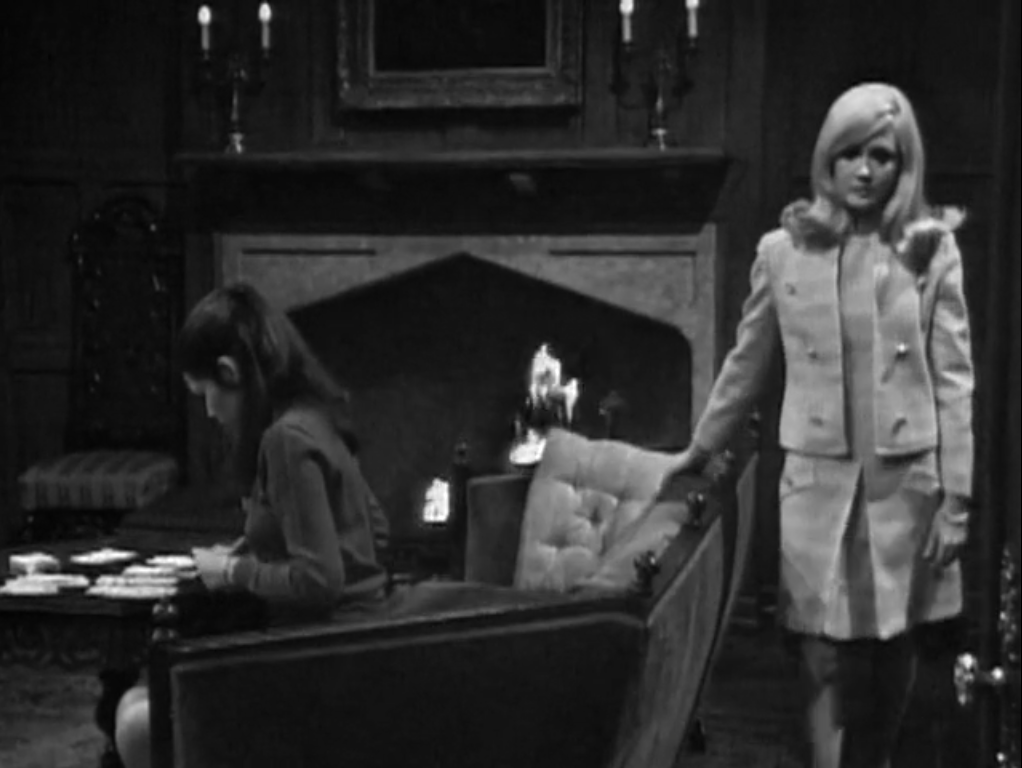
We then see the drawing room of the great house at Collinwood, where two young women are both showing signs of disturbance. There’s no way of telling which one the narration is referring to. Flighty heiress Carolyn is pacing and talking, while well-meaning governess Vicki is clenched tight playing solitaire. This sloppy mismatch is the first sign that we’re dealing with a script by Malcolm Marmorstein, the worst writer on Dark Shadows.

Disturbed by strange premonitions and events

Vicki and Carolyn are worried about strange and troubled boy David. David has spent the night with his mother, blonde fire witch Laura, and is not back yet. They are convinced that Laura is dangerous, but cannot be sure how or to whom. Marmorstein’s awkward dialogue stumbles up to a climax in which Vicki tells Carolyn that visiting parapsychologist Dr Peter Guthrie had said he was inclined to organize a séance. Considering that he first discussed that idea in a conversation with the two of them yesterday, Vicki’s announcement of this as news and Carolyn’s incredulous reaction will leave returning viewers mystified.

David comes home. He’s fine. He tells Vicki that he sensed the presence of the ghost of Josette Collins watching over him in his mother’s cottage, and that he knows he is safe wherever Josette is. What the audience knows, but neither Vicki nor David does, is that Laura and Josette had a confrontation while he was sleeping, and that Josette retreated. Josette is not strong enough to defeat Laura by herself. When David goes to sit by the fire and stare at it in a trance-like state, as his mother habitually does, we wonder how Vicki and the others will put together a strong enough force to help Josette save David. That’s a suspenseful sequence, effectively realized.

Hardworking young fisherman Joe comes to the house on a business matter. He and Carolyn have a conversation about their defunct romance. Carolyn says that she has matured since those days, and that she is free to give it another try. Joe says he is not free. For a show with so many ghosts and ghoulies, it’s surprising that Dark Shadows inspires the greatest fear in its fans when they threaten to bore us yet again with a tedious dead-end storyline like the Carolyn/ Joe relationship. It’s certainly a relief when Joe is so firm as to leave no doubt that we’re finally done with that.

Joe has transferred his affections to Maggie Evans, The Nicest Girl in Town. We dissolve to an extreme closeup of the laughing mouth of Maggie’s father, drunken artist Sam Evans. Sam is in the local tavern, The Blue Whale, with a drink in his hand, a crony on either side of him, and some music we haven’t heard before on the jukebox.

Glad Sam

Maggie and Joe are at a table, where he is trying to make her jealous by telling her of Carolyn’s interest in him, and she can’t stop watching her father and fretting about his drinking. The two of them talk a bit about how Sam’s drinking has reversed the roles of parent and child. That’s the big theme of Maggie in the first 42 weeks of the show, that she is an Adult Child of an Alcoholic. It’s because she’s had to cope with Sam’s addiction that Maggie is so nice to everyone, and also because of it that she has a habit of starting her lines with a little laugh that doesn’t always make sense in context. As the show goes on, Sam drinks a lot less and Maggie gets involved in a wider variety of stories, but that weird little laugh, the union card of many an ACoA, stays with the character to the end of her time on the the series.

Maggie leaves Joe alone at the table while she confronts Sam. She doesn’t stop him drinking, but she does manage to wreck the good mood he and his buddies had going. In the course of their talk, they recap the conversation Sam had with Dr Guthrie Thursday.

Dashing action hero Burke Devlin comes in and sits down with Joe while Maggie is scolding Sam. The two of them have been at odds over Carolyn, and now discover that neither of them is interested in her any longer. Joe seems irritated that his list of reasons to dislike Burke has grown shorter.

When Maggie returns to the table, Burke exchanges a few friendly words with her. He then goes to the bar to buy Sam a drink. Maggie voices her dismay at this plan, and even Bob the bartender gives a dark look at the idea of serving Sam yet more booze. But Burke ignores them both.

Burke wants to know about the conversation Sam had with Dr Guthrie. They recap the conversation Sam had with Maggie a few minutes before. Burke is in love with Laura, and may be under her influence. This conversation raises the prospect that Burke will be an ally of Laura’s against Vicki and her team. Its similarity to the conversation Maggie and Sam had so shortly before suggests that the Evanses may also make themselves more useful to Laura than to the good guys. The repetition grates hard enough on the audience that it is an inefficient way of making that point, but the point itself does add to the suspense.

Most episodes of Dark Shadows have only five credited actors and no extras. This one has seven credited actors and a bunch of extras, including featured background player Bob O’Connell as the bartender. There have been several episodes the last couple of weeks with only four actors; apparently they’ve been saving up to splurge on this one. It is by no means the dullest installment of this period of the show, but neither are there any of the thrills or major story developments you would expect from a high-budget episode. Frankly, it’s rather worrying that this is what they lay out the big bucks for now. Is this as exciting as the show is going to get?

Episode 156: Why is my baby crying?

At the end of Friday’s episode, we saw reclusive matriarch Liz start to fall down the stairs, then saw her sprawled on the floor below. Today begins with a recreation of that scene, but instead of merely starting to fall, actress Joan Bennett tumbles far enough forward that she must really have gone down. It’s an impressive stunt.

Dark Shadows first stunt performer: Joan Bennett

Most of the episode is taken up with Liz’ demented condition and the reactions of the members of the household to it. The audience knows that Liz’ troubles are the result of a spell cast on her by blonde fire witch Laura. At moments Liz is almost able to figure that out herself, but no one else has a clue what is going on. The whole episode is full of standout moments for Liz. If there had been Daytime Emmy Awards in 1967, this would have been the episode Dan Curtis Productions would have sent to the voters to get Joan Bennett her Best Actress award.

At one point, Liz begins to recover her memory and is about to take action against Laura. Before she can reach anyone, a ghostly figure appears in her room. Afterward, she has a mad scene, indicating that she has been rendered powerless.

The ghostly sighting raises some questions about Laura. Is it Laura’s ghost she sees? Or another ghost allied with Laura? Or has her abuse of Liz’ brain led it to produce this hallucination on its own? The show is very indefinite about what exactly Laura is and how she operates, giving us the chance to have a lot of fun speculating about her.

This episode is replete with notable firsts. In addition to the first real stunt of the series, it features the first scene in which Bob O’Connell, as the bartender in The Blue Whale, has lines to deliver.

In that same scene at The Blue Whale, we hear music coming out of the jukebox that we haven’t heard before. It is a medley of Lennon-McCartney tunes rendered in “smooth jazz” style by Bud Shank.

It’s also the first time a conversation on the landing at the top of the stairs leading up from the foyer is photographed straight-on. Several times, we had seen characters talking to each other up there, but always before the camera had been angled up from the floor below. That had created the sense that the conversation was removed from the main course of the action. Today, it’s just another part of the set.

It is the first time we see Liz’ room. Two notable firsts take place there. A favorite prop of Dark Shadows fandom, the so-called “Ralston-Purina lamp,”* has been seen several times in the Collinsport Inn. In Liz’ room today, it makes the first of many appearances in the great house of Collinwood.

The Ralston-Purina lamp

The ghostly figure in Liz’ room is played by Susan Sullivan, who has been acting in primetime on network television more or less continuously for the last 55 years. During the other hours, she writes plays and performs in Dark Shadows audio dramas.

A play she wrote under the title “What Friends Do” was produced by Smartphone Theater and posted on Youtube. The cast is made up of Dark Shadows alums Susan Sullivan, Kathryn Leigh Scott, Mitch Ryan, and David Selby. It’s about four friends in a retirement community during the Covid pandemic, and it’s terrific. The Q & A after includes a lot of stuff that Dark Shadows fans will find irresistible, including a little bit about today’s episode.

The voice that says “Dark Shadows is a Dan Curtis production” at the end of the closing credits does not sound like ABC staff announcer Bob Lloyd. It’s higher-pitched and faster than his delivery, and the vowels are flatter than he articulates them. Perhaps it’s a tape fault distorting Lloyd’s voice, or perhaps he had a cold that day. If it was someone else, it’s another first. The Dark Shadows wiki doesn’t say anything about it, so I assume the surviving records and the published books that use them don’t say it was someone else.

*So-called because its red-and-white checked pattern looks like the logo of the Ralston-Purina animal food company.

Episode 102: Come down like you do

A deluxe episode today- multiple location inserts, three sets, six credited actors, several extras, music we haven’t heard before, and a special effect. By Dark Shadows standards, that’s a spectacular.

At the end of yesterday’s episode, high-born ne’er-do-well Roger Collins had sneaked up on well-meaning governess Vicki from behind, seized her, covered her mouth with his hands, and ordered her to be silent. Since Vicki is convinced Roger is a murderer and is afraid he will murder her to protect his secrets, that was quite a cliffhanger.

As we open today, Roger makes Vicki promise she won’t scream if he lets her go. He explains that when he decided to forcibly silence her, Maggie, keeper of the Collinsport restaurant and The Nicest Girl in Town, might still have been within earshot of a scream. So he “had to do that.” Otherwise, Maggie, to whom he contemptuously refers as “that little countergirl,” might have intruded on their private conversation. Now, they are all alone in the house.

Vicki does not find Roger’s explanation of his assault on her any more satisfactory than we might expect. She moves about the room keeping her eyes on him, her weight on her toes, and a clear line between her and the exit. Roger asks if she thinks he killed beloved local man Bill Malloy. She answers “I don’t think anything.” He asks her to listen to the whole story. She hears him out, but doesn’t let her guard down for a second.

Roger admits that he did see Bill the night he died. That involves admitting that he tricked Vicki into thinking he left home later than he in fact did, and thereby into giving him a false alibi in a statement to the sheriff. Roger ignores Vicki’s shocked reaction to this, and goes on to explain that Bill was already dead when he saw him. They had arranged to meet atop Lookout Point, but when Roger arrived he saw a body face-down on the beach below. He hurried down, and saw that it was Bill. Vicki asks if he looked like he’d been dead long. Not long, Roger says; he must have fallen off the cliff, been knocked unconscious, and drowned in the two or three feet of water on the beach just moments before.

Roger says he left Bill without calling for help or reporting the accident because he was afraid people would think he murdered him. “After all, I had motive, as they say.” Roger’s motive would be that Bill was trying to prove that he, not dashing action hero Burke Devlin, was responsible for a fatal hit-and-run accident ten years before. “Even you don’t believe me, do you?” he asks Vicki. Vicki says she doesn’t know what to believe, and edges closer to the door.

Returning viewers know that Roger is Dark Shadows’ most clearly defined villain, and have seen him frantically trying to conceal or destroy evidence relating to Bill’s death. Any story the makers of the show want us to consider accepting will have to give him some share of guilt. In this story, he is admitting to leaving the scene of a fatal accident. That is the very crime Bill was trying to prove that he, not Burke, committed ten years before. Since Roger is not a doctor, he is not competent to make a determination as to whether an unresponsive person is dead. For all he knows, Bill might have been saved had he gone for help. If we’ve been paying attention to the “Revenge of Burke Devlin” story, we should be wondering whether the account Roger has given Vicki will itself be enough to send him to prison. If so, we will wonder what Roger has up his sleeve to keep her quiet.

At the long-abandoned Old House, Roger’s son, strange and troubled boy David Collins, is talking to the portrait of his ancestor Josette. He asks Josette why she won’t “come down like you usually do” and talk to him. We don’t hear an answer, but David says “Well, I suppose you know what’s best.”

David tells the portrait that his governess Vicki knows that his father murdered Bill Malloy. He asks Josette if Bill’s ghost is with her and the other ghosts. Apparently she doesn’t answer him. He says that if his father finds out what Vicki knows, he will murder her, and then probably go on to murder him as well. David hears sounds outside the Old House. He puts out his candle and hides behind a chair.

Gruff caretaker Matthew enters. He announces to the dark room that he saw a light through the window, so there’s no point hiding. David comes out from behind the chair. He tells Matthew that he is visiting his friends- the ghost of Josette, of another woman similar to her, and of a younger woman, one about Vicki’s age. Matthew dismisses the topic of ghosts. David tells him that Vicki knows who killed Bill Malloy. As he has done each time Bill’s death has been mentioned, Matthew becomes agitated.

This time, Matthew’s agitation takes the form of a solicitous curiosity. David declares that his father is the murderer. “Did Miss Winters say that?” Matthew asks. No, David allows, but that’s what she meant. He asks Matthew to help him protect Vicki from Roger. Matthew mutters that he wouldn’t want any harm to come to Vicki.

Matthew’s agitation redirects our attention to the opening voiceover. Each episode starts with a brief monologue. For the first 55 weeks, all of these are delivered by Alexandra Moltke Isles in character as Vicki. Usually, they are not very informative. They are more about setting a vaguely anxious mood than about giving us specific facts about what’s going on in the story. Usually, whatever factual claims they do make are true. The only clear exception we’ve seen to that pattern so far came in #15, when Vicki says in the opening voiceover that she has made friends with David, a claim utterly belied by all the events that follow. Today, Vicki says in the opening that Roger is “the one person I have reason to fear.” That may also be false. Early on, reclusive matriarch Liz warned her that Matthew is a “strange and violent man,” and his unease about the death of Bill suggests that she might do well to keep an eye on him.

After David and Matthew have left the house, we see a replay of a bit of video from episode 70. The portrait of Josette glows, and her transparent figure walks down invisible stairs from the mantelpiece to the floor, then turns and looks back at the portrait. When David asked Josette to “come down like you usually do,” evidently he was referring to this manifestation.

Josette’s apparition has a different resonance for viewers today than it would have had for most viewers in 1966. The devices on which we see the show now have bigger screens and far clearer pictures than almost anyone would have had in those days. So it is easy for us to recognize a fact of which almost no members of the original audience would have been aware- the ghost of Josette is played by Kathryn Leigh Scott, the same actress who plays the Maggie whom Roger disdained as “that little countergirl.” Social class is a major concern of the show in the first 42 weeks, and the contrast between high-status and low-status characters is especially vivid today. That a character whose station is so lowly Roger cannot even bring himself to mention her name is played by the same person who plays a personage so lofty that she has a mansion to herself more than a century after her death gives a special punch to that contrast.

Meanwhile, flighty heiress Carolyn is on a date with Burke in the local tavern, The Blue Whale. Carolyn and Burke are well-dressed, as are the several extras at the other tables. They have china plates in front of them, and there is a more upscale type of background music playing than we usually hear at The Blue Whale. The show is at pains to establish that the tavern is a place for a nice date, rather than the waterfront dive it often appears to be. If that isn’t enough to set up an expectation that Burke and Carolyn’s date will be an important one, he says he plans to take her to another, even nicer, place later on for dancing and drinks.

Carolyn tells Burke she thinks that Vicki and Roger are becoming a couple. He is surprised. As she is explaining what has led her to this theory, she mentions that she told Roger something which Burke knows will reveal that Vicki suspects him of killing Bill. Burke excuses himself, saying that he is supposed to telephone his lawyer. He calls Vicki, and tells her he’s sending a taxi to take her away from Roger. She agrees to meet it.

Back at the table, Burke abruptly terminates the date. He explains to Carolyn that he has an urgent business meeting in ten minutes. She takes the news with uncharacteristically good humor.

Vicki slips out the back door of the house. The episode closes with a new location insert, a shot of her outdoors in the dark.

Screenshot by Dark Shadows Before I Die

This may sound like a lot of talk, much of it recapping, but when you watch it the whole thing feels like it’s packed with high-stakes action. The actors are all in good form today, and, as usual, Francis Swann’s script gives them the opportunity to show what they can do. It is strong from beginning to end, well worth the extra expenditures they devoted to it.