
Silversmith Ezra Braithwaite comes to the great house of Collinwood, bearing a ledger with information that old world gentleman Barnabas Collins wants. Barnabas is in the study, so twelve year old boy David Collins lets Mr Braithwaite into the house and escorts him to the drawing room. The two of them play a scene that may not have looked like much on the page, but as delivered by talented comic actors Abe Vigoda and David Henesy the lines are hilarious.
For example, Mr Braithwaite has two pairs of glasses, which he describes to David as his glasses for looking at things and his glasses for looking at people. David asks if the ones he is wearing are his “thing glasses.” We laughed out loud at that whole exchange. Mr Braithwaite asks David to go get “Uncle Barnabas”; David replies “He’s my cousin,” to which Mr Braithwaite answers “Ah, yes.” Again, that wouldn’t be a hit in a joke book, but Vigoda and Mr Henesy sell it. The purest example comes when Mr Braithwaite starts to change his glasses as he turns to the pages of the ledger and says out loud to himself “Oh, Ezra, Ezra, you already got on your reading glasses.” That is a laugh line entirely because of the way Vigoda stresses the words “got” and “on.”
There is a little exchange between Ezra and David that will stand out to longtime viewers:
Ezra: David is it? Well, I don’t remember a Collins being named David before. Now, my name is Ezra, as my father was and his father before him. You find a name like Ezra and you don’t give it up.
David: I guess not.
Ezra: Yes, now, David’s kind of a new-fangled name.
David: No, there’s King David in the Bible.
Ezra: Oh, of course, yes, yes. A good man, too.
In #153, it was established that no Collins ever bore the name “David” until undead blonde fire witch Laura Murdoch Collins insisted that her husband Roger go along with her plan to name their son “David Theodore Collins.” That turned out to be hugely important as evidence of Laura’s evil intentions. In #288, it sounded like they had decided to retcon that away when David looked in a family album, saw a portrait of a “David Collins” from a previous century, and wondered aloud if he had found his namesake. Nothing has come of that potential namesake in the 79 weeks since, and Ezra’s line that he didn’t “remember a Collins being named David before” would suggest that they’ve gone back to the original idea.
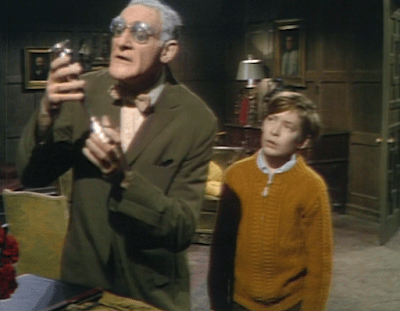
Each time Mr Braithwaite looks at someone through his “thing glasses,” we get a point of view shot showing that his eyesight is blurry. They then cut back to the other actor in regular focus. These shots are brief enough that the repetition isn’t a big problem, but it results in a series of exchanges the actors deliver to the camera rather than to each other. Those don’t work at all. Mr Henesy and Abe Vigoda had such a fine comic rhythm going that it’s a shame to break it up with this clunky stuff.
Reading the ledger, Mr Braithwaite says that the silver pentagram Barnabas wants to know about was bought in April 1897 by Miss Beth Chavez and paid for by Quentin Collins. We have seen Beth’s ghost. She is very tall and so thin you could clasp your fingers around her waist. Her complexion is pale as can be, her hair blonde, her eyes blue. I’ve met a fair number of Chavezes in my time, including a couple of Elizabeth Chavezes, and none has met this description. I have nothing to say against slender blondes, and actress Terrayne Crawford is movie-star beautiful. Still, if a fellow were excited about a blind date with a girl known to him only by the name “Beth Chavez,” he’d probably be a bit disappointed if the person who showed up met her description.
We have also seen Quentin’s ghost. Quentin is manipulating David into helping him with a number of murders he intends to commit. Beth has thwarted one of these murders so far, and is trying to prevent Quentin from achieving other evil plans of his. But Quentin is apparently more powerful than she is.
While Mr Braithwaite is alone in the drawing room, Quentin enters through a secret panel. Earlier in this episode, they made it clear Quentin can choose whether he is visible to the living people in the spaces he occupies; there is no need for him to hide. Why does he use the panel?
Longtime viewers may be able to make a surmise. We saw this panel for the first time in #87, when David’s father Roger used it for a sneaky errand. We didn’t see it or hear of it again until #643, when David told nine-year old Amy Jennings that there was a passage “very few people” knew about, and used it to lead her to the room in which Quentin was at that point confined. Quentin’s use of it will therefore suggest that he knows all the secrets of the house. It also suggests that when he dwelt there as a living being he was a naughty fellow who was in the habit of using its secret passages for the sort of underhanded mischief Roger got up to in #87 and #88.
Quentin strolls up to Mr Braithwaite and smiles at him. Mr Braithwaite is wearing his “thing glasses” and cannot see Quentin clearly. He asks Quentin if he is the friend Barnabas spoke of when he asked him about the pentagram. Quentin nods. Mr Braithwaite says that he himself made the pentagram in April 1897, when he was “fifteen and a half.” It is now February 1969, so we know that Mr Braithwaite is 87. He recognizes Quentin. Shocked to see a man who has been dead for decades apparently alive, well, and in his twenties,* Mr Braithwaite dies of a heart attack.
It’s a shame we won’t be seeing more of Abe Vigoda as Mr Braithwaite. At least they spelled his name correctly in the credits this time; yesterday he was “Abe Vigodo.”
*Two days past his 28th birthday, to be exact. Happy belated 84th to David Selby!

 Dark Shadows Commentary