Episode 499: Fair warning

From #133, artist Sam Evans was compelled to paint a series of pictures that explained the evil intentions of undead blonde witch Laura Murdoch Collins, estranged wife of sarcastic dandy Roger Collins. In #146, Laura put a stop to Sam’s work by starting a fire that burned his hands so badly it seemed for a time he might never be able to paint again.

Sam shares his home, the “Evans cottage,” with his daughter Maggie, who is The Nicest Girl in Town and a waitress at the diner in the Collinsport Inn. Between her earnings there and the paintings Sam sells, the Evanses make a living, but it isn’t such a grand living that he can turn down any commissions, even very eccentric ones. Moreover, his work space entirely dominates the interior of the cottage. In the early days of the show, Sam’s old friend Burke Devlin often stopped by, and the conversation always turned to reminiscences of Burke’s youthful days of honest poverty. Nowadays the most frequent visitor is Maggie’s fiancé, hardworking fisherman Joe Haskell. Sam is delighted with the prospect of this upwardly mobile laborer as a son-in-law. When a representative of the moneyed world visits Sam or Maggie at home, as New York art dealer Portia Fitzsimmons did in #193 and old world gentleman Barnabas Collins did in #222, the contrast between their manner and the humble surroundings is meant to jolt us. The Evans cottage is therefore our window on the working class of Collinsport. When the troubles of the ancient and esteemed Collins family have an effect there, Dark Shadows is telling us that the whole town is dependent on the businesses they own and suffers as a result of their problems.

Yesterday, Barnabas came back to the cottage and brought Sam a very odd commission indeed. He presented a painting of a lovely young woman in eighteenth century garb and offered Sam $500* to paint over the image so that before morning the woman would look to be “about 200 years old.” Sam wasn’t in a position to refuse that much money, even though Barnabas wouldn’t explain why he wanted him to do such a thing.

If Sam knew what the audience knows, he would likely have turned the job down even if Barnabas had offered $500,000,000. The woman in the portrait is Angelique, and like Laura she is an undead blonde witch. In the 1790s, Angelique cursed Barnabas and made him a vampire. In #466, Barnabas’ vampirism went into remission. Shortly thereafter, the portrait made its way to the great house of Collinwood, where Roger became obsessed with it. In #473, Roger returned from an unexplained absence with a new wife. She is Angelique, wearing a black wig and calling herself Cassandra. From #366-#461, Dark Shadows had been a costume drama set in the 1790s; during this segment, we saw that Angelique was a far more dynamic and brutal menace than Laura ever was. Sam would hardly want to involve himself in a battle with this wiggéd witch.

For his part, Barnabas first appeared on camera in #210 and #211. But his portrait was first seen hanging in the foyer at Collinwood in #205, having been prefigured in #195. Dangerously unstable ruffian Willie Loomis became obsessed with the portrait of Barnabas. Willie could hear a heartbeat pounding from the portrait in #208 and #209, and followed its sound to the crypt where Barnabas was trapped in his coffin. As Roger’s obsession with Angelique’s portrait would bring her back to the world of the living, so Willie’s obsession with Barnabas’ portrait led to his return.

In the opening teaser, we see Sam working on the painting. He tells it that he can’t understand why Barnabas would want to disfigure such a pretty face, then resumes his task. The camera zooms in on the painting, as it had zoomed in on Barnabas’ portrait in #208 and #209, and the soundtrack plays the same heartbeat. Sam doesn’t react- he can’t hear it. It is addressed to the audience, especially to those members of the audience who remember the show as it was 13 months ago.

Angelique/ Cassandra is in the gazebo on the grounds of Collinwood. She is wearing a hooded cloak to conceal the aging she has already experienced as a result of Sam’s work. Her cat’s paw Tony Peterson, a local attorney, shows up, responding to her psychic summons. She entrances him with a flame and he tells her that the artist who has been in touch with the Collinses most frequently of late is Sam Evans. From this she concludes that Sam is aging her portrait at Barnabas’ bidding. Before Angelique/ Cassandra and Tony can go their separate ways, heiress Carolyn Collins Stoddard comes upon them.

Tony and Carolyn met in #357. In that episode, he was an instance of Jerry Lacy’s Humphrey Bogart imitation. A hard-boiled materialist, Tony had grown up in Collinsport as a working-class boy. He resented the Collinses and attributed all of their unusual characteristics to their wealth and social prominence. At that time, Barnabas was still a vampire and Carolyn was under his power. As a blood thrall, she knew that there was more to life than could be explained by Tony’s reductive logic, but she wasn’t free to offer any explanations. When Tony saw Barnabas biting Carolyn in #463, he interpreted their embrace as a sign of a sexual relationship.

Now their roles are reversed. It is unclear what Carolyn remembers from her time under Barnabas’ control; Nancy Barrett often plays the character as if she remembers everything, but the dialogue doesn’t give her much support for that, and in this scene she is as this-worldly as Tony was in the Autumn of 1967. She interprets Tony and Angelique/ Cassandra’s meeting at the gazebo as proof positive of an adulterous liaison, and declares she will report it to Roger. When Tony tells her that Angelique/ Cassandra has some mysterious power, Carolyn is dismissive, declaring that the Collinses are the ones who have all the power in this town. Tony tries to explain that the power Angelique/ Cassandra has is of an entirely different order from the power their ownership of capital gives the Collinses, and Carolyn responds with unconcealed contempt.

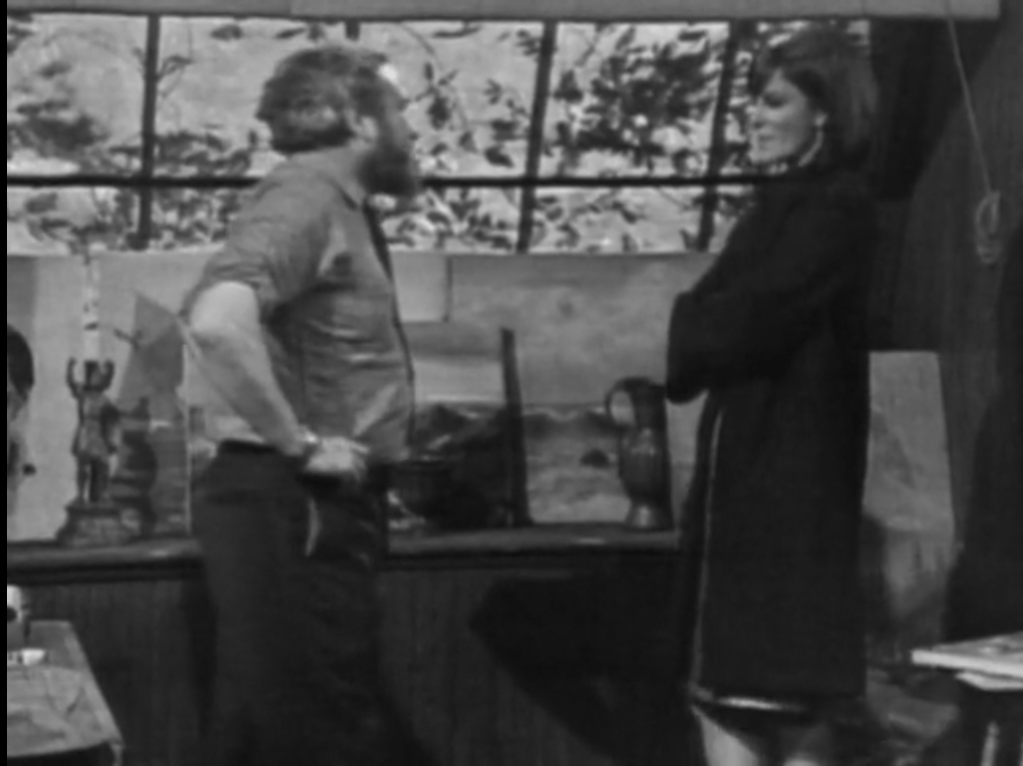
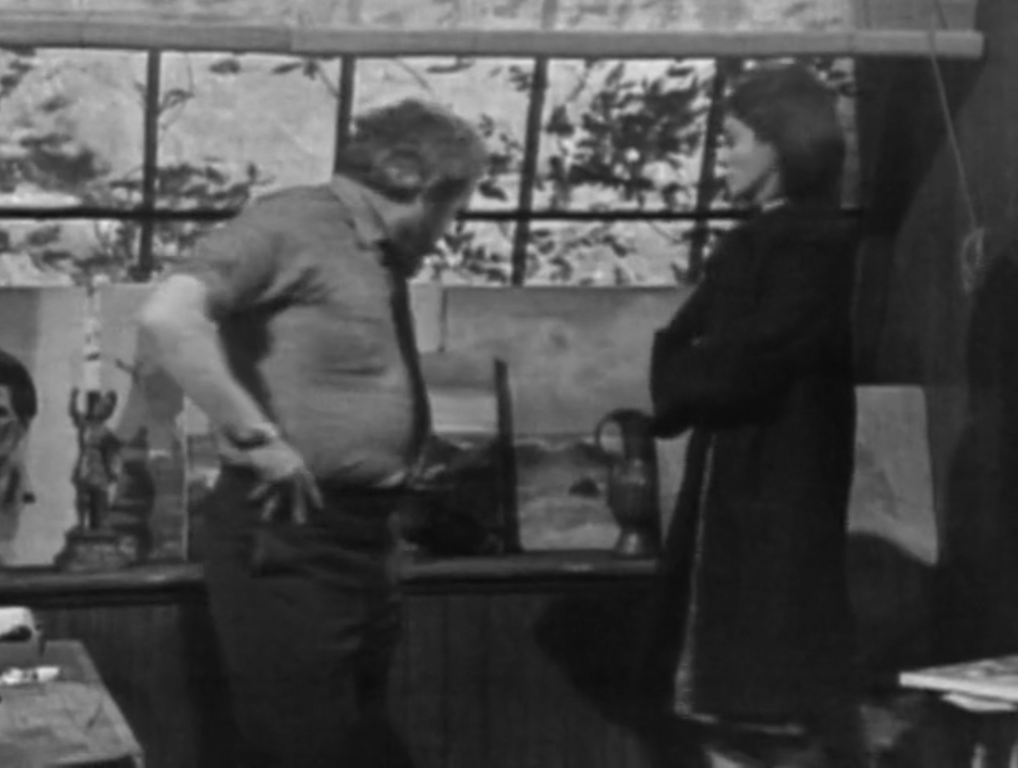
Angelique/ Cassandra knocks on the door of the Evans cottage. Sam opens the door. She ignores his objections and enters. While he keeps ordering her to get out of his house, she stands next to the portrait as he has aged it and points out her resemblance to it. He is astounded, but keeps telling her to leave. She says that she has no grievance against him and that no harm will come to him if he hands the painting over to her. He refuses. She heads out.

Angelique/ Cassandra and her portrait. Screenshot by Dark Shadows Before I Die.

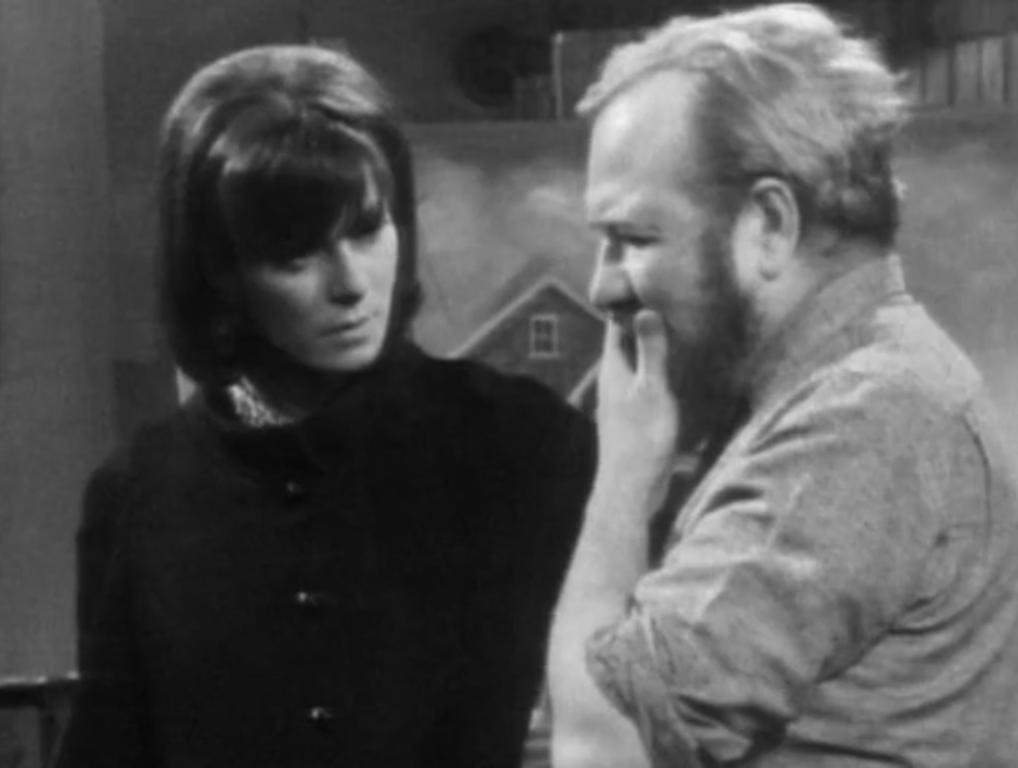
Angelique/ Cassandra has barely closed the door behind her when Sam has trouble seeing. After a moment, he realizes he has been struck blind. She comes back in, takes the painting, tells him she warned him, and leaves.

Sam realizes he is blind. Screenshot by Dark Shadows Before I Die.

Closing Miscellany

Over the years, several members of the cast said on the record that Sam’s blindness was actor David Ford’s idea. He thought that if he could wear dark glasses it wouldn’t bother the audience that he read all his lines off the teleprompter.

In 2022, a commenter on Danny Horn’s post about this episode on his blog Dark Shadows Every Day identified the portraits of Angelique as the work of ABC Art Department specialist Joseph Guilfoyle:

You asked if anyone knew who painted these portraits. I can verify that the portraits of Angelique were painted by Joseph Guilfoyle. He was an artist in the Art Department at ABC. He was my Godfather and his daughter remembers this very well as it made her a bit of a celebrity at the time. Portraits were not commissioned out but instead were created in the Art Department as it was filled with many talented artists.

“Erin Allan,” posted at 5:55 PM Pacific Time 26 February 2022 on “Episode 499: A Senior Moment,” Dark Shadows Every Day, Danny Horn, 10 October 2014

Also worthy of note are the two facial makeups representing Angelique’s aging. It’s no wonder they didn’t have the personnel to make David Ford’s fake mustache look convincing when they were lavishing all the work on turning Lara Parker into two quite distinct old crones.

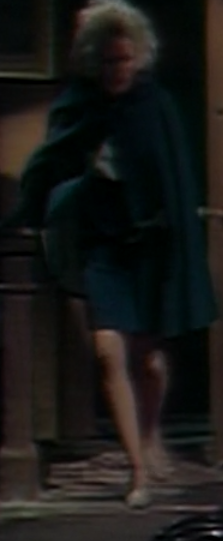
The costumers were involved in a famous production error in the final scene. Angelique/ Cassandra’s hooded cloak cuts off above her knees. There is no old age makeup on her legs, which are featured from every angle, making a ludicrous contrast with her face and wig.
*In 2024’s money, that’s $4544.17.
Episode 202: You and I wouldn’t be friends

There is only one ongoing story on Dark Shadows right now, and it doesn’t seem to have much of a future. Seagoing con man Jason McGuire is blackmailing reclusive matriarch Liz, threatening to reveal that she killed her husband Paul Stoddard eighteen years ago and that he buried Stoddard’s body in the basement of the great house of Collinwood. Not only was all of that clear when Liz and Jason had their first conversation several days ago, but yesterday we heard Jason on the telephone making it clear that he is bluffing. If Liz calls the police, he will get out of town as fast as he can. So whatever Liz does in response to Jason’s so-frequently repeated threat, the story can go only so far before it reaches a dead end.

Looking at Jason, audiences at the time would have recognized actor Dennis Patrick as a frequent guest star on prime time television shows and might have suspected that he was too big a name to stay on a daytime soap opera for very long. They would not have known that Patrick always made it a point to have an end date in place anytime he agreed to guest on a soap or that when he played Jason he did not have a contract, and was free to walk away any time he wanted. Seeing him share so many scenes with Joan Bennett, who had been a major movie star for a number of years, they might have thought it was possible he could stick around, but the show so quickly burned through what little story the two of them had that it wouldn’t have seemed likely.

So, what comes next? Alexandra Moltke Isles’ opening voiceover, delivered as always in character as well-meaning governess Vicki, gives us a hint:

My name is Victoria Winters. The foundations of Collinwood house a frightful secret, a secret that has lain dormant for eighteen years, a secret awakened by a stranger. But there is another stranger, one who is to awaken and unleash a force that will affect the lives of everyone.

This other stranger is Jason’s henchman, dangerously unstable ruffian Willie Loomis. At the beginning of this episode, Willie is drinking at the bar in Collinsport’s only night spot, The Blue Whale. There are three other customers in the tavern, an old man at the bar and a young couple in the background* bowing to each other at irregular intervals. If we assume, as I suppose we must, that these movements represent an attempt at dancing, we might wonder if the force Willie is destined to awaken and unleash is choreography.

Maggie Evans, The Nicest Girl in Town, enters. She looks around for a long moment, then slowly makes her way to a table. Willie tells Bob the bartender he wants to buy Maggie a drink. Bob goes to her table, and we see them have a conversation in the course of which Bob gestures to Willie and Maggie shakes her head no. When Bob returns to the bar, Willie tells him that “A good bartender wouldn’t have asked any questions!” Not even what kind of drink the lady would like, apparently. So maybe he’s going to awaken and unleash the force of unconsumed beverages.

Willie goes to Maggie’s table and sits down. When she protests that she’s waiting for someone, he sneers that no one tells him where to sit.** As Willie, James Hall is doing a great job of establishing himself as a clear and present danger to everyone he meets. Maybe Willie was right about one thing- a good bartender would notice Maggie’s discomfort and order Willie out of the bar. It’s obvious that Willie wants to awaken and unleash the force of sexual assault.

Maggie’s boyfriend, hardworking young fisherman Joe, enters. Willie refuses to leave the table and tells Joe to go wait at the bar. Joe squares up for a fight. He and Willie are about to start throwing punches when Jason comes into the bar and commands Willie to back off. At that, Willie awakens and unleashes the force of doing as he is told.

Jason apologizes to Maggie and Joe for Willie’s behavior and tells Bob he wants to treat everyone to a round of drinks. Joe mentions that Maggie’s father, drunken artist Sam, will be sad he missed a free drink. Maggie says that Sam won’t be drinking tonight, because New York art dealer Portia Fitzsimmons is pressing him for more paintings. Evidently Sam will be working more and drinking less now that he is no longer connected to any ongoing storyline.

At the bar, Willie complains to Jason that he’s come to help him, but hasn’t got any money out of the operation yet. Jason gives him some cash and tells him to be patient. The time has not yet come for Willie’s brawn to complement Jason’s brains.

Hall’s Willie does not spend any time processing his emotions or any energy concealing them. When he is getting ready to fight, he displays unfiltered rage; the instant he has to forgo the idea of beating up Joe and raping Maggie, he lowers his eyes and a look of deepest despair comes over him. Much as we hate Willie when he is menacing our friends, the transparency and intensity of his feelings makes it easy to watch him when he is feeling sorry for himself. Why is this strange, horrible man the way he is, and what will he do next? So when he awakens and unleashes the force of whining, it proves to be a strong enough force to keep us watching for a few minutes.

Those are good minutes for Dennis Patrick as well. Monotonous as Patrick’s scenes with Joan Bennett were, his scenes with other members of the cast usually had some element of unpredictability. We don’t know what is going on between Jason and Willie, and Jason himself doesn’t really know what Willie is going to do from one moment to the next. So it’s fun to watch Jason scramble to keep his associate in line. Also, we have a chance to root for Jason, at least for the duration of his two shots with Willie, since his control over Willie is what prevents violence against characters we care about.

Jason’s remark about Willie’s brawn raises the question of what exactly he wants Willie for. Liz is giving Jason everything she has, bit by bit, in response to his blackmail. If that is the whole plan, there doesn’t seem to be any need for brawn at all. Of course, Hall is a short, slender man, so much so that only his well-realized portrait of a violent felon keeps Willie’s confrontation with the substantially taller and more muscular Joe from looking ridiculous. Only Jason’s intervention prevented Willie from awakening and unleashing the force of badly losing a bar fight. Still, we keep wondering what the next phase of Jason’s evil plan will be.

Back at Collinwood, Jason is in the study, smoking a fine cigar. Flighty heiress Carolyn enters, and remarks that the cigar is one of her Uncle Roger’s favorites. Jason says that he knows of even finer cigars, and says that his whole philosophy of life is finding the good things and squeezing whatever he can out of them. Carolyn agrees that he has described himself well, neither hiding her disgust nor disturbing his complacent attitude.

Jason has identified himself as a friend of Carolyn’s father, the long-missing Paul Stoddard. Carolyn explains that she knows very little about her father, and asks Jason to tell her about him. He doesn’t really tell her anything she doesn’t already know, but does remark that “Paul Stoddard and I were very much alike.” He delivers that line in a way that suggests it might become significant. Once Carolyn gets up to go, Jason assures her that he does have stories about Stoddard to tell her some other time. Once she is gone and we are wondering if he really knew Stoddard at all, he steals three more of Roger’s cigars.

When we were watching this episode, my wife, Mrs Acilius, surmised that Carolyn asked Jason about her father less because she wanted to learn about him than because she wanted to figure Jason out. It is strange that she follows her obvious disapproval of Jason’s “philosophy of life” with “I never knew my father…,” unless it is a ploy to get Jason to talk about himself. And indeed, he does tell her far more about himself than about Stoddard. So that may well have been on Nancy Barrett’s mind when she was playing the scene.

A knock comes at the front door. Carolyn opens it to find Willie, identifying himself as a friend of Jason’s and announcing that he has decided to accept Jason’s invitation to stay at Collinwood. Jason is crestfallen to see that he has lost his control over Willie, and we are appalled to see Maggie’s would-be assailant moving into Carolyn’s house.

*This is the man in that couple. He would be a very familiar face on TV for a long time after this. He isn’t listed on either the Dark Shadows wiki or the imdb entry for this episode, and I can’t quite place him.

Hey look, it’s that guy! The one who was on those cop shows, you remember.

UPDATED 7 February 2024: I just spotted him in an episode of Columbo! His name is Paul Jenkins.

Paul R. Jenkins as Sergeant Douglas and Peter Falk as Lieutenant Columbo in The Most Dangerous Match (1973)

Jenkins appeared in a number of feature films, among them Rosemary’s Baby, Chinatown, and Network, and did guest spots on dozens of TV shows, among them the Dark Shadows-adjacent Falcon Crest. Evidently he was friends with Sidney Poitier, the two of them worked together on multiple projects, including Poitier’s 1992 film Sneakers. Most of the images of Jenkins I can find online come from a 1972 episode of M*A*S*H where he played an American NCO who keeps a Korean woman as a slave. This still from The Secrets of Isis illustrates his Wikipedia entry, and the civilian clothing from the 1970s is more typical of his on-screen appearance than was the 1950s Army uniform he wore on M*A*S*H:

Paul R. Jenkins, 1975.

**For some reason, Willie addresses Maggie as “Speedball.” “Listen, Speedball!” he commands. I wonder if Vladimir Nabokov considered Listen, Speedball as the title for a sequel to his Speak, Memory.

Episode 193: Portia Fitzsimmons

Drunken artist Sam Evans receives an unexpected visitor to his cottage. She is famed art dealer Portia Fitzsimmons, and she is magnificent.

Mrs Fitzsimmons, as she insists on being addressed, was in a junk shop earlier this week, where she found two of Sam’s paintings available to buyers of the frames they were in. The paintings were done ten or twelve years ago, and she declares that they are in a style that will soon become fashionable. If Sam can come up with a dozen more canvases from that period, he will have a one-man show at her gallery, and he will become famous. With that fame, he may even be able to sell some of his newer paintings, countless of which have been collecting dust around the cottage for years on end.

This was the very first scene of Dark Shadows I ever saw. I’d heard of the show when I was a boy in the late 70s and my mother was watching whatever daytime soap she was into. I heard her say something like, “Ooh, they’re going to turn into Dark Shadows.” I asked her what Dark Shadows was, and she explained that it was a soap opera that had been on about ten years before which introduced a vampire as one of the regular characters. At that age, I thought of soaps as the dullest thing in the world. I wasn’t particularly into vampires, but they were obviously too interesting for the televised sleeping pills that beamed into our living room for an hour every afternoon, so I followed up with some more questions. She had never watched the show, so all she could tell me was that it started as a more or less conventional daytime serial, added a vampire, and became a hit.

When the 90s came along and I got cable TV in my apartment, that was still all I knew about it. So when I saw that the Sci-Fi Channel* was showing Dark Shadows, I decided to take a look. There is no suggestion of vampires in this one, but Portia Fitzsimmons is such a dynamic character that I could see that the show was capable of being pretty lively without them.

Actress Lovelady Powell has two physical abilities that enable her to give us something fresh to look at every second the camera is on her. First is her remarkably mobile face. Her left eyelid alone is capable of a wider variety of expressions than most performers can produce with their entire physiognomy. Since it is her left eye that is focused on Sam throughout the scene, that eyelid is going to be the crucial body part in her delineation of their relationship, but she uses it with remarkable facility. Focus on her left eyelid in these three images, and see how it does most of the work in taking her in a few seconds from delighted to dismayed to dismissive:

Delighted
Dismayed
Dismissive

Those three images show a major shift in mood. The same eyelid can also modulate finer shades of feeling. In this sequence a few moments later, the left eye is partially obscured, but still shows precisely what is going on when Mrs Fitzsimmons gives Sam his marching orders:

Laying down the law
Letting it sink in
Adding emphasis
Observing Sam’s reaction
Confirming Sam in his reaction
Making up her mind about Sam

Powell not only made excellent use of the fine muscles of her face, but of her limbs as well. So her second strength is her style of movement. She walks around the set continually, making many wide, sweeping gestures. If those seemed to be a number of distinct motions, she would be a hectic, distracting presence. But in fact, it all comes together as an uninterrupted flow, and defines the entire performance space in terms of her action and her presence. This is difficult to illustrate with still images, but if you look at how she uses her elbows in this sequence I think you’ll get the idea:

Maximum distance
Approaching
Arrival
Starting to unbend

I think an actor could watch this scene a dozen times and learn new things from every viewing.

All these techniques for establishing visual dominance pay off in the scene. Sam is an artist who has so utterly despaired of finding an audience for his art that it simply does not register with him that a famous art dealer has come calling. Returning viewers will remember that Sam has been moping around feeling sorry for himself since his first appearance in episode 5. Two weeks ago, in #184, he told his daughter Maggie that it was too late for him ever to have a one-man show and that all he could ever hope for was to sell a few paintings to tourists every summer. Within minutes, Mrs Fitzsimmons has changed all of that. She watches Sam’s reactions as she turns his life upside down, and visibly calculates the particular sort of flourish with which she will deliver each of her lines. When he tells her that he thinks he will be able to assemble enough paintings within a week, she stands in the doorway and replies that she is sure he will be able to do it then, “if you can do it at all.” She then pirouettes away and wafts off whence she came.

When I first saw the scene, I wondered how big a part Mrs Fitzsimmons would play in the storylines to come. I still remember seeing the name “Lovelady Powell” in the closing credits. With my work schedule at the time, I didn’t have a chance to see another episode for months, and when I did join it again there was no sign of Portia Fitzsimmons. I assumed she’d been written out, perhaps to return in some later narrative arc, perhaps because Lovelady Powell had gone on to bigger things. It came as quite a surprise to learn that this was her only appearance on Dark Shadows, and that her acting career never really took off.

Now that I’m on my second complete viewing of the series, it’s an even bigger surprise. The portraits of the ancestors of the ancient and esteemed Collins family are among the most prominent visual features of the chief sets, those representing the great house of Collinwood. Portraits there and elsewhere, including in the long-abandoned Old House at Collinwood and in the Evans cottage, have repeatedly been shown to have supernatural power, representing a bridge between the world of the living and that of the dead.

Further, every storyline that has been resolved so far has centered on strange and troubled boy David Collins. The show has gone out of its way to show that David has promise as an artist. David Collins is nine, and actor David Henesy turned ten in October of 1966, but the character is unusual enough and the actor is sophisticated enough that it would be interesting to see David interact with the grand dame of the New York art world.

An art connoisseur is therefore as well-positioned as anyone to act as a guide to the uncanny realms into which the show will be venturing from now on. Combining Portia Fitzsimmons’ claim to expertise with her imperious personality and Lovelady Powell’s sophisticated acting style, you’d have a character who could carry us right through the whole series. The producers will be hard-pressed to find another actress who can play as worldly and forceful a Vergil to the various Dantes who will be exploring Collinwood’s weird infernos.

Sam’s reaction to Portia Fitzsimmons’ command that he bring her a dozen canvases that he painted ten or twelve years ago puzzled me on my first viewing, and puzzles me in a different way now. The only group of works that fill that bill are in the possession of high-born ne’er-do-well Roger Collins. Sam sold them to Roger ten years ago for $15,000. Roger likes money, a point made clear in his scene with Sam today. If Sam simply telephoned Roger and told him that the famous Portia Fitzsimmons wants to show the paintings in her gallery and sell them at a great profit to Roger, no doubt he would be eager to find them and make the deal.

Sam does not do anything so straightforward. Instead, he visits Roger at Collinwood. Roger responds to his presence by railing at him, declaring that he never wants to see him in the house and wants him to leave immediately. Sam then insists that Roger give him the paintings. When Roger asks why, Sam denies that any part of the $15,000 was a payment for the paintings. He starts to explain that it was hush money Roger gave Sam to ensure he kept a secret Roger wants withheld from dashing action hero Burke Devlin.** Roger looks around in terror when Sam starts talking about the secret, then orders him never to speak of the matter again. Sam says he will tell Burke all about it unless Roger produces the paintings. Roger dismisses Sam’s threat, but does offer to sell him the paintings for $50,000, unless it turns out that he destroyed them or lost them somewhere along the way.

Now that I’ve seen episodes 1-192 a couple of times, I know that Sam hates Roger, hates himself for taking Roger’s money and betraying Burke, and wants to start a new life in which Roger will have no part. But his undisguised attempt to blackmail Roger into handing over the paintings isn’t really in character for Sam. His tortured conscience has hobbled Sam time and again in his attempts to stand up to Roger. Besides, Sam just had a harrowing encounter with the supernatural in the form of Roger’s estranged wife, blonde fire witch Laura Collins, and that experience seemed like it would make him a kinder and more thoughtful man. That his first act after emerging from it is to commit an out-and-out felony is a disappointment to me.

My wife, Mrs Acilius, wasn’t disappointed. She likes the scenes when Sam is sober enough to stand up to Roger, and she sees this as one of the strongest of those. While she acknowledges that Sam is not being rational, she cheers for his desire to press to the hilt his advantage over the rich so-and-so who has been a blight on his existence for so long.

In the local tavern, The Blue Whale, Maggie Evans is having a drink with her boyfriend, hardworking young fisherman Joe. The camera focuses on a man in a seaman’s coat and captain’s hat sitting at the bar, eavesdropping on their conversation. When they mention Collinwood and reclusive matriarch Liz, the sailor perks up and approaches them.

He apologizes for listening to their conversation, but goes on to ask a series of questions about its content. When Joe makes it clear he does not welcome the intrusion, he apologizes again, while in the act of sitting down with them. When they are finally getting rid of him, he says that it is terribly sad that Liz never leaves her home, and while speaking of that terrible sadness flashes a huge grin. He gives his name as Jason McGuire.

So we are introduced to a second new character in this episode. This one is apparently going to get some kind of storyline started. The actor is talented and the scene has some good things in it, but Jason McGuire is no Portia Fitzsimmons.

*As it then was known.

**A sketch of Burke is on display in Sam’s cottage today. The Dark Shadows wiki speaks with the voice of fans everywhere when it says that Sam tore up a sketch of Burke in #41 and therefore should not have this item now. But Sam made that sketch as part of his preparation for painting a full portrait of Burke. Artists make more than one sketch when they are getting ready for a major painting, so the fact that Sam tore up one sketch doesn’t mean that he doesn’t have any number of others lying around.