Episode 214: Nothing lasts forever

For the first 20 weeks of its run, Dark Shadows developed its story at a stately pace. When writers Art Wallace and Francis Swann were replaced by Ron Sproat and Malcolm Marmorstein, stately became glacial, and at times ground to a halt altogether. For the last few months, Joe Caldwell has been making uncredited contributions to the writing. While Caldwell is probably responsible for some of the glittering moments of witty dialogue and intriguing characterization that have cropped up, everything is still taking a very long time. And this is the second episode in a row in which nothing at all happens to advance the plot.

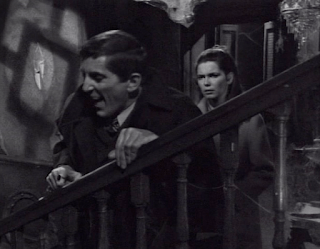
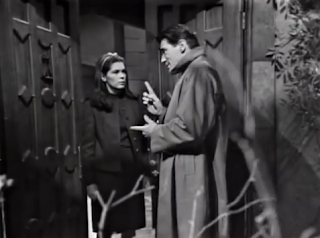
There are a few interesting moments. We begin with well-meaning governess Vicki entering the long-abandoned Old House on the grounds of the estate of Collinwood in search of her charge, strange and troubled boy David Collins. The doors swing shut, and she cannot open them. The recently arrived Barnabas Collins comes down the stairs, startling her. He opens the doors easily.

This may not sound like a big thrill, but regular viewers will remember that doors swung open at the approach of the previous supernatural menace, blonde fire witch Laura Murdoch Collins. When characters who did not know that Laura was anything other than a woman saw that happen, they didn’t react- it was a small enough thing that they could fail to notice it, and a weird enough thing that it didn’t register. So we have been prepared to watch for tricks with doors as a sign of the uncanny.

Barnabas’ big challenge today is a job of acting. He has to convince the residents of Collinwood that he is a living man from the twentieth century, not a reanimated corpse come to prey upon the living. He has trouble staying in character. When he tells Vicki that once, centuries ago, a father and son had a quarrel in the Old House that led to the son’s death, he starts laughing and repeats the word “death.” Vicki looks at him like he’s a lunatic. He gets it back together fairly quickly, but when Vicki goes back to the great house on the estate she will tell flighty heiress Carolyn that Barnabas is kind of strange.

“Death Ha Ha!” Screenshot by Dark Shadows Before I Die

Barnabas gives Vicki a long, flowery speech about the building of the house, one with no apparent motivation and many logical stopping places. Marmorstein has been giving these overheated orations to actor after actor, defeating them all. As Vicki, Alexandra Moltke Isles came the closest to selling one of them, at the beginning of #167, but she needed maximum support from the director in the form of close-up shots and lighting effects, and even then it was a relief when it was over.

Barnabas’ entire part consists of such speeches. Jonathan Frid stumbles over his lines quite a bit today, as he will do henceforth. No wonder- not only was he dyslexic, but at this point they were shooting seven days a week to make up for production time they lost in a strike late in March. That left him with precious little time to memorize the pages and pages of purple prose they kept dumping on him.

Listening to Frid struggle through his dialogue today, we discover the first reason why Barnabas became such a hit. In his voice, through his mannerisms, Marmorstein’s gibberish sounds gorgeous. Sometimes Frid’s struggle to remember what he’s supposed to say is a problem for the character. Since Barnabas is himself an actor essaying a demanding role, it gets confusing to see Frid’s own difficulties laid on top of his. But even at those times the sound of his voice is so appealing that we root for him to recover and deliver more of his ridiculous lines.

In his speech to Vicki about the building of the Old House, Barnabas mentions that the foundations were made of rocks deposited by glaciers. Any reference at all to glaciers is pretty brave, considering the rate at which the story has been moving in the Sproat/ Marmorstein era. It also raises a question about Barnabas. He is the man who posed for a portrait done in an eighteenth century style, and David told dangerously unstable ruffian Willie Loomis stories about Barnabas’ mother Naomi that would place her towards the middle of the eighteenth century. We’ve also glimpsed a plaque on Naomi’s tomb that gives her dates as 1761-1821, but that prop hasn’t received anything like the screen time the portrait of Barnabas has had, and must have been made long before David’s lines to Willie were finalized. So the trend is to regard Barnabas as someone who was confined to a coffin from the eighteenth century until Monday night. When he starts talking about the rocks laid down during the Ice Age, an event unknown until the mid-nineteenth century, we wonder which night this week he spent updating his understanding of geology.

In the great house, high-born ne-er-do-well Roger comes home from a business trip to Boston. Before updating him and the audience on recent plot developments, Carolyn reminisces about her childhood, when he used to bring gifts to her when he would come home from business trips. She tells him he was the only father she knew. This is a retcon- up to this point, they’ve taken pains to make it clear that Roger and David only moved into the house a few weeks before Vicki’s arrival in episode 1.

Vicki and Barnabas enter the great house. She introduces him to Carolyn and Roger. Roger quickly escorts Barnabas to the study where the two of them talk alone. Roger mentions that a vineyard in Spain that had been in the family in the eighteenth century was still theirs until shortly before World War Two. Barnabas does not react to the phrase “World War Two” at all. Whether this is because he has been studying history as well as geology, or because he was simply overwhelmed with so much new information, is not explained.

While Roger and Barnabas are in the study, Vicki tries to explain to Carolyn why she thinks Barnabas is a bit odd. Carolyn doesn’t want to hear it. She explains the basis of the Collins family’s attitude towards Barnabas when she says it’s a relief just to meet someone friendly after the rough time they’ve had lately. Viewers who have been watching from the beginning will understand how strong that sense of relief must be, and will know that Barnabas is in a position to ride it right into a permanent billet on the estate.

Barnabas leaves, and Roger shows Vicki and Carolyn the portrait. He points out that Barnabas is wearing the same ring as its subject. He does not point out that he is also carrying the even more distinctive wolf’s-head cane.

While those three talk about the wealthy and genial visitor from England Barnabas appears to be, we wonder what he really is. Barnabas first appeared as a hand darting out of a coffin, he has shown up only at night, he lived hundreds of years ago, and he is played by an actor who bears a noticeable resemblance to Bela Lugosi. So we assume that he is a vampire. But so far, there hasn’t been any direct evidence of blood-sucking. During the months Laura was on the show, they made a point of not assimilating her to any familiar mythology. So for all we know, he might be something we’ve never heard of.

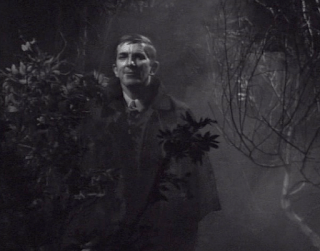
The final shot before the credits roll is in the outdoors, where Barnabas is standing perfectly still, surrounded by shrubbery, and with a big smile on his face. Perhaps that shot is telling us that Barnabas is not the vampire we might assume he is, but that he is in fact an undead garden gnome.

Barnabas the lawn ornament. Screenshot by Dark Shadows Before I Die

Episode 209: The darkest and strangest secret of them all

Dangerously unstable ruffian Willie Loomis stares at the portrait of Barnabas Collins hanging in the foyer of the great house of Collinwood. The portrait’s eyes glow and the sound of a heartbeat fills the space. Willie’s fellow unwelcome house-guest, seagoing con man Jason McGuire, comes into the room. Willie is surprised Jason can’t hear the heartbeat.

After consulting the Collins family histories, Willie goes to an old cemetery where legend has it a woman was interred with many fine jewels. The Caretaker of the cemetery stops Willie before he can break into her tomb. Willie hears the heartbeat coming from the tomb, but, again to his amazement, the Caretaker cannot hear it.

Yesterday, strange and troubled boy David Collins had told Willie that in some previous century, a pirate fell in love with Abigail Collins, gave her jewels, and that Abigail took those jewels to her grave. Today, Willie repeats this story to wildly indiscreet housekeeper Mrs Johnson, only he identifies the woman as Naomi Collins. Fandom likes to seize on this kind of thing, presenting it either as an error or as a sign of retcons in progress, but I suspect that it is just a clumsy way of suggesting that the characters are hazy on the details of the legend.

The legend itself is very much the sort of thing that inspired Dark Shadows in its first months. ABC executive Leonard Goldberg explained that he greenlighted production of the show when he saw that Gothic romance novels were prominently featured everywhere books were sold. The idea of a grand lady in a manor house somehow meeting and having a secret romance with a pirate is a perfect Gothic romance plot, as for example in Daphne du Maurier’s Frenchman’s Creek. Willie’s fascination with the tale might reflect an accurate assessment of the situation if Dark Shadows were still a Gothic romance, but the show left that genre behind as the Laura Collins storyline developed from #126 to #193. If Willie had been watching the show, he would know that the story David told him is not the one that is going to shape his future as a character on it.

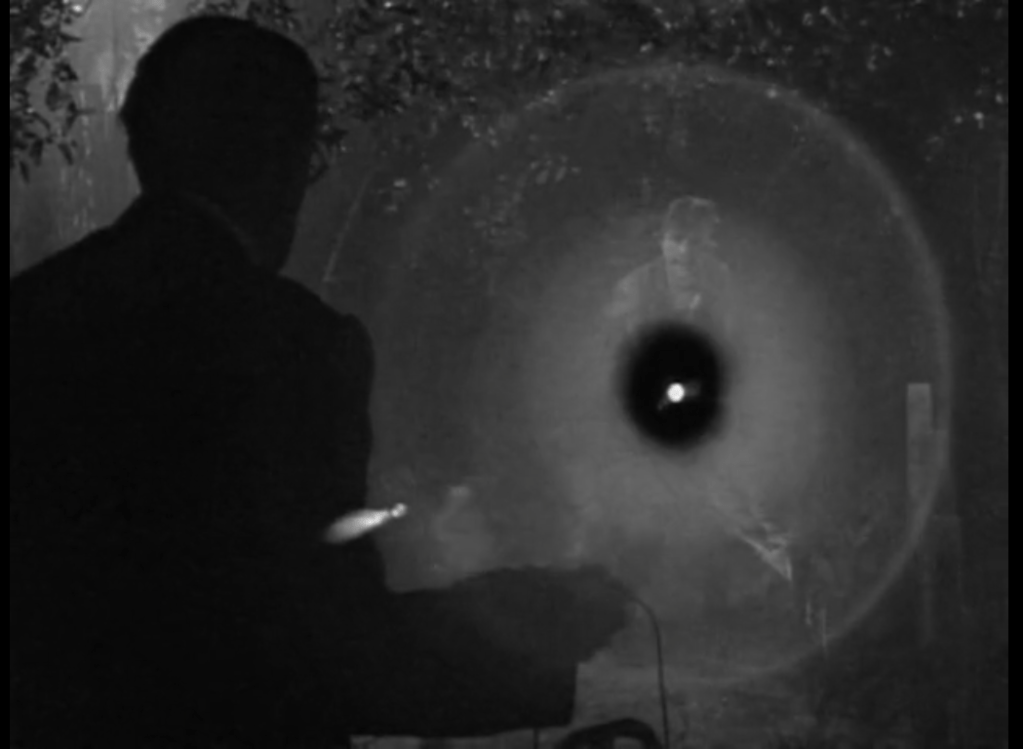
When Willie is wandering around the old cemetery, he twice shines a flashlight directly into the camera and creates a halo effect. The first time might have been an accident on the actor’s part, but the second time the halo frames the Caretaker in a way that is obviously intentional. Patrick McCray’s entry on this episode in his Dark Shadows Daybook describes the Caretaker as “a refugee from the EC universe.” Indeed, Willie’s crouching posture and angry facial expression, the halo filling so much of the screen, the tombstones in the background, and the Caretaker’s silhouetted figure carrying a lantern add up to a composition so much like a panel from an EC comic book that it may well be a conscious homage:

Beware the Vault of Horror!

This is our first look at the Tomb of the Collinses.

Introducing the Tomb of the Collinses
Willie sneaks up to the Tomb

It’s also the first time we are told the name of the cemetery five miles north of Collinsport in which the Tomb is situated. Mrs Johnson calls it “Eagle’s Hill Cemetery,” though later it will be called “Eagle Hill.” Mrs Johnson also mentions the Collinsport cemetery two miles south of town, and the Collins’ family’s private cemetery located in some other place. They won’t stick with any of this geography for long, though it all fits very neatly with everything we heard about burial grounds in the Collinsport area during the Laura story.

Episode 87: She came to us from nowhere, and now it seems she has disappeared into nowhere

Hardworking young fisherman Joe is spending the evening with Maggie, The Nicest Girl in Town. It’s their first date. Maggie impresses him with her knowledge of ships, and he sings a verse of “What Do You Do With a Drunken Sailor?” It may not sound like much, but the actors, Kathryn Leigh Scott and Joel Crothers, sell it so well that we’ll be rooting for Joe and Maggie for years to come. The final moment of the scene comes after Joe leaves. Maggie looks directly into the camera and says to the audience, “Goodnight, pal.”

Goodnight, pal

In the great house of Collinwood, high-born ne’er-do-well Roger Collins greets his niece, flighty heiress Carolyn, on her return home. Carolyn is upset because Joe has broken off their relationship and is having a date with Maggie. The story of Joe and Carolyn was a bore, largely because the two of them never had a scene with any fraction of the sweetness we see between Joe and Maggie today. There was nothing at stake in their quarrels, because they had nothing to lose if they simply gave up on each other.

Roger tells Carolyn that well-meaning governess Vicki hasn’t been seen for hours, and that he promised Carolyn’s mother, reclusive matriarch Liz, that he would sit up waiting for Vicki’s return. Carolyn is worried as well, and asks Roger why he isn’t actively searching for her. He says she’s probably fine. When Carolyn says that people don’t just disappear, he reminds her of family friend Bill Malloy, who disappeared not so long ago, but then turned up. Considering that Bill turned up in the form of a corpse washed ashore by the tide, it is perhaps unsurprising that Carolyn does not find Roger’s analogy particularly comforting.

After Roger persuades Carolyn to toddle off to bed, he makes sure he’s alone (well, alone except for the stagehand in the lower left-hand corner of the screen.)

Once assured that no one mentioned in the script can see him, Roger returns to the drawing room and opens a secret passage we’ve never seen before. After he disappears into it, Carolyn comes to the drawing room and is baffled at his absence.

The suggestion that Carolyn doesn’t know about the secret passage is characteristic of the show. From the beginning, Vicki has represented our point of view. She started off knowing nothing about the other characters, and everything had to be explained to her while she was on camera. If Vicki knows just what we know, Carolyn, who grew up in the house where most of the action is set, can be presumed to know a great deal we do not. When they reveal a secret to us, they can amplify its importance by showing that Carolyn isn’t in on it. They’ve done this several times, mostly in situations having to do with the murky origins of Roger’s feud with dashing action hero Burke Devlin. Carolyn’s ignorance of the secret passage is particularly effective- it’s right there in the most important room of the only house she’s ever lived in. If she doesn’t know about it, it must be a very well-kept secret indeed.

We go with Roger into the secret passage. He shines his flashlight directly into the camera, creating a halo of light around it. This would not seem to be a desirable visual effect, yet we will see it many, many times in the years to come. This is the second appearance of the effect. The first time came when Roger’s son, strange and troubled boy David, was leading Vicki into the abandoned Old House in episode 70. Now we see it when Roger himself is entering another abandoned space, one where he might meet Vicki.

Halo

It’s hard to believe that the repeated use of this effect was altogether unintentional.

All the more so because of what follows Roger’s entry into the passageway. His journey through it actually does seem to wind through a very large space. In the opening narration, Vicki had said that the house is made up of 80 rooms, retconning the total of 40 given in the second episode. Roger’s trek up one flight of stairs, down another, up a spiral staircase, around corners, past windows, etc etc, seems like it must take him past enough space for at least that many. Perhaps the sequence would be a bit more attractive with less time spent focused on Roger’s feet, but all in all it is as effective a creation of space as Dark Shadows would ever do. If there had been Daytime Emmy Awards in 1966, Lela Swift would have had every right to expect to win Best Director for conjuring up this illusion of vast, winding corridors without editing or going outside the tiny studio space available to her.

Roger does indeed discover Vicki’s whereabouts. He hears her calling for David from behind a locked door, promising David not to tell anyone he imprisoned her there if he will let her out now. Roger does not simply let Vicki out. Instead, he makes some loud noises, then puts on a ghostly, wavering voice and calls out to Vicki that she is in great danger as long as she stays in Collinwood. He seems to be having trouble keeping a straight face when he makes these spooky sounds. Vicki isn’t laughing, and returning viewers aren’t either- in Friday’s episode, she and we saw the ghost of Bill Malloy in the room, and heard that ghost warn her that she would be killed if she stayed in the house much longer.

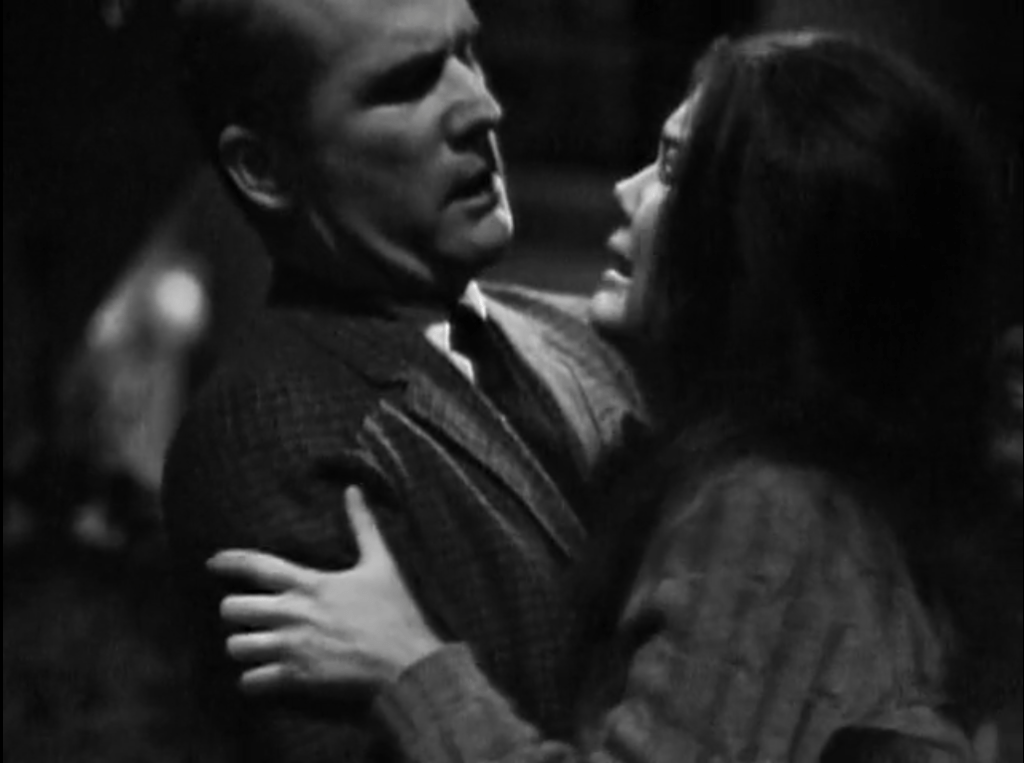
Once he’s had his fun, Roger opens the door. After another flashlight halo, Vicki recognizes him. Alexandra Moltke Isles gives us one of the finest moments of acting in the entire series, when Vicki throws her arms around Roger, her bodily movement as smooth as any ballet dancer’s but her voice jagged, and says that “David is a monster, you were right!” Up to this point, Roger has been brutally hostile to his son, Vicki heroically friendly to him. Her determination to befriend David has become so central to her character that hearing her make this declaration makes it seem that she is permanently broken.

Broken Vicki

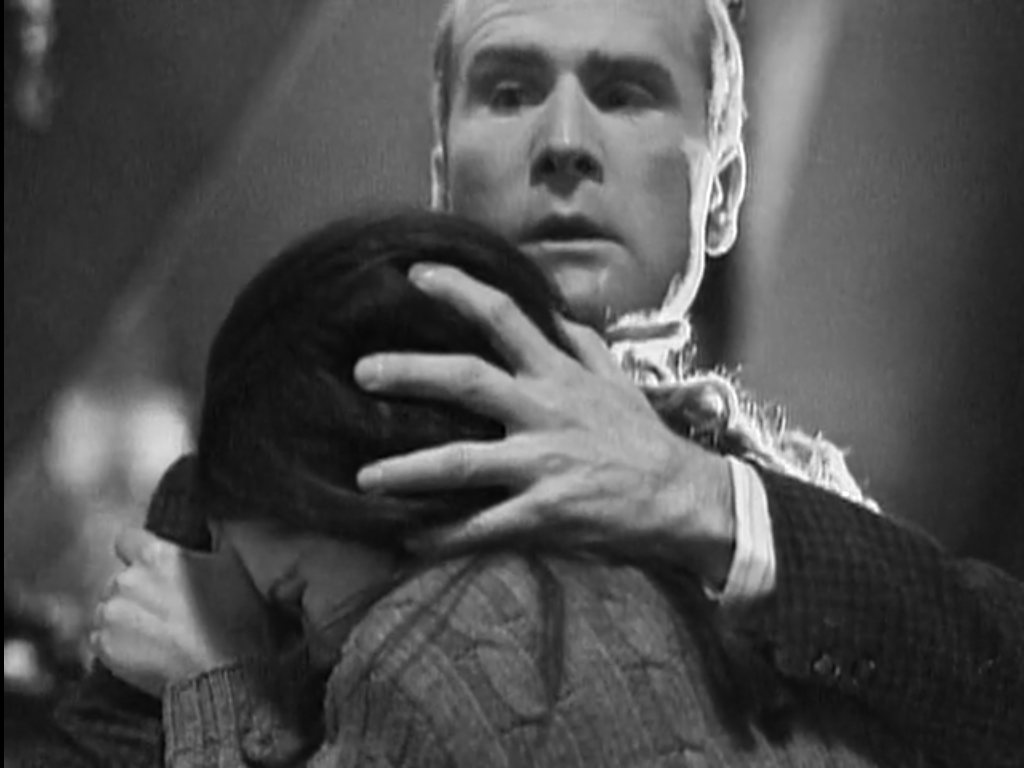
Vicki struggles to hold back her sobbing long enough to tell Roger that she saw the ghost of Bill Malloy. That’s an episode-ending sting- Roger wants everyone to forget about Bill’s death, and if his ghost starts popping up he is unlikely to get that wish.

Stunned Roger

Mrs Isles was a “head actor,” one who found the character’s innermost psychological motivation and worked outward from that. That heavily interiorized style would be one of the things that left her in the dust, along with similar performers like Joel Crothers and Don Briscoe, in the period when Dark Shadows was a hyper-fast paced, wildly zany show about vampires and werewolves and time-travel and God knows what. But in the period when Art Wallace and Francis Swann were writing finely etched character studies, she consistently excelled. In this little turn, she shows that when it was logical for her character to go big, she could go as big as any of the stars of the show in those later days.

Episode 77: Burke Devlin, Burke Devlin, Burke Devlin!

Screenshot by the Dark Shadows wiki

Yesterday, dashing action hero Burke Devlin announced to the ancient and esteemed Collins family that he intends to drive them out of business and take all their holdings. He then muddied the waters by offering to pay them an inflated price for their dilapidated old house. Still, everyone came away with the impression that Burke had openly declared himself to be the deadly enemy of the Collinses.

Problem child David Collins wasn’t in that episode, and he refuses to believe the characters who were when they tell him that his idol Burke has said that he is out to strip the Collinses of their assets. The only person David likes, aside from Burke, is his aunt, reclusive matriarch Liz. He struggles when forced to choose sides between them. His misery and frustration grow palpably throughout the episode.

At least David can still do something he likes. His cousin, flighty heiress Carolyn, tries to get him to return a photograph of Burke that he stole. While she is in his room, he taunts Carolyn with the idea that Burke isn’t really attracted to her, but that he prefers well-meaning governess Vicki. This infuriates Carolyn, much to David’s satisfaction.

The photo itself is a bit of a mystery. It shows Burke striking oil:

Screenshot by The Collinsport Historical Society

The show has repeatedly told us that Burke grew up poor, that he was still poor when he went to prison, and that he was penniless, despised, and alone in the world when he got out of prison just five years ago. Yet now, he owns a corporate raiding firm, and is a millionaire many times over. They’ve dwelt on this time frame so much that even a soap opera audience is likely to start wondering how he got so rich so quickly. The photo may be an attempt to answer that question. Everyone knows that if you strike oil, you can become a millionaire overnight. Of course, you would have to own the mineral rights to the land the oil is on to profit from such a discovery, and would also need to secure drilling equipment and to hire a crew to operate it if you’re going to make the strike in the first place. How an indigent person fresh out of the state penitentiary is supposed to have paid for those things is not really easier to explain than how he could start a private equity concern.

Both yesterday’s episode and today’s include references to Liz’ estranged husband, Carolyn’s father Paul Stoddard. Yesterday’s included a reference to another character we have yet to see, Laura Collins. Laura is David’s mother, the estranged wife of high-born ne’er-do-well Roger Collins, and the onetime fiancee of Burke. These two had been mentioned only a handful of times in the first months of the show, and neither was given a name until well into it. That they are coming up more often now might lead us to wonder if we will be meeting one or both of them sooner or later.

Episode 71: The place where they cut the heads off the fish

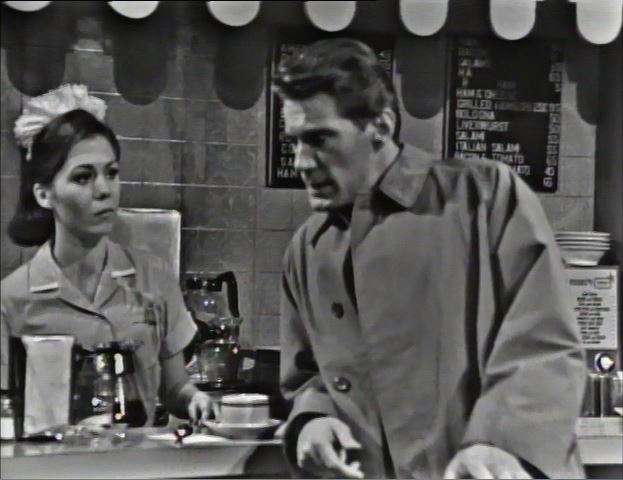
Friday’s episode ended, not with a cliffhanger, but with a visitation from the supernatural, as we saw the ghost of Josette Collins descend from her portrait and pirouette around the columns of the mansion she haunts. Today, Roger and Vicki sit in the diner, where he gives her a lecture about the sardine-packing business.

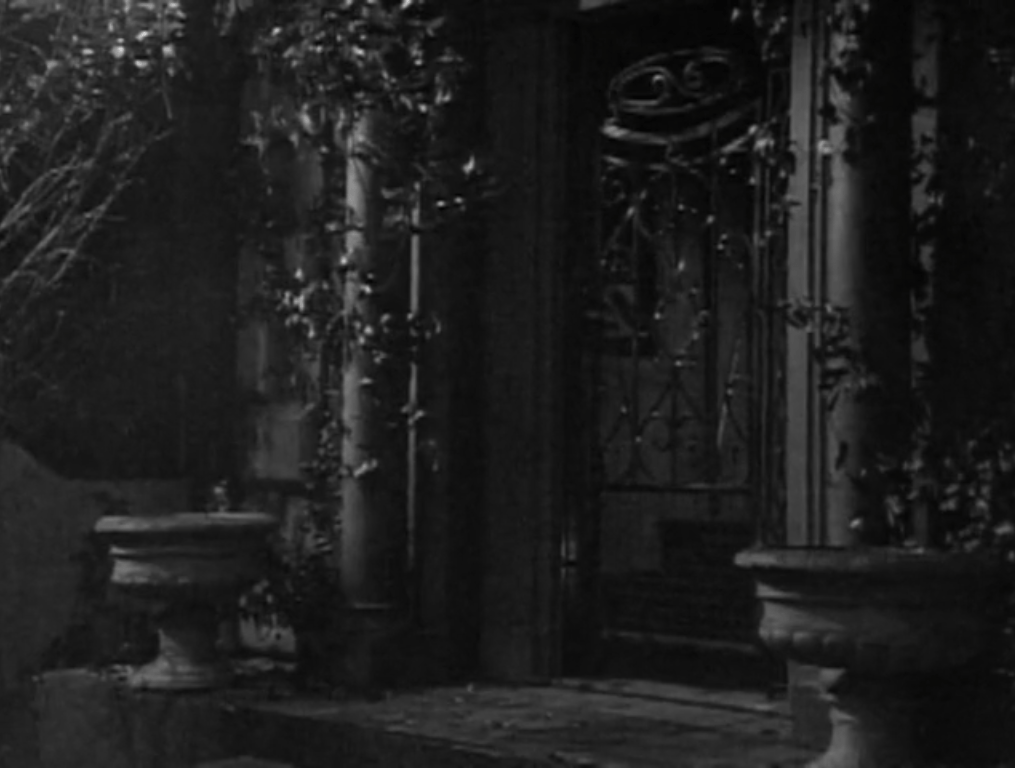
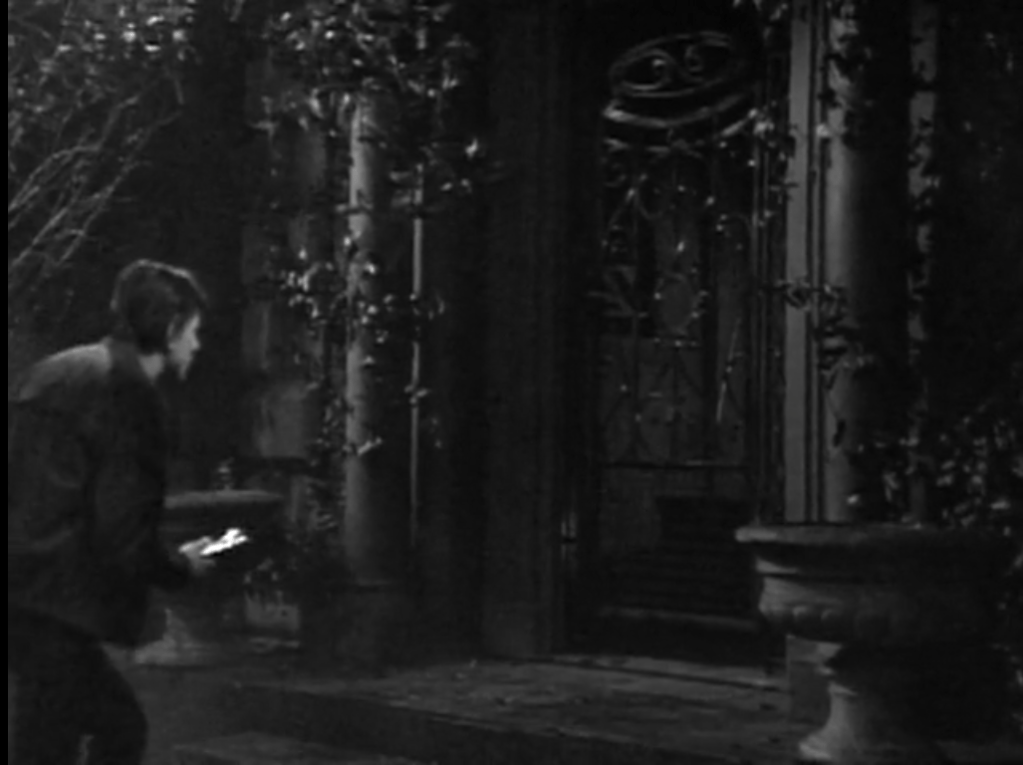
The apparition of Josette was the climax of an episode featuring more exterior footage than we have seen thus far. Today, we have several more location inserts, as we see Roger and Vicki walking around the village of Collinsport. As that one came to a climax with a new set- the Old House- this one also ends with our first look at a new set- the outside of the front doors of the great house of Collinwood.

Screen captures by Dark Shadows from the Beginning
First look at the front door of Collinwood from the outside
Screenshot by Dark Shadows Before I Die

These attention-getting moves prompt us to look for something big. The makers of the show tell us in so many words that the business story isn’t it.

After Roger has told Vicki a few facts about the sardine industry, she asks how the fishermen know where to look for sardines. He makes it clear that he has reached the limit of his willingness to discuss the topic with a dismissive, “Oh… luck. And experience.” Only when his enemy Burke comes in and he wants to look busy does Roger return to the subject with gusto. After Vicki has toured the cannery, Burke asks if Roger showed her “the place where they cut the heads off the fish.” Neither of those characters would watch a show about the sardine industry, or expect anyone else to do so. When they tell us that the business Burke is scheming to seize from Roger’s family doesn’t seem like exciting narrative fodder even to the two of them, the makers of Dark Shadows are telling us to forget about the business stories and focus on the sort of thing we saw at the end of Friday’s installment.

There is one bit of trivia that I hold onto from this episode. Vicki mentions to Roger that she finds it amusing that the family’s wealth began with the whaling industry and now comes from sardines- from the greatest giants of the sea to some of the tiniest fish in the ocean. An origin as whalers fits with the idea they have at this period of the show, that the Collins family first became wealthy in the 1830s.

Later, they will push them back in time, and present them as having already been rich long before then. That would rule out whaling as the first source of the Collinses’ riches. The New England whaling industry was a creation of the nineteenth century. The region’s wealth prior to that time was founded on cod fishing.

One of the major themes of the show in this period is that the Collinses are much less rich and operate on a much smaller scale than they did in the past. The transition from whales to sardines is an obvious metaphor for that decline. So obvious, in fact, that Vicki’s remark is rather a tactless one.

Episode 57: All we do is talk about death

Screenshot by Dark Shadows from the Beginning

In the opening teaser, dashing action hero Burke Devlin is having lunch in the restaurant at the Collinsport Inn. As usual, he’s alone there. He strikes up a conversation with Maggie Evans, who runs the place. She listens sympathetically while he tells her that he’s worried about the missing man, plant manager Bill Malloy. He goes on about the great meal he’ll buy for his dear friend Bill when he finally turns up. Maggie has to break the news to him that the Coast Guard has fished Bill’s corpse out of the sea.

Burke suspects that his bitter enemy, high-born ne’er -do-well Roger Collins, is responsible for Bill’s death. After he telephones the sheriff’s office to ask for information and doesn’t get answers, he returns to the restaurant, agitated. Well-meaning governess Vicki walks in; Burke snaps at her about Roger, and they quarrel. Burke goes to the sheriff’s office with this suspicion. So far from enlisting the sheriff as an ally against Roger, Burke finds himself being questioned as a suspect.

Burke returns to the restaurant. Vicki is still there, having had a heart-to-heart with her new friend Maggie. Burke yet again asks Vicki for a date; she yet again refuses him, this time because she’s planning to have dinner at Maggie’s house where she will be introduced to Maggie’s father, Burke’s former friend Sam.

Patrick McCray and Marc Masse write characteristically admirable posts about this episode on their blogs. McCray cites this episode as a fine example of the kind of story-telling that defined the show in its first 42 weeks:

Episode 57 is a focused study in how much the show would change in its first year. That’s not damning with faint praise nor stating the obvious about supernatural vs secular threats. It’s a compelling little episode that moves faster than many in the post-1897 run of the series. Within it is an entirely different approach to storytelling. Far more than other soaps, DARK SHADOWS was a show about action. Characters did things in the present rather than just talk about things done in the past. And when time, space, morality, and death are irrelevant to many of your main characters, it’s easy to present a Nietzschean amusement park of action and story twists. That’s not how the program began, though. It was only with the introduction of Laura Collins that DARK SHADOWS became a series about possibilities, not limits. But limits, and seeing attractive, interesting people struggle against them, is the bread and butter of terrestrial TV drama, and episode 57 is a beautifully executed cage.

Patrick McCray, Dark Shadows Daybook

He goes on to talk about the sorts of characters they can have in this period of the show who would become impossible in later days. Bill Malloy, for example: “Malloy was too good at getting things done to coexist with incredibly vulnerable monsters whose only protection came from how unobservant everyone else was.” Because of the centrality of the character of Liz and the theme of her seclusion in this period of the show, I’d always thought of the first 42 weeks as a study in the social and psychological effects of the refusal to face unpleasant facts. But of course denial is still the show’s great theme all the way through.  

Masse discusses the apparent discontinuity of Burke’s wistful tone before he learns that Bill is dead with Burke and Bill’s relationship as we saw it when Bill was alive:

And since when has Burke even cared about Malloy as a person? If he really had revered Malloy for having given him his start as he claims today, then how come he didn’t buy Malloy that best meal ever upon his return to Collinsport, instead of just toying with him at the Blue Whale in episode 3, hanging up the phone on him in episode 9, and then deftly evading his questions before showing him the door when Bill [paid] an unannounced visit to Burke’s hotel room in episode 21?

The above three episodes along with number 57 were all written by story creator and developer Art Wallace, which shows that already by September 1966 Dark Shadows was reinventing itself storywise to such a significant degree that contradictions in continuity would present themselves even if episodes in question were written by the same writer. Burke did acknowledge to Malloy in episode 45, a Francis Swann episode, that he’d been a fair employer to him when he was just starting out working on the boats of the Collins fleet; but in keeping with the opportunistic nature of Burke’s character, this was only after Malloy had offered to make a deal with him, which Burke must have surely understood would greatly benefit his own interests.

Marc Masse, Dark Shadows from the Beginning

I think there is a bit more grounding in what we see for Burke’s rhapsody about Malloy in today’s episode than Masse gives the show credit for. Also, that it is misleading to suggest that only now are we seeing abrupt changes.

I’ll deal with the second of these points first. When Burke came to town in episode 1, he was cold to everyone. They retconned this aspect of his personality in episode 21, where he revisits the sets where he dealt some of his harshest snubs in #1 and is a hail-fellow-well-met even to people whom he had reason to avoid. That was a necessary revision. Soap opera writing is largely a matter of filling screen time with conversation, so a character who isn’t on speaking terms with anyone is useless. But it wasn’t a very well-motivated change in terms of what has happened in the story. Viewers who remembered episode 1 would have had a hard time explaining why Burke’s attitude is so different now.

This time, though, Art Wallace’s script makes it clear time and again that Burke is isolated and getting lonely. He had expected Sam to be his friend, but has learned that Sam fears him. Sam’s daughter Maggie listens sympathetically to him, but he’s a customer of hers, and that’s her job. He certainly can’t expect a social invitation to the Evans house. He thinks he might be able to join forces with the sheriff, but is lucky to get out of his office without a bail ticket. He arrived on the same train as Vicki, and was attracted to her from the first. Every time he sees her, he asks her out and she turns him down. When he finds out that Vicki will be having dinner with the Evanses, it makes the picture of his isolation complete. Burke hasn’t made a single friend all the time he’s been in town, and it’s getting to him.

This takes us back to Patrick McCray’s point, about the “incredibly vulnerable monsters whose only protection came from how unobservant everyone else was.” As time goes on and Dark Shadows becomes more and more a show for young children, it will often be laughable just how unobservant the human characters are. But the first of the incredibly vulnerable monsters will meet a family buffeted by hostility, suspicion, and blackmail, surrounded by enemies even inside the walls of their big dark house on the hill. He will present himself to the Collinses as a warm-hearted, charming, unworldly visitor from a foreign land who wants nothing but their friendship. The lonely people he meets will all but collapse into his arms. In Burke’s rhapsody about Bill, we see the same neediness at work.

Episode 24: Have you ever sat on a wrench?

The entire episode is set in the Collinsport Inn- the lobby, the restaurant, and Burke’s room.

In episode 21, Vicki took Liz in hand as if she were Plato’s Socrates and Liz were some pompous Athenian aristocrat, leading her through a series of simple, seemingly innocent questions to a most uncomfortable conclusion. That took place in the drawing room at Collinwood, while Carolyn watched. In episode 24, Carolyn joins Burke and the sheriff in Burke’s room. It’s Burke’s turn to play Socrates, Carolyn’s to answer the questions, and the sheriff’s to be an audience. Burke’s questioning is not only effective at raising doubts in the sheriff’s mind, but also prompts regular viewers to bracket Vicki and Burke together and see them as a likely, indeed inevitable, romantic pair.

The scenes in Burke’s room also highlight Roger’s bizarre folly in telling Burke his evidence against him before going to the police. We saw Vicki try to talk Roger out of this in two episodes, and the sheriff commented on it later. Watching the well-prepared Burke cross-examine Carolyn as effectively as any defense attorney, it is all the clearer that Roger’s behavior was driven not by any rational calculation, but by some wild impulse he cannot entirely control.

The scenes in the lobby and the restaurant show us a quiet rewriting of some characterizations laid out in episode 1. In that episode, Burke stood in the lobby and refused to admit that he so much as knew the name of Mr Wells, the hotel clerk, simply because Wells was from the town from which he was sent to prison ten years before. Now he stands on the same set, warmly greets one of the policemen who made the case against him, and repeatedly tries to persuade him to join him for lunch. Also in episode 1, Maggie stood behind the counter of the restaurant and told Vicki that she considers her, as a member of the staff of Collinwood, to be a “jerk” practically as bad as the family that owns the house. In this one, Carolyn herself comes into the restaurant and she and Maggie have a warm, cozy chat, like old friends.

I suppose it was inevitable that they would retcon Burke into a hail-fellow-well-met and Maggie into a friend of at least some of the Collinses. After all, soap operas consist mostly of conversation, so characters who aren’t on speaking terms with each other are dead weight. Placing these scenes on the same sets used in episode 1 is an emphatic way to make it clear to viewers who remember that episode that the change is intentional and permanent.

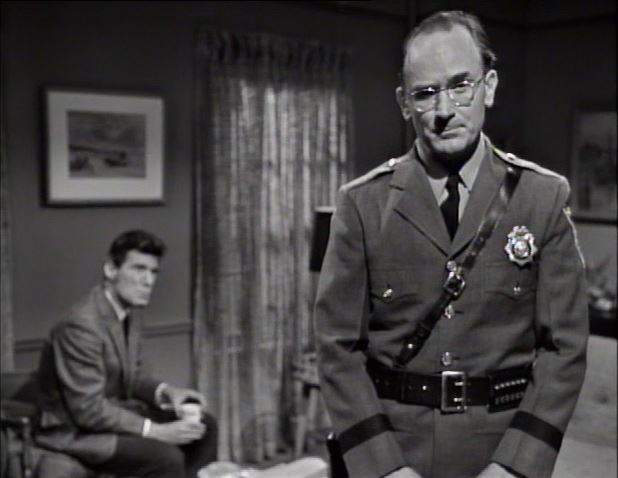
The videography is also as ambitious as we ever see it in this show. The camera tracks fluidly through the lobby, showing us more of that set than we see in any other episode, ending in a low angle shot of the sheriff that makes him look ominous. Some of those tracking shots are too much for Michael Currie, the actor playing the sheriff- during his scene alone with Burke, he bumps into one camera, stumbles into a piece of furniture, and then the other camera hits him in the back of the head. After that, he stands with his back to Burke and his elbows bent in front of him, looking for all the world like he is urinating on the floor:

Currie is so physically awkward that when Burke asks the sheriff the rhetorical question “Have you ever sat on a wrench?,” it seems to be a pretty near certainty that the answer is yes.

Currie has a rough time in this episode with his lines as well as with his movement. Perhaps the single funniest blooper comes when he declares that a good memory “is what I’m paid for,” then forgets his next line. It’s also interesting when he calls Burke “Burt.” Bloopers are after all one of the things Dark Shadows is known for, so we can’t be too annoyed with him for those. Worse is what happens when he does remember his lines. He intones them all as if he were leading the Pledge of Allegiance.

In the months after Mark Allen left the show, the standard of acting on it was remarkably high. Every actor other than Currie consistently turns in performances so strong that watching an episode feels like a fine evening at the theater. And bad as he is, even Currie doesn’t keep his scene partners from delivering good performances. He just wasn’t ready for professional acting. So I don’t have the same need to complain about him as about Allen, but he does deliver the series’ first laugh-out-loud moments of incompetence, and it is a relief when he is replaced.