Maggie Evans is working the counter in the restaurant at the Collinsport Inn. We open with her on the telephone, explaining to her father Sam that she hasn’t seen Bill Malloy. Dashing action hero Burke Devlin comes in, orders breakfast, and asks Maggie if she’s seen Bill Malloy. Hardworking young fisherman Joe Haskell comes in, scowls at his bête noire Devlin, and asks Maggie if she’s seen Bill Malloy. Flighty heiress Carolyn Stoddard comes in. Carolyn already knows that Maggie hasn’t seen Bill Malloy, so she talks about her car.
Maggie and Carolyn are both cheerful when the episode opens, and by the end the men have dragged them down into gloom. Joe is in a sour mood, not only because shares the universal worry about where Bill Malloy is, but also because of the steadily mounting evidence that Carolyn doesn’t have any intention of getting married. Burke is in a towering rage because of his suspicion that either the dastardly Roger Collins or the drunken Sam Evans did away with Bill Malloy to prevent Bill from clearing Burke of the manslaughter charge that long ago sent Burke to prison. Sam is wallowing in despair, as per usual.
Maggie goes home to the Evans cottage to find that Burke is there, confronting Sam. The two men have been yelling at each other about not knowing where Bill Malloy is. After Burke leaves, Maggie tries to get Sam to tell her what’s going on. He refuses to do so. Downcast, she turns to go back to work. Before she leaves she asks her father “Where are we all heading?” After she’s gone, Sam looks at the closed door and says “Towards death, Maggie darling. We’re all heading towards death.”
Carolyn goes home to the mansion at Collinwood with Joe. They start to hug and kiss when there’s a knock at the door. Carolyn answers. It’s Burke, demanding to speak to Roger. He wants some answers, mainly about where Bill Malloy is. Joe and Burke wait in the foyer while Carolyn searches the house for Roger.
Burke gives an angry and not very coherent speech denouncing the Collinses. Some commentators think the evident difficulty Mitch Ryan has with this speech is a sign that he was drunk during taping. Ryan did have a drinking problem, and admitted that in the 1960s he sometimes showed up to work drunk. But the speech itself is so awkward and weird that I suspect there is another culprit aside from alcohol- uncredited additional dialogue by Malcolm Marmorstein. Be that as it may, the speech rubs Joe the wrong way, and by the time Carolyn comes back and tells Burke that Roger isn’t home, Joe is in a worse mood than ever.
In these early months of the show, the Collinses are in danger of running out of money and losing their position. In yesterday’s episode, we learned that Roger blew his half of the inheritance and Liz drew heavily on hers to keep the business in the family; in this one, we learn that the house is a moldering ruin and the rest of the family’s assets are leveraged to the hilt. Burke plans to take his revenge in part by buying up their debts and making himself their master, which it appears he is in a position to do.
Burke and his investigator are at a table in a restaurant in Bangor when they discuss these matters. Carolyn has followed Burke to the restaurant. Burke spots her, invites her to his table, and sends the investigator away. Burke flirts with Carolyn as he makes sure she didn’t overhear any important information. He makes a show of his elaborately filigreed pen. When she admires it, he makes a gift of it to her.
The last time Carolyn made her way to Burke’s luncheon table, she played with her ring, called his attention to it, and left it behind as a deliberate stratagem to prompt him to call her. She seemed altogether unconcerned with the fact that the ring was a gift from Burke’s sworn enemy, her Uncle Roger, even after Burke indicated that he found it significant; and went ahead to keep an appointment to get the ring back from Burke even after Burke had given it to Roger and Roger had returned it to her. This strange obliviousness in all things having to do with Roger recalls the equally strange blitheness with which Carolyn told Vicki about her crush on her Uncle Roger when they first met “he sends me, he really does!”)
This time the object that passes from one to the other is another distinctive bit of metal associated with some important relationships. Burke tells Carolyn how few pens there are like it in the world, that he had them made to distinguish their bearers as key people in his life. When he makes the pen a gift to Carolyn, he implies that what he is giving her is not just a thing, but a new connection between them.
I made some remarks about these scenes in a comment on John and Christine Scoleri’s Dark Shadows Before I Die:
Carolyn comes to Burke’s table at one restaurant and leaves a special ring with him; she comes to his table at another restaurant and he gives a special pen to her. Even if the mid-60s weren’t the Age of Freud among intellectually ambitious people in the USA, the flirty tone of the two encounters would make it difficult not to see these tokens as body part symbols.
…As for the pen, it is going to become a more and more unmistakable phallic symbol over the next several weeks, leading us to wonder what the show is trying to tell us about the relationship between Burke and Roger and what was really going on between them before that accident ten years ago.
There’s also a scene between Sam and Liz. Yesterday’s episode ended with a big cliffhanger when Liz opened the doors and saw Sam waiting outside, suggesting that he is going to unburden himself of the secret he and Roger share. In true soap opera fashion, once the cliffhanger has brought the audience back to watch the next episode it has served its purpose. It is then to be got out of the way as quickly and anticlimactically as possible.
Today’s anticlimax sheds an unexpected light on Sam’s position. Sam’s extreme reluctance to tell his secret grew out of his assumption that whenever and wherever he started talking, he would find a hyper-attentive audience who would listen to his his every word and lose no time putting them into far-reaching and disastrous action. What he actually meets in Liz is personal dislike for him and impatience with anything he might want to say. Once Sam starts to talk about Roger, she assumes he has come to blackmail her with some sordid information about her no-good brother, and she makes it clear she will not be having it. Joe comes to the house, Liz mentions Bill, and Sam crumbles, his secret untold and unwanted. If the audience is expecting Sam to murdered, this result will add an extra touch of bathos to his plight- a man carrying a secret that spells his doom, but that does not attract the attention of a suitable listener.
Ray Stewart, later to gain a place in history as part of the gay couple on Barney Miller, appears in this episode as a featured extra. He’s the head-waiter in the restaurant in Bangor. Both the Dark Shadows wiki and his imdb page list his role as “Customer,” but here you see him telling the server which table to go to first:
Ray Stewart is still alive, maybe he should complain about his role being mislabeled. In all seriousness, I’d like to see him and other onetime background players on one of those panel discussions they used to have at Dark Shadows cons and now have on Zoom. I’d like to know what it was like being an extra on the show. And of course some of them went on to become big names.
Three people expressed surprise in episode 40 that Roger Collins wasn’t at his office. He still isn’t there today, and three more people are surprised. He finally decides to go in when Liz presents him with the alternative of looking for Carolyn.
Bill Malloy isn’t at work either, hasn’t been all day. He and Roger have been taking turns inviting themselves into Sam Evans’ house. Sam is also not working, and in fact takes time out of his busy schedule of downing one glass of whiskey after another to destroy the only thing we’ve seen him make as part of a paying job, a sketch of Burke. Maggie pieces the sketch back together- she’s also at home when she’s supposed to be working.
Telephones are unusually dynamic in this episode. Typically we see only one end of a phone call on Dark Shadows. This time, we cut back and forth between both ends of three telephone conversations this time. In the teaser Roger is browbeating Sam; Sam sets the phone down and walks off. While he gets another drink, the receiver is in the foreground and we hear Roger’s voice at the same volume as we did when Sam was listening. Sam comes back, returns the receiver to its cradle, and goes to sit down while it rings.
The bit when we see the phone and hear Roger’s voice, though Sam isn’t looking at the phone and can’t hear it, establishes the telephone as a character with its own relationship to the audience, independent of anyone who may or may not be paying attention to it. It’s a neat moment:
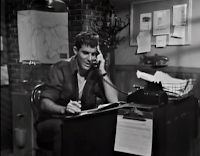
Liz calls the office and talks to Joe. Joe tells her Bill hasn’t been in all day. The stress in his voice, the papers piled on his desk, and the tight grip he has on the telephone receiver all make it credible that he’s the only person in town who showed up for work today:
Liz mainly wants to talk to Joe about Carolyn. Joe tells her he hasn’t talked to Carolyn in some time, and that he has no idea what if anything she is thinking about their relationship. While he breaks this news to Liz, we see him continue working, then cut back to the look of distress on Liz’ face.
Maggie calls Collinwood. Vicki answers and is excited to talk to Maggie. I guess the show is telling us they’re friends now. Maggie asks to talk to Roger. Vicki says Roger is probably in the office at this time of day, Maggie somehow knows he isn’t, Vicki remarks that he isn’t in the habit of confiding in her. Roger overhears this and asks “Is there any reason why I should confide in you?” When Vicki holds the receiver out to him and says Maggie Evans is on the line, he takes it and hangs up without so much as putting the receiver to his ear. Vicki and Roger then have one of their little quarrels.
That’s the only thing Vicki does in the episode. Her character is heading into a danger zone. Through the first eight weeks, she was on all the time. She was our representative, the outsider who knew nothing about the other characters or the town they live in, and to whom everything had to be explained. Now she knows as much about the rest of the characters as they know about each other, and we know as much as we want to learn by hearing explanations.
The major characters all have their secrets, but the only two who know each other’s secret are Roger and Sam. Vicki isn’t any likelier than anyone else to uncover that one. She has no secrets of her own, and her original story-line- her quest to discover her origins- is dead in the water. What’s more, Vicki is no good at lying. Soap operas are mostly conversation, and the big events on them are lies and the exposure of lies. The only time Vicki has tried to lie to anyone- in episode 13, when she told Matthew that Liz knew she was in his cottage- she was immediately found out, with disastrous consequences. If she’s going to stay relevant to the show, something is going to have to change, and fast. It’s fun to watch Alexandra Moltke Isles bicker with Louis Edmonds, but the characters they play need something meatier to bicker about.
This is the first episode credited to writer Francis Swann, indeed the first episode credited to anyone other than Art Wallace. Swann’s teleplay finds humor in the idea that so many people have taken the day off. Each time another character remarks on a case of absenteeism it gets that much closer to raising a chuckle. And Roger’s line that looking for Carolyn would require him to “neglect my vital tasks at the office… Dear me, no” is genuinely funny, especially as Louis Edmonds delivers it. The telephone scenes are also an innovation, and promise a new source of visual activity. Those favorable omens are offset by Vicki’s scene and its suggestion that her character is about to be allowed to wither on the vine.
A couple of the blogs I read when I prepare my comments made remarks about this episode with which I disagree. John Scoleri of Dark Shadows Before I Die says this of the quarrel between Sam and Maggie:
I know Sam gets frustrated with Maggie, but I’m beginning to wonder about their relationship. If he’s that close to hitting Maggie when he gets drunk, there’s no way I’m believing he hasn’t done that before.
It doesn’t look to me like Sam has hit Maggie. She’s inches from his face when he is at his angriest, yet she doesn’t flinch, doesn’t slump down, doesn’t show any sign of withdrawal or fear or anger or panic or sullenness or bewilderment or any other possible response to physical abuse.
There hasn’t been much happening on DARK SHADOWS in the last few weeks, but that doesn’t mean the show hasn’t been moving forward. There’s been a growing sense of doom throughout the show, and it’s obvious that someone is going to die. In this episode Sam rips up his portrait sketch of Burke Devlin, he and Roger lob threats at each other, Liz begins to draw Joe’s attention to his girlfriend’s romantic intentions on the family rival, and Victoria has been pushed around by just about everyone in the cast. In theory, any one of them is eligible for a ride in the bone wagon, but the show has been implying that Devlin is headed for a fall. It’s interesting that the show decides to go in another direction: I don’t know when Bill Malloy checks in at Eagle Hill Cemetery, but it’s probably sooner rather than later.
While it is true that “in theory, any one of them is eligible for a ride in the bone wagon,” I do think there’s a clear front-runner to be the first Dark Shadows character to be killed. It’s Sam who is obsessed with the fear of death, Sam whom Roger has threatened, Sam who left a mysterious sealed envelope to be opened in the event “something happens.” And, from an out-of-universe perspective, it’s Sam who has a daughter played by an appealing actress who needs a story-line. Maggie seeking revenge for the killing of her father would be just the plot to elevate Kathryn Leigh Scott from the bottom of the second string to the starting lineup where she so obviously belongs.
No other character has anyone so well-positioned to play avenger if they’re killed. The only keen attachment Bill Malloy has shown is his devotion to Liz, and in her scene with Matthew in episode 38 Liz demonstrated that she sees devotion from people outside the family as a tool to use when time comes to protect the good name of those inside it. So if she suspects Roger killed Bill, she won’t become Bill’s avenger- if she could order Matthew to throw away his own good name to cover up the truth about David, we can hardly expect her to expose Roger to redress Bill’s grievance against him. Indeed, when Bill is murdered, they will introduce an entirely new character to seek revenge for him.
Vicki is an orphan, who tells us in today’s opening narration that before she arrived at Collinwood she had never known a home. No one is likely to avenge her, and besides, she still does the opening narration for every episode- she’s supposed to be important, even if the writers can’t quite figure out what to do with her. Burke is supposed to be rich and powerful. Presumably he has friends, but we haven’t seen any of them. Joe is Mr Nice Guy and he’s mentioned a friend or two, but again, we haven’t seen them. The series story bible calls for Roger to die when Burke finally gets his revenge, but every time Louis Edmonds’ performance is the most interesting thing in an episode it becomes so much the less likely that they will ever get around to playing that scene. So the smart money, at this point, would be on Sam to be the victim in the first Dark Shadows murder. So much so, indeed, that it might not be surprising enough if it does happen- they may think they have to kill someone else to keep the audience engaged.
David Ford joins the cast as Sam Evans, replacing the woeful Mark Allen. Ford was always one of my favorites. He was one of the reasons I started watching the show when it was on the Sci-Fi channel in the 90s- I remembered him from one of my favorite movies, the musical 1776, where he plays John Hancock.
Marc Masse made a point in his Dark Shadows from the Beginning that I hadn’t thought of before. I’d always thought of Thayer David as the founder of the Dark Shadows house style of acting (“Go back to your grave!”) That isn’t wrong, as we will see when Thayer David joins the cast next week. But David Ford made a much bigger contribution than I realized. Several members of the cast, especially Louis Edmonds and Nancy Barrett,* tend to play their roles in a big, stagy manner, but Ford represents a step beyond them.
Masse writes:
To this point Dark Shadows has been written, directed, and acted solely as a vehicle for television.
Here in episode 35, the style of acting on Dark Shadows takes a theatrical turn with the debut of David Ford, who, with one grand and sweeping wave of the arm and eloquent turn of phrase, will single-handedly transform the acting approach from that of a standard television show to that of a teleplay:
“A façade, my dear boy!”
You have to wonder if that line was an ad lib; it fit in perfectly with the gesture, and thus far Art Wallace has never written with such a fanciful flourish.
Masse also gives some very interesting information about what Ford was doing when he landed the role of Sam Evans, information that points towards an approach to casting that will become a marked feature of the show in the years ahead:
In the year preceding Dark Shadows, Ford was performing on the Hartford Stage in a successful production of the Tennessee Williams play Cat on a Hot Tin Roof in the role of Big Daddy. That’s why when he first appears on Dark Shadows he has that half a beard type style, having fashioned his performance of Big Daddy after the one made famous in the 1958 motion picture adaptation, especially the way he scrunches up his eyes for the effect of dramatic intensity, giving it his best Burl Ives.
There is indeed a good deal of Burl Ives in today’s iteration of Sam, enough that we can assume that Ford was hired in part as a Burl Ives imitator. In future years, we’ll see Jonathan Frid, who looks like Bela Lugosi and walks and talks like Boris Karloff, playing a character who is a mashup of Lugosi’s Dracula and Karloff’s Imhotep.** And Jerry Lacy, who was most famous for his Humphrey Bogart imitation, and whose first role on the show was as a Bogart-inflected lawyer. And David Selby, who, if you listen to him with your eyes closed, you’d swear was Joseph Cotten. And Roger Davis, who Joan Bennett famously described as show business’ answer to the question “What would Henry Fonda be like if he had had no talent?” Ford is the first of that company of mimics, and among the best.
This is also the first episode where Carolyn and David have a scene together, rather odd considering we’ve had 34 episodes mostly set in the house where they are two of the five residents. Carolyn can’t stand the boy to start with, and in this one she’s just found out he tried to murder his father, her beloved uncle Roger. Besides, she’s in a bad mood because Joe called her up and told her he found Vicki in Burke’s hotel room. So they have a shoving match, she tells him he’s a monster, etc. Nancy Barrett and David Henesy ham these scenes up so grandly that it’s hard to imagine why they haven’t been on camera together before, it’s tremendous fun.
This is a bad episode for Alexandra Moltke Isles. Carolyn is nasty to Vicki about Burke, then apologizes and gets mad at herself, all while Vicki stands perfectly still with a smile plastered on her face. Vicki’s own lines are patronizing and inappropriate, starting with “Carolyn, you idiot” and going downhill from there. When Carolyn makes the painful admission that she has a tendency to grab for everything, Vicki delivers a smugly sanctimonious “That’s a good way to end up with nothing.” At the end of the episode, Vicki has a brief confrontation with David, which Mrs Isles plays well enough, but there isn’t much to it.
I think Mrs Isles’ technique was to start with the emotions the character was supposed to be feeling and to project those through whatever dialogue she is given. That’s served her well so far. Dark Shadows was her first professional acting job, and she fits right in with old pros like Joan Bennett and Broadway up-and-comers like Mitch Ryan. But she’s just awful in these scenes. My guess is that she couldn’t figure out what Vicki was feeling or thinking, since no one would do or say the things she does or says in today’s show, and so she just tried to stay out of Nancy Barrett’s way. Or maybe she read the script, thought Vicki was being an ass, and decided to play the character in the most asinine way possible. Either way, I winced to see it.
*Both natives of Louisiana. I doubt that means anything, but as the series goes on and gradually loses all interest in creating an illusion of being Down East someplace near Bar Harbor, I get more and more interested in the geographical origins of the actors. I’ll try to confine that topic to footnotes for the next three years, but when we hear David Selby’s voice we’re going to talk about the idea of a New England Brahmin with a West Virginia accent.
**Imhotep is the title character from The Mummy. Originally I was going to say that Frid moves and sounds “like Boris Karloff’s Mummy,” but that rather overstates the feminine side of his role.
In episode 18, Roger (Louis Edmonds) had demanded Vicki (Alexandra Moltke Isles) come with him to Burke’s hotel room, where they will tell Burke (Mitch Ryan) about all the evidence they have connecting him to Roger’s car wreck. Vicki repeatedly protests in that episode that it would be better to take this information to the police. In this one, they arrive at the hotel, and again Vicki objects that they really should be going to the police. Roger, however, is a man obsessed. He asks Vicki to wait in the restaurant while he goes to Burke’s room, telling her that it may not be necessary for her to join him.
Sam (Mark Allen) comes to the restaurant looking for his daughter Maggie. Finding that Maggie isn’t at work, he invites himself to Vicki’s table. Their previous encounter had been a strange and frightening one on the top of Widow’s Hill; Vicki is no more comfortable with Sam now than she had been then. He bellows at her, she reacts with quietly frosty disdain. These attitudes may have less to do with the script or the direction than with Mark Allen’s limitations as an actor; he bellows all of his lines in this episode, and quiet frostiness is as effective a technique as any other for holding onto the audience while sharing a scene with an incompetent loudmouth.
There’s no incompetence in the scenes in Burke’s room. Louis Edmonds and Mitch Ryan were first-rate stage actors, and their confrontation is a terrific fireworks display. When Roger brings Vicki up to tell Burke what she saw him do in the garage, she again plays the scene quietly, an effective counterpoint to the artillery blasts the men have been letting loose.
In the Evans cottage, Sam finds that Maggie (Kathryn Leigh Scott) has been home all this time. When Allen bellows at her, Scott bellows back at him, a far less effective tactic than the quiet intensity Mrs Isles had used earlier. The scene has some potential- the situation is that an alcoholic finds that his adult daughter has been checking up on him, he resents it, and they have a fight about all of the ways in which she has been forced to take on the parental role in their relationship. But as a shouting match, it might as well be about anything, or about nothing.
Returning home after their confrontation with Devlin, Roger and Vicki say goodnight in the foyer. Time and again in these early episodes, people have urged Vicki to leave Collinsport while she still can. Even in this episode, Burke had told her that. But as they part ways for the night, Vicki to her bedroom and Roger to the brandy bottle, Roger tells her that as a witness, “you can’t leave now.”
That line is effective enough, but if the scene between Sam and Maggie had worked it would have been very powerful. The Evanses, father and daughter, are a case of two people who are trapped, trapped in Collinsport, trapped with each other, trapped with his alcoholism and her sense of obligation to keep him alive. As written, the scene could have brought all that out, and induced a claustrophobic sense in the audience that would have made Roger’s line feel like a death sentence. As ruined by Mark Allen, it just leaves us with the sense that we’re watching a show that needs some recasting.
Roger and Vicki encounter each other on the peak of Widow’s Hill. Roger remarks it is the highest point in the area. At the end of their conversation, Vicki will call to Carolyn, inviting her to join them “down here.” This may seem to be a blooper, but since we hear “down” used to mean “up” in a later episode, I speculate that it’s a peculiarity of Collinsport English.
Little happens to advance the plot in this episode, but between Roger’s announcement that he and Vicki are standing on the highest point in the area and Vicki’s invitation to come “down here,” we hear a lot about the ghostly legends of the place. After the scene in episode 11 where the ghosts are troubling Elizabeth while David is doing something mysterious involving motor grease and little pieces of metal, it seems that the show is using the ghosts as a sign that something big is happening. Certainly the “Widow’s Wail” is a striking sound effect, and Louis Edmonds does a good job of selling the idea that Roger really does believe in all the legends about the house that his social position might require him and Elizabeth to ridicule publicly.
It’s a bit jarring that Carolyn drifts into the scene asking what Vicki and Roger are doing- “planning a suicide pact?” She had just told Vicki about the legend that a third governess would die by jumping off the cliff, and the series story bible still calls for Roger to throw himself to his death from it. So you might think it would be in questionable taste to bring that particular topic up just now.
There’s also a scene in the Evans cottage where Maggie (Kathryn Leigh Scott) tries to get Sam (Mark Allen) to tell her what’s been bothering him. In episode 11, Conrad Bain had triumphed over a weak script and Mark Allen’s relentless whine to turn what might have been a lot of tedious recapping into a compulsively watchable scene. At the beginning of this scene, Kathryn Leigh Scott is mustering such powerful emotions that it looks like she might be about to accomplish the same feat, but Allen has switched from whining all his lines to bellowing them. So the scene is a dead loss.
One of the great challenges of writing a serial is fitting enough recap of previous story points into each installment that new viewers can catch up without putting so much in that you bore the regulars. A time will come when Dark Shadows gives up recapping altogether, but in these early weeks they are scrupulous about soapcraft.
In episode 11, much of the recapping takes place in a scene between innkeeper Mr Wells (Conrad Bain) and drunken artist Sam Evans (Mark Allen.) The story justification for Mr Wells telling Sam everything the audience might need to know about Burke Devlin and the Collinses is that Sam’s daughter Maggie, who runs the restaurant in the inn, is about to return to work, and Mr Wells doesn’t want her to see her father drunk. He knows that as long as Sam thinks he might have something new to tell him about Burke, he will sit there and drink coffee.
The scene between Mr Wells and Sam is an example of something that becomes ever more important to Dark Shadows as it goes on: good acting trumping not-so-good writing. And good acting trumping bad acting- while Mark Allen is the worst actor on the show, Conrad Bain is phenomenally good. He single-handedly takes what must have looked in the script to be a terribly dull scene and makes it completely absorbing. I can imagine a show entirely composed of him looking into the camera and telling stories, and that show would be great. No wonder he went on to have such a big career in television!




 Dark Shadows Commentary