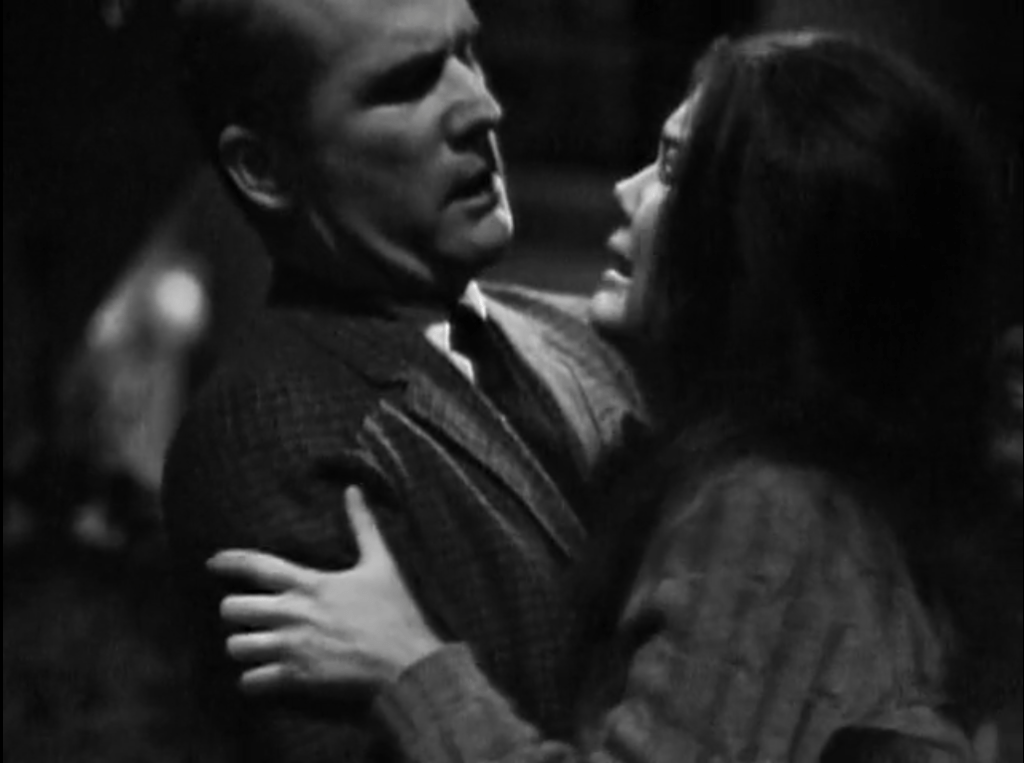
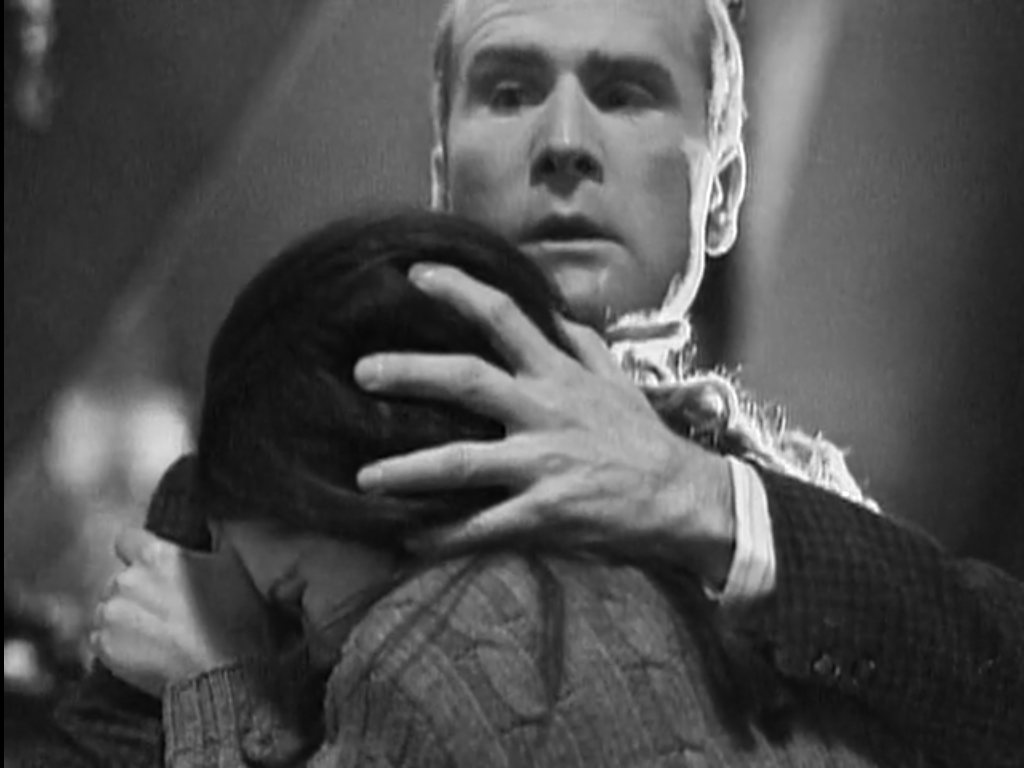
Episode 586: The way my life has turned out

Some very big problems with this one. Danny Horn goes into detail about three of them in his post about the episode on Dark Shadows Every Day, and I have further complaints.

Friday’s episode ended with Frankenstein’s monster Adam in the act of strangling well-meaning governess Vicki as she lies in her bed at the great house on the estate of Collinwood. In today’s opening Adam goes on throttling Vicki for quite a while. At length heiress Carolyn and recovering vampire Barnabas mosey into Vicki’s room. Adam is long gone, and Vicki is still alive. Permanent houseguest Julia is a doctor, and we hear a report of her prognosis that Vicki will be all right. Carolyn has been hiding Adam in a spare room; suave warlock Nicholas shows up and does some damage control. He suggests to Carolyn that Adam might not be guilty of the attempted strangulation, then goes to Adam’s room to talk with him while they wait for Carolyn to come. By the time she gets there, Adam and Nicholas have their story straight. Carolyn accepts Adam’s denials. At that point, everyone loses interest in Vicki and what happened to her.

Nicholas had put Adam up to demanding that Barnabas and Julia build him a mate. Adam had threatened to kill Vicki if they did not comply. Yesterday, he concluded that they were not taking him seriously, and that was his motive for the murder attempt. At the end of today’s episode, Barnabas goes back home to the Old House on the estate and finds Adam waiting for him. Adam tells Barnabas that he has decided they should use Carolyn as the donor of the “life force” that will bring the mate to life.

Adam’s attack on Vicki was Friday’s week-ending cliffhanger. It might have generated substantial suspense, as it has been so long since Vicki has had much to do on the show that it is possible we might be seeing the last of her. But, as Danny points out, they botch the scene badly:

I mean, there is obviously no way that she could have survived this attack. Adam is an enormous Frankenstein creature; it’s been established that he can bend steel bars just by giving them a stern look. Even for a soap heroine, there’s no way that Vicki could maintain structural integrity under these circumstances. She’s just not built for it.

It’s quite a grisly little scene, actually, because it happens so quickly. She doesn’t really get a chance to react. She was sleeping, and then Adam put his hands around her neck, and now she’s dead, and she doesn’t even know what’s going on…

By the time Carolyn returns to the scene of the crime, Julia’s already been and gone — the invisible off-screen soap doctor who doesn’t actually appear in this episode.

Barnabas tells Carolyn that Vicki’s alive, but she’s in shock. I am too, actually; our lame Frankenstein monster can’t even kill a governess at point-blank range.

Danny Horn, “Episode 586: The Invisible Woman,” posted 17 February 2015 on Dark Shadows Every Day.

Danny revisits this point later in his post:

Problem number one is the lack of consequences. They actually opened the week with the murder of a main character — and ten minutes later, everyone’s back to starting positions. Vicki’s not dead, and Adam’s not even being blamed for the assault.

Now, I’m not complaining that Adam hurt somebody and isn’t expressing any noticeable remorse. It’s true that today’s felony places Adam squarely in the villain column, but that’s fine. Fantasy-adventure stories need villains, and villains are supposed to do villainous things.

The consequences issue is that Adam basically just killed Vicki, and it hardly even registers as a plot point. There’s no investigation, no confession, and no character development; it’s just a thing that happened, and we can all forget about it.

Danny Horn, “Episode 586: The Invisible Woman,” posted 17 February 2015 on Dark Shadows Every Day.

Adam’s threat to kill Vicki never seemed to fit with his personality, but considering that he accidentally killed his friend Sam because he didn’t know his own strength, we could at least imagine that he might inadvertently carry it through. And as Danny says, the brevity and simplicity of the scene add to its force if we think it might actually show Vicki’s death. She was the show’s protagonist for its first 38 weeks and an important part of it for a long time after, and for her life to end so abruptly that she doesn’t even have a chance to scream, for the sake of a plot point that isn’t even her killer’s own idea, would be shocking in the pointless, unsatisfying way that violent deaths are shocking in real life. But if Adam can shake Vicki by the neck from the opening teaser through the first scene without seriously injuring her, he clearly isn’t going to kill anyone, and Barnabas and Julia may as well go off and do something else.

Nicholas is Dark Shadows’ main villain at this point; he is supposed to seem so powerful that we can’t imagine how the other characters will overcome him, and so wicked that we will forgive them for any expedient they can find that will work against him. This is currently the show’s main source of suspense. As Danny explains, they do serious damage to that today:

Nicholas is supposed to be the real mastermind behind this operation, so Adam still ends up reduced to being the dumb muscle, rather than a strategic thinker.

Unfortunately, Nicholas’ management skills are also kind of questionable at the moment. We see him scolding Adam for trying to kill Vicki, but where has Nicholas been for the last couple weeks?

It’s up to Adam to fill Nicholas in on the latest plot development — that Barnabas has chosen Maggie to be the sacrificial victim in their Bride of Frankenstein mad science experiment, giving her “life force” so Adam’s new mate can live.

Nicholas has a crush on Maggie, so he’s furious about this, but it’s a hollow moment. If Nicholas is the manipulative wizard running the show, then he should have known that they spent a good chunk of last week discussing this.

Dude, you have a magic mirror that can show you anything that’s going on at the Old House. You should have been on top of this. It’s just irresponsible.

Danny Horn, “Episode 586: The Invisible Woman,” posted 17 February 2015 on Dark Shadows Every Day.

A third major flaw with the episode comes with Carolyn’s role. Danny explains:

I know that it’s odd to say, “This storyline about creating a female love-slave for a violent psychopath isn’t particularly strong on women’s issues,” but Dark Shadows isn’t just a fantasy-adventure story, where you can marginalize all the female characters and move on to the car chase. It’s also a soap opera, and soap operas are supposed to be about women, and women-related subjects like feelings and consequences.

But here we are, watching an episode of daytime television that begins with strangling a woman who doesn’t struggle or even cry out, and then the rest of the time is mostly Carolyn talking to a series of men who lie to her and boss her around.

This is a real problem, and it’s going to come up again. The Bride of Frankenstein story has turned into a reverse beauty pageant, where the guys get together and argue about which woman they’re going to sacrifice on the altar of mad science. This hot potato is going to be tossed around between Carolyn, Vicki and Maggie all week.

Julia is the one female character in the story who actually has agency of her own, but she’s kind of sidelined too — mostly just turning the knobs and flipping the switches while the guys decide whose life force they’re going to extract. The fact that they can have this whole episode with Julia off-camera pretty much says everything.

Danny Horn, “Episode 586: The Invisible Woman,” posted 17 February 2015 on Dark Shadows Every Day.

Danny goes so far as to say that the gullibility Carolyn has to display when Adam and Nicholas lie to her “actually threatens to break the show,” and he is right. The failure to take female characters seriously not only disrespects the show’s core demographic, but specifically makes it harder to tell a suspenseful story. We can see why when Carolyn asks Barnabas why he believes Adam attacked Vicki. At this point Barnabas knows that Carolyn is hiding Adam, and he believes that Carolyn, like everyone else in the great house, is in danger from him. He therefore has every reason to confide in her, and since she can’t go to the police, no reason to hold back even the parts of the story that would incriminate him. But he flatly refuses to tell her anything at all. Ever since March 1967, the rule on Dark Shadows has been that only the villains are allowed to know what is going on. That cramps the action seriously, and when they add further restrictions on who can participate, it limits the possible outcomes of any situation so severely that it becomes all too predictable.

The scene in which Barnabas refuses to tell Carolyn what he knows brings up yet a fourth problem, one Danny does not mention. Barnabas takes such an indefensible position that he winds up seeming ridiculously weak. The main villain already looks weak, so when the principal protagonist does too, we have little reason to hope for an exciting story.

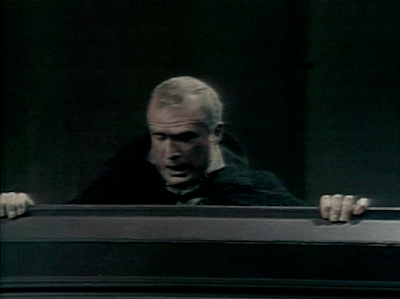
What keeps this episode from the “Stinkers” bin is Robert Rodan’s performance as Adam. In his early days, when Adam knew only a few words, Rodan managed to play on our sympathies, but had little opportunity to do more. Now the character speaks fluently and the actor delivers his lines with remarkable precision. Danny calls it a blooper when, during the three-scene in Adam’s room, Nicholas tells Carolyn that Adam is growing used to being blamed, and he responds by shouting all but the last word of “I am not used to… it.” I disagree. The dropping of his voice shows that there is a great deal Adam is not used to and does not plan to get used to, more than he can put into words.

The final scene in Barnabas’ house is also a fine turn for Rodan. Barnabas finds Adam waiting for him in his front parlor. We had seen Adam there in his first weeks as an inarticulate, raging creature; now he is well-spoken and very much in control of himself as he presents Barnabas with an impossible demand implicitly backed by a horrifying ultimatum. The contrast is chilling. I particularly relished Rodan’s rendering of this little speech:

Barnabas, please sit down.

When I first knew you,

I never thought I could be the gentleman that you are.

You are a very imposing man, Barnabas.

I still find it difficult not to be frightened by your manner.

Adam does not make threats in this scene; he creates a frightening situation simply by the imperturbable calm with which he issues his commands. It is Rodan’s finest moment so far.

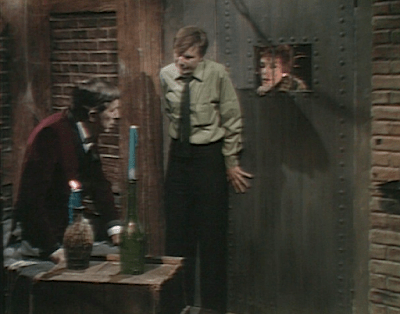
Adam states his requirements. Screenshot by Dark Shadows Before I Die.

Closing Miscellany

Nicholas tells Carolyn that he is concerned about what happens on the estate of Collinwood since “I live here too.” When he first moved into the house he now rents from the Collins family, it was on the other side of the village of Collinsport from their home. A week or two ago, the opening voiceover referred to it as “another house on the estate,” and we’ve been hearing people around Collinwood refer to it as “very near.” So that’s a retcon. Since Adam has been coming and going between Collinwood and Nicholas’ house without being seen, I suppose it is a logical one, but it does make you wonder what they were thinking when they originally made it so clear it was some distance away.

Barnabas asks Carolyn if there is a way into Vicki’s room than her locked door. He knows very well that there is, since he himself used a secret passage to get into that room twice when Dark Shadows was a costume drama set in the 1790s and the gracious Josette slept there.

Episode 548: Too much a part of him

Wicked witch Angelique defied her supervisor, suave warlock Nicholas, one too many times. Yesterday, Nicholas stripped Angelique of her powers, including her immunity to aging. Since she is 194 years old, this leaves her with a sharply limited future.

Today, Nicholas tells Angelique he will think of sparing her from her imminent demise if she can persuade recovering vampire Barnabas to forgive her for her extreme abuse of him and of everyone he has ever cared about. She goes to Barnabas and begs him for forgiveness. Barnabas replies that when he asked her for forgiveness, she responded by turning him into a vampire. He does show signs of concern for her, but cannot pardon everything she has done. He specifically mentions The Dream Curse, a three month storyline that not only brought great suffering to him and a dozen other characters, but which also made the audience miserable. She dies.

Angelique begs Barnabas for forgiveness. Screenshot by Dark Shadows Before I Die.

Nicholas’ only acknowledged motivation to this point has been a selfless devotion to evil for its own sake. That makes it odd that he would place a value on forgiveness. Dark Shadows is pervaded with ghost stories, and ghost stories are, first and foremost, explanations of how unresolved conflicts in the past can poison relationships among people in the present. It is also a soap opera, and the biggest events in soaps are changes in the way particular characters feel about each other. So both genres tend to elevate forgiveness, not only as a virtue, but as the highest form of The Good in human life. We saw this in the first year of the show, when well-meaning governess Vicki kept forgiving strange and troubled boy David for his attempts to kill her, acts of forgiveness which culminated in #191 when David ran from the mother who was trying to lure him to his own death into Vicki’s arms and an acceptance of life. Two weeks later, in #201, dashing action hero Burke closed another narrative thread left over from episode #1 when he forgave sarcastic dandy Roger for an old grievance he had against him. With those events, it was pardoning that cleared the flotsam left over from Dark Shadows 1.0, paving the way for the introduction of Barnabas and the advent of Dark Shadows 2.0.

Perhaps Nicholas was so certain Barnabas would not be able to bring himself to forgive Angelique in the time available before her death that making her beg for forgiveness was his way of perverting the world’s best thing into yet another instrument of cruelty. Certainly he suggests this interpretation when he introduces the idea with a laugh and a comment that he might find it “amusing.”

When Nicholas stands over Angelique’s corpse, he tells her that her own hatred had made it impossible for Barnabas to forgive her because it had “become too much a part of him.” That Angelique’s hatred became a part of Barnabas rings a bell for longtime viewers. The show has always depicted supernatural beings, not as self-contained individuals, but as complexes of phenomena that operate more or less independently, often without each other’s knowledge, sometimes in pursuit of mutually exclusive goals. For example, in 1967 the ghost of Barnabas’ little sister Sarah visited David during the day and tried to prevent him finding out Barnabas was a vampire, but she also appeared to David in a dream and showed him everything the daytime ghost wanted to keep hidden. When David told the Sarah of the waking hours what her dream visitation form had shown him, she was horrified and forbade him from following up on any of that information.

When Angelique places a curse, she sometimes seems to create a little version of herself, give it possession of the person she is targeting, and turn it loose in the world. Sometimes that little Angelique turns against her. For example, she raised the body of Barnabas’ uncle Jeremiah from the dead to use for her own nefarious purposes, only to find that it would not return to its grave when she was finished with it. When Barnabas was a vampire, he had some obsessions that were strikingly similar to obsessions Angelique had shown. So Angelique wanted Barnabas to love her, and had the power to cast a spell that would make him do so, but instead wrought immense havoc on everyone else with one wild scheme after another, because she wanted him to come to her “of his own will.” Likewise the vampire Barnabas wanted to make Vicki his victim, but passed up one opportunity after another to bite her because he wanted her to come to him “of her own will.” That similarity is so close that it makes us wonder if the Barnabas we first met was simply Angelique in disguise. Not only her hatred, but all of her quirks had become part of him.

Angelique came from the 1790s to 1968 by some magical process that involved a portrait of her that is now on a stand in Vicki’s room. Today she uses a secret panel to let herself into the room and look at the portrait. We first saw that panel open when the show was a costume drama set in the 1790s. The room was occupied then by gracious lady Josette, and it was the vampire Barnabas who used the panel to enter. We haven’t seen the panel since, leaving it strongly associated with Barnabas in the minds of regular viewers. Angelique’s use of it today further suggests her identity with him when he is in his vampire state.

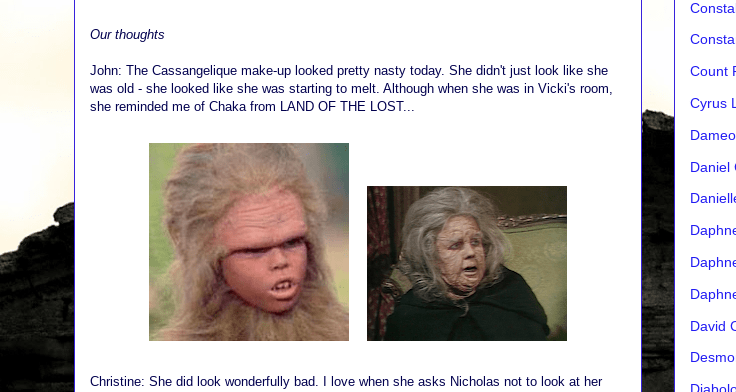
In their post about the episode on Dark Shadows Before I Die, John and Christine Scoleri find a resemblance between Angelique’s old age makeup and another TV character:

Captured from Dark Shadows Before I Die.

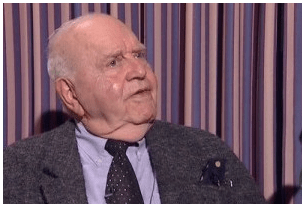
But look at Angelique’s creator, writer Sam Hall. She came by her looks honestly:

Episode 423: A position to threaten me

The gracious Josette, recently ill, has disappeared from her bedroom in the great house of Collinwood. She did not exit through the door to the hallway, nor did she climb out the window. Josette’s aunt, the Countess DuPrés, asks the master of the house, haughty tyrant Joshua Collins, how her niece could have got out. Joshua says there is a secret passage, but he cannot imagine how Josette would know about it. He did not tell her, and the only other people who knew of its existence were his brother Jeremiah and his son Barnabas, both of whom are dead. Since Josette was engaged to Barnabas for a time and was later married to Jeremiah, perhaps one of them might have mentioned the passage to her, but this possibility does not occur to Joshua.

Everyone in the house becomes involved in a search for Josette. That includes untrustworthy naval officer Nathan Forbes, Nathan’s fiancée Millicent Collins, and Nathan’s wife Suki. Millicent does not know that Suki is Nathan’s wife. Suki introduced herself to the Collinses as his sister, and is content to go on masquerading as such so long as there is a prospect Nathan will pass along a great chunk of Millicent’s vast inheritance to her. Nathan did not expect Suki to turn up, and she has been making him extremely uncomfortable for the last couple of days. It has been magnificent to watch.

Nathan and Suki need to have a conference about some topics they cannot possibly discuss in a house where they might be overheard. It occurs to him that no one is living in the Old House on the estate. He tells Suki to wait for him there.

Nathan is not entirely wrong when he says that “there is no one living” in the Old House. However, there is one among those who are not living who is not simply dead. That is Barnabas, who has become a vampire. Suki enters the house and meets him.

Barnabas demands to know who Suki is. When she introduces herself as Suki Forbes, sister of Nathan, he soon declares “You are not his sister, you are his wife! Don’t bother to deny it.” He tells her that Nathan has no sister, therefore she could only be his wife.

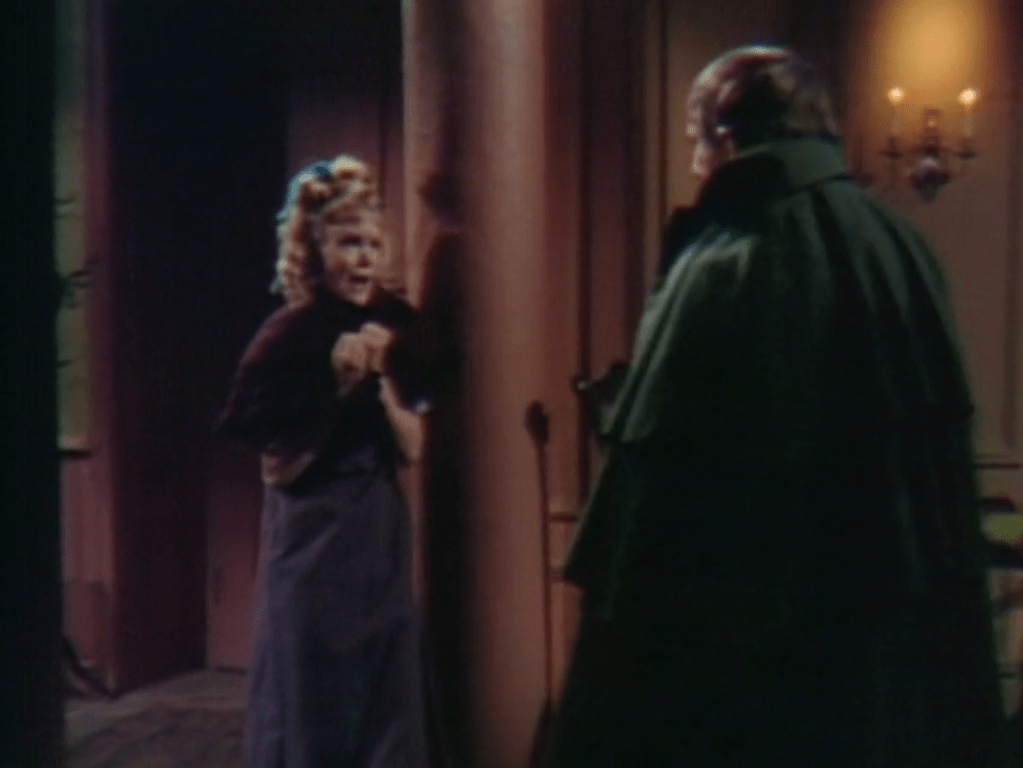
Suki plays the innocent.

This conclusion is more impressive the more you think about it. Before Barnabas died, he and Nathan were friends, so it is reasonable that he would know Nathan has no sister. Suki is not carrying a bag or riding a horse or wearing strong boots, so she must be staying at the great house. She gives her name as Forbes, so she must be staying there as a connection of Nathan’s. Granted that she is lying about being his sister, the true nature of that connection must be something she and Nathan want to conceal from the Collinses. Barnabas knows that Nathan has persuaded Millicent to marry him, prospectively raising him from the genteel poverty of life on a junior naval officer’s salary to the great wealth of the New York branch of the Collins family. So the secret relationship must be one that would deny him that glittering prize. Suki, indeed, must be Nathan’s wife. It is a brilliantly logical inference, which makes it inexplicable that Barnabas draws it. He is a character who does smart things sometimes, foolish things frequently, but he has never before shown any great aptitude for sequential reasoning. Nonetheless, it is a wonderful moment. Wonderful moments multiply when Suki is around.

Suki is one of the most quick-witted and daring characters on the show. She recovers from the initial shock after a second or two and asks Barnabas what it is to him if she is Nathan’s wife. He speaks in his usual menacing way, and she tells him he is in no position to make threats. She recognizes Barnabas from the portrait of him that hangs in the great house. She realizes that the official story, the tale Joshua put about that Barnabas has gone to England, must be the cover for some shameful secret, and she sets about crafting a blackmail demand as her price for keeping that secret.

Suki thinks she has Barnabas over a barrel.

Suki finds Josette’s cloak on a chair. She realizes that Josette is in the house with Barnabas, and we see her thinking up new and higher blackmail demands.

Suki makes a discovery.

While Suki is involved with the cloak, Barnabas dematerializes. Bewildered, she looks for him in the parlor, then goes outside. A bat frightens her.

Suki frightened.

Suki retreats into the house. She melts down and starts sobbing with fear.

Suki reaches her breaking point.

The bat reappears in the room. It hovers near the lens of the camera, then gives way to Barnabas, one of the best efforts they have made at showing Barnabas change form. Suki tells him she can’t believe what she is seeing.

Suki cannot believe her eyes.

Suki brings out the best in the writing staff, driving them to show each character doing whatever it is they do that makes the biggest contribution to the show. Unfortunately, Barnabas makes his biggest contribution when he murders people. So he winds up strangling Suki at the end of this episode. It is a terrible shame that a character as dynamic as Suki is only on Dark Shadows for a few days.

So long, Suki.

It is also a shame that Jane Draper doesn’t come back to play another part in one of the segments of Dark Shadows set in a period other than the late 18th century. Perhaps the makers of the show thought that in Nancy Barrett, who plays Millicent in the 18th century segment, Carolyn Collins Stoddard in the 1960s segments, and many other characters in segments we will see later, the show already had a tiny blonde actress with a wide range and a forceful style. Her similarities to Miss Barrett may have prompted the producers to cast Ms Draper as Millicent’s rival/ would-be exploiter/ mocking Doppelgänger. Miss Barrett’s other characters tend to be very different from Millicent. They are given to abrupt psychological reverses, alternating between acute self-consciousness and fierce self-loathing and between irritable distrust and complete emotional dependence. Her characters are usually their own mocking Doppelgänger, so that there was no need to cast another actress to play such a part. But Ms Draper is so very good as Suki that there can be little doubt she would have been able to handle any role they threw her way.

Episode 422: Never gave you love

Yesterday, 5 February 1796, the Countess DuPrés visited suspected witch Victoria Winters in the Collinsport gaol. The countess begged Vicki to lift the spell that she believes to be causing her niece, the gracious Josette, to behave strangely. Vicki responded that she had cast no spell on Josette or anyone else. She claimed that she was not a witch at all, but an unwilling and well-meaning time traveler displaced from the year 1968. As it happens, this is true.

Vicki told the countess that according to the history and legend she learned in the 1960s, Josette will soon die. The last events leading to her death will be triggered when she loses a ring with a black onyx stone. Vicki’s remarks settled any lingering doubts the countess may have. She is now certain that Vicki is a witch, and that when she claims to be warning people against upcoming dangers she is in fact taunting them with her own cruel plans.

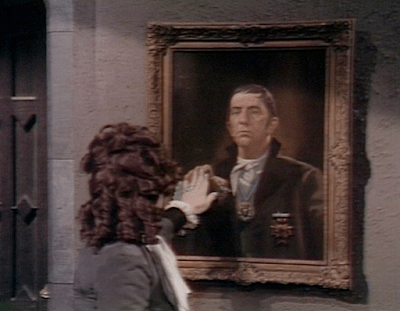
In Josette’s room, the countess discovers that Josette has somehow come into possession of just such a ring as Vicki described. Josette refuses to tell her where it came from. Later, the countess stands in the foyer of the great house of Collinwood, studying the portrait of the late Barnabas Collins that hangs there. She recognizes Josette’s new ring as the one in the portrait. Well might she recognize it- she knew Barnabas well, he died only a couple of weeks before, and he wore the ring all the time. He and Josette had been engaged to marry each other, and never gave up their passionate attachment even after they married other people. It is hard to think of a reason why the countess would not have thought of Barnabas at the moment Vicki began describing the ring, much less as soon as she saw it on Josette’s finger.

The countess studies the portrait of Barnabas. Screenshot by Dark Shadows Before I Die.

Barnabas’ father, haughty overlord Joshua, asks the countess what she finds so interesting about the portrait. She asks if the ring was part of a set; he answers that it was unique. He begins to reminisce about Barnabas’ great fondness for the ring. His warm look of recollection gives way to an expression of deep pain, and he stops himself as he is about to say that he left it on Barnabas’ finger when he buried him. He refuses to say any more about Barnabas.

The countess and Joshua do not like each other very much, but they are of one mind about Vicki. It is inexplicable that the countess does not tell Joshua about Vicki’s prediction and about the fact that Josette now has Barnabas’ ring. Her reticence sets up a dramatic moment, when Josette comes downstairs, faints, and Joshua finds the ring on her finger. But that moment would only have been more dramatic if it had also been the first time the countess saw Josette with the ring. Vicki’s description of a ring should have been more than enough to prompt her to study the portrait and ask Joshua about Barnabas’ ring, but perhaps not enough to embolden her to say much to Joshua. The scene in Josette’s room makes a hash of the countess’ motivations here, and leaves Joshua’s discovery of the ring as a pointless repetition.

Joshua goes to Barnabas’ coffin, hidden in a secret chamber of the family mausoleum. He talks to Barnabas for a while. He admits that he was a cold and distant father, but vows to take a terrible revenge on anyone who might have disturbed his rest. He opens the coffin and finds that it is empty. His shock is chiefly to do with the disappearance of the body, but can only be sharpened when he realizes that instead of delivering his heartfelt confession to his son’s corpse he was in the somewhat ridiculous position of delivering it to a piece of furniture. This is a characteristic situation for Joshua- when he is ready to open up about his feelings, he finds that no one is there who can even appear to be listening.

He ain’t got no body. Screenshot by Dark Shadows Before I Die.

Returning viewers know that no one robbed Barnabas’ grave. He has become a vampire. He gave Josette the ring himself, after biting her and telling her she would become his undead bride. All of this has been concealed from Joshua, the countess, and Vicki. Barnabas shows up today and has a forgettable scene with Josette. They get involved with the secret passage leading out of her bedroom.

Josette’s room will be Vicki’s in the 1960s, when she is the governess at Collinwood, and we saw in #412 that she knows about the secret passage. There is one other thing you would expect Vicki to have known. Barnabas returned to prey upon the living in April of 1967; Vicki knew him from then until she came unstuck in time in November of that year, though she thought he was alive. He wore the ring with the black onyx stone all the time in 1967, just as he did in 1795. Vicki was familiar with the portrait, which still hung there in her time. She believed its subject to be the ancestor of her acquaintance, knew that it was the same ring, and knew that the “original” Barnabas had been Josette’s lover. So if Vicki read a book or heard a legend that described the ring in connection with Josette, you would think she would have put one and one together and come up with two.

Episode 412: The book

For the first 39 weeks of Dark Shadows, well-meaning governess Vicki was the main protagonist. Her understated, sometimes diffident manner fit with the pace and themes of the show in that period. When the show introduced its first supernatural villain, undead fire witch Laura Murdoch Collins, Vicki rose to the occasion and led the opposition to her. When Laura went up in smoke, the last of the themes that made Vicki a suitable lead went with her. Vicki remained our chief point-of-view character for some time after that, but she didn’t find much footing in any of the stories. She receded steadily from center stage for months.

In November 1967, Vicki came unstuck in time and found herself in the year 1795. At first this seemed to be an opportunity for a reset, but Vicki wound up being written in the time-travel story as a complete moron. She kept yelling at the other characters that they were being played by actors who had other parts in the first 73 weeks of the show, refused to take advice from people who tried to explain how she could fit in with her new surroundings, and insistently held onto possessions that eighteenth century people would take as evidence that she was evil. Now she finds herself in gaol, accused of witchcraft and facing a possible death sentence.

The other day, the gracious Josette visited Vicki in gaol and begged her to lift the spell that had brought a terminal illness on the gallant Barnabas Collins. Unable to persuade Josette that she was not a witch, Vicki told her that she had come from the future and brought with her a book about the history of the Collins family printed in the twentieth century. She told Josette where to find this book. When she did find it, Josette was more convinced than ever that Vicki was the witch.

Now, Barnabas has died. Josette visits Vicki again, and vows to do whatever she can to see that she is hanged. Josette is so distraught over Barnabas’ death that she quite calmly says she may want to take her own life soon, but she does look forward fondly to testifying against Vicki and seeing her execution.

Josette takes consolation in the idea that she will help get Vicki sentenced to death. Screenshot by Dark Shadows Before I Die.

After Josette leaves, Vicki asks her gaoler/ defense attorney/ prospective boyfriend Peter to sneak her out of the gaol. She wants to go to Collinwood and steal the book back.

Evidently Peter is no brighter than Vicki, because he agrees to this plan. Vicki goes to Josette’s bedroom. As we might have expected, Vicki is seen in the room- Josette’s aunt, the Countess DuPrés, opens the door and finds her with the book in her hands. By the time the countess returns with Josette and the witch-hunting Rev’d Trask, Vicki and the book are gone. This will be Vicki’s own bedroom in 1967, and she knows of a secret passage leading out of it. The other three do not know of this passage, and no one in 1795 knows of any reason Vicki would be aware of it. So far as they know, she has appeared and disappeared by magic.

Back in the gaol, Peter locks Vicki in her cell and hides the book in his desk. Trask and the ladies knock on the door and demand to see Vicki. Peter swears that she has been in her cell all night. Josette is concerned that they no longer have the book, but Trask says they don’t need it- only a witch can be in two places at once. Peter’s statement will suffice to put Vicki’s neck in the noose.

As of this writing (18 January 2024,) four of the five actors in this episode are still alive. Only Grayson Hall is no longer with us; she died in 1985. Hall’s countess, like Kathryn Leigh Scott’s Josette and Jerry Lacy’s Trask, is a lot of fun to watch. Vicki is so brainless that the part defeats Alexandra Moltke Isles, and Roger Davis is never an agreeable screen presence. So we wind up cheering on the people who want to put the heroine to death and hoping that her love interest joins her on the gibbet.

Episode 88: Restless souls

Well-meaning governess Vicki and flighty heiress Carolyn are in the drawing room at the great house of Collinwood, talking about Vicki’s recent experience of imprisonment. Vicki’s charge, strange, troubled boy David, lured her to a room in the abandoned west wing of the house and locked her in. As Vicki declares that she saw the ghost of beloved local man Bill Malloy in the room, reclusive matriarch Liz appears in the doorway and reacts with shock.

Liz protests that the idea of ghosts is nonsense. Vicki says she’d always believed that, but that what she saw has convinced her otherwise. Liz repeats to Vicki what her brother, high-born ne’er-do-well Roger, has told her. Roger found Vicki locked in a room in the west wing where David, his son, had left her as a kind of prank. Vicki protests that it was no prank, that she believes David wanted to kill her, and that the time has come for her to leave her position as his governess. Roger comes in, and heartily endorses Vicki’s plan to go away.

Liz sends Vicki and Carolyn out of the room, and quizzes Roger about how he found Vicki. In yesterday’s episode, it seemed that Carolyn does not know about the secret passage from the drawing room to the west wing. Today, Roger lies to Liz to conceal the fact that he used that passage. We’re left wondering if even Liz, who owns the house and has lived there all her life, might not know that it is there. Roger is clearly not inclined to build anything; it must be an old feature of the house that he somehow learned about. If, as Liz’ younger brother, he knows about it and she does not, he must have decided to keep it a secret from her. How he learned about the passage, why he decided to hide it from Liz, what use he may have made of it in the past, and what plans he may yet have for it in the future would all seem to be fruitful questions to build stories around.

Upstairs, Carolyn pleads with Vicki to stay. After Carolyn keeps steering the conversation back to her own problems and Vicki’s usefulness to her, Vicki asks in exasperation “Didn’t anybody miss me?” Less than a minute later, Carolyn is talking about her boyfriend troubles again, giving Vicki a clear answer to that question.

Liz asks Roger if he’s ever seen a ghost in Collinwood. Roger is startled by the question. He says he isn’t sure. He’s seen too many inexplicable things there to be sure that none of them were ghosts, and he tells Liz that he knows she can’t say anything different about her own experience. This is the most candid conversation the two of them have had up to this point, and by far the most candid either of them has been about the supernatural side of the household. We’d better enjoy it while it lasts- when Ron Sproat and Malcolm Marmorstein take over the writing duties in a few weeks, the idea of either Liz or Roger talking openly about ghosts will become unthinkable.

At Roger’s suggestion, he and Liz make their way to the room where David trapped Vicki. They find some things of David’s strewn about, confirming that he knew the room well and deliberately set out to confine Vicki there. Roger airily says that “I suppose it’s a horrible thing for a father to say about his own son, but I think that David is an incipient psychopath.” Roger has been saying equally horrible things about David from the first episode on, so this isn’t an especially dramatic thing for returning viewers to hear. Liz listens to him intently, asking if this is why he believes Vicki ought to leave the house. He says that yes, on the pattern of David’s previous behavior he expects him to continue to pose a danger to Vicki.

They also find evidence confirming Vicki’s story about the ghost of Bill Malloy. She had said that the spirit appeared dripping water and seaweed on the floor; Liz finds wet seaweed there, apparently convincing her that Vicki’s story is true and Bill’s spirit is roaming about trying to set an injustice right.

Screenshot by Dark Shadows Before I Die

Back in the drawing room, Liz makes some general remarks about ghosts. Carolyn and Vicki come in. Carolyn asks Liz to talk Vicki into staying. Liz says that she would like for Vicki to stay, but that she won’t try to influence her decision. Roger urges her to go. Vicki says that she wants to know why David hates her, and that her decision depends on her next conversation with him.

Episode 87: She came to us from nowhere, and now it seems she has disappeared into nowhere

Hardworking young fisherman Joe is spending the evening with Maggie, The Nicest Girl in Town. It’s their first date. Maggie impresses him with her knowledge of ships, and he sings a verse of “What Do You Do With a Drunken Sailor?” It may not sound like much, but the actors, Kathryn Leigh Scott and Joel Crothers, sell it so well that we’ll be rooting for Joe and Maggie for years to come. The final moment of the scene comes after Joe leaves. Maggie looks directly into the camera and says to the audience, “Goodnight, pal.”

Goodnight, pal

In the great house of Collinwood, high-born ne’er-do-well Roger Collins greets his niece, flighty heiress Carolyn, on her return home. Carolyn is upset because Joe has broken off their relationship and is having a date with Maggie. The story of Joe and Carolyn was a bore, largely because the two of them never had a scene with any fraction of the sweetness we see between Joe and Maggie today. There was nothing at stake in their quarrels, because they had nothing to lose if they simply gave up on each other.

Roger tells Carolyn that well-meaning governess Vicki hasn’t been seen for hours, and that he promised Carolyn’s mother, reclusive matriarch Liz, that he would sit up waiting for Vicki’s return. Carolyn is worried as well, and asks Roger why he isn’t actively searching for her. He says she’s probably fine. When Carolyn says that people don’t just disappear, he reminds her of family friend Bill Malloy, who disappeared not so long ago, but then turned up. Considering that Bill turned up in the form of a corpse washed ashore by the tide, it is perhaps unsurprising that Carolyn does not find Roger’s analogy particularly comforting.

After Roger persuades Carolyn to toddle off to bed, he makes sure he’s alone (well, alone except for the stagehand in the lower left-hand corner of the screen.)

Once assured that no one mentioned in the script can see him, Roger returns to the drawing room and opens a secret passage we’ve never seen before. After he disappears into it, Carolyn comes to the drawing room and is baffled at his absence.

The suggestion that Carolyn doesn’t know about the secret passage is characteristic of the show. From the beginning, Vicki has represented our point of view. She started off knowing nothing about the other characters, and everything had to be explained to her while she was on camera. If Vicki knows just what we know, Carolyn, who grew up in the house where most of the action is set, can be presumed to know a great deal we do not. When they reveal a secret to us, they can amplify its importance by showing that Carolyn isn’t in on it. They’ve done this several times, mostly in situations having to do with the murky origins of Roger’s feud with dashing action hero Burke Devlin. Carolyn’s ignorance of the secret passage is particularly effective- it’s right there in the most important room of the only house she’s ever lived in. If she doesn’t know about it, it must be a very well-kept secret indeed.

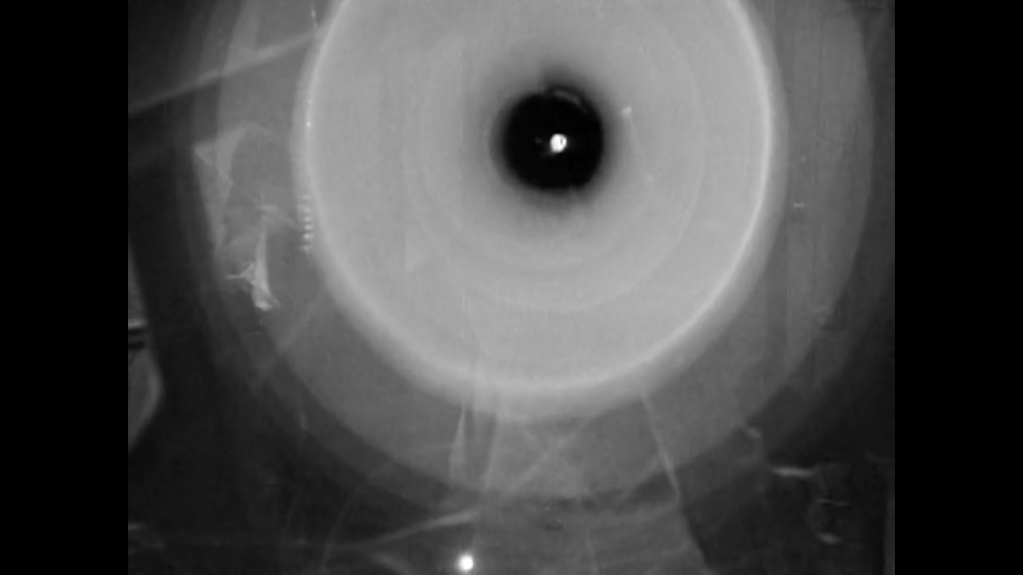
We go with Roger into the secret passage. He shines his flashlight directly into the camera, creating a halo of light around it. This would not seem to be a desirable visual effect, yet we will see it many, many times in the years to come. This is the second appearance of the effect. The first time came when Roger’s son, strange and troubled boy David, was leading Vicki into the abandoned Old House in episode 70. Now we see it when Roger himself is entering another abandoned space, one where he might meet Vicki.

Halo

It’s hard to believe that the repeated use of this effect was altogether unintentional.

All the more so because of what follows Roger’s entry into the passageway. His journey through it actually does seem to wind through a very large space. In the opening narration, Vicki had said that the house is made up of 80 rooms, retconning the total of 40 given in the second episode. Roger’s trek up one flight of stairs, down another, up a spiral staircase, around corners, past windows, etc etc, seems like it must take him past enough space for at least that many. Perhaps the sequence would be a bit more attractive with less time spent focused on Roger’s feet, but all in all it is as effective a creation of space as Dark Shadows would ever do. If there had been Daytime Emmy Awards in 1966, Lela Swift would have had every right to expect to win Best Director for conjuring up this illusion of vast, winding corridors without editing or going outside the tiny studio space available to her.

Roger does indeed discover Vicki’s whereabouts. He hears her calling for David from behind a locked door, promising David not to tell anyone he imprisoned her there if he will let her out now. Roger does not simply let Vicki out. Instead, he makes some loud noises, then puts on a ghostly, wavering voice and calls out to Vicki that she is in great danger as long as she stays in Collinwood. He seems to be having trouble keeping a straight face when he makes these spooky sounds. Vicki isn’t laughing, and returning viewers aren’t either- in Friday’s episode, she and we saw the ghost of Bill Malloy in the room, and heard that ghost warn her that she would be killed if she stayed in the house much longer.

Once he’s had his fun, Roger opens the door. After another flashlight halo, Vicki recognizes him. Alexandra Moltke Isles gives us one of the finest moments of acting in the entire series, when Vicki throws her arms around Roger, her bodily movement as smooth as any ballet dancer’s but her voice jagged, and says that “David is a monster, you were right!” Up to this point, Roger has been brutally hostile to his son, Vicki heroically friendly to him. Her determination to befriend David has become so central to her character that hearing her make this declaration makes it seem that she is permanently broken.

Broken Vicki

Vicki struggles to hold back her sobbing long enough to tell Roger that she saw the ghost of Bill Malloy. That’s an episode-ending sting- Roger wants everyone to forget about Bill’s death, and if his ghost starts popping up he is unlikely to get that wish.

Stunned Roger

Mrs Isles was a “head actor,” one who found the character’s innermost psychological motivation and worked outward from that. That heavily interiorized style would be one of the things that left her in the dust, along with similar performers like Joel Crothers and Don Briscoe, in the period when Dark Shadows was a hyper-fast paced, wildly zany show about vampires and werewolves and time-travel and God knows what. But in the period when Art Wallace and Francis Swann were writing finely etched character studies, she consistently excelled. In this little turn, she shows that when it was logical for her character to go big, she could go as big as any of the stars of the show in those later days.