Episode 259: Mustache, must tell

Elizabeth Collins Stoddard, matriarch of the ancient and esteemed Collins family of Collinsport, Maine, receives a telephone call. Her daughter Carolyn is in jail. Driving drunk, Carolyn barely missed a pedestrian, smashing instead into a tree. The almost-victim rescued Carolyn from the car moments before the fuel tank exploded, and Carolyn rewarded her with some nasty remarks. Liz is upset that her brother Roger isn’t available to pick Carolyn up from the police station.

Well-meaning governess Vicki suggests that Liz go to the police station herself. Liz hasn’t left home under her own power for eighteen years, and so reacts to this idea with dread. Vicki talks her into it, giving Alexandra Moltke Isles a chance to show that there is some substance to her character. Looking in through the front door, we see Liz taking a series of halting, forced steps to Vicki’s car.*

Seen in isolation from the rest of the series, Liz’ march is a poignant evocation of agoraphobia. But the Liz-is-a-recluse story is a dead end. They never showed us anyplace Liz would want to go, and the reason for her staying in the house was exposed in #249 as nonsensical. Still, they’ve been presenting Liz as a recluse from the beginning, so sending her into town feels like a promise that something big will happen.

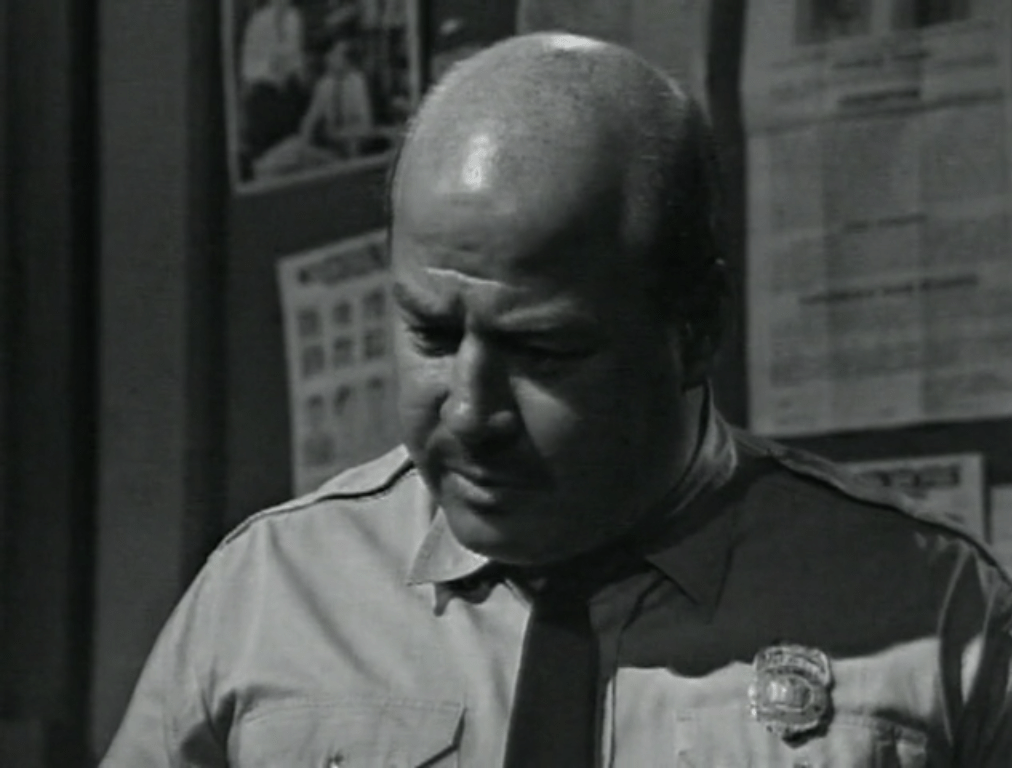
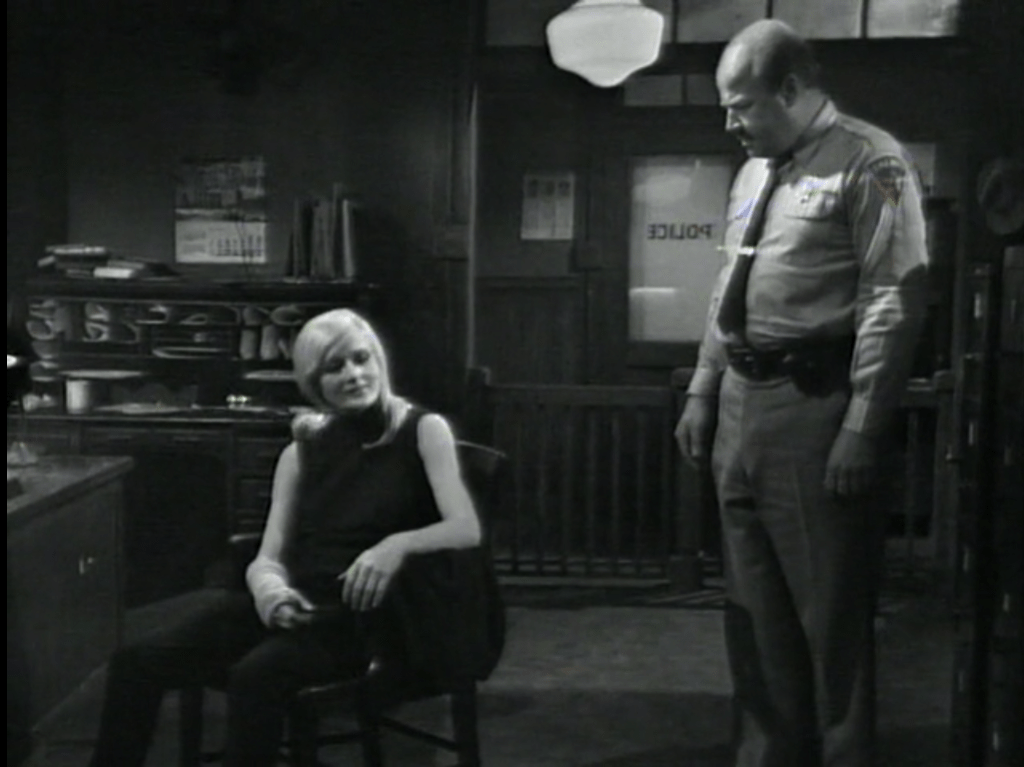
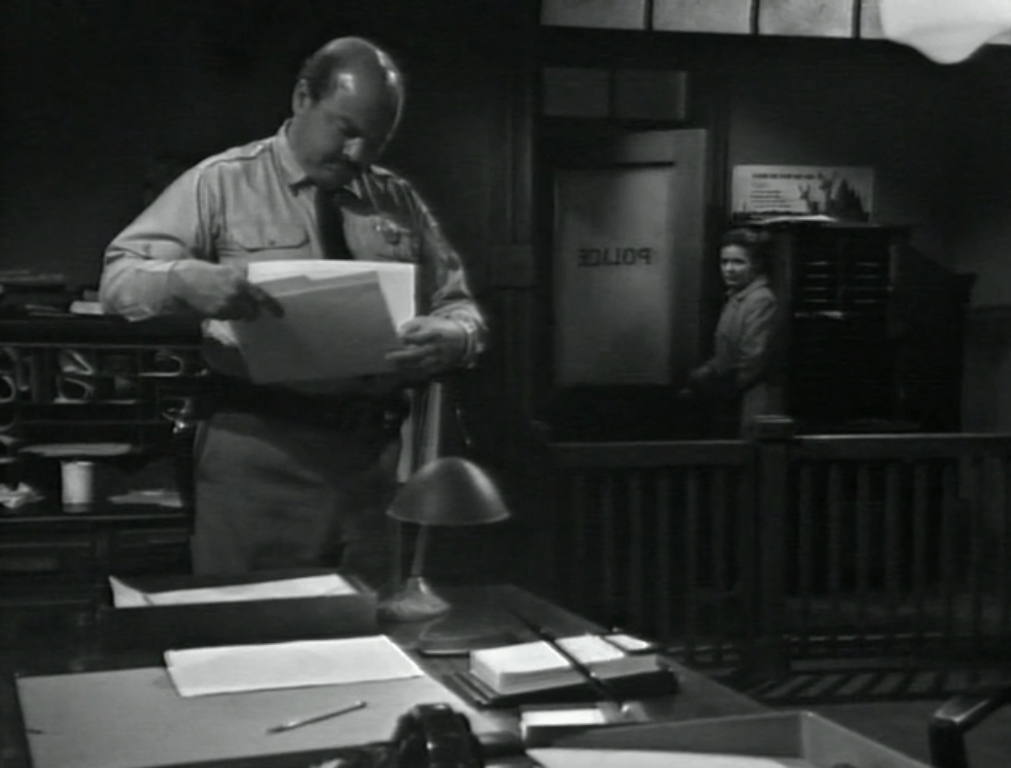
In the police station, we see that Sheriff Patterson has grown a mustache. He didn’t have one when last we saw him, in #248, and he won’t have one when next we see him, in #272. So this is our only chance to appreciate it.

Carolyn is doing a “teen rebel” bit. This would have been one thing earlier in the series, when she was supposed to be fresh out of high school and wildly capricious. But she took charge of the family business for a month early in the spring of 1967, and has been relatively level-headed since. When she makes sassy remarks to the sheriff, they are just throwing all that character development out the window.

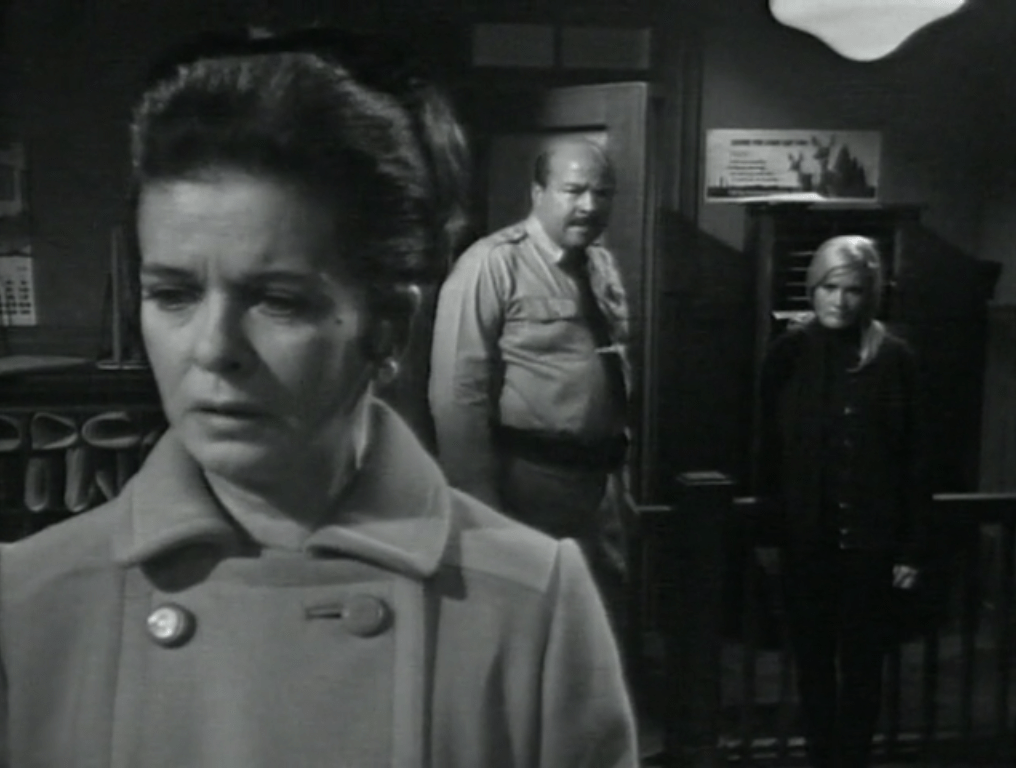
Liz shows up, to the sheriff’s amazement and Carolyn’s. Carolyn recovers from the shock, and claims she is not impressed by Liz’ leaving the house. Liz supposedly stayed there for eighteen years waiting for Carolyn’s father, Paul Stoddard, to come back. Now she is divorcing Stoddard and marrying seagoing con man Jason McGuire. If Stoddard means nothing to Liz anymore, what’s the big deal about going into town? Carolyn then makes some superheated remarks about Liz’ disloyalty to Stoddard. Finally, she refuses to leave with Liz. She insists on spending the night in a cell.

In #244, Liz tried to tell Carolyn that her father was a terrible man who never loved anyone. Carolyn became upset and wouldn’t listen to her, then jumped to believe Jason’s stories that Stoddard was a fine fellow who doted on her. That was understandable as a first reaction to dismal news, but we’ve never seen any other indication that Carolyn is especially hung up on the father who disappeared from the house when she was an infant. All the shouting about “my father!” comes out of nowhere. The scene amounts to nothing.

Back in the drawing room, Liz has a conversation with Jason. She has agreed to marry him because he has threatened that if she does not he will reveal to the police that she killed Stoddard and he buried him in the basement. The blackmail plot has been dragging on for months, and we have yet to see anything happen between Liz and Jason that didn’t happen in the first five minutes they were on camera. At this point, scenes like this are just a test of the audience’s endurance.

Upstairs in Collinwood, Vicki hears sobbing in Liz’ bedroom. She calls to her, and lets herself in. She apologizes for urging her to see Carolyn. She suspects that Liz has something she wants to say, and gently presses her to say it. Liz finally confesses that she killed Stoddard. The whole scene is very effective, a strong conclusion to a weak outing.

*It became clear in #232 and #233 that Vicki has a car. How and when she came into possession of this vehicle has not been explained.

Episode 251: Madness preferable to sanity

We reprise the final scene of Friday’s episode, in which vampire Barnabas Collins catches his prisoner Maggie Evans trying to stab him. He flashes his fangs at her.

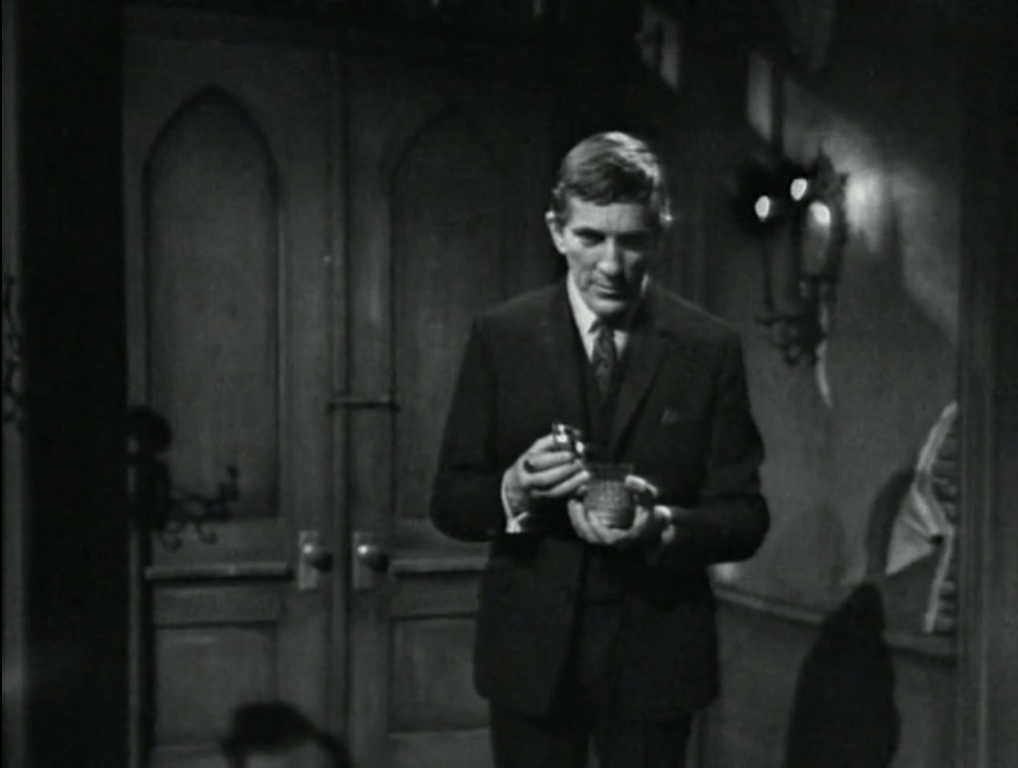
Doctor Teeth and the Electric Mayhem

The first time around, this had been the climax of a number of powerfully realized scenes, so it still carried a punch despite the silliness of the fangs. From a standing start, though, the result is a bad laugh.

In the 45 seconds following the first commercial, ABC staff announcer Bill Rice* summarizes the action of the previous week’s episodes.** This recap comes so close to exhausting every event we saw in those 110 minutes of scripted drama that regular viewers will have another unintended laugh.

The recap was inserted because many ABC stations preempted Dark Shadows to cover a United Nations debate about the Vietnam War. The show was about as resolutely disengaged from contemporary politics as it was possible to be, but conjoining US policy in Vietnam with a character like Barnabas, who combines a vast capacity for killing with a desperate need to be loved, does bring certain thoughts to mind.

Barnabas and Maggie have a conversation about his inclination to kill her. Barnabas’ sorely bedraggled blood-thrall Willie Loomis joins in, saying that Barnabas will have to kill him first. This would not seem to present Barnabas with any difficulty at all. Willie wouldn’t be missed- everyone else on the show remembers Willie from the days before he met Barnabas, when he was dangerously unstable ruffian Willie Loomis, and has been urging Barnabas to get rid of him. Nor would it be especially difficult for Barnabas to replace Willie- he just has to bite someone else, and that other person will become his new slave. But Barnabas stands around arguing with Willie and Maggie. When someone knocks on the front door, he scolds Willie for failing to keep it locked, such a humdrum complaint under the circumstances as to bring another bad laugh. Barnabas leaves Willie and Maggie in the basement while he answers the door. Before he goes, he sticks out his lower lip, a facial expression known as “pouting.”

Barnabas pouts

The visitor is well-meaning governess Vicki, who tells Barnabas that the sheriff has ordered that no woman go out alone at night. Some think it strange to send a woman out alone at night to carry this message to a man who is indoors, but considering what we’ve seen of the sheriff, doing the exact opposite of what he commands would seem always to be the wisest course.

Vicki notices an antique music box on a table in Barnabas’ front parlor. Vicki admires its tune and makes a few not-very-coherent remarks about “the past” while it is playing. Barnabas has been using this music box as a tool to hypnotize Maggie into believing that she is his long-lost love Josette. After Vicki leaves, he opens it again, then looks at the door through which she left. He turns his head and smiles, looking very much like someone who has just had an exciting new idea.

Lightbulb moment

Meanwhile, Maggie and Willie talk to each other in the basement. The two of them had one of the most electrifying scenes of the entire series down there Friday. The last traces of that energy have been piddled away by the time Barnabas comes back downstairs and resumes his conversation with them.

Willie urges Barnabas to look at Maggie and see how beautiful she is. Barnabas says “No” and looks away. Coming at a moment of high dramatic tension, this might have been powerful. When we sit down as an audience, we enter into a sort of agreement that if the show includes something worth seeing, we will look at it. So when we see a character refusing to look at a sight as well worth contemplating as was the young Kathryn Leigh Scott,*** we might be shocked. But there has been too much idle chatter, and the memory of Barnabas’ pout is so fresh, that all we can think of is a petulant child saying “I don’t wanna look at her!”

Barnabas announces that he will not kill Maggie right away. He tells her that he will make her suffer torments worse than anyone has ever known so that death will finally come as a blessed relief, then locks her up in the prison cell in the basement of the house. What, your house doesn’t have a prison cell in its basement? It’s a standard feature of homes in Collinsport, as we will come to see in future episodes.

Barnabas goes to the great house of Collinwood and talks to Vicki. He brings a handkerchief that, legend has it, was a gift from the queen of France to Josette. They babble about “the past” and Barnabas invites her to drop in at his house “some day.” He says “day,” even though he’s busy being dead every day until sunset. And doesn’t specify when- any old time, if she hears screams coming from the basement she’ll probably just ignore them.

Evidently Barnabas is thinking of Vicki as a backup Josette in case Maggie doesn’t come around. This marks a retreat from #240 and #241, when strange and troubled boy David Collins, who has seen Josette’s ghost many times, saw Maggie in the gown Barnabas gave her and said that she must have been Josette because she looked “exactly the same” as he had seen her before. That suggested, not only that Barnabas chose Maggie because of her looks, but also that he might be right in thinking that she is Josette’s reincarnation. This storyline is modeled on the 1932 Universal film The Mummy, in which Imhotep’s idea that Helen Grosvenor is the reincarnation of his lost love Princess Ankh-esen-amun is substantiated when Zita Johann plays both roles. If Vicki and Maggie are interchangeable, then all of that goes by the boards.

*Presumably no relation to the main character of Gene Roddenberry’s 1963-4 CBS TV series The Lieutenant, one episode of which was written by Art Wallace.

**As transcribed by the Dark Shadows wiki:

For those who have missed the last few episodes of Dark Shadows: Elizabeth Collins [Stoddard,] at Jason McGuire’s insistence, has taken Vicki, Carolyn, and Roger into the basement room and convinces them that it holds no mystery. They don’t realize that beneath the flagstones on the floor is concealed the room’s secret—the body of Elizabeth’s husband, Paul. Elizabeth, now realizing that the secret can never be told, announces to the family that she and Jason will be married. Maggie Evans escaped from Barnabas and attempted to get to her father, but was recaptured and told by Barnabas that unless she assumes the identity of Josette Collins, she will die. Realizing that she can never escape, Maggie attempts to destroy Barnabas.

The title card shown during the recap

***Or for that matter as is the not-so-young Miss Scott of today, she’s one of the best looking octogenarians around.

Episode 248: The bride of Barnabas Collins

At the end of yesterday’s installment, artist Sam Evans looked out the window of his house and saw his daughter, missing local girl Maggie. Today, the sheriff shows up and reports that he and his men couldn’t find anything to substantiate Sam’s report. The sheriff then tries to convince Sam that he didn’t really see Maggie at all. When last we see Sam, he is telling himself that it was only his imagination.

Maggie had escaped from the custody of vampire Barnabas Collins and Barnabas’ sorely bedraggled blood thrall, Willie Loomis. Today, Barnabas meets Maggie in the graveyard, chokes her, and takes her into the tomb where he spent a century or two. He declares that he will punish her for trying to leave him.

As Barnabas talks, Maggie seems inclined to go along with his plan to annihilate her personality and replace it with that of his long-dead love, Josette. He wonders aloud if the punishment he was planning is necessary after all. But then she remembers that she is holding her father’s pipe, and she calls out “Pop!” Barnabas then takes her to the hidden room in the back of the tomb and shuts her up in his old coffin.

Director Lela Swift was uncharacteristically sloppy with the framing yesterday, but today she makes up for it with one of the most remembered shots of the entire series. When Barnabas shuts Maggie up in the coffin, we see him from her point of view. Claustrophobic viewers beware!

Barnabas closing the lid

The next morning, Willie releases Maggie from the coffin, takes her back to Barnabas’ house, and urges her to convince herself that she is Josette. For a while, she tries it. We start to wonder if Willie will have as much success with Maggie as the sheriff had with her father. But then she looks in the mirror and shouts “I’m Maggie Evans!”

That may not sound like much story for 22 minutes, but it never feels slow. Swift and the actors are all in fine form today.

On the other hand, there are a couple of script problems. The sheriff is written as such a fool that we can’t help but be distracted, and the scene between Maggie and Barnabas in the outer section of the tomb goes on too long. But even at its lowest points the actors just about save it. Dana Elcar always makes it seem that Sheriff Patterson knows more than he’s letting on, so it isn’t until he starts trying to talk Sam into believing he didn’t really see Maggie that we get the sinking feeling that he is absolutely useless. And Jonathan Frid and Kathryn Leigh Scott are electric as Barnabas and Maggie, so much so that we could forgive the scene between them even if it had been twice as repetitious as it fact is. With two consecutive episodes including as much good stuff as was in yesterday’s and today’s, it’s starting to seem like they are due to land one in the ranks of the Genuinely Good Episodes any day now.

Episode 219: One look at the man

This teleplay badly needed another trip through the typewriter.

In the opening scenes, seagoing con man Jason McGuire demands his friend and former henchman, the sorely bedraggled Willie Loomis, leave the estate of Collinwood and the town of Collinsport. He mentions that he saw Willie’s car the night before at the cemetery. He then orders Willie to get on a bus and leave town. Then he starts talking about Willie’s car again. Does Willie have a car or not? They’ve gone back and forth on this from one episode to another, but today they can’t keep it straight from one line of dialogue to the next.

A doctor shows up to examine Willie. He tells Jason that Willie is not sick at all. The reason he is so weak is that he has lost “an enormous amount of blood.” What does the doctor think the word “sick” means if it doesn’t apply to a person who is doing badly because of an “enormous” loss of blood?

Whatever meaning the doctor attaches to “sick” apparently also applies to “ailment.” High-born ne’er-do-well Roger Collins asks what Willie’s ailment is, and the doctor says he has no ailment. He is simply immobilized due to an enormous loss of blood.

The doctor tells first Jason, then Roger, that Willie will be fine if he gets some rest and fluids and food. The idea of a blood transfusion doesn’t cross his mind, nor do Jason or Roger bring it up. It would be one thing if the doctor, Jason, and Roger were played by the Three Stooges, but there is no sign that we are supposed to think that they are a load of idiots.

An actor who has repeatedly triumphed over bad writing reappears after an absence of sixteen weeks. This is Dana Elcar as Sheriff George Patterson. The sheriff’s activities don’t always make a great deal of sense, but Elcar’s acting choices and his zest for performance make him a pleasure to watch no matter how dire the script he has to work with.

Today, the sheriff is telling Roger that a number of cows on the farms owned by the Collins family have been destroyed. A person or persons unknown somehow sucked every drop of blood out of these cows through small punctures in their hides. Roger is deeply unsettled by this strange news, and the sheriff sympathizes with him.

Roger repeatedly asks the sheriff why he is the one telling him about the cows. He says that he would have expected the veterinarian to call him. The sheriff says that the veterinarian called his office, because he determined that the cows were killed by someone’s deliberate act. That doesn’t explain why the veterinarian, whose bill the Collinses will presumably be paying, didn’t call him. We were so glad to see these fine actors working together that the senselessness of the scene didn’t bother us while we were watching it, but as soon as it was over we were left with a feeling of confusion.

Roger and the sheriff. Screenshot by Dark Shadows Before I Die

Regular viewers do wonder what farms the sheriff and Roger are talking about. The only previous reference to the word “farm” in connection with the Collinses was in #64, when Sheriff Patterson told their servant Matthew Morgan to “work their farm for them” and stay out of trouble. Today’s conversation repeatedly refers to “farms,” plural, more than one of which are big enough to have cows. That’s an operation much too complicated for Matthew, who had many other duties, to have handled by himself. Besides, Matthew left his job in #112 and was scared to death by ghosts in #126, and hasn’t been replaced. Whatever farm Matthew was working must have been so small that the Collinses can take care of it themselves in whatever time they can spare from their main occupation, keeping secrets and being sarcastic.

Writer Ron Sproat specialized in inventorying disused storylines and getting them out of the way. Back when Matthew was on the show, the Collinses were heavily in debt and running out of money. Dashing action hero Burke Devlin spent the first 40 weeks of the show trying to avenge himself on the Collinses by driving them into bankruptcy. All of that has gone by the boards, and we aren’t hearing any more about troubles concerning the business. So it’s time for Dark Shadows to reconceive the family as financially secure, indeed as imposingly rich. Talking about their many farms and the herds of livestock on them helps Sproat open up space in his narrative warehouse, but it doesn’t offer much to interest the audience.

My wife, Mrs Acilius, thought up a little fanfic that might have introduced the same points more intriguingly. The trouble with the cows first came up in #215. Hardworking young fisherman Joe Haskell told the story of a calf belonging to his uncle that was found drained of blood. That suggested that an evil has been loosed that is spreading throughout the town and beyond. Why not stick with Joe as the point of view character in connection with the mystery of the desiccated cows? Not only would that give a badly under-utilized character something to do, but would also give us the sense that the fate of a whole community is at stake in the action.

If they needed to connect the Collinses to the cow story, they could have come up with a way to oblige them to join with Joe to figure out what’s going on. That in turn would raise the prospect of a story structured like Bram Stoker’s Dracula, in which one character after another joins the team opposing the malign Count. The formation of the group that resisted blonde fire witch Laura Murdoch Collins in the months leading up to #191 very much followed the pattern set in Stoker’s novel. Of course, the ending could be modified. The Laura story ended, not with the triumphant team-work that defeats Dracula, but with well-meaning governess Vicki cut off from her allies and left to confront Laura alone. But the team-work leading up to that point was full of interest, as characters shared information with each other, reconfigured their relationships, and found themselves doing things neither they nor we would have expected. Simply reintroducing the topic of the cows and leaving Joe and the Collinses siloed off from each other is easy for the writers, but it doesn’t take the story anywhere.

Episode 138: You should know about the Grim Reaper

The authorities in Phoenix, Arizona have asked the sheriff in Collinsport, Maine to inform high-born ne’er-do-well Roger Collins that they have identified the charred body of a woman as that of Roger’s wife, mysterious and long-absent Laura. The body was found in what was left of Laura’s apartment in Phoenix after a fire destroyed the building, and the woman was Laura’s age, height, and build. Since Laura was the only person associated with the building whose whereabouts were unknown, the identification of the remains as hers seemed secure to the Arizona authorities.

It seems less so in Collinsport, as Laura is no longer absent. She’s been back in town for days. She has been staying at the Collinsport Inn, where she met several old acquaintances. They recognized each other and engaged in conversation. She has come to the great house of Collinwood, where she talked with Roger and other members of the family, and will be staying in the caretaker’s cottage on the grounds of the estate. Only her son, strange and troubled boy David, has expressed any doubt as to her identity, and no one takes that doubt literally.

If the sheriff knew that he was living in a soap opera, he might suspect that the woman who has come to town is a previously unknown evil twin posing as Laura. If he knew that his particular soap is loaded with supernatural storylines, he might try to figure out what sort of uncanny being she could be. But he seems to be under the impression that he lives in the world. When at one point Roger tells him to “Stop being melodramatic,” it doesn’t occur to him that he has no choice but to be melodramatic. So, all he can do is ask Laura if she knows who the dead woman might have been. When tells him she doesn’t, he leaves.

Roger is eager to divorce Laura and send her away with their son, David. After the sheriff goes, Roger expresses his consternation at the news of the fire. Laura has nowhere to take David. When she tells him that she never planned to take David to that apartment, but that she had “made a commitment to another place,” he is instantly relieved. He does not ask where that other place is. His interest in where Laura or David will be or what they will be doing is exhausted the moment he learns they will be far away from him.

Someone else is visiting Collinwood tonight who wants more from Laura than Roger does. That is Roger’s nemesis and Laura’s ex-boyfriend, dashing action hero Burke Devlin. Flighty heiress Carolyn has gone to get Laura’s bag from the Collinsport Inn and bring it to her aunt. While in town, she met Burke. When she told him of her errand, Burke volunteered to help her carry the bag. Now she and Burke are in the drawing room at Collinwood. They kiss, and he persuades her to let him carry the bag to the cottage. When Carolyn says that she is jealous of his interest in her aunt, he assures her it’s “all business.” She tells him he can’t fool her, to which he replies “Yes I can.”

Burke kisses Carolyn. Screenshot by Dark Shadows Before I Die.

As Carolyn, Nancy Barrett plays, first, excitement as Burke moves in to kiss her; then, a mixture of frustration and confusion, as she begins to suspect that he is only using her to get to Laura. Regular viewers have seen Burke several times after a flirtatious scene with Carolyn, and each time he has switched immediately into hard-driving businessman mode the moment she wasn’t looking. With her performance in this scene, we start to wonder if she is about to catch on that he doesn’t have any feelings for her.

Roger finds Burke and Carolyn in the drawing room. He is furious with Burke for coming to the house, and with Carolyn for inviting him in. He and Burke rage at each other. As Roger, Louis Edmonds does a superb job of simultaneously conveying white-hot rage at Burke and a much colder anger towards his niece. Up to now, Carolyn has responded to her uncle’s prohibitions against seeing Burke flippantly, but this time she seems to accept that she has gone too far. After Burke leaves, she kisses Roger on the cheek and whispers “Goodnight, uncle,” sounding genuinely chastened. Roger is usually a difficult man to take seriously, but Edmonds’ tremendous performance in this scene leaves her with no choice but to give a hushed reaction.

Placing this scene after Roger’s blasé reaction to his wife and Burke’s cynical toying with Carolyn makes the point that Roger and Burke are more excited about each other than either ever is about anyone else. The show embeds their emotions in the “Revenge of Burke Devlin” storyline. Burke is trying to send Roger to prison, and is scheming to enlist Laura in his efforts. Ten years ago, Burke was imprisoned because Roger and Laura testified that he was driving his car, with them as passengers, when he ran down a pedestrian and left him to die. Before the accident, Burke and Laura had been a couple; the day Burke was sentenced, Laura and Roger were married. Now Burke hopes Laura will say that she perjured herself, and that Roger was driving.

Burke’s plans never quite make logical sense. Were Laura to confess to perjury, she would be in as much legal trouble as Roger. Even if she struck a bargain to keep herself out of prison, she would certainly not advance her goal of taking David by alienating Roger and branding herself a criminal. It is difficult to see what incentive Burke imagines that she has to join him.

At the cottage, Laura is sitting by the fire, staring off into space. When Burke knocks on her door, she continues staring. In Laura’s scenes by fireplaces, the spooky music, the slowly panning camera, and Diana Millay’s rigid posture all combine to create the impression that what we see when we look at Laura is only a fragment of a human being.

Laura stares off into space. Screenshot by Dark Shadows Before I Die.

Once Laura lets Burke in, he talks her into closing the door, pushes himself close to her, and insists on telling her about the demands he will be making on her. He wants her to testify against Roger, to restore the years he spent behind bars, and to love him. When she tells him that the things he wants are not in her power to give, he refuses to take no for an answer. Over her objections, he takes her in his arms and forces a kiss on her. As Burke kisses Laura, the door opens and Roger appears with a gun.

Burke kisses Laura. Screenshot by Dark Shadows Before I Die.

Burke’s demand that the past be undone and his attempt to force Laura to feel love for him show the unreality of his ambitions. He claims to represent “Honesty and the Truth,” but everything he clamors for is an empty fantasy. So much so that we wonder if what he really wants might be something quite different from what he keeps saying he wants.

Episode 54: A proper charge

At the end of yesterday’s episode, dour caretaker Matthew admitted to reclusive matriarch Liz that he had found a drowned man on the beach, that the man was missing plant manager Bill Malloy, and that he had pushed the body out to sea and watched it float away. Liz then called the sheriff.

As today’s episode opens, Liz’ ne-er-do-well brother Roger doesn’t know about Matthew’s confession. We see him in his office, countermanding orders Bill Malloy had given and acting like he has Malloy’s job. On his blog Dark Shadows from the Beginning, Marc Masse interprets this as an indication of guilty knowledge on Roger’s part:

Roger has evidently just implemented a new system that has effectively replaced Bill Malloy’s previous methods for operations at the plant. This indicates that Roger knows for certain that Malloy will not be returning as plant manager, which enshrouds him with an additional layer of suspicion given how as of the close of episode 53 only two people knew for certain that Bill Malloy was in fact dead: Matthew Morgan and Elizabeth Stoddard, and as of today’s episode the sheriff. Roger will be informed of Malloy’s demise later on that day when his sister calls him away from the office to have him return to Collinwood, and Roger will feign surprise upon hearing the news, but it’s evident from his phone conversation above that he was somehow already aware of Malloy’s fate.

That’s a possible interpretation, and I certainly thought of it the first time I saw the episode. On the other hand, Malloy has been missing for more than a day, and was last seen drinking in a bar. So even if he were to walk in the door in prime physical condition at this very moment, he would be in a poor position to defend himself in workplace politics. Roger could easily claim that he was simply moving to fill a vacuum. The show is keeping Roger viable as a suspect, but is not committing itself to the idea that he is the guilty party.

Whatever Roger knows about the situation, dashing action hero Burke knows less. But Burke seems to think of himself as very knowledgeable. He storms into Roger’s office and confronts him with the fact that Malloy was trying to prove that Roger, not Burke, was responsible for the killing that sent Burke to prison years before. Burke makes many accusations against Roger, some of which the audience knows to be true, but none of which he is yet in a position to prove.

The scenes in Roger’s office are intercut with scenes in the drawing room in the mansion at Collinwood. There, the sheriff is talking with Liz and Matthew about Matthew’s confession. Matthew asks the sheriff if he will be arrested now. To which the sheriff replies, “I can’t think of a proper charge.” He jokes about “burial without a license,” then goes on to warn Matthew that he has laid himself open to suspicion.

This is a moment when you can tell you’re watching a show made in 1966. Seven years later, coverage of investigations into the Watergate affair would give the American public an intensive eighteen-month tutorial in criminal law concerning obstruction of justice and related offenses. Ever since that time, residents of the USA have known that you are risking jail any time you make things difficult for the police. Prior to that, however, this was not well-known even among lawyers who practiced in areas other than criminal law.

Watergate itself illustrated this. Several of the major figures in that matter were lawyers, and many of them, including Richard Nixon himself, genuinely did not know that it was an offense for a person who had not been involved in a crime to cover that crime up. You can hear Nixon on the White House tapes telling his legal aide John Dean that because Dean didn’t know about the Watergate burglary in advance, the things Dean had done to hinder the investigation of the burglary can’t possibly put him in danger of prosecution. In his memoirs, Dean admits his own ignorance of the relevant law, confessing that he first read the federal statutes on obstruction of justice not when he was in law school, not when he was studying for the bar, not when he was a staffer for a commission tasked with rewriting the federal criminal code, but in his office at the White House, after he’d been running the Watergate cover-up for nine months. He reports in that same book that several other White House staffers who were lawyers shared his ignorance. Many of them would go on to confirm this aspect of his account.

In light of the legal education that Watergate provided the people of the USA, the sheriff sounds like an idiot. That same education ruined other old shows. Perry Mason, for example- ridiculous as it is that every episode ends with the guilty party jumping up in court and shouting “I did it!,” if you’re into the story you feel enough poetic justice in those endings that they don’t really bother you. But Mason himself can hardly make it through five minutes without committing every crime with which Haldeman, Ehrlichman, Mitchell, and Dean would be charged and a few more besides. Perry Mason broadcast its final episode in May of 1966, so that show, not the Watergate news, was the law school the original audience had attended.

Miscellaneous:

The episode opens with footage of Louis Edmonds walking around outdoors on a waterfront. They play some nice sound effects of sea-birds over it.

The sheriff we see in this episode is Sheriff Patterson, the first of that name. He is played by Dana Elcar, a fine actor who would be ubiquitous on American television and cinema screens in the 1980s. If we’re heading into a major story arc dominated by a mystery story, it’s a relief to know that the policeman role will be in such trustworthy hands. The part will be re-cast many times in the years to come, and never again as well. Then again, none of the subsequent Sheriffs Patterson will be as important as is this first.

Since there is a good deal of overlap between fans of Star Trek and fans of Dark Shadows, I might mention that this was the episode that aired on the day Star Trek premiered.

There was a great deal of Anglophilia involved in the making of Dark Shadows: the mid-Atlantic accents, the plots lifted from English literature, etc. So it may not be a coincidence that a dark-haired, small-chinned matriarch named Elizabeth presides over the family at the center of it. Indeed, Joan Bennett looked enough like the northern European royals that when they wanted to cast an actress who resembled her closely enough to set the audience wondering how their characters were related, they settled on the daughter of a Danish count. So I might also mention that I am writing this on the day Britain’s Elizabeth II died.

There are two big flubs. At one point when they’re about to cut from the drawing room back to the office, we hear a loud noise and some garbled voices in the background. My wife, Mrs Acilius, wondered if this was Josette Collins trying to make herself heard.

At the very end of the episode, as announcer Bob Lloyd is intoning “Dark Shadows is a Dan Curtis production,” a figure walks in front of the camera. You can just see the top of his head. The Dark Shadows wiki refers to the figure as “a crew member.” Marc Masse says it’s probably Mitch Ryan. John and Christine Scoleri speculate on their blog Dark Shadows Before I Die that it might be Dan Curtis himself. To me it looks like more the hairdo Thayer David is wearing as Matthew Morgan than like either Ryan’s hairdo as Burke or Dan Curtis’ hair- there seems to be some grey in it, and it looks to be more matted than either wavy or curly.