Episode 258: Secret friend

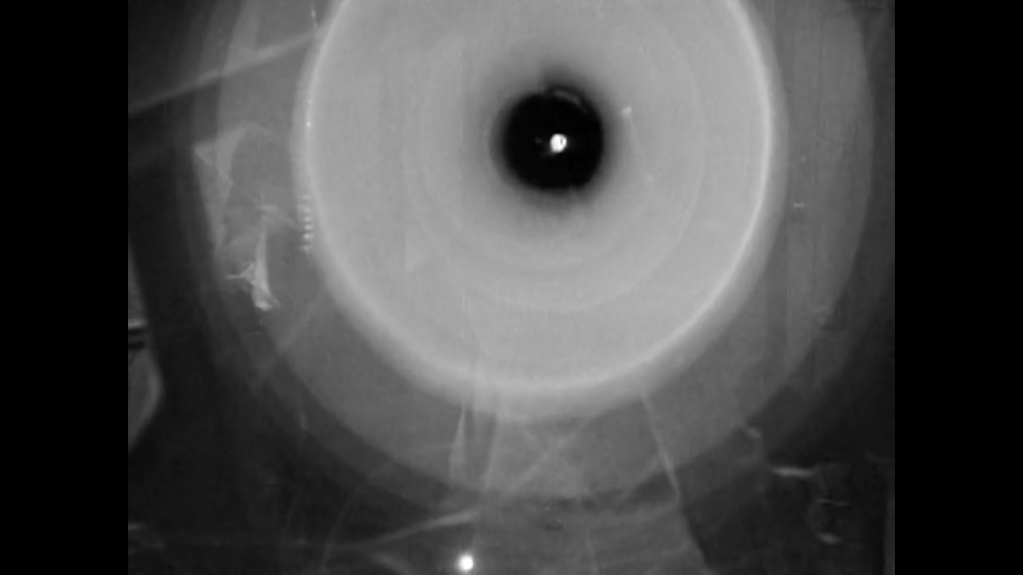
Maggie Evans, The Nicest Girl in Town, is giving up hope. Vampire Barnabas Collins locked her up in the jail cell in the basement of his house some time ago, and everyone she knows is coming to believe that she is dead.

The other day, a little girl in eighteenth century clothing appeared outside Maggie’s cell. The girl did not respond when Maggie tried to get her attention, nor did Barnabas’ sorely bedraggled blood thrall, Willie, see her when she walked past him. Only on her second or third visit to Maggie did the girl interact with her, and then only to warn her not to tell her big brother that she had seen her. Maggie suspects that the girl was a hallucination of hers.

We know that the girl is real, because we saw her interacting with someone else. Outside Barnabas’ house, the girl talked with strange and troubled boy David Collins and played catch with him. If we’ve been watching the show from the beginning, we also know that there are many ghosts in and around Barnabas’ house, and that they have a special rapport with David. Further, this girl gives her name as Sarah and says that everyone she knows went away a long time ago. We’ve been told that Barnabas had a sister named Sarah who died in childhood, so we know that Sarah is the ghost of that sister.

Today, the girl appears to Maggie again. This time she shows up in the cell itself. At first, she tosses her ball in the air, sings “London Bridge,” and ignores Maggie’s repeated questions. Eighteenth century kids didn’t have mobile phones, apparently they had to resort to a ball and “London Bridge” when they wanted to tune out the grownups. Sarah finally comes around when Maggie puts her hand on her shoulder.

Sarah explains that she came because Maggie was crying. She asks what Maggie is sad about, which Maggie doesn’t try to explain.

Sarah won’t answer many of Maggie’s questions. Sarah says that she has been looking for her parents, and she is puzzled as to where they and everyone else have gone. She says she does have one friend. If that is a reference to David, it would show that Sarah can learn information during one apparition and retain it during subsequent apparitions. It is unclear whether she knows that she is a ghost, and her understanding of Maggie’s situation is remarkably slight.

Maggie and Sarah play catch and sing “London Bridge” together. Sarah vanishes a moment before Barnabas arrives. Maggie reacts to him with terror, but when it becomes clear that he isn’t planning to kill her right away her excitement at Sarah’s visit comes bursting out. She tells him that she has a secret friend who visits her in her cell and plays with her. When he asks what she’s talking about, she tells him it’s a secret. She babbles in a gleeful, childlike way.

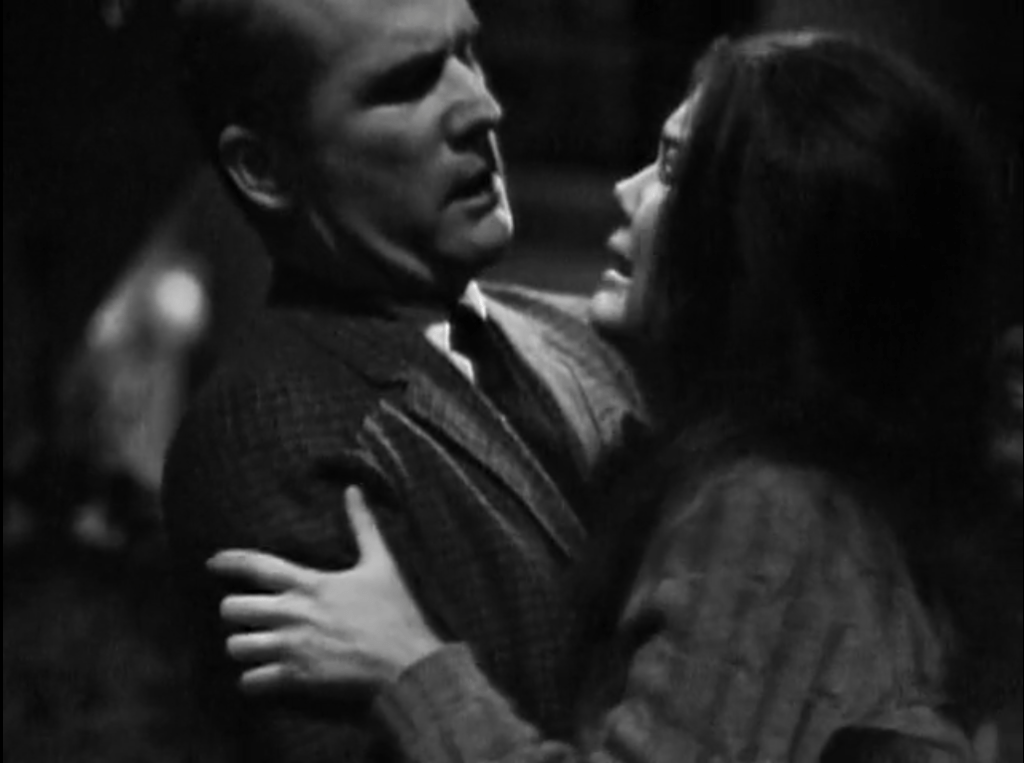
Barnabas reacts to this with discomfort. He keeps his eyes on Maggie and edges away from her, speaking to her in a pitying tone. Bleak as Maggie’s situation is, this is a laugh-out-loud moment- she’s become too weird for Barnabas.

Maggie weirds Barnabas out

Upstairs, Barnabas tells Willie that Maggie isn’t working out. In a moment of wild hope, Willie asks if that means he’ll let her go. Barnabas sourly replies that of course it does not mean that- they will have to kill her. His plan is to kill her in such a way that no trace of her will ever be found, “because there will be no trace.”

Willie takes a meal to Maggie and demands she stop pretending to be crazy. It isn’t helping her, he says. She denies that she is doing any such thing, and babbles cheerfully that “I do whatever anyone tells me to do.” Willie leans in, putting his face close to hers, and screams and shouts that she has to be her usual self if she is to have any chance of survival.

After Willie leaves, Maggie starts crying again and telling herself that there is no little girl. But then she looks at the floor and finds a doll Sarah left behind. Maggie smiles, knowing that her secret friend does exist.

Maggie’s mad scenes are fascinating. Even though she believes that Sarah is real and we know she is right, seeing Sarah has the same effect on Maggie a psychotic break might have. It takes her out of the reality that she shares with Barnabas and Willie, and gives her an affect that is neither continuous with her usual personality nor intelligible to them.

The three adult actors are all on the top of their form today, just superb. Nowadays, when Sharon Smyth Lentz describes her performance as Sarah, she says that “The first word that comes to mind is ‘clueless.’” But that works out surprisingly well. We know so little about what, if anything, is going on in Sarah’s mind that the keynotes of the performance would have to be “lost,” “confused,” and “vague,” and she had those three things down pat. Things sometimes get rocky when Sarah has a long stretch of dialogue or when multiple actors are moving at the same time, but neither of those is a problem today.

Joe Caldwell started making uncredited contributions to the writing of Dark Shadows early in 1967, and I am tempted to attribute every good thing in a script by Malcolm Marmorstein to him. But Caldwell’s name is showing up in the credits now, and this episode is excellent. So maybe Marmorstein could rise to an occasion every now and then.

My wife, Mrs Acilius, points out that this is the first episode set entirely in the Old House.

Episode 87: She came to us from nowhere, and now it seems she has disappeared into nowhere

Hardworking young fisherman Joe is spending the evening with Maggie, The Nicest Girl in Town. It’s their first date. Maggie impresses him with her knowledge of ships, and he sings a verse of “What Do You Do With a Drunken Sailor?” It may not sound like much, but the actors, Kathryn Leigh Scott and Joel Crothers, sell it so well that we’ll be rooting for Joe and Maggie for years to come. The final moment of the scene comes after Joe leaves. Maggie looks directly into the camera and says to the audience, “Goodnight, pal.”

Goodnight, pal

In the great house of Collinwood, high-born ne’er-do-well Roger Collins greets his niece, flighty heiress Carolyn, on her return home. Carolyn is upset because Joe has broken off their relationship and is having a date with Maggie. The story of Joe and Carolyn was a bore, largely because the two of them never had a scene with any fraction of the sweetness we see between Joe and Maggie today. There was nothing at stake in their quarrels, because they had nothing to lose if they simply gave up on each other.

Roger tells Carolyn that well-meaning governess Vicki hasn’t been seen for hours, and that he promised Carolyn’s mother, reclusive matriarch Liz, that he would sit up waiting for Vicki’s return. Carolyn is worried as well, and asks Roger why he isn’t actively searching for her. He says she’s probably fine. When Carolyn says that people don’t just disappear, he reminds her of family friend Bill Malloy, who disappeared not so long ago, but then turned up. Considering that Bill turned up in the form of a corpse washed ashore by the tide, it is perhaps unsurprising that Carolyn does not find Roger’s analogy particularly comforting.

After Roger persuades Carolyn to toddle off to bed, he makes sure he’s alone (well, alone except for the stagehand in the lower left-hand corner of the screen.)

Once assured that no one mentioned in the script can see him, Roger returns to the drawing room and opens a secret passage we’ve never seen before. After he disappears into it, Carolyn comes to the drawing room and is baffled at his absence.

The suggestion that Carolyn doesn’t know about the secret passage is characteristic of the show. From the beginning, Vicki has represented our point of view. She started off knowing nothing about the other characters, and everything had to be explained to her while she was on camera. If Vicki knows just what we know, Carolyn, who grew up in the house where most of the action is set, can be presumed to know a great deal we do not. When they reveal a secret to us, they can amplify its importance by showing that Carolyn isn’t in on it. They’ve done this several times, mostly in situations having to do with the murky origins of Roger’s feud with dashing action hero Burke Devlin. Carolyn’s ignorance of the secret passage is particularly effective- it’s right there in the most important room of the only house she’s ever lived in. If she doesn’t know about it, it must be a very well-kept secret indeed.

We go with Roger into the secret passage. He shines his flashlight directly into the camera, creating a halo of light around it. This would not seem to be a desirable visual effect, yet we will see it many, many times in the years to come. This is the second appearance of the effect. The first time came when Roger’s son, strange and troubled boy David, was leading Vicki into the abandoned Old House in episode 70. Now we see it when Roger himself is entering another abandoned space, one where he might meet Vicki.

Halo

It’s hard to believe that the repeated use of this effect was altogether unintentional.

All the more so because of what follows Roger’s entry into the passageway. His journey through it actually does seem to wind through a very large space. In the opening narration, Vicki had said that the house is made up of 80 rooms, retconning the total of 40 given in the second episode. Roger’s trek up one flight of stairs, down another, up a spiral staircase, around corners, past windows, etc etc, seems like it must take him past enough space for at least that many. Perhaps the sequence would be a bit more attractive with less time spent focused on Roger’s feet, but all in all it is as effective a creation of space as Dark Shadows would ever do. If there had been Daytime Emmy Awards in 1966, Lela Swift would have had every right to expect to win Best Director for conjuring up this illusion of vast, winding corridors without editing or going outside the tiny studio space available to her.

Roger does indeed discover Vicki’s whereabouts. He hears her calling for David from behind a locked door, promising David not to tell anyone he imprisoned her there if he will let her out now. Roger does not simply let Vicki out. Instead, he makes some loud noises, then puts on a ghostly, wavering voice and calls out to Vicki that she is in great danger as long as she stays in Collinwood. He seems to be having trouble keeping a straight face when he makes these spooky sounds. Vicki isn’t laughing, and returning viewers aren’t either- in Friday’s episode, she and we saw the ghost of Bill Malloy in the room, and heard that ghost warn her that she would be killed if she stayed in the house much longer.

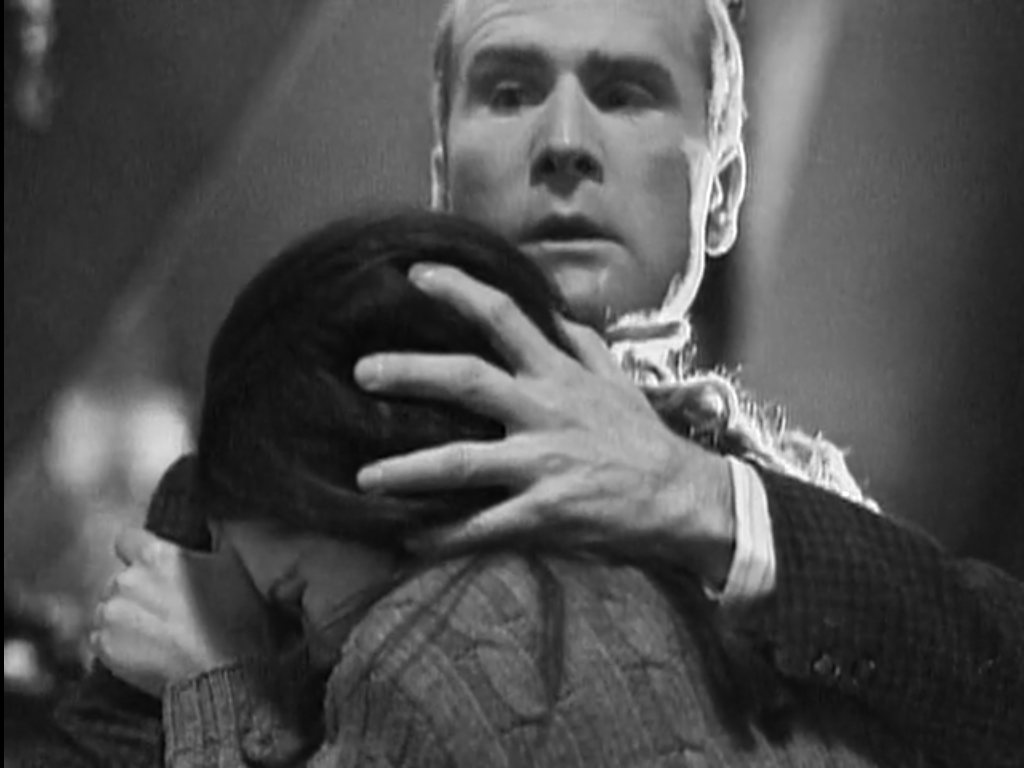
Once he’s had his fun, Roger opens the door. After another flashlight halo, Vicki recognizes him. Alexandra Moltke Isles gives us one of the finest moments of acting in the entire series, when Vicki throws her arms around Roger, her bodily movement as smooth as any ballet dancer’s but her voice jagged, and says that “David is a monster, you were right!” Up to this point, Roger has been brutally hostile to his son, Vicki heroically friendly to him. Her determination to befriend David has become so central to her character that hearing her make this declaration makes it seem that she is permanently broken.

Broken Vicki

Vicki struggles to hold back her sobbing long enough to tell Roger that she saw the ghost of Bill Malloy. That’s an episode-ending sting- Roger wants everyone to forget about Bill’s death, and if his ghost starts popping up he is unlikely to get that wish.

Stunned Roger

Mrs Isles was a “head actor,” one who found the character’s innermost psychological motivation and worked outward from that. That heavily interiorized style would be one of the things that left her in the dust, along with similar performers like Joel Crothers and Don Briscoe, in the period when Dark Shadows was a hyper-fast paced, wildly zany show about vampires and werewolves and time-travel and God knows what. But in the period when Art Wallace and Francis Swann were writing finely etched character studies, she consistently excelled. In this little turn, she shows that when it was logical for her character to go big, she could go as big as any of the stars of the show in those later days.

Episode 85: What do you do with a drunken sailor?

The final episode written by Art Wallace is the first to feature actors singing. It’s also the first to feature a talking ghost.

The song is “What Do You Do With A Drunken Sailor?” It is sung first in the tavern, where drunken artist Sam Evans and dashing action hero Burke Devlin are reminiscing about their late friend, beloved local man Bill Malloy. Bill worked on the fishing boats for many years, and sang that old shanty all the time. Sam and Burke croon a few of its more family-friendly lines.

We hear the song again, sung by the ghost of Bill Malloy. Well-meaning governess Vicki is, for reasons far too tedious to repeat, imprisoned in a disused room. Bill’s ghost manifests itself in the doorway, takes a step into the room, and begins singing. Draped in the wet seaweed that covered his body after it washed up on shore, he warns Vicki that she will be killed if she does not escape. He turns back towards the door and vanishes into thin air. Vicki tells herself that the apparition was a dream, but finds wet seaweed on the floor where Bill had stood.

Bill Malloy manifests himself. Screen capture by Dark Shadows Before I Die

As the representative of the business operations that support the ancient and esteemed Collins family in their old dark house on the hill, Bill Malloy had been central to the rational, daylight logic side of the show. He came to the house to keep reclusive matriarch Liz updated on the operations of the cannery and the fishing fleet, and he discussed financial affairs with her. There had been a couple of indications that he once had a crush on Liz, suggesting the possibility that they might fall in love, complicating their business relationship and giving rise to a rather tame soap opera romance. For the last couple of months a mystery story about his death and the investigation into it has kept us mindful of evidence and witnesses and the sheriff and other symbols of explainable, shared reality. When Art Wallace, who wrote the series bible and was credited with the first 40 episodes, moves Bill Malloy into the supernatural back-world of Josette and the Widows, he forecloses any possibility that Dark Shadows will be a conventional soap opera with plots about slightly inconvenient love affairs and struggles over the ownership of a sardine packing concern. We’re going to be seeing “ghosties and ghoulies and long-leggedy beasties and things that go bump in the night,” to repeat a quote Sam delivers today.

It’s also worth pointing out the type of ghost Bill is. He is mostly spirit, but there is a corporeal side to him as well. He enters the room at the closed door. Since he is insubstantial enough that wooden barriers won’t stop him, he isn’t a revenant or a zombie or any other kind of reanimated corpse. On the other hand, he is substantial enough that he moves from one location- somewhere on the other side of the door, apparently- to another. So he isn’t a pure phantom. Unlike a true revenant, he vanishes into thin air, but unlike a pure phantom he leaves behind clumps of the wet seaweed with which he was festooned. We will see more ghosts in the years ahead, and most of them will be a mixture of the spectral and the bodily.

Art Wallace’s name is on every episode of Dark Shadows under “Story Created and Written by,” but he had nothing to do with it after this episode. He will be missed. He wasn’t perfect- this week has been pretty grim, with the unwelcome story of Vicki’s confinement, and with Wednesday’s episode and Thursday’s having been utter stinkers- but he was usually quite good. He and Francis Swann both had a firm understanding of what actors can do and how writers can enable them to do it. After Swann leaves the show late next month, they won’t have another writer of whom that can be said until Joe Caldwell comes aboard next summer.

Episode 76: His own shadow

Dashing action hero Burke Devlin pays yet another visit to the great house of Collinwood. He announces to its residents, the ancient and esteemed Collins family, that he intends to take control of all their properties, including the house. He is buying up their debts and will use them to seize their businesses. He offers to pay them for the house, though. He even offers to pay for it at higher than the market value.

Screen capture by Dark Shadows from the Beginning

Ne’er-do-well Roger Collins urges his sister, reclusive matriarch Liz, to take Burke’s offer for the house. It’s a huge, gloomy, impractical place, and they would be better off without it. He doesn’t mention that the cash might come in handy when Burke starts calling in all the notes they have no way of meeting. Liz won’t hear of it, and vows to fight.

Flighty heiress Carolyn and well-meaning governess Vicki process their feelings about the matter. Carolyn is wounded by the evidence that Burke never really wanted to be her boyfriend- not that he ever said he did, but she kept hoping. Vicki wonders what Burke is thinking, and whether he understands his own motives. He admits that he may not- after all, if he’s trying to avenge the wrongs the Collinses have done him by bankrupting them and collecting their assets, why not just watch their house fall into his lap with the cannery, the fishing boats, and whatever else they may have, leaving them with nothing?

With this post we say goodbye to one of the bloggers who has kept us company. This was the last episode Marc Masse discussed on his blog Dark Shadows from the Beginning. His posts usually include stimulating insights, sometimes remarkable scholarship, and occasionally material that is in one way or another frustrating. Still, he is always well worth reading.

Among his most extraordinary contributions was about the story of the sabotaging of Roger’s car, a.k.a. The Saga of the Bleeder Valve. That story began when we, accompanying Vicki, saw Burke standing by Roger’s car in episode 13.

Burke and Vicki in the garage, from Dark Shadows from the Beginning

Burke tells Vicki that he was looking at Roger’s car because he was thinking of buying one like it, an explanation she finds unconvincing.

In his post about episode 46, Masse includes a long section about similarities between the Saga of the Bleeder Valve and a particular episode of The Alfred Hitchcock Hour. He convinces me that Art Wallace and Lela Swift had studied that episode. You’ll notice from his screenshots that that John Cassavetes even had the same haircut that Mitch Ryan wore as Burke:

Source material for the missing brake valve storyline on Dark Shadows can also be found in The Alfred Hitchcock Hour anthology series. In the episode Murder Case (season 2, episode 19; aired March 6, 1964), Gena Rowlands plays an actress (Diana Justin) in London married to a rich diamond merchant (Charles Justin) played by Murray Matheson. Diana isn’t really in love with her much older husband Charles, but since he is the main financial backer of a play she is starring in, her success is ensured… that is until the boyfriend she dropped so she could run off to England and start a production company with her rich husband, a struggling actor named Lee Griffin (played by John Cassavetes), manages to wangle his way through an audition and secure a part in the play by getting Diana to pass a good word along to the author and director of the production. Lee gets Diana to agree to resume their former relationship, and in no time the pair are in cahoots to relieve Diana of her marital obligations and in the process secure a huge windfall by plotting to have the old man bumped off. To accomplish this, they arrange for Charles to have an automobile accident; this is where the similarities to the missing brake valve story on Dark Shadows come into play.

One afternoon, on a visit up to the country home where Diana and Charles live, which is situated high up on a hilly area, Lee gets an idea when he comments on how the type of car that Charles drives is famous for its brakes.

Alfred Hitchcock Hour_Murder Case_Lee comments on the brakes for Charles' car_ep46

To compromise the functioning of the car’s brake system, Lee first uses a wrench to loosen something, probably the bleeder valve…

Alfred Hitchcock Hour_Murder Case_Lee uses a wrench to loosen the brake system_ep46

…after which he pumps the brake pedal several times so there won’t be any hydraulic fluid left for when Charles next gets behind the wheel.

Alfred Hitchcock Hour_Murder Case_Lee pumps the brakes free of hydraulic fluid_ep46

Just after completing the task, and with the wrench still in his back pocket, Charles walks in to find Lee there standing by his car, just like in Dark Shadows episode 13 when Victoria Winters walks into the Collinwood garage to find Burke near Roger’s car. To diffuse the situation, Lee explains to Charles: “I was, uh, just admiring your car. It’s, uh, fabulous!”

Alfred Hitchcock Hour_Murder Case_Lee and Charles chatting in the garage_ep46

That night Lee and Diana have a performance in London; to set the plan in motion, Lee phones Charles from backstage while the play is still on and concocts a story about nearly having gotten into an accident on their drive into London due to a careless young motorist, which left Diana shaken up, and suggesting to Charles that he drive down to London to take his wife home…

Alfred Hitchcock Hour_Murder Case_Lee phones Charles from London_ep46

…which he agrees to, just like in Dark Shadows episode 15 when Roger agrees to drive into town to meet with Burke at the Blue Whale.

Alfred Hitchcock Hour_Murder Case_Charles in the garage getting set for the drive to London_ep46

Similar to how Roger in episode 17 is shown to have miraculously escaped with just a sprained arm and a few stitches to the forehead, Charles winds up crashing head on into a tractor that was just starting up the hill; despite that the car ended up a total loss, Charles was extremely lucky in having sustained only a couple of cracked ribs and a slight concussion.

Alfred Hitchcock Hour_Murder Case_Charles escaped the accident with only minor injuries_ep46

The missing brake valve story on Dark Shadows never really did feel like something that would ordinarily be presented on a daytime serial drama. Instead, thus far Dark Shadows has taken its cue from 1940s film noir for atmosphere, Broadway theater style for acting performances, and nighttime mystery suspense anthology programs for subject matter. Is it any wonder that Dark Shadows would go on to evolve into the cultural phenomenon it would later become? A truly one of a kind blend of widely varying influences.

Marc Masse, Dark Shadows from the Beginning, “Episode 46: Destroy Me, Pt.1,” 3 February 2019

In his post for episode 76, Masse includes the audio of Joan Bennett singing “Sentimental Moments” in the 1955 film We’re No Angels. I’d never heard of the song, and had no idea she sang. Indeed she was not a Singer with a capital S, but her gentle, precise phrasing is perfect for this strange, sad little tune. I think of it as a farewell to Masse and his blog.