
Suave warlock Nicholas Blair is entertaining two guests in his home. They are Frankenstein’s monsters. The man is named Adam; in the 22 weeks since he came to life, Adam has learned to speak fluent English, to play chess, and to discuss the writings of Sigmund Freud, but he is still very unsure in his dealings with other people. Desperate to be loved but quick to resort to violence, he always winds up taking orders from someone or other.
The woman is named Eve. Created to be Adam’s mate, she came to life only in #596, but has all the memories and personality of Danielle Roget, a homicidal maniac who lived in France and America in the late eighteenth century. Her connection to Danielle was the result of Nicholas’ doing; when he learned of Adam’s existence, Nicholas decided to use him to found a new humanoid species, a race who would owe their existence to Satan rather than to God. In furtherance of that plan, Nicholas said in #575 he wanted to infuse Adam’s mate with the spirit of “the most evil woman who ever lived,” and he settled on Danielle as that woman.
We see today that Nicholas has over-egged his pudding. The thoroughly sincere Adam bores Eve/ Danielle to tears. She can barely stand to look at him while he tries to woo her, and sends him off to bed. She approaches Nicholas and suggests that he become her lover, preferably after she has killed Adam. Nicholas is amused by the idea, but tells Eve/ Danielle that unless she sticks with Adam, he will kill her. If Nicholas wants the two of them to found a whole new breed of creatures who will subdue the Earth for the Devil, he probably should have picked a woman whose vices ran less to violence and more to lust.
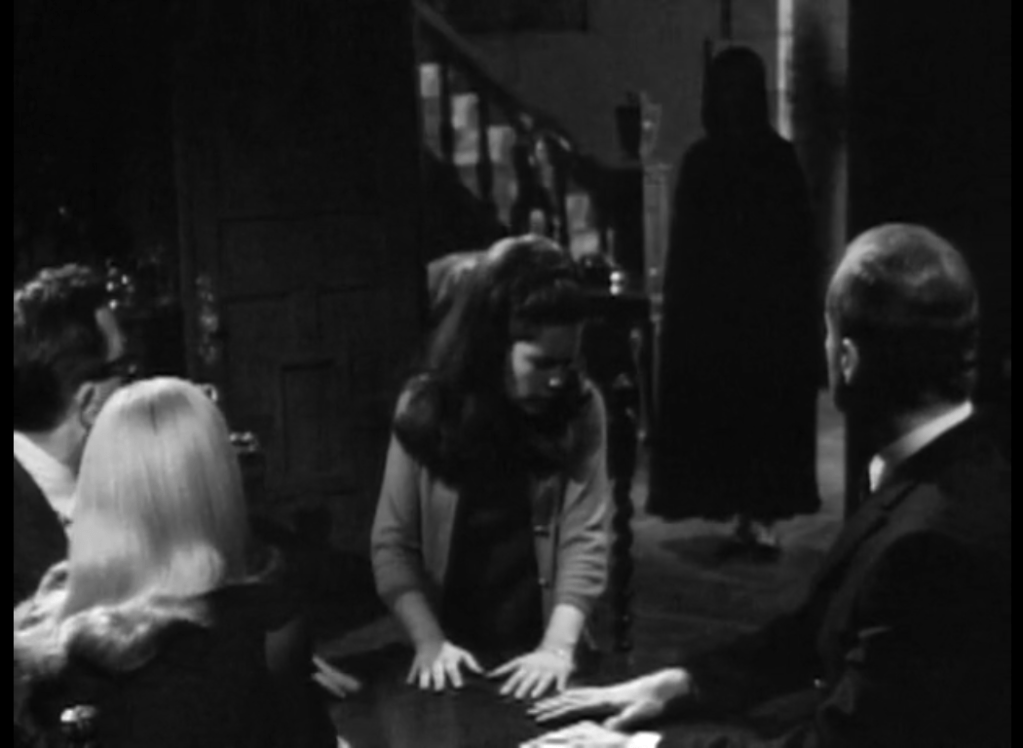
Shortly after Eve/ Danielle came to life, a wind blew into the room where she was staying, indicating that a ghostly visitor had come to her. She addressed it as “mon petit” and said “I will not go back.” Today, the same visitor appears at the Old House on the great estate of Collinwood, home of recovering vampire Barnabas Collins. The ghostly wind knocks a book off Barnabas’ shelf written in 1798 by one Philippe Cordier. Occult expert Timothy Eliot Stokes is visiting Barnabas and Barnabas’ inseparable friend, mad scientist Julia Hoffman. Stokes decrees that the three of them must hold a séance at once.
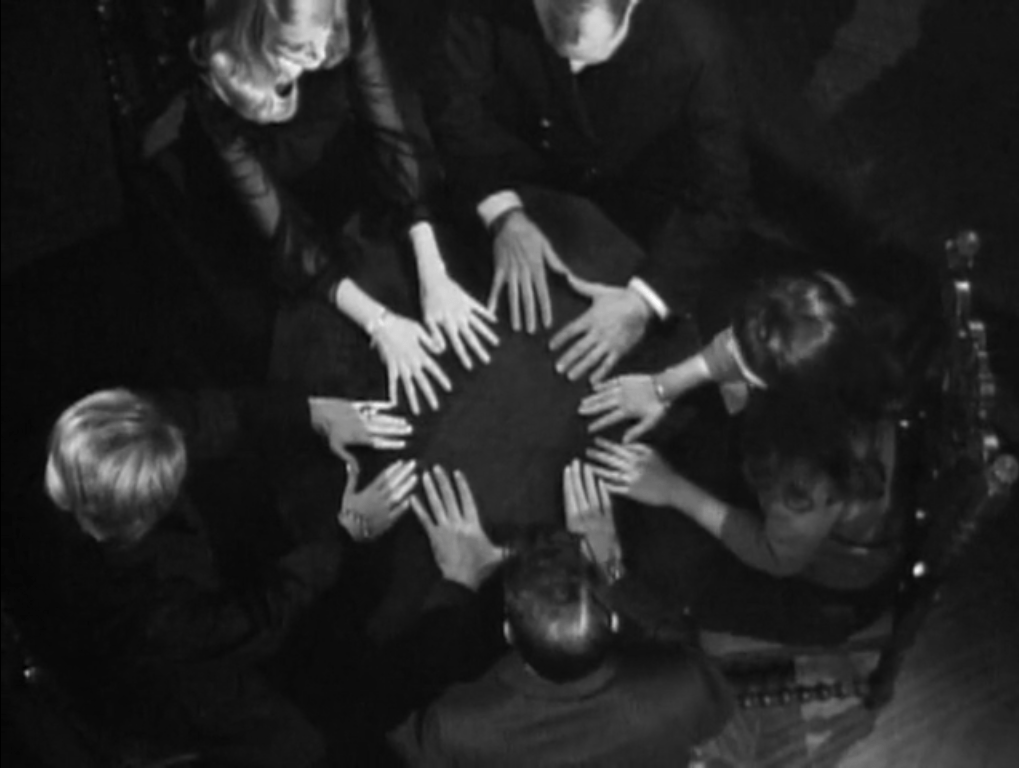
When there is a séance on Dark Shadows, there are three indispensable roles. There must be someone who gives instructions and supervises the proceedings, usually with considerable gruffness. The first time a séance was held in this room, using this table, was in #186, back in March 1967. Well-meaning governess Vicki was the supervisor that time, and it was startling to see her cast aside her demure manner to take the same gruff tone others would adopt in that role. It is not unusual for Stokes to be gruff, but since Julia and Barnabas have both attended multiple séances before, his tone will strike regular viewers as unnecessary.
The second indispensable role is that of medium. That role falls to Barnabas today. He passes out and starts moaning. At this point the third role comes into play. It is Julia who must express alarm and try to break the trance. As supervisor, Stokes must then sternly rebuke her and insist that the dead be allowed to speak through the medium.
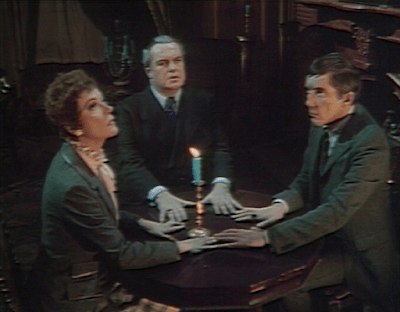
Barnabas speaks a few phrases in French, as Vicki had spoken in French when the spirit of the gracious Josette possessed her in Dark Shadows’ very first séance, in #170 and #171 in February of 1967. He also speaks English with a French accent. Some fans like to poke fun at Jonathan Frid for the French accent that comes out of Barnabas’ mouth today, as indeed some liked to poke fun at Alexandra Moltke Isles for the accent that came out of Vicki’s. To those people I can only say, if those accents sound funny to you, just go to France- you will laugh all day long, because that’s how French people actually talk.
Through Barnabas, Philippe Cordier says that he has been lonely since Danielle’s spirit left him to return to the world of the living. Combined with Eve/Danielle’s refusal to “go back,” this implies that Philippe is Danielle’s boyfriend in Hell. He vows to kill “the man who says he loves her,” viz Adam, which seems illogical- if he wants her to leave the upper world and come back to him in Hell, he could achieve that simply by killing her. If he wants to punish the person who took her away from him, again Adam is the wrong target- it was Nicholas who picked Danielle. Adam had nothing to do with it. But Philippe, even though he was a published author when he was alive, is not an intellect now, only a spirit seeking vengeance. He is raw energy untrammeled by mind, and there is no reasoning with him.
Frid’s turn as Philippe is impressive. We’ve seen Barnabas in many moods, but he always has something to lose and almost always has something to hide. Frid often said that he played him as, first and foremost, a liar. But there is nothing disingenuous about Philippe. He is pure rage. In this tiny performance, Frid embodies that rage, and does not at all remind us of Barnabas.
Adam and Barnabas have a mystical connection that gives them a Corsican Brothers relationship. So far we have only seen this in action twice, both times when Barnabas was suffocating and Adam had trouble breathing. It does not work consistently, and it is not clear if Barnabas will suffer any of Adam’s pain. Indeed, when Adam fell off a cliff and nearly died, it didn’t bother Barnabas a bit. But apparently the bond does in fact go in both directions. When, after the séance, Philippe goes to Nicholas’ house and starts strangling Adam, Barnabas also starts choking.
In February and March of 1967 Dark Shadows was still aimed mostly at an adult audience made up of people who were impressed that the cast included Joan Bennett. But this episode demonstrates how completely it has since become a kids’ show. The first two séances resulted from long preparation, involved great effort, and produced tantalizingly vague, elusive messages. But this time around, the characters see signs of a ghost, Stokes immediately declares it’s time for a séance, and within two minutes Philippe Cordier is complaining about how he has to put himself back on the dating market of the damned. My wife, Mrs Acilius, pointed out that this is like something you would see in a story written by a small child. If the barrier between the dead and the living is inconvenient to the progression of the story, then you throw it out the window and proceed as if you could call up a ghost and have a conversation any time you wanted.



 Dark Shadows Commentary