
Episode 368/369: Whole future

In 1966 and 1967, supernatural menaces Laura Murdoch Collins and Barnabas Collins would often be seen staring out the windows of their houses on the great estate of Collinwood, sending psychic energy towards the targets of their sinister plans. In 1795, Barnabas is neither supernatural nor menacing, but we already see him peering out one of those windows. He is not projecting bad vibes into the world, but is worried about his beloved fiancée, Josette DuPrés. She is supposed to arrive soon, in fact was supposed to arrive some time ago. Now there is a storm, and he hopes she is not at sea.
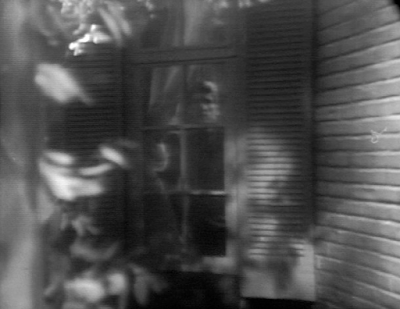
Earliest window-stare, by dramatic date. Screenshot by Dark Shadows Before I Die.

The audience’s main point-of-view character in 1966 and for most of 1967 was well-meaning governess Vicki. Now Vicki has come unstuck in time, and found herself in this extended flashback to the eighteenth century. Since she will know Barnabas and regard him as a close friend in the 1960s, she is at her ease talking to him now. Although she is a member of the staff in his family’s house in a period when it was customary for masters to summon their servants with bells and communicate with them only in direct commands, Barnabas is a remarkably genial and democratic sort who welcomes her casual manner.

Vicki has already annoyed the audience several times by blurting out information that makes it obvious to the other characters that she does not belong in their world. She does that again in this scene. Barnabas is worried something may have happened to Josette, and Vicki tells him that she will arrive safely. He is surprised by the assurance with which she delivers this prediction, and asks if she is clairvoyant. She realizes that she has been indiscreet, and denies that she is. He is unconvinced.

Barnabas’ father, haughty overlord Joshua Collins, enters. He is appalled to find his son socializing with a servant. He dispatches Vicki to the nursery to look after her charge, his young daughter Sarah. He demands to know why Barnabas is not tending to his own duties at the family’s shipyard. They begin to quarrel, when a knock comes at the door.

Barnabas opens the door to find a woman named Angelique, whom he identifies as maid to Josette’s aunt, the Countess DuPrés. Angelique says that the countess was on her way to Collinwood, but that her carriage is stuck in the mud. Joshua orders Barnabas to send a footman to rescue her. Angelique is the first character we have met in 1795 who is not played by a performer we have seen in the first 73 weeks of the show.

Enter Angelique. Screenshot by Dark Shadows Before I Die.

Joshua goes to his wife, Naomi. Naomi is an alcoholic, a fact of which we are made aware because almost her every scene begins with a shot of her drinking alone. That’s what she is doing before Joshua finds her. He scolds her for her drinking; she complains that he doesn’t allow her to do anything else. She can’t even pass the time with a book- we saw Monday that Naomi is completely illiterate.

Glug glug glug. Screenshot by Dark Shadows Before I Die.

Naomi’s alcoholism is both a nod to the concern of first-wave feminism with the atrophy of the elite housewife, and a suggestive side-light on Barnabas as we knew him in the 1967 segment. Then, Barnabas abducted Maggie Evans, The Nicest Girl in Town, and tried by more or less magical means to replace her personality with that of Josette. For the first 40 weeks of Dark Shadows, Maggie’s father’s alcoholism had been a substantial story element, and she would always retain a number of classic Adult Child of an Alcoholic (ACoA, in the lingo of the recovery movement) characteristics, such as beginning utterances with a little laugh to prove that she is happy. Now that we know that Barnabas is also an ACoA, we can wonder if that shared experience was part of the reason he was drawn to Maggie.

The countess arrives. Since she is played by Grayson Hall, who also plays mad scientist Julia Hoffman in the parts of the show set in the 1960s, Vicki blurts out “Julia!” when she sees her. Hall had also been nominated for an Academy Award for her performance as Judith Fellowes in the 1964 film Night of the Iguana; if Vicki is going to keep the audience up to date on the cast’s resumes, it would have been more interesting if she’d exclaimed “Judith!” Vicki explains that the countess looks like someone she once knew who was named Julia, a remark which irritates the countess, who would like to think her appearance is distinctive. Vicki has certainly not made a favorable impression on this grand lady.

Joshua tells the countess he is surprised that “You still affect a title” when “France has followed our example and become a republic.” His pride in this development, after the Terror and in the bloodiest year of the wars in the Vendée, marks Joshua as a member of the Jeffersonian party in US politics. The Federalists and others had long since turned against the French Revolution by that year.

The countess tells Joshua that it is precisely because France has become a republic that she chooses to live on the island of Martinique. That answers a question that some fans ask about Angelique- why is she white? If the DuPrés family lives on Martinique and are major sugar planters there, they must hold a great many African people in slavery. When we hear that they are bringing a servant with them, we expect that servant to be Black. When we learn that the the countess is an emigré, we realize that she brought Angelique with her from France.

The countess may solve one puzzle for us in her exchange with Joshua, but she presents us with another. Josette’s father André is the countess’ brother, yet he is never referred to as a count. Indeed, when he appears, we will see him answer to “Mr DuPrés.” Perhaps he renounced his title, as many French aristocrats did during the Revolution.

Whatever the explanation, “DuPrés” would seem to represent a missed opportunity. When Josette was first mentioned, in the early months of Dark Shadows, her maiden name was given as “LaFrenière.” It would have been a nice touch to have kept that name for Josette and her father, and to have reserved “DuPrés” as the name of the countess’ late husband.

“LaFrenière” had been a perfect choice because of its class ambiguity for a show about an aristocratic family in the state of Maine- it was originally the family name of the barons of Fresnes, and could therefore be a sign of a senior order of nobility, but is also a very widespread name in Quebec. So “Josette LaFrenière” might either have been a French noblewoman who deigned to marry into the mercantile Collins family at the apex of their prestige, or a working class girl from the north who eloped with the boss’ son.

The choice of Martinique as Josette’s place of origin might add a new twist to this class ambiguity. The Empress Josephine grew up there as a member of the untitled but ancient Tascher family, who, like the fictional DuPrés family, owned an enormous sugar plantation on the island. The Taschers of Martinique went back and forth between Martinique and metropolitan France, and Josephine herself was living there in 1779 when she married her first husband, the Vicomte de Beauharnais. Josephine herself was in prison when the vicomte was guillotined in 1794, one of the last to die in the Reign of Terror, and she was freed just a few days later. The next year, she recovered her husband’s property, and a year after that married the young general Napoleon Bonaparte. It seems likely that the similarity between the names “Josephine” and “Josette” was writer Sam Hall’s inspiration for placing Josette’s origins on Martinique. Association with a figure who was at once a grand lady and an example of very steep upward social mobility could synthesize the two possible Josettes LaFrenière into a single figure.

Had they developed the story of the family’s relationship with the town of Collinsport more richly in Dark Shadows 1.0 and 2.0, they could have used this ambiguity to build up suspense that would be resolved today, in the third episode of Dark Shadows 3.0. Since they did so little with that theme in those days, when the story was moving very slowly and it would have been relatively easy to fit just about anything in, I suppose we shouldn’t be surprised that they drop it so completely at this period of the show, when the story is flowing at a breakneck speed.

The countess’ lofty aristocratic manner stings Joshua. Alone with Naomi, he loudly proclaims his belief that all men are equal. We already know enough about Joshua’s tyranny over his household that this absurd little speech must be an intentional spoof of the rich landowners who supported the Jeffersonian party in the early decades of the Republic. Again, this would be funnier and more poignant if the show had done more with social class in its first 73 weeks.

Barnabas sees the countess dealing out tarot cards. He tells her she is too sophisticated for them, and is reluctant to sit with her while she uses them to read his fortune. The moment she says that the cards suggest a connection between him and the concept of infinity, his skepticism evaporates instantly and he excitedly asks if that means he will live forever. The countess cautions that his jubilation at this idea may be misplaced. She notices the “Wicked Woman” card, and takes a significant look at Vicki. Evidently the audience is not alone in objecting to Vicki’s brainless nattering about what the show used to be like.*

Angelique comes to Barnabas’ room. It turns out the two of them had a brief affair when he was first on Martinique, and she expects to resume it. He is not at all pleased at her attentions.
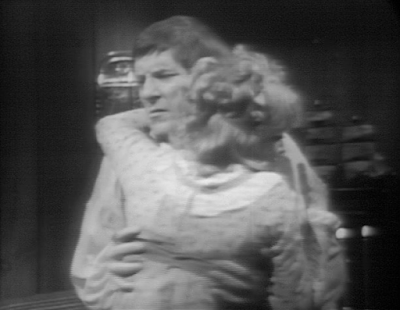
Not how every man would react to a passionate embrace from Lara Parker… Screenshot by Dark Shadows Before I Die.

Barnabas explains that he was already falling in love with Josette when he and Angelique had their fling, but that he didn’t really know her. He couldn’t believe that she would reciprocate his feelings, and consoled himself by dallying with Angelique. This explanation goes over with her about as well as you’d expect, and she storms out of the room, vowing that she will get her way in the end.

We know that the tarot cards are giving accurate information, because the show leans heavily on the uncanny and they wouldn’t have spent so much time on a gimmick that wasn’t meant to advance the plot. We also know that Vicki is not the Wicked Woman the countess is looking for. That leaves Angelique, and we can assume that her wickedness will express itself in some supernatural action taken to avenge herself on Barnabas. Since we know that Barnabas will become a vampire, we wonder if it is Angelique who makes him one.

Closing Miscellany

I usually refer to surviving cast members with courtesy titles and to deceased ones by surname alone. So Alexandra Moltke Isles is “Mrs Isles,” which has been her professional name for 56 years, David Henesy is “Mr Henesy,” Nancy Barrett is “Miss Barrett,” etc, while Jonathan Frid, Joan Bennett, Louis Edmonds, and Grayson Hall are just “Frid,” “Bennett,” “Edmonds,” and “Hall.” Until last month, I’d been looking forward to saying lots of things about “Miss Parker” and her portrayal of Angelique, but Lara Parker died on 12 October 2023. So she’s just going to be “Parker,” and I’m going to be sad about it.

Artist Teri S. Wood has created a number of short animations about Angelique and Barnabas. This one is based on their two-scene at the end of today’s episode:

https://www.youtube.com/watch?v=pyxI0q2aOIk

Patrick McCray has a post about this episode that mystifies me. He writes that “After seven months of hearing about Angelique, today, she enters. So, no pressure Lara. You only have to live up to a half year of build-up.” Uh, what? There has been absolutely no reference to Angelique on the show before today. I can think of an interpretation of the story that might retroject Angelique into episodes #211-365, and I will talk about it next week. But I don’t think it is an interpretation Patrick would favor.

He also talks about David Ball’s method of reading plays from the ending back to the beginning and then from the beginning forward, so that the ending comes to seem implicit in everything else. He allows that Dark Shadows has more than one ending, but I would say he doesn’t go far enough. I’d say the series has ten endings. The first came in #191, when Laura went up in smoke while her son David found refuge in Vicki’s arms. That ending defined Dark Shadows 1.0 as the story of David’s escape from his evil, undead mother Laura, and his adoption of Vicki as his new, life-affirming mother. The second came in #364, when Barnabas met the ghost of his little sister Sarah, she commanded him to be nice to the living, and he went right on with his murderous plans. That ending defined Dark Shadows 2.0 as the story of Barnabas’ irredeemable evil.

Two of the other endings will feature Angelique dying in Barnabas’ arms, and Patrick suggests that those make the whole show the story of their relationship. I don’t buy it at all. Each of the ten parts is about what it is about, and even those two episodes with Angelique dying derive more dramatic charge from other moments.

*Making connections with the first 73 weeks is my job!
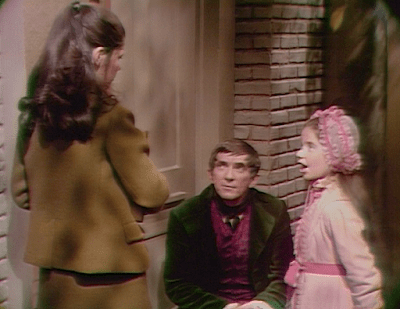
Episode 366: Who else could I be?

In 2021, I left a comment on Danny Horn’s blog post about episode 256. I found great significance in the introduction of the ghost of ten year old Sarah Collins:

I’d say Sarah’s introduction is the single most important moment in the whole show, more important than Barnabas coming out of the box, more important even than Barnabas’ first decision not to kill Julia.

From the beginning they’d been playing with the idea that there was another cast of characters hidden behind the characters we’ve been watching, supernatural characters who can make their influence felt at certain moments. The most prominent of these was the ghost of Josette. This ghost is a serene, distant, imperturbable. When her ghost and the ghosts of the widows rescue Vicki from Matthew in 126, there is an amused smile in Josette’s voice, the sound of someone for whom nothing very important is at stake in the affairs of this world.

When David sees Maggie in Josette’s clothes and mistakes her for the ghost of Josette in 240 and 241, it is clear that if the ghost of Josette returns, it will not be in that mode. After that sight, Josette’s ghost can return only as a terrifying spirit of vengeance. And David’s confrontation with Willie in 253 makes it clear that the protecting ghost will not return at all.

So the show has discarded the old supernatural realm of Josette and the widows, a realm that was, as you say, never more than slightly accessible. With Sarah’s appearance, we are introduced to an entirely new part of the show. Once again we have a set of characters hidden in the supernatural background, but they can interact with the characters from the main continuity more directly and at greater length than Josette and the widows ever could.

The puzzle of Sarah’s connection to Barnabas, and her talk about looking for the members of her family, indicates that this new order of supernatural beings have complex and unsettled relationships with each other, and that characters from the main continuity can have an influence on those relationships. We will have to figure those relationships out in the weeks and months to come, but as soon as Sarah demands Maggie not tell her big brother that she saw her, we know that they might come to enmesh the living beings. Every scene with Sarah, then, is a step leading directly to the time-travel and parallel universe storylines that will come to define the show.

“Acilius,” 15 September 2021, on Dark Shadows Every Day, Episode 256: Falling Down

By the end of last week, Dark Shadows had, for the second time in its 73 weeks on the air, run out of stories to tell. When Dark Shadows 1.0 ended with the disappearance of blonde fire witch Laura Murdoch Collins in #191 and #192, the way forward was clear- introduce another supernatural menace to succeed Laura. That came in the form of vampire Barnabas Collins. As people tuned in to see how a daily soap opera could fit a vampire into its pattern, Dark Shadows 2.0 became a bona fide hit and a major pop culture phenomenon.

The first version of the show came to an end because none of the non-Laura stories ever really took off and the only danger Laura presented was that she would incinerate her son David when she herself vanished in flames. Once that was prevented, her threat profile was closed and the show needed to start over.

The second version crackled along quite well for months. It’s true that a number of the storylines had reached their natural conclusions, but they made little to no effort to replace them. On the contrary, they went out of their way to close off possible narrative directions. While even the slowest parts of Dark Shadows 1.0 left us guessing what might come next, the final weeks of Dark Shadows 2.0 present us with nothing but a series of blank walls. The first time I saw the show, I watched #365 without a single idea as to what they could do in #366.

What they actually do is to launch Dark Shadows 3.0 by flipping the back-world of the dead past into the foreground, while the characters and events of 1967 are thrust behind the action into a realm only we and Vicki know anything about. Indeed, it is Sarah who executes the switch.

We had a glimpse of what that might look like in #280, when Barnabas hosted a party in the Old House on the estate of Collinwood, restored in an eighteenth century style, to which the living members of the Collins family came dressed as their ancestors of that period. In Friday’s episode, we saw a séance in the great house on the estate on a dark and stormy night. Sarah spoke through well-meaning governess Vicki and said she would “tell the story from the beginning.” At that, Vicki vanished from the table, her eighteenth century counterpart Phyllis Wick appeared in her place, and Vicki found herself outside the Old House on a sunny day in the year 1795. Today, she meets the living versions of Barnabas and Sarah, as well as some of those who were impersonated at Barnabas’ costume party.

The first person Vicki meets in 1795 is Barnabas. She has spent a great deal of time with him in 1967, so she assumes he is just in costume. He is startled by her clothing- she is still dressed as she was at the séance. He assures her they have never met, and when she keeps insisting they have he begins to suspect that she is insane.

Sarah meets them and declares that Vicki is her new governess. Evidently she had some kind of premonition as to what her new governess would look like, and Vicki meets the description. Barnabas brightens and asks Vicki if she is a governess. She acknowledges that she is. Before she can explain that she is governess to a boy who won’t be born for 160 years, he ushers her into the house.

Old friends? Screenshot by Dark Shadows Before I Die.

The writers faced a thorny problem with this segment of the series. Vicki has spent a great deal of time with Barnabas and has seen Sarah, so she must recognize them. On the other hand, most of the rest of the people she meets in 1795 will be played by the actors who have played characters she knew in 1966 and 1967. When Victoria is alone in the front parlor of the house, we find out how they have decided to handle this situation. Joel Crothers, who in the contemporary segment of Dark Shadows played hardworking young fisherman Joe Haskell, enters in the character of bon vivant naval officer Nathan Forbes. Vicki throws herself in his arms and gushes about how happy she is to see him. Nathan is quite happy to see her, since she is a remarkably beautiful young woman and extremely friendly, but he is puzzled that she insists on calling him Joe.

The scene between Nathan and Vicki is pretty funny, and it’s understandable that Vicki would react as she does. But it’s also ominous. When we see actors at work, we may remember other parts they have played, but we don’t expect their scene-mates to bring them up. They are just supposed to accept them as whoever they are supposed to be at that moment. When Joan Bennett enters, not as twentieth-century matriarch Elizabeth Collins Stoddard, but as Liz’ ancestor Naomi Collins, we wonder how Vicki will react to her. Indeed, she does slow things down with a lot of wailing about how she can’t believe she isn’t Mrs Stoddard, a person of whom Naomi has never heard. It then dawns on us that every time Vicki meets anyone, she’s going to drag us through this same business where she mistakes them for another character the actor has played. That’s going to annoy us and make the other characters think she is deranged.

One of the reasons Vicki’s yelling about the cast’s resumes annoys us so much is that we all know how to look at the various characters an actor has played and see how they illuminate each other. We don’t need her to tell us to do that. Academics put that into a category of practices called “iconography,” which is shorthand for the idea that we remember what we’ve seen more than once in various kinds of movies and shows and notice when we see it again.

As Liz, Joan Bennett was the sort of imposing matriarch she often played as a major star of feature films and the Broadway stage. Virtually every event we saw in the first 25 weeks of Dark Shadows had its origins in Liz’ reactions to the events around her, and she was still the single most powerful figure in the whole gallery of characters for 30 weeks after that, right up to the death of seagoing con man Jason McGuire in #275. Everyone else was dependent on her, in one way or another.

Naomi is the lady of the manor in 1795, as Liz is in the 1960s. But we quickly learn that she is at the opposite extreme from her descendant. When invitations come for Barnabas’ upcoming wedding, she asks Nathan to read them to her. While Liz dominates the family and the town from her desk, Naomi is entirely illiterate.

This is something of an anachronism. Colonial New England was founded by Puritans who thought everyone ought to read the Bible, and so provided elementary schooling for all children, boys and girls. Scholars estimate that by the end of the eighteenth century, over 90 percent of men and about half of women in that region would have been able to read the Bible easily. A woman as wealthy as Naomi would certainly have had this ability, and the basic literacy which Naomi lacks would have been a rarity at any level of society. Perhaps the writers and producers of Dark Shadows were unaware of this history. Perhaps they are suggesting that she, like her son’s fiancée Josette DuPrés, came from some part of the world that valued literacy less highly than did New England. In any case, they do show us how severely disadvantaged she is in any disagreement with the men in her life, and how narrowly the bounds of her activities are circumscribed.

Barnabas comes back with the news that the carriage bringing Sarah’s governess overturned. The governess herself is missing from the scene of the accident; the other three people aboard were killed. When Phyllis Wick appeared in Vicki’s place at the séance, she did indeed say that she had just been in a carriage wreck, so this news will not come as a complete surprise to returning viewers.

Messenger scene. Screenshot by Dark Shadows Before I Die.

This brings up a question and points to a missed opportunity. The question is whether Phyllis’ carriage had overturned in the original course of events. If so, perhaps she was killed along with the other three, and Sarah never did get a new governess. If not, then Sarah’s ghost killed three people when she sent Vicki back in time. Sarah has always been nice to people we liked, and has declared her allegiance to goodness. But she is also pretty clumsy, so she might have killed them inadvertently.

The missed opportunity is that Vicki could have entered 1795 at the scene of the accident. Had she been found in the wreckage, in Phyllis’ dress, with a wound that kept her from speaking for the first week of the segment, it would make sense that she was taken for the new governess. Of course, we wouldn’t have to see a carriage- some sound effects and a shot of Vicki on the ground, with some smudges on her face and the rim of a wagon wheel partly visible near her, would have been plenty. Surely the budget would have allowed that much.

Had Vicki been mute for the first week of the story, we could have seen her face and heard her thoughts in pre-recorded voiceovers as she saw Barnabas and Sarah and recognized them; we could have seen her face but not heard her thoughts as she saw other familiar actors in new roles, leaving it open whether she saw them as the same people she knew in the 1960s. By the time she had regained the ability to speak, she would have caught on that she had to pretend to be Phyllis Wick, to be a native of the eighteenth century, and to be new to Collinsport.

That way, she would start off with a reasonable chance of making a go of life in that era. Moreover, as we were drawn to Barnabas when we watched him trying to pass as a native of the twentieth century, we could be excited to see Vicki try to present herself as a native of the eighteenth. As it is, she is constantly drawing attention to herself as an alien, so much so that it is hardly likely the Collinses would want her in their house in any capacity, certainly not as tutor to their beloved daughter. Moreover, starting Dark Shadows 3.0 with Vicki doing what Barnabas did in Dark Shadows 2.0, while Barnabas would take the role Vicki played in their relationship then, as a benevolent if uncomprehending friend, would shed new light on both characters and on their stories. What she does instead is to annoy us and make it difficult to care about her at all.

We do get a brief inversion of Vicki’s relationship with her charge from the 1960s, strange and troubled boy David Collins. When Vicki first met David in #4, he greeted her with “I hate you!” and she assured him that they were going to be good friends. Vicki certainly does not hate Sarah, but she would appear to any observer who did not know what we know about her to be mentally ill, just as David appeared to be when first we saw him. It is little Sarah who cheerfully assures Vicki that they will be good friends. As her mental health is the least of Vicki’s problems now, so it turned out in 1966 that David’s difficulties stemmed, not from delusions, but from an all-too-accurate understanding of his metaphysical relationship to the world he lived in. Vicki rose to the challenge and became the companion and supporter David needed. In Sarah’s prediction that she and Vicki will be good friends, we therefore hear a promise that the show will develop a relationship between the two of them in which Sarah will emerge as Vicki’s confidant and protector.

The series was made with very little advance planning. Just a few weeks ago, we heard about a painting or drawing depicting Barnabas and Sarah as children of about the same age, yet today we see the forty two year old Jonathan Frid playing Barnabas as a fatherly figure to Sarah as played by ten year old Sharon Smyth. Still, they’ve put so much into the costumes and so much thought into the new characters that they must have meant for this segment to last more than a couple of weeks. Having Vicki insistently call everyone by the wrong names and then run around idiotically announcing information that she knows only because she is from 1967 puts her on the express train towards an insane asylum. If they don’t stop her doing those things right quick, they will have written themselves into a corner before they’ve got their money’s worth out of the work they have already done.

The episode looks very different from anything we’ve seen on Dark Shadows before. The series has been in color for months now, but there have only been one or two days when they managed to use color as anything more than an occasional special effect. Today, they are working from a palette of pinks and greens that give a sense of lightness and good cheer that is altogether new to the show. It doesn’t really play out in the visual strategy of the episode- the story they are telling in pictures is aimed chiefly at the majority of viewers who are watching on black and white sets. But for those who do have color television, it is unmistakable that this is not the same show that ended on Friday.