
We open with the sight of a man (Dennis Patrick) sitting nervously on a chair placed in the middle of a pentagram marked on a rug. At each point of the pentagram there is a candle. The man is Paul Stoddard.
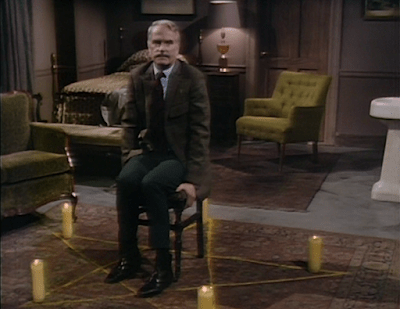
Regular viewers will remember #752, in which Quentin Collins was told to sit on a chair in the middle of a similar pentagram. Quentin’s friend, amateur warlock Evan Hanley, told him that by doing this he could keep from turning into a werewolf. Paul isn’t afraid of turning into a werewolf, and he doesn’t have a friend like Evan. His worry is vague, but urgent- he knows that someone is after him, that if that someone catches up to him they will do something horrible, and that whoever it is keeps sending him messages that it is time for him to pay his debt. But he has no idea who that is, what they will do, or what the debt they are talking about. Sitting in the pentagram was a suggestion that came from a sailor who cruised him in a gay bar met him in a local tavern.
Paul’s pursuers are a cult associated with mysterious beings known as “the Leviathan people.” It has been made clear to us that both Paul and his daughter, heiress Carolyn Collins Stoddard, are, unknown to themselves, part of its orbit. In #888, Paul and Carolyn ran into each other at a cairn that is the cult’s ceremonial center and looked at it. Carolyn had been on its site many times, and could not understand why she had not seen it before. In #894/895, the cult’s acting leader, Carolyn’s distant cousin Barnabas Collins, took antique shop owner Philip Todd to the cairn. Philip told Barnabas he had walked past the site a few days before and that the cairn was not there then; Barnabas explained that only those connected with the Leviathan cult can see it. Barnabas has also been highly solicitous of Carolyn’s well-being since he became part of the cult, and he keeps telling her that he knows she has an extraordinary future ahead of her. So we know that the cult has plans for her, and Paul’s distress suggests that they have less attractive plans for him.
Paul sees the doorknob turning. He is terrified. Instead of the enemy Paul expects, Carolyn enters. He yells at her to leave. She stays. When he is unable to explain what he is afraid of, but that the pentagram on the floor will protect him, she notices that it is the same as the symbol she has been wearing on a chain around her neck. Barnabas gave it to her some days ago and urged her to wear it always. The audience knows, but she does not, that he intends it to protect her from the local werewolf. When she sees the similarity, the show invites us to wonder what the Leviathans have to do with werewolves. Carolyn tells Paul that if the symbol will protect him from his enemies in the form of chalk or gaffer tape on the floor, it will also protect him when it is composed of a silver pendant. He puts the pendant on and declares that he feels much better. He can no longer hear the voices that have been telling him his payment is due immediately. He embraces Carolyn and tells her he trusts only her.
When Carolyn mentioned Barnabas to Paul, he responded “Who is Barnabas?” Carolyn seems surprised he does not know, since she saw him near Barnabas’ house. Indeed, we saw him enter Barnabas’ house and wander through it the night he first returned to Collinwood, after an absence of twenty years. But he doesn’t remember anything about that.
Not that Carolyn’s own long acquaintance with Barnabas is all that enlightening to her just now. Ever since the Leviathans adopted him as one of their own, he has not been himself at all. We see him in his front parlor with mad scientist Julia Hoffman, who has for a year and a half been his inseparable best friend. She is trying to interest him in some information she has gathered about another storyline, and he makes it clear he could not be less interested in it or in her. She demands to know what he is interested in, and he refuses to answer. Carolyn enters, and suddenly Barnabas is all ears. Julia, frustrated, snaps that now she can see what he does care about.
In the autumn of 1967, Barnabas was a vampire and Julia had failed in an attempt to make him human again. He bit Carolyn and made her his blood thrall. He also decided that he would kill Julia to prevent her exposing him. Julia soon learned that Carolyn was both a wily operator and a most devoted servant. Julia had already realized that she was in so deep with Barnabas that she would be unlikely ever to make a life with anyone else, and so she conceived an unrequited love for him. In her dealings with Carolyn in those days, terror mingled with jealousy. Her bitter remark when she sees that Barnabas, who has been so dismissive of her, is now so concerned with Carolyn, reminds longtime viewers of that jealousy. Combined with the story of a daughter reunited with her long-absent and none too respectable father, this faint suggestion of a love triangle is enough to remind us that we are watching a daytime soap.
For her part, Carolyn was freed of her subservience to Barnabas as soon as he was freed of the effects of the vampire curse in March 1968. For some time, Nancy Barrett went out of her way to play Carolyn in a way that left us wondering if Carolyn remembered her time in his power. The scripts didn’t give her a lot of support in that endeavor, but the closeness she feels towards him combines with Julia’s jealousy to bring it back to our minds.
Carolyn has come to ask Julia to help Paul. Julia is back in the great house of Collinwood getting her medical bag to take to Paul’s hotel room when Paul himself bursts in. He demands to see Carolyn. Julia tells him that she left a little while ago to go to his hotel, and is probably there now. The telephone rings. Julia answers it, and tells Paul it is for him. This doesn’t strike her as odd, even though he hasn’t set foot there in twenty years, not since the night he left his wife Liz thinking she had killed him. Julia hands the phone to Paul. He expects to hear Carolyn, but instead hears the same voice that has been taunting him, saying that his bill is due now. He hangs up, and it starts ringing again. He forbids Julia to answer it, and runs out. We cut to his hotel room, and see that this time it is Carolyn trying to reach her father. Later, Carolyn will come home and Julia will tell her that Paul doesn’t seem to want help, however much he may need it.
Paul goes back to his room, and hears the phone there ringing. Terrified, he runs out, returning to the bar where he’d picked up trade met a new friend the night before. He sees another stranger sitting at a table, looking him over and beckoning him by rolling back one finger. The stranger is Barnabas.
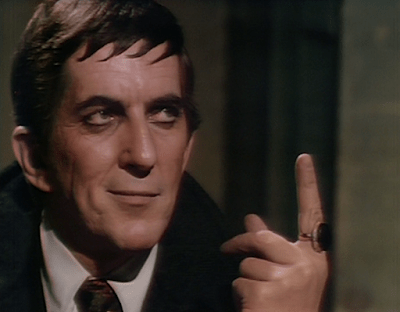
Paul reluctantly goes to the table, and Barnabas introduces himself. Paul says he doesn’t know Barnabas, but Barnabas makes it clear he knows all about Paul. He asks him to think back to the night he left Collinwood in 1949. We dissolve to a flashback.
Paul is at the bar, and another strange man strikes up a conversation with him. The man encourages him to assume that he has the power to grant any wish Paul might make in return for a price they would agree on. Paul says that in that case, he will ask for twenty years of boundless prosperity. At the end of those twenty years, Paul will give up anything he has, even his “most precious possession.” They shake hands on this deal. Paul laughs, and says he has won the game. He said that he would surrender anything he has, present tense- not anything he might gain in the course of his successful future, but anything he has as of 4 December 1949. On that date, Paul assures the man, he has nothing anyone could possibly want. The man laughs, and wants to drink to congratulate Paul on his cleverness.
Back in the present, Barnabas is laughing as heartily as the other man did twenty years before. He finds it preposterous that Paul could have forgotten such an important encounter. Paul can’t see anything important in it- it was just a silly little game, and its only consequence was that a strange man bought him a drink. Barnabas says that on the contrary, the bargain he struck was quite real. The Leviathans kept their side of it by giving him the success he has had over the last twenty years. Now that the twenty years are up, the time has come for them to claim the most precious possession he had the night he fled Collinwood.
Paul says that he supposes Barnabas is talking about his soul. He laughs heartily at that, and tells Barnabas that he is welcome to it. He is telling Paul that that is not what he meant as Carolyn enters. Paul is still laughing, and is delighted to see his daughter. She says she is relieved that the two of them found each other, and he tells her everything will be all right now. Barnabas says that Carolyn is her father’s most precious possession.
The scenes of Paul rushing around in a steadily mounting panic he is unable to explain are highly reminiscent of The Twilight Zone. The last line is a twist worthy of that classic series, especially as delivered by Jonathan Frid. His icy performance as Barnabas in these early episodes of the Leviathan arc not only recalls the malign representatives of alien powers on that show, but is superb in itself. He stumbles a little over his words in Barnabas’ scene with Julia, but is perfectly composed otherwise, and the effect is quite frightening.
I remarked on the gay subtext of the barroom scenes in the comment thread on Danny Horn’s post about the episode at his great Dark Shadows Every Day:
So far, this has been the gayest storyline the show has taken on yet.
In 899, the sailor offers to buy Paul a drink, and Paul shouts “I buy my own drinks!” This isn’t subtext- any man getting that reaction in a bar will know that the other fellow has interpreted his offer as including more than the drink. Paul apologizes and becomes friendly, indicating that he is willing to abandon that interpretation and set aside the hostility that accompanied it.
In this episode, we’re back in the same bar. Barnabas beckons Paul to his table with his index finger. I invite any man who doesn’t think we are intended to read this as a reference to a sexual come-on to try that move on a homophobic tough guy in a bar.
Paul’s face shows his inner struggle as he tries to resist Barnabas’ advances, but he can’t. Barnabas coaxes him into reminiscing about yet another night in the same bar, when a casual encounter with yet another guy led to something that seemed at the time like a little harmless tomfoolery, but that has now grown into a threat to his relationship with his family, his standing in the community, his physical well-being, and everything else.
Comment by “Acilius,” left 12 December 2020 on Danny Horn, “Episode 900: The Long Con,” posted on Dark Shadows Every Day, 18 July 2016.
In response to someone who said some kind words about that comment, I made a remark that I no longer think is very good:
Thanks! It’s a bit of a puzzle- so far as I know, none of the writers on the show at this time was gay, so I’m not sure why they decided to go so deep into these themes just then.
Comment by “Acilius,” left 11 April 2021 on Danny Horn, “Episode 900: The Long Con,” posted on Dark Shadows Every Day, 18 July 2016.
What I think now, and probably would have thought then if I had stopped and considered it for a minute before I hit “Post Comment,” is that the writing staff’s sexuality has nothing to do with it. They were worldly, sophisticated people with long experience in the theatrical profession in New York City. They all probably had many gay friends, and when they are called upon to write a story about people being drawn into a secret underworld and learning uncomfortable truths about themselves in the process their minds will naturally turn to themes having to do with closeted homosexuality. Granted, that doesn’t fully account for Christopher Bernau’s decision to play Philip as a much queenier version of Paul Lynde, but it is hardly a “puzzle” that the writers would draw on motifs suggestive of the closet when that’s the story they have to work with.
The man who met Paul in the bar in 1949 is unnamed in today’s dialogue, but will later be referred to as Mr Strak. Strak is played by John Harkins, who appeared in #174 as Lieutenant Costa of the Arizona State Police and in #878, 879, 880, 881, and 883 as Garth Blackwood, formerly the keeper of England’s Dartmoor Prison, and by that time a creature raised from Hell to wreak vengeance on an escaped prisoner and anyone else who caught his attention.
Strak’s name may remind longtime viewers of another minor character whom we saw in episodes #1 and #2, Wilbur Strake, private eye. We saw Strake in this same bar, where he gave reports about Carolyn and other members of the Collins family to his employer, Burke Devlin. Like Strak, Strake was a rather smug, sardonic sort. Add to this the rarity of the names “Strak” and “Strake” and the fact that they sound so much alike, and it seems obvious that there is an intentional reference of some kind. Paul’s presence in this storyline is the result of the writers reaching back to the show’s early days to find a loose end they could attach to this storyline to incorporate it into the Collins family saga, so they probably were looking through the scripts from the first week. Still, I can’t imagine they thought many people would remember Wilbur Strake by this point. Likely the reference is an inside joke, but who was on the inside and what the point of the joke was, I can’t begin to guess.
I wasn’t writing detailed posts with background information when I covered the first weeks of the show, so I will mention here Strake was played by Joseph Julian, who later became a regular on Somerset, a soap that aired on NBC opposite Dark Shadows for the last year of its run. The cast of Somerset included several Dark Shadows alums, including Dennis Patrick, Joel Crothers, and Christopher Pennock in major roles, and, as day players, Dolph Sweet and Humbert Allen Astredo.

 Dark Shadows Commentary