It’s chiasmus week on Dark Shadows. Chiasmus is when the last thing that happens in a story resembles the first thing that happened. Usually that causes the audience to look back on that first thing in a new light. Sometimes chiasmus gets very detailed, and the first several things are mirrored by the last several things.
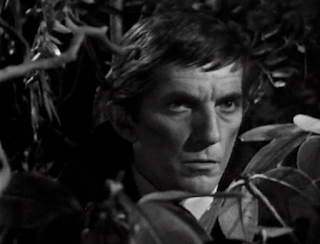
On Wednesday, we began with well-meaning governess Vicki asleep in vampire Barnabas Collins’ house on the estate of Collinwood. Barnabas crept into her bedroom and stood over her, but did not bite. Then it was morning, and Barnabas’ sorely bedraggled blood thrall Willie delayed Vicki as she was leaving the house. Vicki took our point of view with her to the great house on the estate, where we started to see events through the eyes of visiting mad scientist Julia Hoffman. That episode ended with Julia going to Barnabas’ house. Willie delayed Julia entering the house, and Barnabas and Julia met. Their scene was tense, but Barnabas did not use any of his powers against Julia. That chiasmus marked the transition from Vicki to Julia as the audience’s main character to identify with.
On Thursday, we began with Barnabas spying on Vicki through her window, then entering her bedroom and standing over her while she slept. He again left the room without harming her. We ended with Julia spying on Barnabas through his window, then entering his house, opening his coffin, and looking at him. The parallel is completed when we see today that she left the coffin room without harming Barnabas. That chiasmus showed that Julia is capable of turning the tables on Barnabas.
Today’s episode begins with a reprise of yesterday’s cliffhanger, showing Julia gasping when she opens the coffin. So returning viewers suspect that it is likely to end with Barnabas in Julia’s room, and the suspense comes as we try to figure out how he will get there and how she will escape his malign power.
We see Julia in the drawing room of the great house talking to her friend, addled quack Dave Woodard. Dr Woodard says that her failure to report to him on the progress she has made with their common patient, Maggie Evans, The Nicest Girl in Town, coupled with her presence at Collinwood, a hundred miles from the hospital where Maggie is, has forced him to remove Maggie from her care. Julia lies to him, claiming that she has no progress to report and that the whole thing is impossibly boring. This somehow convinces Dr Woodard to leave Julia on the case.
Julia is at Collinwood pretending to be an historian studying the old families of New England, and Vicki has volunteered to help her in her research. Now Vicki is terribly afraid that if she gets involved in what Julia is doing, she will become involved in things that are too interesting for her to handle, and she wants to withdraw before she forever loses contact with tedium and drabness.
Barnabas tells Vicki that she has nothing to fear from “the past,” which at this point on Dark Shadows means the plot. While he is reassuring her, the set catches fire. We hear fire extinguishers and other noises in the background, but Jonathan Frid and Alexandra Moltke Isles don’t break character for an instant. The scene is a dreary one, marking as it does the doom of Vicki as a major part of the show, and the lines are poorly written, but they are absolutely committed to their work.
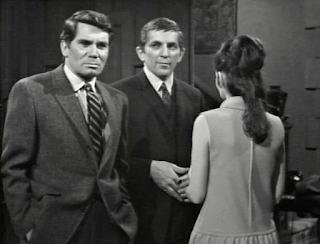
Barnabas does not believe Julia’s cover story, and is quite sure she represents a threat to him. He meets with her in the drawing room to reiterate his refusal to cooperate with her project. When Julia says that she is particularly interested in his “namesake”- actually himself- Barnabas airily asserts that he was by all accounts a dull fellow. Julia may have been able to sell that line to Dr Woodard on this same set a few minutes ago, but Barnabas doesn’t make any impression on Julia with it. The two of them continue to argue as they pass from the drawing room through the foyer. The dialogue isn’t really any better than what Barnabas and Vicki had in the previous scene, but because Frid and Grayson Hall have a lively relationship to depict- two people who each of whom knows more about the other than they are willing to say, and each of whom knows that the other knows much of what they are holding back- they make their whole sparring match seem to glisten with wit and style.
Barnabas agrees to meet Julia at his house the next evening. After he leaves, Julia tells his portrait that she can’t wait that long for their next encounter, and she knows he can’t, either.
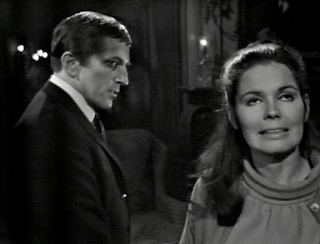
We cut to Julia in her bedroom. Vicki pays a visit, during which we hear another depressing conversation about Vicki’s newfound fear of narrative relevance. Julia assures her that “There is nothing for you to fear.” After Vicki leaves, Julia looks at her clock and sees it is a quarter to one in the morning. We dissolve to the foyer, where the hall clock reads 2:00. Barnabas appears in Julia’s bedroom and approaches the bed, where he prepares to uncover Julia. We then hear Julia greeting Barnabas by name. She emerges from the shadows on the other end of the room, and tells Barnabas she has been waiting for him a long, long time.
A storm is keeping everyone awake at the great house of Collinwood. Well-meaning governess Vicki is having a particularly hard time falling asleep, since she has the feeling someone is staring at her. When heiress Carolyn comes into Vicki’s room, Vicki points out the window and asks Carolyn if she sees a figure standing behind a tree. Carolyn doesn’t know what Vicki is talking about. We cut to the yard, but we see a figure crouching in the bushes, not standing by a tree.
The crouching figure is vampire Barnabas Collins, and he looks ridiculous. Barnabas has been meaning to bite Vicki for weeks now, and keeps getting sidetracked. Earlier this week she even invited herself to spend the night in his house, and come morning she still had all her blood.
After Carolyn leaves the room, Vicki goes to bed. Barnabas finally materializes and approaches her bedside, but again can’t bring himself to go through with the bite. Instead, he opens the music box he gave her and disappears. The music awakens her.
Carolyn comes back in and tells Vicki the power is out. Vicki says she doesn’t understand how the music box could have been opened while she slept, and says she had a feeling that something dangerous had been in her room. Barnabas’ pusillanimity makes him dangerous indeed to Vicki- if she doesn’t get a place in the vampire story soon, Vicki will be at risk of becoming irrelevant to the show.
Vicki and Carolyn go downstairs and find Julia Hoffman awake and reading some old books. Julia is a mad scientist who has learned that Barnabas is a vampire and has come to study him, but she has told the family that she is an historian working on a book about the old families of New England.
Julia questions Vicki about Barnabas. She had learned about Barnabas in her capacity as a doctor treating his previous victim, Maggie Evans, and Vicki’s answers explain what Maggie meant when she remembered that she heard “a tinkling melody” and smelled a “sweet fragrance” during her captivity. As Julia continues to probe, Vicki becomes upset and hastens back to her room. Vicki has been Julia’s main advocate in Collinwood, as she was the main advocate for Dark Shadows‘ first character derived from Professor Van Helsing, Dr Peter Guthrie, who helped in the fight against undead fire witch Laura Murdoch Collins last spring. Julia’s unbothered reaction to her angry departure suggests that she isn’t planning to take Vicki into her confidence and doesn’t think she needs her help.
Julia and Carolyn chat for a moment, then go back to bed when the power comes back on. John Scoleri has a fine summary of this part of the episode: “So in Collinwood they drink coffee when they can’t sleep, get up when the power is off, and go back to bed once it comes back on. Maybe they’re all vampires…”
At home in the Old House on the estate, Barnabas is staring out the window feeling sorry for himself. Julia sneaks up near the window. She listens to him talk to his sorely bedraggled blood thrall Willie.
Barnabas tells Willie to go to Portland, Maine to buy some necessities and to come back as soon as possible so that he can keep Julia away from the house. He says he is worried about who Julia really is and what she wants. He tells Willie that the sun is about to rise, so he might as well leave right away while Barnabas goes to the basement.
Once the front parlor is clear, Julia opens the window, a process we see from the inside. Just three weeks ago, we saw seagoing con man Jason McGuire enter through the same window. Jason would fight Willie, go to the basement, find Barnabas in his coffin, and be killed.
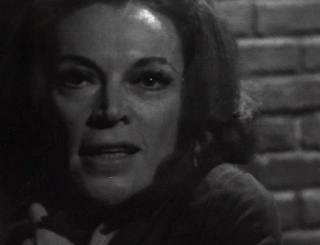
Julia has made sure Willie is gone, but she does go to the basement. Like Jason, she finds Barnabas’ coffin, opens it, and sees him inside. We see her reaction. For the first time, there is a trace of fear on her face.
Julia is now the first person to learn that Barnabas is a vampire otherwise than by becoming his victim. As the episode began with Barnabas spying on Vicki through her window, then entering her room while she was unconscious and looking at her, so it ends with Julia spying on Barnabas through his window, then entering his inner sanctum while he is unconscious and looking at him. This chiasmus suggests that Julia is capable of turning the tables on Barnabas. It remains to be seen whether the parallel will be complete, and she will choose to leave him be as Barnabas left Vicki be, or she will try to do something against him.
At the great house of Collinwood, well-meaning governess Vicki is in a stupor, staring out a window and dreaming of a time when she will again be central to the plot.
Ever since #191 when she rescued her charge, strange and troubled boy David Collins, from his mother, undead fire witch Laura, Vicki has been hanging on to narrative relevance by her fingernails. Now Dark Shadows is built around vampire Barnabas Collins, and Vicki longs to play a major role in his storyline. He plans to make her his next victim, but is moving so slowly towards that objective that we’ve started to wonder if he ever will strike.
David comes into the room and calls Vicki’s name several times. When she finally comes to, she admits that she has been zoning out a lot lately, and says that it is a habit she needs to break. David says that it frightens him when she gets that way. She doesn’t look like herself when those spells come over her. He gets the feeling that she’s turning into someone else. Vicki can’t deny that David is onto something, and only when he insists on sticking with the subject after she has clearly become uncomfortable does Vicki become defensive and retreat behind claims that David is letting his imagination run away with him.
Mad scientist Julia Hoffman has insinuated herself into the house, concealing her true identity and pretending to be an historian writing a book about the old families of New England. David shows her an album of family portraits. He identifies one portrait as his namesake, David Collins. In #153, it was established that he was the first member of the family to bear the name “David,” and that his mother Laura insisted on giving her son this name would ultimately become evidence that her evil plans for him were in place long before he was born. So David’s remark about a previous “David Collins” will strike longtime viewers as a significant retcon.*
Though David has looked through the book many times, he finds a portrait in it that he has never seen before. It depicts Sarah Collins, who lived from 1786 to 1796. Sarah’s ghost has been busy in the area in recent weeks, and the clear implication is that she inserted the page. That in turn would suggest that Sarah might have more powers than we have seen her use so far.
Julia and David find a photograph of Sarah Collins, d. 1796. Screenshot by Dark Shadows Before I Die
David has seen Sarah and played with her on more than one occasion, and he recognizes the portrait. He wonders aloud if the girl he has met is Sarah’s ghost. Julia laughs off the suggestion. Vicki returns. She also recognizes the picture of Sarah. The police circulated a drawing of her when Maggie Evans, The Nicest Girl in Town, was missing. Since Julia is actually a doctor who found out that supernatural doings were afoot at Collinwood when she was treating Maggie, she has heard several facts about Sarah, and by the end of her talks with David and Vicki she knows enough to be sure David is right about her.
We cut to the Blue Whale tavern, where Vicki is on a date with her depressing boyfriend, fake Shemp Burke Devlin. Burke sullenly complains about Vicki’s wish to help Julia with her project, complaining about Vicki’s “interest in the past.” “Interest in the past” is at this point synonymous with “a function in the story,” and Burke lost the last trace of that months ago. It’s as if Burke and Vicki know that they are fictional characters, and he resents her for holding on to a place in the action while he has settled in once and for all on the discard pile.
Vicki mentions that the night before, she had been awakened by the sound of a small girl singing. She says that after she got up and lit a candle, she could still hear the singing, but could not see the girl. Burke is too busy grumbling and making nasty remarks about Vicki’s mental health to ask her why she lit a candle rather than flipping the light switch. Vicki has to press on with more details and then volunteer that she wasn’t sleeping in her own room. She was sleeping in the Old House at Collinwood, home to Barnabas Collins.
Burke is upset by this news. Unfortunately Vicki doesn’t let him believe she went to bed with Barnabas. She tells him she was in a guest room, and that Barnabas was “a perfect gentleman.” Burke demands Vicki never go to the Old House again, and she refuses to make any such promise.
Julia takes the book of portraits to the Old House and insists that Barnabas look through it. While he grudgingly complies, Julia opens her compact. She finds that Barnabas does not cast a reflection in its mirror. This confirms her suspicion that Barnabas is a vampire. In #241 and #278, we had seen his reflection, but perhaps those were slip-ups and they were planning all along to use the idea that vampires do not cast a reflection.
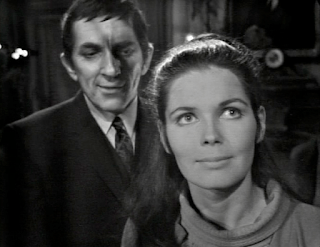
Barnabas catches Julia studying her mirror and angrily asks what she is doing. She smiles and chirps that even historians have their share of feminine vanity. He glowers at her. The camera holds on his menacing look for quite some time, leading us to think that Julia has signed her own death warrant. But she doesn’t seem to think she is in any great danger. She is still smiling when she leaves.
Back in the great house, Vicki wanders up to the portrait of Barnabas that hangs by the front door. Apparently she is planning to stare at it as she resumes her dream of having something to do on the show. It worked for dangerously unstable ruffian Willie Loomis- after a couple of long sessions staring at the portrait, Barnabas summoned him and next thing he knew he was securely established as his sorely bedraggled blood thrall, a core member of the cast. So Vicki is trying to take a proven path to success.
Before Vicki can get any high-quality staring done, Julia enters. Vicki asks her how it went with Barnabas, and Julia exults that she may have learned everything she needed to know.
*My wife, Mrs Acilius, noticed this and had a lot to say about it. I will refer to her insights in later entries, as they would contain spoilers at this point in the run of the show.
In the first year of Dark Shadows, every major storyline came to its climax after well-meaning governess Vicki found out what was going on. Now, the only ongoing storyline is centered on vampire Barnabas Collins. If Vicki finds out Barnabas is a vampire, she will lead an effort to destroy him, as she led an effort against Dark Shadows’ previous undead menace, blonde fire witch Laura Murdoch Collins. Barnabas is a hit, bringing far and away the biggest ratings Dark Shadows has had. So we are in suspense as we wonder how Vicki will find out about Barnabas, and in another kind of suspense as we wonder how they will manage to keep him on the show after she does.
As we open today, we see an intriguing possibility. Vicki is staying over at Barnabas’ house, sleeping in the bedroom of his lost love Josette. Barnabas is standing over her, about to bite. If he does, perhaps he will turn her into a vampire. Then we might find out what kind of vampire Vicki could be. Perhaps she would be like Lucy in Bram Stoker’s Dracula, who became the “Bloofer Lady” and preyed on the small children of the East End of London. Since Vicki’s whole thing has been her role as protector of strange and troubled boy David Collins, it would be a heartbreaking reversal to see her become a threat to David. And perhaps she might emerge as a rival to Barnabas. He is a lackadaisical vampire, who was on the show for 13 weeks before he got round to killing anyone and even then it wasn’t a premeditated murder. Maybe Vampire Vicki will be the killing machine who shows Barnabas how it’s done.
But Barnabas wimps out. He keeps looking at Josette’s portrait, and slinks out of the room without biting Vicki. If they go on like this much longer, we will stop wondering how and when Vicki will be incorporated into the vampire story and start wondering why she is still on the show.
Vicki is bustling out the front door of Barnabas’ house when his sorely bedraggled blood thrall, Willie, offers to make breakfast for her. He keeps asking her if she sensed anything wrong while she was sleeping, and holds onto the topic until she remembers the dangerously unstable ruffian he was before Barnabas got hold of him. She sternly asks if he slipped into the room while she was sleeping, and he denies it.
Back at the great house, mad scientist Julia Hoffman, pretending to be an historian studying the early history of the ancient and esteemed Collins family, is trying to convince matriarch Liz to cooperate with her project. Liz is too worried about Vicki to pay Julia much attention. Vicki had left for Barnabas’ house after everyone in the great house was asleep, planning to be back before they awoke, but because she felt such profound peace in Josette’s room she overslept. Vicki comes in and explains the situation. Liz seems like she is about to weep for joy, and talks about how wonderful it is that Vicki was with Barnabas. Julia has figured out the truth about Barnabas, and reacts to Liz and Vicki’s swoony attitude towards him with alarm. This is one of the first times someone other than Vicki has served as the audience’s representative while Vicki is on screen.
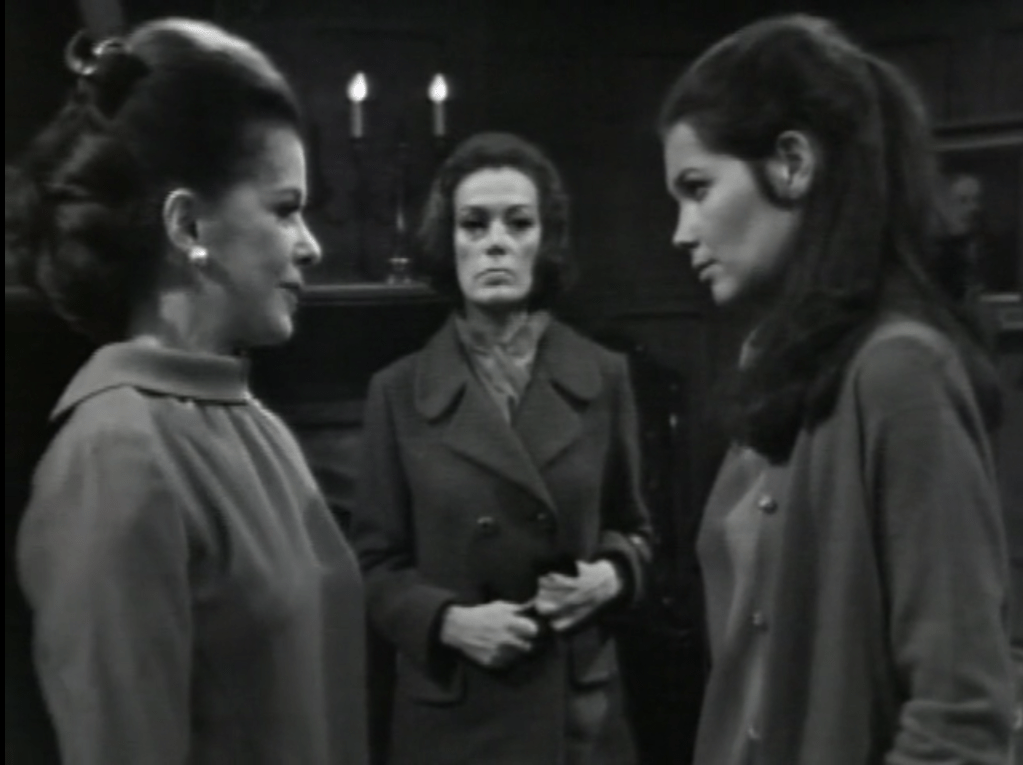
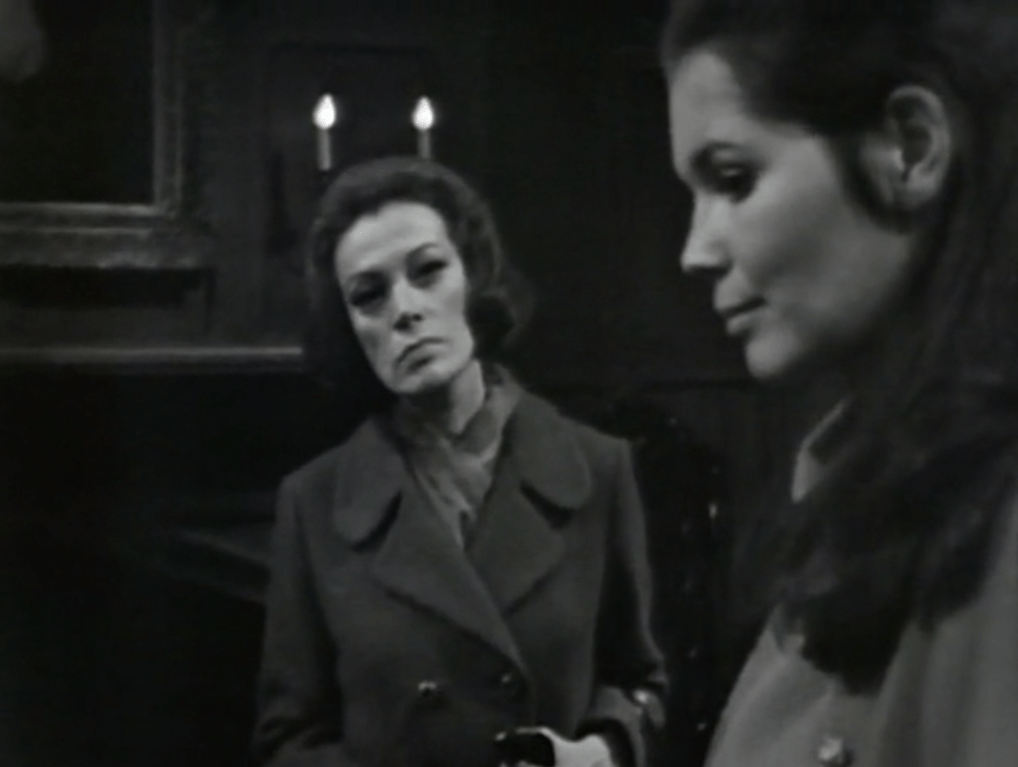
Julia does not share Liz’ conviction that Barnabas is the best host a girl could hope forJulia takes a look at Vicki’s complexion and her neck
Vicki backs Julia’s efforts to win Liz over. When Julia says that she is sure she will uncover important information if Liz and “Mr Collins” help her, Liz replies that her brother Roger is even less interested in the past than she is.
Julia explains that she was referring to Barnabas, but the mention of Roger reinforces the concern Barnabas’ failure to bite Vicki raised. When Dark Shadows started, Roger was its principal villain. That all ended, and he hasn’t had a storyline in months. Louis Edmonds was such a talented actor and such a funny person that the whole cast is loose and zestful in episodes that do include Roger, but in terms of the plot he is surplus equipment. Now that Barnabas is driving the story, “interested in the past” is synonymous with “relevant to the plot,” so that when Liz says that neither she nor Roger is interested in the past, she is saying neither of them is likely to make anything happen.
The biggest draw for the first episode of Dark Shadows was that onetime major movie star Joan Bennett was in the cast, but none of Liz’ storylines really clicked, and now all she does is spend a scene or two objecting to plot developments that we all know she won’t be able to prevent. If those two characters could end up on the junk-heap, there is no reason why the same might not happen to Vicki.
Indeed, Julia’s project suggests that Vicki may be heading for the fringes of the story. The last time a researcher was at Collinwood under false pretenses was during the Laura story. As the leader of the good guys, Vicki had advised parapsychologist Dr Peter Guthrie to keep his specialty a secret from Roger and others to reduce the danger that Laura would catch on to what they were doing. Now, Vicki is one of the people from whom the secret is being kept.
After Liz caves in and tells Vicki that, as a favor to her, she will allow Julia to proceed, Julia goes to Barnabas’ house. This gives us a bit of chiasmus. As the episode began with a scene involving Vicki and Barnabas followed by a scene in which Willie delays Vicki’s departure from the house, so it will end with a scene in which Willie delays Julia’s entry into the house followed by a scene between Barnabas and Julia. That structural device is another hint that Julia will be occupying a space where we had expected to find Vicki.
Julia keeps interrupting Willie’s demands that she leave the house with questions that he can’t resist answering. She is impressed that the restoration of the house is so consistently faithful to the period, and asks if Barnabas referred to pictures when they were doing the work. Willie answers with a flat no. She asks how he managed to create something so convincing that it looks like the work was supervised by someone who saw the house when it was originally in that condition in a previous century, and Willie says that he did have pictures. She asks him why he lied to her, and he is tongue-tied. She asks if Barnabas is such a difficult man to work for that he feels he has no choice but to lie, and Willie panics all the more.
Willie is still trying to get out of the trap when Barnabas appears. As usual when he has to talk to a visitor whom Willie has failed to scare off, Barnabas apologizes for Willie’s unfriendliness. He is his usual gracious “cousin from England” self at first, but very bluntly refuses to cooperate with Julia’s efforts. She prods him, and he becomes rather crude. Her amused response to his arrogant remarks leaves him uneasy, knowing that she has made him look foolish and limited the options available to him in future encounters.
The most interesting storyline in the first 39 weeks of Dark Shadows was the relationship between well-meaning governess Victoria Winters and her charge, strange and troubled boy David Collins. That story concluded when David chose life with Vicki over death with his mother, undead fire witch Laura Murdoch Collins. Vicki and David settled into a happy and uneventful friendship, and the show moved on. Now its core is vampire Barnabas Collins, and Vicki is trying to migrate into his orbit.
When we open, Vicki has made her way to Barnabas’ house as a storm was breaking. She had made a show of wanting to hurry home, only to find that it was raining so hard she had to stay with Barnabas overnight. The opening scenes take place in Barnabas’ front parlor, where Vicki is all wide-eyed innocence.
Vicki and Barnabas are both excited about the prospect of a sleepover. Screenshot by Dark Shadows Before I Die
Vicki asks Barnabas about the long-ago death of Josette Collins. Unknown to her, Josette killed herself because she feared Barnabas would turn her into a vampire, the fate he has in mind for Vicki now. As he tells the story, Barnabas shows more and more anguish. At the end, he suggests that the storm might be letting up and offers to take Vicki home. She says that the rain sounds worse than ever, and insists on staying. This is the first scene in which Barnabas plays the “reluctant vampire” we hear so much about in thumbnail sketches of Dark Shadows.
Vicki goes up to Josette’s restored bedroom. She lies on the bed and covers herself up, remaining fully clothed. She doesn’t even take her shoes off.
Downstairs, Barnabas’ sorely bedraggled blood thrall Willie brings a child’s ball he found in the basement by Barnabas’ coffin. For a moment they are afraid that David might have made his way to the basement during the daytime, but Barnabas concludes that they would have heard about it by now if that had happened. Willie brings up the little girl whom he and David both saw playing outside the house on separate occasions some weeks ago. He also reminds Barnabas that when he was keeping Maggie Evans, The Nicest Girl in Town, in the prison cell in the basement Maggie talked about a little girl who visited her there. Barnabas won’t listen to anything about Maggie, and is irritated when Willie keeps saying that he has the feeling that there is someone else in the house. But he does go to search the basement.
Meanwhile, Vicki is awakened by the sound of a child’s voice singing “London Bridge.” Returning viewers know that this is the little girl Willie spoke of, and that she is the ghost of Barnabas’ nine year old sister Sarah. Victoria lights a candle and searches the room, but finds nothing.
Willie is startled when Victoria comes down the stairs and calls him. Barnabas hadn’t bothered telling him she was around. We might be startled too. The diffident, girlish manner she had used with Barnabas earlier in the episode is gone; when she calls “Willie!” she is every inch the lady of the house summoning a servant. In their previous interactions, Willie has always called Vicki by her first name. Today she is “Miss Winters” to him, and that’s only to be expected- she retains an air of command even as Willie tries to warn her that she is in danger.
Barnabas enters and hears Willie urging Vicki to get out of the house at once. Willie takes a second to come up with a suitable lie, claiming that he was afraid spending the night in the house would get people talking about Vicki. She and Barnabas dismiss this concern. Vicki praises Willie’s generous offer to walk her home and shelter her from the rain, and Barnabas assures Willie that he will get what he deserves.
Vicki tells Barnabas that she heard a little girl singing “London Bridge.” Shaken by this report, he insists it is impossible for her to have heard any such thing. He says that he understands if she does not want to return to the room, implicitly repeating his offer to let her go, but she happily returns upstairs. In this conversation, she is not as loftily aristocratic as she had been with Willie, but neither does she revert to the diffident girlishness she had shown Barnabas in the first scene. She looks him in the eye, smiles, speaks briskly, and moves from her hips. She is a woman who knows what she wants and has made up her mind to get it.
Barnabas and Willie have an interesting talk after Vicki goes back upstairs. Willie asks about the little girl, and Barnabas hotly denies she exists. Barnabas is his usual menacing self at first, but then says he won’t punish him for trying to warn Vicki. He asks Willie to “talk to me.” Willie is startled by this, then Barnabas says he has a better idea- “don’t talk to me.” This generates a bad laugh. Some think this is Jonathan Frid trying to cover a misreading of a line, but I tend to think it is good acting exposing bad writing. After their talk, Barnabas sends Willie to his room, then goes upstairs and stares at Vicki while she sleeps, apparently contemplating the possibility of biting her.
Well-meaning governess Vicki says that she would like sit alone in her room “forever” listening to an antique music box. This may seem extreme, but consider the alternatives. Heiress Carolyn comes in and asks her to recap the last couple of episodes; Carolyn responds to every sentence Vicki speaks by asking her to repeat it. Fake Shemp Burke Devlin is downstairs waiting to take Vicki on a date; they went out yesterday, and he spent the time angrily telling her she must be crazy because she believed things he knew to be true. When she meets him today, he’s even angrier, and Carolyn joins in his gaslighting project.
The one bright spot in Vicki’s evening is the courtly Barnabas Collins. He has dropped by the house to give her a book that he thought she might like. By the time Vicki gets downstairs, Burke and Carolyn have come at Barnabas with a lot of free-floating hostility about Vicki’s interest in history. He responded to them affably, and when Vicki arrives he makes a show of not giving her the book.
Vicki sees the book and insists Barnabas let her look at it. When she sees that he inscribed it to her, she asks what is going on. Burke admits that he talked Barnabas out of making the present. Vicki becomes upset with him. Barnabas apologizes for having come and hastens back to his house. Burke is left looking like an absolute fool, which was no doubt Barnabas’ plan.
Burke keeps banging on about how it is unhealthy to “live in the past.” He means that he doesn’t want Vicki to learn about the history of the people she works for and of the house they live in, and that Barnabas is a big nerd because he restored the Old House on the estate to its condition as of a previous century and that he lives there.
This is an eccentric way of using the phrase. Usually when people say that someone “lives in the past,” they are accusing them of being stuck in a bygone period of their own life. Burke doesn’t know that Barnabas is a vampire, or that he lived in the house when it was in the condition to which he has restored it. So that isn’t the charge he has in mind. So far as Burke knows, Barnabas is a creative person who imagined a new project, committed himself to it, and with great effort and great skill made it a reality. Nor does he know that Barnabas wants to turn Vicki into a vampiric version of his lost love Josette, or that her interest in history is partly inspired by Barnabas’ supernatural influence over her. So far as Burke knows, Vicki has taken up a scholarly hobby that would be wholesome for anyone and that is particularly appropriate for a teacher.
If any character is “living in the past,” in the sense in which that expression is typically used, it is Burke. When he was Vicki’s age, he was a member of the local working class, presumably living in a rented room in the town of Collinsport. Since then, he went to New York, became a corporate raider, and grew so rich he could live anywhere he chooses. The place he has chosen is another rented room in Collinsport. He is dating a woman half his age, and regularly drops in on the Collinses, who were acquaintances of his in his youth. In all these ways, he has turned his back on his current life and created a fantasy version of the life he lived long ago.
Burke is also an echo of the past of Dark Shadows. When the show started, he was the driving force of many storylines. But those storylines all fizzled, and what remained of them was wrapped up in the story of his ex-girlfriend, undead fire witch Laura Murdoch Collins. Shortly after Laura’s story ended, Burke formally renounced the quest for revenge that had been his chief motive, and there’s been no reason for him to be on the show since. Making matters worse, he was recast last month as actor Anthony George, who is completely lost in the part. So we can sympathize with Vicki’s reluctance to keep spending time with him.
Burke demands that Vicki come with him. He barks at her that he needs a drink. He’s already so angry and so insulting that we can only hope he isn’t a mean drunk. After he issues several more declarations and commands, Vicki tells him she will be staying home with a book. He leaves.
Staying in and reading doesn’t seem to be Vicki’s real plan. Vicki goes to Barnabas’ house, ostensibly to apologize for the unpleasant reception Burke and Carolyn gave him, and for her failure to thank him for the book. He accepts her apologies most graciously.
A storm is starting, and Vicki has neglected to wear the raincoat and headscarf we’ve seen her in several times. When they look outside, she and Barnabas say that it is raining too heavily for anyone to go anywhere. She apologizes for getting caught at his house, and Barnabas says that he is happy to have her. He suggests she spend the night in the restored bedroom of Josette Collins. She is delighted by this idea.
Yesterday, Victoria had said she could stay in Josette’s room “forever.” So it seems obvious that she fully intended to be at Barnabas’ house when the storm started raging, and to spend the night there. Of course this fits very well with Barnabas’ scheme, so he is quite happy to oblige her.
Four and a half weeks ago, Maggie Evans, The Nicest Girl in Town, escaped from vampire Barnabas Collins. Barnabas managed to scramble Maggie’s brains sufficiently that she has amnesia covering her time as his victim and much of the rest of her life as well. She is now a patient at a mental hospital called Windcliff, where her care is supervised by Dr Julia Hoffman.
Maggie’s family doctor, addled quack Dave Woodard, is an old friend of Julia’s. He had recommended Maggie be sent to Windcliff. He had also come up with a cockamamie scheme to protect her from her captor by hiding her there and telling everyone in and around the town of Collinsport that she was dead. If he had known that the captor was a vampire, this might have made some kind of sense- no character on Dark Shadows has ever heard of Dracula, so they don’t know how to fight against vampires. But he doesn’t know that, so his plan is just a way for the writers to stall while they try to come up with more plot points.
Today we open with Woodard in Julia’s office, complaining that she isn’t communicating with him about Maggie’s case. She tells him that there have been no developments worth reporting. Returning viewers know that this is a lie, because in a session we saw yesterday Maggie remembered a lot of sense impressions from her time of captivity and Julia told her that they represented tremendous progress. Woodard tells Julia that a lack of new information is no excuse for her failure to return any of his last six phone calls. He says that she seems to be intent on hoarding any information she may glean from Maggie as her own private possession, an impression he describes as frightening.
Julia responds to this characterization with a display of offense, and Woodard apologizes. She then brings up an idea that occurred to her at the end of yesterday’s episode. She says that Maggie’s memory might improve if she takes her to visit Eagle Hill Cemetery, where she was found wandering early in her illness. Woodard objects strongly that Maggie’s condition, as Julia has described it, is so delicate that such a visit might do her permanent harm. Julia retreats and promises she won’t actually take Maggie to the cemetery. This is such a flagrant lie that the camera momentarily goes haywire, focusing on Woodard’s chair rather than his face.
Woodard leaves, and Julia calls Maggie in. She’s already wearing her coat. She asks where Julia is going to take her, and she tells her not to worry about that.
On the great estate of Collinwood, well-meaning governess Vicki is staring vacantly into space while listening to an antique music box Barnabas gave her as part of his plan to subject her to the same treatment he inflicted on Maggie. A knock comes at the door. Vicki closes the music box and goes to answer it. It is her boyfriend, fake Shemp Burke Devlin.
Burke is waging a determined battle against the story, and he is fighting dirty. He doesn’t want Vicki to have anything to do with Barnabas, or with the ghost of Josette Collins. When Vicki says she wants to lay flowers on Josette’s grave in the cemetery, where we know she will cross paths with Maggie and Julia, he resists furiously. When she reminds him that she has had dealings with Josette’s ghost, he says “Or you think you have.” In previous episodes, including yesterday’s and Monday’s, he knew she had, and in an earlier period of the show he knew that several other characters, including some of the most level-headed ones, had also encountered Josette’s ghost. When he starts belittling Vicki for believing in “the spooks of Collinwood,” it therefore comes off as an especially crude instance of gaslighting. The Mrs and I aren’t much for profanity, but we both cussed at the screen when Burke was disgracing himself this way.
Julia and Maggie are in the cemetery. I believe it is the first time we’ve seen the set in a daylight scene. You can see the shadows of the foliage on the soundstage walls, and the corners where the walls meet. I can’t believe the director meant for us to see those things, but I kind of like it- the situation needs a touch of unreality, and the obvious falsity gives it the feeling of a black box theater.
Some of the shadows on the wall that Art Wallace spoke ofCorner of the soundstage
Maggie is agitated. Julia tells her to calm down and that everything is all right. I’m no expert, but I kind of doubt that talk therapy involves a lot of “Calm down!” and “Everything is all right!” It reminded me of this Saturday Night Live sketch from the 90s, in which Patrick Stewart plays “Phil McCracken, Scottish Therapist,” a psychologist who won’t stand for any emotionalism from his patients.
Vicki and Burke see Julia and Maggie in the distance. When Maggie turns to face them, Vicki recognizes her. Julia whisks her away before Burke can see her. When Vicki tells Burke she saw Maggie, he immediately unloads on her with the same garbage he handed her at Collinwood. He declares that Maggie is dead, that Vicki knows she’s dead, that she can’t possibly have seen her, that “there is a resemblance, THAT’S! ALL!” When he asks “What’s wrong with you?” I stopped the streaming and shouted at the screen “She’s wasting her time with you, you ******* ********, that’s what’s wrong with her!” To that, Mrs Acilius said that we should just restart the show and get through the scene.
Part of what makes Burke’s behavior so infuriating is the writer’s fault. A first-time viewer, unaware that what Burke is telling Vicki are delusions that suggest she is crazy are in fact things he knows to be true, might think that he is being reasonable in dismissing ideas about ghosts and the like. But even that viewer will realize that a person ought to be nicer about it. When Vicki says she saw Maggie, Burke could easily have suggested that they go up to the woman and introduce themselves, thinking that a closer look will disabuse her of the notion. But actor Anthony George must also bear part of the blame.
George C. Scott famously told Gene Siskel that there are three things to consider in evaluating an actor’s performance: first is to make the audience believe that the person they are looking at is the sort of person who might do the things the character does. This is in turn dependent on casting- put the wrong person in the part, and all is lost. Second are the choices the actor makes in the key emotional moments. Performers have any number of options as to how they will use their faces, voices, and limbs to show a character’s feelings, and those who make a lasting impression are those who make choices that are at once totally unexpected and perfectly logical. Third is the zest of performance, the actor’s joy in the opportunity to create a character. If that doesn’t come through, nothing else is worth much.
As Burke, Anthony George fails all three of these tests. Burke would have been a difficult part for anyone to take over, both because the originator of the role, Mitch Ryan, was so memorable, and because the character had lost all connection to any ongoing storylines by the time Ryan left. And by his own admission, George knew nothing about soap operas and had no idea how to play a romantic interest on one when he joined Dark Shadows. That’s where he fails the casting part of the believability test.
As for the skill part, George has something going for him. He is always mindful of his physicality, moving only those parts of his body he needs to show us who he is and keeping the rest of himself admirably still. He also keeps his voice remarkably consistent, both by holding a steady level of volume and maintaining a simple, precise pitch. In these and other ways, he shows impressive levels of technical proficiency as an actor, but the result is a mannered, unconvincing performance. His Burke doesn’t seem to be a real person. As a cardboard figure, he becomes an abstract symbol of whatever he’s doing, and when he’s doing something bad he’s hard not to hate.
Since he makes one choice for each resource available to him and sticks with it unvaryingly throughout the episode, he doesn’t give the audience any surprises. Nor does he yield anything to his scene-mates. They always know exactly what’s coming from him. George’s eyes are always watching another actor intently, as he watches Alexandra Moltke Isles intently today, but nothing in her performance can divert him from his plan, not in the smallest particular. When Burke isn’t listening to the other character, as he isn’t listening to Vicki, George’s disconnection from the other actors makes Burke seem like an irredeemable jackass.
Nor does George show any zest for the part. He covers his discomfort with soap acting by plastering on a smile whenever the script allows it, but he is stiff when Burke ought to be loose, cool when he ought to be warm, and loud when he ought to speak with a quiet, nuanced voice. The result is just sad and awkward. When Burke is being pleasant, we can feel sorry for George, but when he has to play the scenes like the ones Burke gets today we just want him to get off the screen and leave us alone.
Compare George’s Burke with Grayson Hall’s Julia, and you will see how an actor can determine an audience’s reaction to a character. Julia is a terrible therapist. She lies repeatedly to Woodard in the beginning, denying the severe breach of ethics and disturbing disregard of public safety involved in covering up what she knows and suspects about Maggie’s experiences and running an unconscionable risk with Maggie’s mental health by taking her to the cemetery. She lies again to Maggie at the end, promising that they will duck into the Tomb of the Collinses only for a moment and then refusing to let her leave there when she starts to show a violent emotional reaction. Her methods are so unorthodox and so harsh that we suspect she is not interested in helping Maggie at all. Because we have known Maggie since episode #1, and Kathryn Leigh Scott’s performance as Maggie renews our fondness for her every time she appears, we ought to feel deep hostility towards Julia.
But we don’t. In fact, Julia quickly becomes (almost) every Dark Shadows fan’s favorite character. The George C. Scott tests tell us why. Hall’s manner is so intense that we can believe her as a mad scientist; her uninhibited use of every facial muscle, of the full range of her vocal output, and of subtle tricks of movement she learned from choreographers when she appeared in musicals may have produced a style that no acting teacher could recommend as a model, but they do mean that every moment she is on screen she is doing something we wouldn’t have predicted; and she’s clearly having a blast. She can do things vastly worse than what makes us hate Burke today, and we will still want her to come back again and again.
Closing Miscellany
The opening voiceovers aren’t usually the best-written parts of the show, but there is a particularly bad bit in today’s: “Hidden deep in the cliffs of Collinwood, the majestic, ancient rocks that separate the Earth from the sea, there is a tiny cove carved by a long-ago sea. No one at Collinwood has seen it, and no one will ever see it.” If no one ever will see it, why bother telling us about it? The narrator tells us that it is because “the Earth knows how to hide its secrets well. Sometimes men, too, must hide secrets.” Does this mean that “no one ever will” discover the secrets the characters are hiding from each other? That isn’t a very promising thing to tell the audience of a soap opera, a genre which is all about unsuccessful attempts to keep secrets and their aftermath.
Maggie tells Julia that she doesn’t recognize the name Collins. She has lived her whole life in the town of Collinsport, where most people are employed by Collins Enterprises, which is owned by the Collins family who live at Collinwood. That’s some pretty widespread amnesia she has.
The show has been going back and forth on the dates when Barnabas and Josette Collins originally lived and died. Today we get a long look at Josette’s tombstone, giving her dates as 1800-1822, and another at the plaque on Barnabas’ little sister Sarah’s resting place in the mausoleum, with the dates 1786-1796. Those dates fit with a remark Barnabas made to his sorely bedraggled blood thrall Willie in #271, that Sarah lived long before he met Josette, but not with his remark in #281 that Josette had been dead for “almost 200 years,” much less with a book we saw in #52 that gave her dates as 1810-1834.
We cut back and forth between an opulent estate called Collinwood and a mental hospital called Windcliff.
At Collinwood, we spend our time with well-meaning governess Vicki. From the beginning of Dark Shadows, Vicki has been the audience’s main point of view character. The audience is now made up chiefly of people who want to see how they are going to fit vampire Barnabas Collins into an ongoing series, and Barnabas’ principal concern is getting hold of a woman, erasing her personality, and replacing it with that of his lost love Josette. So of course Vicki is fascinated with Barnabas and fantasizes about being Josette.
Matriarch Liz has functioned as a blocking figure. Her goal has been to keep her secrets. Her actions in pursuit of that goal have slowed story development in a largely futile attempt to create suspense. She’s fresh out of secrets, but is still trying to put the brakes on. She keeps complaining that Vicki’s interest in Josette is unwholesome.
Liz has a point. Barnabas has settled on Vicki as the next subject of his experiment. To that end, he has given Vicki Josette’s music box. When he was trying his lunatic plan on Maggie Evans, The Nicest Girl in Town, he had given Maggie the music box. Evidently the music box has some kind of magical power over the women to whom Barnabas gives it. When she opens it, Vicki sits for hours staring vacantly into space listening to its simple tune.
The previous night, Vicki had worn Josette’s dress at a costume party Barnabas hosted in his house on the estate. The party ended in a séance in which Josette spoke through Vicki. Liz mentions this possession as a sign that Vicki is becoming too involved with Josette. Vicki doesn’t see anything out of the ordinary. She blandly exclaims “It’s happened before!” Indeed, the show’s first séance, in #170 and #171, climaxed with Vicki channeling a message from Josette. Liz points out that this doesn’t make it better.
Vicki goes to Barnabas’ house to return the dress. She and Barnabas’ sorely bedraggled blood thrall Willie take it to Josette’s restored bedroom upstairs. There, she blissfully tells Willie she wishes she could wear Josette’s clothes all the time. Remembering what Barnabas did to Maggie and knowing his plans for Vicki, Willie winces. He hates the things Barnabas does, but is too far under his power to actively oppose him. Vicki goes on about how close she is coming to feel to Josette, and Willie winces harder. She tells him that she has been listening to the music box for hours at a time, and he shouts “You shouldn’t do that!” When she asks why not, he takes a second to come up with something that he can say. He tells her she might damage the mechanism. Still blissful, she says, “Oh, I’ll be careful.”
Willie tells Vicki that tomorrow is Josette’s birthday. Vicki is delighted with this information. She resolves to go to the cemetery and lay flowers on Josette’s grave. When she tells Liz of this plan, Liz objects to it. Because of Liz’ function as a blocking figure, her opposition implies that it will advance the plot. To appease Liz, Vicki agrees not to go alone, but to take Liz’ fellow narrative speed-bump Burke Devlin.
At Windcliff, Maggie is in session with her therapist, Dr Julia Hoffman. As a result of her time as Barnabas’ prisoner, Maggie has amnesia and can speak only with difficulty. In his effort to Josettify Maggie, Barnabas combined his own supernatural powers with sensory stimuli like the music box that were supposed to elicit the responses he had in mind. Now Julia is trying to recreate those stimuli in her effort to recover Maggie’s memories and restore her personality.
At one point, Maggie tells Julia about a sweet scent that regular viewers know to be that of Josette’s jasmine perfume. As she does so, music starts playing on the soundtrack that we have heard when Josette’s ghost has appeared. When this happened, my wife, Mrs Acilius, said “Josette is there.” Later in the episode, when Vicki is in Josette’s room with Willie, Vicki takes a whiff of the perfume. The music strikes up then too. Josette’s ghost hasn’t manifested since March- maybe the ghost’s musical cue is now the perfume’s.
Their use of sensory stimuli is not the only way in which Julia is a reverse-image reflection of Barnabas. Barnabas is a vampire, so we expect to hate him and oppose his plans. But he is also the character who makes the show fun to watch, so we find ourselves wanting to see more of him. Further, he evolves into a comic villain, with whom we identify as we see him scramble to keep his madcap schemes from backfiring. And the longer we see him, the more of actor Jonathan Frid’s personality comes through, and Frid seems to have been adorable.
Julia is a doctor trying to help a patient we know and care about, so we expect to like her and cheer her on. Yet she always seems more than a little sinister. She takes a stern, occasionally impatient tone with Maggie today, which we might think is part of her therapeutic technique. But in her previous appearance, in #265, she took the same tone with Maggie’s father, boyfriend, and family doctor, none of whom is her patient. More than once in that episode, she made remarks suggesting that she suspected that Maggie’s condition was the result of an encounter with an undead monster, then refused to explain what she meant. We wonder why she would withhold such information. At the end of today’s installment, she insists that Maggie return to a place where something terrible happened to her. When Maggie begs her not to make her go back there, we see a closeup of Julia’s face with a look of satisfaction that led Mrs Acilius to say “Julia can do ‘evil face’ as well as Barnabas can.”*
Julia’s E-face
Julia’s grim satisfaction mirrors ours. Ever since Liz gave her great show of reluctance at Vicki’s plan to lay flowers at Josette’s grave, we’ve been wondering what kind of progress a stop at the cemetery could possibly represent for the story. Julia has unwittingly answered that question for us. The place she is going to take Maggie is, of course, that very cemetery.
*Mrs Acilius had a lot to say about Julia as Barnabas in reverse, this whole section is derived from her insights.
For sixteen weeks, from March to June, seagoing con man Jason McGuire had lived the high life blackmailing reclusive matriarch Liz. Now the blackmail scheme has blown up in Jason’s face, and the police have given him until sundown to clear out of Collinsport. Looking for someone else to exploit, Jason has come to the Old House on Liz’ estate, where her distant cousin Barnabas lives with Jason’s onetime henchman Willie.
Jason lingers outside a window. He sees Willie bring Barnabas a chest full of jewelry. He hears Barnabas and Willie talking about Maggie Evans, The Nicest Girl in Town, whom they abducted, held prisoner, and, they believe, killed. He is still listening when Barnabas and Willie start talking about well-meaning governess Vicki, to whom Barnabas plans to give the same treatment.
A bit later, Jason finds Willie in the woods outside the house. He demands Willie meet him in the Blue Whale tavern at noon the next day and give him a pile of jewels from the chest. He tells Willie that he knows what he and Barnabas did to Maggie and what they are planning to do to Vicki. Willie agrees to the meeting.
We cut to the tavern. Jason is waiting at the bar when Vicki comes in. She grimaces at the sight of Jason, then asks Bob the bartender if he has seen Liz’ daughter Carolyn. Bob shakes his head no.
Jason insists on talking to Vicki. We do not know what to expect from this conversation. Jason is a villain who has often taken pleasure in being cruel to Liz and other characters, and the scenes in which he threatened Liz were so repetitious as to constitute cruelty to the audience. He believes that Barnabas is a serial killer of women, and his plan to squeeze money out of Barnabas requires him to turn a blind eye while he continues in that career. On the other hand, Jason showed genuine and unselfish concern for Willie when he was ill, and actor Dennis Patrick has taken every opportunity to play him as a comedy villain, with whom we can empathize while he scrambles to keep his lies from being exposed. So we can easily imagine Jason wanting to give Vicki some kind of warning.
Jason begins their talk with a question about Carolyn. Vicki tells him that Carolyn left the house because she believed the false story that he had used to blackmail Liz, and expresses her intense disapproval of him. He makes some defensive and self-pitying remarks, and Vicki continues to tell him how bad he is. He tells her that she will soon suffer hardships while he is far away, laughing at her. She says she doesn’t know what he means, and he refuses to explain. She says “There is nothing as sad as a hollow threat.” At no point in any of this had it seemed that Jason was about to warn Vicki of Barnabas’ plans.
As Vicki is going, Jason says he wonders who she really is and where she comes from. He then says that she does not know the answers to those questions. He says that he was in Collinsport 18 years ago, and he might know them. That stops Vicki in her tracks. She turns, looks at Jason, and asks him what he knows. He says that whatever he knows, he will take with him. She says that he is only trying to hurt her. He asks if he is succeeding. She goes.
Vicki wonders if Jason knows something
It has been a while since we last heard about Vicki’s quest to solve the riddle of her origins. That story element never amounted to much, in part because, as Wallace McBride pointed out in a Collinsport Historical Society post in 2020, the very first episode of the show ended by showing us Liz and Vicki as each other’s mirror images. From that point on, everything has pointed to Liz as Vicki’s biological mother. Art Wallace’s original story bible for Dark Shadows had suggested that Liz’ ex-husband Paul Stoddard would be revealed as Vicki’s father and some other woman as her mother, but Art Wallace also said that the story might be better served by saying that Liz was her mother by another man, and that seems to be what they have tacitly done.
Art Wallace’s plan had also been that Vicki’s origins would be revealed at the climax of the blackmail story. It is not clear when they gave up on that. Since the actual episode, #271, runs drastically short, it is possible that they changed their minds only a few days before taping.
One of the possibilities was that Liz would admit that she was Vicki’s mother and Jason was her father. They haven’t done much to suggest that there ever was a sexual relationship between Liz and Jason, so this possibility lurks far in the background. If it were to turn out to be true, Jason’s indifference to Barnabas’ plans for Vicki becomes all the more chilling. Since Stoddard was also indifferent to Carolyn’s well-being, it would give Liz’ two daughters something miserable to have in common.
Jason was a friend of Stoddard, so he might have some information that would be meaningful if they are going for a twist in which all the hints that Liz is Vicki’s mother by another man were false and another woman were her mother by Stoddard. At any rate, when Jason says that whatever information he has will leave with him, it seems that he is telling the audience that the quest for Vicki’s origins will never be resolved.
Willie shows up at the tavern and gives Jason one piece of jewelry. Jason is loudly dissatisfied with this. Willie leaves him.
Later, Jason breaks into the Old House. As he enters, three notes ring out on the soundtrack. I sometimes laugh at this three note motif with my wife, Mrs Acilius. Not only because “dum, dum, DUMM!” is a corny way to end a show, but also because it often follows a three syllable closing line. So if the last words spoken before we hear it are “I want more!,” we will sing “I- want- MORE!” Since Barnabas is a far more dangerous person than Jason knows, this time Mrs Acilius sang “You- are- DEAD!”
A wedding is being held in the drawing room of the great house at Collinwood. Matriarch Liz is marrying seagoing con man Jason. Carolyn, Liz’s daughter by her first husband, Paul Stoddard, has a pistol in her purse, which she is planning to use to shoot Jason before the ceremony can be completed. Well-meaning governess Vicki is distressed, because Liz confided in her in #259 that she is marrying Jason only because he is blackmailing her. Liz killed Stoddard long ago and Jason buried the body in the basement, facts he will reveal if she does not comply with his demands. The other guests hate Jason, but they share neither Vicki’s understanding of the situation nor Carolyn’s sense of initiative, so they just stand around and scowl.
When the judge asks Liz if she takes Jason to be her lawful wedded husband, she exclaims that she cannot. She points to him and declares “I killed Paul Stoddard and that man was my accomplice.” Carolyn drops the gun, Vicki flashes a defiant look at Jason, and everyone else is stunned.
Vicki triumphant
The judge excuses himself. He claims that he might be required to act as a judicial officer in a case that could arise from what Liz is about to say. That may not make sense in terms of the laws or canons of judicial conduct actually in effect in the State of Maine in 1967, where what he has already heard would be far too much to avoid being called as a witness. But it fits nicely with the logic of Soap Opera Law, in which neither the police nor the courts may be notified of any criminal matter until the prime suspect has completed his or her own investigation.
Carolyn says “You killed my father.” Before Liz can say much in response, Carolyn announces that she was about to kill Jason. Vicki’s boyfriend, Fake Shemp Burke Devlin, finds Carolyn’s gun. For some reason, Burke holds the gun up. He points it at whomever he is facing. When Jason announces he will be leaving the room, Burke is pointing the gun at him and forbids him to go. Again, giving orders to a person on whom you have a deadly weapon trained may be a felony in our world, but it is all well and good under Soap Opera Law.
Liz mentions that Vicki already knows that she killed Stoddard and that Jason has been blackmailing her. This prompts Liz’ brother Roger to tell Vicki “That was a secret you had no right to keep.” Liz responds that, had Vicki told anyone, she would have denied it and sent her away. Liz then describes the events of the night eighteen years before when she and Stoddard had their final showdown. We see them in flashback, on this same set.
Stoddard told Liz he was leaving her, never to return. She replied that she did not object to his going, but that the suitcase full of bonds, jewels, and other valuable assets he was planning to take was Carolyn’s property and would have to stay.
When the show started, just over a year ago, Stoddard’s disappearance had been 18 years in the past. So it still is, moving its date from 1948 to 1949. At that time, Stoddard was last seen six months before Carolyn was born. Later, they would say she was a newborn when her father vanished. In the flashback today, he answers Liz’ assertion of Carolyn’s right to the contents of the suitcase by saying that he has been putting up with the child for two years. We saw her birth-date as 1946 the other day, so apparently they are planning to stick with the idea that she was a toddler when Stoddard was last seen.
Stoddard and Liz quarrel over the suitcase. He confirms that he and his friend Jason have a plan to convert its contents into a big bundle of cash. He is walking away from her when she takes a poker from the fireplace and hits him on the back of the head. This may be another deed entirely unjustifiable by real-world law, but under Soap Opera Law any act committed against a man who openly despises his two-year old daughter and tries to steal from her is outside the jurisdiction of the courts.
Stoddard fell to the floor, bled, and remained very still after Liz hit him. Shocked by what she had done, she reeled out of the drawing room and closed the doors behind her. As she stood in the foyer wishing she were dead, Jason entered the house. Liz sent him into the drawing room to look at Stoddard. He came out, told her Stoddard was dead, and offered to bury him for her. After all, everyone in town knew he was leaving- there need be no scandal to cloud Carolyn’s future.
Liz asks why Jason wants to help her- he was Stoddard’s friend, planning to help Stoddard steal from her. Jason explains that Stoddard is beyond help now. Liz goes along with his plan.
In this flashback, Jason’s Irish accent is convincingly realistic. It sounds like he’s from Antrim, or someplace else in Norn Iron. That’s a contrast with what we’ve heard so far, when he’s been more than a little reminiscent of this guy:
Hearts, moons, clo-o-overs
My in-universe, fanfic theory is that Jason hadn’t been home or spent much time with other Irishmen in the years between 1949 and 1967, and so his accent drifted into a music hall Oyrish. My out-of-universe theory is that Dennis Patrick spent some time with a dialect coach after joining the show, but by the time he had learned to sound plausible Jason’s silly accent was already such an established part of the character that he couldn’t change it.
When Jason was done with his work downstairs, he showed Liz the storage room where he buried Stoddard in the floor. We got a long, long look at that floor in #249, when it was clean and tidy and there were many boxes and crates on it. When Jason left it to Liz “18 years ago,” there was dirt piled up all over the floor, a shovel in the corner, and few boxes or crates. Evidently Liz cleaned it up herself and organized its contents at some point. That doesn’t fit with the idea she had before #249, that a person entering the room would immediately discover her secret. Since Liz had often gone into the room in the early months of the show, it never had made sense she would believe such a thing, but it is annoying to be reminded of it.
In voiceover, Liz tells us that when Jason left her with the key to the room she knew she would be a prisoner of the house forever. The episode then ends, after less than 18 minutes of scripted content. That’s the shortest installment so far. The closing credits roll slowly, so slowly that they run out of music. The names scroll by in silence for 25 seconds before ABC staff announcer Bob Lloyd says “Dark Shadows is a Dan Curtis production.”
That cannot have been Plan A. This episode has eight speaking parts, two segments of events set in different decades, voiceover narration, a costume change, etc. So there was plenty of stuff that might have proven impossible in dress rehearsal, requiring a quick rewrite that might have left them running a little short. But they’ve been ambitious before, and have never ended up like this. So I suspect that the late script change that got them into trouble was more complicated than that.
Art Wallace’s original story bible for Dark Shadows, titled Shadows on the Wall, called for the mystery of Vicki’s parentage to be resolved at the same time as the blackmail plot. Wallace’s first idea was that Vicki would be shown to be the illegitimate daughter of Paul Stoddard, and that Liz’ interest in her well-being began with guilt after she responded to the news of Vicki’s existence by attacking Stoddard. Wallace also said that if it were more story-productive, they could say that Vicki was Liz’ illegitimate daughter.
Casting Alexandra Moltke Isles as Vicki committed them to that second course of action. Famously, when Joan Bennett first saw Mrs Isles on set she mistook her for her daughter, and the show has often capitalized on their resemblance to present Vicki as a reflection of Liz. For example, notice how the two women stand in this shot from today’s episode:
Pay particular attention to their legs- it’s the same posture
Moreover, the ghost of Josette Collins took a lively interest in Vicki in the first 39 weeks of the show, and Josette is specifically a protector of members of the Collins family. If Vicki is Paul’s illegitimate daughter, she is not a Collins and not linked to Josette.
The only advantage we’ve ever seen of establishing Vicki as a non-Collins would be the possibility of a romance between her and Roger. Since Vicki the foundling-turned-governess is Jane Eyre and Roger the father of her charge is Mr Rochester, this is an obvious direction to go. The show took a few feints towards such a relationship in the early days, but those clearly led nowhere. Vicki came to town in #1 on the same train as Burke, so they are fated to get together. Roger and Burke openly hate each other and often seem to secretly love each other, making for a potentially explosive love triangle if Vicki comes between them, but neither Roger and Burke’s much-advertised enmity nor their barely concealed homoerotic connection ever developed into a very interesting story. The whole thing fizzled out completely months ago. So there doesn’t seem to be a point in resolving the question of Vicki’s parentage any other way than with Liz admitting maternity.
So the first question is, when did they decide that this episode would not include that admission? The short running time would seem to suggest that it was only a few days before taping.
The second question is, why did they make that decision? Liz’ line today that she would fire Vicki if she had betrayed her secret, coupled with all the remarks she has been making to Vicki in the last few weeks about how Carolyn is the one and only person she really cares about, would suggest that the producers and writers are thinking of moving away from the idea of Vicki as Liz’ natural daughter. But the directors are still committed to it, as are the actresses.
We begin to suspect that the producers and writers are hoping that the viewers who have joined the show since the vampire came on in April won’t care about Vicki’s origin, so that they can just drop the whole thing. Since the only storylines they have going are the blackmail arc, which Liz is bringing to its end with her confession today, and the vampire arc, in which nothing at all is happening at the moment, you might think they would be glad to fill some screen time with Vicki and the rest of them reorienting themselves around a newly revealed family relationship. But, maybe not!