Episode 698: The kind of scene you should be avoiding

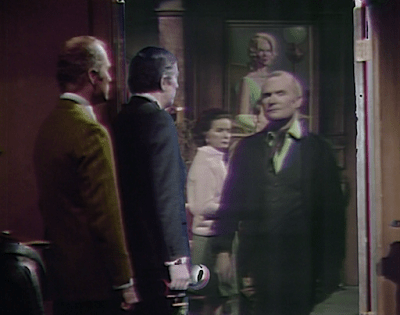
Barnabas Collins, old world gentleman extraordinaire, and Julia Hoffman, MD, are helping mysterious drifter Chris Jennings cover up the fact that he is a werewolf, responsible for a great many violent deaths. Lately Chris has started transforming into his lupine shape even on nights when the moon is not full, and this morning they find that he has not changed back even after dawn.

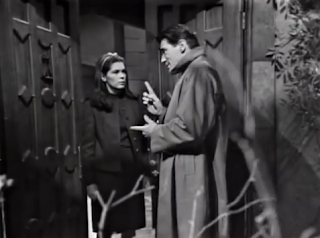
As if that did not present enough difficulty to Julia and Barnabas, one of Chris’ surviving victims is in town. She is his onetime fiancée, Sabrina Stuart. Two years ago, Sabrina saw Chris as the werewolf. She hasn’t told anyone about him, because she hasn’t been able to speak since. Her hair turned white, her skin turned pale, and she has been nearly catatonic.

Others have encountered the werewolf, and none has had this reaction. It’s true that Chris’ cousin Joe had to be taken to a mental hospital after he saw the transformation, but Joe had just been through a very long train of supernaturally induced traumas that had shattered his sensibilities and taken away everything he cared about. Seeing Chris change was just the last step in that process. Sabrina, as we see in a flashback segment today, was fine until she encountered Chris as the werewolf, and she didn’t even see the transformation itself. Yet here she is two years later, unspeaking, immobilized, and wearing the same makeup that Eli Wallach wore as Mr Freeze in the 1960s Batman TV show.

In a comment on Danny Horn’s post about this episode at Dark Shadows Every Day, “Cole” speculates that the show might have meant to tell us that the real reason Sabrina’s condition is less to do with what happened that on night in Chris’ apartment than with her brother and sole caretaker, Ned, played by Roger Davis:

I am once more getting through the Ned/Sabrina scenes thanks to this blog and the comments here; and although I still have to frequently avert my eyes from the screen to hold back the nausea, I keep concentrating on the dialogue while speculating further on JRM’s theory.

It does seem that we– and Julia– might be meant to feel especially concerned by Ned’s refusal to even consider allowing Sabrina to stay at Windcliff. He even says (or, rather, since it is Roger Davis, he SCREAMS), ​”I won’t be separated from her!”

I don’t think his character is meant to be overly suspicious of Julia and Barnabas so the vehemence behind his already rather alarming declaration becomes more baffling unless the viewer concludes he has … extremely unnatural feelings of possessiveness towards sad, PTSD-afflicted Sabrina.

It is almost half as frustrating as it is disturbing because, with any other actors, we would surely know for certain how to interpret these scenes.

We would perhaps recognize that when Sabrina stares pleadingly at Julia once Ned leaves the room, that her muteness is caused as much by her horror at being an ongoing victim of her brother’s unspeakable abuse as by having once witnessed Chris’s transformation into a werewolf. We wouldn’t wonder, instead if the actress, Lisa Richards, is actually pleading with Hall to help her endure Davis’s deliberate act of molesting and assaulting her through out these scenes.

If it wasn’t Roger Davis in this role, we would know who Ned is really meant to be since there is no way any of the other regular male cast members would willingly subject their costars to type of abuse Davis is inflicting on Richards.

If it were … say, Jerry Lacy who was currently playing “Ned Stuart” in a manner even remotely similar to Roger Davis’s ‘interpretation’ of the role, we would recognize at once that the character of Ned is obviously scripted to be an incestuous rapist (and I am sure Lacy would still keep his hands professionally and respectfully away from Lisa Richards’s/”Sabrina’s” breasts, instead using actual acting techniques to portray his character’s warped nature). But with Davis ..

It really could be, as Mary commented below, that he is trying to get the poor actress to break character. And how could we expect other than that he would use his usual disgusting and violent Drumph-like/”‘you can grab them by the pussy” sense of Curtis-granted entitlement to assault her as “Ned,” regardless of the intent of the writer and director.

Either way, what a horrifically mistaken choice in casting.

Lisa Richards: fifty years later, I am thinking of you and hoping you weren’t forced to endure PTSD after filming these scenes with Davis.

Comment left 29 August 2021 by “Cole” on “Episode 698: Sister Act,” Dark Shadows Every Day, Danny Horn, 8 August 2015

When I mentally recast the many parts Roger Davis played on Dark Shadows, I divide them between two men who were background players in the show’s first months. I imagine Fredric Forrest playing the two characters with aliases, Peter Bradford (a.k.a. Jeff Clark) and Charles Delaware Tate (a.k.a. Harrison Monroe.) Forrest excelled both as a quietly intense man under pressure and as a sweet, goofy, overgrown kid. In the hands of an actor who, unlike Mr Davis, could project those qualities, those two unloved characters might both have become fan favorites. His other two parts, Ned Stuart and Dirk Wilkins, would have been perfect for Harvey Keitel, who is unsurpassed as a man who is agitated by a deep anger that he himself barely understands and that he certainly cannot explain to anyone else. Not that it’s any secret why Ned is angry at Chris, but when he takes a break from pawing at Sabrina’s face and breasts he handles her so roughly that he is obviously angry with her, and that is something he isn’t going to be giving any thought.

Mr Davis’ behavior wasn’t much better in episodes directed by Lela Swift and others, but it is little surprise director Henry Kaplan didn’t rein him in. Kaplan directed with a conductor’s baton, and actresses complain that he would jab them with it. When the person in charge has that light a regard for women’s personal space, it’s no wonder a creep like Mr Davis felt free to rub himself all over Ms Richards.

Episode 492: Think of a worse place

Mad scientist Julia Hoffman and recovering vampire Barnabas Collins have created a Frankenstein’s monster and named him Adam. Adam is 6’6″ and brawny, he can walk, and he seems to have some degree of understanding of speech. Still, he is only a few hours old, and he knows nothing about the world in which he finds himself. When he throws a tantrum and smashes up lab equipment, Barnabas gets a gun and prepares to shoot him to death. Julia stops him. She injects Adam with a powerful sedative and says they should take him to the basement of Barnabas’ house and lock him up in the prison cell where Barnabas sometimes confines his victims.

Returning viewers will be puzzled by this idea. Julia is in charge of a mental hospital a hundred miles away, and has twice stashed victims of Barnabas’ there and used her powers of hypnosis to mutilate their memories so that they cannot tell the authorities about him. Adam has no memories that would threaten Barnabas’ position; all he needs is care and supervision. Of course, sending him away would stop the story, so if Barnabas suggested it the writers would have to give Julia a line to explain why it wouldn’t be possible. That would be so easy to do that it is very odd they don’t bother to do it.

At one point, Julia says “We must make him trust us.” When Barnabas asks how, she admits that she doesn’t know. I suppose the first step would be to ensure that he never learns anything at all about either of them.

Meanwhile, Barnabas’ old nemesis, wicked witch Angelique, has come back to life. Wearing a black wig and calling herself Cassandra, she has married sarcastic dandy Roger Collins, establishing herself as a resident of the great house of Collinwood and as stepmother to strange and troubled boy David. The other day, David caught Angelique/ Cassandra kissing her cat’s paw Tony. Before he could tell his father what he had seen, Angelique/ Cassandra cast a spell on David leaving him unable to speak or write. Now David’s muteness has become an inconvenience to her, so she casts another spell on him, making him forget everything from the moment before he came upon her and Tony, then restoring his power of speech.

For the first several months of Dark Shadows, David had emotional problems resulting from the hostile atmosphere in which he spent the first years of his life. Roger openly hated David, and in #83 deliberately manipulated him into making an attempt on the life of well-meaning governess Vicki. David’s mother, undead fire witch Laura Murdoch Collins, was no better, trying to lure David to his death in the flames which would consume her current form and give her new life.

The only other children on the show until now were Daniel Collins, who like David was played by David Henesy and who was the object of a murder plot by his legal guardian, and Sarah Collins. Sarah was a ghost from #255 to #364, and a living being from #366 to #415. When Sarah was alive, Angelique had abused her very cruelly. Sarah’s big brother Barnabas spurned Angelique’s advances, and Angelique published him by afflicting Sarah with a grave illness. When Angelique placed the curse that made Barnabas a vampire, she declared that it would mean the death of everyone who loved him, and she should have known that as one of those who loved him most dearly Sarah would be among the first to die.

Roger and Angelique/ Cassandra, therefore, are hardly more promising as parents than are Barnabas and Julia. David and Adam might wind up in therapy together some day.

The episode ends with a dream sequence, part of the “Dream Curse” that Angelique decreed would fill time when the writers get stuck. One character after another has the same dream, each time ending with an image that is supposed to suggest some hidden fear that character has. Today’s dreamer is housekeeper Mrs Johnson. Evidently she is afraid of video inserts, because she sees a clip from an educational film about bats. It’s an interesting image, not at all in the thoroughly stagey, vaguely stately visual style director Lela Swift established for Dark Shadows.

And behind Door #3, a Zonk! Thank you for playing “Let’s Make a Nightmare,” we hope you had a good time. Screenshot by Dark Shadows Before I Die.

Episode 71: The place where they cut the heads off the fish

Friday’s episode ended, not with a cliffhanger, but with a visitation from the supernatural, as we saw the ghost of Josette Collins descend from her portrait and pirouette around the columns of the mansion she haunts. Today, Roger and Vicki sit in the diner, where he gives her a lecture about the sardine-packing business.

The apparition of Josette was the climax of an episode featuring more exterior footage than we have seen thus far. Today, we have several more location inserts, as we see Roger and Vicki walking around the village of Collinsport. As that one came to a climax with a new set- the Old House- this one also ends with our first look at a new set- the outside of the front doors of the great house of Collinwood.

Screen captures by Dark Shadows from the Beginning
First look at the front door of Collinwood from the outside
Screenshot by Dark Shadows Before I Die

These attention-getting moves prompt us to look for something big. The makers of the show tell us in so many words that the business story isn’t it.

After Roger has told Vicki a few facts about the sardine industry, she asks how the fishermen know where to look for sardines. He makes it clear that he has reached the limit of his willingness to discuss the topic with a dismissive, “Oh… luck. And experience.” Only when his enemy Burke comes in and he wants to look busy does Roger return to the subject with gusto. After Vicki has toured the cannery, Burke asks if Roger showed her “the place where they cut the heads off the fish.” Neither of those characters would watch a show about the sardine industry, or expect anyone else to do so. When they tell us that the business Burke is scheming to seize from Roger’s family doesn’t seem like exciting narrative fodder even to the two of them, the makers of Dark Shadows are telling us to forget about the business stories and focus on the sort of thing we saw at the end of Friday’s installment.

There is one bit of trivia that I hold onto from this episode. Vicki mentions to Roger that she finds it amusing that the family’s wealth began with the whaling industry and now comes from sardines- from the greatest giants of the sea to some of the tiniest fish in the ocean. An origin as whalers fits with the idea they have at this period of the show, that the Collins family first became wealthy in the 1830s.

Later, they will push them back in time, and present them as having already been rich long before then. That would rule out whaling as the first source of the Collinses’ riches. The New England whaling industry was a creation of the nineteenth century. The region’s wealth prior to that time was founded on cod fishing.

One of the major themes of the show in this period is that the Collinses are much less rich and operate on a much smaller scale than they did in the past. The transition from whales to sardines is an obvious metaphor for that decline. So obvious, in fact, that Vicki’s remark is rather a tactless one.