Episode 137: The one with Frederic Forrest

Drunken artist Sam Evans is slamming down the booze at Collinsport’s tavern, The Blue Whale. The sheriff asks him if he’s seen high-born ne’er-do-well Roger Collins. After the sheriff leaves, Sam goes to the pay phone and calls Roger at home, leaving us wondering why the sheriff didn’t think to do that. Sam asks Roger to come and meet him.

Before Roger can get to the tavern, dashing action hero Burke Devlin invites himself to sit at Sam’s table. Sam and Roger have a tense conversation about Roger’s recently returned wife, the mysterious and long-absent Laura. Roger comes, and he and Burke have another tense conversation about Laura and her plans. Later, Roger and Sam leave, and Roger’s niece, flighty heiress Carolyn, joins Burke at the table. They have a scattered and confused conversation about what Laura is up to.

The most important thing about all of these scenes at The Blue Whale is that one of the background players is future movie star Frederic Forrest, making his first screen appearance. He is in quite a few shots. The camera work is ambitious in this one, and Forrest’s face is one of the elements director Lela Swift and the camera operators work hardest to capitalize on. Indeed, after the episode opens with establishing shots of the exteriors of the mansion and the tavern, Forrest’s face is the first thing we see:

The first shot with actors.

As Sam makes his way to the telephone, he has to cut in on the dancing couple. As he does so, Forrest’s face is again emphasized:

Sam finds that the dancing couple is blocking his access to the pay phone
Sam makes his way through the dancing couple

When Roger comes into the tavern, the couple is at first startled to see the biggest snob in town in such a place. When Roger seems uncomfortable, they play it cool. Their body language seen from behind conveys the startle, but it is on Forrest’s face that we see the pretended nonchalance:

Is that Collins of Collinsport!?
We’re being casual.

We catch another glimpse of the couple. Burke has been staring off into space thinking about Roger and Laura while Carolyn struggles to get his attention. He takes a break from that and tries to be charming to Carolyn. As he does so, we see the couple in the background, showing what two people look like when they are actually interested in each other. Forrest keeps moving and changing expressions, while the woman holds a smile. It really is his face that sells the moment:
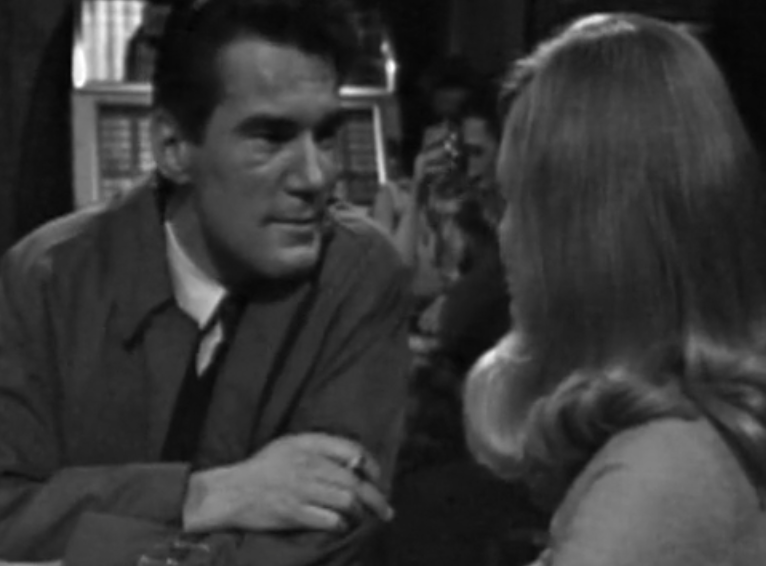
Frederic Forrest talking to his date

That so much emphasis was placed on a background player who later proved himself to be a remarkably capable screen actor makes it hard not to wonder what might have been. Well-meaning governess Vicki is in the early stages of a relationship with instantly forgettable young lawyer Frank. Conard Fowkes, the actor who played Frank, seems to have been a nice guy and all, but perhaps if Forrest had taken the part the character’s full name wouldn’t have started with “instantly forgettable.”

I think of the goofy sincerity Forrest brought to the part of Chef in Apocalypse Now, and I see the perfect companion to Vicki as she wanders into a world of ever-more bizarre supernatural beings. Vicki always seems very innocent at the beginning of a scene, but quite often in these early months she makes tart little remarks that remind us that she is supposed to have grown up as a street kid in NYC. Forrest would have been ideal to both emphasize Vicki’s sweetness and to set her up to show her incisive side. Maybe it’s just as well that didn’t happen- I suspect that if Forrest had played Frank, the Vicki/ Frank romance might have been popular enough that the show might never have got round to the wild experiments that eventually made it such a hit that it is still available today.

Forrest’s skill at playing quiet men who can explode into fury when provoked would have turned many characters we haven’t met yet into fan favorites. Elsewhere, I’ve mentioned Forrest as the actor who should have played Charles Delaware Tate; I suspect that if I keep this blog up through episode 1245, Forrest’s name will come up in connection with several more.

Also, this is the episode where we first learn that authorities in Phoenix, Arizona have identified a charred corpse as the remains of Laura Collins. Since we have by this time begun to suspect that Laura might be a ghost, or an inhuman impostor, or two separate beings, one of them a ghost and the other an inhuman impostor, this news seems less ridiculous to us than it does to the characters.

For the first months of the show, the set representing the foyer of Collinwood ended a few inches from the front door. When they expanded that, they at first decorated the wall with a metal device resembling a coat of arms. Today, we see a mirror there. Throughout the rest of the interior, portraits of Collins ancestors adorn spaces of comparable prominence. The metal thing looked cheap and silly compared to the portraits. The mirror looks better, serves an obvious practical purpose for the characters, and figures in several of the complicated shots Lela Swift and her crew pull off today. But still, there really ought to be a portrait there.

Indeed, this episode explicitly tells us that portraits are terribly important. Sam takes Roger to his home and shows him a portrait of Laura surrounded by flames that some mysterious force has possessed him to paint. Sam hates the painting, and Roger is appalled by it. So it would seem unlikely to be hung next to the front door of Collinwood, but we might suspect that a portrait will eventually land there that will be associated with some kind of weird power.

Episode 44: Casually, and in passing

Even the dullest, most routinely soap operatic episodes of Dark Shadows have a couple of moments when you can tell they were being made by people with artistic ambition. This one is a case in point. Bill brings Liz some unwelcome information. Look at the composition of the shot:

Screenshot by Dark Shadows From the Beginning

They hold it like that for about a minute, and Joan Bennett’s response to the closeup really shows you how she came to be the movie star she was in the 1940s. It really is great.

In the same sequence, Carolyn hears for the first time that her adored Uncle Roger is in trouble. They cut to her for just a fraction of a second, which makes her reaction all the more effective:

Screenshot by Dark Shadows From the Beginning

The last shot is also a fine bit of visual story-telling. After his attempt to get Liz to face facts, Bill returns to the Blue Whale, and takes a seat in an even danker part of the bar than he’d occupied previously.

Screenshot by Dark Shadows From the Beginning

There’s also a good moment when the banker is presenting his visit as routine and Liz, who in the episodes earlier this week had been shown time and again to be in a precarious financial state, combines a faultlessly well-composed smile with hands trembling so hard her teacup almost cracks against its saucer.

And that’s it. The story points are a lot of tedious stuff about people we’ve never seen and relationships that aren’t going anywhere. Most of the actors do their best, but even in that department there is one notable exception.

The banker is played by Patrick McVey, a veteran character actor who could usually be relied upon to turn in a solid performance. He does well enough with the lines he remembers, but he takes most of his dialogue straight off the TelePrompTer. Marc Masse counts 22 shots of McVey catching up on his reading. That takes you out of the show, so that you start noticing everything else that’s wrong. In particular, the banker at one point tells Liz that anyone who might buy up her outstanding notes could put her out of business in a moment, and that in fact someone has been looking into the price of those notes. She asks who, he says “I don’t remember his name.” Mrs Acilius and I laughed out loud at that, saying to the screen “Isn’t it printed on the TelePrompTer?” Obviously the script called for the banker to deliver that line, and maybe if McVey had known his part we could have overlooked the absurdity of it, but as it stands, it is the most memorable moment of the entire episode.

Episode 24: Have you ever sat on a wrench?

The entire episode is set in the Collinsport Inn- the lobby, the restaurant, and Burke’s room.

In episode 21, Vicki took Liz in hand as if she were Plato’s Socrates and Liz were some pompous Athenian aristocrat, leading her through a series of simple, seemingly innocent questions to a most uncomfortable conclusion. That took place in the drawing room at Collinwood, while Carolyn watched. In episode 24, Carolyn joins Burke and the sheriff in Burke’s room. It’s Burke’s turn to play Socrates, Carolyn’s to answer the questions, and the sheriff’s to be an audience. Burke’s questioning is not only effective at raising doubts in the sheriff’s mind, but also prompts regular viewers to bracket Vicki and Burke together and see them as a likely, indeed inevitable, romantic pair.

The scenes in Burke’s room also highlight Roger’s bizarre folly in telling Burke his evidence against him before going to the police. We saw Vicki try to talk Roger out of this in two episodes, and the sheriff commented on it later. Watching the well-prepared Burke cross-examine Carolyn as effectively as any defense attorney, it is all the clearer that Roger’s behavior was driven not by any rational calculation, but by some wild impulse he cannot entirely control.

The scenes in the lobby and the restaurant show us a quiet rewriting of some characterizations laid out in episode 1. In that episode, Burke stood in the lobby and refused to admit that he so much as knew the name of Mr Wells, the hotel clerk, simply because Wells was from the town from which he was sent to prison ten years before. Now he stands on the same set, warmly greets one of the policemen who made the case against him, and repeatedly tries to persuade him to join him for lunch. Also in episode 1, Maggie stood behind the counter of the restaurant and told Vicki that she considers her, as a member of the staff of Collinwood, to be a “jerk” practically as bad as the family that owns the house. In this one, Carolyn herself comes into the restaurant and she and Maggie have a warm, cozy chat, like old friends.

I suppose it was inevitable that they would retcon Burke into a hail-fellow-well-met and Maggie into a friend of at least some of the Collinses. After all, soap operas consist mostly of conversation, so characters who aren’t on speaking terms with each other are dead weight. Placing these scenes on the same sets used in episode 1 is an emphatic way to make it clear to viewers who remember that episode that the change is intentional and permanent.

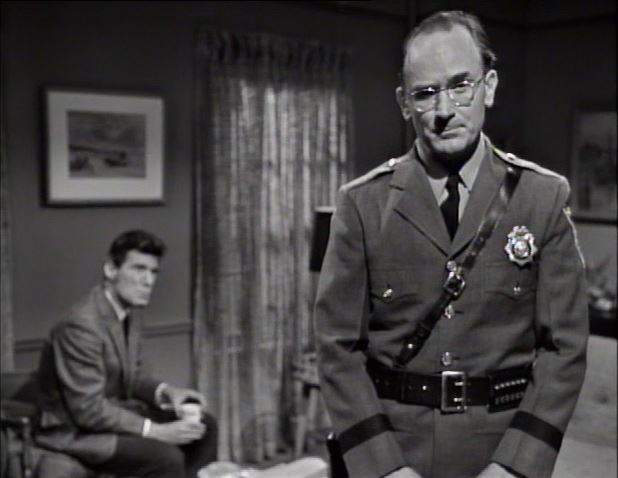
The videography is also as ambitious as we ever see it in this show. The camera tracks fluidly through the lobby, showing us more of that set than we see in any other episode, ending in a low angle shot of the sheriff that makes him look ominous. Some of those tracking shots are too much for Michael Currie, the actor playing the sheriff- during his scene alone with Burke, he bumps into one camera, stumbles into a piece of furniture, and then the other camera hits him in the back of the head. After that, he stands with his back to Burke and his elbows bent in front of him, looking for all the world like he is urinating on the floor:

Currie is so physically awkward that when Burke asks the sheriff the rhetorical question “Have you ever sat on a wrench?,” it seems to be a pretty near certainty that the answer is yes.

Currie has a rough time in this episode with his lines as well as with his movement. Perhaps the single funniest blooper comes when he declares that a good memory “is what I’m paid for,” then forgets his next line. It’s also interesting when he calls Burke “Burt.” Bloopers are after all one of the things Dark Shadows is known for, so we can’t be too annoyed with him for those. Worse is what happens when he does remember his lines. He intones them all as if he were leading the Pledge of Allegiance.

In the months after Mark Allen left the show, the standard of acting on it was remarkably high. Every actor other than Currie consistently turns in performances so strong that watching an episode feels like a fine evening at the theater. And bad as he is, even Currie doesn’t keep his scene partners from delivering good performances. He just wasn’t ready for professional acting. So I don’t have the same need to complain about him as about Allen, but he does deliver the series’ first laugh-out-loud moments of incompetence, and it is a relief when he is replaced.