Episode 293: A better story next time

Well-meaning governess Vicki was the main character of Dark Shadows in its first 39 weeks, and themost interesting storyline was her relationship to her charge, strange and troubled boy David Collins. That story came to its climax when David chose life with Vicki over death with his mother, blonde fire witch Laura Murdoch Collins, in #191, and Vicki hasn’t had much to do since.

Yesterday, Vicki told her depressing boyfriend, fake Shemp Burke Devlin, about an old vacant house that excites her. Since Vicki’s work with David is compensated mainly with room and board, the only way her interest in an empty house could lead to anything happening on the show would be if she quit her job, married Burke, and moved there with him. Since Burke has even less connection to the ongoing narrative arc than Vicki does, and has been spending his time lately demanding that she stop trying to attach herself to the story and settle in with him in his dead end far away from the plot, that is a dismal prospect.

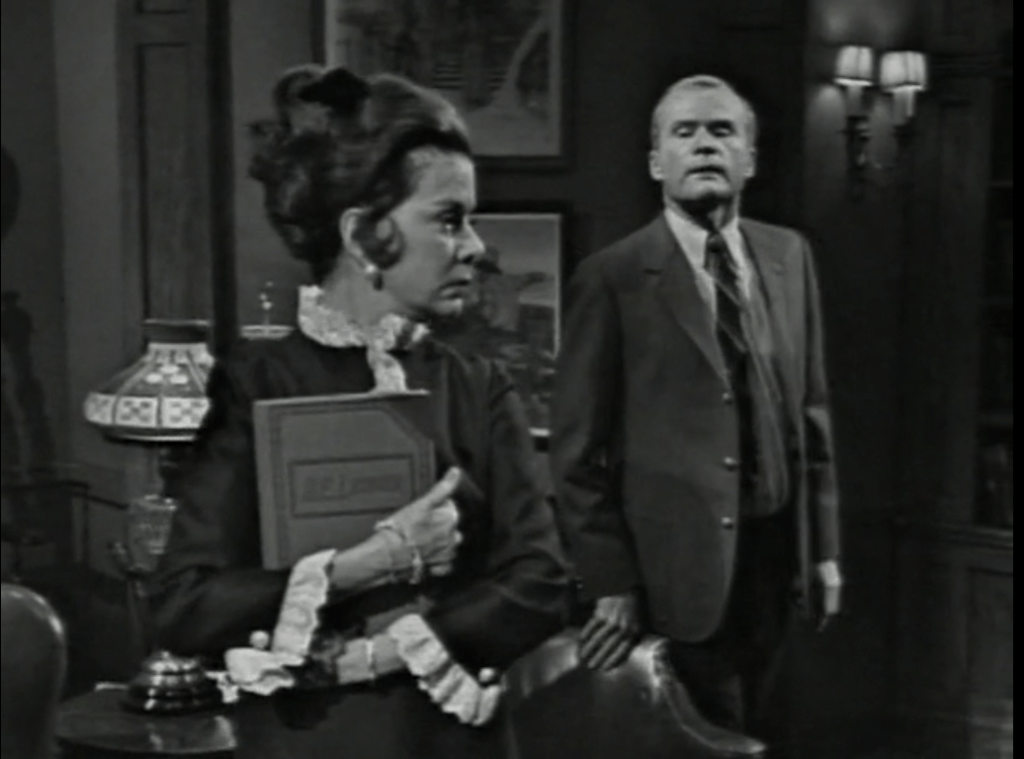
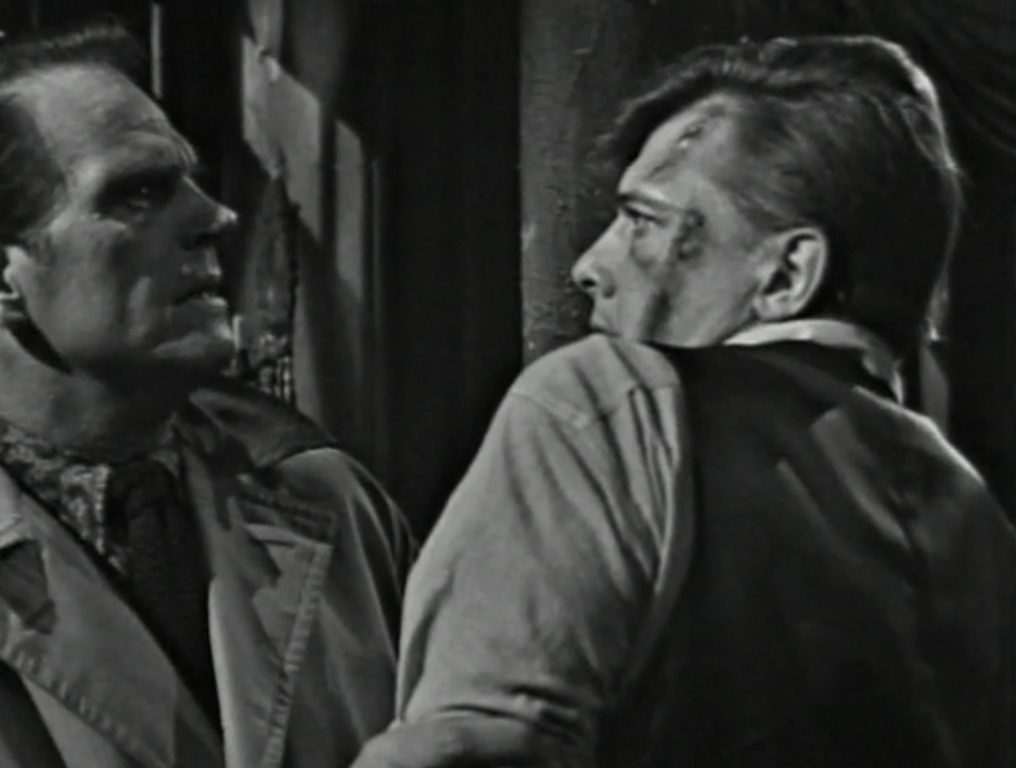
All the action on the show is centered on vampire Barnabas Collins. In the opening scene, Barnabas talked with his sorely bedraggled blood thrall Willie Loomis about two women. One was Vicki. Willie was agitated that Barnabas is planning to bite Vicki. This is an odd thing to worry about- Vicki has gone out of her way to make herself available to Barnabas for biting, even contriving to spend the night in his house. But she still has all her blood, and no foothold in the vampire story. When Barnabas tells Willie that he does not intend to harm Vicki in any way, those of us who hope she will stay relevant to Dark Shadows have a sinking feeling that he might be telling the truth.

The other woman Barnabas and Willie discuss is mad scientist Julia Hoffman. In contrast to his assurances that he means no harm to Vicki, Barnabas muses openly that he might have to kill Julia at any moment. Observing Willie’s reactions, Barnabas comments that it is interesting that Willie is so concerned about Vicki, but utterly indifferent to Julia. If we remember Willie as he was before Barnabas enslaved him, this may not be so odd.

Before he became sorely bedraggled blood thrall Willie Loomis, he was dangerously unstable ruffian Willie Loomis, menace to womankind. Willie tried to rape Vicki, among others, and his guilt over the use he made of his freedom when he had it is reflected in his solicitousness towards those whom he once used so ill. By the time he met Julia, he had been under Barnabas’ power for months, so he has made no choices concerning her that he can regret.

Barnabas shows up as Vicki and Burke are getting ready to visit “the house by the sea.” Barnabas slips a couple of times as he talks with them about it, revealing to the audience that he is familiar with the house. This raises our hopes- perhaps Vicki’s fascination with the house will lead her to Barnabas and relevance, not to Burke and oblivion. Vicki invites Barnabas to come along with her and Burke as they tour the house, and he agrees.

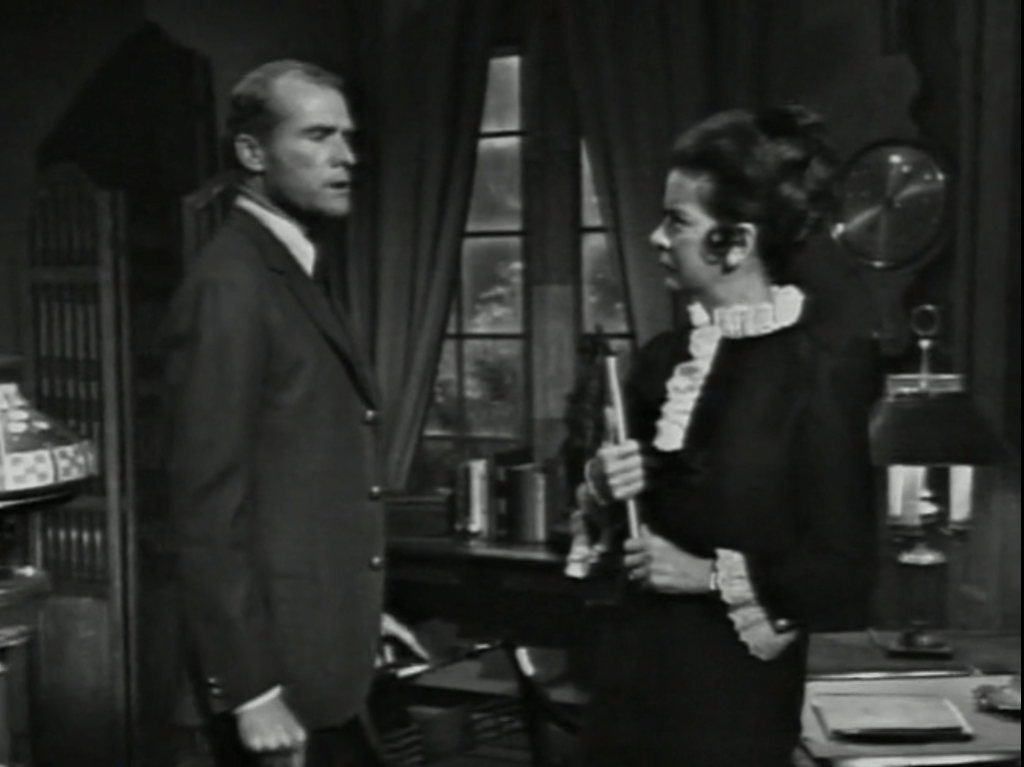
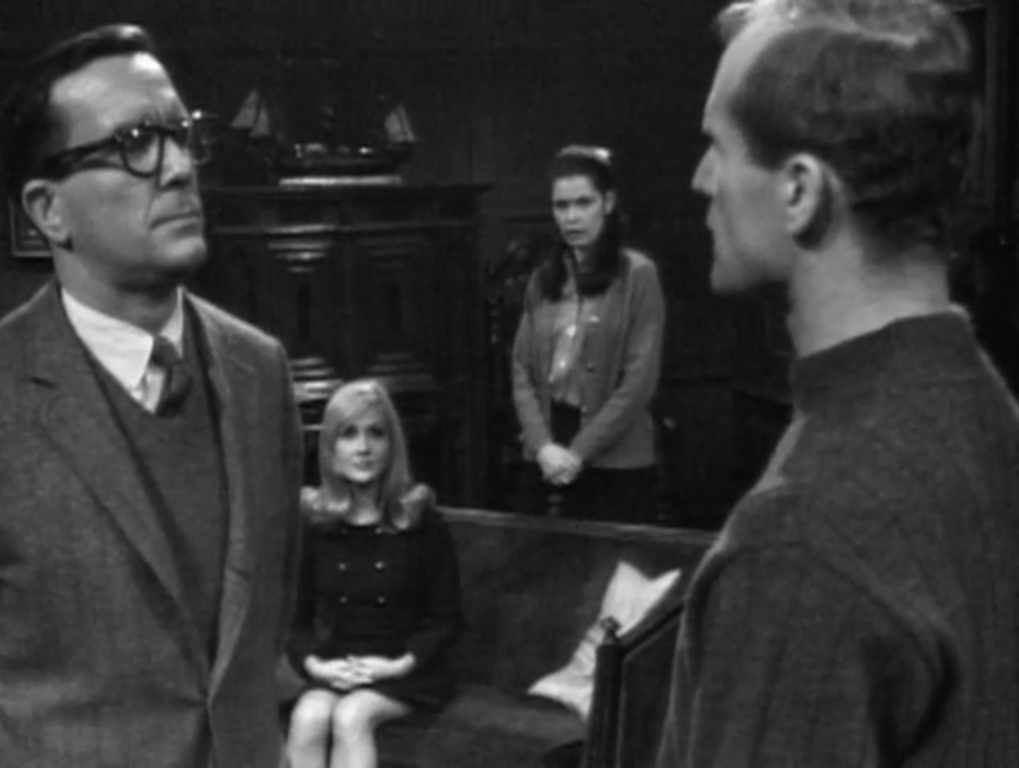
While Vicki is upstairs changing her clothes, Barnabas and Burke talk in the drawing room. Barnabas points out that little is known of how Burke became so rich so quickly in the years before he came back to Collinsport. Burke responds that far less is known of Barnabas than of him, that his entire life before this year is perfectly obscure to everyone. As Barnabas, Jonathan Frid plays this scene with more variety and subtlety of expression than any previous one, and as Burke, Anthony George gives a tight, forceful performance. It is the first time Dark Shadows viewers have glimpsed the reason George had such a long and busy career as an actor.

George was a cold actor who excelled at characters whose intelligence and determination were obvious, but whose feelings and intentions the audience could only guess at. That would have made him a fine choice for the part of Burke in the early months of the show, but these days he spends most of his time giving big reactions to bewildering news and the rest in passionate love scenes with Vicki. George was just awful at both of those. But in today’s duel with Barnabas, Burke is choosing his every word and gesture with care, putting him right in the center of George’s wheelhouse. Opposite the much warmer Jonathan Frid, the effect is electric.

It leaves me wondering what might have been. Mitch Ryan was compelling as Burke #1, but his hot style of acting pushed Burke’s emotions to the surface and took away some of the mystery that would have been needed to make the “Revenge of Burke Devlin” storyline a success. With George in the part, that story would probably still have fizzled, but it might have taken a bit longer to do so. And of course the part George has been struggling with, until this scene in vain, was written for Ryan. If the two had just traded places and the scripts had stayed the same, Burke #1 and Burke #2 might both have been strong characters.

Of course, they wouldn’t have stayed entirely the same. The writers watch the show and are influenced by what they see the actors doing. But they may not have changed as much as you might expect. Neither Ron Sproat nor Malcolm Marmorstein seemed to have much sense of what actors could do. It’s no wonder that George’s first good scene comes in the second episode credited to Gordon Russell. Perhaps if Russell had been with the show earlier, Burke #2 might have been more of a success.

The scene also brings up one of my favorite fanfic ideas. People are going to wonder about Barnabas’ background, and Burke needs to be written off the show. Why not solve both of those problems by having Barnabas enslave Burke, make Burke set up businesses in Barnabas’ name and use his shadier contacts to get Barnabas false identification papers, then kill Burke off once he has exhausted his resources? You could do that in such a way that the other characters would think Barnabas was a nice guy who was using his wealth to prop Burke up, consolidating his position in their eyes. You could also use it to connect Barnabas to the wider world beyond the estate, suggesting that he poses a menace not only to one family but to a whole community.

At length, Vicki comes back downstairs. Burke greets her first, but she barely acknowledges him. She has eyes only for Barnabas. Barnabas may not be in any hurry to bite Vicki, but she is bursting with readiness to get into the vampire story and back into the main action of the show.
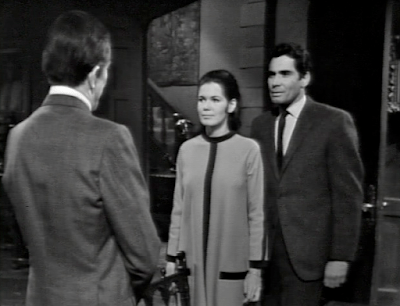
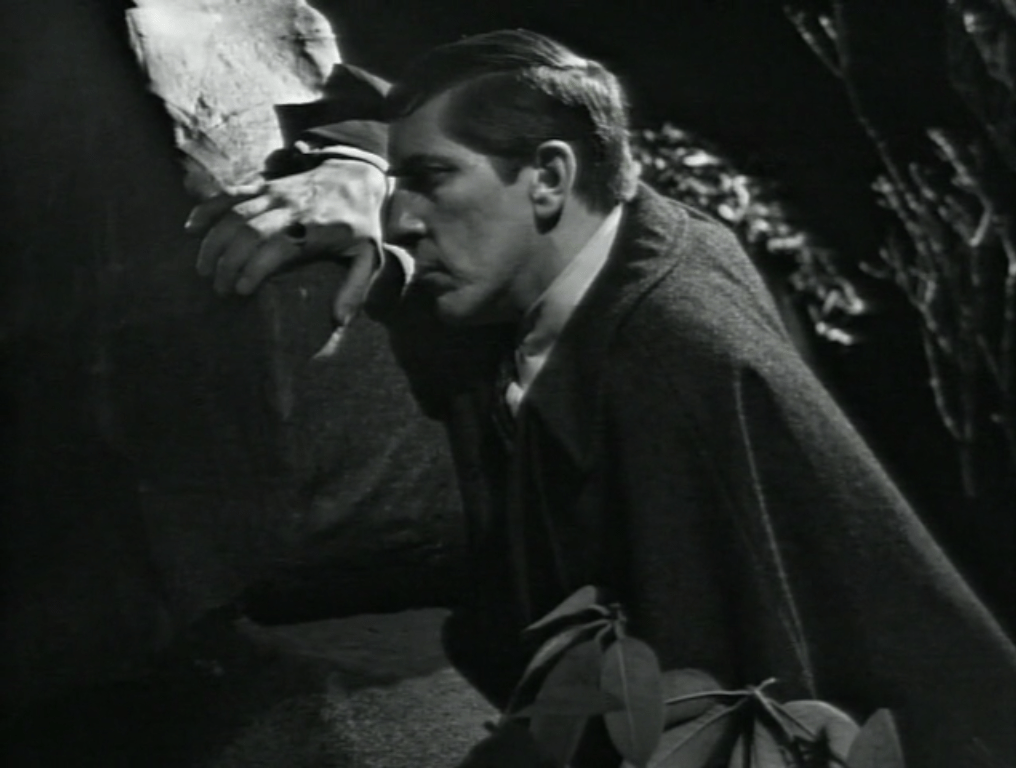
Eyes on the prize. Screenshot by Dark Shadows Before I Die.

Episode 261: Nine, ten, home again

Maggie Evans, The Nicest Girl in Town, has solved a riddle posed by the ghost of nine year old Sarah Collins. The solution led Maggie to a secret panel through which she has escaped from the cell in which she has been imprisoned by Sarah’s big brother, vampire Barnabas Collins. Barnabas is chasing Maggie through the corridors on the other side of the panel.

Maggie has reached two doors, both of which appear to be locked. The other day, Sarah had visited Maggie in the cell and played “London Bridge” on her recorder. Maggie hears a few notes of that same tune, and one of the doors opens. She runs through the door, closing it behind her. She finds herself in another maze of corridors. She hears the music again, and follows it to a stairway. A moment later, we cut to Barnabas going through the other door and heading in Maggie’s direction.

Maggie finds herself on the beach. She staggers about and collapses. Apparently her escape took more strength than she had left after her long imprisonment. Barnabas makes his way to the beach and stands over Maggie, declaring that he has defeated her. She screams.

Maggie’s father, Sam Evans, is on the beach. Sarah had visited him at home and told him he might find Maggie if he went there that night. Sam hears Maggie’s scream and calls out. Barnabas retreats while Sam runs to Maggie.

Barnabas hides behind a rock and stares hard at Maggie. When he first sucked Maggie’s blood, Barnabas gained great power over her mind. She has shaken free from that to the point where she can try to kill him and run away from him, but maybe he still thinks he can put some kind of zap on her.

Evil eye

In the hospital, Sam, addled quack Dr Woodard, and Maggie’s boyfriend Joe discover that Maggie has amnesia and thinks she’s ten years old. She greets Sam as “Papa,” a title Sam says she hasn’t used in “a long time.” She did call him that in #200, but that was an ultra-dramatic moment, so maybe he means it has been a long time since she used it when she was calm and cheerful. Sam tells Woodard about Sarah. Maggie reacts to Sarah’s name, which is surprising since Sarah never gave it to her. Maggie has Sarah’s doll, which the men find puzzling but don’t ask her about.

Woodard has an idea. The three of them will tell everyone that Maggie is dead, and she will go to Windcliff, a nursing home a hundred miles north of town, which would put it someplace near Mount Katahdin. There, she will be in the hands of Dr Woodard’s colleague Julia Hoffman.

After Sam and Joe have agreed to this, we see Barnabas enter the hospital. A clock prominently featured on the wall shows that it is 3:30 AM. Barnabas asks to see Maggie. Dr Woodard asks him how he knew she was in the hospital. He claims that he has heard a rumor to that effect from everyone in town. Woodard says he isn’t surprised. Collinsport must be rather an odd place if everyone is up and exchanging rumors at that hour.

Woodard tells Barnabas that Maggie is dead. She never recovered consciousness, so she wasn’t able to tell anyone what happened to her. Barnabas manages to keep from smiling until after he turns his face away from the doctor.

Barnabas’ obvious relief when Woodard tells him that Maggie is dead makes an interesting contrast with the shot of him behind the rock on the beach. Maggie’s amnesia is such a stark change from her mental state in the last couple of weeks that it seems Barnabas must have made a successful attempt to project psychic power against her. But those transmissions go in only one direction- he can’t sense that Maggie is still alive.

This is the first time we hear the name “Julia Hoffman.” Woodard first mentioned Dr Hoffman in #242, when she was a blood specialist and a man. Julia still has expert knowledge about blood, but is now primarily a psychiatrist.

There is a legend among fans of Dark Shadows that Julia transitioned from male to female as the result of a typographical error. Ron Sproat is supposed to have put the name “Julian Hoffman” in the script, but a typist left the “n” off the end of the first name. Executive Producer Dan Curtis liked the idea of a female Dr Hoffman, and they ran with it.

The Dark Shadows wiki explains that the evidence does not support this charming tale. Various members of cast and production staff told various stories over the years to explain the switch, and no surviving paperwork can settle the question for us. It certainly is true that the storylines sometimes took wild U-turns based on last-minute decisions by Curtis and others, and some of those decisions were so whimsical that they may as well have been based on typographical errors. But it is also true that we’ve never heard the name “Julian,” and the near-rhyme of “Julian Hoffman” would be the first awkward-sounding name on Dark Shadows. Further, Woodard stopped mentioning Hoffman weeks ago, likely before ABC had decided to renew the show beyond #260.

If they are going to make another 13 weeks of Dark Shadows, they are going to need new characters and new storylines. They must have responded to the renewal with some story conferences during which the producers, the writing staff, and others tried to flesh out some possibilities.

The writers appear to have decided there would be a secret passage from the Old House to the beach by #238, when well-meaning governess Vicki mentions that the Old House is very close to the sea. That was a retcon that would startle viewers who remembered previous episodes that suggested it was deep in the woods. But it wasn’t clear then that Maggie would be the one escaping by that passage. She was ranging freely through the house at that point, and wasn’t locked up in the cell until #251. Until that point, it was possible Maggie would become a vampire and be destroyed like Lucy in Dracula, leaving Vicki to be the Final Girl who escapes from Barnabas’ clutches and defeats him.

Months ago, they brought parapsychologist Dr Peter Guthrie on the show to help fight undead fire witch Laura Murdoch Collins. In #183 and #184, Guthrie offered to help Laura if she would renounce evil and participate in his research. That suggested the possibility that a complex relationship might arise between the male visiting expert and the undead female menace. Laura was a one-shot monster, on a mission to burn her son David to death and bound to vanish after the attempt, and so could not stay on the show indefinitely. She could respond to Guthrie’s offer only by killing him the night after he made it. But now an undead male menace is here for the duration, so a female visiting expert might be able to pick up the marker Guthrie laid down.

There are a lot of jokes in Dark Shadows fandom about Julia’s two specialties. Psychiatry and hematology don’t usually go hand in hand. I’ve dreamed up a little fanfic that satisfies me about this. I shared it in a comment on Danny Horn’s Dark Shadows Every Day:

The story I made up for myself is that Julia started out as a blood specialist but switched to psychiatry. She was interested in rare diseases, the rarer the better. She found that in hematology, there’s so much money to be made from developing treatments for the most widespread disorders that a researcher with an emphasis in the exotic is constantly fighting an uphill battle for funding and recognition.* Even those colleagues who had an abstract appreciation of the importance of studying rare disorders had to work within a system where all the institutions push them towards the biggest projects possible.

Psychiatry, on the other hand, always had room for the unusual.** In fact, Julia discovered that high-strung rich people would pay a great deal of money to be told that whatever happens to be bothering them at the moment is not the same kind of problem that one of their servants might have, but is a mental aberration hitherto unattested in the annals of psychiatry.*** So she switched to that field and quickly made enough money to open her own, hugely profitable, mental hospital. But she never stopped working in rare blood diseases, and the experiments she was able to finance by flattering the vanity of her wealthier patients earned her such a reputation in a male-dominated field that even her old acquaintance Dave Woodard would commit sexist slips of the tongue and say of “Hoffman” that “he” is “the top man in the field” of rare blood diseases.

Lucrative as Windcliff was, Julia’s true love was never money, or even science per se, but the exotic. When she found herself as the best friend/ frequent accomplice/ bossy big sister of an honest-to-wickedness vampire, surrounded by ghosts and witches and werewolves and Frankensteins and time travelers and interdimensional anomalies and who knows what else, there was never any question of her going back to the office.

*I have no reason to believe this was true in the real world in the middle decades of the twentieth century, or that it is true today. It’s simply part of the fictional world in which I see Julia.
**(Same note)
***(Same note)

“Acilius,” comment left 23 January 2021 on “Episode 1042: Still Another Murderer,” Dark Shadows Every Day, Danny Horn, 2 July 2017

Episode 245: Microscopic views of hideous malignancies

Two of the best blogs about Dark Shadows share the same web address. One is Dark Shadows Every Day, a series of more than a thousand well-crafted, insightful, often hilarious essays by Danny Horn about episodes #210 through #1245 and related topics. The other is the group blog that Danny’s readers maintain in the comment threads under each of his posts. The commenters outdid themselves in their remarks on Danny’s post about this episode.

At the beginning of the episode, addled quack Dr Woodard has figured out that the two victims of vampire Barnabas Collins, sorely bedraggled blood thrall Willie Loomis and missing local girl Maggie Evans, have something in common. He hopes that if he can compare a sample of Willie’s blood with Maggie’s he will figure out what that is. Willie is terrified that this will lead to the exposure of Barnabas. Puzzlingly, Barnabas is unworried and orders Willie to cooperate. Only after Willie has given the blood and the doctor has left do we learn that Barnabas switched Willie’s sample with a normal one. “DS Willie” comments:

Barnabas is seriously messing with Willie’s mind in this one. So much of what Barnabas says has double meanings, even triple. Of course he’s playing with Woodard too, but Woodard never realizes it.

For one thing, just after Willie’s blood is taken, Barnabas makes creepy blood comments, ending with “…surrendering your utmost self” and his next line “Now, you had no choice.” I suspect this is all meant more for Willie than for the doctor. Willie had no choice but to surrender his utmost self.

Barnabas delights in repeatedly demonstrating his control over Willie, all to the doctor’s approval. When Willie flares up momentarily at Dr. Woodard’s remark about understanding being frightened, Barnabas immediately brings Willie to heel with a harsh word and harsher look.

Later Barnabas jerks Willie’s chain some more, just because he can, and to tighten his control even more. It’s classic Stockholm syndrome type stuff. The victim is abused and in absolute fear for his life, and yet any lessening of the captor’s threats or violence can be perceived as mercy, bonding the victim to his captor.

His shirt in Barnabas’ menacing grasp, Willie swears he would never, never betray Barnabas. He is only thrown to the ground instead of being choked or beaten. Barnabas proceeds to make Willie feel stupid and disloyal and dishonorable and undeserving of future protection. Add enthrallment on top of that. Oh, and the police having Willie as their top suspect, and Jason having beaten and threatened to kill Willie, even though Willie was trying to protect him.

It is actually pretty amazing that Willie has held up under the strain. He is in full-on survival mode, and yet still has the decency to try to shield Maggie and others insofar as he can, given his powerlessness.

Hey, what was up with Barnabas saying Willie’s blood is a “delicate little flower painted on glass”? He says it twice (once to Woodard and once to Willie) while looking directly at the slide. That doesn’t come across as a remark about blood in general.

“DS Willie,” on Dark Shadows Every Day, 13 October 2018 at 12:38 AM Pacific time

He adds another comment:

Oh. Barnabas was using yet another method to get Willie under his thumb: verbally emasculating him with the “delicate little flower” reference to Willie’s blood on the slide. But I think Willie was so relieved that he missed the diss.

“DS Willie,” on Dark Shadows Every Day, 26 December 2018 at 5:57 PM Pacific time

I made a contribution of my own to the thread. In response to Danny’s unfavorable comparison of Dr Woodard with Bram Stoker’s Professor Van Helsing, I commented:

Screenshot by Dark Shadows Before I Die

I don’t think Woodard is Van Helsing at all. He’s Dr John Seward, treating Lucy and Renfield and baffled by the whole thing until he calls in his brilliant old professor. The mysterious Hoffman, one of the best men in the field, that’s the expert who is going to shake things up.

Seward is young, dynamic, and ready for adventure, while Woodard is middle aged, pudgy, and ready for an afternoon tee-time at the local country club. But that change is necessary. Readers of the novel have plenty of time to think about the sort of group that might go on the expedition Van Helsing organizes, and will expect a bunch of high-spirited youths. On a soap, a character like Seward would be the heroine’s new love interest, and Dark Shadows is flailing about trying to figure out what to do with the love interests Vicki and Maggie have now. The last thing they want right now is another bold, handsome young man who is apparently under a vow of celibacy.

“Acilius,” on Dark Shadows Every Day, 19 May 2023 at 7:26 PM Pacific time

In response to Danny’s remark that Jonathan Frid’s bobbles make it hard to guess what lines the script originally gave vampire Barnabas Collins, commenter “TD” replies:

#1. “Now, in a way, isn’t that understandable?

#2. “After all, blood is the life force.

#3. “It reaches into the deepest recesses of both the heart, and the brain.

#4. “It is the familiar of our complete being.

#5. “To surrender even one drop of it is to suggest a partial surrender of one’s utmost self.”

I’m not so sure this is actual Fridspeak. Yes, it’s kind of gibberishy, but it does make grammatical sense and some sort of syntactical sense. Frid delivers it smoothly and with confidence, unlike his halting fumblings when he can’t remember his lines. When he says this, it’s in a close-up shot, and he’s looking down. My guess is that he is reading it directly from a script. Also, this is Joe Caldwell’s first script (or first credited script–he did some writing on earlier Ron Sproat scripts, if another website is accurate). Maybe this is Caldwell exhibiting the enthusiasm of a first solo outing. Dr. Woodard has a couple of hi-falutin’ and rhetorically “poetic” (and gibberishy) speeches of his own in this episode.

Also, might this episode be marked as the first one to demonstrate the “reluctant” or “sympathetic” vampire in Barnabas’s character? In this episode (in another speechy series of lines), when Dr. Woodard and Barnabas are discussing the “madman” who broke into Woodard’s office and stole the blood sample, we get this exchange:

Dr. Woodard: You know, it’s the peculiar magnificence of the human spirit that’s required to provide the potential for such corruption. [See? This is like the Barnabas “blood is the life force” speech–who talks like this???]
Barnabas: Yes, I know what you mean. Whoever he is, he must certainly be, at one and the same time, more than a man…and less than a man.
Dr. Woodard: You seem almost sorry for him.
Barnabas: Sorry? No, I’m not sorry. The truth is, I loathe him. I loathe him very, very deeply.

“TD” on Dark Shadows Every Day, 2 June 2017 at 11:06 AM Pacific time

I agree with “TD” that today’s dialogue is marred by purple passages; I would go so far as to say that none of the lines would have survived a rewrite. Not among the lines delivered by the human actors, anyway- our beagle was fascinated when the hound howled on the soundtrack.

I should mention that at least one perceptive critic of Dark Shadows disagrees with me and “TD” about the script. Patrick McCray’s Dark Shadows Daybook is in its own way the equal of the two blogs at Dark Shadows Every Day. Patrick wrote two posts about this episode. In one from 2016, he wrote that “The language is poetic and evocative. Barnabas has moments of self-loathing and ambiguity that are gorgeously, hauntingly phrased, and the same can be said for Woodard’s exploration of science and mystery.” In 2019, he went so far as to call it “the best written episode of the series.”

John and Christine Scoleri also include some interesting material in the post about this episode on their recap-heavy blog Dark Shadows Before I Die. I particularly liked the series of screenshots at the end of the post captioned with some of the purple prose from today’s dialogue.

Episode 242: One of the best men in the field

Maggie Evans, The Nicest Girl in Town, suffered from an ailment her doctor, Dave Woodard M. D., could not identify. She then vanished from her hospital room in a manner law enforcement, led by Sheriff George Patterson, could not explain. The opening voiceover says that Maggie’s troubles “mystify the finest minds.” This is the first and last time either Woodard or Patterson is classed with “the finest minds” even among the low-functioning characters who abound in the period when Dark Shadows is being written by Ron Sproat and Malcolm Marmorstein. Well-meaning governess Vicki is still the single smartest character on the show, and she turns into an absolute moron every two or three days.

In the opening teaser, dashing action hero Burke Devlin asks Dr Woodard if his studies of Maggie’s blood samples will help find her. He says that they won’t, but that if he can diagnose her he might be able to help her after she is found. Burke asks if he is about to make a diagnosis. He says that he might be making progress towards that goal. At that point, there is a dramatic musical sting, and we cut to the credits. That’s the hook, a statement that further study is needed.

Dr Woodard tells Burke that he has contacted “Hoffman, one of the best men in the field,” and that he hopes Hoffman will be able to get things moving. Under Burke’s questioning, he admits that he is pessimistic that Hoffman will see anything he has missed. This is the first mention of the name “Hoffman” on Dark Shadows. I believe it is only the second mention* of any surname that is not derived from Irish (as are such names as Collins, Devlin, Malloy, and McGuire,) English (as are names such as Woodard, Patterson, Loomis, Johnson, Stockbridge, and Garner,) Welsh (as are names such as Evans and Morgan,) Scottish (as are the names Adair and Murdoch,) or French (as are the names La Freniere, Bilodeau, and du Près.)** It is certainly the first name we have heard that suggests there might be Jewish people in the universe of Dark Shadows.

We then cut to the study in great house of Collinwood, where high-born ne’er-do-well Roger Collins has to confront his sister, reclusive matriarch Liz. The auditors have told Roger that the books are out of balance at the family business. Roger knows that the reason for this is that Liz is giving money to buy the silence of seagoing con man Jason McGuire. He reminds Liz that he himself was afraid of blackmail for the first 40 weeks of the show, so he knows from personal experience that it is no way to live. Liz refuses Roger’s plea that she tell him her secret. As he probes and she resists, they move around the room at times like fencers, at times like dancers performing a paso doble. Their movements are easily the most interesting element of the episode, a credit to director John Sedwick.

Roger’s first approach to the shielded Liz
Liz parries Roger’s thrust
Roger’s second approach

Roger admits that he hasn’t been much help to Liz over the years, but begs her to let him help her now. Liz won’t tell him anything, but she is touched to see her bratty brother sincerely trying to step up.

Liz goes to the drawing room. The camera is behind her as she approaches the room. Jason is standing at the fireplace under the large portrait, the spot furthest from the camera. Not only does he look as small as possible, but at the moment we first see him he is turned away from us, his head tilted far back as he takes a drink. Jason’s smallness and obscurity, coming so soon after Roger’s speech about the dreariness of blackmail, feels like an acknowledgment that Jason doesn’t have much to offer the audience.***

Coming upon Jason

Liz tells Jason she can’t give him any more money without blowing the secret they share. He amazes her by accepting this information calmly, but she is sure he is not done tormenting her.

Liz returns to the study, where Roger is still sitting. She tells him that she has talked to the auditor and straightened out the books. That sounds like something that would take quite a while, even if you are sitting across from each other, and Liz and the auditor had to do it over the telephone. So how long has Roger been sitting there?

Then we rejoin Burke and Woodard in the doctor’s office, which someone has ransacked. The perpetrator wrenched the metal bars out of the window and stole Maggie’s blood samples. Dr Woodard says that the only way the bars could have been twisted was by someone with the “supernatural strength of madness.” I’m not an expert in mental health, but that does not sound like a conventional psychiatric opinion to me.

*After Lieutenant Costa of the Arizona State Police, whom we saw when Dark Shadows took us to Phoenix in #174.

**It is pretty weird that a show set in Maine has so few French-surnamed characters. We’ve only heard of one working-class Mainer with a French name, Amos Bilodeau. La Freniere was given in #45 as the maiden name of Josette, a grand lady who came from France to marry into the Collins family in a previous century; eventually, Josette’s birth name will be retconned to du Près.

***My wife, Mrs Acilius, was the one who really noticed the visual strategy both in Liz and Roger’s first scene in the study and in Liz’ entry into the drawing room.

Episode 232: One quick day

Maggie Evans, The Nicest Girl in Town, has been sick in bed. As long as the sun is up, she is very weak, has no memory of what’s been going on, and can sleep. When darkness comes on, she has wild mood swings and has to be physically restrained from running out into the night.

Moreover, the people who have spent the most time trying to help Maggie have no idea what is wrong with her and don’t seem to be making any progress towards finding out. Her doctor is as ignorant of medicine as are the writers, which is to say completely. The parts assigned to her father Sam and her boyfriend Joe consist of variations on the theme of helplessness.

As this episode begins, Maggie is still in bed, Joe is still sitting with her, and they are still at a loss to understand the situation or develop any plans. After yesterday’s episode, in which the actors labored mightily to inject three minutes of nonverbal storytelling into the half hour window Dark Shadows filled, things are looking pretty grim for the audience.

But then we get a sign of hope. Joe calls well-meaning governess Vicki and asks her to sit with Maggie. At the end of #229, Vicki realized that Maggie’s condition is the same as that which befell the luckless Willie Loomis a few weeks back. Moreover, Vicki is our point-of-view character, and she has consistently been the first to catch on to information after it has been shown to the audience. In the storyline centering on blonde fire witch Laura Murdoch Collins, Vicki led the team that opposed Laura’s attempt to burn her son David to death, and ultimately rescued David as Laura vanished in the flames. So if a battle is going to be waged for Maggie’s sake, we expect Vicki to be a central figure in it.

When Vicki takes Joe’s call, she is in the foyer of the great house of Collinwood. Seagoing con man Jason McGuire is in the same space, and asks her about Maggie. Vicki hates Jason, who is flagrantly blackmailing reclusive matriarch Liz. Vicki keeps trying to excuse herself without answering his questions, and won’t make eye contact with him. But Jason insists, and she tells him enough that he, too, recognizes that Maggie is suffering from the same thing that happened to Willie.

If we remember the ending of #229, this is a poignant moment. If Vicki and Jason could work together, they could solve the puzzle and discover that the mysterious Barnabas Collins is in fact a vampire who has enslaved Willie and is preying on Maggie. But Vicki’s eminently justified loathing of Jason, combined with Jason’s own shortcomings, makes this impossible. As a result, Barnabas is free to go on wreaking havoc.

While Vicki makes her way to Maggie’s house,* Jason goes to the Old House on the grounds of Collinwood to call on Willie. He finds that his onetime henchman’s face is badly bruised and scraped. Regular viewers know that Barnabas used his heavy cane to give Willie a beating the other day, and these disfigurements confirm that Barnabas is quite uninhibited in his use of violence.

Jason discovers Willie’s wounds

Jason reminds Willie that he has found him a couple of times in Eagle Hill cemetery.** After one of those visits, Willie turned up very sick, with two little punctures in his skin and a great loss of blood. Though he was desperately weak during the day, at night he gained strength and ran out. Now, Maggie Evans has been found wandering in the same cemetery, and she exhibits the same symptoms.

Jason tells Willie that he won’t tolerate anything that might bring the police to Collinwood, and demands to know what is behind the troubles he and Maggie have had. Willie tells him it isn’t wise to probe into that matter. When Jason says that sounds like a threat, Willie replies that it is simply a warning. “Threat or warning, I don’t need either from you!” Willie has a strange faraway look as he replies “OK… but, at the moment, it’s all I have to give.” Willie then says “You’ll have to excuse me, but Mr Collins doesn’t like my entertaining guests.”

The reluctant host

The dialogue between Jason and Willie in this scene is spare and elegant, without a wasted word. The actors match it, giving delicate performances of a sort the scripts rarely support.*** As Willie, John Karlen begins it trying to conceal his wounds from Jason and scampering about the set looking for a place to hide. As Jason, Dennis Patrick begins in a stern but solicitous manner. When Jason cannot get Willie to tell him how his face was hurt, Jason finally declares “I’m not going to concern myself with what happened to you.” He then becomes more directly menacing, but with a faint undercurrent of panic as his fear that whatever is happening with Willie will upset his own plans grows. He loses his advantage, and Willie stops trying to hide. By the time the scene ends, Willie is in control. Jason promises to find out what Willie is up to, and Willie replies “Fortunately, you’re not a man who keeps his promises. Fortunately for you, that is.”

The scene is not only an improvement over the repetitious jabbering we heard in the episode Malcolm Marmorstein wrote yesterday, but such a departure from the usual standards of the show in this period that it’s hard to believe it was actually written by Ron Sproat, as the credits say it was. Joe Caldwell has been making uncredited contributions to the scripts for months now, and I believe this scene must have been one of his.

Vicki doesn’t know about Willie’s connection to Eagle Hill. She also doesn’t know that it was Willie who called to tell her where to find Maggie, something Jason figures out in his scene with Willie. Again, if it were possible for Vicki and Jason to pool their knowledge, things would start moving very quickly.

Back in the Evans cottage, Joe tells Vicki that Maggie is not herself. “I was in that room with her most of the day. I never missed her so much in my life.” I think that line was also one of Caldwell’s. Sproat was capable of writing the occasional lapidary epigram, as indeed was Marmorstein, but neither of them had much feeling for what the actors could do. So few people could deliver that line in as natural a tone as Joel Crothers achieves that it must have come from a writer who had Crothers’ voice in his head.

When Maggie was alone with Joe, she yelled at him to go away and never come back. Then, she sounded like a sick person who didn’t know what she was saying. With Vicki, she says very calmly that she and Joe must never see each other again as long as she lives. It leaves no doubt that she is protecting him, wanting him to stay away from her as she is absorbed into Barnabas’ world of the undead. That was clear enough to the audience yesterday, when she found herself receiving a transfusion of Joe’s blood and screamed that she didn’t want anyone’s blood, especially not his. If Vicki were able to add Jason’s information about Willie to what she already knows, she might begin to suspect something like it.

The thunder roars, the french windows swing open, and an ominous silhouette appears in the lightning. It is the figure of a man in a cape, holding a cane in his left hand.**** Vicki stifles a scream. The lightning illuminates the night again, and the figure is gone. Vicki rushes to close the windows, ignoring Maggie’s plea to leave them open.

Now you see him
Now you don’t

After closing the windows, Vicki turns to Maggie, bends over, and creaks out in a frightened voice “Ma-a-aggie!” Maggie responds “It’s all right… it’s all right now… it’s all right.” We cut to the closing credits, wondering just how wrong Maggie’s version of “all right” has become.

*How, I’d like to know? It’s unlikely she walked- Collinwood is miles from town, it’s a dark and stormy night, and several local women have been attacked by an assailant who is still unidentified and at large. But she doesn’t ask anyone to lend her a car, as she always has when she has wanted to go anywhere in previous episodes. Joe doesn’t say anything about coming to get her. And there hasn’t been any indication that she herself has acquired a car, or a bicycle, or a pogo stick.

**The show is still equivocating on the name of the cemetery. When it was first mentioned in #209, it was called “Eagle’s Hill.” Vicki and Sam still call it that, but the other characters who have mentioned it call it “Eagle Hill.” Eventually that latter form will become usual.

***John Karlen uses a vaguely Southern accent at some moments today. The first Willie Loomis, James Hall, is from Mississippi, and Karlen sometimes tries to make his version of the character sound like he also came from that part of the world. Eventually he will give up on that, and Willie, like Karlen, will be a native of Brooklyn.

****As a private joke,amusing only to me, I think of this as “Barnabas Collins #4.” Before the part was cast, producer Robert Costello was the model in the first stages of the painting of the portrait of Barnabas. Then stand-in Timothy Gordon played the hand that darts out of Barnabas’ coffin and grabs Willie’s throat in #210. Jonathan Frid first appeared in #211, making him Barnabas Collins #3. Today, stand-in Alfred Dillay becomes Barnabas Collins #4.

Episode 214: Nothing lasts forever

For the first 20 weeks of its run, Dark Shadows developed its story at a stately pace. When writers Art Wallace and Francis Swann were replaced by Ron Sproat and Malcolm Marmorstein, stately became glacial, and at times ground to a halt altogether. For the last few months, Joe Caldwell has been making uncredited contributions to the writing. While Caldwell is probably responsible for some of the glittering moments of witty dialogue and intriguing characterization that have cropped up, everything is still taking a very long time. And this is the second episode in a row in which nothing at all happens to advance the plot.

There are a few interesting moments. We begin with well-meaning governess Vicki entering the long-abandoned Old House on the grounds of the estate of Collinwood in search of her charge, strange and troubled boy David Collins. The doors swing shut, and she cannot open them. The recently arrived Barnabas Collins comes down the stairs, startling her. He opens the doors easily.

This may not sound like a big thrill, but regular viewers will remember that doors swung open at the approach of the previous supernatural menace, blonde fire witch Laura Murdoch Collins. When characters who did not know that Laura was anything other than a woman saw that happen, they didn’t react- it was a small enough thing that they could fail to notice it, and a weird enough thing that it didn’t register. So we have been prepared to watch for tricks with doors as a sign of the uncanny.

Barnabas’ big challenge today is a job of acting. He has to convince the residents of Collinwood that he is a living man from the twentieth century, not a reanimated corpse come to prey upon the living. He has trouble staying in character. When he tells Vicki that once, centuries ago, a father and son had a quarrel in the Old House that led to the son’s death, he starts laughing and repeats the word “death.” Vicki looks at him like he’s a lunatic. He gets it back together fairly quickly, but when Vicki goes back to the great house on the estate she will tell flighty heiress Carolyn that Barnabas is kind of strange.

“Death Ha Ha!” Screenshot by Dark Shadows Before I Die

Barnabas gives Vicki a long, flowery speech about the building of the house, one with no apparent motivation and many logical stopping places. Marmorstein has been giving these overheated orations to actor after actor, defeating them all. As Vicki, Alexandra Moltke Isles came the closest to selling one of them, at the beginning of #167, but she needed maximum support from the director in the form of close-up shots and lighting effects, and even then it was a relief when it was over.

Barnabas’ entire part consists of such speeches. Jonathan Frid stumbles over his lines quite a bit today, as he will do henceforth. No wonder- not only was he dyslexic, but at this point they were shooting seven days a week to make up for production time they lost in a strike late in March. That left him with precious little time to memorize the pages and pages of purple prose they kept dumping on him.

Listening to Frid struggle through his dialogue today, we discover the first reason why Barnabas became such a hit. In his voice, through his mannerisms, Marmorstein’s gibberish sounds gorgeous. Sometimes Frid’s struggle to remember what he’s supposed to say is a problem for the character. Since Barnabas is himself an actor essaying a demanding role, it gets confusing to see Frid’s own difficulties laid on top of his. But even at those times the sound of his voice is so appealing that we root for him to recover and deliver more of his ridiculous lines.

In his speech to Vicki about the building of the Old House, Barnabas mentions that the foundations were made of rocks deposited by glaciers. Any reference at all to glaciers is pretty brave, considering the rate at which the story has been moving in the Sproat/ Marmorstein era. It also raises a question about Barnabas. He is the man who posed for a portrait done in an eighteenth century style, and David told dangerously unstable ruffian Willie Loomis stories about Barnabas’ mother Naomi that would place her towards the middle of the eighteenth century. We’ve also glimpsed a plaque on Naomi’s tomb that gives her dates as 1761-1821, but that prop hasn’t received anything like the screen time the portrait of Barnabas has had, and must have been made long before David’s lines to Willie were finalized. So the trend is to regard Barnabas as someone who was confined to a coffin from the eighteenth century until Monday night. When he starts talking about the rocks laid down during the Ice Age, an event unknown until the mid-nineteenth century, we wonder which night this week he spent updating his understanding of geology.

In the great house, high-born ne-er-do-well Roger comes home from a business trip to Boston. Before updating him and the audience on recent plot developments, Carolyn reminisces about her childhood, when he used to bring gifts to her when he would come home from business trips. She tells him he was the only father she knew. This is a retcon- up to this point, they’ve taken pains to make it clear that Roger and David only moved into the house a few weeks before Vicki’s arrival in episode 1.

Vicki and Barnabas enter the great house. She introduces him to Carolyn and Roger. Roger quickly escorts Barnabas to the study where the two of them talk alone. Roger mentions that a vineyard in Spain that had been in the family in the eighteenth century was still theirs until shortly before World War Two. Barnabas does not react to the phrase “World War Two” at all. Whether this is because he has been studying history as well as geology, or because he was simply overwhelmed with so much new information, is not explained.

While Roger and Barnabas are in the study, Vicki tries to explain to Carolyn why she thinks Barnabas is a bit odd. Carolyn doesn’t want to hear it. She explains the basis of the Collins family’s attitude towards Barnabas when she says it’s a relief just to meet someone friendly after the rough time they’ve had lately. Viewers who have been watching from the beginning will understand how strong that sense of relief must be, and will know that Barnabas is in a position to ride it right into a permanent billet on the estate.

Barnabas leaves, and Roger shows Vicki and Carolyn the portrait. He points out that Barnabas is wearing the same ring as its subject. He does not point out that he is also carrying the even more distinctive wolf’s-head cane.

While those three talk about the wealthy and genial visitor from England Barnabas appears to be, we wonder what he really is. Barnabas first appeared as a hand darting out of a coffin, he has shown up only at night, he lived hundreds of years ago, and he is played by an actor who bears a noticeable resemblance to Bela Lugosi. So we assume that he is a vampire. But so far, there hasn’t been any direct evidence of blood-sucking. During the months Laura was on the show, they made a point of not assimilating her to any familiar mythology. So for all we know, he might be something we’ve never heard of.

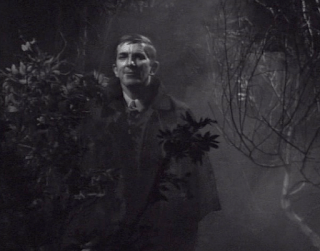
The final shot before the credits roll is in the outdoors, where Barnabas is standing perfectly still, surrounded by shrubbery, and with a big smile on his face. Perhaps that shot is telling us that Barnabas is not the vampire we might assume he is, but that he is in fact an undead garden gnome.

Barnabas the lawn ornament. Screenshot by Dark Shadows Before I Die

Episode 167: The power to do more

We open in the drawing room of the great house on the estate of Collinwood. Well-meaning governess Vicki is taking a page from her adversary, blonde fire witch Laura, and staring into the flames of the hearth. She delivers a speech to visiting parapsychologist Dr Guthrie. Even though today’s script is credited to Ron Sproat, the speech is full of the kind of elevated language and overwrought imagery fans of Dark Shadows usually associate with writer Malcolm Marmorstein. I suspect Marmorstein actually wrote this speech. Marmorstein’s flowery gibberish will defeat actor after actor until a Canadian character man with a Shakespearean background joins the cast and gets it all to himself. From him, it will sound gorgeous.

As Vicki, Alexandra Moltke Isles delivers the speech with her back slightly arched, her shoulders still, her face rigid, and her voice raised to an almost operatic level. It’s as big a performance as we have seen her give, and it very nearly sells the purple prose she has to utter. She’s describing a dream that her charge, strange and troubled boy David, told her that he had while he was staying with his mother Laura. There’s fire, and it’s very dark, and David and Laura are alone in infinite space, and a whole lot of other hugger-mugger.

In several of Vicki’s scenes with her boyfriend, instantly forgettable young lawyer Frank, Mrs Isles has had to project this combination of a personality forceful enough to lead a battle against supernatural evil with a mind struggling to find its way through a situation with no conventional points of reference. In those previous scenes, that combination was a feature of Vicki and Frank’s relationship. Playing the same combination in a scene without Frank, it becomes a feature of Vicki’s characterization. She pulls it off as well as anyone could, considering the lines she has to say.

Guthrie’s speeches are just as badly overwritten. John Lasell takes a different approach to them. He hunches his shoulders forward, speaks in a quieter and slightly higher-pitched voice than usual, and looks at his feet a lot. He is giving his scene partner as much room as possible for her larger than life turn by making himself very small. It’s a challenge to remember anything that is said in this scene, but the image the two actors create lingers. We see Vicki as the leader ready to drive the action on behalf of the forces of daylight and Guthrie as the sage seared by his contact with the powers of the dark.

In the cottage on the grounds of the same estate, Laura is talking with her estranged husband, high-born ne’er-do-well Roger. She says over and over that she hasn’t much time- she must take their son David immediately. Roger asks why she is so hurried all of a sudden. She tries to evade the question, stirring his suspicions.

Roger tells Laura that he can’t oblige her in any case. He must stay on the good side of his sister, reclusive matriarch Liz. Liz is dead set against Laura taking David. Laura cast a spell on Liz a couple of weeks ago, and now she is in a hospital, catatonic. Roger lives as a guest in Liz’ house and receives a paycheck from her business. If she returns and finds that he has sent David away with Laura, she might put him in a position where he has no alternative but to work for a living. Laura should know her husband well enough to know he would go to any lengths to avoid that horrifying prospect.

Back in the great house, Guthrie talks with Vicki and flighty heiress Carolyn about his idea of holding a séance. Carolyn talks through her feelings about it, and decides that her initial reluctance is a matter of fear. Roger comes in, and they tell him about the idea. Louis Edmonds has a lot of fun with Roger’s lines denouncing Guthrie’s “quackery.” Roger ultimately agrees to participate if it will get rid of Guthrie. When he learns that Guthrie wants Laura to take part as well, he reacts incredulously.

Roger facing the “quack”

When Guthrie first came on the show, it was indicated that he would be staying in the house. But at the end of this scene, Vicki shows him out. Evidently he has taken rooms somewhere else. It’s confusing.

Carolyn is sure Laura can’t be talked into attending their séance. Nor does she see any other reason to keep her around. Over Vicki’s objections, she declares that she will confront Laura with evidence that she has been lying about what she did the night Liz was taken ill, and that once she has done this she will order her to leave the estate.

Carolyn does go to Laura’s cottage. She leads Laura to repeat the lies she told. When she springs the evidence on her, Laura tells more lies. Carolyn refuses to accept them, and Laura makes a menacing reply. Carolyn holds her ground, but does not order Laura to leave.

The episode originally aired on Valentine’s Day in 1967 (as they would say on the show, exactly 56 years ago!!!!) Mrs Isles was in the spirit of the holiday, as witness her blowing a kiss to the camera while holding the slate.

The announcements over the closing credits are delivered by someone other than ABC staff announcer Bob Lloyd. It sounds like the same voice we heard giving the announcements at the end of #156. I miss Bob!

Episode 163: Poor relation

At the end of last week, reclusive matriarch Liz left the estate of Collinwood for an extended stay in a hospital. It would seem that she took all of Dark Shadows‘ plot points with her. This is the third episode in a row in which we see nothing but characters reprising conversations that didn’t advance the story the first time we heard them. Writers Ron Sproat and Malcolm Marmorstein have been in charge of the scripting for twelve weeks, and they are clearly in big trouble.

This one has a bizarrely dumb opening. Yesterday, strange and troubled boy David took Dr Peter Guthrie, visiting parapsychologist, to the long-abandoned Old House on the grounds of the great estate of Collinwood. Dr Guthrie told David that he would leave him alone in the parlor for a few minutes to try to summon the ghost of Josette Collins. David stared at the portrait of Josette over the mantelpiece until it transformed. It became a painting of David and his mother, blonde fire witch Laura Murdoch Collins, in flames.

Today’s episode picks up at that point. Dr Guthrie finds David standing on what returning viewers will recognize as the exact spot where he had left him two or three minutes before. Even someone who had never seen Dark Shadows before will look at the set and see that David occupies what must be the most conspicuous location in the entire house, between the foot of the staircase, the fireplace, and the front door. Inexplicably, Guthrie comes downstairs calling “David! Da-a-a-vid!” and announces “I was looking for you!” In a later scene, David will tell Laura that Dr Guthrie is nice but not very smart. After this senseless exchange, that line draws a laugh from the audience.

A conversation between Laura and her estranged husband, high-born ne’er-do-well Roger Collins includes a couple of interesting remarks. Roger wonders whether Laura will succeed in what they both want and persuade their son to leave with her after their divorce becomes final. Laura’s assurance that she can win David over after a single night alone with him (“That’s all I need, Roger–one night…one night alone with him and you’ll never be troubled by him again…because he’ll belong to me…completely”) is delivered in the same jarringly sensual tone she had used talking to David in #159. Considering that David has already tried to kill his father, the suggestion that the danger Laura presents to David is something to do with Freud’s theory of the Oedipus complex is not far to find.

Roger says that when they lived together, Laura’s receptiveness to other men’s attention made him jealous. She contradicts him, saying that the only reason he ever wanted her was that his nemesis, dashing action hero Burke, wanted her. We’ve seen time and again that neither Roger nor Burke is ever as excited about anyone else as they are about each other, and we’ve been invited to wonder what exactly went on between them before they became enemies.

When David comes to Laura’s cottage, the two of them talk about the idea that he might leave Collinwood and live with her. He brings up a point he hasn’t in their previous discussions of this matter, saying that well-meaning governess Vicki will lose her job if he does that. When Laura says that Vicki can get another job, and will probably get married and have children of her own soon, David insists that Vicki loves him more than she does anyone else. This is a touching moment for regular viewers, who saw David move from hatred of Vicki to friendship for her in the one narrative arc of the first several months of Dark Shadows that worked every time we saw it. The Laura story, whatever else it may be, is the grand finale of that theme, and therefore the logical conclusion of the show as we have known it so far.

Mrs Acilius and I agree that the best part of the episode comes in the four seconds after Laura hears someone knocking on her door. As we’ve seen several times, she is sitting motionless, staring into the fire, and only after the second knock does she stir. This time Diana Millay does a particularly good job of looking robotic while Laura tears herself away from the flames.

It registers on Laura that someone is knocking on the door

The best thing about the last two weeks has been the addition to the cast of John Lasell as Dr Guthrie. As of this writing,* it would appear that Mr Lasell is still alive; I’ve found addresses for John Whitin Lasell, Jr, aged 95 years, in both Los Angeles and Orange, New Jersey. Oddly enough, there’s also a Post Office Box in his name in Franklin, Maine. Franklin is about 40 miles from Bangor, down towards the coast where Collinsport would have been.

IMDb says that Mr Lasell was born 6 November 1928 in Worcester, Massachusetts. Wikipedia agrees about the date, but says that he was born in Williamstown, Vermont. The 1940 US Census records the 11 year old John W. Lasell, Jr, as a resident of Northbridge, Massachusetts and gives his birthplace as Massachusetts. There is a memorial to John W. Lasell, Sr, in Northbridge, commemorating his heroic death in the Second World War. So I think we can be confident that John Junior was a Bay Stater by birth. I’m inclined to think Wikipedia’s claim that he was born in Vermont is the result of confusion with dairy farmer John Elliot Lasell. John E. Lasell actually did live in Williamstown, Vermont, and does not appear to have been any relation to the actor. Also, Mrs. John W. Lasell, Sr, the former Frances Sumner, lived into her 97th year, so it shouldn’t be too much of a surprise that her son is still around in his mid-90s.

*3 February 2023

Episode 162: Already told you that

In the first few months of Dark Shadows, events moved along at a leisurely pace. When writers Ron Sproat and Malcolm Marmorstein took over the scripting, that pace slowed further. Yesterday, the story ground to a complete halt, and all twenty-two minutes were taken up with conversations recapping previous episodes. We are still stuck in place today. Not only is it nothing but recapping, the recaps are embedded in reprises of conversations we have already seen.

In the drawing room in the great house of Collinwood, well-meaning governess Vicki tells visiting parapsychologist Dr Guthrie about the relationship between strange and troubled boy David and the ghost of Josette Collins. This is all recycled from conversations Vicki has had with her boyfriend, instantly forgettable young lawyer Frank.

In a cottage elsewhere on the estate, David is talking with his mother, blonde fire witch Laura. They are having the latest in what is coming to be a long series of conversations about whether David wants to go with her or stay at Collinwood with his father. They just review facts already familiar to us.

David returns to the great house and meets Dr Guthrie. They talk about the ghosts David has seen. Dr Guthrie is the first character to react to David’s stories calmly and without disbelief from the beginning. Still, we’ve heard David tell all these stories before. Vicki now matches Guthrie’s attitude completely, and his way of putting questions to David is the same as that of wildly indiscreet housekeeper Mrs Johnson.

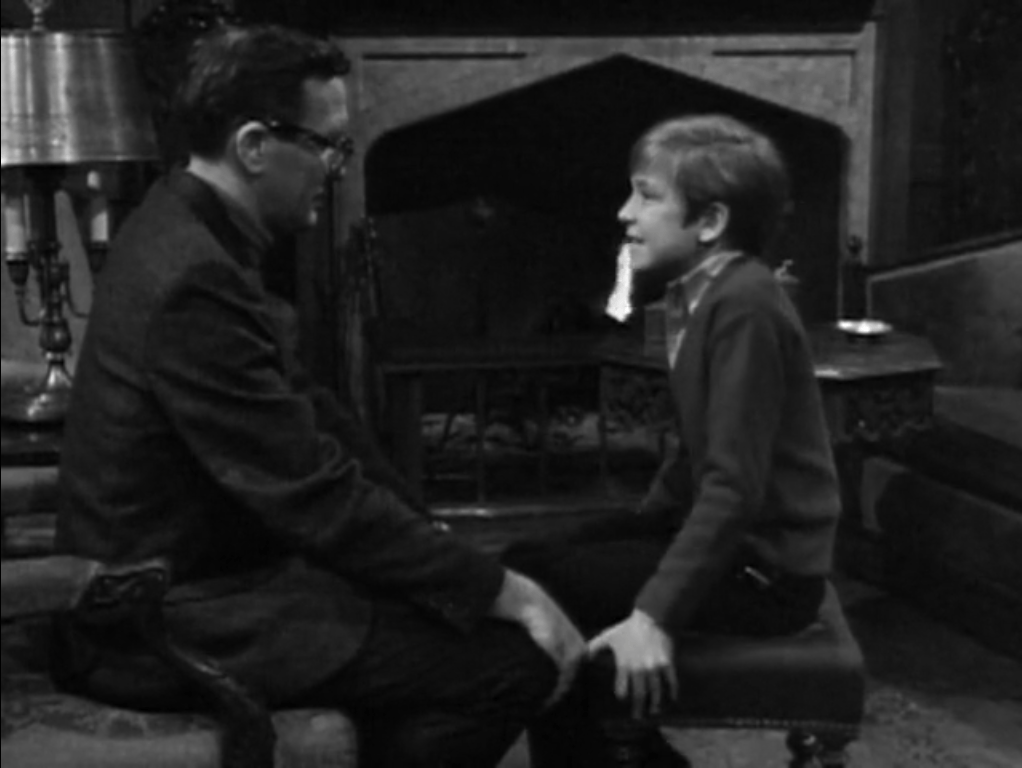
If the episode has a high point, it comes in the middle of this conversation. When David first meets Dr Guthrie, he stands stiffly in front of him. Indeed, throughout the episode the actors are quite stiff, determined to stay afloat when they know the script hasn’t given them a drop of water. When it becomes clear to David that Guthrie is going to take him seriously, he relaxes. He grabs a footstool, sits in front of Guthrie, and starts gabbing away. At that moment, the actor David Henesy transforms into the character David Collins.*

David tells Guthrie all

Vicki goes to visit Laura in the cottage. For the last few days, Vicki has been in control of the house, control she has maintained in part by lying to everyone. Lying is what protagonists do in soap operas, and Vicki has risen to the occasion admirably. At first she tries to lie to Laura, telling her that she isn’t trying to keep David away from her, but only insisting that he stay current with his studies. Laura bats that story away easily. Vicki is pretty sure that Laura is a creature of the supernatural, and apparently concludes that there isn’t much point trying to lie to her. So she tells her part of the truth, which is that her boss, reclusive matriarch Liz, has ordered her to keep David away from her. This was a fairly interesting scene the first time they played it in #152, and not entirely without interest when they revisited it in #159. This third time, Laura ends the conversation with an overt threat. That adds to a long list of indications we’ve already seen that Laura is at once growing in power and running out of time.

David took Vicki to the Old House on the estate to see the ghosts in episode 70, and took his mother there to see them in #141. So he takes Dr Guthrie there today. In #70, we saw that Josette’s portrait above the mantelpiece in the Old House glows when her ghost is present, and in #141 David explained that Josette appears to only one person at a time. Today, both Vicki and David explain this same point to Dr Guthrie. He leaves David alone with the portrait. David has a conversation with the portrait modeled on the one he had with it in #102. The portrait does start to glow, and transforms into the painting of David and his mother immersed in flames that dominated the show for a couple of weeks. Evidently Josette is still trying to warn David about the danger his mother represents.

The portrait transformed

By the standards of the first year of Dark Shadows, the transformation of the portrait is a major special effect. Coming as it does at the end of an entire episode spent reworking scenes that weren’t exciting the first time we saw them, it shows the limits of what special effects can do to make up for bad writing. In a suspenseful installment, even an effect as modest as a spotlight shining on the portrait while the theremin plays can be effective. This time, we’re left waiting to see if Josette has any more slides to show David.

*I owe this point to Mrs Acilius.

Episode 149: The scent of jasmine

Yesterday’s episode gave writer Ron Sproat six major points to communicate to the audience:

  1. None of the characters yet believed that the relationship between mysterious and long-absent Laura Collins and her son, strange and troubled boy David, involved physical danger or crime, much less a threat from the supernatural realm.
  2. An police investigation taking place off-screen and centered in Phoenix, Arizona will advance the plot.
  3. Well-meaning governess Vicki is a credible protagonist in the storyline about Laura.
  4. Dashing action hero Burke Devlin is too smitten with Laura to be of much help to Vicki in her efforts to protect David from Laura.
  5. The budding romance between Burke and flighty heiress Carolyn is at an end.
  6. Vicki has decided the time has come to start fighting Laura.

With more help from the actors than he really deserved, Sproat managed to get all six of these points across. Today, Malcolm Marmorstein has only two themes to deal with. First, he shows us Carolyn processing her feelings about Burke. Then, he shows us the characters discovering that they are living in a ghost story.

Carolyn comes home to the great house of Collinwood in a grim mood. Vicki asks Carolyn who has upset her. She says that Burke has put an end to their budding romance. She asks Vicki to guess who has caught Burke’s eye now, and Vicki names Laura.

Later, Carolyn puts the same question to Laura’s estranged husband, her uncle, high-born ne’er-do-well Roger Collins. Roger also names Laura, also without batting an eye. When Carolyn is surprised at his calm reaction, he assures her he has no interest in anything Burke and Laura might get up to.

In her anguish, Carolyn tells Roger that he would take an entirely different attitude if he could see Burke from a woman’s point of view. As Roger, Louis Edmonds replies to this remark by raising an eyebrow ever so slightly.

Not-so-straight faces

The episodes Art Wallace and Francis Swann wrote in the first twenty weeks of Dark Shadows gave more than a few hints that Burke and Roger’s enmity has its roots in a past homoerotic relationship. In the months since Sproat and Marmorstein took over the writing duties, that idea has only cropped up a couple of times in Sproat’s scripts, and not at all in Marmorstein’s.

Edmonds’ raised eyebrow here will bring a chuckle to regular viewers who have caught on to the theme. As the look passes from his face, Carolyn turns to look at her uncle. When Nancy Barrett saw Louis Edmonds, she must have been glad the scene was ending, as she didn’t have to worry about keeping herself from laughing out loud.

In the village of Collinsport, drunken artist Sam Evans and his daughter Maggie, The Nicest Girl in Town, are at home. Maggie is trying to cheer her father up after a recent mishap with fire injured his hands, leaving him temporarily unable to hold either a paint brush or a whiskey glass. Losing his ability to paint is not as upsetting to Sam as it might be at another time. Lately, an occult power has compelled him to paint nothing but pictures of Laura, naked and in flames, a subject which he and everyone else, especially the lady herself, finds horrifying.

Maggie tries to talk sense to Sam. Screenshot by Dark Shadows Before I Die

What is weighing most heavily on Sam at the moment is a mystical feeling that something is happening to the first of these paintings. It now hangs at Collinwood in the bedroom of Laura and Roger’s son, strange and troubled boy David. An occult power, presumably the same one that took possession of Sam, made Vicki take it back to Collinwood and show it to David. David took the painting because it depicted the scene of a recurring nightmare that had afflicted him and that Sam had no way of knowing about. In the nightmare, Laura had beckoned David to join her in the flames. Again, the nightmare seems to be a communication from an occult power, and there is no reason why it could not be the same one that possessed Sam and Vicki.

The painting has a blank spot the size and shape of David. Sam’s mystical feeling suggests to him that the painting is being completed. He goes to Collinwood to investigate.

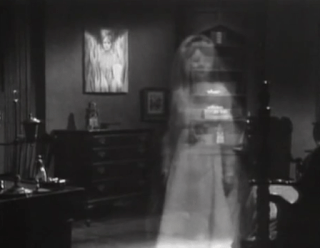
While Sam is on his way, we see David’s room. The painting glows, as both it and the portrait of Josette Collins hanging in the long-abandoned Old House have done when supernatural beings were about. Josette herself manifests. She looks around. She turns to the painting and touches the blank spot.

Josette’s ghost is played here by stand-in Rosemary McNamara. We get a fair glimpse of her face. Her hair and makeup looks very much like those we just saw Kathryn Leigh Scott wearing as Maggie. Miss Scott has played the ghost of Josette several times already and will be closely associated with Josette later in the series. If resemblance is intentional, as it would seem it must be,* why not simply have Miss Scott play Josette today?

The ghost of Josette in David’s room. Screenshot by Dark Shadows Before I Die

Roger, Carolyn, and Vicki are gathered in the drawing room, talking about the painting. Carolyn reminds Roger that David is out of the house, and suggests that he take the painting now and destroy it. Vicki objects that David would take that as a grave betrayal.

A knock comes at the door. Vicki answers it and greets Sam. She shows concern for his injured hands, and very gently takes his coat. She tells him that she is as mystified by her own actions in taking the painting and giving it to David as Sam is mystified by his compulsion to paint it in the first place. Sam asks to speak with Roger. Vicki ushers him into the drawing room, where he meets Roger and Carolyn.

Roger and Sam hate each other, but in front of the young ladies they behave almost correctly. Certainly their hostility doesn’t slow down the exchange of story-productive information. Sam asks to see the painting. Roger and Carolyn send Vicki up to David’s room to fetch it.

That’s an interesting moment. When Sam knocked, Vicki had gone to answer the door at once, and had presented him to Roger and Carolyn very much in the person of a household servant. When Roger and Carolyn send her for the painting, she is all smiles, happy to be on the job. Yet when she and Carolyn were in the drawing room earlier discussing Burke, Vicki was functioning entirely as Carolyn’s equal. The two of them sound like old friends, or like the sisters the show has been hinting they might be. Vicki can move with remarkable facility between the roles of servant and family member. That extraordinary flexibility is one of the qualities that we can imagine will come in handy as she confronts the spiritual forces of darkness gathering in the background.

When Vicki enters David’s room, spooky music starts to play. Vicki walks in slowly, looking from side to side. She senses an eerie presence. She looks at the painting, and sees that where it once was blank it now sports an image of David. She screams.

Roger, Carolyn, and Sam are momentarily stunned by Vicki’s scream. By the time they leave the drawing room, Vicki is already on the stairs holding the painting. Seeing David’s face depicted there, Roger exclaims that he saw the painting earlier that day, and that the spot was still blank then. Sam touches it, and says that is impossible- it is oil paint, and would take days to dry. Roger says that the painting now shows the whole scene of David’s nightmare.

As the four of them try to figure out what could have happened, Vicki says that when she entered the room she felt a weird presence. She says there was a specific perception accompanying this vague feeling- she could smell jasmine perfume. None of the ladies in the house wear that scent. Vicki says that she smelled it once before- in #126, when she saw the ghost of Josette Collins. The association of Josette with the scent of jasmine will continue throughout the series.

Vicki and Carolyn wonder how David will react to his own likeness in the painting, and Roger replies that he never will see it. He throws it in the fireplace. As it burns, the sound of a woman’s scream rings through the room.

Screen capture by the Dark Shadows wiki

This episode is a turning point. Hints of supernatural activity have been cropping up in the show from week one, the audience has been seeing evidence of it for months, and both Vicki and David have seen and talked with ghosts. But the completed painting and the scream that emerges from the fireplace are the first unambiguous tokens of the occult that have been presented to a group like these four.

The only other time more than one person had seen anything like it came in #88, when Roger and his sister, reclusive matriarch Liz, found seaweed on the spot where Vicki reported that the ghost of beloved local man Bill Malloy had dropped it. But Roger and Liz both want to keep the stories of Collinwood’s haunting to a minimum, and they threw the seaweed into the fire without telling Vicki or anyone else that they had found it. Denial, the psychological defense mechanism, is the ruling passion of their lives, and when the two of them found the evidence it was a foregone conclusion that it would be destroyed.

There is no such unity among Sam, Vicki, Carolyn, and Roger. Now that the only way any of them can deny that supernatural powers are operating in connection with Laura and David is to lie, we see that the four of them are strikingly ill-appointed to be the members of a plot to keep a secret. Sam is an outsider and no friend of the Collinses. Vicki is too conscientious to be part of a coverup. Carolyn is a loose cannon, and might tell anyone anything. Roger is unburdened by a conscience and is quite happy to tell lies, but he is also so cowardly and irresolute that he might be the weak link in any conspiracy he might join. So, not only do these characters now know that spirits are at work in connection with Laura’s relationship with David, but everyone else is likely to find out as well.

*Rosemary McNamara’s face is of the same general type as Kathryn Leigh Scott’s, but I think the hair and makeup above emphasize the similarity. Here’s the picture from her imdb profile:

Rosemary McNamara, from imdb