In his post about this episode on Dark Shadows Every Day, Danny Horn remarks on the recapping that permeates the dialogue and reckons it as writer Sam Hall’s critique of the ongoing storylines. That assessment will be familiar to those who, unlike Danny, have been watching the show from the beginning. When Ron Sproat joined the writing staff in October 1966, his first several scripts featured a systematic inventory of the available narrative material, with each plot very explicitly marked as suitable or unsuitable for further development.
In its first year, very little happened on Dark Shadows; now, it has swung to the opposite extreme, and there is a climax at every commercial break. But the result is oddly similar. They don’t take the time to explore the overall situation, so that little seems to be at stake even when a spectacular event takes place. No matter how much happens per minute of screen time, it feels like the pace is slow. We see suave warlock Nicholas in the gazebo on the grounds of the estate of Collinwood summoning his subordinate, the wicked witch known variously as Angelique and Cassandra, and hear him complain that she has spent weeks attempting to do what she should have accomplished in minutes. Thus Hall assures us that the pace will be picking up.
Angelique/ Cassandra comes to the gazebo, to which Nicholas refers as a “ga-ZAY-bo” in a bit of Collinsport English Angelique/ Cassandra herself introduced in #489. There, the two of them quarrel about her dilatory approach. They stand behind columns and look like debaters at podiums.
Maybe I’m reading too much into the set design, but in one of the photos Angelique and Nicholas are sperated by a statue of a Goddess (I assumed Venus). Wouldn’t it be awesome if it was Venus and that statue between them was to represent Angelique’s love for Barnabas blocking her efforts at villainy? More likely that the shot just looked better composed with the statue in the middle but how awesome if it was meant to be subtle symbolism! 🙂
“lakeplacidskater,” posted 25 February 2015 on Danny Horn, “Episode 528: This Tawdry Affair,” 21 November 2014.*
The statue appears to me to represent not Venus, but a harvest goddess. She is fully clothed, and there is a sack at her feet which seems to be full of grain. That makes a lot less sense than does the suggestion “lakeplacidskater” made. The Collinses derive their wealth from fishing and shipping, not from farming, so it is surprising that they would put a symbol of agriculture in such a prominent place. Perhaps she stands for wealth in general, but not for so much wealth that the family could afford to commission a statue of a sea goddess. And neither a bountiful harvest in particular nor wealth in general is any sort of obstacle between Nicholas and Angelique/ Cassandra. I suppose the visual metaphor might be emphasizing the image of the two of them as debaters, with the goddess serving as moderator.
Nicholas dominates Angelique/ Cassandra thoroughly and rather cruelly. Viewers who remember her from the portion of Dark Shadows set in the late eighteenth century may be taken aback by this. In those days, her power often seemed to be limited only by her own carelessness. That made for something of a shapeless narrative, since no one could oppose her effectively. Not only does Nicholas reduce her to a lowly state today, but he himself bungles a simple task when he sets out to do something nasty to well-meaning governess Vicki. Thus we see that the villains will have their work cut out for them.
Later, Vicki is in bed at her friend Maggie’s house. She has gone there to escape a curse Angelique/ Cassandra has placed that has caused several people to have the same nightmare. Since Maggie was at home when she was the first person to have the nightmare, and Vicki’s boyfriend Peter was sleeping there when he had it, it is hard to understand why Vicki thinks it is a place of safety.
We have several closeups of the face of the clock while Vicki goes to sleep. It’s an Ingraham eight day clock, apparently they wanted to make sure we knew that. When Vicki finally nods off, Angelique/ Cassandra materializes in the room with a jar of rose water that is supposed to make Vicki have the nightmare. Ever since the days when humanoid Phoenix Laura Murdoch Collins was on the show, we’ve been seeing undead witches materialize in people’s bedrooms while they sleep. This time, Maggie walks in and sees Angelique/ Cassandra. She screams at the sight. All of the women in the cast were required to scream frequently, so frequently that fans become connoisseurs of screaming. Kathryn Leigh Scott was one of the better screamers, not far behind Clarice Blackburn, so that makes for a satisfying ending.
*I can’t help but point that when “lakeplacidskater” left her post, all the members of the cast were still alive. Humbert Allen Astredo would die in 2016 and Lara Parker in 2023; Alexandra Moltke Isles, Roger Davis, and Kathryn Leigh Scott are still with us.
Vampires and mad scientists are both metaphors for extreme selfishness. The vampire exists only to feed on humans, gaining a night’s nourishment for himself at infinite cost to them; the mad scientist takes skills and equipment that could bring great boons to humanity and uses them only to further some perverse private whim. The Frankenstein’s monster emerges as the logical synthesis of these metaphors. As a botched resurrection and a parody of the Christian story, the Frankenstein’s monster evokes the vampire; as the helpless product of the mad scientist’s hubris, he is a child neglected and abused by a narcissistic parent, bringing home the real-world stakes of the issues raised in stories of uncanny horrors.
Mad scientist Julia Hoffman and vampire Barnabas Collins have finally got round to creating a Frankenstein’s monster of their own. His name is Adam. Julia and Barnabas had expected Barnabas to die and his “life force,” what the opening voiceover today refers to as his “spirit,” to animate Adam. They are surprised that the experiment has ended with Barnabas and Adam both alive. They are entirely bewildered about what to do with this 6′ 6″ newborn. Julia goes to her usual default, and injects him with a sedative.
Matriarch Liz comes from the great house of Collinwood to the house where Julia and Barnabas are working. She brings some information about the B plot. Barnabas makes it clear that he and Julia are deeply involved in an experiment begun by the house’s previous owner, the late Dr Lang. Liz is mystified by Barnabas’ new interest in science. She and Julia go to Collinwood, while Barnabas stays downstairs in Lang’s old consulting room. He is waiting for the dawn, wondering if the process of creating Adam cured him of the symptoms of vampirism or if he will crumble into dust when the sun rises.
In the lab upstairs, Adam regains consciousness. He plays with some of the shiny objects around him. It’s rather an odd playpen for a baby, with its electrical equipment spraying sparks, vials of boiling acid, loaded gun, and medical sharps. But he seems delighted with everything until he grabs a scalpel by the wrong end. Then he starts smashing things.
By that point, Julia is back, the sun is up, and Barnabas has learned he is human again. Julia and Barnabas hear the crashing sounds from upstairs. They try to stop Adam. He flings them aside. The episode ends with him sticking his arm out the door while they press it shut. Grayson Hall and Jonathan Frid do such a good job of playing Julia and Barnabas as farcically clueless that the sequence left me and Mrs Acilius roaring with laughter.
There is a bit of self-reference in this one. The first person Adam sees when he opens his eyes is Barnabas. When he can see Barnabas, he is calm. When he cannot, he becomes agitated and dangerous. Most of the people watching Dark Shadows at this point first tuned in because they were curious about Barnabas, and have stayed with the show because they are fascinated with him. The viewer mail whenever Barnabas was not getting enough of the spotlight to please his fans must have been unpleasant for the writing staff to read, and might have made them apprehensive of the crowds that gathered every weekday outside the studio at 442 West 54th Street. Perhaps Adam’s rampage was their nightmare dramatized.
Dark Shadows often signaled a commercial break by playing an ominous three note motif on the soundtrack. Even in 1968, DUN DUN DUNNNN! was a pretty corny way to punch up your dramatic values. It was even cornier when, as was often the case, it followed a three syllable clausula. So today’s first act ends with vampire Barnabas Collins vowing that he will kill the Rev’d Mr Trask, a visiting witchfinder whose fanatical pursuit of bewildered time-traveler Vicki has helped precipitate many disasters. After Barnabas says Trask is “Going To Die!,” Mrs Acilius and I sang along with the motif- “Going- To- Die!” The missus pointed out that many among the 8-13 year olds who made up so much of the show’s original audience probably sang exactly the same refrain when the episode was first broadcast.
There are a couple of missing transitions in quick succession today. The opening scene between Barnabas and Ben takes place in the Old House on the estate of Collinwood; they take care to show a clock to establish the time of this scene as 4:00 AM. We then cut to the great house on the same estate, where it appears to be dark out. A knock comes at the door; the mistress of the house, Naomi Collins (Joan Bennett,) answers and finds Trask. It isn’t 4:00 AM anymore- Ben enters after a moment, and mentions that the sun is about to set. Inserting a still photo of a daytime scene would have been enough to tell us that many hours have passed, and the lack of that insert really is confusing.
Trask has come demanding the keys to the Old House so that he can gather Vicki’s things and burn them. A different kind of transition is omitted in the scene this demand initiates. Lately, Naomi has become assertive and independent, primarily in her refusal to go along with the persecution of Vicki. She does that for a while in her response to Trask, ordering him to leave, telling him he disgusts her, slapping him in the face, and daring him to hit her. But when Trask threatens to go to her husband, haughty tyrant Joshua, and enlist him against her, she gives in immediately, without any visible change in affect. That is puzzling, and not at all in keeping with Joan Bennett’s usual style. Typically, she makes the most of every chance she gets to show us why she was one of the biggest movie stars of the late 1930s.
Rough patches like these, along with the many many line bobbles from all the actors throughout the episode, make me wonder if writer Gordon Russell was late delivering the script. The show never had more than three credited writers at a time, and there must have been occasions when they couldn’t get the documents to the directors and actors early enough that they could get everything nailed down. It would take considerable thought for any performer to choose the best way to play a brief moment within which Naomi moves from fearless defiance to capitulation. Perhaps the reason she wound up doing nothing was that she didn’t have time to think about the question.
Ben accompanies Trask to the Old House. While Trask goes to Vicki’s old room, Ben meets Barnabas emerging from the basement and apprises him of the situation. We see Trask upstairs and hear Ben and Barnabas’ voices in the distance. Trask reacts, but goes ahead with his mission. He waits until he is downstairs with all of Vicki’s stuff in a bundle before confronting Ben and demanding to know who else is in the house. Ben claims that he was talking to himself. Trask is unconvinced.
Later, we see Trask in his own room at a nearby inn. He hears the rattling of chains and the disembodied voice of Barnabas taunting him. After a while, Barnabas’ hand comes floating towards him. When this happened, Mrs Acilius called out “Got your nose!” We both burst out laughing and were still laughing hard when the closing credits started to roll.
Despite the rough spots and the bad laugh at the end, this installment was a lot of fun. I can’t give it the “Genuinely Good Episode” tag, but we won’t be tempted to skip it if we do another watch-through of the series someday.
It is 1795. In the foyer of the great house of Collinwood, young gentleman Barnabas Collins stands on the staircase, his father Joshua stands on the floor. Joshua forbids Barnabas to marry lady’s maid Angelique on pain of disinheritance; when Barnabas declares he will marry her anyway, Joshua announces that they are no longer father and son.
In 1967, Barnabas will return to Collinwood as a vampire. In that year, in episode #214, he will take well-meaning governess Vicki on a guided tour of the foyer of the old manor house, indicate the staircase there, and say that “On these stairs, a father and son hurled words at each other, words that would lead to the death of the son.” He will then begin laughing maniacally and repeat the words “The death!,” seeing the desperate irony of referring to his own death in the past tense.
By today’s episode, the Collinses have moved out of the old manor house without any shocking scenes between Barnabas and Joshua playing out on the stairs there. That isn’t so surprising- that one remark eight months ago was the only reference to the stairs as the site of a fateful quarrel between Barnabas and Joshua, and the writer responsible for that day’s script, Malcolm Marmorstein, has been gone and forgotten since August. Neither today’s screenwriter, Gordon Russell, nor his colleague, Sam Hall, was with the show when Barnabas gave that speech to Vicki, and the third member of the writing staff, Ron Sproat, has been in the background for most of the 1795 segment so far.
But they do go out of their way to put Barnabas on the stairs of the new house for his showdown with Joshua today. It seems likely that they are hoping that at least some viewers will remember Barnabas’ remark in #214 and look for a significance in the connection. They did that sort of thing all the time in the early months of the show. For example, when they were developing a murder mystery about the death of beloved local man Bill Malloy in the last four months of 1966, they would show us a clock face in one episode, then weeks later have a character lie about the time established by that clock. Sproat more or less put a stop to those kinds of wild over-estimations of the audience’s attention span when he joined the writing staff near the end of 1966, but ever since the vampire story began in April of 1967 they had acquired obsessive fans who sent letters and gathered outside the studio. So they do have a reason to try to close the loop on a very long and very slender thread. What might the significance be of this particular nod to Barnabas’ first days on the show?
The 1795 segment began when the ghost of Barnabas’ little sister Sarah took possession of Vicki at a séance in #365, announced she wanted to “tell the story from the beginning,” and hurled Vicki back to her own time as a living being. But it is not simply a flashback explaining what made Barnabas a vampire. Vicki has completely failed to adapt to her new environment, and as a result has made significant changes to the timeline. She is now in hiding, suspected of witchcraft because of her endless stream of bizarre words and actions.
In fact, there is a witch at Collinwood. It is Angelique. Presumably, the first time these events took place Angelique pinned responsibility for her crimes on Sarah’s proper governess, Phyllis Wick. We caught a glimpse of Phyllis in #365; we could tell, not only that she was indigenous to the eighteenth century, but that she was quite cautious about anything that might suggest the paranormal. It would have taken Angelique some time and effort to set Phyllis up as a patsy, while Vicki volunteered for the role without any action at all on Angelique’s part. So maybe Vicki has speeded everything up. Maybe the family was still in the Old House when Joshua disowned Barnabas in the original sequence of events, but Vicki’s blunderings have accelerated matters so that they moved out before the conflict between them came to a head.
There is another puzzle about the writers’ intentions in this episode. It is established that without his inheritance or his position in the family business, Barnabas will be in a most parlous state. In separate scenes, both Barnabas and Joshua talk about the impossibility of Barnabas finding a job in Collinsport. Barnabas tells Angelique they will have to go at least as far as Boston before they can find anyone who will risk Joshua’s displeasure by hiring him. Later, Joshua tells Naomi that Barnabas won’t even be able to reach Boston- he doesn’t have enough money and won’t be able to get enough credit to stay in an inn, and he has no friends who will so much as put him up for a night if they know he doesn’t have an inheritance coming.
Barnabas’ mother, Naomi, has a solution to his financial problems. She gives him the Old House. The Old House is supposed to be a huge mansion, which it takes a very substantial income to maintain. How a man who can’t even afford a room for the night is going to meet those expenses is not made clear.
The frustrating thing about this is that they dwell at such length about the hard realities of dollars and cents immediately before, and then again after, Naomi makes her gift. By the laws of Soap Opera Land, a character who possesses a symbol of wealth such as a mansion does not need an income. We can accept that convention, and do in the 1967 segment, when a moneyless Barnabas occupies the Old House and can pay for all sorts of expensive things. But today they keep rubbing our faces in the implausibility of it.
My wife, Mrs Acilius, suggested they could have presented both themes if they’d dealt with the realistic financial problems in one episode and in a subsequent episode had gone back to the fantasy world. Maybe Joshua disinherits Barnabas on a Friday, he worries about getting a job on Monday, Tuesday we watch someone try to introduce Vicki to the concept of “lying,” Wednesday we see caddish naval officer Nathan woo feather-headed heiress Millicent, Thursday much-put-upon servant Ben Stokes tries to escape from the spell with which Angelique controls him, and then comes another Friday, when Naomi waves her magic wand and gives Barnabas the house. But as it stands, Barnabas talks to Angelique about how they have to go hundreds of miles to eke out a bare subsistence, Joshua talks to Naomi about Barnabas’ impending poverty, and then all of a sudden they remember that none of that matters, sorry sorry we shouldn’t have bothered you with it.
There were times in 1966 and 1967 when Dark Shadows only had one viable storyline, and no readily apparent means of starting others. But now they have several stories in progress, and an abundance of lively characters with whom they can make as many more as they like. There is no need for events in any one plot-line to move so quickly that incompatible themes crash into each other with such an unfortunate result.
Naomi’s gift to Barnabas was legally impossible in 1795. Until 1821, Maine was part of Massachusetts, and married women could not own property in Massachusetts until 1822. Maine did not pass its own Married Women’s Property Act until 1844. The show never brings this up, so it isn’t the same kind of problem as Barnabas’ lack of income.
Still, it does represent a missed opportunity. If Naomi’s family of origin had owned the house, they might have placed it in a trust over which she would have enough influence to deliver it to her son against her husband’s wishes. In fact, the show never makes the slightest allusion to where Naomi came from. If they’d given her relatives of her own, she would have had potential allies in a clash with Joshua and potential goals to pursue independently of him. As it stands, they have put her firmly in his shadow, so that the category of possible stories about Naomi is a subset of stories about Joshua. That’s a sad situation for a character who is capable of the dynamism she shows today, and a criminal waste of the talents of an actress as accomplished as Joan Bennett.
Wicked witch Angelique cast a spell bringing a painful and apparently terminal illness to little Sarah Collins, beloved baby sister of young gentleman Barnabas. Angelique was enraged that Barnabas would not love her and wanted him to watch Sarah in agony, so that the love he felt for his sister would torture him. Barnabas happened by Angelique’s room in the servants’ quarters of the manor house of Collinwood while Sarah was languishing, and it occurred to Angelique that she had some leverage to use against him. She told him she might know of a cure for Sarah, and extorted his promise to marry her if she effected it. He agreed, Sarah recovered, and today Angelique comes to collect.
At first, Barnabas is bewildered by Angelique’s belief that they are going to marry. She brings up his promise. He is flabbergasted to find that she took it seriously. He does not know that she is a witch, and only now seems to suspect that she is a crazy person. She asks if he won’t have her because she is a servant. He gallantly denies that class makes any difference. He says that the real problem is in his feelings for Josette, his former fiancée, who eloped with his uncle Jeremiah. He says that he knows there can never again be anything between him and Josette, but neither will he ever cease to love her. Barnabas asks if Angelique would be willing to marry him, knowing that Josette will always have the first place in his heart; she asks what that matters, as long as she gets to be his wife. She repeatedly releases him from the promise he made while Sarah was ill, but he agrees to marry her anyway.
Yesterday’s episode and today’s include writer Ron Sproat’s first significant scenes featuring Angelique and Barnabas. In the scenes Sam Hall and Gordon Russell gave them, it seems that, while Barnabas has definitely made up his mind that Josette is the one for him, he also has the hots for Angelique. So he squirms and looks unhappy when Angelique throws herself at him, but he does kiss her and he does not hesitate to accept her invitation to visit her alone in her room in the servants’ quarters. So we can imagine that when Barnabas first met Angelique on the island of Martinique, believing as he did at that time that Josette could never love him, he was just doing what came naturally to him when he availed himself of her favors.
But in Sproat’s scenes, Barnabas isn’t attracted to Angelique at all. Yesterday he saw her while he was frantically worried about Sarah’s illness, so any sign of attraction would have had to be subtle. But today, they have a long, deeply emotional conversation in the course of which they decide to get married, and throughout he looks and sounds like he’s talking to his grandmother. That invites us to imagine their affair on Martinique in quite a different light. Perhaps he settled for Angelique then in the same way he is settling for her now- he despaired of ever getting the relationship he really wanted, and decided to give the path of least resistance a try.
It may not be irrelevant that Sproat was gay. For that matter, so was actor Jonathan Frid, a fact that wasn’t publicly acknowledged by his representatives until he’d been dead for ten years, but that can’t have been all that hard for sophisticated viewers to figure out in 1967.
Before Dark Shadows took us back in time to 1795, we knew Barnabas as a vampire trying to convince people he was a living man. In his efforts to pass, we often saw him alienated from his own feelings, isolated from others, and unable to express himself through any conventional form of masculinity. It wasn’t hard to find gay subtext in him then. But I think that in this scene we see the most specific and recognizable closet situation he has been in so far. When he expresses disbelief that Angelique will “accept me as I am,” even knowing “the way I feel,” the character collapses into the actor for a moment, and Josette merges into some guy to whom Frid would never feel comfortable introducing us. When he takes Angelique at her word and agrees to a sham marriage, he sees her as someone who has a place for the man he is. From what we have seen of her single-minded pursuit of Barnabas’ devotion, we know that she expects to turn him into someone else, and that they will both be terribly disappointed.
It is 1795, and we are on the great estate of Collinwood. Under the influence of wicked witch Angelique, the kindly Jeremiah and the gracious Josette have eloped, breaking the heart of Josette’s fiancé, Jeremiah’s nephew and best friend Barnabas Collins. Barnabas, up to that point an idealistic man of the Enlightenment, responded by going against his beliefs and challenging Jeremiah to a duel.
Angelique is a lady’s maid. She was introduced as maid to Josette’s aunt, the Countess DuPrés, but today it seems she is Josette’s maid. She comes to Barnabas’ room. He demands to know why her mistress has sent her, meaning Josette, to which she replies she has come on her own account.
Angelique asks Barnabas why he has challenged Jeremiah to a duel, since he has never fought a duel or even seen one before. He explains that he could not stand being an object of pity- “I couldn’t be poor Barnabas.” In 1967, Barnabas will be a vampire. We saw him in that year, in #345, telling his sometime associate mad scientist Julia Hoffman the story of his relationship with Josette. The story he told was different from other versions he had told previously, for example in #233 and #236, and radically different from what we have seen play out in this extended flashback. In the story he told Julia, as in all other versions we had heard before coming to 1795, Josette was originally Jeremiah’s fiancée. One theme developed that resonates here was that all he could be to Josette was a faithful friend, and that he found that role humiliating. He was “poor Barnabas” in that version of the story, and he implies that it was to escape from that identity that he did whatever it was that made him the undead monster he became.
Angelique cast her spell on Josette and Jeremiah because she wanted Barnabas for herself. Now that she sees that he is likely to get himself killed before she can make her play for him, she asks him to wear a medallion of hers, one which she says will bring good luck. In the 1960s, a portrait of Barnabas hangs in the foyer of the great house of Collinwood. He is wearing a medallion in that portrait. Is Angelique’s medallion the one in the portrait? We can’t be sure.
Josette and Jeremiah have a conversation. They try to figure out what came over them. They don’t love each other, and regret hurting Barnabas. As their conversation goes on, Josette realizes that Jeremiah regrets it so deeply that he is planning to let Barnabas kill him in the upcoming duel. She is horrified by this. She doesn’t want anyone to die, and has accepted the fact that Jeremiah is the only husband she’s got. Nevertheless, she cannot dissuade him.
Josette’s father arranges for Jeremiah to have a final talk with Barnabas. Barnabas accuses Jeremiah of lusting for Josette all along, saying that “you wanted her the moment you saw her.” This is not true of Jeremiah, but in #345 it is exactly what Barnabas tells Julia he himself did. In that version, he conceived a wild passion for Jeremiah’s bride-to-be the moment he first saw her.
Barnabas tells Jeremiah “You must have hated me all your life.” As we have seen over these last few weeks, Jeremiah and Barnabas have been dear friends all their lives. But from his early days on the show in the spring of 1967 until we left for our voyage to the past in #365, Barnabas consistently said that he hated Jeremiah from his earliest days. The overall effect of comparing Barnabas’ various accounts of the past with each other and with what we are seeing in this flashback is something like reading the accounts of the patient’s memories in a case study by Freud. Not only does the order of the events jumble as retcon follows retcon, but guilt floats from one person to another and back again.
When Jeremiah tries to explain how he and Josette found themselves stricken with intermittent attacks of intense desire for each other and how they struggled against those attacks during the intervals between them, Barnabas asks “Why didn’t you come to me then?” That’s a good question, and it suggests another, equally good question. Angelique is casting spells because she and Barnabas had a brief affair before he became engaged to Josette. Why hasn’t he come clean to Josette about his past? If he had, Josette would not have put herself so completely in Angelique’s hands that she could bind her with her spells at leisure.
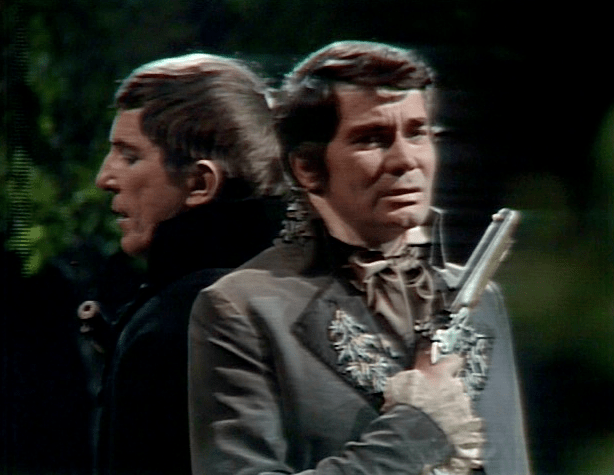
Jeremiah and Barnabas have their duel. We see them back to back, getting ready to pace off the prescribed distance. On Jeremiah’s face, we see his resolution to let Barnabas kill him.
The men are in place when Josette comes running up, pleading with them to stop. She arrives just in time to see Barnabas shoot Jeremiah. Some say they hear only one shot, but I hear two. I think Jeremiah deloped.
Josette goes to Jeremiah’s crumpled body and shouts at Barnabas. “You monster! You madman! You killed the only man I ever loved!” She claims that she and Jeremiah were happy together, and that in his pride Barnabas could not let them be happy. She refuses Barnabas’ offer to help move Jeremiah and get a doctor for him.
Angelique had rubbed Josette’s forehead with some of the rose water in which she had put her love potion not long before this, so Josette’s declarations that Jeremiah is “the only man [she] ever loved” and that they were happy together could be a sign of that influence. It could also be rooted in Josette’s realistic assessment of her situation. Earlier, she had told Jeremiah that she would never again allow herself to say that she loved Barnabas, and when Jeremiah said that his own death would make her a free woman she rejected the idea. Whatever the circumstances that led to the marriage, she is Jeremiah’s wife, and if she becomes his widow she will have an obligation to keep up certain appearances.
This was Anthony George’s last episode. George was woefully miscast when he first joined the show in #262 as the second actor to play Burke Devlin. Writers Ron Sproat and Malcolm Marmorstein kept writing Burke as if he were still being played by the explosively exuberant Mitch Ryan. George’s style was the exact opposite of Ryan’s. He was a cold actor whose characters keep us guessing as to their motives and intentions. He was utterly lost as the hot-headed Burke.
When Gordon Russell joined the writing staff in #292, things looked up for George. Russell understood what actors could do, and gave George some scenes he played very well indeed. In Jeremiah Collins, Russell and Sam Hall created a character who was perfect for George. It’s fascinating to watch Josette scrutinize Jeremiah until she gradually realizes that he has decided to throw his life away to do penance for the offense he and she have committed against Barnabas. It is also credible that, while we can see what Jeremiah is doing, Barnabas, who has known him all his life, would not catch on. George was so bad as Burke in the Sproat/ Marmorstein era that it seemed anything that got him off the show would be welcome. But Russell and Hall know so well how to take advantage of his strengths that it is sad to see him go.
All of the actors have trouble with their dialogue today, even the usually reliable Kathryn Leigh Scott and Lara Parker. Jonathan Frid always struggles, but is especially rough this time, and as for David Ford, what can we say. He mangles virtually every line. His character is supposed to be French; he doesn’t sound French, but doesn’t exactly speak English, either. Danny Horn transcribes many of Ford’s flubs in his post about the episode on Dark Shadows Before I Die, but you really have to hear it for yourself to absorb the sheer bizarreness of the speechlike sounds that come out of Ford’s mouth. I always enjoy watching Ford, and I think he made a major contribution to Dark Shadows‘ acting style when he first came on the show, but when he is off he is way, way off.
As I’ve gone along making these notes, I’ve occasionally been moved to tag episodes as “Genuinely Good” or “Stinkers.” Since no episode of Dark Shadows aired 56 years ago today- 23 November 1967 was Thanksgiving Day in the United States, so ABC showed football games instead of its regular programming- I’m taking the opportunity to list the installments to which I gave these labels.
Genuinely Good Episodes
#25. Written by Art Wallace. Vicki finds an incriminating piece of evidence in David’s room.
#32. Written by Art Wallace. Roger and Liz face the fact that it was David who tried to kill Roger.
#50. Written by Art Wallace. Vicki and Carolyn see Bill Malloy’s body below the cliff.
#59. Written by Art Wallace. The sheriff comes to Collinwood and questions Roger.
#68. Written by Francis Swann. Roger encourages David to murder Vicki.
#69. Written by Francis Swann. Mrs Johnson visits Burke in his hotel room.
#87. Written by Francis Swann. Roger finds Vicki in the sealed room and releases her.
#102. Written by Francis Swann. David has a conversation with the portrait of Josette.
#103. Written by Francis Swann. Vicki and Burke investigate Roger.
#112. Written by Ron Sproat. Liz rescues Vicki from Matthew.
#126. Written by Ron Sproat. The ghosts of Josette and the Widows, accompanied by that of Bill Malloy, rescue Vicki from Matthew.
#146. Written by Malcolm Marmorstein. Sam burns his hands.
#182. Written by Ron Sproat. Roger begins to suspect that Laura might really be a supernatural being and a threat to David.
#253. Written by Joe Caldwell. Maggie gives Willie her ring. The first really good episode of Dark Shadows 2.0.
#254. Written by Joe Caldwell. Carolyn and Buzz announce their engagement.
#258. Written by Malcolm Marmorstein. Maggie talks with Sarah.
#260. Written by Ron Sproat. Maggie escapes from Barnabas.
#265. Written by Malcolm Marmorstein. First appearance of Dr Julia Hoffman.
#318. Written by Gordon Russell. Barnabas and Julia hide in the secret room of the mausoleum while Sam and Woodard search the outer part.
#325. Written by Gordon Russell. Sarah comes to David in a dream.
#327. Written by Gordon Russell. David communicates with two aspects of Sarah that don’t communicate with each other.
#333. Written by Ron Sproat. Burke and Woodard search Barnabas’ basement.
#344. Written by Joe Caldwell. David knows what’s going on and has given up hope of changing it.
#345. Written by Gordon Russell. Burke is missing and feared dead.
#348. Written by Joe Caldwell. Julia tries to save the experiment. The first episode of Dark Shadows to fully integrate color into a coherent visual strategy, and probably the best episode of the series up to this point.
#351. Written by Gordon Russell. Barnabas adds Carolyn to his diet.
#363. Written by Gordon Russell. Tony catches Carolyn going through his safe, then Sarah appears to Barnabas.
#364. Written by Gordon Russell. Sarah confronts Barnabas.
#365. Written by Sam Hall. A séance at Collinwood has an unexpected result. This is the final episode of Dark Shadows 2.0.
I credit the writers, because there were only two directors in this period of Dark Shadows, Lela Swift and John Sedwick, and they didn’t differ sharply in approach. The rest of the production staff was the same in every episode, so the writers were the only ones whose names seemed like they might give a clue as to what set the best episodes apart from the worst ones.
I’m very surprised to see Marmorstein’s name in this list three times. Joe Caldwell was making uncredited contributions to the writing from #123 on; #146 is very much in his style, and I suspect he was its true author. But Caldwell was getting on-screen credit by the time of #258 and #265, so I think those must actually have been Marmorstein’s handiwork. Granted, neither of them is all that close to the top of the all-time great list, and the actors and directors do a lot to elevate them. Even so, they do prove that Marmorstein was not the total incompetent he so often seemed to be.
One thing I notice is that many of these episodes feature long-delayed confrontations in which the character learns information they hadn’t expected and can’t use right away. So in #25, David talks with Vicki and for the first time makes an explicit statement about his father’s accident, while Liz talks with Roger and for the first time makes an explicit statement about Vicki’s origins. In each case, the explicit statement is an obvious lie and the person telling it demands that the other go along with it. Hearing the characters talk about issues they’ve been evading for a long time relieves some worn-out suspense, while the actual content of the conversation builds fresh suspense as we wonder what use Vicki and Roger will make of the knowledge that David and Liz are lying. And of course the similarity between David’s behavior and his aunt’s shows that the boy is carrying on a family tradition.
In #32, Roger and Liz finally admit to themselves and each other the fact that David caused the accident. While they set to work covering this up, Roger tells Liz that he isn’t sure David really is his son. Liz refuses to entertain the question, but it sets us up for the storyline centering on David’s mother Laura.
Jumping ahead to #258, the conversation between Maggie and Sarah shows that Sarah is able to interact with the living and suggests that she wishes Maggie well, but is just as inconclusive as were the conversations in #25 and #32. Sarah’s conversation with Barnabas in #364 shows that she is angry with him and trying to rein him in, but also shows that she has little direct influence over him.
Stinkers
#223. Written by Ron Sproat. David runs around and screams.
#249. Written by Ron Sproat. The family looks in the locked room and doesn’t find anything.
#266. Written by Ron Sproat. Liz is depressed.
#268. Written by Ron Sproat. Liz is still depressed.
#272. Written by Joe Caldwell. Liz has revealed her secret, and no one knows what to do about it.
#298. Written by Ron Sproat. It seems as if Maggie is going to remember what Barnabas did to her, but then she doesn’t.
#299. Written by Ron Sproat. It seems as if Barnabas is going to bite Vicki, but then he doesn’t.
#356. Written by Gordon Russell. Julia sticks her notebook in the clock, giving the clock the star turn it has been waiting for.
I suppose the first thing you’ll notice is that I didn’t come up with the “Stinkers” label until after Barnabas joined the show. If I’d thought of it sooner, Malcolm Marmorstein’s name would have graced the list many times. Also, there probably would have been some episodes there that aired on Fridays, as they didn’t really start to make an effort to do anything special at the end of the week until about halfway through Laura’s arc.
But I’m not going to go back and add the label to episodes from the first 42 weeks. I didn’t have any particular thought of making “Best” and “Worst” lists when I put them on; I was just marking some of my posts as raves or pans. So I’d be imposing a false organization on them if I went back through and did that.
When Dark Shadows debuted in June 1966, it was a Gothic romance in which characters sometimes equivocated about whether they were using the word “ghost” metaphorically to refer to present troubles caused by past conflicts or literally to refer to things that go bump in the night.
That version of the series ended with the story of undead fire witch Laura Murdoch Collins. In Laura’s months on the show, her arc absorbed such major plot elements as the conflict between high-born ne’er-do-well Roger Collins and local man Burke Devlin, the psychological problems of strange and troubled boy David, David’s relationship with his well-meaning governess Vicki, and the tensions between the ancient and esteemed Collins family and the working class people of the town of Collinsport. By the time Laura went up in smoke in #191 and #192, there was no life remaining in any open narrative thread, and Dark Shadows 1.0 was at an end.
Dark Shadows 2.0 launched in #193 with the introduction of seagoing con man Jason McGuire. Jason was an in-betweener who would tie up the loose ends remaining from the 25 weeks before Laura joined the gallery of characters and facilitate the introduction of Laura’s successor as a major supernatural menace, vampire Barnabas Collins. Jason kept himself busy blackmailing reclusive matriarch Elizabeth Collins Stoddard, his sidekick Willie Loomis accidentally released Barnabas, and the show kept dropping hints that when Liz finally stood up to Jason all of the original secrets would be laid bare.
The makers of Dark Shadows didn’t do much advance planning, so they kept Jason on the show for 13 weeks after Barnabas premiered while they tried to come up with some other way to fill the time. When Jason’s plan finally blew up in his face, they even left some of the old secrets still buried, most notably the question of where Vicki originally came from.
Barnabas finally killed Jason in #275, and he hasn’t been mentioned in a while. But he is not forgotten. As we open today, lawyer Tony Peterson has caught heiress Carolyn Collins Stoddard in his office, rummaging through his safe. Tony has been dating Carolyn and is clearly very much attracted to her. He invites her to tell him a story that will give him an excuse not to call the police. She has to think fast to come up with one, and what she settles on is a version of the story of Jason and Liz.
Tony knows that Carolyn was trying to steal a notebook that he had put in his safe. This notebook was the property of his newest client, Julia Hoffman, a permanent guest at the great house of Collinwood. Carolyn tells Tony that Julia was blackmailing Liz. The notebook, she claims, is a diary kept by a man with whom Liz had an affair, and it contains proof that the man was Carolyn’s father. Julia knew the man and knew that he was planning to come to Collinwood to squeeze money out of Liz in return for his silence, but he died before he could do so. Julia took the diary and picked up where he left off.
Since Tony’s professional ethics will not allow him to be a party to blackmail, this is the one story that could give him a plausible reason not to report Carolyn’s crime to the police. It also gives him a reason to feel sorry for the Collinses, whom he hated when we first saw him, removing an obstacle to the possibility he might fall in love with Carolyn.
The echo of the Jason/ Liz story in the image of Liz forced to accept a blackmailer as a member of the household offers a great deal more than narrative convenience to regular viewers. The audience knew what Jason was threatening to tell if Liz did not submit to his demands, but the characters did not. One idea that some among them seemed to suspect was that Jason was Vicki’s father and Liz was her mother. Indeed, the makers of the show did plan to explain Vicki’s paternity at the end of the blackmail arc, a plan they abandoned so late that the climactic episode runs some minutes short. When Carolyn brings up the idea of her mother being blackmailed to keep it secret that she bore a child out of wedlock, those of us who have been watching all along will realize that she was among those who suspected that this was the secret that gave Jason his hold over her.
The audience knows that there will be no romance between Tony and Carolyn, because we know that she is Barnabas’ blood thrall. Barnabas sent her after Julia’s notebook, because it contains the records of an experiment in which she tried to cure him of vampirism. It would expose him were it to fall into the hands of the authorities. Since Barnabas wants to rid himself of Julia, perhaps by killing her, perhaps by driving her totally insane, he cannot leave such a document out of his possession.
Dark Shadows has come to as much of a dead end now as it had when Laura’s arc was ending. None of the ongoing stories has room for more than a few steps of further development, and if they keep running through those steps at the current pace everything will be resolved in a couple of days. Bringing up Jason, whose introduction marked the beginning of Dark Shadows 2.0, leads us to wonder if they have something up their sleeves that will launch Dark Shadows 3.0.
Tony takes Carolyn home to Collinwood, where he confronts Julia. He tells her what Carolyn told him. She denies it, and says that she will write a letter entrusting the notebook to him to remain unread unless something happens to her, in which case he will read it and hand it over to the authorities. That satisfies him that he isn’t a party to blackmail, and he agrees to her terms.
For the last couple of days, Barnabas has been using black magic in an attempt to break Julia’s grip on sanity. Her clear thinking and calm demeanor in this scene prove that this attempt has failed. The only open question in the only ongoing conflict is, therefore, whether Barnabas will try to murder Julia. She is such a valuable character that it is hard to feel any real suspense about whether he will succeed in killing her, but there is a chance that he will make an attempt.
David and Vicki have come home from a trip to Boston. David enters the drawing room, sees Julia, and greets her. She can barely pay attention to him long enough to say hello. He asks if she is all right; again, she is clearly not at all focused on him. She excuses herself, saying she has to go to Barnabas’ house.
David’s relationships to the other characters were the engine that drove Dark Shadows 1.0, and when Barnabas began to pose a danger to David that same engine accelerated the pace of Dark Shadows 2.0. Julia has been central to the plot for some time; that she can’t be bothered to take any notice of David tells us that that engine has fallen apart. Whatever they are planning to do next week, David won’t be at the heart of it.
David leaves the drawing room. He gets as far as the foyer. There, he sees his friend, the ghost of Barnabas’ ten year old sister Sarah. He tells Sarah that he has been on a trip. She asks where he went. He says he went to China. “Oh,” she responds, blandly. “You’re not impressed?” “No, my father’s friends used to go to China on their ships.” “Well, I didn’t really go to China. I went to Boston.” “BOSTON!!!” Sarah exclaims. “I went to Boston once!” She’s electrified. It’s adorable beyond belief.
Suddenly, Sarah looks disturbed and says she has to go. David asks why, and she says there is trouble brewing at the Old House. Again, David has been sidelined. If there is going to be any more action, it will have to come from fresh sources.
The Old House is Barnabas’ house, and that’s where we go next. We see Julia arriving there. She tells Barnabas that Vicki is back. He is mildly interested. She then tells him that she has seen Sarah. Barnabas longs to see Sarah, and is tormented that she will appear to others but not to him. He accuses Julia of lying. She insists that she is not, and taunts him with Sarah’s refusal to appear to him. He grabs Julia by the throat. He has done this before as a threat, but this time it looks like he really means to strangle her. Before he can, a wind blows the door open and the candles out, and Sarah walks in. She approaches her brother, glaring at him.
Mad scientist Julia Hoffman must hide her notebook from vampire Barnabas Collins and Barnabas’ blood thrall, his distant cousin Carolyn. The notebook documents Barnabas’ vampirism, and he does not want it to fall into the hands of the authorities. Once he gets hold of it, he plans to kill Julia.
The last time Dark Shadows devoted as much story time to attempts to hide and find an object as they have to this notebook was when high-born ne’er-do-well Roger Collins was frantically trying to hide local man Burke Devlin’s filigreed fountain pen, a story that dragged on from August to November of 1966. Few remember that storyline fondly, but at least the pen was a unique piece of evidence that might connect Roger to a homicide. The notebook is less satisfactory as a focus of attention, since there is nothing unique about it- Julia could easily have written a hundred documents detailing Barnabas’ secret and stashed them all over the world, and for all Barnabas knows she may have done. There are several strong episodes during this period, but the inadequacy of the notebook as a MacGuffin, combined with the fact that Julia could at any moment hop in her car and drive someplace where Barnabas wouldn’t be able to hurt her, prevents any momentum carrying over from day to day.
There are two important things about this installment. It is the first episode written chiefly by Sam Hall,* who will become far and away the most important member of Dark Shadows‘ writing staff. Hall would write hundreds of episodes, right up to the final one, would write the two theatrical features based on the show that were produced in the early 1970s, and would stick with producer Dan Curtis for years afterward, even contributing a script to the ill-fated 1991 primetime reboot of Dark Shadows. The husband of Grayson Hall, who played Julia, he would develop the show into something as different from its November 1967 incarnation as that version is from the show that premiered in June 1966.
On his blog Dark Shadows Every Day, Danny Horn argued that Hall’s contribution was to see Dark Shadows as, first and foremost, a “mashup” of various stories. The example he gives in his post about this episode are the scenes in the office of Tony Peterson, a local attorney whom Julia has hired to keep the notebook locked up in his safe. Tony is played by Jerry Lacy, who in the 1960s and 1970s was chiefly known for his Humphrey Bogart imitation. He would do that imitation on Broadway in 1969 in Woody Allen’s Play It Again, Sam and again in the 1972 film version of that play; here he is doing it in a 1980 commercial for the Long Beach California Press-Telegram.
In the scenes Danny focuses on, Mr Lacy imitates Bogart as Sam Spade or Philip Marlowe meeting a succession of mysterious women in his office. Grayson Hall plays Julia as a frightened and barely coherent client and Nancy Barrett plays Carolyn as the blonde you’d be a fool to trust, even if she does have a pair of gams that won’t quit. They’re all having a great time with their pastiche of The Maltese Falcon, The Big Sleep, and other staples of the Late Late Show.
I do have to demur from Danny’s claim that Hall pioneered Dark Shadows as a mashup. It was that from #1, when Jane Eyre met the Count of Monte Cristo and they both found Art Wallace trying to remake a script he’d already sold to television twice. Nor is he the first to mash up disparate genres. The story of Burke’s fountain pen led into a police procedural that merged with a ghost story; Burke’s typically soapy conflict with Roger dissolved into the story of Roger’s ex-wife, undead fire witch Laura Murdoch Collins, a story which was Dark Shadows’ first and most detailed adaptation of Dracula. The difference in Hall’s approach to mashups is that always before, one of the genres was Gothic melodrama. Today, a vampire story is meeting a film noir, and there are some elements of conventional daytime soap opera in the margins. Hall is letting go of Dan Curtis’ original idea of chasing viewers who read Gothic romances.
We get a clue as to what that might mean for the existing characters when Tony asks Julia if she is afraid of Roger Collins. Julia laughs loud and long at the idea that Roger is any kind of danger. For the first 25 weeks, Roger was indeed a deadly menace, but ever since Laura came through he has been reduced to occasional comic relief. Viewers who find a reminder of Burke’s fountain pen in the business with the notebook will see that even the villainous early Roger is a minor threat compared to the supernatural force Barnabas represents. So we are not to assume that any character or theme surviving from the show’s original conception is safe.
*The credits on screen say Gordon Russell wrote it, but evidently the paperwork from the show demonstrates that Hall did. Also, some of last week’s episodes sounded and felt as much like Hall’s work as this one does, but none of the experts tries to credit him with those, so I’ll defer to the consensus and say that while his influence may have been visible some days ago, this one marks his debut on Dark Shadows as the principal author of a teleplay.
For the last eight weeks, Dark Shadows has been presenting a riddle about strange and troubled boy David Collins. In #288, he wondered if mysterious little girl Sarah might be a ghost. Since then, he has seen her several times, and every time she has given fresh evidence to corroborate that hypothesis. When he isn’t with Sarah, David is either looking for her or fielding questions from adults who are anxious to make contact with her, and in the course of every search and every question he finds still more reason to suppose that she is a ghost. David had always been the first character to believe in ghosts, yet he kept resisting the obvious conclusion that Sarah was one.
Friday, David had a dream in which Sarah told him that she died when she was ten years old. In that same dream, David saw his cousin Barnabas rise from a coffin, greet Sarah warmly, and threaten him with his cane. Yesterday, David woke up and told his well-meaning governess Vicki that he now understood everything about Sarah, because he knew that she was a ghost. Vicki listened carefully to his dream. Much to his frustration, she tried to talk him out of taking it literally. But today, when David is out of earshot, Vicki twice shows the other adults that she regards David’s dream with the utmost seriousness.
In the drawing room of the great house of Collinwood, mad scientist Julia Hoffman tries to hypnotize David so that he will stop making trouble for her co-conspirator Barnabas. Before she can induce the trance, David recognizes her medallion as the one a faceless woman held before his face in the dream. He flees from Julia and calls out for Vicki.
Vicki and matriarch Liz ask Julia what happened. Julia tries to play dumb, but Vicki recognizes her medallion both as the one David described when he was telling her about his dream and as the one Julia showed her and Maggie Evans, The Nicest Girl in Town, when she dropped in on them at Maggie’s house in #298. During that visit, Vicki briefly left Julia and Maggie alone together. Before she left the room, Maggie was about to remember who abducted her and held her prisoner; after she came back, Maggie’s amnesia had returned in full force. During the interval, Julia had used the medallion to do a little emergency hypnosis, restoring the memory block that keeps Maggie from identifying Barnabas as her captor and as a vampire. Julia has reason to squirm when she realizes that Vicki has connected the medallion both with that incident and with David’s dream.
Vicki goes to David’s room to again try to talk him out of a supernatural reading of his dream. She finds him gazing into his crystal ball, looking for Sarah. He pleads with her to allow him to go look for Sarah. She resists, but he tells her that he saw Sarah in the crystal ball and that it won’t take him long to find her. He promises to tell Vicki what he and Sarah talk about. She lets him go, on condition that he be back within an hour.
The riddle of David’s long refusal to acknowledge that Sarah is a ghost is matched by the riddle of Vicki’s attitude. She has seen and interacted with ghosts on many occasions, a fact that is no secret from David. Both her recognition of Julia’s medallion and her acceptance of David’s claim to have seen Sarah in the crystal ball show that she knows she is operating in a world where supernatural forces are at work. Yet she keeps urging David back into “logical explanation”-land. Perhaps she has read Henry James’ “The Turn of the Screw,” and doesn’t want there to be any ambiguity about whether the boy saw the ghosts himself or his crazy governess put the idea into his head.
David goes to the woods, hears the familiar strains of “London Bridge,” and sees Sarah. She tells him that she knows he saw her in his crystal ball. When he asks how she knows he was looking into his crystal ball, she answers only “I know lots of things.” He asks her about his dream; apparently that is not among the things she knows about, because it all comes as news to her. David tells her that in his dream, she told him that she was very sick when she was ten years old. She excitedly replies “That’s true!” He then says that she told him she died of that sickness. Even now, after the dream, after telling Vicki that Sarah is a ghost and shouting with frustration when she won’t agree, he follows up the idea that Sarah has died with “That isn’t true, is it, Sarah?”
Before Sarah can answer, Vicki’s depressing boyfriend Burke lumbers onto the scene. He hears David and Sarah’s voices and shouts “David!” Sarah then becomes alarmed and declares she has to go away. David asks her to stay, and goes to tell Burke to wait. By the time they turn around, Sarah has vanished.
Burke used to be an interesting character, back when he was a dashing action hero played by the charismatic Mitch Ryan. In fact, he was the one who gave David the crystal ball in the first place, back in #48. But he hasn’t had much to do on the show since his major storyline evaporated in #201, and now he is played by Anthony George, an actor whose cool, understated approach was the exact opposite of Ryan’s tendency to red-hot, larger than life reactions. In the scripts written by Ron Sproat, the part of Burke still depends on Ryan’s strengths, and George is entirely at sea with it. Today, Gordon Russell’s script takes advantage both of George’s actual abilities and of the dimwitted impression he has made previously.
David tells Burke that he doesn’t think Sarah will talk to anyone other than him from now on, not because she is shy, but because she doesn’t want anyone else to know that she is a ghost. Burke gives David a smug little speech about how foolish it is to believe in ghosts. David asks how Sarah got away so fast. Burke admits he doesn’t know. David gives Burke some details about Sarah’s way of vanishing into thin air, and he is left speechless.
Back in the drawing room, Burke tells Vicki and Liz that David thinks Sarah is a ghost. Liz reflexively asks if he ought to be taken to a doctor. Burke suavely says that he doesn’t believe it is as serious as all that, that David is just letting his imagination run away with him.
Vicki speaks up. She says that she disagrees with Burke on two points. First, she thinks the matter is very serious. Second, she doesn’t believe it has anything to do with David’s imagination. Sarah really is a ghost.
Burke starts giving another sanctimonious speech about how one oughtn’t to believe in ghosts. Some weeks ago, Sproat and recently-departed, never-lamented writer Malcolm Marmorstein had given Burke some angry speeches in which he demanded Vicki stop taking the supernatural seriously. Those speeches would have marked Burke as bad news had Mitch Ryan delivered them, but at least they might have suggested that he was going to become an interesting villain- coming from an actor as cold as Anthony George, they were just pointless nastiness. Vicki’s attempts to comply with Burke’s gaslighting campaign also did a lot of damage to her character in the audience’s eyes, presenting her as weak-willed and empty-headed.
But today, Gordon Russell doesn’t write Burke as a loudmouth or Vicki as an aspiring doormat. Instead, he lets George make a reasonable-sounding case in the quiet, detached manner in which he excelled, and he has Vicki surprise him with an equally quiet but unyielding disagreement. She tells Burke to hire all the private investigators he likes to use and tell them to search for Sarah. If they can produce the girl in the flesh, she will admit that she is mistaken. But she tells Burke that won’t happen, because “David is right- that little girl is a ghost.”
If we remember Vicki’s earlier attempts to submit to Burke’s gaslighting, this scene answers the riddle about her. She knows that there are a lot of Burkes and a lot of Lizzes in this world, and that if you want to get along with them you have to be able to present yourself as someone who doesn’t believe in ghosts. She is trying to teach David how to play the role of the practical-minded fellow who takes it for granted that what we can see in the plain light of day is all we have to concern ourselves with. If she and the other adults can shelter him from enough of the uncanny doings that she knows full well are afoot all around them, perhaps he might get through his childhood actually being something like that fellow. It worked out that way when David’s mother, undead fire witch Laura Murdoch Collins, came to Collinwood to claim him- the storyline around her drew him deeper and deeper into the world of the occult, but once Vicki had rescued him and it was all over he didn’t remember anything about that side of it.
Upstairs, David is trying to sleep. Sarah appears in the corner of his room, lit from below. Laura stood on the same spot, in the same lighting, when she visited David while he slept in #150. His mother had called his name in a whispering voice and had a subtle message for him, but Sarah yells “David!” and says she’s ready to answer more questions.
David doesn’t ask her if she died. Perhaps when he told Burke that she doesn’t want anyone to know that she is a ghost, he meant that he has realized it is a sensitive subject for her. He does ask about the coffin he saw in his dream. She says she doesn’t know what he’s talking about. He says it was in a room that he felt he’d been in before, and she says maybe it was. He says he doesn’t know where it is, and she tells him that’s good- she doesn’t want him going anywhere near it.
David keeps talking about the coffin, and it dawns on him that it is in the basement of Barnabas’ house. She insists that he stay away from Barnabas’ house, that it isn’t safe for him there. She won’t answer any of his questions about that, but she keeps insisting that he stay away from Barnabas’ house.
David asks Sarah if Barnabas’ servant Willie really was the man who abducted Maggie, as the police think. Sarah answers, “Oh no, poor Willie only went to Maggie’s house to warn her.” David asks what he was trying to warn Maggie of, and Sarah says that she has to go away. She repeats that he must stay away from Barnabas’ house. He pleads with her to stay, but she dematerializes in front of him. This is the first time we’ve seen a ghost vanish in this way since #85, when the ghost of Bill Malloy appeared to Vicki, sang a sea shanty, and then disappeared. It’s also the first time Sarah has let David see her dematerialize. Evidently, she’s more relaxed about these things now that she’s out to him.
Closing Miscellany
There is a particularly funny blooper 14 minutes and 20 seconds into the episode, when Burke comes out of the door that leads to the bedrooms at Collinwood, an off-camera voice calls out “Go in!,” he turns around, goes back in the door, then comes out again with exactly the same expression on his face.
Burke and Vicki have a little conversation about why Julia spends so much time at Barnabas’ house. Burke guesses Julia might have “a mad crush on Barnabas.” Vicki reacts as if this is absurd. The same idea had occurred to Julia’s old acquaintance Dave Woodard, MD, in #324, and Julia had been delighted to find that she had inadvertently acquired a cover story. That Burke came up with the notion independently leads us to wonder if we will be hearing more about it, and that Vicki regards it as so self-evidently preposterous reminds us of the times she has seemed more interested in Barnabas than in Burke. Perhaps the Vicki/ Burke/ Barnabas love triangle has a future after all.





 Dark Shadows Commentary