Episode 233: Very clever girl

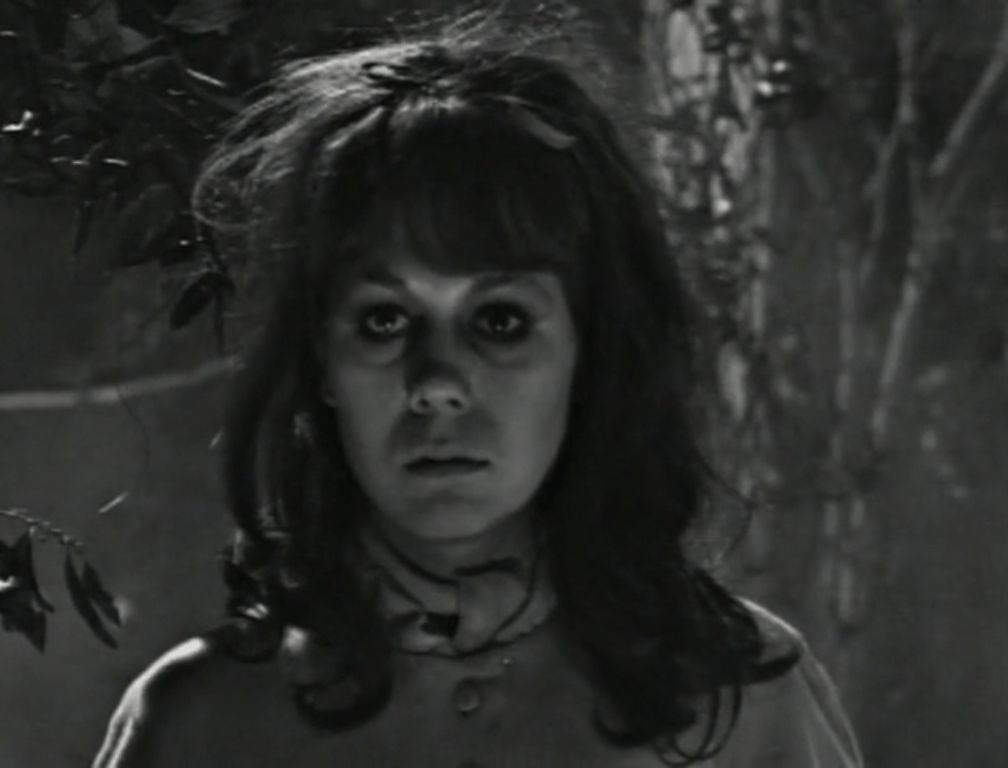
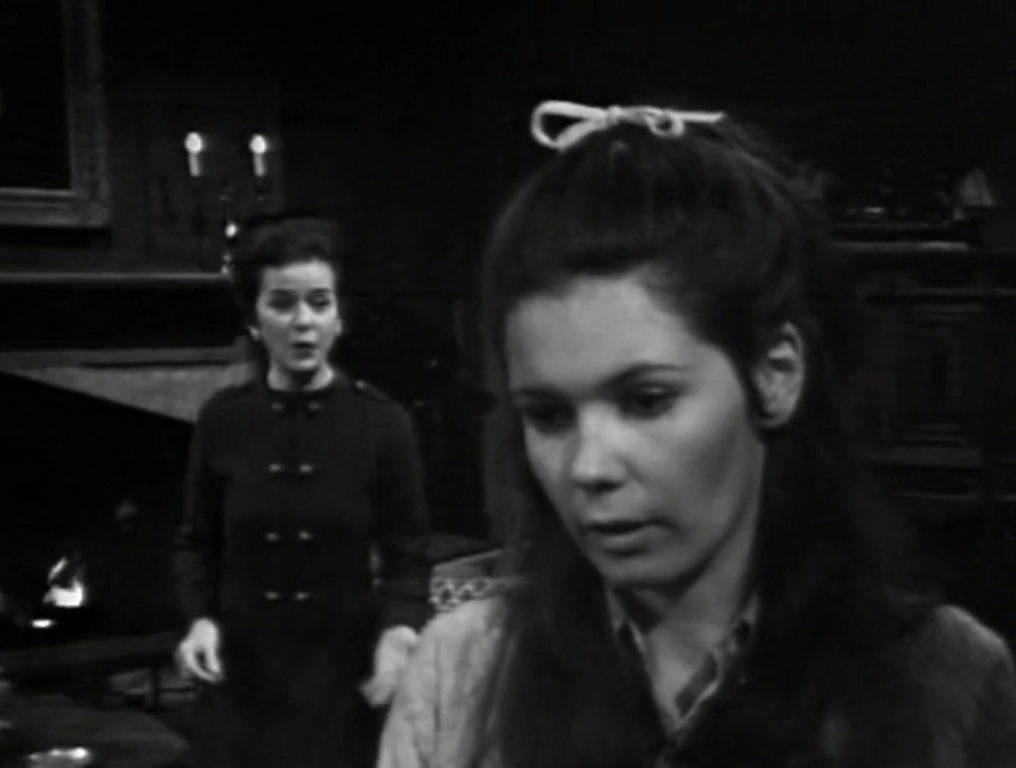
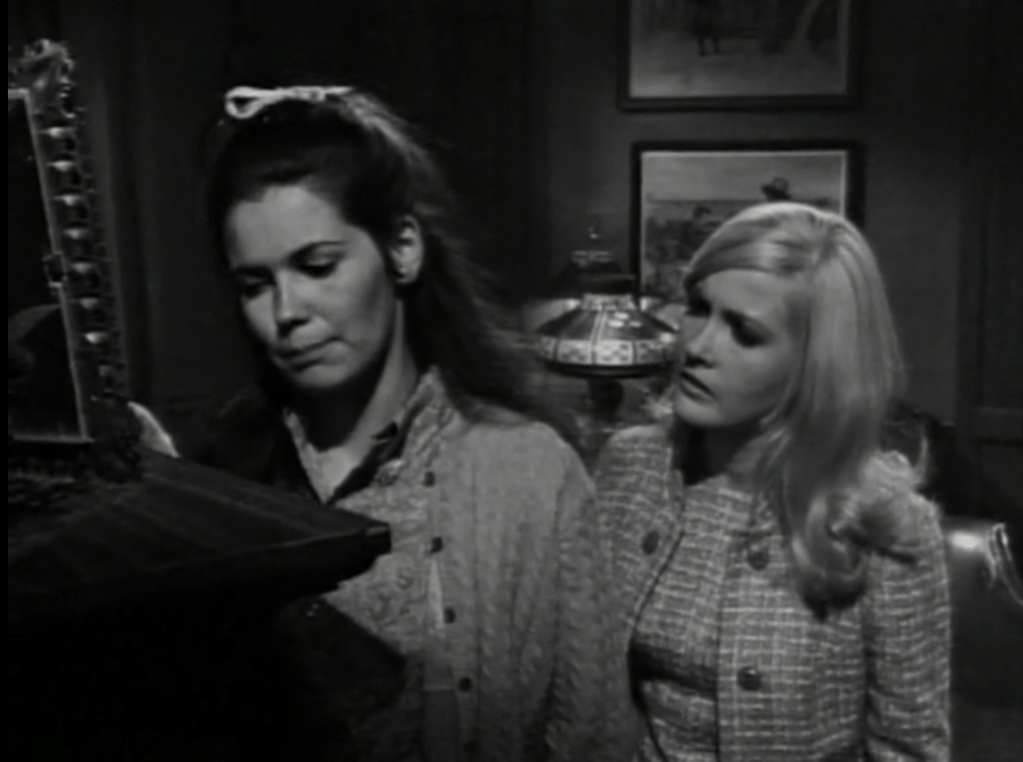
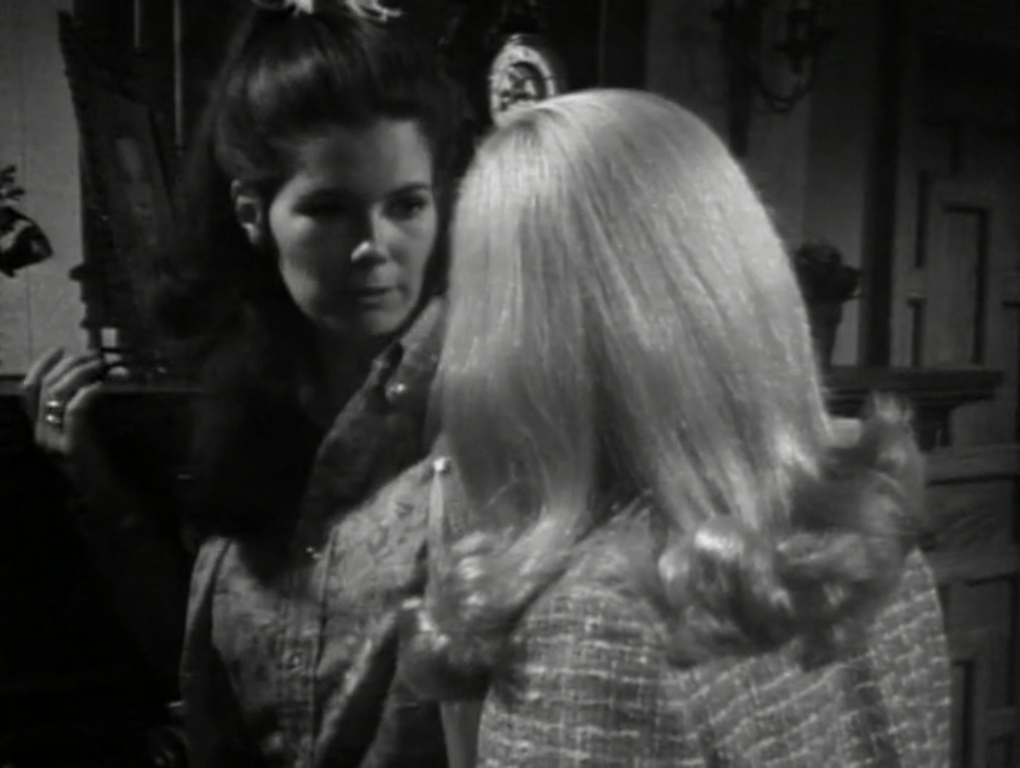
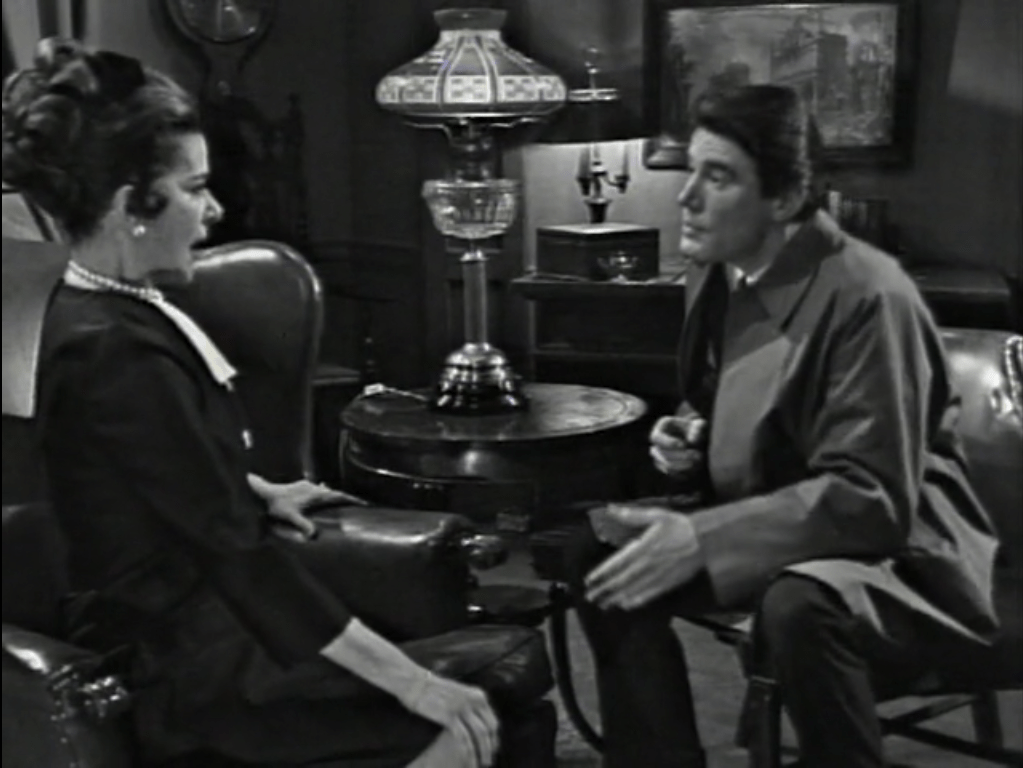
Well-meaning governess Vicki and flighty heiress Carolyn are in the drawing room of the great house of Collinwood talking about how nervous the electrical storm outside is making them. Vicki describes her reactions while driving a car a few moments before. This deepens a mystery that opened yesterday- what car? They’ve so often made a point of having Vicki ask to borrow Carolyn’s car, or accepting rides from people, or catching the bus, or walking much further than people thought was sensible that you’d expect them to have mentioned something if she got a car of her own.

The lights go out, and the women get even more nervous. A figure appears in the doorway and frightens them. They are relieved to discover that it’s just cousin Barnabas. Barnabas is getting to be such a familiar presence that one suspects they might have been relieved to see him even if they knew he is a vampire.

Barnabas looks out the window at the storm and talks about how fierce the storms are on the hilltop Collinwood occupies. He mentions something we haven’t heard about for months, the “Widows’ Wail.” The wind makes a peculiar sound as it blows over Widows’ Hill, and there is a legend that it is really the disembodied voices of the widows whose menfolk died on the fishing boats of the cruel Collins family. We heard the sound effect several times in the first ten weeks of the show, and the legend often came up in those days.

Barnabas then goes on at great length about a woman who leapt to her death from the cliff on Widow’s Hill well over a century before. He makes it clear that the woman was alone with her lover, then describes particular words and gestures in such detail and with such feeling that only the lover himself could provide them. He assures the women that “every word” of his account is true, including the parts about the woman unable to face a future in which she would be transformed into something she found intolerable, the lover putting his lips on the woman’s neck, her growing faint as a result, her finding a last burst of energy to fling herself to death on the rocks below, and her body found bloodless, but with a look of serenity on her face.*

Carolyn was on edge to start with, and the story deepens her anxiety. She excuses herself to go to bed. Vicki was even more anxious than Carolyn before Barnabas started his tale, but as he goes on her fear vanishes. She tells Barnabas that she wonders if there is a connection between the “bloodless” body and the recent incidents of blood loss involving cows, Barnabas’ servant Willie, and Maggie Evans, the Nicest Girl in Town. Barnabas reminds her that his story took place in an earlier century. She says she knows that, but that she is thinking that the ordinary logic of the natural world may not be enough to solve the ongoing mysteries. Regular viewers will remember that Vicki has had extensive experience with the paranormal, and have been expecting her to be the first to consider the possibility that Willie, Maggie, and the cows have encountered something that is not subject to the same laws that describe ordinary phenomena.

Vicki updates Barnabas on her thinking. Screenshot by Dark Shadows Before I Die

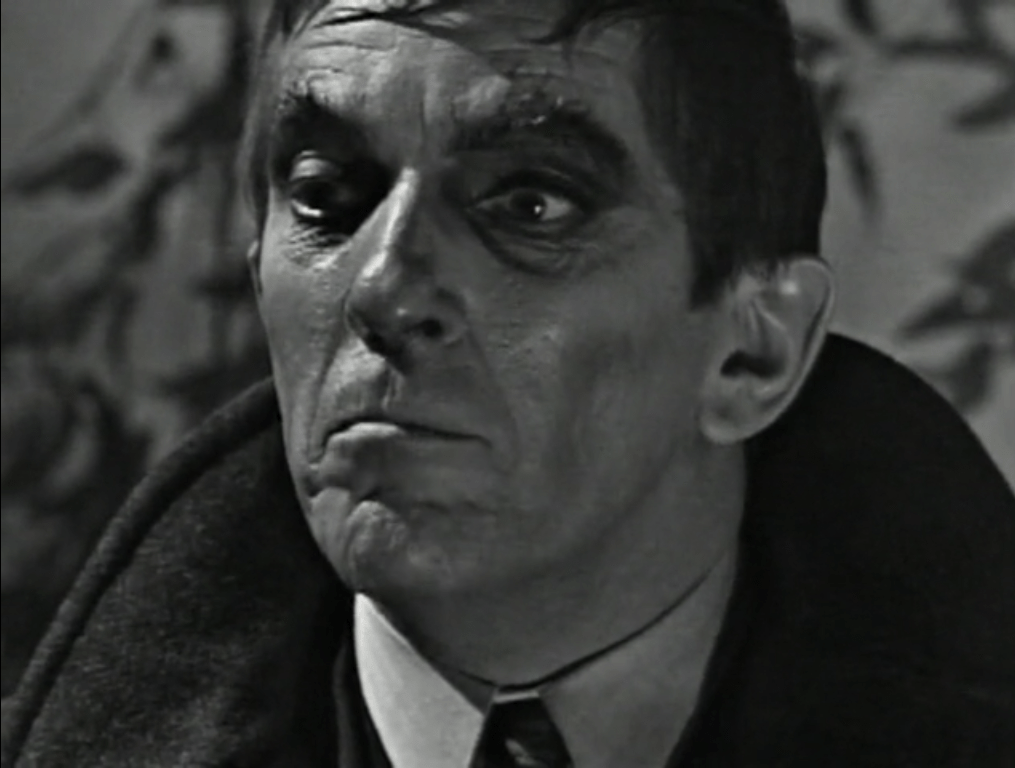
Barnabas squirms, and at one point drops his “cousin from England” mask altogether. As Vicki is explaining her thinking, he says in a bland voice that she is a “very clever girl” and should be careful lest the same thing happen to her that happened to Willie, Maggie, and the cows. Then he looks up and starts to walk away from her, leading to an ominous music sting and a commercial break.

After the break, we see that Barnabas is still in the drawing room with Vicki. She looks startled, and asks him what he meant by his remark. He says that he merely meant that whatever happened to them might happen to anyone. If that is intended to retroactively veil his unveiled threat, it fails miserably- it sounds even more menacing.

Among the representatives of the show’s supernatural back-world whom Vicki has already met, none is more important than the ghost of Josette Collins. The woman Barnabas is describing threw herself to her death off Widow’s Hill in a previous century while wearing a white dress, as Josette did. Other women have jumped from there in the years since, but Josette is still the most famous. When Maggie’s father, artist Sam Evans, saw the portrait of Josette in #185, he asked if she was the lady who went over the cliff. Vicki’s excited reaction to the story suggests that she thinks Barnabas might be talking about Josette.

If he is, it is a major retcon. When we first saw Barnabas in the Old House in #212, he told strange and troubled boy David Collins that she was “our ancestor,” meaning a forebear both of David’s branch of the family and of “the original Barnabas Collins,” that is, himself. After David left, he told the portrait that the house was his now, and that the spirits of his father Joshua and of Josette have no more power there. When he refers to Josette as his ancestor and brackets her with his father, he implies that she sided with his father against him. Since we know that Joshua’s wife, Barnabas’ mother, was named Naomi, and that Josette’s husband was named Jeremiah Collins, the likeliest explanation of these lines would be that Josette was Barnabas’ grandmother. Just a few weeks later, they seem to have reinvented her as his lover.

Barnabas’ story is also a bit of a departure from the usual depiction of vampires. Bram Stoker’s Dracula may have been a revenant form of Vlad III of Wallachia, but he doesn’t mope around obsessing over the good old days in the fifteenth century when he could stay up all day impaling people to his heart’s content. He is entirely focused on the task before him. Dracula’s colleagues in film and on stage had likewise tended to be killing machines, not given to nostalgia or introspection.

Barnabas’ claims to be a devotee of the late eighteenth century have so far been a technique for shifting the conversation from current events, of which he is after all comprehensively ignorant, to the deep past, in discussion of which he can show that he knows so much about the Collins family that he must be a member of it. Even when he gets carried away, as in #214 when he was telling Vicki about the construction of the Old House and started laughing maniacally about the word “death,” it’s a reminder that the events he is talking about seem quite recent to him, since he emerged from his coffin not long ago. But today, he seems to be brooding over the past in a way that has less to do with previous vampires than it does with the character Boris Karloff played in The Mummy (1932). Indeed, Jonathan Frid’s voice and movements are so strongly reminiscent of Karloff that one wonders if Barnabas will turn out to be a merger of Dracula with Imhotep.

Seagoing con man Jason McGuire enters. Vicki hates Jason, who is flagrantly blackmailing reclusive matriarch Liz. She likes Barnabas, but the encounter with him is getting extremely awkward. She quickly excuses herself to go to bed. When Barnabas says that he too must be going, Jason insists that he stay.

Barnabas’ reaction to Jason is pretty funny. When Jason says he wants to discuss something with him, Barnabas tenses and rolls his eyes. Suddenly the drawing room is the scene of a drawing room comedy, and Barnabas is the classic snob forced to deal with an uncouth bounder. For regular viewers, their scene is not just a well-played, if not particularly well-written, specimen of this genre. Barnabas is the latest of the supernatural beings who have been driving the action of the show for six months, while Jason is a throwback to the days when Dark Shadows was a noir-ish crime drama centered on the search for Burke Devlin’s fountain pen. Barnabas’ disdain for Jason mirrors our lack of interest in reviving that phase of the show.

Jason reveals to Barnabas that he had seen Willie earlier that night, that he suspects Willie is involved somehow in the troubles afflicting Maggie, and that he knows Willie has been visiting Eagle Hill cemetery. All of this is unsettling to Barnabas. He goes home to the Old House on the estate, shouts “Willie!,” and raises the cane he had earlier used to give Willie a severe beating.

*John and Christine Scoleri transcribe Barnabas’ whole story in their post about this episode on their Dark Shadows Before I Die.
Episode 232: One quick day

Maggie Evans, The Nicest Girl in Town, has been sick in bed. As long as the sun is up, she is very weak, has no memory of what’s been going on, and can sleep. When darkness comes on, she has wild mood swings and has to be physically restrained from running out into the night.

Moreover, the people who have spent the most time trying to help Maggie have no idea what is wrong with her and don’t seem to be making any progress towards finding out. Her doctor is as ignorant of medicine as are the writers, which is to say completely. The parts assigned to her father Sam and her boyfriend Joe consist of variations on the theme of helplessness.

As this episode begins, Maggie is still in bed, Joe is still sitting with her, and they are still at a loss to understand the situation or develop any plans. After yesterday’s episode, in which the actors labored mightily to inject three minutes of nonverbal storytelling into the half hour window Dark Shadows filled, things are looking pretty grim for the audience.

But then we get a sign of hope. Joe calls well-meaning governess Vicki and asks her to sit with Maggie. At the end of #229, Vicki realized that Maggie’s condition is the same as that which befell the luckless Willie Loomis a few weeks back. Moreover, Vicki is our point-of-view character, and she has consistently been the first to catch on to information after it has been shown to the audience. In the storyline centering on blonde fire witch Laura Murdoch Collins, Vicki led the team that opposed Laura’s attempt to burn her son David to death, and ultimately rescued David as Laura vanished in the flames. So if a battle is going to be waged for Maggie’s sake, we expect Vicki to be a central figure in it.

When Vicki takes Joe’s call, she is in the foyer of the great house of Collinwood. Seagoing con man Jason McGuire is in the same space, and asks her about Maggie. Vicki hates Jason, who is flagrantly blackmailing reclusive matriarch Liz. Vicki keeps trying to excuse herself without answering his questions, and won’t make eye contact with him. But Jason insists, and she tells him enough that he, too, recognizes that Maggie is suffering from the same thing that happened to Willie.

If we remember the ending of #229, this is a poignant moment. If Vicki and Jason could work together, they could solve the puzzle and discover that the mysterious Barnabas Collins is in fact a vampire who has enslaved Willie and is preying on Maggie. But Vicki’s eminently justified loathing of Jason, combined with Jason’s own shortcomings, makes this impossible. As a result, Barnabas is free to go on wreaking havoc.

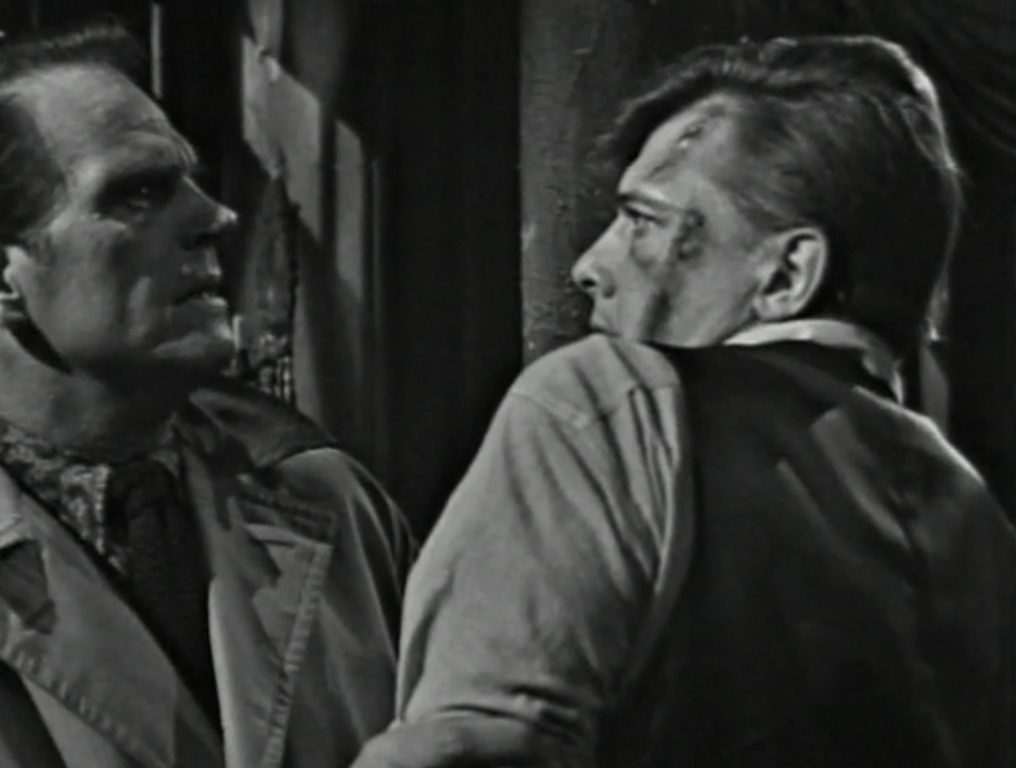
While Vicki makes her way to Maggie’s house,* Jason goes to the Old House on the grounds of Collinwood to call on Willie. He finds that his onetime henchman’s face is badly bruised and scraped. Regular viewers know that Barnabas used his heavy cane to give Willie a beating the other day, and these disfigurements confirm that Barnabas is quite uninhibited in his use of violence.

Jason discovers Willie’s wounds

Jason reminds Willie that he has found him a couple of times in Eagle Hill cemetery.** After one of those visits, Willie turned up very sick, with two little punctures in his skin and a great loss of blood. Though he was desperately weak during the day, at night he gained strength and ran out. Now, Maggie Evans has been found wandering in the same cemetery, and she exhibits the same symptoms.

Jason tells Willie that he won’t tolerate anything that might bring the police to Collinwood, and demands to know what is behind the troubles he and Maggie have had. Willie tells him it isn’t wise to probe into that matter. When Jason says that sounds like a threat, Willie replies that it is simply a warning. “Threat or warning, I don’t need either from you!” Willie has a strange faraway look as he replies “OK… but, at the moment, it’s all I have to give.” Willie then says “You’ll have to excuse me, but Mr Collins doesn’t like my entertaining guests.”

The reluctant host

The dialogue between Jason and Willie in this scene is spare and elegant, without a wasted word. The actors match it, giving delicate performances of a sort the scripts rarely support.*** As Willie, John Karlen begins it trying to conceal his wounds from Jason and scampering about the set looking for a place to hide. As Jason, Dennis Patrick begins in a stern but solicitous manner. When Jason cannot get Willie to tell him how his face was hurt, Jason finally declares “I’m not going to concern myself with what happened to you.” He then becomes more directly menacing, but with a faint undercurrent of panic as his fear that whatever is happening with Willie will upset his own plans grows. He loses his advantage, and Willie stops trying to hide. By the time the scene ends, Willie is in control. Jason promises to find out what Willie is up to, and Willie replies “Fortunately, you’re not a man who keeps his promises. Fortunately for you, that is.”

The scene is not only an improvement over the repetitious jabbering we heard in the episode Malcolm Marmorstein wrote yesterday, but such a departure from the usual standards of the show in this period that it’s hard to believe it was actually written by Ron Sproat, as the credits say it was. Joe Caldwell has been making uncredited contributions to the scripts for months now, and I believe this scene must have been one of his.

Vicki doesn’t know about Willie’s connection to Eagle Hill. She also doesn’t know that it was Willie who called to tell her where to find Maggie, something Jason figures out in his scene with Willie. Again, if it were possible for Vicki and Jason to pool their knowledge, things would start moving very quickly.

Back in the Evans cottage, Joe tells Vicki that Maggie is not herself. “I was in that room with her most of the day. I never missed her so much in my life.” I think that line was also one of Caldwell’s. Sproat was capable of writing the occasional lapidary epigram, as indeed was Marmorstein, but neither of them had much feeling for what the actors could do. So few people could deliver that line in as natural a tone as Joel Crothers achieves that it must have come from a writer who had Crothers’ voice in his head.

When Maggie was alone with Joe, she yelled at him to go away and never come back. Then, she sounded like a sick person who didn’t know what she was saying. With Vicki, she says very calmly that she and Joe must never see each other again as long as she lives. It leaves no doubt that she is protecting him, wanting him to stay away from her as she is absorbed into Barnabas’ world of the undead. That was clear enough to the audience yesterday, when she found herself receiving a transfusion of Joe’s blood and screamed that she didn’t want anyone’s blood, especially not his. If Vicki were able to add Jason’s information about Willie to what she already knows, she might begin to suspect something like it.

The thunder roars, the french windows swing open, and an ominous silhouette appears in the lightning. It is the figure of a man in a cape, holding a cane in his left hand.**** Vicki stifles a scream. The lightning illuminates the night again, and the figure is gone. Vicki rushes to close the windows, ignoring Maggie’s plea to leave them open.

Now you see him
Now you don’t

After closing the windows, Vicki turns to Maggie, bends over, and creaks out in a frightened voice “Ma-a-aggie!” Maggie responds “It’s all right… it’s all right now… it’s all right.” We cut to the closing credits, wondering just how wrong Maggie’s version of “all right” has become.

*How, I’d like to know? It’s unlikely she walked- Collinwood is miles from town, it’s a dark and stormy night, and several local women have been attacked by an assailant who is still unidentified and at large. But she doesn’t ask anyone to lend her a car, as she always has when she has wanted to go anywhere in previous episodes. Joe doesn’t say anything about coming to get her. And there hasn’t been any indication that she herself has acquired a car, or a bicycle, or a pogo stick.

**The show is still equivocating on the name of the cemetery. When it was first mentioned in #209, it was called “Eagle’s Hill.” Vicki and Sam still call it that, but the other characters who have mentioned it call it “Eagle Hill.” Eventually that latter form will become usual.

***John Karlen uses a vaguely Southern accent at some moments today. The first Willie Loomis, James Hall, is from Mississippi, and Karlen sometimes tries to make his version of the character sound like he also came from that part of the world. Eventually he will give up on that, and Willie, like Karlen, will be a native of Brooklyn.

****As a private joke,amusing only to me, I think of this as “Barnabas Collins #4.” Before the part was cast, producer Robert Costello was the model in the first stages of the painting of the portrait of Barnabas. Then stand-in Timothy Gordon played the hand that darts out of Barnabas’ coffin and grabs Willie’s throat in #210. Jonathan Frid first appeared in #211, making him Barnabas Collins #3. Today, stand-in Alfred Dillay becomes Barnabas Collins #4.

Episode 231: Anyone’s blood

Today is only the second time we hear a voice announce a recast over the opening title. The first time was in #35, when David Ford took over the part of drunken artist Sam Evans from wildly incompetent actor Mark Allen. This time Robert Gerringer is taking over the part of addled quack Dr Woodard from Richard Woods. Woods only played the role twice, and neither time could he find a way to distract the audience from the ignorance of medicine that the writers showed in their scripts.

Gerringer’s lines don’t make much more sense than did the ones they dumped on Woods, but he acts up a storm. Woodard is examining Sam’s daughter Maggie Evans, The Nicest Girl in Town. Unknown to Sam or Woodard, vampire Barnabas Collins has been sucking Maggie’s blood. Woodard is firm with Maggie when she resists his examination. He seems to be somewhat on edge, just enough that we wonder if there is more to it than the difficulties we can see Maggie giving him. Perhaps he is thinking something he isn’t saying. Woods never managed to make us wonder if his version of the doctor was doing that.

When Woodard and Sam leave Maggie’s room, Woodard assumes an alarmed tone. He tells Sam that Maggie is on the point of death and needs a blood transfusion at once. By showing us that Woodard was concealing the true nature of his concern when he was with Maggie, Gerringer gives substance to our hopes that the character’s nonsensical words and deeds will turn out to be a screen hiding something interesting.

Maggie’s boyfriend, hardworking young fisherman Joe, joins Sam and Woodard. Woodard asks if either Sam or Joe has blood type A. Joe does. Woodard doesn’t ask about Rh factors or Joe’s medical history or anything else, he simply marches Joe into Maggie’s room and the bodily fluids start pumping right away. Joe holds Maggie’s hand at first, but her violent protests force him to let go.

Transfusion

In Bram Stoker’s Dracula, Professor Van Helsing and Dr John Seward give blood transfusions to the vampire’s victims. That novel was written in 1897, and blood types weren’t discovered until 1900, so Van Helsing and Seward take blood indiscriminately from all the men cooperating in the effort to defeat Dracula. Van Helsing is particularly enthusiastic when he learns that Arthur Holmwood has given blood to Lucy Westenra, because Arthur “is the lover of her!” Van Helsing is Dutch, and speaks in a vaguely comical broken English. Woodard doesn’t seem particularly excited that Joe is “the lover of her,” but audiences who had read the book will recognize the allusion.

At this point in the production of Dark Shadows, the tentative plan was that Dr Woodard would become something like the expert on paranormal dangers that Dr Peter Guthrie had been during the Phoenix storyline, and that Barnabas would be destroyed in episode 275. Like Stoker’s Dracula, the Phoenix arc had featured a group of stout-hearted men and one valiant young woman coming together to do battle with an undead menace. Dr Guthrie had been their Van Helsing, an expert from out of town who leapfrogs over some weaknesses in the evidence actually available to the protagonists to get them to the same level of understanding that the audience has been given. Also like Van Helsing, Guthrie is the first to realize that the one female member of the team is the key to the success of their efforts, and so he insists on putting her in situations the other men regard as too dangerous for her. As Mina had been instrumental in the destruction of Dracula, so well-meaning governess Vicki is the person who finally thwarts the plans of the Phoenix.

If Woodard and Vicki are going to destroy Barnabas in #275, we have to wonder what story the show will have to tell in #276. The only other plotline going at the moment is the blackmail of reclusive matriarch Liz by seagoing con man Jason McGuire, and that can’t continue indefinitely. Not only will Liz run out of things for Jason to take away from her, but Dennis Patrick, the actor playing Jason, will leave the show no later than the end of June. Since the end of June is when #275 will be airing, we can hardly expect Jason to take the show over after that time.

In fact, Jason is an in-betweener brought on the show to clear away the last non-paranormal plot elements left over from the period before the show became a supernatural thriller in December 1966. By the time he leaves, both the reason for Liz’ long self-immuration in the great house of Collinwood and the identity of Vicki’s parents are supposed to be laid bare for all to see. Neither of those secrets ever generated an interesting story, but as long as they are around it is at least theoretically possible that the show will become a conventional daytime soap opera again. Without them, they are altogether committed to the spook show route. Destroy Barnabas, and you just have to come up with yet another menace from beyond the grave.

I remember Gerringer’s acting style from the first time I saw Dark Shadows. That was back in the 90s, when it was on what was then called the SciFi Channel. He so perfectly represented the doctor characters on the soaps my mother used to watch when I was a kid twenty years before that seeing him in the middle of a story about a vampire told me everything about the strangeness of a conventional daytime serial switching to a horror theme. If that guy is the one to drive the stake through Barnabas’ heart, or if he is even part of the team that finishes him off, it will be a statement that the makers of Dark Shadows have decided to stop being silly and start imitating The Guiding Light.

My wife, Mrs Acilius, was particularly frustrated with the dialogue in this episode. As Maggie, Kathryn Leigh Scott does a good job with nonverbal communication creating the image of a reluctant patient trying to get out of her skin, but her lines consist chiefly of repeating whatever is said to her. The other members of the cast are equally effective at projecting concern for a loved one whose grave illness they don’t understand and can’t help, but their lines too are so heavily loaded with repetition that we started to suspect that Malcolm Marmorstein was writing for a cast of myna birds. In particular, Woodard’s lines to Sam in the living room repeat the word “shock” so many times that they start to sound like he’s stuttering.

The original choices for the roles of Sam, Joe, Dr Woodard, and Maggie.
Photo by Bird Ecology Study Group

In his post about this episode, Danny Horn complains that there is not a single interesting still image in it. I agree with that, though I would say that the actors’ movements tell a story. Granted, it is a story that could have been told in a tiny fraction of the actual running time, but they deserve credit for holding the show together when the script gave them zero support.

Danny says that the episode would have been just as good if it were a radio show. Mrs Acilius says that it would have been “a thousand times better” than it is if it were a silent movie. Maybe they could compromise, and it could be presented with neither audio nor video, and the audience could spend the 22 minutes doing something else.

Episode 230: Some explaining to do

The Body in Question

Dark Shadows has been a supernatural thriller ever since the ghosts of Josette and the Widows scared Matthew Morgan to death in December 1966. But today’s episode is the first one that is structured like a horror movie.

Horror movies tend to focus on the visible damage done to the bodies of the female victims of the monster. The current victim is Maggie Evans, The Nicest Girl in Town, and the monster is vampire Barnabas Collins. We open with Maggie’s father, artist Sam Evans, looking helplessly around the house. Sam doesn’t know it, but Maggie was compelled to leave by the power that Barnabas has gained over her by drinking her blood.

What Sam does know is that Maggie was in extremely poor health. He cannot understand how she could have gone anywhere under her own power. We then see Maggie looking awful and wandering around the graveyard. Later, a closeup of a professional headshot of actress Kathryn Leigh Scott will dissolve into an image of Maggie among the tombstones, contrasting her usual fresh-faced beauty with her present ghastly haggardness.

Maggie’s professional headshot
The dissolve
Bride of the monster

The monster who has reduced her to this sorry state, vampire Barnabas Collins, emerges from the fog. Barnabas has been on the show for four full weeks now, but this is the first time we see his face not in the pleasant disguise of a wealthy gentleman visiting from across the sea. He is wearing a more extreme version of the makeup Maggie has on, and his fangs feature prominently. This is the introduction of the monster, a key element on any horror film, and it suggests that Barnabas is now what Maggie will become.

Barnabas inspects Maggie
Two of a kind?
Fangs on display.
Screenshot by Dark Shadows Before I Die

When Barnabas hears Maggie’s friends approaching before he can complete his evil plan, he drops her on the ground and steps over her, again treating her body as a thing.

Barnabas steps over Maggie

After she is carried home, Maggie moans about her pain but can say nothing about what has happened to her, who is responsible for it, or what she is thinking. Again, we can connect only with her physical being, not her social relations or her inner life or the events that have involved her. At the end, the handkerchief tied around her neck is removed without her permission or objection, as if she were inanimate. The camera zooms in on open wounds on her neck, isolating that area and leaving us with the image of the wounds as things available to us to examine apart from Maggie’s personality or the rest of her body.

The Source of the Evil

The episode is an adaptation of elements from Bram Stoker’s Dracula. Early in that novel, the vampire’s victim Lucy rose from her sickbed and wandered off to a graveyard. As Lucy is found by her friend Mina, so Maggie will be found by her friend, well-meaning governess Vicki. As Mina would spend the second half of the novel as the only female member of a group of stalwart and dynamic men doing battle with the evil Count, so Vicki is working with an otherwise all-male search party led by dashing action hero Burke Devlin. As Mina’s colleagues exclude her from their activities and thereby come close to total failure, so the men leave Vicki behind in the Evans cottage to wait by the phone, only to find that she is the one who will have the most to offer when she joins them in the field.

After Lucy dies and her undead form is destroyed, Mina becomes Dracula’s victim. Mina ends up as the precursor of the “Final Girl” in the mad slasher movie, playing a key part in Dracula’s final defeat, though unlike those movies Dracula ends with a successful team effort.

Since Vicki has been our point of view character from the beginning, was an effective protagonist in the “Phoenix” storyline, and is as relentlessly wholesome as the Final Girl typically is, we might expect that she will be Barnabas’ last victim. That expectation in turn suggests that Maggie, like Lucy, will die, rise as a vampire, and be destroyed by those who love her most. Maggie is one of every viewer’s favorite characters, so the prospect that she might turn into a monster and then leave the show altogether brings keen suspense.

Barnabas Beats His Willie

Vicki does have two important conversations with sorely bedraggled blood thrall Willie Loomis while she is in the Evans cottage. The first occurs when Willie comes to the door to bring a message that his master Barnabas will not be available at the usual time to sit for the portrait Maggie’s father is painting of him. Vicki tells Willie that Sam is out searching for Maggie, and Willie becomes very upset to learn that Maggie is missing.

The second conversation comes a few minutes later, when Willie, not disguising his voice in any way, telephones the Evans cottage and tells Vicki that Maggie is in the cemetery and that she is in extreme danger. Somehow Vicki doesn’t recognize his voice. I suppose there were lots of people it might have been- maybe it was Detective Mary Beth Lacey’s husband Harvey from Cagney and Lacey, or Stefan from Daughters of Darkness, or Jock Porter from Love is a Many Splendored Thing, or Geoffrey Fitton from the original Broadway cast of All in Good Time, or any of dozens of policemen and criminals who were in single episodes of cop shows in the 1970s and 1980s.

Willie’s call to Vicki made me wonder about the extent of Barnabas’ powers. When we first saw Barnabas with Willie, his power over him was so extreme that it cost Willie a great effort even to ask Barnabas an unwelcome question, and a look was enough to drive Willie to scurry off and perform the most hateful of tasks. An act of defiance like this was out of the question. Perhaps Barnabas can only keep one blood thrall under total control at a time, and by adding Maggie to his diet he has weakened his hold over Willie.

Willie intrudes on Barnabas’ encounter with Maggie in the cemetery to warn him that Maggie’s friends are on their way. Barnabas instantly suspects that Willie told them where to look for her. When Vicki’s party arrives in the cemetery, Barnabas and Willie run away and hide in the back room of the Collins family tomb where Barnabas was trapped for about 170 years until Willie accidentally released him. This is a departure from Dracula– the Count would have attacked whoever interrupted him, no matter how many of them there were, and fled only if they were armed with crucifixes or consecrated communion wafers or other objects he couldn’t tolerate. But, as my wife Mrs Acilius pointed out, Barnabas has gone a long time without using his vampire powers, so he’s probably rusty.

Barnabas and Willie listen as Burke looks around the outer room of the mausoleum. Once they are sure he is gone, Barnabas confronts Willie with his suspicions. Willie’s lies do not satisfy him, and he lifts his heavy cane and starts beating Willie with it. All we see of this beating is Jonathan Frid’s face and the cane in his hand, but those images, coupled with sound of John Karlen’s cries, imply a violence that shocks us.

In the secret room.
Screenshot by Dark Shadows Before I Die

Closing Miscellany

Burke picks Maggie up off the ground, grunting audibly as he does so. He carries her into her house, again with a lot of grunting. If I had been Kathryn Leigh Scott’s agent, the production staff would have received a very hot letter about that grunting. The good-looking young women on a soap opera aren’t supposed to weigh anything at all, certainly not enough to cause a dashing action hero to grunt like that even if he carried her all the way from the cemetery.*

In his post about this episode, Danny Horn has some lines about the ineffectiveness of the Collinsport police that I can’t resist quoting:

Sam tells the Scooby gang that he’s alerted the police — the sheriff and his deputies are out looking for Maggie. But, as everyone knows, the police department in Collinsport is 100% useless, so by now the deputies have probably arrested each other, and the sheriff’s all tangled up in a clothesline somewhere…

Vicki tries to call the sheriff, but there’s no answer; apparently every single person associated with the police department is out searching for Maggie, or falling down wells, or buying magic beans, or whatever the hell it is that Collinsport police officers do in a crisis. 

Danny Horn, “Episode 230: The Transylvania Twist,” Dark Shadows Every Day, 27 September 2013

When I first read about “the sheriff all tangled up in a clothesline somewhere” a few years ago, I laughed for about five minutes and knew I would be reading Danny’s blog to the end. I’m glad I did, it’s so much fun it inspired me to start this one.

*Mrs Acilius and I remembered a story Miss Scott tells nowadays. Early in the production of the show, Joan Bennett saw her eating a cheese Danish and said “The figure you have now can be your career for the rest of your life.” She put the cheese Danish down immediately, and hasn’t eaten another since. Our response to the story has been to eat cheese Danish on Miss Scott’s behalf at regular intervals.

Episode 229: A very sick girl

The opening voiceover tells us that “Evil reaches deeply into man’s soul, turning his heart to stone, transforming him into a vile monstrosity, and it is horrible to observe this process in an innocent and not be able to recognize it or prevent it.” Without that introduction, first-time viewers would have no reason to assume that Maggie Evans, The Nicest Girl in Town, is going through anything other than an ordinary sickness that has her looking bad and snapping at people.

Kathryn Leigh Scott does play Maggie’s moodiness very well. She does an especially admirable job in the scene where she yells at her boyfriend, hardworking young fisherman Joe, and orders him out of the house. After Joe goes, Maggie looks directly into the camera, and returning viewers will recognize that she is well on her her way to becoming the undead.

Bloofer lady

Meanwhile, well-meaning governess Vicki and dashing action hero Burke are dressed up and having dinner in Collinsport’s only night spot, The Blue Whale. Most of the time, The Blue Whale is a waterfront dive with frequent bar fights. But when Burke and Vicki dine there in their good clothes, the place transforms into a respectable restaurant, as it did in #189.

Burke and Vicki recap some plot points surrounding the great estate of Collinwood. Later, Maggie’s father Sam comes in and tells them of her condition. Vicki replies to Sam’s description with “Now let me see if I understand this. You said that yesterday she was sick and she collapsed, and last night she was up and around, and this morning she was sick again?”

In his post about this episode on his great blog Dark Shadows Every Day, Danny Horn’s response to this line is “IT IS NOT OKAY TO SUMMARIZE A RECAP THAT HE JUST SAID ONE SENTENCE AGO.” It’s true that the episode is heavy on recapping. A defter writer than Malcolm Marmorstein probably would have started the scene with Vicki putting this question to Sam, leaving out the recap that it re-recaps. But Vicki’s question itself is a good moment. As she delivers it, Alexandra Moltke Isles uses her face to show Vicki coming to a realization that has so far eluded everyone else.

The moment of recognition

Vicki recognizes that Maggie’s symptoms are identical to those which sorely bedraggled blood-thrall Willie Loomis displayed a couple of weeks ago. As she explains this, we see Burke gradually catch on and Sam absorb the information. Up to this point, everyone has been remarkably obtuse in failing to make this connection- the same doctor who examined Willie examined Maggie today, and doesn’t give any sign of recognizing it, or for that matter of understanding anything else relating to medicine.

As Vicki was the only character yesterday who escaped the long-running Idiot Plot that goes on because everyone fails to notice the abundant evidence that reclusive matriarch Liz killed her husband and buried him in the basement, so she is the only character today who spots the obvious similarity between the cases of the two victims of the vampire. The show is still sputtering along, but in a Smart Vicki turn like this we can find a glimmer of hope that it will start moving soon.

Episode 228: An unending succession of demands

We start with the twelfth iteration of a ritual that has been numbing our minds since March. Seagoing con man Jason McGuire makes a demand of reclusive matriarch Liz, in this case a position as Director of Public Relations for the Collins family business. Liz resists. Jason threatens to expose her terrible secret. Liz capitulates.

Liz’ daughter, flighty heiress Carolyn, is fed up with Jason’s endless impositions on her mother and everyone else in and around the great house of Collinwood. She knows that Jason was a friend of her long-absent father, Paul Stoddard. When her uncle, high-born ne’er-do-well Roger Collins, tells her that some belongings of Stoddard’s are kept in the mysterious locked room of the basement of Collinwood, Carolyn decides she wants to go into the room and examine them.

Liz has the only key to the room, and hasn’t let anyone in it in the 18 or 19 years since Stoddard disappeared. She is shocked when Carolyn asks for the key. She tells her that they have nothing of Stoddard’s and that the room is empty. Roger and well-meaning governess Vicki are there when Carolyn presses Liz on the subject and Liz becomes agitated.

Later, Liz talks to Vicki privately and apologizes for her tone in that conversation. Vicki can’t believe that the locked room is empty. Vicki turns away from Liz, looks down, and says she can understand that it would be painful for her if Carolyn went through Stoddard’s belongings. We’ve seen Vicki try to lie on several occasions. She has always been unsuccessful at it, in part because she has mannerisms like these that give her away.

Vicki lying to Liz

Liz is so desperate to recruit an ally that she ignores Vicki’s tells, and immediately confirms that she is keeping things of Stoddard’s in the room. She must not realize that Vicki is an inept liar, because she asks her to back up her own lie and to persuade Carolyn that the room is empty.

Liz choosing to believe Vicki

In the study, Vicki finds Carolyn searching for the key to the locked room. The two women argue a bit about whether Carolyn ought to let herself into the room. Vicki turns away from Carolyn, looks down, and asks her to consider that her father’s things might not be in the room at all. Since these are the same mannerisms that told us she was lying to Liz, at first we think she is getting ready to repeat Liz’ lie to Carolyn.

Vicki looking like she’s about to lie to Carolyn

Carolyn asks Vicki what she is talking about. She turns to Carolyn and says that she wonders if there is something hidden in the room that would be far worse to uncover than a few random possessions of Paul Stoddard’s could be. With that, we cut to the closing credits.

Vicki not lying to Carolyn

The whole story of the locked room is a case of what Roger Ebert famously called “Idiot Plot,” a story that would end immediately if any of the characters were as smart as the typical member of the audience. No one has seen or heard from Stoddard since he disappeared. Liz hasn’t left the house since that night. She fired all the household staff, replacing them with a single extremely unsociable man, and discouraged strangers from entering the house. She is terrified of anyone entering a room in the basement that she locked shortly after Stoddard left, and is now flagrantly being blackmailed by a man who was around at that time.

It’s refreshing that Vicki is the one who seems to be figuring out that Stoddard’s corpse might be buried in the locked room. Again and again, the writers have painted themselves into a corner and found themselves able to get from one story point to the next only by having a character disregard all available facts and logic and do something inexplicably foolish. Since Vicki gets more screen time than anyone else, it has usually fallen to her to be Designated Dum-Dum. Indeed, the writers will eventually rely on Dumb Vicki so often that the character becomes unusable. But today, we get a look at Smart Vicki, and that version of her is terrific.

Episode 227: The nature of her illness

Vampire Barnabas Collins enters the bedroom of Maggie Evans, The Nicest Girl in Town. We see a closeup of him in profile, his mouth open to expose his fangs. This shot might have been effective if it had flashed on the screen for a fifth of a second or less and been followed by some kind of action, but we linger on it for a couple of seconds and cut to the opening credits. The result is laugh-out-loud funny. It makes him look like he’s pretending to be a dog in a cartoon. It’s bad enough when Barnabas reminds us of a Scooby-Doo villain without pushing him over the line into imitating Scooby-Doo.

Ruh-roh!
Screenshot by Dark Shadows Before I Die

The rest of the episode is composed of scenes that go on too long, though none quite as disastrously as this. In the morning, Maggie’s father, artist and former alcoholic Sam, wakes her. She is ill and moody. Kathryn Leigh Scott maintains just the right level of intensity, and David Ford plays Sam quietly enough to stay out of her way. But they make all their points in the first minute or two, and it just keeps going.

Later, Maggie is sitting at the counter at her place of employment in the restaurant at the Collinsport Inn.* She’s wearing a scarf and feeling awful. Her boyfriend, hardworking young fisherman Joe, comes in. He teasingly asks her how a paying customer can get a cup of coffee. She tells him to pour it himself. He’s about to do it when she drags herself to her feet. She drops the cup. He makes a little joke about seeing her use a broom and she says she’ll sweep it up later. He is shocked, and she snaps at him.

She continues to have trouble with basic tasks, and Joe grows concerned. Sam comes in and reminds her that he told her she shouldn’t have gone to work. He says he’ll call the doctor, and she yells at him. Then, she faints.

That’s probably the best scene in the episode. Miss Scott holds on at the level she had established in the previous scene, while Joel Crothers matches Ford’s steady, understated support. With three actors, there’s enough action to keep us interested. My wife, Mrs Acilius, praised the choreography that allowed Miss Scott to make such a memorable turn unencumbered by Malcolm Marmorstein’s dialogue. Still, they could have done all that in about half the time and we wouldn’t have missed a thing.

Then Maggie’s back in her room, this time with Joe sitting on the side of the bed while she lies in it. The body language between them is affectionate, but after about a minute and a half you can’t help but notice them complying with the requirements of the Standards and Practices office. Sick as Maggie is, it is jarring to see Joe keep his distance from her quite so scrupulously.

Night falls, and we see Barnabas in his house. He peers out his window, and we cut to Maggie. She’s still in her room, but now she is out of bed, brushing her hair, and grinning. Sam enters and is surprised at the change in her.

Maggie’s up.
Screenshot by Dark Shadows Before I Die

After a meandering conversation, Maggie volunteers to drive Sam to Barnabas’ house where Sam will be working on a portrait of Barnabas. Evidently Sam agrees, because the two of them enter there together.

Maggie and Barnabas exchange looks and conversation loaded with double meanings while Sam sets up. Jonathan Frid plays Barnabas’ part in this so heavily that it is laughable Sam doesn’t notice something is going on between him and Maggie.

Barnabas and Maggie murmuring to each other.
Screenshot by Dark Shadows Before I Die

I’m always reluctant to complain about Frid’s acting. It’s so hard to explain just what it was that made Barnabas such an enormous hit that you can never rule out the possibility that any given thing might have been indispensable to it. Still, seeing him ham it up so shamelessly today, especially after the other three members of the cast have shown such strict discipline, I did have to wonder what he was thinking. It’s hard to imagine anyone would have directed him to play the part that way.

I can see one advantage to Frid’s overacting. Maggie sticks around his house a couple of minutes after the point of the sequence has been made, and the time is filled with repetitious dialogue about her illness. When Barnabas says that the house is an unhealthy place for someone in her condition, Frid leans so hard on the line and makes himself look so silly that you don’t really notice that there is no reason for the scene still to be going on.

After Maggie has gone home and got back into bed, Sam tells Barnabas he’s tired and thinks it’s time to stop for the night.** Barnabas wants him to keep going for a while and to take the next night off. They discuss this fascinating topic at length. Sam decides to spend an hour working on the background. Their conversation has already taken so long that we fear they might show that hour of painting in real time, and it is a relief when Barnabas says he will go outside while Sam paints. We can assume he’s going to pop into Maggie’s room for a snack.

*The last appearance of this set, alas.

**Barnabas’ sorely bedraggled blood-thrall, Willie Loomis, will be driving Sam home. At this point they’ve settled on the idea that Willie has a car.

Episode 225/226: Enough to give any woman nightmares

Dark Shadows is recycling a story element from December 1966 and January 1967. Back then, blonde fire witch Laura Murdoch Collins kept staring out the window into the night and establishing a psychic connection with her son, strange and troubled boy David Collins. Each time she did so, David would have a terrible nightmare in which she was beckoning him to his death in flames. Since burning him to death was in fact her plan, we were left wondering if the nightmares were Laura’s attempt to get him used to the idea; if they were signs of his own willpower as he resisted her influence; if they were messages from the benevolent ghost of Josette Collins trying to warn her descendant of the danger his mother presented to him; or were the result of some other force that travels with Laura, but that is not under her control or necessarily known to her.

The other day, vampire Barnabas Collins stared out his window into the night and established a psychic connection with Maggie Evans, The Nicest Girl in Town. Maggie reacted to that contact with confusion and dismay. In yesterday’s episode, she had a nightmare in which she saw a coffin open from the inside and herself laid out in it. It isn’t much of a stretch to assume that Barnabas’ plans for Maggie will require her to spend her days in a coffin. That leaves us with just the same options we had in accounting for David’s nightmares.

Maggie and Barnabas cross paths today in Collinsport’s night spot, The Blue Whale tavern. When Maggie leaves, Barnabas wishes her “Sweet Dreams.” She is shocked at this conventional night-time farewell. We see her at home getting ready for bed; Barnabas is still in The Blue Whale, chatting amiably with dashing action hero Burke Devlin. Barnabas gets a peculiar look on his face, excuses himself, and hurries out. Then we cut to the Evans cottage, where we see him entering her room to bite her. These are things we might have expected to see if the nightmare was something Barnabas sent to get Maggie used to the idea of becoming a vampire.

Barnabas sits at a table in the tavern with Maggie’s father Sam. They talk about how strong and independent she is. We have known her since the first episode, and know that she is indeed someone who can stand up for herself. Reminding us of that, this conversation leaves open the idea that the source of the nightmare is Maggie’s own struggle against Barnabas.

Sam himself figured prominently in the Laura story as a medium for Josette’s influence. He is an artist, and when David’s nightmares did not suffice to make Laura’s plans clear to the characters, Josette took possession of Sam and used him to literally paint a picture for them. That possession occurred in Sam and Maggie’s cottage. Moreover, Maggie had been delighted with Barnabas before the nightmare, but seeing him now she is extremely uncomfortable. That reaction, Sam’s presence in the episode, and the scene in the Evans cottage would all seem to support the idea that the nightmare was a warning from Josette.

When Barnabas and Burke are alone at the table, Burke is admiring the silver wolf’s head sculpted on the handle of Barnabas’ cane. He says that it looks ferocious and asks if the cane was made to be a weapon. Barnabas replies that he sees the wolf’s head as a peaceful symbol, an animal originally wild and hostile that has been tamed to be a companion, “almost a servant,” to humans. Canines are not so tame when Barnabas is busy, however. We hear a variety of dog noises, ranging from the howl of a sad hound to the violent snarling of a pack of large hunting dogs. This does not appear to serve his interests. Since it happens around people like Maggie who are mystically connected to him when he is far away, it is difficult to see it as a natural phenomenon. And since Josette’s previous interventions have not involved dogs, she is not an obvious suspect. So perhaps when Barnabas rose from his grave, he brought with him a ghostly companion who is not his servant, but is working at cross-purposes with him.

Barnabas realizes that he wants to have a bite before sunrise

Joe and Maggie are interesting today. Maggie wakes up from her nightmare and calls Joe. We see Joe, getting our first look at his apartment. We don’t see much of the place, just a single panel behind him decorated in true Collinsport fashion with a painting on one side and the shadow of some studio equipment on the other.

Joe at home

It isn’t just the decor that tells us Joe is a true Collinsporter. Maggie waits anxiously for him to answer when the phone rings several times. When we see him, we know what took him so long- he had to put his robe on over his pajamas. Sure, he lives alone, but he isn’t a savage.

When Joe and Maggie enter the tavern, she remarks that they could have saved money- she has liquor at home. Joe tells her she needed to get out of the house. Again, he is following the norms of Collinsport. A young woman alone at home telephones her boyfriend in the middle of the night and asks him to come over right away. A fellow from another town might not have realized that the best thing to do was to take her to a public place where they would be likely to meet her father.

Maggie and Joe have been talking about getting married for a while now. She kept saying she couldn’t marry, because she was worried about her father. During the “Revenge of Burke Devlin” arc, which ran from the first episode until Burke decided to peace out in #201, Sam was an alcoholic given to binge drinking. When they gave up on that storyline, they dropped the theme of Sam’s alcoholism as well. Today he goes to a bar with someone who is determined to buy him all the liquor he will accept. He stops after a couple of drinks and goes home, where he is crisp and sober. Apparently he just isn’t an alcoholic any more. I’m no expert, but I have a feeling it doesn’t really work that way. Be that as it may, it leaves Joe and Maggie with no reason not to get married.

Joe and Maggie not only run into Sam at The Blue Whale, but also Barnabas. If Art Wallace and Francis Swann were still writing the show, or if Violet Welles had come on board, I might wonder if this were a subtle hint that sexual repression creates monsters. Joe Caldwell has been making uncredited contributions to the writing for months, and he was perfectly capable of slipping in a point like that. But this one is credited to Ron Sproat, and Sproat is shameless about putting characters where they need to be to make the next plot point happen on whatever flimsy pretext he can find, regardless of any other consideration. So while it is always possible that the cast or the director or someone else associated with the production was trying to make a clever point, I don’t think Sproat was in on it.

Closing Miscellany:

The makers of Dark Shadows wanted episodes aired on Fridays to have numbers that ended in 5 or 0. A strike several weeks ago caused them to miss a day of broadcasting, and the numbers have been off ever since. They gave this one two numbers, 525 and 526, to get back on track.

Barnabas addresses Burke as “Devlin” and hardworking young fisherman Joe Haskell as “Haskell.” We’ve heard him call Sam “Mr Evans,” so evidently he’s following some rule of his own about who gets a courtesy title and who doesn’t. His exquisite manners are such a big part of what comes up when the other characters talk about him that the writers might well have thought they were making some kind of point with this, but heaven knows what it was. Making it even harder to decipher, he calls Maggie “Miss Evans” at the beginning of the episode, but “Maggie” at the end.

I can’t resist quoting one of the many lines that made me laugh when I read Danny Horn’s commentary about Barnabas in his post about this episode:

What a weird character. Even for a vampire, he’s a weird character.

Danny Horn, “Episode 225/226: Fangs for Nothing,” Dark Shadows Every Day, 23 September 2013

Episode 224: Alone in the growing darkness

We begin with a chat between strange and troubled boy David Collins and his (vastly) older cousin, vampire Barnabas Collins. David has questions about the portrait of his ancestor Josette that long hung in the house Barnabas is now occupying. Barnabas assures him that he will hang it prominently once the house has been refurbished.

Yesterday, David was wandering from set to set moaning that he couldn’t feel the presence of Josette’s ghost. This was a clumsy way of addressing a question that is at the top of the minds of regular viewers. Josette’s ghost has been decisive in all the storylines on Dark Shadows for the six months prior to Barnabas’ arrival, and the house Barnabas has taken over is her stronghold. Though she can at moments erupt into the foreground with awesome power, as when she and the other ghosts scared crazed handyman Matthew Morgan to death in #126, she is usually a vague, wispy presence. It is unclear how or if she can survive contact with a menace as dynamic as a vampire.

Josette communicates with David through her portrait, and when she was recruiting a team to thwart the plans David’s mother, blonde fire witch Laura Murdoch Collins, had to burn him alive, she took possession of artist Sam Evans and made him paint pictures warning what Laura was up to. Now Barnabas has hired Sam and is sitting for a portrait that he will hang where Josette’s was long displayed. In #212, Barnabas looked at Josette’s portrait and said that the power it represented was ended, and David’s reactions yesterday suggested he was right.

Portraits are not Josette’s only means of communication. During the Laura storyline, David had a recurring nightmare that may have been in part the product of Josette’s intervention. Someone else has a nightmare today, and it is clearly a warning about Barnabas.

While Barnabas is sitting for Sam, he makes a series of remarks about Sam’s daughter Maggie, The Nicest Girl in Town. To those who know that he is a vampire, everything about Barnabas is creepy, but he lays such heavy emphasis on lines like “I believe her future is already assured” that it is hard to believe Sam isn’t alarmed. We dissolve from that sequence to Maggie in her bedroom* trying to get some sleep. That in turn dissolves to a dream sequence** in which Maggie sees herself in a coffin and screams. She then wakes up, still screaming.

Josette was able to use Sam as a medium, and to do so while he was in the front room of the same house where Maggie is sleeping. So those who remember the Laura storyline will see the nightmare as the opening gambit in Josette’s effort to oppose Barnabas, and will be anticipating her next move.

Between these two segments, we spend some time with seagoing con man Jason McGuire and his former associate, Barnabas’ sorely bedraggled blood thrall Willie Loomis. Reclusive matriarch Liz informs Jason that Willie has been living with and working for Barnabas. Jason had believed that Willie left town permanently several days earlier, and has no idea he is in any way connected with Barnabas. Liz wants to be rid of Willie. Jason likes to boast that he can control Willie, something we have never seen him succeed in doing, and assures her that he will be able to handle the situation.

Jason goes to the Old House and confronts Willie. He makes a number of sarcastic remarks questioning Willie’s masculinity, demands to know what kind of scam he is running on Barnabas, and grabs him by the lapels when Willie can tell him only that he is trying to lead a different sort of life. Jason is holding Willie and snarling at him when Barnabas shows up. Jason unhands Willie and is surprised at how meekly Willie complies with Barnabas’ command that he run an errand.

Barnabas catches Jason with his hands on his Willie

Barnabas tells Jason that he has spoken with Liz and that she has agreed to let him keep Willie. Jason tries to tell Barnabas about Willie’s past and boasts once more of his ability to control Willie. Barnabas cuts him off with “I can deal with him far more effectively than anyone.” That leaves Jason speechless.

In his post about this episode on Dark Shadows Every Day, Danny Horn tells us that the scene between Jason and Willie brought a memo from ABC’s Standards and Practices office. A censor named Bernardine McKenna was concerned that Jason’s lines might suggest a sexual relationship between Willie and Barnabas.***

McKenna’s memo raises some questions about Jason’s whole relationship with Willie. When Jason was first introduced, we occasionally saw him on the telephone talking to someone who was evidently important to his plans. Eventually he started calling this person “Willie.” After Willie appeared in person, we kept waiting to see what Jason wanted him to do. Jason’s only project is to blackmail Liz, and he doesn’t need any help with that. Not only did we never see Jason give Willie anything to do, but Willie continually caused him troubles that made life so unpleasant for Liz that she considered calling the police, a move that would would have brought Jason’s whole plan crashing down around his ears. So Jason’s decisions to bring Willie along and to keep him around were not motivated by any immediate need for his assistance.

A couple of times, Willie threatened to expose Jason’s own terrible secrets. But by the time Willie was recovering from Barnabas’ initial attacks on him, those threats didn’t seem to have much substance, and yet Jason insisted on keeping Willie around Collinwood and nursing him back to health. Jason’s scenes with Willie in his sickroom show enough traces of tenderness and genuine concern that there must be some depth to their relationship.

The original plan had been to name the character, not “Willie,” but “Chris.” I wonder if that would have given Bernadine McKenna more to worry about. If we’d listened to Jason on the telephone with a mysterious “Chris” who was in some kind of partnership with him, we might assume that “Chris” was his girlfriend. When Chris turned out to be Christopher, we would set that thought aside. But we might not have forgotten it entirely. When we were wondering what the connection is between the men, one of the possibilities we couldn’t quite exclude might have been that they had been lovers.

*This is the first time we see Maggie’s bedroom. The living room of the Evans cottage has been a frequent set from the earliest days of the show, but this addition of a second room augments its importance and confirms that Maggie will be a major character in the current storyline.

**We’ve heard characters talk about their dreams before, but this is the first time a dream is shown to us.

***Danny read McKenna’s memo in Jim Pierson’s 1988 book The Introduction of Barnabas.

Episode 223: She isn’t watching over us anymore

Strange and troubled boy David Collins is in the Old House on the estate of Collinwood with his aunt, reclusive matriarch Liz. David laments to Liz that he can no longer feel the tutelary presence of the ghost of their ancestor Josette Collins. For more than 24 weeks, from #70 when the Old House was introduced to #191 with the conclusion of the storyline centered on David’s mother, blonde fire witch Laura Murdoch Collins, the Old House had been Josette’s sanctuary. Now it is “a new house, a new place,” and she’s gone. David is particularly sad that the house’s new occupant, the newly arrived Barnabas Collins, has removed Josette’s portrait from its place above the mantle in the front parlor and plans to hang a portrait of himself there.

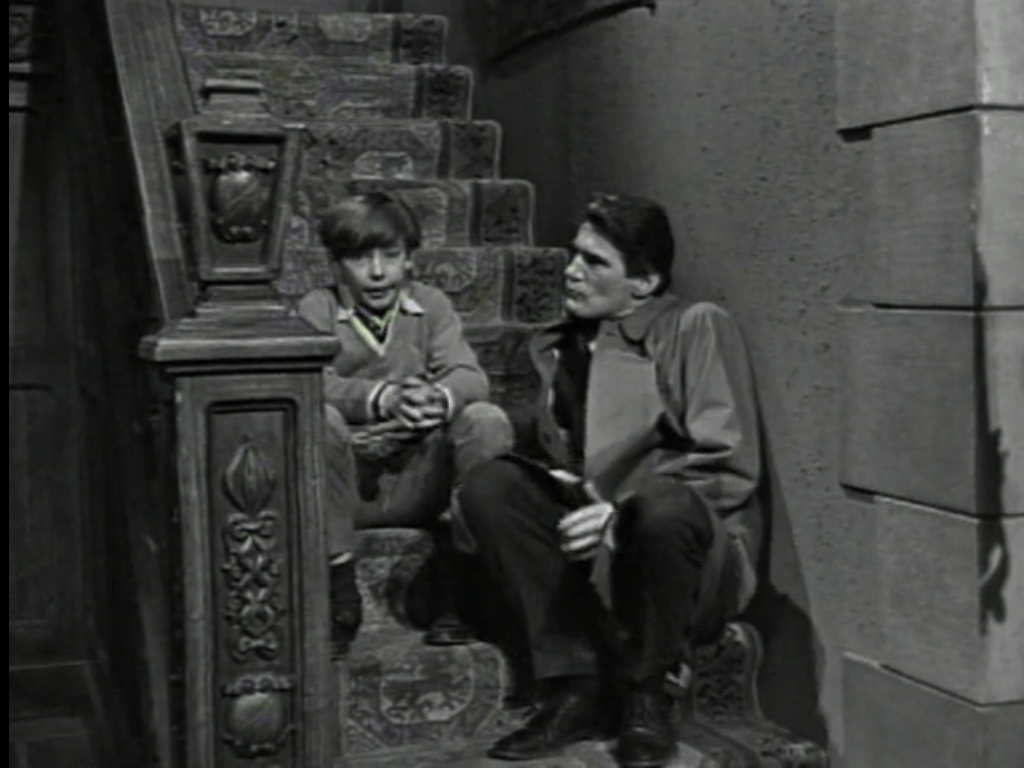
Back in the great house on the estate, David sees dashing action hero Burke Devlin. He sits on the stairs with Burke and talks about his feelings concerning Barnabas, Josette, the portrait, and the Old House. Burke suggests he ask Barnabas to give him the portrait. David is thrilled by this suggestion, and declares that he will go to the Old House at once to ask him. Burke points out that Barnabas probably isn’t home. That doesn’t make an impression on David, but he does stop before going out the door. Burke asks if he is afraid to go there alone, apparently preparing to volunteer to go with him. David says he isn’t afraid, but doesn’t explain what feeling he does have that is holding him back.

David and Burke talk it out

David goes to the Old House and calls to Barnabas. No one answers. The howling of dogs fills the air from every side, frightening David. He calls to Josette. He does not feel her presence. The doors slam shut on their own; when he runs to them, he cannot open them. We conclude with a closeup of his terrified face.

Those three scenes might have appeared in a good episode, but this is not that episode. In fact, it is a real stinker, very possibly the single worst we have seen so far. There is one funny line, when Liz remarks that Willie Loomis’ “illness appears to have caused him no end of convenience.” And the actors and director do what they can. But the script defeats them all.

As David Collins, David Henesy appears to be delivering the lines Ron Sproat actually wrote when he says things like “If I blame [Barnabas] for anything, it’s for changing things around [at the Old House]… I just hope he hasn’t changed [the Old House.]” Some of the words that come out of his mouth may be flubs, but most of it is of a piece with what the adult actors are saying in response to him, and nothing anyone says is close to intelligible. This is one of the rare episodes when Henesy winds up roaming about the sets declaiming like some kid actor in a 60s TV show.

As well-meaning governess Vicki, Alexandra Moltke Isles is trying so hard to remember her own pointless lines that she stands stiff as a board every time she is on camera. Vicki and David’s scenes were the heart of the first 39 weeks of the show, often in spite of writing nearly as bad as what the cast is stuck with today, but their conversation on the stairs today is terribly dull to watch.

Joan Bennett and Mitch Ryan each had star quality in abundance, and so they manage to hold their scenes together. The opening scene between Liz and Vicki has some snap to it, David’s conversation with Burke is appealing, and when Liz and Burke have a scene in the study arguing about a business deal she made with a man called Hackett* things start to crackle. But even in that scene Bennett and Ryan stumble over Sproat’s awful dialogue and wind up in the ditch more than once. Her frequent glances at the teleprompter and a couple of alarmingly long pauses from him turn the crackle to a fizzle well before it is over.

Burke and Liz argue about the Hackett deal

The scene between David and Liz in the Old House is another defeat for Joan Bennett. David Collins’ nonsensical lines and David Henesy’s flailing attempts to find some kind of through line in them leave her standing in mid-air, and the scene goes on so long they repeat every point they have to make at least twice. By the third time through the sparse material they have to work with, not even she could make it interesting.

Moreover, regular viewers will be puzzled when Liz tells David over and over that the Old House and its contents belong to Barnabas. On Monday, in #220, Barnabas and Vicki had a conversation in the foyer of the great house about the fact that he was not going to own the Old House. There hasn’t been any indication of a change in that plan, but Liz goes out of her way to say three times, not that Barnabas is staying in the house, but that it is his. We are left wondering what she is talking about.

Burke and Vicki spend some time together. They stand in front of the portrait of Barnabas Collins in the foyer of the great house talking about Barnabas’ decision to hire Willie as his servant. Burke remarks that “Cousin Barnabas doesn’t seem too bright.” That’s a fun moment, but then Vicki sticks up for Barnabas and they have nowhere to go with it. The scene doesn’t end until they’ve spent a few more moments standing there jabbering.

Burke and Vicki sit on the sofa together in the drawing room. The nonverbal communication between them raises the question the show has been teasing for some time, whether Burke and Vicki are dating. As with Burke’s paternal moment with David, it shows that the actors and directors can create little stories to keep us interested when they can keep the dialogue out of the way.

Burke says he’s going to talk with Liz about a business matter that he can’t tell Vicki about. He then tells Vicki why he is concerned about the matter. These mutually contradictory lines are no better than David being upset that Barnabas has changed the Old House, and just hoping that he hasn’t changed the Old House. For a moment, friend Burke doesn’t seem too bright.

*A name we have never heard before on Dark Shadows.