
Episode 660: Suppose I am from another century

A couple of weeks ago well-meaning governess Victoria Winters vanished into a rift in the fabric of space and time, traveling back to the 1790s to be with her husband, a loudmouthed idiot known variously as Peter and Jeff. Now evidence is accumulating that when Vicki and Peter/ Jeff were reunited, they were immediately put to death for their many crimes. Old world gentleman Barnabas Collins is determined to follow Vicki into the past and thwart the course of justice.

Barnabas and his best friend, mad scientist Julia Hoffman, call on occult expert Timothy Eliot Stokes. Barnabas pleads with Stokes to work the same mumbo-jumbo for him that enabled Peter/ Jeff to go back to the 1790s. Stokes says that the procedure would have no effect on Barnabas. He explains that it transported Peter/ Jeff only because Peter/ Jeff properly belonged to that period. It would do nothing to a person who was already living in his own time. Barnabas then asks “Suppose I am from another century?” Stokes replies “Then it’s one of the best-kept secrets in Collinsport, isn’t it?” while Julia coughs and looks panic-stricken.
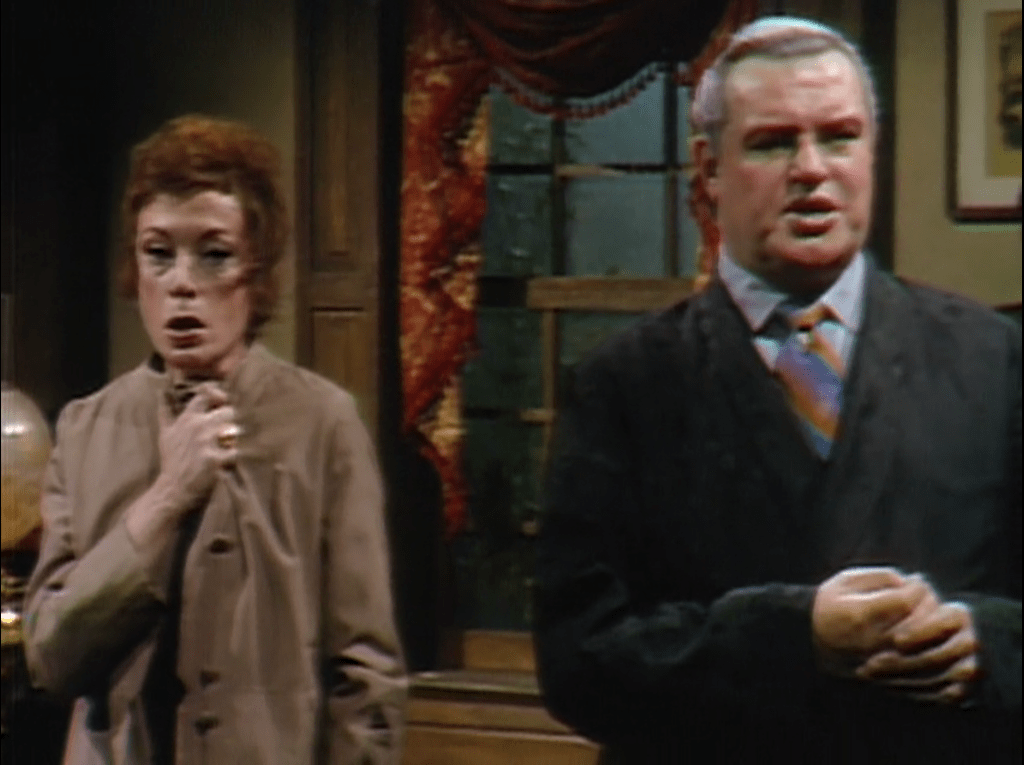
Julia and Stokes react to Barnabas’ invitation to suppose that he is from another century.

In fact, Barnabas is a native of the eighteenth century. He finds himself in the 1960s because he was, for 172 years, a vampire. This is indeed one of the best-kept secrets in town. If any part of it leaks out he and Julia will be spending the 1970s and 1980s in prison, so it is no wonder she tries to shut him down before he can make any indiscreet revelations to Stokes. But it is an exciting moment for longtime viewers. As it stands, Julia is the only character who knows Barnabas’ secret, and therefore the only one who can speak freely with him or interpret new information in the light of what the audience already knows. Stokes is a highly dynamic character; if he joins the inner circle, there is no telling how fast the action might move or in what direction. It is a bit of a letdown that Barnabas decides not to come out to him.

Stokes makes a little speech that puzzles many viewers. He says that he has reached the conclusion that Peter/ Jeff really was two people. The spirit of an eighteenth century man named Peter Bradford must have come to the year 1968 and taken possession of the body of a living man named Jeff Clark. Now that Peter has returned to the past, Jeff must have regained control of his physical being and is out there in the world someplace. This theory does not fit with anything we have seen over the last several months, and it won’t lead to any further story development.

Peter/ Jeff himself suggested the same idea a few weeks ago, but he had so little information about himself that we could discount it. Stokes, though, is one of the mouthpieces through which the show tells us what we are supposed to believe.

Many science fiction and fantasy fans like to take the world-building elements of their favorite franchises as seriously as they possibly can, and treat every apparent contradiction or dead end as a riddle to be solved. That kind of analysis doesn’t get you very far with Dark Shadows, a narrative universe whose structure star Joan Bennett summarized by saying “We ramble around.” It is tempting to go to the opposite extreme, and to assume that they didn’t do any advance planning at all. But we know from an interview that writer Violet Welles gave to the fanzine The World of Dark Shadows in 1991 that they did the same planning exercises that other daytime soaps did. They would make up six month story forecasts called “flimsies” and fill those out with more detailed plans covering periods of 13 weeks. Welles explains the resulting difficulty:

The difficult ones were — we were in 13-week segments, and there were sometimes characters that didn’t work, and because they didn’t work, they didn’t use them as much, they weren’t part of the plot. So at the end of the 13 weeks, toward the end of the cycle, you’d have characters who were really not a lot of interest who had to play scenes with other characters who really didn’t have a lot of interest, dealing with things that basically didn’t concern them. Those were hard to write. But you never felt particularly overwhelmed.

Violet Welles interviewed by Megan Powell-Nivling, The World of Dark Shadows, issue #59/60, June 1991. Preserved by Danny Horn on Dark Shadows Every Day, 30 August 2015.

In other words, while the writers definitely did long-range planning, those long-range plans come into the audience’s view not a source of secret message to decode, but in the residue left over from stories that didn’t work out. During his months on the show, Peter/ Jeff spent a lot of time getting violently angry when people called him “Peter,” responding in his grating whine “My na-a-ame is JEFF! CLARK!” That disagreeable habit made up about 90 percent of Peter/ Jeff’s personality, and the other 10 percent was no picnic either. Coupled with this Goes Nowhere/ Does Nothing story about Peter appropriating the body of Jeff Clark, I would guess that in some early stage of planning they kicked around the possibility of having two Peter/ Jeffs. But it has long since become clear that one Peter/ Jeff is already one too many. That leaves them to fill out some scenes that would otherwise run short with material that may have seemed like a good idea when they made up the flimsies six months ago, but that is pointless now.

Also in this episode, children Amy Jennings and David Collins visit Eagle Hill cemetery and have questions. Amy suggests they go see the caretaker, a suggestion David derides. He declares that the caretaker is as old as the tombstones, and that he won’t answer any of their questions. Amy insists, and they go looking for him.

The caretaker appeared on the show four times when David’s mother, undead fire witch Laura Murdoch Collins, was the chief supernatural menace. He then made five more appearances early in Barnabas’ time as a vampire. As played by veteran stage actor Daniel F. Keyes, he was a delight, a boundlessly befuddled old chap who seemed to have strayed in from the pages of EC Comics. Sadly, David and Amy don’t find the caretaker today.

Eagle Hill cemetery itself was introduced as one of several burial grounds in the Collinsport area. It is the old graveyard north of town, and Barnabas and his immediate family were the only Collinses buried there. The rest of the Collins ancestors were interred in a private family cemetery, and there was also a public cemetery somewhere in or around the village of Collinsport. They stuck with this geography longer than you might have expected. But today Amy explicitly says that Eagle Hill is on the grounds of the estate of Collinwood, just outside the front door of the main house. This contributes to the effect, growing very noticeable lately, that the imaginary space in which the drama takes place is collapsing in on itself. The occasional excursions the show took to the town of Bangor, Maine in its early days are long gone, and now we barely even see the village of Collinsport. It’s often said that Dark Shadows is Star Trek for agoraphobes; it is starting to feel as if it is retreating into a very small cocoon indeed.

Episode 659: Changing of the guard

Old world gentleman Barnabas Collins, in temporary charge of the great house of Collinwood, has decided to pack children David Collins and Amy Jennings off to boarding schools in Boston. They pretend to be happy about this, but in fact want to stay in the house, where they have come under the power of the evil ghost of Quentin Collins. Neither they nor Quentin can figure out a way to stop Barnabas’ plan. David takes a photo of Barnabas standing with heiress Carolyn Collins Stoddard; when the photo is developed, a mysterious figure appears in the background, hanging by the neck. Barnabas believes that the figure represents vanished governess Victoria Winters, and that he must travel back in time to rescue her. He therefore has no time to go to Boston and put the children in schools, so the plan is off.

Hanging out. Screenshot by Dark Shadows Before I Die.

Several characters see the photo, but only Barnabas recognizes the hanged woman as Vicki. No wonder- Vicki has been played by two actresses, and neither of them posed for it. The original Vicki was Alexandra Moltke Isles; the second was Betsy Durkin. This is Carolyn Groves, who will play Vicki in a couple of upcoming episodes. The usual rule of nomenclature when discussing recast parts is to give the performers numbers, and so Mrs Isles would be Vicki #1, Miss Durkin Vicki #2, and Miss Groves Vicki #3. But in deference to their first names, we might call them Vicki A, Vicki B, and Vicki C.

Craig Slocum appears on the show for the last time today. He plays Harry Johnson, a household servant. When Carolyn Stoddard orders Harry to fetch the children’s luggage, the camera lingers on the look of distaste she gives him. Carolyn and Harry had some unpleasant dealings several months ago, when she was hiding a Frankenstein’s monster named Adam in the long deserted west wing of the house and Harry tried to use this information to blackmail her. Carolyn kept control of that situation, but her facial expression as she looks at him today shows that she remembers Harry’s behavior and does not regard him as a man to be trusted.

Upstairs, Harry finds the children in David’s room. He catches them using an antique telephone through which they have been able to communicate with Quentin. He wants to know what they have been doing. David says that they might as well tell him, prompting an alarmed reaction from Amy. He gives a partly accurate account. The true parts are the ones Harry instantly disbelieves. This wouldn’t have worked with any of the other grownups at Collinwood; they have all had too much experience of the supernatural to disregard such a story. But Harry is relatively new to the house, and is too dim-witted to understand what he has seen. Their secret is safe with him.

Slocum ‘s performances were uneven in quality. He first appeared as Noah Gifford, a criminally inclined sailor who figured in five episodes from #439 to #455, a period when Dark Shadows was a costume drama set in the 1790s. He was very bad in those five. He didn’t know what to do with his voice, so that he always sounded like he was reading words one at a time off a teleprompter that kept speeding up and slowing down on its own. Dark Shadows returned to contemporary dress a few weeks after Noah’s last appearance, and Slocum returned to the cast as Harry. He had the same trouble with his speech in his early stabs at that role, but he did eventually learn to relax. In #551, he amazed the world by doing a genuinely good job. He has been passable most of the time since, and he is all right today. Still, Harry doesn’t have much room to grow, and Slocum was so bad so many times that it’s a relief to see him go.

There is an intriguing little blooper near the beginning. Barnabas is supposed to say that he is on his way to see Carolyn. Jonathan Frid actually says that he is going to see “Barrah- Carolyn.” In a recent episode, a day player asked to see “Mister Jonathan” and was ushered to Barnabas, so perhaps he caught the bug and is going to call Carolyn “Barrett, Nancy.”

Episode 658: Joe’s rough night in

Hardworking young fisherman Joe Haskell has gone out of his mind. He is in a jail cell, where a sheriff and a psychiatrist ask him questions which he can’t answer. When his cousin comes to visit him, he becomes violently agitated and the psychiatrist has to give him a shot to knock him out. He has a series of dreams reenacting some of the more recent events that contributed to his madness. When he comes to, the sheriff and the cousin are putting him in a straitjacket while the psychiatrist is explaining he will be transported to the mental hospital in the morning.

So long, Joe. Screenshot by Dark Shadows Every Day.

This is Joe’s final appearance. He debuted in #3 as a doggedly virtuous good guy; it was a personal triumph of JoelCrothers’ that he kept him interesting to watch when there was so little doubt what he would do (always The Right Thing, natch.) From November 1967 to March 1968, Dark Shadows was a costume drama set in the 1790s; Crothers played roguish naval officer Nathan Forbes in that part of the show. Nathan was as complex in his motivations and as busy in the plot as Joe was one-dimensional and underutilized, and it was great fun to see what Crothers could do when he had a real part to work with. After the show came back to contemporary dress, Joe was victimized by a series of supernatural villains, and Crothers had the opportunity to depict various forms of anguish and dread. Today is a showcase for this talented performer, and next week there will be a flashback next week in which we get one more chance to see Nathan. At that point, Joel Crothers will bid adieu to Dark Shadows once for all.*

Crothers worked steadily in soaps for many years. In 1982 and 1983, he did some important work on Broadway and seemed to be on the point of a whole new career on stage when his health started failing. It turned out he had AIDS. He died in 1985, at the age of 44. Danny Horn’s post about this one involves a heartfelt and really lovely tribute to Crothers. It ends with this tearful bit, with which I too will close:

He should have been here with us all these years.

He should be goofing around with Kathryn and Lara at the Dark Shadows Festivals, shaking his head in amazement at the crazy, stubborn people still watching the silly spook show that he thought he’d left behind.

After a while, he’d probably be appearing a couple times a month on Days of Our Lives or As the World Turns — his sexy rascal character finally domesticated, giving advice to the 22-year-olds who are suddenly playing his grandchildren.

But at the Dark Shadows Festivals, everyone still thinks of him as the beautiful 27-year-old who lost his mind and went off to Windcliff. For one weekend every summer, Joel Crothers is young again.

Every year at the Festival, someone always asks the big question: Did Joe ever come back to Collinsport and reunite with Maggie? Joel meets Kathryn’s eye, and they both grin, astonished every time. These paper-thin characters that they played are still alive, on VHS and public TV.

He should have been here. He should have felt that.

I don’t know if Joel had a lover when he died, but I know he was loved. He was gorgeous and sweet, a successful actor in a popular genre, and a lovely guy. He must have left a trail of broken hearts, everywhere he went. And here they are, all these years later, still broken.

Danny Horn, “Episode 658: Did He Fall, or Was He Pushed?,” from Dark Shadows Every Day, 4 June 2015

*Thanks to commenter Percy’s Owner for helping me correct this paragraph.