
The protagonist and narrator of Daphne Du Maurier’s novel Rebecca is the second wife of the enigmatic Maxim de Winter. The theme of the story is the protagonist’s timidity. She never introduces herself to us or reports a conversation in which anyone addresses her by name, so that we can call her only “the second Mrs de Winter.” Many people around her have something to say about Maxim’s first wife, the late Rebecca, though Maxim himself never mentions Rebecca and becomes upset when anyone reminds him of her. From this, the second Mrs de Winter concludes that Rebecca was an unsurpassably glamorous being and that Maxim is still in love with her and always will be. She is terrified of housekeeper Mrs Danvers, but since she would be terrified of anyone, this does not constitute evidence that Mrs Danvers actually represents a threat to her. In fact, the main thing about Mrs Danvers is her ambiguity. We have no way of knowing what she is thinking. Nor do we know what she is doing until the end of the book, when it turns out she is more dangerous even than the narrator had feared. It is also at the end that the second Mrs de Winter finds that Maxim’s hang-up is not his unquenched love for Rebecca. He never loved Rebecca, and would have been glad when she drowned were he not afraid of being prosecuted for his role in her death.
Alfred Hitchcock’s 1940 film Rebecca had to make several things definite that the novel could leave unsettled. So, while in the novel Mrs Danvers is a figure we glimpse in the course of her narrator’s confused attempts to remember what happened in her early days in the mansion, in the film she is a major character in several scenes. So we saw from relatively early on that Mrs Danvers was deliberately playing on the second Mrs de Winter’s insecurities in an attempt to get rid of her.
The film deviates even further from the book in showing Mrs Danvers’ motivation. Du Maurier was herself bisexual and may have started Rebecca with a plan to sketch Mrs Danvers as a mind warped by life in the closet, but as the story turned out it did not shed any light on the roots or structure of Mrs Danvers’ very intense feelings for Rebecca. It was just one more item on the endless list of things that the second Mrs de Winter could not hope to understand. But Judith Anderson’s performance of Mrs Danvers’ fixation on Rebecca struck film censor Joseph Breen as providing a “quite inescapable inference of sex perversion.” Anderson would deny then and in later years that she meant to play the character that way, but her body language throughout, most famously in the scene where Mrs Danvers handles Rebecca’s intimate apparel, makes those denials laughable.
Now, the A story of Dark Shadows is an adaptation of Rebecca. We are in an alternate universe, where the counterparts of Maggie Evans, Quentin Collins, Julia Hoffman, and wicked witch Angelique are cast in the roles of, respectively, the second Mrs de Winter, Maxim, Mrs Danvers, and Rebecca.
There is even less ambiguity here than in Hitchcock’s film. So after Miss Hoffman sets up a moment to enrage Quentin and confuse Maggie, Maggie goes to Angelique’s old room and hears Miss Hoffman telling the portrait of Angelique that hangs there how inadequate she had exposed her as being, cackling with glee all the while. Today Miss Hoffman sets up another such moment, suggesting Maggie give Quentin’s son Daniel a particular record that she knows Quentin will fly into a rage upon hearing. Miss Hoffman is so blatant that Quentin catches on to what she is doing and orders her to apologize to Maggie. When she does, she drifts off halfway through into a rhapsody about how irresistibly beautiful Angelique was. Grayson Hall had played lesbian characters in two films, Satan in High Heels (1962,) which became a cult favorite, and Night of the Iguana (1964,) for which she was nominated for the Academy Award for Best Supporting Actress. So she is on familiar ground when Miss Hoffman’s craving for Angelique becomes a spoof of Mrs Danvers’ homoerotic attachment to Rebecca.
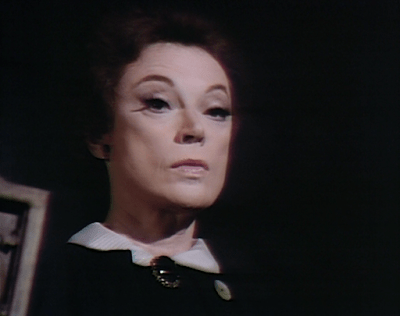
It is not only in the character of Miss Hoffman that this version of Rebecca is less subtle than were those that preceded it. Maggie is even slower on the uptake than was the second Mrs de Winter. Even after she heard Miss Hoffman cackle about her deficiencies, and even after multiple people have made it clear that they are siding with her against Miss Hoffman, she still takes her advice and buys the record. Quentin is quite reasonable today, but that’s a first- so far, he has been even more miserly with information than Maxim was. And where Rebecca was an intimidating memory that became an inconvenient corpse, we end today’s episode with Maggie opening the doors to the drawing room and seeing Quentin offering a glass of sherry to someone who, for all she sees, can only be Angelique come back to life.
 Dark Shadows Commentary
Did Hitchcock use “Monkeyface” in both Suspicion <i>and</i> Rebecca? Now I’m going to have to go back and rewatch! Not that I ever need much of an excuse. Maybe I’ll throw in Dragonwyck and make an evening of it…
LikeLiked by 1 person
Oh yes it is SUSPICION! I so strongly remembered that in Laurence Olivier’s voice that I didn’t bother checking. I’ll have to correct the post, thanks for catching it.
LikeLike
I honestly didn’t mean to “well, actually” you – I seriously thought Hitchcock might have liked that little detail so much he used it twice! It seems like the kind of thing he might have done!
LikeLike