Episode 413: So sad for such a long time

Sarah Collins is going to turn 11 two days from now, on 26 January 1796. Sarah misses her big brother Barnabas. She has been told that Barnabas has gone to England, and today her mother, Naomi, tells her that Barnabas may not be back for a long time, maybe not until Sarah is grown up. Sarah refuses to believe this. She insists that if she lights a candle in the window of the bedroom where Barnabas’ onetime fiancée, the gracious Josette, has been staying, Barnabas will “somehow know it’s there” and come home.

Naomi lies to Sarah.

Sarah is right to disbelieve her mother. On the orders of her husband, haughty overlord Joshua, Naomi is repeating a lie to conceal Barnabas’ death. Joshua believes that Barnabas died from the plague, and that if that word gets out the men won’t report for work at the family’s shipyard. In fact, Barnabas never had the plague. He died of a witch’s curse. As a further result of the curse, he is now a vampire. The last few nights, he has been snacking on the women who frequent the waterfront of the village.

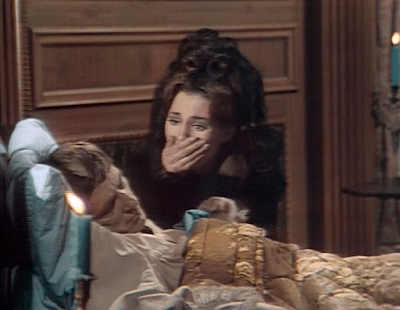
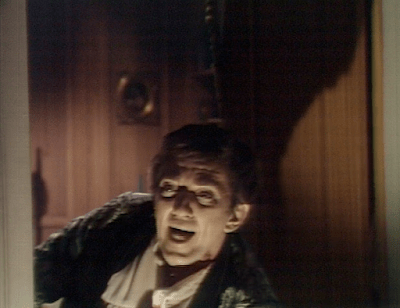
Josette is out of town, so Sarah takes the candle to her room, meaning to leave it there as a surprise. Looking out the window, she sees Barnabas on the lawn, peering up. Sarah is excited to see her brother, and runs out of the house after him. He doesn’t want her to know what has become of him, and runs off.

Barnabas on the lawn.
Sarah spots Barnabas.

Seconds after she exits the front door, Sarah is in the cemetery. It has been established many times that this cemetery is miles from the house; earlier in this very episode, Barnabas’ helper Ben visited him in his tomb there, and made it clear he had plenty of opportunity to shake anyone who might be following him as he journeyed there from the house. This inconsistency bothers a lot of people, but I kind of like it. We got to know Sarah as a ghost in 1967, and she was at the center of a number of very intriguing surrealistic sequences. She’s alive now, but the whole situation is so bizarre that it only seems right she moves as she would in a dream. Watching the scene this time, I was surprised- I had remembered the set behind Sarah being blurred as she ran and some other visual effects that would have presented it as an eldritch moment, but none of those was actually there.

The episode ends with Sarah in the outer part of the tomb, near the secret panel behind which Barnabas’ coffin is hidden. She is calling out to him. We have been warned that Sarah will die on her birthday as a result of exposure; when Barnabas does not come to her, she complains of the cold, and we end on an ominous note.

Sarah in the mausoleum.

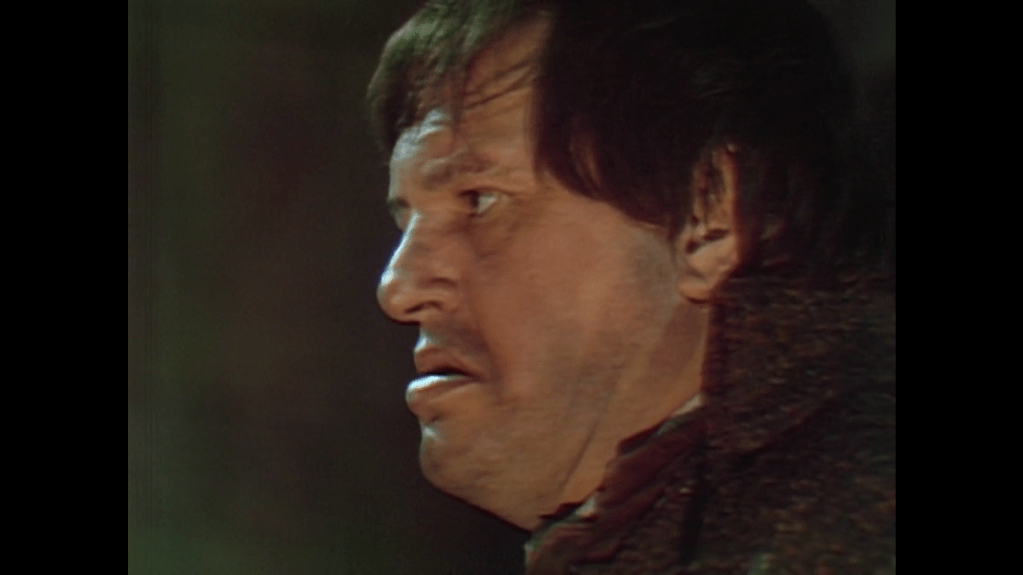
When Sarah sees Barnabas standing on the lawn, we echo earlier phases of Dark Shadows. We often saw characters looking out that window during the first 73 weeks of Dark Shadows, when the dramatic date was 1966 or 1967 and the room was occupied by well-meaning governess Vicki. We also saw Barnabas peer up at Vicki’s window from the lawn several times. The first time was at the end of #214, when the camera stuck with him so long we wondered if he really was a vampire and not just a garden gnome.

The closing shot of #214, set in 1967. Compare with the image of Barnabas on the lawn above.

Barnabas’ penchant for staring at windows in turn echoed his predecessor as the show’s supernatural menace, undead fire witch Laura Murdoch Collins. As ten year old Sarah Collins looks out a window and sees her big brother Barnabas looking up at her from the lawn today, so in #134 did another child of the same age, strange and troubled boy David Collins, look out a window and see his mother Laura looking up at him from the same lawn.

Vicki is in this episode. Sarah’s ghost yanked her here from November 1967 so that she could “tell the story from the beginning.” It isn’t so much Vicki who has been getting the story as it is the audience. Vicki is left out of most of the key developments; in particular, she has no clue Barnabas is a vampire. She has done such a poor job of fitting into her new environment that even though witchcraft laws had been repealed throughout the English-speaking world sixty years before, the village of Collinsport has brought them back just for her. She is in gaol, and from there has continued to find ways to make her situation so much worse that she is now all but certain to be hanged.

Today, Vicki asks for Naomi to visit her in the gaol. Barnabas and Ben are the only ones who know who the witch really was, but neither of them is in a position to talk to the authorities and clear Vicki’s name. Naomi and Sarah are the only other people who believe that Vicki is innocent. Vicki tells Naomi that she has a book printed in the twentieth century that tells her Sarah will die of exposure on her eleventh birthday. In response, Naomi looks at her in wonderment and says that she is starting to believe she really is a witch. Vicki dismisses that topic, and pleads with her to keep Sarah indoors for the next few days. Naomi agrees to do so.

Vicki’s warnings not only make Naomi suspect that the charges against her are true; it is because Naomi is not home that no one stops Sarah running out and getting stuck in a cold place. I suppose there is meant to be a dramatic irony in seeing Vicki bring about the very disasters she is trying to prevent, but the character’s foolishness throughout the whole segment set in the late eighteenth century blunts that irony.

If we saw a smart person operating at the top of her form and still causing a series of calamities, we might have a sense of tragic inevitability, a feeling that the course of history cannot be changed whatever we do. But Vicki has not been that person. Movie reviewer Roger Ebert famously called stories that depend on the characters doing things the average member of the audience would be too smart to do “idiot plot.” For all the strengths of the 1795 segment, there is an idiot plot at the center of it, and Vicki is the Designated Dum-Dum. That undercuts the arc and destroys the character.
Episode 412: The book

For the first 39 weeks of Dark Shadows, well-meaning governess Vicki was the main protagonist. Her understated, sometimes diffident manner fit with the pace and themes of the show in that period. When the show introduced its first supernatural villain, undead fire witch Laura Murdoch Collins, Vicki rose to the occasion and led the opposition to her. When Laura went up in smoke, the last of the themes that made Vicki a suitable lead went with her. Vicki remained our chief point-of-view character for some time after that, but she didn’t find much footing in any of the stories. She receded steadily from center stage for months.

In November 1967, Vicki came unstuck in time and found herself in the year 1795. At first this seemed to be an opportunity for a reset, but Vicki wound up being written in the time-travel story as a complete moron. She kept yelling at the other characters that they were being played by actors who had other parts in the first 73 weeks of the show, refused to take advice from people who tried to explain how she could fit in with her new surroundings, and insistently held onto possessions that eighteenth century people would take as evidence that she was evil. Now she finds herself in gaol, accused of witchcraft and facing a possible death sentence.

The other day, the gracious Josette visited Vicki in gaol and begged her to lift the spell that had brought a terminal illness on the gallant Barnabas Collins. Unable to persuade Josette that she was not a witch, Vicki told her that she had come from the future and brought with her a book about the history of the Collins family printed in the twentieth century. She told Josette where to find this book. When she did find it, Josette was more convinced than ever that Vicki was the witch.

Now, Barnabas has died. Josette visits Vicki again, and vows to do whatever she can to see that she is hanged. Josette is so distraught over Barnabas’ death that she quite calmly says she may want to take her own life soon, but she does look forward fondly to testifying against Vicki and seeing her execution.

Josette takes consolation in the idea that she will help get Vicki sentenced to death. Screenshot by Dark Shadows Before I Die.

After Josette leaves, Vicki asks her gaoler/ defense attorney/ prospective boyfriend Peter to sneak her out of the gaol. She wants to go to Collinwood and steal the book back.

Evidently Peter is no brighter than Vicki, because he agrees to this plan. Vicki goes to Josette’s bedroom. As we might have expected, Vicki is seen in the room- Josette’s aunt, the Countess DuPrés, opens the door and finds her with the book in her hands. By the time the countess returns with Josette and the witch-hunting Rev’d Trask, Vicki and the book are gone. This will be Vicki’s own bedroom in 1967, and she knows of a secret passage leading out of it. The other three do not know of this passage, and no one in 1795 knows of any reason Vicki would be aware of it. So far as they know, she has appeared and disappeared by magic.

Back in the gaol, Peter locks Vicki in her cell and hides the book in his desk. Trask and the ladies knock on the door and demand to see Vicki. Peter swears that she has been in her cell all night. Josette is concerned that they no longer have the book, but Trask says they don’t need it- only a witch can be in two places at once. Peter’s statement will suffice to put Vicki’s neck in the noose.

As of this writing (18 January 2024,) four of the five actors in this episode are still alive. Only Grayson Hall is no longer with us; she died in 1985. Hall’s countess, like Kathryn Leigh Scott’s Josette and Jerry Lacy’s Trask, is a lot of fun to watch. Vicki is so brainless that the part defeats Alexandra Moltke Isles, and Roger Davis is never an agreeable screen presence. So we wind up cheering on the people who want to put the heroine to death and hoping that her love interest joins her on the gibbet.

Episode 411: No longer really human

Messy eater. Screenshot by Dark Shadows Before I Die.

At the top of the episode, wicked witch Angelique is in the secret chamber hidden inside the Collins family mausoleum. She is standing before the open coffin of Barnabas Collins, a stake in one hand and a mallet in the other. The sun is setting; once it does, Barnabas will rise as a vampire. She would drive the stake through his heart to prevent this outcome, but she is moving in time with the background music, and it is too slow. Barnabas awakes, knocks the equipment from her hands, and grabs her throat.

In 1967, throat-grabbing was Barnabas’ reflex when someone opened his coffin at dusk. The character first appeared in #210 as a hand darting to the throat of would-be grave robber Willie Loomis; Barnabas would bite Willie and enslave him. In #275, seagoing con man Jason McGuire opened the coffin; again the hand darted to the throat, and in #276 we learned that Jason was dead. That was the first time in 1967 Barnabas killed someone.

Now it is 1795. When we return from the opening title sequence, Barnabas has let go of Angelique. He has questions, and she is trying to avoid answering them. He realizes that she is afraid of him. When he figures out that she has turned him into a monster, he strangles her. In 1967, thirteen weeks separated Willie’s freeing of Barnabas from the death of Jason; this time, Barnabas chokes the life out of Angelique only eight minutes after he first awakens as a vampire.

Barnabas opens the door to the outer part of the mausoleum. The mechanism that opens this door is hidden inside one of the stairs leading out, and the camera lingers on it long enough to show that Barnabas must already be very familiar with the room to have gone directly to it. Returning viewers will remember that Angelique seemed unable to find it yesterday, and committed fans will remember that strange and troubled boy David Collins spent a whole week trapped in the secret chamber in September 1967 because it was so well hidden. The ghost of Barnabas’ little sister Sarah had to manifest to David in #315 and show him the door opener before the plot could move forward.

In the outer part of the mausoleum, Barnabas finds much put-upon servant Ben. Ben had been Barnabas’ devoted friend, but Angelique cast a spell on him and forced him to do her evil bidding. He is glad to hear Angelique is dead, and pledges to help Barnabas. As a living man, Barnabas had always gone out of his way to reciprocate Ben’s friendship, but throughout their conversation in the mausoleum he keeps telling Ben about the reasons he has to kill him. Only when Ben points out that he will need someone to protect him during the day does Barnabas agree to let him live. This was the same appeal that mad scientist Julia Hoffman made to Barnabas in #351. Since Barnabas was busily preparing to kill Julia a few episodes after that, this echo does not inspire much hope for Ben’s future.

Barnabas and Ben are having a little talk about how to dispose of Angelique’s corpse when they hear someone approaching the mausoleum. Barnabas hustles back into the secret chamber. Ben turns to the entrance, an appropriately helpless expression on his face.

Ben faces the darkness, waiting for whatever fresh hell may be approaching.

Haughty overlord Joshua Collins enters. Joshua is Barnabas’ father and Ben’s legally recognized master. Joshua accuses Ben of coming to rob Barnabas’ grave. Ben denies it. Joshua demands to know who he was talking to a moment before. Ben says that he was praying and that the only way out of the chamber is the way Joshua came. Joshua says that it is not the only way- Ben’s confederate could have gone into the secret chamber. Joshua opens the secret chamber, looks inside, and sees only Barnabas’ coffin. He is about to close the panel again when a bat flies out and flusters him. After the bat is gone, he agrees to let Ben stay and say more prayers for Barnabas.

Ben is in the graveyard when Barnabas materializes in front of him. Barnabas tells Ben that his new existence has brought him new powers. When the two of them return to the mausoleum, Ben sees that Barnabas’ face is streaked with blood. Barnabas tells him that he has discovered that along with his new powers, he has a new need- he must drink other people’s blood in order to survive. Tomorrow, Ben will hear of an unfortunate woman in the village killed by a wild animal. Barnabas says that he should have let Angelique destroy him; Ben protests that he oughtn’t say things like that. Evidently Ben is going to stick with Barnabas no matter how gruesome his deeds become.

Episode 410: Do you know the word “vampire”?

The name “Barnabas Collins” was first spoken on Dark Shadows by strange and troubled boy David Collins in #205. By the time of his first appearance in #211, it was already clear to the audience that Barnabas was a vampire. Yet the word “vampire” was never spoken on the show in those days. Barnabas was referred to as one of “the Undead,” a title that had previously been given to David’s mother, blonde fire witch Laura Murdoch Collins, and also as “the living dead.” At times avoidance of the word led to a bit of fun. So in #315, mad scientist Julia Hoffman is trying to talk Barnabas out of killing David, and says that the boy must not die “at the hands of a-.” When her voice breaks off, Barnabas smiles, leans in, turns his face towards her, and asks “at the hands of a what, doctor?” He is positively gleeful that she has come so close to blurting out a taboo word. It’s as if he had caught her about to make a fool of herself by uttering a slur, and he all but dares her to say it out loud.

As of today, Barnabas has been a part of Dark Shadows for 41 weeks, the same length of time the show had been running before David spoke his name.* The embargo on the word “vampire” finally ends today. We are in the year 1795, and wicked witch Angelique has cursed Barnabas. The first part of the curse has killed him. His father, haughty overlord Joshua, believes Barnabas died of the plague and has hidden his corpse in the secret room of the Collins family mausoleum lest this news cause a panic at the shipyards. Joshua refuses to tell anyone where Barnabas’ remains are, even Angelique, who was Barnabas’ wife.

Angelique regrets the curse, and tried to lift it while Barnabas was still alive. Now that he has died, she wants to prevent the second part of it from coming true. If she does not drive a stake through Barnabas’ heart before dusk, he will rise as a vampire.

Angelique summons much put-upon servant Ben. Ben had been Barnabas’ loyal friend, and to his great misery Angelique has used her powers to enslave him and force him to help in her evil schemes. Now she orders him to find Barnabas’ body, make a sharp stake out of holly wood, and report back to her.

Joshua violently disapproved of Angelique’s marriage to Barnabas and wants to be rid of her. He offers her $20,000 in gold if she will go away and leave behind a signed paper promising never to return. He leaves the paper and the passbook to the bank account containing the gold, and we see her sign.

It isn’t always very meaningful to compare prices across centuries. You couldn’t get a smartphone or a Lexus or a roll of toilet paper for any amount of money in the eighteenth century. But we can compare the price of gold from year to year. In 1795, the official price of gold in the USA was $19.39 per ounce. So, when Joshua offers Angelique $20,000 in gold, he is offering her 1031.46** ounces of it. As I’m writing this (17 January 2024,) the price of an ounce of gold is $2010.60. So, there is a sense in which Joshua pays Angelique $2,073,852.50 to leave Collinwood.

Ben returns with the stake; he and Angelique go to the mausoleum. There, Ben opens the secret room, remarking that Joshua showed it to him on his first day as a servant at Collinwood. Joshua had explained that he hid guns there for the Continentals during the War for Independence, and he wants Ben to keep it clean so that it will be ready in case it is ever needed again. Ben says that it is hard to believe that Joshua was a patriot during the Revolution, but he supposes he was. That Joshua still thinks it might be necessary to take up arms at short notice during the second term of the Washington administration suggests his politics might have been rather fervent.

In the secret room, Angelique and Ben see Barnabas’ coffin. She introduces Ben to the word “vampire,” then tells him to open the coffin. He refuses, and runs out of the room. He shuts the door, sealing her in the chamber with Barnabas. It is surprising that he can do this- perhaps her power over him is waning. She opens the coffin herself and picks up the stake and mallet. The music plays on the soundtrack, and she moves in time with it. She raises the mallet, we catch a glimpse of Barnabas*** in his coffin, and the episode ends.

Angelique prepares to stake Barnabas. Screenshot by Dark Shadows Before I Die.

*Though he has been in the air for a bit longer than that. We first saw his portrait on the wall next to the front door of the great house of Collinwood in #204, and while the portrait was being painted an elaborate shot was tricked up in #195 to make it look like a portrait was on that spot. 

**To be exact, 1031.45951521 ounces.

***A stand-in wearing heavy makeup, not Jonathan Frid.

Episode 409: Some of the facts

When well-meaning governess Victoria Winters came unstuck in time and tumbled from 1967 to 1795, she brought with her a copy of the Collins family history. We first saw this book in #45, when flighty heiress Carolyn Collins Stoddard read this excerpt aloud:

Jeremiah Collins, sixth generation descendant of the founder of Collinsport. In 1830 married Josette Lafrenière of Paris, France. The construction of Collinwood, the family mansion, was begun the same year.

Right up to the last few weeks before Vicki left for the past in November 1967, Dark Shadows kept equivocating about whether Josette, Jeremiah, and the rest of them lived in 1830 or in the late 18th century. The name “Lafrenière” was not mentioned again after #45, but neither was any other surname given for her birth family until the name “DuPrés” was introduced during the 1795 segment. Likewise, #45 is the only time we hear that Josette was from Paris. Her association with the island of Martinique is established in #239, when the vampire Barnabas Collins tells his victim Maggie that he met Josette there and taught her English on the journey to Collinsport, where she was to marry Jeremiah. That Josette was the daughter of the richest French planter on Martinique, a condition that in 1795 in our time-band characterized the lady who would become the Empress Josephine, is something the show commits itself to during the flashback segment.

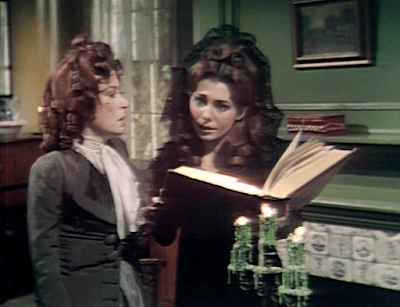
These were only a few of the myriad revisions and retcons the show went through in regard to Barnabas and Josette’s time as living beings. Today, Josette and her aunt, the Countess DuPrés, go through the book and remark on its many inaccuracies. The episode ends with a shock when they realize that at least one of these inaccuracies is the result of a conscious decision by haughty overlord Joshua Collins to falsify the record of events.

Josette and the countess read The Book. Screenshot by Dark Shadows Before I Die.

I was going to write about how meta this all is, but then I reread Danny Horn’s post about the episode on Dark Shadows Every Day and found that he had already done it. I would just add that the very idea of traveling back in time is a metaphor for rewriting, so that the whole storyline is an exercise in self-reference by the writers and producers.

This episode features the death of Barnabas Collins. Barnabas has been the show’s main draw for a long time, but he was already dead when we met him in April 1967, and he’s been dying for the last four days of this flashback, so that’s less of a milestone than it might seem. The event is presented as another exercise in continuity. In #345, vampire Barnabas told mad scientist Julia Hoffman that before his death he had vowed to Josette that he would someday return to her. Indeed, Josette is at his bedside in his last moments as a human, and he does make that vow.

Barnabas dies. Screenshot by Dark Shadows Before I Die.

Barnabas accompanies his vow with a plea for Josette to wait for him. That, too, is a continuity moment. Josette is played by Kathryn Leigh Scott, who also played Maggie. When Barnabas returned as a vampire in 1967, he kept Maggie prisoner and tried to replace her personality with that of Josette. Whatever the living Barnabas may have been thinking in his last moments, the vampire Barnabas expected to find Josette waiting for him, 172 years after his death, and that expectation motivated the first major crime we saw him commit.

Episode 408: My imperfect science

Late in 1966, the ghost of Josette Collins emerged from the supernatural back-world behind the action of Dark Shadows and rescued well-meaning governess Vicki from homicidal groundskeeper Matthew Morgan. Early in 1967, Vicki and several other characters worked closely with the ghost of Josette to thwart the evil plans of undead fire witch Laura Murdoch Collins. After these experiences, Vicki felt so close to the ghost that, to some, it seemed possible that her personality might disintegrate and she might become a sort of reincarnation of Josette.

In November 1967, the back-world and the foreground traded places. Vicki came unstuck in time and found herself in 1795, where Josette and others whom she had met as uncanny entities are alive and she is the alien interloper from another world. Vicki did not in any way adapt to her new surroundings, and immediately brought suspicion on herself. Now she is in jail, spelled “gaol,” awaiting trial on charges of witchcraft.

Josette visits Vicki today and begs her to lift the curse that has brought a mysterious and apparently terminal illness to gallant gentleman Barnabas Collins. Despite her situation, Vicki is shocked that Josette believes her to be a witch. Unable to persuade her of her innocence, Vicki tells Josette that she is a time-traveler and sends her off to look for a book she brought with her from the future. Josette interprets this as a confession of witchcraft, and when she finds the book makes it clear that she could not possibly have interpreted it as anything else.

Vicki makes Josette cry. Screenshot by Dark Shadows Before I Die.

If the show had kept the memory of Vicki’s friendship with Josette’s ghost fresh, this might have been a powerful scene. But Josette’s ghost receded from the action after the Laura story ended in #191, and in #223 and #240 it was made explicit that she is no longer a palpable presence on the estate of Collinwood. We’ve barely heard of Vicki’s connection to Josette in recent months. By this point, even viewers who have been with the show from the beginning are unlikely to make a connection between Vicki’s behavior in her scene with Josette and those old stories. Instead, we see yet another case of Vicki being a tiresome fool.

Disappointing as that scene is, it is not the low point of the episode. That came in the scene immediately before. Actor Jack Stamberger appears as a doctor called to treat Barnabas. Doctors on Dark Shadows are ineffectual figures brought on to fill time, unless they are mad scientists who take a bad situation that is troubling one or a few characters and make it so much worse that it can be a major narrative arc. Stamberger’s part is of the former sort.

It is a particularly objectionable specimen of the category. The other G.P.s usually started with at least a theoretical possibility that they might do something to advance the plot, or turn out to be old friends with established characters who could show a new facet of their personalities in interaction with them, or at least bring out some unusual medical equipment that would be fun to look at. They’ve already foreclosed all of those possibilities before this doctor appears, so the scene is advertised as a waste of time.

One of these is not like the others. Screenshot by Dark Shadows Before I Die.

Worse, watching Stamberger’s performance is like sticking your head in a bucket of itching powder. His scene partners, Kathryn Leigh Scott, Lara Parker, and Grayson Scott with dialogue, and Jonathan Frid with moans and anguished facial expressions, are all totally committed to the period setting, and really do seem like gentlefolk inhabiting a mansion in a previous century. Stamberger doesn’t even try to do what they are doing. He puts on a growly voice that might have been acceptable if he were playing a trail-boss in a Western, but that doesn’t have much place in any scene set indoors. It certainly doesn’t make sense for a man in genteel surroundings who talks about nothing but how helpless he is. He doesn’t maintain eye contact with any of the ladies long enough to put himself into the same space with them. He bungles most of his lines, and even those he speaks as written he follows by shuffling his feet, breathing heavily, and looking around. Dark Shadows was, for all practical purposes, done live; if videotape editing had been freely available, it’s hard to imagine director Lela Swift wouldn’t have stopped the scene and taken the time to smack him upside the head.

On his Dark Shadows Every Day, Danny Horn argues that Addison Powell was, as he stylizes it, THE WORST ACTOR EVER TO APPEAR ON DARK SHADOWS. I’m not sure who deserves that title, but today Stamberger locks up the award for Most Irritating Performance.

Episode 407: Damn spot

In a moment of anger, wicked witch Angelique cursed her husband Barnabas Collins. In the first stage of the curse, a bat bit Barnabas on the neck. Barnabas lost a great deal of blood, and now has a high fever. If he dies, he will rise as a vampire. Angelique regrets placing the curse and is trying to undo it.

At the top of today’s episode, Angelique is fussing over a large bloodstain on the floor of the front parlor. With a word, she can turn Barnabas into a vampire. Earlier, she turned his father Joshua into a cat one day and back into a human another day. She made Barnabas’ true love, the gracious Josette, conceive a mad passion for his uncle, Jeremiah, made Jeremiah reciprocate it, and drove the two of them to elope. She enthralled Barnabas’ devoted friend, much put-upon servant Ben Stokes, and forced him to assist her in her evil plans. She could sicken Barnabas’ little sister Sarah and kill her or heal her as she chose. She made bewildered time traveler Vicki suffer hallucinations that led her to incriminate herself as the witch. Yet for all her powers over humans, she is utterly stumped by the stain on the floor. She stares at it and talks to herself for a minute or two, helplessly rubs it with a dry cloth, then stands up, defeated. Considering that she was a lady’s maid until she married Barnabas, you might think that the first thing she would have learned when she took up black magic would be spells to help with the house-cleaning, but evidently not.

“Out, out, damn spot!” Screenshot by Dark Shadows Before I Die.

Unlike the blood on Lady MacBeth’s hands, the stain on the floor is visible to everyone. Barnabas’ mother Naomi sees it when she has come to the house and asked to see her son. Angelique denies that he is there. We cut back and forth between the women in the front parlor and Barnabas in his sick room. When Naomi notices the bloodstain on the floor, Angelique claims that it is a wine stain. Naomi is a serious alcoholic, so she probably knows the difference between a wine stain and a bloodstain. The ailing Barnabas makes noises that Naomi hears, and Angelique claims that they are just the sounds of the house. Naomi lived in the house until she gave it to Barnabas a couple of weeks before, so she probably knows the house’s noises well enough that this won’t fool her either. Even after Angelique has resorted to these two very ill-chosen lies, Naomi gives up and goes away. It is fun to watch Angelique struggle to find a way out of an awkward situation with her mother-in-law, and touching to see that Naomi is so determined to believe the best about Barnabas and his new wife that she decides to accept Angelique’s explanations.

Angelique goes upstairs and gives Barnabas a potion meant to cure him of her curse. She is terribly upset when it doesn’t work. We’ve seen Angelique regret her spells before, and in #377 we heard her thinking about the fact that she can’t control their effects once she has cast them. But this is the first time we have seen her go so far in an effort to undo her evil deeds. When she offers to bring Josette to Barnabas, there is enough desperation on her face that it seems plausible that she sincerely intends to let her rival try to help him.

In the great house, Naomi and Joshua quarrel about Barnabas and Angelique. Joshua claims that he has not the slightest concern about Barnabas; as soon as Naomi leaves the room to answer the door, we see a haunted look on his face that shows this to be a lie. It’s a wonderful touch, and sets up an expectation that Joshua will soon relent in his hostility to Barnabas.

Naomi opens the door to find Josette and her aunt, the Countess DuPrés. When the bat attacked Barnabas, Josette and the countess were many miles away from Collinwood, yet Josette not only sensed that something terrible was happening, streams of blood appeared on her neck at the same spots where they appeared on Barnabas’ neck. After this experience, they hastened back to Collinwood.

While Josette and the countess were in the inn far away, a bat appeared outside their window. Though Angelique has been dispatching bats to do her bidding, she did not then know and still does not know where Josette and the countess were at that time. Regular viewers of Dark Shadows should be ready for this. The show’s first supernatural menace, undead fire witch Laura Murdoch Collins, was introduced in December 1966 as an assortment of related but autonomous phenomena, and we saw in 1967 that the ghost of Sarah was also made up of several parts, not all of which were aware of each other or working towards the same goals. So the bat that spies on Barnabas, the bat that bites Barnabas, and the bat that hangs around Josette and the countess may all be parts of the complex known as “Angelique,” but that need not mean that they are all under the control of the woman we know by that name or that she is even aware of them.

Josette is determined to help Barnabas and says that she and her aunt will be going to the Old House to ask Angelique where he is. Naomi is sure Angelique does not know, but Josette and the countess insist on going to the Old House anyway.

When Naomi came to visit, Angelique had to be pleasant. Naomi is Barnabas’ mother, and she is the only ally Angelique can hope to have in the family. But she doesn’t have any need to be nice to Josette or the countess. She keeps telling them to get out of her house, and they keep refusing. Finally they are on their way to the door when they hear Barnabas’ voice crying out “Josette!” At that, there’s no stopping Josette from rushing up the staircase to his room. The countess holds Angelique back, and Josette finds Barnabas bleeding and delirious. He keeps calling her name, unable to recognize that she is with him. He staggers past her. His back to her, he leans out into the hallway and calls “Josette! Josette!” It’s a poignant image of a man who has never fully appreciated anything he had, and who has now lost everything.

“Josette! Josette!” Screenshot by Dark Shadows Before I Die.

Episode 406: Cursed with eternal life

Through the first eight weeks of the part of Dark Shadows set in the year 1795, it seemed likely that wicked witch Angelique would not be on the show when it returned to the 1960s. Her narcissistic personality and consistent record of failure in her evil schemes overlapped so much with what we saw from vampire Barnabas Collins in 1967 that it would be hard to have them on the show at the same time, while her hyper-intense personality and the fast pace of the action she has generated would seem to be signs that she is not meant to stay on a daytime serial for the duration.

That starts to change today. Barnabas is not yet a vampire, but a living being and a gallant gentleman, albeit a deeply selfish and alarmingly violent one. He married Angelique, not knowing that she was a witch until too late. He has tried to kill her three times in the last few days. That was one attempt too many for Angelique, who in her irritation put a curse on him. A bat bit his throat, leaving him with heavy blood loss and a high fever. Today, Angelique tells escaped convict Ben Stokes, who is Barnabas’ loyal friend and her wretched thrall, that if Barnabas dies he will become “the living dead.”

Barney and friends. Screenshot by Dark Shadows Before I Die.

When she is telling Ben what will happen if Barnabas dies, Angelique says that “I am responsible” for the situation. That is a phrase Barnabas never uttered in 1967. Angelique also tells Ben that she must keep Barnabas alive to prevent fulfillment of the curse, and that she will try to lift it altogether when she is stronger. That is another difference from vampire Barnabas- when one of his plans failed, he didn’t try to cure his victim. What failure with one person meant to him was that it was time to kill that one and start over with another. So we can see that the overlap between Angelique’s personality and the one Barnabas will have as a vampire is not total, and that it may be possible to construct plots involving both of them.

Episode 405: To love anyone

Gallant gentleman Barnabas Collins discovered that his wife, Angelique, was a wicked witch and a deadly threat to his true love, the gracious Josette. He did not tell anyone what he knew about Angelique, but did persuade Josette to flee. Today, Angelique discovers that Josette is beyond the range of her powers.

In her rage, Angelique takes a doll belonging to Barnabas’ little sister Sarah. She sticks pins in it; Barnabas has learned that this causes Sarah to become ill. Angelique is about to stick a pin into the doll’s heart when Barnabas takes a dueling pistol and shoots Angelique.

Angelique drops the doll; Barnabas takes the pins from it. Angelique presses her hand to her shoulder while delivering a long, bombastic speech. Barnabas has plenty of time to reload the pistol and shoot her again, but chooses just to stand there and listen to her. This turns out to be a bad decision when she ends the speech by placing a curse on him. He will spend all eternity unable to rest, and everyone who loves him will die. Having completed her death scene, she ostentatiously collapses.

We hear a window smashing. A bat appears. It approaches Barnabas. He yells at it, flails his arms, and walks backward. This is an echo of #330, which ended with strange and troubled boy David Collins reacting the same way when the same puppet appeared in his bedroom. David was a neurotic and isolated pre-teen who had been through a lot of trauma, so that was an effective scene. Barnabas is a grown man who has been trying to function as an action hero. Seeing him as the equivalent of a cartoon lady standing on a chair screaming because she saw a mouse rather undercuts this. Anyway, the bat bites Barnabas on the neck, so now he’s going to be a vampire.

The bite. Not Barnabas’ cloak in the background, playing the role of The Grim Reaper. Screenshot by Dark Shadows Before I Die.

In #330, it was Barnabas who sent the bat against David. This is one of many indications that the vampire Barnabas we knew from April to November of 1967 was not only under Angelique’s curse, but that he was in some sense a manifestation of Angelique. Maybe when she casts a spell, she breaks off a chunk of herself and that chunk goes about the world pursuing its own objectives. The image of a supernatural being as a complex of vaguely related but independent phenomena has been standard in Dark Shadows since undead fire witch Laura Murdoch Collins first appeared on the show in December of 1966, so regular viewers are prepared to learn that the vampiric Barnabas is a subcategory of the syndrome known as “Angelique.”

This episode explains how a couple of the more important props got to be in the places we are used to seeing them. Early in the episode, Barnabas gives Josette a music box. This music box figured heavily in the story from May to August 1967 as a symbol of Josette and as a vehicle for some kind of magic spell that was supposed to turn other people into her. A bit later, we see that Barnabas has hung the portrait of Josette over the mantle in the front parlor of the Old House. It was there when we first saw the Old House in #70, and was the focus of all supernatural phenomena on the show from then until Barnabas reclaimed the Old House in #212.

Episode 404: I forgot you were here

When I was a kid in the 80s, a friend of mine liked watching syndicated reruns of the tongue-in-cheek Western series Alias Smith and Jones on Saturday afternoons. I didn’t much care for it, but sat through a few of them with him. Eventually they got to some episodes in which the actor who played the character with the alias “Smith” was replaced by a man who was always smiling as if he had just said something terribly clever, even if he hadn’t said anything at all. After a few minutes of that bozo’s inane mugging, my friend couldn’t stand it either, and we could go back outside and play. So that worked out to my benefit.  

In those same years, I was a great fan of The Twilight Zone. The man whose pointless self-satisfied smile ruined Alias Smith and Jones for its fans showed up in one of those episodes, but he was used intelligently there. The episode was called “Spur of the Moment.” In it, a young woman has to choose between two lovers, one of them a prosperous fellow whom her father likes, the other a penniless dreamer whom the whole family hates. Any audience will have seen that story countless times and will assume that we are supposed to root for the penniless dreamer. But The Twilight Zone mixed that up for us by casting the likable Robert E. Hogan as daddy’s choice and the man with what we nowadays call an “instantly punchable face” as the poor boy. When the twist ending shows us that the woman was horribly wrong to marry the poor boy, it’s our dislike of the actor playing him that makes it a satisfying resolution.

So, when I first saw this episode of Dark Shadows some years ago, it was with some apprehension that I met the sight of that same repellent man on screen. His name is Roger Davis. In later years, Joan Bennett would look back at her time on Dark Shadows and would refer to Mr Davis as “Hollywood’s answer to the question, ‘What would Henry Fonda have been like if he had had no talent?'” Mr Davis’ head is shaped like Fonda’s, and his character turns out to be a defense attorney, a common occupation among the roles Fonda played.

The first line addressed to Mr Davis is “I forgot you were here,” spoken by bewildered time-traveler Vicki. When his character Peter, a jailer who is reading for the bar, tells her that he can hear her in her cell at night, she tells him she didn’t know he was there. Vicki’s repeated failure to notice Peter’s existence may not sound like an auspicious start to what is supposed to be a big romance, but it isn’t as bad as what happens when he is escorting her back to her cell. He puts his hand on her elbow, and she reflexively recoils.

Mr Davis is just awful in his scene today. He spits each of out his lines as if they were so many watermelon seeds, stops between them to strike poses almost in the manner of a bodybuilder, and looks at the teleprompter. The last was a near-universal practice on Dark Shadows, but I mention it for two reasons. First, because this is his debut on the show- even Jonathan Frid, whose relationship with the teleprompter is the true love story of Dark Shadows, didn’t start reading from it until he’d been on the show for a week or two. Second, in his attempts to defend what he did on Dark Shadows, Mr Davis has many times claimed that he “always” knew his lines, that he “never” used the teleprompter.

Mr Davis is going to be a heavy presence on the show for what will seem like a very, very long time to come. He, more than anyone else, prompted me to make a habit of what I call “imaginary recasting.” When Joan Bennett was stuck playing a scene with him, she evidently made the experience endurable by thinking back to the days when she was a movie star playing opposite the original, talented Henry Fonda. When I am watching him butcher a scene, I think of other actors who actually appeared on Dark Shadows or who would likely have accepted a part on it if offered, and try to visualize what they would have done in his stead.

Harvey Keitel was a background player in #33, and surely he would have accepted a speaking role on the show at this point in his career. Mr Davis’ invariably, pointlessly belligerent tone of voice makes Peter seem like a guy with a lot of anger. Mr Keitel is of course a master of playing men who have issues with anger but are still deeply sympathetic. When it’s time to sit through one of Mr Davis’ scenes as Peter, I have enough fun imagining what Mr Keitel could have done with the part that I am not too sorely tempted to give up.

Closing Miscellany

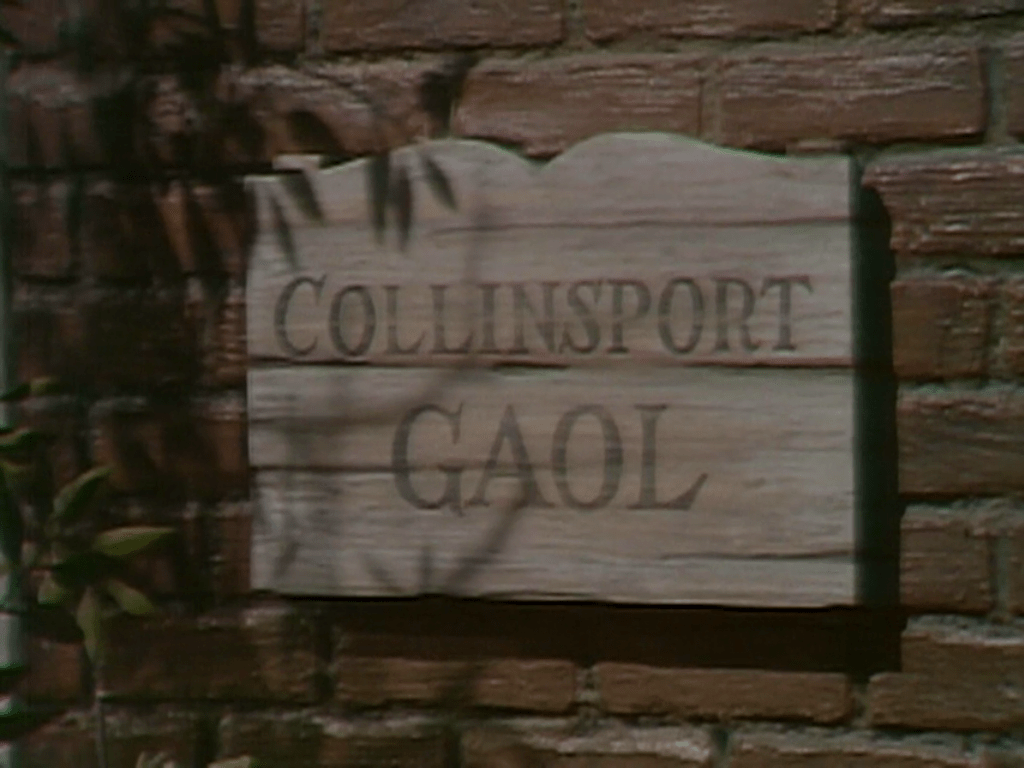
This is the first episode to show that the sign outside the town lockup is labeled, in a period-appropriate spelling, “Collinsport Gaol.”

Ballad of Collinsport Gaol.

The Bil Baird bat puppet appears in this episode, but is so close to the camera it looks like a felt cutout. Bit of a disappointment.

In his post about this episode on Dark Shadows Every Day, Danny Horn discusses the performance Addison Powell gives as a lawyer who meets with Vicki and decides he can’t take her case. He claims that Powell was THE WORST ACTOR EVER TO APPEAR ON DARK SHADOWS. Powell isn’t one of my favorites, but I don’t think he deserves that title. Of those we’ve seen so far, I’d say Mark Allen, who played drunken artist Sam Evans in the first weeks of the series, was the most consistently worthless performer, while Michael Hadge, who was motorcycle enthusiast Buzz for a while in 1967, was the most endearingly inept. Powell is awkward in his scene today, but Roger Davis is even more so, and he, unlike Powell, is so naturally unpleasant that he has to be flawless to earn the audience’s toleration.