Dark Shadows never really stuck to the soap opera tradition calling for Friday episodes to go at a whirlwind pace, build to a shocking revelation, and end with a cliffhanger that brings the audience back after the weekend. The practice of giving a single writer responsibility for a full week more often meant that Friday was an anticlimax that showed his exhaustion. Episode #95 last week was Ron Sproat’s first Friday episode, and in it he tried to play by those usual rules. Today, he doesn’t have enough story to keep things moving very fast, but there is a cliffhanger.
In #95, well-meaning governess Vicki realized that the fountain pen she found on the beach at Lookout Point belonged to dashing action hero Burke Devlin, and jumped to the conclusion that Burke dropped it there while murdering beloved local man Bill Malloy. Today, Vicki has learned that Burke didn’t have the pen the night Bill died. Rather, it was in possession of high-born ne’er-do-well Roger Collins. She has re-jumped, now to the conclusion that Roger killed Bill.
Vicki dashes from her home in the great house of Collinwood to see Burke in his hotel room and tells him what she thinks. She no longer has the pen, and it occurs to her in the middle of the conversation that the pen doesn’t actually prove anything about Bill’s death. Burke is frustrated that Vicki isn’t ready to go to the sheriff, but eventually agrees that they don’t have enough evidence to move against his enemy Roger.
The scene between Burke and Vicki goes on for a long time, and does not lead to any definite conclusions. It would have no place in a conventional Friday episode. It is important, though. Burke is a hot-headed fellow who rarely admits that he is wrong about anything, least of all about a topic that relates to his bête noire, Roger. Not only does Vicki get him to do that, she also shares an intimate scene with him in his kitchen where she makes coffee. After that, he keeps touching her. The sequence leaves little doubt it is just a matter of time before a Vicki/ Burke romance takes hold.
Something’s brewing
Back in Collinwood, flighty heiress Carolyn is quarreling with strange and troubled boy David Collins about Burke. Carolyn has a dinner date with Burke tonight. David regards this as unfair. Burke, whom David idolizes, is the sworn enemy of the Collins family. Therefore, David’s father Roger and his aunt, reclusive matriarch Liz, forbid him to see Burke. If he cannot spend time with his favorite person, he does not see why his cousin should be allowed to go on dates with him.
When David tells Roger about Carolyn’s date with Burke, Roger tries to forbid her seeing him as well, but he has little authority where Carolyn is concerned. In the course of their argument, Carolyn mentions that she told Vicki about Burke’s pen. Roger realizes that this means that Vicki will now suspect him of killing Bill. We’ve seen Roger do cruel things to protect himself, and know that he wants to get rid of Vicki. Indeed, at their first encounter he startled her while she was standing on the edge of a cliff, nearly prompting her to fall to her death. So now that he sees her as a potential accuser in a murder case, we must regard him as a danger to Vicki.
This is the fourth episode credited to writer Ron Sproat. Sproat is making an inventory of the narrative elements available to him, and labeling each one with his plans for it.
In his first episode, #94, Sproat put two of Dark Shadows’ original storylines into a box marked “To Be Discarded.” Those were the quest well-meaning governess Vicki is on to discover her birth family and the relationship between flighty heiress Carolyn and hardworking young fisherman Joe. He put Vicki’s relationship with bland young lawyer Frank and Joe’s with Maggie, The Nicest Girl in Town, into the box marked “For Future Development.”
In #95, he put the whodunit surrounding the death of beloved local man Bill Malloy in the “For Future Development” box. He also noted the idea of a relationship between Vicki and high-born ne’er-do-well Roger Collins as a long-term possibility, depending on the outcome of the Bill Malloy story.
Yesterday, in #98, he reimagined Roger’s son, strange and troubled boy David Collins, not as the frantic and needy victim of his father’s abuse he has been hithertofore, but as an ice-cold sociopath who manipulates the adults around him. If he keeps that personality, David will be able to drive the story for longer periods than he has been able to do so far. We were also reintroduced to a ghost we haven’t heard from in months, suggesting that the supernatural themes will be getting a more detailed treatment.
Today, Sproat continues making his catalog. Dashing action hero Burke Devlin, sworn enemy of the Collins family, is key to the stories Sproat processes this time out. We see most of the events through the eyes of Burke’s secret agent in the great house of Collinwood, housekeeper Mrs Johnson. Using the housekeeper as the point of view character, Sproat suggests that his task in these episodes is primarily one of housekeeping.
In the middle of the episode, we have a couple of scenes about Burke’s attempt to hire staff away from the Collins cannery and fishing fleet. In #89, that attempt set up a visually interesting scene, where a larger than usual group of featured background players gathered in Burke’s hotel room to hear his plans. But the story about them never seemed likely to go anywhere. Today, actor Dolph Sweet appears as the spokesman for the loyal employees who refuse to leave the Collinses. Sweet brings a raw, immediate style to the part that makes a powerful impression. His job today is to drop the story point into the “To Be Discarded” box, and he does it memorably.
Carolyn has long been obsessed with Burke and jealous of Burke’s interest in Vicki. The episode opens with Carolyn making snide remarks to Vicki about a ride Burke gave her to the town of Bangor, Maine. Vicki, under the impression that a pen she has found is evidence pointing to Burke’s involvement in Bill’s death, tells Carolyn that Burke is the very last man in the world a woman should want to be involved with. Vicki has promised Roger not to mention the pen to anyone, so she can’t explain her feelings to Carolyn.
Vicki and Carolyn discuss Burke while Mrs Johnson listens in the background. Screenshot by Dark Shadows Before I Die.
At the end of the episode, Burke has called Carolyn and made a date with her. Elated, Carolyn apologizes to Vicki and is her best friend again. Vicki tries to talk her out of seeing Burke without mentioning the pen. That effort gives way to a conversation in which Carolyn mentions that Burke gave her a pen, that she gave the pen to Roger, and that Roger lost the pen the night Bill Malloy died. Hearing this and remembering Roger’s behavior when they were alone together in episode 96, Vicki concludes that Roger, not Burke, killed Bill.
These scenes mark Carolyn’s fixation on Burke and her fluctuations between unrestrained hostility and unreserved solicitude towards Vicki as themes that will continue. The ending of course advances the Bill Malloy story, and sets up a conflict between Vicki and Roger.
A woman named Mrs Johnson joins the domestic staff of the great house of Collinwood. After reclusive matriarch Liz has sat with her in the drawing room for a few minutes, Mrs Johnson rises to begin her duties. Liz asks her to wait, and stammeringly warns her that some members of the household may seem unfriendly at first. She isn’t to take notice of that- they simply need time to get used to having a new person around when they have been so isolated for so long. Mrs Johnson takes this warning in stride, and again thinks she has been dismissed. But a second time Liz asks her to wait. She tells Mrs Johnson that she needn’t go into the closed-off portions of the house,* and particularly emphasizes that she wants her to stay out of the basement.
Liz’ nephew, strange and troubled boy David Collins, is not at all happy with Mrs Johnson’s accession to the household establishment. When his aunt begins to introduce them, David cuts her off, saying that he had met Mrs Johnson in the restaurant at the Collinsport Inn. He asks Mrs Johnson why she wants to work in the house. His level tone shocks his aunt. She takes David into the drawing room while Mrs Johnson goes upstairs.
When Liz reproves him for rudeness, David asks if he will have to apologize to Mrs Johnson again. He explains that the Collins family’s arch-nemesis, dashing action hero Burke Devlin, had made him apologize to Mrs Johnson in the restaurant after he yelled at her to “Shut up!” Liz says that for once Burke did the right thing. David then asks if Mrs Johnson is going to be his jailer. Liz asks him where he got such an idea. David starts talking about ghosts, and Liz can’t take it anymore. She tells him to go. He complies, still eerily calm.
In the next scene, we’re back in the drawing room. Gruff caretaker Matthew is working in the fireplace. David sneaks up behind Matthew and startles him. He asks Matthew what he’s scared of- is it ghosts? Matthew says he doesn’t talk about such things. David keeps needling him. Matthew gets more and more agitated, David stays absolutely in control of himself.
Mrs Johnson comes in with a ham sandwich and a glass of milk on a tray. She tells David she’s been looking all over the house for him. He protests that he doesn’t take his meals on a tray, but in the kitchen. When Matthew warns him not to make a mess, he gladly sits down on the couch and takes hold of the sandwich. Matthew sulks away.
Mrs Johnson wheedles David into talking about the closed-off rooms of the house. She asks him what he sees there. He asks if she believes in ghosts. She says she doesn’t. He says, again in the blandest possible voice, “You will.”
Matthew returns in time to hear Mrs Johnson encouraging David to describe the closed-off rooms. He sends David to the kitchen with his tray, and scolds Mrs Johnson for asking questions about matters Liz doesn’t want anyone looking into.
When the clock strikes 3 AM, Mrs Johnson shines a flashlight directly into the camera. She is inspecting the basement. She tries the door to the locked room. She can’t open it, but looks into whatever she can. Suddenly, something grabs her from the darkness. She looks down, and sees David’s complacent grin.
Cheshire cat
Mrs Johnson tells David she came down to investigate a noise. That doesn’t impress David, perhaps because it doesn’t explain why she was opening drawers and cigar boxes. For his part, he tells her that he’s there waiting to see a ghost.
David tells Mrs Johnson that his aunt will be very upset if he finds out she was in the basement. She tries to bluster her way out of trouble, but David tells her not to worry- he won’t tell. She asks why not. Because, he says, she’s a friend of Burke Devlin. She denies being Burke’s friend. He says she must be- otherwise, when she publicly accused Burke of causing the death of beloved local man Bill Malloy, he would have been angry. Burke’s mildness persuaded David that the accusation was a little drama the two of them were acting out. Returning viewers have seen enough of Burke’s temper to know how David came up with his premises, and those who saw episode 79 know that his conclusion is true.
David goes on to say that he thinks Burke must have sent Mrs Johnson to the house to spy on his father, high-born ne’er-do-well Roger Collins. This is also true. Before she can try to deny it, David says that he is all for this mission, because he hates his father and hopes he dies. Mrs Johnson is shocked, both by the words and by the altogether relaxed demeanor with which David speaks them. She must never have met a nine year old sociopath before.
Mrs Johnson resumes her bluster. David assures her that he won’t tell Liz he saw her if she doesn’t tell that she saw him. He goes upstairs, disappointed that he missed seeing the ghost. Mrs Johnson stays downstairs, and after a moment hears a woman sobbing inside the locked room. She tries the door again- it is covered with cobwebs, and obviously hasn’t been opened in a very long time. She knocks, and the sobbing desists.
We’ve heard the sobbing woman before. She drew well-meaning governess Vicki to the basement in the first week of the show, and when Matthew found Vicki down there he rebuked her fiercely and reported to Liz that he caught her “snoopin’ around,” the supreme evil in Matthew’s moral universe. When Liz talked to Vicki about the incident, she amazed Vicki by denying that she had heard any sobbing. Eventually, Vicki forced Roger to admit that he had heard the sobbing many times over the years, and that he had no idea what it was. The reappearance of the sobbing woman promises a resolution to a long-standing mystery.
*Several times in the episode, Mrs Johnson mentions the disused “east wing” of Collinwood. We’ve heard a good deal about a closed-off west wing, and it will be years before the show confirms that there is also an east wing. So “east wing” is probably a blooper today. But it is clear that the house has multiple closed-off sections, and in episode 84 there is a distinct suggestion of a sealed east wing. So if it is a blooper, it is a felicitous one.
Dark Shadows tells the story of the great house of Collinwood and its residents, the ancient and esteemed Collins family. From the first episode, some of the most important elements of the house’s visual impact are the portraits of the Collins ancestors that decorate its drawing room and foyer.
The foyer is dominated by a portrait identified as Benjamin Collins. In episode 2, well-meaning governess Vicki feels so intimidated by Benjamin’s portrait that she looks at it, says “Boo!,” and runs away:
The drawing room is home to several portraits. The two that have been most frequently discussed so far on the show are those of Isaac Collins, which moves around a bit but usually hangs by the piano, and of Jeremiah Collins, which has a secure home above the mantle. Reclusive matriarch Liz used the portrait of Isaac as a visual aid in a lecture about family history that she delivered to her nephew, strange and troubled boy David, in episode 17:
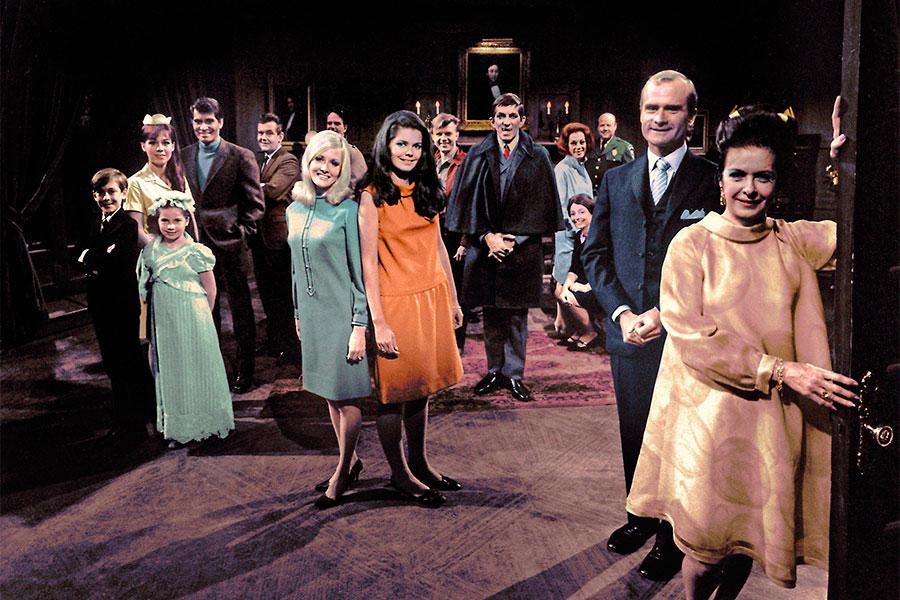
The portrait of Jeremiah features prominently in almost every scene in the drawing room. Since the drawing room is the single most important set in the series, that makes the portrait one of its stars. It’s only appropriate that it looked over this June 1967 publicity photo of the cast:
By November of 1966, we have seen three stories about portraits. The first starts in episode 22 and drags on for quite a while. Dashing action hero Burke Devlin calls on drunken artist Sam Evans and commissions him to paint his portrait, specifying that it is to be the same size and style as the portraits in Collinwood. Burke is scheming to take the house away from the Collinses, and to hang a portrait of himself in one of its most conspicuous spots. For about six weeks, high-born ne’er-do-well Roger Collins frantically tries to bully Sam into canceling the commission. Roger doesn’t care about Burke’s plans for the house. He is just afraid that in the course of the sittings Burke will learn a dark and terrible secret he and Sam share.
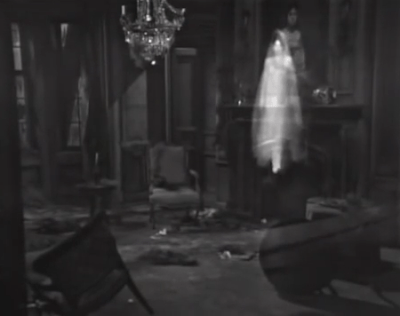
Another story takes place within a single episode, episode 70. We get our first look at The Old House and the portrait of Josette Collins that presides over its parlor. After everyone has left, the portrait begins to glow, and the ghost of Josette comes walking out of the portrait:
Today’s major theme is a story that began in episode 60. Visiting the Evans cottage, Vicki found a portrait that she herself strongly resembles. Sam told her that he painted it 25 years ago, and that the model was a local woman named Betty Hanscombe. This excited Vicki, who grew up a foundling and is on a quest to find out who her birth parents were. Vicki wondered if Betty Hanscombe might be her long-lost mother, or if some nearby relative of hers might be. Sam disappointed Vicki’s hopes as soon as he had raised them, telling her that Betty died before Vicki was born and that she has no relatives in the area. Since then, Vicki’s interest in the portrait has been revived. She learned that there was once a butler at Collinwood called Hanscombe. She has formed a vague hope that one of her parents was a member of a central Maine family named Hanscombe, and she is trying to track them down.
Today, Vicki goes back to the Evans cottage and asks Sam for another look at the portrait of Betty Hanscombe. Sam is in a good mood; before Vicki shows up, he’s singing, and his baritone voice sounds like he’s ready to appear in musicals on Broadway. Uncharacteristically, he is sober, a fact demonstrated by his almost successful attempt to thread a needle. He gives Vicki a courtly reception, recaps what he told her about Betty Hanscombe and the painting seven and a half weeks ago, and when she persists in showing interest makes a gift of the portrait to her. She’s flabbergasted by his generosity, though considering that he painted it twenty five years ago and hasn’t sold it yet he may as well be generous.
While Vicki is at the Evans cottage, Liz summons her brother Roger to the drawing room. She has deduced that Vicki is not going to forget about Betty Hanscombe or her portrait, and instructs Roger that their goal is to stuff those topics into the deepest possible obscurity.
Vicki returns with the portrait and shows it to Liz and Roger. Roger watches Liz and listens to her declare that it looks nothing like Vicki. Liz then directs Roger to look at the painting, and he dutifully echoes her statement. Since it is in fact a painting of Alexandra Moltke Isles, we can sympathize with Vicki’s disbelief at the position they are taking. She seems to be about to give up when flighty heiress Carolyn walks into the room, looks at the painting, and asks Vicki when she had her portrait done. “It looks exactly like you!” It’s a terrific ending for the episode, and leaves us wondering what will come of the Betty Hanscombe story.*
High-born ne’er do-well Roger Collins is desperate to get rid of his son’s governess, the well-meaning Vicki, before she discovers his dark deeds. Sometimes he’s simply unpleasant to her. Twice he’s offered to bribe her to leave. Once he pretended to be a ghost in order to scare her off, not knowing that she had just seen a real ghost who warned her to leave the house before she was killed. Occasionally he turns on his very considerable charm in his efforts to convince her that she ought to leave; she usually sees through these efforts quickly, and he is left in a weaker position than he was before.
Yesterday, Vicki was in Bangor, Maine, fifty miles from her home in the great house of Collinwood. While waiting for dashing action hero Burke Devlin to give her a ride home, she realized that the pen she found on the beach some weeks ago must have belonged to Burke, and jumped to the conclusion that Burke dropped it there while murdering beloved local man Bill Malloy. Frightened, she called Roger to come and get her.
Today, Roger is driving Vicki home in a heavy rainstorm. Returning viewers know that Roger was in possession of such a pen, that he lost it the night Bill died, and that he is terrified the pen Vicki found will lead to disaster for him. We also know that he is a vicious man who will stick at nothing to protect himself.
Vicki knows none of these things, but she does know that Roger and Burke are sworn enemies. Therefore, she is surprised when Roger tells her that the pen isn’t really evidence of anything. After all, it was two days after Bill’s death that she found it- Burke could have dropped it there after Bill went into the water, or long before. She is even more surprised when he urges her to forget the whole matter and never again to mention the pen to anyone. Roger can imagine a scenario in which Burke might have killed Bill, and even says that he thinks it is likely, but he tells her that with no more evidence than she has there is nothing to be gained by challenging the coroner’s verdict that Bill’s death was an accident.
When Vicki asks Roger why he is leaving the main road in the midst of the storm, we might wonder if he has laid some dastardly plot. On the dark, flooded back way, they quickly find themselves trapped. Roger leaves Vicki in the car while he takes his flashlight to look for shelter. He returns and describes an abandoned shack he claims to have spotted just then. His description of it is so detailed that we cannot help but suspect that he has been there before, and that it figures in an evil plan of his. Roger defuses that suspicion, though, when on his own initiative he leaves a note inside the windshield of the car directing any passersby to the shack.
When they enter the shack, Roger teasingly says “I should have carried you over the threshold.” Vicki instantly responds “But you are married.” With a sour look, he answers “If you can call it that.” After a bit of conversation about Roger’s unhappy domestic situation, they sit close together. Vicki tells Roger that she wonders if his son, strange and troubled boy David, got his unscrupulousness from his mother. “You’re nothing like that,” she says. While they huddle together, Vicki asks Roger to tell her all about himself.
Despite her previous wariness of him and her prompt reminder to him today of his marital status, it would seem that Roger could make quite a bit of progress with Vicki if he were to forget his other methods of persuasion and concentrate on charm. In episode 78, Roger even took Vicki on a date. That didn’t amount to much, but at the end Roger promised to take Vicki out again and she seemed interested. Watching them together in this one, we wonder if they might at some point get together. Vicki the foundling-turned-governess is obviously modeled on Jane Eyre, and Roger is not only her charge’s father, but the name “Roger” even sounds like “Rochester.” A relationship with Roger wouldn’t involve living happily ever after, but that’s a difference of genre- characters in novels might get happy endings, but characters on soap operas don’t get any endings at all, not unless they’re killed off the show.
In Art Wallace’s original story bible for Dark Shadows, called Shadows on the Wall, Roger was supposed to be killed off early on, while trying to murder Vicki to prevent her exposing a crime of his. It was also supposed to be revealed that Vicki was the illegitimate daughter, not of any member of the ancient and esteemed Collins family, but of the estranged husband of Roger’s sister Liz. That wouldn’t make much sense- the Collinses are the center of the show, and Vicki is the main character. If she’s going to be anyone’s long-lost love child, it should be Liz’. And indeed, Alexandra Moltke Isles and Joan Bennett look very much alike, a resemblance the camera work often emphasizes. But, if Roger isn’t going to die soon, establishing that Vicki is not a blood relative would leave the path open to a marriage between them.
Of course, if Liz is secretly Vicki’s mother, that would be the perfect background for a soap opera engagement between Vicki and Roger. Liz would find herself forced to choose between revealing her terrible secret or allowing her daughter to marry her own uncle. In a later decade, a show might let the characters get married and reveal the family relation years later, but I don’t think ABC’s Standards and Practices department would have signed off on that one in the 1960s.
If there is going to be a Vicki/ Roger romance, it isn’t going to start today. Roger answers Vicki’s question about what he wants in life by saying that at the moment he only wants two things- for them to be rescued, and for her to leave Collinwood. He tells her that he is worried that she is in mortal danger if she stays. David has tried to kill her; he’s tried to kill Roger too, come to that. Previously, Roger has urged her to get away before he succeeds. But today, she isn’t thinking of David. She asks if Roger really thinks Burke is a deadly threat to her. He pauses long enough to make us wonder if he’d been planning to talk about David, then decides to run with what Vicki’s given him. He dwells on Burke’s temper as Vicki has witnessed it and tells her that he has seen even worse displays. When she says that she finds it difficult to believe that Burke would kill her, he says that he’s sure Bill Malloy found that difficult to believe as well. This gets her back to the idea of telling the police about the pen. When she protests that not telling them would be withholding evidence, his charm breaks down and he shouts “Then withhold it, you little idiot!”
His previous attempts at suavity had also ended in name-calling. On those occasions, he could only apologize while Vicki regarded him coolly. This time, he bounces back and continues to press Vicki with claims that he’s thinking of her safety. She is looking very doubtful, though, as if something is dawning on her. After a moment, the sheriff appears at the door. He tells Roger that he and his men were in the area, noticed Roger’s car, and followed the directions on the note he left in the windshield. He notices that Vicki is deep in thought. He asks her what’s on her mind. After a long hesitation, she gives a meaningless response, telling him nothing about the pen. But we know that she has asked herself a question, and that the answer is going to mean trouble for Roger.
Well-meaning governess Vicki is in a hotel restaurant in Bangor, Maine. She is waiting for dashing action hero Burke to drive her the 50 miles to her home in the great house of Collinwood.
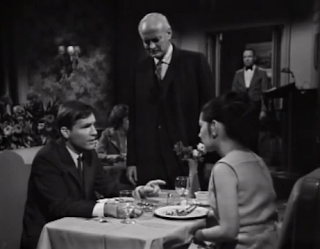
Vicki is sitting at a table with Burke’s lawyer, Mr Blair. Blair takes out a pen to mark up some contracts. Vicki tells him that his pen is identical to one she found on the beach at “a place called Lookout Point.” She had earlier told another lawyer, her new friend Frank, that beloved local man Bill Malloy was killed at Lookout Point. Blair doesn’t know that part of it.
Blair tells Vicki that she must be mistaken- there are only six such pens in the world. He has one, Burke has one, and the other four are in South America. Blair tells her that if she found one, it must be Burke’s. He goes on to say that the pen is very expensive, and that if it is Burke’s he would certainly want it back.
Blair hands Vicki the pen. She examines it. A look of alarm crosses her face. She hurriedly assures Blair that, looking at it close up, she can see that it is nothing like the pen she found.
Burke returns to the table. Blair gives him the contracts to sign. He asks Blair to lend him something to write with, saying “My pen is among the missing.” Focused on the contracts, the men do not notice as Vicki’s look of discomfort intensifies.
Burke asks Vicki if she’s ready to go. She excuses herself to make a telephone call. Unable to reach Frank, she calls Collinwood. High-born ne’er-do-well Roger answers. Vicki asks Roger to come to Bangor to get her. Appalled by the notion, Roger asks why he would ask him to inconvenience himself so seriously. She says she thinks she might be in danger. She explains her theory that the pen she found made its way to Lookout Point when Burke dropped it there while murdering Bill Malloy. Roger tells Vicki to wait for him, and rushes out of the house.
Over a period of several episodes, the sheriff questioned Roger, Burke, and drunken artist Sam Evans about Bill’s death. Roger is firmly outlined as the villain, so we suspect him. There were also a number of moments when the show gave us definite reasons to think Sam might be the culprit. At no point did they dwell on the idea that Burke may be responsible, but it would be an interesting twist.
Bill had told Burke he would find evidence to clear his name in connection with a manslaughter charge that sent him to prison years before, and it has never been clear just what Bill could do to deliver on that promise. Perhaps we will learn that Burke discovered that Bill couldn’t deliver on it, and, succumbing to the violent temper he has displayed many times, he reacted by shoving Bill off Lookout Point to his death in the waters below. For all we know, Vicki’s suspicions might be the first step towards exposing Burke as the killer of Bill Malloy.
It’s true that Roger had Burke’s pen and believes that the pen Vicki found will suggest that he was at Lookout Point. But it could easily be that Burke, who after all gave the pen away very blithely when he was having lunch with flighty heiress Carolyn in the same restaurant where he and Vicki are today, in fact owns another one, that Vicki found that other one, and that Roger lost the pen Burke gave Carolyn somewhere else. Roger’s frantic attempts to hide the pen would incline us to believe that he was at Lookout Point with Bill, but it is precisely that belief that would make the revelation that it was Burke who dropped the pen a twist ending.
The pen itself, as the only piece of physical evidence in a whodunit that has been going for ten weeks and shows no signs of ending, gets a great deal of attention. Dark Shadows fans often lament this, and rightly so. At times, the pen falls into Alfred Hitchcock’s famous category of a “MacGuffin,” the thing that everyone in the story is urgently trying to get hold of. In a 90 minute action movie, just about anything can be a MacGuffin- a cache of diamonds, a secret document, the Maltese Falcon, etc. But when the story goes on for months and it involves a mystery we’re supposed to be trying to solve, the thing people are trying to get their hands on can’t be just anything.
Of course, if we’re watching an inverted mystery where we see the case from the villain’s point of view, there will be excitement any time s/he suddenly realizes s/he left a piece of evidence unconcealed. Some of Roger’s scenes with the pen play this way, but since we didn’t see what happened to Bill Malloy and haven’t been told anything definite, they don’t quite close the loop.
There are two things a piece of evidence has to be if it is to work in the place the story gives to Burke’s pen. First, it has to be a clue that will solve the mystery. Roger’s behavior concerning the pen certainly reinforces our suspicions of him, but it is easy to think of many other ways it could have been left where it was. Even if we leave aside the possibility that it is a duplicate Burke dropped, we have to remember it was several days after Bill’s death that Vicki found the pen. Who knows what sort of creature might have been attracted to its shiny surface, carried it from wherever it was originally left, and deposited on the beach long after Bill was already dead.
Second, and more importantly, the object has to connect one substantive story element to another. The crucial piece of evidence in Dark Shadows’ first mystery story met this requirement. Strange and troubled boy David had tried to kill his father, Roger, by tampering with the brakes on his car. David had trouble getting rid of the bleeder valve, and was eventually caught with it in his possession. We’ve seen David reading a magazine about mechanics and playing with mechanical toys, and have seen Roger refusing to take an interest in machinery. So a piece of hardware in David’s possession reminds us of the estrangement between father and son. Moreover, while Roger is not interested in the workings of his car, he is avidly concerned with it as a marker of his status. Burke envies him that status, and hangs around the car. When Burke comes to be involved in the story of Roger’s crash, the prominence of a piece of the car brings that envy to mind. That the same object represents Roger’s conflicts with David and with Burke associates those conflicts with each other in our minds, and sets us up to expect them to merge, as indeed they do.
Burke’s pen has no such associations. It’s something he shares with Mr Blair, who is barely a character on the show, and with four other men whom we have never seen and whose names we’ve never heard. Neither Burke nor anyone else we’ve seen is a calligrapher, or a writer, or any other person who would come to mind when we hear about pens. So the story doesn’t establish a specific symbolic charge for a pen considered as a pen.
Of course, the show was made in 1966, so there is an inevitable symbolism associated with any cylindrical object. Zach Weinersmith explained this the other day in a Saturday Morning Breakfast Cereal comic:
I think the writers intentionally put their fair share of Freudianism into the scripts, and I can’t imagine Louis Edmonds didn’t expect some in the audience to watch his portrayal of Roger’s panicked obsession with where Burke’s pen is and think in those terms. Indeed, while Weinersmith talks about the period 1890-1970 and singles out the 1930s as a peak, it was in the 1960s, the age of Tennessee Williams, Edward Albee, and Peter Shaffer, that Freudianism peaked in its influence on the New York theater world where the people involved in making Dark Shadows were most at home. So this episode would be a case in point for Weinersmith’s hypothesis.
This is the first episode credited to writer Ron Sproat. Before long, Francis Swann will leave Dark Shadows, and for several months the only credited writers will be Sproat and Malcolm Marmorstein. Marmorstein will write 82 episodes and leave in August of 1967. Sproat will write hundreds and will stay with the show until 1969.
Today’s setup might remind us of the show’s first writer, Art Wallace. It’s shaped like one of Wallace’s diptych episodes, intercutting between two contrasting groups of characters. This time, we cut back and forth between, on the one hand, a dull but pleasant dinner date between well-meaning governess Vicki and instantly forgettable lawyer Frank at a restaurant in Bangor and, on the other hand, an extremely uncomfortable dinner date between hardworking fisherman Joe and flighty heiress Carolyn at the Blue Whale in Collinsport.
In Bangor, Vicki and Frank smile at each other while Vicki tells the sorts of stories she’s been telling all along. Vicki hopes Frank will be able to aid her in her effort to learn the identity of her birth parents, a quest she has been on since episode 1. Frank’s father Richard briefly joins him and Vicki at their table. Amid good wishes for the two of them, Richard delivers a cautionary message about Vicki’s research. Later, he talks privately with Frank. He strongly approves of Vicki as someone to date, but is chary of many aspects of the research Frank has volunteered to do for her.
In Collinsport, Joe and Carolyn are bickering about Carolyn’s obsession with dashing action hero Burke Devlin when Maggie Evans, The Nicest Girl in Town, enters the tavern with her father, drunken artist Sam Evans. Carolyn invites the Evanses to join them at their table. Carolyn eventually starts talking about Burke again, prompting Joe to ask her to dance. Away from the Evanses, Joe tells Carolyn he is tired of her falling bacxk on him when Burke isn’t available. Carolyn storms out. Joe takes her home, then returns to the tavern, and he and Maggie start a conversation they both seem to be enjoying hugely.
By intercutting scenes, Wallace’s diptychs usually achieve a contrast that brings into focus details of the psychology of the characters and their relationships to each other that we might not have thought about had we watched the scenes straight through. In Sproat’s hands, today’s episode doesn’t do that so much as it comments his own position as a new writer joining an established show.
Vicki has learned nothing about her origins since episode 1, and there is no prospect she ever will. In Frank, she has found a potential boyfriend. In the ears of the audience, Richard’s advice to Frank to pursue Vicki energetically but to pursue her inquiries only circumspectly is a recommendation that the show drop an old, unproductive old storyline and to develop a new one.
Carolyn and Joe’s relationship is another story element that has been in place from the beginning and that has not advanced in any way. We have never seen any reason for them to be a couple, and are simply impatient with scenes where they sit around and make each other miserable. Joe recently had a date with Maggie, and it was sweet to watch those two having fun together. So today’s scenes in the Blue Whale make it emphatically clear that the time has come to drop the Carolyn and Joe story and move on to a new phase where Maggie and Joe are together.
Sproat not only makes himself visible in this episode, he also provides mirrors for critics and commentators. When Richard shows up and interrupts the ten thousandth* sad story the audience has heard about the Hammond Foundling Home, Frank and Vicki seem to be having a pleasant enough time with each other. It is possible that viewers who weren’t watching on many of the days when Vicki told those previous stories are having a pleasant enough time with the episode. But on any given day, only so much of your audience will consist of new viewers and people with short-term memory loss. A time will come when you have to move on to something new, and Richard is the in-universe representative of those who would say that time is already upon us.
In the Blue Whale, the Evanses represent the critics. Joe and Carolyn leave the table twice to dance. The first time, they look happy, and Sam tells Maggie that there is no chance of Joe and Carolyn splitting up. Sam is a chronic pessimist. If he makes a prediction, we take it that it would be bad news for that prediction to come true. In this context, to say that Joe will never break it off with Carolyn is to say that the show will never become more interesting. The second time Joe and Carolyn dance, they are obviously giving up on each other. Maggie, almost as much the optimist as her father is a pessimist, gives a little smile. Joe and Carolyn’s quarrel is embarrassing for her to watch, but it’s good news for her that she’s getting a boyfriend, and maybe a storyline. It’s also good news for us that the show is open to exploring fresh topics.
I don’t think that Richard and the Evanses are so much Sproat’s attempt to impose particular readings on the audience as they are the results of his analysis of the reactions thoughtful viewers are likely to have. If so, I have one data point in support of his theory. In their discussion about this episode on their blog Dark Shadows Before I Die, John and Christine Scoleri actually find themselves playing the roles of optimistic and pessimistic critic as Sproat scripted them for the Evanses. Here are John as Maggie and Christine as Sam:
John: Have we finally seen the end of the Joe/Carolyn relationship? Now that it’s clear to Joe that Carolyn only comes running to him when she’s jealous, I think he’s had enough of her. The only offenses on Maggie’s record are the bad blonde wig she started with, and calling Vicki a jerk when they first met. But other than that, she’s far less maintenance than Carolyn, so hopefully the change will do Joe some good, provided his job working for the Collins fishery isn’t in jeopardy…
Christine: It’s a soap opera, so I expect the relationship to go through its death throes before the last gasp. Joe’s a glutton for punishment, so I don’t think it’s over yet.
The Scoleris always do a good job of pretending not to know what’s coming next even when they demonstrably do know. So there is a bit of role-playing to start with. But they are such patient and insightful critics that I don’t think they would just start imitating the characters, certainly not unintentionally. It’s more likely that this exchange represents evidence that Sproat was right about the ways people were likely to read the episode.
*A rough approximation. Could be the twelve thousandth, I haven’t counted.
Strange and troubled boy David Collins talks with his father, high-born ne’er-do-well Roger, about David’s governess, the well-meaning Vicki. David wants Vicki to stay on. Puzzled by this, Roger lists some of the cruelties David has meted out to Vicki. David explains that he has changed his mind about her since he did those things. Roger asks why. David explains that Vicki has seen the ghost of beloved local man Bill Malloy, and that if she sees the ghost again, it might reveal that Roger murdered Bill. Roger responds to this remark by slapping David across the face. David is shocked, and runs to his aunt, reclusive matriarch Liz, to complain.
Roger is well-established as an abusive parent. He has time and again spoken openly of his hatred for his son, and more than once we have seen him manipulate the rage with which he has filled David so that the boy will do his dirty work for him. This is the first time we’ve seen him engage in physical violence. David’s disbelieving reaction and his assumption that he has the right to complain support the idea that Roger has previously limited himself to psychological abuse.
The actors are such pros that I find it hard to imagine Louis Edmonds really made contact with David Henesy when he swung his hand. But Henesy visibly flinches a second before the slap, as if he expected to be hit. Maybe Edmonds came close enough in dress rehearsal that Henesy couldn’t help being scared.
When David runs to Liz, he finds that she is busy trying to reason with her own strange and troubled child, flighty heiress Carolyn. Carolyn is annoyed by David’s interruption, and dismisses his claims about Roger out of hand. Even after Roger proclaims that he did hit David and will do it again if he doesn’t stop babbling about ghosts, Carolyn says that she believes David made the whole thing up. Liz sends Roger, but not Carolyn, out of the room, and talks to David about the incident. Liz walks him back to his room, not saying much as he seethes and says that he wishes his father were dead.
Liz returns to her conversation with Carolyn, trying to talk her out of her obsession with the family’s arch-nemesis, dashing action hero Burke Devlin. Liz understands the fascination- how could she not? Carolyn is a vigorous young woman, and she’s already broken up with the only other attractive man on the show, hardworking young fisherman Joe. So Liz shares some information about how miserable her marriage to Carolyn’s father was, tells her that Joe reminds her of the man she wishes she had married instead, and urges her to try to patch things up with him.
Roger reappears and pouts to his sister Liz. He claims that Vicki is a bad influence on David and demands that Liz fire her. Liz refuses to do so, or to take anything Roger says at all seriously. When he refers to the idea that he might take David and leave her house, she tells him she is sure that her money means more to him than does his son. His response to that is to slam his hand on the piano and to concede her point.
The Liz/ Roger moments today focus on Dark Shadows‘ most characteristic relationship, that between a Bossy Big Sister and her Bratty Little Brother. Liz fails to address Roger’s hitting David for the same reason she fails to address his psychological abuse of the boy- facing either problem would require acknowledging that Roger is a father and that he has the responsibilities of a grown man. Liz is deeply invested in treating him like a naughty little boy whose behavior she will try to correct when the two of them are alone together, but for whom she will always cover when the grownups are around.
Her cutting remark about Roger’s attachment to her money shows the same pattern. When it’s just the two of them, Liz scolds him for living off her. But when there was a prospect he would face consequences for his spendthrift ways, she borrowed against everything she has to pay his way out of trouble.
In a world of Bossy Big Sisters and Bratty Little Brothers, David is adrift. He’s bratty enough, but has no sister. The obvious candidate for a substitute big sister, his cousin Carolyn, makes it clear today she couldn’t be less interested in David. Regular viewers know that Roger and David moved into the house not long before episode 1, that Carolyn didn’t grow up with David, and that she was not happy when he ended her long reign as an only child. Aunt Liz likes David very much, but she has spent too much time protecting Roger from accountability to protect anyone from Roger. Vicki is determined to befriend David, and now that she has seen a ghost there is a chance she will succeed. But she is far too mentally healthy to reenact with him the pattern the Collinses of Collinwood are bred to expect. To accept Vicki’s friendship, David will have to learn an altogether new way of relating to another person.
The only episode of the series to take place entirely outside of the town of Collinsport and the great house of Collinwood, this one is set in Bangor, Maine.
Well-meaning governess Vicki has gone to that town in search of information about herself. When she asks her employer, reclusive matriarch Liz, even the most basic questions about why she decided to hire her and how she knew she existed, Liz becomes evasive, then flatly and transparently lies to her. Vicki has found an old document in the house that may shed light not only on the matters Liz has already refused to discuss, but even on her questions about her birth family. Sure that Liz won’t give her any information about the document, she decides to take it to Liz’ lawyers, the firm of Garner and Garner.
Lawyers on soap operas don’t always follow the rules that bind their counterparts in our universe, but at least in this episode Garner and Garner are not going to tell Vicki anything their client does not want her to know. Indeed, the Garners are realistic enough to present a problem. One of them is Frank Garner, a young lawyer who is going to date Vicki for a few months. As played by Conard Fowkes, Frank is very much the sort of fellow you would expect to meet in a law office in Bangor, Maine. In this phase Dark Shadows still has some room for low-key stories and naturalistic acting, but no TV series this side of C-SPAN would be able to accommodate a character like Frank.
It’s a shame Frank isn’t more suited to Dark Shadows. The show urgently needs more young men in the cast. At this point, the only male actors between the ages of 11 and 40 they have who have appeared more than once are Joel Crothers as hardworking young fisherman Joe Haskell, Mitch Ryan as dashing action hero Burke Devlin, and Dana Elcar as Sheriff Patterson. Sheriff Patterson is supposed to be older than the 39 year old Elcar, and is coded as an authority figure who is unavailable for dating. So Joe and Burke have to provide the male points on all of the love triangles.
I think Frank could have been saved had he been played by a different actor. However dull the dialogue the writers might give him, he is on screen enough that a sufficiently charismatic performer could have grabbed our attention. And maybe stimulated the imagination of the writers, so that he would have had interesting things to say and do. Harvey Keitel had danced in the background at The Blue Whale in episode 33, and so must have been available for a speaking part on the show. Keitel’s quiet, brooding intensity always convinces an audience that a character who is saying very little is thinking deeply and feeling strongly and planning mighty things. Keitel would have been quite powerful as Frank.
Fowkes brought a light tone to his performance, and that is welcome. Dark Shadows always struggled to maintain a bit of sparkle against the background of a setting so gloomy that in this episode Vicki finds it “hard to believe there was ever any real gaiety at Collinwood.” If that line is meant to raise our hopes that a Vicki-Frank relationship will create a bright new mood, it sets us up for instant disappointment. Frank is cheerful and pleasant enough, but he doesn’t project enough personality to change the feeling even of the shots he is in, let alone of the entire series.
Keitel has never been known for lightness. If you wanted that, you could have turned to another Blue Whale dancer- Frederic Forrest, whom we will see in episode 137. Thinking of the goofy charm that Forrest’s character maintained throughout a movie as heavy as Apocalypse Now it’s easy to imagine a breeze of fresh air running through Dark Shadows. Not only would Forrest himself have been fun to watch as Frank, but he might well have brought out some of the most under-utilized aspects of Vicki’s character. A handful of times in these early months, Vicki is allowed to make jokes, usually in her scenes with strange and troubled boy David. David will not be amused, but the audience can see that Alexandra Moltke Isles is capable of being extremely funny. A relationship between a character played by Forrest and one played by Mrs Isles might have given the writers abundant opportunities to showcase that side of her. A pairing with the earnest, cheerful, but entirely humorless Frank represents a death sentence for Funny Vicki.
Well-meaning governess Vicki, fresh from imprisonment at the hands of strange and troubled boy David Collins, gets a few days off work to visit Bangor, Maine. Flighty heiress Carolyn had agreed to drive her to the bus station in the town of Collinsport. Carolyn doesn’t have a job, go to school, or seem to have anything else to do, so why she and Vicki don’t just take a road trip together is unclear.
They wait for the bus at the local restaurant. From there, Carolyn telephones dashing action hero Burke Devlin, her family’s arch-nemesis and the object of her own obsessive crush, and invites him to join the two of them at their table.
Carolyn tells Burke that Vicki has recently seen the ghost of beloved local man Bill Malloy. Vicki tries not to give Burke any additional information. When Burke learns of Vicki’s plans, he volunteers to take her to Bangor in his car. She declines, but he won’t take no for an answer. I don’t drive, and I admire the way this scene shows how hard it can be for a non-driver to decline a ride.
When Burke leaves to get Vicki’s bags, Carolyn blows up at her. Carolyn tells Vicki that she must have known she came to town hoping to see Burke and spend the evening with him. Vicki did not know any such thing. After all, Burke has openly declared his intention of forcing Carolyn’s entire family into bankruptcy and disgrace, and she has expressed remorse for her infatuation with him. When Carolyn makes it clear she is still chasing Burke, Vicki doesn’t know what to say.
The Collinsport Historical Society says that Carolyn spends this week alienating the audience, and her passive-aggressive behavior towards Vicki is indeed exasperating. Watching the scene in the restaurant, it makes perfect sense that Vicki would decide that escaping Carolyn is worth the risk of getting in trouble with her employers by spending an hour with Burke.
Back home at the great house of Collinwood, Carolyn hears her mother, reclusive matriarch Liz, playing the piano. She makes a lot of noise when she comes in, ensuring that her mother will call her into the drawing room. Once there, Carolyn puts on a great show of being upset. She gives partial, teasing answers to each of her mother’s questions, drawing her in as best she can. She finally declares that Vicki is not to be trusted. She reveals that Vicki is in a car with Burke, probably telling him everything she knows about the Collinses and Collinwood. We then cut to Vicki and Burke in the car, where she is telling him everything she knows about her recent sighting of Bill Malloy’s ghost in the house.
Again, the scene in the restaurant explains Vicki’s behavior. Carolyn had told Burke so much about it that it would be hard for Vicki or anyone else to see much point in trying to keep the rest of the story from him. When Burke wants her to say that the ghost accused someone in the house of murder, she insists that it only said it was someone in Collinsport, not Collinwood.
Carolyn has always been tempestuous, and Vicki has always been quick to forgive her. Perhaps now that the relationship between Vicki and David is about to enter a quieter, more complicated phase, the makers of the show wanted to ensure that there would be a continual source of conflict within the house. That might explain why they have chosen to feature Carolyn’s nastier side so heavily this week.







 Dark Shadows Commentary