
When Dark Shadows began, its most dangerous villain was high-born ne’er-do-well Roger Collins. Since the plan was to kill Roger off after his crimes were exposed, writer Art Wallace and actor Louis Edmonds were free to present him as gruesomely as they pleased. That turned out to be so much fun for all concerned that it soon became impossible to imagine the show without Roger, and the plan changed.
Once Roger was established as a permanent part of the ensemble, they toned his wickedness down. He still did and said awful things, but they would pull him back whenever he might risk alienating the audience. So, he at first openly expressed his hatred for his young son, strange and troubled boy David, and in #68 and #83 coldly exploited David’s mental health problems to manipulate him into trying to murder well-meaning governess Vicki. But when David got Vicki into a situation that might actually have resulted in her death, Roger rescued her. When Roger’s estranged wife Laura showed up and wanted to take David away with her, Roger was so delighted at the prospect of getting rid of the boy that he willfully ignored one sign after another that something was seriously wrong with Laura. But when Vicki finally proved to him that Laura was an undead fire witch who intended to incinerate David, Roger joined in the effort to save him, and was so shaken by the experience that he would never again be overtly hostile to David.
Nor was his attitude towards David the only sign of Roger’s pathological lack of family feeling. He had squandered his inheritance, selling his half of the family business to finance his extravagant lifestyle. His sister, reclusive matriarch Elizabeth Collins Stoddard, went deep into debt buying back what Roger had sold. When Roger ran out of money, Liz took him and David in at the great house of Collinwood. When in #41 Liz reproved Roger for the difficult position she had put him in, he proudly declared that he had “enjoyed” his inheritance, and twitted her for her dreary ways. Liz gave Roger a job in the business, but the only time we saw him visiting his office he answered his phone and told the caller that what he was asking was someone else’s job. When in #273 Roger found that seagoing con man Jason McGuire had tricked Liz into believing that she had a terrible secret that she could keep only by surrendering her whole fortune to him in blackmail payments, he admitted to his sister that if she had confided her troubles in him, he would probably have done the same thing.
When vampire Barnabas Collins succeeded Laura as Dark Shadows‘ supernatural Big Bad, Roger was pushed to the margins of the story. From that time on, he had two things to contribute. The first were sarcastic remarks, many of them very funny, that established him as the show’s sardonic gay uncle. The second, which gave him what little function he retained in the plot, were ostentatious refusals to believe the evidence piling up on all sides that the family was beset by a procession of bloodthirsty monsters. Since several other characters, Liz among them, also refused to face these facts, the show could go long periods of time without featuring Roger at all.
In November 1967, Vicki came unstuck in time and found herself in the year 1795. From then until March 1968, Dark Shadows was a costume drama set in that period. The segment was a hit in the ratings, and a triumph for Louis Edmonds, who was cast as haughty overlord Joshua Collins. Joshua was the opposite of Roger- as protective of the family’s position as Roger was careless of it, as committed to making money as Roger was thoughtless in spending it, as courageous in the face of physical danger as Roger was cowardly. The 1790s segment became The Tragedy of Joshua Collins, as we saw how Joshua’s best qualities led him to create the dark and twisted world in which his descendants would grow up to be weak, selfish men like Roger.
When the show came back from the 1790s, Roger was obsessed with a portrait painted in those days. The portrait’s subject was Angelique, the wicked witch who precipitated the disasters that annihilated Joshua’s family. Before long, Angelique herself returned, wearing a wig, using a false name, and married to Roger. The spell Angelique cast to win Roger occasionally caused him to think he was Joshua, and by the time that story ended Roger had become, if not the imperious tycoon Joshua was, certainly a hard-working, conscientious family man. He still had a languid manner and a way with a quip, but was otherwise unrecognizable as the show’s original Man You Love to Hate.
Evil spirits drove the Collinses out of the great house of Collinwood in #694. That episode marked the end of Roger’s function as one of the “There must be a logical explanation!” people. He was the last member of the family to insist that everyone else was being silly, but when he finally accepted the reality of the situation and was on his way out of the house, he turned to declare to the ghosts that the living would be back to reclaim what was rightfully theirs. From that moment on, Roger was no longer a narrative brake pad.
For most of 1969, Dark Shadows was set in 1897. In that year, we got to know Quentin Collins, who as a ghost would be chiefly responsible for the haunting that had driven the Collinses out of Collinwood. We saw that the living Quentin was a charming rogue, a spendthrift who cheerfully tells his sober-minded sister Judith that he can waste money faster than she can give it to him, inclined to violence when it serves his purposes and quick to run away when he is in danger of being called to account for his crimes. In short, he is what Roger originally was, only played by a younger, sexier actor, and with an unlimited future on a show that has discovered the characters won’t alienate the audience by being evil, only by being dull.
In the 1897 segment, Edmonds played Quentin’s brother Edward, who was not dull, but not evil either. Edward was stuffy and hypocritical. He was occasionally cruel, sometimes because of greed, sometimes because of prejudice, and sometimes because he flew into a panic in the face of an unexpected danger. But he was sincerely devoted to his children, and he had a sense of decency that would assert itself even after he had done awful things. For all his faults, Edward was ultimately one of the most lovable characters Dark Shadows ever created. If 1795 was The Tragedy of Joshua Collins, 1897 was largely the Comedy of Edward.
After 1897, Dark Shadows spent several months bogged down in an attempt to make a story out of some themes drawn from the tales of H. P. Lovecraft. Roger showed up in this part of the show just a few times. Quentin, brought into contemporary dress intact due to his great popularity in the 1897 segment, told Roger what was going on in #958. Rather than scoff as he would have in 1967 or 1968, Roger accepted Quentin’s account at once and helped him in the battle. Roger had by that point turned into Edward. His habit of denial was gone, and with it all of his languor and most of his wit.
Now the show is clearing out the last villains left over from the Lovecraft project and launching a story about a parallel universe that is occasionally visible through a doorway in the long-disused east wing of the great house. Roger is active in both of these plots today.
Even when he was a villain who cared nothing for his son, his sister, his family name, or Collinsport Enterprises, Roger very much enjoyed the company of his niece, Carolyn Collins Stoddard. On Friday, he was hugging Carolyn while she wept about the difficulties she was having in her new marriage; he called her “Kitten,” a term of endearment he has used with her since #4. In those early days, the show was heavy with hints that Roger and Carolyn’s relationship verged on incest. She often answered to “Kitten” in the moments when those hints were most insistent. But there was nothing unwholesome about Roger’s embrace of Carolyn on Friday, and he is irreproachably fatherly in his attitude towards her today.
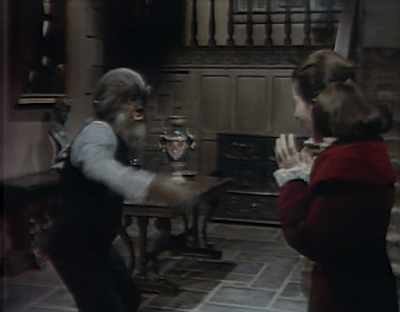
At rise, Carolyn is in a trap. A man named Bruno, one of the leftover villains introduced while the show was dealing with the Lovecraft-derived material, has tricked her into entering a room where he has already imprisoned her old friend Chris Jennings. Bruno locked the door, and Carolyn saw that Chris was on the floor, writhing in pain. She asks him what is wrong, he won’t answer. Carolyn doesn’t know it, but Chris is a werewolf. The moon is rising, and his pains are the first stage of his transformation.
Bruno’s master wants Carolyn’s husband dead, and has decided that if the werewolf kills Carolyn he will lose the will to live. Since it would have been at least as easy to get the husband into the room as it was to get Carolyn there, and since one of the main things they have told us about the husband is that he is vulnerable to werewolf attacks, this scheme is unnecessarily complicated, marked for the audience as likely to fail. Indeed, since Bruno, his master, and Carolyn’s husband are all short-timers who don’t really need to be on the show anymore, while Carolyn has been a core member of the cast since #2, we can be quite sure it will fail, and if we have spent time over the weekend wondering about the cliffhanger, we’ve spent it wondering what will save Carolyn.
What saves Carolyn turns out to be well-timed intervention by her Uncle Roger. Roger was worried that she wouldn’t tell him why she was crying about her marriage, and followed her to Bruno’s place. He saw her enter, and after a few minutes let himself in. He confronted Bruno in his parlor, heard Carolyn and Chris in the back room, and found that the door to the back room was locked. When Bruno told him the door would stay locked, Roger hit him on the head with a candlestick, knocking him out. He took Bruno’s key, unlocked the door, and freed Carolyn. While Roger telephoned Collinwood to ask for permanent houseguest Julia Hoffman, MD, Chris jumped out of the back room’s window. Roger then decided that he and Carolyn should go home.
It may strike first-time viewers as odd that Roger calls Julia and not the police. Established fans will be unsurprised, knowing that the Collinsport Sheriff’s office is one of the world’s most useless organizations and that Julia is a mad scientist whose powers know few limits. Still, once Roger gets Carolyn home he does tell her they should call the sheriff. She refuses, and also forbids him to tell her mother Liz anything about what has happened.
Roger finds Liz moping in the drawing room. He strikes up a conversation about Carolyn’s troubles. He says that he and Liz both made unhappy marriages, and that it is disappointing to see that the next generation seems determined to repeat their mistakes. He says that he wishes Carolyn would confide in one of them. Liz says that all she knows is that someone or something is threatening Carolyn’s husband, and that she refuses to discuss it. The camera pulls back, and we see that Carolyn is right there. Director Henry Kaplan was pretty bad at moving the actors around and even worse at figuring out where to point the camera, but he deserves credit for this shot. When we suddenly see Carolyn standing there, we realize that Roger and Liz are so deep in their worries that they are oblivious to their surroundings.
Carolyn insists on going to the carriage house on the grounds of the estate to see her husband. Since Bruno is at large, Roger objects. He can’t mention Bruno in front of Liz, since Carolyn has decreed that her mother must not be told what happened earlier in the evening, so he is powerless to stop her going.
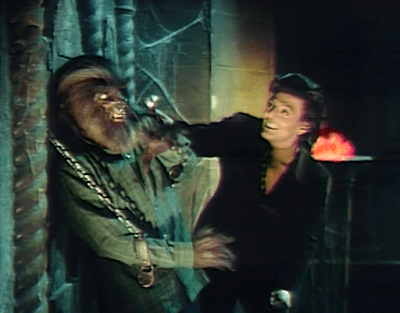
Bruno does catch up with Carolyn, and he tells her he is going to kill her. Before he can do so, the werewolf springs out, pushes Carolyn aside, and slashes Bruno. She goes home and tells Roger and Liz what happened. From Carolyn’s description, Liz recognizes the werewolf as the same creature they encountered in late 1968 and early 1969, and Roger rushes out.
Roger finds Bruno on the ground. He tells Bruno he will call a doctor. Bruno says it’s too late. He says a few words (“animal… not an animal…”) and loses consciousness.
Back in the great house, Roger says that the police are searching the grounds for the werewolf. He says it’s terrible that Carolyn should have met with such an incident on top of what has already happened to her. Liz asks what he means, and Carolyn glares at him, appalled at his indiscretion. He stammers out something about how she’s having marital problems, then announces he has to go because he promised to do something for Barnabas.
Roger and Liz never have figured out that Barnabas is a vampire, and though Carolyn was briefly his blood thrall she’s forgotten all about it. So far as the Collinses are concerned, their distant cousin Barnabas is just a night person. Several times now, Barnabas has looked into a room in the east wing and has seen, not the dark space, bare floor, and sparsely decorated walls that are there in his universe, but an alternative version of the room, brightly lit, fully furnished, and heavily decorated. He has seen people with the same looks, voices, and names as people he knows, but with different personalities and relationships. He has reported this to Julia and her friend, Professor Timothy Eliot Stokes, who have explained to him the many-worlds hypothesis.
On Friday, Barnabas told Roger about the room and about Julia and Stokes’ theory. The Roger of 1967 and 1968 would have jeered at Barnabas before he had spoken five words, but in 1970 he believed him readily enough. Barnabas expressed surprise at Roger’s openness to his outlandish account, and Roger acknowledges that “a year ago” he would have dismissed it. It was thirteen months ago that Roger turned and told the ghosts that the living would someday reconquer the great house; when he says “a year ago,” perhaps Roger is rounding down. Roger agreed then to come back and check the room.
When Barnabas showed Roger the room on Friday, it was bare. When Roger goes there himself today, he finds that the parallel universe is there. He cannot pass the invisible barrier in the doorway to enter it, nor can he communicate with the people there, but he can see them and hear them.
The first resident of the parallel universe Roger sees is Bruno’s counterpart. Astonished, he exclaims “I just saw him die!” Parallel Bruno is looking at the portrait of Parallel Angelique that dominates the room and telling it that the music he wrote for her will make her immortal. Roger does not appear to recognize the portrait’s resemblance to his second wife, much less to remember that he himself used to carry on similarly one-sided conversations with her eighteenth century portrait.
Parallel Liz enters and demands to know what Parallel Bruno is doing in the room. He says he belongs there. She tells him he is the only one who thinks so. She tells him that the master of the house, who is Quentin’s counterpart, will be coming home soon, and that he will never tolerate Bruno’s presence. Bruno says that he has heard that Quentin has remarried. When Liz says this is so, Bruno declares that Angelique will never allow another woman in the house. Liz is exasperated that people keep talking about Angelique as if she were still alive. Bruno exits.
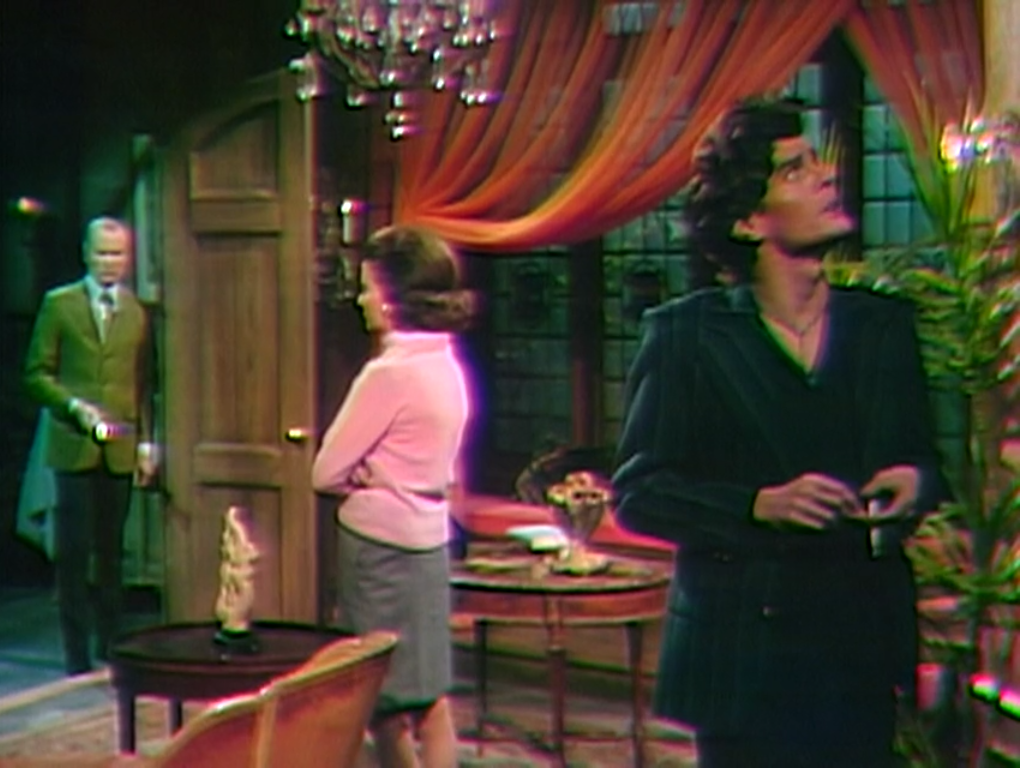
Stunned by what he has seen, Roger looks away for a moment. He thinks of going to fetch Barnabas. His attention returns when he hears a conversation between Liz’ counterpart and his own.
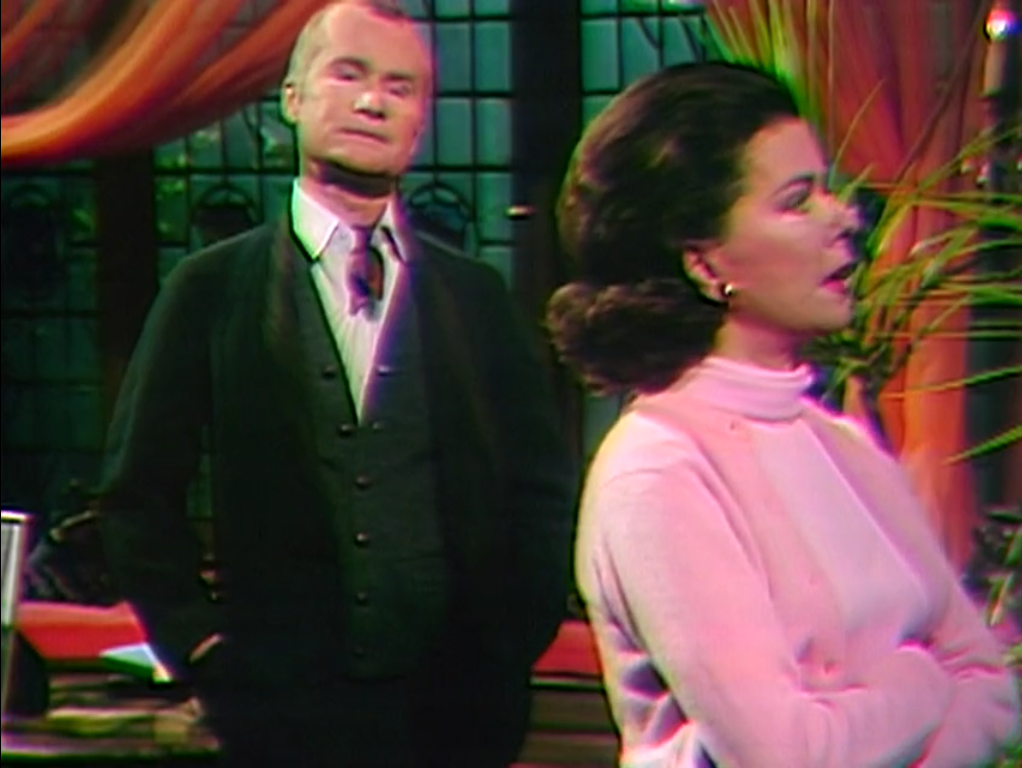
Barnabas saw Parallel Roger on Friday; he was talking to the portrait in a way that suggested an obsession not so different from the one which the eighteenth century portrait had inspired in the Roger we knew. Today, Parallel Roger talks to Parallel Liz about Parallel Bruno in an airy, superior manner quite out of keeping with what we have had from our Roger today, but which sounds exactly like him as he was in 1967 and 1968.
PARALLEL ROGER: Was that Bruno, the terrible-tempered boy wonder I saw just now?
PARALLEL LIZ: Yes, he’s come back.
PARALLEL ROGER: Back to compose more of his morbid music and bore us with his tiresome memories of her? Well… It’ll be worth seeing the look on Quentin’s face when he finds out, won’t it?
Alliterative series such as “terrible-tempered” and “more morbid music” were characteristic of the old Roger’s verbal cleverness, as sarcastic expressions like “boy wonder” and complaints of boredom were typical of his habit of advertising his contempt for everyone and everything. Even Parallel Roger’s closing hope of “seeing the look on Quentin’s face,” as opposed to any thought of action he might himself take, is of a piece with the old Roger’s cowardice and laziness. Our Roger is horrified by the sight of his double.
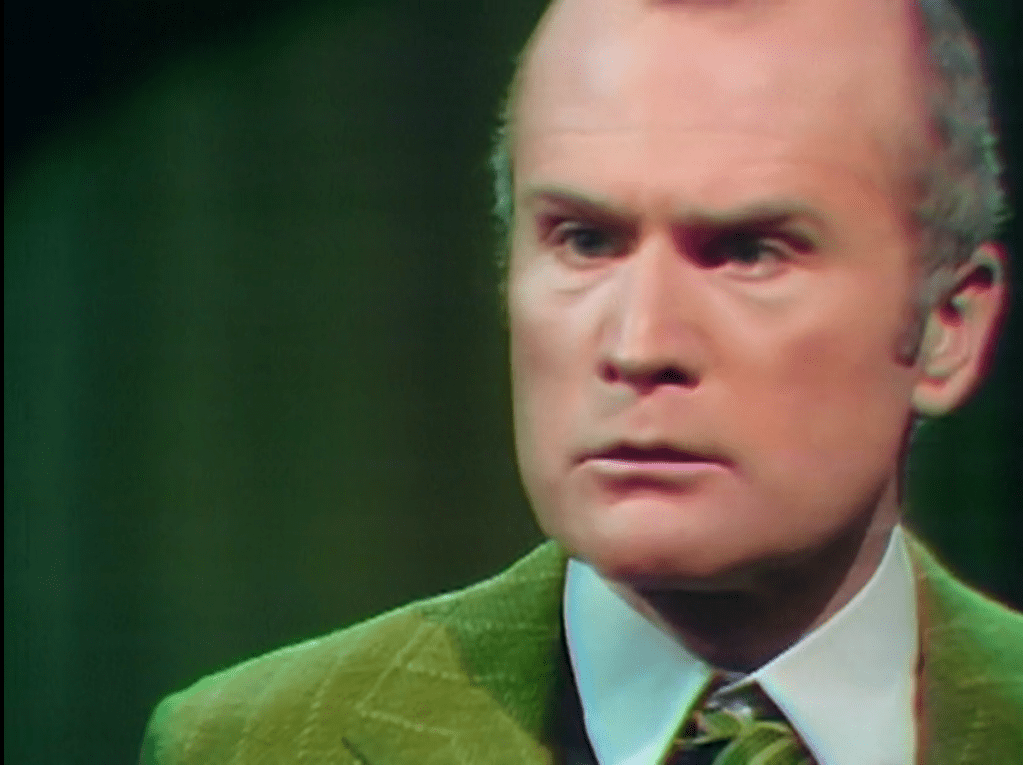
Evidently the makers of the show have decided that Roger’s development has brought him to a dead end, and they are going to use the journey into “Parallel Time” to reintroduce the original villain. That Parallel Roger shares a scene with Parallel Liz suggests that we will again see the dynamic that their counterparts in the main “time-band” pioneered on the show, the conflict between Bratty Little Brother and Bossy Big Sister. This type of conflict is still one of Dark Shadows‘ signature elements, represented most prominently by Barnabas and Julia. The 1897 segment benefited from a similar conflict between Quentin and Judith; the 1795 segment lacked such a conflict, and in its absence they had to lean pretty hard on stories that put individual characters into isolation from the rest of the cast, burning them up one by one. Perhaps they plan to use the old standoff between Bratty Roger and Bossy Liz to keep the Parallel Time story spinning if the overall narrative hits some rough patches.
This episode marks the final appearance of the main “time-band” version of Bruno; the werewolf really did kill him. It is also the last time we will see the werewolf. Alex Stevens was billed as “Stunt Coordinator” when he played the werewolf. He will stay with the show as a stuntman, but won’t get his name in the credits again.

 Dark Shadows Commentary