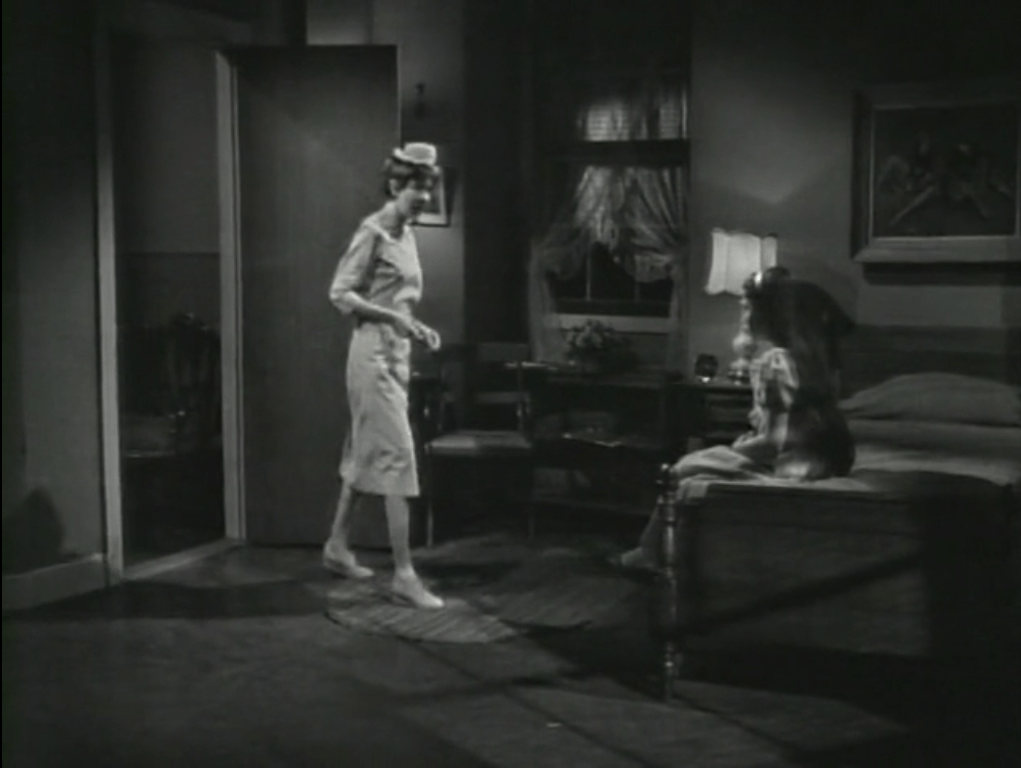
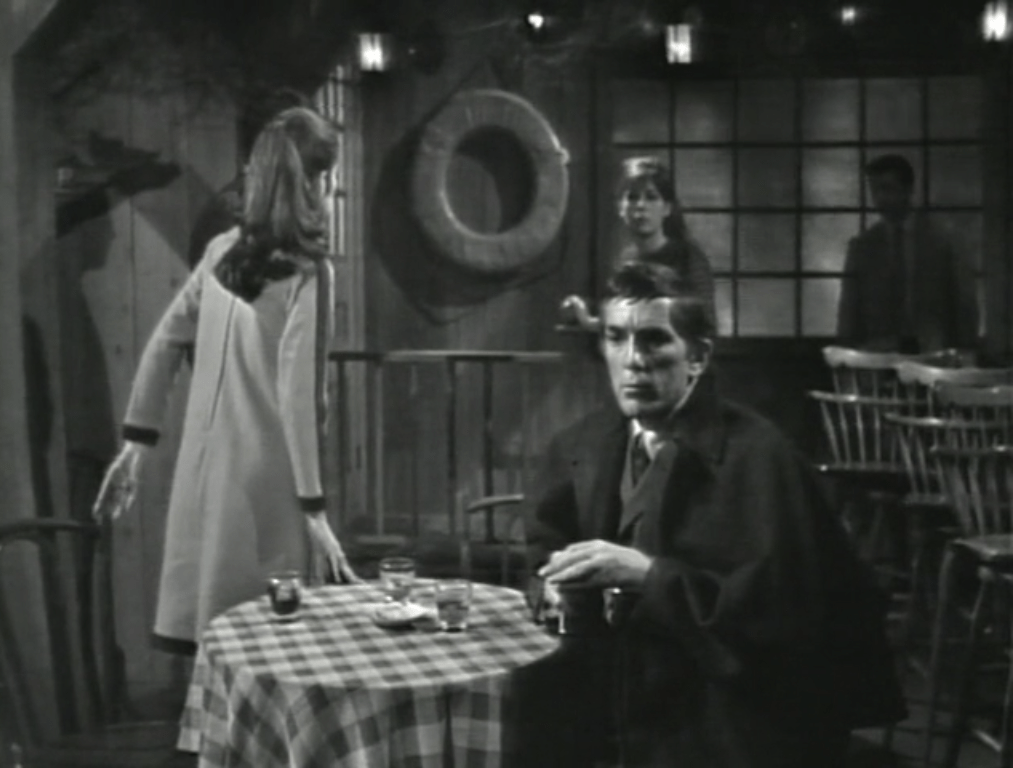
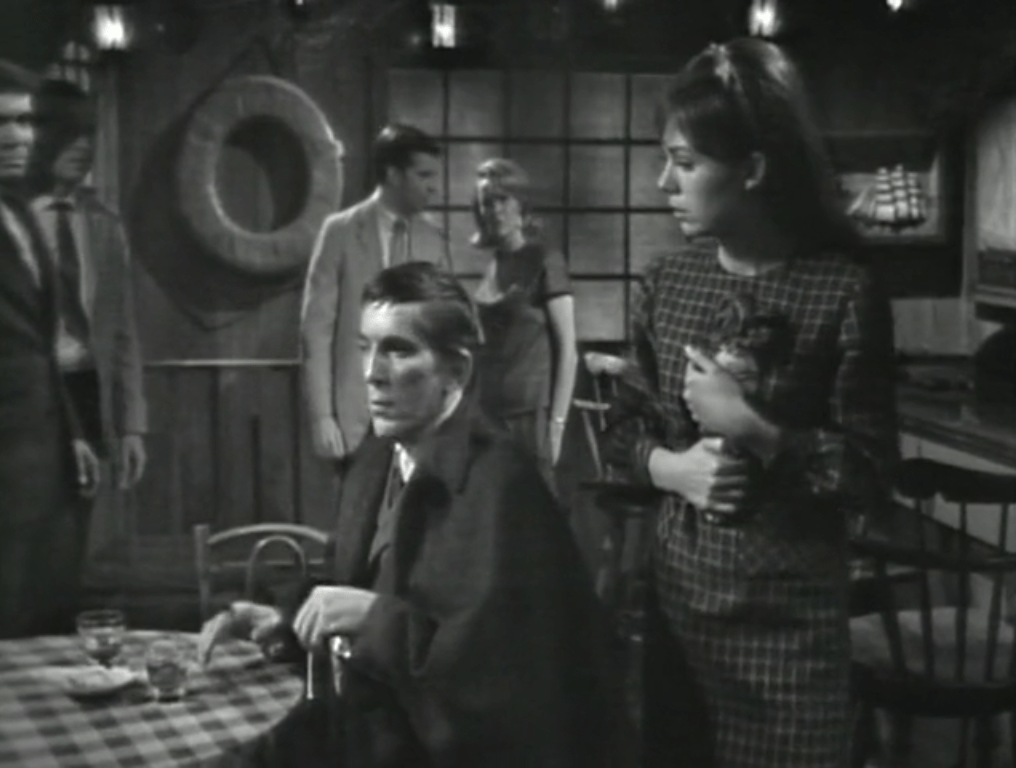
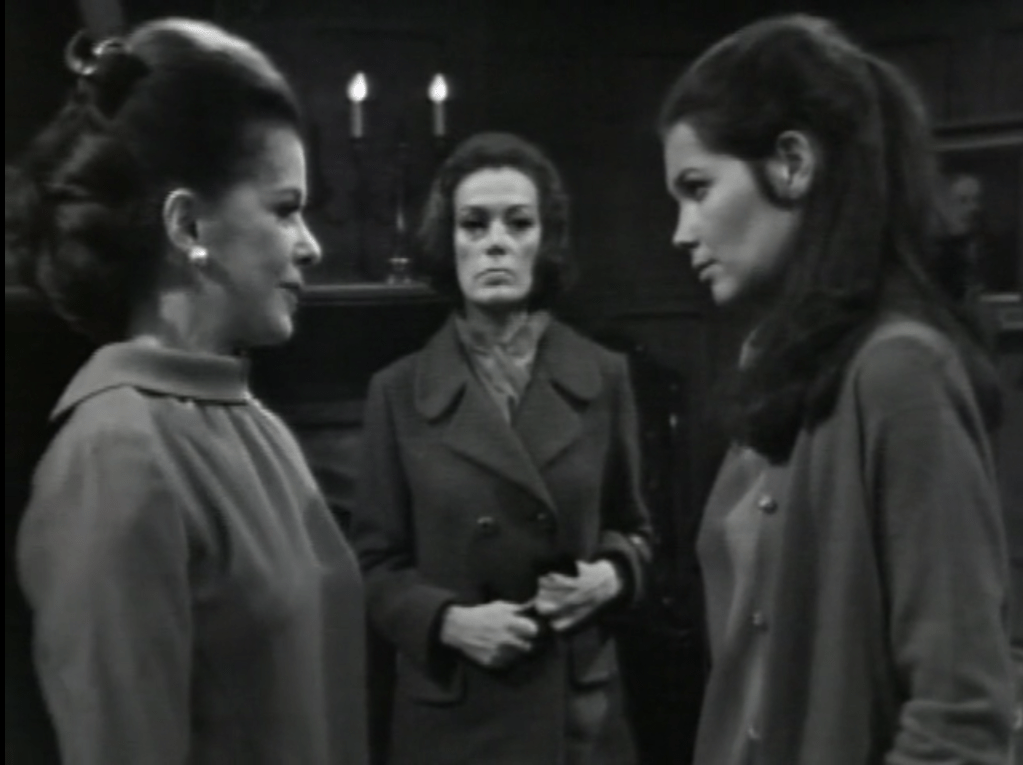
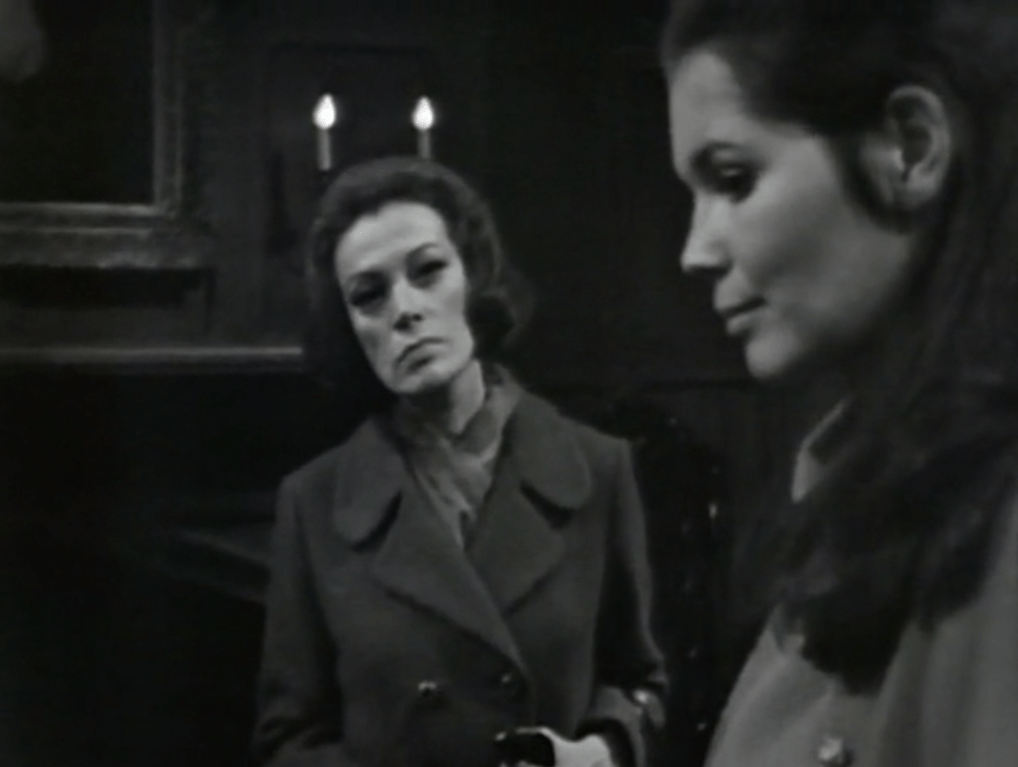
Strange and troubled boy David Collins stands outside the drawing room at the great house of Collinwood and overhears his father, Roger, talking with permanent house-guest Julia Hoffman. Roger and Julia are discussing David’s fear of his cousin, old world gentleman Barnabas Collins, and his belief that Barnabas is hiding something terrible in the basement of his home in the Old House on the estate. Roger takes it for granted that Barnabas is above reproach, and has therefore concluded that David is suffering from some sort of mental disorder. Julia encourages Roger in this conclusion, and urges him to send David away to boarding school. Roger is amenable to this idea, but tells Julia that his sister, matriarch Liz, will never allow it.
The last time David overheard his father in the drawing room saying he wanted to send him away to school, he attempted to murder him. But that was in episode #10, almost fifteen months ago. Since then, David has been through a lot, and has decided he wants to align himself with good against evil. So he doesn’t try to kill Roger this time. Instead, he steals a set of keys to Barnabas’ house that Liz keeps in her study and sets off to gather evidence with which he can prove himself right.
Returning viewers will recall that David’s friend, the ghost of ten year old Sarah, has repeatedly warned him not to go near the Old House, and especially to stay away from the basement. David remembers her words, but makes his way into Barnabas’ basement regardless. There, he sees an open coffin. While David is looking the other way, Barnabas comes up behind the lid and slams it shut. David turns, and Barnabas glares at him. Since Barnabas is a vampire who has spent quite a bit of time thinking of killing David, this would seem to leave the boy in something of a pickle.
There are three firsts in this episode, all relating to voice acting. This is the first time Alexandra Moltke Isles appears in an episode but does not read the opening voiceover. Sharon Smyth appears only through the pre-recorded voice of Sarah; her name does appear in the closing credits, the first time a performer is credited for something other than an on-camera appearance. And the closing titles end with Grayson Hall saying “Dark Shadows is a Dan Curtis Production,” the first time someone other than an ABC staff announcer* has delivered that line.
*Usually Bob Lloyd, though someone else filled in for Lloyd in #156 and #167.
Both Danny Horn and Patrick McCray wrote fine blog posts about this episode. I have a few things to add to what they’ve said.
When vampire Barnabas Collins and his sorely bedraggled blood thrall Willie approach the Tomb of the Collinses, strange and troubled boy David hears them talking about mysterious little girl Sarah. Since Sarah had made him promise to keep her connection to the place secret, he opens the panel to the concealed chamber she had shown him and hides there. To his horror, he hears Barnabas order Willie to open the panel. Still trying to keep Sarah’s secret, he hides in the coffin in the center of the chamber while Willie and Barnabas walk around it. He hears them talk about Barnabas’ relationship with Sarah and Willie’s discomfort with the chamber.
They don’t mention that Barnabas is a vampire, or that he was the one who imprisoned Maggie Evans, The Nicest Girl In Town. But they say enough that David should be able to figure out all of Barnabas’ secrets. Once he has heard Barnabas say that he was left to comfort Sarah after their dog was put down, it isn’t much of a leap to conclude that Sarah is his little sister. And once he’s heard Barnabas ask Willie if he is frightened by the “contents” of the chamber, he should know that there is something in there more than can be seen at a first glance.
In episodes #301 and #306, we were reminded of Jason McGuire, whom Barnabas killed and forced Willie to bury in the floor of this chamber. We also saw the chamber itself in #306, so that regular viewers would be sure to think of Jason’s grave. If David should repeat Barnabas’ comment about the chamber’s “contents” at the right time, Jason might yet be exhumed. So Barnabas has created an extreme danger to himself with his big mouth. Since it does not seem that Dark Shadows could continue if either Barnabas or David were to destroy the other, we are in suspense as to how they will get out of this situation.
After Barnabas and Willie leave, David gets out of the coffin and finds he cannot open the panel from the inside. Willie had used a gadget hidden in the stairs to open it, the first time we have seen this device. As David starts to panic, he hears the strains of Sarah’s signature tune, “London Bridge.” He turns away from the panel, looks at the blank walls of the chamber, and starts calling on Sarah.
In his post, Danny Horn asks “Has David just figured out that Sarah’s a ghost?” I think it’s more complicated than that. In #288, David happily considered the possibility that Sarah might be a ghost, and throughout the series he has been on easy terms with several ghosts. So I think he has assumed she was a ghost all along, and was just too tactful to bring it up when he was talking with her.
Back in the great house of Collinwood, well-meaning governess Vicki is on the terrace, worried about David’s disappearance. Barnabas peeks at her through the gate, as he would do if he were not allowed to look at her. Then he just walks up and starts a conversation with her, leaving us to wonder what the whole peeping-Tom act was about.
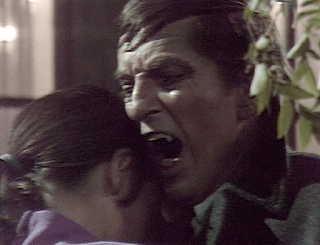
Vicki is so concerned for David that she starts crying. Barnabas tells her to put her head on his shoulder, which she does. He seems to be trying to restrain himself, but she has such a long, pretty neck, and it’s right there, and he’s so very thirsty…
As Barnabas lunges in to bite her, my concern and sympathy is challenged as I ponder her almost athletic lack of awareness. Of course, I’ll inevitably side with the person getting her throat ripped out… but it won’t stop me from wondering why she’s practically painting a landing strip on her neck. Vicki? You have a generation of young people idolizing you.
Today, the discussion isn’t even a metaphor. No, she’s not asking for it. No one is. So, what is the message that we’re supposed to take away from a dangerous conversation like this? For a person constantly asking questions about everything — and never understanding what she hears — Vicki is the picture of unawareness. Evil is evil. An attack is an attack. And awareness is power. Ironic that her would-be attacker, Barnabas, is frequently even more unaware than is she. However, if anyone on a soap paid attention at all, the stories would last ten minutes. But that’s the point. The more the characters lack focus, the more we learn its value. David is the most aware character on the show, and in this episode, he learns the most he ever will in one night. Pity it’s from inside a coffin.
That part of the discussion is too much metaphor to ignore.
Patrick McCray, “The Dark Shadows Daybook: August 22,” The Collinsport Historical Society, 22 August 2018.
Again, I think it’s a more complicated. I think we have to analyze Vicki’s behavior at three levels of intentionality. First, there’s the in-universe level, the sort of analysis of her motives another character in the same story might give if they had the same information we do. If that character saw Vicki’s depressing fiancé Burke angrily telling her she was crazy for saying that she had seen and heard things that we have also seen and heard, refusing to give her even the most basic information about himself and airily dismissing her questions as a morbid preoccupation with “the past,” and telling other people that her imagination will “run wild” unless he monitors and controls her, they might very well think that Vicki is tired of Burke’s abusive ways. To that character, there would be nothing “athletic” about Vicki’s failure to suspect Barnabas- it is perfectly natural for her to want to think the best of a man who has always been pleasant and respectful to her, unlike the blatant villain she is supposed to marry.
The second level of intentionality is of Vicki’s usual function in the narrative. Up to this point, every storyline has come to its climax when Vicki found out what was going on. She is still the audience’s main point of view character, and as such she naturally tends towards the center of the action. All of the action lately has been in the vampire story, so we expect her to involve herself deeply in it. In the first weeks, when it was possible that Barnabas, as the second in a parade of supernatural nemeses, would be destroyed and make way for a third as undead fire witch Laura Murdoch Collins had made way for him, we expected Vicki to be the one who drive the stake into his heart. Now that it is clear he is on the show for the long haul, we are expecting Vicki to become his victim, and presumably to become a vampire herself. As the protagonist, she is actively working to get more deeply involved with Barnabas. She hasn’t yet resorted to “painting a landing strip on her neck,” but she did invite herself to spend the night at Barnabas’ house in #285 and #286, and it wasn’t her fault she left in the morning still having all her blood.
Vicki the unappreciated fiancée wants only a friend who will respect her; Vicki the protagonist wants to be part of the main story. The tension between the incompatible goals of these two aspects of Vicki is expressed in the third level of intentionality, which Alexandra Moltke Isles expresses in the choices that make up her performance. Mrs Isles takes every opportunity to show that Vicki is more strongly drawn to Barnabas than to anyone else, most definitely including Burke. That attraction brings the character back to life. After a few days when she was trying to submit to Burke’s abuse and ignore “the past,” Barnabas asks her to intercede with Burke on his behalf and she comes roaring back, an assertive character who will not give an inch even when Burke makes some good points.
It is the sight of this strong Vicki that introduces a conflict into the audience’s feelings. On the one hand, we don’t want to lose her, and if she does not become a vampire, it’s hard to see a future for her on the show. On the other, it would be a terrible betrayal for Barnabas to repay her trust in him by doing such a thing to her. All the more so because we’ve spent so much time seeing Vicki become close to David, and if she follows the pattern set in Bram Stoker’s Dracula, vampire Vicki will be a threat to all children.
Our sadness at that betrayal would be a deep emotion of exactly the kind soap operas are supposed to create. That so shocking a crime would lead to a more meaningful and more suspenseful story and a richer part for our favorite character would guarantee that we would surprise ourselves by forgiving Barnabas for it and cheering when he and Vicki become a couple. So, I think a savvy audience watching Dark Shadows up to this point would have to expect to see just that story play out.
Maggie Evans, The Nicest Girl in Town, can’t stand being cooped up in her house all the time waiting for the person who abducted her and held her prisoner to be identified. Since she has amnesia covering the entire period of her captivity, her father Sam and her boyfriend Joe have to recap the whole storyline to her before they agree to go with her to the local tavern, The Blue Whale, where they can meet with other people who will help them recap the storyline that followed.
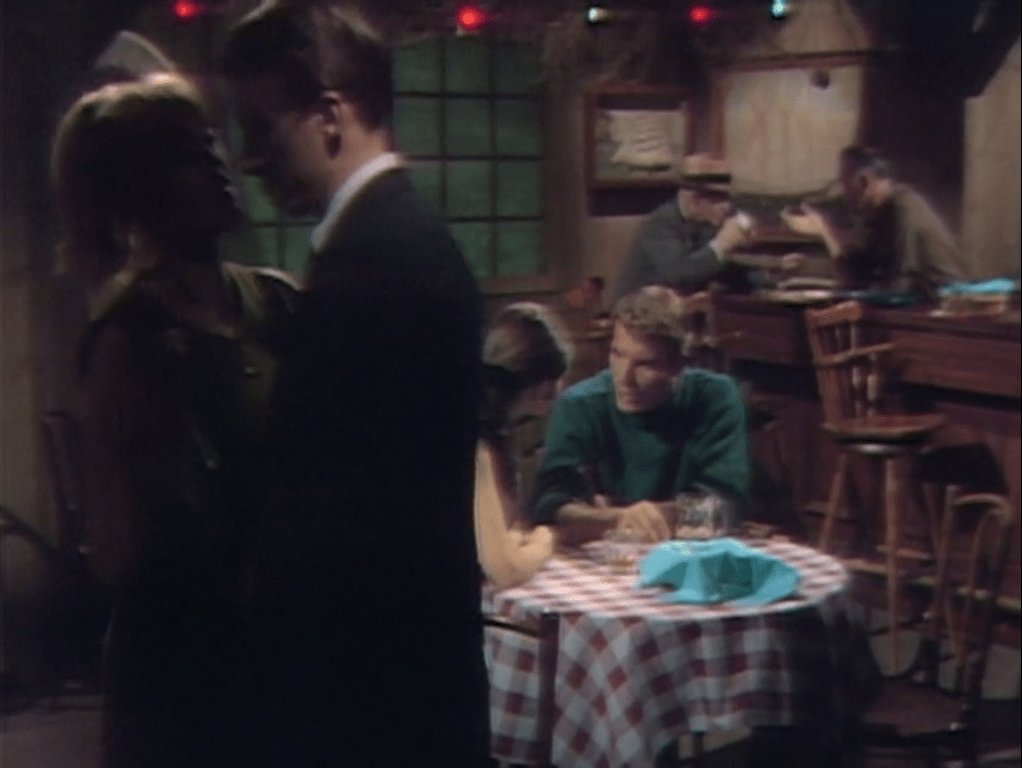
At the Blue Whale, a couple stands at the jukebox and play the theme from “A Man and a Woman.” We see that Bob the Bartender is back on duty. The other day, someone else was in his place, so it’s a relief to know that he’s still around.
At The Blue Whale.
Joe enters, and finds well-meaning governess Vicki alone at a table. He joins her, and she explains that she is waiting for her depressing fiancé Burke. Joe explains that he is waiting for Maggie and Sam. They start recapping while Bob brings them drinks and the couple dances. The couple must be out-of-towners- they aren’t good dancers, exactly, but neither are they doing the Collinsport Convulsion.
Unusually competent dancing.
Maggie and Sam arrive. “A Man and a Woman” continues to play while everyone compares notes about a mysterious little girl named Sarah who seems to have had some connection with Maggie during the time she was missing. Everyone tells everything they know, except Vicki. This is odd- Vicki is the one who brought up the topic of the little girl and who keeps pressing it forward, but she does not mention that she saw Sarah at the top of the stairs in the house occupied by courtly gentleman Barnabas Collins.
Burke enters. Maggie, Sam, and Joe excuse themselves. Burke has been so dreary in recent weeks that it’s hardly surprising Maggie would rather resume hiding in her house than be around him.
Vicki is upset with Burke. Barnabas complained to her yesterday that Burke was having him investigated. She demands that he shut the investigation down at once, issuing an ultimatum that she will end their engagement if he does not. Burke sounds smarter than he has in months as he explains his reasons for thinking there is something sinister about Barnabas. Unlike all the scenes where Burke was angrily asserting that Vicki was crazy for saying that she had seen and heard things we had also seen and heard, Vicki stands her ground. She won’t give an inch, and she immediately comes up with plausible explanations for all of Burke’s observations.
When Burke starts talking, the background music shifts from “A Man and a Woman” to “Brazil.” We have heard this tune behind Burke at the Blue Whale many times; it really is his theme song. When it plays, we know that we’re supposed to focus on him. When he starts talking about Maggie, it shifts again, to one of the “Blue Whale” dance tunes Robert Cobert wrote for the show. That tells us that Burke is no longer the subject- instead, we are paying attention to the overall story of Dark Shadows.
As it happens, returning viewers know that Burke is right about Barnabas and Vicki is wrong. We also know why Vicki didn’t volunteer that she saw Sarah at Barnabas’ house- she does not want to cast any suspicion on her friend. But we also know that the Dark Shadows has been fun since Barnabas joined the cast, and that no stories are going on that do not center on him. If Barnabas is caught, there won’t be a show for us to watch. Besides, it’s great to see Vicki finally standing up to Burke, even if it isn’t on one of the many occasions when he is wrong. Nor is Anthony George even struggling to play him. He is a cold actor who is at a loss when Burke is supposed to be reacting ferociously to provocations or exuding passion in love scenes, but this scene is right up his alley, with Burke cool, forceful, and intelligent. Alexandra Moltke Isles gets a real workout having to dominate the scene when George is in his wheelhouse, and she pulls it off admirably.
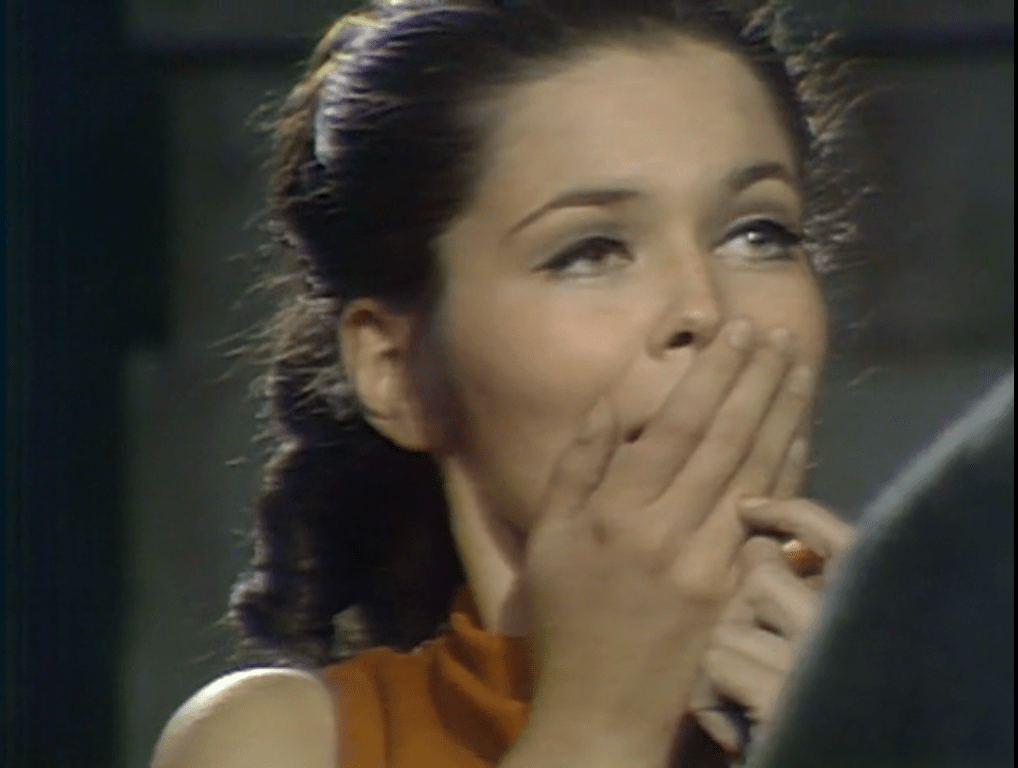
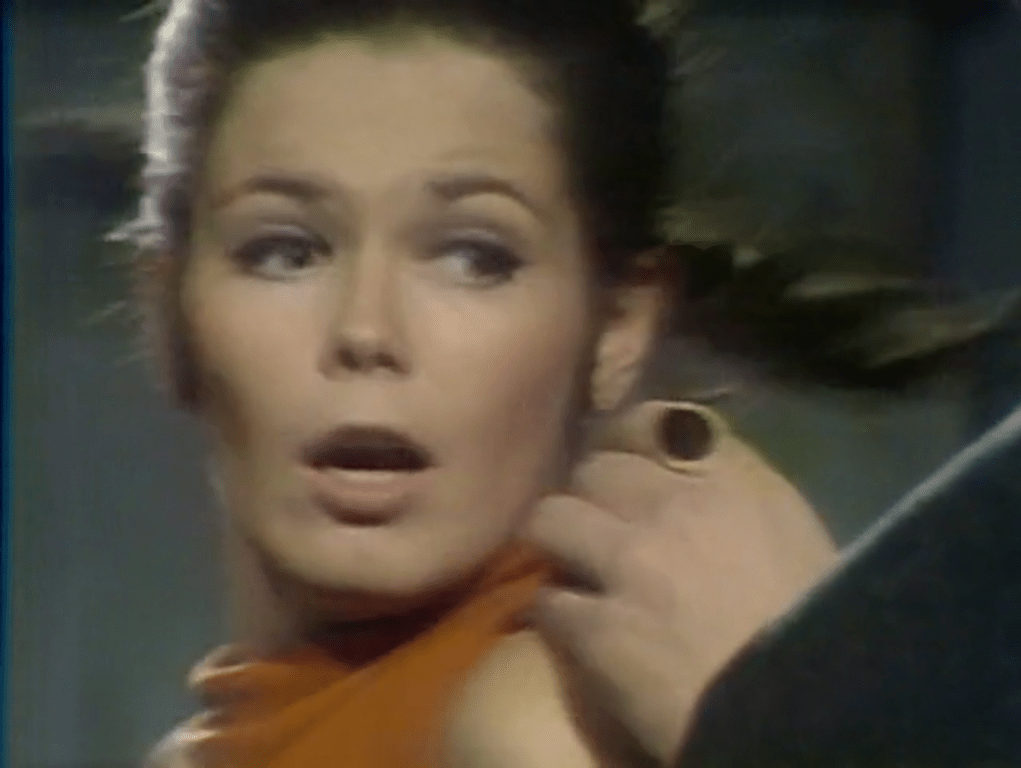
Vampire Barnabas Collins creeps up on well-meaning governess Vicki from behind. He touches her neck, and she is startled.
Stifling a giggle
This scene plays twice. First, before the opening title sequence, then again immediately after. The first time around, Vicki stifles a giggle when she sees Barnabas. The second, she seems frightened.
Frightened
Barnabas does not bite Vicki. He apologizes for startling her. She says that no apology is needed, and she stands very close to him. They talk about the Moon and the night and about what incredible romantics they both are.
Incredible romantics
In #285 and #286, Vicki contrived to get Barnabas to invite her to spend the night in his house. In #293, she invited Barnabas to tag along on a date she was having with her depressing boyfriend Burke, and while Burke stood there she had eyes only for Barnabas. In this conversation, Vicki reluctantly turns down an invitation from Barnabas so she can go on some more dismal dates with Burke.
Mad scientist Julia Hoffman interrupts Barnabas and Vicki. After Vicki excuses herself to get ready for her date, Julia demands that Barnabas leave her alone. Barnabas says that he means her no harm. This is all too believable- twice before today, we have seen Barnabas enter a room where Vicki was sleeping and leave without biting her. It’s starting to seem unlikely that she will ever have a place in the vampire story. Since the vampire story is the only plot going on Dark Shadows, that leads us to wonder why she is still on the show.
This scene takes place on a new set, a courtyard with a terrace and a fountain. It looks very much like a set in the 1965 film The Sound of Music, the one where the Countess who is supposed to marry Captain von Trapp has the conversations that remove her from the love triangle and leave the path open for von Trapp to marry Maria. That movie was such a big hit that it seems likely that they had it in mind when they designed this set for scenes concerned with the love triangle involving Vicki, Burke, and Barnabas.
Julia’s intervention leads some to believe that there is another love triangle budding in which she will vie for Barnabas’ affections, but I don’t see any trace of that in Julia’s stern manner today. She simply seems to be concerned that Barnabas stop preying on people while she performs the experiments that are supposed to cure him of vampirism.
In later years, Grayson Hall would claim that she decided on her own initiative to play Julia as if she were in love with Barnabas. She said that by the time the writers and directors caught on to what she was doing, they had received so much enthusiastic fan mail that they had to let her go on doing it. In response to this story, Danny Horn makes some uncharacteristic remarks in his post about this episode on Dark Shadows Every Day:
It’s a great story, especially because it appeals to the audience’s secret belief that the actors really are the characters that they play. We love to believe that, especially for daytime soap opera characters, who we spend time with every day.
But really, everybody who watches television believes that the characters are real. That’s why we love to hear about unscripted moments that were invented during rehearsal. As intelligent adults, we understand that writers and directors and producers create the characters, and then the actors show up and say the words. But there’s a little child inside of us, who wants to be told that Julia Hoffman is real, and she lives inside Grayson Hall.
Danny Horn, “A Human Life,” Dark Shadows Every Day, 2 Jaunary 2014.
As the blog went on, Danny put more and more emphasis on the chaotic process by which Dark Shadows was created. I suspect this passage was something he wrote in haste. Even at this early stage, he had made it clear that he knew that it was not true that “writers and directors and producers create the characters, and then the actors show up and say the words.” By the time he finished in 2021, his main theme had long been that the real subject of Dark Shadows was “a team of under-resourced lunatics desperately struggling every day to make the most surprising possible show.” That team most definitely included actors padding their parts in ways they could do only because the show was done live to tape, with edits never done if not absolutely necessary, and often not done even when they were.
Julia visits Vicki’s room and helps her choose an outfit for her date with Burke. Julia urges Vicki to avoid Barnabas, because he has a crush on her and it would hurt him to encourage him in it. Vicki says that she has never seen any sign of such a crush. Nor have we- he has talked with his sorely bedraggled blood thrall Willie about a plan to take Vicki as his next victim. Aside from giving her an enchanted music box that is supposed to brainwash her, he has been remarkably leisurely about the whole thing. If anything, she is the one who has been pursuing him.
Vicki and Burke are out by the fountain. He remarks that she has been very quiet, and she refers to having a lot on her mind. This raises our hopes that she is thinking about what Julia told her and is going to ditch Burke and go to Barnabas. They start talking about their wretched childhoods. Previously, we had heard that Burke’s mother died when he was young and that his alcoholic father supported the family by making lobster pots; now Burke tells us that when he was nine his father left the family. It’s hard to see much point in this retcon; most likely the writers had just forgotten about the earlier story.
Vicki mentions that there was one nurse at the Hammond Foundling Home whom she liked. In the early days of the Dark Shadows, she would often reminisce about her ridiculously bleak experiences growing up in this fictional orphanage. Usually she would get a faraway look in her eyes and smile, then tell some story that started with an appalling horror and got worse and worse as it went. This time, she again stares off into the distance and smiles, so that viewers who have been watching from the beginning brace themselves to hear that the nurse turned out to be the worst abuser of all, or that she was murdered in front of Vicki while the other children laughed, or that she ran the kitchen the winter they ran out of food and had to resort to cannibalism. But no, Vicki is just sharing a pleasant little memory. The show is a lot less hard-edged now that it’s about a vampire.
Not that they’ve stopped presenting horrible images altogether. No, they show us Burke kissing Vicki.
When Burke was played by Mitch Ryan, he was a great kisser, a talent he displayed with Vicki among others. But Anthony George does not appear to have seen anyone kiss before he attempts it. As he points his lips at Alexandra Moltke Isles, she stiffens her neck, a move that may have suggested excitement if her partner were doing something recognizable as a sign of affection, but that in this context looks like she’s suffering from whiplash. After his first failed effort, he rests his head on her shoulder and looks miserable.
Attempted kissAfter the failure
We pull back from Burke’s fumbling and see Barnabas at the gate to the courtyard, looking forlorn. I’m sure the writer and director wanted us to take this image as a sign that Barnabas is feeling sorry for himself, but the scene he’s been watching with us is so dreary that we would all have the same look on our faces.
Barnabas has seen the sorry spectacle
Some attribute George’s phenomenally bad kissing to his sexuality. I don’t buy it. Joel Crothers was also gay, and we’ve seen Joe Haskell give convincingly sultry kisses to two actresses. Louis Edmonds was gay too, and when Dark Shadows finally gives him an on-screen kiss two years from now he will do just as well. And the actresses unanimously testified that Jonathan Frid was the best kisser in the cast. Furthermore, the other conspicuously inept kisser on the show was the emphatically heterosexual Roger Davis (whom we have yet to see.) So George’s failures in this department are his alone, and do not reflect on any demographic group of which he was a member.
In the house, Vicki and Burke continue their vain struggle to kiss. Julia walks in and apologizes for intruding. She does not leave, nor does she take her eyes off Vicki and Burke. That makes sense- after all, she is still an MD, and it would appear that whatever is wrong with Burke might require some kind of medical intervention.
Vicki excuses herself to go to bed, and Burke asks Julia to join him in the drawing room. There, he denounces Vicki for her “vivid imagination,” a terrible quality that must be stamped out. He tells Julia that Vicki has experienced two hallucinations recently. We know that these were not hallucinations at all, but actual visitations from the ghost of Sarah Collins. Burke doesn’t know that. However, he does know of another sighting which led him to angrily accuse Vicki of being insane, when she saw Maggie Evans, The Nicest Girl in Town, walking in a cemetery. At the time, everyone thought Maggie was dead, but now that it has been revealed she is alive, he removes the incident from his bill of particulars against Vicki.
Burke is furious with Vicki for having an imagination and wanting to be part of the story
Burke and Vicki, like most of the other characters, believe Julia’s cover story that she is an historian researching the Collinses for a book about the old families of New England. He asserts that helping Julia with her project is having a bad effect on Vicki, because she must “live in the present.” Julia asks if this means that she must live with him. Burke agrees that it does.
To Burke’s surprise, Julia agrees that Vicki should stop helping her and stay away from anything suggestive of past centuries. The two of them talk about how Vicki must be watched and controlled lest her imagination “run wild.” Julia is a mad scientist in league with a vampire, so this sort of talk is to be expected from her, but Burke is supposed to be on Vicki’s side. His frank intention to crush her imagination, expressed alternately with undisguised rage and airy paternalism, is as repulsive as anything we have seen from Barnabas.
Upstairs, Vicki is asleep. Barnabas opens the door and walks into the room. Again he thinks about biting her, again he doesn’t. He opens the enchanted music box, looks at her a bit longer, and leaves the way he came. If Barnabas doesn’t get off the dime soon, Vicki may marry Burke and become useless forever.
The only story on Dark Shadows at this point is the one about vampire Barnabas Collins. They’re trying to get a second one off the ground, about an old vacant house that has caught the fancy of well-meaning governess Vicki. Vicki’s depressing boyfriend Burke has interpreted her interest in the place as a marriage proposal. He wants to buy the house and live in it with her.
Today, we find out that the house is the property of the ancient and esteemed Collins family. That isn’t a big surprise, since Barnabas clearly knew something about it from his time as a human. It does suggest a partial answer to a question Vicki had when she, Burke, and Barnabas visited the house on Thursday. Barnabas found a handkerchief there bearing the initials “F. McA. C.” and gave it to Vicki. She expressed a determination to find out what those initials stood for. Now she should be able to look at the family’s records and search for a Mrs Collins whose maiden name had the initials “F. McA.”
Burke asks matriarch Liz if she is willing to sell the house to him, and she is perfectly agreeable. Liz’ daughter Carolyn joins them for a tour of the house. There is some startlingly sloppy writing in this scene. Carolyn remarks that the house has a special warmth and speculates that it is the result of so much light reflected into its windows from the sea nearby. A couple of minutes later, Liz complains that the house is terribly cold, and Carolyn says that’s because it is so close to the sea.
Both Liz’ glad willingness to sell the house to Burke and her trip to it signal that storylines from the first year of the show are now behind us once and for all. Burke was introduced in episode 1 as a dashing action hero returning to his home town to wreak vengeance on his old persecutors, the Collins family. The “Revenge of Burke Devlin” arc consisted so largely of talk about people, places, and events we never saw that it didn’t amount to much, and by the time Burke formally renounced his revenge in #201 it had long since fizzled. That left some chance it would flare back up, so in #223 Liz vowed she would never sell Burke any property at any price, but now the door is firmly closed on that old theme.
When Dark Shadows started, Liz was a recluse who hadn’t left home in eighteen years. Since they never showed us anyplace Liz might want to go, that story was an even more total dud than was The Revenge of Burke Devlin. Even after the reason for Liz’ seclusion was exposed as fraudulent in #273, she still made a show of reluctance when her brother Roger suggested she go to town in #277. Now she doesn’t hesitate to hop in a car and go to the house by the sea. In fact, she is the one who urges Carolyn to get out of the house. So that sends another non-starter to the narrative junk yard.
In this episode, the characters refer to “the house by the sea” as “Seaview.” That was an inside joke. The Newport, Rhode Island mansion used in the exterior establishing shots of the great house of Collinwood was known as Seaview Terrace. In 1974, Martin and Millicent Carey bought the house, and it came to be known as the Carey Mansion.
Meanwhile, Vicki is visiting Maggie Evans, The Nicest Girl in Town. Maggie has amnesia, a condition induced by her doctor, mad scientist Julia Hoffman. Julia is in league with Barnabas, and has damaged Maggie’s memory to keep her from recalling that Barnabas abducted her and tried to replace her personality with that of his lost love Josette. Vicki is trying to help Maggie regain her memory.
There is another instance of distressingly sloppy writing in this scene. Vicki tells Maggie that she thought she saw her in Eagle Hill cemetery during the period she cannot recall. She tells Maggie that Burke tried to convince her that she can’t have seen her. In response, Maggie asks if Burke saw her, and Vicki again says Burke tried to convince her she hadn’t seen her.
Vicki tells Maggie that she and Burke had gone to the cemetery to lay flowers at Josette’s grave. Maggie reacts strongly to Josette’s name, and Vicki starts telling her about Josette. When she mentions that Barnabas has restored Josette’s room, a light comes on in Maggie’s eyes and she grows very animated. She is about to say something when a knock comes at the door. It is Julia.
There is a strange blooper in the conversation between Vicki and Julia at the door. Julia asks “Would it be all right if I came in and waited?” Vicki responds “Not at all.” My wife, Mrs Acilius, is usually very forgiving of bloopers, but she laughed out loud at this one.
It could be that Julia’s line was “Would you mind if I came in and waited?” Alexandra Moltke Isles was famously accurate with her line delivery, even when her scene partners bobbled, and it could be that she just went ahead and said what Vicki was supposed to say even though it didn’t make sense. In view of Carolyn’s self-contradictory lines about the temperature of the house and Vicki’s repetitious lines about Burke’s attempt to gaslight her, both of which were obviously scripted, it could also be that the actors are working from Ron Sproat’s unrevised first draft.
While Julia looks at some of Maggie’s father’s paintings, Vicki sits back on the couch with Maggie. Julia hears Maggie exclaim “Barnabas!” and get very agitated. It seems she is about to tell Vicki all about what happened when she was missing.
Maggie, remembering
Julia swoops in, asking if they like antiques. Vicki looks bewildered at the interruption, but answers with a polite yes.
Julia interrupts
Julia presses her jeweled medallion on her. Vicki passes it to Maggie, and Julia asks for a cup of tea. Maggie volunteers to make the tea, but Vicki insists on doing it. In #143, the living room and kitchen in the Evans cottage were two parts of an undivided space, but now we hear Vicki close a door when she goes to make tea. Not only is that confusing to viewers who remember the earlier episodes, but since Vicki goes in the direction of the front door it seems for a moment that she is leaving the cottage altogether.
While Vicki is out of the room, Julia hypnotizes Maggie. She commands her to forget everything that happened while she was missing. When Vicki returns, Maggie has indeed forgotten everything.
Maggie Evans, The Nicest Girl in Town, is a patient in a mental hospital run by a mad scientist who is in league with the vampire who kept her prisoner. So there are bars on the windows of her room, and a lock on the outside of the door. The vampire, Barnabas Collins, scrambled her memories before she escaped from him, and the mad scientist, Julia Hoffman, intends to keep her in her amnesiac state.
We see Maggie at the barred window, begging for someone to help her go home. At that, her friend, the ghost of nine year old Sarah Collins, materializes in the room. Maggie hugs Sarah, and Sarah apologizes for taking so long to find her. Sarah assures Maggie that she can help her get home, but tells her she will have to do what she says.
Sarah apologizes for taking so long to come
At Sarah’s direction, Maggie stands in the corner behind the door and calls the nurse while Sarah sits on the bed. The nurse opens the door and sees Sarah, but not Maggie. Maggie slips out and closes the door behind her, locking Sarah and the nurse in the room. The nurse tries the door, looks back, and sees that Sarah is nowhere to be found. The camera stays with her for a long moment as she looks around in bewilderment. As Nurse Jackson, Alice Drummond does a great job with this stage business.
Meanwhile, back in Collinsport, there is a misdemeanor in progress. Well-meaning governess Vicki, her depressing boyfriend Burke, and Barnabas are sneaking into an old vacant house that has captured Vicki’s fancy. Barnabas astounds Burke with his ability to see in the dark as he describes the “No Trespassing” sign, and refers to the same ability as he volunteers to explore the upper storey of the house while Burke and Vicki stand around on the ground floor.
Burke has taken Vicki’s interest in the house as a marriage proposal, and keeps talking about how they should furnish it when they live there together. The only thing he says that gets much of a reaction from her is a disparaging remark about Barnabas, which elicits flash of anger. Yesterday’s episode included a couple of clues that Vicki’s infatuation with “the house by the sea” might lead her, not to Burke and irrelevance, but to Barnabas and the center of the action. Her forceful response to Burke’s Barnabas-bashing renews those hopes.
Burke has spoken ill of Barnabas
Barnabas comes back from the upstairs with a handkerchief bearing the initials “F. McA. C.” He makes a present of it to Vicki. When she objects to this act of theft, he assures her that whoever it belonged to would want her to have it. That too picks up on hints from yesterday, when Barnabas indicated by his typical slips of the tongue that he had a connection to the house that he didn’t want the other characters to know about. We haven’t yet heard of anyone living or dead with the initials “F. McA. C.,” so presumably we are supposed to start waiting to hear a fresh story about Barnabas’ earlier existence.
Somewhere to the north, Maggie and Sarah are sitting in the woods. In recent days, we have heard several times that the mental hospital is a hundred miles from Maggie’s home in Collinsport, so if they are going to walk the whole way and take breaks it will be a while before they get back.
Maggie asks Sarah how she got into her room. “Do you really want to know?” Maggie says she does. “The same way I got out.” How did she get out? “The same way I got in!” At that, Maggie laughs. Sarah first met Maggie when she was Barnabas’ prisoner, and she remarks that this is the first time she has heard her laugh. She tells her she ought to do it all the time.
Apparently, an early draft of the script called for a truck driver to pick Maggie up and take her back to town. But that couldn’t be. How will Sarah get Maggie to Collinsport from the hospital? The same way she got to the hospital from Collinsport, of course.
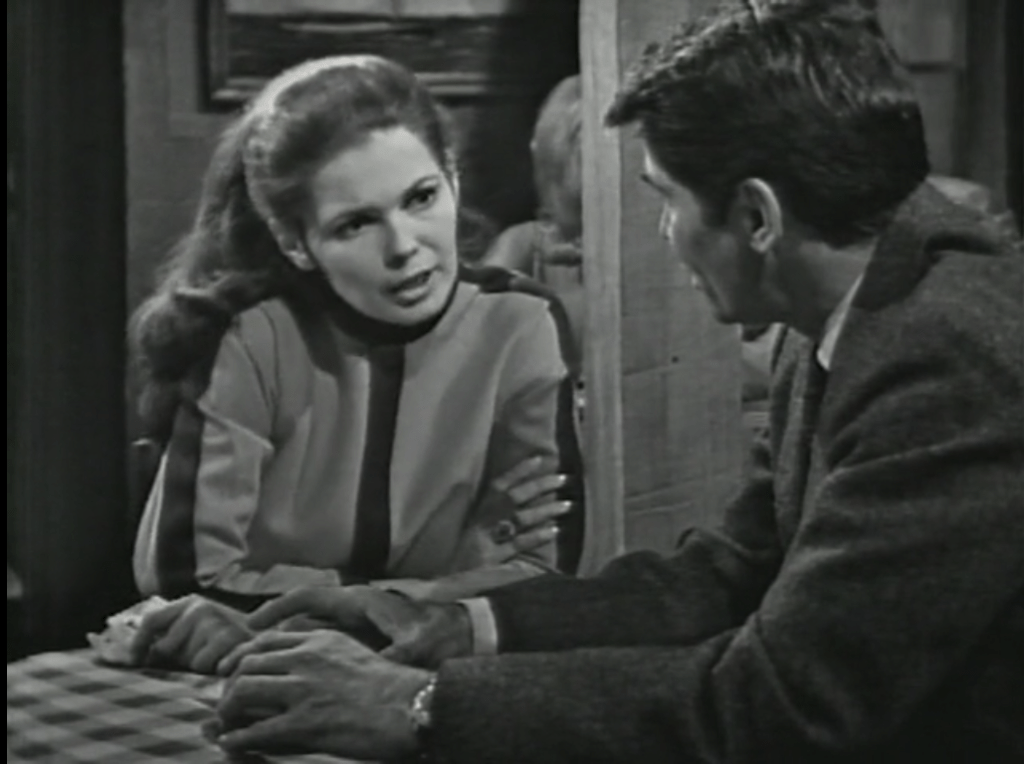
In Collinsport, Vicki, Burke, and Barnabas are sitting at a table in the Blue Whale tavern. While Barnabas gets the drinks, Vicki tells Burke that he and Barnabas are extraordinarily unalike. Burke says he takes that as a compliment, a remark to which Vicki reacts with displeasure.
Burke has repeated his offense
We can sympathize- sure, Barnabas is a vampire, and that is sub-optimal in a potential husband. But it doesn’t make him the opposite of Burke, who has been draining the life out of Vicki lately with his demands that she steer clear of anything that might be interesting to the audience and become as dull as he is. The real difference between Burke and Barnabas is that Barnabas drives one exciting plot point after another, while Burke makes nothing happen.
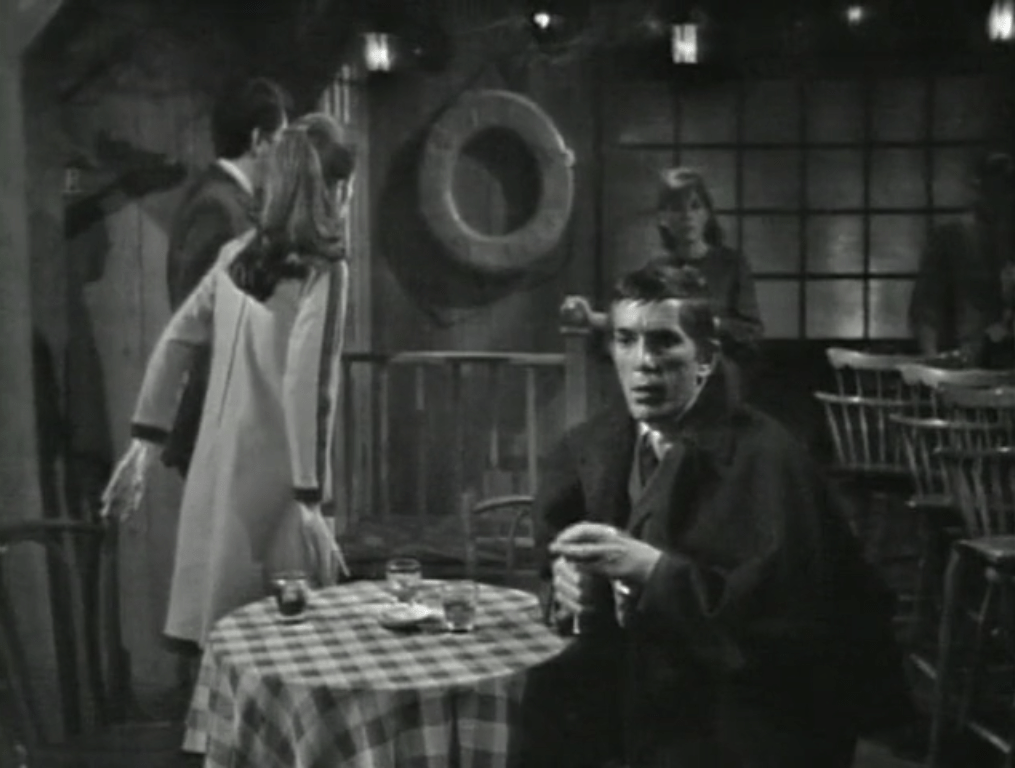
Barnabas comes back to the table, and the conversation returns to the “house by the sea.” Burke is about to propose marriage to Vicki. Suddenly, the jukebox stops playing and everyone falls silent. It is as if something has entered the room that everyone can feel but no one can see. The door opens, and in walks Maggie.
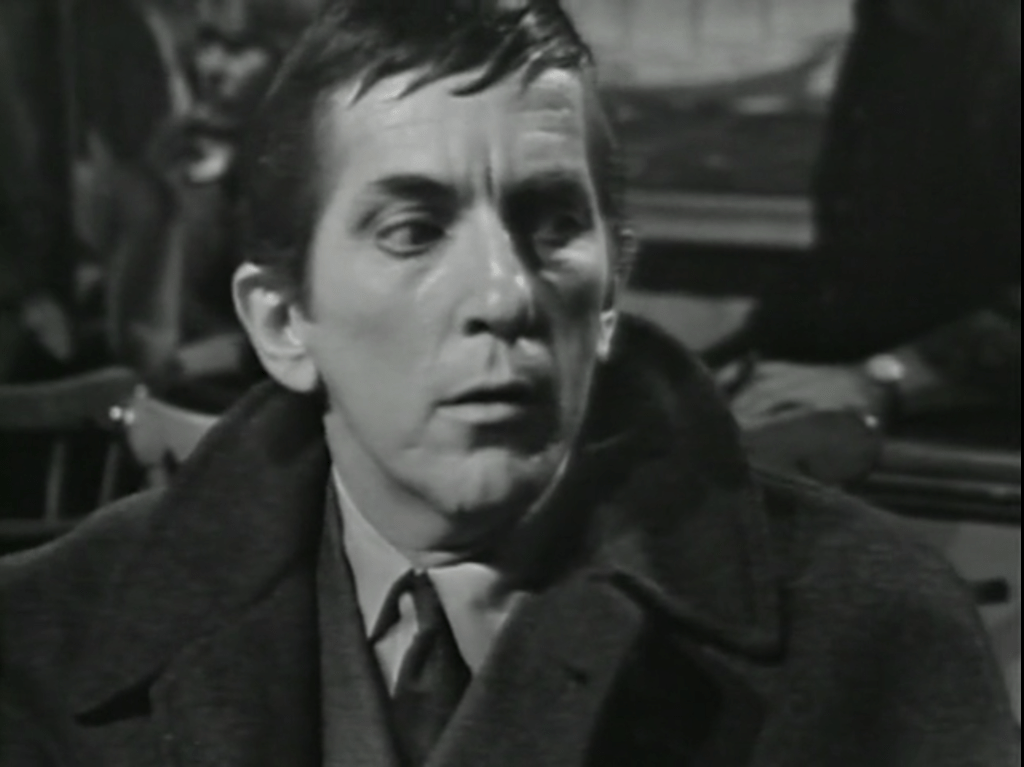
Vicki is the first to see her. She calls her name. Barnabas reacts with alarm. Maggie walks slowly towards their table. She approaches Barnabas, who tries to remain very still. She takes a long look at him, walking around to get the best angle. She touches her head, calls out “No!,” and faints. And that is what you call a “cliffhanger ending.”
It’s chiasmus week on Dark Shadows. Chiasmus is when the last thing that happens in a story resembles the first thing that happened. Usually that causes the audience to look back on that first thing in a new light. Sometimes chiasmus gets very detailed, and the first several things are mirrored by the last several things.
On Wednesday, we began with well-meaning governess Vicki asleep in vampire Barnabas Collins’ house on the estate of Collinwood. Barnabas crept into her bedroom and stood over her, but did not bite. Then it was morning, and Barnabas’ sorely bedraggled blood thrall Willie delayed Vicki as she was leaving the house. Vicki took our point of view with her to the great house on the estate, where we started to see events through the eyes of visiting mad scientist Julia Hoffman. That episode ended with Julia going to Barnabas’ house. Willie delayed Julia entering the house, and Barnabas and Julia met. Their scene was tense, but Barnabas did not use any of his powers against Julia. That chiasmus marked the transition from Vicki to Julia as the audience’s main character to identify with.
On Thursday, we began with Barnabas spying on Vicki through her window, then entering her bedroom and standing over her while she slept. He again left the room without harming her. We ended with Julia spying on Barnabas through his window, then entering his house, opening his coffin, and looking at him. The parallel is completed when we see today that she left the coffin room without harming Barnabas. That chiasmus showed that Julia is capable of turning the tables on Barnabas.
Today’s episode begins with a reprise of yesterday’s cliffhanger, showing Julia gasping when she opens the coffin. So returning viewers suspect that it is likely to end with Barnabas in Julia’s room, and the suspense comes as we try to figure out how he will get there and how she will escape his malign power.
We see Julia in the drawing room of the great house talking to her friend, addled quack Dave Woodard. Dr Woodard says that her failure to report to him on the progress she has made with their common patient, Maggie Evans, The Nicest Girl in Town, coupled with her presence at Collinwood, a hundred miles from the hospital where Maggie is, has forced him to remove Maggie from her care. Julia lies to him, claiming that she has no progress to report and that the whole thing is impossibly boring. This somehow convinces Dr Woodard to leave Julia on the case.
Julia is at Collinwood pretending to be an historian studying the old families of New England, and Vicki has volunteered to help her in her research. Now Vicki is terribly afraid that if she gets involved in what Julia is doing, she will become involved in things that are too interesting for her to handle, and she wants to withdraw before she forever loses contact with tedium and drabness.
Barnabas tells Vicki that she has nothing to fear from “the past,” which at this point on Dark Shadows means the plot. While he is reassuring her, the set catches fire. We hear fire extinguishers and other noises in the background, but Jonathan Frid and Alexandra Moltke Isles don’t break character for an instant. The scene is a dreary one, marking as it does the doom of Vicki as a major part of the show, and the lines are poorly written, but they are absolutely committed to their work.
Barnabas does not believe Julia’s cover story, and is quite sure she represents a threat to him. He meets with her in the drawing room to reiterate his refusal to cooperate with her project. When Julia says that she is particularly interested in his “namesake”- actually himself- Barnabas airily asserts that he was by all accounts a dull fellow. Julia may have been able to sell that line to Dr Woodard on this same set a few minutes ago, but Barnabas doesn’t make any impression on Julia with it. The two of them continue to argue as they pass from the drawing room through the foyer. The dialogue isn’t really any better than what Barnabas and Vicki had in the previous scene, but because Frid and Grayson Hall have a lively relationship to depict- two people who each of whom knows more about the other than they are willing to say, and each of whom knows that the other knows much of what they are holding back- they make their whole sparring match seem to glisten with wit and style.
Barnabas agrees to meet Julia at his house the next evening. After he leaves, Julia tells his portrait that she can’t wait that long for their next encounter, and she knows he can’t, either.
We cut to Julia in her bedroom. Vicki pays a visit, during which we hear another depressing conversation about Vicki’s newfound fear of narrative relevance. Julia assures her that “There is nothing for you to fear.” After Vicki leaves, Julia looks at her clock and sees it is a quarter to one in the morning. We dissolve to the foyer, where the hall clock reads 2:00. Barnabas appears in Julia’s bedroom and approaches the bed, where he prepares to uncover Julia. We then hear Julia greeting Barnabas by name. She emerges from the shadows on the other end of the room, and tells Barnabas she has been waiting for him a long, long time.
In the first year of Dark Shadows, every major storyline came to its climax after well-meaning governess Vicki found out what was going on. Now, the only ongoing storyline is centered on vampire Barnabas Collins. If Vicki finds out Barnabas is a vampire, she will lead an effort to destroy him, as she led an effort against Dark Shadows’ previous undead menace, blonde fire witch Laura Murdoch Collins. Barnabas is a hit, bringing far and away the biggest ratings Dark Shadows has had. So we are in suspense as we wonder how Vicki will find out about Barnabas, and in another kind of suspense as we wonder how they will manage to keep him on the show after she does.
As we open today, we see an intriguing possibility. Vicki is staying over at Barnabas’ house, sleeping in the bedroom of his lost love Josette. Barnabas is standing over her, about to bite. If he does, perhaps he will turn her into a vampire. Then we might find out what kind of vampire Vicki could be. Perhaps she would be like Lucy in Bram Stoker’s Dracula, who became the “Bloofer Lady” and preyed on the small children of the East End of London. Since Vicki’s whole thing has been her role as protector of strange and troubled boy David Collins, it would be a heartbreaking reversal to see her become a threat to David. And perhaps she might emerge as a rival to Barnabas. He is a lackadaisical vampire, who was on the show for 13 weeks before he got round to killing anyone and even then it wasn’t a premeditated murder. Maybe Vampire Vicki will be the killing machine who shows Barnabas how it’s done.
But Barnabas wimps out. He keeps looking at Josette’s portrait, and slinks out of the room without biting Vicki. If they go on like this much longer, we will stop wondering how and when Vicki will be incorporated into the vampire story and start wondering why she is still on the show.
Vicki is bustling out the front door of Barnabas’ house when his sorely bedraggled blood thrall, Willie, offers to make breakfast for her. He keeps asking her if she sensed anything wrong while she was sleeping, and holds onto the topic until she remembers the dangerously unstable ruffian he was before Barnabas got hold of him. She sternly asks if he slipped into the room while she was sleeping, and he denies it.
Back at the great house, mad scientist Julia Hoffman, pretending to be an historian studying the early history of the ancient and esteemed Collins family, is trying to convince matriarch Liz to cooperate with her project. Liz is too worried about Vicki to pay Julia much attention. Vicki had left for Barnabas’ house after everyone in the great house was asleep, planning to be back before they awoke, but because she felt such profound peace in Josette’s room she overslept. Vicki comes in and explains the situation. Liz seems like she is about to weep for joy, and talks about how wonderful it is that Vicki was with Barnabas. Julia has figured out the truth about Barnabas, and reacts to Liz and Vicki’s swoony attitude towards him with alarm. This is one of the first times someone other than Vicki has served as the audience’s representative while Vicki is on screen.
Julia does not share Liz’ conviction that Barnabas is the best host a girl could hope forJulia takes a look at Vicki’s complexion and her neck
Vicki backs Julia’s efforts to win Liz over. When Julia says that she is sure she will uncover important information if Liz and “Mr Collins” help her, Liz replies that her brother Roger is even less interested in the past than she is.
Julia explains that she was referring to Barnabas, but the mention of Roger reinforces the concern Barnabas’ failure to bite Vicki raised. When Dark Shadows started, Roger was its principal villain. That all ended, and he hasn’t had a storyline in months. Louis Edmonds was such a talented actor and such a funny person that the whole cast is loose and zestful in episodes that do include Roger, but in terms of the plot he is surplus equipment. Now that Barnabas is driving the story, “interested in the past” is synonymous with “relevant to the plot,” so that when Liz says that neither she nor Roger is interested in the past, she is saying neither of them is likely to make anything happen.
The biggest draw for the first episode of Dark Shadows was that onetime major movie star Joan Bennett was in the cast, but none of Liz’ storylines really clicked, and now all she does is spend a scene or two objecting to plot developments that we all know she won’t be able to prevent. If those two characters could end up on the junk-heap, there is no reason why the same might not happen to Vicki.
Indeed, Julia’s project suggests that Vicki may be heading for the fringes of the story. The last time a researcher was at Collinwood under false pretenses was during the Laura story. As the leader of the good guys, Vicki had advised parapsychologist Dr Peter Guthrie to keep his specialty a secret from Roger and others to reduce the danger that Laura would catch on to what they were doing. Now, Vicki is one of the people from whom the secret is being kept.
After Liz caves in and tells Vicki that, as a favor to her, she will allow Julia to proceed, Julia goes to Barnabas’ house. This gives us a bit of chiasmus. As the episode began with a scene involving Vicki and Barnabas followed by a scene in which Willie delays Vicki’s departure from the house, so it will end with a scene in which Willie delays Julia’s entry into the house followed by a scene between Barnabas and Julia. That structural device is another hint that Julia will be occupying a space where we had expected to find Vicki.
Julia keeps interrupting Willie’s demands that she leave the house with questions that he can’t resist answering. She is impressed that the restoration of the house is so consistently faithful to the period, and asks if Barnabas referred to pictures when they were doing the work. Willie answers with a flat no. She asks how he managed to create something so convincing that it looks like the work was supervised by someone who saw the house when it was originally in that condition in a previous century, and Willie says that he did have pictures. She asks him why he lied to her, and he is tongue-tied. She asks if Barnabas is such a difficult man to work for that he feels he has no choice but to lie, and Willie panics all the more.
Willie is still trying to get out of the trap when Barnabas appears. As usual when he has to talk to a visitor whom Willie has failed to scare off, Barnabas apologizes for Willie’s unfriendliness. He is his usual gracious “cousin from England” self at first, but very bluntly refuses to cooperate with Julia’s efforts. She prods him, and he becomes rather crude. Her amused response to his arrogant remarks leaves him uneasy, knowing that she has made him look foolish and limited the options available to him in future encounters.
The most interesting storyline in the first 39 weeks of Dark Shadows was the relationship between well-meaning governess Victoria Winters and her charge, strange and troubled boy David Collins. That story concluded when David chose life with Vicki over death with his mother, undead fire witch Laura Murdoch Collins. Vicki and David settled into a happy and uneventful friendship, and the show moved on. Now its core is vampire Barnabas Collins, and Vicki is trying to migrate into his orbit.
When we open, Vicki has made her way to Barnabas’ house as a storm was breaking. She had made a show of wanting to hurry home, only to find that it was raining so hard she had to stay with Barnabas overnight. The opening scenes take place in Barnabas’ front parlor, where Vicki is all wide-eyed innocence.
Vicki and Barnabas are both excited about the prospect of a sleepover. Screenshot by Dark Shadows Before I Die
Vicki asks Barnabas about the long-ago death of Josette Collins. Unknown to her, Josette killed herself because she feared Barnabas would turn her into a vampire, the fate he has in mind for Vicki now. As he tells the story, Barnabas shows more and more anguish. At the end, he suggests that the storm might be letting up and offers to take Vicki home. She says that the rain sounds worse than ever, and insists on staying. This is the first scene in which Barnabas plays the “reluctant vampire” we hear so much about in thumbnail sketches of Dark Shadows.
Vicki goes up to Josette’s restored bedroom. She lies on the bed and covers herself up, remaining fully clothed. She doesn’t even take her shoes off.
Downstairs, Barnabas’ sorely bedraggled blood thrall Willie brings a child’s ball he found in the basement by Barnabas’ coffin. For a moment they are afraid that David might have made his way to the basement during the daytime, but Barnabas concludes that they would have heard about it by now if that had happened. Willie brings up the little girl whom he and David both saw playing outside the house on separate occasions some weeks ago. He also reminds Barnabas that when he was keeping Maggie Evans, The Nicest Girl in Town, in the prison cell in the basement Maggie talked about a little girl who visited her there. Barnabas won’t listen to anything about Maggie, and is irritated when Willie keeps saying that he has the feeling that there is someone else in the house. But he does go to search the basement.
Meanwhile, Vicki is awakened by the sound of a child’s voice singing “London Bridge.” Returning viewers know that this is the little girl Willie spoke of, and that she is the ghost of Barnabas’ nine year old sister Sarah. Victoria lights a candle and searches the room, but finds nothing.
Willie is startled when Victoria comes down the stairs and calls him. Barnabas hadn’t bothered telling him she was around. We might be startled too. The diffident, girlish manner she had used with Barnabas earlier in the episode is gone; when she calls “Willie!” she is every inch the lady of the house summoning a servant. In their previous interactions, Willie has always called Vicki by her first name. Today she is “Miss Winters” to him, and that’s only to be expected- she retains an air of command even as Willie tries to warn her that she is in danger.
Barnabas enters and hears Willie urging Vicki to get out of the house at once. Willie takes a second to come up with a suitable lie, claiming that he was afraid spending the night in the house would get people talking about Vicki. She and Barnabas dismiss this concern. Vicki praises Willie’s generous offer to walk her home and shelter her from the rain, and Barnabas assures Willie that he will get what he deserves.
Vicki tells Barnabas that she heard a little girl singing “London Bridge.” Shaken by this report, he insists it is impossible for her to have heard any such thing. He says that he understands if she does not want to return to the room, implicitly repeating his offer to let her go, but she happily returns upstairs. In this conversation, she is not as loftily aristocratic as she had been with Willie, but neither does she revert to the diffident girlishness she had shown Barnabas in the first scene. She looks him in the eye, smiles, speaks briskly, and moves from her hips. She is a woman who knows what she wants and has made up her mind to get it.
Barnabas and Willie have an interesting talk after Vicki goes back upstairs. Willie asks about the little girl, and Barnabas hotly denies she exists. Barnabas is his usual menacing self at first, but then says he won’t punish him for trying to warn Vicki. He asks Willie to “talk to me.” Willie is startled by this, then Barnabas says he has a better idea- “don’t talk to me.” This generates a bad laugh. Some think this is Jonathan Frid trying to cover a misreading of a line, but I tend to think it is good acting exposing bad writing. After their talk, Barnabas sends Willie to his room, then goes upstairs and stares at Vicki while she sleeps, apparently contemplating the possibility of biting her.
Four and a half weeks ago, Maggie Evans, The Nicest Girl in Town, escaped from vampire Barnabas Collins. Barnabas managed to scramble Maggie’s brains sufficiently that she has amnesia covering her time as his victim and much of the rest of her life as well. She is now a patient at a mental hospital called Windcliff, where her care is supervised by Dr Julia Hoffman.
Maggie’s family doctor, addled quack Dave Woodard, is an old friend of Julia’s. He had recommended Maggie be sent to Windcliff. He had also come up with a cockamamie scheme to protect her from her captor by hiding her there and telling everyone in and around the town of Collinsport that she was dead. If he had known that the captor was a vampire, this might have made some kind of sense- no character on Dark Shadows has ever heard of Dracula, so they don’t know how to fight against vampires. But he doesn’t know that, so his plan is just a way for the writers to stall while they try to come up with more plot points.
Today we open with Woodard in Julia’s office, complaining that she isn’t communicating with him about Maggie’s case. She tells him that there have been no developments worth reporting. Returning viewers know that this is a lie, because in a session we saw yesterday Maggie remembered a lot of sense impressions from her time of captivity and Julia told her that they represented tremendous progress. Woodard tells Julia that a lack of new information is no excuse for her failure to return any of his last six phone calls. He says that she seems to be intent on hoarding any information she may glean from Maggie as her own private possession, an impression he describes as frightening.
Julia responds to this characterization with a display of offense, and Woodard apologizes. She then brings up an idea that occurred to her at the end of yesterday’s episode. She says that Maggie’s memory might improve if she takes her to visit Eagle Hill Cemetery, where she was found wandering early in her illness. Woodard objects strongly that Maggie’s condition, as Julia has described it, is so delicate that such a visit might do her permanent harm. Julia retreats and promises she won’t actually take Maggie to the cemetery. This is such a flagrant lie that the camera momentarily goes haywire, focusing on Woodard’s chair rather than his face.
Woodard leaves, and Julia calls Maggie in. She’s already wearing her coat. She asks where Julia is going to take her, and she tells her not to worry about that.
On the great estate of Collinwood, well-meaning governess Vicki is staring vacantly into space while listening to an antique music box Barnabas gave her as part of his plan to subject her to the same treatment he inflicted on Maggie. A knock comes at the door. Vicki closes the music box and goes to answer it. It is her boyfriend, fake Shemp Burke Devlin.
Burke is waging a determined battle against the story, and he is fighting dirty. He doesn’t want Vicki to have anything to do with Barnabas, or with the ghost of Josette Collins. When Vicki says she wants to lay flowers on Josette’s grave in the cemetery, where we know she will cross paths with Maggie and Julia, he resists furiously. When she reminds him that she has had dealings with Josette’s ghost, he says “Or you think you have.” In previous episodes, including yesterday’s and Monday’s, he knew she had, and in an earlier period of the show he knew that several other characters, including some of the most level-headed ones, had also encountered Josette’s ghost. When he starts belittling Vicki for believing in “the spooks of Collinwood,” it therefore comes off as an especially crude instance of gaslighting. The Mrs and I aren’t much for profanity, but we both cussed at the screen when Burke was disgracing himself this way.
Julia and Maggie are in the cemetery. I believe it is the first time we’ve seen the set in a daylight scene. You can see the shadows of the foliage on the soundstage walls, and the corners where the walls meet. I can’t believe the director meant for us to see those things, but I kind of like it- the situation needs a touch of unreality, and the obvious falsity gives it the feeling of a black box theater.
Some of the shadows on the wall that Art Wallace spoke ofCorner of the soundstage
Maggie is agitated. Julia tells her to calm down and that everything is all right. I’m no expert, but I kind of doubt that talk therapy involves a lot of “Calm down!” and “Everything is all right!” It reminded me of this Saturday Night Live sketch from the 90s, in which Patrick Stewart plays “Phil McCracken, Scottish Therapist,” a psychologist who won’t stand for any emotionalism from his patients.
Vicki and Burke see Julia and Maggie in the distance. When Maggie turns to face them, Vicki recognizes her. Julia whisks her away before Burke can see her. When Vicki tells Burke she saw Maggie, he immediately unloads on her with the same garbage he handed her at Collinwood. He declares that Maggie is dead, that Vicki knows she’s dead, that she can’t possibly have seen her, that “there is a resemblance, THAT’S! ALL!” When he asks “What’s wrong with you?” I stopped the streaming and shouted at the screen “She’s wasting her time with you, you ******* ********, that’s what’s wrong with her!” To that, Mrs Acilius said that we should just restart the show and get through the scene.
Part of what makes Burke’s behavior so infuriating is the writer’s fault. A first-time viewer, unaware that what Burke is telling Vicki are delusions that suggest she is crazy are in fact things he knows to be true, might think that he is being reasonable in dismissing ideas about ghosts and the like. But even that viewer will realize that a person ought to be nicer about it. When Vicki says she saw Maggie, Burke could easily have suggested that they go up to the woman and introduce themselves, thinking that a closer look will disabuse her of the notion. But actor Anthony George must also bear part of the blame.
George C. Scott famously told Gene Siskel that there are three things to consider in evaluating an actor’s performance: first is to make the audience believe that the person they are looking at is the sort of person who might do the things the character does. This is in turn dependent on casting- put the wrong person in the part, and all is lost. Second are the choices the actor makes in the key emotional moments. Performers have any number of options as to how they will use their faces, voices, and limbs to show a character’s feelings, and those who make a lasting impression are those who make choices that are at once totally unexpected and perfectly logical. Third is the zest of performance, the actor’s joy in the opportunity to create a character. If that doesn’t come through, nothing else is worth much.
As Burke, Anthony George fails all three of these tests. Burke would have been a difficult part for anyone to take over, both because the originator of the role, Mitch Ryan, was so memorable, and because the character had lost all connection to any ongoing storylines by the time Ryan left. And by his own admission, George knew nothing about soap operas and had no idea how to play a romantic interest on one when he joined Dark Shadows. That’s where he fails the casting part of the believability test.
As for the skill part, George has something going for him. He is always mindful of his physicality, moving only those parts of his body he needs to show us who he is and keeping the rest of himself admirably still. He also keeps his voice remarkably consistent, both by holding a steady level of volume and maintaining a simple, precise pitch. In these and other ways, he shows impressive levels of technical proficiency as an actor, but the result is a mannered, unconvincing performance. His Burke doesn’t seem to be a real person. As a cardboard figure, he becomes an abstract symbol of whatever he’s doing, and when he’s doing something bad he’s hard not to hate.
Since he makes one choice for each resource available to him and sticks with it unvaryingly throughout the episode, he doesn’t give the audience any surprises. Nor does he yield anything to his scene-mates. They always know exactly what’s coming from him. George’s eyes are always watching another actor intently, as he watches Alexandra Moltke Isles intently today, but nothing in her performance can divert him from his plan, not in the smallest particular. When Burke isn’t listening to the other character, as he isn’t listening to Vicki, George’s disconnection from the other actors makes Burke seem like an irredeemable jackass.
Nor does George show any zest for the part. He covers his discomfort with soap acting by plastering on a smile whenever the script allows it, but he is stiff when Burke ought to be loose, cool when he ought to be warm, and loud when he ought to speak with a quiet, nuanced voice. The result is just sad and awkward. When Burke is being pleasant, we can feel sorry for George, but when he has to play the scenes like the ones Burke gets today we just want him to get off the screen and leave us alone.
Compare George’s Burke with Grayson Hall’s Julia, and you will see how an actor can determine an audience’s reaction to a character. Julia is a terrible therapist. She lies repeatedly to Woodard in the beginning, denying the severe breach of ethics and disturbing disregard of public safety involved in covering up what she knows and suspects about Maggie’s experiences and running an unconscionable risk with Maggie’s mental health by taking her to the cemetery. She lies again to Maggie at the end, promising that they will duck into the Tomb of the Collinses only for a moment and then refusing to let her leave there when she starts to show a violent emotional reaction. Her methods are so unorthodox and so harsh that we suspect she is not interested in helping Maggie at all. Because we have known Maggie since episode #1, and Kathryn Leigh Scott’s performance as Maggie renews our fondness for her every time she appears, we ought to feel deep hostility towards Julia.
But we don’t. In fact, Julia quickly becomes (almost) every Dark Shadows fan’s favorite character. The George C. Scott tests tell us why. Hall’s manner is so intense that we can believe her as a mad scientist; her uninhibited use of every facial muscle, of the full range of her vocal output, and of subtle tricks of movement she learned from choreographers when she appeared in musicals may have produced a style that no acting teacher could recommend as a model, but they do mean that every moment she is on screen she is doing something we wouldn’t have predicted; and she’s clearly having a blast. She can do things vastly worse than what makes us hate Burke today, and we will still want her to come back again and again.
Closing Miscellany
The opening voiceovers aren’t usually the best-written parts of the show, but there is a particularly bad bit in today’s: “Hidden deep in the cliffs of Collinwood, the majestic, ancient rocks that separate the Earth from the sea, there is a tiny cove carved by a long-ago sea. No one at Collinwood has seen it, and no one will ever see it.” If no one ever will see it, why bother telling us about it? The narrator tells us that it is because “the Earth knows how to hide its secrets well. Sometimes men, too, must hide secrets.” Does this mean that “no one ever will” discover the secrets the characters are hiding from each other? That isn’t a very promising thing to tell the audience of a soap opera, a genre which is all about unsuccessful attempts to keep secrets and their aftermath.
Maggie tells Julia that she doesn’t recognize the name Collins. She has lived her whole life in the town of Collinsport, where most people are employed by Collins Enterprises, which is owned by the Collins family who live at Collinwood. That’s some pretty widespread amnesia she has.
The show has been going back and forth on the dates when Barnabas and Josette Collins originally lived and died. Today we get a long look at Josette’s tombstone, giving her dates as 1800-1822, and another at the plaque on Barnabas’ little sister Sarah’s resting place in the mausoleum, with the dates 1786-1796. Those dates fit with a remark Barnabas made to his sorely bedraggled blood thrall Willie in #271, that Sarah lived long before he met Josette, but not with his remark in #281 that Josette had been dead for “almost 200 years,” much less with a book we saw in #52 that gave her dates as 1810-1834.