In Dark Shadows Version 1.0, well-meaning governess Vicki represents our point-of-view. In the 1930s and 40s, radio soap operas would often have a character to whom they would assign that role, one person to whom everything has to be explained so that the audience can be brought into the story. That may have worked on a show in a 15 minute time slot, but it’s a stretch to build a 30 minute daily drama around one character, and today’s hour-long daytime serials couldn’t possibly keep one person on the spot the whole time. In part, that’s because you’d wear the actor out. More importantly, it’s because soap operas are usually about abruptly disclosing secrets to the audience and gradually leaking them out to the characters. A character who has no secrets from the audience can’t generate that kind of action, and will sooner or later turn into dead wood.
Today, we start with reclusive matriarch Liz recruiting Vicki to help her keep one of her secrets. Vicki found Liz in the basement late last night, a fact which Liz has made her promise she will not share with anyone. Vicki does not see why anyone should care whether Liz goes into the basement of her own house at night or any other time, and indeed no one does care. But Liz insists she keep quiet about it, and when Liz’ daughter Carolyn mentions having heard her up in the middle of the night, she makes Vicki lie and say that she was the one who was up.
Since Vicki can have no secrets from us, she cannot be particularly good at keeping secrets from the other characters. If she were able to tell a convincing lie, a person just tuning in to the show might be deceived by Vicki. She has tried her hand at lying a few times so far, always with disastrous results when the lie immediately collapsed. This time, Carolyn doesn’t catch on, and there don’t seem to be any ill effects, but that’s just because it’s a topic Carolyn doesn’t care about. Vicki changes her whole demeanor when she’s getting ready to tell these lies, stiffening her spine, plastering on a smile, and speaking a little bit too loudly. On previous occasions she had different tells, looking down and taking a breath before she speaks, or looking around and stammering while she speaks, etc. A supercut of those scenes might serve as a catalog of the various types of inept liars. Alexandra Moltke Isles renders each type convincingly enough that such a video could be useful to students of acting, of psychology, and of poker. But it would also show why Vicki is facing a limited future as a soap opera character.
We’re supposed to be saddened that Vicki has had to damage her friendship with Carolyn by lying to her, but I was on Liz’ side, rooting for the lie to work and Carolyn to stop asking questions. Otherwise, we’ll have to hear more about Liz’ attitude towards her basement, and that is such a stupefyingly dull topic it makes us yearn for the days when they spent 21 episodes showing people wondering where Burke Devlin’s fountain pen might be. Besides, Liz is an accomplished liar. If Vicki can study under her and learn her skills, she might be able to continue as a major character.
While Vicki is struggling with the rules of the genre in which she exists, another character is comfortably embodying one of the most familiar stock figures of soapdom. That’s Jason McGuire, a con man who has a history with the matriarch of the powerful family. He’s in the restaurant at the Collinsport Inn having a breezy chat across the counter with Maggie, The Nicest Girl in Town, who is impressed by his habit of putting lemon peel in his coffee. Hey, you work for tips, you find ways to be impressed by the customers.
Vicki comes into the restaurant and chats with Maggie about Liz’ recovery from the mysterious illness that recently put her in the hospital. Overhearing Liz’ name, Jason sidles up to Vicki and questions her about the residents of the great house at Collinwood. He won’t give Vicki his name, but gets her to tell him about everyone who lives there. She describes her own duties as “governess… companion… tutor,” to which Jason replies that she sounds busy.
Coupled with the fact that we first saw her today sorting Liz’ mail, the word “companion” suggests that the show is changing Vicki’s job so that she will be the first involved, not only in stories that center on strange and troubled boy David, but also in those centering on Liz. That’s promising- not only would it give Vicki a chance to learn how to lie, but it also suggests that they might have figured out how to mirror the one consistently interesting relationship on the show so far, that between Vicki and David. Perhaps it will be as much fun to watch Vicki as Liz’ pupil as it has been to watch David as Vicki’s.
After Jason questions her, he tells Vicki that he will definitely be seeing her again soon. He then leaves, still not having told her his name. Vicki asks Maggie who he is. She tells Maggie that Jason made her uncomfortable with his questions about the residents of Collinwood, and that the theme of those questions was “not so much how they are… as where they are.” Dark Shadows has been heavy with recapping, but this may be the first example of a conversation in which two characters recap the conversation immediately preceding it, without even a commercial break in between.
Back at Collinwood, a knock sounds at the front door. Carolyn comes downstairs to answer it. As she does so, we see a mirror in a spot by the door. For some time, the mirror has been alternating on that spot with a metallic decoration. We saw the metallic decoration most recently, but now the mirror is back.
Carolyn opens the door to find Jason. He claims to be an old acquaintance of the family, but refuses to give his name. Carolyn eventually gives in and admits him to the house. While Jason is saying that nothing in the house has changed in many years, the mirror is filled with the reflection of a portrait. When we were watching the episode, this brief glimpse led us to believe that the mirror had been replaced with a portrait. We haven’t seen this effect before, and it is so striking that it is hard to believe it was an accident. Indeed, precisely the same image will be used under the closing credits of an episode coming up four years from now, suggesting that it is something they’ve given a great deal of thought.
The portrait by the door
In the drawing room, Jason continues to withhold his name, telling Carolyn that he doesn’t want to spoil the surprise he has in store for her mother. He charms Carolyn with his claims to have gone ten times each to Hong Kong, Naples, Madagascar,* and every other place that pleased him the first nine times he visited.
When Liz comes downstairs, Carolyn tells her that an old acquaintance of hers is waiting to see her. Liz smiles at this news, but when she sees Jason her expression turns to one of utter despair.
*In 139, David’s mother, blonde fire witch Laura Murdoch Collins, mentioned that when he was a little boy he was interested in Madagascar. When Carolyn brings up Madagascar today, we wonder if the Collinses have some connection to the island.
Like many children of divorce, strange and troubled boy David Collins finds himself having to decide which parent he will live with. He and his father, high-born ne’er-do-well Roger, have been living in the great house of Collinwood as guests of Roger’s sister, reclusive matriarch Liz, ever since Roger ran out of money some months ago. Now David’s mother, blonde fire witch Laura Murdoch Collins, has reappeared after an absence of many years, and she wants to take David. This idea delighted Roger from the first, but David had initially reacted to Laura with fear. He still has mixed feelings about her.
Today, well-meaning governess Vicki is trying to get David to focus on his studies. He tells her that he is thinking about his living situation. He likes Collinwood, especially since Vicki came. But he has just about decided to go away with his mother.
Vicki asks why David wants to do this. He reminds her of a vision he had yesterday that terrified him. He saw himself in the fireplace, immersed in flames and showing no sign of wanting to escape them. He interprets this as a warning from the supernatural realm that he is in great danger, and that the danger is to be found at Collinwood. He believes he will find safety if he goes far from the estate with his mother.
Vicki knows that David is partly correct. She has considerable evidence that the ghost of Josette Collins has been trying to warn David and her and several other people that David is in danger of being burned alive. She is also sure that the source of this danger is at Collinwood- it is Laura herself. She is an inhuman creature who will burn David alive. Vicki can’t tell David about this, but she does remind him of some of Josette’s previous warnings. David realizes that his mother featured prominently in those warnings, but does not see that she is the one Josette is warning him about. To Vicki’s dismay, David concludes that Laura is also in danger, and that it is urgent that the two of them go off together at once.
When her warnings to David backfire, Josette is running true to form. The first time she tried to rescue someone from imminent peril was in episode 122, when crazed handyman Matthew Morgan had kidnapped Vicki. Matthew’s response upon hearing a ghostly voice was to put a knife to Vicki’s throat. Eventually Josette enlisted some of her buddies from that land of ghosts which forms the back-world behind what we see, and together they would stop Matthew and save Vicki. Here again, Josette needs help getting her point across.
Of all the characters, David is the one who has had the easiest rapport with Josette. In #102, we saw him standing in front of her portrait in the long-abandoned Old House on the grounds of Collinwood, chattering happily away to her. We couldn’t hear her, but he could. She had no need to manifest herself visibly or do anything else spectacular; she and David could just talk to each other.
Now, Laura is blocking Josette’s attempts to communicate. In #165, Josette manifested in a room with Laura and David; Laura ordered her to go away, and she did. In #170, Josette began speaking through Vicki at a séance; Laura silenced her, and in later episodes visiting parapsychologist Dr Guthrie said that Josette was battling against some power at least equal to her own. Strong as Josette’s connection to David has been, she cannot break through his mother’s interference.
Vicki confers with Guthrie. They decide to present their case to Roger, who alone has the legal right to oppose Laura’s wish to take David, and to dashing action hero Burke Devlin, who has a great influence over the boy. Guthrie meets with Roger in the drawing room, and Vicki goes to Burke’s suite at the Collinsport Inn.
Roger despised Guthrie as a quack starting almost as soon as he met him, but in his most recent appearance, in #178, he started to suspect that there might be something to Guthrie’s ideas. He is quite rude to Guthrie throughout their conversation today, but does hear him out.
Burke respects Vicki, but finds it impossible to sit still when she starts talking about Josette. So she sticks to the demonstrable facts. The camera sticks to Alexandra Moltke Isles’ eyes, on which the light plays arrestingly.
Vicki looks at Burke
At length, Burke admits that something strange might be going on. Vicki asks Burke if he will stop encouraging David to go away with his mother. He says he believes that he ought to stop doing that, but that he doesn’t know what he will actually do after he next sees Laura. Vicki says she knows how he feels about Laura. Burke tells her that he himself doesn’t know how he feels about Laura, or about anyone else.
Mitch Ryan projects Burke’s bewilderment about his own behavior when he is with Laura. We haven’t seen any sign that Laura has cast a spell on Burke. So far, it is entirely possible that Burke is just smitten with Laura. She was the ex-girlfriend who left him for Roger and is now suggesting she wants to get back together with him. As such, she is the symbol of both his lost youth and his upcoming triumph over his bitter enemy. Also, she is beautiful, and can be hilariously funny. That combination would be enough to cloud anyone’s mind. But when Burke is telling Vicki how confused he is about his emotions, we wonder if there might be some witchcraft involved as well.
Back at Collinwood, Roger and David are in the drawing room. David tells Roger that he wants to go away with Laura, and when Roger asks why he has made that decision David tells him what he saw in the fire. David asks him if he still wants him to go away. In previous episodes, David had asked Roger about his hostility towards him. Sometimes Roger parried these questions with witty remarks, other times he simply dismissed David and walked away. Now Roger just chokes up. “We’ll see,” he keeps saying. “We’ll see.” What we the audience see in Louis Edmonds’ performance is a man who is starting to realize what he has thrown away by refusing to love his son. It makes a powerful moment.
Roger tries to connect with David
After David leaves him alone in the drawing room, Roger assumes his usual position in front of the brandy bottle and pours himself a glass. He lifts it to his lips, then looks around, as if he detects an unusual scent in the air. He sets the drink down. He turns, and sees an old book open itself.
Roger sees the book open itself
A book first did this in the drawing room in #52. That time the Collins family history opened to a picture of Josette. More recently, Josette’s signature jasmine perfume was in the air in the crypt at the old cemetery when a book opened itself there in #157. Regular viewers will therefore assume that when a book opens without visible aid of a cast member, it is Josette, the spectral research librarian, leading the characters to the information they need.
Roger hasn’t seen these previous occurrences, and he has chosen to disregard the evidence he has seen for the existence of supernatural influences around him. So the sight of the book opening itself comes as a great shock to him. When he looks at the page to which it has opened, he finds out something about the death of a woman named Laura Murdoch Radcliffe, whom Guthrie and Vicki believe to be an earlier incarnation of his wife. That Laura had died by fire in 1867, along with her young son David. Guthrie had told Roger that. A fact he had not mentioned, and which strikes Roger with particular terror, is that David Radcliffe had not wanted to be rescued from the fire. He had wanted to burn.
The idea of Laura the Phoenix is an interesting one, and the storyline gives Josette and the other vague, indefinable spirits of the supernatural back-world Dark Shadows has been hinting at since it began a suitable adversary to bring them into the action of the main continuity. But most of the individual episodes are so slow, so heavy with recapping, and so confused in their development that few of them can be recommended on their own merits. Indeed, this is only the second episode from the Laura arc, after #146, to which I apply the “Genuinely Good Episode” tag.
After we watched the episode, my wife, Mrs Acilius, shared her theory that the show is getting better because they’ve learned that it will be renewed for another 13 weeks. That makes sense- if it was going to be canceled after #195, the writers might not want to come up with any fresh stories and the producers certainly wouldn’t want to pay to build any new sets or hire actors to play new characters. Better just to run out the clock so that the Laura arc ends in #195 and everyone else lives spookily ever after. But if they know they can keep going until #260, they will have time to work out new ideas.
We open in the cottage on the great estate of Collinwood. Blonde fire witch Laura Murdoch Collins is pleading with dashing action hero Burke Devlin to help her. Laura and her husband, high-born ne’er do-well Roger Collins, are divorcing. Laura wants to leave with their son, strange and troubled boy David. Since Roger is all for this plan, Burke is unsure why she needs his help. Laura’s lines aren’t much, but Diana Millay delivers them in such a perfectly sardonic tone that we laughed out loud. And not only us- here’s Mitch Ryan breaking character to laugh on screen a second before the opening title
Burke isn’t laughing- Mitch Ryan is
David finds his governess, the well-meaning Vicki, arranging flowers in the drawing room of the great house on the estate. David is furious with Vicki and everyone else. Wildly indiscreet housekeeper Mrs Johnson has told him that there was a séance at the house last night, and that his buddy, the ghost of Josette Collins, spoke through Vicki. David feels that Josette belongs to him, and is outraged that he wasn’t invited to the séance. Vicki is shocked that Mrs Johnson told David about the séance.
David asks Vicki why the séance should be kept secret from him. She tells him that it isn’t a secret, it is just something he ought not to know about. This distinction doesn’t make any more sense to David than it would to anyone else. It seems that Vicki is being sincere, but she has a complicated thought to express and has not had time to work out a way to express it clearly. Seeing David’s frustration, Vicki tells him that she can’t explain the matter any further. Vicki reaches out to caress him, and he pulls away, asserting that they can’t make up. He announces that he is going outside to play. Entirely unruffled, Vicki asks to go with him. He refuses and stalks out of the house.
Through the first months of the show, David hated Vicki and she struggled to befriend him. This scene is a well-realized glimpse into the friendship that has developed since then. Even when David is very angry with Vicki and doesn’t think she is being fair or honest with him, he knows that she will be patient and affectionate. When he says they can’t make up now, we know that they’ve made up before and hope to see them make up again.
Laura and Burke are still talking in the cottage. Burke very much wants to be with Laura, and agrees to help her persuade David to leave Collinwood and live with her. They talk about the mysterious illness that has overtaken reclusive matriarch Liz and led to her hospitalization. Burke is startled when Laura says “That was hard enough to arrange.” Seeing his expression, she hastens to explain that all she meant was that she had a hard time persuading the family to send Liz to a hospital where she could be cared for properly. Burke doesn’t seem to be quite convinced.
Following Laura’s suggestion, Burke finds David at the old fishing shack, a location that has never before been seen or mentioned. He tells David he would like to take him fishing, and encourages him to go live with Laura. David is excited about the proposed fishing trip, but confides in Burke that he still has mixed feelings about his mother. When she first came to Collinwood after several years when she was far away, David had been afraid of Laura. He likes her now, but the fear still complicates his feelings towards her. As David Collins, David Henesy does a superb job depicting these conflicting emotions.
Burke approaches the fishing shackBurke finds DavidBurke and David talk
Vicki shows up. She scolds David for going so far from the house without telling her where he would be. When Burke and David bring up the idea of a fishing trip, Vicki says it’s still winter and they should wait until it’s warmer. David had predicted Vicki would say no, and turns to Burke when he is proven right.
Vicki the wet blanket
Over Vicki’s objections, David leaves for his mother’s cottage. Vicki stays with Burke, who asks her what she has against Laura. He tries to talk her out of her misgivings, but when Vicki carefully lays out the inexplicable events that have surrounded Laura’s return, he falls silent.
David leaves for the cottageBurke and Vicki start their conversation
Burke has heard all of these facts before, but Vicki’s quiet candor connects with him. She looks up at him very steadily, keeping both eyes on him the whole time. Closeups concentrating on Vicki’s eyes do tend to make Alexandra Moltke Isles’ strabismus noticeable, but the extraordinary stillness of her body turns that to advantage. It’s as if she is concentrating so hard on telling the straight story that she can’t keep her eyes in place. She speaks in a quiet, level voice, and uses the simplest available words. Of all the attempts characters in today’s episode make to persuade each other of things, only this resolutely plain one has the desired effect.
Burke tries to dismiss Vicki’s concernsVicki speaksBurke starts to catch on
In the cottage, Laura and David sit by the fire. He asks her what happened at the séance. She denies that anything at all happened, except that Vicki got upset. She tells David that Vicki is a high-strung and nervous person whom he ought not to trust. David’s two scenes with Vicki today are enough to show even a first-time viewer that he is unlikely to accept this description of her. He doesn’t protest, though. He seems anguished when Laura tells him that Vicki and her friend Dr Guthrie may lie to him even about her.
Burke comes in. He tells David it’s getting dark, and David grumbles that he’ll have to get back to the great house to stay out of trouble. Burke confronts Laura about the strange goings-on Vicki has enumerated. Laura points out that for Vicki’s suspicions of her to have any substance, she would have to be a superhuman being. She invites Burke to touch her. She asks him if she seems to be anything other than a woman pleading for help, if she seems to be any different than she was when he loved her before. He turns away. With a bleak look on his face, he says “Don’t work me, Laura.”
We open in the drawing room of the great house on the estate of Collinwood. Well-meaning governess Vicki is taking a page from her adversary, blonde fire witch Laura, and staring into the flames of the hearth. She delivers a speech to visiting parapsychologist Dr Guthrie. Even though today’s script is credited to Ron Sproat, the speech is full of the kind of elevated language and overwrought imagery fans of Dark Shadows usually associate with writer Malcolm Marmorstein. I suspect Marmorstein actually wrote this speech. Marmorstein’s flowery gibberish will defeat actor after actor until a Canadian character man with a Shakespearean background joins the cast and gets it all to himself. From him, it will sound gorgeous.
As Vicki, Alexandra Moltke Isles delivers the speech with her back slightly arched, her shoulders still, her face rigid, and her voice raised to an almost operatic level. It’s as big a performance as we have seen her give, and it very nearly sells the purple prose she has to utter. She’s describing a dream that her charge, strange and troubled boy David, told her that he had while he was staying with his mother Laura. There’s fire, and it’s very dark, and David and Laura are alone in infinite space, and a whole lot of other hugger-mugger.
In several of Vicki’s scenes with her boyfriend, instantly forgettable young lawyer Frank, Mrs Isles has had to project this combination of a personality forceful enough to lead a battle against supernatural evil with a mind struggling to find its way through a situation with no conventional points of reference. In those previous scenes, that combination was a feature of Vicki and Frank’s relationship. Playing the same combination in a scene without Frank, it becomes a feature of Vicki’s characterization. She pulls it off as well as anyone could, considering the lines she has to say.
Guthrie’s speeches are just as badly overwritten. John Lasell takes a different approach to them. He hunches his shoulders forward, speaks in a quieter and slightly higher-pitched voice than usual, and looks at his feet a lot. He is giving his scene partner as much room as possible for her larger than life turn by making himself very small. It’s a challenge to remember anything that is said in this scene, but the image the two actors create lingers. We see Vicki as the leader ready to drive the action on behalf of the forces of daylight and Guthrie as the sage seared by his contact with the powers of the dark.
In the cottage on the grounds of the same estate, Laura is talking with her estranged husband, high-born ne’er-do-well Roger. She says over and over that she hasn’t much time- she must take their son David immediately. Roger asks why she is so hurried all of a sudden. She tries to evade the question, stirring his suspicions.
Roger tells Laura that he can’t oblige her in any case. He must stay on the good side of his sister, reclusive matriarch Liz. Liz is dead set against Laura taking David. Laura cast a spell on Liz a couple of weeks ago, and now she is in a hospital, catatonic. Roger lives as a guest in Liz’ house and receives a paycheck from her business. If she returns and finds that he has sent David away with Laura, she might put him in a position where he has no alternative but to work for a living. Laura should know her husband well enough to know he would go to any lengths to avoid that horrifying prospect.
Back in the great house, Guthrie talks with Vicki and flighty heiress Carolyn about his idea of holding a séance. Carolyn talks through her feelings about it, and decides that her initial reluctance is a matter of fear. Roger comes in, and they tell him about the idea. Louis Edmonds has a lot of fun with Roger’s lines denouncing Guthrie’s “quackery.” Roger ultimately agrees to participate if it will get rid of Guthrie. When he learns that Guthrie wants Laura to take part as well, he reacts incredulously.
Roger facing the “quack”
When Guthrie first came on the show, it was indicated that he would be staying in the house. But at the end of this scene, Vicki shows him out. Evidently he has taken rooms somewhere else. It’s confusing.
Carolyn is sure Laura can’t be talked into attending their séance. Nor does she see any other reason to keep her around. Over Vicki’s objections, she declares that she will confront Laura with evidence that she has been lying about what she did the night Liz was taken ill, and that once she has done this she will order her to leave the estate.
Carolyn does go to Laura’s cottage. She leads Laura to repeat the lies she told. When she springs the evidence on her, Laura tells more lies. Carolyn refuses to accept them, and Laura makes a menacing reply. Carolyn holds her ground, but does not order Laura to leave.
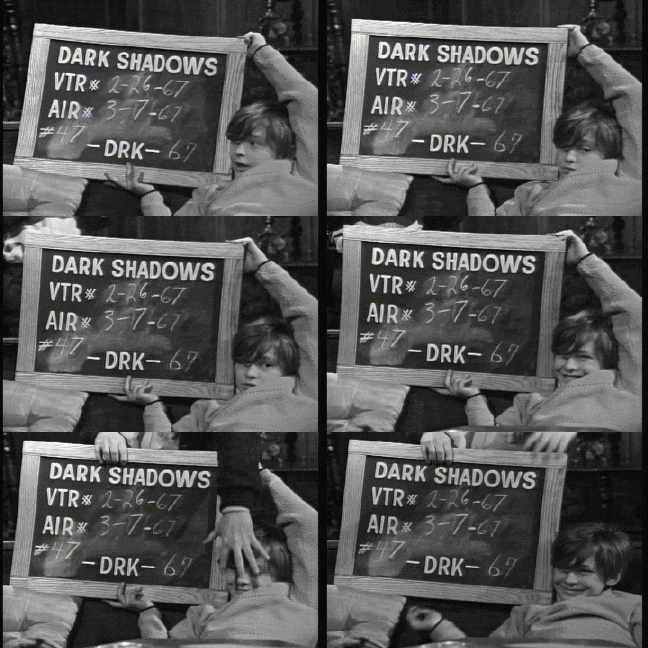
The episode originally aired on Valentine’s Day in 1967 (as they would say on the show, exactly 56 years ago!!!!) Mrs Isles was in the spirit of the holiday, as witness her blowing a kiss to the camera while holding the slate.
The announcements over the closing credits are delivered by someone other than ABC staff announcer Bob Lloyd. It sounds like the same voice we heard giving the announcements at the end of #156. I miss Bob!
The mysterious and long-absent Laura Collins is sitting motionless by the fire in her current residence, the cottage on the grounds of the great estate of Collinwood. A knock sounds at the door. As always in this situation, it takes Laura a moment to rouse herself and begin moving. When she does, her movements are disconnected and robotic, as if she is reassembling herself. This image, coupled with what regular viewers have seen in previous episodes, suggests that what we see when we look at Laura is never more than half of a person. Part of her, maybe most of her, exists in the form of energy that somehow inheres in the fire.
Laura opens the door to instantly forgettable young lawyer Frank Garner. Frank identifies himself as the representative of Laura’s estranged husband, high-born ne’er-do-well Roger Collins, in their divorce. She tells him she doesn’t want any money or property. All she wants is custody of their son, strange and troubled boy David. Since Roger is eager to see David go with her, she doesn’t see the need for a lawyer of her own.
Frank points out that as one of the heirs to the Collins interests, David stands to become a “very wealthy young man.” Laura suggests that all of David’s assets be put in a trust that she cannot access. When Frank asks how she will support David until he comes into his legal majority, she says vaguely “I have… resources.” When he presses the point, she assures him that “where I plan to take [David,] he’ll have no need for anything the Collins family could give him.” Since the Collins family is presented in this episode as “very wealthy,”* that would suggest she is taking him someplace where money cannot be exchanged for goods and services. This is, to put it mildly, an intriguing prospect.
Throughout her talk with Frank, Laura makes it clear her priority is to settle the divorce and leave with David as soon as possible. Frank says that lawyers can usually settle business among themselves more quickly than they can with people unrepresented by counsel and asks if she wants the matter settled quickly. Laura answers that she wants that “more than he can realize.” She asks Frank to represent both her and Roger, to draw up the papers to finalize what they have discussed, and to get it over with.
Before he can leave the cottage, Frank has to break some bad news to Laura. The police in Phoenix, Arizona, are still investigating a fire that destroyed the apartment where she lived in that city and killed an unidentified woman who had a key to it. There might be a hearing. If so she will have to return to Phoenix to testify, perhaps on short notice.
Laura chose to live in Phoenix. She has told versions of the legend of the phoenix both to David (#140) and to Maggie Evans (#128,) who was waiting on her table at the restaurant in the Collinsport Inn. Furthermore, Maggie’s father, drunken artist Sam, knew Laura when she lived in town ten years before and hasn’t been in touch with her since. When Maggie told him that a customer had told her the legend of the Phoenix, he clearly knew that Maggie was talking about Laura. So she has been fascinated with the story for years. In the version of the legend she related to David, it was in the context of a description of a mystical land like those which figure in the stories of the Holy Grail, which “some call Paradise,” and which is her true home. So when Laura implies that she plans to take David someplace where there is no buying or selling, we listen up.
Frank leaves, but before Laura can resume her stupor beside the fire someone else knocks. It is well-meaning governess Vicki. Vicki tells her that her boss, reclusive matriarch Liz, has ordered her to keep Laura away from David. Laura asks if Vicki will obey this command. Vicki says she has no choice. It’s her job, after all, and besides, Liz has been very nice to her.
Laura asks how someone who herself grew up in a foundling home can keep a child from his mother. Vicki recaps all the strange things that have happened since Laura came back. Regular viewers know that these events are signs of supernatural activity. We know this because we’ve seen transparent figures superimposed over shots and have heard theremin music playing on the soundtrack. But Vicki hasn’t been watching the show, so even though she tells Laura almost everything she has seen and heard Laura can provide more-or-less plausible explanations for all of it.
Vicki is unconvinced, but still goes back to the great house and tells Liz that she won’t be able to follow her orders. Laura is David’s mother, after all, and does have her rights. Liz is so angry that she can’t look at Vicki, and stares directly at the teleprompter throughout the entire scene.
Liz demands that Vicki say she will do as she has commanded. Vicki looks down, and even after Liz has repeated herself more than once she still doesn’t say that she will. The closeup on Vicki before Liz sends her away to check in on David is quite a powerful moment. In a couple of seconds, Alexandra Moltke Isles shows very clearly that Vicki is ashamed to be disobeying Liz, embarrassed to be yelled at in the drawing room, and yet determined to continue in her course of action.** It’s a remarkably efficient performance.
Vicki being yelled at
Vicki leaves the room. The camera stays on Liz as we hear voices in the foyer. Roger crosses paths with Vicki. He enters the drawing room and asks Liz why Vicki is upset. Liz dismisses the question, and Roger compares her to Lucrezia Borgia. Irritated, Liz says she is in no mood for his jokes. “Who’s joking?” he replies.
That’s a startling moment. Roger spent the first several months of the show trying to get Vicki out of the house, if necessary by manipulating David into murdering her (#68.) Now, he’s expressing sympathy for Vicki, apparently spontaneously. It’s true that the motive for that hostility was rooted in a storyline that has been partially resolved, but it is still interesting that Roger actually seems to like Vicki now.
A knock sounds. Again the camera stays on Liz in the drawing room while we hear Roger greet Frank in the foyer. It was a week ago, in #147, that we first heard characters speaking while off-camera. I wish they had done that more often. They need all the tricks they can find to create a sense of space, to make us feel that their little sets are actually a huge mansion, a rolling estate, and a whole town.
Frank tells Roger and Liz about his conversation with Laura. Roger is delighted that the only thing Laura wants is custody of David and urges Frank to draw up the papers at once. Liz, outraged, declares that custody of David is the one thing Laura can’t have, and forbids him to draw the papers up at all. Faced with this disagreement between Roger, his client of record, and Liz, who is actually paying his fee, Frank can do nothing. He excuses himself. On his way out, Roger whispers to him that he should prepare the papers- he promises to handle Liz.
The telephone rings. It is a report that the authorities in Phoenix have examined the charred corpse found in the burned ruins of Laura’s apartment. They are positive that it is the body of Laura herself. Roger and Liz are bewildered by the news.
*In other episodes, especially those focusing on the “Revenge of Burke Devlin” storyline, they seem to be gasping along on the brink of total financial ruin. But today, we hear about nothing but how terribly rich they are, so that’s what we’ll go with.
**This is puzzling for regular viewers. In #148, Vicki expressed a determination to keep Laura away from David. The information she shares with Laura is the basis for that determination. It isn’t at all clear why she doesn’t stick with it. For that matter, if she can tell Laura everything she knows when she regards Laura as a menace, why can’t she tell her benefactress Liz that she is thinking the same way she is? It could be that Ron Sproat, who wrote #148, and Malcolm Marmorstein, who wrote this one, didn’t talk to each other, and the producer was too busy with other things to catch the inconsistency. Whatever the cause, Mrs Isles gives such strong performances in both episodes that I’m inclined to treat them as self-contained stories so far as Vicki is concerned.
Yesterday, several characters saw clear evidence that supernatural forces are intervening to warn that the mysterious and long-absent Laura poses a grave danger to her son, strange and troubled boy David Collins.
High-born ne’er-do-well Roger Collins was one of those characters. In keeping with his family’s traditions, Roger habitually responds to signs of the supernatural by going into denial. He has an especially strong motive for denying that there is anything alarming about the relationship between David and Laura. David is his son, Laura is his wife, and he wants to be rid of them both. Laura wants to divorce him and leave with David, a prospect he finds most attractive.
At the insistence of well-meaning governess Vicki, Roger tells reclusive matriarch Liz some of the signs that uncanny beings are at work. In response, Liz decides to go to Laura and tell her that she may no longer see her son.
The confrontation between Laura and Liz takes place in the cottage where Laura is staying now that she has returned from her long absence. Laura points out that it is absurd for a child’s paternal aunt to forbid his mother from seeing him. The only case Liz could make in answer to this objection would rest on yesterday’s supernatural manifestations, but even if she had seen those events first-hand that isn’t something you can really bring up while conducting an argument in the modern world. So the two women just make assertions about their respective strength of personality.
Upstairs at Collinwood, David was crying before Vicki managed to calm him by telling him his mother’s favorite story, the legend of the Phoenix. In his sleep, he is crying again. Laura appears as a glowing figure in the corner of the room. She awakens him and stands at the foot of his bed.
Laura appearsLaura speaks
The oldest surviving version of the legend of the Phoenix appears in the Histories of Herodotus. Many passages in Herodotus describe dreams, and they all represent the dream as a figure standing at the foot of the dreamer’s bed, making a speech to him. That’s the usual form dreams take in ancient Greek literature generally, in fact, and that Greek image of the dream has had its influence in later writing. So I suppose it could be that Laura’s visit to David is a nod to the sources of the Phoenix legend, and it certainly could be meant to suggest a familiar way dreams are depicted in literature.
Diana Millay usually plays Laura as a dreamlike figure, rather vague in manner and stilted in speech, and this scene is no exception. David Henesy plays David Collins here in the wide-awake style of an uncomfortable character in a comedy of manners. Laura makes cryptic promises of being forever united to David, to which he gives polite but nervous responses such as “That’s nice!” and “I’m sure we will!” David doesn’t seem to be asleep, suggesting that Laura’s otherworldly manner signifies nothing so familiar as a dream.
Laura notices David’s tears. She gives him a handkerchief to dry them. At the end of their conversation, she vanishes into thin air and David falls asleep. The handkerchief is still there, however, proving it was no ordinary dream.
At this stage of her existence, Laura seems to be divided into at least three entities. There is the woman who lives in the cottage, visits the great house, and talks to the other characters. There is a ghostly image David has seen flickering on the lawn. And there is a charred corpse in the morgue in Phoenix, Arizona. There is no assurance that these are the only three components of Laura, and no explanation of how they relate to each other. Does the speaking character know about the ghost? Does one control the other? If they operate independently, do they have the same goals? If they have different goals, might they come into conflict with each other? A scene like this one raises all of those questions, because we don’t know which Laura we’re dealing with.
It is also possible that she isn’t Laura at all. A couple of weeks ago, we thought it was Laura who compelled drunken artist Sam Evans to paint pictures of her naked and in flames. Yesterday, we learned that the spirit possessing Sam was actually the ghost of Josette Collins, and that she was doing it to oppose Laura’s plans. So maybe Josette has disguised herself as Laura in order to unsettle David and keep him from following his mother to his doom.
There is an unusual blooper just short of the 3 minute mark. From 2:51 to 2:57, Alexandra Moltke Isles has a fit of the giggles. This starts when Joan Bennett enters and flares up again as she walks past Mrs Isles. It’s true that Miss Bennett’s dress betrayed a good deal more of the outlines of the garments underneath it than one would expect. That may have had something to do with the laughing attack, but Mrs Isles was usually so professional that it is difficult to believe she wouldn’t have gotten that under control after dress rehearsal. Some of the actresses have talked about how Louis Edmonds would make remarks to them before shots that made it extremely difficult for them not to laugh on camera during serious scenes, perhaps he was the culprit here.
The giggle beginsThe giggle resumesThe giggle concealed
Writer Ron Sproat stayed with Dark Shadows too long, and fans of Danny Horn’s great blog Dark Shadows Every Day will have fond memories of his frequent denunciations of Sproat. It is true Sproat had many glaring weaknesses. For example, he was pretty bad at inventing stories to tell, which you might think would get in the way of building a career as a fiction writer. But one strength Sproat undoubtedly had was a sense of structure. There might not be anything happening in one of his episodes, but you can count on him to make it clear why it isn’t happening, where it isn’t happening, to whom it isn’t happening, and who isn’t making it happen. Today there are some events, and between Sproat’s script and the work of the actors, it is plain to see what purpose each of those events serves in keeping the story on track.
As the episode opens, Lieutenant Dan Riley of the Maine State Police is visiting instantly forgettable young lawyer Frank Garner in an office. Regular viewers will be confused; we’ve seen this set several times, with exactly these decorations, as high-born ne’er-do-well Roger Collins’ office at the headquarters of Collins Enterprises. We haven’t seen the set since #69, and Roger wasn’t there at that time. So apparently Frank has moved in.
Frank hasn’t even moved the portrait of the Mustache Man from the spot where Roger had it when he was in the office. Screenshot by Dark Shadows Before I Die
Lieutenant Riley wants to pass along to Frank the information that the Phoenix, Arizona police have given him about a fire in Laura Collins’ apartment in that city. Laura is Roger’s estranged wife, and Frank is representing Roger in their upcoming divorce. It isn’t clear why Riley wants to tell Roger’s lawyer what he has heard about Laura. Later in the episode, Frank will tell well-meaning governess Vicki that Riley came to him because he is a “lawyer for the Collins family.” Perhaps that means he believed that Frank represented Laura. Throughout their conversation, Frank repeatedly protests that no one has any grounds for accusing Laura of anything, encouraging Riley in such a belief. I suppose it’s a lawyer’s job to collect damaging information about the opposition, but Frank does seem to be pushing an ethical boundary here.
The charred body of a woman was found in what was left of Laura’s apartment. Since the woman appeared to be the same age, height, and build as Laura, the room was locked from the inside, and everyone associated with the building other than Laura was accounted for, the body was initially identified as hers. Riley now tells us that the police have determined that the fire started in Laura’s apartment, and that a witness claims to have seen Laura in the building the day of the fire.
Laura checked into the Collinsport Inn the day of the fire and has been in and around town ever since, as many witnesses can testify. Riley says that there is no indication that Laura has been on an airplane recently, and it would seem impossible to travel from Phoenix, Arizona to central Maine in a few hours any other way.
The lieutenant goes on to say that because the room was locked from the inside and the woman who died in the fire made no attempt to escape, the police suspect murder. This is nonsense. An attempt to escape might have been evidence of murder, not the lack of such an attempt. And if the room was locked from the inside, how did the murderer get out?
Frank doesn’t raise these objections, but just blusters through a lot of verbiage as he protests against any suggestion that Laura should be suspected of murder. The lieutenant keeps pointing out that Arizona isn’t his jurisdiction, so he doesn’t have anything to do with it. He’s just a messenger.
Some scholar of acting really ought to make a frame-by-frame study of Conard Fowkes portrayal of Frank in this scene. He has plenty of dialogue, he’s challenging statements made by a policeman, he raises his voice, makes gestures, moves around the room, looks down moodily and up excitedly. Yet he is still so bland that it is difficult to remember a word he says. It is far beyond my understanding of the actor’s craft to explain how Fowkes manages to be so consistently dull no matter what the character is doing.
When Frank is a small part of an episode, I think of his blandness as a note of pure realism. He is just the sort of person you would expect to meet in a small-town law office in 1967, and indeed it is reassuring to think that someone who has obviously never thought of putting himself in the spotlight would handle your sensitive legal affairs. The last person anyone should want as a lawyer is some guy who habitually makes himself interesting to watch on television.
Today, Frank is the leading man of the first half of the episode, and comes back with a key part in the second half. Giving that much time to a performer with such a bland screen presence does serve a purpose. None of the characters has really committed to the notion that they have to worry about crimes and physical danger, much less that they are facing a challenge from the realm of the supernatural. As far as they know, the whole story today is about a couple of romances and a child custody matter. That’s the right speed for dull, amiable Frank Garner.
That the characters don’t yet know the true dimensions of what they are facing in the storyline is one of the points this scene has to make. The other is that we will be hearing more about the investigation in Phoenix, and that it will advance the plot.
I think an acting problem muddies this second point. Today Vince O’Brien takes over the part of Lieutenant Dan Riley from John Connell, who played him in #143 and #144. As Connell played him, Riley was an out-of-town cop, not the least bit awed by the Collinses of Collinsport. His matter-of-fact speaking and impatient listening made it clear that the family’s connection to the case in Phoenix was not going to result in the discreet, abbreviated treatment that the local authorities have given them. But O’Brien’s version of the character is noticeably quick to agree when Frank makes a statement. When Frank does a TV lawyer “may I remind you” about the elements of a murder charge (elements which he gets wrong, but hey, it’s TV, not law school,) O’Brien’s Riley is agitated. He shows defiance by declaring “You don’t have to remind me” in a harrumphing voice, but his wide eyes and trembling legs show that he is intimidated to be in a discussion with the representative of the mighty Collinses. There’s no point in bringing in an out-of-town character if that’s what you’re going for- the residents of Collinsport can show you what it’s like to live under the thumb of the people in the big house on the hill. And it introduces a doubt as to whether anything will come of the investigation, a doubt which leaves us wondering why we just spent so much time watching these two guys talk to each other.
Meanwhile, Vicki is visiting dashing action hero Burke Devlin in his hotel suite. Burke has asked her to come. Yesterday, she told him that she was suspicious there was something sinister about Laura, and he had listened attentively. Later, he met with Laura and the love he once felt for her had flared back into life. So today, he wants to tell Vicki that Laura is A-OK and she should do everything she can to help her.
Like the scene with Frank and Lieutenant Riley in Roger’s office, this scene has two points to make. First is to establish Vicki as a credible protagonist for the rest of the storyline about the danger Laura presents to her son, strange and troubled boy David. Second is to show that Burke is so smitten with Laura that he won’t be much help in protecting David.
Burke guides Vicki into his kitchen, a cozy space where people can confide in each other. Last time they were in this space, she made coffee for him; this time, he makes coffee for her. He’s remarkably dainty about it, sifting cream and sugar in separate cups. He makes a pitch about how remarkable Laura is, how he’s rethought everything they said yesterday, and how a fine woman like her deserves Vicki’s trust and support.
Vicki is unimpressed. She was in the room when Laura telephoned Burke yesterday, and heard him agree to meet her at one of their old places. She presses him to explain what has changed his mind, and he won’t give a clear answer. She asks how well he really knows Laura, and he looks dreamily off into space and says that he knows her better than anyone else. She asks if his feelings for Laura might be clouding his judgment, and he demands she change the subject. When Burke urges her to persuade David to grow closer to his mother Laura, Vicki replies “I’ll do what I can for David.” Burke says “You’re hedging.” Vicki replies coolly, “I can’t help it.” When he repeats his urging, he tells her she doesn’t look convinced. She replies, “I can’t help how I look, either.”
Vicki’s strength and intelligence and Burke’s dreamy infatuation should impress anyone watching this scene, but especially viewers who just saw yesterday’s episode. When Vicki is asking Burke what happened between yesterday and today to change his mind, she is waiting for him to talk about the meeting he arranged with Laura while she was right next to him. He never mentions it, and his repeated statements that all he has done is think more deeply implies that he does not remember that Vicki heard him talking to Laura. He is so captivated with Laura that the sound of her voice erases his awareness of everyone else, even of someone he is trying hard to persuade of an important idea.
Shortly after Vicki leaves, Burke receives another visitor from the great house of Collinwood. Flighty heiress Carolyn shows up. Carolyn is pouting because Burke hasn’t been paying attention to her since her Aunt Laura showed up.
This scene has one major point to make, which is that the budding Burke/ Carolyn romance is not going to be blooming this winter. Nancy Barrett’s Carolyn bursts off the screen as she bounces from one extreme to another, trying to attract Burke by pushing her breasts at him, trying to anger him by suggesting that her mother Liz and her Uncle Roger were right when they said he was just using her to get at them, trying to embarrass him by bringing up the obstacles between him and Laura, trying to break through his reserve by flinging her arms around his neck and pleading with him to love her.
Burke tries to let Carolyn down easy, smiling at her, caressing her face, hugging her, kissing her on the forehead. But signs of boredom and irritation keep slipping out. He tells her that the time has come for them not to see each other any more, and there can be no doubt he means it.
Burke, bored with Carolyn
Vicki goes to visit Frank. Frank blabs everything to her that the lieutenant had told him.
Vicki is deeply concerned about the idea that Laura might be a murderer. Frank keeps telling her that there’s probably nothing to that idea, but Vicki resolves at the end of the episode to do whatever she can to keep Laura away from David. Having established Vicki as a character strong enough and smart enough to square off with Laura in her previous scene, this scene shows us her decision to do just that.
A few times in the early months of Dark Shadows, writers Art Wallace and Francis Swann found themselves in a corner. The story could move forward only if a character took a particular action, but they couldn’t come up with a reason to explain why any character would take that action. So they had the character do whatever it was simply because it was in the script, and hoped the actors or director or somebody would come up with sleight of hand to conceal their desperation.
Since well-meaning governess Vicki was on screen more than anyone else, she was the one most often required to behave without motivation. Sometimes, Alexandra Moltke Isles finds a way to make Vicki’s behavior intelligible in spite of the writers. The scenes in which Vicki tries to befriend her charge, strange and troubled boy David Collins, are Dark Shadows‘ premier example of good acting trumping bad writing, and there are smaller examples as well. But there are three times in the Wallace/ Swann era- in episodes 26, 38, and 83– when Vicki simply looks like an idiot. This “Dumb Vicki” will appear more and more often as the series goes on, and will eventually ruin the character and do grave damage to the show.
Some weeks ago, Wallace and Swann were succeeded as the principal writers of the show by Ron Sproat and Malcolm Marmorstein. Sproat was a cut below Wallace and Swann, and Marmorstein was far less talented even than Sproat. Today, we get a succession of Dumb Vicki moments resulting from basic incompetence on Marmorstein’s part.
Vicki is visiting her friend Maggie Evans, The Nicest Girl in Town. Maggie has shown her a canvas that her father, drunken artist Sam, was possessed by an unexplained force to paint. Sam hates the painting and is surprised as he watches it take shape under his brush, but is powerless to stop working on it. It depicts Laura Collins, mother of David. Laura is shown as a winged figure, nude and engulfed in flames.
Sam has had several scenes in which he was shown in closeup delivering speeches about his hatred for the painting and going through convulsions while spooky music plays on the soundtrack. He has also had scenes with Maggie and with Laura’s husband, high-born ne’er-do-well Roger Collins, in which he tries to explain what is going on with him and the painting. Yesterday, Maggie recapped much of this to Vicki, sharing the suspicion that Laura is somehow responsible for Sam’s compulsion to paint the picture. Since the show has also given us loads of hints that Laura is connected to the supernatural, this all adds up to a very heavy-handed way of telling the audience that Sam is possessed.
Once you can say that your characters are possessed by unseen spirits, you get a lot of extra latitude as to what constitutes motivation. Once they have shown us that he is possessed, all we need to know about Sam for his actions to make sense is that he has some kind of connection to Laura and that Laura has some connection to the supernatural. The results of the possession hold our interest as we compare them with other events in the story and look for a pattern we can fit them into.
As far as the supernatural beings responsible for the possession go, we don’t need much information at all about their motivation. Far less than for human characters. Most audiences have more or less definite ideas as to what human beings are and what makes them do the things they do. We’re more flexible as to what supernatural beings are, and are willing to spend a long time searching for coherence hidden in story elements that don’t seem to have a logical connection once we have seen that there are uncanny forces in operation.
To get the benefit of that audience participation, a writer does have to show that supernatural forces are at work. Today, Vicki seems to be possessed, but there is no scene showing us that this has happened. Vicki looks at the painting and says she wants it. Asked why, she says she doesn’t know. Nothing she says makes much sense, or much impression.
Three seconds of Vicki staring at the painting while we hear a theremin cue on the soundtrack would have sufficed to tell us that she was falling under a spell. Not only don’t we get that, Mrs Isles never gets a chance to show us what is happening to Vicki. When Vicki first looked at the painting, she was partially obscured, standing behind Maggie; examining it later, she has her back to the camera. During her dialogue with the loudly agitated Sam, only a few brief shots focus on her. Sam gives Vicki the painting. When Maggie says she wonders how Laura will react when Vicki brings the painting into the house, Vicki mumbles that she doesn’t know.
Had we seen Vicki falling under the spell, the result could have been a powerful moment. As a supernatural storyline goes on, the mysterious forces behind it spread their influence from one character to another. The first moment in this one when we could see that sort of contagion at work is when the powers that have been controlling Sam take hold of Vicki. To hide that moment from us is to hide the whole development of the narrative arc.
Moreover, that this particular development takes place on this set among these characters is quite significant. When Vicki and Maggie first met, Maggie told her that she was a jerk for taking a job at the great house of Collinwood. She told Vicki that Collinwood was a source of trouble for the town of Collinsport. As the weeks went on, Maggie and other Collinsport natives made it clear that a big part of that trouble comes from the ghosts and ghoulies that are housed in Collinwood and that threaten to break out and take over the town. This will indeed become the major theme of the show in the years ahead.
Now Vicki has lived in Collinwood for over six months, and the only ghosts she has seen are the friendly, protective spirits of Josette Collins and beloved local man Bill Malloy. The first time a supernatural being does something frightening to Vicki is in the town of Collinsport, in Maggie’s own house.
Indeed, the Phoenix storyline is the only one in the whole series to invert the usual pattern of Collinwood as hell-mouth and Collinsport as a beleaguered outpost of normality. There are other storylines where evil powers came from far away, from across the sea or from another dimension, and settled in Collinwood before spreading out to threaten Collinsport, but in this story the source of the disturbance is Laura. While she may tell David in episode 140 that she comes from one of the realms described in the legends of the Holy Grail, that origin applies only to her uncanny side. When Laura first came to town, she had told Maggie that she was originally from Collinsport, and in episode 130, Laura’s estranged husband Roger, and Roger’s sister, reclusive matriarch Liz, had mentioned that Laura’s family had moved away from town.
The episode also leaves us on our own trying to figure out what Vicki is thinking. Regular viewers might take some time during the commercial break to puzzle it out, put it in the context of what we’ve seen previously, and wonder if Vicki is in a stupor because she too is possessed. That might help us to get through the rest of the episode, but if we are to feel a live connection to the character we have to understand what she is feeling while we are watching her. A theory we come up with after the fact is no substitute for empathy we experience during the scene. And of course people tuning in to Dark Shadows for the first time will simply think that Vicki is some kind of idiot.
Many fans of Dark Shadows, especially those who haven’t seen the first 42 weeks of the show or who didn’t see them until later episodes had given them fixed impressions, blame Alexandra Moltke Isles’ acting for Dumb Vicki. But today’s scene in the Evans cottage shows how deeply unfair that is. If an actor doesn’t have lines to deliver, she can’t use her voice to create a character. If the camera isn’t pointed at her, her body language is no use. And if the director is telling her to play the scene quietly while the others are going over the top, she’s likely to fade into the background. Without even a musical sting on the soundtrack to support her, there is nothing Mrs Isles could have done to communicate to the audience what Vicki is going through in this scene.
It is easy for me to denounce Malcolm Marmorstein, since his scripts are so often so bad. I am reluctant to place a share of the blame on director John Sedwick, since I am always impressed with Sedwick’s visual style and usually with his deployment of actors. But I can’t believe anyone would have stopped him pointing a camera at Mrs Isles at the appropriate moment, giving her a chance to play her part.
Back at the great house of Collinwood, David and Laura are sitting by the fire. David asks his mother about her old boyfriends. He wants to know if she ever dated dashing action hero Burke Devlin. She admits that she did. When David lets on that he wishes Burke, rather than Roger, were his father, Laura squirms. We’ve had a number of indications that Burke might in fact be David’s biological father, and Laura is alarmed that David is raising the topic.
The front door opens, and David and Laura are glad to see their friend Vicki. They are intrigued by the package Vicki is carrying. David begs to see what’s inside. Laura, in a light and cheerful voice, tells him that if Vicki wanted him to see it, she would have shown it to them. He continues to beg. Vicki says “All right!,” and unveils it. When we were watching the episode, Mrs Acilius exclaimed “All right!?,” appalled at Vicki’s nonsensical decision to yield to David’s pleas despite the cover Laura was giving her. Again, the idea that Vicki’s weird decisions and vague, distracted manner might be symptoms of possession was somewhere in our minds, but since nothing had been shown to give direct support to that idea our emotional reaction suited a Dumb Vicki moment.
As Maggie had suggested she might be, Laura is horrified to see herself depicted in this fiery image. David is thrilled- he had been plagued by a recurring nightmare, one he had described in detail to the deeply concerned Vicki, in which his mother stood in a sea of flames and beckoned him to join her. He asks how Sam knew about his dream- did he have the same dream? Vicki mumbles that he didn’t, that he didn’t know anything about the dream or even why he was painting the picture. The audience may have wondered why Vicki didn’t remember the dream until now- the explanation that fits best with the story is that she has been possessed by the same spirit that possessed Sam, but with so little attention given to Vicki as she was reacting to the painting some very insightful critics have taken it as another Dumb Vicki moment.
David points to a white space in the painting, one the shape of his own head, and asks what goes there. Vicki mumbles that she doesn’t know, and that Sam himself didn’t know. David is delighted with the painting and wants to hang it in his room. He asks Vicki to give it to him. Vicki tells him that his mother will have to rule on that question. Laura hates the painting and tries to talk David out of hanging it, but he is nothing deterred. She finally caves in.
While David goes upstairs with the painting, Laura asks Vicki what she was thinking bringing such a terrible thing into the house. Vicki says she doesn’t know- something just came over her. That goes to show that the writer wanted us to think that Vicki was possessed, which in turn makes it all the more exasperating that he didn’t let us in on it at the appropriate time. The fact that we know the writer wants us to have a reaction doesn’t mean that we actually have it. Confusion pushes people away from a story, and merely intellectual explanations offered after the fact don’t draw us back in.
Vicki, seeming to regain some of her brainpower, goes to David’s room and tries to talk him out of keeping the painting. He dismisses her concerns immediately, without even changing his delighted manner, and hangs it on his wall. Looking at it, Vicki admits that it looks like it belongs there.
Laura enters, and tells David she has changed her mind. She thinks it would be bad for him to have such an image on display, and asks him to get rid of the painting. David responds by threatening never to speak to her again. Laura has just been reunited with David after years of separation, and his initial reaction to her return was confused and traumatic. So it is understandable that she capitulates to this extortion.
It is more surprising that Vicki responds by turning away and wringing her hands after Laura leaves. Usually Vicki scolds David after he is nasty to people, and she has been on a particular mission to break down the barriers between him and his mother. If it were clear that Vicki was under the influence of a spirit and was not herself, this uncharacteristically diffident response might have carried a dramatic punch, at least for regular viewers. As it is, it slides past as yet another Dumb Vicki moment.
Back in the Evans cottage, Sam comes back from his usual night of drinking at the local tavern. Maggie is infinitely weary of her father’s alcoholism, but does smile to hear him reciting poetry and talking about a seascape he is planning to paint. At least he’s happy. Sam goes to his easel to start that seascape, only to recoil as he realizes that he is in fact painting another version of the picture of Laura in flames.
David is asleep in his room. The painting starts to glow. Then Laura’s painted likeness is replaced with a video insert of her face. The insert grows and grows, and David screams for it to stay away.
Maggie’s suspicion that Laura is behind the portrait fits with the many signs the show has given us of Laura’s uncanny nature. Laura’s reaction when Vicki brings the painting home, though, shows us that what has been happening to Sam does not serve Laura’s interests, any more than David’s nightmare did.
I think there are three possible explanations for the origin of the compulsion Sam had to paint the picture, the compulsion Vicki had to claim it, and David’s nocturnal disturbances. It could be that by exposing David time and again to the image of him following her into flames, Laura is gradually wearing down David’s resistance to a horrible idea that will lead to his destruction. In support of this interpretation, we remember the first night Laura was at Collinwood. She was calling David’s name in a quiet voice at the window of her cottage, far from the great house. Yet the sound of her voice penetrated David’s mind as he slept. He writhed on his bed, and went into the nightmare. Laura’s objection to the painting militates against this explanation.
When we were watching the episode, Mrs Acilius suggested a second reading. There might be a lot to Laura. Maybe in addition to the physical presence in the house that wants David to come away with her, there is also a ghostly presence that wants to warn him and everyone else of the danger that implies. That interpretation would fit with David’s sighting, the night Laura first came to the house, of a flickering image on the lawn that looked like Laura. David longed for that Laura to come to him, but reacted with terror when he saw the fleshly Laura in the drawing room. Perhaps there are two of her, and one is trying to protect David from the other. It is also possible that the two Lauras are not aware of each other, or even fully aware of themselves. So this interpretation is easier to reconcile with apparently contradictory evidence.
Vicki’s involvement suggests a third possibility. The ghost of Josette Collins appeared to her and comforted her in episode 126, and an eerie glow had emanated from the portrait of Josette when David left Laura alone in the Old House yesterday. Laura was alarmed to hear that David was interested in the ghosts of Collinwood, had not wanted to go to the Old House, and lies to David when he asks if he saw any sign of Josette’s presence. Perhaps Josette is intervening to thwart Laura’s plans, and it is her power that is benumbing Vicki today. Josette’s previous interventions have been intermittent and subtle, suggesting that it is difficult for her to reach the world of the living. So if she is preparing for a showdown with Laura, we might it expect it to take her some time to recruit her strength.
Again, this is the kind of search for patterns that an audience will gladly go into once you’ve let them know that there are supernatural forces at work in your story. Since Josette has been in the background of the show from week one, has appeared repeatedly, has a set devoted to her in the Old House, and has established connections with both Vicki and David, we might expect her to be the first of the uncanny presences we think of when we enter a supernatural storyline. That she is a tutelary spirit presiding over Collinwood brings it into sharp focus that the estate is under assault from a supernatural force emanating from the town of Collinsport. Today’s failure with Vicki kicks Josette’s ghost out of the spotlight, and that is one of the major faults with the episode.
This is the thing that people miss when they talk about soap opera couples. Two characters don’t have to be in love with each other to be a “couple” — although they often are, which is why people think that’s the definition.
Two characters are a “couple” when a scene with them together is way more interesting than a scene with them apart. It makes absolutely no difference whether they love each other, or hate each other, or they’re partners, or best friends. Kirk and Spock are a couple. Ernie and Bert are a couple.
By Danny’s definition, Dark Shadows‘ first supercouple is well-meaning governess Vicki and her charge, strange and troubled boy David Collins. Most of the storylines the series started with- Vicki’s quest for her origins, dashing action hero Burke Devlin’s quest for revenge on high-born ne’er-do-well Roger, reclusive matriarch Liz’ insistence that certain parts of the house never be entered, the doomed romance between flighty heiress Carolyn and hardworking young fisherman Joe, etc- either dribble away to nothing or never really get started. But Vicki’s attempt to befriend David is interesting every time we see the two of them together on screen.
That is entirely down to the actors. The scripts give David the same viciously hostile lines of dialogue over and again, require Vicki to read aloud from textbooks about the geography of Maine, and lock Vicki up in windowless rooms for what seem like eons. But David Henesy and Alexandra Moltke Isles, with their facial expressions, tones of voice, gestures, use of space, etc, create the impression of a relationship steadily growing in emotional complexity and importance. When David finally looks up into Vicki’s eyes and declares “I love you, Miss Winters!” in #89, this body language gives us a context within which we can feel that a plot-line has moved forward. In the months since that statement, David and Vicki have grown closer, and now they are quite cozy.
So much so, in fact, that there is a danger that they might end up recreating the interpersonal dynamic that Liz and Roger model and that will become Dark Shadows’ signature- a relationship between a bossy big sister and her bratty little brother. Liz continually tries to control Roger’s behavior so that he will not be bad, and when her efforts fail, as they invariably do, she covers up for him and shields him from accountability. Earlier this week, as Vicki explained David to himself and he clutched at her for support after he had done shocking things, we could see how after a time they might fall into that pattern.
Today, they seem to put that danger behind them once and for all. David’s mother, the mysterious and long-absent Laura, has come back and wants to take David to live with her. David has wanted this for years, but in the days since Laura’s return has come to be deathly afraid of her. Vicki has met with Laura and arranged to cross paths with Laura when she and David take their afternoon walk. Vicki’s theory, which has quite a bit of evidence behind it, is that David is only afraid of rejection, and that if he can see his mother in a setting where nothing will be expected of him he will start to relax.
The first result of this encounter is that David slips off a high cliff, clinging for his life to a crumbling rock on its edge. This would seem to be a negative outcome. Vicki rescues him, embraces him, and talks him into going to his mother.
Vicki holds David and urges him to go to his mother
David sees that Laura is crying and apologizes to her. They embrace and warm to each other. David, Laura, and Vicki walk back to the house together. David’s father, Roger, and his aunt, Liz, are impressed with the progress Vicki has made.
Happy at home
Dark Shadows began on a sort of 14 week schedule. Coming at the end of the first 14 weeks, episode 70 gave us our first visit to the haunted Old House and our first unambiguous sighting of a ghost. At the end of the third 14 weeks, episode 210 will end with a hand darting out of a coffin and rebooting the show entirely. Today, the conclusion of the second 14 week period is perhaps less spectacular, but in its own way just as pivotal as those other milestone episodes.
With David’s apology for making his mother cry and his resolution to open up to her, he is becoming significantly less bratty. With her handing of David off to Laura, Vicki is renouncing her opportunity to be bossy, and indeed to become a surrogate sister to him. With that danger out of the way and an untroubled friendship established between them, the Vicki/ David arc seems to have reached a logical conclusion. The series will have to find a new supercouple, or a clutch of new storylines, if it is to hold our attention in the long term.
Perhaps Laura and David will be the new pair at the center of the show. They are together at the beginning and end of the second half of the episode, and in between Laura gets some information about David to which she gives an intriguing reaction.
At the beginning of that second half, the five characters in today’s episode share a meal in the kitchen at Collinwood. The richest people in town live in a huge mansion, and this is their dining room:
Family dinner
I suppose Liz and her daughter, flighty heiress Carolyn, lived alone in the house for 18 years, ending with Roger and David’s arrival sometime last spring. So perhaps there is a bigger dining room sealed off somewhere. Be that as it may, the smallness of the kitchen is one of its most valuable features as a set. Scenes there have an intimacy that makes it natural for characters to share important information with each other. Indeed, almost every time we’ve seen the kitchen, we’ve seen someone pick up information that led them to take action that advanced the plot.
Liz and Roger mention that Laura hasn’t eaten anything. Roger follows that with jokes about the cooking abilities of Mrs Johnson, Collinwood’s housekeeper. Laura not eating is a familiar theme to the audience. The first several times we saw Laura she was in the restaurant at the Collinsport Inn. Maggie Evans, keeper of that restaurant, remarked that Laura never ate during any of her visits there, and yesterday she didn’t touch the breakfast Vicki brought her. The emphasis they keep putting on this point is one of many signs they’ve offered that there is something uncanny about her.
After the others have left the little table, Liz exchanges a few words with Laura. She mentions that David is a highly imaginative child, who even supposes that he talks with the ghosts of Collinwood. At this, Laura opens her eyes wide, shifts in her seat, looks straight ahead, and says that that does sound like pure fantasy. Liz adds that he spends a lot of time with the ghosts. Laura glances back in Liz’ direction and says that perhaps now he will spend more time with her.
One might imagine that a long-absent mother, hearing that her son thinks he spends a lot of time in conversation with ghosts, would be concerned for his mental health. A reaction like the one Laura gives Liz might be a sign of such concern. But we’ve had so many hints that Laura is herself somehow connected to the supernatural that this does not seem to be a likely explanation. More probably, her discomfort is a sign that David’s sensitivity to the uncanny and his communication with the ghosts might lead him to learn something about her that she does not want him to know.
Laura and David sit by the fire in the drawing room. Vicki has scolded David for his habit of standing at the doors to the drawing room and eavesdropping on conversations taking place inside. Now, it’s Vicki’s turn to stand on the same spot and eavesdrop on a conversation involving David.
Vicki listens in
David has asked Laura to tell him about the place she comes from. “Some call it Paradise,” she says. She starts describing a hot, sunny place with palm trees. Her last known address before appearing in Collinsport was Phoenix, Arizona, so maybe that’s what she’s talking about. But as she goes on, the description sounds less and less like that city, and more and more like the places we hear about in the legends of the Holy Grail. The air is always fragrant with the flowers that bloom continually, and the trees are the proper nesting places of a creature that figures prominently in the Grail legends, the Phoenix. David has never heard of the Phoenix, and Laura tells him an elaborate version of its story.
In episode 128, Maggie sat at Laura’s table in the restaurant and Laura told her the story of the Phoenix. When Maggie told her father, drunken artist Sam, that a mysterious blonde woman who used to live in Collinsport had told her that tale, Sam had reacted as if he recognized the story as one Laura used to tell. The version she told Maggie, though, was a relatively brief one, and was by way of an etymology for the name of her most recent hometown. The version she tells David today is much more elaborate. It evokes a whole world, claims that world as her home and therefore as David’s, and invites David to take his rightful place under the sign of the Phoenix.
As Vicki hears Laura reach the climax of the story, a sudden wind blows the front doors open, and a fraction of a second later blows the drawing room doors open as well. Laura looks up and sees Vicki eavesdropping. She is a bit startled to see her, though not as startled as Vicki is to be seen:
Vicki caught eavesdropping
After a brief moment- less than a second- Laura turns from Vicki and to the fire. She and David peer into the flames.
Peering into the flames together
Laura turns from the flames and looks at David. The episode closes with her look of satisfaction as she sees her son fascinated by the fire.
Watching David watch the fire
The doors have blown open before when the show wanted us to think that supernatural forces are at work in the house. Laura herself may control some supernatural forces, but it seems unlikely that she is the author of this incident. It interrupts her story just as she is declaring that “The Phoenix is reborn!,” her reaction shows that she didn’t know or particularly care that Vicki was eavesdropping, and her turn to the fire would suggest that she is concerned the wind might have extinguished the flames. Perhaps we are supposed to think that Laura’s presence and her plans have stirred up one or more of the ghosts Liz mentioned to Laura after dinner, and that the gust of wind was a sign of their presence. That would in turn suggest that the weeks ahead will feature a conflict between Laura’s uncanny powers and those of the spirits lurking in the back-world implicit in the action of the show.
High-born ne’er do-well Roger Collins walks in on his estranged wife, the mysterious and long-absent Laura, fending off an attempt by his arch-nemesis, dashing action hero Burke Devlin, to plant a kiss on her. Roger is equipped with a bolt action rifle.
Great emphasis is placed on the rifle. The most prominent set in all of Dark Shadows is the drawing room in the great house of Collinwood, and it was altered yesterday to put a gun rack on its wall. This will startle regular viewers who remember that in episode #118 reclusive matriarch Liz had to go to the back part of the house to dig up Roger’s almost-forgotten guns. Now, those guns are on display in the family’s main dwelling place and holiest shrine.
It is 1967 and everyone associated with the creative side of the show is connected with the NYC theater world, so there is approximately a 100% chance that we are intended to read these scenes in Freudian terms. The gun is a phallic symbol, but a corrupted, sickened one- it promises, not pleasure and the creation of new life, but pain and killing. In the context of Roger and Laura’s dead marriage, it demonstrates that Roger’s sexual frustration has warped him and led him to violence.
Roger declares that Burke is trespassing on his property and bothering his wife, and declares that no court in the world would convict him of anything were he to shoot Burke to death. He also says that killing Burke would give him great pleasure. Burke asks him why he doesn’t do it, and Laura wearily complains that she had enough of these sort of encounters between them ten years ago.
Laura’s remark comes as a jolt. Ten years ago, Roger and Laura were not a long-separated couple in the process of divorcing- they were not yet a couple at all. As far as the world was concerned, she and Burke were involved with each other, and Roger was a friend who sometimes tagged along on their dates. That was the situation until a fatal hit-and-run accident involving Burke’s car. This is the first time the three of them have been alone together since that night. After the accident, Laura and Roger testified against Burke. He went to prison and they married each other. When Laura says that the way Roger and Burke are carrying on now is the way they interacted ten years ago, she is saying that even when she was ostensibly Burke’s girlfriend the two men were more excited about each other than either was about her. Perhaps Laura was the one who tagged along on Roger and Burke’s dates.
Burke grabs the gun. He and Roger struggle for it. It fires into the ceiling, and Burke tears it from Roger’s hands, flinging it to the floor. Burke picks it up. Roger rants and raves, vowing to kill Burke. Yet he does not make any protest when Burke walks off with the rifle, even though the rifle is a valuable piece of property and a central feature of Collinwood’s decor. Roger can attempt to express his masculinity only in conjunction with Burke. When Burke removes the phallic symbol and silently leaves, Roger is struck mute.
After Burke leaves, Roger and Laura continue to develop the themes of powerlessness and sterility. Having none of the influence over her an ongoing sexual relationship might give him, he complains of her disloyalty to him and of his humiliation in the eyes of those who might see her socializing with Burke. He tries to assert power over her with threats of legal consequences if she goes along with Burke’s plan to reopen the hit-and-run case. Laura agrees that she cannot help Burke without losing the one thing she wants to gain, custody of their son, strange and troubled boy David. Roger completes the image of his own emasculation with a parting remark that he will be happy to see Laura leave with their son “if David is my son.”
There is something of a fault with the production. Neither Laura nor Roger is in a position to bring new life into the world, and we are in doubt as to whether Laura is, strictly speaking, alive at all. Yet as Laura, Diana Millay is quite visibly pregnant, and she will only get “pregnanter and pregnanter” as the story goes on. Her style of acting, her personality, and her looks are so perfect for the part that it is impossible to imagine anyone else playing it, but it was very confusing to present her as an avatar of death and the unreal past when she is such a strong visual symbol of life and the growing future.
After Roger flounces out of Laura’s cottage, she goes to the window and calls to David. We see David asleep in his room in the great house. He is writhing on his bed, hearing his mother’s voice and having a nightmare. Well-meaning governess Vicki wakes David, telling him that it is 10:30 AM.* David tells her that he had the same nightmare he did the night before, in which his mother beckoned him into a firestorm. Vicki tries to assuage his fears, purring lovingly at him, but he is still deeply disturbed.
Roger enters and tells David to come along and see his mother. David flies into a tantrum, insisting that he will not see her and that no one can make him. When Roger threatens to beat him, David clings to Vicki and pleads with her to stop his father from hitting him. Vicki calmly states that “No one is going to hit you,” underlining Roger’s lack of authority in his relationships with both David and the hired help. David runs off.
Vicki sits on David’s bed and tells Roger that she has a theory about David’s behavior. She believes that he really wants to see his mother and that her love is tremendously important to him, but that he has worked himself into his current state because he is afraid she will reject him. This theory has a very substantial basis in fact. When Laura first came to the house in #134, David was extremely eager to meet her, until he suddenly asked Vicki “What if I do or say something to make her hate me?” From that moment on, he has become more and more reluctant to see Laura. Vicki tells Roger that she will work to arrange a meeting between mother and son in a situation where he will not feel pressured to perform in any particular way.
Vicki shows up at the cottage carrying a tray of tea things. Laura is impressed with the breakfast. Vicki shares her idea of arranging an apparently chance meeting during the walk she and David take around the grounds every afternoon beginning at 4:30.** Laura does not eat or drink anything during her breakfast with Vicki, but she does ask a series of questions about David. Vicki enthusiastically tells her every nice thing about him she can think of, leaving out such awkward incidents as his attempts to murder Roger and Vicki herself.
Laura chooses the top of Widow’s Hill for their “chance” meeting. This is rather an odd place considering that it is likely to be getting dark by 4:30 PM in early January in central Maine, and Widow’s Hill is a place from which people famously fall to their deaths. But, Laura is the boy’s mother. Besides, the other option was the greenhouse, and they don’t have a set for a greenhouse, so Vicki goes along with it.***
At the top of the hill, David asks Vicki why she wanted to go there, and starts talking about how dangerous it is. He noodles around at the edge of the cliff, alarming her, but he says he knows the ground so well it isn’t dangerous for him. After a minute, David says it’s boring there and he wants to leave. Vicki scrambles for a reason to stay, and finds a ship on the horizon. That catches David’s attention. He watches it, wanders ever closer to the precipice, and talks about sailing around the world.
That’s when Laura shows up. In episode 2, Roger introduced himself to Vicki by startling her while she stood on the edge of the cliff, nearly prompting her to fall to her death. In #75, Vicki returned the compliment. Now, Laura simply starts talking while David is on the precipice. Shocked to hear her voice, he jumps back.
Laura goes on about how David was always interested in exotic places when he was a little boy. He looks petrified, but does agree that he remembers those conversations. She reaches out and calls him to come to her. He recoils, slips, and ends up clutching the side of the precipice. That’s what’s known as a “cliffhanger ending.”
*In many markets, ABC affiliates ignored the network’s recommendation that Dark Shadows be broadcast at 4:00 PM and showed it at 10:30 AM. Hearing Vicki mention this hour makes me wonder if we are supposed to think of the action of a soap opera taking place, not only on the date of the original broadcast, but at the time.
**4:30 was the time when Dark Shadows ended in markets where the ABC affiliate went along with the network’s recommended schedule. Mustn’t have people outdoors between 4 and 4:30!
***Mrs Acilius pointed out this consideration when we were watching the episode.



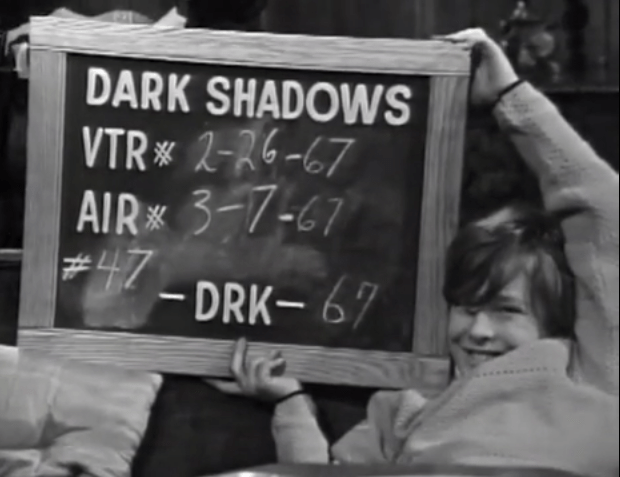


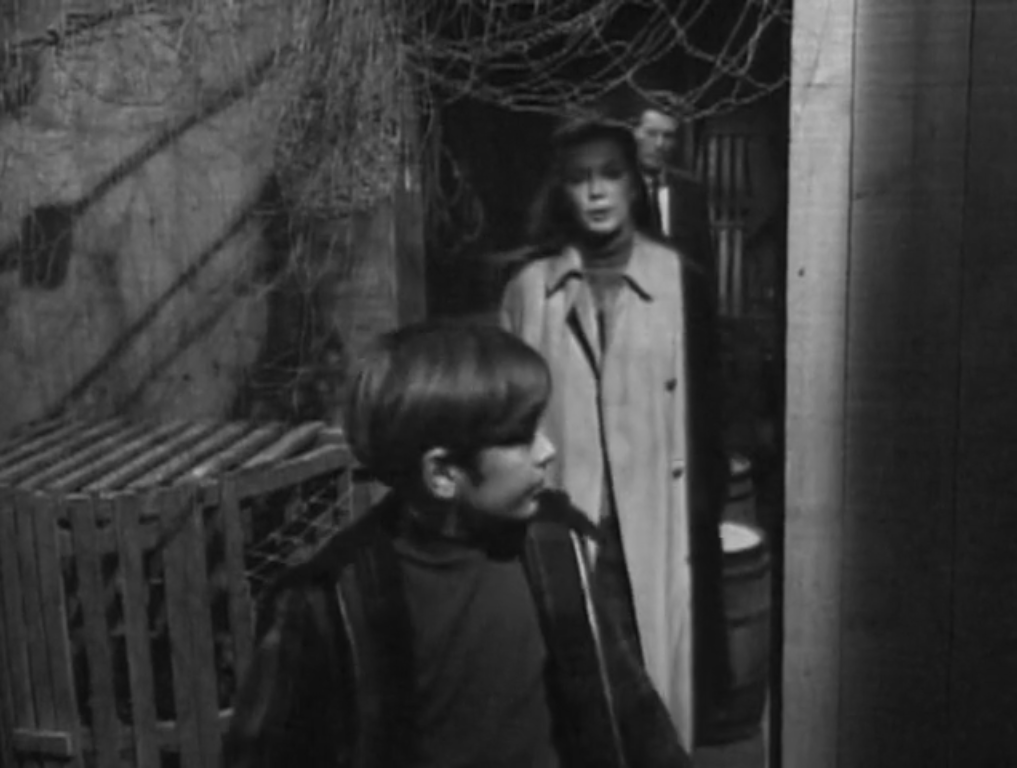

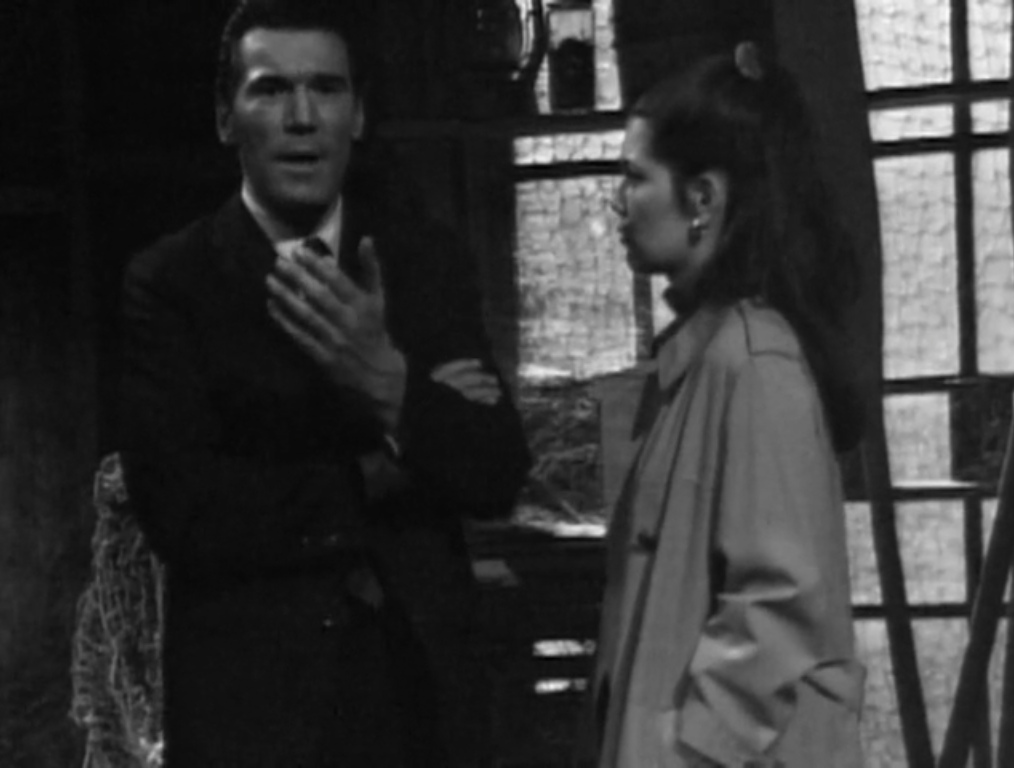
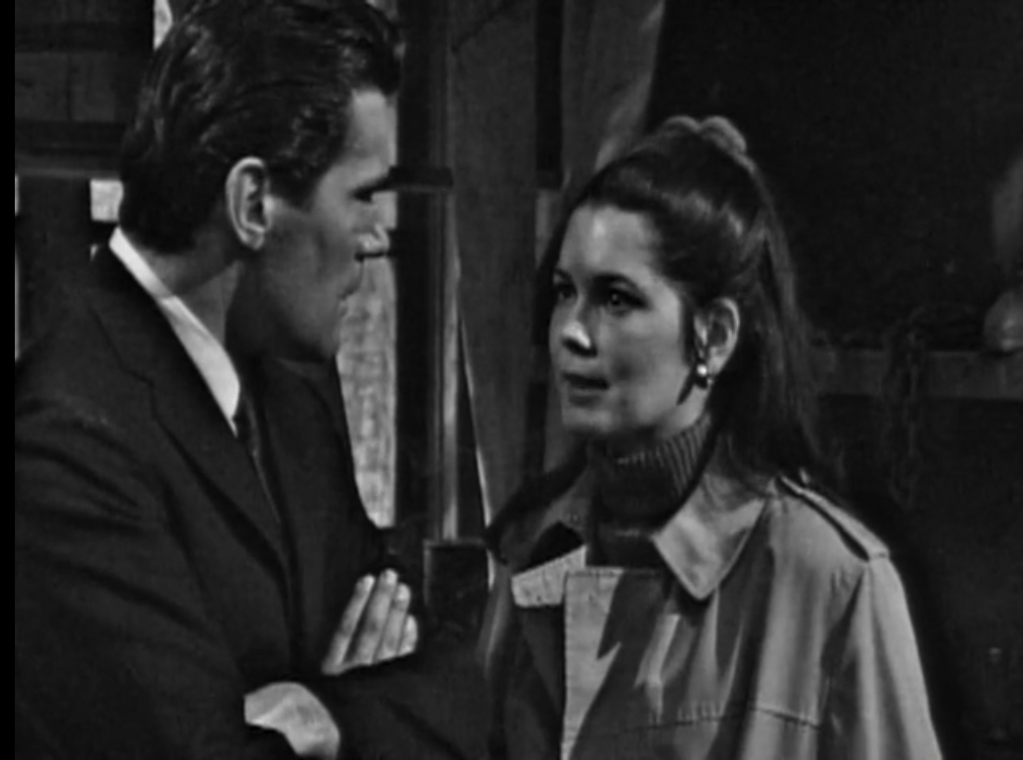
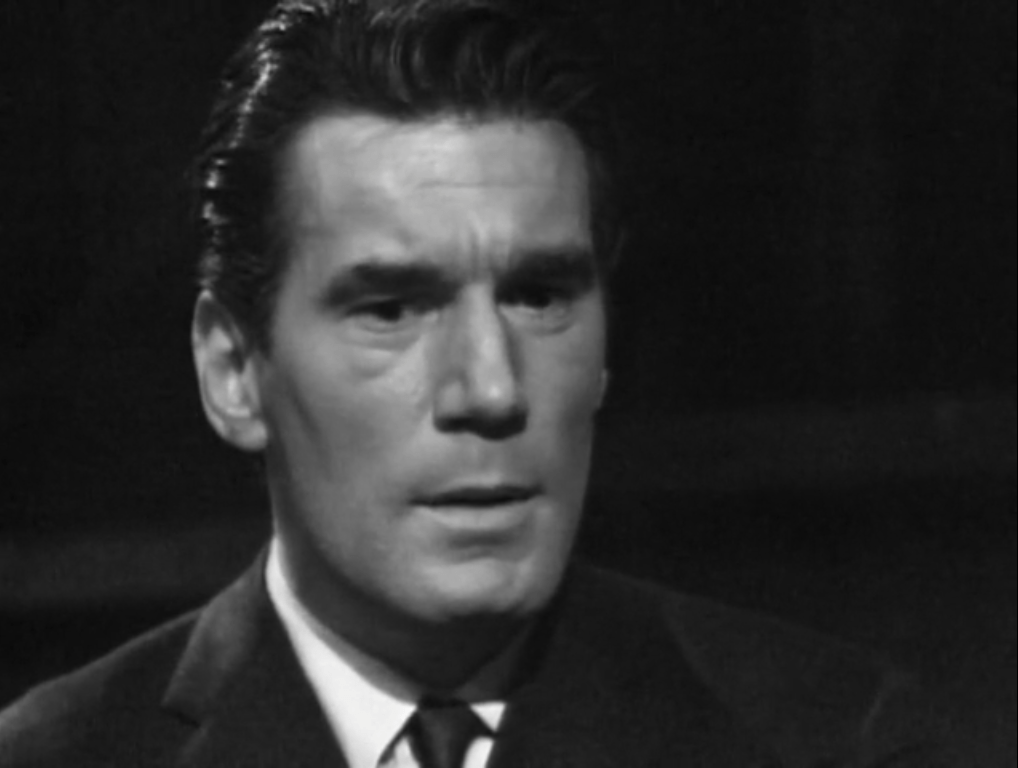

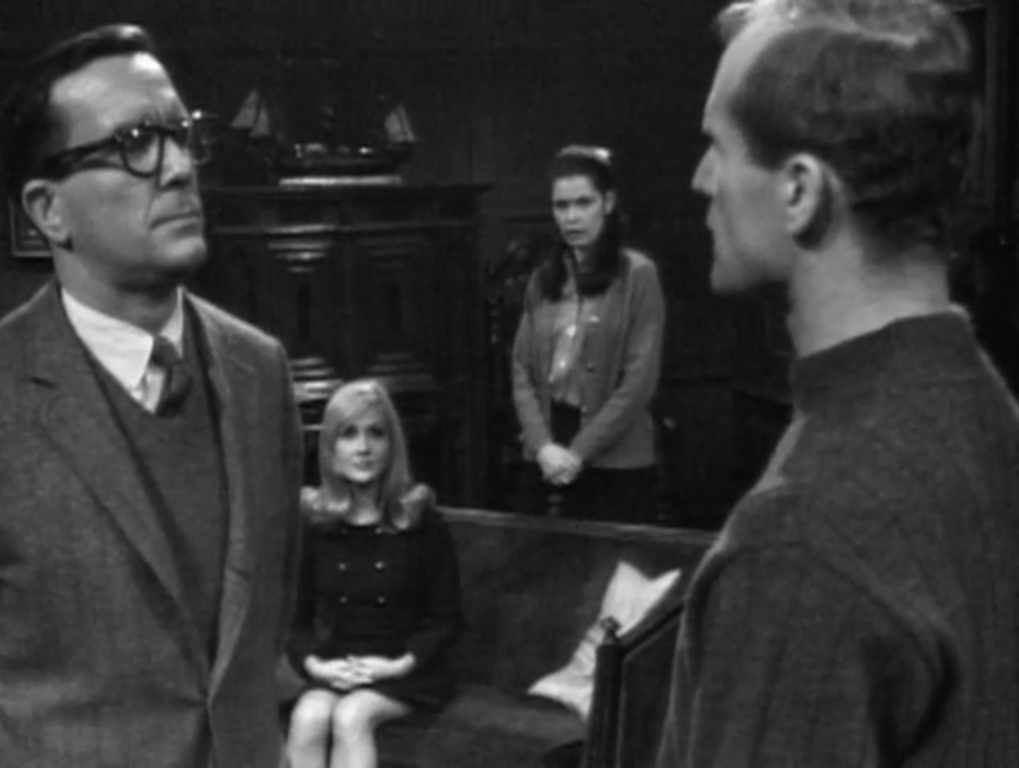
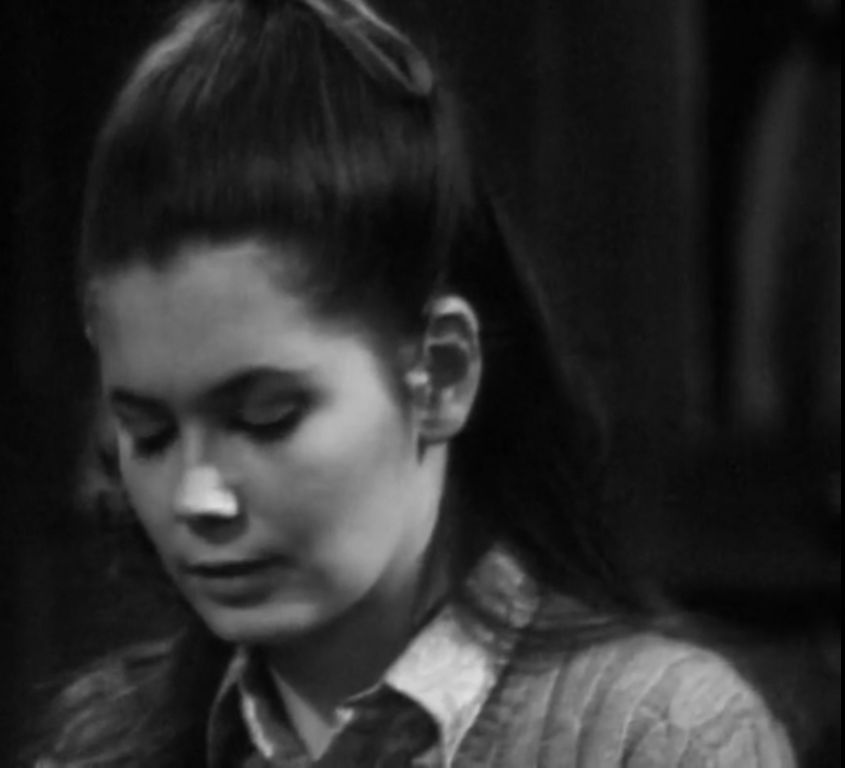
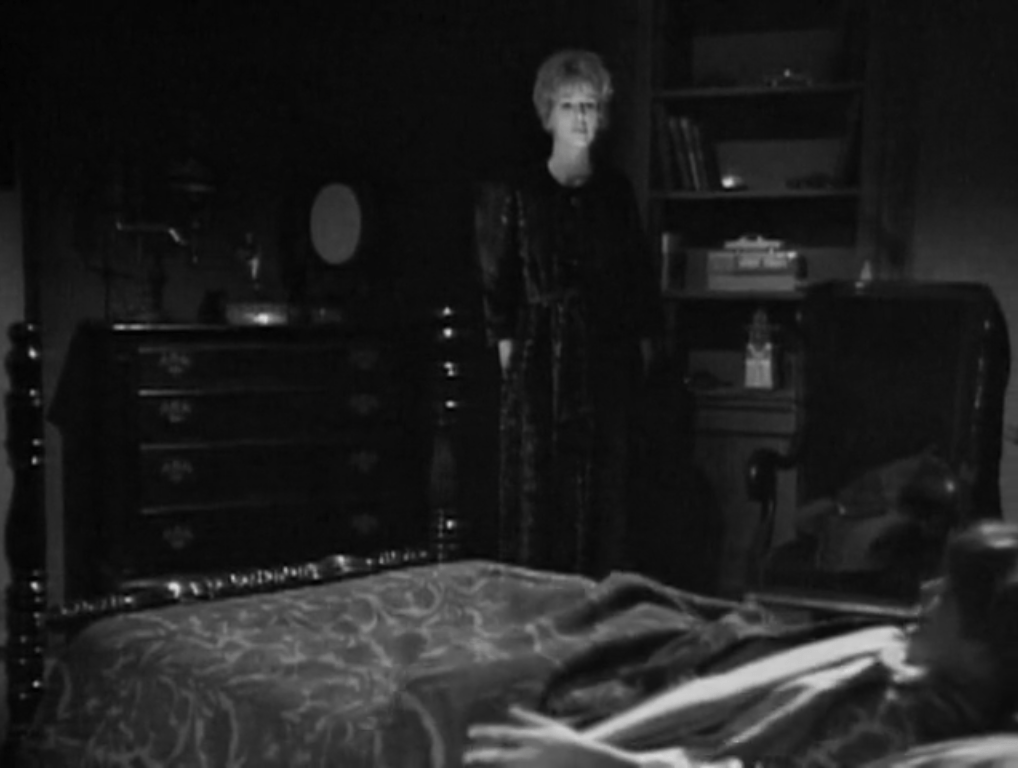


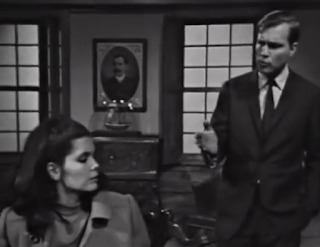


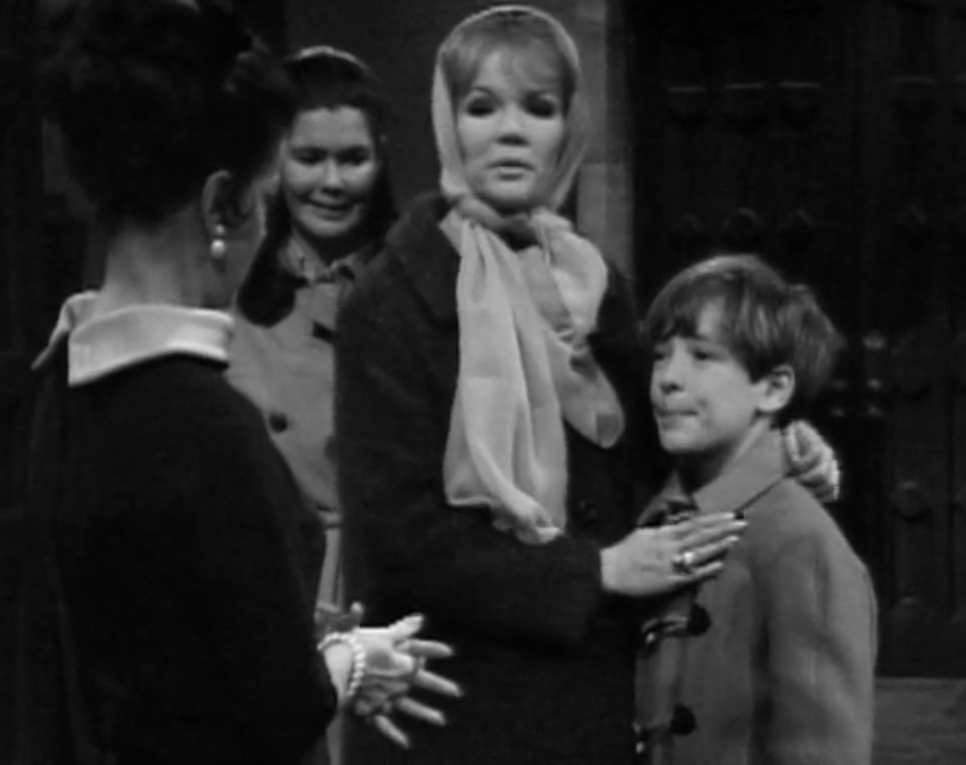

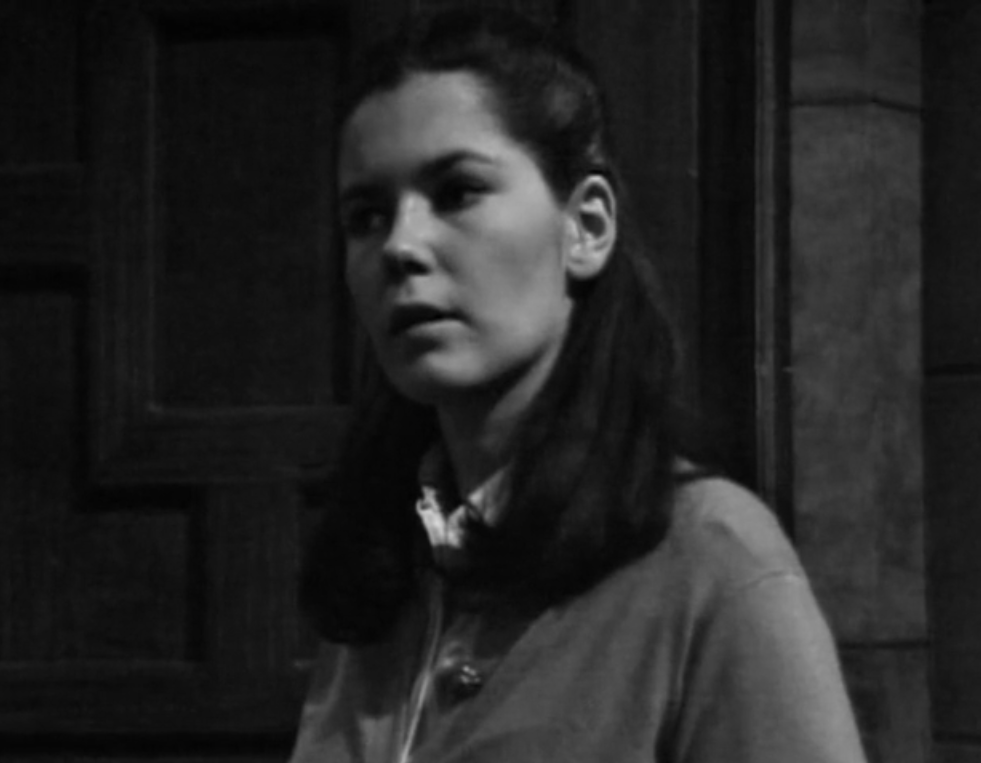


 Dark Shadows Commentary