For the first 20 weeks of its run, Dark Shadows developed its story at a stately pace. When writers Art Wallace and Francis Swann were replaced by Ron Sproat and Malcolm Marmorstein, stately became glacial, and at times ground to a halt altogether. For the last few months, Joe Caldwell has been making uncredited contributions to the writing. While Caldwell is probably responsible for some of the glittering moments of witty dialogue and intriguing characterization that have cropped up, everything is still taking a very long time. And this is the second episode in a row in which nothing at all happens to advance the plot.
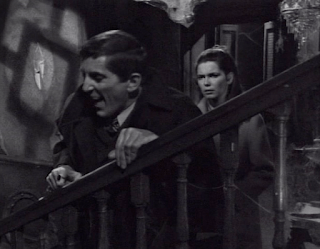
There are a few interesting moments. We begin with well-meaning governess Vicki entering the long-abandoned Old House on the grounds of the estate of Collinwood in search of her charge, strange and troubled boy David Collins. The doors swing shut, and she cannot open them. The recently arrived Barnabas Collins comes down the stairs, startling her. He opens the doors easily.
This may not sound like a big thrill, but regular viewers will remember that doors swung open at the approach of the previous supernatural menace, blonde fire witch Laura Murdoch Collins. When characters who did not know that Laura was anything other than a woman saw that happen, they didn’t react- it was a small enough thing that they could fail to notice it, and a weird enough thing that it didn’t register. So we have been prepared to watch for tricks with doors as a sign of the uncanny.
Barnabas’ big challenge today is a job of acting. He has to convince the residents of Collinwood that he is a living man from the twentieth century, not a reanimated corpse come to prey upon the living. He has trouble staying in character. When he tells Vicki that once, centuries ago, a father and son had a quarrel in the Old House that led to the son’s death, he starts laughing and repeats the word “death.” Vicki looks at him like he’s a lunatic. He gets it back together fairly quickly, but when Vicki goes back to the great house on the estate she will tell flighty heiress Carolyn that Barnabas is kind of strange.
Barnabas gives Vicki a long, flowery speech about the building of the house, one with no apparent motivation and many logical stopping places. Marmorstein has been giving these overheated orations to actor after actor, defeating them all. As Vicki, Alexandra Moltke Isles came the closest to selling one of them, at the beginning of #167, but she needed maximum support from the director in the form of close-up shots and lighting effects, and even then it was a relief when it was over.
Barnabas’ entire part consists of such speeches. Jonathan Frid stumbles over his lines quite a bit today, as he will do henceforth. No wonder- not only was he dyslexic, but at this point they were shooting seven days a week to make up for production time they lost in a strike late in March. That left him with precious little time to memorize the pages and pages of purple prose they kept dumping on him.
Listening to Frid struggle through his dialogue today, we discover the first reason why Barnabas became such a hit. In his voice, through his mannerisms, Marmorstein’s gibberish sounds gorgeous. Sometimes Frid’s struggle to remember what he’s supposed to say is a problem for the character. Since Barnabas is himself an actor essaying a demanding role, it gets confusing to see Frid’s own difficulties laid on top of his. But even at those times the sound of his voice is so appealing that we root for him to recover and deliver more of his ridiculous lines.
In his speech to Vicki about the building of the Old House, Barnabas mentions that the foundations were made of rocks deposited by glaciers. Any reference at all to glaciers is pretty brave, considering the rate at which the story has been moving in the Sproat/ Marmorstein era. It also raises a question about Barnabas. He is the man who posed for a portrait done in an eighteenth century style, and David told dangerously unstable ruffian Willie Loomis stories about Barnabas’ mother Naomi that would place her towards the middle of the eighteenth century. We’ve also glimpsed a plaque on Naomi’s tomb that gives her dates as 1761-1821, but that prop hasn’t received anything like the screen time the portrait of Barnabas has had, and must have been made long before David’s lines to Willie were finalized. So the trend is to regard Barnabas as someone who was confined to a coffin from the eighteenth century until Monday night. When he starts talking about the rocks laid down during the Ice Age, an event unknown until the mid-nineteenth century, we wonder which night this week he spent updating his understanding of geology.
In the great house, high-born ne-er-do-well Roger comes home from a business trip to Boston. Before updating him and the audience on recent plot developments, Carolyn reminisces about her childhood, when he used to bring gifts to her when he would come home from business trips. She tells him he was the only father she knew. This is a retcon- up to this point, they’ve taken pains to make it clear that Roger and David only moved into the house a few weeks before Vicki’s arrival in episode 1.
Vicki and Barnabas enter the great house. She introduces him to Carolyn and Roger. Roger quickly escorts Barnabas to the study where the two of them talk alone. Roger mentions that a vineyard in Spain that had been in the family in the eighteenth century was still theirs until shortly before World War Two. Barnabas does not react to the phrase “World War Two” at all. Whether this is because he has been studying history as well as geology, or because he was simply overwhelmed with so much new information, is not explained.
While Roger and Barnabas are in the study, Vicki tries to explain to Carolyn why she thinks Barnabas is a bit odd. Carolyn doesn’t want to hear it. She explains the basis of the Collins family’s attitude towards Barnabas when she says it’s a relief just to meet someone friendly after the rough time they’ve had lately. Viewers who have been watching from the beginning will understand how strong that sense of relief must be, and will know that Barnabas is in a position to ride it right into a permanent billet on the estate.
Barnabas leaves, and Roger shows Vicki and Carolyn the portrait. He points out that Barnabas is wearing the same ring as its subject. He does not point out that he is also carrying the even more distinctive wolf’s-head cane.
While those three talk about the wealthy and genial visitor from England Barnabas appears to be, we wonder what he really is. Barnabas first appeared as a hand darting out of a coffin, he has shown up only at night, he lived hundreds of years ago, and he is played by an actor who bears a noticeable resemblance to Bela Lugosi. So we assume that he is a vampire. But so far, there hasn’t been any direct evidence of blood-sucking. During the months Laura was on the show, they made a point of not assimilating her to any familiar mythology. So for all we know, he might be something we’ve never heard of.
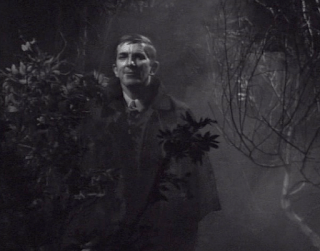
The final shot before the credits roll is in the outdoors, where Barnabas is standing perfectly still, surrounded by shrubbery, and with a big smile on his face. Perhaps that shot is telling us that Barnabas is not the vampire we might assume he is, but that he is in fact an undead garden gnome.
The first shot of the first episode of Dark Shadows featured well-meaning governess Vicki sitting on a train next to a window in which we saw the reflection of dashing action hero Burke Devlin. Vicki was on her way to the great estate of Collinwood, where she hoped to learn who her birth parents were. Burke was on his way to the village of Collinsport, where he hoped to exact revenge on high-born ne’er-do-well Roger Collins and other residents of Collinwood.
Vicki’s quest to learn her origins never took off, and hasn’t been mentioned for months. Burke’s pursuit of revenge drove a lot of action in the first twenty-one weeks of the show, but has been fading ever further into the background in the nineteen weeks since. Today, it fizzles out altogether.
In his original story bible for Dark Shadows, titled Shadows on the Wall, Art Wallace had proposed that Burke’s pressure on Roger would culminate in Roger’s death. Roger was to inadvertently reveal to Vicki that he was guilty of the crime that sent Burke to prison long ago. Roger would then try to push Vicki off the cliff at Widow’s Hill, but would miss her and go over the edge himself. The show discarded this resolution when Roger’s relationships with several other characters proved to be consistently interesting, particularly the Bossy Big Sister/ Bratty Little Brother dynamic between him and reclusive matriarch Liz. Besides, Louis Edmonds had such a gift for comic dialogue that he could get a laugh out of even the lines in which Malcolm Marmorstein attempted to be funny. So they couldn’t afford to kill Roger off.
Further, they have gone over Roger’s crime so frequently and made all the details so clear to everyone concerned that a trial wouldn’t give the audience any new information about what happened or show us any characters reacting to shocking news. It would be like a real trial, where all the evidence has gone through a discovery process and there are no surprise witnesses. No one is going to put that on commercial television in 1967.
So when Burke shows up at the great house of Collinwood with drunken artist Sam Evans, who has finally admitted that he saw what happened and took Roger’s bribe to keep quiet about it, the only real question is how Burke can leave the status quo in place.
Burke demands that Roger and Liz meet with him and Sam in the drawing room. Burke demonstrates his mastery by closing the drawing room doors, something that Liz, the mistress of Collinwood, usually does, and that Vicki did several times during the weeks when Liz was away and she was effectively in charge of the place.*
Roger of course tries out a series of lies in his attempts to deny Burke and Sam’s charges, but Liz is convinced. When she picks up the telephone and calls the sheriff, Burke reaches in and disconnects her. He says that she doesn’t have to turn Roger in- it is enough for him to know that she really would do it. She declares that she won’t let Burke keep coming back and using Roger’s guilt to blackmail the family, apparently intending to place another call. Burke says that he will never bring it up again, provided Roger confesses here and now in front of the three of them. He does. Burke tells Roger that he used to want to see him rot in jail but that now he realizes that “People like you rot wherever they are.” Burke and Sam leave, and that’s that as far as they are concerned.
During a few scenes scattered throughout the first forty weeks of Dark Shadows, Burke had considered relenting from his quest for vengeance. Those scenes hadn’t been developed in any great depth, and hadn’t been connected to each other. Only in the climactic week of the “Phoenix” storyline, when Burke and Roger briefly joined forces to save Roger’s young son David from death at the hands of his mother, blonde fire witch Laura Murdoch Collins, did we have a sustained glimpse of something other than all-consuming enmity between the two men. That was such an extreme situation, and was followed so quickly by a renewal of their hostilities, that Burke’s decision to peace out cannot be said to have any foundation in what we have seen the characters do so far. It is simply a convenient way of discarding a story element that has outlived its usefulness.
Most episodes of Dark Shadows have a cast of five actors. The rest are almost evenly divided between casts of six and casts of four. Today is a rarity with eight on screen. Six of these eight have been deeply involved in the Revenge of Burke Devlin storyline, and are at loose ends now that it has reached its abrupt conclusion. Burke, Roger, and Sam suddenly find themselves with nothing in particular to do. Also, flighty heiress Carolyn had a mad crush on Burke that alarmed her mother Liz and terrified her uncle Roger; that ended months ago, and she’s been a utility player ever since. Vicki is starting to date Burke; if Burke is no longer a threat to the family, there’s no obvious drama in that relationship, and she doesn’t have much else going on. David was as fascinated by Burke as Carolyn was; now that Laura is gone and he is happy with Vicki as his substitute mother, he’s pretty well settled in too.
We don’t see wildly indiscreet housekeeper Mrs Johnson today. She had come to Collinwood as Burke’s secret agent. Now that Burke is satisfied, presumably that’s over. Nor does Sam’s daughter Maggie, The Nicest Girl in Town, appear. She’s been dating hardworking young fisherman Joe, rebuffing his suggestions that they think about marriage because she is worried about what is going on with her Pop. Now that Sam’s conflict with Roger has come to its conclusion, there isn’t any reason the two of them shouldn’t get married, or stay unmarried, or whatever. So today’s episode leaves nine of the eleven major characters with no specific connection to any unresolved storyline.
Indeed, there is only one ongoing narrative arc. Long before he wrote Shadows on the Wall, Art Wallace wrote “The House,” a 1954 episode of The Web, an anthology series produced for CBS by Mark Goodson and Bill Todman.** Wallace recycled the story of “The House” for a 1957 installment of an hourlong anthology, Goodyear Playhouse, on NBC. Alternating with Alcoa Theatre in a window known collectively as A Turn of Fate, Goodyear Playhouse featured many pilots. The only one that seems to have been picked up was My World and Welcome to It, which went to series after an interval of more than a decade. I haven’t seen Wallace’s Goodyear Playhouse episode, but the 1954 version is too thin to fill a half hour, so I can’t see that an hourlong reworking would have been likely to catch the eyes of networks that passed on so many other pilots presented in that series, including teleplays by Rod Serling and Paddy Chayefsky. Wallace incorporated the story of “The House” in Shadows on the Wall, and a couple of weeks ago Dark Shadows dredged it up.
Seagoing con man Jason McGuire presented himself at Collinwood, to Liz’ great dismay. So far, they have had five conversations, two of them in Friday’s episode. All have followed the same pattern. Jason and Liz meet in the drawing room; he makes a demand of her; she resists; he threatens to expose her terrible secret; she capitulates. It’s true that on Friday they varied this a bit. Roger was with them during the first session, so that they had to veil their meanings, and in the second session Jason finds that Liz is unable to meet his initial demand, so that he shifts to a second one. In the first scene, they have a lot to show us as Liz and Jason manage to communicate their usual messages without letting Roger in on anything, and in the second they show us that Jason puts a higher priority on keeping Liz under his control than on any particular item he might want her to give him, so they managed to be interesting that day.
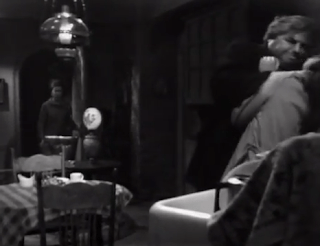
Today, Jason and Liz have their sixth conversation. It isn’t in the drawing room this time, but in the basement. While looking for David, Vicki had caught Jason listening at the doors of the drawing room at the moment when Liz was talking about going to the police, and he had rushed up to his room and telephoned*** his associate Willie, telling him they should be ready to get out of town fast. This conversation lets the audience know that Jason’s threat to Liz is a bluff. David had then caught Jason trying to get into the locked room in the basement. David told Liz what he saw Jason doing. Liz then goes down to the basement herself and shines a flashlight directly into the camera. We can see her in the halo, but Jason cannot. He seems helpless while she shines the light at him.
Jason blinded by the light
Jason scrambles a bit to regain control of the situation. Liz tells him he must leave the house immediately. He finally puts into words what the audience has long since figured out is on Liz’ mind, that she killed her husband Paul Stoddard eighteen years ago, that Jason buried him in the room, and that Jason will take this information to the police if she does not comply with his demands. She yields.
Liz’ reaction is interesting in the light of her scenes with Roger. When Burke was in the room, she explained her determination to call the police by saying that blackmail is no life for anyone to live. After Burke and Sam have gone, Roger starts begging Liz to let him and David keep living in her house. She doesn’t seem to know what he is talking about. She says that “Everyone does terrible things,” a remark she had also made to Burke and that is certainly true of characters who last on soap operas. He wants to go on pleading with her, but she just walks off, deep in thought about something else.
Remembering those scenes, we see Liz not simply giving in to Jason, but making a decision to keep going along with him. That makes today’s iteration of Jason Threatens Liz a bit more worthwhile than were the first three, if not quite as lively as the two we saw Friday. We can see something going on in her mind that raises the possibility she might do something different next time.
Two actors have bad trouble with lines today. When Burke is supposed to be saying something very dramatic and powerful about “hypocrites,” Mitch Ryan is actually blabbering about “hippie-crippie… er… hippie-crizz.” And when David Collins meets his Aunt Liz on the stairs and tells her he saw Jason in the basement, David Henesy stumbles over so many lines he falls out of character. Eventually he gets enough of the words out that you can tell what he’s trying to say, but he never really recaptures David Collins’ rhythm and intonations.
This latter slip-up leads to a reminder that there are always people in the audience checking in to a series for the first time with any given episode, so that actors are subject to judgments that don’t take into account what they have done before. At the bottom of their post on this episode, John and Christine Scoleri transcribe a conversation with a friend of theirs who hadn’t seen any of the episodes before this one. He says “Those who think the kid playing David went to any kind of acting school, raise your hand. Now leave the auditorium, please.”
In fact, David Henesy had been working steadily as a professional actor for four years before joining the cast of Dark Shadows at the age of nine. During that time, he had studied under many teachers, among them Uta Hagen. Usually, that background shows through, even when a particular script gives him problems. For example, he had a lot of difficulty with his lines in #191, and I rated that one as one of his weaker efforts. But here’s what Patrick McCray said about it on his Dark Shadows Daybook:
The success of this installment rests on the narrow shoulders of David Henesy. At the end of a big Henesy episode or scene, it’s common to announce that the kid nailed it, and this episode is no exception. His scene partners have it easy. They have straightforward, high stakes objectives to pursue. Either David goes into the fire or he doesn’t. There are only so many ways that people can implore the kid to come to them. On the other hand, Henesy has to stretch out indecision and keep it fresh for twenty minutes… with the help of an “ancient legend” that he recites. Not only does he succeed like a champ, but he concludes one of his better Hagen Days with a tearful catharsis that reads as properly-uncomfortably authentic.
Patrick McCray, Dark Shadows Daybook, 7 March 2018
I disagree with McCray overall about #191- I think Henesy’s line troubles in that one are bad enough that he doesn’t “succeed like a champ,” but I do agree that there are also some good things in his performance, particularly the way he uses his eyes and his posture. And there is no doubt that the last two minutes are very good.
Not even McCray comes to Henesy’s defense regarding #201, though the scene in the basement is all right. David Collins has a pleasant little conversation with Jason, and David Henesy gives sufficient support to Dennis Patrick that we can see just how badly wasted that talented actor is in all of those scenes where Jason repeats his threat to Liz.
*When we were watching the episode, my wife, Mrs Acilius, noticed the significance of Burke’s closing the drawing room doors. She had a lot to say about it, I wish she could remember her WordPress password and write her observations here.
**Later to become game show specialists, Goodson and Todman would be the producers of Match Game, which in the 1960s was on CBS 4:00-4:30 PM Monday through Friday opposite Dark Shadows, and of Password, a version of which would replace Dark Shadows on ABC in that timeslot when the show was canceled in April 1971.
***Just a few weeks ago, Laura nearly succeeded in killing David because there were no telephones upstairs. Apparently that has led Liz to have some new lines installed.
Seagoing con man Jason McGuire has talked his way into the drawing room of the great house at Collinwood. Reclusive matriarch Liz is dismayed to see him. Their conversation builds to his threat that the secret they share about something that happened one night eighteen years ago will not be safe unless she lets him stay at the house. She capitulates to this threat.
Jason invades Liz’ spaceLiz trapped under Jason
Liz’ husband, the never-seen Paul Stoddard, disappeared eighteen years ago, and she hasn’t left Collinwood since. Jason makes it clear to more than one character that he knew Stoddard, and implies to Liz that the terrible secret they share explains Stoddard’s absence. She is very uncomfortable any time anyone goes into the basement of the house. After Jason goes to get his luggage today, Liz tells well-meaning governess Vicki that it is more important than ever that no one know she saw her coming out of the locked room in the basement the other night. The obvious conclusion would seem to be that Liz and Jason killed Stoddard and hid his corpse in the locked room, though perhaps there might be some twist coming up that will lead us to a different conclusion.
Looking at today’s episode, I think we can see several routes they might take to add interest to the tale. Vicki is eager to help Liz in any way she can, and both Liz’ daughter Carolyn and her brother Roger show themselves more than ready to stand with her against Jason. If she accepts their help and tells them any part of the truth, their reactions to what she tells them and their attempts to work together against Jason might change the relationships among them in exciting ways.
Carolyn wonders if Jason is an old flame of Liz’. If there is an attraction between Liz and Jason, then we might see that Carolyn inherited her tendency to fall for the worst possible man from her mother, and there might be conflict between mother and daughter mirroring the tension when Carolyn was chasing after the family’s nemesis, dashing action hero Burke Devlin. Jason is mysterious enough, and actor Dennis Patrick is charismatic enough, that a romance that begins with Liz disregarding her better judgment and falling for Jason in spite of everything could lead to any number of interesting places.
Jason’s threat to Liz today, and indeed all of his talk when they are alone in the drawing room, is in terms of a single incident- “the most important incident of your life,” as Jason describes it to Liz. If his only leverage over her comes from one isolated event, then all he can do is repeat the same threat every time he wants her to make another concession. That would get to be unbearably monotonous very quickly. On the other hand, Liz’ reaction to him shows that when she and Stoddard knew him eighteen years ago, he was just as smooth-talking and untrustworthy as he is now. So it might be that Liz and Stoddard involved themselves in a series of his scams, and that she has a long list of secrets she is afraid he will expose. If that turns out to be the case, there might be a long list of pressure points where he can place his finger depending on just how outrageous his demand might be.
Failing any of those twists, the Jason storyline could be pretty dreary. Art Wallace, who was the sole credited writer for the first 40 episodes of Dark Shadows and stayed with show until #85, wrote a 30 minute episode of a CBS anthology series called The Web in 1954 under the title “The House.” You can see the whole thing here:
That version features a retired sailor coming to a coastal town. He finds out that a local woman whom he knew years before hasn’t left her house since he was around, which was at the same time her husband disappeared. He goes to her house and threatens that he will expose the hideous secret in her basement unless she lets him stay with her. His demands mount. When he insists that she marry him, she finally admits that she killed her husband and the sailor hid his body in the basement. The basement is dug up, revealing that there never was a body there. Indeed, she never killed anyone. The husband tricked her into thinking she had killed him, and the sailor tricked her into thinking he had buried him. When this truth comes out, the sailor flees and the woman lives happily ever after.
That may sound like enough story to fill a 30 minute time-slot, but The House has a number of slow parts. That thinness bodes ill for the narrative arc now starting. This is already Jason’s third episode, and the themes of Stoddard’s absence, Liz’ seclusion, and the locked room in the basement were dealt with over and again in the first weeks of Dark Shadows. Art Wallace’s original story bible for the series, Shadows on the Wall, included a straight retelling of the plot of The House, with no fresh complications until the very end. Today, when Jason tells Liz that as a houseguest he won’t require much entertaining, she replies “I don’t intend to entertain you at all!” If they stick to Wallace’s idea, the same might be the epigram for Jason’s whole storyline.
A few times in the early months of Dark Shadows, writers Art Wallace and Francis Swann found themselves in a corner. The story could move forward only if a character took a particular action, but they couldn’t come up with a reason to explain why any character would take that action. So they had the character do whatever it was simply because it was in the script, and hoped the actors or director or somebody would come up with sleight of hand to conceal their desperation.
Since well-meaning governess Vicki was on screen more than anyone else, she was the one most often required to behave without motivation. Sometimes, Alexandra Moltke Isles finds a way to make Vicki’s behavior intelligible in spite of the writers. The scenes in which Vicki tries to befriend her charge, strange and troubled boy David Collins, are Dark Shadows‘ premier example of good acting trumping bad writing, and there are smaller examples as well. But there are three times in the Wallace/ Swann era- in episodes 26, 38, and 83– when Vicki simply looks like an idiot. This “Dumb Vicki” will appear more and more often as the series goes on, and will eventually ruin the character and do grave damage to the show.
Some weeks ago, Wallace and Swann were succeeded as the principal writers of the show by Ron Sproat and Malcolm Marmorstein. Sproat was a cut below Wallace and Swann, and Marmorstein was far less talented even than Sproat. Today, we get a succession of Dumb Vicki moments resulting from basic incompetence on Marmorstein’s part.
Vicki is visiting her friend Maggie Evans, The Nicest Girl in Town. Maggie has shown her a canvas that her father, drunken artist Sam, was possessed by an unexplained force to paint. Sam hates the painting and is surprised as he watches it take shape under his brush, but is powerless to stop working on it. It depicts Laura Collins, mother of David. Laura is shown as a winged figure, nude and engulfed in flames.
Sam has had several scenes in which he was shown in closeup delivering speeches about his hatred for the painting and going through convulsions while spooky music plays on the soundtrack. He has also had scenes with Maggie and with Laura’s husband, high-born ne’er-do-well Roger Collins, in which he tries to explain what is going on with him and the painting. Yesterday, Maggie recapped much of this to Vicki, sharing the suspicion that Laura is somehow responsible for Sam’s compulsion to paint the picture. Since the show has also given us loads of hints that Laura is connected to the supernatural, this all adds up to a very heavy-handed way of telling the audience that Sam is possessed.
Once you can say that your characters are possessed by unseen spirits, you get a lot of extra latitude as to what constitutes motivation. Once they have shown us that he is possessed, all we need to know about Sam for his actions to make sense is that he has some kind of connection to Laura and that Laura has some connection to the supernatural. The results of the possession hold our interest as we compare them with other events in the story and look for a pattern we can fit them into.
As far as the supernatural beings responsible for the possession go, we don’t need much information at all about their motivation. Far less than for human characters. Most audiences have more or less definite ideas as to what human beings are and what makes them do the things they do. We’re more flexible as to what supernatural beings are, and are willing to spend a long time searching for coherence hidden in story elements that don’t seem to have a logical connection once we have seen that there are uncanny forces in operation.
To get the benefit of that audience participation, a writer does have to show that supernatural forces are at work. Today, Vicki seems to be possessed, but there is no scene showing us that this has happened. Vicki looks at the painting and says she wants it. Asked why, she says she doesn’t know. Nothing she says makes much sense, or much impression.
Three seconds of Vicki staring at the painting while we hear a theremin cue on the soundtrack would have sufficed to tell us that she was falling under a spell. Not only don’t we get that, Mrs Isles never gets a chance to show us what is happening to Vicki. When Vicki first looked at the painting, she was partially obscured, standing behind Maggie; examining it later, she has her back to the camera. During her dialogue with the loudly agitated Sam, only a few brief shots focus on her. Sam gives Vicki the painting. When Maggie says she wonders how Laura will react when Vicki brings the painting into the house, Vicki mumbles that she doesn’t know.
Had we seen Vicki falling under the spell, the result could have been a powerful moment. As a supernatural storyline goes on, the mysterious forces behind it spread their influence from one character to another. The first moment in this one when we could see that sort of contagion at work is when the powers that have been controlling Sam take hold of Vicki. To hide that moment from us is to hide the whole development of the narrative arc.
Moreover, that this particular development takes place on this set among these characters is quite significant. When Vicki and Maggie first met, Maggie told her that she was a jerk for taking a job at the great house of Collinwood. She told Vicki that Collinwood was a source of trouble for the town of Collinsport. As the weeks went on, Maggie and other Collinsport natives made it clear that a big part of that trouble comes from the ghosts and ghoulies that are housed in Collinwood and that threaten to break out and take over the town. This will indeed become the major theme of the show in the years ahead.
Now Vicki has lived in Collinwood for over six months, and the only ghosts she has seen are the friendly, protective spirits of Josette Collins and beloved local man Bill Malloy. The first time a supernatural being does something frightening to Vicki is in the town of Collinsport, in Maggie’s own house.
Indeed, the Phoenix storyline is the only one in the whole series to invert the usual pattern of Collinwood as hell-mouth and Collinsport as a beleaguered outpost of normality. There are other storylines where evil powers came from far away, from across the sea or from another dimension, and settled in Collinwood before spreading out to threaten Collinsport, but in this story the source of the disturbance is Laura. While she may tell David in episode 140 that she comes from one of the realms described in the legends of the Holy Grail, that origin applies only to her uncanny side. When Laura first came to town, she had told Maggie that she was originally from Collinsport, and in episode 130, Laura’s estranged husband Roger, and Roger’s sister, reclusive matriarch Liz, had mentioned that Laura’s family had moved away from town.
The episode also leaves us on our own trying to figure out what Vicki is thinking. Regular viewers might take some time during the commercial break to puzzle it out, put it in the context of what we’ve seen previously, and wonder if Vicki is in a stupor because she too is possessed. That might help us to get through the rest of the episode, but if we are to feel a live connection to the character we have to understand what she is feeling while we are watching her. A theory we come up with after the fact is no substitute for empathy we experience during the scene. And of course people tuning in to Dark Shadows for the first time will simply think that Vicki is some kind of idiot.
Many fans of Dark Shadows, especially those who haven’t seen the first 42 weeks of the show or who didn’t see them until later episodes had given them fixed impressions, blame Alexandra Moltke Isles’ acting for Dumb Vicki. But today’s scene in the Evans cottage shows how deeply unfair that is. If an actor doesn’t have lines to deliver, she can’t use her voice to create a character. If the camera isn’t pointed at her, her body language is no use. And if the director is telling her to play the scene quietly while the others are going over the top, she’s likely to fade into the background. Without even a musical sting on the soundtrack to support her, there is nothing Mrs Isles could have done to communicate to the audience what Vicki is going through in this scene.
It is easy for me to denounce Malcolm Marmorstein, since his scripts are so often so bad. I am reluctant to place a share of the blame on director John Sedwick, since I am always impressed with Sedwick’s visual style and usually with his deployment of actors. But I can’t believe anyone would have stopped him pointing a camera at Mrs Isles at the appropriate moment, giving her a chance to play her part.
Back at the great house of Collinwood, David and Laura are sitting by the fire. David asks his mother about her old boyfriends. He wants to know if she ever dated dashing action hero Burke Devlin. She admits that she did. When David lets on that he wishes Burke, rather than Roger, were his father, Laura squirms. We’ve had a number of indications that Burke might in fact be David’s biological father, and Laura is alarmed that David is raising the topic.
The front door opens, and David and Laura are glad to see their friend Vicki. They are intrigued by the package Vicki is carrying. David begs to see what’s inside. Laura, in a light and cheerful voice, tells him that if Vicki wanted him to see it, she would have shown it to them. He continues to beg. Vicki says “All right!,” and unveils it. When we were watching the episode, Mrs Acilius exclaimed “All right!?,” appalled at Vicki’s nonsensical decision to yield to David’s pleas despite the cover Laura was giving her. Again, the idea that Vicki’s weird decisions and vague, distracted manner might be symptoms of possession was somewhere in our minds, but since nothing had been shown to give direct support to that idea our emotional reaction suited a Dumb Vicki moment.
As Maggie had suggested she might be, Laura is horrified to see herself depicted in this fiery image. David is thrilled- he had been plagued by a recurring nightmare, one he had described in detail to the deeply concerned Vicki, in which his mother stood in a sea of flames and beckoned him to join her. He asks how Sam knew about his dream- did he have the same dream? Vicki mumbles that he didn’t, that he didn’t know anything about the dream or even why he was painting the picture. The audience may have wondered why Vicki didn’t remember the dream until now- the explanation that fits best with the story is that she has been possessed by the same spirit that possessed Sam, but with so little attention given to Vicki as she was reacting to the painting some very insightful critics have taken it as another Dumb Vicki moment.
David points to a white space in the painting, one the shape of his own head, and asks what goes there. Vicki mumbles that she doesn’t know, and that Sam himself didn’t know. David is delighted with the painting and wants to hang it in his room. He asks Vicki to give it to him. Vicki tells him that his mother will have to rule on that question. Laura hates the painting and tries to talk David out of hanging it, but he is nothing deterred. She finally caves in.
While David goes upstairs with the painting, Laura asks Vicki what she was thinking bringing such a terrible thing into the house. Vicki says she doesn’t know- something just came over her. That goes to show that the writer wanted us to think that Vicki was possessed, which in turn makes it all the more exasperating that he didn’t let us in on it at the appropriate time. The fact that we know the writer wants us to have a reaction doesn’t mean that we actually have it. Confusion pushes people away from a story, and merely intellectual explanations offered after the fact don’t draw us back in.
Vicki, seeming to regain some of her brainpower, goes to David’s room and tries to talk him out of keeping the painting. He dismisses her concerns immediately, without even changing his delighted manner, and hangs it on his wall. Looking at it, Vicki admits that it looks like it belongs there.
Laura enters, and tells David she has changed her mind. She thinks it would be bad for him to have such an image on display, and asks him to get rid of the painting. David responds by threatening never to speak to her again. Laura has just been reunited with David after years of separation, and his initial reaction to her return was confused and traumatic. So it is understandable that she capitulates to this extortion.
It is more surprising that Vicki responds by turning away and wringing her hands after Laura leaves. Usually Vicki scolds David after he is nasty to people, and she has been on a particular mission to break down the barriers between him and his mother. If it were clear that Vicki was under the influence of a spirit and was not herself, this uncharacteristically diffident response might have carried a dramatic punch, at least for regular viewers. As it is, it slides past as yet another Dumb Vicki moment.
Back in the Evans cottage, Sam comes back from his usual night of drinking at the local tavern. Maggie is infinitely weary of her father’s alcoholism, but does smile to hear him reciting poetry and talking about a seascape he is planning to paint. At least he’s happy. Sam goes to his easel to start that seascape, only to recoil as he realizes that he is in fact painting another version of the picture of Laura in flames.
David is asleep in his room. The painting starts to glow. Then Laura’s painted likeness is replaced with a video insert of her face. The insert grows and grows, and David screams for it to stay away.
Maggie’s suspicion that Laura is behind the portrait fits with the many signs the show has given us of Laura’s uncanny nature. Laura’s reaction when Vicki brings the painting home, though, shows us that what has been happening to Sam does not serve Laura’s interests, any more than David’s nightmare did.
I think there are three possible explanations for the origin of the compulsion Sam had to paint the picture, the compulsion Vicki had to claim it, and David’s nocturnal disturbances. It could be that by exposing David time and again to the image of him following her into flames, Laura is gradually wearing down David’s resistance to a horrible idea that will lead to his destruction. In support of this interpretation, we remember the first night Laura was at Collinwood. She was calling David’s name in a quiet voice at the window of her cottage, far from the great house. Yet the sound of her voice penetrated David’s mind as he slept. He writhed on his bed, and went into the nightmare. Laura’s objection to the painting militates against this explanation.
When we were watching the episode, Mrs Acilius suggested a second reading. There might be a lot to Laura. Maybe in addition to the physical presence in the house that wants David to come away with her, there is also a ghostly presence that wants to warn him and everyone else of the danger that implies. That interpretation would fit with David’s sighting, the night Laura first came to the house, of a flickering image on the lawn that looked like Laura. David longed for that Laura to come to him, but reacted with terror when he saw the fleshly Laura in the drawing room. Perhaps there are two of her, and one is trying to protect David from the other. It is also possible that the two Lauras are not aware of each other, or even fully aware of themselves. So this interpretation is easier to reconcile with apparently contradictory evidence.
Vicki’s involvement suggests a third possibility. The ghost of Josette Collins appeared to her and comforted her in episode 126, and an eerie glow had emanated from the portrait of Josette when David left Laura alone in the Old House yesterday. Laura was alarmed to hear that David was interested in the ghosts of Collinwood, had not wanted to go to the Old House, and lies to David when he asks if he saw any sign of Josette’s presence. Perhaps Josette is intervening to thwart Laura’s plans, and it is her power that is benumbing Vicki today. Josette’s previous interventions have been intermittent and subtle, suggesting that it is difficult for her to reach the world of the living. So if she is preparing for a showdown with Laura, we might it expect it to take her some time to recruit her strength.
Again, this is the kind of search for patterns that an audience will gladly go into once you’ve let them know that there are supernatural forces at work in your story. Since Josette has been in the background of the show from week one, has appeared repeatedly, has a set devoted to her in the Old House, and has established connections with both Vicki and David, we might expect her to be the first of the uncanny presences we think of when we enter a supernatural storyline. That she is a tutelary spirit presiding over Collinwood brings it into sharp focus that the estate is under assault from a supernatural force emanating from the town of Collinsport. Today’s failure with Vicki kicks Josette’s ghost out of the spotlight, and that is one of the major faults with the episode.
In the great house on the estate of Collinwood, reclusive matriarch Liz and instantly forgettable young lawyer Frank worry about where well-meaning governess Vicki has got to. Since Vicki is a witness in the investigation of the death of beloved local man Bill Malloy, and she has been the target of at least two attempted assassinations in the last 24 hours, the sheriff and his men are searching the grounds of Collinwood looking for her.
As it happens, gruff caretaker Matthew is holding Vicki prisoner in his cottage on the estate. Matthew had blurted out a confession that he killed Bill, and has now decided he must kill Vicki to keep her quiet. Vicki tries to persuade Matthew that he will be better off with her alive, but he will not change his mind. As he is putting his hands around her neck with the stated intention of breaking it, the door opens. Liz enters. Startled, Matthew unhands Vicki. She tells Liz that Matthew killed Bill and is about to kill her.
Art Wallace’s original story bible for Dark Shadows, which circulates under the title Shadows on the Wall, had called for Liz’ brother, high-born ne’er-do-well Roger, to be exposed as a murderer and a deadly threat to Vicki. Roger would fall to his death in the course of his final attempt on Vicki’s life. That was still possible a week ago.
Now that we’ve heard Matthew’s confessions, we know that Roger isn’t going anywhere. Not only does that keep one of the show’s most engaging actors, Louis Edmonds, in the cast; it also opens a long list of story possibilities. Perhaps Roger and Vicki will reenact the climax of Jane Eyre, and the dark-haired governess will marry her charge’s father. Perhaps the horrendous relationship between Roger and his son, strange and troubled boy David, will improve in some way, or perhaps David will make another attempt to kill his father. Certainly we can expect more scenes between Roger and Liz, as the show plays out the first of its signature relationships between Bossy Big Sister and Bratty Little Brother.
Further, Liz tells Frank and the sheriff that there are three residences on the estate- the great house, the Old House, and the caretaker’s cottage. One of Matthew’s previous attacks on Vicki took place at the Old House, and we’ve twice seen a ghost there who is clearly marked as someone who will be coming back again. Vicki is trapped in the caretaker’s cottage now, and the great house is the main setting for the series. By listing the three locations in this way, Liz is telling the audience to expect to see more of each of these sets, not just in this storyline but in the stories to come.
Dashing action hero Burke Devlin visits the sheriff in his office. He brings the sheriff up to date on the recent threats well-meaning governess Vicki has faced. He also tells the sheriff that Vicki had found a pen belonging to Burke on a beach, and that he thinks that high-born ne’er-do-well Roger Collins dropped the pen there while murdering beloved local man Bill Malloy. Burke also thinks that Roger is the one who has been menacing Vicki. He asks the sheriff if he will play along with a scheme that might put some “concrete evidence” behind his beliefs.
In the great house of Collinwood, Roger faces a series of very sharply pointed questions about Vicki’s problems from his sister, reclusive matriarch Liz. He denies everything, including things Liz can prove to be true. He tries to say that Vicki is untrustworthy because she claims to have seen a ghost dripping wet seaweed on the floor in the west wing of the house. Liz reminds Roger that they investigated that claim, and found the wet seaweed just where Vicki said it would be.
The sheriff and Burke show up at the house. In the mood established by their conversation, Liz and Roger are left feeling trapped and small, as this shot none-too-subtly shows:
The sheriff asks to see Vicki. Liz explains that she gave her a sedative and sent her to bed. He then questions Roger and Liz about the stories Burke has told. Liz downplays Vicki’s experiences; Roger makes another attempt to sell the idea that Vicki is nuts because she claims to have seen a ghost. When Burke brings up the topic of the pen, Liz is at a loss- it is the first she has heard of it. Roger tries to brazen it out. When Burke produces a pen identical to the one Vicki found, he flails and finally denies that the pens are at all alike. The sheriff asks Liz to send both Vicki and flighty heiress Carolyn to his office first thing in the morning to examine the pen.
Liz tells Roger that she is confident Carolyn and Vicki will tell the sheriff the truth. When he tells her he needs time to think, she replies that he doesn’t need any time to think of more lies. He declares that there is something he must attend to immediately, and rushes out of the house. Liz watches her little brother leave the house, frustrated in her attempts first to correct his behavior, then to shield him from its consequences.
Roger goes to the peak of Widow’s Hill. He had stolen the pen Vicki found and buried it under a rock there. He digs it up. As he looks at it, Burke and the sheriff appear and thank him for saving them a lot of trouble.
Art Wallace’s original story bible for Dark Shadows had called for Roger to have his final scene on this spot. Vicki was to have found evidence that would send Roger to prison, he was to attempt to kill her by throwing her off the peak of Widow’s Hill. She would avoid that fate when Roger instead went over the cliff himself. As it has worked out, Louis Edmonds is too appealing an actor to lose. So Roger stays on the show as a suspect in an investigation, perhaps as a defendant in a trial. It won’t be the last time Dark Shadows extends an attractive villain’s stay on the show by playing out different events on the set where his story was originally meant to end.
High-born ne’er do-well Roger Collins is desperate to get rid of his son’s governess, the well-meaning Vicki, before she discovers his dark deeds. Sometimes he’s simply unpleasant to her. Twice he’s offered to bribe her to leave. Once he pretended to be a ghost in order to scare her off, not knowing that she had just seen a real ghost who warned her to leave the house before she was killed. Occasionally he turns on his very considerable charm in his efforts to convince her that she ought to leave; she usually sees through these efforts quickly, and he is left in a weaker position than he was before.
Yesterday, Vicki was in Bangor, Maine, fifty miles from her home in the great house of Collinwood. While waiting for dashing action hero Burke Devlin to give her a ride home, she realized that the pen she found on the beach some weeks ago must have belonged to Burke, and jumped to the conclusion that Burke dropped it there while murdering beloved local man Bill Malloy. Frightened, she called Roger to come and get her.
Today, Roger is driving Vicki home in a heavy rainstorm. Returning viewers know that Roger was in possession of such a pen, that he lost it the night Bill died, and that he is terrified the pen Vicki found will lead to disaster for him. We also know that he is a vicious man who will stick at nothing to protect himself.
Vicki knows none of these things, but she does know that Roger and Burke are sworn enemies. Therefore, she is surprised when Roger tells her that the pen isn’t really evidence of anything. After all, it was two days after Bill’s death that she found it- Burke could have dropped it there after Bill went into the water, or long before. She is even more surprised when he urges her to forget the whole matter and never again to mention the pen to anyone. Roger can imagine a scenario in which Burke might have killed Bill, and even says that he thinks it is likely, but he tells her that with no more evidence than she has there is nothing to be gained by challenging the coroner’s verdict that Bill’s death was an accident.
When Vicki asks Roger why he is leaving the main road in the midst of the storm, we might wonder if he has laid some dastardly plot. On the dark, flooded back way, they quickly find themselves trapped. Roger leaves Vicki in the car while he takes his flashlight to look for shelter. He returns and describes an abandoned shack he claims to have spotted just then. His description of it is so detailed that we cannot help but suspect that he has been there before, and that it figures in an evil plan of his. Roger defuses that suspicion, though, when on his own initiative he leaves a note inside the windshield of the car directing any passersby to the shack.
When they enter the shack, Roger teasingly says “I should have carried you over the threshold.” Vicki instantly responds “But you are married.” With a sour look, he answers “If you can call it that.” After a bit of conversation about Roger’s unhappy domestic situation, they sit close together. Vicki tells Roger that she wonders if his son, strange and troubled boy David, got his unscrupulousness from his mother. “You’re nothing like that,” she says. While they huddle together, Vicki asks Roger to tell her all about himself.
Despite her previous wariness of him and her prompt reminder to him today of his marital status, it would seem that Roger could make quite a bit of progress with Vicki if he were to forget his other methods of persuasion and concentrate on charm. In episode 78, Roger even took Vicki on a date. That didn’t amount to much, but at the end Roger promised to take Vicki out again and she seemed interested. Watching them together in this one, we wonder if they might at some point get together. Vicki the foundling-turned-governess is obviously modeled on Jane Eyre, and Roger is not only her charge’s father, but the name “Roger” even sounds like “Rochester.” A relationship with Roger wouldn’t involve living happily ever after, but that’s a difference of genre- characters in novels might get happy endings, but characters on soap operas don’t get any endings at all, not unless they’re killed off the show.
In Art Wallace’s original story bible for Dark Shadows, called Shadows on the Wall, Roger was supposed to be killed off early on, while trying to murder Vicki to prevent her exposing a crime of his. It was also supposed to be revealed that Vicki was the illegitimate daughter, not of any member of the ancient and esteemed Collins family, but of the estranged husband of Roger’s sister Liz. That wouldn’t make much sense- the Collinses are the center of the show, and Vicki is the main character. If she’s going to be anyone’s long-lost love child, it should be Liz’. And indeed, Alexandra Moltke Isles and Joan Bennett look very much alike, a resemblance the camera work often emphasizes. But, if Roger isn’t going to die soon, establishing that Vicki is not a blood relative would leave the path open to a marriage between them.
Of course, if Liz is secretly Vicki’s mother, that would be the perfect background for a soap opera engagement between Vicki and Roger. Liz would find herself forced to choose between revealing her terrible secret or allowing her daughter to marry her own uncle. In a later decade, a show might let the characters get married and reveal the family relation years later, but I don’t think ABC’s Standards and Practices department would have signed off on that one in the 1960s.
If there is going to be a Vicki/ Roger romance, it isn’t going to start today. Roger answers Vicki’s question about what he wants in life by saying that at the moment he only wants two things- for them to be rescued, and for her to leave Collinwood. He tells her that he is worried that she is in mortal danger if she stays. David has tried to kill her; he’s tried to kill Roger too, come to that. Previously, Roger has urged her to get away before he succeeds. But today, she isn’t thinking of David. She asks if Roger really thinks Burke is a deadly threat to her. He pauses long enough to make us wonder if he’d been planning to talk about David, then decides to run with what Vicki’s given him. He dwells on Burke’s temper as Vicki has witnessed it and tells her that he has seen even worse displays. When she says that she finds it difficult to believe that Burke would kill her, he says that he’s sure Bill Malloy found that difficult to believe as well. This gets her back to the idea of telling the police about the pen. When she protests that not telling them would be withholding evidence, his charm breaks down and he shouts “Then withhold it, you little idiot!”
His previous attempts at suavity had also ended in name-calling. On those occasions, he could only apologize while Vicki regarded him coolly. This time, he bounces back and continues to press Vicki with claims that he’s thinking of her safety. She is looking very doubtful, though, as if something is dawning on her. After a moment, the sheriff appears at the door. He tells Roger that he and his men were in the area, noticed Roger’s car, and followed the directions on the note he left in the windshield. He notices that Vicki is deep in thought. He asks her what’s on her mind. After a long hesitation, she gives a meaningless response, telling him nothing about the pen. But we know that she has asked herself a question, and that the answer is going to mean trouble for Roger.
This is the first episode credited to writer Ron Sproat. Before long, Francis Swann will leave Dark Shadows, and for several months the only credited writers will be Sproat and Malcolm Marmorstein. Marmorstein will write 82 episodes and leave in August of 1967. Sproat will write hundreds and will stay with the show until 1969.
Today’s setup might remind us of the show’s first writer, Art Wallace. It’s shaped like one of Wallace’s diptych episodes, intercutting between two contrasting groups of characters. This time, we cut back and forth between, on the one hand, a dull but pleasant dinner date between well-meaning governess Vicki and instantly forgettable lawyer Frank at a restaurant in Bangor and, on the other hand, an extremely uncomfortable dinner date between hardworking fisherman Joe and flighty heiress Carolyn at the Blue Whale in Collinsport.
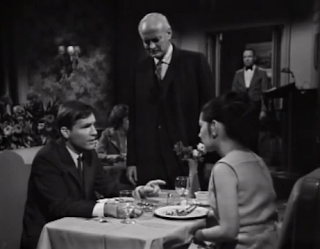
In Bangor, Vicki and Frank smile at each other while Vicki tells the sorts of stories she’s been telling all along. Vicki hopes Frank will be able to aid her in her effort to learn the identity of her birth parents, a quest she has been on since episode 1. Frank’s father Richard briefly joins him and Vicki at their table. Amid good wishes for the two of them, Richard delivers a cautionary message about Vicki’s research. Later, he talks privately with Frank. He strongly approves of Vicki as someone to date, but is chary of many aspects of the research Frank has volunteered to do for her.
In Collinsport, Joe and Carolyn are bickering about Carolyn’s obsession with dashing action hero Burke Devlin when Maggie Evans, The Nicest Girl in Town, enters the tavern with her father, drunken artist Sam Evans. Carolyn invites the Evanses to join them at their table. Carolyn eventually starts talking about Burke again, prompting Joe to ask her to dance. Away from the Evanses, Joe tells Carolyn he is tired of her falling bacxk on him when Burke isn’t available. Carolyn storms out. Joe takes her home, then returns to the tavern, and he and Maggie start a conversation they both seem to be enjoying hugely.
By intercutting scenes, Wallace’s diptychs usually achieve a contrast that brings into focus details of the psychology of the characters and their relationships to each other that we might not have thought about had we watched the scenes straight through. In Sproat’s hands, today’s episode doesn’t do that so much as it comments his own position as a new writer joining an established show.
Vicki has learned nothing about her origins since episode 1, and there is no prospect she ever will. In Frank, she has found a potential boyfriend. In the ears of the audience, Richard’s advice to Frank to pursue Vicki energetically but to pursue her inquiries only circumspectly is a recommendation that the show drop an old, unproductive old storyline and to develop a new one.
Carolyn and Joe’s relationship is another story element that has been in place from the beginning and that has not advanced in any way. We have never seen any reason for them to be a couple, and are simply impatient with scenes where they sit around and make each other miserable. Joe recently had a date with Maggie, and it was sweet to watch those two having fun together. So today’s scenes in the Blue Whale make it emphatically clear that the time has come to drop the Carolyn and Joe story and move on to a new phase where Maggie and Joe are together.
Sproat not only makes himself visible in this episode, he also provides mirrors for critics and commentators. When Richard shows up and interrupts the ten thousandth* sad story the audience has heard about the Hammond Foundling Home, Frank and Vicki seem to be having a pleasant enough time with each other. It is possible that viewers who weren’t watching on many of the days when Vicki told those previous stories are having a pleasant enough time with the episode. But on any given day, only so much of your audience will consist of new viewers and people with short-term memory loss. A time will come when you have to move on to something new, and Richard is the in-universe representative of those who would say that time is already upon us.
In the Blue Whale, the Evanses represent the critics. Joe and Carolyn leave the table twice to dance. The first time, they look happy, and Sam tells Maggie that there is no chance of Joe and Carolyn splitting up. Sam is a chronic pessimist. If he makes a prediction, we take it that it would be bad news for that prediction to come true. In this context, to say that Joe will never break it off with Carolyn is to say that the show will never become more interesting. The second time Joe and Carolyn dance, they are obviously giving up on each other. Maggie, almost as much the optimist as her father is a pessimist, gives a little smile. Joe and Carolyn’s quarrel is embarrassing for her to watch, but it’s good news for her that she’s getting a boyfriend, and maybe a storyline. It’s also good news for us that the show is open to exploring fresh topics.
I don’t think that Richard and the Evanses are so much Sproat’s attempt to impose particular readings on the audience as they are the results of his analysis of the reactions thoughtful viewers are likely to have. If so, I have one data point in support of his theory. In their discussion about this episode on their blog Dark Shadows Before I Die, John and Christine Scoleri actually find themselves playing the roles of optimistic and pessimistic critic as Sproat scripted them for the Evanses. Here are John as Maggie and Christine as Sam:
John: Have we finally seen the end of the Joe/Carolyn relationship? Now that it’s clear to Joe that Carolyn only comes running to him when she’s jealous, I think he’s had enough of her. The only offenses on Maggie’s record are the bad blonde wig she started with, and calling Vicki a jerk when they first met. But other than that, she’s far less maintenance than Carolyn, so hopefully the change will do Joe some good, provided his job working for the Collins fishery isn’t in jeopardy…
Christine: It’s a soap opera, so I expect the relationship to go through its death throes before the last gasp. Joe’s a glutton for punishment, so I don’t think it’s over yet.
The Scoleris always do a good job of pretending not to know what’s coming next even when they demonstrably do know. So there is a bit of role-playing to start with. But they are such patient and insightful critics that I don’t think they would just start imitating the characters, certainly not unintentionally. It’s more likely that this exchange represents evidence that Sproat was right about the ways people were likely to read the episode.
*A rough approximation. Could be the twelve thousandth, I haven’t counted.
The final episode written by Art Wallace is the first to feature actors singing. It’s also the first to feature a talking ghost.
The song is “What Do You Do With A Drunken Sailor?” It is sung first in the tavern, where drunken artist Sam Evans and dashing action hero Burke Devlin are reminiscing about their late friend, beloved local man Bill Malloy. Bill worked on the fishing boats for many years, and sang that old shanty all the time. Sam and Burke croon a few of its more family-friendly lines.
We hear the song again, sung by the ghost of Bill Malloy. Well-meaning governess Vicki is, for reasons far too tedious to repeat, imprisoned in a disused room. Bill’s ghost manifests itself in the doorway, takes a step into the room, and begins singing. Draped in the wet seaweed that covered his body after it washed up on shore, he warns Vicki that she will be killed if she does not escape. He turns back towards the door and vanishes into thin air. Vicki tells herself that the apparition was a dream, but finds wet seaweed on the floor where Bill had stood.
As the representative of the business operations that support the ancient and esteemed Collins family in their old dark house on the hill, Bill Malloy had been central to the rational, daylight logic side of the show. He came to the house to keep reclusive matriarch Liz updated on the operations of the cannery and the fishing fleet, and he discussed financial affairs with her. There had been a couple of indications that he once had a crush on Liz, suggesting the possibility that they might fall in love, complicating their business relationship and giving rise to a rather tame soap opera romance. For the last couple of months a mystery story about his death and the investigation into it has kept us mindful of evidence and witnesses and the sheriff and other symbols of explainable, shared reality. When Art Wallace, who wrote the series bible and was credited with the first 40 episodes, moves Bill Malloy into the supernatural back-world of Josette and the Widows, he forecloses any possibility that Dark Shadows will be a conventional soap opera with plots about slightly inconvenient love affairs and struggles over the ownership of a sardine packing concern. We’re going to be seeing “ghosties and ghoulies and long-leggedy beasties and things that go bump in the night,” to repeat a quote Sam delivers today.
It’s also worth pointing out the type of ghost Bill is. He is mostly spirit, but there is a corporeal side to him as well. He enters the room at the closed door. Since he is insubstantial enough that wooden barriers won’t stop him, he isn’t a revenant or a zombie or any other kind of reanimated corpse. On the other hand, he is substantial enough that he moves from one location- somewhere on the other side of the door, apparently- to another. So he isn’t a pure phantom. Unlike a true revenant, he vanishes into thin air, but unlike a pure phantom he leaves behind clumps of the wet seaweed with which he was festooned. We will see more ghosts in the years ahead, and most of them will be a mixture of the spectral and the bodily.
Art Wallace’s name is on every episode of Dark Shadows under “Story Created and Written by,” but he had nothing to do with it after this episode. He will be missed. He wasn’t perfect- this week has been pretty grim, with the unwelcome story of Vicki’s confinement, and with Wednesday’s episode and Thursday’s having been utter stinkers- but he was usually quite good. He and Francis Swann both had a firm understanding of what actors can do and how writers can enable them to do it. After Swann leaves the show late next month, they won’t have another writer of whom that can be said until Joe Caldwell comes aboard next summer.
In the great house of Collinwood, strange and troubled boy David Collins tricks his well-meaning governess, Vicki, into a room where he locks her up. Hardworking young fisherman Joe comes to the house to tell his sometime girlfriend, flighty heiress Carolyn, that he can’t spend the evening with her because he has a date with someone else.
I suppose this is one of writer Art Wallace’s diptych episodes, in which the contrast between a pair of intercut scenes tells us more about the characters than we would gather watching either scene straight through. Most such episodes are powerful and engrossing. Unfortunately, both of today’s topics are deadly dull. The pointlessness of the one multiplies the tedium of the other.
Joe and Carolyn’s relationship has never been interesting for one second. Their scenes are divided between Carolyn’s flagrant displays of contempt for Joe, quarrels that begin when Joe objects to those displays, and the occasional conversation about how the two of them don’t have a future. Today’s conversation between them is a break-up scene. An actual breakup would be welcome, but they’ve raised our hopes that way before. Since the only emotion Carolyn and Joe have managed to arouse in the audience is impatience, we don’t have any of the mixed feelings that could make the scene poignant or exciting.
The contrast at the hinge of the diptych is between, on the one hand, David taunting the suddenly brainless Vicki with the prospect that she will be in her prison for the rest of her life and, on the other, Carolyn dismissing the suddenly self-assertive Joe with the prospect that they will never see each other again. Joe’s uncharacteristic strength is more appealing, and better grounded in what we’ve seen so far, than is the uncharacteristic stupidity that led Vicki into David’s trap. But even if the breakup is the real thing this time, it’s hard to feel much relief when we know that we’re going to be locked up and miserable with Vicki.
There is some trivia in this one that will appeal to confirmed fans of Dark Shadows. It’s the first time we go inside the west wing; we get a look at a corridor and at the room where Vicki will be confined. Vicki and David talk about the long, twisting way they have taken, suggesting that it is a very large place. Much larger than reclusive matriarch Liz suggested in episode 2, when she told Vicki that the whole house, including the closed-off portions, has a total of 40 rooms.
Also, Vicki mentions that the west wing has been closed for 50 years. David picks up on “50 years” in a story he tells to frighten Vicki, ensuring that it will stick in the audience’s mind. Yet Liz, who is supposed to be in her 40s, has a conversation with her daughter Carolyn in which she remembers a time when far “fewer rooms were closed off.” That suggests that there is not only a locked-up west wing, but perhaps an east wing as well. That won’t be confirmed for four years, but it is implicit here.
Reminiscing about the way the house used to be, Liz says “There’s nothing in those rooms now but ghosts and memories.” In fact, the rooms in the west wing, like the abandoned Old House and the basement, are stuffed to bursting, not only with antique furniture, books, trunks, vases, paintings, rugs, and other things that could be sold at a high enough price to finance a considerable amount of work on the house, but also with old newspapers, tattered clothing, helpless governesses, and other unsaleable items that should not be kept in storage. For his part, David tells us that the west wing is full of mice, and we see so many cobwebs that the air quality in the occupied parts of the house must be severely affected by its dust. The Collinses really ought to empty their disused spaces and hire a couple to keep them clean.
No abandoned corridor would be complete without a full-sized metal candelabra in front of a porcelain vase resting on a dedicated stand
Apparently executive producer Dan Curtis insisted as a point of visual style that abandoned buildings be shown crammed with stuff. Today, that means that Vicki’s failure to pick up any of the blunt objects surrounding her and start beating the door down makes her look like an even bigger idiot than she already does for falling into the trap in the first place. The window is too high for her to reach, but with so much furniture and so many other objects in the room it would be no trick for her to stack something up she could climb on. After all, animal behaviorists give intelligence tests in which they get baboons to pile one thing on top of another so that they can reach a piece of fruit dangling from the ceiling. Too bad Vicki doesn’t have a baboon with her to give her some guidance.







 Dark Shadows Commentary