Last week’s episodes established that high-born ne’er-do-well Roger Collins and dashing action hero Burke Devlin are both unpredictable men capable of real cruelty, and that our point of view character, well-meaning governess Vicki Winters, is about to find herself in the middle of a conflict between them. Today, we see that Roger and Burke’s conflict will take the form of a lot of prattling about a fountain pen.
As we open, Vicki is starting a math lesson with her charge, “strange and troubled boy” David Collins. David, son of Roger, has been studying his crystal ball, hoping to find evidence implicating his hated father in murder. Unknown to either of them, Vicki may have stumbled upon just such evidence. While taking a walk on the beach at Lookout Point, she found a fountain pen that Roger may have left there during a homicide. All Vicki knows is that the pen looks nice. She is in a happy mood, and teases David with jokes about the pen. As usual, David refuses to laugh or to cheer up in any way, but he is impressed that the pen looks to be very pricey.
Vicki reclaiming the pen from David
In the restaurant at the Collinsport Inn, Burke invites himself to sit at the sheriff’s table. Perhaps Burke has a crystal ball of his own- he has somehow developed a theory that Roger left the pen on the beach at Lookout Point while killing beloved local man Bill Malloy. The sheriff is unimpressed with Burke’s theory and bored with the whole topic of the pen. In this, he is the voice of the audience. On his blog Dark Shadows Every Day, Danny Horn lists 21 episodes that are largely or entirely dedicated to talking about the pen. I believe it is uncontroversial among Dark Shadows fans to say that 21 episodes was too many for this theme.
Knowing that Vicki has the pen, Roger is close to panic. He succeeds in his second attempt to steal it from David’s room. Between the two attempts, he has offered Vicki thousands of dollars in cash if she will go away and take a job with friends of his in Florida. He has also complied with Burke’s telephoned demand that he go to town and participate in a confrontation about the pen. During this confrontation, the sheriff happens by and earns a cheer from all of us by telling Burke to find another topic.
As the Saga of the Pen begins, the idea that Roger will be exposed as a murderer generates a measure of excitement. Our desire to see justice triumph is in conflict with the fact that Roger is so much fun to watch that we don’t want him to face any consequences that will remove him from the core cast. That is the sort of conflict an audience experiences as suspense.
Today, though, the suspense is blunted. The coroner has ruled Bill Malloy’s death an accident, so the sheriff doesn’t have a case to investigate. Even if there were still a homicide case pending, there is no way of proving that the pen was left on the beach that night. Bill died many days before Vicki found the pen. In that interval, a person, an animal, or the tides could have moved the pen a great distance.
Roger’s conflict with Burke is similarly unconvincing. Burke has searched Lookout Point and knows the pen isn’t there now, and he has no reason to think that it ever was there. He had no reason to summon Roger to town, nor did Roger have any reason to come.
At times, the writing seems to be deliberately tedious. Both the word “pen” and images of the pen are repeated countless times. The sheriff’s exasperation with the topic gets a great deal of screen time, and Roger’s labeling of it as an “endless conversation” is the only memorable phrase in his whole scene with Burke.
The pen was first introduced in episode #42, the second episode written by Francis Swann. Episodes 1-40 were all credited to Art Wallace, who also wrote the original series bible, Shadows on the Wall. Neither the death of Bill Malloy nor the pen is in Shadows on the Wall; those may have been among Swann’s contributions. This is Wallace’s last week on the show. Swann will stick around for another month, leaving after episode #113. I wonder if the tedious parts of today’s script are Wallace’s refusal to try to make Swann’s inspiration interesting, or if they are a positive warning to Swann and the writers who are about to come on board that the Saga of the Pen is going to bore the audience silly unless they rethink it radically.
We spend today, not so much with the ancient and esteemed Collins family, but with two of the three members of their household staff. Gruff caretaker Matthew Morgan goes into town so that he can scowl at the family’s nemesis, dashing action hero Burke Devlin. Mrs Sarah Johnson goes to the great house of Collinwood to interview for the position of housekeeper.
During the interview, Mrs Johnson tells reclusive matriarch Liz that “I’m not a gossip.” This will become a frequent refrain of hers in the years to come, and will usually serve as a preface to remarks in which she will blab the entire contents of her mind to anyone who will listen. This time, “I’m not a gossip” is followed immediately by her assertion that in all her years as housekeeper to beloved local man Bill Malloy, she never repeated a word she heard spoken in his house to anyone. It seems to be news to Liz that Bill had ever spoken any words he would want to have kept in confidence. It’s certainly news to the audience. All we’ve heard up to this point was that Bill’s whole life was absorbed in his work. Mrs Johnson set me wondering what we might yet learn about Bill.
Matthew drives Mrs Johnson back to town. He sits down with her as she prepares to have lunch at the restaurant in the Collinsport Inn. Matthew tries to persuade her she would be better off moving in with her daughter than taking a job at Collinwood. He tells her that Collinwood is in fact haunted, and that if she isn’t afraid of its ghosts she ought to be. She is unconvinced.
Matthew gets a great deal of emphasis in this episode. There are two location inserts featuring him- when he walks through downtown Collinsport to the Collinsport Inn, and when the taxi carrying Mrs Johnson pulls up to the outside of the house and we see him trimming bushes. Exterior footage is never commonplace in Dark Shadows, and when we see a character moving around outdoors it’s a sign of something important.
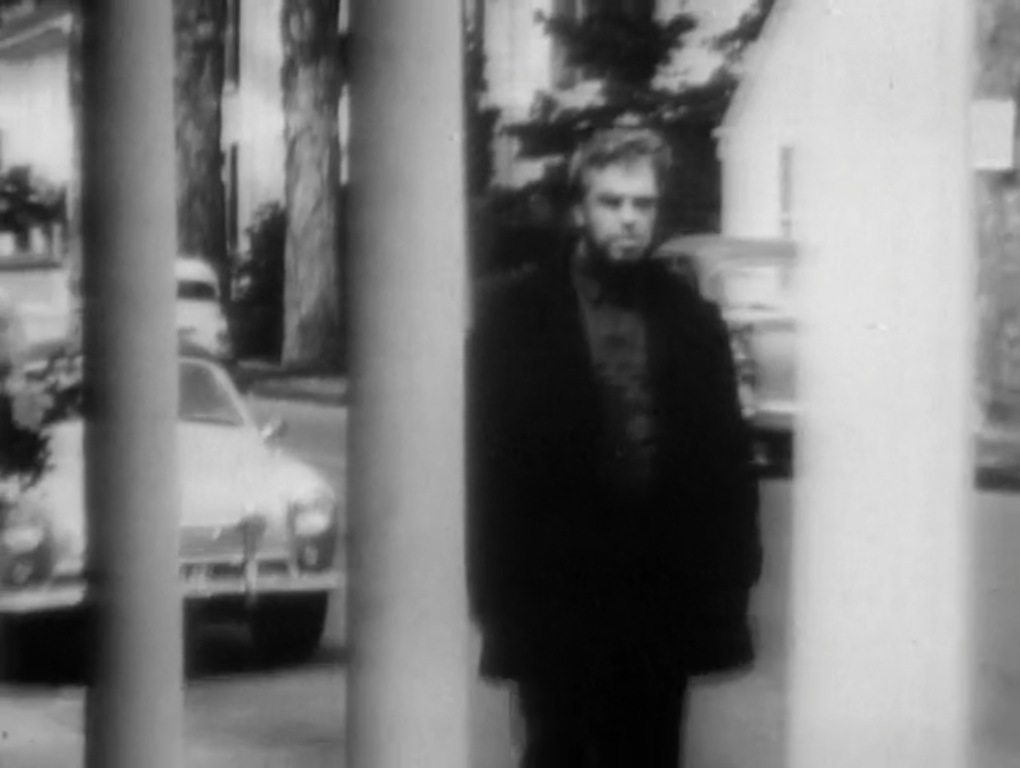
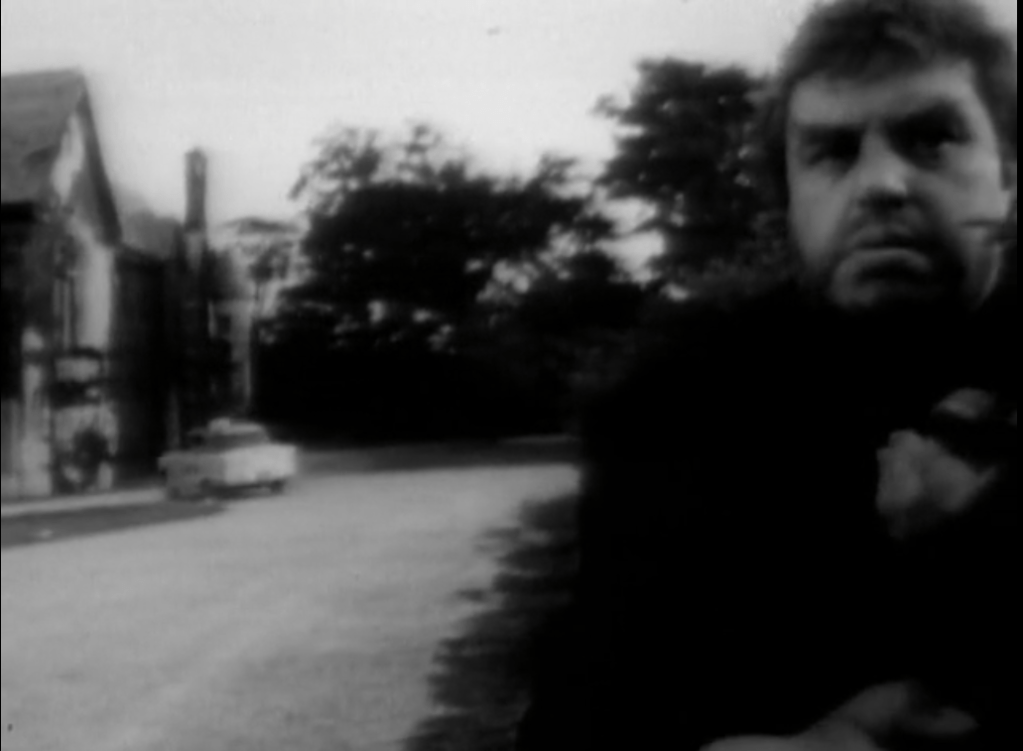
Matthew in townMatthew sees the taxi
Unknown to Matthew or Liz, Mrs Johnson is in fact convinced that Liz’ brother, high-born ne’er-do-well Roger, is responsible for Bill’s death and that Liz is protecting him. She wants to become housekeeper at Collinwood so she can spy on the Collinses for Burke.
After Matthew leaves the restaurant, Mrs Johnson reports to Burke on her interview with Liz. He is dissatisfied with her work as a secret agent. He berates her, as we had seen him berate his henchmen in earlier episodes. They had submitted to his rantings meekly. Mrs Johnson snaps at him, and gets an apology. Evidently we are supposed to expect that she will be a strong character in her own right, not a mere cat’s paw for Burke.
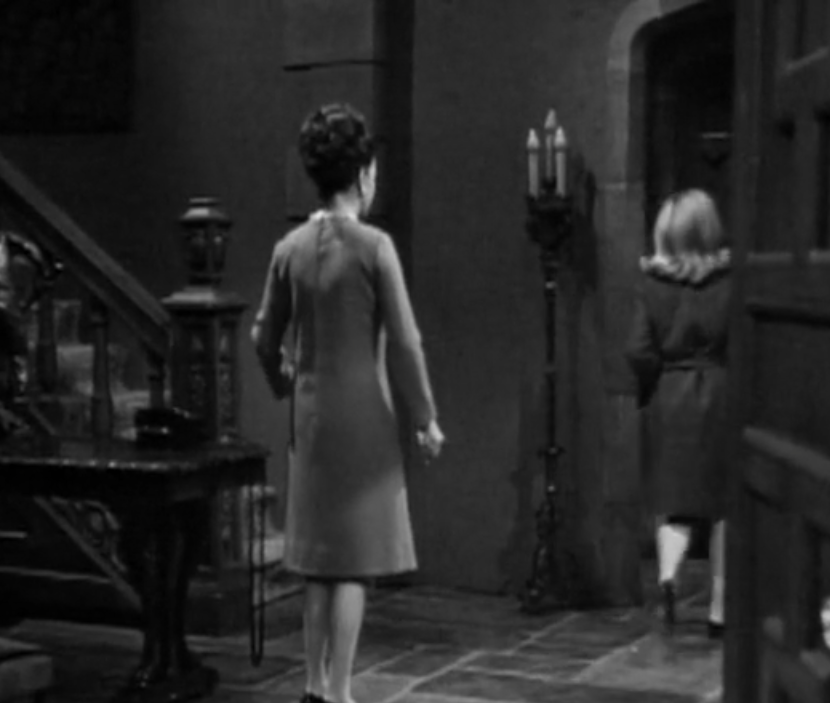
This is the first of many episodes that survives only on kinescope. This has some happy effects. For example, the footage of Matthew walking in downtown Collinsport is preceded by a shot of him going out the front door of the great house. The kinescope’s poorer resolution makes this set look like very much like an outdoor shot itself.
CORRECTION: It turns out this isn’t a kinescope, just a particularly crummy videotape. There’s a kinescope coming up later this week, though.
Dashing action hero Burke Devlin pays yet another visit to the great house of Collinwood. He announces to its residents, the ancient and esteemed Collins family, that he intends to take control of all their properties, including the house. He is buying up their debts and will use them to seize their businesses. He offers to pay them for the house, though. He even offers to pay for it at higher than the market value.
Ne’er-do-well Roger Collins urges his sister, reclusive matriarch Liz, to take Burke’s offer for the house. It’s a huge, gloomy, impractical place, and they would be better off without it. He doesn’t mention that the cash might come in handy when Burke starts calling in all the notes they have no way of meeting. Liz won’t hear of it, and vows to fight.
Flighty heiress Carolyn and well-meaning governess Vicki process their feelings about the matter. Carolyn is wounded by the evidence that Burke never really wanted to be her boyfriend- not that he ever said he did, but she kept hoping. Vicki wonders what Burke is thinking, and whether he understands his own motives. He admits that he may not- after all, if he’s trying to avenge the wrongs the Collinses have done him by bankrupting them and collecting their assets, why not just watch their house fall into his lap with the cannery, the fishing boats, and whatever else they may have, leaving them with nothing?
With this post we say goodbye to one of the bloggers who has kept us company. This was the last episode Marc Masse discussed on his blog Dark Shadows from the Beginning. His posts usually include stimulating insights, sometimes remarkable scholarship, and occasionally material that is in one way or another frustrating. Still, he is always well worth reading.
Among his most extraordinary contributions was about the story of the sabotaging of Roger’s car, a.k.a. The Saga of the Bleeder Valve. That story began when we, accompanying Vicki, saw Burke standing by Roger’s car in episode 13.
Burke tells Vicki that he was looking at Roger’s car because he was thinking of buying one like it, an explanation she finds unconvincing.
In his post about episode 46, Masse includes a long section about similarities between the Saga of the Bleeder Valve and a particular episode of The Alfred Hitchcock Hour. He convinces me that Art Wallace and Lela Swift had studied that episode. You’ll notice from his screenshots that that John Cassavetes even had the same haircut that Mitch Ryan wore as Burke:
Source material for the missing brake valve storyline on Dark Shadows can also be found in The Alfred Hitchcock Hour anthology series. In the episode Murder Case (season 2, episode 19; aired March 6, 1964), Gena Rowlands plays an actress (Diana Justin) in London married to a rich diamond merchant (Charles Justin) played by Murray Matheson. Diana isn’t really in love with her much older husband Charles, but since he is the main financial backer of a play she is starring in, her success is ensured… that is until the boyfriend she dropped so she could run off to England and start a production company with her rich husband, a struggling actor named Lee Griffin (played by John Cassavetes), manages to wangle his way through an audition and secure a part in the play by getting Diana to pass a good word along to the author and director of the production. Lee gets Diana to agree to resume their former relationship, and in no time the pair are in cahoots to relieve Diana of her marital obligations and in the process secure a huge windfall by plotting to have the old man bumped off. To accomplish this, they arrange for Charles to have an automobile accident; this is where the similarities to the missing brake valve story on Dark Shadows come into play.
One afternoon, on a visit up to the country home where Diana and Charles live, which is situated high up on a hilly area, Lee gets an idea when he comments on how the type of car that Charles drives is famous for its brakes.
To compromise the functioning of the car’s brake system, Lee first uses a wrench to loosen something, probably the bleeder valve…
…after which he pumps the brake pedal several times so there won’t be any hydraulic fluid left for when Charles next gets behind the wheel.
Just after completing the task, and with the wrench still in his back pocket, Charles walks in to find Lee there standing by his car, just like in Dark Shadows episode 13 when Victoria Winters walks into the Collinwood garage to find Burke near Roger’s car. To diffuse the situation, Lee explains to Charles: “I was, uh, just admiring your car. It’s, uh, fabulous!”
That night Lee and Diana have a performance in London; to set the plan in motion, Lee phones Charles from backstage while the play is still on and concocts a story about nearly having gotten into an accident on their drive into London due to a careless young motorist, which left Diana shaken up, and suggesting to Charles that he drive down to London to take his wife home…
…which he agrees to, just like in Dark Shadows episode 15 when Roger agrees to drive into town to meet with Burke at the Blue Whale.
Similar to how Roger in episode 17 is shown to have miraculously escaped with just a sprained arm and a few stitches to the forehead, Charles winds up crashing head on into a tractor that was just starting up the hill; despite that the car ended up a total loss, Charles was extremely lucky in having sustained only a couple of cracked ribs and a slight concussion.
The missing brake valve story on Dark Shadows never really did feel like something that would ordinarily be presented on a daytime serial drama. Instead, thus far Dark Shadows has taken its cue from 1940s film noir for atmosphere, Broadway theater style for acting performances, and nighttime mystery suspense anthology programs for subject matter. Is it any wonder that Dark Shadows would go on to evolve into the cultural phenomenon it would later become? A truly one of a kind blend of widely varying influences.
In his post for episode 76, Masse includes the audio of Joan Bennett singing “Sentimental Moments” in the 1955 film We’re No Angels. I’d never heard of the song, and had no idea she sang. Indeed she was not a Singer with a capital S, but her gentle, precise phrasing is perfect for this strange, sad little tune. I think of it as a farewell to Masse and his blog.
The first 19 weeks of Dark Shadows were credited to writers Art Wallace and Francis Swann. Wallace and Swann both specialized in finely etched character studies. So the plot doesn’t move very quickly in those opening months, but the actors do get an opportunity to show their stuff.
Every member of yesterday’s all-female cast, Alexandra Moltke Isles, Nancy Barrett, Joan Bennett, Kathryn Leigh Scott, and Clarice Blackburn, had at least one emotionally charged scene that gave her a star turn. Each made the most of it. Today’s episode is quieter. Most of it consists of people waiting for the coroner to rule whether the death of beloved local man Bill Malloy was an accident or homicide.
Joan Bennett and Kathryn Leigh Scott are back as reclusive matriarch Liz and restaurant operator Maggie. They are joined by David Henesy as problem child David Collins, David Ford as drunken artist Sam, and Dana Elcar as the sheriff.
Sam goes into the sheriff’s office to ask about the coroner’s report, and quickly realizes that no matter what he does or says, he keeps making himself look like a suspect in Bill’s death. Sam’s anxiety plays effectively against the sheriff’s serenity.
At the great house of Collinwood, David thinks he has a card to play against well-meaning governess Vicki. He tells Liz that Vicki never showed up to give him his lessons for the day. To his disappointment, Liz tells David that she knows all about that, that Vicki isn’t in trouble, and that she will be his governess for years to come. The two of them have a very nice scene in which David tries to convince his aunt that he will never like Vicki and Liz isn’t having it.
The sheriff comes to Collinwood to tell Liz that the coroner ruled Bill’s death an accident. As he is approaching, David runs out the front door. There’s a bit of unintentional humor there- Liz is calling David to come back to the house when we hear a car. It sounds as if the nine-year old David is driving away.
David goes to the restaurant, where Maggie and her father Sam are having one of their depressing conversations about the consequences of his alcoholism. Maggie introduces David to Sam. David smiles when Sam addresses him as “Mr Collins,” and is excited to learn that Sam is a professional artist. A happy moment is budding until Sam asks David how his father is doing. David hates his father. If he knew that Sam also hates him, they would no doubt become fast friends. But he seems to think Sam and his father are friends, and so he rushes off. It’s a poignant bit.
Well-meaning governess Vicki sits placidly in her bedroom at the great house of Collinwood, sewing and looking out the window. Flighty heiress Carolyn comes in and loudly berates Vicki for spending the day away from her charge, problem child David. Carolyn saw Vicki coming home as a passenger in a car driven by the family’s arch-nemesis, dashing action hero Burke Devlin, and jumped to the conclusion that Vicki was both on a date with Burke and on Burke’s side in his conflict with her family. Vicki is at first bewildered by Carolyn’s rage, and then confronts her with her own record of infatuation with Burke.
This scene shows how well cast Nancy Barrett and Alexandra Moltke Isles were as Carolyn and Vicki respectively. Miss Barrett throws herself completely into whatever her character is supposed to be doing at any given moment, a perfect style for the role of someone who is stormy and unpredictable. Mrs Isles takes a very deliberate approach to her part, working her way from the center of Vicki’s thoughts out to whatever lines she has to deliver. That suits the role of someone who is often baffled by the strange goings-on around her and who gradually gathers the strength to stand up for herself.
Carolyn is on her way to the front door when her mother, reclusive matriarch Liz, asks her where she’s going. Still upset after her confrontation with Vicki, Carolyn snaps at Liz and gives sarcastic answers. Eventually she tells her that Vicki didn’t give David his lessons for the day, that she spent the day with Burke, and that she brought Burke home with her. Alarmed by this report, Liz heads upstairs towards Vicki’s room. Carolyn remembers her latest project, persuading her mother to take Mrs Sarah Johnson onto the domestic staff as a housekeeper. Liz cuts her off, saying that she has no time to think of hiring a housekeeper- all she can think about is firing a governess.
After Liz leaves the foyer to fire Vicki because Carolyn has led her to suspect she might be a spy for Burke, Carolyn picks up the telephone. She tries to call Burke. Evidently the infatuation Vicki had brought up to her is still driving Carolyn to inexplicable actions.
Mrs Johnson is in the restaurant at the Collinsport Inn. In fact, we first see her on the pay-phone there, talking to Burke about her plan to join the staff at Collinwood so she can work as a spy for him. Patrick McCray makes a nice remark about this on his Dark Shadows Daybook:
[P]lanting a spy for Burke Devlin is just the touch of espionage intrigue that Collinwood needs. Finally, someone can actually be the spy that Vicki is suddenly accused of working as. (In the same episode no less, with the irony and subtlety of an anvil landing in your lap.) That kind of duality — especially among the backstairs staff — is a concession to the dramatic thinking that DARK SHADOWS kinda lost over the years. The show gained plot, but it lost those opportunities for characters to reflect one another. As it reached a supernatural frenzy, this earlier, authorial delicacy was a necessary casualty. However, it’s vital to know that a sculpted duality like Mrs. Johnson and Vicki is an instinct buried in the program’s DNA.
I think he paints with a bit of a broad brush when he says that “this earlier authorial delicacy was a necessary casualty.” The frenzied pace of the later years didn’t stop Joe Caldwell or Violet Welles from crafting dramatic miniatures Art Wallace and Francis Swann would have been proud of. While Sam Hall and Gordon Russell were no miniaturists and did often value slam-bang story development over every other consideration, they did take time to show characters in each other’s reflections. Indeed, the whole “1970 Parallel Time” arc is months and months of nothing but “opportunities for characters to reflect one another,” and the actors could often make those reflections interesting (at least the first two or three times you saw them.) Of course, there are also large numbers of episodes written by Ron Sproat and Malcolm Marmorstein, but you can’t blame their shortcomings on excessively rapid pacing.
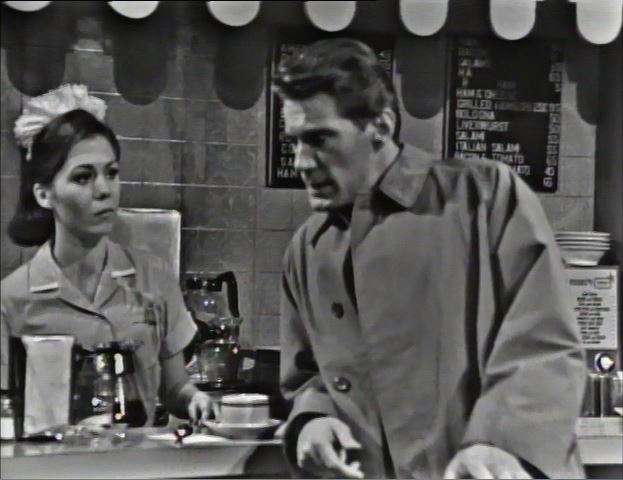
Mrs Johnson is a difficult customer for Maggie Evans, who runs the restaurant. She sends a sandwich back because she disapproves of the mayonnaise, and the look on Maggie’s face shows us that the cost of that sandwich is coming out of her paycheck. Mrs Johnson insists her meal be served in courses, demands that Maggie sit at her table, and gives her a tip of 10 cents (I checked- 10 cents in October 1966 would have the same purchasing power as 90 cents in October 2022. You could take that to your local hardware store, buy several nails, and still have enough left to operate a gumball machine.) She declares that the death of her late employer, beloved local man Bill Malloy, was no accident, and that according to the Bible someone will have to pay for it. When Carolyn comes into the restaurant, Maggie leaps at the opportunity to leave Mrs Johnson and wait on her.
Clarice Blackburn must have had tremendous fun playing Mrs Johnson in these sequences. The character is exaggerated almost to the level of what would become Dark Shadows’ “Go back to your grave!” house style of acting, so that there is no need to worry about overacting. Besides, so many performers wait tables that one of the standard responses young people in Los Angeles get when they tell people they are actors is “Great! What restaurant?” So it must always be gratifying to play a character who will show the world what a bad restaurant customer looks like.
As Maggie, Kathryn Leigh Scott also has a juicy role today. We usually see her in one of two settings. Either she is in the restaurant, where she is required to be nice to everyone, or she is at home with her father, drunken artist Sam. As the adult child of an alcoholic, she has a thousand habits designed to keep the mood light. When she is dealing with Mrs Johnson, Miss Scott shows us what Maggie looks like when her Nicest Girl In Town persona is stretched to the max.
When she greets Carolyn, Maggie goes right into the chirpiest version of that persona. It’s a version that brings home the continuity between Maggie’s relationship to her father and her relationship to her customers. She speaks the first few syllables of each of her lines through a laugh. Many Dark Shadows fans complain about that as a habit of Kathryn Leigh Scott’s, but it’s a habit of Maggie’s. And if you start watching the series from episode 1, seeing all the scenes in the Evans cottage between Maggie and Sam, you’ll recognize it as something many adult children of alcoholics do. At the risk of giving away a spoiler, I’ll say that Sam will eventually cut back on his drinking, and some time after that will be written out of the show altogether. But Maggie’s character is formed in these weeks, when Sam is drunk all the time. Some of Miss Scott’s other characters on the show have similar habits, but those are the characters who are presented as Maggie Evans by other means, so they would have to be recognizable as her.
Carolyn tries to explain to Maggie, sotto voce, why Mrs Johnson is so upset, and Maggie drops her Nicest Girl In Town voice completely for a second- “I know who she is,” she rasps. Carolyn has been friendly to Maggie, and is equally friendly when she goes to sit with Mrs Johnson and tries to talk her into taking the job as housekeeper at Collinwood, assuming that her mother will offer it to her. After Mrs Johnson leaves, Maggie tells Carolyn that she has never been able to stand her- “She’s always given me the willies. I don’t know why,” she says, looking thoughtfully off into the middle distance.
Carolyn’s friendliness to the working class Maggie and Mrs Johnson is a welcome relief from her terribly snobbish sneer at Vicki as “Little Orphan Annie” who should “go back to your precious foundling home.” And it’s an opportunity for Nancy Barrett to take her performance from one emotional extreme to another within a single episode.
Back in the mansion, Liz confronts Vicki about not giving David his lessons. Vicki replies that Liz’ brother, high-born ne’er-do-well Roger, had said that he would tell Liz that he had taken Vicki on a tour of the cannery and had given David the day off. When Vicki hears Liz on the telephone confirming this with Roger, she blows up at Liz. She objects to being checked up on, she objects to being accused of lying, and, turning to look at the last spot where she had seen Carolyn, she objects to being accused of stealing people’s boyfriends. After she is done with her objections, she walks over to Liz. With their backs to the camera, the women quietly apologize to each other. Vicki explains that her protests mark the only way she can go on living in the house. Liz for the first time calls Vicki by her first name. Hearing this conversation when they are looking away from us is remarkably effective at creating a sense that they are sharing an intimate moment- more is happening between the two of them than even the audience can know.
Mrs Isles and Joan Bennett, as Liz, both play a wide array of emotions in their two scenes together, and do so brilliantly. It’s particularly interesting to compare Liz’ startled reaction to Carolyn’s snapping at her in the foyer when she asks her where she’s going to with her startled reaction to Vicki raising her voice at her in the drawing room when she’s been on the phone with Roger. They are two quite distinct startles. We see Liz from behind when Carolyn startles her. From that angle, we see the muscles in the back of her neck tense, signifying anger. That startle gives way to a parental sternness. The startle Vicki provokes is shown in profile. Liz pulls back a little, suggesting guilt. It leads to a rapid retreat.
Each episode of Dark Shadows begins with a voiceover. In this phase of the show, the voiceovers are all narrated by Alexandra Moltke Isles in character as Victoria Winters, well-meaning governess, and are brief passages of almost purely decorative prose, meant only to set a mood and to vanish from the audience’s memory as soon as the action starts. Art Wallace and Francis Swann, the writers credited for the first 97 episodes, were old pros who had been turning out scripts for decades, and were good at staying out of their own way. That’s why I haven’t yet said anything about any of the opening voiceovers- when Wallace or Swann set out to write something forgettable, they succeeded. By the time I started writing, I had no recollection of them whatever.
Today’s opening voiceover is unusually substantive, so much so that it threatens to leave a trace in the audience’s mind:
My name is Victoria Winters. Once again it is quiet in Collinwood. There is no sound but the ticking of the great clock in the entrance hall. And the lonely footsteps of a woman who hasn’t left its grounds in eighteen years. A woman whose life is limited to musty corridors and the endless beat of a grandfather clock. A beat that seems to ignore the vitality of the world around it.
Vicki names herself, names the estate where she lives, talks about how quiet it is, mentions the clock, tells the audience that the lady of the house is a recluse who hasn’t left home in eighteen years, complains about the air quality in the house, brings the clock up again, and assures us that interesting things are happening everywhere except here. It leaves us wondering why Vicki is so hung up on the clock, why she doesn’t run the vacuum cleaner herself, and why, if the entire world surrounding Collinwood is chock full of vitality, they don’t turn the camera in some other direction.
That’s the sort of thing we’re going to get from Wallace and Swann’s immediate successors, Ron Sproat and Malcolm Marmorstein. In writing their opening voiceovers, Sproat and Marmorstein fell between two stools. They didn’t write brief, deliberately forgettable passages as Wallace and Swann had done; nor did they integrate the opening voiceovers into the action of the show, as would happen in later years when the story is moving very fast and the episodes start with detailed recaps of events so far. Instead, Sproat and Marmorstein saw the voiceovers as vehicles for long passages of flowery, over-developed imagery. Those are certainly no more effective at setting a mood than were Wallace and Swann’s brief remarks, but they do both try the patience of the audience and linger as distractions. That’s one of the things that prejudices viewers against the character of Vicki- since so many episodes from the Sproat/ Marmorstein era start with Vicki rambling on about the weather or making vague remarks about “one small boy” or whatever, the first impression she leaves on viewers who start watching with episodes from that period is that of a prattling fool.
While Wallace and Swann are the only writers whose names have appeared in the credits thus far, it is very possible that others not credited contributed additional bits. I may be wrong, but my nose catches a whiff of Marmorstein in these six strange, distracting sentences. The description of the clock while we’re looking at it, the specified number of years since reclusive matriarch Liz has left the estate, the evocation of the “musty corridors,” the yearning glance at the eventful world outside, are all typical of Marmorstein’s attempts to turn the voiceovers into freestanding dramatic monologues, but without identifiable characters or plot development.
Today’s episode doesn’t shed much light on Vicki’s relationship to the clock or on the standards of cleanliness in the great house of Collinwood. Instead, it’s a kaleidoscope episode, in which each change of scene varies the combination of characters who interact on each set. The action plays out on two sets this time, the foyer/ drawing room representing the downstairs of the great house, and the Blue Whale tavern, representing the low and bustling life of the village. Because the sets typify the “musty corridors” inside the house and the “vitality of the world around it,” the episode is also a diptych of sorts- not Art Wallace’s usual diptych contrasting two pairs of people, but a diptych contrasting two places and the attitudes those places inspire in the people who spend time in them.
The five pieces tumbling about in today’s kaleidoscope are reclusive matriarch Liz, tightly-wound handyman Matthew, flighty heiress Carolyn, hardworking young fisherman Joe, and Maggie, the nicest girl in town. The regular bartender at the Blue Whale gets a fair bit of screen time as well. In the first 63 episodes, he’s answered to names including “Joe,” Andy,” “Mike,” and “Punchy.” Today, Joe the fisherman calls the bartender “Punchy,” a name he called him most recently in episode 56, the same episode where drunken artist Sam calls him “Mike.” Maybe we’re supposed to think that the young men know the bartender as “Punchy,” the older men as “Mike.” Eventually the show settles on the name “Bob” for him, perhaps because the performer’s name was Bob O’Connell. In one episode (#319,) Sam calls him “Ba-ba-roony,” giving rise to the idea that his name is Bob Rooney.
Liz appears only at Collinwood, of course; Joe and the bartender appear only in the bar. The others migrate back and forth between the two sets. We first see Carolyn with Joe in the bar, talking about what a flop their date has been and how pointless their whole relationship is. Maggie interrupts this thrilling conversation, looking for her father, Sam the drunken artist. After puzzling Carolyn and Joe with a number of cryptic remarks, Maggie gives up looking for her father and goes to Collinwood to look for high-born ne’er-do-well Roger. Roger isn’t home, so she winds up talking to Liz. This is the 63rd episode, and it’s the first time we’ve seen these two major characters together.
We first see Matthew in Collinwood, telling Liz how much he wants to help her. He then goes to the bar, where Carolyn and Joe see him. Matthew is looking for dashing action hero Burke Devlin, whom he hates. He implies to Carolyn and Joe that Burke is to blame for the death of beloved local man Bill Malloy. Joe doesn’t like Burke any more than Matthew does. The instant he hears Matthew’s idea, he is all in on it. Carolyn resists the suggestion.
Carolyn goes home to Collinwood. Maggie has explained to Liz that Burke has been saying terrible things about her father, that she can’t find her father to ask him about Burke’s allegations, and that Roger might know something about them. Liz urges Maggie to believe in her father, and to regard Burke as a dangerous, unscrupulous man capable of many dark deeds. Hearing the last part of this, Carolyn asks her mother if she believes that Burke is capable of murder. Yes, Liz says, she does believe that he is capable of that.
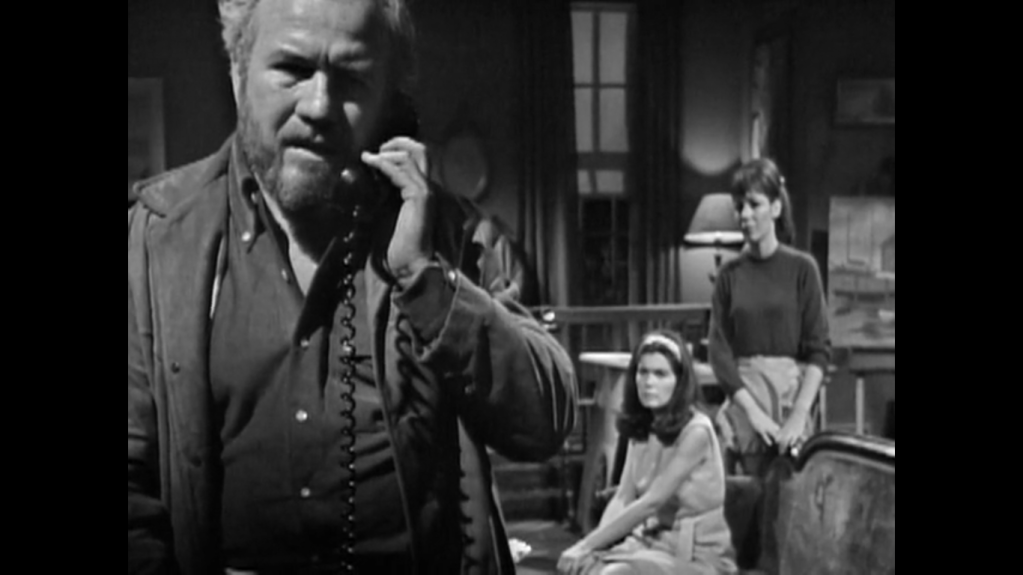
My wife, Mrs Acilius, pointed out that my post about episode 60 was unfair. She objected to the sentence “The Friday cliffhanger is Burke asking if he may join the Evanses and Vicki for dinner.” As she explained, that moment actually is an effective cliffhanger. I hadn’t mentioned that the sheriff had called drunken artist Sam Evans to warn him that dashing action hero Burke Devlin might be coming to his house, that he urged Sam to call back if Burke did come, and that actor David Ford played Sam’s reaction to this call with a convincing display of terror.
Sam trying to conceal his fear from the women behind him and the man on the other end of the call
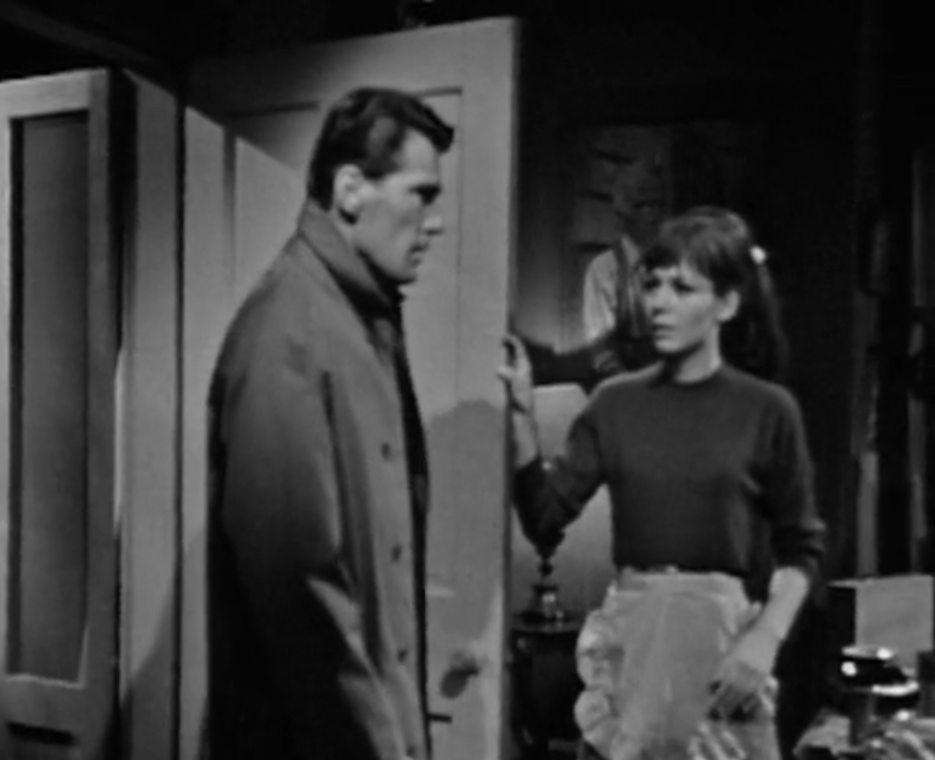
I also failed to mention the shot when Burke enters the room. Before Sam can get the words out to tell his daughter Maggie not to open the door, Burke has burst in. The scenes in the Evans cottage have been dimly lit, with all three figures moving before dark backgrounds. When the light colored door swings open, its relative brightness feels for a second like a flash, and when he stands in front of it Burke cuts a stark figure. We see him in contrast with Maggie, who stands against a dark background, wearing a dark top and a stunned expression:
Burke enters the Evans cottage
Throughout the episode, Sam had failed repeatedly to exercise any measure of control even in a social situation in his own home where the only other people are his daughter Maggie and well-meaning governess Vicki, the two kindliest characters on the show. The irruption of Burke into that setting is indeed a formidable moment for Sam.
So yes, that was a more plausible Friday cliffhanger than I allowed. Perhaps I was prejudiced against it because I remembered this episode. The purpose of a cliffhanger is to bring the audience back for the next installment. Typically, the next installment will begin by resolving the cliffhanger as quickly and unceremoniously as possible. But today, Burke’s intrusion into the Evans cottage drags on and on. In the process, it does serious harm to Burke’s character.
After rushing into the Evans cottage, Burke defies Sam and Maggie to say that he isn’t welcome. Maggie, unaware of the sheriff’s call urging Sam to let him know if Burke shows up, breaks down and says that of course Burke is welcome. Burke then tries to order Vicki and Maggie into the kitchen so that he can be alone with Sam. Neither woman is at all meek, however, and they stand up to Burke’s browbeating admirably.
Not so Sam. He takes the first opportunity to run away. We know that Sam has his guilty secrets, but he is a likable character, and it is hurts to imagine the pain that will await him the rest of his life whenever he remembers the night he left his daughter and her sweet young friend to face an angry man alone in his house. Sam doesn’t even call the sheriff. Instead, in his panic he goes to the hotel to try to retrieve a sealed envelope he had Maggie leave in the safe there. That gives us a scene with Conrad Bain as hotel manager Mr Wells. Bain is always a delight, and his little business about the envelope is certainly the most pleasant part of the episode. At the end of the episode, Sam will meet Burke at the hotel and ask to talk with him alone in his room, leaving us with the image of him trying to redeem himself in his own eyes.
Before that end comes, however, we have much, much more of Burke trying to bully the young women in the cottage. He won’t let them eat dinner. He harangues them about his manslaughter conviction. In the course of that harangue, it becomes clear that he isn’t thinking at all clearly. “I was drunk and don’t remember too much about that night, but I do remember Roger Collins taking over the wheel.” That’s just delicious- he was hopelessly drunk, blacked out in fact, but he’s pretty sure he remembers giving the keys to someone else before the fatal collision. The fact that his substitute driver was just as drunk as he was doesn’t seem to occur to him as a flaw in his “defense,” nor does the fact that this one convenient piece of information is the only thing to surface from his alcoholic stupor. That sort of thinking runs at such an oblique angle to reality that there would be nothing to say to Burke even if he were willing to listen to you. He goes on to suggest to Maggie that her father may have killed their old friend Bill Malloy, and refuses to leave the house when Maggie tells him to do so.
Burke’s abuse of Sam, Maggie, and Vicki makes it hard for us to like Burke as much as the show needs us to like him. We’re supposed to perk up when he’s on screen, not only because we don’t know what he might do next, but also because we don’t know whether we will approve of whatever surprising thing he makes happen. Even when he is trying to destroy the family to which our point of view character, Vicki, owes her loyalty, we’re supposed to want to see more of him. But when we see him treat Vicki and Maggie the way he does here, the image of him as a grinning thug sticks in the mind, and it is hard to want more of that.
All the more so, perhaps, because of his ineffectiveness as a thug. Our first concern with the show is that it should tell an interesting story, and Burke earns our attention by providing exciting story points. We can like even a very evil character who makes exciting things happen, but someone who simply shows up at your house when you’re about to eat, keeps you from your dinner, rambles on with a lot of nonsense, insults your father, and refuses to leave is just testing your patience for bad conduct.
We can compare Burke as the villain of this episode to another, more interesting villain. Throughout 1966, Mitch Ryan was not only playing Burke on Dark Shadows, but was also on Broadway in Wait Until Dark. In that play, he was one of the con men who, under the control of a mysterious figure calling himself Harry Roat, junior (and senior, but that’s another matter,) talk their way into a blind woman’s apartment and try, at first by trickery and then by threats of murder, to get her to hand over something valuable that she hadn’t realized she had in her possession. Like Maggie and Vicki, the heroine of the play stands up to Ryan’s character and the other villains. She ultimately triumphs over them. Unlike Burke, who is simply indulging on rage for its own sake and boring everyone as he does so, Roat has devised a brilliantly clever scheme to trick his victim, a scheme which fails only because she is his equal in brilliance and his superior in other ways. Wait Until Dark was a major hit in that original Broadway run, as was the movie version the next year and as many revivals of it have been in the years since. If Roat’s activities were as pointless in the play as Burke’s are in this episode, I very much doubt it would have been produced at all.
Art Wallace, credited as the author of this episode’s script, specialized in finely-etched character studies. Often as not, he favored a diptych structure, in which the episode intercuts between two groups of characters. In the contrast between their relationships, we learn more about them in a shorter time than we could if one group was on screen the whole time.
He doesn’t use that structure today. It’s more of a kaleidoscope, in which the characters tumble about, moving from set to set, recombining in different groups. The five reflecting surfaces in this particular kaleidoscope are drunken artist Sam; hardworking young fisherman Joe; the sheriff; flighty heiress Carolyn; and problem child David. Their reactions to the mysterious death of plant manager Bill Malloy have set them spinning.
Carolyn, Sam, and the sheriff play it very hot. Bill was like a father to Carolyn. She wants to keen over him, and is raging with frustration that she can’t find anyone to wail with. Bill was trying to prove that Sam had committed a crime. He can barely restrain himself from panicking in his fear that he will be accused of killing Bill. The sheriff is investigating the case. He wants answers from Sam, and comes down on him very hard when he doesn’t get them.
Joe is more subdued. He is clearly saddened by the death of a man he worked for and admired, but is quiet and attentive to others. When Sam insistently tries to get him to figure out what the police will be able to reconstruct from the place where Bill’s body washed up on shore, Joe very patiently explains about tide tables and the like. When the sheriff comes upon Sam and Joe and suggests Joe go away, he complies in good humor.
David is absolutely cool. He is trying to figure out where Bill’s body first went into the water in hopes that he will be able to prove that his father, whom he hates, murdered Bill. When Carolyn demands that he adopt an attitude consistent with hers, he flatly refuses. She persists, he delivers one incisive comeback after another.
Carolyn bemoans their fate, living in the walls of the mansion at Collinwood. David says he likes it, that it’s fun to live in a house with real ghosts. “Sure, it’s scary sometimes,” he allows, but the ghosts are his friends. Maybe Mr Malloy will be one of them. Carolyn is exasperated by this reply, but can’t bring herself to deny that the house is haunted.
Joe shows up at the big dark house on the hill to see Carolyn. David picks up where Sam left off, and questions Joe about how to read a tide table. Unlike Sam, David has a set of tide tables with him, and the two of them sit down and start doing calculations. Carolyn reacts to this with abhorrence. Joe leaves with Carolyn, but not before encouraging David to stick with his calculations. He tells the boy to ask his father for help, a suggestion to which David reacts sharply.
After Joe and Carolyn have left the house, a knock comes at the door. David exclaims joyously, “Joe, I knew you’d come back!” When he opens the door, though, it isn’t Joe- it’s the sheriff. David resumes his perfect serenity and asks, “Have you come to see my father?” When he says yes, David goes to fetch him, a blissful smile on his face.
In the opening teaser, dashing action hero Burke Devlin is having lunch in the restaurant at the Collinsport Inn. As usual, he’s alone there. He strikes up a conversation with Maggie Evans, who runs the place. She listens sympathetically while he tells her that he’s worried about the missing man, plant manager Bill Malloy. He goes on about the great meal he’ll buy for his dear friend Bill when he finally turns up. Maggie has to break the news to him that the Coast Guard has fished Bill’s corpse out of the sea.
Burke suspects that his bitter enemy, high-born ne’er -do-well Roger Collins, is responsible for Bill’s death. After he telephones the sheriff’s office to ask for information and doesn’t get answers, he returns to the restaurant, agitated. Well-meaning governess Vicki walks in; Burke snaps at her about Roger, and they quarrel. Burke goes to the sheriff’s office with this suspicion. So far from enlisting the sheriff as an ally against Roger, Burke finds himself being questioned as a suspect.
Burke returns to the restaurant. Vicki is still there, having had a heart-to-heart with her new friend Maggie. Burke yet again asks Vicki for a date; she yet again refuses him, this time because she’s planning to have dinner at Maggie’s house where she will be introduced to Maggie’s father, Burke’s former friend Sam.
Patrick McCray and Marc Masse write characteristically admirable posts about this episode on their blogs. McCray cites this episode as a fine example of the kind of story-telling that defined the show in its first 42 weeks:
Episode 57 is a focused study in how much the show would change in its first year. That’s not damning with faint praise nor stating the obvious about supernatural vs secular threats. It’s a compelling little episode that moves faster than many in the post-1897 run of the series. Within it is an entirely different approach to storytelling. Far more than other soaps, DARK SHADOWS was a show about action. Characters did things in the present rather than just talk about things done in the past. And when time, space, morality, and death are irrelevant to many of your main characters, it’s easy to present a Nietzschean amusement park of action and story twists. That’s not how the program began, though. It was only with the introduction of Laura Collins that DARK SHADOWS became a series about possibilities, not limits. But limits, and seeing attractive, interesting people struggle against them, is the bread and butter of terrestrial TV drama, and episode 57 is a beautifully executed cage.
He goes on to talk about the sorts of characters they can have in this period of the show who would become impossible in later days. Bill Malloy, for example: “Malloy was too good at getting things done to coexist with incredibly vulnerable monsters whose only protection came from how unobservant everyone else was.” Because of the centrality of the character of Liz and the theme of her seclusion in this period of the show, I’d always thought of the first 42 weeks as a study in the social and psychological effects of the refusal to face unpleasant facts. But of course denial is still the show’s great theme all the way through.
Masse discusses the apparent discontinuity of Burke’s wistful tone before he learns that Bill is dead with Burke and Bill’s relationship as we saw it when Bill was alive:
And since when has Burke even cared about Malloy as a person? If he really had revered Malloy for having given him his start as he claims today, then how come he didn’t buy Malloy that best meal ever upon his return to Collinsport, instead of just toying with him at the Blue Whale in episode 3, hanging up the phone on him in episode 9, and then deftly evading his questions before showing him the door when Bill [paid] an unannounced visit to Burke’s hotel room in episode 21?
The above three episodes along with number 57 were all written by story creator and developer Art Wallace, which shows that already by September 1966 Dark Shadows was reinventing itself storywise to such a significant degree that contradictions in continuity would present themselves even if episodes in question were written by the same writer. Burke did acknowledge to Malloy in episode 45, a Francis Swann episode, that he’d been a fair employer to him when he was just starting out working on the boats of the Collins fleet; but in keeping with the opportunistic nature of Burke’s character, this was only after Malloy had offered to make a deal with him, which Burke must have surely understood would greatly benefit his own interests.
I think there is a bit more grounding in what we see for Burke’s rhapsody about Malloy in today’s episode than Masse gives the show credit for. Also, that it is misleading to suggest that only now are we seeing abrupt changes.
I’ll deal with the second of these points first. When Burke came to town in episode 1, he was cold to everyone. They retconned this aspect of his personality in episode 21, where he revisits the sets where he dealt some of his harshest snubs in #1 and is a hail-fellow-well-met even to people whom he had reason to avoid. That was a necessary revision. Soap opera writing is largely a matter of filling screen time with conversation, so a character who isn’t on speaking terms with anyone is useless. But it wasn’t a very well-motivated change in terms of what has happened in the story. Viewers who remembered episode 1 would have had a hard time explaining why Burke’s attitude is so different now.
This time, though, Art Wallace’s script makes it clear time and again that Burke is isolated and getting lonely. He had expected Sam to be his friend, but has learned that Sam fears him. Sam’s daughter Maggie listens sympathetically to him, but he’s a customer of hers, and that’s her job. He certainly can’t expect a social invitation to the Evans house. He thinks he might be able to join forces with the sheriff, but is lucky to get out of his office without a bail ticket. He arrived on the same train as Vicki, and was attracted to her from the first. Every time he sees her, he asks her out and she turns him down. When he finds out that Vicki will be having dinner with the Evanses, it makes the picture of his isolation complete. Burke hasn’t made a single friend all the time he’s been in town, and it’s getting to him.
This takes us back to Patrick McCray’s point, about the “incredibly vulnerable monsters whose only protection came from how unobservant everyone else was.” As time goes on and Dark Shadows becomes more and more a show for young children, it will often be laughable just how unobservant the human characters are. But the first of the incredibly vulnerable monsters will meet a family buffeted by hostility, suspicion, and blackmail, surrounded by enemies even inside the walls of their big dark house on the hill. He will present himself to the Collinses as a warm-hearted, charming, unworldly visitor from a foreign land who wants nothing but their friendship. The lonely people he meets will all but collapse into his arms. In Burke’s rhapsody about Bill, we see the same neediness at work.
We’ve been watching each episode of Dark Shadows on the 56th anniversary of its original broadcast. Today was the 56th anniversary of the broadcast of episode 56, so a milestone of sorts.
Word is making its way around the town of Collinsport that the Coast Guard has found the body of Bill Malloy, manager of the fishing fleet and cannery that between them employ most of the men in town and sustain the Collins family in their big dark house on the hill. In the opening, reclusive matriarch Liz is stumbling over her words trying to break the news of Bill’s death to her daughter Carolyn. The phone rings. Carolyn answers it, and gets the Coast Guard’s report. Liz is shattered.
Carolyn tells well-meaning governess Vicki that Bill’s body has been found. In episode 52, Carolyn had told Vicki that Bill was like a father to her. Carolyn, as played by Nancy Barrett, does indeed seem as upset in this scene as would someone who had just heard that her father’s body had washed up on shore. Vicki, as played by Alexandra Moltke Isles, is very calm and deliberate as she listens to Carolyn, letting her say what she has to say and emote as she needs to emote. It’s quite a well-turned bit of drama.
In the Blue Whale, Collinsport’s tavern, Liz’ ne’er-d-well brother Roger finds drunken artist Sam Evans, his co-conspirator in a long-ago crime. Sam tells Roger that the Coast Guard has found Bill’s body. Roger first takes a very lofty tone and announces that he will do whatever he must to ensure that Bill’s killer is brought to justice. After Sam asks him what he means by this, Roger coaches him on the lies the two of them should tell to ensure that neither of them is convicted of killing Bill.
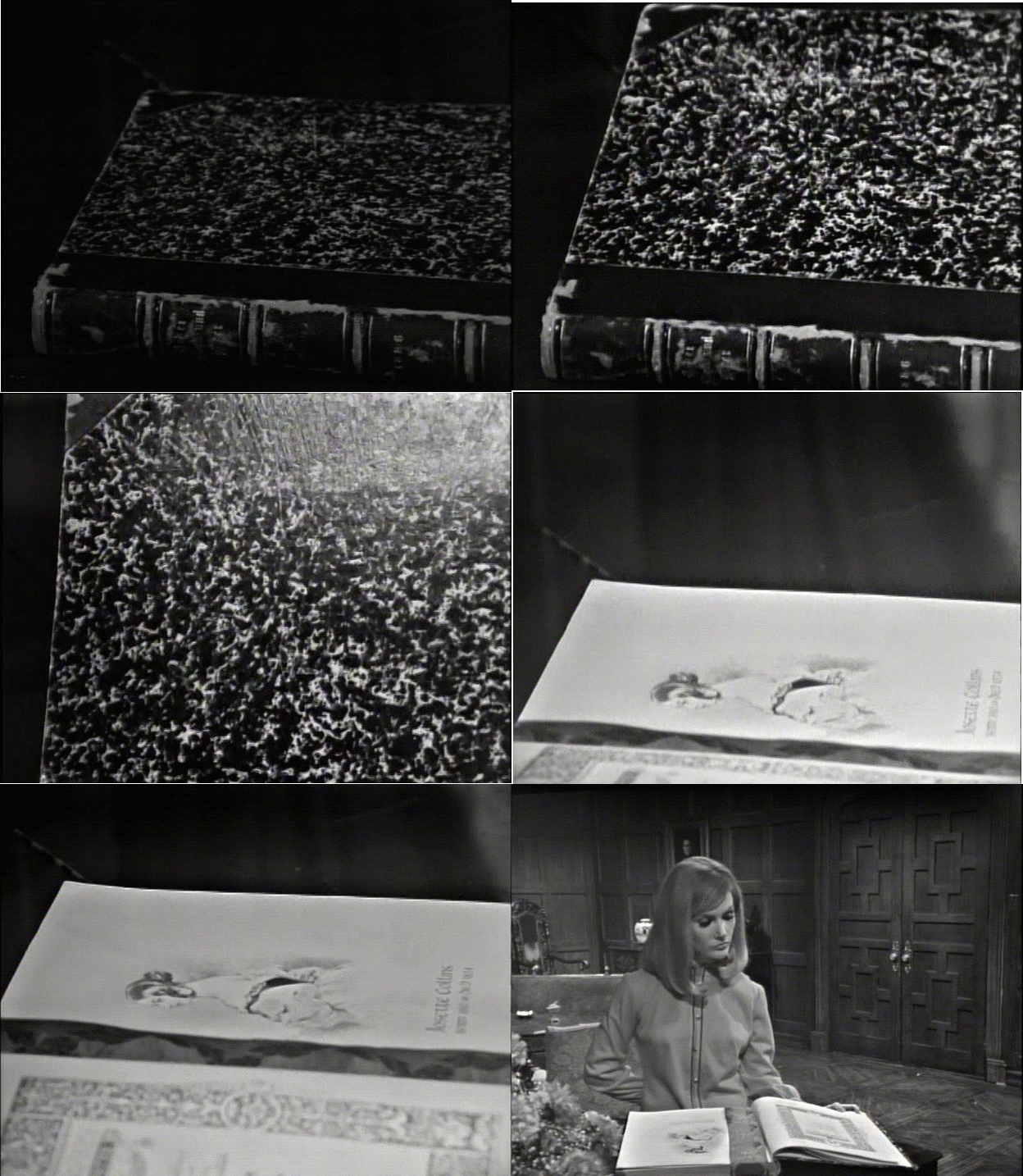
Back at the great house on the estate of Collinwood, we see the Collins family album open to the page with the picture and name of Josette Collins. The last time we saw this was in episode 52, when the book opened to that page without the aid of any visible hands. Now we see that Carolyn is opening the book. That is followed immediately by the drawing room doors opening. That too has been the prelude to a ghostly apparition, but this time turns out to be Vicki’s doing.
The first few weeks, several characters used the word “ghosts” in metaphorical senses when talking with Vicki. Each time, she behaved as if they were talking about literal ghosts and said something like “Surely you don’t believe in ghosts!” To which they said that they damn well did believe in them, and that if she goes on living in the house at Collinwood for any length of time she will, too. Reminding us of ghostly manifestations and then showing mortal agency behind them harks back to this kind of open question. Art Wallace, who was the only writer credited on the first 40 episodes, is the writer today as well. Evidently he wants to remind us of the supernatural themes and to keep us guessing where they will take us.







 Dark Shadows Commentary